

EN 1948-4:2010
(Main)Stationary source emissions - Determination of the mass concentration of PCDDs/PCDFs and dioxin-like PCBs - Part 4: Sampling and analysis of dioxin-like PCBs
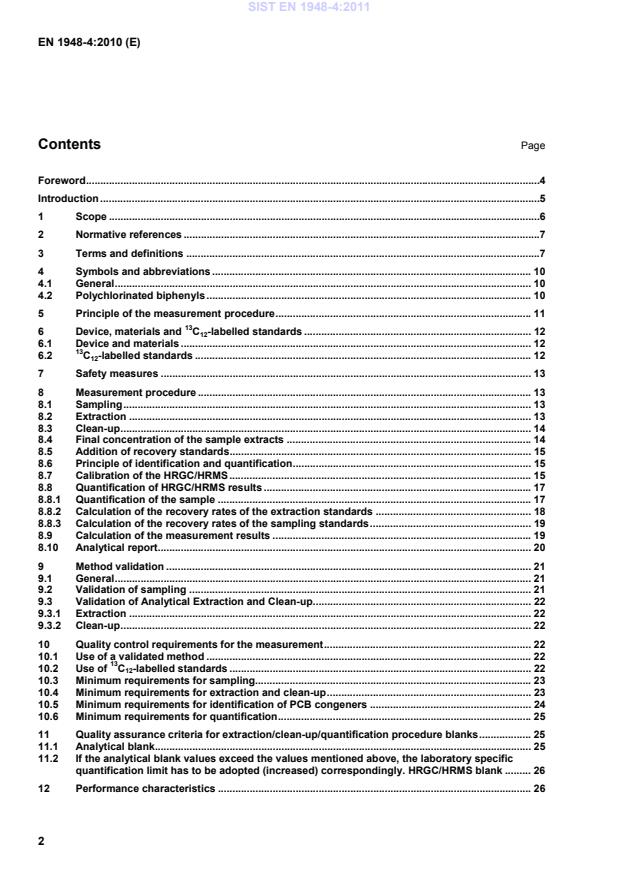
- Abstract
This European Standard specifies sampling from stationary sources, extraction, clean-up, identification and quantification procedures of the dioxin-like PCBs. The procedure described lays down requirements to measure the PCB congeners given in Annex A (see Table A.1). It is applicable to the 12 non- and mono-ortho PCB designated by the WHO. It is optimised to measure PCB concentrations of about 0,01 ng WHO-TEQPCB/m3.
In addition to the 12 non- and mono-ortho-PCB the present document is also applicable to measure further PCB-congeners like the "marker PCB" 28, 52, 101, 138, 153, 180 (see Annex F).
This document specifies a framework of quality control requirements which should be fulfilled by any PCB sampling, extraction, clean-up, identification and quantification methods to be applied.
As a result of their similar chemical behaviour PCBs, as shown in the validation campaign, can be sampled from stationary sources together with the PCDDs/PCDFs. Therefore, it is possible to measure PCBs together with PCDDs/PCDFs by applying EN 1948-1, -2, -3 and -4. The complete sampling procedure is described in EN 1948-1. Each of the three sampling methods of EN 1948-1 can be combined with the methods described in this document to complete the measurement procedure. EN 1948-1 is an integral part of the complete measurement procedure and is necessary for the determination of PCBs.
The analyses of the following PCB congeners is described in this European Standard and is validated in the validation campaign:
a) Non-ortho substituted PCBs
1) 3,3’,4,4’-TeCB(77)
2) 3,4,4’,5-TeCB (81)
3) 3,3’,4,4’,5-PeCB (126)
4) 3,3’,4,4’,5,5’-HxCB (169)
b) Mono-ortho substituted PCBs
1) 2,3,3’,4,4’-PeCB (105)
2) 2,3,4,4’,5-PeCB (114)
3) 2,3’,4,4’,5-PeCB (118)
4) 2’,3,4,4’,5-PeCB (123)
5) 2,3,3’,4,4’,5-HxCB (156)
6) 2,3,3’,4,4’,5’-HxCB (157)
7) 2,3’,4,4’,5,5’-HxCB (167)
8) 2,3,3’,4,4’,5,5’-HpCB (189)
c) Marker PCBs
1) 2,4,4'- TriCB (28)
2) 2,2',5,5'-TeCB (52)
3) 2,2',4,5,5'- PeCB
- Status
- Withdrawn
- Publication Date
- 05-Oct-2010
- Withdrawal Date
- 03-Dec-2013
- Technical Committee
- CEN/TC 264 - Air quality
- Drafting Committee
- CEN/TC 264/WG 1 - Dioxins - emissions
- Current Stage
- 9960 - Withdrawal effective - Withdrawal
- Start Date
- 04-Dec-2013
- Completion Date
- 04-Dec-2013

Relations
- Effective Date
- 22-Dec-2008
- Effective Date
- 02-Oct-2013
- Effective Date
- 28-Jan-2026
- Effective Date
- 28-Jan-2026
- Effective Date
- 28-Jan-2026
- Effective Date
- 28-Jan-2026
- Referred By
EN ISO 8655-4:2002 - Piston-operated volumetric apparatus - Part 4: Dilutors (ISO 8655-4:2002) - Effective Date
- 28-Jan-2026
- Effective Date
- 28-Jan-2026
- Effective Date
- 28-Jan-2026
- Referred By
EN ISO 8655-5:2002 - Piston-operated volumetric apparatus - Part 5: Dispensers (ISO 8655-5:2002) - Effective Date
- 28-Jan-2026
- Effective Date
- 28-Jan-2026
- Effective Date
- 28-Jan-2026
- Effective Date
- 28-Jan-2026
- Effective Date
- 28-Jan-2026
- Effective Date
- 27-Jun-2012
Get Certified
Connect with accredited certification bodies for this standard

CIS Institut d.o.o.
Personal Protective Equipment (PPE) certification body. Notified Body NB-2890 for EU Regulation 2016/425 PPE.

Kiwa BDA Testing
Building and construction product certification.
Kmetijski inštitut Slovenije
Agricultural Institute of Slovenia. Soil testing, plant health, agricultural product analysis.
Sponsored listings
Frequently Asked Questions
EN 1948-4:2010 is a standard published by the European Committee for Standardization (CEN). Its full title is "Stationary source emissions - Determination of the mass concentration of PCDDs/PCDFs and dioxin-like PCBs - Part 4: Sampling and analysis of dioxin-like PCBs". This standard covers: This European Standard specifies sampling from stationary sources, extraction, clean-up, identification and quantification procedures of the dioxin-like PCBs. The procedure described lays down requirements to measure the PCB congeners given in Annex A (see Table A.1). It is applicable to the 12 non- and mono-ortho PCB designated by the WHO. It is optimised to measure PCB concentrations of about 0,01 ng WHO-TEQPCB/m3. In addition to the 12 non- and mono-ortho-PCB the present document is also applicable to measure further PCB-congeners like the "marker PCB" 28, 52, 101, 138, 153, 180 (see Annex F). This document specifies a framework of quality control requirements which should be fulfilled by any PCB sampling, extraction, clean-up, identification and quantification methods to be applied. As a result of their similar chemical behaviour PCBs, as shown in the validation campaign, can be sampled from stationary sources together with the PCDDs/PCDFs. Therefore, it is possible to measure PCBs together with PCDDs/PCDFs by applying EN 1948-1, -2, -3 and -4. The complete sampling procedure is described in EN 1948-1. Each of the three sampling methods of EN 1948-1 can be combined with the methods described in this document to complete the measurement procedure. EN 1948-1 is an integral part of the complete measurement procedure and is necessary for the determination of PCBs. The analyses of the following PCB congeners is described in this European Standard and is validated in the validation campaign: a) Non-ortho substituted PCBs 1) 3,3’,4,4’-TeCB(77) 2) 3,4,4’,5-TeCB (81) 3) 3,3’,4,4’,5-PeCB (126) 4) 3,3’,4,4’,5,5’-HxCB (169) b) Mono-ortho substituted PCBs 1) 2,3,3’,4,4’-PeCB (105) 2) 2,3,4,4’,5-PeCB (114) 3) 2,3’,4,4’,5-PeCB (118) 4) 2’,3,4,4’,5-PeCB (123) 5) 2,3,3’,4,4’,5-HxCB (156) 6) 2,3,3’,4,4’,5’-HxCB (157) 7) 2,3’,4,4’,5,5’-HxCB (167) 8) 2,3,3’,4,4’,5,5’-HpCB (189) c) Marker PCBs 1) 2,4,4'- TriCB (28) 2) 2,2',5,5'-TeCB (52) 3) 2,2',4,5,5'- PeCB
This European Standard specifies sampling from stationary sources, extraction, clean-up, identification and quantification procedures of the dioxin-like PCBs. The procedure described lays down requirements to measure the PCB congeners given in Annex A (see Table A.1). It is applicable to the 12 non- and mono-ortho PCB designated by the WHO. It is optimised to measure PCB concentrations of about 0,01 ng WHO-TEQPCB/m3. In addition to the 12 non- and mono-ortho-PCB the present document is also applicable to measure further PCB-congeners like the "marker PCB" 28, 52, 101, 138, 153, 180 (see Annex F). This document specifies a framework of quality control requirements which should be fulfilled by any PCB sampling, extraction, clean-up, identification and quantification methods to be applied. As a result of their similar chemical behaviour PCBs, as shown in the validation campaign, can be sampled from stationary sources together with the PCDDs/PCDFs. Therefore, it is possible to measure PCBs together with PCDDs/PCDFs by applying EN 1948-1, -2, -3 and -4. The complete sampling procedure is described in EN 1948-1. Each of the three sampling methods of EN 1948-1 can be combined with the methods described in this document to complete the measurement procedure. EN 1948-1 is an integral part of the complete measurement procedure and is necessary for the determination of PCBs. The analyses of the following PCB congeners is described in this European Standard and is validated in the validation campaign: a) Non-ortho substituted PCBs 1) 3,3’,4,4’-TeCB(77) 2) 3,4,4’,5-TeCB (81) 3) 3,3’,4,4’,5-PeCB (126) 4) 3,3’,4,4’,5,5’-HxCB (169) b) Mono-ortho substituted PCBs 1) 2,3,3’,4,4’-PeCB (105) 2) 2,3,4,4’,5-PeCB (114) 3) 2,3’,4,4’,5-PeCB (118) 4) 2’,3,4,4’,5-PeCB (123) 5) 2,3,3’,4,4’,5-HxCB (156) 6) 2,3,3’,4,4’,5’-HxCB (157) 7) 2,3’,4,4’,5,5’-HxCB (167) 8) 2,3,3’,4,4’,5,5’-HpCB (189) c) Marker PCBs 1) 2,4,4'- TriCB (28) 2) 2,2',5,5'-TeCB (52) 3) 2,2',4,5,5'- PeCB
EN 1948-4:2010 is classified under the following ICS (International Classification for Standards) categories: 13.040.40 - Stationary source emissions. The ICS classification helps identify the subject area and facilitates finding related standards.
EN 1948-4:2010 has the following relationships with other standards: It is inter standard links to CEN/TS 1948-4:2007, EN 1948-4:2010+A1:2013, EN 1948-1:2006, EN 1948-3:2006, EN 13284-1:2001, EN 1948-2:2006, EN ISO 8655-4:2002, EN ISO 8655-2:2002, EN ISO 8655-3:2002, EN ISO 8655-5:2002, EN ISO 8655-7:2005, EN ISO 7218:2007, EN ISO 8655-6:2002, EN ISO 7218:2007/A1:2013, EN 1948-4:2010/prA1. Understanding these relationships helps ensure you are using the most current and applicable version of the standard.
EN 1948-4:2010 is associated with the following European legislation: Standardization Mandates: M/388. When a standard is cited in the Official Journal of the European Union, products manufactured in conformity with it benefit from a presumption of conformity with the essential requirements of the corresponding EU directive or regulation.
EN 1948-4:2010 is available in PDF format for immediate download after purchase. The document can be added to your cart and obtained through the secure checkout process. Digital delivery ensures instant access to the complete standard document.
Standards Content (Sample)
2003-01.Slovenski inštitut za standardizacijo. Razmnoževanje celote ali delov tega standarda ni dovoljeno.Emissionen aus stationären Quellen - Bestimmung der Massenkonzentration von PCDD/PCDF und dioxin-ähnlichen PCB - Teil 4: Probenahme und Analyse dioxin-ähnlicher PCBÉmissions de sources fixes - Détermination de la concentration massique en PCDD/PCDF et PCB de type dioxine - Partie 4: Prélèvement et analyse des PCB de type dioxineStationary source emissions - Determination of the mass concentration of PCDDs/PCDFs and dioxin-like PCBs - Part 4: Sampling and analysis of dioxin-like PCBs13.040.40Stationary source emissionsICS:Ta slovenski standard je istoveten z:EN 1948-4:2010SIST EN 1948-4:2011en,fr,de01-december-2011SIST EN 1948-4:2011SLOVENSKI
STANDARDSIST-TS CEN/TS 1948-4:20081DGRPHãþD
EUROPEAN STANDARD NORME EUROPÉENNE EUROPÄISCHE NORM
EN 1948-4
October 2010 ICS 13.040.40 Supersedes CEN/TS 1948-4:2007English Version
Stationary source emissions - Determination of the mass concentration of PCDDs/PCDFs and dioxin-like PCBs - Part 4: Sampling and analysis of dioxin-like PCBs
Émissions de sources fixes - Détermination de la concentration massique en PCDD/PCDF et PCB de type dioxine - Partie 4: Prélèvement et analyse des PCB de type dioxine
Emissionen aus stationären Quellen - Bestimmung der Massenkonzentration von PCDD/PCDF und dioxin-ähnlichen PCB - Teil 4: Probenahme und Analyse dioxin-ähnlicher PCB This European Standard was approved by CEN on 28 August 2010.
CEN members are bound to comply with the CEN/CENELEC Internal Regulations which stipulate the conditions for giving this European Standard the status of a national standard without any alteration. Up-to-date lists and bibliographical references concerning such national standards may be obtained on application to the CEN Management Centre or to any CEN member.
This European Standard exists in three official versions (English, French, German). A version in any other language made by translation under the responsibility of a CEN member into its own language and notified to the CEN Management Centre has the same status as the official versions.
CEN members are the national standards bodies of Austria, Belgium, Bulgaria, Croatia, Cyprus, Czech Republic, Denmark, Estonia, Finland, France, Germany, Greece, Hungary, Iceland, Ireland, Italy, Latvia, Lithuania, Luxembourg, Malta, Netherlands, Norway, Poland, Portugal, Romania, Slovakia, Slovenia, Spain, Sweden, Switzerland and United Kingdom.
EUROPEAN COMMITTEE FOR STANDARDIZATION
COMITÉ EUROPÉEN DE NORMALISATION EUROPÄISCHES KOMITEE FÜR NORMUNG
Management Centre:
Avenue Marnix 17,
B-1000 Brussels © 2010 CEN All rights of exploitation in any form and by any means reserved worldwide for CEN national Members. Ref. No. EN 1948-4:2010: ESIST EN 1948-4:2011
Toxicity and toxic equivalency . 29Annex B (informative)
Examples of extraction and clean-up procedures . 30Annex C (informative)
Evaluation of the performance characteristics . 41Annex D (informative)
Recommendations for measuring high concentrations of
dioxin-like PCBs . 48Annex E (informative)
Possible interferences in dioxin-like PCB analysis . 49Annex F (informative)
Measurement of the marker PCBs 28, 52, 101, 138, 153, and 180 in addition to the 12 dioxin-like PCBs . 52Annex G (informative)
Measurement of hexachlorobenzene (HCB) . 55Annex H (informative)
Significant technical changes . 56Annex ZA (informative)
Relationship between this European Standard and the essential requirements of EU Directives . 57Bibliography . 58 SIST EN 1948-4:2011
The first three parts are necessary for the performance of the PCDD/PCDF measurements. In addition this document EN 1948-4 describes the sampling, extraction and analyses of dioxin-like PCBs and requires references to EN 1948-1, -2, -3. The precision and the performance characteristics of the measurement of PCBs were determined between 2006 and 2008 in a comparison and validation trial at both a waste incinerator and a shredder plant sponsored by the European Commission and the European Free Trade Association. The basic requirements of the determination of PCBs were first published as CEN/TS 1948-4, which served as a basis for these mandated validation measurements. This document EN 1948-4 additionally includes important guidance for sampling and analysis over a broad concentration range gained during the mandated validation measurements. According to the CEN/CENELEC Internal Regulations, the national standards organizations of the following countries are bound to implement this European Standard: Austria, Belgium, Bulgaria, Croatia, Cyprus, Czech Republic, Denmark, Estonia, Finland, France, Germany, Greece, Hungary, Iceland, Ireland, Italy, Latvia, Lithuania, Luxembourg, Malta, Netherlands, Norway, Poland, Portugal, Romania, Slovakia, Slovenia, Spain, Sweden, Switzerland and the United Kingdom.
Figure 1 —Structure of PCB SIST EN 1948-4:2011
In addition to the 12 non- and mono-ortho-PCB the present document is also applicable to measure further PCB-congeners like the "marker PCB" 28, 52, 101, 138, 153, 180 (see Annex F). This document specifies a framework of quality control requirements for any PCB sampling, extraction, clean-up, identification and quantification methods to be applied.
As a result of their similar chemical behaviour PCBs, as shown in the validation campaign, can be sampled from stationary sources together with the PCDDs/PCDFs. Therefore, it is possible to measure PCBs together with PCDDs/PCDFs by applying EN 1948-1, -2, -3 and -4. The complete sampling procedure is described in EN 1948-1. Each of the three sampling methods of EN 1948-1 can be combined with the methods described in this document to complete the measurement procedure. EN 1948-1 is an integral part of the complete measurement procedure and is necessary for the determination of PCBs.
The analyses of the following PCB congeners is described in this European Standard and is validated in the validation campaign: a) Non-ortho substituted PCBs 1) 3,3’,4,4’-TeCB(77) 2) 3,4,4’,5-TeCB (81) 3) 3,3’,4,4’,5-PeCB (126) 4) 3,3’,4,4’,5,5’-HxCB (169) b) Mono-ortho substituted PCBs 1) 2,3,3’,4,4’-PeCB (105) 2) 2,3,4,4’,5-PeCB (114) 3) 2,3’,4,4’,5-PeCB (118) 4) 2’,3,4,4’,5-PeCB (123) 5) 2,3,3’,4,4’,5-HxCB (156) 6) 2,3,3’,4,4’,5’-HxCB (157) 7) 2,3’,4,4’,5,5’-HxCB (167) 8) 2,3,3’,4,4’,5,5’-HpCB (189) c) Marker PCBs 1) 2,4,4'- TriCB (28) SIST EN 1948-4:2011
Determination of the mass concentration of PCDDs/PCDFs and dioxin-like PCBs
Part 1: Sampling of PCDDs/PCDFs EN 1948-2:2006, Stationary source emissions
Determination of the mass concentration of PCDDs/PCDFs and dioxin-like PCBs
Part 2: Extraction and clean-up of PCDDs/PCDFs EN 1948-3:2006, Stationary source emissions
Determination of the mass concentration of PCDDs/PCDFs and dioxin-like PCBs
Part 3: Identification and quantification of PCDDs/PCDFs EN 13284-1:2001, Stationary source emissions
Determination of low range mass concentration of dust
Part 1: Manual gravimetric method 3 Terms and definitions For the purposes of this document, the terms and definitions given in EN 1948-1:2006, EN 1948-2:2006, EN 1948-3:2006 and the following apply. 3.1 analytical blank value value determined by a blank sample covering the complete analytical procedure including extraction, clean-up, identification and quantification including all the relevant reagents and materials
3.2 congener any one of the 209 individual PCBs 3.3 dioxin-like PCB WHO-PCB non- and mono-ortho PCB with an affinity to the Ah-receptor, showing similar toxic effects as the 2,3,7,8-substituted PCDDs/PCDFs according to WHO [9] 3.4 extraction standard quantification standard 13C12-labelled PCBs, added before extraction and used for calculating results SIST EN 1948-4:2011
NOTE For a detailed description, see EN 1948-1:2006, Annex A. 3.8 isokinetic sampling sampling at a flow rate such that the velocity and direction of the gas entering the sampling nozzle are the same as the velocity and direction of the gas in the duct at the sampling point
[EN 13284-1:2001, 3.5]
3.9 keeper solvent of high boiling point added to the sample in order to avoid evaporation losses 3.10 limit of detection
LOD minimum value of the measurand for which the measuring system is not in the basic state, with a stated probability NOTE 1 The detection limit, also referred to as capability of detection, is defined by reference to the applicable basic state. But it may be different from "zero", for instance for oxygen measurement as well as when gas chromatographs are used. [Adapted from EN ISO 9169:2006, 2.2.10 [12]] NOTE 2 The measurement value can be distinguished from the analytical blank value with a confidence of 99 %. The limit of detection is expressed as the mean analytical blank value (bave) plus three times the standard deviation of the analytical blank (sb). bavesbLOD3+= (1) where
LOD is the detection limit;
bave is the mean analytical blank value;
sb is standard deviation of the analytical blank. NOTE 3 In this document the limit of detection should preferably be calculated from the analytical blank bave. If this is not possible, the limit of detection can be calculated from the signal to noise ratio according to 8.1 of EN 1948-3:2006 (resp. 10.5 of this document). SIST EN 1948-4:2011
LOQ
limit above which a quantification of the measurand is possible, expressed as the mean analytical blank value plus five to ten times the standard deviation of the analytical blank
NOTE 1 The factor F depends on the accepted measurement uncertainty.
bavesFbLOQ+= (2) where
LOQ is the quantification limit;
bave is the mean analytical blank value;
sb is standard deviation of the analytical blank. NOTE 2 In this document the limit of quantification should preferably be calculated from the analytical blank bave. If this is not possible, the limit of quantification can be calculated from the signal to noise ratio according to 8.1 of
EN 1948-3:2006 or see 10.5 of this document using the requirement of 8.3, e) of EN 1948-3:2006 or 10.6, d) of this document. NOTE 3 In practice, the Factor F = 10 corresponds to a reasonable measurement uncertainty of approximately 20 %. 3.12 marker PCBs the six PCBs: 28, 52, 101, 138, 153, 180 3.13 PCB isomers PCBs with identical chemical composition but different structure 3.14 recovery standard 13C12-labelled PCBs, added before injection into the GC 3.15 sampling standard 13C12-labelled PCBs, added before sampling 3.16 spiking addition of 13C12-labelled PCB standards 3.17 WHO-TEF toxic equivalent factor first proposed by WHO in 1997 [9; 10] NOTE For detailed description, see Annex A. 3.18 WHO-TEQ toxic equivalent obtained by multiplying the mass determined with the corresponding WHO-TEF including PCDDs, PCDFs and PCBs
NOTE 1 For detailed description, see Annex A.
high resolution gas chromatography HRMS
high resolution mass spectrometry I-TEF international toxic equivalent factor (for detailed description, see Annex A of EN 1948-1:2006) I-TEQ international toxic equivalent (for detailed description, see Annex A of EN 1948-1:2006) LOD limit of detection LOQ limit of quantification PCBs polychlorinated biphenyls PCDDs/PCDFs polychlorinated dibenzo-p-dioxins/dibenzofurans PTFE polytetrafluoroethylene PU foam
polyurethane foam TDI tolerable daily intake WHO-TEF toxic equivalent factor of the World Health Organisation WHO-TEQ toxic equivalent of the World Health Organisation 4.2 Polychlorinated biphenyls TriCB Trichlorobiphenyl SIST EN 1948-4:2011
For the determination of PCBs it is useful to separate them from PCDDs/PCDFs and vice versa (interferences see Annex E). The main purpose of the clean-up procedure of the raw sample extract is removal of sample matrix components, which can overload the separation method, disturb the quantification or severely impact the performance of the identification and quantification method. Furthermore, enrichment of the analytes in the final sample extract is achieved. Extraction procedures are normally based on soxhlet extraction of filters and adsorbents and liquid extraction of the condensate. Sample clean-up is usually carried out by multi-column liquid chromatographic techniques using different adsorbents. The method specified in this document is based on using gas chromatography/mass spectrometry combined with the isotope dilution technique to enable the separation, detection and quantification of PCB in the extracts of emission samples. These extracts are prepared in accordance with EN 1948-2 and contain at least one of the recovery standards mentioned in Table 1. The combination of gas chromatography and mass spectrometry enables the differentiation of 12 dioxin-like PCB congeners and marker PCB congeners by either retention time and/or mass.
Table 1 — 13C12-labelled PCBs congeners to be added to the sample at different stages of the procedure for measurement of about 0,01 ng WHO-TEQPCB/m3 assuming 10 m³ of sampling volume.
Solution:
Total volume in microlitres: (e.g. toluene, n-nonane) Sampling sampling standard
100 Extraction extraction standard
100 GC Injection recovery standard a
at least 10
Congeners added Total amount in picograms added before: 13C12-2,3,4,4'-TeCB (60) 1 000
13C12-3,3’,4,5,5’-PeCB (127) b 1 000
13C12-2,3,3',4,5,5'-HxCB (159) 1 000
13C12-3,3’,4,4’-TeCB (77)
1 000
13C12-3,4,4’,5-TeCB (81)
1 000
13C12-2,3,3’,4,4’-PeCB (105) b
1 000
13C12-2,3,4,4’,5-PeCB (114)
1 000
13C12-2,3’,4,4’,5-PeCB (118)
1 000
13C12-2’,3,4,4’,5-PeCB (123)
1 000
13C12-3,3’,4,4’,5-PeCB (126)
1 000
13C12-2,3,3’,4,4’,5-HxCB (156)
1 000
13C12-2,3,3’,4,4’,5’-HxCB (157)
1 000
13C12-2,3’,4,4’,5,5’-HxCB (167)
1 000
13C12-3,3’,4,4’,5,5’-HxCB (169)
1 000
13C12-2,3,3’,4,4’,5,5’-HpCB (189)
1 000
Solution:
Total volume in microlitres: (e.g. toluene, n-nonane) Sampling sampling standard
100 Extraction extraction standard
100 GC Injection recovery standard a
at least 10
Congeners added Total amount in picograms added before: 13C12-2,3’,4’,5-TeCB (70)
1 000 13C12-2,3,3’,5,5’-PeCB (111)
1 000 13C12-2,2’,3,3’,4,4’,5-HpCB (170)
1 000 a Recovery standards: Table 1 shows a selection of available 13C 12-labelled PCBs suitable as recovery standards. At least one shall be added for each dioxin-like PCB containing fraction.
b Sampling Standards: Attention should be paid to possible co-elution problems of PCB 127 and PCB 105 on certain commercially available columns. 7 Safety measures All relevant national safety regulations shall be observed. The dioxin-like PCBs as well as the 2,3,7,8-chlorine substituted PCDDs/PCDFs, which can usually be present in emission samples together with PCBs, are among the most toxic chemicals. All work with PCBs and PCDDs/PCDFs therefore requires the utmost care; the national safety measures which correspond to those for toxic substances shall be strictly adhered to. 8 Measurement procedure 8.1 Sampling The sampling and storage shall be performed according to EN 1948-1. The sampling train is spiked with 13C12-labelled PCBs (see Table 1) as described for PCDD/PCDF in EN 1948-1.
For sample storage the use of screw caps with aluminium-lined seals is recommended to avoid losses. Alternatively the use of non-greased glass ground necks is recommended. If using plastic sealings, losses have to be expected due to adsorption on the sealing materials. 8.2 Extraction Before extraction the extraction standards shall be added to the sample following EN 1948-2. Pre-treatment of all sampled particles with hydrochloric acid shall be part of any extraction procedure (examples of procedures are given in Annex A of EN 1948-2:2006, see also [13]). The extraction procedure is carried out using the following materials and techniques. Detailed descriptions of some procedures are given in Annex A of EN 1948-2:2006. Other methods can also be used but shall be of proven equal performance to the techniques below: a) For particle collecting media (glass fibre filters, thimbles, glass wool, etc.) a Soxhlet extraction with toluene or a comparable method shall be performed. b) For solid adsorbents (Polyurethane foam, XAD-2) a Soxhlet extraction for 20 h with toluene or comparable validated method shall be performed. (Water shall be removed, e.g. via a Dean-Stark water separator or by sodium sulphate.) c) For aqueous liquids (condensate and bubbler/impinger solution) a liquid/liquid extraction with toluene or dichloromethane shall be performed. The water/toluene volume ratio should not be greater than 20:1. Three consecutive extractions shall be carried out. SIST EN 1948-4:2011
e) When sampling with flow division is performed, the filter part and the condenser/adsorber part may be analyzed separately. The measured concentrations shall be added at the final stage of calculation.
f) Alternatively an aliquot of the filter extract, corresponding to the proportion of side stream to main stream gas volume, is combined for analysis with the condenser/adsorber part. In this case, the quantity of extraction standard solution added to the filter is increased in proportion to the ratio of main stream to side stream gas volume. g) If coke or activated carbon is used in the gas cleaning system of the incinerator suitable methods, including freeze drying or Dean-Stark extraction or the addition of water miscible solvents to the extraction medium, shall be taken to remove water. Attention shall be paid to the method validation of this step. After extraction, the organic solvents containing water shall be dried before the concentration procedure. After combination of all extraction and rinsing solutions any volume reduction shall be carefully carried out to avoid evaporation losses of PCBs. In case evaporation to nearly dryness is necessary, use of a small amount (e.g. 50 µl) of a keeper (usually a high-boiling solvent such as tetradecane) is strongly recommended. 8.3 Clean-up Clean-up methods shall prepare the sample extract in an appropriate manner for subsequent quantitative determination (see also 8.8). Clean-up procedures have to concentrate PCBs in the extracts and to remove interfering matrix components present in the raw extract. Proven clean-up procedures shall be used normally containing two or more of the following techniques which can be combined in different orders. A detailed description of some of the procedures is given in Annex B. Other methods can also be used but shall be proven to be of equal performance to the techniques described below: a) Gel permeation chromatography The interesting molecular weight range for PCBs of 200 g/mol to 500 g/mol can be isolated from larger molecules and polymers which might overload other clean-up methods. b) Multilayer column liquid chromatography Silica with different activity grades and surface modifications. Compounds with different chemical properties than PCBs can be removed. If sulphuric acid treatment of the sample extract is carried out, it has to be checked that losses of PCBs do not occur due to the formed carboniferous surfaces. c) Column adsorption chromatography using activated carbon Non-ortho PCBs' molecules are separated from mono- and di-ortho PCBs. d) Column liquid chromatography on alumina of different activity grade and acidity/basicity Interfering compounds with small differences in polarity or structure compared to PCBs can be removed. 8.4 Final concentration of the sample extracts To achieve sufficient quantification limits, the cleaned sample fraction(s) are concentrated to a small volume before quantification. SIST EN 1948-4:2011
The gas chromatographic parameters offer information that enables identification of isomers (position of Cl substituents), whereas the mass spectrometric parameters enable differentiation between congeners with different numbers of chlorine substituents. 8.7 Calibration of the HRGC/HRMS Quantification shall be carried out within the linear range of the system. This range has to be determined during the calibration procedure.
Further recommendations for the measurement of very high concentrations are given in Annex D. Table 2 — Concentrations of PCB congeners in calibration solutions Congeners Solution concentrations (pg/µl) standard solution std 1 standard solution std 2 standard solution std 3 standard solution std 4 standard solution std 5 standard solution std 6 IUPAC, PCB
Native "dioxin-like" PCBs 77, 81, 105, 114, 123, 126, 156, 157, 167, 169, 189 0,1 1 10 50 200 800 118 0,6 6 60 300 1 200 4 800 Labelled "dioxin-like" PCBs (extraction standards) 77, 81, 105, 114, 118, 123, 126, 156, 157, 167, 169, 189 10 10 10 10 10 10 Labelled PCBs (sampling standards) 60, 127, 159 10 10 10 10 10 10 Labelled PCBs (recovery standards) 70, 111, 170 10 10 10 10 10 10 Calibration frequency depends on the stability of the instrument. Daily calibration checks shall be run with at least one of the standard solutions of Table 2. If the deviation of a single injected calibration standard exceeds 20 % a full five point calibration shall be carried out. This deviation is calculated as the average of the absolute values of the deviation of the relative response factors of the 12 PCBs. A full five point calibration shall also be performed, if the deviation for PCB 126 exceeds 20 %.
In addition, a full five point calibration shall be repeated after major changes such as: a) use of new or repaired equipment; b) replacement of GC columns; c) after ion source cleaning. The relative response factors are used together with the 13C12-labelled congeners, added to the sample to quantify the mass of the native PCBs by the isotope dilution method. The relative response factor for congener i is defined and calculated as follows: CCCCiiiiiQQAArrf12131312⋅= (3) where irrf
is the relative response factor of native congener i relative to 13C12-labelled congener i; SIST EN 1948-4:2011
Figure 2 — HRGC/HRMS calibration curve of the mass ratio CCiiQQ1312versus response ratio CCiiAA1312 8.8 Quantification of HRGC/HRMS results 8.8.1 Quantification of the sample The mass of congener i in the sample is calculated as follows: CCCCiiiiiAArrfQQ13121312⋅= (4) SIST EN 1948-4:2011
CiQ12 is the mass of the native congener i; CiQ13 is the mass of the 13C12-labelled congener i added to the sample; CCiiAA1312 is the response ratio of native congener i and 13C12-labelled congener i in the sample; irrf
is the relative response factor of native congener i relative to 13C12-labelled congener i. The responses of all detected masses of the PCBs in the samples shall be within the linear range of the method (see Clause 11). Overlap in the mass window between high isotopic (i.e. M+12, M+14) of the native PCBs with the lower isotopic ions (M, M+2) of the 13C12-labelled standards, will result in a significant deviation from linearity beyond a mass ratio of 10, especially for higher chlorinated congeners. Every native dioxin-like PCB congener is quantified against its corresponding labelled 13C12-PCB congener.
Table 3 shows the theoretical isotope ratio for all PCBs with four to seven chlorine substituents examples for monitored PCBs. Table 3 — Mass of ions for PCBs (informative)
Ion Natives Labelled 13C12 Relative Abundance TeCB M 289,922 4 301,962 6 78
M+2 291,919 4 303,959 7 100
M+4 293,916 5 305,956 7 48 PeCB M 323,883 4 335,923 6 63
M+2 325,880 4 337,920 7 100
M+4 327,877 5 339,917 7 64 HxCB M+2 359,841 5 371,881 7 100
M+4 361,838 5 373,878 8 80 HpCB M+2 393,802 5 405,842 8 100
M+4 395,799 5 407,839 8 96
8.8.2 Calculation of the recovery rates of the extraction standards The extraction standards are quantified against the recovery standards as given in Table 1 using Equation (5). reereee100iiiiiiAArrfQQR××= (5) where eiR
is the recovery rate of the extraction standard i in percent; eiQ
is the mass of the extraction standard i added to the sample; SIST EN 1948-4:2011
is the relative response factor of extraction standard i relative to recovery standard i. If more than one recovery standard is used (see Table 1) the number of chlorine atoms in corresponding standards should be equal or as similar as possible to the extraction standard. 8.8.3 Calculation of the recovery rates of the sampling standards The sampling standards are quantified against the extraction standards shown in Table 4 using Equation (6). esaesasa100iiiiiiAArrfQQR××= (6) where saiR is the recovery rate of the sampling standard i in percent; saiQ is the mass of the sampling standard i added to the sample; eiQ
is the mass of the extraction standard i added to the sample; esaiiAA is the response ratio of the sampling standard i and the relevant extraction standard i in the sample; irrf
is the relative response factor of sampling standard i relative to extraction standard i. Table 4 — Calculation scheme for the recovery rates of the sampling standards Sampling standard
Extraction standard
13C12-2,3,4,4'-TeCB (60) 13C12-3,3’,4,4’-TeCB (77) 13C12-3,3’,4,5,5’-PeCB (127) 13C12-2,3’,4,4’,5-PeCB (118) 13C12-2,3,3',4,5,5'-HxCB (159) 13C12-2,3,3’,4,4’,5-HxCB (156)
Sampling standards and extraction standards shall be in the same fraction. If the PCBs are separated into different fractions during the clean-up, it can happen that the cal
...