

EN 459-1:2010
(Main)Building lime - Part 1: Definitions, specifications and conformity criteria
- Abstract
This European Standard applies to building lime used for:
- preparation of binder for mortar (for example for masonry, rendering and plastering);
- production of other construction products (for example calcium silicate bricks, autoclaved aerated concrete, concrete, etc.);
- civil engineering applications (for example soil treatment, asphalt mixtures, etc.).
It gives definitions for the different types of building lime and their classification. It also gives requirements for their chemical and physical properties which depend on the type of building lime and specifies the conformity criteria.
Terms of delivery or other contractual conditions, normally included in documents exchanged between the supplier and the purchaser of building lime, are outside the scope of this European Standard.
- Status
- Withdrawn
- Publication Date
- 07-Sep-2010
- Withdrawal Date
- 06-Oct-2026
- Technical Committee
- CEN/TC 51 - Cement and building limes
- Drafting Committee
- CEN/TC 51/WG 11 - Building lime
- Current Stage
- 9960 - Withdrawal effective - Withdrawal
- Start Date
- 29-Apr-2015
- Completion Date
- 07-Oct-2026
- Directive
- 305/2011 - Regulation (eu) No 305/2011 of the European Parliament and of the Council of 9 march 2011 laying down harmonised conditions for the marketing of construction products and repealing council directive 89/106/eecOJ Ref: C, C 259 OJ Date: 08-Aug-2014
89/106/EEC - Construction productsOJ Ref: C, C 344 OJ Date: 17-Dec-2010

Relations
- Replaces
EN 459-1:2001/AC:2002 - Building lime - Part 1: Definitions, specifications and conformity criteria - Effective Date
- 13-Sep-2010
- Effective Date
- 22-Dec-2008
- Replaced By
EN 459-1:2015 - Building lime - Part 1: Definitions, specifications and conformity criteria - Effective Date
- 19-Jun-2013
- Effective Date
- 28-Jan-2026
- Effective Date
- 28-Jan-2026
- Effective Date
- 28-Jan-2026
- Effective Date
- 28-Jan-2026
- Effective Date
- 28-Jan-2026
- Effective Date
- 28-Jan-2026
Get Certified
Connect with accredited certification bodies for this standard

DIBt (Deutsches Institut für Bautechnik)
German Institute for Building Technology.
DIN CERTCO
DIN Group product certification.

Aboma Certification B.V.
Specialized in construction, metal, and transport sectors.
Sponsored listings
Frequently Asked Questions
EN 459-1:2010 is a standard published by the European Committee for Standardization (CEN). Its full title is "Building lime - Part 1: Definitions, specifications and conformity criteria". This standard covers: This European Standard applies to building lime used for: - preparation of binder for mortar (for example for masonry, rendering and plastering); - production of other construction products (for example calcium silicate bricks, autoclaved aerated concrete, concrete, etc.); - civil engineering applications (for example soil treatment, asphalt mixtures, etc.). It gives definitions for the different types of building lime and their classification. It also gives requirements for their chemical and physical properties which depend on the type of building lime and specifies the conformity criteria. Terms of delivery or other contractual conditions, normally included in documents exchanged between the supplier and the purchaser of building lime, are outside the scope of this European Standard.
This European Standard applies to building lime used for: - preparation of binder for mortar (for example for masonry, rendering and plastering); - production of other construction products (for example calcium silicate bricks, autoclaved aerated concrete, concrete, etc.); - civil engineering applications (for example soil treatment, asphalt mixtures, etc.). It gives definitions for the different types of building lime and their classification. It also gives requirements for their chemical and physical properties which depend on the type of building lime and specifies the conformity criteria. Terms of delivery or other contractual conditions, normally included in documents exchanged between the supplier and the purchaser of building lime, are outside the scope of this European Standard.
EN 459-1:2010 is classified under the following ICS (International Classification for Standards) categories: 01.040.91 - Construction materials and building (Vocabularies); 91.100.10 - Cement. Gypsum. Lime. Mortar. The ICS classification helps identify the subject area and facilitates finding related standards.
EN 459-1:2010 has the following relationships with other standards: It is inter standard links to EN 459-1:2001/AC:2002, EN 459-1:2001, EN 459-1:2015, EN 197-1:2011, EN 459-2:2001, EN 459-3:2001, EN 459-3:2011, EN ISO 3834-5:2015, EN 459-2:2010. Understanding these relationships helps ensure you are using the most current and applicable version of the standard.
EN 459-1:2010 is associated with the following European legislation: EU Directives/Regulations: 305/2011, 89/106/EEC; Standardization Mandates: M/114. When a standard is cited in the Official Journal of the European Union, products manufactured in conformity with it benefit from a presumption of conformity with the essential requirements of the corresponding EU directive or regulation.
EN 459-1:2010 is available in PDF format for immediate download after purchase. The document can be added to your cart and obtained through the secure checkout process. Digital delivery ensures instant access to the complete standard document.
Standards Content (Sample)
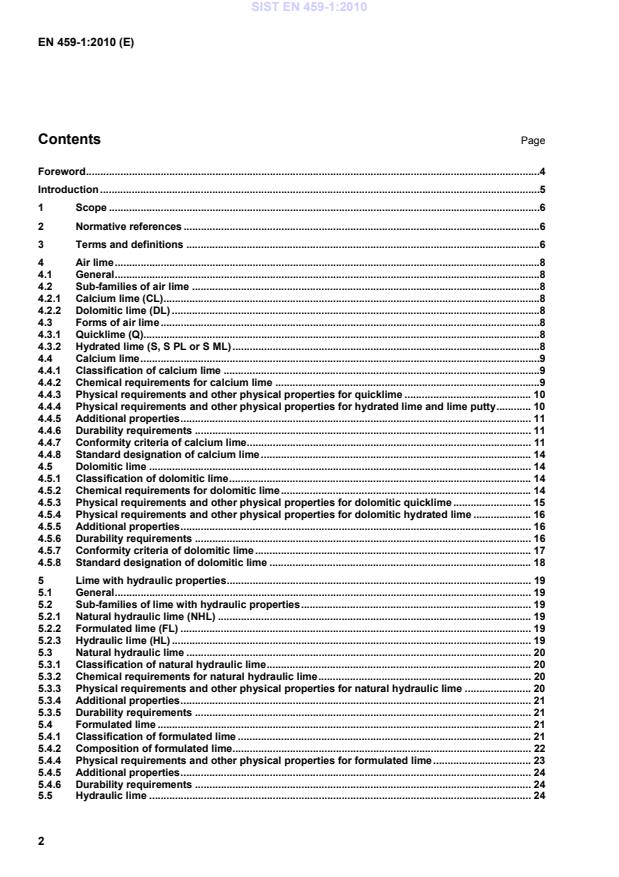
2003-01.Slovenski inštitut za standardizacijo. Razmnoževanje celote ali delov tega standarda ni dovoljeno.Gradbeno apno - 1. del: Definicije, zahteve in merila skladnostiBaukalk - Teil 1: Begriffe, Anforderungen und KonformitätskriterienChaux de construction - Partie 1: Définitions, spécifications et critères de conformitéBuilding lime - Part 1: Definitions, specifications and conformity criteria91.100.10Cement. Mavec. Apno. MaltaCement. Gypsum. Lime. Mortar01.040.91Gradbeni materiali in gradnja (Slovarji)Construction materials and building (Vocabularies)ICS:Ta slovenski standard je istoveten z:EN 459-1:2010SIST EN 459-1:2010en,de01-december-2010SIST EN 459-1:2010SLOVENSKI
STANDARDSIST EN 459-1:2002/AC:2004SIST EN 459-1:20021DGRPHãþD
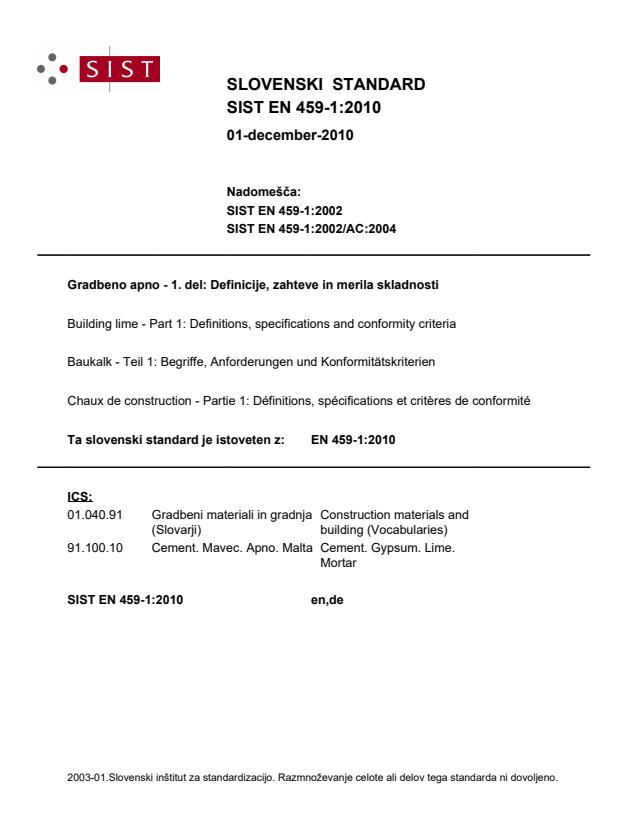
EUROPEAN STANDARD NORME EUROPÉENNE EUROPÄISCHE NORM
EN 459-1
September 2010 ICS 01.040.91; 91.100.10 Supersedes EN 459-1:2001English Version
Building lime - Part 1: Definitions, specifications and conformity criteria
Chaux de construction - Partie 1: Définitions, spécifications et critères de conformité
Baukalk - Teil 1: Begriffe, Anforderungen und Konformitätskriterien This European Standard was approved by CEN on 30 July 2010.
CEN members are bound to comply with the CEN/CENELEC Internal Regulations which stipulate the conditions for giving this European Standard the status of a national standard without any alteration. Up-to-date lists and bibliographical references concerning such national standards may be obtained on application to the CEN Management Centre or to any CEN member.
This European Standard exists in three official versions (English, French, German). A version in any other language made by translation under the responsibility of a CEN member into its own language and notified to the CEN Management Centre has the same status as the official versions.
CEN members are the national standards bodies of Austria, Belgium, Bulgaria, Croatia, Cyprus, Czech Republic, Denmark, Estonia, Finland, France, Germany, Greece, Hungary, Iceland, Ireland, Italy, Latvia, Lithuania, Luxembourg, Malta, Netherlands, Norway, Poland, Portugal, Romania, Slovakia, Slovenia, Spain, Sweden, Switzerland and United Kingdom.
EUROPEAN COMMITTEE FOR STANDARDIZATION
COMITÉ EUROPÉEN DE NORMALISATION EUROPÄISCHES KOMITEE FÜR NORMUNG
Management Centre:
Avenue Marnix 17,
B-1000 Brussels © 2010 CEN All rights of exploitation in any form and by any means reserved worldwide for CEN national Members. Ref. No. EN 459-1:2010: ESIST EN 459-1:2010
Statistical evaluation methods for strength, physical and chemical properties . 29Annex B (informative)
Additional properties for building lime . 35Annex C (informative)
Schematic diagram for the types of lime and fields of application . 37Annex D (normative)
Declaration of composition for formulated lime . 38Annex ZA (informative)
Clauses of this European Standard addressing the provisions of the EU Construction Product Directive . 40Bibliography . 48 SIST EN 459-1:2010
NOTE See also Annex C. 3.1 lime calcium oxide and/or hydroxide, and calcium-magnesium oxide and/or hydroxide produced by the thermal decomposition (calcination) of naturally occurring calcium carbonate (for example limestone, chalk, shells) or naturally occurring calcium magnesium carbonate (for example dolomitic limestone, dolomite) 3.2 building lime group of lime products, exclusively consisting of two families: air lime and lime with hydraulic properties, used in applications or materials for construction, building and civil engineering 3.3 air lime1)
lime (see 3.1) which combines and hardens with carbon dioxide present in air
1) Translation of a term used in most European countries. SIST EN 459-1:2010
NOTE It can be obtained by combining one or more immediately consecutive increments (see EN 459-2). 3.11 autocontrol testing continual testing by the manufacturer of building lime spot samples taken at the point(s) of release from the factory/depot 3.12 control period period of production and dispatch identified for the evaluation of the autocontrol test results SIST EN 459-1:2010
Sub-families and forms of air lime are given in 4.2 and 4.3 respectively.
4.2 Sub-families of air lime 4.2.1 Calcium lime (CL) Calcium lime is an air lime consisting mainly of calcium oxide and/or calcium hydroxide without any hydraulic or pozzolanic addition. 4.2.2
Dolomitic lime (DL) Dolomitic lime is an air lime consisting mainly of calcium magnesium oxide and/or calcium magnesium hydroxide without any hydraulic or pozzolanic addition. 4.3 Forms of air lime 4.3.1 Quicklime (Q) Quicklime is an air lime mainly in the oxide form which reacts exothermically on contact with water. Quicklime is available in a range of sizes from lump to powder. 4.3.2 Hydrated lime (S, S PL or S ML) Hydrated lime is an air lime mainly in the hydroxide form produced by the controlled slaking of quicklime. Hydrated lime is available as: powder (S);
putty (S PL); or
slurry or milk of lime (S ML). Dolomitic lime is also produced as semi-hydrated dolomitic lime (S1), mainly consisting of calcium hydroxide and magnesium oxide. SIST EN 459-1:2010
Conformity with this classification is assessed by means of statistical quality control as described in Annex A of this European Standard. 4.4.2 Chemical requirements for calcium lime The properties of the type of calcium lime shown in Table 2 determined in accordance with EN 459-2 shall conform to the requirements in that table. All types of calcium lime listed in Table 2 may contain additives in small quantities to improve the manufacture or properties of calcium lime. When the total content exceeds 0,1 %, the actual types and amounts shall be declared. Table 2 — Chemical requirements of calcium lime given as characteristic values Type of calcium lime Values given as mass fraction in percent CaO + MgO MgOa CO2b SO3 Available limec CL 90 ≥ 90 ≤ 5 ≤ 4 ≤ 2 ≥ 80 CL 80 ≥ 80 ≤ 5 ≤ 7 ≤ 2 ≥ 65 CL 70 ≥ 70 ≤ 5 ≤ 12 ≤ 2 ≥ 55 The values for CaO + MgO, MgO, CO2 and SO3 are applicable to all forms of calcium lime. For quicklime these values correspond to the finished product; for all other forms of lime (hydrated lime, lime putty and milk of lime) the values are based on the product after subtraction of its free water and bound water content. The values for available lime (calcium oxide for quicklime, calcium hydroxide for hydrated lime) refer to the product when tested in accordance with EN 459-2. a MgO content up to 7 % is permitted if the soundness test in accordance with EN 459-2 is passed. b A higher content of CO2 is permitted, if all other chemical requirements in Table 2 are satisfied and the test frequency satisfies the requirements in Table 7. c Higher values of available lime may be requested.
Table 3 — Physical requirements of quicklime Type of quicklime Soundness after slaking in accordance with 6.4.4 of EN 459-2:2010a CL 90 Pass CL 80 CL 70 a Slaking according to the instructions of the lime producer
Table 4 — Reactivity (R) of quicklime given as characteristic values Type of quicklime Reactivity (time in min), in accordance with 6.6 of EN 459-2:2010 R5 R 4 R3 R2 Rsv CL 90 t60 < 10
t60 < 25
— — other specified value or no requirement CL 80 t60 < 10
t60 < 25
t50 < 25
— CL 70 — — — t40 < 25
The particle size distribution of all types of quicklime shown in Table 1 shall conform to the requirements in Table 5 and shall be determined in accordance with EN 459-2.
Table 5 — Particle size distribution (P) of quicklime given as characteristic values Sieve size Particle size distributiona (mass fraction passing the sieve in percent),
in accordance with Clause 6 of EN 459-2:2010 P4 P3 P2 P1 Psv 10 mm 100 — — — other specified value or no requirement
5 mm ≥ 95 100 100 — 2 mm — ≥ 95 ≥ 95 100 0,2 mm — — ≥ 70 ≥ 95 0,09 mm — ≥ 30 ≥ 50 ≥ 85 a Particle size ≥ 2 mm shall be determined by dry sieving in accordance with
EN 459-2:2010, 6.1 and particle size < 2 mm by air-jet sieving in accordance with EN 459-2:2010, 6.2.
4.4.4 Physical requirements and other physical properties for hydrated lime and lime putty The physical properties of hydrated lime and lime putty of the type shown in Table 6 determined in accordance with EN 459-2 shall conform to the requirements in that table.
c Not for lime putty. The free water content of lime putty is normally between 45 % and 70 %. d Tested in accordance with 6.4 of EN 459-2:2010. e Hydrated calcium lime which includes particles larger than 0,2 mm shall satisfy the requirements of the soundness test for hydrated calcium
limes with grains larger than 0,2 mm in EN 459-2. f Tested in accordance with the test on standard mortar in EN 459-2. g A residue on 0,09 mm sieve up to 15 % is permitted as long as the soundness test given in 6.4.2 of EN 459-2:2010 is passed.
4.4.5 Additional properties Other properties may be subject either to requirements in application standards dealing with the use of calcium lime or to requests from the user. These properties are given in informative Annex B. 4.4.6 Durability requirements The choice of calcium lime, particularly as regards types for different applications and exposure conditions shall follow the appropriate European or national application standards and/or regulations valid in the place of use. 4.4.7 Conformity criteria of calcium lime 4.4.7.1 General requirements Conformity of calcium lime to this European Standard shall be continuously evaluated on the basis of testing of spot samples. The properties to be tested for the autocontrol testing by the manufacturer, test methods and the minimum testing frequencies for each type of calcium lime detailed in Table 1 are specified in Table 7. The declaration of conformity by the manufacturer, shall be based on the evaluation of conformity of building lime with this European Standard according to the scheme specified in EN 459-3. NOTE Requirements for the declaration of conformity which the manufacturer should make available under the CE marking procedure are established in Annex ZA and should not be confused with other types of declaration of conformity. 4.4.7.2 Conformity requirements Sampling shall take place at the point of release of the building lime. SIST EN 459-1:2010
EN 459-2 1/week 2/week X
Hydrated limem 1/day 2/day X
Soundness Quicklimee Hydrated lime 1/dayg 2/day
X Lime putty 1/week 2/week
X Penetration/ Water demand Hydrated lime 2/year 1/month
X Air content Hydrated limek 2/year 1/month
X CaO + MgO, MgOf Quicklime Hydrated lime Lime putty
1/week 2/week
X CO2f, n Quicklime Hydrated lime Lime putty
1/week 2/week
X SO3 Quicklime Hydrated lime Lime putty
1/month 2/month
X Available limef, o Quicklime Hydrated lime Lime putty
1/week 2/week
X Free water Hydrated lime Lime putty
1/month 2/month
X Reactivity Quicklime
1/week 2/week
X a The methods used to take and prepare samples shall be in accordance with EN 459-2. Tests may be carried out at any time between production and dispatch. The producer shall ensure that the requirements are met at the time of dispatch. b See 4.3 and Table 1. c Any other methods may be used provided they are calibrated, either against the reference methods or against internationally accepted reference materials, in order to demonstrate their equivalence. d The control period for conformity evaluation is twelve months. e After slaking (see Table 3, footnote a). f If the test frequency of CaO + MgO and CO2 is higher than the required frequency (e.g. CaO + MgO > 1/week and CO2 > 1/week) then the test frequency of available lime may be reduced to twice per year. If the test frequency of available lime and CO2 is higher than the required frequency (e.g. available lime > 1/week and CO2 > 1/week) then the test frequency of CaO + MgO may be reduced to twice per year. g For hydrated lime: If 30 consecutive test results are less than 10 % of the required value then the test frequency may be reduced to once per month. If any single result is higher than 10 % of the required value then return to daily testing.
For quicklime: If 30 consecutive test results meet the requirement, then the test frequency may be reduced to once per month. If any single result fails the requirement, then return to daily testing. h If the data are not normally distributed the evaluation shall be made by attributes. j If the number of samples taken during the control period is at least one per week the evaluation may be made by variables. k For lime without additives only initial type testing is required. l See EN 459-3:2001, 4.4. m See Table 6, footnote g. n See Table 2, footnote b. o See Table 2, footnote c.
Conformity with this classification is assessed by means of statistical quality control as described in Annex A of this European Standard. 4.5.2 Chemical requirements for dolomitic lime The properties of the type of dolomitic lime shown in Table 9 determined in accordance with EN 459-2 shall conform to the requirements in that table. All types of dolomitic lime listed in Table 9 may contain additives in small quantities to improve the manufacture or properties of dolomitic lime. When the total content exceeds 0,1 %, the actual types and amounts shall be declared. SIST EN 459-1:2010
4.5.3 Physical requirements and other physical properties for dolomitic quicklime The physical properties of dolomitic quicklime of the type shown in Tables 10 to 11 determined in accordance with EN 459-2 shall conform to the requirements in those Tables.
Table 10 — Physical requirements of dolomitic quicklime Type of dolomitic quicklime Soundness after slaking in accordance with 6.4.4 of EN 459-2:2010a DL 90-30 Pass DL 90-5 DL 85-30 DL 80-5 a Slaking according to the instructions of the lime producer.
Table 11 — Reactivity of dolomitic quicklime given as characteristic values Type of dolomitic quicklime Reactivity (time in minutes), in accordance with 6.6 of EN 459-2:2010 R5 R2 R1 Rsv DL 90-30 — t40 < 25
— other specified value or no requirement DL 90-5 t60 < 10
t40 < 25
— DL 85-30 — t40 < 25
— DL 80-5 — — t35 < 25
The particle size distribution of all types of dolomitic quicklime shown in Table 8 shall conform to the requirements in Table 12 and shall be determined in accordance with EN 459-2.
in accordance with Clause 6 of EN 459-2:2010 P4 P3 P2 P1 Psv 10 mm 100 — — — other specified value or no requirement
5 mm ≥ 95 100 100 — 2 mm — ≥ 95 ≥ 95 100 0,2 mm — — ≥ 70 ≥ 95 0,09 mm — ≥ 30 ≥ 50 ≥ 85 a Particle size ≥ 2 mm shall be determined by dry sieving in accordance with
EN 459-2:2010, 6.1 and particle size < 2 mm by air-jet sieving in accordance with EN 459-2:2010, 6.2.
4.5.4 Physical requirements and other physical properties for dolomitic hydrated lime The physical properties of dolomitic hydrated lime of the type shown in Table 13 determined in accordance with EN 459-2 shall conform to the requirements in that table.
Table 13 — Physical requirements of dolomitic hydrated limea given as characteristic values Type of dolomitic hydrated lime Particle size Free water content Soundnessb, c Mortar testsd % residue by mass Penetration Air content 0,09 mm 0,2 mm % mm % DL 90-30 ≤ 7 ≤ 2 ≤ 2 Pass > 10 and < 50 ≤ 12 DL 90-5 DL 85-30 DL 80-5 a Particle size and free water content apply to dolomitic hydrated lime for all applications. Soundness, penetration and air content apply only to dolomitic hydrated lime for masonry mortar, plastering and rendering. b See 6.4.4 of EN 459-2:2010. c Dolomitic hydrated lime which includes particles larger than 0,2 mm shall satisfy the requirements of the soundness test for dolomitic hydrated limes with grains larger than 0,2 mm in EN 459-2. d Tested in accordance with the test on standard mortar in EN 459-2.
4.5.5 Additional properties Other properties may be subject either to requirements in application standards dealing with the use of dolomitic lime or to requests from the users. These properties are given in informative Annex B. 4.5.6 Durability requirements The choice of dolomitic lime particularly as regards type for different applications and exposure conditions shall follow the appropriate European or national application standards and/or regulations valid in the place of use. SIST EN 459-1:2010
EN 459-2 1/week 2/week
X Hydrated lime 1/day 2/day
X Soundness Quicklimee Hydrated lime 1/dayg 2/day
X Penetration/ Water demand
Hydrated lime 2/year 1/month
X Air content Hydrated limek 2/year 1/month
X CaO + MgO, MgO Quicklime Hydrated lime 1/week 2/week
X CO2 Quicklime Hydrated lime 1/week 2/week
X SO3 Quicklime Hydrated lime 1/month 2/month
X Free water Hydrated lime 1/month 2/month
X Reactivity Quicklime 1/week 2/week
X a The methods used to take and prepare samples shall be in accordance with EN 459-2. Tests may be carried out at any time between production and dispatch. The producer shall ensure that
the requirements are met at the time of dispatch. b See 4.3 and Table 8. c Any other methods may be used provided they are calibrated, either against the reference methods or against internationally accepted reference materials, in order to demonstrate their equivalence. d The control period for conformity evaluation is twelve months. e After slaking (see Table 10, footnote a). g For hydrated lime: If 30 consecutive test results are less than 10 % of the required value then the test frequency may be reduced to once per month. If any single result is higher than 10 % of the required value, then return to daily testing. For quicklime: If 30 consecutive test results meet the requirement, then the test frequency may be reduced to once per month. If any single result fails the requirement, then return to daily testing. h If the data are not normally distributed the evaluation shall be made by attributes. j If the number of samples taken during the control period is at least one per week the evaluation may be made by variables.
k For lime without additives only initial type testing is required. l See EN 459-3:2001, 4.4.
4.5.8 Standard designation of dolomitic lime Dolomitic lime shall be identified by its type and notation specified in Table 8, by the form of the product given in 4.3 and for quicklime by the physical requirements given in 4.5.3 (see examples below). EXAMPLE 1 Dolomitic lime 90-30 in the form of quicklime, reactivity R2 and particle size distribution P2, is identified by: EN 459-1 DL 90-30-Q (R2, P2) SIST EN 459-1:2010
in accordance with 5.8 of EN 459-2:2010 Values in mass fraction in percent NHL 2 ≤ 2 ≥ 35 NHL 3,5 ≤ 2 ≥ 25 NHL 5 ≤ 2
...