

EN 12101-3:2002
(Main)Smoke and heat control systems - Part 3: Specification for powered smoke and heat exhaust ventilators
- Abstract
This European standard specifies requirements and gives methods for testing powered smoke and heat exhaust ventilators that are intended to be installed as part of a powered smoke and heat exhaust ventilation system. It also provides a procedure for approving a range of powered smoke and heat exhaust ventilators and their motors, from a limited number of tests.
- Status
- Withdrawn
- Publication Date
- 19-Feb-2002
- Withdrawal Date
- 29-Sep-2026
- Technical Committee
- CEN/TC 191 - Fixed firefighting systems
- Drafting Committee
- CEN/TC 191/SC 1 - Smoke and heat control systems and components
- Current Stage
- 9960 - Withdrawal effective - Withdrawal
- Start Date
- 26-Aug-2015
- Completion Date
- 07-Oct-2026
- Directive
- 305/2011 - Regulation (eu) No 305/2011 of the European Parliament and of the Council of 9 march 2011 laying down harmonised conditions for the marketing of construction products and repealing council directive 89/106/eecOJ Ref: C, C 259 OJ Date: 08-Aug-2014
89/106/EEC - Construction productsOJ Ref: C 13, C 139, C 319, C 67 OJ Date: 17-Mar-2004


Relations
- Effective Date
- 08-Jun-2022
- Effective Date
- 25-Aug-2026
- Effective Date
- 09-Feb-2026
- Effective Date
- 09-Feb-2026
- Effective Date
- 09-Feb-2026
- Effective Date
- 28-Jan-2026
- Effective Date
- 28-Jan-2026
- Effective Date
- 28-Jan-2026
- Effective Date
- 28-Jan-2026
- Effective Date
- 28-Jan-2026
- Effective Date
- 28-Jan-2026
- Effective Date
- 28-Jan-2026
- Refers
EN 1366-5:2021 - Fire resistance tests for service installations - Part 5: Service ducts and shafts - Effective Date
- 28-Jan-2026
- Refers
EN 1366-8:2024 - Fire resistance tests for service installations - Part 8: Smoke extraction ducts - Effective Date
- 28-Jan-2026
- Effective Date
- 28-Jan-2026
Get Certified
Connect with accredited certification bodies for this standard

CIS Institut d.o.o.
Personal Protective Equipment (PPE) certification body. Notified Body NB-2890 for EU Regulation 2016/425 PPE.
Institut za varilstvo d.o.o. (Welding Institute)
Slovenia's leading welding institute since 1952. ISO 3834, EN 1090, pressure equipment certification, NDT personnel, welder qualification. Only IIW Au

Kiwa BDA Testing
Building and construction product certification.
Sponsored listings
Frequently Asked Questions
EN 12101-3:2002 is a standard published by the European Committee for Standardization (CEN). Its full title is "Smoke and heat control systems - Part 3: Specification for powered smoke and heat exhaust ventilators". This standard covers: This European standard specifies requirements and gives methods for testing powered smoke and heat exhaust ventilators that are intended to be installed as part of a powered smoke and heat exhaust ventilation system. It also provides a procedure for approving a range of powered smoke and heat exhaust ventilators and their motors, from a limited number of tests.
This European standard specifies requirements and gives methods for testing powered smoke and heat exhaust ventilators that are intended to be installed as part of a powered smoke and heat exhaust ventilation system. It also provides a procedure for approving a range of powered smoke and heat exhaust ventilators and their motors, from a limited number of tests.
EN 12101-3:2002 is classified under the following ICS (International Classification for Standards) categories: 13.220.20 - Fire protection; 23.120 - Ventilators. Fans. Air-conditioners. The ICS classification helps identify the subject area and facilitates finding related standards.
EN 12101-3:2002 has the following relationships with other standards: It is inter standard links to EN 12101-3:2015, ISO 5801:1997, EN 60034-1:2010, ISO 5221:1984, ISO 834-1:1999, EN ISO 5167-3:2022, EN 1366-4:2021, EN ISO 5167-1:2022, EN 1366-6:2004, EN 1366-7:2004, EN ISO 4611:1999, EN 1366-9:2024, EN 1366-5:2021, EN 1366-8:2024, EN 1366-10:2022+A1:2024. Understanding these relationships helps ensure you are using the most current and applicable version of the standard.
EN 12101-3:2002 is associated with the following European legislation: EU Directives/Regulations: 305/2011, 89/106/EEC; Standardization Mandates: M/109. When a standard is cited in the Official Journal of the European Union, products manufactured in conformity with it benefit from a presumption of conformity with the essential requirements of the corresponding EU directive or regulation.
EN 12101-3:2002 is available in PDF format for immediate download after purchase. The document can be added to your cart and obtained through the secure checkout process. Digital delivery ensures instant access to the complete standard document.
Standards Content (Sample)
2003-01.Slovenski inštitut za standardizacijo. Razmnoževanje celote ali delov tega standarda ni dovoljeno.Smoke and heat control systems - Part 3: Specification for powered smoke and heat exhaust ventilatorsSystemes pour le contrôle des fumées et de la chaleur - Partie 3: Spécifications pour les ventilateurs extracteurs de fumées et de chaleurRauch- und Wärmefreihaltung - Teil 3: Bestimmungen für maschinelle Rauch- und WärmeabzugsgeräteTa slovenski standard je istoveten z:EN 12101-3:2002SIST EN 12101-3:2002en23.12013.220.20ICS:SLOVENSKI
STANDARDSIST EN 12101-3:200201-junij-2002
EUROPEAN STANDARDNORME EUROPÉENNEEUROPÄISCHE NORMEN 12101-3February 2002ICS 13.220.20; 23.120English versionSmoke and heat control systems - Part 3: Specification forpowered smoke and heat exhaust ventilatorsSystèmes pour le contrôle des fumées et de la chaleur -Partie 3: Spécifications pour les ventilateurs extracteurs defumées et de chaleurRauch- und Wärmefreihaltung - Teil 3: Bestimmungen fürmaschinelle Rauch- und WärmeabzugsgeräteThis European Standard was approved by CEN on 9 June 2001.CEN members are bound to comply with the CEN/CENELEC Internal Regulations which stipulate the conditions for giving this EuropeanStandard the status of a national standard without any alteration. Up-to-date lists and bibliographical references concerning such nationalstandards may be obtained on application to the Management Centre or to any CEN member.This European Standard exists in three official versions (English, French, German). A version in any other language made by translationunder the responsibility of a CEN member into its own language and notified to the Management Centre has the same status as the officialversions.CEN members are the national standards bodies of Austria, Belgium, Czech Republic, Denmark, Finland, France, Germany, Greece,Iceland, Ireland, Italy, Luxembourg, Malta, Netherlands, Norway, Portugal, Spain, Sweden, Switzerland and United Kingdom.EUROPEAN COMMITTEE FOR STANDARDIZATIONCOMITÉ EUROPÉEN DE NORMALISATIONEUROPÄISCHES KOMITEE FÜR NORMUNGManagement Centre: rue de Stassart, 36
B-1050 Brussels© 2002 CENAll rights of exploitation in any form and by any means reservedworldwide for CEN national Members.Ref. No. EN 12101-3:2002 E
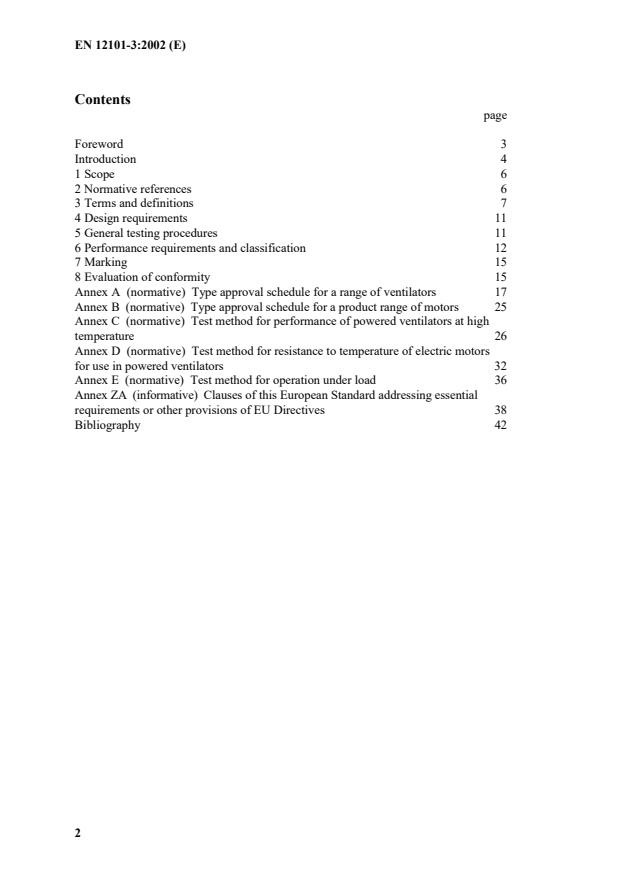
(normative)
Type approval schedule for a range of ventilators17Annex B
(normative)
Type approval schedule for a product range of motors25Annex C
(normative)
Test method for performance of powered ventilators at hightemperature26Annex D
(normative)
Test method for resistance to temperature of electric motorsfor use in powered ventilators32Annex E
(normative)
Test method for operation under load36Annex ZA
(informative)
Clauses of this European Standard addressing essentialrequirements or other provisions of EU Directives38Bibliography42
Fans are usually used.3.6ventilatordevice for enabling the movement of gases into or out of a construction work3.7exhaust ventilatordevice for the movement of gases out of the construction work
Automatic natural smoke and heat exhaust ventilators may also be fitted with a manualcontrol or release device.3.14automatically initiated powered smoke and heat exhaust ventilatorpowered smoke and heat exhaust ventilator that operates automatically after the outbreak offire if called upon to do so
F200; or b)
F300; or c)
F400; or d)
F600; or e)
F842 or f)
Not classified6.1.2For products intended to be installed within a building, there shall be no significantleakage of smoke from the furnace coming from the housing of the ventilator during theentire test period6.1.3At the appropriate temperature given in Table 2, a ventilator shall function for not lessthan the appropriate minimum time, and shall re-start, when tested in accordance withannex C.Table 2 — Test temperature and functioning time according toclassificationClassTemperatureMinimum functioning period°CminutesF200200120F30030060F400400120F60060060F84284230Not classifiedas specifiedas specifiedby sponsorby sponsor6.2 Flow and pressureWhen tested in accordance with annex C, at the appropriate temperature and for theappropriate time given in Table 2, the volume flow shall not change by more than 10 % or thestatic pressure shall not change by more than 20 % of that measured at the end of the warm upperiod of the test.
Increases above those specified may increase the fire risk.6.4 Wind loadIf the ventilator is designed to be installed at the atmospheric termination of a system and isfitted with flaps or louvres and these project above the wind deflectors (cowl or wind shield),the flaps or louvres shall open in less than 30 s against of a load of 200 Pa, when theventilator is tested in accordance with annex E.6.5 Snow load6.5.1 If the ventilator is designed to be installed at the atmospheric termination of a system,the ventilator shall be classified as one of the following:— SL 0— SL 125— SL 250— SL 500— SL 1000— SL ANOTE
The designations 0, 125, 250, 500, 1000 and A represent the test snow load in Pascalsapplied when the ventilator is tested in accordance with annex E The "A" in SLA will be replaced bythe test snow load when this exceeds 1000, or by the test load if one of the four defined values is notused.Where the minimum angle of installation (combining roof pitch and ventilator pitch)recommended by the supplier exceeds 45°, the ventilator takes the classification SL 1000without a test; except where the snow will be prevented from slipping from the ventilator e.g.by wind deflectors.
The following types of ventilators may be suitable for use on heated buildings without asnow load classification test:a) vertical discharge units without flaps or dampers;b) vertical discharge units with uninsulated metal flaps or dampers.6.6 Operation at low temperatureA powered ventilator with a separate device for the operation of the dampers, flaps or louvres,which does not use the air pressure from the fan, shall conform to 7.3 of prEN 12101-2:1995,when tested in accordance with annex E of prEN 12101-2:1995.6.7 ReliabilityA powered ventilator with dampers, flaps or louvres or a separate device for the operation ofthe dampers, flaps or louvres, which does not use the air pressure from the fan, shall conformto 7.1 of prEN 12101-2:1995 when tested in accordance with annex C of prEN 12101-2:1995.6.8 Performance data of ventilators6.8.1 The supplier shall provide a data sheet giving the aerodynamic and acousticperformance data of the ventilator assessed at ambient temperature in accordance withISO 5801, taking into account the reduction in performance caused by the increasedclearances required for high temperature.NOTE
It is permissible to convert these figures to determine the performance with hot gases and atother speeds of rotation using the scaling formulae from ISO 5801, with due allowance for tipclearance effects.6.8.2 If a ventilator is designed to be fitted with a duct for cooling air the data sheet shallinclude the volume pressure characteristic of the auxiliary system and the minimum coolingair flow required.
the name or trade mark of the supplier, and b)
the type and model; and c)
the application classes; and d)
the temperature/time category; and e)
the maximum exhaust temperature in °C; and f)
the functioning period in minutes; and g)
the year of manufacture; and h)
technical data such as power, current, voltage, pressure, volume flow; and i)
the motor insulation class; and j)
the snow load class; k)
the number and the year of this European Standard.Where the requirements of annex ZA.3 give the same information as above, the requirementsof this clause (7) shall be considered to have been met.8 Evaluation of conformity8.1 GeneralThe compliance of powered smoke and heat exhaust ventilators with the requirements of thisstandard shall be demonstrated by:- initial type testing,- factory production control by the manufacturer.8.2 Initial type testingInitial type testing shall be performed on first application of this standard. Tests previouslyperformed in accordance with the provisions of this standard (e.g. same product, samecharacteristic(s), test method, sampling procedure, system of evaluation of conformity) maybe taken into account. In addition, initial type testing shall be performed at the beginning ofthe production of a new product type or at the beginning of a new method of production(where these may affect the stated properties).All characteristics given in clauses 5 and 6.1 to 6.7 shall be subject to initial type testing.
the ventilator with the most highly stressed impeller, or the ventilators withimpellers in which the individual stress in any material, weld or fastening is thehighest, as appropriate (see A.4); b)
for ventilators with motors mounted in an enclosure which restricts the cooling, theworst case shall be tested, for example the ventilator with the ratio of motor crosssectional area to the minimum cross sectional area through which the cooling airflows; c)
at least two sizes are tested at their highest rotational speed; d)
the ventilator with the smallest motor frame size to be used; e)
if the highest impeller stress levels are determined by geometric similarityconditions from A.4.1, sufficient sizes of ventilators to ensure that the impellerdiameters of the range are from 0,8 to 1,26 of those tested; f)
if the highest impeller stress levels are determined by the calculation methods inA.4.2, sufficient sizes of ventilators to ensure that the impeller diameters of therange are from 0,63 to 1,26 of those tested.A.2 MotorsA product range shall only be approved if the motors used in the range are also approved,except when the impeller is not mounted on the motor shaft and the motors are out of theairstream in ambient air and the cooling of the motor is not affected by heat transfer from theventilator or the ventilator construction. When the motor is out of the airstream and theimpeller is mounted on the motor shaft, motors from a different supplier to the one used inthe ventilator test may be used, provided that the tested and alternative motors are of the sameconstruction, i.e. same class of insulation and bearing type and class of fit and samesynchronous speed and rating.A.3 Combined testingThe tests to approve ventilators and motors may be performed at the same time. The motorapproval procedure is given in annexes B and D. Motors tested independently of fans or inanother range of ventilators may also be used provided these tests have been undertaken withsimilar mechanical loads and cooling conditions as described in this annex and annex D.
The method given for calculating stresses is for comparative purposes only and is notsuitable for design assessment. It only takes into account centrifugally induced stresses asaerodynamically induced stresses are of less importance.A.4.2.1 Axial impellersA.4.2.1.1 Centrifugal forceDivide the blade into four parts using five sections as shown in Figure A.1.Calculate the centrifugal force for each part as follows2n1nn1n1nn1+nn,2)()-(2)(RRRRAAFWhereFn,n+1is the centrifugal force in Newtons of the part of the blade between sections nand n+1; is the density in kg/m3;Anis the area of section n in m2;Rnis the radius of section n;is the angular velocity in radians/s.
...