

EN 1366-4:2021
(Main)Fire resistance tests for service installations - Part 4: Linear joint seals
- Abstract
This part of the EN 1366 series specifies a method for determining the fire resistance of linear joint seals based on their intended end use. Perimeter seals of curtain walling are excluded from this part of the EN 1366 series.
This document is intended to be used in conjunction with EN 1363-1.
The following tests are included in this document:
- no mechanically induced movement;
- mechanically induced movement.
Tests in accordance with this part of the EN 1366 series are not intended to provide quantitative information on the rate of leakage of smoke and/or hot gases, or on the transmission or generation of fumes. Such phenomena are only noted in the test report in describing the general behaviour of test specimens during the test.
The load-bearing capacity of a linear joint seal is not addressed in this part of the EN 1366 series. No information can be implied by the test concerning the influence of the inclusion of linear joint seals on the loadbearing capacity of the separating element.
- Status
- Published
- Publication Date
- 09-Feb-2021
- Withdrawal Date
- 30-Aug-2021
- Technical Committee
- CEN/TC 127 - Fire safety in buildings
- Drafting Committee
- CEN/TC 127/WG 2 - Services
- Current Stage
- 9093 - Decision to confirm - Review Enquiry
- Start Date
- 03-Sep-2026
- Completion Date
- 07-Oct-2026


Overview
EN 1366-4:2021 - Fire resistance tests for service installations, Part 4: Linear joint seals (CEN) - specifies a harmonized test method to determine the fire performance of linear joint seals used in building joints, gaps and interfaces. Published February 2021, this edition supersedes EN 1366-4:2006+A1:2010 and is intended to be used together with EN 1363-1 (general fire resistance test conditions).
Important scope points:
- Covers both no mechanically induced movement and mechanically induced movement conditions (movement is described prior to fire exposure).
- Perimeter seals of curtain walling are excluded.
- Tests assess integrity and insulation performance of seals; they do not provide quantitative leakage rates for smoke/hot gases.
- The load-bearing capacity of the supporting construction is outside the scope.
Key Topics and Requirements
- Test types: two basic regimes - static joint seals (no movement) and seals subject to mechanically induced movement (movement capability defined).
- Sealing materials and forms: detailed definitions and installation requirements for fabrics, foams (in situ), membrane-forming seals, mineral wool (faced/unfaced), mortar/plaster, sealants, pre-formed compressible strips/composites/ropes and pre-formed strips.
- Test specimen and installation: specimen size, number of specimens, splice locations and conditioning procedures are specified.
- Instrumentation and measurements: thermocouple placement (including for joints <12 mm), integrity measurement and observation procedures.
- Performance criteria: pass/fail criteria for integrity and insulation and expression of results in the test report.
- Field of direct application: guidance on application to rigid and flexible supporting constructions, orientation and dimensional limits (Annex A - no movement; Annex B - movement).
- Limitations: test reports note general behaviour (smoke, fumes) but do not quantify leakage; no indication of effects on load-bearing capacity.
Applications
EN 1366-4:2021 is used to:
- Demonstrate fire resistance performance of joint sealing systems in walls, floors and other construction joints.
- Support product certification, technical data sheets and fire design specifications.
- Inform selection of seals for building fire compartmentation and passive fire protection strategies.
- Provide standardized test data for fire engineers, specifiers and building control authorities.
Who should use this standard
- Fire test laboratories and manufacturers of sealants and joint systems.
- Fire safety engineers, façade and building envelope designers.
- Architects, installers and building control bodies who specify or approve materials for fire separation and compartmentation.
- Product certification and conformity assessment bodies.
Related Standards
- EN 1363-1 (Fire resistance tests - general requirements)
- Other parts of EN 1366 series (e.g., Part 1 ventilation ducts, Part 3 penetration seals, Part 5 service shafts) for linked service-installation testing contexts.
Keywords: EN 1366-4:2021, linear joint seals, fire resistance tests, CEN, EN 1363-1, integrity, insulation, mechanically induced movement, joint sealing systems.
Relations
- Effective Date
- 08-Jun-2022
- Effective Date
- 25-Mar-2026
- Effective Date
- 25-Mar-2026
- Effective Date
- 28-Jan-2026
- Effective Date
- 28-Jan-2026
- Effective Date
- 28-Jan-2026
- Effective Date
- 28-Jan-2026
- Effective Date
- 28-Jan-2026
- Effective Date
- 28-Jan-2026
- Effective Date
- 28-Jan-2026
- Referred By
EN 1996-1-2:2024 - Eurocode 6 - Design of masonry structures - Part 1-2: Structural fire design - Effective Date
- 28-Jan-2026
- Effective Date
- 28-Jan-2026
- Effective Date
- 28-Jan-2026
Get Certified
Connect with accredited certification bodies for this standard

CIS Institut d.o.o.
Personal Protective Equipment (PPE) certification body. Notified Body NB-2890 for EU Regulation 2016/425 PPE.

Kiwa BDA Testing
Building and construction product certification.
Kmetijski inštitut Slovenije
Agricultural Institute of Slovenia. Soil testing, plant health, agricultural product analysis.
Sponsored listings
Frequently Asked Questions
EN 1366-4:2021 is a standard published by the European Committee for Standardization (CEN). Its full title is "Fire resistance tests for service installations - Part 4: Linear joint seals". This standard covers: This part of the EN 1366 series specifies a method for determining the fire resistance of linear joint seals based on their intended end use. Perimeter seals of curtain walling are excluded from this part of the EN 1366 series. This document is intended to be used in conjunction with EN 1363-1. The following tests are included in this document: - no mechanically induced movement; - mechanically induced movement. Tests in accordance with this part of the EN 1366 series are not intended to provide quantitative information on the rate of leakage of smoke and/or hot gases, or on the transmission or generation of fumes. Such phenomena are only noted in the test report in describing the general behaviour of test specimens during the test. The load-bearing capacity of a linear joint seal is not addressed in this part of the EN 1366 series. No information can be implied by the test concerning the influence of the inclusion of linear joint seals on the loadbearing capacity of the separating element.
This part of the EN 1366 series specifies a method for determining the fire resistance of linear joint seals based on their intended end use. Perimeter seals of curtain walling are excluded from this part of the EN 1366 series. This document is intended to be used in conjunction with EN 1363-1. The following tests are included in this document: - no mechanically induced movement; - mechanically induced movement. Tests in accordance with this part of the EN 1366 series are not intended to provide quantitative information on the rate of leakage of smoke and/or hot gases, or on the transmission or generation of fumes. Such phenomena are only noted in the test report in describing the general behaviour of test specimens during the test. The load-bearing capacity of a linear joint seal is not addressed in this part of the EN 1366 series. No information can be implied by the test concerning the influence of the inclusion of linear joint seals on the loadbearing capacity of the separating element.
EN 1366-4:2021 is classified under the following ICS (International Classification for Standards) categories: 13.220.50 - Fire-resistance of building materials and elements. The ICS classification helps identify the subject area and facilitates finding related standards.
EN 1366-4:2021 has the following relationships with other standards: It is inter standard links to EN 1366-4:2006+A1:2010, EN 1994-1-2:2026, EN 1994-1-1:2026, EN 1994-1-2:2005, EN 1994-1-1:2004, EN 1363-1:2020, EN ISO 13943:2023, EN 1363-2:1999, EN 13501-2:2023, EN 12101-3:2002, EN 1996-1-2:2024, EN 13501-2:2016, EN 13501-2:2007+A1:2009. Understanding these relationships helps ensure you are using the most current and applicable version of the standard.
EN 1366-4:2021 is associated with the following European legislation: EU Directives/Regulations: 305/2011; Standardization Mandates: M/117. When a standard is cited in the Official Journal of the European Union, products manufactured in conformity with it benefit from a presumption of conformity with the essential requirements of the corresponding EU directive or regulation.
EN 1366-4:2021 is available in PDF format for immediate download after purchase. The document can be added to your cart and obtained through the secure checkout process. Digital delivery ensures instant access to the complete standard document.
Standards Content (Sample)
SLOVENSKI STANDARD
01-april-2021
Nadomešča:
SIST EN 1366-4:2006+A1:2010
Preskusi požarne odpornosti servisnih inštalacij - 4. del: Tesnilna sredstva za
ravne stike
Fire resistance tests for service installations - Part 4: Linear joint seals
Feuerwiderstandsprüfungen für Installationen - Teil 4: Abdichtungssysteme für
Bauteilfugen
Essais de résistance au feu des installations techniques - Partie 4 : Calfeutrements de
joints linéaires
Ta slovenski standard je istoveten z: EN 1366-4:2021
ICS:
13.220.50 Požarna odpornost Fire-resistance of building
gradbenih materialov in materials and elements
elementov
91.100.50 Veziva. Tesnilni materiali Binders. Sealing materials
2003-01.Slovenski inštitut za standardizacijo. Razmnoževanje celote ali delov tega standarda ni dovoljeno.
EN 1366-4
EUROPEAN STANDARD
NORME EUROPÉENNE
February 2021
EUROPÄISCHE NORM
ICS 13.220.50 Supersedes EN 1366-4:2006+A1:2010
English Version
Fire resistance tests for service installations - Part 4:
Linear joint seals
Essais de résistance au feu des installations techniques Feuerwiderstandsprüfungen für Installationen - Teil 4:
- Partie 4 : Calfeutrements de joints linéaires Abdichtungssysteme für Bauteilfugen
This European Standard was approved by CEN on 27 December 2020.
CEN members are bound to comply with the CEN/CENELEC Internal Regulations which stipulate the conditions for giving this
European Standard the status of a national standard without any alteration. Up-to-date lists and bibliographical references
concerning such national standards may be obtained on application to the CEN-CENELEC Management Centre or to any CEN
member.
This European Standard exists in three official versions (English, French, German). A version in any other language made by
translation under the responsibility of a CEN member into its own language and notified to the CEN-CENELEC Management
Centre has the same status as the official versions.
CEN members are the national standards bodies of Austria, Belgium, Bulgaria, Croatia, Cyprus, Czech Republic, Denmark, Estonia,
Finland, France, Germany, Greece, Hungary, Iceland, Ireland, Italy, Latvia, Lithuania, Luxembourg, Malta, Netherlands, Norway,
Poland, Portugal, Republic of North Macedonia, Romania, Serbia, Slovakia, Slovenia, Spain, Sweden, Switzerland, Turkey and
United Kingdom.
EUROPEAN COMMITTEE FOR STANDARDIZATION
COMITÉ EUROPÉEN DE NORMALISATION
EUROPÄISCHES KOMITEE FÜR NORMUNG
CEN-CENELEC Management Centre: Rue de la Science 23, B-1040 Brussels
© 2021 CEN All rights of exploitation in any form and by any means reserved Ref. No. EN 1366-4:2021 E
worldwide for CEN national Members.
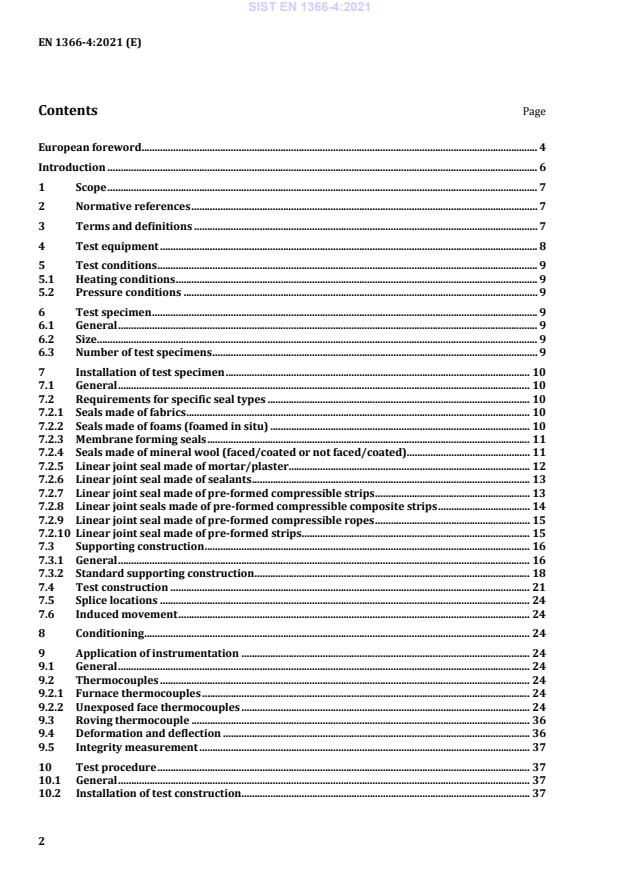
Contents Page
European foreword . 4
Introduction . 6
1 Scope . 7
2 Normative references . 7
3 Terms and definitions . 7
4 Test equipment . 8
5 Test conditions . 9
5.1 Heating conditions . 9
5.2 Pressure conditions . 9
6 Test specimen . 9
6.1 General . 9
6.2 Size . 9
6.3 Number of test specimens . 9
7 Installation of test specimen . 10
7.1 General . 10
7.2 Requirements for specific seal types . 10
7.2.1 Seals made of fabrics . 10
7.2.2 Seals made of foams (foamed in situ) . 10
7.2.3 Membrane forming seals . 11
7.2.4 Seals made of mineral wool (faced/coated or not faced/coated). 11
7.2.5 Linear joint seal made of mortar/plaster. 12
7.2.6 Linear joint seal made of sealants . 13
7.2.7 Linear joint seal made of pre-formed compressible strips . 13
7.2.8 Linear joint seals made of pre-formed compressible composite strips . 14
7.2.9 Linear joint seal made of pre-formed compressible ropes . 15
7.2.10 Linear joint seal made of pre-formed strips . 15
7.3 Supporting construction . 16
7.3.1 General . 16
7.3.2 Standard supporting construction . 18
7.4 Test construction . 21
7.5 Splice locations . 24
7.6 Induced movement . 24
8 Conditioning . 24
9 Application of instrumentation . 24
9.1 General . 24
9.2 Thermocouples . 24
9.2.1 Furnace thermocouples . 24
9.2.2 Unexposed face thermocouples . 24
9.3 Roving thermocouple . 36
9.4 Deformation and deflection . 36
9.5 Integrity measurement . 37
10 Test procedure . 37
10.1 General . 37
10.2 Installation of test construction . 37
10.3 Mechanically induced movement of the test specimen . 37
10.4 Measurements and observations . 37
11 Performance criteria . 37
11.1 Insulation . 37
11.2 Integrity. 37
11.3 Expression of results . 38
12 Test report . 38
13 Field of direct application of test results . 38
13.1 Orientation . 38
13.2 Supporting construction . 39
13.2.1 Rigid constructions . 39
13.2.2 Flexible wall constructions . 41
13.2.3 Flexible floor constructions . 41
13.2.4 Non-standard supporting constructions . 41
13.3 Seal position . 41
13.4 Mechanically induced movement . 41
13.5 Dimensions . 42
13.5.1 Linear joint seal made of fabrics . 42
13.5.2 Linear joint seal made of foams – foamed in situ . 42
13.5.3 Membrane forming seals . 42
13.5.4 Linear joint seal made of mineral wool (faced/coated or not faced/coated) . 42
13.5.5 Linear joint seal made of mortar/plaster . 42
13.5.6 Linear joint seal made of sealants . 42
13.5.7 Linear joint seal made of pre-formed compressible strips . 43
13.5.8 Linear joint seals made of pre-formed compressible composite strips . 44
13.5.9 Linear joint seal made of pre-formed compressible ropes . 44
13.5.10 Linear joint seal made of pre-formed strips . 45
Annex A (normative) Standard condition for linear joint seals with no mechanically
induced movement of the joint faces . 46
Annex B (normative) Standard condition for linear joint seals with mechanically induced
movement of the joint faces . 47
Annex C (informative) Guidance on the use of this document . 52
Bibliography . 56
European foreword
This European Standard (EN 1366-4:2021) has been prepared by Technical Committee CEN/TC 127
“Fire safety in buildings”, the secretariat of which is held by BSI.
This European Standard shall be given the status of a national standard, either by publication of an
identical text or by endorsement, at the latest by August 2021, and conflicting national standards shall
be withdrawn at the latest by August 2021.
Attention is drawn to the possibility that some of the elements of this document may be the subject of
patent rights. CEN shall not be held responsible for identifying any or all such patent rights.
This European Standard has been prepared under a mandate given to CEN by the European
Commission and the European Free Trade Association.
This document supersedes EN 1366-4:2006+A1:2010.
The following changes have been made in comparison to EN 1366-4:2006+A1:2010:
— mechanically induced movement described only prior to fire exposure;
— clear definition of movement capability;
— detailed definition of Sealing types:
7.2.1 Seals made of fabrics;
7.2.2 Seals made of foams (foamed in situ);
7.2.3 Membrane forming seals;
7.2.4 Seals made of mineral wool (faced/coated or not faced/coated);
7.2.5 Linear joint seal made of mortar/plaster;
7.2.6 Linear joint seal made of sealants
7.2.7 Linear joint seal made of pre-formed compressible strips;
7.2.8 Linear joint seals made of pre-formed compressible composite strips;
7.2.9 Linear joint seal made of pre-formed compressible ropes;
7.2.10 Linear joint seal made of pre-formed strips;
— missing applications added or detailed testing procedure described:
— top of wall Joint for walls abutting concrete slabs with profiled metal sheet;
— flexible wall constructions;
— top of wall Joint for flexible walls;
— timber elements;
— missing distances on Thermocouples defined;
— thermocouples on Joint Seals < 12mm defined;
— chapter for direct field of application added on each sealing type.
EN 1366 ‘Fire resistance tests for service installations’ consists of the following parts:
— Part 1: Ventilation ducts
— Part 2: Fire dampers
— Part 3: Penetration seals
— Part 4: Linear joint seals
— Part 5: Service ducts and shafts
— Part 6: Raised access and hollow core floors
— Part 7: Conveyor systems and their closures
— Part 8: Smoke extraction ducts
— Part 9: Single compartment smoke extraction ducts
— Part 10: Smoke control dampers
— Part 11: Fire protective systems for cable systems and associated components
— Part 12: Non-mechanical fire barrier for ventilation ductwork
— Part 13: Chimneys (in course of preparation)
According to the CEN-CENELEC Internal Regulations, the national standards organisations of the
following countries are bound to implement this European Standard: Austria, Belgium, Bulgaria,
Croatia, Cyprus, Czech Republic, Denmark, Estonia, Finland, France, Germany, Greece, Hungary, Iceland,
Ireland, Italy, Latvia, Lithuania, Luxembourg, Malta, Netherlands, Norway, Poland, Portugal, Republic of
North Macedonia, Romania, Serbia, Slovakia, Slovenia, Spain, Sweden, Switzerland, Turkey and the
United Kingdom.
Introduction
Linear joint seals are positioned in joints, voids, gaps or other discontinuities within one or between
two or more construction elements.
Normally such openings are denoted as linear because their length is greater than their width - defined
by a typical ratio of at least 10:1 in practice.
Joints are present in buildings due to the following:
a) acceptable dimensional tolerances between two or more building elements, e.g. between non-load
bearing walls and floors;
b) by design to accommodate various movements induced by thermal differentials, seismicity and
movement induced by wind loads;
c) as a result of inadequate design, inaccurate assembly, repairs or damage to the building.
The purpose of the tests in this document is to assess:
d) the effect of a linear joint seal on the integrity and insulation of the construction;
e) the integrity and insulation performance of the linear joint seal;
f) the effect of movement within the supporting construction on the fire resistance performance of
linear joint seals (see Annex B).
The results of these tests are one factor in assessing the fire resistance performance of joint seals.
Annex A describes the principles of standard conditions for linear joint seals where no mechanically
induced relative movement occurs between the joint faces.
Annex B provides standard conditions for joints with mechanically induced movement of opposing joint
faces.
CAUTION The attention of all persons concerned with managing and carrying out this fire resistance
test is drawn to the fact that fire testing may be hazardous and that there is a possibility that toxic
and/or harmful smoke and gases may be evolved during the test. Mechanical and operational hazards
may also arise during the construction of the test elements or structures, during their testing and
during the disposal of test residues.
An assessment of all potential hazards and risks to health should be made and safety precautions
should be identified and provided. Written safety instructions should be issued. Appropriate training
should be given to relevant personnel. Laboratory personnel should ensure that they follow written
safety instructions at all times.
1 Scope
This part of the EN 1366 series specifies a method for determining the fire resistance of linear joint
seals based on their intended end use. Perimeter seals of curtain walling are excluded from this part of
the EN 1366 series.
This document is intended to be used in conjunction with EN 1363-1.
The following tests are included in this document:
— no mechanically induced movement;
— mechanically induced movement.
Tests in accordance with this part of the EN 1366 series are not intended to provide quantitative
information on the rate of leakage of smoke and/or hot gases, or on the transmission or generation of
fumes. Such phenomena are only noted in the test report in describing the general behaviour of test
specimens during the test.
The load-bearing capacity of a linear joint seal is not addressed in this part of the EN 1366 series. No
information can be implied by the test concerning the influence of the inclusion of linear joint seals on
the loadbearing capacity of the separating element.
2 Normative references
The following documents are referred to in the text in such a way that some or all of their content
constitutes requirements of this document. For dated references, only the edition cited applies. For
undated references, the latest edition of the referenced document (including any amendments) applies.
EN 1363-1, Fire resistance tests — Part 1: General Requirements
EN 1363-2, Fire resistance tests — Part 2: Alternative and additional procedures
EN 1994-1-1, Eurocode 4: Design of composite steel and concrete structures — Part 1-1: General rules and
rules for buildings
EN 1994-1-2, Eurocode 4 — Design of composite steel and concrete structures — Part 1-2: General rules -
Structural fire design
EN 13501-2, Fire classification of construction products and building elements — Part 2: Classification
using data from fire resistance tests, excluding ventilation services
EN ISO 13943, Fire safety — Vocabulary (ISO 13943)
3 Terms and definitions
For the purposes of this document, the terms and definitions given in EN 1363-1 and EN ISO 13943 and
the following apply.
ISO and IEC maintain terminological databases for use in standardization at the following addresses:
— IEC Electropedia: available at http://www.electropedia.org/
— ISO Online browsing platform: available at https://www.iso.org/obp
3.1
linear joint
linear void having a length to width ratio of at least 10:1 within one or between two or more juxtaposed
construction elements
Note 1 to entry: Typical locations of linear joints include floors, the perimeter of floors, walls, ceilings and roofs.
3.2
linear joint seal
system designed to maintain the fire separating function and, if relevant, to accommodate a specified
degree of movement within the linear joint
3.3
movement capability
maximum amount of movement the joint seal is able to tolerate as stated by the manufacturer or the
test sponsor, expressed as a percentage of the nominal width
Note 1 to entry: The percentage given is not the total displacement between minimum and maximum joint
width, but the displacement in one direction, e.g. for lateral movement either elongation (+x%) or compression
(-x%).
Note 2 to entry: The movement capability is usually the same over the entire range of the nominal widths.
3.4
nominal joint width
specified width of a joint seal, to be selected by the manufacturer or test sponsor
3.5
splice
connection or junction between or within the length of a linear joint seal
3.6
supporting construction
construction that may be required for the testing of some separating elements into which the test
specimen is assembled, e.g. the wall into which a linear joint seal is fitted
3.7
test construction
complete assembly of the test specimen(s) together with its supporting construction
3.8
test specimen
linear joint seal of a specific material, design and dimensions provided for the purpose of determining
either its fire resistance or its contribution to the fire resistance of another separating element
4 Test equipment
In addition to the test equipment specified in EN 1363-1, and if applicable EN 1363-2, the internal
dimensions of the test furnace shall be such that a distance of at least 200 mm exists between the long
edge of a linear joint and the wall of the furnace, subject to a minimum internal size of
1 m × 1 m × 0,75 m. Where the nominal width of the linear joint seal is greater than 300 mm, the
internal size of the furnace shall be at least 3 m × 3 m × 0,75 m (see 6.2). Where the nominal width of
the linear joint seal in the test specimen is greater than 100 mm and less than or equal to 300 mm, the
size of the furnace shall at least be able to heat a length of 10 times the nominal width of the linear joint,
subject to deviations from this rule given in 6.2.
5 Test conditions
5.1 Heating conditions
The heating and furnace atmosphere shall conform to those given in EN 1363-1 or, if applicable,
EN 1363-2.
5.2 Pressure conditions
A vertical furnace shall be operated so that a minimum pressure of 15 Pa exists in the centre of the test
specimen mounted in the lowest position.
A horizontal furnace shall be operated so that a pressure of (20 ± 3) Pa is established at a position
(100 ± 10) mm below the lowest point of the test construction.
6 Test specimen
6.1 General
The test specimen consists of a linear joint seal. One test specimen shall be prepared for each type of
supporting construction and type of movement, if relevant, for which the sponsor seeks classification
(see Annexes A and B).
6.2 Size
A linear joint seal shall be of uniform design cross-sectional area and of the maximum length that can be
accommodated in the separating element selected for test. For non-movement joints a shorter length
may be used subject to a minimum of 900 mm. In order to avoid boundary effects, the distance between
the long edge of the linear joint seal and the outer perimeter of the heated part of the separating
element shall be not less than 200 mm at any point.
A typical minimum length to width ratio for a linear joint seal is 10:1. The length to width ratio may be <
10:1 in case the heated length of the linear joint seal is ≥ 2 600 mm.
6.3 Number of test specimens
In the case of vertical elements two tests shall be carried out, one from each direction of exposure. If in
practice the fire risk can be identified as coming from one side only, or where the linear joint seal is fully
symmetrical, then only one specimen may be tested with the appropriate face exposed to the heating
regime.
Where it can be established clearly in a non-symmetrical construction that there is a weaker direction
of exposure only one specimen may be tested. In such a case, a full justification for the procedure
adopted shall be included in the report.
In the case of horizontal elements the test specimen shall be exposed to heating from the underside.
Where a linear joint seal is intended for use in both horizontal and vertical separating elements, each
orientation shall be tested.
7 Installation of test specimen
7.1 General
All materials used in the construction, fabrication and installation process of the test specimen shall be
representative of the design, materials and workmanship of those to be used in practice.
Where voids exist within a linear joint seal (e.g. when it is in the form of a tube), the ends shall be
hermetically sealed in order to prevent airflow through the test specimen. For tests with movement, the
sealing of the voids shall be done after imposing the movement to avoid damaging the seal during the
movement.
When a primer is part of the system, it shall be included in the test. Each primer shall be tested
separately.
The standard conditions are given in Annexes A and B.
7.2 Requirements for specific seal types
7.2.1 Seals made of fabrics
For definitions of the relevant dimensions see Figure 1.
For seals made of either various thicknesses or several layers of one thickness of fabric the maximum
nominal joint width shall be used with the relating intended number of layers in the seal and with the
minimum and maximum (if relevant) material thickness for the intended fire resistance performance.
Key
t thickness of the supporting construction
t thickness of fabric
m
w nominal joint width
Figure 1 — Linear joint seal made of fabrics
7.2.2 Seals made of foams (foamed in situ)
For definitions of the relevant dimensions see Figure 2.
The maximum nominal joint width at the lowest seal depth intended (see Figure 2) shall be used.
Key
t thickness of the supporting construction
t seal depth
s
w nominal joint width
Figure 2 — Linear joint seal made of foam – foamed in situ
7.2.3 Membrane forming seals
For definitions of the relevant dimensions see Figure 3.
The minimum thickness of the membrane t , the minimum depth of the backing material (e.g. mineral
s
wool), the maximum joint width and the minimum overlap at the substrate shall be used.
In case of a void between the membrane and the backfilling material, the largest and the minimum void
shall be tested.
Key
1 membrane
1a backfilling material
t thickness of the supporting construction
t thickness of the backfilling material
b
t seal depth
s
u overlap
w nominal joint width
Figure 3 — Membrane forming seal
7.2.4 Seals made of mineral wool (faced/coated or not faced/coated)
For definitions of the relevant dimensions see Figure 5.
The compression characteristics through a slab of mineral wool will vary depending on which axis the
compression is applied. As a result, the field of application for a mineral wool joint seal will depend on
its orientation within the joint. Similarly, this can also be dependent on the fibre orientation introduced
during production and the way it was cut from its original slab.
Figure 4 depicts a slab of mineral wool, with the three potential directions of applying the required
compression to produce a linear joint seal:
A⬄A – through the slab thickness, as produced;
B⬄B – along the slab length;
C⬄C – across the slab width.
Figure 4 — Mineral wool – compression directions
When a seal with a constant depth but variable joint width is considered, it shall be subjected to a fire
resistance test at the maximum nominal joint width, provided the smallest intended seal width can be
filled in the intended seal depth. The degree of initial compression (%) of the mineral wool exerted on
the seal by the joint width shall be recorded.
Key
t thickness of the supporting construction
t seal depth
s
w nominal joint width
Figure 5 — Linear joint seal made of mineral wool
7.2.5 Linear joint seal made of mortar/plaster
For definitions of the relevant dimensions see Figure 6.
The maximum nominal joint width at the lowest seal depth intended shall be used.
Key
t thickness of the supporting construction
t seal depth
s
w nominal joint width
Figure 6 — Linear joint seal made of mortar/plaster
7.2.6 Linear joint seal made of sealants
For definitions of the relevant dimensions see Figure 7.
Sealants are normally used in combination with a backing material. The seal depth is the sum of the
thicknesses of the sealant and the backing material. If a backing material is used without a contribution
to the fire resistance performance, only the depth of the sealant is considered as the overall seal depth.
NOTE Backing materials of reaction to fire class A1 or A2 in accordance with EN 13501-1 such as mineral
wool are considered to contribute to the fire performance of a linear joint seal. Materials of reaction to fire class B
to F in accordance with EN 13501-1, e.g. Polystyrene, Polyethylene, are considered not to contribute to the fire
performance of a linear joint seal.
A B
Key
A seal with backfilling material contributing to the fire resistance performance
B a
seal with backfilling material without contribution to the fire resistance performance
t thickness of the supporting construction
t thickness of the backfilling material
b
t seal depth
s
w nominal joint width
a
The type of cross section is an example only
Figure 7 — Linear joint seal made of sealants
Where only one seal depth, with a specified sealant thickness, is intended being used for various joint
widths in practice, the maximum nominal joint width shall be used.
If the sealant thickness or the backing material thickness varies with the joint width, a test shall be
conducted at the maximum nominal joint width for each related seal depth specified by the test
sponsor.
7.2.7 Linear joint seal made of pre-formed compressible strips
For definitions of the relevant dimensions see Figure 8.
In the strip size range between the smallest strip width and maximum 60 mm width the smallest strip
size (width w ) shall be tested in the maximum nominal joint width intended for this strip size, the
s, min
largest strip size (width w ) shall be tested in the maximum nominal joint width intended for this
s, max
strip size and a third strip size in between shall be tested. It shall be the size which width is next to the
width w calculated by the formula:
s, calc
w = (w - w )/2 + w
s, calc s, max s, min s, min
so that w (see Figure 30) is a minimum. All tests shall be done with the minimum seal depth.
s, x
All strip sizes with a width > 60 mm shall be tested individually.
If the use of more than one layer of strips is intended in practice a test with the maximum layers
intended shall be done with the largest nominal joint width and the same seal depth used in the single
layer test to achieve the maximum field of direct application.
Key
t thickness of the supporting construction
t seal depth
s
w nominal joint width
Note The Figure shows an example with three strip layers
Figure 8 — Linear joint seal made of pre-formed compressible strips
7.2.8 Linear joint seals made of pre-formed compressible composite strips
For definitions of the relevant dimensions see Figure 9.
In the strip size range between the smallest strip width and maximum 60 mm width the smallest strip
size (width w ) shall be tested in the maximum nominal joint width intended for this strip size, the
s, min
largest strip size (width w ) shall be tested in the maximum nominal joint width intended for this
s, max
strip size and a third strip size in between shall be tested. It shall be the size which width is next to the
width w calculated by the formula:
s, calc
w = (w - w )/2 + w
s, calc s, max s, min s, min
so that w (see Figure 30) is a minimum. All tests shall be done with the minimum seal depth.
s, x
All strip sizes with a width > 60 mm shall be tested individually.
Key
1 non-reactive material
1a reactive material
t thickness of the supporting construction
t seal depth
s
w nominal joint width
Figure 9 — Linear joint seal made of pre-formed compressible composite strips
7.2.9 Linear joint seal made of pre-formed compressible ropes
For definitions of the relevant dimensions see Figure 10.
In the rope size range between the smallest diameter and maximum 60 mm diameter the smallest rope
size (diameter d ) shall be tested in the maximum nominal joint width intended for this rope size, the
min
largest rope size (diameter d ) shall be tested in the maximum nominal joint width intended for this
max
rope size and a third rope size in between shall be tested. It shall be the size which diameter is next to
the diameter d calculated by the formula:
calc
d = (d - d )/2 + d
calc max min min
so that d (see Figure 31) is a minimum.
x
All rope sizes with a diameter > 60 mm shall be tested individually.
Key
t thickness of the supporting construction
t seal depth
s
w nominal joint width
Figure 10 — Linear joint seal made of a pre-formed compressible rope
7.2.10 Linear joint seal made of pre-formed strips
For definitions of the relevant dimensions see Figure 11.
The minimum and maximum (if relevant) thickness of the strip, maximum nominal joint width and
minimum overlap at the substrate shall be used.
Key
t thickness of the supporting construction
t seal depth
s
w nominal joint width
Figure 11 — Linear joint seal made of pre-formed strips
7.3 Supporting construction
7.3.1 General
The supporting construction shall be of known fire resistance and representative of that used in
practice. The supporting construction for test purposes shall be as shown in Figures 12, 13 or 14. The
supporting construction may be either one of the standard constructions listed in 7.3.2 or a specific
construction. In the latter case, however, the field of direct application is limited (see 13.2). The
thickness of the supporting construction shall be chosen by the test sponsor.
If linings are applied at the edges of a linear joint seal, these should be considered as part of the linear
joint seal.
Key
1 linear joints
2 monolithic slab, single joint
3 monolithic slab, multiple joints
Figure 12 — Examples of supporting constructions – monolithic slabs
Key
1 linear joints
2 adjacent discrete members, single joint
3 adjacent discrete members, multiple joints
Figure 13 — Examples of supporting constructions - adjacent discrete members
A B C
Key
A rigid wall abutting a floor made of concrete with profiled steel sheet
B rigid wall abutting a concrete floor
C flexible wall abutting a concrete floor
1 linear joint seal
2 wall construction
3 concrete slab with profiled steel sheet
4 concrete slab
Figure 14 — Examples of supporting constructions – top of wall joints
7.3.2 Standard supporting construction
7.3.2.1 Wall constructions
7.3.2.1.1 Rigid wall constructions
Density: ≥ 350 kg/m Material: Autoclaved aerated concrete
or (2 400 ± 200) kg/m Material: Normal density concrete
7.3.2.1.2 Flexible wall constructions
The standard supporting construction shall be in accordance with the provisions given in EN 1363-1,
subject to the following:
— the size of the flexible wall shall be minimum 2,4 m in height and minimum 1,20 m in width for top
of wall joints. The flexible wall shall contain minimum 1 vertical butt joint between the boards;
— the wall shall be restrained only on the top and bottom edge;
— the overall thickness and number of the gypsum board(s) shall be as given in Table 1;
— the insulation shall be removed to a depth of 100 mm along the linear joint seal;
— steel studs of varying widths may be used to fit the flexible wall constructions defined in Table 1.
Table 1 — Standard flexible wall constructions
Overall wall
Intended fire Steel Gypsum board type F in Insulation:
resistance stud accordance with EN 520 Mineral wool thickness
depth [mm]
[mm]
Number of Thickness of Thickness Density
layers at boards [mm] 3
[kg/m ]
each side [mm]
EI 30 44 to 55 1 12,5 40 to 50 30 to 60 69 to 80
EI 60 44 to 55 2 12,5 40 to 50 30 to 60 94 to 105
a
EI 90 or EI 120 44 to 55 2 12,5 40 to 50 85 to 115 94 to 105
EI 120 62 to 75 2 15 60 to 70 85 to 115 122 to 135
NOTE The stud centres are typically at 600 mm or 625 mm.
a
This is the intended fire resistance for the test of a linear joint seal and does not state that a wall with these dimensions
will have a classification of EI 120 in all cases.
7.3.2.2 Floor constructions
7.3.2.2.1 Rigid floor constructions
Density: ≥ 350 kg/m Material: Autoclaved aerated concrete
or (2 400 ± 200) kg/m Material: Normal density concrete
7.3.2.2.2 Concrete slabs with profiled steel sheet
The standard supporting construction shall be in accordance with the provisions given in EN 1363-1,
EN 1994-1-1 and EN 1994-1-2, subject to the following:
— profiled steel sheet, nominal thickness range 0,7 mm to 1,25 mm;
— normal density concrete, density (2 400 ± 200) kg/m .
7.3.2.2.3 Timber elements
Timber used for test constructions shall have a minimum nominal density of 350 kg/m as measured
after conditioning at 20 °C / 65 % RH. The conditioning shall be continued until the moisture content of
the timber is equal to or less than 12 %.
7.3.2.3 Steel joint faces
Any steel joint face may be simulated by the following test construction. The face of a rigid supporting
construction shall be covered by 10 mm mineral fibre insulation of a density of at least 35 kg/m and by
a steel angle of thickness t, as requested by the test sponsor. The side of the test construction where the
steel angle is visible shall be at the non-exposed side of the test construction (see Figure 15).
Dimensions in millimetres
A
B
Key
A standard configuration with the steel angle on one joint face
B standard configuration with steel angles on both joint faces
1 joint seal
2 steel angle
3 cement mortar bedding
4 3
mineral fibre insulation (≥ 35 kg/m )
5 rigid supporting construction, wall or floor
6 position of the fixings of the steel angle to the concrete supporting construction at nominal 300 mm
centre
t thickness of the steel angle
Figure 15 — Standard configuration for steel faced joints
7.4 Test construction
For the purpose of tests, joints may be formed in monolithic slabs or by adjacent discrete members
(see Figures 12 and 13).
The linear joint seal shall be installed in accordance with the manufacturer's instructions. The
installation procedures shall be described in the test report.
A test construction may incorporate several discrete linear joint seals, evaluating the performance of
different systems or the effect of different joint face substrates (see Figures 16 and 17) provided that
the following conditions are met:
a) The minimum distance on the exposed side between adjacent seals (d in Figure 18) shall be not
min
less than the thickness of the supporting construction, but not less than 200 mm. On the unexposed
side the minimum distance between adjacent seals shall not be less than 200 mm (see Figure 18).
Where a monolithic slab is used for non-movement joints the minimum distance between all edges
of the joint and the edge of the supporting construction shall be minimum 200 mm.
b) The test construction can either be inserted in the furnace opening or put onto the furnace walls.
The minimum width of the supporting elements adjacent to the edges of the furnace opening shall
be such that a distance of at least 200 mm exists between the longitudinal edge of the linear joint
seal and the interior furnace face (see Figure 18).
The minimum distance between a joint edge and an adjacent blockout edge shall be at least 200 mm
(see Figure 18).
In flexible wall constructions horizontal joint seals shall be tested only in top of wall configurations.
Vertical joint seals in flexible walls shall be tested at the vertical edges of the
...