

EN 13501-2:2016
(Main)Fire classification of construction products and building elements - Part 2: Classification using data from fire resistance tests, excluding ventilation services
- Abstract
This European Standard specifies the procedure for classification of construction products and building elements using data from fire resistance and smoke leakage tests which are within the direct field of application of the relevant test method. Classification on the basis of extended application of test results is also included in the scope of this European Standard."
This European Standard deals with:
a) loadbearing elements without a fire separating function:
walls;
floors;
roofs;
beams;
columns;
balconies;
walkways;
stairs.
b) loadbearing elements with a fire separating function, with or without glazing, services and fixtures:
walls;
floors;
roofs;
raised floors.
c) products and systems for protecting elements or parts of the works:
ceilings with no independent fire resistance;
fire protective coatings, claddings and screens;
d) non-loadbearing elements or parts of works, with or without glazing, services and fixtures:
partitions;
facades (curtain walls) and external walls;
ceilings with independent fire resistance;
raised floors
fire doors and shutters and their closing devices;
smoke control doors;
conveyor systems and their closures;
penetration seals;
linear gap seals;
service ducts and shafts;
chimneys.
e) wall and ceiling coverings with fire protection ability.
f) lift landing doors which are tested according to EN 81-58 are excluded from this European Standard. Lift landing doors which are tested in accordance with EN 1634-1, are classified in accordance with 7.5.5.
Relevant test methods which have been prepared for these elements are listed in Clauses 2 and 7.
- Status
- Withdrawn
- Publication Date
- 21-Jun-2016
- Withdrawal Date
- 06-Oct-2026
- Technical Committee
- CEN/TC 127 - Fire safety in buildings
- Drafting Committee
- CEN/TC 127/WG 7 - Classification
- Current Stage
- 9960 - Withdrawal effective - Withdrawal
- Start Date
- 31-May-2023
- Completion Date
- 07-Oct-2026

Relations
- Effective Date
- 29-Jun-2016
- Effective Date
- 03-Feb-2021
- Effective Date
- 02-Sep-2026
- Effective Date
- 29-Jul-2026
- Effective Date
- 29-Jul-2026
- Effective Date
- 28-Jan-2026
- Effective Date
- 28-Jan-2026
- Effective Date
- 28-Jan-2026
- Effective Date
- 28-Jan-2026
- Effective Date
- 28-Jan-2026
- Effective Date
- 28-Jan-2026
- Effective Date
- 28-Jan-2026
- Effective Date
- 28-Jan-2026
- Effective Date
- 28-Jan-2026
- Effective Date
- 28-Jan-2026
Get Certified
Connect with accredited certification bodies for this standard

CIS Institut d.o.o.
Personal Protective Equipment (PPE) certification body. Notified Body NB-2890 for EU Regulation 2016/425 PPE.

Kiwa BDA Testing
Building and construction product certification.
Kmetijski inštitut Slovenije
Agricultural Institute of Slovenia. Soil testing, plant health, agricultural product analysis.
Sponsored listings
Frequently Asked Questions
EN 13501-2:2016 is a standard published by the European Committee for Standardization (CEN). Its full title is "Fire classification of construction products and building elements - Part 2: Classification using data from fire resistance tests, excluding ventilation services". This standard covers: This European Standard specifies the procedure for classification of construction products and building elements using data from fire resistance and smoke leakage tests which are within the direct field of application of the relevant test method. Classification on the basis of extended application of test results is also included in the scope of this European Standard." This European Standard deals with: a) loadbearing elements without a fire separating function: walls; floors; roofs; beams; columns; balconies; walkways; stairs. b) loadbearing elements with a fire separating function, with or without glazing, services and fixtures: walls; floors; roofs; raised floors. c) products and systems for protecting elements or parts of the works: ceilings with no independent fire resistance; fire protective coatings, claddings and screens; d) non-loadbearing elements or parts of works, with or without glazing, services and fixtures: partitions; facades (curtain walls) and external walls; ceilings with independent fire resistance; raised floors fire doors and shutters and their closing devices; smoke control doors; conveyor systems and their closures; penetration seals; linear gap seals; service ducts and shafts; chimneys. e) wall and ceiling coverings with fire protection ability. f) lift landing doors which are tested according to EN 81-58 are excluded from this European Standard. Lift landing doors which are tested in accordance with EN 1634-1, are classified in accordance with 7.5.5. Relevant test methods which have been prepared for these elements are listed in Clauses 2 and 7.
This European Standard specifies the procedure for classification of construction products and building elements using data from fire resistance and smoke leakage tests which are within the direct field of application of the relevant test method. Classification on the basis of extended application of test results is also included in the scope of this European Standard." This European Standard deals with: a) loadbearing elements without a fire separating function: walls; floors; roofs; beams; columns; balconies; walkways; stairs. b) loadbearing elements with a fire separating function, with or without glazing, services and fixtures: walls; floors; roofs; raised floors. c) products and systems for protecting elements or parts of the works: ceilings with no independent fire resistance; fire protective coatings, claddings and screens; d) non-loadbearing elements or parts of works, with or without glazing, services and fixtures: partitions; facades (curtain walls) and external walls; ceilings with independent fire resistance; raised floors fire doors and shutters and their closing devices; smoke control doors; conveyor systems and their closures; penetration seals; linear gap seals; service ducts and shafts; chimneys. e) wall and ceiling coverings with fire protection ability. f) lift landing doors which are tested according to EN 81-58 are excluded from this European Standard. Lift landing doors which are tested in accordance with EN 1634-1, are classified in accordance with 7.5.5. Relevant test methods which have been prepared for these elements are listed in Clauses 2 and 7.
EN 13501-2:2016 is classified under the following ICS (International Classification for Standards) categories: 13.220.50 - Fire-resistance of building materials and elements. The ICS classification helps identify the subject area and facilitates finding related standards.
EN 13501-2:2016 has the following relationships with other standards: It is inter standard links to EN 13501-2:2007+A1:2009, EN 13501-2:2023, EN 15269-5:2026, EN 15254-7:2026, EN 15254-5:2026, EN 13381-9:2015, EN 1364-2:1999, EN 13381-7:2019, EN 1365-2:2014, EN 1365-1:2012, EN 14600:2005, EN 1364-3:2014, EN 13381-4:2013, EN 13381-2:2014, EN 1365-3:1999. Understanding these relationships helps ensure you are using the most current and applicable version of the standard.
EN 13501-2:2016 is associated with the following European legislation: EU Directives/Regulations: 305/2011; Standardization Mandates: M/117. When a standard is cited in the Official Journal of the European Union, products manufactured in conformity with it benefit from a presumption of conformity with the essential requirements of the corresponding EU directive or regulation.
EN 13501-2:2016 is available in PDF format for immediate download after purchase. The document can be added to your cart and obtained through the secure checkout process. Digital delivery ensures instant access to the complete standard document.
Standards Content (Sample)
2003-01.Slovenski inštitut za standardizacijo. Razmnoževanje celote ali delov tega standarda ni dovoljeno.Klassifizierung von Bauprodukten und Bauarten zu ihrem Brandverhalten - Teil 2: Klassifizierung mit den Ergebnissen aus den Feuerwiderstandsprüfungen, mit Ausnahme von LüftungsanlagenClassement au feu des produits et éléments de construction - Partie 2: Classement à partir des données d'essais de résistance au feu à l'exclusion des produits utilisés dans les systèmes de ventilationFire classification of construction products and building elements - Part 2: Classification using data from fire resistance tests, excluding ventilation services13.220.50Požarna odpornost gradbenih materialov in elementovFire-resistance of building materials and elementsICS:Ta slovenski standard je istoveten z:EN 13501-2:2016SIST EN 13501-2:2016en,fr,de01-september-2016SIST EN 13501-2:2016SLOVENSKI
STANDARDSIST EN 13501-2:2008+A1:20091DGRPHãþD
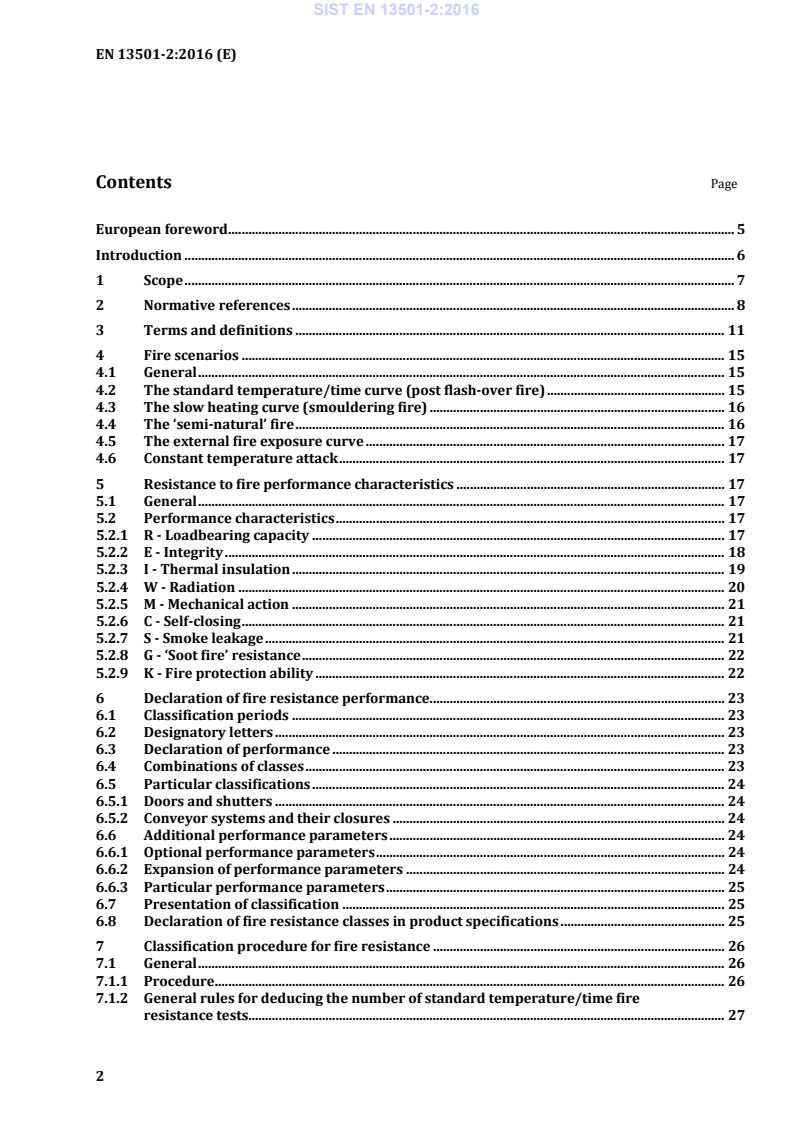
EUROPEAN STANDARD NORME EUROPÉENNE EUROPÄISCHE NORM
EN 13501-2
June
t r s x ICS
s uä t t rä w r Supersedes EN
s u w r sæ tã t r r y ªA sã t r r {English Version
Fire classification of construction products and building elements æ Part
tã Classification using data from fire resistance testsá excluding ventilation services Classement au feu des produits et éléments de construction æ Partie
tã Classement à partir des données d 5essais de résistance au feu à l 5exclusion des produits utilisés dans les systèmes de ventilation
Klassifizierung von Bauprodukten und Bauarten zu ihrem Brandverhalten æ Teil
tã Klassifizierung mit den Ergebnissen aus den Feuerwiderstandsprüfungená mit Ausnahme von Lüftungsanlagen This European Standard was approved by CEN on
t u April
t r s xä
egulations which stipulate the conditions for giving this European Standard the status of a national standard without any alterationä Upætoædate lists and bibliographical references concerning such national standards may be obtained on application to the CENæCENELEC Management Centre or to any CEN memberä
translation under the responsibility of a CEN member into its own language and notified to the CENæCENELEC Management Centre has the same status as the official versionsä
CEN members are the national standards bodies of Austriaá Belgiumá Bulgariaá Croatiaá Cyprusá Czech Republicá Denmarká Estoniaá Finlandá Former Yugoslav Republic of Macedoniaá Franceá Germanyá Greeceá Hungaryá Icelandá Irelandá Italyá Latviaá Lithuaniaá Luxembourgá Maltaá Netherlandsá Norwayá Polandá Portugalá Romaniaá Slovakiaá Sloveniaá Spainá Swedená Switzerlandá Turkey andUnited Kingdomä
EUROPEAN COMMITTEE FOR STANDARDIZATION COMITÉ EUROPÉEN DE NORMALISATION EUROPÄISCHES KOMITEE FÜR NORMUNG
CEN-CENELEC Management Centre:
Avenue Marnix 17,
B-1000 Brussels
t r s x CEN All rights of exploitation in any form and by any means reserved worldwide for CEN national Membersä Refä Noä EN
s u w r sæ tã t r s x ESIST EN 13501-2:2016
Classification report . 63 A.1 General . 63 A.2 Content and format . 63 A.3 Classification report format . 64 Annex B (informative)
Presentation of characterization data and their field of application for products and systems for protecting elements or parts of work . 68 B.1 General . 68 B.2 Characterization data for protective vertical membranes . 68 B.3 Characterization data for applied protection to concrete members . 69 SIST EN 13501-2:2016
— fire protective coatings, claddings and screens; d) non-loadbearing elements or parts of works, with or without glazing, services and fixtures: — partitions; — facades (curtain walls) and external walls; — ceilings with independent fire resistance; — raised floors; — fire doors and shutters and their closing devices; SIST EN 13501-2:2016
Note 1 to entry: Element covers both individual products and elements made up of one or more products. [SOURCE: EN 1363-1: 2012] 3.2 ceiling non-loadbearing element of a building construction designed to provide horizontal fire separation [SOURCE: EN 1364-2:1999] 3.3 self-supporting ceiling ceiling with a span from wall to wall, without any additional suspension devices [SOURCE: EN 1364-2:1999] 3.4 door or shutter assembly (doorset) pedestrian doorset or industrial type doorset including any frame or guide, door leaf or leaves, rolling or folding curtain, etc; which is provided to give a fire resisting capability when used for the closing of permanent openings in fire resisting elements, which includes any side panel(s), flush over panel(s) transom panel(s) and/or glazing together with the building hardware and any seals (whether provided for the purpose of fire resistance or smoke control or for other purposes such as draught or acoustics) which form the assembly [SOURCE: EN 1634-1: 2014] 3.5 floor horizontal separating element of building construction which is loadbearing [SOURCE: EN 1365-2: 2014] SIST EN 13501-2:2016
The loadbearing capacity of the member at normal temperature is determined by testing or calculation, taking into account the actual mechanical properties of the loadbearing element tested. 3.27 covering product intended to protect underlying products against damage during a specified fire exposure 3.28 direct field of application outcome of a process (involving the application of defined rules) whereby a test result is deemed to be equally valid for variations in one or more of the product properties and/or intended end use applications SIST EN 13501-2:2016
is the time from the start of the test in minutes (min); T
is the mean furnace temperature in degrees Celsius (°C). NOTE Further details relating to the practical application of this curve and other test parameters, e.g. tolerances, are given in EN 1363-1. 4.3 The slow heating curve (smouldering fire) The smouldering fire test shall only be used if it is expected that the fire resistance performance of the element may be reduced by exposure to temperatures associated with the growth stage of a fire. It is, therefore, particularly relevant to elements whose performance may be dependent upon high heating rates below approximately 500 °C (as provided during the standard temperature/time curve) for achievement of their classifications (i.e. mainly reactive or intumescent products). The slow heating curve is given by the following relationship: for 0 < t

t s 0,2515420Tt=+
(2) for t > 21 ()()10345log820120Tt=−++
(3) where t
is the time from start of test in minutes (min); T
is the mean furnace temperature in degrees Celsius (°C). NOTE Further details relating to the practical application of this curve, and other test parameters e.g. tolerances, are given in EN 1363-2. 4.4 The ‘semi-natural’ fire During the ‘semi-natural’ fire test the temperature of the fire gases adjacent to the soffit of the ceiling shall reach 1 000 °C within 10 min to 20 min of the start of the test. Because of the difficulties in achieving the necessary thermal attack in a conventional furnace, the attack shall be provided by fire from wooden cribs made from softwood. NOTE 1 The ‘semi-natural’ fire is a fire which produces direct flame impingement with a high convective heat transfer content which is not realised in furnace tests using the standard temperature/time curve. The term ‘semi-natural’ fire corresponds to the single burning item exposure required for ceilings in 4.3.1.3.4 (a) of the Interpretative Document 2 (not to be confused with the “single burning item” test for reaction to fire). It is relevant only for lightweight suspended horizontal protective membranes having a low thermal inertia. NOTE 2 Further details relating to the practical application of this thermal attack, and other test parameters, are given in EN 13381-1. SIST EN 13501-2:2016
(4) where t
is the time from start of test in minutes (min); T
is the mean furnace temperature in degrees Celsius (°C). NOTE Further details relating to the practical application of this curve, and other test parameters e.g. tolerances, are given in EN 1363-2. 4.6 Constant temperature attack In addition to the heating regimes given above, the evaluation of some elements shall be made using a notional constant value of temperature. The specified temperature depends upon the type of element. The rate at which this temperature is achieved is specified in each relevant test standard. The following temperatures shall be used for the elements indicated: — 20 °C for evaluating the leakage rate of smoke control doors at ambient temperature; — 200 °C for evaluating the leakage rate of medium temperature smoke control doors; — 500 °C for evaluating the fire performance of raised floors; — 1 000 °C for evaluating soot fire resistance of chimneys and chimney related products. 5 Resistance to fire performance characteristics 5.1 General ID2 requires the assessment of the characteristic loadbearing capacity and/or integrity and/or insulation. Further optional characteristics are also specified by ID2, namely radiation, mechanical aspects, self-closing ability and smoke leakage. The need to classify based on these optional characteristics is dependent on national regulations and may be specified under certain conditions for certain elements. This clause provides the necessary details of each of the above characteristics. Where a characteristic may have more than one different definition or type of performance, later clauses identify which specific definition applies to which element. 5.2 Performance characteristics 5.2.1 R - Loadbearing capacity Loadbearing capacity R is the ability of the element of construction to withstand fire exposure under specified mechanical actions, on one or more faces, for a period of time, without any loss of structural stability. SIST EN 13501-2:2016
...