

EN 13501-2:2007+A1:2009
(Main + Amendment)Fire classification of construction products and building elements - Part 2: Classification using data from fire resistance tests, excluding ventilation services
- Abstract
This European Standard specifies the procedure for classification of construction products and building elements using data from fire resistance and smoke leakage tests which are within the direct field of application of the relevant test method. Classification on the basis of extended application of test results is also included in the scope of this European Standard.
This European Standard deals with:
a) loadbearing elements without a fire separating function:
walls;
floors;
roofs;
beams;
columns;
balconies;
walkways;
stairs.
b) loadbearing elements with a fire separating function, with or without glazing, services and fixtures:
walls;
floors;
roofs;
raised floors.
c) products and systems for protecting elements or parts of the works
ceilings with no independent fire resistance;
fire protective coatings, claddings and screens;
d) non-loadbearing elements or parts of works, with or without glazing, services and fixtures:
partitions;
facades (curtain walls) and external walls;
ceilings with independent fire resistance;
fire doors and shutters and their closing devices;
smoke control doors;
conveyor systems and their closures;
penetration seals;
linear joint seals;
service ducts and shafts;
chimneys.
e) wall and ceiling coverings with fire protection ability.
f) lift landing doors which are tested according to EN 81-58 are excluded from this European Standard. Lift landing doors which are tested according to EN 1634-1 are classified in accordance with 7.5.5.
Relevant test methods which have been prepared for these elements are listed in Clauses 2 and 7.
- Status
- Withdrawn
- Publication Date
- 01-Sep-2009
- Withdrawal Date
- 06-Oct-2026
- Technical Committee
- CEN/TC 127 - Fire safety in buildings
- Drafting Committee
- CEN/TC 127/WG 7 - Classification
- Current Stage
- 9960 - Withdrawal effective - Withdrawal
- Start Date
- 22-Jun-2016
- Completion Date
- 07-Oct-2026

Relations
- Effective Date
- 27-Jun-2009
- Effective Date
- 29-Jun-2016
- Effective Date
- 02-Sep-2026
- Effective Date
- 29-Jul-2026
- Effective Date
- 28-Jan-2026
- Effective Date
- 28-Jan-2026
- Effective Date
- 28-Jan-2026
- Effective Date
- 28-Jan-2026
- Effective Date
- 28-Jan-2026
- Effective Date
- 28-Jan-2026
- Effective Date
- 28-Jan-2026
- Effective Date
- 28-Jan-2026
- Effective Date
- 28-Jan-2026
- Effective Date
- 28-Jan-2026
- Effective Date
- 28-Jan-2026
Get Certified
Connect with accredited certification bodies for this standard

CIS Institut d.o.o.
Personal Protective Equipment (PPE) certification body. Notified Body NB-2890 for EU Regulation 2016/425 PPE.

Kiwa BDA Testing
Building and construction product certification.
Kmetijski inštitut Slovenije
Agricultural Institute of Slovenia. Soil testing, plant health, agricultural product analysis.
Sponsored listings
Frequently Asked Questions
EN 13501-2:2007+A1:2009 is a standard published by the European Committee for Standardization (CEN). Its full title is "Fire classification of construction products and building elements - Part 2: Classification using data from fire resistance tests, excluding ventilation services". This standard covers: This European Standard specifies the procedure for classification of construction products and building elements using data from fire resistance and smoke leakage tests which are within the direct field of application of the relevant test method. Classification on the basis of extended application of test results is also included in the scope of this European Standard. This European Standard deals with: a) loadbearing elements without a fire separating function: walls; floors; roofs; beams; columns; balconies; walkways; stairs. b) loadbearing elements with a fire separating function, with or without glazing, services and fixtures: walls; floors; roofs; raised floors. c) products and systems for protecting elements or parts of the works ceilings with no independent fire resistance; fire protective coatings, claddings and screens; d) non-loadbearing elements or parts of works, with or without glazing, services and fixtures: partitions; facades (curtain walls) and external walls; ceilings with independent fire resistance; fire doors and shutters and their closing devices; smoke control doors; conveyor systems and their closures; penetration seals; linear joint seals; service ducts and shafts; chimneys. e) wall and ceiling coverings with fire protection ability. f) lift landing doors which are tested according to EN 81-58 are excluded from this European Standard. Lift landing doors which are tested according to EN 1634-1 are classified in accordance with 7.5.5. Relevant test methods which have been prepared for these elements are listed in Clauses 2 and 7.
This European Standard specifies the procedure for classification of construction products and building elements using data from fire resistance and smoke leakage tests which are within the direct field of application of the relevant test method. Classification on the basis of extended application of test results is also included in the scope of this European Standard. This European Standard deals with: a) loadbearing elements without a fire separating function: walls; floors; roofs; beams; columns; balconies; walkways; stairs. b) loadbearing elements with a fire separating function, with or without glazing, services and fixtures: walls; floors; roofs; raised floors. c) products and systems for protecting elements or parts of the works ceilings with no independent fire resistance; fire protective coatings, claddings and screens; d) non-loadbearing elements or parts of works, with or without glazing, services and fixtures: partitions; facades (curtain walls) and external walls; ceilings with independent fire resistance; fire doors and shutters and their closing devices; smoke control doors; conveyor systems and their closures; penetration seals; linear joint seals; service ducts and shafts; chimneys. e) wall and ceiling coverings with fire protection ability. f) lift landing doors which are tested according to EN 81-58 are excluded from this European Standard. Lift landing doors which are tested according to EN 1634-1 are classified in accordance with 7.5.5. Relevant test methods which have been prepared for these elements are listed in Clauses 2 and 7.
EN 13501-2:2007+A1:2009 is classified under the following ICS (International Classification for Standards) categories: 13.220.50 - Fire-resistance of building materials and elements. The ICS classification helps identify the subject area and facilitates finding related standards.
EN 13501-2:2007+A1:2009 has the following relationships with other standards: It is inter standard links to EN 13501-2:2007, EN 13501-2:2016, EN 15269-5:2026, EN 15254-5:2026, EN 13381-4:2013, EN 1366-7:2004, prEN 15269-20, EN 1365-1:2012, EN 14600:2005, EN 1364-3:2014, EN 13381-2:2014, EN 13381-7:2019, EN 13381-5:2014, EN 13381-3:2015, EN 1365-2:2014. Understanding these relationships helps ensure you are using the most current and applicable version of the standard.
EN 13501-2:2007+A1:2009 is associated with the following European legislation: Standardization Mandates: M/117. When a standard is cited in the Official Journal of the European Union, products manufactured in conformity with it benefit from a presumption of conformity with the essential requirements of the corresponding EU directive or regulation.
EN 13501-2:2007+A1:2009 is available in PDF format for immediate download after purchase. The document can be added to your cart and obtained through the secure checkout process. Digital delivery ensures instant access to the complete standard document.
Standards Content (Sample)
2003-01.Slovenski inštitut za standardizacijo. Razmnoževanje celote ali delov tega standarda ni dovoljeno.Klassifizierung von Bauprodukten und Bauarten zu ihrem Brandverhalten - Teil 2: Klassifizierung mit den Ergebnissen aus den Feuerwiderstandsprüfungen, mit Ausnahme von LüftungsanlagenClassement au feu des produits et éléments de construction - Partie 2: Classement à partir des données d'essais de résistance au feu à l'exclusion des produits utilisés dans les systèmes de ventilationFire classification of construction products and building elements - Part 2: Classification using data from fire resistance tests, excluding ventilation services13.220.50Požarna odpornost gradbenih materialov in elementovFire-resistance of building materials and elementsICS:Ta slovenski standard je istoveten z:EN 13501-2:2007+A1:2009SIST EN 13501-2:2008+A1:2009en,fr,de01-december-2009SIST EN 13501-2:2008+A1:2009SLOVENSKI
STANDARD
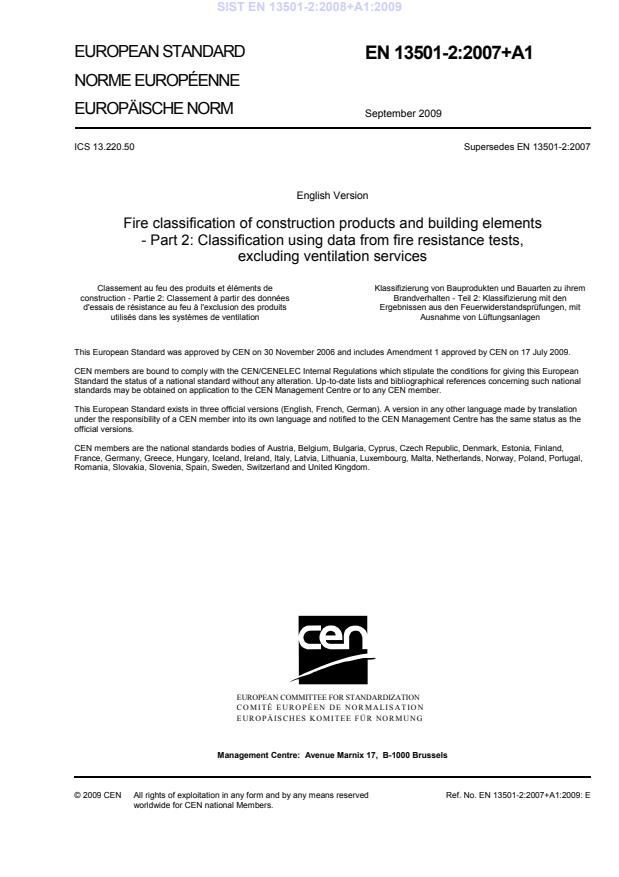
EUROPEAN STANDARD NORME EUROPÉENNE EUROPÄISCHE NORM
EN 13501-2:2007+A1
September 2009 ICS 13.220.50 Supersedes EN 13501-2:2007English Version
Fire classification of construction products and building elements - Part 2: Classification using data from fire resistance tests, excluding ventilation services
Classement au feu des produits et éléments de construction - Partie 2: Classement à partir des données d'essais de résistance au feu à l'exclusion des produits utilisés dans les systèmes de ventilation
Klassifizierung von Bauprodukten und Bauarten zu ihrem Brandverhalten - Teil 2: Klassifizierung mit den Ergebnissen aus den Feuerwiderstandsprüfungen, mit Ausnahme von Lüftungsanlagen This European Standard was approved by CEN on 30 November 2006 and includes Amendment 1 approved by CEN on 17 July 2009.
CEN members are bound to comply with the CEN/CENELEC Internal Regulations which stipulate the conditions for giving this European Standard the status of a national standard without any alteration. Up-to-date lists and bibliographical references concerning such national standards may be obtained on application to the CEN Management Centre or to any CEN member.
This European Standard exists in three official versions (English, French, German). A version in any other language made by translation under the responsibility of a CEN member into its own language and notified to the CEN Management Centre has the same status as the official versions.
CEN members are the national standards bodies of Austria, Belgium, Bulgaria, Cyprus, Czech Republic, Denmark, Estonia, Finland, France, Germany, Greece, Hungary, Iceland, Ireland, Italy, Latvia, Lithuania, Luxembourg, Malta, Netherlands, Norway, Poland, Portugal, Romania, Slovakia, Slovenia, Spain, Sweden, Switzerland and United Kingdom.
EUROPEAN COMMITTEE FOR STANDARDIZATION
COMITÉ EUROPÉEN DE NORMALISATION EUROPÄISCHES KOMITEE FÜR NORMUNG
Management Centre:
Avenue Marnix 17,
B-1000 Brussels © 2009 CEN All rights of exploitation in any form and by any means reserved worldwide for CEN national Members. Ref. No. EN 13501-2:2007+A1:2009: ESIST EN 13501-2:2008+A1:2009
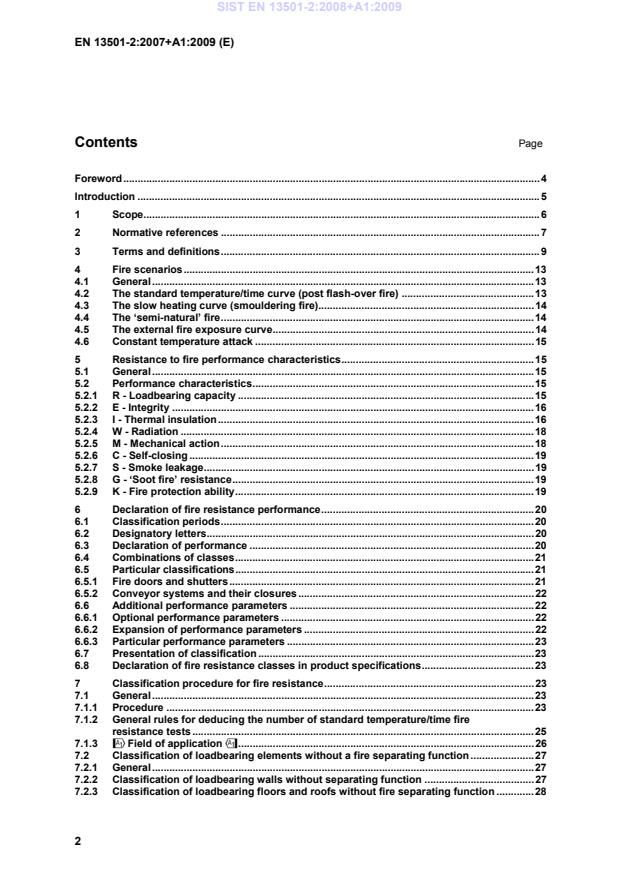
Classification report . 60A.1General . 60A.2Content and format . 60A.3Classification report format . 62Annex B (informative)
Presentation of characterisation data and their field of application for products and systems for protecting elements or parts of work . 66B.1General . 66B.2Characterisation data for protective vertical membranes . 66B.3Characterisation data for applied protection to concrete members . 67B.4Characterisation data for applied protection to steelwork . 68B.5Characterisation data for applied protection to concrete/profiled sheet steel composite members . 70B.6Characterisation data for applied protection to concrete filled hollow steel columns . 71B.7Characterisation data for applied protection to timber members . 72Bibliography . 80 SIST EN 13501-2:2008+A1:2009
walls; floors; roofs; beams; columns; balconies; walkways; stairs. b) loadbearing elements with a fire separating function, with or without glazing, services and fixtures:
walls; floors; roofs; raised floors. c) products and systems for protecting elements or parts of the works
ceilings with no independent fire resistance; fire protective coatings, claddings and screens; d) non-loadbearing elements or parts of works, with or without glazing, services and fixtures:
partitions; facades (curtain walls) and external walls; ceilings with independent fire resistance; fire doors and shutters and their closing devices; smoke control doors; conveyor systems and their closures; penetration seals; linear joint seals; service ducts and shafts; chimneys. e) wall and ceiling coverings with fire protection ability. f) lift landing doors which are tested according to EN 81-58 are excluded from this European Standard. Lift landing doors which are tested according to EN 1634-1 are classified in accordance with 7.5.5. Relevant test methods which have been prepared for these elements are listed in Clauses 2 and 7. SIST EN 13501-2:2008+A1:2009
- Full configuration (complete assembly) EN 1364-4, Fire resistance tests for non-loadbearing elements — Part 4: Curtain walling — Part configuration EN 1365-1, Fire resistance tests for loadbearing elements — Part 1: Walls EN 1365-2, Fire resistance tests for loadbearing elements — Part 2: Floors and roofs EN 1365-3, Fire resistance tests for loadbearing elements — Part 3: Beams EN 1365-4, Fire resistance tests for loadbearing elements — Part 4: Columns EN 1365-5, Fire resistance tests for loadbearing elements — Part 5: Balconies and walkways EN 1365-6, Fire resistance tests for loadbearing elements — Part 6: Stairs EN 1366-3, Fire resistance tests for service installations — Part 3: Penetration seals EN 1366-4, Fire resistance tests for service installations — Part 4: Linear joint seals EN 1366-5, Fire resistance tests for service installations — Part 5: Service ducts and shafts EN 1366-6, Fire resistance tests for service installations — Part 6: Raised access and hollow core floors EN 1366-7, Fire resistance tests for service installations — Part 7: Conveyor systems and their closures EN 1634-1, Fire resistance tests for door and shutter assemblies — Part 1: Fire doors and shutters EN 1634-3, Fire resistance tests for door and shutter assemblies — Part 3: Smoke control doors and shutters EN 13216-1, Chimneys — Test methods for system chimneys — Part 1: General test methods CEN/TS 13381-1, Test methods for determining the contribution to the fire resistance of structural members — Part 1: Horizontal protective membranes ENV 13381-2, Test methods for determining the contribution to the fire resistance of structural members — Part 2: Vertical protective membranes ENV 13381-3, Test methods for determining the contribution to the fire resistance of structural members — Part 3: Applied protection to concrete members SIST EN 13501-2:2008+A1:2009
1) !To be published." SIST EN 13501-2:2008+A1:2009
(EN 1363-1:1999). An element, for the purpose of this European Standard, covers both individual products and elements made up of one or more products 3.2 ceiling non-loadbearing element of a building construction designed to provide horizontal fire separation (EN 1364-2:1999) SIST EN 13501-2:2008+A1:2009
(EN 1364-2:1999) 3.4 door or shutter assembly (doorset) complete assembly, including any frame or guide, door leaf or leaves, rolling or folding curtain etc., which is provided for closing of permanent openings in separating elements. This includes all side-panels, vision panels or transom panels, together with the door hardware and any seals (whether provided for the purpose of fire or smoke control or for other purposes such as draught control or acoustics) which are used in the assembly
(EN 1634-1:2000) 3.5 floor horizontal element of building construction which is loadbearing
(EN 1365-2:1999) 3.6 roof horizontal or sloped element of building construction which is loadbearing
(EN 1365-2:1999) 3.7 suspended ceiling ceiling which is suspended from a supporting construction
(EN 1364-2:1999) 3.8 loadbearing wall wall designed to support an applied load
(EN 1365-1:1999) 3.9 non-loadbearing wall wall designed not to be subjected to any load other than its self weight
(EN 1364-1:1999) 3.10 internal wall wall which provides fire separation. It can be exposed separately to a fire from either side
(EN 1364-1:1999 and EN 1365-1:1999) 3.11 external wall wall forming the external envelope of a building which may be exposed separately to an internal or an external fire
(EN 1364-1:1999 and EN 1365-1:1999) SIST EN 13501-2:2008+A1:2009
(EN 1364-1:1999 and EN 1365-1:1999) 3.13 un-insulated wall wall, with or without glazing, which satisfies the integrity and, where required, the radiation criteria for the achieved fire resistance period but which is not intended to provide insulation. Such a wall can consist entirely of un-insulated fire resistant glazing
(EN 1364-1:1999 and EN 1365-1:1999) 3.14 separating wall wall with or without glazing provided within a building or between adjoining buildings to prevent the transfer of fire from one side to the other
(EN 1364-1:1999 and EN 1365-1:1999) 3.15 curtain wall external non-loadbearing wall which is independent of the structural frame and supported in place in front of loadbearing structures. A curtain wall typically includes panels, glazing, seals, fixings, transoms and mullions
(EN 1364-3:2006) 3.16 fire resistant glazing glazing system consisting of one or more transparent or translucent panes with a suitable method of mounting, with e.g. frames, seals and fixing materials, capable of satisfying the appropriate fire resistance criteria
(EN 1364-1:1999) 3.17 insulated glazing fire resistant glazing which satisfies both the integrity and insulation criteria for the achieved fire resistance period
(EN 1364-1:1999) 3.18 un-insulated glazing fire resistance glazing which satisfies the integrity and, where required, the radiation criteria for the achieved fire resistance period but which is not intended to provide insulation
(EN 1364-1:1999) 3.19 glazed element building element with one or more (light transmissive) panes, fire resistant or not, that are built in a frame with fixings and seals
(EN 1364-1:1999) SIST EN 13501-2:2008+A1:2009
(EN 1363-1:1999) 3.21 loadbearing element element that is intended for use in supporting an external load in a building and maintaining this support in the event of a fire
(EN 1363-1:1999) 3.22 separating element element that is intended for use in maintaining separation between two adjacent areas of a building in the event of a fire
(EN 1363-1:1999) 3.23 smoke leakage ability of an element of construction to reduce the passage of hot and/or cold gases or smoke from one side of the element to the other to below specified levels
(EN 1363-1:1999) 3.24 sustained flaming continuous flaming for a period of time greater than 10 s
(EN 1363-1:1999) 3.25 load level magnitude of the test load (mechanical actions) in relation to the loadbearing capacity of the member at normal temperature NOTE The loadbearing capacity of the member at normal temperature is determined by testing or calculation, taking into account the actual mechanical properties of the loadbearing element tested. 3.26 covering product intended to protect underlying products against damage during a specified fire exposure 3.27 direct field of application !outcome of a process (involving the application of defined rules) whereby a test result is deemed to be equally valid for variations in one or more of the product properties and/or intended end use applications" 3.28 extended field of application !outcome of a process (involving the application of defined rules that may incorporate calculation procedures) that predicts, for a variation of a product property and/or its intended end use application(s), a test result on the basis of one or more test results to the same test standard" SIST EN 13501-2:2008+A1:2009
(EN 1366-7:2004) !3.30 extended application result predicted result for a performance parameter obtained following the process of extended field of application 3.31 extended application report document reporting extended application results, including all details of the process leading to those results, prepared in accordance with prEN 15725" 4 Fire scenarios 4.1 General The second essential requirement of the Construction Products Directive addresses spread of fire and smoke and the loadbearing capacity of the construction. These requirements are considered to be satisfied by proving fire resistance of loadbearing and/or separating elements. Fire resistance of loadbearing and/or separating elements shall be assessed using one or more of the levels of thermal attack given in 4.2 to 4.6. Further clauses of this European Standard identify which attack(s) shall be used for which elements. NOTE 1 The various levels of thermal action given in 4.2 to 4.6 reflect different fire scenarios and the standards which prescribe their translation into practical tests give tolerances for their application. NOTE 2 Other heating curves exist, for example the hydrocarbon curve. Also, for extreme fire scenarios (e.g. traffic tunnels, nuclear plants), more severe conventional curves can be specified. These are not, however, used for the classification of elements according to this European Standard. 4.2 The standard temperature/time curve (post flash-over fire) When applied as a basis for testing, the standard temperature/time relationship shall be applied for the full duration of the test. The relationship, which is a model of a fully developed fire in a compartment, is given by the following relationship: T = 345 log10 (8t +1) + 20 where t
is the time from the start of the test in minutes (min); T
is the mean furnace temperature in degrees Celsius (°C). NOTE Further details relating to the practical application of this curve and other test parameters, e.g. tolerances, are given in EN 1363-1. SIST EN 13501-2:2008+A1:2009
is the time from start of test in minutes (min); T
is the mean furnace temperature in degrees Celsius (°C). NOTE Further details relating to the practical application of this curve, and other test parameters e.g. tolerances, are given in EN 1363-2. 4.4 The ‘semi-natural’ fire During the ‘semi-natural’ fire test the temperature of the fire gases adjacent to the soffit of the ceiling shall reach 1 000 °C within 10 min to 20 min of the start of the test. Because of the difficulties in achieving the necessary thermal attack in a conventional furnace, the attack shall be provided by fire from wooden cribs made from softwood. NOTE 1 The ‘semi-natural’ fire is a fire which produces direct flame impingement with a high convective heat transfer content which is not realised in furnace tests using the standard temperature/time curve. The term ‘semi-natural’ fire corresponds to the single burning item exposure required for ceilings in 4.3.1.3.4 (a) of the Interpretative Document 2 (not to be confused with the “single burning item” test for reaction to fire). It is relevant only for lightweight suspended horizontal protective membranes having a low thermal inertia. NOTE 2 Further details relating to the practical application of this thermal attack, and other test parameters, are given in CEN/TS 13381-1. 4.5 The external fire exposure curve This is a temperature/time relationship which represents the exposure of the external face of a wall to fire which may emerge from a window of a building, or from a free-burning external fire. The curve is defined by the relationship: T = 660 (1 – 0,687 e-0,32t – 0,313 e-3,8t) + 20 where t
is the time from start of test in minutes (min); T
is the mean furnace temperature in degrees Celsius (°C). SIST EN 13501-2:2008+A1:2009
...