

EN 12215:2004+A1:2009
(Main + Amendment)Coating plants - Spray booths for application of organic liquid coating materials - Safety requirements
- Abstract
This document is applicable to spray booths as well as multizone spray booths for the application of organic liquid coating materials (paints, varnishes....), and deals with all significant hazards relevant to spray booths or multizone spray booths, when they are used as intended and under the conditions foreseen by the manufacturer (see clause 4).
A spray booth is an assembly of the following linked components: forced ventilation by one or more fans; dry air filtering and/or wet air washing systems, measuring and control devices, ventilation air heating system, automatic fire extinguishing equipment, warning devices, electrical apparatus, joined together within or at a partially or totally enclosed structure (limited by walls, called space) for the controlled processing of spray application of organic liquid coating material.
NOTE 1 Spray booths are classified in annex G.
This standard describes methods of verification of safety measures, information labels to be affixed to the spray booth and minimum usage requirements contained within the operators handbook.
This standard does not cover:
- spraying areas (spaces for application of organic liquid coating materials which are limited only by one side wall used for extraction of exhaust ventilation).
- combined spray booths according to definition given in 3.2;
NOTE 2 See prEN 13355.
- the limiting walls of spray booths if they are constituent parts of a building are not to be considered part of the machinery assembly;
- the workroom or building used for the spraying of large size items (example: air-liner);
- spraying equipment used in spray booths which is covered by EN 1953, EN 50050, and EN 50176.
- Spray booths which are part of complex installations.
NOTE 3 complex installations may include additional hazards.
This standard is not applicable to spray boots which are manufactured before the date of publication of this standard by CEN.
- Status
- Withdrawn
- Publication Date
- 11-Aug-2009
- Withdrawal Date
- 06-Oct-2026
- Technical Committee
- CEN/TC 271 - Surface treatment equipment - Safety
- Drafting Committee
- CEN/TC 271/WG 3 - Coating plants
- Current Stage
- 9960 - Withdrawal effective - Withdrawal
- Start Date
- 05-Dec-2018
- Completion Date
- 07-Oct-2026

Relations
- Effective Date
- 19-Jan-2023
- Effective Date
- 18-Jan-2023
- Effective Date
- 08-Jul-2015
- Effective Date
- 25-Aug-2026
- Effective Date
- 09-Feb-2026
- Effective Date
- 09-Feb-2026
- Effective Date
- 09-Feb-2026
- Refers
EN IEC 60079-11:2024 - Explosive atmospheres - Part 11: Equipment protection by intrinsic safety "i" - Effective Date
- 09-Feb-2026
- Effective Date
- 09-Feb-2026
- Refers
EN IEC 60079-18:2025 - Explosive atmospheres - Part 18: Equipment protection by encapsulation "m" - Effective Date
- 09-Feb-2026
- Effective Date
- 09-Feb-2026
- Refers
EN 60079-2:2014 - Explosive atmospheres - Part 2: Equipment protection by pressurized enclosure "p" - Effective Date
- 09-Feb-2026
- Refers
EN 60079-6:2015 - Explosive atmospheres - Part 6: Equipment protection by liquid immersion "o" - Effective Date
- 09-Feb-2026
- Effective Date
- 09-Feb-2026
- Effective Date
- 09-Feb-2026
Frequently Asked Questions
EN 12215:2004+A1:2009 is a standard published by the European Committee for Standardization (CEN). Its full title is "Coating plants - Spray booths for application of organic liquid coating materials - Safety requirements". This standard covers: This document is applicable to spray booths as well as multizone spray booths for the application of organic liquid coating materials (paints, varnishes....), and deals with all significant hazards relevant to spray booths or multizone spray booths, when they are used as intended and under the conditions foreseen by the manufacturer (see clause 4). A spray booth is an assembly of the following linked components: forced ventilation by one or more fans; dry air filtering and/or wet air washing systems, measuring and control devices, ventilation air heating system, automatic fire extinguishing equipment, warning devices, electrical apparatus, joined together within or at a partially or totally enclosed structure (limited by walls, called space) for the controlled processing of spray application of organic liquid coating material. NOTE 1 Spray booths are classified in annex G. This standard describes methods of verification of safety measures, information labels to be affixed to the spray booth and minimum usage requirements contained within the operators handbook. This standard does not cover: - spraying areas (spaces for application of organic liquid coating materials which are limited only by one side wall used for extraction of exhaust ventilation). - combined spray booths according to definition given in 3.2; NOTE 2 See prEN 13355. - the limiting walls of spray booths if they are constituent parts of a building are not to be considered part of the machinery assembly; - the workroom or building used for the spraying of large size items (example: air-liner); - spraying equipment used in spray booths which is covered by EN 1953, EN 50050, and EN 50176. - Spray booths which are part of complex installations. NOTE 3 complex installations may include additional hazards. This standard is not applicable to spray boots which are manufactured before the date of publication of this standard by CEN.
This document is applicable to spray booths as well as multizone spray booths for the application of organic liquid coating materials (paints, varnishes....), and deals with all significant hazards relevant to spray booths or multizone spray booths, when they are used as intended and under the conditions foreseen by the manufacturer (see clause 4). A spray booth is an assembly of the following linked components: forced ventilation by one or more fans; dry air filtering and/or wet air washing systems, measuring and control devices, ventilation air heating system, automatic fire extinguishing equipment, warning devices, electrical apparatus, joined together within or at a partially or totally enclosed structure (limited by walls, called space) for the controlled processing of spray application of organic liquid coating material. NOTE 1 Spray booths are classified in annex G. This standard describes methods of verification of safety measures, information labels to be affixed to the spray booth and minimum usage requirements contained within the operators handbook. This standard does not cover: - spraying areas (spaces for application of organic liquid coating materials which are limited only by one side wall used for extraction of exhaust ventilation). - combined spray booths according to definition given in 3.2; NOTE 2 See prEN 13355. - the limiting walls of spray booths if they are constituent parts of a building are not to be considered part of the machinery assembly; - the workroom or building used for the spraying of large size items (example: air-liner); - spraying equipment used in spray booths which is covered by EN 1953, EN 50050, and EN 50176. - Spray booths which are part of complex installations. NOTE 3 complex installations may include additional hazards. This standard is not applicable to spray boots which are manufactured before the date of publication of this standard by CEN.
EN 12215:2004+A1:2009 is classified under the following ICS (International Classification for Standards) categories: 87.100 - Paint coating equipment. The ICS classification helps identify the subject area and facilitates finding related standards.
EN 12215:2004+A1:2009 has the following relationships with other standards: It is inter standard links to EN 12215:2004, EN 12215:2004/AC:2006, EN 16985:2018, ISO 8598:1996, EN IEC 60079-0:2018, EN IEC 60079-25:2022, EN IEC 60079-15:2019, EN IEC 60079-11:2024, EN 60079-5:2015, EN IEC 60079-18:2025, EN 50050:2006, EN 60079-2:2014, EN 60079-6:2015, EN 60529:1991, ISO 9289:1991. Understanding these relationships helps ensure you are using the most current and applicable version of the standard.
EN 12215:2004+A1:2009 is associated with the following European legislation: EU Directives/Regulations: 2006/42/EC, 98/37/EC; Standardization Mandates: M/079, M/396. When a standard is cited in the Official Journal of the European Union, products manufactured in conformity with it benefit from a presumption of conformity with the essential requirements of the corresponding EU directive or regulation.
EN 12215:2004+A1:2009 is available in PDF format for immediate download after purchase. The document can be added to your cart and obtained through the secure checkout process. Digital delivery ensures instant access to the complete standard document.
Standards Content (Sample)
2003-01.Slovenski inštitut za standardizacijo. Razmnoževanje celote ali delov tega standarda ni dovoljeno.Beschichtungsanlagen - Spritzkabinen für flüssige organische Beschichtungsstoffe - SicherheitsanforderungenInstallations d'application - Cabines d'application par pulvérisation de produits de revêtement organiques liquides - Prescriptions de sécuritéCoating plants - Spray booths for application of organic liquid coating materials - Safety requirements87.100Oprema za nanašanje premazovPaint coating equipment25.220.60Organske prevlekeOrganic coatingsICS:Ta slovenski standard je istoveten z:EN 12215:2004+A1:2009SIST EN 12215:2005+A1:2009en01-november-2009SIST EN 12215:2005+A1:2009SLOVENSKI
STANDARDSIST EN 12215:20051DGRPHãþD
EUROPEAN STANDARD NORME EUROPÉENNE EUROPÄISCHE NORM
EN 12215:2004+A1
August 2009 ICS 87.100 Supersedes EN 12215:2004English Version
Coating plants - Spray booths for application of organic liquid coating materials - Safety requirements
Installations d'application - Cabines d'application par pulvérisation de produits de revêtement organiques liquides - Prescriptions de sécurité
Beschichtungsanlagen - Spritzkabinen für flüssige organische Beschichtungsstoffe - Sicherheitsanforderungen This European Standard was approved by CEN on 10 September 2004 and includes Corrigendum 1 issued by CEN on 14 June 2006 and Amendment 1 approved by CEN on 16 July 2009.
CEN members are bound to comply with the CEN/CENELEC Internal Regulations which stipulate the conditions for giving this European Standard the status of a national standard without any alteration. Up-to-date lists and bibliographical references concerning such national standards may be obtained on application to the CEN Management Centre or to any CEN member.
This European Standard exists in three official versions (English, French, German). A version in any other language made by translation under the responsibility of a CEN member into its own language and notified to the CEN Management Centre has the same status as the official versions.
CEN members are the national standards bodies of Austria, Belgium, Bulgaria, Cyprus, Czech Republic, Denmark, Estonia, Finland, France, Germany, Greece, Hungary, Iceland, Ireland, Italy, Latvia, Lithuania, Luxembourg, Malta, Netherlands, Norway, Poland, Portugal, Romania, Slovakia, Slovenia, Spain, Sweden, Switzerland and United Kingdom.
EUROPEAN COMMITTEE FOR STANDARDIZATION
COMITÉ EUROPÉEN DE NORMALISATION EUROPÄISCHES KOMITEE FÜR NORMUNG
Management Centre:
Avenue Marnix 17,
B-1000 Brussels © 2009 CEN All rights of exploitation in any form and by any means reserved worldwide for CEN national Members. Ref. No. EN 12215:2004+A1:2009: ESIST EN 12215:2005+A1:2009
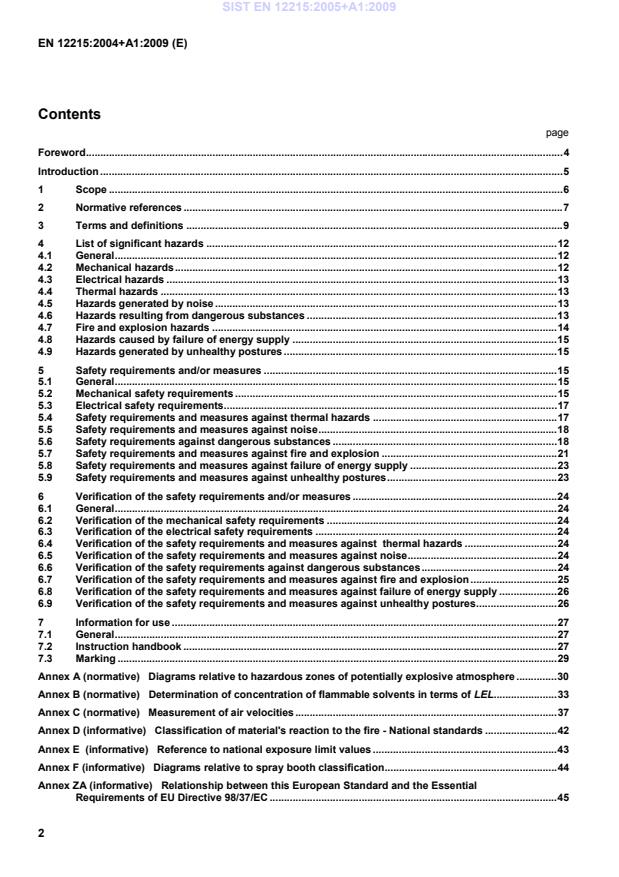
thermal hazards . 246.5Verification of the safety requirements and measures against noise . 246.6Verification of the safety requirements against dangerous substances . 246.7Verification of the safety requirements and measures against fire and explosion . 256.8Verification of the safety requirements and measures against failure of energy supply . 266.9Verification of the safety requirements and measures against unhealthy postures . 267Information for use . 277.1General . 277.2Instruction handbook . 277.3Marking . 29Annex A (normative)
Diagrams relative to hazardous zones of potentially explosive atmosphere . 30Annex B (normative)
Determination of concentration of flammable solvents in terms of LEL. 33Annex C (normative)
Measurement of air velocities . 37Annex D (informative)
Classification of material's reaction to the fire - National standards . 42Annex E
(informative)
Reference to national exposure limit values . 43Annex F (informative)
Diagrams relative to spray booth classification . 44Annex ZA (informative)
Relationship between this European Standard and the Essential Requirements of EU Directive 98/37/EC . 45SIST EN 12215:2005+A1:2009
!!!!Relationship between this European Standard and the Essential Requirements of EU Directive 2006/42/EC"""" . 46Bibliography . 47SIST EN 12215:2005+A1:2009
Attention is drawn to the possibility that some of the elements of this document may be the subject of patent rights. CEN [and/or CENELEC] shall not be held responsible for identifying any or all such patent rights. This European Standard was approved by CEN on 10 September 2004 and includes Corrigendum 1 issued by CEN on 14 June 2006 and Amendment 1 approved by CEN on 16 July 2009. This document supersedes EN 12215:2004. The start and finish of text introduced or altered by amendment is indicated in the text by tags !". The modifications of the related CEN Corrigendum have been implemented at the appropriate places in the text and are indicated by the tags ˜ ™1. This document is one of a set of standards devoted to the health and safety requirements of coating plants for the application and drying of organic liquid coating material and varnishes. This document has been prepared under a mandate given to CEN by the European Commission and the European Free Trade Association, and supports essential requirements of EU-directives. NOTE Although a spray booth, as an integral whole, formally does not fall under the scope of the ATEX Directive 94/9/EC, the standard is based upon a fundamental risk analysis according to this directive. !For relationship with EU Directives, see informative Annexes ZA and ZB, which are integral parts of this document." According to the CEN/CENELEC Internal Regulations, the national standards organizations of the following countries are bound to implement this European Standard: Austria, Belgium, Bulgaria, Cyprus, Czech Republic, Denmark, Estonia, Finland, France, Germany, Greece, Hungary, Iceland, Ireland, Italy, Latvia, Lithuania, Luxembourg, Malta, Netherlands, Norway, Poland, Portugal, Romania, Slovakia, Slovenia, Spain, Sweden, Switzerland and United Kingdom.
1 Applicable to the French version. SIST EN 12215:2005+A1:2009
EN 525, Non-domestic direct gas-fired forced convection air heaters for space heating not exceeding a net heat input of 300 kW. EN 563, Safety of machinery — Temperatures of touchable surfaces — Ergonomics data to establish temperature limit values for hot surfaces. EN 746-1, Industrial thermoprocessing equipment — Part 1: Common safety requirements for industrial thermoprocessing equipment. EN 746-2, Industrial thermoprocessing equipment — Part 2: Safety requirements for combustion and fuel handling systems. EN 954-1, Safety of machinery — Safety-related parts of control systems — Part 1: General principles for
design. EN 971-1:1996, Paints and varnishes — Terms and definitions for coating materials — Part 1: General terms. EN 982, Safety of machinery — Safety requirements for fluid power systems and their components — Hydraulics. EN 983, Safety of machinery — Safety requirements for fluid power systems and their components — Pneumatics. EN 1070:1998, Safety of machinery — Terminology. EN 1088, Safety of machinery — Interlocking devices associated with guards — Principles for design and selection. EN 1127-1:1997, Explosive atmospheres — Explosion prevention and protection — Part 1: Basic concepts and methodology. EN 1838, Lighting applications — Emergency lighting. EN 1953, Atomising and spraying equipment for coating materials — Safety requirements. EN 13463-1:2001, Non-electrical equipment for potentially explosive atmospheres — Part 1: Basic method and requirements. EN 13463-5, Non-electrical equipment intended for use in potentially explosive atmospheres — Part 5: Protection by constructional safety “c”. EN 13478, Safety of machinery — Fire prevention and protection. prEN 14986, Design of fans working in potentially explosive atmospheres. !EN 14462:2005 Noise test code for surface treatment equipment including its ancillary handling equipment" EN 50015, Electrical apparatus for potentially explosive atmospheres — Oil immersion "o", EN 50016, Electrical apparatus for potentially explosive atmospheres — Pressurised apparatus "p". EN 50017, Electrical apparatus for potentially explosive atmospheres — Powder filling "q". EN 50050, Electrical apparatus for potentially explosive atmospheres — Electrostatic hand-held spraying equipment. SIST EN 12215:2005+A1:2009
explosive gas atmospheres – Part 0: General requirements
(IEC 60079-0:2004. EN 60079-1, Electrical apparatus for
potentially explosive
atmospheres – Part 1:
Flameproof enclosure "d" (IEC
60079-1:2003). EN 60079-7, Electrical apparatus for explosive gas
atmospheres – Part 7: Increased safety
"e" (IEC 60079-7:2001). EN 50020, Electrical apparatus for potentially explosive atmospheres — Intrinsic safety "i". EN 60079-15, Electrical apparatus for
explosive gas atmospheres -
Part 15: Type of protection "n"
(IEC 60079-15:2001, modified). EN 60079-18, Electrical apparatus for
explosive gas atmospheres – Part 18: Construction, test and
marking of type of protection
encapsulation "m" electrical
apparatus (IEC 60079-18:2004). EN 60079-25, Electrical apparatus for
explosive gas atmospheres – Part 25: Intrinsically safe
systems (IEC 60079-25:2003. EN 60204-1:1997, Safety of machinery — Electrical equipment of machines – Part 1:
General requirements (IEC
60204-1:1997). EN 60529, Degrees of protection provided by enclosures (IP code) (IEC 60529:1989). EN ISO 3746, Acoustics — Determination of sound power levels of noise sources using sound pressure — Survey method using an enveloping measurement surface over a reflecting plane (ISO 3764:1995). EN ISO 4871, Acoustics — Declaration and verification of noise emission values of machinery and equipment (ISO 4871:1996). EN ISO 11202, Acoustics — Noise emitted by machinery and equipment — Measurement of emission sound pressure levels at the work station and at other specified positions — Survey method in situ (ISO 11202:1995). EN ISO 12100-1:2003, Safety of machinery - Basic concepts, general principles for design – Part 1: Basic terminology, methodology (ISO 12100-1:2003). EN ISO 12100-2:2003, Safety of machinery - Basic concepts, general principles for design – Part 2: Technical principles (ISO 12100-2:2003). EN ISO 14122-2, Safety of machinery — Permanent means of access to machinery — Part 2: Working platforms and walkways (ISO 14122-2:2001). EN ISO 14122-3, Safety of machinery — Permanent means of access to machinery — Part 3: Stairs, stepladders and guard-rails (ISO 14122-3:2001). EN ISO 14122-4, Safety of machinery — Permanent means of access to machinery — Part 4: Fixed ladders (ISO 14122-4:2004). SIST EN 12215:2005+A1:2009
3.1 spray booth assembly of linked components such as forced ventilation by one or more fans; dry air filtering and/or wet air washing systems, measuring and control devices (e.g. interlocking of forced ventilation and spraying device), ventilation air heating system (e.g. burner), automatic fire extinguishing equipment, warning devices, electrical apparatus, joined together within or at a partially or totally enclosed structure (limited by walls, called space) for the controlled processing of spray application of organic liquid coating material 3.1.1 enclosed spray booth (see annex F – Figures F.1 and F.3) spray booth enclosed on all sides during spray process except the openings for ingress and egress of workpieces and ducts for ventilation 3.1.2 open top spray booth (see annex F - Figure F.2) spray booth enclosed on all sides during spray process except the top entrance side for ventilation air, the openings for ingress and egress of workpieces and ducts for exhaust ventilation 3.1.3 open fronted spray booth (see annex F – Figure F.4) spray booth enclosed on all sides during spray process except openings provided in the side walls for ingress and egress of workpieces and ducts for exhaust ventilation. The open front side is used as entrance of ventilation air and access for operator 3.2 combined spraying and drying booth assembly of linked components such as fan(s), ventilation air heating system (e.g. heat exchanger or burner), power driven dampers, forced ventilation ducting, dry air filtering and/or wet air washing systems, automatic fire extinguishing equipment and additional specific electrical equipment, control and power circuits joined together for the spraying and drying process of liquid coating material in a space totally enclosed provided with a forced ventilation NOTE The combined booth can be provided with a working pit. 3.3 organic liquid coating material organic product, in liquid form, that when applied to a substrate forms a film possessing protective, decorative and/or other specific technical properties, e.g. paints, varnishes, including their solvents and thinners (see EN 971-1) 3.4 binder non-volatile part of the medium which forms the film (see 1.6 of EN 971-1:1996) 3.5 solvent single liquid, or blends of liquid, volatile under specified drying conditions, and in which the binder is completely soluble (see 1.4.5 of EN 971-1:1996) NOTE Solvents are also contained in liquids used as cleaning or washing agents. SIST EN 12215:2005+A1:2009
3.7 spray processes atomisation of liquid organic coating materials by different means 3.7.1 pneumatic process sprayed organic coating material by a flow of compressed air 3.7.2 airless or under hydrostatic pressure processed sprayed organic coating material through a suitable nozzle under high pressure 3.7.3 combined process combination of several processes such as hydrostatic pressure associated with compressed air 3.7.4 electrostatic process sprayed organic coating material electrostatically charged and attracted by the surface of the earthed workpiece 3.8 flammable (combustible) substance substance in the form of gas, vapour, liquid, solid or mixtures of these, able to undergo an exothermic reaction with air when ignited (see 3.1 of EN 1127-1:1997) NOTE "Combustible materials" and "flammable substances" are equivalently used terms in this standard. Examples are paint aerosols and solvents. 3.9 drying evaporation of liquids from the materials being processed (see 3.5 of EN 1539:2000) 3.10 forced ventilation air circulation achieved by one or several fans 3.11 fresh air air drawn from a clean source inside or outside the building into the spray booth 3.12 circulated air air extracted from the volume and reintroduced into it NOTE In this standard, the volume is the spray booth. 3.13 explosive atmosphere mixture with air, under atmospheric conditions, of flammable substance(s) in the form of gas, vapour, mist or dust, in which after ignition has occurred, combustion spreads to the entire unburned mixture (see 3.17 of EN 1127-1:1997) 3.14 lower explosion limit (LEL) lower limit of explosion range (see 3.8 and 3.13 of EN 1127-1:1997) SIST EN 12215:2005+A1:2009
3.17.1 Equipment Group II Category 1 equipment in this category is intended for use in areas in which explosive atmospheres caused by mixtures of air and gases, vapours or mists are present continuously for long periods or frequently
(see 3.2.3 of EN 13463-1:2001) NOTE Equipment of category 1 is suitable for use in zone 0. 3.17.2 equipment Group II Category 2 Equipment in this category is intended for use in areas in which explosive atmospheres caused by mixtures of air and gases, vapours or mists are likely to occur (see 3.2.4 of EN 13463-1:2001) NOTE Equipment of category 2 is suitable for use in zone 1. 3.17.3 Equipment Group II Category 3 equipment in this category is intended for use in areas in which explosive atmospheres cause by mixtures of air and gases, vapours or mists are unlikely to occur, or, if they do occur, are likely to do so only in frequently and for a short period only (see 3.2.5 of EN 13463-1:2001) NOTE Equipment of category 3 is suitable for use in zone 2. 3.18 pit ground excavation covered or open. For example a suction pit SIST EN 12215:2005+A1:2009
4.7.1 Fire hazards Such hazards can be generated by, e.g.: ignition of flammable paint and varnish deposits inside the spray booth, in exhaust ducts and filtration units; when the spray booth is in operation a misuse or mechanical or electrical defects can cause ignition of these deposits. This is especially valid in electrostatic spray booths; in maintenance operations requiring use of cutting or welding tools, energy released can also initiate a combustion; The fast propagation of fire induces a risk for the neighbouring areas. failure of liquid coating material or solvent or combustible liquid pipes or fittings with exit of flammable liquids inside the spray booth; ignition of cleaning rags containing solvents; auto-ignition created from chemical reactions between different types of liquid coating materials; electrostatic equipment, badly driven items or control system malfunction causing electric arcs between items to be painted and machinery parts at high voltage. Hence electric arcs can provoke the ignition of the paint aerosol. This can especially occur in plant using robots or automated machines; heating devices capable of igniting solvents. NOTE Examples of ignition sources are: hot surfaces e.g. of heating systems and electrical equipment; sparks created by mechanically induced energy e.g. fans, conveyors, etc.; electrostatic discharges; electrical sparks; welding and other sources of thermal energy used during maintenance and cleaning. 4.7.2 Explosion hazards Such hazards can occur when the concentration of the flammable substances in air exceeds the lower explosion limit (LEL) and if an effective ignition source is present. NOTE 1 Examples of flammable substances which increase concentration above the normal: solvent vapours from the flash off process; SIST EN 12215:2005+A1:2009
...