

EN 1515-2:2001
(Main)Flanges and their joints - Bolting - Part 2: Classification of bolt materials for steel flanges, PN designated
- Abstract
This European Standard covers the classification of bolt materials combination with the flange material groups of steel flanges prEN 1092-1 (PN-designated).
Bolt materials are listed in EN 1515-1, flange material groups are listed in prEN 1092-1.
- Status
- Published
- Publication Date
- 04-Dec-2001
- Technical Committee
- CEN/TC 74 - Flanges and their joints
- Drafting Committee
- CEN/TC 74/WG 9 - Bolting
- Current Stage
- 9093 - Decision to confirm - Review Enquiry
- Start Date
- 13-Oct-2022
- Completion Date
- 30-Sep-2026
- Directive
- 97/23/EC - Pressure equipment


Overview
EN 1515-2:2001 - "Flanges and their joints - Bolting - Part 2: Classification of bolt materials for steel flanges, PN designated" is a CEN European Standard that defines how bolt materials are classified in combination with the flange material groups of steel flanges specified in prEN 1092-1 (PN‑designated). The standard links bolt material choices (listed in EN 1515-1) to flange groups to help ensure appropriate strength compatibility across pressure/temperature (p/T) ratings.
Key topics and technical requirements
- Scope: Classification of bolt materials for steel flanges (PN designated) using the flange material groups from prEN 1092-1. Bolt materials are referenced from EN 1515-1.
- Normative references: prEN 1092-1, EN 1515-1, EN 10269, EN ISO 898-1, EN ISO 3506-1 (standards governing flange groups, bolt selection and fastener mechanical properties).
- Combination tables: Table 1 maps flange material groups to permitted bolt material types and property classes. The table is valid for flanges with p/T ratings in prEN 1092-1 and may be used as a guide for large flanges without p/T ratings (e.g., DN 700+).
- Strength classification: For each flange group, bolt materials are classified into three strength levels:
- Low strength - strength ratio (flange/bolt) less than the standard flange calculation; suitable for less severe services or oversized joints (may require joint recalculation).
- Normal strength - strength ratio similar to that used in standard flange calculation; suitable for general service within p/T ratings.
- High strength - bolt strength significantly exceeds the standard calculation; usable but requires careful assembly control (e.g., torque control) to avoid overstressing flanges.
- Design check: Classification is based on comparing the chosen flange/bolt strength ratio to the ratio used in the standard flange calculation (see informative Annex A).
- Safety note: Materials in classes 4.6 and 6.8 are explicitly not intended for use within the scope of the EU Pressure Equipment Directive.
Applications
- Selecting and specifying appropriate bolting for steel flanged joints in piping, valves and pressure systems.
- Creating procurement and technical specifications that ensure material compatibility with flange material groups and p/T ratings.
- Guiding maintenance, replacement and retrofitting decisions for flanged joints to maintain mechanical integrity and regulatory compliance.
Who uses this standard
- Piping and mechanical engineers
- Pressure equipment designers and manufacturers
- Fastener and flange suppliers
- QA/QC inspectors and maintenance teams
- Procurement/specification writers seeking compliance with EU directives
Related standards
- EN 1515-1 - Selection of bolting
- prEN 1092-1 - Circular steel flanges (PN designated)
- EN ISO 898-1, EN ISO 3506-1 - Mechanical properties of fasteners
- EN 10269 - Steels and nickel alloys for fasteners
Keywords: EN 1515-2, flanges, bolt materials classification, steel flanges PN, bolting selection, prEN 1092-1, EN 1515-1, flange bolting compatibility, p/T ratings.
Relations
- Effective Date
- 28-Jan-2026
- Effective Date
- 28-Jan-2026
- Effective Date
- 28-Jan-2026
- Effective Date
- 28-Jan-2026
- Effective Date
- 09-Feb-2026
- Effective Date
- 09-Feb-2026
- Effective Date
- 28-Jan-2026
- Effective Date
- 28-Jan-2026
- Effective Date
- 28-Jan-2026
- Effective Date
- 28-Jan-2026
- Effective Date
- 28-Jan-2026
- Effective Date
- 28-Jan-2026
- Effective Date
- 28-Jan-2026
- Effective Date
- 28-Jan-2026
- Effective Date
- 28-Jan-2026
Get Certified
Connect with accredited certification bodies for this standard

Institut za varilstvo d.o.o. (Welding Institute)
Slovenia's leading welding institute since 1952. ISO 3834, EN 1090, pressure equipment certification, NDT personnel, welder qualification. Only IIW Au
Sponsored listings
Frequently Asked Questions
EN 1515-2:2001 is a standard published by the European Committee for Standardization (CEN). Its full title is "Flanges and their joints - Bolting - Part 2: Classification of bolt materials for steel flanges, PN designated". This standard covers: This European Standard covers the classification of bolt materials combination with the flange material groups of steel flanges prEN 1092-1 (PN-designated). Bolt materials are listed in EN 1515-1, flange material groups are listed in prEN 1092-1.
This European Standard covers the classification of bolt materials combination with the flange material groups of steel flanges prEN 1092-1 (PN-designated). Bolt materials are listed in EN 1515-1, flange material groups are listed in prEN 1092-1.
EN 1515-2:2001 is classified under the following ICS (International Classification for Standards) categories: 21.060.10 - Bolts, screws, studs; 21.060.20 - Nuts; 23.040.60 - Flanges, couplings and joints. The ICS classification helps identify the subject area and facilitates finding related standards.
EN 1515-2:2001 has the following relationships with other standards: It is inter standard links to EN ISO 898-1:2013, EN 10269:2013, EN ISO 3506-1:2020, EN 1515-1:1999, EN 60244-11:1993, HD 236.4 S2:1978, EN 13480-3:2012, EN 13480-3:2017, EN 12308:1998, EN 12693:2008, EN 13480-3:2024, EN 1594:2024, EN 1092-1:2018, EN 12007-3:2000, EN 14141:2013. Understanding these relationships helps ensure you are using the most current and applicable version of the standard.
EN 1515-2:2001 is associated with the following European legislation: EU Directives/Regulations: 97/23/EC; Standardization Mandates: M/071. When a standard is cited in the Official Journal of the European Union, products manufactured in conformity with it benefit from a presumption of conformity with the essential requirements of the corresponding EU directive or regulation.
EN 1515-2:2001 is available in PDF format for immediate download after purchase. The document can be added to your cart and obtained through the secure checkout process. Digital delivery ensures instant access to the complete standard document.
Standards Content (Sample)
2003-01.Slovenski inštitut za standardizacijo. Razmnoževanje celote ali delov tega standarda ni dovoljeno.Flansche und ihre Verbindungen - Schrauben und Muttern - Teil 2: Klassifizierung von Schraubenwerkstoffen für Stahlflansche, nach PN bezeichnetBrides et leurs assemblages - Boulonnerie - Partie 2: Classification de matériaux de boulonnerie pour brides en acier, désignées PNFlanges and their joints - Bolting - Part 2: Classification of bolt materials for steel flanges, PN designated23.040.60Prirobnice, oglavki in spojni elementiFlanges, couplings and joints21.060.10Sorniki, vijaki, stebelni vijakiBolts, screws, studsICS:Ta slovenski standard je istoveten z:EN 1515-2:2001SIST EN 1515-2:2002en01-maj-2002SIST EN 1515-2:2002SLOVENSKI
STANDARD
EUROPEAN STANDARDNORME EUROPÉENNEEUROPÄISCHE NORMEN 1515-2December 2001ICS 21.060.01; 23.040.60English versionFlanges and their joints - Bolting - Part 2: Classification of boltmaterials for steel flanges, PN designatedBrides et leurs assemblages - Boulonnerie - Partie 2:Classification de matériaux de boulonnerie pour brides enacier, désignées PNFlansche und ihre Verbindungen - Schrauben und Muttern -Teil 2: Klassifizierung von Schraubenwerkstoffen fürStahlflansche, nach PN bezeichnetThis European Standard was approved by CEN on 20 October 2001.CEN members are bound to comply with the CEN/CENELEC Internal Regulations which stipulate the conditions for giving this EuropeanStandard the status of a national standard without any alteration. Up-to-date lists and bibliographical references concerning such nationalstandards may be obtained on application to the Management Centre or to any CEN member.This European Standard exists in three official versions (English, French, German). A version in any other language made by translationunder the responsibility of a CEN member into its own language and notified to the Management Centre has the same status as the officialversions.CEN members are the national standards bodies of Austria, Belgium, Czech Republic, Denmark, Finland, France, Germany, Greece,Iceland, Ireland, Italy, Luxembourg, Netherlands, Norway, Portugal, Spain, Sweden, Switzerland and United Kingdom.EUROPEAN COMMITTEE FOR STANDARDIZATIONCOMITÉ EUROPÉEN DE NORMALISATIONEUROPÄISCHES KOMITEE FÜR NORMUNGManagement Centre: rue de Stassart, 36
B-1050 Brussels© 2001 CENAll rights of exploitation in any form and by any means reservedworldwide for CEN national Members.Ref. No. EN 1515-2:2001 ESIST EN 1515-2:2002
(informative)
Basic information.17Annex ZA
(informative)
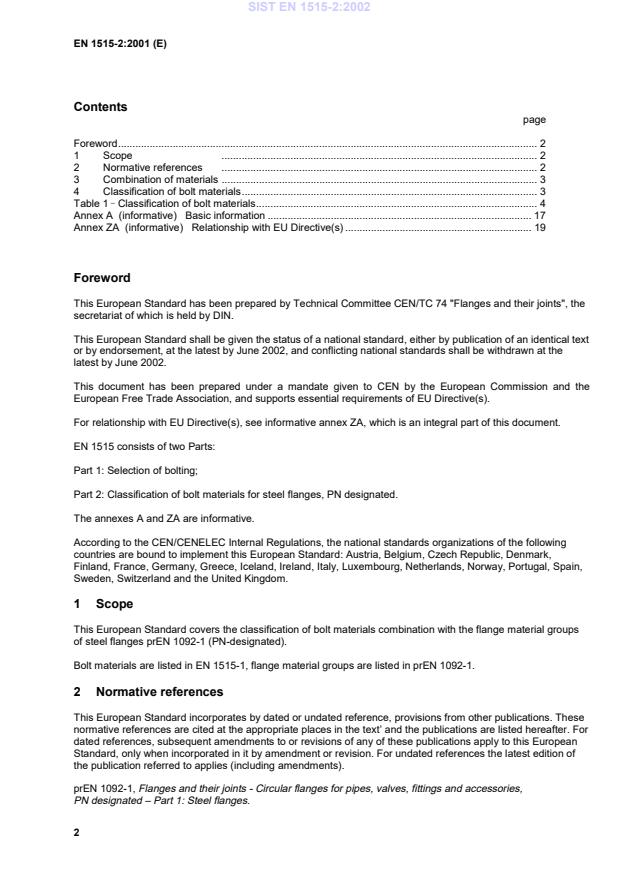
Relationship with EU Directive(s).19ForewordThis European Standard has been prepared by Technical Committee CEN/TC 74 "Flanges and their joints", thesecretariat of which is held by DIN.This European Standard shall be given the status of a national standard, either by publication of an identical textor by endorsement, at the latest by June 2002, and conflicting national standards shall be withdrawn at thelatest by June 2002.This document has been prepared under a mandate given to CEN by the European Commission and theEuropean Free Trade Association, and supports essential requirements of EU Directive(s).For relationship with EU Directive(s), see informative annex ZA, which is an integral part of this document.EN 1515 consists of two Parts:Part 1: Selection of bolting;Part 2: Classification of bolt materials for steel flanges, PN designated.The annexes A and ZA are informative.According to the CEN/CENELEC Internal Regulations, the national standards organizations of the followingcountries are bound to implement this European Standard: Austria, Belgium, Czech Republic, Denmark,Finland, France, Germany, Greece, Iceland, Ireland, Italy, Luxembourg, Netherlands, Norway, Portugal, Spain,Sweden, Switzerland and the United Kingdom.1ScopeThis European Standard covers the classification of bolt materials combination with the flange material groupsof steel flanges prEN 1092-1 (PN-designated).Bolt materials are listed in EN 1515-1, flange material groups are listed in prEN 1092-1.2Normative referencesThis European Standard incorporates by dated or undated reference, provisions from other publications. Thesenormative references are cited at the appropriate places in the text’ and the publications are listed hereafter. Fordated references, subsequent amendments to or revisions of any of these publications apply to this EuropeanStandard, only when incorporated in it by amendment or revision. For undated references the latest edition ofthe publication referred to applies (including amendments).prEN 1092-1, Flanges and their joints - Circular flanges for pipes, valves, fittings and accessories,PN designated – Part 1: Steel flanges.SIST EN 1515-2:2002
Bold materials 4.6 and 6.8 are not intended for the use in the scope of the Pressure Equipment Directive.4Classification of bolt materialsThe classification of bolt materials as given in Table 1 is based on the comparison of the strengths of the flangematerial and the bolt material. The strength ratio r of the flange/bolt combination chosen is compared with thestrength ratio of the flange bolt combination used for the standard flange calculation (see annex A).For each flange material group the classification is done in three strength levels: Low strength: The strength ratio of the chosen flange/bolt combination is less than that used in thestandard flange calculation.These bolts may be used for less severe service, e.g. for water service or in case of oversized flangedjoints. For definition of these service conditions, special experience is necessary otherwise a recalculation ofthe flanged joint shall be done. Normal strength: The strength ratio of the chosen flange/bolt combination is similar (within defined limits)to that used in the standard flange calculation.These bolts may be used for all service in the range of the P/T-ratings unless there are other restrictions tothe contrary. High strength: The strength ratio of the chosen flange/bolt combination is much more higher than that usedin the standard flange calculation.These bolts may be used in the same range like normal strength level bolting. During assembly however,care should be taken not to overstress the flanges (e. g. by means of torque control).SIST EN 1515-2:2002
...