

EN 13480-3:2012
(Main)Metallic industrial piping - Part 3: Design and calculation
- Abstract
1.1 The purpose of EN 13480 is to define the requirements for design, manufacture, installation, testing and inspection of industrial piping systems and supports, including safety systems, made of metallic materials (but initially restricted to steel) with a view to ensure safe operation. 1.2 EN 13480 is applicable to metallic piping above ground, ducted or buried, independent of pressure.
- Status
- Withdrawn
- Publication Date
- 26-Jun-2012
- Withdrawal Date
- 29-Sep-2026
- Technical Committee
- CEN/TC 267 - Industrial piping and pipelines
- Drafting Committee
- CEN/TC 267/WG 8 - Maintenance of EN 13480 series
- Current Stage
- 9960 - Withdrawal effective - Withdrawal
- Start Date
- 28-Jun-2017
- Completion Date
- 30-Sep-2026
- Directive
- 2014/68/EU - Directive 2014/68/EU of the European Parliament and of the Council of 15 May 2014 on the harmonisation of the laws of the Member States relating to the making available on the market of pressure equipmentOJ Ref: C 293/01 OJ Date: 12-Aug-2016
97/23/EC - Pressure equipmentOJ Ref: C, C 233 OJ Date: 03-Aug-2012

Relations
- Effective Date
- 04-Jul-2012
- Effective Date
- 04-Jul-2012
- Effective Date
- 04-Jul-2012
- Effective Date
- 04-Jul-2012
- Effective Date
- 20-Jun-2012
- Effective Date
- 06-Jun-2012
- Effective Date
- 08-Jun-2022
- Effective Date
- 28-Jan-2026
- Effective Date
- 28-Jan-2026
- Effective Date
- 28-Jan-2026
- Effective Date
- 28-Jan-2026
- Effective Date
- 28-Jan-2026
- Effective Date
- 28-Jan-2026
- Effective Date
- 28-Jan-2026
- Effective Date
- 28-Jan-2026
Get Certified
Connect with accredited certification bodies for this standard

Institut za varilstvo d.o.o. (Welding Institute)
Slovenia's leading welding institute since 1952. ISO 3834, EN 1090, pressure equipment certification, NDT personnel, welder qualification. Only IIW Au
Sponsored listings
Frequently Asked Questions
EN 13480-3:2012 is a standard published by the European Committee for Standardization (CEN). Its full title is "Metallic industrial piping - Part 3: Design and calculation". This standard covers: 1.1 The purpose of EN 13480 is to define the requirements for design, manufacture, installation, testing and inspection of industrial piping systems and supports, including safety systems, made of metallic materials (but initially restricted to steel) with a view to ensure safe operation. 1.2 EN 13480 is applicable to metallic piping above ground, ducted or buried, independent of pressure.
1.1 The purpose of EN 13480 is to define the requirements for design, manufacture, installation, testing and inspection of industrial piping systems and supports, including safety systems, made of metallic materials (but initially restricted to steel) with a view to ensure safe operation. 1.2 EN 13480 is applicable to metallic piping above ground, ducted or buried, independent of pressure.
EN 13480-3:2012 is classified under the following ICS (International Classification for Standards) categories: 23.040.01 - Pipeline components and pipelines in general. The ICS classification helps identify the subject area and facilitates finding related standards.
EN 13480-3:2012 has the following relationships with other standards: It is inter standard links to EN 13480-3:2002/A3:2009, EN 13480-3:2002/A4:2010, EN 13480-3:2002, EN 13480-3:2002/A5:2012, EN 13480-3:2002/A1:2005, EN 13480-3:2002/A2:2006, EN 13480-3:2017, EN 1993-1-4:2006, EN 13480-2:2012, EN 1515-2:2001, EN 287-1:2004/A2:2006, EN 13445-3:2009, EN 1993-1-3:2006, EN 12953-3:2002, EN 1993-1-1:2005. Understanding these relationships helps ensure you are using the most current and applicable version of the standard.
EN 13480-3:2012 is associated with the following European legislation: EU Directives/Regulations: 2014/68/EU, 97/23/EC; Standardization Mandates: M/071. When a standard is cited in the Official Journal of the European Union, products manufactured in conformity with it benefit from a presumption of conformity with the essential requirements of the corresponding EU directive or regulation.
EN 13480-3:2012 is available in PDF format for immediate download after purchase. The document can be added to your cart and obtained through the secure checkout process. Digital delivery ensures instant access to the complete standard document.
Standards Content (Sample)
2003-01.Slovenski inštitut za standardizacijo. Razmnoževanje celote ali delov tega standarda ni dovoljeno.Metallische industrielle Rohrleitungen - Teil 3: Konstruktion und BerechnungTuyauteries industrielles métalliques - Partie 3: Conception et calculMetallic industrial piping - Part 3: Design and calculation77.140.75Jeklene cevi in cevni profili za posebne nameneSteel pipes and tubes for specific useICS:Ta slovenski standard je istoveten z:EN 13480-3:2012SIST EN 13480-3:2012en,fr,de01-oktober-2012SIST EN 13480-3:2012SLOVENSKI
STANDARDSIST EN 13480-3:2002/A3:2009SIST EN 13480-3:2002/A4:2010SIST EN 13480-3:2002/A5:2012SIST EN 13480-3:2002SIST EN 13480-3:2002/A1:2005SIST EN 13480-3:2002/A2:20071DGRPHãþD
EUROPEAN STANDARD NORME EUROPÉENNE EUROPÄISCHE NORM
EN 13480-3
June 2012 ICS 23.040.01 Supersedes EN 13480-3:2002English Version
Metallic industrial piping - Part 3: Design and calculation
Tuyauteries industrielles métalliques - Partie 3: Conception et calcul
Metallische industrielle Rohrleitungen - Teil 3: Konstruktion und Berechnung This European Standard was approved by CEN on 8 May 2012.
CEN members are bound to comply with the CEN/CENELEC Internal Regulations which stipulate the conditions for giving this European Standard the status of a national standard without any alteration. Up-to-date lists and bibliographical references concerning such national standards may be obtained on application to the CEN-CENELEC Management Centre or to any CEN member.
This European Standard exists in three official versions (English, French, German). A version in any other language made by translation under the responsibility of a CEN member into its own language and notified to the CEN-CENELEC Management Centre has the same status as the official versions.
CEN members are the national standards bodies of Austria, Belgium, Bulgaria, Croatia, Cyprus, Czech Republic, Denmark, Estonia, Finland, France, Germany, Greece, Hungary, Iceland, Ireland, Italy, Latvia, Lithuania, Luxembourg, Malta, Netherlands, Norway, Poland, Portugal, Romania, Slovakia, Slovenia, Spain, Sweden, Switzerland, Turkey and United Kingdom.
EUROPEAN COMMITTEE FOR STANDARDIZATION
COMITÉ EUROPÉEN DE NORMALISATION EUROPÄISCHES KOMITEE FÜR NORMUNG
Management Centre:
Avenue Marnix 17,
B-1000 Brussels © 2012 CEN All rights of exploitation in any form and by any means reserved worldwide for CEN national Members. Ref. No. EN 13480-3:2012: ESIST EN 13480-3:2012
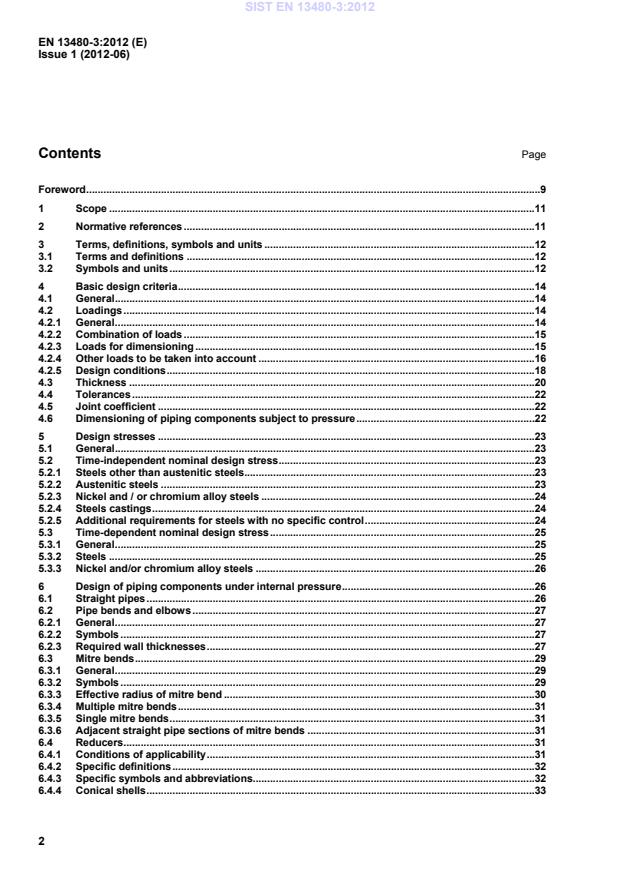
Issue 1 (2012-06) 2 Contents Page Foreword .9 1 Scope .11 2 Normative references .11 3 Terms, definitions, symbols and units .12 3.1 Terms and definitions .12 3.2 Symbols and units .12 4 Basic design criteria .14 4.1 General .14 4.2 Loadings .14 4.2.1 General .14 4.2.2 Combination of loads .15 4.2.3 Loads for dimensioning .15 4.2.4 Other loads to be taken into account .16 4.2.5 Design conditions .18 4.3 Thickness .20 4.4 Tolerances .22 4.5 Joint coefficient .22 4.6 Dimensioning of piping components subject to pressure .22 5 Design stresses .23 5.1 General .23 5.2 Time-independent nominal design stress .23 5.2.1 Steels other than austenitic steels .23 5.2.2 Austenitic steels .23 5.2.3 Nickel and / or chromium alloy steels .24 5.2.4 Steels castings .24 5.2.5 Additional requirements for steels with no specific control .24 5.3 Time-dependent nominal design stress .25 5.3.1 General .25 5.3.2 Steels .25 5.3.3 Nickel and/or chromium alloy steels .26 6 Design of piping components under internal pressure .26 6.1 Straight pipes .26 6.2 Pipe bends and elbows .27 6.2.1 General .27 6.2.2 Symbols .27 6.2.3 Required wall thicknesses .27 6.3 Mitre bends .29 6.3.1 General .29 6.3.2 Symbols .29 6.3.3 Effective radius of mitre bend .30 6.3.4 Multiple mitre bends .31 6.3.5 Single mitre bends .31 6.3.6 Adjacent straight pipe sections of mitre bends .31 6.4 Reducers .31 6.4.1 Conditions of applicability .31 6.4.2 Specific definitions .32 6.4.3 Specific symbols and abbreviations.32 6.4.4 Conical shells .33 SIST EN 13480-3:2012
Issue 1 (2012-06) 3 6.4.5 Junctions - general . 34 6.4.6 Junction between the large end of a cone and a cylinder without a knuckle . 34 6.4.7 Junction between the large end of a cone and a cylinder with a knuckle . 37 6.4.8 Junction between the small end of a cone and a cylinder . 38 6.4.9 Offset reducers . 40 6.4.10 Special forged reducers. 40 6.5 Flexible piping components . 41 6.5.1 General . 41 6.5.2 Expansion joints . 41 6.5.3 Corrugated metal hose assemblies . 42 6.6 Bolted flange connections. 44 6.6.1 General . 44 6.6.2 Symbols . 44 6.6.3 Standard flange . 44 6.6.4 Non-standard flange . 45 7 Design of ends under internal pressure . 45 7.1 Dished ends . 45 7.1.1 Symbols . 45 7.1.2 Hemispherical ends . 46 7.1.3 Torispherical ends . 46 7.1.4 Ellipsoidal ends . 48 7.1.5 Calculation of . 49 7.2 Circular flat ends . 52 7.2.1 General . 52 7.2.2 Symbols . 52 7.2.3 Unstayed flat circular ends welded to cylindrical shells/pipes . 54 7.2.4 Unstayed flat circular bolted ends . 61 7.2.5 Reinforcements of openings in unstayed flat ends . 67 8 Openings and branch connections . 69 8.1 General . 69 8.2 Symbols . 70 8.3 Limitations . 71 8.3.1 Thickness ratio . 71 8.3.2 Openings in the vicinity of discontinuities . 72 8.3.3 Types of reinforcement . 74 8.3.4 Calculation method . 75 8.3.5 Elliptical openings and oblique branch connections . 75 8.3.6 Reinforcing pads . 77 8.3.7 Dissimilar material of shell and reinforcements . 77 8.3.8 Extruded outlets . 77 8.3.9 Branches in bends or elbows . 77 8.3.10 Screwed-in branches . 77 8.4 Isolated openings . 78 8.4.1 General . 78 8.4.2 Unreinforced openings . 81 8.4.3 Reinforced openings with di/Di
< 0,8 . 81 8.4.4 Reinforced single openings with 0,8 < d/D 1,0 . 87 8.5 Adjacent openings . 87 8.5.1 Unreinforced openings . 87 8.5.2 Reinforced openings with d/D 0,8 . 87 8.6 Design of special piping components . 88 8.6.1 Cylindrical Y-pieces . 88 8.6.2 Spherical Y-pieces . 89 8.6.3 Triform reinforced branches . 90 9 Design of piping components under external pressure . 91 9.1 General . 91 9.2 Symbols and elastic stress limits . 93 SIST EN 13480-3:2012
Issue 1 (2012-06) 4 9.2.1 Symbols .93 9.2.2 Elastic stress limits .94 9.3 Cylindrical pipes, elbows and mitre bends .94 9.3.1 Determination of lengths .94 9.3.2 Interstiffener collapse .96 9.3.3 Overall collapse of stiffened pipes .98 9.3.4 Stiffener stability .99 9.3.5 Heating/cooling channels . 102 9.4 Reducers (conical shells) . 103 9.5 Dished ends . 104 9.5.1 Hemispherical ends . 104 9.5.2 Torispherical ends . 105 9.5.3 Ellipsoidal ends . 105 10 Design for cyclic loading . 106 10.1 General . 106 10.2 Exemption from detailed fatigue analysis . 106 10.3 Fatigue design for cyclic pressure . 107 10.3.1 Equivalent full load cycles . 107 10.3.2 Simplified fatigue analysis . 107 10.4 Fatigue design for thermal gradients . 121 10.4.1 General . 121 10.4.2 Design guidance . 121 10.5 Fatigue design for combined loads . 121 11 Integral attachments . 122 11.1 General . 122 11.2 Allowable stresses. 122 11.3 Symbols . 123 11.4 Hollow circular attachments . 125 11.4.1 Limitations . 125 11.4.2 Preliminary calculations . 125 11.4.3 Analysis of attachments welded to pipe with a full penetration weld . 127 11.4.4 Analysis of attachments welded to pipe with fillet or partial penetration weld . 128 11.5 Rectangular attachments . 128 11.5.1 Limitations . 128 11.5.2 Preliminary calculations . 128 11.5.3 Analysis of attachments welded to pipe with a full penetration weld . 130 11.5.4 Analysis of attachments welded to pipe with fillet or partial penetration weld . 130 11.6 Stress analysis of the run pipe . 131 11.7 Shear stress analysis in attachment. 132 11.7.1 Hollow circular attachments . 132 11.7.2 Rectangular attachments . 133 11.8 Alternative calculation methods . 133 12 Flexibility analysis and acceptance criteria . 133 12.1 Basic conditions . 133 12.1.1 General . 133 12.1.2 Loading conditions . 133 12.1.3 Allowable stresses. 133 12.2 Piping flexibility . 135 12.2.1 General . 135 12.2.2 Basic conditions . 135 12.2.3 Displacement strains . 136 12.2.4 Displacement stresses . 137 12.2.5 Stress range . 137 12.2.6 Cold pull . 138 12.2.7 Properties for flexibility analysis . 138 12.2.8 Supporting conditions . 139 12.2.9 Expansion joints . 140 SIST EN 13480-3:2012
Issue 1 (2012-06) 5 12.2.10 Flexibility analysis . 140 12.3 Flexibility analysis . 142 12.3.1 General . 142 12.3.2 Stress due to sustained loads . 142 12.3.3 Stress due to sustained and occasional or exceptional loads . 143 12.3.4 Stress range due to thermal expansion and alternating loads . 144 12.3.5 Additional conditions for the creep range . 145 12.3.6 Stresses due to a single non-repeated support movement . 145 12.3.7 Determination of resultant moments . 145 12.3.8 Reactions . 148 12.4 Fatigue analysis . 148 12.5 Vibration . 148 13 Supports . 148 13.1 General requirements . 148 13.1.1 General . 148 13.1.2 Classification of supports . 149 13.1.3 Additional definitions . 149 13.1.4 Boundaries . 150 13.1.5 Welded support attachments . 152 13.2 Material requirements . 154 13.3 Design . 154 13.3.1 General . 154 13.3.2 Design temperatures for support components . 155 13.3.3 Detail design . 157 13.3.4 Buckling . 158 13.3.5 Support location . 158 13.3.6 Determination of component sizes . 158 13.4 Connections . 159 13.4.1 Welded connections . 159 13.4.2 Bolted connections . 160 13.5 Design requirements for special components . 160 13.5.1 Constant load hangers and supports . 160 13.5.2 Variable load hangers and supports . 161 13.5.3 Rigid struts . 162 13.5.4 Shock arrestors (shock absorber, snubber) . 163 13.5.5 Sliding supports . 164 13.5.6 Anchors . 164 13.6 Documentation of supports. 164 13.7 Marking of supports . 164 Annex A (informative)
Dynamic analysis . 165 A.1 General . 165 A.2 Analysis by calculation . 165 A.2.1 Seismic events . 165 A.2.2 Rapid valve closure . 169 A.2.3 Flow induced vibration . 172 A.2.4 Safety valve discharge . 174 A.2.5 Allowable stresses . 176 A.3 Alternative means of design verification . 176 A.3.1 Comparative studies . 176 A.3.2 Full scale testing . 177 A.3.3 Reduced scale testing . 177 Annex B (normative)
More accurate calculation of bends and elbows . 178 B.1 General . 178 B.2 Symbols and units . 178 B.3 Required wall thickness. 179 B.4 Calculation . 180 B.4.1 Calculation of wall thickness . 180 SIST EN 13480-3:2012
Issue 1 (2012-06) 6 B.4.2 Stress calculation . 182 Annex C (informative)
Expansion joints . 186 C.1 Incorporation of expansion joints into piping systems . 186 C.1.1 General . 186 C.1.2 Types of expansion joints . 186 C.1.3 Design of expansion joints . 187 C.1.4 Designing with expansion joints . 188 C.1.5 Analyses and calculation . 189 C.1.6 Cold pull . 190 C.2 Maximum spacing for unrestrained axially compensated straight runs . 190 C.2.1 General . 190 C.2.2 Calculation rules . 190 C.2.3 Maximum spacing for defined conditions . 192 C.3 Indication for the design of expansion joints . 193 C.3.1 General . 193 C.3.2 Design data, Symbols . 194 C.3.3 Design and calculation . 195 C.3.4 Information for the system analyst . 197 Annex D (normative)
Flanges . 198 D.1 Purpose . 198 D.2 Specific terms and definitions . 198 D.3 Specific symbols and abbreviations. 199 D.4 General . 200 D.4.1 Introduction . 200 D.4.2 Use of standard flanges without calculation . 201 D.4.3 Bolting . 201 D.4.4 Flange construction. 203 D.4.5 Machining . 203 D.4.6 Gaskets . 203 D.5 Narrow face gasketed flanges . 204 D.5.1 General . 204 D.5.2 Bolt loads and areas . 207 D.5.3 Flange moments . 208 D.5.4 Flange stresses and stress limits . 209 D.5.5 Narrow face flanges subject to external pressure . 215 D.5.6 Lap joints . 215 D.5.7 Split ring flanges . 218 D.6 Full face flanges with soft ring type gaskets . 219 D.6.1 Specific symbols and abbreviations. 220 D.6.2 Bolt loads and areas . 220 D.6.3 Flange design . 221 D.6.4 Full face flanges subject to external pressure . 222 D.7 Seal welded flanges . 222 D.8 Reverse narrow face flanges . 223 D.8.1 Internal pressure . 223 D.8.2 External pressure. 225 D.9 Reverse full face flanges . 225 D.9.1 General . 225 D.9.2 Design following method of D.5 . 225 D.9.3 Design following method of D.6 . 227 D.10 Full face flanges with metal to metal contact . 229 D.10.1 General . 229 D.10.2 Specific symbols and abbreviations. 229 D.10.3 Design . 230 Annex E (normative)
Design of branch connections in piping accessories . 232 E.1 Scope . 232 E.1.1 General . 232 SIST EN 13480-3:2012
Issue 1 (2012-06) 7 E.2 Reinforcement . 234 E.2.1 Angles and areas . 234 E.2.2 The following condition shall be satisfied: . 234 E.3 Flexibility analysis . 236 Annex F (informative)
Testing during operation in the case of cyclic loading . 237 F.1 Testing during operation .
...