

ASTM C1775-22
(Specification)Standard Specification for Laminate Protective Jacket and Tape for Use over Thermal Insulation for Outdoor Applications
General Information
- Abstract
SCOPE
1.1 This specification addresses the minimum performance for flexible laminate protective jacket and a pressure sensitive adhesive tape for use over thermal insulation on pipes, duct, and equipment operating at both above and below ambient temperatures and installed outdoors, above ground. It does not include the following: protective metal jacket, homogenous plastic film jacket materials, modified asphalt jacket materials, and butyl rubber membranes.
1.2 This type of material shall consist of multiple layers of polymer film and aluminum foil laminated to one another with layer(s) of reinforcement as an option.
1.3 Jacket and tape materials covered by this specification shall have low water vapor permeance values; however, they are not necessarily always used as vapor retarders. The water vapor transmission tests address the jacket and tape materials only and do not address overlaps or taped joints. All materials shall be weather resistant and intended to have sufficient strength to provide protection for mechanical insulation.
1.4 Materials covered under this specification shall have a high, medium, or low surface emittance.
1.5 The top layer shall be on of the following: aluminum foil, a polymer film, or a polymer coating.
1.6 This specification includes jacket materials both with and without factory applied, pressure sensitive adhesives. The tape materials covered by this specification always have a factory applied, pressure sensitive adhesive.
1.7 The values stated in inch-pound units are to be regarded as standard. The values given in parentheses are mathematical conversions to SI units that are provided for information only and are not considered standard.
1.8 This standard does not purport to address all of the safety concerns, if any, associated with its use. It is the responsibility of the user of this standard to establish appropriate safety, health, and environmental practices and determine the applicability of regulatory limitations prior to use.
1.9 This international standard was developed in accordance with internationally recognized principles on standardization established in the Decision on Principles for the Development of International Standards, Guides and Recommendations issued by the World Trade Organization Technical Barriers to Trade (TBT) Committee.
- Status
- Published
- Publication Date
- 28-Feb-2022
- Technical Committee
- C16 - Thermal Insulation
- Drafting Committee
- C16.40 - Insulation Systems
Buy Documents


ASTM C1775-22 - Standard Specification for Laminate Protective Jacket and Tape for Use over Thermal Insulation for Outdoor Applications

REDLINE ASTM C1775-22 - Standard Specification for Laminate Protective Jacket and Tape for Use over Thermal Insulation for Outdoor Applications
Overview
ASTM C1775-22: Standard Specification for Laminate Protective Jacket and Tape for Use over Thermal Insulation for Outdoor Applications is an internationally recognized standard set forth by ASTM International. This specification outlines the minimum performance criteria for flexible laminate protective jackets and tapes designed to cover thermal insulation systems on pipes, ducts, and equipment installed outdoors and above ground, subject to both above and below ambient temperatures. The standard ensures materials provide sufficient protection against weather, mechanical damage, and moisture, resulting in improved durability and performance of underlying thermal insulation.
Key Topics
- Scope and Restrictions: ASTM C1775-22 explicitly covers flexible, multi-layer laminate jackets and pressure-sensitive adhesive tapes utilized as protective coverings over outdoor mechanical insulation. It does not apply to metal jackets, homogeneous plastic films, modified asphalt, or butyl rubber membranes.
- Material Construction:
- Jackets consist of multiple layers, including polymer film and aluminum foil, optionally with reinforcement layers.
- Top layers may be aluminum foil, polymer film, or polymer coatings.
- Product forms include both adhesive and non-adhesive jackets; all tapes feature factory-applied pressure-sensitive adhesives.
- Performance Requirements:
- Low water vapor permeance for moisture protection.
- Mechanical strength including puncture resistance, burst strength, and tensile strength.
- Weather resistance, including exposure to UV and moisture.
- Surface emittance ratings: materials can have high, medium, or low emittance levels, affecting insulation performance.
- Fungi resistance and dimensional stability for long-term reliability.
- Testing and Evaluation: Performance is measured according to multiple ASTM test methods, such as water vapor transmission, mechanical durability, peel adhesion, fungi resistance, and UV weathering.
Applications
Laminate protective jackets and tapes specified by ASTM C1775-22 are most often used to enhance the longevity and performance of thermal insulation systems in demanding outdoor environments. Typical applications include:
- Mechanical insulation protection for pipework, ductwork, and equipment on building exteriors or industrial sites.
- Moisture and weather shielding for thermal insulation in HVAC systems, chemical processing plants, refineries, and utilities.
- Sealing and joint wrapping for insulation cladding, ensuring continuous coverage and minimizing vapor ingress.
- Adaptability to various climates, functioning effectively across broad temperature ranges.
Using materials compliant with this standard can help facility owners and designers ensure consistent thermal performance, minimize energy loss, and prevent deterioration due to environmental exposure.
Related Standards
Several ASTM standards are frequently referenced alongside ASTM C1775-22 to provide a comprehensive basis for the specification, testing, and selection of insulation and protective jacketing materials:
- ASTM C168 - Terminology Relating to Thermal Insulation
- ASTM C1136 - Specification for Flexible, Low Permeance Vapor Retarders for Thermal Insulation
- ASTM C1263 - Test Method for Thermal Integrity of Flexible Water Vapor Retarders
- ASTM C1338 - Test Method for Determining Fungi Resistance of Insulation Materials and Facings
- ASTM C1371 - Test Method for Determination of Emittance of Materials Near Room Temperature Using Portable Emissometers
- ASTM D882, D1000, D1204, D3330, D3759 - Methods for testing plastic sheeting and tape physical properties
- ASTM E96, F1249 - Methods for water vapor transmission rate determination
- ASTM G154 - UV Weather Resistance Testing
Together, these standards support robust quality assurance and ensure protective jackets and tapes meet the demands of outdoor thermal insulation applications.
Keywords: laminate protective jacket, insulation jacketing, adhesive tape, outdoor thermal insulation, ASTM C1775-22, weather resistant insulation, pipe insulation protection, duct insulation covering, mechanical insulation, water vapor barrier, UV resistant, specification
Relations
- Effective Date
- 15-Apr-2024
- Effective Date
- 01-Jun-2020
- Effective Date
- 01-Apr-2020
- Effective Date
- 15-Apr-2018
- Effective Date
- 01-Jul-2017
- Effective Date
- 01-Jun-2017
- Effective Date
- 15-Oct-2015
- Effective Date
- 01-Jun-2015
- Effective Date
- 01-Mar-2014
- Effective Date
- 01-Jan-2014
- Effective Date
- 01-Apr-2013
- Effective Date
- 01-Dec-2012
- Effective Date
- 01-Aug-2011
- Effective Date
- 01-Nov-2010
- Refers
ASTM C1263-95(2010) - Standard Test Method for Thermal Integrity of Flexible Water Vapor Retarders - Effective Date
- 01-Nov-2010
Buy Documents
ASTM C1775-22 - Standard Specification for Laminate Protective Jacket and Tape for Use over Thermal Insulation for Outdoor Applications
REDLINE ASTM C1775-22 - Standard Specification for Laminate Protective Jacket and Tape for Use over Thermal Insulation for Outdoor Applications
Get Certified
Connect with accredited certification bodies for this standard

IMQ S.p.A. (Certification)
Italian electrical product certification.

SLG Prüf- und Zertifizierungs GmbH
German testing and certification body.

UL Solutions
Global safety science company with testing, inspection and certification.
Sponsored listings
Frequently Asked Questions
ASTM C1775-22 is a technical specification published by ASTM International. Its full title is "Standard Specification for Laminate Protective Jacket and Tape for Use over Thermal Insulation for Outdoor Applications". This standard covers: SCOPE 1.1 This specification addresses the minimum performance for flexible laminate protective jacket and a pressure sensitive adhesive tape for use over thermal insulation on pipes, duct, and equipment operating at both above and below ambient temperatures and installed outdoors, above ground. It does not include the following: protective metal jacket, homogenous plastic film jacket materials, modified asphalt jacket materials, and butyl rubber membranes. 1.2 This type of material shall consist of multiple layers of polymer film and aluminum foil laminated to one another with layer(s) of reinforcement as an option. 1.3 Jacket and tape materials covered by this specification shall have low water vapor permeance values; however, they are not necessarily always used as vapor retarders. The water vapor transmission tests address the jacket and tape materials only and do not address overlaps or taped joints. All materials shall be weather resistant and intended to have sufficient strength to provide protection for mechanical insulation. 1.4 Materials covered under this specification shall have a high, medium, or low surface emittance. 1.5 The top layer shall be on of the following: aluminum foil, a polymer film, or a polymer coating. 1.6 This specification includes jacket materials both with and without factory applied, pressure sensitive adhesives. The tape materials covered by this specification always have a factory applied, pressure sensitive adhesive. 1.7 The values stated in inch-pound units are to be regarded as standard. The values given in parentheses are mathematical conversions to SI units that are provided for information only and are not considered standard. 1.8 This standard does not purport to address all of the safety concerns, if any, associated with its use. It is the responsibility of the user of this standard to establish appropriate safety, health, and environmental practices and determine the applicability of regulatory limitations prior to use. 1.9 This international standard was developed in accordance with internationally recognized principles on standardization established in the Decision on Principles for the Development of International Standards, Guides and Recommendations issued by the World Trade Organization Technical Barriers to Trade (TBT) Committee.
SCOPE 1.1 This specification addresses the minimum performance for flexible laminate protective jacket and a pressure sensitive adhesive tape for use over thermal insulation on pipes, duct, and equipment operating at both above and below ambient temperatures and installed outdoors, above ground. It does not include the following: protective metal jacket, homogenous plastic film jacket materials, modified asphalt jacket materials, and butyl rubber membranes. 1.2 This type of material shall consist of multiple layers of polymer film and aluminum foil laminated to one another with layer(s) of reinforcement as an option. 1.3 Jacket and tape materials covered by this specification shall have low water vapor permeance values; however, they are not necessarily always used as vapor retarders. The water vapor transmission tests address the jacket and tape materials only and do not address overlaps or taped joints. All materials shall be weather resistant and intended to have sufficient strength to provide protection for mechanical insulation. 1.4 Materials covered under this specification shall have a high, medium, or low surface emittance. 1.5 The top layer shall be on of the following: aluminum foil, a polymer film, or a polymer coating. 1.6 This specification includes jacket materials both with and without factory applied, pressure sensitive adhesives. The tape materials covered by this specification always have a factory applied, pressure sensitive adhesive. 1.7 The values stated in inch-pound units are to be regarded as standard. The values given in parentheses are mathematical conversions to SI units that are provided for information only and are not considered standard. 1.8 This standard does not purport to address all of the safety concerns, if any, associated with its use. It is the responsibility of the user of this standard to establish appropriate safety, health, and environmental practices and determine the applicability of regulatory limitations prior to use. 1.9 This international standard was developed in accordance with internationally recognized principles on standardization established in the Decision on Principles for the Development of International Standards, Guides and Recommendations issued by the World Trade Organization Technical Barriers to Trade (TBT) Committee.
ASTM C1775-22 is classified under the following ICS (International Classification for Standards) categories: 29.035.20 - Plastics and rubber insulating materials; 29.120.10 - Conduits for electrical purposes. The ICS classification helps identify the subject area and facilitates finding related standards.
ASTM C1775-22 has the following relationships with other standards: It is inter standard links to ASTM C168-24, ASTM F1249-20, ASTM D1204-14(2020), ASTM C168-18, ASTM D1000-17, ASTM C168-17, ASTM C168-15a, ASTM C168-15, ASTM D1204-14, ASTM C1338-14, ASTM C168-13, ASTM G154-12, ASTM F1249-06(2011), ASTM C1371-04a(2010)e1, ASTM C1263-95(2010). Understanding these relationships helps ensure you are using the most current and applicable version of the standard.
ASTM C1775-22 is available in PDF format for immediate download after purchase. The document can be added to your cart and obtained through the secure checkout process. Digital delivery ensures instant access to the complete standard document.
Standards Content (Sample)
This international standard was developed in accordance with internationally recognized principles on standardization established in the Decision on Principles for the
Development of International Standards, Guides and Recommendations issued by the World Trade Organization Technical Barriers to Trade (TBT) Committee.
Designation:C1775 −22
Standard Specification for
Laminate Protective Jacket and Tape for Use over Thermal
Insulation for Outdoor Applications
This standard is issued under the fixed designation C1775; the number immediately following the designation indicates the year of
original adoption or, in the case of revision, the year of last revision. A number in parentheses indicates the year of last reapproval. A
superscript epsilon (´) indicates an editorial change since the last revision or reapproval.
1. Scope responsibility of the user of this standard to establish appro-
priate safety, health, and environmental practices and deter-
1.1 This specification addresses the minimum performance
mine the applicability of regulatory limitations prior to use.
for flexible laminate protective jacket and a pressure sensitive
1.9 This international standard was developed in accor-
adhesive tape for use over thermal insulation on pipes, duct,
dance with internationally recognized principles on standard-
and equipment operating at both above and below ambient
ization established in the Decision on Principles for the
temperatures and installed outdoors, above ground. It does not
Development of International Standards, Guides and Recom-
include the following: protective metal jacket, homogenous
mendations issued by the World Trade Organization Technical
plastic film jacket materials, modified asphalt jacket materials,
Barriers to Trade (TBT) Committee.
and butyl rubber membranes.
1.2 This type of material shall consist of multiple layers of
2. Referenced Documents
polymer film and aluminum foil laminated to one another with 2
2.1 ASTM Standards:
layer(s) of reinforcement as an option.
C168 Terminology Relating to Thermal Insulation
1.3 Jacket and tape materials covered by this specification C1263 Test Method for Thermal Integrity of Flexible Water
shall have low water vapor permeance values; however, they
Vapor Retarders
are not necessarily always used as vapor retarders. The water C1338 Test Method for Determining Fungi Resistance of
vapor transmission tests address the jacket and tape materials
Insulation Materials and Facings
only and do not address overlaps or taped joints. All materials C1371 Test Method for Determination of Emittance of
shall be weather resistant and intended to have sufficient
Materials Near Room Temperature Using Portable Emis-
strength to provide protection for mechanical insulation. someters
D774 Test Method for Bursting Strength of Paper
1.4 Materials covered under this specification shall have a
D882 Test Method for Tensile Properties of Thin Plastic
high, medium, or low surface emittance.
Sheeting
1.5 The top layer shall be on of the following: aluminum
D1000 Test Methods for Pressure-Sensitive Adhesive-
foil, a polymer film, or a polymer coating.
Coated Tapes Used for Electrical and Electronic Applica-
1.6 This specification includes jacket materials both with tions
and without factory applied, pressure sensitive adhesives. The D1204 Test Method for Linear Dimensional Changes of
tape materials covered by this specification always have a Nonrigid Thermoplastic Sheeting or Film at Elevated
factory applied, pressure sensitive adhesive. Temperature
D3330 Test Method for PeelAdhesion of Pressure-Sensitive
1.7 The values stated in inch-pound units are to be regarded
Tape
as standard. The values given in parentheses are mathematical
D3759 Test Method for Breaking Strength and Elongation of
conversions to SI units that are provided for information only
Pressure-Sensitive Tape
and are not considered standard.
E96 Test Methods for Gravimetric Determination of Water
1.8 This standard does not purport to address all of the
Vapor Transmission Rate of Materials
safety concerns, if any, associated with its use. It is the
F1249 Test Method for Water Vapor Transmission Rate
Through Plastic Film and Sheeting Using a Modulated
Infrared Sensor
This specification is under the jurisdiction of ASTM Committee C16 on
Thermal Insulation and is the direct responsibility of Subcommittee C16.40 on
Insulation Systems. For referenced ASTM standards, visit the ASTM website, www.astm.org, or
Current edition approved March 1, 2022. Published March 2022. Originally contact ASTM Customer Service at service@astm.org. For Annual Book of ASTM
approved in 2013. Last previous edition approved in 2014 as C1775 – 14. DOI: Standards volume information, refer to the standard’s Document Summary page on
10.1520/C1775-22. the ASTM website.
Copyright © ASTM International, 100 Barr Harbor Drive, PO Box C700, West Conshohocken, PA 19428-2959. United States
C1775−22
G154 Practice for Operating Fluorescent Ultraviolet (UV) 5.2 At least one layer shall be a polymer film.
Lamp Apparatus for Exposure of Nonmetallic Materials
5.3 The polymer film(s) and foil layers shall be factory
bonded to one another.
3. Terminology
3.1 Definitions:
6. Performance Characteristics
3.1.1 Definitions in Terminology C168 apply to terms used
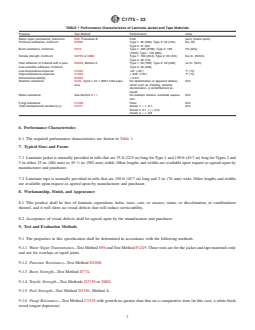
6.1 The required performance characteristics are shown in
in this specification.
Table 1.
3.1.2 laminate jacket, n—a thin, flexible sheet material
intended for use as a jacket over thermal insulation on pipe,
7. Typical Sizes and Forms
duct, or equipment, and consisting of multiple layers of plastic
7.1 Laminate jacket is normally provided in rolls that are 75
film and foil bonded together.
ft (22.9 m) long for Type 1 and 150 ft (45.7 m) long for Types
3.1.2.1 Discussion—A laminate jacket is available with or
2 and 3 in either 23 in. (484 mm) or 35 ⁄2 in. (902 mm) width.
without a factory applied pressure sensitive ad
...
This document is not an ASTM standard and is intended only to provide the user of an ASTM standard an indication of what changes have been made to the previous version. Because
it may not be technically possible to adequately depict all changes accurately, ASTM recommends that users consult prior editions as appropriate. In all cases only the current version
of the standard as published by ASTM is to be considered the official document.
Designation: C1775 − 14 C1775 − 22
Standard Specification for
Laminate Protective Jacket and Tape for Use over Thermal
Insulation for Outdoor Applications
This standard is issued under the fixed designation C1775; the number immediately following the designation indicates the year of
original adoption or, in the case of revision, the year of last revision. A number in parentheses indicates the year of last reapproval. A
superscript epsilon (´) indicates an editorial change since the last revision or reapproval.
1. Scope
1.1 This specification addresses the minimum performance for flexible laminate protective jacket and a pressure sensitive adhesive
tape for use over thermal insulation on pipes, duct, and equipment operating at both above and below ambient temperatures and
installed outdoors, above ground. It does not include the following: protective metal jacket, homogenous plastic film jacket
materials, modified asphalt jacket materials, and butyl rubber membranes.
1.2 This type of material shall consist of multiple layers of polymer film and aluminum foil laminated to one another with layer(s)
of reinforcement as an option.
1.3 Jacket and tape materials covered by this specification shall have low water vapor permeance values; however, they are not
necessarily always used as vapor retarders. The water vapor transmission tests address the jacket and tape materials only and do
not address overlaps or taped joints. All materials shall be weather resistant and intended to have sufficient strength to provide
protection for mechanical insulation.
1.4 Materials covered under this specification shall have a high, medium, or low surface emittance.
1.5 The top layer shall be on of the following: aluminum foil, a polymer film, or a polymer coating.
1.6 This specification includes jacket materials both with and without factory applied, pressure sensitive adhesives. The tape
materials covered by this specification always have a factory applied, pressure sensitive adhesive.
1.7 The values stated in inch-pound units are to be regarded as standard. The values given in parentheses are mathematical
conversions to SI units that are provided for information only and are not considered standard.
1.8 This standard does not purport to address all of the safety concerns, if any, associated with its use. It is the responsibility
of the user of this standard to establish appropriate safety safety, health, and healthenvironmental practices and determine the
applicability of regulatory limitations prior to use.
1.9 This international standard was developed in accordance with internationally recognized principles on standardization
established in the Decision on Principles for the Development of International Standards, Guides and Recommendations issued
by the World Trade Organization Technical Barriers to Trade (TBT) Committee.
This specification is under the jurisdiction of ASTM Committee C16 on Thermal Insulation and is the direct responsibility of Subcommittee C16.40 on Insulation
Systems.
Current edition approved Oct. 15, 2014March 1, 2022. Published November 2014March 2022. Originally approved in 2013. Last previous edition approved in 20132014
as C1775 – 13.14. DOI: 10.1520/C1775-14.10.1520/C1775-22.
Copyright © ASTM International, 100 Barr Harbor Drive, PO Box C700, West Conshohocken, PA 19428-2959. United States
C1775 − 22
2. Referenced Documents
2.1 ASTM Standards:
C168 Terminology Relating to Thermal Insulation
C1136 Specification for Flexible, Low Permeance Vapor Retarders for Thermal Insulation
C1263 Test Method for Thermal Integrity of Flexible Water Vapor Retarders
C1338 Test Method for Determining Fungi Resistance of Insulation Materials and Facings
C1371 Test Method for Determination of Emittance of Materials Near Room Temperature Using Portable Emissometers
D774 Test Method for Bursting Strength of Paper
D882 Test Method for Tensile Properties of Thin Plastic Sheeting
D1000 Test Methods for Pressure-Sensitive Adhesive-Coated Tapes Used for Electrical and Electronic Applications
D1204 Test Method for Linear Dimensional Changes of Nonrigid Thermoplastic Sheeting or Film at Elevated Temperature
D3330 Test Method for Peel Adhesion of Pressure-Sensitive Tape
D3759 Test Method for Breaking Strength and Elongation of Pressure-Sensitive Tape
E96 Test Methods for Gravimetric Determination of Water Vapor Transmission Rate of Materials
F1249 Test Method for Water Vapor Transmission Rate Through Plastic Film and Sheeting Using a Modulated Infrared Sensor
G154 Practice for Operating Fluorescent Ultraviolet (UV) Lamp Apparatus for Exposure of Nonmetallic Materials
3. Terminology
3.1 Definitions:
3.1.1 Definitions in Terminology C168 apply to terms used in this specification.
3.1.2 laminate jacket, n—a thin, flexible sheet material intended for use as a jacket over thermal insulation on pipe, duct, or
equipment, and consisting of multiple layers of plastic film and foil bonded together.
3.1.2.1 Discussion—
A laminate jacket is available with or without a factory applied pressure sensitive adhesive.
3.1.2.2 Discussion—
While laminate jacket is commercially available in different widths, it typically is provided commercially in approximately the
same width as pipe insulation sections.
3.1.3 laminate tape, n—a thin, flexible sheet material intended for use as a tape to seal and secure a compatible laminate jacket
over thermal insulation on pipe, duct, or equipment.
3.1.3.1 Discussion—
Laminate tape always has a factory applied, pressure sensitive adhesive which first requires removal of a release liner.
3.1.3.2 Discussion—
Laminate tape is commercially available in several different widt
...