

ASTM D1000-17
(Test Method)Standard Test Methods for Pressure-Sensitive Adhesive-Coated Tapes Used for Electrical and Electronic Applications
General Information
- Abstract
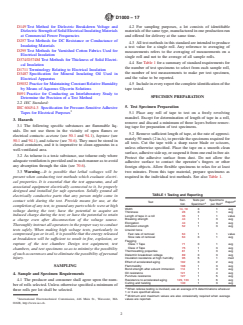
SCOPE
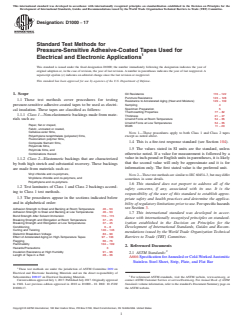
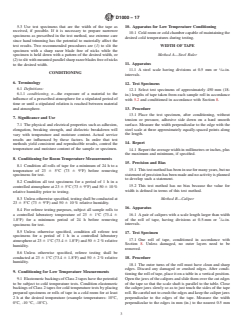
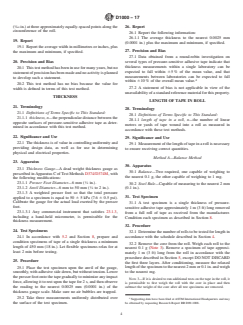
1.1 These test methods cover procedures for testing pressure-sensitive adhesive-coated tapes to be used as electrical insulation. These tapes are classified as follows:
1.1.1 Class 1—Non-elastomeric backings made from materials such as:
Paper, flat or creped,
Fabric, uncoated or coated,
Cellulose ester films,
Polyethylene terephthalate (polyester) films,
Fluorocarbon polymer films,
Composite filament films,
Polyamide films,
Polyimide films, and
Combinations thereof.
1.1.2 Class 2—Elastomeric backings that are characterized by both high stretch and substantial recovery. These backings are made from materials such as:
Vinyl chloride and co-polymers,
Vinylidene chloride and co-polymers, and
Polyethylene and co-polymers.
1.2 Test laminates of Class 1 and Class 2 backings according to Class 1 test methods.
1.3 The procedures appear in the sections indicated below and in alphabetical order:
Adhesion Strength to Steel and Backing at Room Temperature
46 – 53
Adhesion Strength to Steel and Backing at Low Temperatures
46 – 53
Bond Strength After Solvent Immersion
110 – 115
Breaking Strength and Elongation at Room Temperature
37 – 45
Breaking Strength and Elongation at Low Temperatures
37 – 45
Conditioning
6 – 8
Curling and Twisting
140 – 146
Dielectric Breakdown Voltage
83 – 90
Effect of Accelerated Aging on High-Temperature Tapes
97 – 103
Flagging
66 – 76
Flammability
104 – 109
Hazards/Precautions
3
Insulation Resistance at High Humidity
91 – 96
Length of Tape in a Roll
28 – 36
Oil Resistance
116 – 122
Puncture Resistance
123 – 128
Resistance to Accelerated Aging (Heat and Moisture)
129 – 139
Sampling
4
Specimen Preparation
5
Thermosetting Properties
77 – 82
Thickness
21 – 27
Unwind Force at Room Temperature
54 – 65
Unwind Force at Low Temperatures
54 – 65
Width
11 – 20
Note 1: These procedures apply to both Class 1 and Class 2 tapes except as noted above.
1.4 This is a fire-test response standard (see Section 104).
1.5 The values stated in SI units are the standard, unless otherwise noted. If a value for measurement is followed by a value in inch-pound or English units in parentheses, it is likely that the second value will only be approximate and it is for information only. The first stated value is the preferred unit.
Note 2: These test methods are similar to IEC 60454–3, but may differ sometimes in some details.
1.6 This standard does not purport to address all of the safety concerns, if any, associated with its use. It is the responsibility of the user of this standard to establish appropriate safety and health practices and determine the applicability of regulatory limitations prior to use. For specific hazards see Section 3.
1.7 This international standard was developed in accordance with internationally recognized principles on standardization established in the Decision on Principles for the Development of International Standards, Guides and Recommendations issued by the World Trade Organization Technical Barriers to Trade (TBT) Committee.
- Status
- Published
- Publication Date
- 30-Jun-2017
- Technical Committee
- D09 - Electrical and Electronic Insulating Materials
- Drafting Committee
- D09.07 - Electrical Insulating Materials
Buy Documents
ASTM D1000-17 - Standard Test Methods for Pressure-Sensitive Adhesive-Coated Tapes Used for Electrical and Electronic Applications
REDLINE ASTM D1000-17 - Standard Test Methods for Pressure-Sensitive Adhesive-Coated Tapes Used for Electrical and Electronic Applications
Overview
ASTM D1000-17 is the industry standard for test methods evaluating pressure-sensitive adhesive-coated tapes designated for electrical and electronic applications. Developed by ASTM International, this standard specifies laboratory procedures to assess the physical, mechanical, and electrical properties of tapes used as electrical insulation. The standard covers tapes with both non-elastomeric and elastomeric backings, providing comprehensive testing guidelines for insulating tapes made from various materials such as paper, fabric, polyester, fluoropolymer films, polyamide, and more.
ASTM D1000-17 helps manufacturers, engineers, and quality assurance professionals ensure that pressure-sensitive tapes meet the stringent requirements of safety, reliability, and performance necessary in today's electrical and electronic systems.
Key Topics
The standard outlines detailed test methods and criteria for the following critical tape properties:
- Adhesion Strength
- Measured against steel and tape backings at both room and low temperatures.
- Breaking Strength and Elongation
- Assessed at room and low temperatures for mechanical durability.
- Dielectric Breakdown Voltage
- Evaluates the tape’s ability to withstand electrical stress without failure.
- Insulation Resistance
- Tested under high humidity for long-term electrical stability.
- Length, Width, and Thickness
- Accurate measurement techniques to verify dimensions for application fit and consistency.
- Flammability and Oil Resistance
- Evaluates safety and compatibility with harsh environments.
- Resistance to Accelerated Aging
- Simulates long-term exposure to heat and moisture to predict service life.
- Unwind Force
- Measures forces required to dispense tape in both manual and automated processes.
- Flagging, Curling, and Twisting
- Gauges handling properties crucial for practical use.
Safety precautions for handling chemicals and equipment, as well as detailed sampling guidelines and specimen preparation methods, are also included to ensure repeatable and reliable results.
Applications
Pressure-sensitive adhesive tapes qualifying under ASTM D1000-17 are vital in several key areas:
- Electrical Insulation
Used for wrapping, bundling, and securing wires or cables, these tapes must offer high dielectric strength and stable adhesion for the safety and integrity of motors, transformers, and switchgear. - Electronic Manufacturing
Provides protective insulation in PCBs, electronic modules, and sensitive electrical assemblies. - Field Maintenance and Repair
Enables technicians to quickly insulate or reinforce connections and splices, even in challenging environmental conditions. - Automotive and Aerospace Industries
Specified for vibration-resistant and heat-resistant electrical insulation in wiring harnesses. - Utilities and Industrial Equipment
Chosen for reliability and ease of installation in demanding power distribution and control systems.
Verifying tape characteristics in accordance with ASTM D1000-17 ensures that end-use installations are safe, long-lasting, and compliant with industry codes.
Related Standards
The ASTM D1000-17 standard references and aligns with several important related standards, including:
- IEC 60454-3
Specification for pressure-sensitive adhesive tapes for electrical purposes, widely used internationally. - ASTM D149
Test method for dielectric breakdown voltage and dielectric strength of solid electrical insulating materials. - ASTM D257
Test methods for DC resistance or conductance of insulating materials. - ASTM D295
Procedures for varnished cotton fabrics used in electrical insulation. - ASTM D374/D374M
Methods for measuring the thickness of solid electrical insulation. - ASTM D3487
Specification for mineral insulating oil, often used in conjunction with insulating tapes.
Adherence to ASTM D1000-17 promotes compatibility and global acceptance, ensuring pressure-sensitive adhesive-coated tapes perform as required across varied electrical and electronic applications.
Relations
- Effective Date
- 01-Jul-2017
- Effective Date
- 01-Mar-2024
- Effective Date
- 01-Oct-2023
- Effective Date
- 01-Jan-2020
- Effective Date
- 01-Mar-2019
- Refers
ASTM D3487-16e1 - Standard Specification for Mineral Insulating Oil Used in Electrical Apparatus - Effective Date
- 15-Jun-2016
- Refers
ASTM D3487-16 - Standard Specification for Mineral Insulating Oil Used in Electrical Apparatus - Effective Date
- 15-Jun-2016
- Effective Date
- 01-Nov-2015
- Effective Date
- 01-Nov-2014
- Effective Date
- 01-May-2014
- Effective Date
- 01-Nov-2013
- Effective Date
- 01-May-2013
- Effective Date
- 15-Jan-2012
- Effective Date
- 01-Nov-2011
- Effective Date
- 01-Aug-2011
Buy Documents
ASTM D1000-17 - Standard Test Methods for Pressure-Sensitive Adhesive-Coated Tapes Used for Electrical and Electronic Applications
REDLINE ASTM D1000-17 - Standard Test Methods for Pressure-Sensitive Adhesive-Coated Tapes Used for Electrical and Electronic Applications
Get Certified
Connect with accredited certification bodies for this standard

IMQ S.p.A. (Certification)
Italian electrical product certification.

SLG Prüf- und Zertifizierungs GmbH
German testing and certification body.

UL Solutions
Global safety science company with testing, inspection and certification.
Sponsored listings
Frequently Asked Questions
ASTM D1000-17 is a standard published by ASTM International. Its full title is "Standard Test Methods for Pressure-Sensitive Adhesive-Coated Tapes Used for Electrical and Electronic Applications". This standard covers: SCOPE 1.1 These test methods cover procedures for testing pressure-sensitive adhesive-coated tapes to be used as electrical insulation. These tapes are classified as follows: 1.1.1 Class 1—Non-elastomeric backings made from materials such as: Paper, flat or creped, Fabric, uncoated or coated, Cellulose ester films, Polyethylene terephthalate (polyester) films, Fluorocarbon polymer films, Composite filament films, Polyamide films, Polyimide films, and Combinations thereof. 1.1.2 Class 2—Elastomeric backings that are characterized by both high stretch and substantial recovery. These backings are made from materials such as: Vinyl chloride and co-polymers, Vinylidene chloride and co-polymers, and Polyethylene and co-polymers. 1.2 Test laminates of Class 1 and Class 2 backings according to Class 1 test methods. 1.3 The procedures appear in the sections indicated below and in alphabetical order: Adhesion Strength to Steel and Backing at Room Temperature 46 – 53 Adhesion Strength to Steel and Backing at Low Temperatures 46 – 53 Bond Strength After Solvent Immersion 110 – 115 Breaking Strength and Elongation at Room Temperature 37 – 45 Breaking Strength and Elongation at Low Temperatures 37 – 45 Conditioning 6 – 8 Curling and Twisting 140 – 146 Dielectric Breakdown Voltage 83 – 90 Effect of Accelerated Aging on High-Temperature Tapes 97 – 103 Flagging 66 – 76 Flammability 104 – 109 Hazards/Precautions 3 Insulation Resistance at High Humidity 91 – 96 Length of Tape in a Roll 28 – 36 Oil Resistance 116 – 122 Puncture Resistance 123 – 128 Resistance to Accelerated Aging (Heat and Moisture) 129 – 139 Sampling 4 Specimen Preparation 5 Thermosetting Properties 77 – 82 Thickness 21 – 27 Unwind Force at Room Temperature 54 – 65 Unwind Force at Low Temperatures 54 – 65 Width 11 – 20 Note 1: These procedures apply to both Class 1 and Class 2 tapes except as noted above. 1.4 This is a fire-test response standard (see Section 104). 1.5 The values stated in SI units are the standard, unless otherwise noted. If a value for measurement is followed by a value in inch-pound or English units in parentheses, it is likely that the second value will only be approximate and it is for information only. The first stated value is the preferred unit. Note 2: These test methods are similar to IEC 60454–3, but may differ sometimes in some details. 1.6 This standard does not purport to address all of the safety concerns, if any, associated with its use. It is the responsibility of the user of this standard to establish appropriate safety and health practices and determine the applicability of regulatory limitations prior to use. For specific hazards see Section 3. 1.7 This international standard was developed in accordance with internationally recognized principles on standardization established in the Decision on Principles for the Development of International Standards, Guides and Recommendations issued by the World Trade Organization Technical Barriers to Trade (TBT) Committee.
SCOPE 1.1 These test methods cover procedures for testing pressure-sensitive adhesive-coated tapes to be used as electrical insulation. These tapes are classified as follows: 1.1.1 Class 1—Non-elastomeric backings made from materials such as: Paper, flat or creped, Fabric, uncoated or coated, Cellulose ester films, Polyethylene terephthalate (polyester) films, Fluorocarbon polymer films, Composite filament films, Polyamide films, Polyimide films, and Combinations thereof. 1.1.2 Class 2—Elastomeric backings that are characterized by both high stretch and substantial recovery. These backings are made from materials such as: Vinyl chloride and co-polymers, Vinylidene chloride and co-polymers, and Polyethylene and co-polymers. 1.2 Test laminates of Class 1 and Class 2 backings according to Class 1 test methods. 1.3 The procedures appear in the sections indicated below and in alphabetical order: Adhesion Strength to Steel and Backing at Room Temperature 46 – 53 Adhesion Strength to Steel and Backing at Low Temperatures 46 – 53 Bond Strength After Solvent Immersion 110 – 115 Breaking Strength and Elongation at Room Temperature 37 – 45 Breaking Strength and Elongation at Low Temperatures 37 – 45 Conditioning 6 – 8 Curling and Twisting 140 – 146 Dielectric Breakdown Voltage 83 – 90 Effect of Accelerated Aging on High-Temperature Tapes 97 – 103 Flagging 66 – 76 Flammability 104 – 109 Hazards/Precautions 3 Insulation Resistance at High Humidity 91 – 96 Length of Tape in a Roll 28 – 36 Oil Resistance 116 – 122 Puncture Resistance 123 – 128 Resistance to Accelerated Aging (Heat and Moisture) 129 – 139 Sampling 4 Specimen Preparation 5 Thermosetting Properties 77 – 82 Thickness 21 – 27 Unwind Force at Room Temperature 54 – 65 Unwind Force at Low Temperatures 54 – 65 Width 11 – 20 Note 1: These procedures apply to both Class 1 and Class 2 tapes except as noted above. 1.4 This is a fire-test response standard (see Section 104). 1.5 The values stated in SI units are the standard, unless otherwise noted. If a value for measurement is followed by a value in inch-pound or English units in parentheses, it is likely that the second value will only be approximate and it is for information only. The first stated value is the preferred unit. Note 2: These test methods are similar to IEC 60454–3, but may differ sometimes in some details. 1.6 This standard does not purport to address all of the safety concerns, if any, associated with its use. It is the responsibility of the user of this standard to establish appropriate safety and health practices and determine the applicability of regulatory limitations prior to use. For specific hazards see Section 3. 1.7 This international standard was developed in accordance with internationally recognized principles on standardization established in the Decision on Principles for the Development of International Standards, Guides and Recommendations issued by the World Trade Organization Technical Barriers to Trade (TBT) Committee.
ASTM D1000-17 is classified under the following ICS (International Classification for Standards) categories: 29.035.20 - Plastics and rubber insulating materials. The ICS classification helps identify the subject area and facilitates finding related standards.
ASTM D1000-17 has the following relationships with other standards: It is inter standard links to ASTM D1000-10, ASTM D1711-24, ASTM D374/D374M-23, ASTM D149-20, ASTM D5032-19, ASTM D3487-16e1, ASTM D3487-16, ASTM D1711-15, ASTM D1711-14a, ASTM D1711-14, ASTM D1711-13, ASTM E691-13, ASTM D295-12, ASTM E691-11, ASTM D5032-11. Understanding these relationships helps ensure you are using the most current and applicable version of the standard.
ASTM D1000-17 is available in PDF format for immediate download after purchase. The document can be added to your cart and obtained through the secure checkout process. Digital delivery ensures instant access to the complete standard document.
Standards Content (Sample)
This international standard was developed in accordance with internationally recognized principles on standardization established in the Decision on Principles for the
Development of International Standards, Guides and Recommendations issued by the World Trade Organization Technical Barriers to Trade (TBT) Committee.
Designation: D1000 − 17
Standard Test Methods for
Pressure-Sensitive Adhesive-Coated Tapes Used for
Electrical and Electronic Applications
This standard is issued under the fixed designation D1000; the number immediately following the designation indicates the year of
original adoption or, in the case of revision, the year of last revision. A number in parentheses indicates the year of last reapproval. A
superscript epsilon (´) indicates an editorial change since the last revision or reapproval.
This standard has been approved for use by agencies of the U.S. Department of Defense.
1. Scope
Oil Resistance 116 – 122
Puncture Resistance 123 – 128
1.1 These test methods cover procedures for testing
Resistance to Accelerated Aging (Heat and Moisture) 129 – 139
pressure-sensitive adhesive-coated tapes to be used as electri- Sampling 4
Specimen Preparation 5
cal insulation. These tapes are classified as follows:
Thermosetting Properties 77–82
1.1.1 Class 1—Non-elastomeric backings made from mate-
Thickness 21–27
rials such as: Unwind Force at Room Temperature 54–65
Unwind Force at Low Temperatures 54–65
Paper, flat or creped,
Width 11–20
Fabric, uncoated or coated,
Cellulose ester films,
NOTE 1—These procedures apply to both Class 1 and Class 2 tapes
Polyethylene terephthalate (polyester) films,
except as noted above.
Fluorocarbon polymer films,
1.4 This is a fire-test response standard (see Section 104).
Composite filament films,
Polyamide films,
1.5 The values stated in SI units are the standard, unless
Polyimide films, and
Combinations thereof.
otherwise noted. If a value for measurement is followed by a
value in inch-pound or English units in parentheses, it is likely
1.1.2 Class 2—Elastomeric backings that are characterized
that the second value will only be approximate and it is for
by both high stretch and substantial recovery. These backings
information only. The first stated value is the preferred unit.
are made from materials such as:
Vinyl chloride and co-polymers,
NOTE2—ThesetestmethodsaresimilartoIEC60454–3,butmaydiffer
Vinylidene chloride and co-polymers, and
sometimes in some details.
Polyethylene and co-polymers.
1.6 This standard does not purport to address all of the
1.2 Test laminates of Class 1 and Class 2 backings accord-
safety concerns, if any, associated with its use. It is the
ing to Class 1 test methods.
responsibility of the user of this standard to establish appro-
1.3 The procedures appear in the sections indicated below
priate safety and health practices and determine the applica-
and in alphabetical order: bility of regulatory limitations prior to use.Forspecifichazards
see Section 3.
Adhesion Strength to Steel and Backing at Room Temperature 46–53
Adhesion Strength to Steel and Backing at Low Temperatures 46–53
1.7 This international standard was developed in accor-
Bond Strength After Solvent Immersion 110–115
dance with internationally recognized principles on standard-
Breaking Strength and Elongation at Room Temperature 37–45
ization established in the Decision on Principles for the
Breaking Strength and Elongation at Low Temperatures 37–45
Conditioning 6–8
Development of International Standards, Guides and Recom-
Curling and Twisting 140 – 146
mendations issued by the World Trade Organization Technical
Dielectric Breakdown Voltage 83–90
Barriers to Trade (TBT) Committee.
Effect of Accelerated Aging on High-Temperature Tapes 97 – 103
Flagging 66–76
Flammability 104 – 109
2. Referenced Documents
Hazards/Precautions 3
Insulation Resistance at High Humidity 91–96
2.1 ASTM Standards:
Length of Tape in a Roll 28–36
A666 Specification forAnnealed or Cold-WorkedAustenitic
Stainless Steel Sheet, Strip, Plate, and Flat Bar
These test methods are under the jurisdiction of ASTM Committee D09 on
Electrical and Electronic Insulating Materials and are the direct responsibility of
Subcommittee D09.07 on Electrical Insulating Materials. For referenced ASTM standards, visit the ASTM website, www.astm.org, or
Current edition approved July 1, 2017. Published July 2017. Originally approved contact ASTM Customer Service at service@astm.org. For Annual Book of ASTM
in 1948. Last previous edition approved in 2010 as D1000 – 10. DOI: 10.1520/ Standards volume information, refer to the standard’s Document Summary page on
D1000-17. the ASTM website.
Copyright © ASTM International, 100 Barr Harbor Drive, PO Box C700, West Conshohocken, PA 19428-2959. United States
D1000 − 17
D149 Test Method for Dielectric Breakdown Voltage and 4.2 For sampling purposes, a lot consists of identifiable
DielectricStrengthofSolidElectricalInsulatingMaterials materialsofthesametype,manufacturedinoneproductionrun
at Commercial Power Frequencies and offered for delivery at the same time.
D257 Test Methods for DC Resistance or Conductance of
4.3 All test methods in this standard are intended to produce
Insulating Materials
a test value for a single roll. Any reference to averaging of
D295 Test Methods for Varnished Cotton Fabrics Used for
measurements refers to the averaging of measurements on a
Electrical Insulation
single roll and not to the average of all sample rolls.
D374/D374M Test Methods for Thickness of Solid Electri-
4.4 See Table 1 for a summary of standard requirements for
cal Insulation
the number of test specimens to select from each sample roll,
D1711 Terminology Relating to Electrical Insulation
the number of test measurements to make per test specimen,
D3487 Specification for Mineral Insulating Oil Used in
and the value to be reported.
Electrical Apparatus
D5032 Practice for Maintaining Constant Relative Humidity
4.5 Includeineveryreportthecompleteidentificationofthe
by Means of Aqueous Glycerin Solutions tape tested.
E691 Practice for Conducting an Interlaboratory Study to
SPECIMEN PREPARATION
Determine the Precision of a Test Method
2.2 IEC Standard:
5. Test Specimen Preparation
IEC 60454-3 Specification for Pressure-Sensitive Adhesive
Tapes for Electrical Purposes
5.1 Place any roll of tape to test on a freely revolving
mandrel. Except for determination of length of tape in a roll,
3. Hazards
remove and discard a minimum of three layers before remov-
3.1 The following specific substances are flammable liq-
ing tape for preparation of test specimens.
uids. Do not use them in the vicinity of open flames or
5.2 Remove sufficient length of tape, at the rate of approxi-
electrical contacts: acetone (see 50.1 and 94.1), heptane (see
mately 50 mm/s (2 in./s), to provide the specimens required for
50.1 and 94.1), and toluene (see 70.6). They must be stored in
all tests. Cut the tape with a sharp razor blade or scissors,
closed containers, and it is imperative to clean apparatus in a
unless otherwise specified. Place the tape on a smooth clean
well-ventilated area.
surface,adhesivesideup,orsuspenditfromoneendinfreeair.
3.2 As toluene is a toxic substance, use toluene only where
Protect the adhesive surface from dust. Do not allow the
adequateventilationisprovidedandinsuchmannerastoavoid
adhesive surface to contact the operator’s fingers or other
any absorption through the skin (see 70.6).
foreign objects. Allow flexible specimens to relax for at least
two minutes. From this tape material, prepare specimens as
3.3 Warning—It is possible that lethal voltages will be
required in the individual test methods. See also Table 1.
present when conducting test methods which evaluate electri-
cal properties. It is essential that the test apparatus, and all
associated equipment electrically connected to it, be properly
designed and installed for safe operation. Solidly ground all
TABLE 1 Testing and Reporting
electrically conductive parts that any person might come in
Sec- Tests per Specimens
contact with during the test. Provide means for use, at the B
Test Report
A A
tion Specimen per Roll
completion of any test, to ground any parts which: were at high
Width 14, 19 3 1 avg
voltage during the test; have the potential to acquire an
Thickness 26 3 1 avg
induced charge during the test; or have the potential to retain
Length of tape in a roll 35 1 1 value
Breaking strength 44 1 3 avg
a charge even after disconnection of the voltage source.
Elongation 44 1 3 avg
Thoroughly instruct all operators in the proper way to conduct
Adhesion strength 52 1 3 avg
tests safely. When making high voltage tests, particularly in
Unwind force
Fast rate of removal 64 1 1 value
compressed gas or in oil, it is possible that the energy released
Slow rate of removal 64 3 1 avg
at breakdown will be suffıcient to result in fire, explosion, or
Flagging
rupture of the test chamber. Design test equipment, test Class 1 Tape 71 3 1 avg
Class 2 Tape 75 1 3 avg
chambers, and test specimens so as to minimize the possibility
Thermosetting properties 81 1 3 avg
of such occurrences and to eliminate the possibility of personal
Dielectric breakdown voltage 89 3 3 avg
injury.
Insulation resistance at high humidity 95 5 1 med
Effect of accelerated aging 102 3 2 avg
Flammability 108 1 3 avg
SAMPLING
Bond strength after solvent immersion 114 1 3 avg
Oil resistance 121 1 4 avg
4. Sample and Specimen Requirements
Puncture resistance 127 1 5 avg
4.1 The producer and consumer shall agree upon the num- Resistance to accelerated aging 129, 133 1 6 avg
Curling and twisting 140 1 3 avg
ber of rolls selected. Unless otherwise specified a minimum of
A
When referee testing is involved, use an average of 5 determinations wherever
three rolls per lot shall be selected.
1 or 3 are specified above.
B
Minimum and maximum values are also occasionally required when average
International Electrotechnical Commission, 446 Main St., Worcester, MA
values are reported.
01608, http://www.iec.ch.
D1000 − 17
5.3 Use test specimens that are the width of the tape as 10. Apparatus for Low Temperature Conditioning
received, if possible. If it is necessary to prepare narrower
10.1 Cold room or cold chamber capable of maintaining the
specimens as prescribed in the test method, use extreme care
desired cold temperatures during testing.
since hand trimming has the potential to materially affect the
test results. Two recommended procedures are (1) to slit the
WIDTH OF TAPE
specimen with a sharp razor blade free of nicks while the
Method A—Steel Ruler
specimen is held down with a pattern of the desired width, or
(2)toslitwithmountedparallelsharprazorbladesfreeofnicks
11. Apparatus
to the desired width.
11.1 A steel scale having divisions at 0.5 mm or ⁄64-in.
CONDITIONING
intervals.
6. Terminology
12. Test Specimens
6.1 Definitions:
12.1 Select test specimens of approximately 450 mm (18-
6.1.1 conditioning, n—the exposure of a material to the
in.) lengths of tape taken from each sample roll in accordance
influence of a prescribed atmosphere for a stipulated period of
with 5.2 and conditioned in accordance with Section 8.
time or until a stipulated relation is reached between material
and atmosphere.
13. Procedure
13.1 Place the test specimen, after conditioning, without
7. Significance and Use
tension or pressure, adhesive side down on a hard smooth
surface. Measure the width perpendicular to the edge with the
7.1 The physical and electrical properties such as adhesion,
steel scale at three approximately equally-spaced points along
elongation, breaking strength, and dielectric breakdown will
the length.
vary with temperature and moisture content. Actual service
results are influenced by these factors. In order that test
14. Report
methods yield consistent and reproducible results, control the
temperature and moisture content of the sample or specimen.
14.1 Report the average width in millimetres or inches, plus
the maximum and minimum, if specified.
8. Conditioning for Room Temperature Measurements
15. Precision and Bias
8.1 Condition all rolls of tape for a minimum of 24 h to a
15.1 Thistestmethodhasbeeninuseformanyyears,butno
temperature of 23 6 5°C (73 6 9°F) before removing
statementofprecisionhasbeenmadeandnoactivityisplanned
specimens for test.
to develop such a statement.
8.2 Condition all test specimens for a period of1hina
15.2 This test method has no bias because the value for
controlled atmosphere at 23 6 5°C (73 6 9°F) and 50 6 10 %
width is defined in terms of this test method.
relative humidity prior to testing.
8.3 Unless otherwise specified, testing shall be conducted at
Method B—Caliper
23 6 5°C (73 6 9°F) and 50 6 10 % relative humidity.
16. Apparatus
8.4 For referee testing purposes, subject all sample rolls to
a controlled laboratory temperature of 23 6 1°C (73.4 6 16.1 Apair of calipers with a scale length larger than width
of the roll of tape, having divisions at 0.5-mm or ⁄64-in.
1.8°F) for a minimum period of 24 h before removing
intervals.
specimens for test.
8.5 Unless otherwise specified, condition all referee test
17. Test Specimen
specimens for a period of1hina controlled laboratory
17.1 One roll of tape, conditioned in accordance with
atmosphere at 23 6 1°C (73.4 6 1.8°F) and 50 6 2 % relative
Section 8. Unless damaged, no outer layers need to be
humidity.
removed.
8.6 Unless otherwise specified, referee testing shall be
conducted at 23 6 1°C (73.4 6 1.8°F) and 50 6 2 % relative
18. Procedure
humidity.
18.1 The outer turns of the roll must have clean and sharp
edges. Discard any damaged or crushed edges. After condi-
9. Conditioning for Low Temperature Measurements
tioning the roll of tape, place it on a table in a vertical position.
9.1 Elastomeric backings of Class 2 tapes have the potential Open the jaws of the calipers and slide them over the cut edges
to be subject to cold temperature tests. Condition elastomeric of the tape so that the scale shaft is parallel to the table. Close
backings of Class 2 tapes for cold temperature tests by placing the caliper jaws slowly so as to just touch the sides of the tape
prepared specimens or rolls of tape in a cold room for at least roll.Becarefulnottocrushtheedgesandkeepthecaliperjaws
2 h at the desired temperature (example temperatures: 10°C, perpendicular to the edges of the tape. Measure the width
0°C, -10 °C, -18°C). perpendicular to the edges in mm (in.) to the nearest 0.5 mm
D1000 − 17
( ⁄64 in.) at three approximately equally-spaced points along the 26. Report
circumference of the roll.
26.1 Report the following information:
26.1.1 The average thickness to the nearest 0.0025 mm
19. Report
(0.0001 in.) plus the maximum and minimum, if specified.
19.1 Report the average width in millimetres or inches, plus
27. Precision and Bias
the maximum and minimum, if specified.
27.1 Data obtained from a round-robin investigation on
20. Precision and Bias
several types of pressure-sensitive adhesive tape indicate that
thickness measurements within a single laboratory can be
20.1 Thistestmethodhasbeeninuseformanyyears,butno
expected to fall within 65 % of the mean value, and that
statementofprecisionhasbeenmadeandnoactivityisplanned
measurements between laboratories can be expected to fall
to develop such a statement.
within 610 % of the overall mean value.
20.2 This test method has no bias because the value for
27.2 A statement of bias is not applicable in view of the
width is defined in terms of this test method.
unavailabilityofastandardreferencematerialforthisproperty.
THICKNESS
LENGTH OF TAPE IN ROLL
21. Terminology
28. Terminology
21.1 Definitions of Terms Specific to This Standard:
28.1 Definitions of Terms Specific to This Standard:
21.1.1 thickness, n—the perpendicular distance between the
28.1.1 length of tape in a roll, n—the number of linear
opposite surfaces of pressure-sensitive adhesive tape as deter-
metres or yards of tape wound into a roll as measured in
mined in accordance with this test method.
accordance with these test methods.
22. Significance and Use
29. Significance and Use
22.1 The thickness is of value in controlling uniformity and
29.1 Measurementofthelengthoftapeinarollisnecessary
providing design data, as well as for use in determining
to ensure receiving correct quantities.
physical and electrical properties.
Method A—Balance Method
23. Apparatus
30. Apparatus
23.1 Thickness Gauge—A dead weight thickness gauge as
30.1 Balance—Two required, one capable of weighing to
prescribed inApparatus C ofTest Methods D374/D374M, with
the nearest 0.1 g, the other capable of weighing to 1 mg.
the following modifications:
23.1.1 Presser Foot Diameter—6mm( ⁄4 in.).
30.2 Steel Rule—Capable of measuring to the nearest 2 mm
23.1.2 Anvil Diameter—6mmto50mm( ⁄4 to 2 in.).
(0.1 in.).
23.1.3 A weighted presser foot so that the total pressure
31. Test Specimen
applied to a specimen is equal to 50 6 5 kPa (7.6 6 0.5 psi).
Calibrate the gauge for the actual load exerted by the presser
31.1 A test specimen is a single thickness of pressure-
foot.
sensitive adhesive tape approximately 1 m (3 ft) long removed
23.1.3.1 Any commercial instrument that satisfies 23.1.3,
from a full roll of tape as received from the manufacturer.
including a hand-held micrometer, is permissible for the
Condition each specimen as described in Section 8.
thickness measurement.
32. Procedure
24. Test Specimens
32.1 Determine the number of rolls to be tested for length in
accordance with the schedule described in Section 4.
24.1 In accordance with 5.2 and Section 8, prepare and
condition specimens of tape of a single thickness a minimum
32.2 Remove the core from the roll. Weigh each roll to the
length of 450 mm (18 in.). Let flexible specimens relax for at
nearest 0.1 g (Note 3). Remove a specimen of tape approxi-
least 2 min before testing.
mately1m(3ft) long from the roll in accordance with the
procedure described in Section 5, except DO NOT DISCARD
25. Procedure
the first three layers. After conditioning, measure the relaxed
lengthofthespecimentothenearest2mmor0.1in.andweigh
25.1 Place the test specimen upon the anvil of the gauge,
smoothly,withadhesivesidedown,butwithouttension.Lower to the nearest mg.
thepresserfootontothetapegraduallytominimizeanyimpact
NOTE 3—If it is desired to run additional tests on the tape in the roll, it
force, allowing it to rest upon the tape for 2 s, and then observe
is permissible to first weigh the roll with the core in place and then
the reading to the nearest 0.0025 mm (0.0001 in.) of the subtract the weight of the core after all test specimens are removed.
thickness gauge scale. Make sure no air bubbles are trapped.
25.2 Take three measurements uniformly distributed over
Supporting data have been filed at ASTM International Headquarters and may
the surface of the test specimen. be obtained by requesting Research Report RR:D09-1008.
D1000 − 17
32.3 Calculate the metres per roll as follows: 36.2 These test methods have no bias because the value for
length is defined in terms of these test methods.
weight of roll less core 3length of specimen, mm
Metres per roll 5
weight of specimen 31000
BREAKING STRENGTH AND ELONGATION
(1)
37. Terminology
32.4 Calculate the yards per roll as follows:
37.1 Definitions of Terms Specific to This Standard:
weight of roll less core 3length of specimen, in.
Yards per roll 5 (2)
37.1.1 breaking strength of pressure-sensitive adhesive tape,
weight of specimen 336
n—the force required, per unit width, to break the tape when
Method B—Length Sensor Method
tested under prescribed conditions.
37.1.2 elongation of pressure-sensitive adhesive tape,
33. Apparatus
n—the increase in length at break when the tape is tested under
33.1 Length Sensor—Adevice to measure length by using a
prescribed conditions.
benchmarked rotating wheel which rolls, with low torque and
37.1.2.1 Discussion—In the case of Class 1 tapes, it is
contact pressure, against the circumference of the roll as it
feasiblethattheelongationwillincludecreepinthejawswhich
unwinds. The apparatus includes a spindle for mounting the
is often partially compensated for by “necking” of the speci-
tape, the length sensor mechanism, and a read-out and rotating
men.
wind-up roll that can be used to either manually or automati-
38. Significance and Use
cally unwind the roll of tape. See Fig. 1.
38.1 Breaking Strength—Breakingstrengthoftapeisimpor-
34. Procedure
tant as a measurement of its uniformity, quality, and ability to
34.1 Determine the number of rolls to be tested for length in
withstand tensile stress in application and service.
accordance with the schedule described in Section 4. Use only
38.2 Elongation—Elongation of tape is important as a
full rolls of tape. Do not remove any outer layer.
measurement of its uniformity and quality, as well as a rough
34.2 Mount the roll on the shaft adjacent to the sensor.
indication of its ability to conform to contours of uneven
Position the roll and length sensor so that the sensor is in
surfaces.
contact with the circumference of the roll and the leading end
38.3 In the case of Class 2 tapes, testing at low temperature
of the roll is directly under the sensor. Zero the sensor and
isnecessarytoensurethatthetapeperformswellatcoldwinter
manually pull the leading edge of the tape and fix it to the
temperatures.
wind-up roll.At the start of the unwinding, make sure that the
length sensor maintains good contact with the roll and does not NOTE 4—It is possible that values obtained in dry ice chambers and
walk-in cold rooms will not be equivalent.
slip or bind.After unwinding is completed, take the reading of
the length sensor.
39. Apparatus
35. Report
39.1 Testing Machine—A testing machine of the constant-
rate-of-extension (CRE) type is preferred. Equip the machine
35.1 Report the following information:
with a device for recording the tensile load and the amount of
35.1.1 The length of tape in each roll to the nearest 0.1 m
separation of the grips such that both of these measuring
(0.1 yd).
systems are accurate to 62 % of the breaking load or the
amount of separation of the grips. The apparatus must be
36. Precision and Bias
capable of providing smooth, uniform jaw movement during
36.1 These test methods have been in use for many years,
testing, and the rate adjustable in increments necessary to
but no statement of precision has been made and no activity is
produce strain rates that are specified for the materials under
planned to develop such a statement.
test. Equip the machine with a load cell with a capacity such
that the breaking load of the material under test falls between
10 and 90 % of the maximum capacity of the load cell.
39.2 Extension Indicator—A suitable instrument for deter-
mining the distance between two fixed points located within
the gauge length of the test specimen at any time during the
test. It is desirable, but not essential, that this instrument
automatically record this distance as a function of the load on
thetest specimen, oroftheelapsedtimefor thestart ofthetest,
or both. If only the latter is obtained, also take load-time data.
The extension indicator will usually have a separation of
25 mm (1 in.) between points and be a minimum of 25 mm (1
in.) from both the top and bottom jaws. If a suitable extension
indicator is not available, elongation shall be calculated by jaw
FIG. 1 Measuring Device for Determination of Length of Tape in
Roll (Length Sensor Method) separation distance as described in Section 43.
D1000 − 17
39.3 Holding Fixtures—Use holding fixtures of any one of 42. Procedure
the following types, provided that the fixture does not cut the
42.1 Air Jaws or Manual Jaws—Position the crosshead at
specimen or cause slippage:
the desired gauge length and insert the specimen in the grips.
39.3.1 Air Jaws—A device that can be fitted with various
Tighten the movable grip first. If this process applies a preload
types of grips that will clamp onto a specimen through lever
on the specimen, do not change the balance adjustment to
arms actuated by compressed air cylinders built into the body.
compensate for it. Adjust the initial length of the specimen
The design provides a high gripping force with standard air
between contact points to 100 mm (4 in.).
pressure. Increased air pressure raises the gripping force to
42.2 Drum Jaws—Hold the test specimen in place by
accommodate materials that are often difficult to hold in other
placing approximately three quarters of a turn of the tape
types of grips.
around each holding fixture with the adhesive side in contact
39.3.2 Drum Jaws—Two smooth cylindrical metallic
with the drum. Place the tape in the center of the drums with
drums, 50 mm (2 in.) in diameter with a minimum length of
the edges parallel to the scribed lines. Adjust the initial length
38 mm (1 ⁄2 in.), suitably marked to aid in proper specimen
of the specimen between contact points to 100 mm (4 in.).
alignment.
42.3 Use a constant jaw speed of 300 6 13 mm/min (12 6
NOTE 5—While drum jaws are permissible, they are not preferred. The
design of drum jaws makes it extremely difficult to identify accurately the ⁄2 in./min), unless otherwise specified.
gauge length between jaws.
42.4 Discard breaks that occur at the jaws. Make a mini-
39.3.3 Manual Jaws—A device that can be fitted with
mum of three acceptable determinations.
various types of grips that will clamp onto a specimen through
a manually operated lever.
43. Calculation
39.3.4 Grips—For manual jaws.
43.1 Read the breaking strength directly from the recording
39.3.4.1 Line Contact grips have faces designed to concen-
chart or digital readout.
trate the entire gripping force along a single line perpendicular
to the direction of testing stress. This is usually done by
43.2 Read the percent elongation from the chart or digital
combining one standard flat face with an opposing face from
readout or record the distance between benchmarks at the
which protrudes a half-round.
instant of break or rupture, and note the jaw separation or the
39.3.4.2 Flat Faced grips have their surfaces finished in
distancebetweenbenchmarksattheinstantofbreakorrupture,
order to give the best clamping force on the material for test.
and calculate the percent elongation as follows:
The choice is determined largely by practical experience with
Elongation, % 5 D 2 D /D 3100 (3)
@~ ! #
2 1 1
the materials tested. It is acceptable for the faces to be
smooth-ground, rubber-coated, or serrated. In general, the
where:
smooth-ground surface offers high gripping efficiency with
D = original distance between jaws or benchmarks, and
most flat materials. The rubber-coated surface is of value with
D = distance at instant of break or rupture between jaws or
materials that tend to be weakened by pinching at the edge of
benchmarks.
the jaw face.The serrated surface is recommended for stronger
materials that require the greatest gripping action.
44. Report
It is acceptable to use double-coated tape to reinforce
44.1 Report the following information:
gripping, by applying a thin piece of tape on each side of the
44.1.1 Temperature conditions,
flat grips.
44.1.2 Average breaking strength expressed in newtons per
39.3.4.3 Cold Chamber—For cold temperatures testing, if a
10 mm of width (N/10 mm) or in pounds-force per inch of
cold chamber is used for conditioning, it must be equipped
width, plus the maximum and minimum, if specified, and
with a slot suitable for inserting the tape.
44.1.3 Average percent elongation, plus the maximum and
39.3.4.4 Gloves—White cotton for handling very cold
minimum, if specified.
samples.
45. Precision and Bias
40. Conditioning
40.1 Condition rolls of tape or specimens according to 45.1 Data obtained from a round-robin investigation on
several types of pressure-sensitive adhesive tape indicate that
Sections6–10 for either room or low temperature testing.
breaking-strength measurements within a single laboratory can
be expected to fall within 615 % of the mean value, and
41. Test Specimens
elongation measurements to within 625 % of the mean value.
41.1 Selectspecimensinaccordancewith5.2andSection8.
Among different laboratories they can be expected to fall
Use specimens that are the width of the tape as received if
within 620 % and 630 %, respectively, of the overall mean
possible. If it is necessary to trim the specimens due to the
value.
machine or jaw width limitations, take extreme care since hand
trimming has the potential to materially affect the test results. 45.2 A statement of bias is not applicable in view of the
See 5.3 for recommended procedures to slit narrower widths. unavailability of a standard reference material for these prop-
Put benchmarks on the specimens, if needed. erties.
D1000 − 17
ADHESION STRENGTH TO STEEL AND BACKING
46. Terminology
46.1 Definitions of Terms Specific to This Standard:
46.1.1 adhesion strength of pressure-sensitive adhesive
tape, n—the force necessary to remove the tape from a
prescribed surface when measured in accordance with this test
method.
47. Significance and Use
47.1 In many applications the use of a pressure-sensitive
adhesive tape depends upon adhesion strength to give satisfac-
tory performance. The adhesion property is also important in
determining the uniformity of quality.
FIG. 2 Suggested Construction of Roller for Adhesion Strength
48. Apparatus
Test
48.1 Testing Machine—A constant rate of extension (CRE)
testing machine shall be used. The testing machine shall have
two clamps with centers in the same plane, parallel with the
50. Procedure
direction of the motion of the stressing clamp, and so aligned
50.1 Adhesion to Steel Panel—Prepare the polished surface
that the clamps will hold the specimen entirely in the same
of the steel panel by scrubbing it thoroughly, using a clean
plane.The instrument shall be calibrated to an accuracy of 1 %
piece of surgical gauze saturated with any solvent capable of
of full scale and the scale range of any test shall be such that
facilitating the removal of adhesive residue (Warning —see
the mean test level falls within 10 to 90 % of full scale. Equip
3.1). Scrub the panel again using a clean piece of surgical
the machine with a device that allows a head separation of a
gauze saturated with heptane or any other appropriate solvent
minimum of 250 mm (10 in.).
(Warning—see 3.1). Discard the gauze after each cleaning
48.2 Test Panel —Aflatsteelsheethavingabrightannealed
step. After all traces of solvent evaporate, wipe the surface of
finish, 50 by 125 mm and no less than 1.1 mm thick (2 by 5 in.
the panel with a clean dry piece of surgical gauze.
and no less than ⁄16 in. thick) conforming to stainless steel
NOTE 6—For referee testing, use new cleaned steel panels.
Type 302 or 304 as prescribed in Specification A666. The
surface roughness height shall be 50 6 25 nm (2 6 1 µ in.)
50.2 Remove the specimen from the roll. Let it relax for at
arithmetical average deviation from the mean line. Panels
least 2 min. Apply it, adhesive side down, to the polished
showing stains, discoloration or scratches are not acceptable.
surface of the panel. Apply the specimen so that a 125-mm
(5-in.) length extends beyond one end of the panel.
48.3 Rubber Covered Steel Roller—Asteel roller, Fig. 2,80
6 2.5 mm (3.25 6 0.1 in) in diameter and 45 mm 61mm
50.3 For tapes less than 25 mm (1 in.) wide, cut other strips
(1.75 6 0.05 in.) wide, covered with rubber approximately
from the same sample roll and apply parallel and adjacent to
6mm( ⁄4 in.) in thickness having a durometer hardness of 80
the test specimen to provide a total width of approximately
6 5 Shore A. To apply pressure to the specimen, use a roller
25 mm (1 in.) for rolling purposes only. Then, pass the roller,
weighing 2000 6 50 g (4.5 6 0.1 lb). Construct the roller so
without application of additional pressure, over the backing of
that the weight of the handle is not added to the weight of the
the tape lengthwise, once in each direction at the rate of
roller during use. The operator has the option of using either a
approximately 300 mm/min (12 in./min). After the tape is on
hand roller or a motor-driven roller.
the panel for 20 min (50.3.1), double back the free end of the
test specimen at an angle of 180° and peel 25 mm (1 in.) of the
49. Test Specimens
tape off the panel at the doubled end. Clamp this portion of the
exposed panel in the lower jaw of the testing machine and
49.1 Use test specimens that are 250 mm (10 in.) long and
place the free end of the tape in the upper jaw. Use a jaw travel
nomorethan25 mm(1in.)wide.Removeeachspecimenfrom
rate of 300 mm/min (12 in./min). After the first 25 mm (1 in.)
therollinaccordancewith5.2sothatneithersurfaceinthetest
of tape is removed from the panel, read the specimen adhesion
area contacts the operator’s fingers nor any other foreign
over the next 50 mm (2 in.). Do not take any readings during
object.
the removal of the last 25 mm (inch) of tape from the panel.
49.2 Prepare three test specimens from each roll.
50.3.1 It is acceptable, in order to expedite testing, to
measure the adhesion immediately after application of the tape
to the panel, except for referee testing. This procedure results
The sole source of supply of the test panels meeting these requirements known
in slightly lower and more variable values.
to the committee at this time is Chemsultants International, 9079 Tylor Blvd.,
Mentor OH 44060 or at www.chemsultants.com. If you are aware of alternative
50.4 Test double-sided tapes by removing the liner material
suppliers, please provide this information to ASTM International Headquarters.
and covering the adhesive surface not under test with soft
Your comments will receive careful consideration at a meeting of the responsible
technical committee, which you may attend. tissue paper, such as facial tissue.
D1000 − 17
50.5 If the glass tapes have the potential to break on 180º 54.1.1 unwind force of pressure-sensitive adhesive tape, n—
pullback, reinforce them with another thickness of the same the force required to remove the tape from the roll when
tape or a thinner paper-backed or plastic-backed tape. Report measured in accordance with this test method.
this modification.
55. Significance and Use
50.6 Adhesion to Backing—Conduct the test of the adhesion
55.1 The unwind force at the specified rate gives informa-
of a tape to its own backing in a similar manner, except first
tion on the combined effects of the interlayer adhesion in the
affix a strip of the tape under test to each test panel with both
roll and of the physical condition of the backing and adhesive
ends wrapped around the ends of the panel. Use clean steel
mass.This unwind force is useful as a measure of the effects of
plates. Follow the procedure described in 50.1 – 50.3 except
natural, shelf or accelerated aging, and the unwind force
apply the test specimen to the tape backing rather than to the
determined at the fast rate of removal is useful as a measure of
steel panel. Both test specimen and tape backing are to be used
the ease of unwinding in mechanized or hand dispensers. A
once.
tape width of 25 mm (1 in.) is considered optimum for this test
method. The unwind force for widths other than 25 mm (1 in.)
51. Procedure for Low Temperatures Testing
is not always proportional to the width.
51.1 For low temperature measurements, specimens pre-
pared in Section 49 will be conditioned for 2 h according to
Method A—Fast Rate of Removal
Sections 9 and 10 before testing. Use white cotton gloves for
handling very cold samples.
56. Apparatus
56.1 Testing Machine —A power-driven testing machine,
52. Report
similar to that shown in Fig. 3, that can rewind a roll of tape at
52.1 Report the following information:
45 m/min (150 ft/min) from a specimen roll that is mounted
52.1.1 Testing temperatures,
upon a free-turning roller assembly. By suitable means, attach
52.1.2 Kind of test (to steel or to backing), and
this assembly to a scale or other measuring device. The driven
52.1.3 Average of the three test values for each kind of test
roll of the machine operates at the test speed while it is
expressed in newtons per 10 mm of width (N/10 mm) or in
acceptable to operate the wind-up mandrel through a slip
ounces-force per inch of width, plus the maximum or
clutch.
minimum, if specified.
56.2 Test Jig —Afree-turningrollerassemblysimilartothat
shown in Fig. 4. The free-turning wheel or drum of the
53. Precision and Bias
assembly shall fit snugly into the core of the tape.
53.1 For adhesion to steel, in a round-robin investigation
involving two laboratories and several types of pressure-
57. Conditioning
sensitive adhesive tapes (plastic, cloth, and paper-backed
57.1 Condition rolls of tape or specimens according to
tapes), data generated utilizing the procedures described in
Sections6–10 for either room or low temperature testing, as
Practice E691 indicate that the coefficient of variation within a
needed.
single laboratory, (Vr %) j, is expected to be as much as 7 %
whereas the coefficient of variation between laboratories, (VL
58. Test Specimen
%) j, is expected to be as much as 10 %.
58.1 Use a roll of pressure-sensitive adhesive tape as
53.2 For adhesion to backing, in a round-robin investigation
received and a minimum length of 18 m (20 yd) as the test
involving two laboratories and several types of pressure-
specimen. Discard the first three layers of tape before making
sensitive adhesive tapes (plastic, cloth, and paper-backed
the measurement.
tapes), data generated utilizing the procedures described in
Practice E691 indicate that the coefficient of variation within a
59. Procedure
single laboratory, (Vr %) j, is expected to be as much as 7 %
59.1 Place the roll of tape on the free-turning roller assem-
whereas the coefficient of variation between laboratories, (VL
bly. Thread the tape over the pull roll and attach it to a core on
%) j, is expected to be as much as 11 %.
the wind-up mandrel. Check the zero reading on the scale.
53.3 These test methods have no bias because the values for
adhesion to steel and adhesion to backing are defined solely in
terms of these test methods.
The sole source of supply of the variable-speed unwind machine meeting these
requirements known to the committee at this time is Chemsultants International,
UNWIND FORCE
9349 Hamilton Drive, Mentor, OH 44061-1118. If you are aware of alternative
suppliers, please provide this information to ASTM International Headquarters.
Your comments will receive careful consideration at a meeting of the responsible
54. Terminology
technical committee, which you may attend.
54.1 Definitions of Terms Specific to This Standard: The sole source of supply of the test jig for 3-in. (75 mm) cores meeting these
requirements known to the committee at this time is Chemsultants International,
9349 Hamilton Drive, Mentor, OH 44061-1118. If you are aware of alternative
suppliers, please provide this information to ASTM International Headquarters.
Supporting data have been filed at ASTM International Headquarters and may Your comments will receive careful consideration at a meeting of the responsible
be obtained by requesting Research Report RR:D09-1023. technical committee, which you may attend.
D1000 − 17
FIG. 3 Test Machine for Unwind Force Test (Method A)
62. Test Specimen
62.1 Use a roll of pressure-sensitive adhesive tape as
received and a minimum length of5m(5yd) asa test
specimen. Discard the first three layers of tape before making
the measurement.
63. Procedure
63.1 Place the roll of tape on the free-turning roller assem-
bly. Clamp the roller assembly in the lower jaw of the tension
testing machine. Unwind sufficient tape so that the free end of
thetapecanattachtotheupperjawofthemachine.Operatethe
machine at 300 mm/min (12 in./min) and take readings as
described in 50.3.After 25 mm (1 in.) has been run off, record
FIG. 4 Test Jig for Unwind Force Test
the average load required for unrolling the tape. Run off
approximately 300 mm (1 ft) of tape for each determination.
Operate the machine from the scale. Run off approximately 10
Conduct three tests on each roll.
m (10 yd) for each test. Conduct one test on each roll.
63.1.1 Observe the tape for adhesive transfer to backing and
Method B—Slow Rate of Removal
breaking during unrolling, especially at low temperatures.
60. Apparatus
64. Report
60.1 Use the testing machine and fixtures described in 56.1
64.1 Report the following information:
and 56.2.
64.1.1 Testing temperatures,
61. Conditioning
64.1.2 Rate of removal (fast or slow),
61.1 Condition rolls of tape or specimen according to 64.1.3 Average unwind force in newtons per 10 mm of
Sections6–10 for either room or low temperature testing, as width (N/10 mm) or in ounces-force per inch of width, plus the
needed. maximum and minimum, if specified, and
D1000 − 17
64.1.4 Any adhesive transfer to the backing, delamination backing thickness, use a 3-mm ( ⁄8-in.) diameter rod. For tapes
on composites, or breaking of the tape during unrolling, having a backing thickness greater than 0.025 mm (0.001 in.),
especially at low temperatures. use a 6-mm ( ⁄4-in.) diameter rod.
70.2 Attach a 500-g weight to one end of a 125-mm (5-in.)
65. Precision and Bias
strip of tape. Holding the opposite end of the strip, drape the
65.1 These test methods have been in use for many years,
strip over the rod with the adhesive side contacting and
but no statement of precision has been made and no activity is
adhering to the rod (see Fig. 5(a)). Rotate the rod so that the
planned to develop such a statement.
contact point is at the top of the rod (see Fig. 5(b)) and use a
65.2 These test methods have no bias because the value for sharp razor blade to trim the leading edge of the strip of tape
unwind force is defined in terms of these test methods.
flush with the rod.
70.3 Wind the tape on itself one and one-quarter turns (see
FLAGGING
Fig. 5(c)). Remove the weight and cut the tape at point D by
66. Terminology
tearing against the blade edge, taking care not to cut the lower
layer of tape.
66.1 Definitions of Terms Specific to This Standard:
66.1.1 flagging, n—the lifting of an end of pressure-
NOTE 7—As the tape is being wound up rely only on the weight to get
smooth overlap.Avoid juggling or touching the tape to direct it during the
sensitive adhesive tape that has been applied to a curved
wind up.
surface, thus forming a flag or tab tangent to the surface.
70.4 Flagging (as received)—Insert the specimen assembly
67. Significance and Use
in holes in the base of the board with the flag at the upper end
67.1 Knowledge of the flagging characteristics of tape is
and allow them to condition at 23 6 1°C (73.4 6 1.8°F) and
useful in determining whether such properties as thickness,
50 6 2 % relative humidity for 24 h unless a period of seven
stiffness, and adhesion have been properly balanced for appli-
days is specified.
cations where flagging has the potential to occur.
70.5 Flagging (after thermosetting)—Cure the specimen
assembly as described in 80.1. Remove the assembly from the
Method A—For Class 1 Tape
oven and cool to room temperature.
68. Apparatus
70.6 Flagging (after immersion)—Prepare specimen assem-
68.1 Winding Fixture—A device designed to hold a metal
bly as described in 70.4 or 70.5. With assembly at room
rod at each end and fitted with a crank or other device to rotate
temperature, totally immerse the specimens vertically in a
the rod so that it is possible to wind the specimen thereon.
specified varnish solvent or cleaning solvent such as toluene
Attach the fixture to a rigid support with the rod held in a
(Warning—see3.1and3.2)for15min.Allowassemblytodry
horizontal position.
before measuring the unwound length.
68.2 Rods—Any suitable metal of 3 mm ( ⁄8 in.) or 6 mm
70.7 Measurethelengthoftheunwoundtape(flag)fromthe
( ⁄4 in.) in diameter and at least 125 mm (5 in.) long. Rods of
end of the tape to the point of tangent of the rod (see Fig. 5(d)).
other diameters are acceptable if agreed upon between the
If an uneven flag occurs, record the greatest length. Calculate
manufacturer and the purchaser.
the average length of flag in millimetres to the nearest
millimetre.
68.3 Weight—Amass of 500 6 1 g provided with a hook or
other means of attaching to the specimen.
68.4 Rule, graduated in millimetres.
68.5 Board or Block, a device made of wood or aluminum
to hold the wrapped rods in a near-vertical position.
69. Test Specimens
69.1 Select test rolls specimens and condition them in
accordance with Sec
...
This document is not an ASTM standard and is intended only to provide the user of an ASTM standard an indication of what changes have been made to the previous version. Because
it may not be technically possible to adequately depict all changes accurately, ASTM recommends that users consult prior editions as appropriate. In all cases only the current version
of the standard as published by ASTM is to be considered the official document.
Designation: D1000 − 10 D1000 − 17
Standard Test Methods for
Pressure-Sensitive Adhesive-Coated Tapes Used for
Electrical and Electronic Applications
This standard is issued under the fixed designation D1000; the number immediately following the designation indicates the year of
original adoption or, in the case of revision, the year of last revision. A number in parentheses indicates the year of last reapproval. A
superscript epsilon (´) indicates an editorial change since the last revision or reapproval.
This standard has been approved for use by agencies of the U.S. Department of Defense.
1. Scope*Scope
1.1 These test methods cover procedures for testing pressure-sensitive adhesive-coated tapes to be used as electrical insulation.
These tapes are classified as follows:
1.1.1 Class 1—Non-elastomeric backings made from materials such as:
Paper, flat or creped,
Fabric, uncoated or coated,
Cellulose ester films,
Polyethylene terephthalate (polyester) films,
Fluorocarbon polymer films,
Composite filament films,
Polyamide films,
Polyimide films, and
Combinations thereof.
1.1.2 Class 2—Elastomeric backings that are characterized by both high stretch and substantial recovery. These backings are
made from materials such as:
Vinyl chloride and co-polymers,
Vinylidene chloride and co-polymers, and
Polyethylene and co-polymers.
1.2 Test laminates of Class 1 and Class 2 backings according to Class 1 test methods.
1.3 The procedures appear in the sections indicated below and in alphabetical order:
Adhesion Strength to Steel and Backing at Room Temperature 46 – 53
Adhesion Strength to Steel and Backing at Low Temperatures 46 – 53
Bond Strength After Solvent Immersion 110 – 115
Breaking Strength and Elongation at Room Temperature 37 – 45
Breaking Strength and Elongation at Low Temperatures 37 – 45
Conditioning 6 – 8
Curling and Twisting 140 – 146
Dielectric Breakdown Voltage 83 – 90
Effect of Accelerated Aging on High-Temperature Tapes 97 – 103
Flagging 66 – 76
Flammability 104 – 109
Hazards/Precautions 3
Insulation Resistance at High Humidity 91 – 96
Length of Tape in a Roll 28 – 36
Oil Resistance 116 – 122
Puncture Resistance 123 – 128
Resistance to Accelerated Aging (Heat and Moisture) 129 – 139
Sampling 4
Specimen Preparation 5
Thermosetting Properties 77 – 82
Thickness 21 – 27
Unwind Force at Room Temperature 54 – 65
Unwind Force at Low Temperatures 54 – 65
Width 11 – 20
These test methods are under the jurisdiction of ASTM Committee D09 on Electrical and Electronic Insulating Materials and are the direct responsibility of Subcommittee
D09.07 on Flexible and Rigid Electrical Insulating Materials.
Current edition approved Jan. 1, 2010July 1, 2017. Published February 2010July 2017. Originally approved in 1948. Last previous edition approved in 20092010 as
D1000D1000 – 10.–09. DOI: 10.1520/D1000-10.10.1520/D1000-17.
*A Summary of Changes section appears at the end of this standard
Copyright © ASTM International, 100 Barr Harbor Drive, PO Box C700, West Conshohocken, PA 19428-2959. United States
D1000 − 17
NOTE 1—These procedures apply to both Class 1 and Class 2 tapes except as noted above.
1.4 This is a fire–test response standard.fire-test response standard (see Section 104).
1.5 The values stated in SI units are the standard, unless otherwise noted. If a value for measurement is followed by a value
in inch-pound or English units in parentheses, it is likely that the second value maywill only be approximate and it is for
information only. The first stated value is the preferred unit.
NOTE 2—These test methods are similar to IEC 60454–3, but may differ sometimes in some details.
1.6 This standard does not purport to address all of the safety concerns, if any, associated with its use. It is the responsibility
of the user of this standard to establish appropriate safety and health practices and determine the applicability of regulatory
limitations prior to use. For specific hazards see Section 3.
1.7 This international standard was developed in accordance with internationally recognized principles on standardization
established in the Decision on Principles for the Development of International Standards, Guides and Recommendations issued
by the World Trade Organization Technical Barriers to Trade (TBT) Committee.
2. Referenced Documents
2.1 ASTM Standards:
A167A666 Specification for Stainless and Heat-Resisting Chromium-Nickel Steel Plate, Sheet, and StripAnnealed or
Cold-Worked Austenitic Stainless Steel Sheet, Strip, Plate, and Flat Bar (Withdrawn 2014)
D149 Test Method for Dielectric Breakdown Voltage and Dielectric Strength of Solid Electrical Insulating Materials at
Commercial Power Frequencies
D257 Test Methods for DC Resistance or Conductance of Insulating Materials
D295 Test Methods for Varnished Cotton Fabrics Used for Electrical Insulation
D374D374/D374M Test Methods for Thickness of Solid Electrical Insulation (Metric) D0374_D0374M
D1711 Terminology Relating to Electrical Insulation
D3487 Specification for Mineral Insulating Oil Used in Electrical Apparatus
D5032 Practice for Maintaining Constant Relative Humidity by Means of Aqueous Glycerin Solutions
E691 Practice for Conducting an Interlaboratory Study to Determine the Precision of a Test Method
2.2 IEC Standard:
IEC 60454-3 Specification for Pressure-Sensitive Adhesive Tapes for Electrical Purposes
3. Hazards
3.1 The following specific substances are flammable liquids. Do not use them in the vicinity of open flames or electrical
contacts: acetone (see 50.1 and 94.1), heptane (see 50.1 and 94.1), and toluene (see 70.6). They must be stored in closed containers,
and it is imperative to clean apparatus in a well-ventilated area.
3.2 As toluene is a toxic substance, use toluene only where adequate ventilation is provided and in such manner as to avoid any
absorption through the skin (see 70.6).
3.3 Warning—It is possible that lethal voltages will be present when conducting test methods which evaluate electrical
properties. It is essential that the test apparatus, and all associated equipment electrically connected to it, be properly designed
and installed for safe operation. Solidly ground all electrically conductive parts that any person might come in contact with during
the test. Provide means for use, at the completion of any test, to ground any parts which: were at high voltage during the test; have
the potential to acquire an induced charge during the test; or have the potential to retain a charge even after disconnection of the
voltage source. Thoroughly instruct all operators in the proper way to conduct tests safely. When making high voltage tests,
particularly in compressed gas or in oil, it is possible that the energy released at breakdown will be suffıcient to result in fire,
explosion, or rupture of the test chamber. Design test equipment, test chambers, and test specimens so as to minimize the possibility
of such occurrences and to eliminate the possibility of personal injury.
SAMPLING
4. Sample and Specimen Requirements
4.1 The producer and consumer shall agree upon the number of rolls selected. Unless otherwise specified a minimum of three
rolls per lot shall be selected.
4.2 For sampling purposes, a lot consists of identifiable materials of the same type, manufactured in one production run and
offered for delivery at the same time.
For referenced ASTM standards, visit the ASTM website, www.astm.org, or contact ASTM Customer Service at service@astm.org. For Annual Book of ASTM Standards
volume information, refer to the standard’s Document Summary page on the ASTM website.
Available from American National Standards Institute (ANSI), 25 W. 43rd St., 4th Floor, New York, NY 10036, http://www.ansi.org.International Electrotechnical
Commission, 446 Main St., Worcester, MA 01608, http://www.iec.ch.
D1000 − 17
4.3 All test methods in this standard are intended to produce a test value for a single roll. Any reference to averaging of
measurements refers to the averaging of measurements on a single roll and not to the average of all sample rolls.
4.4 See Table 1 for a summary of standard requirements for the number of test specimens to select from each sample roll, the
number of test measurements to make per test specimen, and the value to be reported.
4.5 Include in every report the complete identification of the tape tested.
SPECIMEN PREPARATION
5. Test Specimen Preparation
5.1 Place any roll of tape to test on a freely revolving mandrel. Except for determination of length of tape in a roll, remove and
discard a minimum of three layers before removing tape for preparation of test specimens.
5.2 Remove sufficient length of tape, at the rate of approximately 50 mm/s (2 in./s), to provide the specimens required for all
tests. Cut the tape with a sharp razor blade or scissors, unless otherwise specified. Place the tape on a smooth clean surface,
adhesive side up, or suspend it from one end in free air. Protect the adhesive surface from dust. Do not allow the adhesive surface
to contact the operator’s fingers or other foreign objects. Allow flexible specimens to relax for at least two minutes. From this tape
material, prepare specimens as required in the individual test methods. See also Table 1.
5.3 Use test specimens that are the width of the tape as received, if possible. If it is necessary to prepare narrower specimens
as prescribed in the test method, use extreme care since hand trimming has the potential to materially affect the test results. Two
recommended procedures are (1) to slit the specimen with a sharp razor blade free of nicks while the specimen is held down with
a pattern of the desired width, or (2) to slit with mounted parallel sharp razor blades free of nicks to the desired width.
CONDITIONING
6. Terminology
6.1 Definitions:
6.1.1 conditioning, n—the exposure of a material to the influence of a prescribed atmosphere for a stipulated period of time or
until a stipulated relation is reached between material and atmosphere.
7. Significance and Use
7.1 The physical and electrical properties such as adhesion, elongation, breaking strength, and dielectric breakdown will vary
with temperature and moisture content. Actual service results are influenced by these factors. In order that test methods yield
consistent and reproducible results, control the temperature and moisture content of the sample or specimen.
TABLE 1 Testing and Reporting
Sec- Tests per Specimens
B
Test Report
A A
tion Specimen per Roll
Width 14, 19 3 1 avg
Thickness 26 3 1 avg
Length of tape in a roll 35 1 1 value
Breaking strength 44 1 3 avg
Elongation 44 1 3 avg
Adhesion strength 52 1 3 avg
Unwind force
Fast rate of removal 64 1 1 value
Slow rate of removal 64 3 1 avg
Flagging
Class 1 Tape 71 3 1 avg
Class 2 Tape 75 1 3 avg
Thermosetting properties 81 1 3 avg
Dielectric breakdown voltage 89 3 3 avg
Insulation resistance at high humidity 95 5 1 med
Effect of accelerated aging 102 3 2 avg
Flammability 108 1 3 avg
Bond strength after solvent immersion 114 1 3 avg
Oil resistance 121 1 4 avg
Puncture resistance 127 1 5 avg
Resistance to accelerated aging 129, 133 1 6 avg
Curling and twisting 140 1 3 avg
A
When referee testing is involved, use an average of 5 determinations wherever
1 or 3 are specified above.
B
Minimum and maximum values are also occasionally required when average
values are reported.
D1000 − 17
8. Conditioning for Room Temperature Measurements
8.1 Condition all rolls of tape for a minimum of 24 h to a temperature of 23 6 5 °C 5°C (73 6 9 °F) 9°F) before removing
specimens for test.
8.2 Condition all test specimens for a period of 1 h in a controlled atmosphere at 23 6 5 °C 5°C (73 6 9 °F) 9°F) and 50 6
10 % relative humidity prior to testing.
8.3 Unless otherwise specified, testing shall be conducted at 23 6 5 °C 5°C (73 6 9 °F) 9°F) and 50 6 10 % relative humidity.
8.4 For referee testing purposes, subject all sample rolls to a controlled laboratory temperature of 23 6 1°C (73.4 6 1.8 °F)
1.8°F) for a minimum period of 24 h before removing specimens for test.
8.5 Unless otherwise specified, condition all referee test specimens for a period of 1 h in a controlled laboratory atmosphere
at 23 6 1°C (73.4 6 1.8 °F) 1.8°F) and 50 6 2 % relative humidity.
8.6 Unless otherwise specified, referee testing shall be conducted at 23 6 1°C (73.4 6 1.8 °F) 1.8°F) and 50 6 2 % relative
humidity.
9. Conditioning for Low Temperature Measurements
9.1 Elastomeric backings of Class 2 tapes have the potential to be subject to cold temperature tests. Condition elastomeric
backings of Class 2 tapes for cold temperature tests by placing prepared specimens or rolls of tape in a cold room for at least 2
h at the desired temperature (example temperatures: 10 °C, 0 °C, 10°C, 0°C, -10 °C, -18 °C).-18°C).
10. Apparatus for Low Temperature Conditioning
10.1 Cold room or cold chamber capable of maintaining the desired cold temperatures during testing.
WIDTH OF TAPE
Method A—Steel Ruler
11. Apparatus
11.1 A steel scale having divisions at 0.5 mm or ⁄64-in. intervals.
12. Test Specimens
12.1 Select test specimens of approximately 450 mm (18-in.) lengths of tape taken from each sample roll in accordance with
5.2 and conditioned in accordance with Section 8.
13. Procedure
13.1 Place the test specimen, after conditioning, without tension or pressure, adhesive side down on a hard smooth surface.
Measure the width perpendicular to the edge with the steel scale at three approximately equally-spaced points along the length.
14. Report
14.1 Report the average width in millimetres or inches, plus the maximum and minimum, if specified.
15. Precision and Bias
15.1 This test method has been in use for many years, but no statement of precision has been made and no activity is planned
to develop such a statement.
15.2 This test method has no bias because the value for width is defined in terms of this test method.
Method B—Caliper
16. Apparatus
16.1 A pair of calipers with a scale length larger than width of the roll of tape, having divisions at 0.5-mm or ⁄64-in. intervals.
17. Test Specimen
17.1 One roll of tape, conditioned in accordance with Section 8. Unless damaged, no outer layers need to be removed.
18. Procedure
18.1 The outer turns of the roll must have clean and sharp edges. Discard any damaged or crushed edges. After conditioning
the roll of tape, place it on a table in a vertical position. Open the jaws of the calipers and slide them over the cut edges of the
tape so that the scale shaft is parallel to the table. Close the caliper jaws slowly so as to just touch the sides of the tape roll. Be
D1000 − 17
careful not to crush the edges and keep the caliper jaws perpendicular to the edges of the tape. Measure the width perpendicular
to the edges in mm (in.) to the nearest 0.5 mm ( ⁄64 in.) at three approximately equally-spaced points along the circumference of
the roll.
19. Report
19.1 Report the average width in millimetres or inches, plus the maximum and minimum, if specified.
20. Precision and Bias
20.1 This test method has been in use for many years, but no statement of precision has been made and no activity is planned
to develop such a statement.
20.2 This test method has no bias because the value for width is defined in terms of this test method.
THICKNESS
21. Terminology
21.1 Definitions of Terms Specific to This Standard:
21.1.1 thickness, n—the perpendicular distance between the opposite surfaces of pressure-sensitive adhesive tape as determined
in accordance with this test method.
22. Significance and Use
22.1 The thickness is of value in controlling uniformity and providing design data, as well as for use in determining physical
and electrical properties.
23. Apparatus
23.1 Thickness Gauge—A dead weight thickness gauge as prescribed in Apparatus C of Test Methods D374D374/D374M, with
the following modifications:
23.1.1 Presser Foot Diameter—6 mm ( ⁄4 in.).
23.1.2 Anvil Diameter—6 mm to 50 mm ( ⁄4 to 2 in.).
23.1.3 A weighted presser foot so that the total pressure applied to a specimen is equal to 50 6 5 kPa (7.6 6 0.5 psi). Calibrate
the gauge for the actual load exerted by the presser foot.
23.1.3.1 Any commercial instrument that satisfies 23.1.3, including a hand-held micrometer, is permissible for the thickness
measurement.
24. Test Specimens
24.1 In accordance with 5.2 and Section 8, prepare and condition specimens of tape of a single thickness a minimum length of
450 mm (18 in.). Let flexible specimens relax for at least 2 min before testing.
25. Procedure
25.1 Place the test specimen upon the anvil of the gauge, smoothly, with adhesive side down, but without tension. Lower the
presser foot onto the tape gradually to minimize any impact force, allowing it to rest upon the tape for 2 s, and then observe the
reading to the nearest 0.0025 mm (0.0001 in.) of the thickness gauge scale. Make sure no air bubbles are trapped.
25.2 Take three measurements uniformly distributed over the surface of the test specimen.
26. Report
26.1 Report the following information:
26.1.1 The average thickness to the nearest 0.0025 mm (0.0001 in.) plus the maximum and minimum, if specified.
27. Precision and Bias
27.1 Data obtained from a round-robin investigation on several types of pressure-sensitive adhesive tape indicate that thickness
measurements within a single laboratory can be expected to fall within 65 % of the mean value, and that measurements between
laboratories can be expected to fall within 610 % of the overall mean value.
27.2 A statement of bias is not applicable in view of the unavailability of a standard reference material for this property.
Supporting data have been filed at ASTM International Headquarters and may be obtained by requesting Research Report RR:D09-1008.
D1000 − 17
LENGTH OF TAPE IN A ROLL
28. Terminology
28.1 Definitions of Terms Specific to This Standard:
28.1.1 length of tape in a roll, n—the number of linear metres or yards of tape wound into a roll as measured in accordance with
these test methods.
29. Significance and Use
29.1 Measurement of the length of tape in a roll is necessary to ensure receiving correct quantities.
Method A—Balance Method
30. Apparatus
30.1 Balance—Two required, one capable of weighing to the nearest 0.1 g, the other capable of weighing to 1 mg.
30.2 Steel Rule—Capable of measuring to the nearest 2 mm (0.1 in.).
31. Test Specimen
31.1 A test specimen is a single thickness of pressure-sensitive adhesive tape approximately 1 m (3 ft) long removed from a
full roll of tape as received from the manufacturer. Condition each specimen as described in Section 8.
32. Procedure
32.1 Determine the number of rolls to be tested for length in accordance with the schedule described in Section 4.
32.2 Remove the core from the roll. Weigh each roll to the nearest 0.1 g (Note 3). Remove a specimen of tape approximately
1 m (3 ft) long from the roll in accordance with the procedure described in Section 5, except DO NOT DISCARD the first three
layers. After conditioning, measure the relaxed length of the specimen to the nearest 2 mm or 0.1 in. and weigh to the nearest mg.
NOTE 3—If it is desired to run additional tests on the tape in the roll, it is permissible to first weigh the roll with the core in place and then subtract
the weight of the core after all test specimens are removed.
32.3 Calculate the metres per roll as follows:
weight of roll less core 3length of specimen, mm
Metres per roll 5 (1)
weight of specimen 31000
32.4 Calculate the yards per roll as follows:
weight of roll less core 3length of specimen, in.
Yards per roll 5 (2)
weight of specimen 336
Method B—Length Sensor Method
33. Apparatus
33.1 Length Sensor—A device to measure length by using a benchmarked rotating wheel which rolls, with low torque and
contact pressure, against the circumference of the roll as it unwinds. The apparatus includes a spindle for mounting the tape, the
length sensor mechanism, and a read-out and rotating wind-up roll that can be used to either manually or automatically unwind
the roll of tape. See Fig. 1.
FIG. 1 Measuring Device for Determination of Length of Tape in a Roll (Length Sensor Method)
D1000 − 17
34. Procedure
34.1 Determine the number of rolls to be tested for length in accordance with the schedule described in Section 4. Use only full
rolls of tape. Do not remove any outer layer.
34.2 Mount the roll on the shaft adjacent to the sensor. Position the roll and length sensor so that the sensor is in contact with
the circumference of the roll and the leading end of the roll is directly under the sensor. Zero the sensor and manually pull the
leading edge of the tape and fix it to the wind-up roll. At the start of the unwinding, make sure that the length sensor maintains
good contact with the roll and does not slip or bind. After unwinding is completed, take the reading of the length sensor.
35. Report
35.1 Report the following information:
35.1.1 The length of tape in each roll to the nearest 0.1 m (0.1 yd).
36. Precision and Bias
36.1 These test methods have been in use for many years, but no statement of precision has been made and no activity is planned
to develop such a statement.
36.2 These test methods have no bias because the value for length is defined in terms of these test methods.
BREAKING STRENGTH AND ELONGATION
37. Terminology
37.1 Definitions of Terms Specific to This Standard:
37.1.1 breaking strength of pressure-sensitive adhesive tape, n—the force required, per unit width, to break the tape when tested
under prescribed conditions.
37.1.2 elongation of pressure-sensitive adhesive tape, n—the increase in length at break when the tape is tested under prescribed
conditions.
37.1.2.1 Discussion—
In the case of Class 1 tapes, it is feasible that the elongation maywill include creep in the jaws which is often partially compensated
for by “necking” of the specimen.
38. Significance and Use
38.1 Breaking Strength—Breaking strength of tape is important as a measurement of its uniformity, quality, and ability to
withstand tensile stress in application and service.
38.2 Elongation—Elongation of tape is important as a measurement of its uniformity and quality, as well as a rough indication
of its ability to conform to contours of uneven surfaces.
38.3 In the case of Class 2 tapes, testing at low temperature is necessary to ensure that the tape performs well at cold winter
temperatures.
NOTE 4—It is possible that values obtained in dry ice chambers and walk-in cold rooms will not be equivalent.
39. Apparatus
39.1 Testing Machine—A testing machine of the constant-rate-of-extension (CRE) type is preferred. Equip the machine with a
device for recording the tensile load and the amount of separation of the grips (Note 5) such that both of these measuring systems
are accurate to 62 % of the breaking load or the amount of separation of the grips. The apparatus must be capable of providing
smooth, uniform jaw movement during testing, and the rate adjustable in increments necessary to produce strain rates that are
specified for the materials under test. Equip the machine with a load cell with a capacity such that the breaking load of the material
under test falls between 10 and 90 % of the maximum capacity of the load cell.
NOTE 5—A high response speed in the recording system is desirable, particularly when relatively high strain rates are employed. The speed of pen
response for recorders is supplied by manufacturers of this equipment. Take care to conduct tests at conditions such that response time (ability of recorder
to follow actual load) will produce less than 2 % error.
39.2 Extension Indicator—A suitable instrument for determining the distance between two fixed points located within the gauge
length of the test specimen at any time during the test. It is desirable, but not essential, that this instrument automatically record
this distance as a function of the load on the test specimen, or of the elapsed time for the start of the test, or both. If only the latter
is obtained, also take load-time data. The extension indicator will usually have a separation of 25 mm (1 in.) 25 mm (1 in.) between
points and be a minimum of 25 mm (1 in.) from both the top and bottom jaws. If a suitable extension indicator is not available,
elongation shall be calculated by jaw separation distance as described in Section 43.
D1000 − 17
39.3 Holding Fixtures—Use holding fixtures of any one of the following types, provided that the fixture does not cut the
specimen or cause slippage:
39.3.1 Air Jaws—A device that can be fitted with various types of grips that will clamp onto a specimen through lever arms
actuated by compressed air cylinders built into the body. The design provides a high gripping force with standard air pressure.
Increased air pressure raises the gripping force to accommodate materials that are often difficult to hold in other types of grips.
39.3.2 Drum Jaws—Two smooth cylindrical metallic drums, 50 mm (2 in.) in diameter with a minimum length of 38 mm 38 mm
(1 ⁄2 in.), suitably marked to aid in proper specimen alignment.
NOTE 5—While drum jaws are permissible, they are not preferred. The design of drum jaws makes it extremely difficult to identify accurately the gauge
length between jaws.
39.3.3 Manual Jaws—A device that can be fitted with various types of grips that will clamp onto a specimen through a manually
operated lever.
39.3.4 Grips—For manual jaws.
39.3.4.1 Line Contact grips have faces designed to concentrate the entire gripping force along a single line perpendicular to the
direction of testing stress. This is usually done by combining one standard flat face with an opposing face from which protrudes
a half-round.
39.3.4.2 Flat Faced grips have their surfaces finished in order to give the best clamping force on the material for test. The choice
is determined largely by practical experience with the materials tested. It is acceptable for the faces to be smooth-ground,
rubber-coated, or serrated. In general, the smooth-ground surface offers high gripping efficiency with most flat materials. The
rubber-coated surface is of value with materials that tend to be weakened by pinching at the edge of the jaw face. The serrated
surface is recommended for stronger materials that require the greatest gripping action.
It is acceptable to use double-coated tape to reinforce gripping, by applying a thin piece of tape on each side of the flat grips.
39.3.4.3 Cold Chamber—For cold temperatures testing, if a cold chamber is used for conditioning, it must be equipped with a
slot suitable for inserting the tape.
39.3.4.4 Gloves—White cotton for handling very cold samples.
40. Conditioning
40.1 Condition rolls of tape or specimens according to Sections 6 – 10 for either room or low temperature testing.
41. Test Specimens
41.1 Select specimens in accordance with 5.2 and Section 8. Use specimens that are the width of the tape as received if possible.
If it is necessary to trim the specimens due to the machine or jaw width limitations, take extreme care since hand trimming has
the potential to materially affect the test results. See 5.3 for recommended procedures to slit narrower widths. Put benchmarks on
the specimens, if needed.
42. Procedure
42.1 Air Jaws or Manual Jaws—Position the crosshead at the desired gauge length and insert the specimen in the grips. Tighten
the movable grip first. If this process applies a preload on the specimen, do not change the balance adjustment to compensate for
it. Adjust the initial length of the specimen between contact points to 100 mm (4 in.).
42.2 Drum Jaws—Hold the test specimen in place by placing approximately three quarters of a turn of the tape around each
holding fixture with the adhesive side in contact with the drum. Place the tape in the center of the drums with the edges parallel
to the scribed lines. Adjust the initial length of the specimen between contact points to 100 mm (4 in.).
42.3 Use a constant jaw speed of 300 6 13 mm/min (12 6 ⁄2 in./min), unless otherwise specified.
42.4 Discard breaks that occur at the jaws. Make a minimum of three acceptable determinations.
43. Calculation
43.1 Read the breaking strength directly from the recording chart or digital readout.
43.2 Read the percent elongation from the chart or digital readout or record the distance between benchmarks at the instant of
break or rupture, and note the jaw separation or the distance between benchmarks at the instant of break or rupture, and calculate
the percent elongation as follows:
Elongation, %5 D 2 D /D 3100 (3)
@~ ! #
2 1 1
where:
D = original distance between jaws or benchmarks, and
D = distance at instant of break or rupture between jaws or benchmarks.
D1000 − 17
44. Report
44.1 Report the following information:
44.1.1 Temperature conditions,
44.1.2 Average breaking strength expressed in newtons per 10 mm of width (N/10 mm) or in pounds-force per inch of width,
plus the maximum and minimum, if specified, and
44.1.3 Average percent elongation, plus the maximum and minimum, if specified.
45. Precision and Bias
45.1 Data obtained from a round-robin investigation on several types of pressure-sensitive adhesive tape indicate that
breaking-strength measurements within a single laboratory can be expected to fall within 615 % of the mean value, and elongation
measurements to within 625 % of the mean value. Among different laboratories they can be expected to fall within 620 % and
630 %, respectively, of the overall mean value.
45.2 A statement of bias is not applicable in view of the unavailability of a standard reference material for these properties.
ADHESION STRENGTH TO STEEL AND BACKING
46. Terminology
46.1 Definitions of Terms Specific to This Standard:
46.1.1 adhesion strength of pressure-sensitive adhesive tape, n—the force necessary to remove the tape from a prescribed
surface when measured in accordance with this test method.
47. Significance and Use
47.1 In many applications the use of a pressure-sensitive adhesive tape depends upon adhesion strength to give satisfactory
performance. The adhesion property is also important in determining the uniformity of quality.
48. Apparatus
48.1 Testing Machine—A constant rate of extension (CRE) testing machine shall be used. The testing machine shall have two
clamps with centers in the same plane, parallel with the direction of the motion of the stressing clamp, and so aligned that the
clamps will hold the specimen entirely in the same plane. The instrument shall be calibrated to an accuracy of 1 % of full scale
and the scale range of any test shall be such that the mean test level falls within 10 to 90 % of full scale. Equip the machine with
a device that allows a head separation of a minimum of 250 mm (10 in.).
48.2 Test Panel —A flat steel sheet having a bright annealed finish, 50 by 125 by 1.5 mm mm and no less than 1.1 mm thick
(2 by 5 by in. and no less than ⁄16 in.). Use in. thick) conforming to stainless steel Type 302 or 304 as prescribed in Specification
A167A666 with. The surface roughness height of 0.0506 0.025 μm (2.0 6 1.0 μin.) arithmetic shall be 50 6 25 nm (2 6 1 μ in.)
arithmetical average deviation from the mean line. Panels showing stains, discoloration or scratches are not acceptable.
48.3 Rubber Covered Steel Roller—A steel roller, Fig. 2, 80 6 2.5 mm (3.25 6 0.1 in) in diameter and 45 mm 6 1 mm (1.75
The sole source of supply of the test panels meeting these requirements known to the committee at this time is Chemsultants International, 9079 Tylor Blvd., Mentor
OH 44060 or at www.chemsultants.com. If you are aware of alternative suppliers, please provide this information to ASTM International Headquarters. Your comments will
receive careful consideration at a meeting of the responsible technical committee, which you may attend.
FIG. 2 Suggested Construction of Roller for Adhesion Strength Test
D1000 − 17
6 0.05 in.) wide, covered with rubber approximately 6 mm 6 mm ( ⁄4 in.) in thickness having a durometer hardness of 80 6 5
Shore A. To apply pressure to the specimen, use a roller weighing 2000 6 50 g (4.56 (4.5 6 0.1 lb). Construct the roller so that
the weight of the handle is not added to the weight of the roller during use. The operator has the option of using either a hand roller
or a motor-driven roller.
49. Test Specimens
49.1 Use test specimens that are 250 mm (10 in.) long and no more than 25 mm 25 mm (1 in.) wide. Remove each specimen
from the roll in accordance with 5.2 so that neither surface in the test area contacts the operator’s fingers nor any other foreign
object.
49.2 Prepare three test specimens from each roll.
50. Procedure
50.1 Adhesion to Steel Panel—Prepare the polished surface of the steel panel by scrubbing it thoroughly, using a clean piece
of surgical gauze saturated with any solvent capable of facilitating the removal of adhesive residue (Warning —see 3.1). Scrub
the panel again using a clean piece of surgical gauze saturated with heptane or any other appropriate solvent (Warning—see 3.1).
Discard the gauze after each cleaning step. After all traces of solvent evaporate, wipe the surface of the panel with a clean dry piece
of surgical gauze.
NOTE 6—For referee testing, use new cleaned steel panels.
50.2 Remove the specimen from the roll. Let it relax for about 2 min or more. at least 2 min. Apply it, adhesive side down, to
the polished surface of the panel. Apply the specimen so that a 125-mm (5-in.) length extends beyond one end of the panel.
50.3 For tapes less than 25 mm (1 in.) wide, cut other strips from the same sample roll and apply parallel and adjacent to the
test specimen to provide a total width of approximately 25 mm 25 mm (1 in.) for rolling purposes only. Then, pass the roller,
without application of additional pressure, over the backing of the tape lengthwise, once in each direction at the rate of
approximately 300 mm/min (12 in./min). After the tape is on the panel for 20 min (50.3.1), double back the free end of the test
specimen at an angle of 180° and peel 25 mm (1 in.) of the tape off the panel at the doubled end. Clamp this portion of the exposed
panel in the lower jaw of the testing machine and place the free end of the tape in the upper jaw. Use a jaw travel rate of 300
mm/min (12 in./min). After the first 25 mm (1 in.) of tape is removed from the panel, read the specimen adhesion over the next
50 mm (2 in.). Do not take any readings during the removal of the last 25 mm (inch) of tape from the panel.
50.3.1 It is acceptable, in order to expedite testing, to measure the adhesion immediately after application of the tape to the
panel, except for referee testing. This procedure results in slightly lower and more variable values.
50.4 Test double-sided tapes by removing the liner material and covering the adhesive surface not under test with soft tissue
paper, such as facial tissue.
50.5 If the glass tapes have the potential to break on 180º pullback, reinforce them with another thickness of the same tape or
a thinner paper-backed or plastic-backed tape. Report this modification.
50.6 Adhesion to Backing—Conduct the test of the adhesion of a tape to its own backing in a similar manner, except first affix
a strip of the tape under test to each test panel with both ends wrapped around the ends of the panel. Use clean steel plates. Follow
the procedure described in 50.1 – 50.3 except apply the test specimen to the tape backing rather than to the steel panel. Both test
specimen and tape backing are to be used once.
51. Procedure for Low Temperatures Testing
51.1 For low temperature measurements, specimens prepared in Section 49 will be conditioned for 2 h according to Sections
9 and 10 before testing. Use white cotton gloves for handling very cold samples.
52. Report
52.1 Report the following information:
52.1.1 Testing temperatures,
52.1.2 Kind of test (to steel or to backing), and
52.1.3 Average of the three test values for each kind of test expressed in newtons per 10 mm of width (N/10 mm) or in
ounces-force per inch of width, plus the maximum or minimum, if specified.
53. Precision and Bias
53.1 For adhesion to steel, in a round-robin investigation involving two laboratories and several types of pressure-sensitive
adhesive tapes (plastic, cloth, and paper-backed tapes), data generated utilizing the procedures described in Practice E691 indicate
D1000 − 17
that the coefficient of variation within a single laboratory, (Vr %) j, is expected to be as much as 7 % whereas the coefficient of
variation between laboratories, (VL %) j, is expected to be as much as 10 %.
53.2 For adhesion to backing, in a round-robin investigation involving two laboratories and several types of pressure-sensitive
adhesive tapes (plastic, cloth, and paper-backed tapes), data generated utilizing the procedures described in Practice E691 indicate
that the coefficient of variation within a single laboratory, (Vr %) j, is expected to be as much as 7 % whereas the coefficient of
variation between laboratories, (VL %) j, is expected to be as much as 11 %.
53.3 These test methods have no bias because the values for adhesion to steel and adhesion to backing are defined solely in
terms of these test methods.
UNWIND FORCE
54. Terminology
54.1 Definitions of Terms Specific to This Standard:
54.1.1 unwind force of pressure-sensitive adhesive tape, n— the force required to remove the tape from the roll when measured
in accordance with this test method.
55. Significance and Use
55.1 The unwind force at the specified rate gives information on the combined effects of the interlayer adhesion in the roll and
of the physical condition of the backing and adhesive mass. This unwind force is useful as a measure of the effects of natural, shelf
or accelerated aging, and the unwind force determined at the fast rate of removal is useful as a measure of the ease of unwinding
in mechanized or hand dispensers. A tape width of 25 mm (1 in.) is considered optimum for this test method. The unwind force
for widths other than 25 mm (1 in.) is not always proportional to the width.
Method A—Fast Rate of Removal
56. Apparatus
56.1 Testing Machine —A power-driven testing machine, similar to that shown in Fig. 3, that can rewind a roll of tape at 45
m/min (150 ft/min) from a specimen roll that is mounted upon a free-turning roller assembly. By suitable means, attach this
assembly to a scale or other measuring device. The driven roll of the machine operates at the test speed while it is acceptable to
operate the wind-up mandrel through a slip clutch.
56.2 Test Jig —A free-turning roller assembly similar to that shown in Fig. 4. The free-turning wheel or drum of the assembly
shall fit snugly into the core of the tape.
57. Conditioning
57.1 Condition rolls of tape or specimens according to Sections 6 – 10 for either room or low temperature testing, as needed.
58. Test Specimen
58.1 Use a roll of pressure-sensitive adhesive tape as received and a minimum length of 18 m (20 yd) as the test specimen.
Discard the first three layers of tape before making the measurement.
59. Procedure
59.1 Place the roll of tape on the free-turning roller assembly. Thread the tape over the pull roll and attach it to a core on the
wind-up mandrel. Check the zero reading on the scale. Operate the machine from the scale. Run off approximately 10 m (10 yd)
for each test. Conduct one test on each roll.
Method B—Slow Rate of Removal
60. Apparatus
60.1 Use the testing machine and fixtures described in 56.1 and 56.2.
Supporting data have been filed at ASTM International Headquarters and may be obtained by requesting Research Report RR:D09-1023.
The sole source of supply of the variable-speed unwind machine meeting these requirements known to the committee at this time is Chemsultants International, 9349
Hamilton Drive, Mentor, OH 44061-1118. If you are aware of alternative suppliers, please provide this information to ASTM International Headquarters. Your comments will
receive careful consideration at a meeting of the responsible technical committee, which you may attend.
The sole source of supply of the test jig for 3-in. (75 mm) cores meeting these requirements known to the committee at this time is Chemsultants International, 9349
Hamilton Drive, Mentor, OH 44061-1118. If you are aware of alternative suppliers, please provide this information to ASTM International Headquarters. Your comments will
receive careful consideration at a meeting of the responsible technical committee, which you may attend.
D1000 − 17
FIG. 3 Test Machine for Unwind Force Test (Method A)
FIG. 4 Test Jig for Unwind Force Test
61. Conditioning
61.1 Condition rolls of tape or specimen according to Sections 6 – 10 for either room or low temperature testing, as needed.
62. Test Specimen
62.1 Use a roll of pressure-sensitive adhesive tape as received and a minimum length of 5 m (5 yd) as a test specimen. Discard
the first three layers of tape before making the measurement.
63. Procedure
63.1 Place the roll of tape on the free-turning roller assembly. Clamp the roller assembly in the lower jaw of the tension testing
machine. Unwind sufficient tape so that the free end of the tape can attach to the upper jaw of the machine. Operate the machine
D1000 − 17
at 300 mm/min (12 in./min) and take readings as described in 50.3. After 25 mm (1 in.) has been run off, record the average load
required for unrolling the tape. Run off approximately 300 mm (1 ft) of tape for each determination. Conduct three tests on each
roll.
63.1.1 Observe the tape for adhesive transfer to backing and breaking during unrolling, especially at low temperatures.
64. Report
64.1 Report the following information:
64.1.1 Testing temperatures,
64.1.2 Rate of removal (fast or slow),
64.1.3 Average unwind force in newtons per 10 mm of width (N/10 mm) or in ounces-force per inch of width, plus the
maximum and minimum, if specified, and
64.1.4 Any adhesive transfer to the backing, delamination on composites, or breaking of the tape during unrolling, especially
at low temperatures.
65. Precision and Bias
65.1 These test methods have been in use for many years, but no statement of precision has been made and no activity is planned
to develop such a statement.
65.2 These test methods have no bias because the value for unwind force is defined in terms of these test methods.
FLAGGING
66. Terminology
66.1 Definitions of Terms Specific to This Standard:
66.1.1 flagging, n—the lifting of an end of pressure-sensitive adhesive tape that has been applied to a curved surface, thus
forming a flag or tab tangent to the surface.
67. Significance and Use
67.1 Knowledge of the flagging characteristics of tape is useful in determining whether such properties as thickness, stiffness,
and adhesion have been properly balanced for applications where flagging has the potential to occur.
Method A—For Class 1 Tape
68. Apparatus
68.1 Winding Fixture—A device designed to hold a metal rod at each end and fitted with a crank or other device to rotate the
rod so that it is possible to wind the specimen thereon. Attach the fixture to a rigid support with the rod held in a horizontal position.
1 1
68.2 Rods—Any suitable metal of 3 mm ( ⁄8 in.) or 6 mm ( ⁄4 in.) in.) in diameter and at least 125 mm (5 in.) long. Rods of
other diameters are acceptable if agreed upon between the manufacturer and the purchaser.
68.3 Weight—A mass of 500 6 1 g provided with a hook or other means of attaching to the specimen.
68.4 Rule, graduated in millimetres.
68.5 Board or Block, a device made of wood or aluminum to hold the wrapped rods in a near-vertical position.
69. Test Specimens
69.1 Select test rolls specimens and condition them in accordance with Sections 5 and 8, except unwind the tape at
approximately 300 mm/s (12 in./s) in order to select three strips of tape about 125 mm (5 in.) long at intervals of 300 mm (12 in.)
(12 in.) along the length. Protect the adhe
...