

ASTM D374/D374M-23
(Test Method)Standard Test Methods for Thickness of Solid Electrical Insulation
General Information
- Abstract
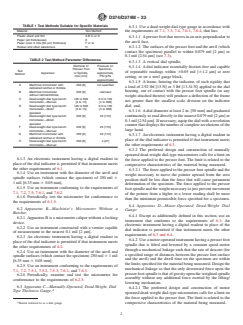
SIGNIFICANCE AND USE
5.1 Some electrical properties, such as dielectric strength, vary with the thickness of the material. Determination of certain properties, such as relative permittivity (dielectric constant) and volume resistivity, usually require a knowledge of the thickness. Design and construction of electrical machinery require that the thickness of insulation be known.
SCOPE
1.1 These test methods cover the determination of the thickness of several types of solid electrical insulating materials employing recommended techniques. Use these test methods except as otherwise required by a material specification.
1.2 The values stated in either SI units or inch-pound units are to be regarded separately as standard. The values stated in each system may not be exact equivalents; therefore, each system shall be used independently of the other. Combining values from the two systems may result in non-conformance with the standard.
1.3 This standard does not purport to address all of the safety concerns, if any, associated with its use. It is the responsibility of the user of this standard to establish appropriate safety, health, and environmental practices and determine the applicability of regulatory limitations prior to use.
1.4 This international standard was developed in accordance with internationally recognized principles on standardization established in the Decision on Principles for the Development of International Standards, Guides and Recommendations issued by the World Trade Organization Technical Barriers to Trade (TBT) Committee.
- Status
- Published
- Publication Date
- 30-Sep-2023
- Technical Committee
- D09 - Electrical and Electronic Insulating Materials
- Drafting Committee
- D09.12 - Electrical Tests
Overview
ASTM D374/D374M-23 – Standard Test Methods for Thickness of Solid Electrical Insulation establishes precise, standardized procedures for determining the thickness of various solid electrical insulating materials. Developed by ASTM International, this standard is crucial for industries relying on accurate insulation measurements, as many electrical properties such as dielectric strength and volume resistivity directly depend on the material’s thickness. Knowing the exact thickness helps ensure proper function, safety, and reliability in the design and construction of electrical equipment.
The standard outlines several methods and best practices for measuring thickness, based on the type and geometry of the material, as well as the intended application. Both SI (metric) and inch-pound units are covered, though the two should not be mixed to maintain compliance.
Key Topics
- Multiple Test Methods: The standard describes eight specific test methods (A through H), each tailored for different materials and thickness ranges, using various types of micrometers and measuring gauges.
- Apparatus Requirements: Detailed characteristics for measuring instruments, including machinist’s micrometers, dead-weight dial gauges, and motor-operated devices, ensuring accurate and repeatable results.
- Calibration and Maintenance: Procedures for calibrating instruments in a controlled laboratory environment, including zero setting, parallelism, and regular verification of readings to avoid measurement errors.
- Specimen Preparation: Guidelines for specimen conditioning, handling, and measurement placement to avoid contamination and inaccuracies.
- Measurement Procedures: Step-by-step instructions for selecting the proper test method based on material, applying the correct pressure, and conducting multiple readings to determine average thickness.
- Safety and Compliance: Emphasis on safety, health, and environmental practices for users of the standard, along with guidance on adhering to international principles and regulatory requirements.
Applications
ASTM D374/D374M-23 is extensively used in manufacturing, quality control, research, and compliance across sectors where electrical insulating materials play a critical role. This includes:
- Electrical Equipment Manufacturing: Verifying insulation thickness ensures products meet design and safety requirements for transformers, motors, cables, and other electrical machinery.
- Material Characterization: Researchers and engineers use this standard to evaluate how thickness impacts key properties like dielectric strength, permittivity, and volume resistivity.
- Product Specification and Quality Assurance: Specifiers and quality managers rely on this standard to assess incoming material shipments and finished products, guaranteeing consistency and regulatory conformity.
- Standardized Reporting: Organizations use these methods for consistent reporting and comparison of insulation thickness data, supporting traceability and external audits.
Typical materials covered include plastic sheets and films, paper (of all thicknesses), rubber, elastomers, and pressboard. Test methods are specified according to material type to account for differences in compressibility, loading rate, and measurement precision requirements.
Related Standards
For robust quality management and specification of electrical insulation materials, ASTM D374/D374M-23 is often used in conjunction with the following standards:
- ASTM D1711: Terminology Relating to Electrical Insulation – provides definitions key to consistent communication and understanding.
- ASTM D618: Practice for Conditioning Plastics for Testing – ensures that specimens are properly conditioned before measurement.
- ASTM E252: Test Method for Thickness of Foil, Thin Sheet, and Film by Mass Measurement – offers alternative thickness measurement techniques for very thin materials.
By adhering to ASTM D374/D374M-23 and related standards, organizations demonstrate a commitment to precise measurement, compliance, product performance, and international best practices in electrical insulation.
Keywords: ASTM D374, insulation thickness test, solid electrical insulation, dielectric strength, volume resistivity, micrometer calibration, electrical insulation testing, insulation quality control, ASTM standards.
Relations
- Effective Date
- 01-Oct-2023
- Effective Date
- 01-Mar-2024
- Effective Date
- 01-Sep-2022
- Effective Date
- 01-Oct-2023
- Referred By
ASTM D5319-22 - Standard Specification for Glass-Fiber Reinforced Polyester Wall and Ceiling Panels - Effective Date
- 01-Oct-2023
- Effective Date
- 01-Oct-2023
- Referred By
ASTM D2633-21 - Standard Test Methods for Thermoplastic Insulations and Jackets for Wire and Cable - Effective Date
- 01-Oct-2023
- Effective Date
- 01-Oct-2023
- Effective Date
- 01-Oct-2023
- Referred By
ASTM A1124/A1124M-23 - Standard Specification for Textured Epoxy-Coated Steel Reinforcing Bars - Effective Date
- 01-Oct-2023
- Effective Date
- 01-Oct-2023
- Effective Date
- 01-Oct-2023
- Effective Date
- 01-Oct-2023
- Effective Date
- 01-Oct-2023
- Effective Date
- 01-Oct-2023
Get Certified
Connect with accredited certification bodies for this standard

IMQ S.p.A. (Certification)
Italian electrical product certification.

SLG Prüf- und Zertifizierungs GmbH
German testing and certification body.

UL Solutions
Global safety science company with testing, inspection and certification.
Sponsored listings
Frequently Asked Questions
ASTM D374/D374M-23 is a standard published by ASTM International. Its full title is "Standard Test Methods for Thickness of Solid Electrical Insulation". This standard covers: SIGNIFICANCE AND USE 5.1 Some electrical properties, such as dielectric strength, vary with the thickness of the material. Determination of certain properties, such as relative permittivity (dielectric constant) and volume resistivity, usually require a knowledge of the thickness. Design and construction of electrical machinery require that the thickness of insulation be known. SCOPE 1.1 These test methods cover the determination of the thickness of several types of solid electrical insulating materials employing recommended techniques. Use these test methods except as otherwise required by a material specification. 1.2 The values stated in either SI units or inch-pound units are to be regarded separately as standard. The values stated in each system may not be exact equivalents; therefore, each system shall be used independently of the other. Combining values from the two systems may result in non-conformance with the standard. 1.3 This standard does not purport to address all of the safety concerns, if any, associated with its use. It is the responsibility of the user of this standard to establish appropriate safety, health, and environmental practices and determine the applicability of regulatory limitations prior to use. 1.4 This international standard was developed in accordance with internationally recognized principles on standardization established in the Decision on Principles for the Development of International Standards, Guides and Recommendations issued by the World Trade Organization Technical Barriers to Trade (TBT) Committee.
SIGNIFICANCE AND USE 5.1 Some electrical properties, such as dielectric strength, vary with the thickness of the material. Determination of certain properties, such as relative permittivity (dielectric constant) and volume resistivity, usually require a knowledge of the thickness. Design and construction of electrical machinery require that the thickness of insulation be known. SCOPE 1.1 These test methods cover the determination of the thickness of several types of solid electrical insulating materials employing recommended techniques. Use these test methods except as otherwise required by a material specification. 1.2 The values stated in either SI units or inch-pound units are to be regarded separately as standard. The values stated in each system may not be exact equivalents; therefore, each system shall be used independently of the other. Combining values from the two systems may result in non-conformance with the standard. 1.3 This standard does not purport to address all of the safety concerns, if any, associated with its use. It is the responsibility of the user of this standard to establish appropriate safety, health, and environmental practices and determine the applicability of regulatory limitations prior to use. 1.4 This international standard was developed in accordance with internationally recognized principles on standardization established in the Decision on Principles for the Development of International Standards, Guides and Recommendations issued by the World Trade Organization Technical Barriers to Trade (TBT) Committee.
ASTM D374/D374M-23 is classified under the following ICS (International Classification for Standards) categories: 29.035.01 - Insulating materials in general. The ICS classification helps identify the subject area and facilitates finding related standards.
ASTM D374/D374M-23 has the following relationships with other standards: It is inter standard links to ASTM D374/D374M-16, ASTM D1711-24, ASTM D1711-22, ASTM D6693/D6693M-20, ASTM D5319-22, ASTM D1000-17, ASTM D2633-21, ASTM A775/A775M-22, ASTM D4496-21e1, ASTM A1124/A1124M-23, ASTM D1932-19, ASTM D2303-20e1, ASTM D3294-22, ASTM F963-23, ASTM D2148-22. Understanding these relationships helps ensure you are using the most current and applicable version of the standard.
ASTM D374/D374M-23 is available in PDF format for immediate download after purchase. The document can be added to your cart and obtained through the secure checkout process. Digital delivery ensures instant access to the complete standard document.
Standards Content (Sample)
This international standard was developed in accordance with internationally recognized principles on standardization established in the Decision on Principles for the
Development of International Standards, Guides and Recommendations issued by the World Trade Organization Technical Barriers to Trade (TBT) Committee.
Designation: D374/D374M − 23
Standard Test Methods for
Thickness of Solid Electrical Insulation
This standard is issued under the fixed designation D374/D374M; the number immediately following the designation indicates the year
of original adoption or, in the case of revision, the year of last revision. A number in parentheses indicates the year of last reapproval.
A superscript epsilon (´) indicates an editorial change since the last revision or reapproval.
This standard has been approved for use by agencies of the U.S. Department of Defense.
1. Scope 3.2 Definitions of Terms Specific to This Standard:
3.2.1 1 micron, μm, n—a dimension equivalent to
1.1 These test methods cover the determination of the
0.03937 mils.
thickness of several types of solid electrical insulating materi-
3.2.2 1 mil, n—a dimension equivalent to 0.0010 in.
als employing recommended techniques. Use these test meth-
ods except as otherwise required by a material specification.
3.2.3 absolute uncertainty (of a measurement), n—the
smallest division able to be read directly on the instrument used
1.2 The values stated in either SI units or inch-pound units
for measurement.
are to be regarded separately as standard. The values stated in
each system may not be exact equivalents; therefore, each
3.2.4 micrometer, n—an instrument for measuring any di-
system shall be used independently of the other. Combining
mension with absolute uncertainty of 1 mil [25 μm] or smaller.
values from the two systems may result in non-conformance
with the standard.
4. Summary of Test Methods
1.3 This standard does not purport to address all of the
4.1 This standard provides eight different test methods for
safety concerns, if any, associated with its use. It is the
the measurement of thickness of solid electrical insulation
responsibility of the user of this standard to establish appro-
materials. The test methods (identified as Test Methods A
priate safety, health, and environmental practices and deter-
through H) employ different micrometers that exert various
mine the applicability of regulatory limitations prior to use.
pressures for varying times upon specimens of different geom-
1.4 This international standard was developed in accor-
etries. Tables 1 and 2 display basic differences of each test
dance with internationally recognized principles on standard-
method and identify test methods applicable for use on various
ization established in the Decision on Principles for the
categories of materials.
Development of International Standards, Guides and Recom-
mendations issued by the World Trade Organization Technical
5. Significance and Use
Barriers to Trade (TBT) Committee.
5.1 Some electrical properties, such as dielectric strength,
vary with the thickness of the material. Determination of
2. Referenced Documents
certain properties, such as relative permittivity (dielectric
2.1 ASTM Standards:
constant) and volume resistivity, usually require a knowledge
D618 Practice for Conditioning Plastics for Testing
of the thickness. Design and construction of electrical machin-
D1711 Terminology Relating to Electrical Insulation
ery require that the thickness of insulation be known.
E252 Test Method for Thickness of Foil, Thin Sheet, and
Film by Mass Measurement
6. Apparatus
3. Terminology
6.1 Apparatus A—Machinist’s Micrometer Caliper with
3.1 Refer to Terminology D1711 for definitions pertinent to Calibrated Ratchet or Friction Thimble:
6.1.1 Apparatus A is a micrometer caliper without a locking
this standard.
device but is equipped with either a calibrated ratchet or a
1 friction thimble. By use of a proper manipulative procedure
These test methods are under the jurisdiction of ASTM Committee D09 on
Electrical and Electronic Insulating Materials and are the direct responsibility of
and a calibrated spring (see Annex A1), the pressure exerted on
Subcommittee D09.12 on Electrical Tests.
the specimen is controllable.
Current edition approved Oct. 1, 2023. Published October 2023. Originally
6.1.2 Use an instrument constructed with a vernier capable
approved in 1933. Last previous edition approved in 2016 as D374/D374M – 16.
of measurement to the nearest 0.1 mil [2 μm].
DOI: 10.1520/D0374_D0374M-23.
For referenced ASTM standards, visit the ASTM website, www.astm.org, or
contact ASTM Customer Service at service@astm.org. For Annual Book of ASTM
Standards volume information, refer to the standard’s Document Summary page on
the ASTM website. Hereinafter referred to as a machinist’s micrometer.
Copyright © ASTM International, 100 Barr Harbor Drive, PO Box C700, West Conshohocken, PA 19428-2959. United States
D374/D374M − 23
TABLE 1 Test Methods Suitable for Specific Materials
6.3.1 Use a dead-weight dial-type gauge in accordance with
Material Test Method the requirements of 7.1, 7.3, 7.4, 7.6.1, 7.6.4, that has:
Plastic sheet and film A B C or D
6.3.1.1 A presser foot that moves in an axis perpendicular to
Paper (all thicknesses) E
the anvil face,
Paper (over 2 mils [50 μm] thickness) F or G
Rubber and other elastomers H 6.3.1.2 The surfaces of the presser foot and the anvil (which
contact the specimen) parallel to within 0.079 mil [2 μm] or
0.1 mil [2.54 μm] (see 7.3),
TABLE 2 Test Method Parameter Differences
6.3.1.3 A vertical dial spindle,
Diameter of Pressure on
6.3.1.4 A dial indicator essentially friction-free and capable
Presser Foot Specimen,
Test
of repeatable readings within 60.05 mil [61.2 μm] at zero
Apparatus or Spindle, approximate,
Method
mils [mm] PSI [kPa
setting, or on a steel gauge block,
approximate]
6.3.1.5 A frame, housing the indicator, of such rigidity that
A Machinist micrometer with 250 [6] not specified
a load of 2.92 lbf [13 N] or 3 lbf [13.34 N] applied to the dial
calibrated ratchet or thimble
B Machinist micrometer 250 [6] unknown housing, out of contact with the presser foot spindle (or any
without ratchet/thimble
weight attached thereto) will produce a deflection of the frame
C Dead-weight dial type bench 125 to 500 0.5 to 130
not greater than the smallest scale division on the indicator
micrometer—Manual [3 to 13] [4 to 900]
dial, and,
D Dead-weight dial type bench 125 to 500 0.5 to 130
micrometer—Motor [3 to 13] [4 to 900]
6.3.1.6 A dial diameter at least 2 in. [50 mm] and graduated
operated
continuously to read directly to the nearest 0.079 mil [2 μm] or
E Dead-weight dial type bench 250 [6] 25 [172]
micrometer—Motor
0.1 mil [2.54 μm]. If necessary, equip the dial with a revolution
operated
counter that displays the number of complete revolutions of the
F Dead-weight dial type bench 250 [6] 25 [172]
large hand.
micrometer—Manual
G Machinist micrometer with 250 [6] 25 [172]
6.3.1.7 An electronic instrument having a digital readout in
calibrated ratchet or thimble
place of the dial indicator is permitted if that instrument meets
H Dead-weight dial type bench 250 [6] 4 [27]
micrometer—Manual
the other requirements of 6.3.
6.3.2 The preferred design and construction of manually
operated dead-weight dial-type micrometers calls for a limit on
6.1.3 An electronic instrument having a digital readout in
the force applied to the presser foot. The limit is related to the
place of the dial indicator is permitted if that instrument meets
compressive characteristics of the material being measured.
the other requirements of 6.1.
6.3.2.1 The force applied to the presser foot spindle and the
6.1.4 Use an instrument with the diameter of the anvil and
weight necessary to move the pointer upward from the zero
spindle surfaces (which contact the specimen) of 250 mil 6
position shall be less than the force that will cause permanent
1 mil [6.35 mm 6 0.05 mm].
deformation of the specimen. The force applied to the presser
6.1.5 Use an instrument conforming to the requirements of
foot spindle and the weight necessary to just prevent movement
7.1, 7.2, 7.5, 7.6.1, and 7.6.2.
of the pointer from a higher to a lower reading shall be more
6.1.6 Periodically, test the micrometer for conformance to
than the minimum permissible force specified for a specimen.
the requirements of 6.1.5.
6.4 Apparatus D—Motor-Operated Dead-Weight Dial
6.2 Apparatus B—Machinist’s Micrometer Without a
Gauge:
Ratchet:
6.4.1 Except as additionally defined in this section, use an
6.2.1 Apparatus B is a micrometer caliper without a locking
instrument that conforms to the requirements of 6.3. An
device.
electronic instrument having a digital readout in place of the
6.2.2 Use an instrument constructed with a vernier capable
dial indicator is permitted if that instrument meets the other
of measurement to the nearest 0.1 mil [2 μm].
requirements of 6.3 and 6.4.
6.2.3 An electronic instrument having a digital readout in
6.4.2 Use a motor operated instrument having a presser foot
place of the dial indicator is permitted if that instrument meets
spindle that is lifted and lowered by a constant speed motor
the other requirements of 6.2.
through a mechanical linkage such that the rate of descent (for
6.2.4 Use an instrument with the diameter of the anvil and
a specified range of distances between the presser foot surface
spindle surfaces (which contact the specimen) 250 mil 6 1 mil
and the anvil) and the dwell time on the specimen are within
[6.35 mm 6 0.05 mm].
the limits specified for the material being measured. Design the
6.2.5 Use an instrument conforming to the requirements of
mechanical linkage so that the only downward force upon the
7.1, 7.2, 7.5.1, 7.5.2, 7.5.3, 7.6.1, and 7.6.3.
presser foot spindle is that of gravity upon the weighted spindle
6.2.6 Periodically, examine and test the micrometer for
assembly without any additional force exerted by the lifting/
conformance to the requirements of 6.2.5.
lowering mechanism.
6.3 Apparatus C—Manually-Operated, Dead-Weight, Dial
6.4.2.1 The preferred design and construction of motor
Type Thickness Gauge:
operated dead-weight dial-type micrometers calls for a limit on
the force applied to the presser foot. The limit is related to the
Herein referred to as a dial gauge. compressive characteristics of the material being measured.
D374/D374M − 23
[0.68 kg] weight on a ball between the hardened surfaces of presser foot
6.4.2.2 The force applied to the presser foot spindle and the
and anvil will result in dimples in the anvil or presser foot surfaces caused
weight necessary to move the pointer upward from the zero
by exceeding the yield stress of the surfaces.
position shall be less than the force that will cause permanent
7.3.1 Observe and record the diameter as measured by the
deformation of the specimen. The force applied to the presser
micrometer at one location.
foot spindle and the weight necessary to just prevent movement
of the pointer from a higher to a lower reading needs to be 7.3.2 Move the ball to another location and repeat the
more than the minimum permissible force specified for a measurement.
specimen.
7.3.3 If the difference between any pair of readings is
greater than 0.1 mil [2.5 μm], the surfaces are NOT parallel.
7. Calibration (General Considerations for Care and Use
of Each of the Various Pieces of Apparatus for 7.4 Lacking a detailed procedure supplied by the instrument
Thickness Measurements) manufacturer, confirm the flatness of the anvil and the spindle
surface of a micrometer or dial gauge by use of an optical flat
7.1 Good testing practices require clean anvil and presser
which has clean surfaces. Surfaces shall be flat within 0.05 mil
foot surfaces for any micrometer instrument. Prior to calibra-
[1.3 μm].
tion or thickness measurements, clean such surfaces by insert-
7.4.1 After cleaning the micrometer surfaces (see 7.1), place
ing a piece of smooth, clean bond paper between the anvil and
the optical flat on the anvil and close the presser foot as
the presser foot and slowly moving the bond paper between the
described in 7.6.2 or 7.6.3 or 7.6.4 or 7.6.5 as appropriate.
surfaces. During measurements, check the zero setting fre-
7.4.2 When illuminated by diffused daylight, interference
quently. It is possible that failure to repeat the zero setting will
bands are formed between the surfaces of the flat and the
be evidence of dirt or contamination on the surfaces.
surfaces of the micrometer. The shape, location, and number of
NOTE 1—Avoid pulling any edge of the bond paper between the
these bands indicate the deviation from flatness in increments
surfaces to reduce the probability of depositing any lint particles on the
of half the average wavelengths of white light, which is taken
surfaces.
as 0.079 mil [2 μm] or 0.1 mil [2.5 μm].
7.2 The parallelism requirements for machinist’s microm-
7.4.2.1 A flat surface forms straight parallel fringes at equal
eters demand that observed differences of readings on a pair of
intervals.
screw-thread-pitch wires or a pair of standard 250 mil
7.4.2.2 A grooved surface forms straight parallel fringes at
[6.35 mm] or 236 mil [6 mm] nominal diameter plug gauges be
unequal intervals.
not greater than 0.079 mil [2 μm] or 0.1 mil [2.5 μm]. Spring-
7.4.2.3 A symmetrical concave or convex surface forms
wire stock or music-wire of known diameter are suitable
concentric circular fringes. Their number is a measure of
substitutes. The wire (or the plug gauge) has a diameter
deviation from flatness.
dimension that is known to be within 60.05 mil [61.3 μm]. It
7.4.2.4 An unsymmetrical concave or convex surface forms
is possible that diameter dimensions will vary by an amount
a series of curved fringes that cut the periphery of the
approximately equal to the axial movement of the spindle when
micrometer surface. The number of fringes cut by a straight
the wire (or the plug gauge) is rotated through 180°.
line connecting the terminals of any fringes is a measure of the
7.2.1 Lacking a detailed procedure supplied by the instru-
deviation from flatness.
ment manufacturer, confirm the parallelism requirements of
machinist’s micrometers using the following procedure:
7.5 Machinist’s Micrometer Requirements:
7.2.1.1 Close the micrometer on the screw-thread-pitch wire
7.5.1 The requirements for zero reading of machinist’s
or the plug gauge in accordance with the calibration procedure
micrometers are met when ten closings of the spindle onto the
of 7.6.2 or 7.6.3 as appropriate.
anvil, in accordance with 7.6.2.3 or 7.6.3.3 as appropriate,
7.2.1.2 Observe and record the thickness indicated.
result in ten zero readings. The condition of zero reading is
7.2.1.3 Move the screw-thread-pitch wire or the plug gauge
satisfied when examinations with a low-power magnifying
to a different position between the presser foot and the anvil
glass show that at least 66 % of the width of the zero
and repeat 7.2.1.1 and 7.2.1.2.
graduation mark on the barrel coincides with at least 66 % of
7.2.1.4 If the difference between any pair of readings is
the width of the reference mark.
greater than 0.1 mil [2.5 μm], the surfaces are NOT parallel.
7.5.2 Proper maintenance of a machinist’s micrometer re-
7.3 Lacking a detailed procedure supplied by the instrument
quires adjusting the instrument for wear of the micrometer
manufacturer, confirm the requirements for parallelism of
screw so that the spindle has no perceptible lateral or longitu-
dial-type micrometers given in 6.3.1.2 by placing a hardened
dinal looseness yet rotates with a torque load of less than
steel ball (such as is used in a ball bearing) of suitable diameter
0.25 ozf–in. [0.0018 Nm]. If this is not achievable after
between the presser foot and the anvil. Mount the ball in a
disassembly, cleaning, and lubrication, replace the instrument.
fork-shaped holder to allow the ball to be conveniently moved
7.5.3 After the zero reading has been checked, use the
from one location to another between the presser foot and the
calibration procedure of 7.6.2 or 7.6.3 (as appropriate for the
anvil. The balls used commercially in ball bearings are almost
machinist’s micrometer under examination) to check for maxi-
perfect spheres having diameters constant within a few micro-
mum acceptable error in the machinist’s micrometer screw.
inches [micrometres].
7.5.3.1 Use selected feeler-gauge blades with known thick-
nesses to within 60.02 mil [60.5 μm] to check micrometers
NOTE 2—Exercise care with this procedure. Calculations using the
equations in X1.3.2 show that it is possible that the use of a 24-oz calibrated in English units at approximately (2, 5, and 10) mil
D374/D374M − 23
[(50.8, 127, and 254) μm]. Use standard gauge blocks at points as they move past the reference mark. This rate approximates
greater than 10 mil [254 μm]. about 2 mils/s [50.8 μm/s].
7.5.3.2 At each point checked, take ten readings. Calculate 7.6.3.3 Continue the closing motion until the spindle face
the arithmetic mean of these ten readings.
contacts the surface of the gauge block (or other calibrating
7.5.3.3 The machinist’s micrometer screw error is within device). Contact is made when frictional resistance initially
requirements if the difference between the mean value of
develops to the movement of the calibrating device between
7.5.3.2 and the gauge block (or feeler-gauge blade) thickness is the anvil and the spindle face.
not more than 0.1 mil [2.54 μm].
7.6.3.4 Observe and record the thickness reading.
7.5.4 Calibration of Spindle Pressure in Machinist’s Mi-
7.6.3.5 Repeat the procedures in 7.6.3.1 – 7.6.3.4 using
crometer with Ratchet or Friction Thimble:
several gauge blocks (or other calibration devices) of different
7.5.4.1 See Annex A1, which details the apparatus and
thicknesses covering the range of thickness of electrical
procedure required for this calibration.
insulation for measurement with this micrometer.
7.6.3.6 Construct a calibration curve that will provide the
7.6 Calibration of Micrometers:
corrections for application to the observed thickness of speci-
7.6.1 Calibrate all micrometers in a standard laboratory
mens tested for thickness using this calibrated micrometer.
atmosphere maintained at 50 % relative humidity and 73.4 °F
[23 °C] or some other standard condition as mutually agreed 7.6.4 Calibration Procedure for Apparatus C, Manually-
Operated Dial-Type Micrometers:
upon between the seller and the purchaser. Use standard gauge
blocks or other metallic objects of known thickness. The
7.6.4.1 Using the procedures detailed in Section 9 pertinent
known thickness accuracy of such blocks shall be within
to the material to be measured, collect calibration data from
610 % of the smallest scale division of the micrometer dial or
observations using several gauge blocks (or other calibration
scale. Thus, if an instrument’s smallest scale division is 0.1 mil devices) of different thicknesses covering the range of thick-
[2.54 μm], the standard gauge block thickness shall be known
ness of electrical insulation for measurement with this microm-
to within 60.01 mil [0.254 μm]. Perform calibration proce- eter.
dures only after the instrument has been checked and found to
7.6.4.2 Construct a calibration curve that will provide the
meet the requirements of the pertinent preceding paragraphs of
corrections for application to the observed thickness of speci-
this standard. Perform calibration procedures at least once
mens tested for thickness using this calibrated micrometer.
every 30 days.
7.6.5 Calibration Procedure for Apparatus D, Motor-
7.6.2 Calibration Procedure for Apparatus A, Machinist’s
Operated Dial-Type Micrometers:
Micrometer with Ratchet or Friction Thimble:
7.6.5.1 Using the procedures detailed in Section 9 pertinent
7.6.2.1 Calibrate the ratchet spring or friction thimble in
to the material to be measured, collect calibration data from
accordance with Annex A1.
observations using several gauge blocks (or other calibration
7.6.2.2 Rotate the spindle so as to close the micrometer on
devices) of different thicknesses covering the range of thick-
the gauge block or other calibrating device. Reverse the
ness of electrical insulation for measurement with this microm-
rotation so as to open the micrometer 4 mils to 5 mils [103 μm
eter.
to 127 μm].
7.6.5.2 Construct a calibration curve that will provide the
7.6.2.3 Using the ratchet knob or the friction thimble, again
corrections for application to the observed thickness of speci-
close the micrometer so slowly on the calibrating device that it
mens tested for thickness using this calibrated micrometer.
becomes easy to count the scale divisions as they move past the
reference mark. This rate approximates about 2 mils/s
8. Test Specimens
[50.8 μm ⁄s].
8.1 Prepare and condition each specimen in equilibrium
7.6.2.4 Continue the closing motion until the ratchet clicks
with the appropriate standard laboratory test conditions in
three times or the friction thimble slips.
accordance with the test method applicable to the specific
7.6.2.5 Observe and record the thickness reading.
material for test.
7.6.2.6 Repeat the procedures in 7.6.2.2 – 7.6.2.5 using
several gauge blocks (or other calibration devices) of different
8.2 For each specimen, take precautions to prevent damage
thicknesses covering the range of thickness of electrical
or contamination that might adversely affect the thickness
insulation for measurement with this micrometer.
measurements.
7.6.2.7 Construct a calibration curve that will provide the
8.3 Unless otherwise specified, make all thickness measure-
corrections for application to the observed thickness of speci-
ments at the standard laboratory atmosphere in accordance
mens tested for thickness using this calibrated micrometer.
with Practice D618, Method A.
7.6.3 Calibration Procedure for Apparatus B, Machinist’s
Micrometer without Ratchet or Friction Thimble:
8.4 In the procedure sections a requirement is made to avoid
7.6.3.1 Rotate the spindle so as to close the micrometer on
making measurements at locations that are less than 250 mils
the gauge block or other calibrating device. Reverse the [6 mm] from any specimen edge. There are instances, particu-
rotation so as to open the micrometer 4 mils to 5 mils [103 μm
larly when measuring very narrow strip specimens used for
to 127 μm]. tensile tests, and so forth, when this requirement cannot be
7.6.3.2 Close the micrometer again so slowly on the cali- satisfied. In such cases, it is permissible to ignore this require-
brating device that it becomes easy to count the scale divisions ment.
D374/D374M − 23
9. Procedures 9.3.6 It is possible that the presence of contaminating
substances on the surfaces of the test specimens, presser foot,
9.1 In the section on procedures, the word test method
anvil, or spindle will interfere with thickness measurements
denotes a combination of both a specific apparatus and a
and result in erroneous readings. To help prevent this
procedure describing its use.
interference, select only clean specimens for testing and keep
9.2 The selection of a test method for measurement of
them and the thickness measuring instrument covered until
thickness is influenced by the characteristics of the solid
ready to make measurements.
electrical insulation for measurement. Each material will differ
9.3.7 Test Method A (applicable to plastic sheet and film
in its response to test method parameters, which include, but
having nominal thickness greater than 10 mils [254 μm]):
are not be limited to: compressibility, rate of loading, ultimate
9.3.7.1 Using Apparatus A and specimens in conformance
load, dwell time, and the dimensions of the presser foot and
with Section 8, close the micrometer on an area of the
anvil. For a specific electrical insulating material, it is possible
specimen outside of the area for measurement. Observe this
that these responses will cause measurements made using one
initial reading and then open the micrometer approximately
test method to differ significantly from measurements made
4 mils [100 μm] beyond the initial reading and move the
using another test method. The procedures that follow are
specimen to the first measurement position. Avoid using
categorized according to the materials to which each applies.
measurement positions that are closer than 250 mils [6.35 mm]
See also Appendix X1.
or 315 mils [8 mm] from any specimen edge.
9.3 Test Methods Applicable to Plastic Sheet and Film:
9.3.7.2 Using the ratchet, or the friction thimble, close the
9.3.1 Except as otherwise specified in other applicable
micrometer at such a rate that it becomes easy to count the
documents, use either Test Method A or B for plastic sheet or
scale divisions as they pass the reference mark. This rate is
film specimens having nominal thickness greater than 10 mils
approximately 2 mils/s [50.8 μm/s].
[254 μm].
9.3.7.3 Continue the closing motion until the ratchet clicks
9.3.2 Except as otherwise specified in other applicable
three times, or the friction thimble slips. Observe the indicated
documents, use either Test Method C or D for plastic sheet or
thickness.
film specimens having nominal thickness at least 1 mil
9.3.7.4 Correct the observed indicated thickness using the
[25.4 μm] but not greater than 10 mils [254 μm].
calibration chart obtained in accordance with 7.6 and record
9.3.3 Annex A3 of Test Method E252 contains an alterna-
the corrected thickness value.
tive test method applicable to all films of nominal thickness
equal to or less than 2 mils [50.8 μm]. 9.3.7.5 Move the specimen to another measurement position
9.3.4 When testing specimens by Test Methods A, B, C, or and repeat 9.3.7.1 – 9.3.7.4.
D, use apparatus that conforms to the requirements of appro-
9.3.7.6 Unless otherwise specified make and record at least
priate parts of Sections 6 and 7 including the requirement for
three thickness measurements on each specimen. The arithme-
accuracy of zero setting. In addition, use an instrument for
tic mean of all thickness values is the thickness of the
either Test Method C or D that has:
specimen.
9.3.4.1 Presser foot diameter not less than 118 mils [3 mm]
9.3.8 Test Method B (applicable to plastic sheet and film
nor greater than 513 mils [13 mm],
having nominal thickness greater than 10 mils [254 μm]):
9.3.4.2 Diameter of the anvil surface upon which the speci-
9.3.8.1 Using Apparatus B and specimens in conformance
men rests of at least 2 mils [50.8 μm], and
with Section 8, close the micrometer on an area of the
9.3.4.3 A force applied by the presser foot to the specimen
specimen outside of the area for measurement. Observe this
not less than 0.1 lbf [0.45 N] nor greater than 1.6 lbf [7 N].
initial reading and then open the micrometer approximately
9.3.4.4 Calculations using the dimensions of 9.3.4.1 and the
4 mils [103 μm] beyond the initial reading and move the
forces of 9.3.4.3 show that the pressure upon a specimen is
specimen to the first measurement position. Avoid using
likely to range between 0.58 psig and 130 psig [3 kPa and
measurement positions that are closer than 250 mils [6.35 mm]
900 kPa]. (Warning—It is possible that cleaning the presser
from any specimen edge.
foot and anvil surfaces as described in 7.1 will cause damage
9.3.8.2 Slowly close the micrometer at such a rate that it
to digital electronic gauges. If that happens, it is possible that
becomes easy to count the scale divisions as they pass the
it will then require very expensive repairs by the instrument
reference mark. This rate is approximately 2 mils ⁄s
manufacturer. To avoid these costs, obtain procedures for
[50.8 μm ⁄s].
cleaning such electronic gauges from the instrument manufac-
9.3.8.3 Continue the closing motion until contact with the
turer.)
specimen surface is just made as evidenced by the initial
9.3.4.5 An electronic gauge is an acceptable substitute for
development of frictional resistance to movement of the
the dial gauge in Test Method C if the presser foot and anvil
micrometer screw. Observe the indicated thickness.
meet the requirements of that test method.
9.3.8.4 Correct the observed indicted thickness using the
9.3.5 When testing specimens using Test Method D, use an
calibration chart obtained in accordance with 7.6 and record
instrument that has a drop rate from 45 mils ⁄s 6 15 mils ⁄s
the corrected thickness value.
[0.75 mm ⁄s to 1.5 mm ⁄s] between 25 mil and 1 mil [650 μm
and 25 μm] on the dial and a capacity of at least 31 mils 9.3.8.5 Move the specimen to another measurement position
[800 μm]. and repeat 9.3.8.1 – 9.3.8.4.
D374/D374M − 23
9.3.8.6 Unless otherwise specified, make and record at least 9.3.10.4 While the presser foot is at rest on the specimen
three thickness measurements on each specimen. The arithme- surface, observe the dial reading. After correcting the observed
tic mean of all thickness values is the thickness of the indicated thickness using the calibration chart obtained in
specimen. accordance with 7.6, record the corrected thickness value.
9.3.9 Test Method C (applicable to plastic sheet and film 9.3.10.5 While the presser foot is near its maximum lift,
having nominal thickness greater than 1 mil but not greater move the specimen to another measurement position and repeat
than 10 mils [25.4 μm but not greater than 254 μm]): 9.3.10.1 – 9.3.10.4.
9.3.10.6 Unless otherwise specified, make and record at
9.3.9.1 Using Apparatus C and specimens in conformance
least three thickness measurements on each specimen. The
with Section 8, place the dial gauge on a solid, level, clean
arithmetic mean of all thickness values is the thickness of the
table or bench that is free of excessive vibration. Confirm that
the anvil and presser foot surfaces are clean. Adjust the zero specimen.
point. 9.3.10.7 Recheck the instrument zero setti
...
This document is not an ASTM standard and is intended only to provide the user of an ASTM standard an indication of what changes have been made to the previous version. Because
it may not be technically possible to adequately depict all changes accurately, ASTM recommends that users consult prior editions as appropriate. In all cases only the current version
of the standard as published by ASTM is to be considered the official document.
Designation: D374/D374M − 16 D374/D374M − 23
Standard Test Methods for
Thickness of Solid Electrical Insulation
This standard is issued under the fixed designation D374/D374M; the number immediately following the designation indicates the year
of original adoption or, in the case of revision, the year of last revision. A number in parentheses indicates the year of last reapproval.
A superscript epsilon (´) indicates an editorial change since the last revision or reapproval.
This standard has been approved for use by agencies of the U.S. Department of Defense.
1. Scope
1.1 These test methods cover the determination of the thickness of several types of solid electrical insulating materials employing
recommended techniques. Use these test methods except as otherwise required by a material specification.
1.2 The values stated in either SI units or inch-pound units are to be regarded separately as standard. The values stated in each
system may not be exact equivalents; therefore, each system shall be used independently of the other. Combining values from the
two systems may result in non-conformance with the standard.
1.3 This standard does not purport to address all of the safety concerns, if any, associated with its use. It is the responsibility
of the user of this standard to establish appropriate safety, health, and environmental practices and determine the applicability of
regulatory limitations prior to use.
1.4 This international standard was developed in accordance with internationally recognized principles on standardization
established in the Decision on Principles for the Development of International Standards, Guides and Recommendations issued
by the World Trade Organization Technical Barriers to Trade (TBT) Committee.
2. Referenced Documents
2.1 ASTM Standards:
D618 Practice for Conditioning Plastics for Testing
D1711 Terminology Relating to Electrical Insulation
D6054 Practice for Conditioning Electrical Insulating Materials for Testing (Withdrawn 2012)
E252 Test Method for Thickness of Foil, Thin Sheet, and Film by Mass Measurement
3. Terminology
3.1 Refer to Terminology D1711 for definitions pertinent to this standard.
3.2 Definitions of Terms Specific to This Standard:
3.2.1 1 micron, μm, n—a dimension equivalent to 0.03937 mils.
3.2.2 1 mil, n—a dimension equivalent to 0.0010 in.
These test methods are under the jurisdiction of ASTM Committee D09 on Electrical and Electronic Insulating Materials and are the direct responsibility of Subcommittee
D09.12 on Electrical Tests.
Current edition approved June 1, 2016Oct. 1, 2023. Published August 2016October 2023. Originally approved in 1933. Last previous edition approved in 20042016 as
D374 – 99 (2004)D374/D374M – 16. which was withdrawn January 2013 and reinstated in June 2016. DOI: 10.1520/D0374_D0374M-16.DOI: 10.1520/D0374_D0374M-23.
For referenced ASTM standards, visit the ASTM website, www.astm.org, or contact ASTM Customer Service at service@astm.org. For Annual Book of ASTM Standards
volume information, refer to the standard’s Document Summary page on the ASTM website.
Copyright © ASTM International, 100 Barr Harbor Drive, PO Box C700, West Conshohocken, PA 19428-2959. United States
D374/D374M − 23
3.2.3 absolute uncertainty (of a measurement), n—the smallest division able to be read directly on the instrument used for
measurement.
3.2.4 micrometer, n—an instrument for measuring any dimension with absolute uncertainty of 1 mil [25 μm] or smaller.
4. Summary of Test Methods
4.1 This standard provides eight different test methods for the measurement of thickness of solid electrical insulation materials.
The test methods (identified as Test Methods A through H) employ different micrometers that exert various pressures for varying
times upon specimens of different geometries. Tables 1 and 2 display basic differences of each test method and identify test
methods applicable for use on various categories of materials.
5. Significance and Use
5.1 Some electrical properties, such as dielectric strength, vary with the thickness of the material. Determination of certain
properties, such as relative permittivity (dielectric constant) and volume resistivity, usually require a knowledge of the thickness.
Design and construction of electrical machinery require that the thickness of insulation be known.
6. Apparatus
6.1 Apparatus A—Machinist’s Micrometer Caliper with Calibrated Ratchet or Friction Thimble:
6.1.1 Apparatus A is a micrometer caliper without a locking device but is equipped with either a calibrated ratchet or a friction
thimble. By use of a proper manipulative procedure and a calibrated spring (see Annex A1), the pressure exerted on the specimen
is controllable.
6.1.2 Use an instrument constructed with a vernier capable of measurement to the nearest 0.1 mil [2 μm].
6.1.3 An electronic instrument having a digital readout in place of the dial indicator is permitted if that instrument meets the other
requirements of 6.1.
6.1.4 Use an instrument with the diameter of the anvil and spindle surfaces (which contact the specimen) of 250 6 1 mil [6.35
6 0.05 mm].250 mil 6 1 mil [6.35 mm 6 0.05 mm].
6.1.5 Use an instrument conforming to the requirements of 7.1, 7.2, 7.5, 7.6.1, and 7.6.2.
6.1.6 Periodically, test the micrometer for conformance to the requirements of 6.1.46.1.5.
6.2 Apparatus B—Machinist’s Micrometer Without a Ratchet:
6.2.1 Apparatus B is a micrometer caliper without a locking device.
6.2.2 Use an instrument constructed with a vernier capable of measurement to the nearest 0.1 mil [2 μm].
6.2.3 An electronic instrument having a digital readout in place of the dial indicator is permitted if that instrument meets the other
requirements of 6.2.
TABLE 1 Test Methods Suitable for Specific Materials
Material Test Method
Plastic sheet and film A B C or D
Paper (all thicknesses) E
Paper (over 2 mils [50 μm] thickness) F or G
Rubber and other elastomers H
Hereinafter referred to as a machinist’s micrometer.
D374/D374M − 23
TABLE 2 Test Method Parameter Differences
Diameter of Pressure on
Presser Foot Specimen,
Test
Apparatus or Spindle, approximate,
Method
mils [mm] PSI [kPa
approximate]
A Machinist micrometer with 250 [6] not specified
calibrated ratchet or thimble
B Machinist micrometer 250 [6] unknown
without ratchet/thimble
C Dead-weight dial type bench 125 to 500 0.5 to 130
micrometer—Manual [3 to 13] [4 to 900]
D Dead-weight dial type bench 125 to 500 0.5 to 130
micrometer—Motor [3 to 13] [4 to 900]
operated
E Dead-weight dial type bench 250 [6] 25 [172]
micrometer—Motor
operated
F Dead-weight dial type bench 250 [6] 25 [172]
micrometer—Manual
G Machinist micrometer with 250 [6] 25 [172]
calibrated ratchet or thimble
H Dead-weight dial type bench 250 [6] 4 [27]
micrometer—Manual
6.2.4 Use an instrument with the diameter of the anvil and spindle surfaces (which contact the specimen) 250 6 1 mil [6.35 6
0.05 mm].250 mil 6 1 mil [6.35 mm 6 0.05 mm].
6.2.5 Use an instrument conforming to the requirements of 7.1, 7.2, 7.5.1, 7.5.2, 7.5.3, 7.6.1, and 7.6.3.
6.2.6 Periodically, examine and test the micrometer for conformance to the requirements of 6.2.46.2.5.
6.3 Apparatus C—Manually-Operated, Dead-Weight, Dial
Type Thickness Gauge:
6.3.1 Use a dead-weight dial-type gauge in accordance with the requirements of 7.1, 7.3, 7.4, 7.6.1, 7.6.4, that has:
6.3.1.1 A presser foot that moves in an axis perpendicular to the anvil face,
6.3.1.2 The surfaces of the presser foot and the anvil (which contact the specimen) parallel to within 0.079 mil [2 μm] or 0.1 mil
[2.54 μm] 0.1 mil [2.54 μm] (see 7.3),
6.3.1.3 A vertical dial spindle,
6.3.1.4 A dial indicator essentially friction-free and capable of repeatable readings within 60.05 mil [61.2 μm] at zero setting,
or on a steel gauge block,
6.3.1.5 A frame, housing the indicator, of such rigidity that a load of 2.92 lbf [13 N] or 3 lbf [13.34 N] applied to the dial housing,
out of contact with the presser foot spindle (or any weight attached thereto) will produce a deflection of the frame not greater than
the smallest scale division on the indicator dial, and,
6.3.1.6 A dial diameter at least 2 in. [50 mm] and graduated continuously to read directly to the nearest 0.079 mil [2 μm] or 0.1
mil [2.54 μm]. If necessary, equip the dial with a revolution counter that displays the number of complete revolutions of the large
hand.
6.3.1.7 An electronic instrument having a digital readout in place of the dial indicator is permitted if that instrument meets the
other requirements of 6.3.
Herein referred to as a dial gauge.
D374/D374M − 23
6.3.2 The preferred design and construction of manually operated dead-weight dial-type micrometers calls for a limit on the force
applied to the presser foot. The limit is related to the compressive characteristics of the material being measured.
6.3.2.1 The force applied to the presser foot spindle and the weight necessary to move the pointer upward from the zero position
shall be less than the force that will cause permanent deformation of the specimen. The force applied to the presser foot spindle
and the weight necessary to just prevent movement of the pointer from a higher to a lower reading shall be more than the minimum
permissible force specified for a specimen.
6.4 Apparatus D—Motor-Operated Dead-Weight Dial Gauge:
6.4.1 Except as additionally defined in this section, use an instrument that conforms to the requirements of 6.3. An electronic
instrument having a digital readout in place of the dial indicator is permitted if that instrument meets the other requirements of
6.3 and 6.4.
6.4.2 Use a motor operated instrument having a presser foot spindle that is lifted and lowered by a constant speed motor through
a mechanical linkage such that the rate of descent (for a specified range of distances between the presser foot surface and the anvil)
and the dwell time on the specimen are within the limits specified for the material being measured. Design the mechanical linkage
so that the only downward force upon the presser foot spindle is that of gravity upon the weighted spindle assembly without any
additional force exerted by the lifting/lowering mechanism.
6.4.2.1 The preferred design and construction of motor operated dead-weight dial-type micrometers calls for a limit on the force
applied to the presser foot. The limit is related to the compressive characteristics of the material being measured.
6.4.2.2 The force applied to the presser foot spindle and the weight necessary to move the pointer upward from the zero position
shall be less than the force that will cause permanent deformation of the specimen. The force applied to the presser foot spindle
and the weight necessary to just prevent movement of the pointer from a higher to a lower reading needs to be more than the
minimum permissible force specified for a specimen.
7. Calibration (General Considerations for Care and Use of Each of the Various Pieces of Apparatus for Thickness
Measurements)
7.1 Good testing practices require clean anvil and presser foot surfaces for any micrometer instrument. Prior to calibration or
thickness measurements, clean such surfaces by inserting a piece of smooth, clean bond paper between the anvil and the presser
foot and slowly moving the bond paper between the surfaces. During measurements, check the zero setting frequently. It is possible
that failure to repeat the zero setting will be evidence of dirt or contamination on the surfaces.
NOTE 1—Avoid pulling any edge of the bond paper between the surfaces to reduce the probability of depositing any lint particles on the surfaces.
7.2 The parallelism requirements for machinist’s micrometers demand that observed differences of readings on a pair of
screw-thread-pitch wires or a pair of standard 250 mil [6.35 mm] or 236 mil [6 mm] 250 mil [6.35 mm] or 236 mil [6 mm] nominal
diameter plug gauges be not greater than 0.079 mil [2 μm] or 0.1 mil [2.5 μm]. 0.079 mil [2 μm] or 0.1 mil [2.5 μm]. Spring-wire
stock or music-wire of known diameter are suitable substitutes. The wire (or the plug gauge) has a diameter dimension that is
known to be within 60.05 mil [61.3 μm]. 60.05 mil [61.3 μm]. It is possible that diameter dimensions will vary by an amount
approximately equal to the axial movement of the spindle when the wire (or the plug gauge) is rotated through 180°.
7.2.1 Lacking a detailed procedure supplied by the instrument manufacturer, confirm the parallelism requirements of machinist’s
micrometers using the following procedure:
7.2.1.1 Close the micrometer on the screw-thread-pitch wire or the plug gauge in accordance with the calibration procedure of
7.6.2 or 7.6.3 as appropriate.
7.2.1.2 Observe and record the thickness indicated.
7.2.1.3 Move the screw-thread-pitch wire or the plug gauge to a different position between the presser foot and the anvil and repeat
7.2.1.1 and 7.2.1.2.
7.2.1.4 If the difference between any pair of readings is greater than 0.1 mil [2.5 μm], the surfaces are NOT parallel.
D374/D374M − 23
7.3 Lacking a detailed procedure supplied by the instrument manufacturer, confirm the requirements for parallelism of dial-type
micrometers given in 6.3.1.2 by placing a hardened steel ball (such as is used in a ball bearing) of suitable diameter between the
presser foot and the anvil. Mount the ball in a fork-shaped holder to allow the ball to be conveniently moved from one location
to another between the presser foot and the anvil. The balls used commercially in ball bearings are almost perfect spheres having
diameters constant within a few microinches [micrometres].
NOTE 2—Exercise care with this procedure. Calculations using the equations in X1.3.2 show that it is possible that the use of a 24-oz [0.68 kg] weight
on a ball between the hardened surfaces of presser foot and anvil will result in dimples in the anvil or presser foot surfaces caused by exceeding the yield
stress of the surfaces.
7.3.1 Observe and record the diameter as measured by the micrometer at one location.
7.3.2 Move the ball to another location and repeat the measurement.
7.3.3 If the difference between any pair of readings is greater than 0.1 mil [2.5 μm], the surfaces are NOT parallel.
7.4 Lacking a detailed procedure supplied by the instrument manufacturer, confirm the flatness of the anvil and the spindle surface
of a micrometer or dial gauge by use of an optical flat which has clean surfaces. Surfaces shall be flat within 0.05 mil [1.3 μm].
7.4.1 After cleaning the micrometer surfaces (see 7.1), place the optical flat on the anvil and close the presser foot as described
in 7.6.2 or 7.6.3 or 7.6.4 or 7.6.5 as appropriate.
7.4.2 When illuminated by diffused daylight, interference bands are formed between the surfaces of the flat and the surfaces of
the micrometer. The shape, location, and number of these bands indicate the deviation from flatness in increments of half the
average wavelengths of white light, which is taken as 0.079 mil [2 μm] or 0.1 mil [2.5 μm].
7.4.2.1 A flat surface forms straight parallel fringes at equal intervals.
7.4.2.2 A grooved surface forms straight parallel fringes at unequal intervals.
7.4.2.3 A symmetrical concave or convex surface forms concentric circular fringes. Their number is a measure of deviation from
flatness.
7.4.2.4 An unsymmetrical concave or convex surface forms a series of curved fringes that cut the periphery of the micrometer
surface. The number of fringes cut by a straight line connecting the terminals of any fringes is a measure of the deviation from
flatness.
7.5 Machinist’s Micrometer Requirements : Requirements:
7.5.1 The requirements for zero reading of machinist’s micrometers are met when ten closings of the spindle onto the anvil, in
accordance with 7.6.2.3 or 7.6.3.3 as appropriate, result in ten zero readings. The condition of zero reading is satisfied when
examinations with a low-power magnifying glass show that at least 66 % of the width of the zero graduation mark on the barrel
coincides with at least 66 % of the width of the reference mark.
7.5.2 Proper maintenance of a machinist’s micrometer requires adjusting the instrument for wear of the micrometer screw so that
the spindle has no perceptible lateral or longitudinal looseness yet rotates with a torque load of less than 0.25 ozf–in. [0.0018 Nm].
If this is not achievable after disassembly, cleaning, and lubrication, replace the instrument.
7.5.3 After the zero reading has been checked, use the calibration procedure of 7.6.2 or 7.6.3 (as appropriate for the machinist’s
micrometer under examination) to check for maximum acceptable error in the machinist’s micrometer screw.
7.5.3.1 Use selected feeler-gauge blades with known thicknesses to within 60.02 mil [60.5 μm] to check micrometers calibrated
in English units at approximately 2,(2, 5, and 10-mil [50.8, 10) mil [(50.8, 127, and 254254) μm]. Use standard gauge blocks at
points greater than 10 mil [254 μm].
7.5.3.2 At each point checked, take ten readings. Calculate the arithmetic mean of these ten readings.
D374/D374M − 23
7.5.3.3 The machinist’s micrometer screw error is within requirements if the difference between the mean value of 7.5.3.2 and the
gauge block (or feeler-gauge blade) thickness is not more than 0.1 mil [2.54 μm].
7.5.4 Calibration of Spindle Pressure in Machinist’s Micrometer with Ratchet or Friction Thimble:
7.5.4.1 See Annex A1, which details the apparatus and procedure required for this calibration.
7.6 Calibration of Micrometers : Micrometers:
7.6.1 Calibrate all micrometers in a standard laboratory atmosphere maintained at 50 % relative humidity and 73.4°F
[23°C]73.4 °F [23 °C] or some other standard condition as mutually agreed upon between the seller and the purchaser. Use
standard gauge blocks or other metallic objects of known thickness. The known thickness accuracy of such blocks shall be within
610 % of the smallest scale division of the micrometer dial or scale. Thus, if an instrument’s smallest scale division is 0.1 mil
[2.54 μm], the standard gauge block thickness shall be known to within 60.01 mil [0.254 μm]. Perform calibration procedures only
after the instrument has been checked and found to meet the requirements of the pertinent preceding paragraphs of this standard.
Perform calibration procedures at least once every 30 days.
7.6.2 Calibration Procedure for Apparatus A, Machinist’s Micrometer with Ratchet or Friction Thimble:
7.6.2.1 Calibrate the ratchet spring or friction thimble in accordance with Annex A1.
7.6.2.2 Rotate the spindle so as to close the micrometer on the gauge block or other calibrating device. Reverse the rotation so
as to open the micrometer 44 mils to 5 mils [103 to 127 μm].[103 μm to 127 μm].
7.6.2.3 Using the ratchet knob or the friction thimble, again close the micrometer so slowly on the calibrating device that it
becomes easy to count the scale divisions as they move past the reference mark. This rate approximates about 2 mils/s [50.8 μm ⁄s].
7.6.2.4 Continue the closing motion until the ratchet clicks three times or the friction thimble slips.
7.6.2.5 Observe and record the thickness reading.
7.6.2.6 Repeat the procedures in 7.6.2.2 – 7.6.2.5 using several gauge blocks (or other calibration devices) of different thicknesses
covering the range of thickness of electrical insulation for measurement with this micrometer.
7.6.2.7 Construct a calibration curve that will provide the corrections for application to the observed thickness of specimens tested
for thickness using this calibrated micrometer.
7.6.3 Calibration Procedure for Apparatus B, Machinist’s Micrometer without Ratchet or Friction Thimble:
7.6.3.1 Rotate the spindle so as to close the micrometer on the gauge block or other calibrating device. Reverse the rotation so
as to open the micrometer 4 to 5 mils [103 4 mils to 5 mils [103 μm to 127 μm].
7.6.3.2 Close the micrometer again so slowly on the calibrating device that it becomes easy to count the scale divisions as they
move past the reference mark. This rate approximates about 2 mils/s [50.8 μm/s].
7.6.3.3 Continue the closing motion until the spindle face contacts the surface of the gauge block (or other calibrating device).
Contact is made when frictional resistance initially develops to the movement of the calibrating device between the anvil and the
spindle face.
7.6.3.4 Observe and record the thickness reading.
7.6.3.5 Repeat the procedures in 7.6.3.1 – 7.6.3.4 using several gauge blocks (or other calibration devices) of different thicknesses
covering the range of thickness of electrical insulation for measurement with this micrometer.
7.6.3.6 Construct a calibration curve that will provide the corrections for application to the observed thickness of specimens tested
for thickness using this calibrated micrometer.
D374/D374M − 23
7.6.4 Calibration Procedure for Apparatus C, Manually-Operated Dial-Type Micrometers:
7.6.4.1 Using the procedures detailed in Section 9 pertinent to the material to be measured, collect calibration data from
observations using several gauge blocks (or other calibration devices) of different thicknesses covering the range of thickness of
electrical insulation for measurement with this micrometer.
7.6.4.2 Construct a calibration curve that will provide the corrections for application to the observed thickness of specimens tested
for thickness using this calibrated micrometer.
7.6.5 Calibration Procedure for Apparatus D, Motor-Operated Dial-Type Micrometers:
7.6.5.1 Using the procedures detailed in Section 9 pertinent to the material to be measured, collect calibration data from
observations using several gauge blocks (or other calibration devices) of different thicknesses covering the range of thickness of
electrical insulation for measurement with this micrometer.
7.6.5.2 Construct a calibration curve that will provide the corrections for application to the observed thickness of specimens tested
for thickness using this calibrated micrometer.
8. Test Specimens
8.1 Prepare and condition each specimen in equilibrium with the appropriate standard laboratory test conditions in accordance
with the test method applicable to the specific material for test.
8.2 For each specimen, take precautions to prevent damage or contamination that might adversely affect the thickness
measurements.
8.3 Unless otherwise specified, make all thickness measurements at the standard laboratory atmosphere in accordance with
Practice D6054D618., Method A.
8.4 In the procedure sections a requirement is made to avoid making measurements at locations that are less than 250 mils [6 mm]
from any specimen edge. There are instances, particularly when measuring very narrow strip specimens used for tensile tests, and
so forth, when this requirement cannot be satisfied. In such cases, it is permissible to ignore this requirement.
9. Procedures
9.1 In the section on procedures, the word test method denotes a combination of both a specific apparatus and a procedure
describing its use.
9.2 The selection of a test method for measurement of thickness is influenced by the characteristics of the solid electrical insulation
for measurement. Each material will differ in its response to test method parameters, which include, but are not be limited to:
compressibility, rate of loading, ultimate load, dwell time, and the dimensions of the presser foot and anvil. For a specific electrical
insulating material, it is possible that these responses will cause measurements made using one test method to differ significantly
from measurements made using another test method. The procedures that follow are categorized according to the materials to
which each applies. See also Appendix X1.
9.3 Test Methods Applicable to Plastic Sheet and Film:
9.3.1 Except as otherwise specified in other applicable documents, use either Test Method A or B for plastic sheet or film
specimens having nominal thickness greater than 10 mils [254 μm].
9.3.2 Except as otherwise specified in other applicable documents, use either Test Method C or D for plastic sheet or film
specimens having nominal thickness at least 1 mil [25.4 μm] [25.4 μm] but not greater than 10 mils [254 μm].
9.3.3 Annex A3 of Test Method E252 contains an alternative test method applicable to all films of nominal thickness equal to or
less than 2 mils [50.8 μm].
D374/D374M − 23
9.3.4 When testing specimens by Test Methods A, B, C, or D, use apparatus that conforms to the requirements of appropriate parts
of Sections 6 and 7 including the requirement for accuracy of zero setting. In addition, use an instrument for either Test Method
C or D that has:
9.3.4.1 Presser foot diameter not less than 118 mils [3 mm] nor greater than 513 mils [13 mm],
9.3.4.2 Diameter of the anvil surface upon which the specimen rests of at least 2 mils [50.8 μm], and
9.3.4.3 A force applied by the presser foot to the specimen not less than 0.1 lbf [0.45 N] nor greater than 1.6 lbf [7 N].
9.3.4.4 Calculations using the dimensions of 9.3.4.1 and the forces of 9.3.4.3 show that the pressure upon a specimen is likely to
range between 0.58 and 130 psig [3 and 900 kPa]. 0.58 psig and 130 psig [3 kPa and 900 kPa]. (Warning—It is possible that
cleaning the presser foot and anvil surfaces as described in 7.1 will cause damage to digital electronic gauges. If that happens, it
is possible that it will then require very expensive repairs by the instrument manufacturer. To avoid these costs, obtain procedures
for cleaning such electronic gauges from the instrument manufacturer.)
9.3.4.5 An electronic gauge is an acceptable substitute for the dial gauge in Test Method C if the presser foot and anvil meet the
requirements of that test method.
9.3.5 When testing specimens using Test Method D, use an instrument that has a drop rate from 4545 mils ⁄s 6 1515 mils mils/s⁄s
[0.75 mm [0.75 ⁄s to 1.5 mm ⁄s] between 2525 mil and 1 mil [650[650 μm and 25 μm] on the dial and a capacity of at least 31 mils
[800 μm].31 mils [800 μm].
9.3.6 It is possible that the presence of contaminating substances on the surfaces of the test specimens, presser foot, anvil, or
spindle will interfere with thickness measurements and result in erroneous readings. To help prevent this interference, select only
clean specimens for testing and keep them and the thickness measuring instrument covered until ready to make measurements.
9.3.7 Test Method A (applicable to plastic sheet and film having nominal thickness greater than 10 mils [254 μm]):
9.3.7.1 Using Apparatus A and specimens in conformance with Section 8, close the micrometer on an area of the specimen outside
of the area for measurement. Observe this initial reading and then open the micrometer approximately 4 mils [100 μm] beyond the
initial reading and move the specimen to the first measurement position. Avoid using measurement positions that are closer than
250 mils [6.35 mm] or 315 mils [8 mm] from any specimen edge.
9.3.7.2 Using the ratchet, or the friction thimble, close the micrometer at such a rate that it becomes easy to count the scale
divisions as they pass the reference mark. This rate is approximately 2 mils/s [50.8 μm/s].
9.3.7.3 Continue the closing motion until the ratchet clicks three times, or the friction thimble slips. Observe the indicated
thickness.
9.3.7.4 Correct the observed indicated thickness using the calibration chart obtained in accordance with 7.6 and record the
corrected thickness value.
9.3.7.5 Move the specimen to another measurement position and repeat 9.3.7.1 – 9.3.7.4.
9.3.7.6 Unless otherwise specified make and record at least three thickness measurements on each specimen. The arithmetic mean
of all thickness values is the thickness of the specimen.
9.3.8 Test Method B (applicable to plastic sheet and film having nominal thickness greater than 10 mils [254 μm]):
9.3.8.1 Using Apparatus B and specimens in conformance with Section 8, close the micrometer on an area of the specimen outside
of the area for measurement. Observe this initial reading and then open the micrometer approximately 4 mils 4 mils [103 μm]
beyond the initial reading and move the specimen to the first measurement position. Avoid using measurement positions that are
closer than 250 mils [6.35 mm] from any specimen edge.
9.3.8.2 Slowly close the micrometer at such a rate that it becomes easy to count the scale divisions as they pass the reference mark.
This rate is approximately 22 mils mils/s ⁄s [50.8 μm [50.8 μm/s].⁄s].
D374/D374M − 23
9.3.8.3 Continue the closing motion until contact with the specimen surface is just made as evidenced by the initial development
of frictional resistance to movement of the micrometer screw. Observe the indicated thickness.
9.3.8.4 Correct the observed indicted thickness using the calibration chart obtained in accordance with 7.6 and record the corrected
thickness value.
9.3.8.5 Move the specimen to another measurement position and repeat 9.3.8.1 – 9.3.8.4.
9.3.8.6 Unless otherwise specified, make and record at least three thickness measurements on each specimen. The arithmetic mean
of all thickness values is the thickness of the specimen.
9.3.9 Test Method C (applicable to plastic sheet and film having nominal thickness greater than 1 mil but not greater than 10 mils
[25.4 μm but not greater than 254 μm]):
9.3.9.1 Using Apparatus C and specimens in conformance with Section 8, place the dial gauge on a solid, level, clean table or
bench that is free of excessive vibration. Confirm that the anvil and presser foot surfaces are clean. Adjust the zero point.
9.3.9.2 Using Apparatus C and specimens in conformance with Section 8, close the micrometer on an area of the specimen outside
of the area for measurement. Observe this initial reading and then open the micrometer approximately 4 mils [100 μm] beyond the
initial reading and move the specimen to the first measurement position. Avoid using measurement positions that are closer than
250 mils [6.35 μm] from any specimen edge.
9.3.9.3 Raise the presser foot slightly.
9.3.9.4 Move the specimen to the first measurement location and lower the presser foot to a dial reading
...