

ASTM D6693/D6693M-20
(Test Method)Standard Test Method for Determining Tensile Properties of Nonreinforced Polyethylene and Nonreinforced Flexible Polypropylene Geomembranes
General Information
- Abstract
SIGNIFICANCE AND USE
4.1 This test method is designed to produce tensile property data for the control and specification of nonreinforced polyethylene and flexible nonreinforced polypropylene geomembranes. These data are also useful for qualitative characterization and for research and development. It may be necessary to modify this procedure for use in testing certain materials as recommended by the material specifications. Therefore, it is advisable to refer to that material's specification before using this test method. Table 1 in Classification D4000 lists the ASTM materials standards that currently exist.
4.2 Tensile properties may vary with specimen preparation, test speed, and environment of testing. Consequently, where precise comparative results are desired, these factors must be carefully monitored and controlled.
4.2.1 It is realized that a material cannot be tested without also testing the method of preparation of that material. Hence, when comparative tests of materials are desired, care must be exercised to ensure that all samples are prepared in exactly the same way, unless the test is to include the effects of sample preparation. Similarly, for referee purposes or comparisons within any given series of specimens, care must be taken to secure the maximum degree of uniformity in details of preparation, treatment, and handling.
SCOPE
1.1 This test method covers the determination of the tensile properties of nonreinforced geomembranes in the form of standard dumbbell-shaped test specimens when tested under defined conditions of pretreatment, temperature, and machine speed.
1.2 This test method can be used for testing materials thickness between 0.25 mm [0.010 in.] and 6.3 mm [0.25 in.].
Note 1: This test method is not intended to precisely measure physical properties of a geomembrane for design purposes. This is an “index test” intended to be used for quality control and specification conformance purposes. The constant rate of crosshead movement of this test lacks accuracy from a theoretical standpoint, since crosshead movement as opposed to actual strain is used. A wide difference may exist between the rate of crosshead movement and the rate of strain in particular areas of the specimen since the specimen does not have a uniform width or cross-sectional area. This may disguise important effects or characteristics of these materials in the plastic state. Use of an extensometer, not included in this test, would more accurately measure strain and strain rate but would still have limitations for some geomembranes. Further, it is realized that variations in the thicknesses of test specimens, as permitted by this test method, produce variations in the surface-volume ratios of such specimens, and that these variations may influence the test results. Hence, where directly comparable results are desired, all samples should be of equal thickness. Special additional tests should be used where more precise physical data are needed. Test Method D4885 is a suitable performance test for many applications.
1.3 The values stated in either SI units or inch-pound units are to be regarded separately as standard. The values stated in each system are not necessarily exact equivalents; therefore, to ensure conformance with the standard, each system shall be used independently of the other, and values from the two systems shall not be combined.
1.4 This standard does not purport to address all of the safety concerns, if any, associated with its use. It is the responsibility of the user of this standard to establish appropriate safety, health, and environmental practices and determine the applicability of regulatory limitations prior to use.
1.5 This international standard was developed in accordance with internationally recognized principles on standardization established in the Decision on Principles for the Development of International Standards, Guides and Recommendations issued by the World Trade Or...
- Status
- Published
- Publication Date
- 30-Jun-2020
- Technical Committee
- D35 - Geosynthetics
- Drafting Committee
- D35.10 - Geomembranes
Buy Documents
ASTM D6693/D6693M-20 - Standard Test Method for Determining Tensile Properties of Nonreinforced Polyethylene and Nonreinforced Flexible Polypropylene Geomembranes
REDLINE ASTM D6693/D6693M-20 - Standard Test Method for Determining Tensile Properties of Nonreinforced Polyethylene and Nonreinforced Flexible Polypropylene Geomembranes
Overview
ASTM D6693/D6693M-20 is a standardized test method developed by ASTM International for determining the tensile properties of nonreinforced polyethylene geomembranes and flexible nonreinforced polypropylene geomembranes. This test method is critical for assessing the quality and performance of geomembrane materials typically used in containment, environmental, and civil engineering applications. By generating tensile property data, the standard supports quality control, specification conformance, and research and development in geosynthetic products.
The test evaluates tensile yield strength, break strength, yield elongation, and break elongation in materials ranging in thickness from 0.25 mm to 6.3 mm under defined temperature and speed conditions. It is considered an index test primarily for quality control purposes, rather than for generating design parameters.
Key Topics
- Tensile Testing of Geomembranes: The standard uses dumbbell-shaped test specimens tested with a constant-rate-of-crosshead-movement machine to determine tensile properties.
- Material Scope: Applies to nonreinforced polyethylene and nonreinforced flexible polypropylene geomembranes with specified thickness ranges.
- Testing Conditions: Specifies controlled test environments regarding temperature and machine speed, emphasizing precise specimen preparation for repeatability.
- Property Measurement: Measures tensile yield strength, break strength, percent yield elongation, and percent break elongation, ensuring consistent reporting standards across tests.
- Quality Control: Intended to support quality assurance and specification compliance for geomembrane manufacturing, delivery, and acceptance.
- Limitations: Not designed for precise material property measurement for structural design-serves as an index test rather than a performance or engineering design tool.
Applications
ASTM D6693/D6693M-20 is used extensively in sectors where geomembranes are critical, including:
- Environmental Engineering: Ensures the quality and consistency of geomembranes used in landfill liners, containment barriers, and waste management facilities by verifying key mechanical properties.
- Civil Infrastructure Projects: Supports construction quality assurance for ponds, canals, and reservoirs where geomembranes serve as critical containment or lining components.
- Product Specification and Procurement: Guides acceptance criteria and compliance for geomembrane suppliers, installers, and end-users to demonstrate that materials meet specified standards.
- Research and Development: Provides foundational data for comparing material properties, developing new products, or validating modifications in manufacturing processes.
- Manufacturing Quality Control: Standardized tensile data helps manufacturers monitor product uniformity, validate process changes, and resolve disputes regarding material conformance.
It is important to note that when precise comparison of materials is required, test conditions, specimen preparation, and sample handling must be strictly controlled as specified in the standard.
Related Standards
ASTM D6693/D6693M-20 references several related ASTM standards vital to the geomembrane and geosynthetics industry, including:
- ASTM D4000: Classification system for specifying plastic materials, helping users identify relevant materials and test specifications.
- ASTM D4885: Test method for determining performance strength of geomembranes by the wide strip tensile method; suitable for more precise physical data and performance testing.
- ASTM D638: Standard test method for tensile properties of plastics; foundation for specimen geometry.
- ASTM D412: Tensile properties test for vulcanized rubber and thermoplastic elastomers; referenced for specimen dimension standards.
- ASTM D4439: Terminology for geosynthetics, clarifying key terms used in geomembrane testing.
- ASTM D5199/D5994: Standards for measuring thickness of geomembranes, essential for accurate test specimen preparation.
- ASTM E4 and E691: Ensuring machine calibration and interlaboratory study practices for reliable test results.
Implementing ASTM D6693/D6693M-20 ensures consistent quality control and specification conformance across diverse engineering projects involving polyethylene and polypropylene geomembranes.
Relations
- Effective Date
- 01-Feb-2024
- Effective Date
- 01-Oct-2023
- Refers
ASTM D5199-12(2019) - Standard Test Method for Measuring the Nominal Thickness of Geosynthetics - Effective Date
- 15-Jun-2019
- Effective Date
- 01-Apr-2019
- Effective Date
- 15-Apr-2018
- Effective Date
- 01-Aug-2017
- Effective Date
- 01-Sep-2015
- Effective Date
- 01-Jul-2015
- Effective Date
- 01-Jun-2014
- Effective Date
- 01-Jun-2014
- Effective Date
- 01-Mar-2014
- Effective Date
- 01-Oct-2013
- Effective Date
- 01-May-2013
- Effective Date
- 01-Oct-2012
- Effective Date
- 01-May-2012
Buy Documents
ASTM D6693/D6693M-20 - Standard Test Method for Determining Tensile Properties of Nonreinforced Polyethylene and Nonreinforced Flexible Polypropylene Geomembranes
REDLINE ASTM D6693/D6693M-20 - Standard Test Method for Determining Tensile Properties of Nonreinforced Polyethylene and Nonreinforced Flexible Polypropylene Geomembranes
Get Certified
Connect with accredited certification bodies for this standard

Control Union Certifications
Global certification for agriculture and sustainability.

Hohenstein Institut
Textile testing and certification.

Bureau Veritas Bangladesh
Bureau Veritas certification services in Bangladesh.
Sponsored listings
Frequently Asked Questions
ASTM D6693/D6693M-20 is a standard published by ASTM International. Its full title is "Standard Test Method for Determining Tensile Properties of Nonreinforced Polyethylene and Nonreinforced Flexible Polypropylene Geomembranes". This standard covers: SIGNIFICANCE AND USE 4.1 This test method is designed to produce tensile property data for the control and specification of nonreinforced polyethylene and flexible nonreinforced polypropylene geomembranes. These data are also useful for qualitative characterization and for research and development. It may be necessary to modify this procedure for use in testing certain materials as recommended by the material specifications. Therefore, it is advisable to refer to that material's specification before using this test method. Table 1 in Classification D4000 lists the ASTM materials standards that currently exist. 4.2 Tensile properties may vary with specimen preparation, test speed, and environment of testing. Consequently, where precise comparative results are desired, these factors must be carefully monitored and controlled. 4.2.1 It is realized that a material cannot be tested without also testing the method of preparation of that material. Hence, when comparative tests of materials are desired, care must be exercised to ensure that all samples are prepared in exactly the same way, unless the test is to include the effects of sample preparation. Similarly, for referee purposes or comparisons within any given series of specimens, care must be taken to secure the maximum degree of uniformity in details of preparation, treatment, and handling. SCOPE 1.1 This test method covers the determination of the tensile properties of nonreinforced geomembranes in the form of standard dumbbell-shaped test specimens when tested under defined conditions of pretreatment, temperature, and machine speed. 1.2 This test method can be used for testing materials thickness between 0.25 mm [0.010 in.] and 6.3 mm [0.25 in.]. Note 1: This test method is not intended to precisely measure physical properties of a geomembrane for design purposes. This is an “index test” intended to be used for quality control and specification conformance purposes. The constant rate of crosshead movement of this test lacks accuracy from a theoretical standpoint, since crosshead movement as opposed to actual strain is used. A wide difference may exist between the rate of crosshead movement and the rate of strain in particular areas of the specimen since the specimen does not have a uniform width or cross-sectional area. This may disguise important effects or characteristics of these materials in the plastic state. Use of an extensometer, not included in this test, would more accurately measure strain and strain rate but would still have limitations for some geomembranes. Further, it is realized that variations in the thicknesses of test specimens, as permitted by this test method, produce variations in the surface-volume ratios of such specimens, and that these variations may influence the test results. Hence, where directly comparable results are desired, all samples should be of equal thickness. Special additional tests should be used where more precise physical data are needed. Test Method D4885 is a suitable performance test for many applications. 1.3 The values stated in either SI units or inch-pound units are to be regarded separately as standard. The values stated in each system are not necessarily exact equivalents; therefore, to ensure conformance with the standard, each system shall be used independently of the other, and values from the two systems shall not be combined. 1.4 This standard does not purport to address all of the safety concerns, if any, associated with its use. It is the responsibility of the user of this standard to establish appropriate safety, health, and environmental practices and determine the applicability of regulatory limitations prior to use. 1.5 This international standard was developed in accordance with internationally recognized principles on standardization established in the Decision on Principles for the Development of International Standards, Guides and Recommendations issued by the World Trade Or...
SIGNIFICANCE AND USE 4.1 This test method is designed to produce tensile property data for the control and specification of nonreinforced polyethylene and flexible nonreinforced polypropylene geomembranes. These data are also useful for qualitative characterization and for research and development. It may be necessary to modify this procedure for use in testing certain materials as recommended by the material specifications. Therefore, it is advisable to refer to that material's specification before using this test method. Table 1 in Classification D4000 lists the ASTM materials standards that currently exist. 4.2 Tensile properties may vary with specimen preparation, test speed, and environment of testing. Consequently, where precise comparative results are desired, these factors must be carefully monitored and controlled. 4.2.1 It is realized that a material cannot be tested without also testing the method of preparation of that material. Hence, when comparative tests of materials are desired, care must be exercised to ensure that all samples are prepared in exactly the same way, unless the test is to include the effects of sample preparation. Similarly, for referee purposes or comparisons within any given series of specimens, care must be taken to secure the maximum degree of uniformity in details of preparation, treatment, and handling. SCOPE 1.1 This test method covers the determination of the tensile properties of nonreinforced geomembranes in the form of standard dumbbell-shaped test specimens when tested under defined conditions of pretreatment, temperature, and machine speed. 1.2 This test method can be used for testing materials thickness between 0.25 mm [0.010 in.] and 6.3 mm [0.25 in.]. Note 1: This test method is not intended to precisely measure physical properties of a geomembrane for design purposes. This is an “index test” intended to be used for quality control and specification conformance purposes. The constant rate of crosshead movement of this test lacks accuracy from a theoretical standpoint, since crosshead movement as opposed to actual strain is used. A wide difference may exist between the rate of crosshead movement and the rate of strain in particular areas of the specimen since the specimen does not have a uniform width or cross-sectional area. This may disguise important effects or characteristics of these materials in the plastic state. Use of an extensometer, not included in this test, would more accurately measure strain and strain rate but would still have limitations for some geomembranes. Further, it is realized that variations in the thicknesses of test specimens, as permitted by this test method, produce variations in the surface-volume ratios of such specimens, and that these variations may influence the test results. Hence, where directly comparable results are desired, all samples should be of equal thickness. Special additional tests should be used where more precise physical data are needed. Test Method D4885 is a suitable performance test for many applications. 1.3 The values stated in either SI units or inch-pound units are to be regarded separately as standard. The values stated in each system are not necessarily exact equivalents; therefore, to ensure conformance with the standard, each system shall be used independently of the other, and values from the two systems shall not be combined. 1.4 This standard does not purport to address all of the safety concerns, if any, associated with its use. It is the responsibility of the user of this standard to establish appropriate safety, health, and environmental practices and determine the applicability of regulatory limitations prior to use. 1.5 This international standard was developed in accordance with internationally recognized principles on standardization established in the Decision on Principles for the Development of International Standards, Guides and Recommendations issued by the World Trade Or...
ASTM D6693/D6693M-20 is classified under the following ICS (International Classification for Standards) categories: 59.080.70 - Geotextiles. The ICS classification helps identify the subject area and facilitates finding related standards.
ASTM D6693/D6693M-20 has the following relationships with other standards: It is inter standard links to ASTM D4439-24, ASTM D374/D374M-23, ASTM D5199-12(2019), ASTM E2586-19e1, ASTM D4439-18, ASTM D4439-17, ASTM D4439-15a, ASTM D4439-15, ASTM E2586-14, ASTM E4-14, ASTM D4439-14, ASTM E2586-13, ASTM E691-13, ASTM E2586-12b, ASTM D4000-12. Understanding these relationships helps ensure you are using the most current and applicable version of the standard.
ASTM D6693/D6693M-20 is available in PDF format for immediate download after purchase. The document can be added to your cart and obtained through the secure checkout process. Digital delivery ensures instant access to the complete standard document.
Standards Content (Sample)
This international standard was developed in accordance with internationally recognized principles on standardization established in the Decision on Principles for the
Development of International Standards, Guides and Recommendations issued by the World Trade Organization Technical Barriers to Trade (TBT) Committee.
Designation: D6693/D6693M − 20
Standard Test Method for
Determining Tensile Properties of Nonreinforced
Polyethylene and Nonreinforced Flexible Polypropylene
Geomembranes
This standard is issued under the fixed designation D6693/D6693M; the number immediately following the designation indicates the
year of original adoption or, in the case of revision, the year of last revision. A number in parentheses indicates the year of last
reapproval. A superscript epsilon (´) indicates an editorial change since the last revision or reapproval.
1. Scope priate safety, health, and environmental practices and deter-
mine the applicability of regulatory limitations prior to use.
1.1 This test method covers the determination of the tensile
1.5 This international standard was developed in accor-
properties of nonreinforced geomembranes in the form of
standard dumbbell-shaped test specimens when tested under dance with internationally recognized principles on standard-
defined conditions of pretreatment, temperature, and machine ization established in the Decision on Principles for the
speed.
Development of International Standards, Guides and Recom-
mendations issued by the World Trade Organization Technical
1.2 This test method can be used for testing materials
Barriers to Trade (TBT) Committee.
thickness between 0.25 mm [0.010 in.] and 6.3 mm [0.25 in.].
NOTE 1—This test method is not intended to precisely measure physical
2. Referenced Documents
properties of a geomembrane for design purposes. This is an “index test”
intended to be used for quality control and specification conformance 2
2.1 ASTM Standards:
purposes. The constant rate of crosshead movement of this test lacks
D374/D374M Test Methods for Thickness of Solid Electri-
accuracy from a theoretical standpoint, since crosshead movement as
opposed to actual strain is used.Awide difference may exist between the
cal Insulation
rate of crosshead movement and the rate of strain in particular areas of the
D412 Test Methods forVulcanized Rubber andThermoplas-
specimen since the specimen does not have a uniform width or cross-
tic Elastomers—Tension
sectional area. This may disguise important effects or characteristics of
D638 Test Method for Tensile Properties of Plastics
these materials in the plastic state. Use of an extensometer, not included
in this test, would more accurately measure strain and strain rate but
D4000 Classification System for Specifying Plastic Materi-
wouldstillhavelimitationsforsomegeomembranes.Further,itisrealized
als
that variations in the thicknesses of test specimens, as permitted by this
D4439 Terminology for Geosynthetics
test method, produce variations in the surface-volume ratios of such
specimens, and that these variations may influence the test results. Hence, D4885 Test Method for Determining Performance Strength
where directly comparable results are desired, all samples should be of
of Geomembranes by the Wide Strip Tensile Method
equal thickness. Special additional tests should be used where more
D5199 Test Method for Measuring the Nominal Thickness
precise physical data are needed. Test Method D4885 is a suitable
of Geosynthetics
performance test for many applications.
D5994/D5994M Test Method for Measuring CoreThickness
1.3 The values stated in either SI units or inch-pound units
of Textured Geomembranes
are to be regarded separately as standard. The values stated in
E4 Practices for Force Verification of Testing Machines
each system are not necessarily exact equivalents; therefore, to
E691 Practice for Conducting an Interlaboratory Study to
ensure conformance with the standard, each system shall be
Determine the Precision of a Test Method
used independently of the other, and values from the two
E2586 Practice for Calculating and Using Basic Statistics
systems shall not be combined.
1.4 This standard does not purport to address all of the
3. Terminology
safety concerns, if any, associated with its use. It is the
responsibility of the user of this standard to establish appro-
3.1 Definitions—Definitions of terms applying to this test
method appear in Terminology D4439.
This test method is under the jurisdiction of ASTM Committee D35 on
GeosyntheticsandisthedirectresponsibilityofSubcommitteeD35.10onGeomem-
branes. For referenced ASTM standards, visit the ASTM website, www.astm.org, or
Current edition approved July 1, 2020. Published July 2020. Originally approved contact ASTM Customer Service at service@astm.org. For Annual Book of ASTM
ɛ1
in 2001. Last previous edition approved in 2015 as D6693/D6693M – 04 (2015) . Standards volume information, refer to the standard’s Document Summary page on
DOI: 10.1520/D6693_D6693M-20. the ASTM website.
Copyright © ASTM International, 100 Barr Harbor Drive, PO Box C700, West Conshohocken, PA 19428-2959. United States
D6693/D6693M − 20
4. Significance and Use tions have been found to be more satisfactory for harder
plastics, such as the thermosetting materials. The serrations
4.1 This test method is designed to produce tensile property
should be kept clean and sharp. Breaking in the grips may
data for the control and specification of nonreinforced poly-
occur at times, even when deep serrations or abraded specimen
ethylene and flexible nonreinforced polypropylene geomem-
surfacesareused;othertechniquesmustbeusedinthesecases.
branes. These data are also useful for qualitative characteriza-
Other techniques that have been found useful, particularly with
tion and for research and development. It may be necessary to
smooth-faced grips, are abrading that portion of the surface of
modify this procedure for use in testing certain materials as
the specimen that will be in the grips, and interposing thin
recommended by the material specifications. Therefore, it is
pieces of abrasive cloth, abrasive paper, plastic, or rubber-
advisable to refer to that material’s specification before using
coated fabric, commonly called hospital sheeting, between the
this test method. Table 1 in Classification D4000 lists the
specimen and the grip surface. No. 80 double-sided abrasive
ASTM materials standards that currently exist.
paper has been found effective in many cases. An open-mesh
4.2 Tensile properties may vary with specimen preparation,
fabric, in which the threads are coated with abrasive, has also
test speed, and environment of testing. Consequently, where
been effective. Reducing the cross-sectional area of the speci-
precise comparative results are desired, these factors must be
men may also be effective. The use of special types of grips is
carefully monitored and controlled.
sometimes necessary to eliminate slippage and breakage in the
4.2.1 It is realized that a material cannot be tested without
grips.
also testing the method of preparation of that material. Hence,
5.1.4 Drive Mechanism—A drive mechanism for imparting
when comparative tests of materials are desired, care must be
to the movable member a uniform, controlled velocity with
exercised to ensure that all samples are prepared in exactly the
respect to the stationary member, with this velocity to be
same way, unless the test is to include the effects of sample
regulated as specified in Section 9.
preparation. Similarly, for referee purposes or comparisons
5.1.5 Load Indicator—A suitable load-indicating mecha-
within any given series of specimens, care must be taken to
nism capable of showing the total tensile load carried by the
secure the maximum degree of uniformity in details of
test specimen when held by the grips.This mechanism shall be
preparation, treatment, and handling.
essentiallyfreeofinertiallagatthespecifiedrateoftestingand
shall indicate the load with an accuracy of 61 % of the
5. Apparatus
indicated value, or better. The accuracy of the testing machine
5.1 Testing Machine—A testing machine of the constant-
shall be verified in accordance with Practices E4.
rate-of-crosshead-movement type and comprising essentially
NOTE 2—Experience has shown that many testing machines now in use
the following:
are incapable of maintaining accuracy for as long as the periods between
5.1.1 Fixed Member—A fixed or essentially stationary
inspection recommended in Practices E4. Hence, it is recommended that
member carrying one grip.
each machine be studied individually and verified as often as may be
found necessary. It frequently will be necessary to perform this function
5.1.2 Movable Member—A movable member carrying a
daily.
second grip.
5.1.6 Crosshead Extension Indicator—Asuitable extension-
5.1.3 Grips—Grips for holding the test specimen between
the fixed member and the movable member of the test indicating mechanism capable of showing the amount of
change in the separation of the grips, that is, crosshead
apparatus can be either a fixed or self-aligning type.
5.1.3.1 Fixed grips are rigidly attached to the fixed and movement, for the calculation of a strain value for yield and
break using the specified gauge length for each. This mecha-
movable members of the test apparatus. Extreme care should
be taken when this type of grip is used to ensure that the test nism shall be essentially free of inertial lag at the specified rate
of testing and shall indicate the crosshead movement with an
specimen is inserted and clamped so that the long axis of the
test specimen coincides with the direction of pull through the accuracy of 610 % of the indicated value.
centerline of the grip assembly.
6. Samples and Test Specimens
5.1.3.2 Self-aligning grips are attached to the fixed and
movable members of the test apparatus. This type of grip 6.1 Asample can come from sheet, plate, or molded plastics
assembly is such that they will move freely into alignment as and can be isotropic or anisotropic.
soon as any load is applied as long as the long axis of the test
6.2 Record any necessary identification for each sample and
specimen will coincide with the direction of the applied pull
maintain that identification with the prepared specimens.
through the centerline of the grip assembly. The specimens
6.3 Test Specimen Dimensions:
should be aligned as perfectly as possible with the direction of
6.3.1 The test specimens shall conform to the dimensions
pull so that no rotary motion will occur in the grips thereby
shown in Fig. 1. This specimen geometry was adopted from
inducing slippage; there is a limit to the amount of misalign-
Test Method D638 and is therefore equivalent to Type IV of
ment self-aligning grips will accommodate.
said standard.
5.1.3.3 The test specimen shall be held in such a way that
6.3.2 Test specimens shall be prepared by die cutting from
slippage relative to the grips is prevented as much as possible.
materials in sheet, plate, slab, or similar form.
Grip surfaces that are deeply scored or serrated with a pattern
similar to those of a coarse single-cut file, serrations about 6.4 All surfaces of the specimen shall be free of visible
2.4 mm [0.09 in.] apart and about 1.6 mm [0.06 in.] deep, have flaws, scratches, or imperfections. If the specimen exhibits
been found satisfactory for most thermoplastics. Finer serra- such markings, it should be discarded and replaced. If these
D6693/D6693M − 20
Specimen Dimensions for Type IV Dog Bone of Thickness, T, mm [in.]
Description Dimension, mm [in.] Tolerances, mm [in.]
A
W—width of narrow section 6 [0.25] ±0.5 [±0.02]
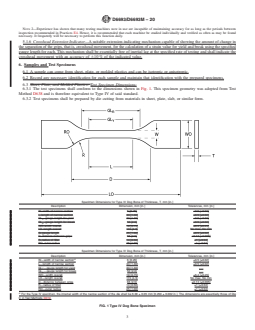
L—length of narrow section 33 [1.30] ±0.5 [±0.02]
GL —gauge length for yield 33 [1.30] . . .
Y
GL —gauge length for break 50 [2.0] . . .
B
WO—width overall 19 [0.75] ±6.4 [±0.25]
LO—length overall 115 [4.5] No max, No min
D—distance between grips 65 [2.5] ±0.13 [±0.005]
R—radius of fillet 14 [0.56] ±1 [±0.04]
RO—outer radius 25 [1.00] ±1 [±0.04]
A
For the Type IV specimen, the internal width of the narrow section of the die shall be 6.00 ± 0.05 mm [0.250 ± 0.002 in.]. The dimensions are essentially those of Die
C in Test Methods D412.
FIG. 1 Type IV Dog Bone Specimen
flaws or imperfections are present in the new specimen, the die 8. Number of Test Specimens
should be inspected for flaws.
8.1 Test at least five specimens for each sample in the case
of isotropic materials.
NOTE 3—Negative effects from imperfections on the edge of the
specimens can severely impact the results of this test and should therefore
8.2 Test ten specimens, five normal to and five parallel with
be carefully monitored. In cases of dispute over the results, inspection of
the principle axis of anisotropy, for each sample in the case of
the die and specimen preparation should take place.
anisotropic materials.
7. Conditioning
8.3 Discard specimens that break at some obvious flaw and
7.1 Conditioning
...
This document is not an ASTM standard and is intended only to provide the user of an ASTM standard an indication of what changes have been made to the previous version. Because
it may not be technically possible to adequately depict all changes accurately, ASTM recommends that users consult prior editions as appropriate. In all cases only the current version
of the standard as published by ASTM is to be considered the official document.
´1
Designation: D6693/D6693M − 04 (Reapproved 2015) D6693/D6693M − 20
Standard Test Method for
Determining Tensile Properties of Nonreinforced
Polyethylene and Nonreinforced Flexible Polypropylene
Geomembranes
This standard is issued under the fixed designation D6693/D6693M; the number immediately following the designation indicates the
year of original adoption or, in the case of revision, the year of last revision. A number in parentheses indicates the year of last
reapproval. A superscript epsilon (´) indicates an editorial change since the last revision or reapproval.
ε NOTE—Designation was changed to dual and units information was corrected editorially in June 2015.
1. Scope
1.1 This test method covers the determination of the tensile properties of nonreinforced geomembranes in the form of standard
dumbbell-shaped test specimens when tested under defined conditions of pretreatment, temperature, and machine speed.
1.2 This test method can be used for testing materials thickness between 0.25 mm [0.010 in.] and 6.3 mm [0.25 in.].
NOTE 1—This test method is not intended to cover precise physical procedures. precisely measure physical properties of a geomembrane for design
purposes. This is an “index test” intended to be used for quality control and specification conformance purposes. The constant rate of crosshead movement
of this test lacks accuracy from a theoretical standpoint. standpoint, since crosshead movement as opposed to actual strain is used. A wide difference may
exist between the rate of crosshead movement and the rate of strain in particular areas of the specimen indicating that the testing speeds specified since
the specimen does not have a uniform width or cross-sectional area. This may disguise important effects or characteristics of these materials in the plastic
state. Use of an extensometer, not included in this test, would more accurately measure strain and strain rate but would still have limitations for some
geomembranes. Further, it is realized that variations in the thicknesses of test specimens, as permitted by this test method, produce variations in the
surface-volume ratios of such specimens, and that these variations may influence the test results. Hence, where directly comparable results are desired,
all samples should be of equal thickness. Special additional tests should be used where more precise physical data are needed. Test Method D4885 is a
suitable performance test for many applications.
1.3 Test data obtained by this test method are relevant and may be appropriate for use in engineering design with consideration
of test conditions as compared with in-service conditions.
1.3 The values stated in either SI units or inch-pound units are to be regarded separately as standard. The values stated in each
system are not necessarily exact equivalents; therefore, to ensure conformance with the standard, each system shall be used
independently of the other, and values from the two systems shall not be combined.
1.4 This standard does not purport to address all of the safety concerns, if any, associated with its use. It is the responsibility
of the user of this standard to establish appropriate safety safety, health, and healthenvironmental practices and determine the
applicability of regulatory limitations prior to use.
1.5 This international standard was developed in accordance with internationally recognized principles on standardization
established in the Decision on Principles for the Development of International Standards, Guides and Recommendations issued
by the World Trade Organization Technical Barriers to Trade (TBT) Committee.
2. Referenced Documents
2.1 ASTM Standards:
D374/D374M Test Methods for Thickness of Solid Electrical Insulation
D412 Test Methods for Vulcanized Rubber and Thermoplastic Elastomers—Tension
D638 Test Method for Tensile Properties of Plastics
D4000 Classification System for Specifying Plastic Materials
D4439 Terminology for Geosynthetics
D4885 Test Method for Determining Performance Strength of Geomembranes by the Wide Strip Tensile Method
D5199 Test Method for Measuring the Nominal Thickness of Geosynthetics
This test method is under the jurisdiction of ASTM Committee D35 on Geosynthetics and is the direct responsibility of Subcommittee D35.10 on Geomembranes.
Current edition approved May 1, 2015July 1, 2020. Published June 2015July 2020. Originally approved in 2001. Last previous edition approved in 20102015 as
ɛ1
D6693–04(2010).D6693/D6693M – 04 (2015) . DOI: 10.1520/D6693_D6693M-04R15E01.10.1520/D6693_D6693M-20.
For referenced ASTM standards, visit the ASTM website, www.astm.org, or contact ASTM Customer Service at service@astm.org. For Annual Book of ASTM Standards
volume information, refer to the standard’s Document Summary page on the ASTM website.
Copyright © ASTM International, 100 Barr Harbor Drive, PO Box C700, West Conshohocken, PA 19428-2959. United States
D6693/D6693M − 20
D5994/D5994M Test Method for Measuring Core Thickness of Textured Geomembranes
E4 Practices for Force Verification of Testing Machines
E691 Practice for Conducting an Interlaboratory Study to Determine the Precision of a Test Method
E2586 Practice for Calculating and Using Basic Statistics
3. Terminology
3.1 Definitions—Definitions of terms applying to this test method appear in Terminology D4439.
4. Significance and Use
4.1 This test method is designed to produce tensile property data for the control and specification of nonreinforced polyethylene
and flexible nonreinforced polypropylene geomembranes. These data are also useful for qualitative characterization and for
research and development. It may be necessary to modify this procedure for use in testing certain materials as recommended by
the material specifications. Therefore, it is advisable to refer to that material’s specification before using this test method. Table 1
in Classification D4000 lists the ASTM materials standards that currently exist.
4.2 Tensile properties may vary with specimen preparation, test speed, and environment of testing. Consequently, where precise
comparative results are desired, these factors must be carefully monitored and controlled.
4.2.1 It is realized that a material cannot be tested without also testing the method of preparation of that material. Hence, when
comparative tests of materials are desired, the care must be exercised to ensure that all samples are prepared in exactly the same
way, unless the test is to include the effects of sample preparation. Similarly, for referee purposes or comparisons within any given
series of specimens, care must be taken to secure the maximum degree of uniformity in details of preparation, treatment, and
handling.
NOTE 2—Tensile properties may provide useful data for plastics engineering design purposes. However, because of the high degree of sensitivity
exhibited by many plastics to rate of straining and environmental conditions, data obtained by this test method cannot be considered valid for applications
involving load-time scales or environments widely different from those of this test method. In cases of such dissimilarity, no reliable estimation of the
limit of usefulness can be made for most plastics. This sensitivity to rate of straining and environment necessitates testing over a broad load-time scale
and range of environmental conditions if tensile properties are to suffice for engineering design purposes.
5. Apparatus
5.1 Testing Machine—A testing machine of the constant-rate-of-crosshead-movement type and comprising essentially the
following:
5.1.1 Fixed Member—A fixed or essentially stationary member carrying one grip.
5.1.2 Movable Member—A movable member carrying a second grip.
5.1.3 Grips—Grips for holding the test specimen between the fixed member and the movable member of the test apparatus can
be either a fixed or self-aligning type.
5.1.3.1 Fixed grips are rigidly attached to the fixed and movable members of the test apparatus. Extreme care should be taken
when this type of grip is used to ensure that the test specimen is inserted and clamped so that the long axis of the test specimen
coincides with the direction of pull through the centerline of the grip assembly.
5.1.3.2 Self-aligning grips are attached to the fixed and movable members of the test apparatus. This type of grip assembly is
such that they will move freely into alignment as soon as any load is applied as long as the long axis of the test specimen will
coincide with the direction of the applied pull through the centerline of the grip assembly. The specimens should be aligned as
perfectly as possible with the direction of pull so that no rotary motion will occur in the grips thereby inducing slippage; there is
a limit to the amount of misalignment self-aligning grips will accommodate.
5.1.3.3 The test specimen shall be held in such a way that slippage relative to the grips is prevented as much as possible. Grip
surfaces that are deeply scored or serrated with a pattern similar to those of a coarse single-cut file, serrations about 2.4 mm [0.09
in.] apart and about 1.6 mm [0.06 in.] deep, have been found satisfactory for most thermoplastics. Finer serrations have been found
to be more satisfactory for harder plastics, such as the thermosetting materials. The serrations should be kept clean and sharp.
Breaking in the grips may occur at times, even when deep serrations or abraded specimen surfaces are used; other techniques must
be used in these cases. Other techniques that have been found useful, particularly with smooth-faced grips, are abrading that portion
of the surface of the specimen that will be in the grips, and interposing thin pieces of abrasive cloth, abrasive paper, plastic, or
rubber-coated fabric, commonly called hospital sheeting, between the specimen and the grip surface. No. 80 double-sided abrasive
paper has been found effective in many cases. An open-mesh fabric, in which the threads are coated with abrasive, has also been
effective. Reducing the cross-sectional area of the specimen may also be effective. The use of special types of grips is sometimes
necessary to eliminate slippage and breakage in the grips.
5.1.4 Drive Mechanism—A drive mechanism for imparting to the movable member a uniform, controlled velocity with respect
to the stationary member, with this velocity to be regulated as specified in Section 9.
5.1.5 Load Indicator—A suitable load-indicating mechanism capable of showing the total tensile load carried by the test
specimen when held by the grips. This mechanism shall be essentially free of inertiainertial lag at the specified rate of testing and
shall indicate the load with an accuracy of 61 % of the indicated value, or better. The accuracy of the testing machine shall be
verified in accordance with Practices E4.
D6693/D6693M − 20
NOTE 2—Experience has shown that many testing machines now in use are incapable of maintaining accuracy for as long as the periods between
inspection recommended in Practices E4. Hence, it is recommended that each machine be studied individually and verified as often as may be found
necessary. It frequently will be necessary to perform this function daily.
5.1.6 Crosshead Extension Indicator—A suitable extension-indicating mechanism capable of showing the amount of change in
the separation of the grips, that is, crosshead movement, for the calculation of a strain value for yield and break using the specified
gauge length for each. This mechanism shall be essentially free of inertial lag at the specified rate of testing and shall indicate the
crosshead movement with an accuracy of 610 % of the indicated value.
6. Samples and Test Specimens
6.1 A sample can come from sheet, plate, or molded plastics and can be isotropic or anisotropic.
6.2 Record any necessary identification for each sample and maintain that identification with the prepared specimens.
6.3 Sheet, Plate, and Molded Plastics: Test Specimen Dimensions:
6.3.1 The test specimens shall conform to the dimensions shown in Fig. 1. This specimen geometry was adopted from Test
Method D638 and is therefore equivalent to Type IV of said standard.
6.3.2 Test specimens shall be prepared by die cutting from materials in sheet, plate, slab, or similar form.
Specimen Dimensions for Type IV Dog Bone of Thickness, T, mm [in.]
Description Dimension, mm [in.] Tolerances, mm [in.]
W–width of narrow section 6 [0.25] ±0.5 [±0.02]
L–length of narrow section 33 [1.30] ±0.5 [±0.02]
GL –gauge length for yield 33 [1.30] ±0.5 [±0.02]
Y
GL –gauge length for break 50 [2.0] ±0.5 [±0.02]
B
WO–width overall 19 [0.75] ±6.4 [±0.25]
LO–length overall 115 [4.5] No max, No min
G–gauge length 25 [1.00] ±0.5 [±0.02]
D–distance between grips 65 [2.5] ±0.13 [±0.005]
R–radius of fillet 14 [0.56] ±1 [±0.04]
RO–outer radius 25 [1.00] ±1 [±0.04]
Specimen Dimensions for Type IV Dog Bone of Thickness, T, mm [in.]
Description Dimension, mm [in.] Tolerances, mm [in.]
A
W—width of narrow section 6 [0.25] ±0.5 [±0.02]
L—length of narrow section 33 [1.30] ±0.5 [±0.02]
GL —gauge length for yield 33 [1.30] . . .
Y
GL —gauge length for break 50 [2.0] . . .
B
WO—width overall 19 [0.75] ±6.4 [±0.25]
LO—length overall 115 [4.5] No max, No min
D—distance between grips 65 [2.5] ±0.13 [±0.005]
R—radius of fillet 14 [0.56] ±1 [±0.04]
RO—outer radius 25 [1.00] ±1 [±0.04]
A
For the Type IV specimen, the internal width of the narrow section of the die shall be 6.00 ± 0.05 mm [0.250 ± 0.002 in.]. The dimensions are essentially those of Die
C in Test Methods D412.
FIG. 1 Type IV Dog Bone Specimen
D6693/D6693M − 20
6.4 All surfaces of the specimen shall be free of visible flaws, scratches, or imperfections. If the specimen exhibits such
markings, it should be discarded and replaced. If these flaws or imperfections are present in the new specimen, the die should be
inspected for flaws.
NOTE 3—Negative effects from imperfections on the edge of the specimens can severely impact the results of this test and should therefore be carefully
monitored. In cases of dispute over the results, inspection of the die and specimen prep
...