

ASTM D7747/D7747M-11(2023)
(Test Method)Standard Test Method for Determining Integrity of Seams Produced Using Thermo-Fusion Methods for Reinforced Geomembranes by the Strip Tensile Method
General Information
- Abstract
SIGNIFICANCE AND USE
4.1 The use of reinforced geomembranes as barrier materials has created a need for a standard test method to evaluate the quality of seams produced by thermo-fusion methods. This test method is used for quality control purposes and is intended to provide quality control and quality assurance personnel with data to evaluate seam quality.
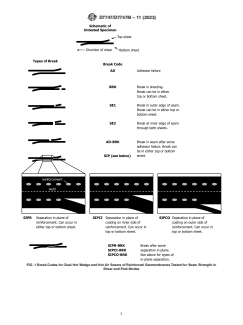
4.2 This standard arose from the need for a destructive test method for evaluating seams of reinforced geomembranes. Standards written for destructive testing of nonreinforced geomembranes do not include all break codes (Fig. 1) applicable to reinforced geomembranes.
FIG. 1 Break Codes for Dual Hot Wedge and Hot Air Seams of Reinforced Geomembranes Tested for Seam Strength in Shear and Peel Modes
4.3 When reinforcement occurs in directions other than machine and cross-machine, scrim are cut at specimen edges, generally lowering results. To partially compensate for this, testing can be performed according to Test Method D7749 or the 2 in. wide strip specimen specified in this method can be utilized. Testing of 1 in. and 2 in. specimens is Method A and Method B, respectively.
4.4 The shear test outlined in this method correlates to strength of parent material measured according to Test Method D7003/D7003M only if reinforcement is parallel to TD. For other materials, seam strength and parent material strength can be compared through Test Methods D7749 and D7004/D7004M. Values obtained with the strip methods shall not be compared to values obtained with grab methods.
SCOPE
1.1 This test method describes destructive quality control tests used to determine the integrity of thermo-fusion seams made with reinforced geomembranes. Test procedures are described for seam tests for peel and shear properties using strip specimens.
1.2 The types of thermal field and factory seaming techniques used to construct geomembrane seams include the following:
1.2.1 Hot Air—This technique introduces high-temperature air between two geomembrane surfaces to facilitate melting. Pressure is applied to the top or bottom geomembrane, forcing together the two surfaces to form a continuous bond.
1.2.2 Hot Wedge—This technique melts the two geomembrane surfaces to be seamed by running a hot metal wedge between them. Pressure is applied to the top and bottom geomembrane to form a continuous bond. Some seams of this kind are made with dual tracks separated by a non-bonded gap. These seams are sometimes referred to as dual hot wedge seams or double-track seams.
1.2.3 Extrusion—This technique encompasses extruding molten resin between two geomembranes or at the edge of two overlapped geomembranes to effect a continuous bond.
1.2.4 Radio Frequency (RF) or Dielectric—High-frequency dielectric equipment is used to generate heat and pressure to form an overlap seam in factory fabrication.
1.2.5 Impulse—Clamping bars heated by wires or a ribbon melt the sheets clamped between them. A cooling period while still clamped allows the polymer to solidify before being released.
1.3 The types of materials covered by this test method include, but are not limited to, reinforced geomembranes made from the following polymers:
1.3.1 Very low-density polyethylene (VLDPE).
1.3.2 Linear low-density polyethylene (LLDPE).
1.3.3 Flexible polypropylene (fPP).
1.3.4 Polyvinyl chloride (PVC).
1.3.5 Chlorosulfonated polyethylene (CSPE).
1.3.6 Ethylene interpolymer alloy (EIA).
1.4 Units—The values stated in either SI units or inch-pound units are to be regarded separately as standard. The values stated in each system may not be exact equivalents; therefore, each system shall be used independently of the other. Combining values from the two systems may result in nonconformance with the standard.
1.5 This standard does not purport to address all of the safety concerns, if any, associated with its use. It is the responsibility of the user of this standard to establish ap...
- Status
- Published
- Publication Date
- 31-Oct-2023
- Technical Committee
- D35 - Geosynthetics
- Drafting Committee
- D35.10 - Geomembranes
Overview
ASTM D7747/D7747M-11(2023) sets out a standard test method for determining the integrity of seams produced using thermo-fusion methods for reinforced geomembranes through the strip tensile method. Established by ASTM International, this standard addresses the growing industry need to perform destructive quality control and assurance tests on seamed geomembranes used as barrier materials in critical containment applications.
The test method evaluates seam strength and quality by applying tensile forces to strip specimens cut from welded seams. It is a vital resource for manufacturers, contractors, and quality assurance professionals working with reinforced geomembrane liners in the environmental, civil engineering, and geotechnical sectors.
Key Topics
- Scope of Testing: This standard applies to reinforced geomembranes made from various polymers, including VLDPE, LLDPE, fPP, PVC, CSPE, and EIA, and focuses on seam strength in shear and peel modes.
- Destructive Seam Testing: The method involves removing and testing samples from installed seams to ensure weld integrity and quality, providing essential data for project certification and regulatory compliance.
- Seaming Techniques: Covered joining methods include:
- Hot Air welding
- Hot Wedge welding (single and dual/separated tracks)
- Extrusion welding
- Radio Frequency (RF) or Dielectric welding
- Impulse welding
- Testing Methods:
- Two specimen widths are evaluated: 1-inch (Method A) and 2-inch (Method B) strip specimens.
- Break codes and modes of failure are used to interpret the results, accounting for the unique reinforcement and scrim structure in the materials.
- Quality Assurance and Data Reporting: Essential testing parameters, break codes, and strength values in N/mm or lb/in must be reported, supporting comprehensive quality documentation.
Applications
The ASTM D7747/D7747M standard is utilized primarily in quality control and quality assurance activities where reinforced geomembrane seams must meet stringent integrity requirements. Key applications include:
- Landfill liners and covers: Ensuring environmental containment of waste and leachate.
- Mining heap leach pads: Verifying seam durability for chemical containment.
- Water and wastewater treatment ponds: Maintaining liquid-tight containment.
- Agricultural lagoons: Reinforcing the integrity of primary and secondary containment barriers.
- Canal lining and reservoir liners: Preventing seepage and loss through seams in geomembrane linings.
This method is also valuable in laboratory testing protocols for product qualification and validation of welding procedures under project-specific or regulatory demands.
Related Standards
Practitioners often consult ASTM D7747/D7747M in conjunction with related ASTM geomembrane and geosynthetic standards to ensure comprehensive quality control, such as:
- ASTM D7003/D7003M: Test method for strip tensile properties of reinforced geomembranes.
- ASTM D7004/D7004M: Test method for grab tensile properties of reinforced geomembranes.
- ASTM D7749/D7749M: Test method for determining integrity of seams by the grab method.
- ASTM D76/D76M: Specification for tensile testing machines for textiles.
- ASTM D4439: Terminology relating to geosynthetics.
Using ASTM D7747/D7747M as part of a robust quality management program ensures reinforced geomembrane barriers meet the highest performance and safety standards in field and factory applications. Proper seam testing as described by this standard helps prevent failures, environmental hazards, and costly remediation efforts, supporting the long-term durability of geosynthetic containment systems.
Relations
- Effective Date
- 01-Nov-2023
- Effective Date
- 01-Feb-2024
- Effective Date
- 15-Jul-2023
- Effective Date
- 01-Feb-2018
- Effective Date
- 01-Nov-2023
- Effective Date
- 01-Nov-2023
- Effective Date
- 01-Nov-2023
Get Certified
Connect with accredited certification bodies for this standard

Control Union Certifications
Global certification for agriculture and sustainability.

Hohenstein Institut
Textile testing and certification.

Bureau Veritas Bangladesh
Bureau Veritas certification services in Bangladesh.
Sponsored listings
Frequently Asked Questions
ASTM D7747/D7747M-11(2023) is a standard published by ASTM International. Its full title is "Standard Test Method for Determining Integrity of Seams Produced Using Thermo-Fusion Methods for Reinforced Geomembranes by the Strip Tensile Method". This standard covers: SIGNIFICANCE AND USE 4.1 The use of reinforced geomembranes as barrier materials has created a need for a standard test method to evaluate the quality of seams produced by thermo-fusion methods. This test method is used for quality control purposes and is intended to provide quality control and quality assurance personnel with data to evaluate seam quality. 4.2 This standard arose from the need for a destructive test method for evaluating seams of reinforced geomembranes. Standards written for destructive testing of nonreinforced geomembranes do not include all break codes (Fig. 1) applicable to reinforced geomembranes. FIG. 1 Break Codes for Dual Hot Wedge and Hot Air Seams of Reinforced Geomembranes Tested for Seam Strength in Shear and Peel Modes 4.3 When reinforcement occurs in directions other than machine and cross-machine, scrim are cut at specimen edges, generally lowering results. To partially compensate for this, testing can be performed according to Test Method D7749 or the 2 in. wide strip specimen specified in this method can be utilized. Testing of 1 in. and 2 in. specimens is Method A and Method B, respectively. 4.4 The shear test outlined in this method correlates to strength of parent material measured according to Test Method D7003/D7003M only if reinforcement is parallel to TD. For other materials, seam strength and parent material strength can be compared through Test Methods D7749 and D7004/D7004M. Values obtained with the strip methods shall not be compared to values obtained with grab methods. SCOPE 1.1 This test method describes destructive quality control tests used to determine the integrity of thermo-fusion seams made with reinforced geomembranes. Test procedures are described for seam tests for peel and shear properties using strip specimens. 1.2 The types of thermal field and factory seaming techniques used to construct geomembrane seams include the following: 1.2.1 Hot Air—This technique introduces high-temperature air between two geomembrane surfaces to facilitate melting. Pressure is applied to the top or bottom geomembrane, forcing together the two surfaces to form a continuous bond. 1.2.2 Hot Wedge—This technique melts the two geomembrane surfaces to be seamed by running a hot metal wedge between them. Pressure is applied to the top and bottom geomembrane to form a continuous bond. Some seams of this kind are made with dual tracks separated by a non-bonded gap. These seams are sometimes referred to as dual hot wedge seams or double-track seams. 1.2.3 Extrusion—This technique encompasses extruding molten resin between two geomembranes or at the edge of two overlapped geomembranes to effect a continuous bond. 1.2.4 Radio Frequency (RF) or Dielectric—High-frequency dielectric equipment is used to generate heat and pressure to form an overlap seam in factory fabrication. 1.2.5 Impulse—Clamping bars heated by wires or a ribbon melt the sheets clamped between them. A cooling period while still clamped allows the polymer to solidify before being released. 1.3 The types of materials covered by this test method include, but are not limited to, reinforced geomembranes made from the following polymers: 1.3.1 Very low-density polyethylene (VLDPE). 1.3.2 Linear low-density polyethylene (LLDPE). 1.3.3 Flexible polypropylene (fPP). 1.3.4 Polyvinyl chloride (PVC). 1.3.5 Chlorosulfonated polyethylene (CSPE). 1.3.6 Ethylene interpolymer alloy (EIA). 1.4 Units—The values stated in either SI units or inch-pound units are to be regarded separately as standard. The values stated in each system may not be exact equivalents; therefore, each system shall be used independently of the other. Combining values from the two systems may result in nonconformance with the standard. 1.5 This standard does not purport to address all of the safety concerns, if any, associated with its use. It is the responsibility of the user of this standard to establish ap...
SIGNIFICANCE AND USE 4.1 The use of reinforced geomembranes as barrier materials has created a need for a standard test method to evaluate the quality of seams produced by thermo-fusion methods. This test method is used for quality control purposes and is intended to provide quality control and quality assurance personnel with data to evaluate seam quality. 4.2 This standard arose from the need for a destructive test method for evaluating seams of reinforced geomembranes. Standards written for destructive testing of nonreinforced geomembranes do not include all break codes (Fig. 1) applicable to reinforced geomembranes. FIG. 1 Break Codes for Dual Hot Wedge and Hot Air Seams of Reinforced Geomembranes Tested for Seam Strength in Shear and Peel Modes 4.3 When reinforcement occurs in directions other than machine and cross-machine, scrim are cut at specimen edges, generally lowering results. To partially compensate for this, testing can be performed according to Test Method D7749 or the 2 in. wide strip specimen specified in this method can be utilized. Testing of 1 in. and 2 in. specimens is Method A and Method B, respectively. 4.4 The shear test outlined in this method correlates to strength of parent material measured according to Test Method D7003/D7003M only if reinforcement is parallel to TD. For other materials, seam strength and parent material strength can be compared through Test Methods D7749 and D7004/D7004M. Values obtained with the strip methods shall not be compared to values obtained with grab methods. SCOPE 1.1 This test method describes destructive quality control tests used to determine the integrity of thermo-fusion seams made with reinforced geomembranes. Test procedures are described for seam tests for peel and shear properties using strip specimens. 1.2 The types of thermal field and factory seaming techniques used to construct geomembrane seams include the following: 1.2.1 Hot Air—This technique introduces high-temperature air between two geomembrane surfaces to facilitate melting. Pressure is applied to the top or bottom geomembrane, forcing together the two surfaces to form a continuous bond. 1.2.2 Hot Wedge—This technique melts the two geomembrane surfaces to be seamed by running a hot metal wedge between them. Pressure is applied to the top and bottom geomembrane to form a continuous bond. Some seams of this kind are made with dual tracks separated by a non-bonded gap. These seams are sometimes referred to as dual hot wedge seams or double-track seams. 1.2.3 Extrusion—This technique encompasses extruding molten resin between two geomembranes or at the edge of two overlapped geomembranes to effect a continuous bond. 1.2.4 Radio Frequency (RF) or Dielectric—High-frequency dielectric equipment is used to generate heat and pressure to form an overlap seam in factory fabrication. 1.2.5 Impulse—Clamping bars heated by wires or a ribbon melt the sheets clamped between them. A cooling period while still clamped allows the polymer to solidify before being released. 1.3 The types of materials covered by this test method include, but are not limited to, reinforced geomembranes made from the following polymers: 1.3.1 Very low-density polyethylene (VLDPE). 1.3.2 Linear low-density polyethylene (LLDPE). 1.3.3 Flexible polypropylene (fPP). 1.3.4 Polyvinyl chloride (PVC). 1.3.5 Chlorosulfonated polyethylene (CSPE). 1.3.6 Ethylene interpolymer alloy (EIA). 1.4 Units—The values stated in either SI units or inch-pound units are to be regarded separately as standard. The values stated in each system may not be exact equivalents; therefore, each system shall be used independently of the other. Combining values from the two systems may result in nonconformance with the standard. 1.5 This standard does not purport to address all of the safety concerns, if any, associated with its use. It is the responsibility of the user of this standard to establish ap...
ASTM D7747/D7747M-11(2023) is classified under the following ICS (International Classification for Standards) categories: 59.080.70 - Geotextiles. The ICS classification helps identify the subject area and facilitates finding related standards.
ASTM D7747/D7747M-11(2023) has the following relationships with other standards: It is inter standard links to ASTM D7747/D7747M-11(2018), ASTM D4439-24, ASTM D4439-23b, ASTM D7749-11(2018), ASTM D7982-15(2021), ASTM D7700-22, ASTM D7749/D7749M-11(2023)e1. Understanding these relationships helps ensure you are using the most current and applicable version of the standard.
ASTM D7747/D7747M-11(2023) is available in PDF format for immediate download after purchase. The document can be added to your cart and obtained through the secure checkout process. Digital delivery ensures instant access to the complete standard document.
Standards Content (Sample)
This international standard was developed in accordance with internationally recognized principles on standardization established in the Decision on Principles for the
Development of International Standards, Guides and Recommendations issued by the World Trade Organization Technical Barriers to Trade (TBT) Committee.
Designation: D7747/D7747M − 11 (Reapproved 2023)
Standard Test Method for
Determining Integrity of Seams Produced Using Thermo-
Fusion Methods for Reinforced Geomembranes by the Strip
Tensile Method
This standard is issued under the fixed designation D7747/D7747M; the number immediately following the designation indicates the
year of original adoption or, in the case of revision, the year of last revision. A number in parentheses indicates the year of last
reapproval. A superscript epsilon (´) indicates an editorial change since the last revision or reapproval.
1. Scope 1.3.2 Linear low-density polyethylene (LLDPE).
1.3.3 Flexible polypropylene (fPP).
1.1 This test method describes destructive quality control
1.3.4 Polyvinyl chloride (PVC).
tests used to determine the integrity of thermo-fusion seams
1.3.5 Chlorosulfonated polyethylene (CSPE).
made with reinforced geomembranes. Test procedures are
1.3.6 Ethylene interpolymer alloy (EIA).
described for seam tests for peel and shear properties using
strip specimens. 1.4 Units—The values stated in either SI units or inch-
pound units are to be regarded separately as standard. The
1.2 The types of thermal field and factory seaming tech-
values stated in each system may not be exact equivalents;
niques used to construct geomembrane seams include the
therefore, each system shall be used independently of the other.
following:
Combining values from the two systems may result in noncon-
1.2.1 Hot Air—This technique introduces high-temperature
formance with the standard.
air between two geomembrane surfaces to facilitate melting.
1.5 This standard does not purport to address all of the
Pressure is applied to the top or bottom geomembrane, forcing
safety concerns, if any, associated with its use. It is the
together the two surfaces to form a continuous bond.
responsibility of the user of this standard to establish appro-
1.2.2 Hot Wedge—This technique melts the two geomem-
priate safety, health, and environmental practices and deter-
brane surfaces to be seamed by running a hot metal wedge
mine the applicability of regulatory limitations prior to use.
between them. Pressure is applied to the top and bottom
1.6 This international standard was developed in accor-
geomembrane to form a continuous bond. Some seams of this
dance with internationally recognized principles on standard-
kind are made with dual tracks separated by a non-bonded gap.
ization established in the Decision on Principles for the
These seams are sometimes referred to as dual hot wedge
Development of International Standards, Guides and Recom-
seams or double-track seams.
mendations issued by the World Trade Organization Technical
1.2.3 Extrusion—This technique encompasses extruding
Barriers to Trade (TBT) Committee.
molten resin between two geomembranes or at the edge of two
overlapped geomembranes to effect a continuous bond.
2. Referenced Documents
1.2.4 Radio Frequency (RF) or Dielectric—High-frequency
dielectric equipment is used to generate heat and pressure to
2.1 ASTM Standards:
form an overlap seam in factory fabrication.
D76/D76M Specification for Tensile Testing Machines for
1.2.5 Impulse—Clamping bars heated by wires or a ribbon
Textiles
melt the sheets clamped between them. A cooling period while
D4439 Terminology for Geosynthetics
still clamped allows the polymer to solidify before being
D7003/D7003M Test Method for Strip Tensile Properties of
released.
Reinforced Geomembranes
D7004/D7004M Test Method for Grab Tensile Properties of
1.3 The types of materials covered by this test method
Reinforced Geomembranes
include, but are not limited to, reinforced geomembranes made
D7749/D7749M Test Method for Determining Integrity of
from the following polymers:
Seams Produced Using Thermo-Fusion Methods for Re-
1.3.1 Very low-density polyethylene (VLDPE).
inforced Geomembranes by the Grab Method
This test method is under the jurisdiction of ASTM Committee D35 on
Geosynthetics and is the direct responsibility of Subcommittee D35.10 on Geomem-
branes. For referenced ASTM standards, visit the ASTM website, www.astm.org, or
Current edition approved Nov. 1, 2023. Published November 2023. Originally contact ASTM Customer Service at service@astm.org. For Annual Book of ASTM
approved in 2011. Last previous edition approved in 2018 as D7747/D7747M – 11 Standards volume information, refer to the standard’s Document Summary page on
(2018). DOI: 10.1520/D7747_D7747M-11R23. the ASTM website.
Copyright © ASTM International, 100 Barr Harbor Drive, PO Box C700, West Conshohocken, PA 19428-2959. United States
D7747/D7747M − 11 (2023)
3. Terminology 6.2.1 Specimens—Rectangular test specimens shall be a
minimum of 150 mm [6.0 in.] plus the seam width in the
3.1 Definitions—Refer to Terminology D4439 for defini-
direction perpendicular to the seam. For Method A, the
tions of terms applying to this test method.
specimens shall be 25.4 mm [1.00 in.] in the direction parallel
4. Significance and Use
to the seam. For Method B, specimens shall be 50.8 mm
[2.00 in.] in the direction parallel to the seam. The seam should
4.1 The use of reinforced geomembranes as barrier materi-
be centered in the specimen.
als has created a need for a standard test method to evaluate the
quality of seams produced by thermo-fusion methods. This test
7. Conditioning
method is used for quality control purposes and is intended to
provide quality control and quality assurance personnel with 7.1 Conditioning—Specimens may be tested once they have
data to evaluate seam quality. equilibrated at standard laboratory temperature. The time
required to reach temperature equilibrium may vary according
4.2 This standard arose from the need for a destructive test
to the material type and thickness.
method for evaluating seams of reinforced geomembranes.
7.2 Test Conditions—Conduct tests at the standard atmo-
Standards written for destructive testing of nonreinforced
geomembranes do not include all break codes (Fig. 1) appli- sphere for testing geosynthetics, a temperature of 21 6 2 °C
[70 6 4 °F] and a relative humidity between 50 to 70 %, unless
cable to reinforced geomembranes.
otherwise specified.
4.3 When reinforcement occurs in directions other than
machine and cross-machine, scrim are cut at specimen edges,
8. Procedure
generally lowering results. To partially compensate for this,
8.1 Shear Test:
testing can be performed according to Test Method D7749/
8.1.1 Set the grip separation equal to the width of the seam
D7749M or the 2 in. wide strip specime
...