

ASTM D5617-23
(Test Method)Standard Test Method for Multi-Axial Elongation of Geomembranes
General Information
- Abstract
SIGNIFICANCE AND USE
5.1 Installed geomembranes are subjected to forces from more than one direction, including forces perpendicular to the surfaces of the geomembrane. Out-of-plane deformation of a geomembrane may be useful in evaluating materials for caps where subsidence of the subsoil may be problematic.
5.2 Failure mechanisms on this test may be different compared to other relatively small-scale index tests and may be beneficial for design purposes.
5.3 In applications where local subsidence is expected, this test can be considered a performance test.
5.4 For applications where geomembranes cannot be deformed in the fashion this test method prescribes, this test method should be considered an index test.
5.5 Due to the time involved to perform this test, it is not considered practical as a quality control test.
SCOPE
1.1 This test method covers the measurement of the out-of-plane response of a geomembrane to a force that is applied perpendicular to the initial plane of the sample.
1.2 When the geomembrane deforms to a prescribed geometric shape (arc of a sphere or ellipsoid), formulations are provided to convert the test data to biaxial tensile stress-strain values. These formulations cannot be used for other geometric shapes. With other geometric shapes, comparative data on deformation versus pressure is obtained.
1.3 This test method requires a large-diameter pressure vessel (610 mm). Information obtained from this test method may be more appropriate for design purposes than many small-scale index tests.
1.4 The values stated in SI units are to be regarded as standard. No other units of measurement are included in this standard.
1.5 This standard does not purport to address all of the safety concerns, if any, associated with its use. It is the responsibility of the user of this standard to establish appropriate safety, health, and environmental practices and determine the applicability of regulatory limitations prior to use.
1.6 This international standard was developed in accordance with internationally recognized principles on standardization established in the Decision on Principles for the Development of International Standards, Guides and Recommendations issued by the World Trade Organization Technical Barriers to Trade (TBT) Committee.
- Status
- Published
- Publication Date
- 31-Oct-2023
- Technical Committee
- D35 - Geosynthetics
- Drafting Committee
- D35.10 - Geomembranes
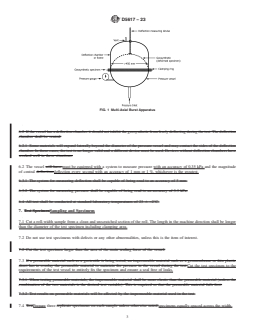
Overview
ASTM D5617-23: Standard Test Method for Multi-Axial Elongation of Geomembranes specifies a laboratory method to evaluate the out-of-plane mechanical response of geomembranes subjected to forces perpendicular to their surface. Developed by ASTM International’s Committee D35 on Geosynthetics, this standard uses a large-diameter pressure vessel to measure how geomembranes deform and ultimately fail under multi-axial tension. The procedure supports the assessment of geomembranes used in engineering projects such as landfill caps, containment barriers, and other structures where dimensional stability and resistance to subsidence are critical.
This standard is particularly valuable for design engineers and researchers needing realistic, performance-based data about geomembrane behavior under complex loading conditions, unlike traditional uniaxial or small-scale index tests.
Key Topics
- Multi-Axial Elongation: The standard measures how geomembranes deform when force is applied perpendicularly, simulating real-world stresses where subsoil settlement or applied loads act in more than one direction.
- Test Apparatus: Requires a pressure vessel with an inside diameter of 610 mm, capable of both accurate pressure and deflection measurements.
- Specimen Preparation: Samples are cut from defect-free sections, properly conditioned, and clamped to ensure accurate and repeatable results.
- Out-of-Plane Deformation: Monitors the extent to which a geomembrane will stretch or rupture, which is important for applications dealing with subsidence or void formation beneath liners.
- Stress-Strain Calculations: If the specimen takes a predictable geometric form-like an arc of a sphere or an ellipsoid-calculations convert physical measurements into biaxial tensile stress-strain values for quantitative analysis.
- Performance vs. Index Test: Serves as a performance test in scenarios where field conditions can cause similar deformations, or as an index test for comparative evaluations when such loading is unlikely.
Applications
ASTM D5617-23 is most relevant for:
- Geomembrane Material Selection: By simulating realistic loading, the standard supports informed decisions on material suitability, especially for capping systems over unstable subsoil.
- Design Evaluation: Data produced can be directly used in engineering calculations and risk assessments where resistance to multi-axial forces is required.
- Performance Testing: Essential in applications where local subsidence is expected, such as landfills, tailings ponds, and mining containment areas, helping verify liner integrity under possible field-induced deformations.
- Comparative Material Research: Allows researchers and manufacturers to benchmark different geomembrane products under consistent multi-axial loading scenarios.
- Supplementary Index Testing: When field-specific multi-axial stresses are not anticipated, results may serve as a comparative index for routine material evaluations.
Note: Due to its complexity and test duration, ASTM D5617-23 is not recommended for routine quality control testing.
Related Standards
Professionals implementing ASTM D5617-23 may also reference the following ASTM standards for a comprehensive assessment of geosynthetics:
- ASTM D4439 - Terminology for Geosynthetics
- ASTM D5199 - Measuring the Nominal Thickness of Geosynthetics
- ASTM D6693 - Tensile Properties of Nonreinforced Polyethylene and Nonreinforced Flexible Polypropylene Geomembranes
- ASTM D5994/D5994M - Measuring Core Thickness of Textured Geomembranes
- ASTM D7003/D7003M - Strip Tensile Properties of Reinforced Geomembranes
These standards, alongside ASTM D5617-23, provide a robust framework for evaluating the physical, mechanical, and engineering performance characteristics of geomembranes and related geosynthetics in critical infrastructure and environmental protection projects.
Relations
- Effective Date
- 01-Nov-2023
- Effective Date
- 01-Feb-2024
- Effective Date
- 01-Nov-2023
- Effective Date
- 01-Nov-2023
- Effective Date
- 01-Nov-2023
- Effective Date
- 01-Nov-2023
- Effective Date
- 01-Nov-2023
Get Certified
Connect with accredited certification bodies for this standard

Control Union Certifications
Global certification for agriculture and sustainability.

Hohenstein Institut
Textile testing and certification.

Bureau Veritas Bangladesh
Bureau Veritas certification services in Bangladesh.
Sponsored listings
Frequently Asked Questions
ASTM D5617-23 is a standard published by ASTM International. Its full title is "Standard Test Method for Multi-Axial Elongation of Geomembranes". This standard covers: SIGNIFICANCE AND USE 5.1 Installed geomembranes are subjected to forces from more than one direction, including forces perpendicular to the surfaces of the geomembrane. Out-of-plane deformation of a geomembrane may be useful in evaluating materials for caps where subsidence of the subsoil may be problematic. 5.2 Failure mechanisms on this test may be different compared to other relatively small-scale index tests and may be beneficial for design purposes. 5.3 In applications where local subsidence is expected, this test can be considered a performance test. 5.4 For applications where geomembranes cannot be deformed in the fashion this test method prescribes, this test method should be considered an index test. 5.5 Due to the time involved to perform this test, it is not considered practical as a quality control test. SCOPE 1.1 This test method covers the measurement of the out-of-plane response of a geomembrane to a force that is applied perpendicular to the initial plane of the sample. 1.2 When the geomembrane deforms to a prescribed geometric shape (arc of a sphere or ellipsoid), formulations are provided to convert the test data to biaxial tensile stress-strain values. These formulations cannot be used for other geometric shapes. With other geometric shapes, comparative data on deformation versus pressure is obtained. 1.3 This test method requires a large-diameter pressure vessel (610 mm). Information obtained from this test method may be more appropriate for design purposes than many small-scale index tests. 1.4 The values stated in SI units are to be regarded as standard. No other units of measurement are included in this standard. 1.5 This standard does not purport to address all of the safety concerns, if any, associated with its use. It is the responsibility of the user of this standard to establish appropriate safety, health, and environmental practices and determine the applicability of regulatory limitations prior to use. 1.6 This international standard was developed in accordance with internationally recognized principles on standardization established in the Decision on Principles for the Development of International Standards, Guides and Recommendations issued by the World Trade Organization Technical Barriers to Trade (TBT) Committee.
SIGNIFICANCE AND USE 5.1 Installed geomembranes are subjected to forces from more than one direction, including forces perpendicular to the surfaces of the geomembrane. Out-of-plane deformation of a geomembrane may be useful in evaluating materials for caps where subsidence of the subsoil may be problematic. 5.2 Failure mechanisms on this test may be different compared to other relatively small-scale index tests and may be beneficial for design purposes. 5.3 In applications where local subsidence is expected, this test can be considered a performance test. 5.4 For applications where geomembranes cannot be deformed in the fashion this test method prescribes, this test method should be considered an index test. 5.5 Due to the time involved to perform this test, it is not considered practical as a quality control test. SCOPE 1.1 This test method covers the measurement of the out-of-plane response of a geomembrane to a force that is applied perpendicular to the initial plane of the sample. 1.2 When the geomembrane deforms to a prescribed geometric shape (arc of a sphere or ellipsoid), formulations are provided to convert the test data to biaxial tensile stress-strain values. These formulations cannot be used for other geometric shapes. With other geometric shapes, comparative data on deformation versus pressure is obtained. 1.3 This test method requires a large-diameter pressure vessel (610 mm). Information obtained from this test method may be more appropriate for design purposes than many small-scale index tests. 1.4 The values stated in SI units are to be regarded as standard. No other units of measurement are included in this standard. 1.5 This standard does not purport to address all of the safety concerns, if any, associated with its use. It is the responsibility of the user of this standard to establish appropriate safety, health, and environmental practices and determine the applicability of regulatory limitations prior to use. 1.6 This international standard was developed in accordance with internationally recognized principles on standardization established in the Decision on Principles for the Development of International Standards, Guides and Recommendations issued by the World Trade Organization Technical Barriers to Trade (TBT) Committee.
ASTM D5617-23 is classified under the following ICS (International Classification for Standards) categories: 59.080.70 - Geotextiles. The ICS classification helps identify the subject area and facilitates finding related standards.
ASTM D5617-23 has the following relationships with other standards: It is inter standard links to ASTM D5617-04(2015), ASTM D4439-24, ASTM D6434-12(2018), ASTM E2777-20, ASTM D4439-23b, ASTM D6455-11(2018), ASTM D7106/D7106M-05(2023). Understanding these relationships helps ensure you are using the most current and applicable version of the standard.
ASTM D5617-23 is available in PDF format for immediate download after purchase. The document can be added to your cart and obtained through the secure checkout process. Digital delivery ensures instant access to the complete standard document.
Standards Content (Sample)
This international standard was developed in accordance with internationally recognized principles on standardization established in the Decision on Principles for the
Development of International Standards, Guides and Recommendations issued by the World Trade Organization Technical Barriers to Trade (TBT) Committee.
Designation: D5617 − 23
Standard Test Method for
Multi-Axial Elongation of Geomembranes
This standard is issued under the fixed designation D5617; the number immediately following the designation indicates the year of
original adoption or, in the case of revision, the year of last revision. A number in parentheses indicates the year of last reapproval. A
superscript epsilon (´) indicates an editorial change since the last revision or reapproval.
1. Scope D5199 Test Method for Measuring the Nominal Thickness
of Geosynthetics
1.1 This test method covers the measurement of the out-of-
D5994/D5994M Test Method for Measuring Core Thickness
plane response of a geomembrane to a force that is applied
of Textured Geomembranes
perpendicular to the initial plane of the sample.
1.2 When the geomembrane deforms to a prescribed geo-
3. Terminology
metric shape (arc of a sphere or ellipsoid), formulations are
3.1 Definitions:
provided to convert the test data to biaxial tensile stress-strain
3.1.1 multi-axial elongation, n—average strain along the
values. These formulations cannot be used for other geometric
arch intercepting the centerpoint, generated by the out-of-plane
shapes. With other geometric shapes, comparative data on
deformation of a geomembrane specimen fixed by a ring and
deformation versus pressure is obtained.
exposed to a fluid pressure.
1.3 This test method requires a large-diameter pressure
3.1.2 For definitions of other terms used in this test method,
vessel (610 mm). Information obtained from this test method
refer to Terminology D4439.
may be more appropriate for design purposes than many
small-scale index tests.
4. Summary of Test Method
1.4 The values stated in SI units are to be regarded as
4.1 A geomembrane specimen is secured at the edges of a
standard. No other units of measurement are included in this
large-diameter pressure vessel. Pressure is applied to the
standard.
specimen to cause out-of-plane deformation and failure. The
1.5 This standard does not purport to address all of the
deformation at break with pressure information is analyzed to
safety concerns, if any, associated with its use. It is the
evaluate various materials.
responsibility of the user of this standard to establish appro-
priate safety, health, and environmental practices and deter-
5. Significance and Use
mine the applicability of regulatory limitations prior to use.
5.1 Installed geomembranes are subjected to forces from
1.6 This international standard was developed in accor-
more than one direction, including forces perpendicular to the
dance with internationally recognized principles on standard-
surfaces of the geomembrane. Out-of-plane deformation of a
ization established in the Decision on Principles for the
geomembrane may be useful in evaluating materials for caps
Development of International Standards, Guides and Recom-
where subsidence of the subsoil may be problematic.
mendations issued by the World Trade Organization Technical
Barriers to Trade (TBT) Committee.
5.2 Failure mechanisms on this test may be different com-
pared to other relatively small-scale index tests and may be
2. Referenced Documents
beneficial for design purposes.
2.1 ASTM Standards:
5.3 In applications where local subsidence is expected, this
D4439 Terminology for Geosynthetics
test can be considered a performance test.
5.4 For applications where geomembranes cannot be de-
formed in the fashion this test method prescribes, this test
This test method is under the jurisdiction of ASTM Committee D35 on
method should be considered an index test.
Geosynthetics and is the direct responsibility of Subcommittee D35.10 on Geomem-
branes.
5.5 Due to the time involved to perform this test, it is not
Current edition approved Nov. 1, 2023. Published December 2023. Originally
considered practical as a quality control test.
approved in 1994. Last previous edition approved in 2015 as D5617 – 04 (2015).
DOI: 10.1520/D5617-23.
For referenced ASTM standards, visit the ASTM website, www.astm.org, or 6. Apparatus
contact ASTM Customer Service at service@astm.org. For Annual Book of ASTM
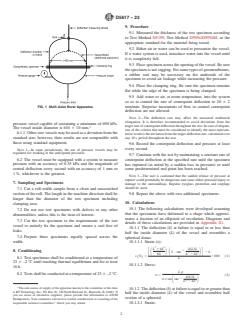
6.1 Fig. 1 shows an example of the test apparatus that can be
Standards volume information, refer to the standard’s Document Summary page on
the ASTM website. used to perform this test method. The apparatus requires a
Copyright © ASTM International, 100 Barr Harbor Drive, PO Box C700, West Conshohocken, PA 19428-2959. United States
D5617 − 23
9. Procedure
9.1 Measured the thickness of the test specimen according
to Test Method D5199, Test Method D5994/D5994M, or the
appropriate standard for the material being tested.
9.2 Either air or water can be used to pressurize the vessel.
If a water system is used, introduce water into the vessel until
it is completely full.
9.3 Place specimen across the opening of the vessel. Be sure
the specimen is not sagging. For some types of geomembranes,
a rubber seal may be necessary on the underside of the
specimen to avoid air leakage while increasing the pressure.
9.4 Place the clamping ring. Be sure the specimen remains
flat while the edge of the specimen is being clamped.
9.5 Add water or air, at room temperature, into the system
so as to control the rate of centerpoint deflection to 20 6 2
mm/min. Stepwise increments of flow to control centerpoint
FIG. 1 Multi-Axial Burst Apparatus
deflection are not allowed.
NOTE 2—The deflection rate may affect the measured multiaxial
elongation. It is therefore recommended to avoid deviations from the
pressure vessel capable of sustaining a minimum of 690 kPa.
target rate of centerpoint deflection throughout the test. In case of dispute,
The vessel inside diameter is 610 6 10 mm.
one of the criteria that must be considered to identify the most represen-
6.1.1 Other size vessels may be used as a deviation from the
tative result is the deviation from the target deflection rate, calculated over
standard size; however, their results are not comparable with any 10 s period throughout the test.
those using standard equipment.
9.6 Record the centerpoint deflection and pressure at least
every second.
NOTE 1—In some jurisdictions, the use of pressure vessels may be
regulated for working at the anticipated pressures.
9.7 Continue with the test by maintaining a constant rate of
6.2 The vessel must be equipped with a system to measure
centerpoint deflection at the specified rate until the specimen
pressure with an accuracy of 0.35 kPa and the magnitude of
has ruptured (as noted by a sudden loss in pressure) or until
central deflection every second with an accuracy of 1 mm or
some predetermined end point has been reached.
1 %, whichever is the greatest.
NOTE 3—The user is cautioned that the sudden release of pressure at
rupture could potentially be dangerous and cause either personal injury or
7. Sampling and Specimens
damage to the surroundings. Regular eyeglass protection and earplugs
should be used.
7.1 Cut a roll-width sample from a clean and unscratched
section of the roll. The length in the machine direction shall be 9.8 Repeat the above with two additional specimens.
longer than the diameter of the test specimen including
10. Calculations
clamping area.
10.1 The following calculations were developed assuming
7.2 Do not use test specimens with defects or any other
that the specimens have def
...
This document is not an ASTM standard and is intended only to provide the user of an ASTM standard an indication of what changes have been made to the previous version. Because
it may not be technically possible to adequately depict all changes accurately, ASTM recommends that users consult prior editions as appropriate. In all cases only the current version
of the standard as published by ASTM is to be considered the official document.
Designation: D5617 − 04 (Reapproved 2015) D5617 − 23
Standard Test Method for
Multi-Axial Tension Test for GeosyntheticsElongation of
Geomembranes
This standard is issued under the fixed designation D5617; the number immediately following the designation indicates the year of
original adoption or, in the case of revision, the year of last revision. A number in parentheses indicates the year of last reapproval. A
superscript epsilon (´) indicates an editorial change since the last revision or reapproval.
1. Scope
1.1 This test method covers the measurement of the out-of-plane response of geosynthetics a geomembrane to a force that is
applied perpendicular to the initial plane of the sample.
1.2 When the geosyntheticgeomembrane deforms to a prescribed geometric shape (arc of a sphere or ellipsoid)ellipsoid),
formulations are provided to convert the test data to biaxial tensile stress-strain values. These formulations cannot be used for other
geometric shapes. With other geometric shapes, comparative data on deformation versus pressure is obtained.
1.3 This test method is more commonly used to test geomembranes. Permeable materials may also be tested in conjunction with
an impermeable material.
1.3 This test method requires a large diameter large-diameter pressure vessel (600(610 mm). Information obtained from this test
method may be more appropriate for design purposes than many small scale index tests such as Test Method small-scale index
tests.D6693 or Test Method D7003/D7003M.
1.4 The values stated in SI units are to be regarded as standard. No other units of measurement are included in this standard.
1.5 This standard does not purport to address all of the safety concerns, if any, associated with its use. It is the responsibility
of the user of this standard to establish appropriate safety and healthsafety, health, and environmental practices and determine
the applicability of regulatory limitations prior to use.
1.6 This international standard was developed in accordance with internationally recognized principles on standardization
established in the Decision on Principles for the Development of International Standards, Guides and Recommendations issued
by the World Trade Organization Technical Barriers to Trade (TBT) Committee.
2. Referenced Documents
2.1 ASTM Standards:
D4439 Terminology for Geosynthetics
D6693D5199 Test Method for Determining Tensile Properties of Nonreinforced Polyethylene and Nonreinforced Flexible
Polypropylene GeomembranesMeasuring the Nominal Thickness of Geosynthetics
This test method is under the jurisdiction of ASTM Committee D35 on Geosynthetics and is the direct responsibility of Subcommittee D35.10 on Geomembranes.
Current edition approved May 1, 2015Nov. 1, 2023. Published June 2015December 2023. Originally approved in 1994. Last previous edition approved in 20102015 as
D5617–04(2010).D5617 – 04 (2015). DOI: 10.1520/D5617-04R15.10.1520/D5617-23.
For referenced ASTM standards, visit the ASTM website, www.astm.org, or contact ASTM Customer Service at service@astm.org. For Annual Book of ASTM Standards
volume information, refer to the standard’s Document Summary page on the ASTM website.
Copyright © ASTM International, 100 Barr Harbor Drive, PO Box C700, West Conshohocken, PA 19428-2959. United States
D5617 − 23
D7003/D7003MD5994/D5994M Test Method for Strip Tensile Properties of ReinforcedMeasuring Core Thickness of Textured
Geomembranes
3. Terminology
3.1 Definitions:
3.1.1 geosynthetic, multi-axial elongation, n—planar product manufactured from polymeric material used with soil, rock, earth,
or other geotechnical engineering related material as an integral part of a man-made project, structure, or system.average strain
along the arch intercepting the centerpoint, generated by the out-of-plane deformation of a geomembrane specimen fixed by a ring
and exposed to a fluid pressure.
3.1.2 multi-axial tension, n—stress in more than one direction.
3.1.2 For definitions of other terms used in this test method, refer to Terminology D4439.
4. Summary of Test Method
4.1 A pre-cut geosynthetic sample geomembrane specimen is secured at the edges of a large diameter (600 mm) large-diameter
pressure vessel. Pressure is applied to the samplespecimen to cause out-of-plane deformation and failure. This deformation The
deformation at break with pressure information can then be is analyzed to evaluate various materials.
5. Significance and Use
5.1 Installed geosyntheticsgeomembranes are subjected to forces from more than one direction, including forces perpendicular to
the surfaces of the geosynthetic. Out of plane geomembrane. Out-of-plane deformation of a geosyntheticgeomembrane may be
useful in evaluating materials for caps where subsidence of the subsoil may be problematic.
5.2 Failure mechanisms on this test may be different compared to other relatively small scale small-scale index tests and may be
beneficial for design purposes.
5.3 In applications where local subsidence is expected, this test can be considered a performance test.
NOTE 1—Although, this test specifies a vessel size of 600 mm, larger diameter vessels will better approximate field performance. However, the user is
cautioned that different size vessels may yield different results and hence may not be comparable.
5.4 For applications where geosyntheticsgeomembranes cannot be deformed in the fashion this test method prescribes, this test
method should be considered an index test.
5.5 Due to the time involved to perform this test method, test, it is not considered practical as a quality control test.
6. Apparatus
6.1 Fig. 1 shows an example of the test apparatus that can be used in the performance of to perform this test method. The apparatus
requires a pressure vessel rated to capable of sustaining a minimum of 690 kPa. The vessel diameter should be 600 inside diameter
is 610 6 10 mm. Other size vessels may be used but it is up to the user to establish correlation to the standard size vessel.
6.1.1 Other size vessels may be used as a deviation from the standard size; however, their results are not comparable with those
using standard equipment.
NOTE 1—In some jurisdictions, the use of pressure vessels may be regulated for working at the anticipated pressures.
The sole source of supply of the apparatus known to the committee at this time is BT Technology, Inc., PO Box 49, 320 North Railroad St., Rushville, IL 62681. If you
are aware of alternative suppliers, please provide this information to ASTM Headquarters. Your comments will receive careful consideration at a meeting of the responsible
technical committee, which you may attend.
D5617 − 23
FIG. 1 Multi-Axial Burst Apparatus
6.2 If the vessel has a deflection chamber it should not inhibit the geosynthetic from freely deflecting during the test. The deflection
chamber shall be vented.
6.2.1 Some materials will expand laterally beyond the diameter of the pressure vessel and may contact the sides of the deflection
chamber. In these cases, the test is no longer valid and a different device must be used. Devices without deflection chambers have
worked well in these situations.
6.2 The vessel will have must be equipped with a system to measure pressure with an accuracy of 0.35 kPa and the magnitude
of central deflection.deflection every second with an accuracy of 1 mm or 1 %, whichever is the greatest.
6.3.1 The system for measuring deflection shall be capable of being read to an accuracy of 5 mm.
6.3.2 The system for measuring pressure shall be capable of being read to an accuracy of 3.5 kPa.
6.4 All test shall be conducted at standard laboratory temperatures of 23 6 −2°C.
7. Test SpecimenSampling and Specimens
7.1 Cut a roll-width sample from a clean and unscratched section of the roll. The length in the machine direction shall be longer
than the diameter of the test specimen including clamping area.
7.2 Do not use test specimens with defects or any other abnormalities, unless this is the item of interest.
7.2 Cut the test specimen larger than the area of the main sealing force of the vessel.
7.3 If a permeable material such as a geotextile is being tested, an impermeable material such as a geomembrane or thin plastic
sheet has to overlay the permeable material to maintain the pressure in the vessel during the test.Cut the test specimen to the
requirements of the test vessel to entirely fix the specimen and ensure a seal free of leaks.
7.3.1 When testing permeable materials, the impermeable material shall be more elastic than the permeable material (unless the
combination of the two materials is the desired test variable). This is required so that the permeable material fails first.
7.3.2 Test results on permeable materials will be affected by the impermeable material used in the test.
7.4 TestPrepare three replicate specimens on each sample unless otherwise noted.specimens equally spaced across the width.
D5617 − 23
8. Conditioning
8.1 Test specimens shall be conditioned at a temperature of 23 6 –2 °C until reaching thermal equilibrium and for at least 16 h.
8.2 Tests shall be conducted at a temperature of 23 6 –2 °C.
9. Procedure
9.1 Cut the test specimen to the requirements Measured the thickness of the test vessel to ensure aspecimen according to Test
Method D5199good seal. Place, Test Method D5994/D5994Mspecimen across the opening of the vessel. Be sure the specimen is
not sagging., or the appropriate standard for the material being tested.
8.2 Be sure the specimen remains flat while the edge of the specimen is being securely clamped into place.
9.2 Either air or water can be used to pressurize the vessel. If a water system is used, introduce water into the vessel until it is
completely filled.full.
9.3 Place specimen across the opening of the vessel. Be sure the specimen is not sagging. For some types of geomembranes, a
rubber seal may be necessary on the underside of the specimen to avoid air leakage while increasing the pressure.
9.4 Place the clamping ring. Be sure the specimen remains flat while the edge of the specimen is being clamped.
9.5 Add water or air air, at room temperature, into the system so as to
...