

ASTM D4595/D4595M-24
(Test Method)Standard Test Method for Tensile Properties of Geotextiles by the Wide-Width Method
General Information
- Abstract
SIGNIFICANCE AND USE
5.1 The determination of the wide-width force-elongation properties of geotextiles provides design parameters for reinforcement type applications, for example, design of reinforced roadways/pavements, reinforced embankments over soft subgrades, reinforced soil retaining walls, and reinforcement of slopes. When strength is not necessarily a design consideration, an alternative test method may be used for acceptance testing. Test Method D4595/D4595M for the determination of the wide-width tensile properties of geotextiles may be used for the acceptance testing of commercial shipments of geotextiles, but caution is advised since information about between-laboratory precision is incomplete (Note 3). Comparative tests as directed in 5.1.1 may be advisable.
5.1.1 In cases of a dispute arising from differences in reported test results when using Test Method D4595/D4595M for acceptance testing of commercial shipments, the purchaser and the supplier should conduct comparative tests to determine if there is a statistical bias between their laboratories. Competent statistical assistance is recommended for the investigation of bias. At a minimum, the two parties should take a group of test specimens which are as homogeneous as possible and which are from a lot of material of the type in question. The test specimens should then be randomly assigned in equal numbers to each laboratory for testing. The average results from the two laboratories should be compared using Student's t-test for unpaired data and an acceptable probability level chosen by the two parties before the testing began. If a bias is found, either its cause must be found and corrected or the purchaser and the supplier must agree to interpret future test results in light of the known bias.
5.2 Most geotextiles can be tested by this test method. Some modification of clamping techniques may be necessary for a given geotextile depending upon its structure. Special clamping adaptions may be necessary with strong...
SCOPE
1.1 This test method covers the measurement of tensile properties of geotextiles using a wide-width specimen tensile method. This test method is applicable to most geotextiles that include woven geotextiles, nonwoven geotextiles, layered fabrics, and knit fabrics that are used for geotextile applications.
1.2 This test method covers the measurement of tensile strength and elongation of geotextiles and includes directions for the calculation of initial modulus, offset modulus, secant modulus, and breaking toughness.
1.3 Procedures for measuring the tensile properties of both conditioned and wet geotextiles by the wide-width method are included.
1.4 The basic distinction between this test method and other methods for measuring strip tensile properties is the width of the specimen. Some fabrics used in geotextile applications have a tendency to contract (neck down) under a force in the gage length area. The greater width of the specimen specified in this test method minimizes the contraction effect of those fabrics and provides a closer relationship to expected geotextile behavior in the field and a standard comparison.
1.5 The values stated in either SI units or inch-pound units are to be regarded separately as standard. The values stated in each system may not be exact equivalents; therefore, each system shall be used independently of the other. Combining values from the two systems may result in nonconformance with the standard.
1.6 This standard does not purport to address all of the safety concerns, if any, associated with its use. It is the responsibility of the user of this standard to establish appropriate safety, health, and environmental practices and determine the applicability of regulatory limitations prior to use.
1.7 This international standard was developed in accordance with internationally recognized principles on standardization established in the Decision on Principles for the Developme...
- Status
- Published
- Publication Date
- 14-Jan-2024
- Technical Committee
- D35 - Geosynthetics
- Drafting Committee
- D35.01 - Mechanical Properties
Buy Documents
ASTM D4595/D4595M-24 - Standard Test Method for Tensile Properties of Geotextiles by the Wide-Width Method
REDLINE ASTM D4595/D4595M-24 - Standard Test Method for Tensile Properties of Geotextiles by the Wide-Width Method
Overview
ASTM D4595/D4595M-24 is a widely recognized standard published by ASTM International, specifying the test method for measuring the tensile properties of geotextiles using the wide-width strip method. This standard is essential for evaluating the mechanical performance of geotextiles in tension, providing reliable data used in the design and acceptance testing of materials for civil engineering and geotechnical applications. The method applies to various forms of geotextiles, including woven, nonwoven, layered, and knit fabrics, and supports both dry and wet condition testing. Importantly, it forms a basis for establishing design parameters in reinforcement-related projects such as roadways, embankments, retaining walls, and slopes.
Key Topics
- Tensile Strength and Elongation: The standard outlines procedures for determining the maximum force per unit width that a geotextile can withstand before rupture, as well as the percentage increase in length at break.
- Modulus Calculations: Directions are provided for calculating initial modulus, offset modulus, and secant modulus, which describe the stiffness and elastic behavior of geotextiles under tensile load.
- Breaking Toughness: The test method includes instructions for evaluating the work-to-break (energy required to rupture) per unit surface area, an indicator of material durability.
- Wide-Width Strip Test: Unlike narrow-strip methods, the use of a wide-width specimen minimizes necking effects, offering results more representative of in-field geotextile behavior.
- Conditioned and Wet Testing: Procedures for testing both conditioned (dry) and thoroughly wet specimens are included to account for real-world variations.
- Sampling and Reporting: Detailed guidance on sampling, test specimen preparation, calculation methods, and reporting format ensures consistency and repeatability.
- Clamping and Equipment Considerations: The standard addresses the need for appropriate clamping techniques and suitable tensile testing machines to avoid slippage or damage, ensuring accurate results.
Applications
ASTM D4595/D4595M-24 is critical for engineers, designers, and manufacturers involved in geotechnical engineering, especially in areas where reinforcement and load-bearing capacity are crucial. Key applications include:
- Design of Reinforced Structures: Used for specifying geotextile reinforcement in roads, pavements, embankments over soft subgrades, soil retaining walls, and slope stabilization projects.
- Quality Control and Acceptance Testing: Provides a standardized method to verify product compliance in commercial shipments, supporting material certification and contractual requirements.
- Research and Product Development: Useful in laboratories for developing new geotextile products and comparing the tensile behavior of various materials under controlled conditions.
- Dispute Resolution: Offers a basis for resolving differences in test results between suppliers and purchasers by recommending comparative laboratory testing methods.
The comprehensive approach of this standard ensures that geotextile products meet required performance criteria, enhancing reliability and safety in infrastructure projects.
Related Standards
To ensure a complete understanding and consistent application, refer to the following ASTM standards in conjunction with ASTM D4595/D4595M-24:
- ASTM D76/D76M: Specification for Tensile Testing Machines for Textiles
- ASTM D123: Terminology Relating to Textiles
- ASTM D4439: Terminology for Geosynthetics
- ASTM D4873/D4873M: Guide for Identification, Storage, and Handling of Geosynthetic Rolls and Samples
- ASTM D8102: Practice for Manufacturing Quality Control of Geotextiles
- ASTM D1776/D1776M: Practice for Conditioning and Testing Textiles
These related standards provide essential definitions, equipment specifications, and procedural guidance, ensuring the tensile property data obtained for geotextiles is accurate, reliable, and globally recognized.
Keywords: ASTM D4595, geotextile tensile properties, wide-width method, geotechnical engineering standards, geotextile testing, civil engineering, geotextile modulus, geotextile specification, ASTM standards for geotextiles, geotextile reinforcement.
Relations
- Effective Date
- 15-Jan-2024
- Effective Date
- 01-Feb-2024
- Effective Date
- 15-Jul-2023
- Effective Date
- 15-Jan-2024
Buy Documents
ASTM D4595/D4595M-24 - Standard Test Method for Tensile Properties of Geotextiles by the Wide-Width Method
REDLINE ASTM D4595/D4595M-24 - Standard Test Method for Tensile Properties of Geotextiles by the Wide-Width Method
Get Certified
Connect with accredited certification bodies for this standard

Control Union Certifications
Global certification for agriculture and sustainability.

Hohenstein Institut
Textile testing and certification.

Bureau Veritas Bangladesh
Bureau Veritas certification services in Bangladesh.
Sponsored listings
Frequently Asked Questions
ASTM D4595/D4595M-24 is a standard published by ASTM International. Its full title is "Standard Test Method for Tensile Properties of Geotextiles by the Wide-Width Method". This standard covers: SIGNIFICANCE AND USE 5.1 The determination of the wide-width force-elongation properties of geotextiles provides design parameters for reinforcement type applications, for example, design of reinforced roadways/pavements, reinforced embankments over soft subgrades, reinforced soil retaining walls, and reinforcement of slopes. When strength is not necessarily a design consideration, an alternative test method may be used for acceptance testing. Test Method D4595/D4595M for the determination of the wide-width tensile properties of geotextiles may be used for the acceptance testing of commercial shipments of geotextiles, but caution is advised since information about between-laboratory precision is incomplete (Note 3). Comparative tests as directed in 5.1.1 may be advisable. 5.1.1 In cases of a dispute arising from differences in reported test results when using Test Method D4595/D4595M for acceptance testing of commercial shipments, the purchaser and the supplier should conduct comparative tests to determine if there is a statistical bias between their laboratories. Competent statistical assistance is recommended for the investigation of bias. At a minimum, the two parties should take a group of test specimens which are as homogeneous as possible and which are from a lot of material of the type in question. The test specimens should then be randomly assigned in equal numbers to each laboratory for testing. The average results from the two laboratories should be compared using Student's t-test for unpaired data and an acceptable probability level chosen by the two parties before the testing began. If a bias is found, either its cause must be found and corrected or the purchaser and the supplier must agree to interpret future test results in light of the known bias. 5.2 Most geotextiles can be tested by this test method. Some modification of clamping techniques may be necessary for a given geotextile depending upon its structure. Special clamping adaptions may be necessary with strong... SCOPE 1.1 This test method covers the measurement of tensile properties of geotextiles using a wide-width specimen tensile method. This test method is applicable to most geotextiles that include woven geotextiles, nonwoven geotextiles, layered fabrics, and knit fabrics that are used for geotextile applications. 1.2 This test method covers the measurement of tensile strength and elongation of geotextiles and includes directions for the calculation of initial modulus, offset modulus, secant modulus, and breaking toughness. 1.3 Procedures for measuring the tensile properties of both conditioned and wet geotextiles by the wide-width method are included. 1.4 The basic distinction between this test method and other methods for measuring strip tensile properties is the width of the specimen. Some fabrics used in geotextile applications have a tendency to contract (neck down) under a force in the gage length area. The greater width of the specimen specified in this test method minimizes the contraction effect of those fabrics and provides a closer relationship to expected geotextile behavior in the field and a standard comparison. 1.5 The values stated in either SI units or inch-pound units are to be regarded separately as standard. The values stated in each system may not be exact equivalents; therefore, each system shall be used independently of the other. Combining values from the two systems may result in nonconformance with the standard. 1.6 This standard does not purport to address all of the safety concerns, if any, associated with its use. It is the responsibility of the user of this standard to establish appropriate safety, health, and environmental practices and determine the applicability of regulatory limitations prior to use. 1.7 This international standard was developed in accordance with internationally recognized principles on standardization established in the Decision on Principles for the Developme...
SIGNIFICANCE AND USE 5.1 The determination of the wide-width force-elongation properties of geotextiles provides design parameters for reinforcement type applications, for example, design of reinforced roadways/pavements, reinforced embankments over soft subgrades, reinforced soil retaining walls, and reinforcement of slopes. When strength is not necessarily a design consideration, an alternative test method may be used for acceptance testing. Test Method D4595/D4595M for the determination of the wide-width tensile properties of geotextiles may be used for the acceptance testing of commercial shipments of geotextiles, but caution is advised since information about between-laboratory precision is incomplete (Note 3). Comparative tests as directed in 5.1.1 may be advisable. 5.1.1 In cases of a dispute arising from differences in reported test results when using Test Method D4595/D4595M for acceptance testing of commercial shipments, the purchaser and the supplier should conduct comparative tests to determine if there is a statistical bias between their laboratories. Competent statistical assistance is recommended for the investigation of bias. At a minimum, the two parties should take a group of test specimens which are as homogeneous as possible and which are from a lot of material of the type in question. The test specimens should then be randomly assigned in equal numbers to each laboratory for testing. The average results from the two laboratories should be compared using Student's t-test for unpaired data and an acceptable probability level chosen by the two parties before the testing began. If a bias is found, either its cause must be found and corrected or the purchaser and the supplier must agree to interpret future test results in light of the known bias. 5.2 Most geotextiles can be tested by this test method. Some modification of clamping techniques may be necessary for a given geotextile depending upon its structure. Special clamping adaptions may be necessary with strong... SCOPE 1.1 This test method covers the measurement of tensile properties of geotextiles using a wide-width specimen tensile method. This test method is applicable to most geotextiles that include woven geotextiles, nonwoven geotextiles, layered fabrics, and knit fabrics that are used for geotextile applications. 1.2 This test method covers the measurement of tensile strength and elongation of geotextiles and includes directions for the calculation of initial modulus, offset modulus, secant modulus, and breaking toughness. 1.3 Procedures for measuring the tensile properties of both conditioned and wet geotextiles by the wide-width method are included. 1.4 The basic distinction between this test method and other methods for measuring strip tensile properties is the width of the specimen. Some fabrics used in geotextile applications have a tendency to contract (neck down) under a force in the gage length area. The greater width of the specimen specified in this test method minimizes the contraction effect of those fabrics and provides a closer relationship to expected geotextile behavior in the field and a standard comparison. 1.5 The values stated in either SI units or inch-pound units are to be regarded separately as standard. The values stated in each system may not be exact equivalents; therefore, each system shall be used independently of the other. Combining values from the two systems may result in nonconformance with the standard. 1.6 This standard does not purport to address all of the safety concerns, if any, associated with its use. It is the responsibility of the user of this standard to establish appropriate safety, health, and environmental practices and determine the applicability of regulatory limitations prior to use. 1.7 This international standard was developed in accordance with internationally recognized principles on standardization established in the Decision on Principles for the Developme...
ASTM D4595/D4595M-24 is classified under the following ICS (International Classification for Standards) categories: 59.080.70 - Geotextiles. The ICS classification helps identify the subject area and facilitates finding related standards.
ASTM D4595/D4595M-24 has the following relationships with other standards: It is inter standard links to ASTM D4595/D4595M-23, ASTM D4439-24, ASTM D4439-23b, ASTM D6389-23. Understanding these relationships helps ensure you are using the most current and applicable version of the standard.
ASTM D4595/D4595M-24 is available in PDF format for immediate download after purchase. The document can be added to your cart and obtained through the secure checkout process. Digital delivery ensures instant access to the complete standard document.
Standards Content (Sample)
This international standard was developed in accordance with internationally recognized principles on standardization established in the Decision on Principles for the
Development of International Standards, Guides and Recommendations issued by the World Trade Organization Technical Barriers to Trade (TBT) Committee.
Designation: D4595/D4595M − 24
Standard Test Method for
Tensile Properties of Geotextiles by the Wide-Width Method
This standard is issued under the fixed designation D4595/D4595M; the number immediately following the designation indicates the
year of original adoption or, in the case of revision, the year of last revision. A number in parentheses indicates the year of last
reapproval. A superscript epsilon (´) indicates an editorial change since the last revision or reapproval.
1. Scope Development of International Standards, Guides and Recom-
mendations issued by the World Trade Organization Technical
1.1 This test method covers the measurement of tensile
Barriers to Trade (TBT) Committee.
properties of geotextiles using a wide-width specimen tensile
method. This test method is applicable to most geotextiles that
2. Referenced Documents
include woven geotextiles, nonwoven geotextiles, layered
2.1 ASTM Standards:
fabrics, and knit fabrics that are used for geotextile applica-
D76/D76M Specification for Tensile Testing Machines for
tions.
Textiles
1.2 This test method covers the measurement of tensile
D579/D579M Practice for Greige Woven Glass Fabrics
strength and elongation of geotextiles and includes directions
D1776/D1776M Practice for Conditioning and Testing Tex-
for the calculation of initial modulus, offset modulus, secant
tiles
modulus, and breaking toughness.
D2905 Practice for Statements on Number of Specimens for
Textiles (Withdrawn 2008)
1.3 Procedures for measuring the tensile properties of both
D4439 Terminology for Geosynthetics
conditioned and wet geotextiles by the wide-width method are
D4873/D4873M Guide for Identification, Storage, and Han-
included.
dling of Geosynthetic Rolls and Samples
1.4 The basic distinction between this test method and other
D8102 Practice for Manufacturing Quality Control of Geo-
methods for measuring strip tensile properties is the width of
textiles
the specimen. Some fabrics used in geotextile applications
have a tendency to contract (neck down) under a force in the 3. Terminology
gage length area. The greater width of the specimen specified
3.1 Definitions of Terms Specific to This Standard:
in this test method minimizes the contraction effect of those −1 −2
3.1.1 breaking toughness, T, (FL ), Jm , n—for
fabrics and provides a closer relationship to expected geotextile
geotextiles, the actual work-to-break per unit surface area of
behavior in the field and a standard comparison.
material.
1.5 The values stated in either SI units or inch-pound units
3.1.1.1 Discussion—Breaking toughness is proportional to
are to be regarded separately as standard. The values stated in
the area under the force-elongation curve from the origin to the
each system may not be exact equivalents; therefore, each
breaking point (see also work-to-break). Breaking toughness is
system shall be used independently of the other. Combining
calculated from work-to-break, gage length, and width of a
values from the two systems may result in nonconformance
specimen.
with the standard.
3.1.2 corresponding force, F , n—the force associated with
c
1.6 This standard does not purport to address all of the
a specific elongation on the force-per-unit-width strain curve.
safety concerns, if any, associated with its use. It is the
(Syn. load at specified elongation, LASE.)
responsibility of the user of this standard to establish appro-
3.2 For terminology of other terms used in this test method,
priate safety, health, and environmental practices and deter-
refer to Terminology D4439.
mine the applicability of regulatory limitations prior to use.
1.7 This international standard was developed in accor-
4. Summary of Test Method
dance with internationally recognized principles on standard-
4.1 A relatively wide specimen is gripped across its entire
ization established in the Decision on Principles for the
width in the clamps of a constant rate of extension (CRE) type
1 2
This test method is under the jurisdiction of ASTM Committee D35 on For referenced ASTM standards, visit the ASTM website, www.astm.org, or
Geosynthetics and is the direct responsibility of Subcommittee D35.01 on Mechani- contact ASTM Customer Service at service@astm.org. For Annual Book of ASTM
cal Properties. Standards volume information, refer to the standard’s Document Summary page on
Current edition approved Jan. 15, 2024. Published February 2024. Originally the ASTM website.
approved in 1986. Last previous edition approved in 2023 as D4595/D4595M – 23. The last approved version of this historical standard is referenced on
DOI: 10.1520/D4595_D4595M-24. www.astm.org.
Copyright © ASTM International, 100 Barr Harbor Drive, PO Box C700, West Conshohocken, PA 19428-2959. United States
D4595/D4595M − 24
tensile testing machine operated at a prescribed rate of
extension, applying a longitudinal force to the specimen until
the specimen ruptures. Tensile strength, elongation, initial and
secant modulus, and breaking toughness of the test specimen
can be calculated from machine scales, dials, recording charts,
or an interfaced computer.
5. Significance and Use
5.1 The determination of the wide-width force-elongation
properties of geotextiles provides design parameters for rein-
forcement type applications, for example, design of reinforced
roadways/pavements, reinforced embankments over soft
subgrades, reinforced soil retaining walls, and reinforcement of
slopes. When strength is not necessarily a design consideration,
an alternative test method may be used for acceptance testing.
Test Method D4595/D4595M for the determination of the
wide-width tensile properties of geotextiles may be used for the
acceptance testing of commercial shipments of geotextiles, but
caution is advised since information about between-laboratory
precision is incomplete (Note 3). Comparative tests as directed
in 5.1.1 may be advisable.
5.1.1 In cases of a dispute arising from differences in
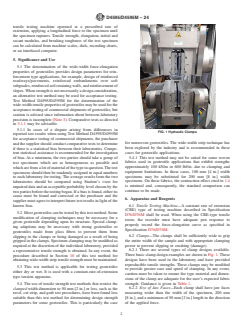
FIG. 1 Hydraulic Clamps
reported test results when using Test Method D4595/D4595M
for acceptance testing of commercial shipments, the purchaser
for nonwoven geotextiles. The wide-width strip technique has
and the supplier should conduct comparative tests to determine
been explored by the industry and is recommended in these
if there is a statistical bias between their laboratories. Compe-
cases for geotextile applications.
tent statistical assistance is recommended for the investigation
5.4.1 This test method may not be suited for some woven
of bias. At a minimum, the two parties should take a group of
fabrics used in geotextile applications that exhibit strengths
test specimens which are as homogeneous as possible and
approximately 100 kN/m or 600 lbf/in. due to clamping and
which are from a lot of material of the type in question. The test
equipment limitations. In those cases, 100 mm [4 in.] width
specimens should then be randomly assigned in equal numbers
specimens may be substituted for 200 mm [8 in.] width
to each laboratory for testing. The average results from the two
specimens. On those fabrics, the contraction effect cited in 1.4
laboratories should be compared using Student’s t-test for
is minimal and, consequently, the standard comparison can
unpaired data and an acceptable probability level chosen by the
continue to be made.
two parties before the testing began. If a bias is found, either its
cause must be found and corrected or the purchaser and the
6. Apparatus and Reagents
supplier must agree to interpret future test results in light of the
known bias. 6.1 Tensile Testing Machine—A constant rate of extension
(CRE) type of testing machine described in Specification
5.2 Most geotextiles can be tested by this test method. Some
D76/D76M shall be used. When using the CRE-type tensile
modification of clamping techniques may be necessary for a
tester, the recorder must have adequate pen response to
given geotextile depending upon its structure. Special clamp-
properly record the force-elongation curve as specified in
ing adaptions may be necessary with strong geotextiles or
Specification D76/D76M.
geotextiles made from glass fibers to prevent them from
6.2 Clamps—The clamps shall be sufficiently wide to grip
slipping in the clamps or being damaged as a result of being
the entire width of the sample and with appropriate clamping
gripped in the clamps. Specimen clamping may be modified as
power to prevent slipping or crushing (damage).
required at the discretion of the individual laboratory, provided
6.2.1 There are several types of clamp designs available.
a representative tensile strength is obtained. In any event, the
Three basic clamp design examples are shown in Fig. 1. These
procedure described in Section 10 of this test method for
designs have been used in the laboratory and have provided
obtaining wide-width strip tensile strength must be maintained.
reproducible tensile strengths. These clamps may be modified
5.3 This test method is applicable for testing geotextiles
to provide greater ease and speed of clamping. In any event,
either dry or wet. It is used with a constant-rate-of-extension
caution must be taken to ensure the type material and dimen-
type tension apparatus.
sions of the clamp are adequate for the user’s expected fabric
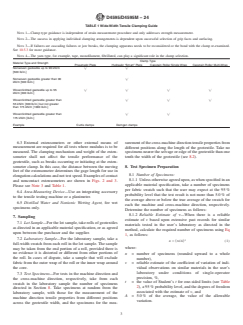
5.4 The use of tensile strength test methods that restrict the strength. Guidance is given in Table 1.
clamped width dimension to 50 mm [2 in.] or less, such as the 6.2.2 Size of Jaw Faces—Each clamp shall have jaw faces
ravel, cut strip, and grab test procedures, have been found less measuring wider than the width of the specimen, 200 mm
suitable than this test method for determining design strength [8 in.], and a minimum of 50 mm [2 in.] length in the direction
parameters for some geotextiles. This is particularly the case of the applied force.
D4595/D4595M − 24
TABLE 1 Wide-Width Tensile Clamping Guide
NOTE 1—Clamp type guidance is independent of strain measurement procedure and only addresses strength measurement.
NOTE 2—The success in applying individual clamping arrangements is dependent upon successful selection of grip faces and surfacing.
NOTE 3—If failures are cascading failures or jaw breaks, the clamping apparatus needs to be reconsidered or the bond with the clamp re-examined.
See 10.5.3 for more guidance.
NOTE 4—The yarn type, for example, tape, monofilament, fibrillated, can play a significant role in the clamp selection.
Clamp Type
Material Type and Strength
Pneumatic Plate Hydraulic “Smart” Plate Capstain Roller Single Wrap Capstain Roller Multi-Wrap
Nonwoven geotextile up to 90 kN/m = =
[500 lb/in.]
Nonwoven geotextile greater than 90 =
kN/m [500 lb/in.]
Woven/knitted geotextile up to 55 = = = =
kN/m [300 lb/in.]
Woven/knitted geotextile greater than = = =
55 kN/m [300 lb/in.] but not greater
than 175 kN/m [1000 lb/in.]
Woven/knitted geotextile greater than = =
175 kN/m [lb/in.]
Example Curtis clamps Demgen clamps
6.3 External extensometers or other external means of surement of the cross-machine direction tensile properties from
measurement are required for all tests where modulus is to be different positions along the length of the geotextile. Take no
measured. The clamping mechanism and weight of the exten-
specimens nearer the selvage or edge of the geotextile than one
someter shall not affect the tensile performance of the
tenth the width of the geotextile (see 8.2).
geotextile, such as breaks occurring or initiating at the exten-
someter clamp. In this case, the distance between the moving
8. Test Specimen Preparation
feet of the extensometer determines the gage length for use in
8.1 Number of Specimens:
elongation calculations and not test speed. Examples of contact
8.1.1 Unless otherwise agreed upon, as when specified in an
and noncontact extensometers are shown in Figs. 2 and 3.
applicable material specification, take a number of specimens
Please see Note 3 and Table 1.
per fabric swatch such that the user may expect at the 95 %
6.4 Area-Measuring Device—Use an integrating accessory
probability level that the test result is not more than 5.0 % of
to the tensile testing machine or a planimeter.
the average above or below the true average of the swatch for
6.5 Distilled Water and Nonionic Wetting Agent, for wet
each the machine and cross-machine direction, respectively.
specimens only.
Determine the number of specimens as follows:
8.1.2 Reliable Estimate of v—When there is a reliable
7. Sampling
estimate of v based upon extensive past records for similar
7.1 Lot Sample—For the lot sample, take rolls of geotextiles
materials tested in the user’s laboratory as directed in the
as directed in an applicable material specification, or as agreed
method, calculate the required number of specimens using Eq
upon between the purchaser and the supplier.
1, as follows:
7.2 Laboratory Sample—For the laboratory sample, take a
n 5 tv/A (1)
~ !
full-width swatch from each roll in the lot sample. The sample
where:
may be taken from the end portion of a roll, provided there is
no evidence it is distorted or different from other portions of
n = number of specimens (rounded upward to a whole
the roll. In cases of dispute, take a sample that will exclude
number),
fabric from the outer wrap of the roll or the inner wrap around
v = reliable estimate of the coefficient of variation of indi-
the core. vidual observations on similar materials in the user’s
laboratory under conditions of single-operator
7.3 Test Specimens—For tests in the machine direction and
precision, %,
the cross-machine direction, respectively, take from each
t = the value of Student’s t for one-sided limits (see Table
swatch in the laboratory sample the number of specimens
2), a 95 % probability level, and the degrees of freedom
directed in Section 8. Take specimens at random from the
associated with the estimate of v, and
laboratory sample, with those for the measurement of the
A = 5.0 % of the average, the value of the allowable
machine direction tensile properties from different positions
variation.
across the geotextile width, and the specimens for the mea-
D4595/D4595M − 24
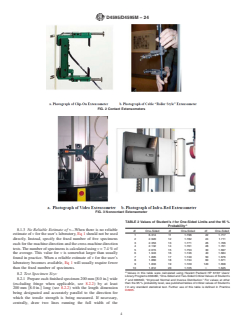
FIG. 2 Contact Extensometers
FIG. 3 Noncontact Extensometer
TABLE 2 Values of Student’s t for One-Sided Limits and the 95 %
A
Probability
8.1.3 No Reliable Estimate of v—When there is no reliable
df One-Sided df One-Sided df One-Sided
estimate of v for the user’s laboratory, Eq 1 should not be used
1 6.314 11 1.796 22 1.717
directly. Instead, specify the fixed number of five specimens 2 2.920 12 1.782 24 1.711
3 2.353 13 1.771 26 1.706
each for the machine direction and the cross-machine direction
4 2.132 14 1.761 28 1.701
tests. The number of specimens is calculated using v = 7.4 % of
5 2.015 15 1.753 30 1.697
the average. This value for v is somewhat larger than usually 6 1.943 16 1.746 40 1.684
7 1.895 17 1.740 50 1.676
found in practice. When a reliable estimate of v for the user’s
8 1.860 18 1.734 60 1.671
laboratory becomes available, Eq 1 will usually require fewer
9 1.833 19 1.729 120 1.658
10 1.812 20 1.725 ` 1.645
than the fixed number of specimens.
A
Values in this table were calculated using Hewlett Packard HP 67/97 Users’
8.2 Test Specimen Size:
Library Programs 03848D, “One-Sided and Two-Sided Critical Values of Student’s
8.2.1 Prepare each finished specimen 200 mm [8.0 in.] wide
t” and 00350D, “Improved Normal and Inverse Distribution.” For values at other
than the 95 % probability level, see published tables of critical values of Student’s
(excluding fringe when applicable, see 8.2.2) by at least
t in any standard statistical text. Further use of this table is defined in Practice
200 mm [8.0 in.] long (see 8.2.2) with the length dimension
D2905.
being designated and accurately parallel to the direction for
which the tensile strength is being measured. If necessary,
centrally, draw two lines running the full width of the
D4595/D4595M − 24
specimen, accurately perpendicular to the length dimension 10.3 Machine Setup Conditions—Adjust the distance be-
and separated by 100 mm [4 in.] to designate the gage area (see tween the clamps at the start of the test either at 100 6 3 mm
5.4.1 and Note 3). [4 6 0.1 in.] or as far apart to adequately insert an extensom-
8.2.2 For some woven geotextiles, it may be necessary to eter (see 6.3). At least one clamp should be supported by a free
cut each specimen 210 mm [8.5 in.] wide and then remove an swivel or universal joint, which will allow the clamp to rotate
equal number of yarns from each side to obtain the 200 mm in the plane of the fabric. Select the force range of the testing
[8.0 in.] finished dimension. This helps maintain specimen machine so the break occurs between 10 and 90 % of full-scale
integrity during the test. force. Set the machine to a strain rate of 10 6 3 % ⁄min.
8.2.3 The length of the specimen depends upon the type of
10.4 Insertion of Specimen in Clamps—Mount the specimen
clamps being used. It must be long enough to extend through
centrally in the clamps. The specimen length in the machine
the full length of both clamps, as determined for the direction
direction and cross-machine direction tests, respectively, must
of test.
be parallel to the direction of application of force. Extreme care
8.2.4 When specimen integrity is not affected, the speci-
should be used when loading the specimen in the clamps to
mens may be initially cut to the finished width.
ensure vertical alignment in the direction of test. A pre-tension
8.2.5 When the wet tensile strength of the fabric is required
force may be applied to the specimen provided it does not
in addition to the dry tensile strength, cut each test specimen at
exceed 1.0 % of the expected breaking force. Test specimen
least twice as long as is required for a standard test (see Note
results with a pre-tension force exceeding 1.0 % of the mea-
1). Number each specimen and then cut it crosswise into two
sured tensile strength may only be used to determine tensile
parts, one for determining the conditioned tensile strength and
strength of the sample, and shall be excluded from consider-
the other for determining the wet tensile strength; each portion
ation for load strain (modulus) properties of the sample.
shall bear the specimen number. In this manner, each paired
10.5 Measurement of Tensile Strength—Start the tensile
break is performed on test specimens containing the same
testing machine and the area-measuring device, and continue
yarns.
running the test to rupture. Stop the machine and reset to the
NOTE 1—For geotextiles which shrink excessively when wet, cut the
initial gage position. Record and report the test results to three
test specimens for obtaining wet tensile strength longer in dimension than
significant figures for each direction separately (see Note 3).
that for dry tensile strength.
10.5.1 If a specimen slips in the jaws, breaks at the edge of
9. Conditioning
the jaws or in the jaws, or if for any reason attributed to faulty
9.1 Bring the specimens to moisture equilibrium in the operation the result falls markedly below the average for the set
atmosphere for testing geotextiles. Equilibrium is considered to of specimens, discard the result and test another specimen.
have been reached when the increase in mass of the specimen Continue until the required number of acceptable breaks has
in successive measurements made at intervals of not less than been obtained. (See 6.2.1 and 10.5.5.)
2 h does not exceed 0.1 % of the mass of the specimen. In 10.5.2 The decision to discard the results of a break shall be
general practice, the industry approaches equilibrium from the based on observation of the specimen during the test and upon
“as-received” side. the inherent variability of the fabric. In the absence of other
criteria for rejecting a so-called jaw break, any break occurring
NOTE 2—It is recognized that in practice, geotextile materials are
within 5 mm [ ⁄4 in.] of the jaws which results in a value below
frequently not weighed to determine when moisture equilibrium has been
reached. While such a procedure cannot be acce
...
This document is not an ASTM standard and is intended only to provide the user of an ASTM standard an indication of what changes have been made to the previous version. Because
it may not be technically possible to adequately depict all changes accurately, ASTM recommends that users consult prior editions as appropriate. In all cases only the current version
of the standard as published by ASTM is to be considered the official document.
Designation: D4595/D4595M − 23 D4595/D4595M − 24
Standard Test Method for
Tensile Properties of Geotextiles by the Wide-Width Method
This standard is issued under the fixed designation D4595/D4595M; the number immediately following the designation indicates the
year of original adoption or, in the case of revision, the year of last revision. A number in parentheses indicates the year of last
reapproval. A superscript epsilon (´) indicates an editorial change since the last revision or reapproval.
1. Scope
1.1 This test method covers the measurement of tensile properties of geotextiles using a wide-width strip specimen tensile method.
This test method is applicable to most geotextiles that include woven fabrics, nonwoven fabrics,geotextiles, nonwoven geotextiles,
layered fabrics, knit fabrics, and felts and knit fabrics that are used for geotextile application.applications.
1.2 This test method covers the measurement of tensile strength and elongation of geotextiles and includes directions for the
calculation of initial modulus, offset modulus, secant modulus, and breaking toughness.
1.3 Procedures for measuring the tensile properties of both conditioned and wet geotextiles by the wide-width strip method are
included.
1.4 The basic distinction between this test method and other methods for measuring strip tensile properties is the width of the
specimen. Some fabrics used in geotextile applications have a tendency to contract (neck down) under a force in the gage length
area. The greater width of the specimen specified in this test method minimizes the contraction effect of those fabrics and provides
a closer relationship to expected geotextile behavior in the field and a standard comparison.
1.5 The values stated in either SI units or inch-pound units are to be regarded separately as standard. The values stated in each
system may not be exact equivalents; therefore, each system shall be used independently of the other. Combining values from the
two systems may result in nonconformance with the standard.
1.6 This standard does not purport to address all of the safety concerns, if any, associated with its use. It is the responsibility
of the user of this standard to establish appropriate safety, health, and environmental practices and determine the applicability of
regulatory limitations prior to use.
1.7 This international standard was developed in accordance with internationally recognized principles on standardization
established in the Decision on Principles for the Development of International Standards, Guides and Recommendations issued
by the World Trade Organization Technical Barriers to Trade (TBT) Committee.
2. Referenced Documents
2.1 ASTM Standards:
D76/D76M Specification for Tensile Testing Machines for Textiles
D123 Terminology Relating to Textiles
D579/D579M Practice for Greige Woven Glass Fabrics
This test method is under the jurisdiction of ASTM Committee D35 on Geosynthetics and is the direct responsibility of Subcommittee D35.01 on Mechanical Properties.
Current edition approved April 15, 2023Jan. 15, 2024. Published May 2023February 2024. Originally approved in 1986. Last previous edition approved in 20172023 as
D4595D4595/D4595M – 23. – 17. DOI: 10.1520/D4595_D4595M-23.DOI: 10.1520/D4595_D4595M-24.
For referenced ASTM standards, visit the ASTM website, www.astm.org, or contact ASTM Customer Service at service@astm.org. For Annual Book of ASTM Standards
volume information, refer to the standard’s Document Summary page on the ASTM website.
Copyright © ASTM International, 100 Barr Harbor Drive, PO Box C700, West Conshohocken, PA 19428-2959. United States
D4595/D4595M − 24
D1776/D1776M Practice for Conditioning and Testing Textiles
D2905 Practice for Statements on Number of Specimens for Textiles (Withdrawn 2008)
D4439 Terminology for Geosynthetics
D4873/D4873M Guide for Identification, Storage, and Handling of Geosynthetic Rolls and Samples
D8102 Practice for Manufacturing Quality Control of Geotextiles
3. Terminology
3.1 atmosphere for testing geotextiles, n—air maintained at a relative humidity of 65 6 5 % and a temperature of 21 6 2 °C [70
6 4 °F].
3.1 Definitions of Terms Specific to This Standard:
−1 −2
3.1.1 breaking toughness, T, (FL ), Jm , n—for geotextiles, the actual work-to-break per unit surface area of material.
3.1.1.1 Discussion—
Breaking toughness is proportional to the area under the force-elongation curve from the origin to the breaking point (see also
work-to-break). Breaking toughness is calculated from work-to-break, gage length, and width of a specimen.
3.1.2 corresponding force, F , n—the force associated with a specific elongation on the force-per-unit-width strain curve. (Syn.
c
load at specified elongation, LASE.)
−1 −2
3.2 breaking toughness, T, (FL ), Jm , n—for geotextiles, the actual work-to-break per unit surface area of material.
3.2.1 Discussion—
Breaking toughness is proportional to the area under the force-elongation curve from the origin to the breaking point (see also
work-to-break). Breaking toughness is calculated from work-to-break, gage length, and width of a specimen.
3.3 corresponding force, F , n—the force associated with a specific elongation on the force-per-unit-width strain curve. (Syn. load
c
at specified elongation, LASE.)
3.4 geotechnical engineering, n—the engineering application of geotechnics.
3.5 geotechnics, n—the application of scientific methods and engineering principles to the acquisition, interpretation, and use of
knowledge of materials of the earth’s crust to the solution of engineering problems.
3.5.1 Discussion—
Geotechnics embraces the fields of soil mechanics, rock mechanics, and many of the engineering aspects of geology, geophysics,
hydrology, and related sciences.
3.6 geotextile, n—any permeable textile material used with foundation, soil, rock, earth, or any other geotechnical engineering
related material, as an integral part of a man-made project, structure, or system.
−1 −1
3.7 initial tensile modulus, J , (FL ), Nm , n—for geotextiles, the ratio of the change in tensile force per unit width to a change
i
in strain (slope) of the initial portion of a force-per-unit-width strain curve.
−1 −1
3.8 offset tensile modulus, J , (FL ), Nm , n—for geotextiles, the ratio of the change in force per unit width to a change in strain
o
(slope) below the proportional limit point and above the tangent point on the force-elongation curve.
3.9 proportional limit, n—the greatest stress which a material is capable of sustaining without any deviation from proportionality
of stress to strain (Hooke’s law).
−1 −1
3.10 secant tensile modulus, J , (FL ), Nm , n—for geotextiles, the ratio of change in force per unit width to a change in strain
sec
(slope) between two points on a force-per-unit-width strain curve.
3.11 tangent point, n—for geotextiles, the first point of the force-elongation curve at which a major decrease in slope occurs.
The last approved version of this historical standard is referenced on www.astm.org.
D4595/D4595M − 24
3.11.1 Discussion—
The tangent point is determined by drawing a tangent line passing through the zero axis and the proportional elastic limit. The point
from the zero-force axis that the force-elongation curve first touches that tangent line is the tangent point.
−1 −1
3.12 tensile modulus, J, (FL ), Nm , n—for geotextiles, the ratio of the change in tensile force per unit width to a corresponding
change in strain (slope).
3.13 tensile strength, n—for geotextiles, the maximum resistance to deformation developed for a specific material when subjected
to tension by an external force.
3.13.1 Discussion—
Tensile strength of geotextiles is the characteristic of a sample as distinct from a specimen and is expressed as force per unit width.
3.14 tensile test, n—in textiles, a test in which a textile material is stretched in one direction to determine the force-elongation
characteristics, the breaking force, or the breaking elongation.
3.15 wide-width strip tensile test, n—for geotextiles, a uniaxial tensile test in which the entire width of a 200 mm [8.0 in.] wide
specimen is gripped in the clamps and the gage length is 100 mm [4.0 in.].
3.16 work-to-break, W, (LF), n—in tensile testing, the total energy required to rupture a specimen.
3.16.1 Discussion—
For geotextiles, work-to-break is proportional to the area under the force-elongation curve from the origin to the breaking point,
and is commonly expressed in joules [inch-pound force].
3.17 yield point, n—the first point of the force-elongation curve above the proportional (linear) section at which an increase in
elongation occurs without a corresponding increase in force.
3.2 For terminology of other terms used in this test method, refer to Terminology D123 and Terminology D4439.
4. Summary of Test Method
4.1 A relatively wide specimen is gripped across its entire width in the clamps of a constant rate of extension (CRE) type tensile
testing machine operated at a prescribed rate of extension, applying a longitudinal force to the specimen until the specimen
ruptures. Tensile strength, elongation, initial and secant modulus, and breaking toughness of the test specimen can be calculated
from machine scales, dials, recording charts, or an interfaced computer.
5. Significance and Use
5.1 The determination of the wide-width strip force-elongation properties of geotextiles provides design parameters for
reinforcement type applications, for example, design of reinforced roadways/pavements, reinforced embankments over soft
subgrades, reinforced soil retaining walls, and reinforcement of slopes. When strength is not necessarily a design consideration,
an alternative test method may be used for acceptance testing. Test Method D4595/D4595M for the determination of the
wide-width strip tensile properties of geotextiles may be used for the acceptance testing of commercial shipments of geotextiles,
but caution is advised since information about between-laboratory precision is incomplete (Note 63). Comparative tests as directed
in 5.1.1 may be advisable.
5.1.1 In cases of a dispute arising from differences in reported test results when using Test Method D4595/D4595M for acceptance
testing of commercial shipments, the purchaser and the supplier should conduct comparative tests to determine if there is a
statistical bias between their laboratories. Competent statistical assistance is recommended for the investigation of bias. At a
minimum, the two parties should take a group of test specimens which are as homogeneous as possible and which are from a lot
of material of the type in question. The test specimens should then be randomly assigned in equal numbers to each laboratory for
testing. The average results from the two laboratories should be compared using Student’s t-test for unpaired data and an acceptable
probability level chosen by the two parties before the testing began. If a bias is found, either its cause must be found and corrected
or the purchaser and the supplier must agree to interpret future test results in light of the known bias.
5.2 Most geotextiles can be tested by this test method. Some modification of clamping techniques may be necessary for a given
geotextile depending upon its structure. Special clamping adaptions may be necessary with strong geotextiles or geotextiles made
D4595/D4595M − 24
FIG. 1 WedgeHydraulic Clamps
from glass fibers to prevent them from slipping in the clamps or being damaged as a result of being gripped in the clamps.
Specimen clamping may be modified as required at the discretion of the individual laboratory, provided a representative tensile
strength is obtained. In any event, the procedure described in Section 10 of this test method for obtaining wide-width strip tensile
strength must be maintained.
5.3 This test method is applicable for testing geotextiles either dry or wet. It is used with a constant-rate-of-extension type tension
apparatus.
5.4 The use of tensile strength test methods that restrict the clamped width dimension to 50 mm [2 in.] or less, such as the ravel,
cut strip, and grab test procedures, have been found less suitable than this test method for determining design strength parameters
for some geotextiles. This is particularly the case for nonwoven geotextiles. The wide-width strip technique has been explored by
the industry and is recommended in these cases for geotextile applications.
5.4.1 This test method may not be suited for some woven fabrics used in geotextile applications that exhibit strengths
approximately 100 kN/m or 600 lbf/in. due to clamping and equipment limitations. In those cases, 100 mm [4 in.] width specimens
may be substituted for 200 mm [8 in.] width specimens. On those fabrics, the contraction effect cited in 1.4 is minimal and,
consequently, the standard comparison can continue to be made.
6. Apparatus and Reagents
6.1 Tensile Testing Machine—A constant rate of extension (CRE) type of testing machine described in Specification D76/D76M
shall be used. When using the CRE-type tensile tester, the recorder must have adequate pen response to properly record the
force-elongation curve as specified in Specification D76/D76M.
6.2 Clamps—The clamps shall be sufficiently wide to grip the entire width of the sample and with appropriate clamping power
to prevent slipping or crushing (damage).
6.2.1 There are several types of clamp designs available. Three basic clamp design examples are shown in Figs. 1-3Fig. 1. These
designs have been used in the laboratory and have provided reproducible tensile strengths. These clamps may be modified to
provide greater ease and speed of clamping. In any event, caution must be taken to ensure the type material and dimensions of the
clamp are adequate for the user’s expected fabric strength. Additional guidance Guidance is given in Appendix X5Table 1.
6.2.2 Size of Jaw Faces—Each clamp shall have jaw faces measuring wider than the width of the specimen, 200 mm [8 in.], and
a minimum of 50 mm [2 in.] length in the direction of the applied force.
D4595/D4595M − 24
TABLE X5.11 Wide-Width Tensile Clamping Guide
NOTE 1—Clamp type guidance is independent of strain measurement procedure and only addresses strength measurement.
NOTE 2—The success in applying individual clamping arrangements is dependent upon successful selection of grip faces and surfacing.
NOTE 3—If failures are cascading failures or jaw breaks, the clamping apparatus needs to be reconsidered or the bond with the clamp re-examined.
See 10.5.3 for more guidance.
NOTE 4—The yarn type, for example, tape, monofilament, fibrillated, can play a significant role in the clamp selection.
Hydraulic
Capstan
Hydraulic “Smart” Capstan Coil
Clamp Type single
Plate (pressure multi- wrap Wedge
wrap
sensitive)
Material Type
Material Type and Strength
High Strength x x
Clamp Type
Strap
Pneumatic Plate Hydraulic “Smart” Plate Capstain Roller Single Wrap Capstain Roller Multi-Wrap
<1000 lb/in. x x
Nonwoven
Geotextile
Nonwoven = =
geotextile up to 90 kN/m [500 lb/in.]
>1000 lb/in. x
Nonwoven Geotextile
Nonwoven geotextile greater than 90 =
kN/m [500 lb/in.]
>1000 lb/in. Woven Geotextile x x
>500 lb/in. x x x
Woven Geotextile
Woven/knitted geotextile = = = =
up to 55 kN/m [300 lb/in.]
<500 lb/in. x x x x
Woven Geotextile
Glass GG and x x
Meshes
Woven/knitted geotextile greater = = =
than 55 kN/m [300 lb/in.] but not
greater than 175 kN/m [1000 lb/in.]
Woven/knitted geotextile greater than = =
175 kN/m [lb/in.]
Example Curtis clamps Demgen clamps Linear
Composite
Clamps
Example Curtis clamps Demgen clamps
6.3 External extensometers or other external means of measurement are required for all tests where modulus is to be measured.
The clamping mechanism and weight of the extensometer shall not affect the tensile performance of the geotextile, such as breaks
occurring or initiating at the extensometer clamp. In this case, the distance between the moving feet of the extensometer determines
the gage length for use in elongation calculations and not test speed. Examples of contact and noncontact extensometers are shown
in Figs. 5-2 and 37. Please see Note 63 and Appendix X5Table 1.
6.4 Area-Measuring Device—Use an integrating accessory to the tensile testing machine or a planimeter.
6.5 Distilled Water and Nonionic Wetting Agent, for wet specimens only.
7. Sampling
7.1 Lot Sample—For the lot sample, take rolls of geotextiles as directed in an applicable material specification, or as agreed upon
between the purchaser and the supplier.
NOTE 1—The extent of the sampling for wide-width strip tensile properties is generally defined in an applicable order or contract. Among the options
D4595/D4595M − 24
FIG. 52 Sanders ClampContact Extensometers
FIG. 63 Noncontact Extensometer
available to the purchaser and the supplier is for the purchaser to accept certification by the manufacturer that the material in question meets the
requirements agreed upon by the two parties, and what the basis for the certification is, such as, historical data generated from material manufactured
under the same conditions.
7.2 Laboratory Sample—For the laboratory sample, take a full-width swatch from each roll in the lot sample. The sample may
be taken from the end portion of a roll, provided there is no evidence it is distorted or different from other portions of the roll. In
cases of dispute, take a sample that will exclude fabric from the outer wrap of the roll or the inner wrap around the core.
7.3 Test Specimens—For tests in the machine direction and the cross-machine direction, respectively, take from each swatch in the
laboratory sample the number of specimens directed in Section 8. Take specimens at random from the laboratory sample, with
those for the measurement of the machine direction tensile properties from different positions across the geotextile width, and the
specimens for the measurement of the cross-machine direction tensile properties from different positions along the length of the
geotextile. Take no specimens nearer the selvage or edge of the geotextile than one tenth the width of the geotextile (see 8.2).
8. Test Specimen Preparation
8.1 Number of Specimens:
D4595/D4595M − 24
TABLE 12 Values of Student’s t for One-Sided Limits and the
A
95 % Probability
df One-Sided df One-Sided df One-Sided
1 6.314 11 1.796 22 1.717
2 2.920 12 1.782 24 1.711
3 2.353 13 1.771 26 1.706
4 2.132 14 1.761 28 1.701
5 2.015 15 1.753 30 1.697
6 1.943 16 1.746 40 1.684
7 1.895 17 1.740 50 1.676
8 1.860 18 1.734 60 1.671
9 1.833 19 1.729 120 1.658
10 1.812 20 1.725 ` 1.645
A
Values in this table were calculated using Hewlett Packard HP 67/97 Users’
Library Programs 03848D, “One-Sided and Two-Sided Critical Values of Student’s
t” and 00350D, “Improved Normal and Inverse Distribution.” For values at other
than the 95 % probability level, see published tables of critical values of Student’s
t in any standard statistical text. Further use of this table is defined in Practice
D2905.
8.1.1 Unless otherwise agreed upon, as when specified in an applicable material specification, take a number of specimens per
fabric swatch such that the user may expect at the 95 % probability level that the test result is not more than 5.0 % of the average
above or below the true average of the swatch for each the machine and cross-machine direction, respectively. Determine the
number of specimens as follows:
8.1.2 Reliable Estimate of v—Unless otherwise agreed upon, as when specified in an applicable material specification, take a
number When there is a reliable estimate of specimensv per fabric swatch such that the user may expect at the 95 % probability
level that the test result is not more than 5.0 % of the average above or below the true average of the swatch for each the machine
and cross-machine direction, respectively. Determine the based upon extensive past records for similar materials tested in the user’s
laboratory as directed in the method, calculate the required number of specimens using Eq 1, as follows:
n 5 tv/A (1)
~ !
8.1.1.1 Reliable Estimate of v—When there is a reliable estimate of v based upon extensive past records for similar materials tested
in the user’s laboratory as directed in the method, calculate the required number of specimens using Eq 1, as follows:
n 5 tv/A (1)
~ !
where:
n = number of specimens (rounded upward to a whole number),
v = reliable estimate of the coefficient of variation of individual observations on similar materials in the user’s laboratory under
conditions of single-operator precision, %,
t = the value of Student’s t for one-sided limits (see Table 1), a 95 % probability level, and the degrees of freedom associated
with the estimate of v, and
A = 5.0 % of the average, the value of the allowable variation.
where:
n = number of specimens (rounded upward to a whole number),
v = reliable estimate of the coefficient of variation of individual observations on similar materials in the user’s laboratory under
conditions of single-operator precision, %,
t = the value of Student’s t for one-sided limits (see Table 2), a 95 % probability level, and the degrees of freedom associated
with the estimate of v, and
A = 5.0 % of the average, the value of the allowable variation.
8.1.1.2 No Reliable Estimate of v—When there is no reliable estimate of v for the user’s laboratory, Eq 1 should not be used
directly. Instead, specify the fixed number of six specimens for each the machine direction and the cross-machine direction tests.
The number of specimens is calculated using v = 7.4 % of the average. This value for v is somewhat larger than usually found in
practice. When a reliable estimate of v for the user’s laboratory becomes available, Eq 1 will usually require fewer than the fixed
number of specimens.
D4595/D4595M − 24
8.1.3 No Reliable Estimate of v—When there is no reliable estimate of v for the user’s laboratory, Eq 1 should not be used directly.
Instead, specify the fixed number of five specimens each for the machine direction and the cross-machine direction tests. The
number of specimens is calculated using v = 7.4 % of the average. This value for v is somewhat larger than usually found in
practice. When a reliable estimate of v for the user’s laboratory becomes available, Eq 1 will usually require fewer than the fixed
number of specimens.
8.2 Test Specimen Size:
8.2.1 Prepare each finished specimen 200 mm [8.0 in.] wide (excluding fringe when applicable, see 8.2.2) by at least 200 mm
[8.0 in.] long (see 8.2.2) with the length dimension being designated and accurately parallel to the direction for which the tensile
strength is being measured. If necessary, centrally, draw two lines running the full width of the specimen, accurately perpendicular
to the length dimension and separated by 100 mm [4 in.] to designate the gage area (see 5.4.1 and Note 63).
8.2.2 For some woven geotextiles, it may be necessary to cut each specimen 210 mm [8.5 in.] wide and then remove an equal
number of yarns from each side to obtain the 200 mm [8.0 in.] finished dimension. This helps maintain specimen integrity during
the test.
8.2.3 The length of the specimen depends upon the type of clamps being used. It must be long enough to extend through the full
length of both clamps, as determined for the direction of test.
8.2.4 When specimen integrity is not affected, the specimens may be initially cut to the finished width.
8.2.5 When the wet tensile strength of the fabric is required in addition to the dry tensile strength, cut each test specimen at least
twice as long as is required for a standard test (see Note 1). Number each specimen and then cut it crosswise into two parts, one
for determining the conditioned tensile strength and the other for determining the wet tensile strength; each portion shall bear the
specimen number. In this manner, each paired break is performed on test specimens containing
...