

ASTM D5887/D5887M-23
(Test Method)Standard Test Method for Measurement of Index Flux Through Saturated Geosynthetic Clay Liner Specimens Using a Flexible Wall Permeameter
General Information
- Abstract
SIGNIFICANCE AND USE
5.1 This test method yields the flux of water through a saturated GCL specimen that is consolidated, hydrated, and permeated under a prescribed set of conditions.
5.2 This test method can be performed to determine if the flux of a GCL specimen exceeds the maximum value stated by the manufacturer.
5.3 This test method can be used to determine the variation in flux within a sample of GCL by testing a number of different specimens.
5.4 This test method does not provide a flux value to be used directly in design calculations.
Note 1: Flux for in-service conditions depends on a number of factors, including confining pressure, type of hydration fluid, degree of hydration, degree of saturation, type of permeating fluid, and hydraulic gradient. Correlation between flux values obtained with this test method and flux through GCLs subjected to in-service conditions has not been fully investigated.
5.5 This test method does not provide a value of hydraulic conductivity. Although hydraulic conductivity can be determined in a manner similar to the method described in this test method, the thickness of the specimen is needed to calculate hydraulic conductivity. This test method does not include procedures for measuring the thickness of the GCL nor of the clay component within the GCL. Refer to Appendix X2 for calculation of hydraulic conductivity.
5.6 The apparatus used in this test method is commonly used to determine the hydraulic conductivity of soil specimens. However, flux values measured in this test are typically much lower than those commonly measured for most natural soils. It is essential that the leakage rate of the apparatus used in this test be less than 10 % of the flux.
SCOPE
1.1 This test method covers an index test that covers laboratory measurement of flux through saturated geosynthetic clay liner (GCL) specimens using a flexible wall permeameter.
1.2 This test method is applicable to GCL products having geotextile backing(s). It is not applicable to GCL products with geomembrane backing(s), geofilm backing(s), or polymer coating backing(s).
1.3 This test method provides a measurement of flux under a prescribed set of conditions that can be used for manufacturing quality control. The test method can also be used to check conformance. The flux value determined using this test method is not considered to be representative of the in-service flux of GCLs.
1.4 The values stated in either SI units or inch-pound units are to be regarded separately as standard. The values stated in each system are not necessarily exact equivalents; therefore, to ensure conformance with the standard, each system shall be used independently of the other, and values from the two systems shall not be combined.
1.5 This standard does not purport to address all of the safety concerns, if any, associated with its use. It is the responsibility of the user of this standard to establish appropriate safety, health, and environmental practices and determine the applicability of regulatory limitations prior to use.
1.6 This international standard was developed in accordance with internationally recognized principles on standardization established in the Decision on Principles for the Development of International Standards, Guides and Recommendations issued by the World Trade Organization Technical Barriers to Trade (TBT) Committee.
- Status
- Published
- Publication Date
- 31-Oct-2023
- Technical Committee
- D35 - Geosynthetics
- Drafting Committee
- D35.04 - Geosynthetic Clay Liners
Buy Documents
ASTM D5887/D5887M-23 - Standard Test Method for Measurement of Index Flux Through Saturated Geosynthetic Clay Liner Specimens Using a Flexible Wall Permeameter
REDLINE ASTM D5887/D5887M-23 - Standard Test Method for Measurement of Index Flux Through Saturated Geosynthetic Clay Liner Specimens Using a Flexible Wall Permeameter
Overview
ASTM D5887/D5887M-23 specifies the standard test method for measuring the index flux of water through saturated geosynthetic clay liner (GCL) specimens using a flexible wall permeameter. This laboratory-based method determines the flux under controlled conditions, supporting quality control and quality assurance processes for GCL manufacturing and installation.
GCLs are widely applied as hydraulic barriers in environmental containment systems, landfill liners, and civil engineering projects due to their low permeability. Accurate flux measurement is crucial in evaluating the integrity and performance of geosynthetic clay liners, helping to ensure that they meet industry expectations and manufacturer specifications.
Key Topics
- Test Principle: The test involves hydrating, consolidating, and permeating GCL specimens under specified stresses, then measuring water flux across the sample using a flexible wall permeameter.
- Scope of Application: This method applies to GCLs with geotextile backing(s) but is not applicable to GCLs with geomembrane, geofilm, or polymer coating backings.
- Measurement & Reporting: The test provides a flux value used for ranking or comparing GCL specimens' performance in controlled conditions, helping assess conformance with manufacturer’s maximum flux requirements.
- Not for Direct Design Use: The index flux obtained is not intended for direct input into engineering design calculations for in-service GCLs, as field conditions-such as confining pressure, saturation, permeating fluid, and hydraulic gradient-affect actual in-service flux.
- Test Apparatus: The equipment includes a flexible wall permeameter, flow control and measurement systems, pressure application controls, test specimen cutting and mounting aids, and temperature regulation devices.
Applications
- Quality Control in Manufacturing: The method is a valuable tool for manufacturers to verify that GCL products meet established flux performance criteria before leaving the facility.
- Conformance Testing: Project owners and engineers use this test to confirm delivered GCL materials comply with performance specifications required for containment structures.
- Research and Product Development: Laboratories and product developers employ ASTM D5887/D5887M to evaluate new formulations or compare the effectiveness of various geotextile backings.
- Batch Variability Assessment: Testing multiple specimens from a single batch can assess and help minimize product variation, ensuring consistent barrier performance in the field.
Related Standards
The following ASTM standards are referenced or related to ASTM D5887/D5887M-23:
- ASTM D374/D374M - Test Methods for Thickness of Solid Electrical Insulation (relevant for measuring GCL thickness)
- ASTM D653 - Terminology Relating to Soil, Rock, and Contained Fluids
- ASTM D2216 - Laboratory Determination of Water (Moisture) Content of Soil and Rock by Mass
- ASTM D4439 - Terminology for Geosynthetics
- ASTM D4753 - Guide for Evaluating, Selecting, and Specifying Balances and Standard Masses
- ASTM E145 - Specification for Gravity-Convection and Forced-Ventilation Ovens
- ASTM E691 - Practice for Conducting an Interlaboratory Study to Determine the Precision of a Test Method
Summary
Adopting ASTM D5887/D5887M-23 for laboratory measurement of index flux through saturated geosynthetic clay liner specimens ensures a consistent, reliable evaluation method for GCLs with geotextile backings. This test method underpins both quality control and compliance efforts within the geosynthetics industry, supporting the long-term durability and effectiveness of containment systems in environmental and civil engineering applications. For optimum barrier performance and regulatory compliance, integrating this standard with related ASTM methods is recommended.
Relations
- Effective Date
- 01-Nov-2023
- Effective Date
- 01-Feb-2024
- Effective Date
- 01-Feb-2024
- Effective Date
- 01-Oct-2023
- Effective Date
- 15-Jul-2023
- Effective Date
- 01-Jun-2016
- Effective Date
- 01-May-2015
- Effective Date
- 01-Nov-2023
- Referred By
ASTM D5889/D5889M-18(2022) - Standard Practice for Quality Control of Geosynthetic Clay Liners - Effective Date
- 01-Nov-2023
- Effective Date
- 01-Nov-2023
- Effective Date
- 01-Nov-2023
- Effective Date
- 01-Nov-2023
Buy Documents
ASTM D5887/D5887M-23 - Standard Test Method for Measurement of Index Flux Through Saturated Geosynthetic Clay Liner Specimens Using a Flexible Wall Permeameter
REDLINE ASTM D5887/D5887M-23 - Standard Test Method for Measurement of Index Flux Through Saturated Geosynthetic Clay Liner Specimens Using a Flexible Wall Permeameter
Get Certified
Connect with accredited certification bodies for this standard

Control Union Certifications
Global certification for agriculture and sustainability.

Hohenstein Institut
Textile testing and certification.
BSMI (Bureau of Standards, Metrology and Inspection)
Taiwan's standards and inspection authority.
Sponsored listings
Frequently Asked Questions
ASTM D5887/D5887M-23 is a standard published by ASTM International. Its full title is "Standard Test Method for Measurement of Index Flux Through Saturated Geosynthetic Clay Liner Specimens Using a Flexible Wall Permeameter". This standard covers: SIGNIFICANCE AND USE 5.1 This test method yields the flux of water through a saturated GCL specimen that is consolidated, hydrated, and permeated under a prescribed set of conditions. 5.2 This test method can be performed to determine if the flux of a GCL specimen exceeds the maximum value stated by the manufacturer. 5.3 This test method can be used to determine the variation in flux within a sample of GCL by testing a number of different specimens. 5.4 This test method does not provide a flux value to be used directly in design calculations. Note 1: Flux for in-service conditions depends on a number of factors, including confining pressure, type of hydration fluid, degree of hydration, degree of saturation, type of permeating fluid, and hydraulic gradient. Correlation between flux values obtained with this test method and flux through GCLs subjected to in-service conditions has not been fully investigated. 5.5 This test method does not provide a value of hydraulic conductivity. Although hydraulic conductivity can be determined in a manner similar to the method described in this test method, the thickness of the specimen is needed to calculate hydraulic conductivity. This test method does not include procedures for measuring the thickness of the GCL nor of the clay component within the GCL. Refer to Appendix X2 for calculation of hydraulic conductivity. 5.6 The apparatus used in this test method is commonly used to determine the hydraulic conductivity of soil specimens. However, flux values measured in this test are typically much lower than those commonly measured for most natural soils. It is essential that the leakage rate of the apparatus used in this test be less than 10 % of the flux. SCOPE 1.1 This test method covers an index test that covers laboratory measurement of flux through saturated geosynthetic clay liner (GCL) specimens using a flexible wall permeameter. 1.2 This test method is applicable to GCL products having geotextile backing(s). It is not applicable to GCL products with geomembrane backing(s), geofilm backing(s), or polymer coating backing(s). 1.3 This test method provides a measurement of flux under a prescribed set of conditions that can be used for manufacturing quality control. The test method can also be used to check conformance. The flux value determined using this test method is not considered to be representative of the in-service flux of GCLs. 1.4 The values stated in either SI units or inch-pound units are to be regarded separately as standard. The values stated in each system are not necessarily exact equivalents; therefore, to ensure conformance with the standard, each system shall be used independently of the other, and values from the two systems shall not be combined. 1.5 This standard does not purport to address all of the safety concerns, if any, associated with its use. It is the responsibility of the user of this standard to establish appropriate safety, health, and environmental practices and determine the applicability of regulatory limitations prior to use. 1.6 This international standard was developed in accordance with internationally recognized principles on standardization established in the Decision on Principles for the Development of International Standards, Guides and Recommendations issued by the World Trade Organization Technical Barriers to Trade (TBT) Committee.
SIGNIFICANCE AND USE 5.1 This test method yields the flux of water through a saturated GCL specimen that is consolidated, hydrated, and permeated under a prescribed set of conditions. 5.2 This test method can be performed to determine if the flux of a GCL specimen exceeds the maximum value stated by the manufacturer. 5.3 This test method can be used to determine the variation in flux within a sample of GCL by testing a number of different specimens. 5.4 This test method does not provide a flux value to be used directly in design calculations. Note 1: Flux for in-service conditions depends on a number of factors, including confining pressure, type of hydration fluid, degree of hydration, degree of saturation, type of permeating fluid, and hydraulic gradient. Correlation between flux values obtained with this test method and flux through GCLs subjected to in-service conditions has not been fully investigated. 5.5 This test method does not provide a value of hydraulic conductivity. Although hydraulic conductivity can be determined in a manner similar to the method described in this test method, the thickness of the specimen is needed to calculate hydraulic conductivity. This test method does not include procedures for measuring the thickness of the GCL nor of the clay component within the GCL. Refer to Appendix X2 for calculation of hydraulic conductivity. 5.6 The apparatus used in this test method is commonly used to determine the hydraulic conductivity of soil specimens. However, flux values measured in this test are typically much lower than those commonly measured for most natural soils. It is essential that the leakage rate of the apparatus used in this test be less than 10 % of the flux. SCOPE 1.1 This test method covers an index test that covers laboratory measurement of flux through saturated geosynthetic clay liner (GCL) specimens using a flexible wall permeameter. 1.2 This test method is applicable to GCL products having geotextile backing(s). It is not applicable to GCL products with geomembrane backing(s), geofilm backing(s), or polymer coating backing(s). 1.3 This test method provides a measurement of flux under a prescribed set of conditions that can be used for manufacturing quality control. The test method can also be used to check conformance. The flux value determined using this test method is not considered to be representative of the in-service flux of GCLs. 1.4 The values stated in either SI units or inch-pound units are to be regarded separately as standard. The values stated in each system are not necessarily exact equivalents; therefore, to ensure conformance with the standard, each system shall be used independently of the other, and values from the two systems shall not be combined. 1.5 This standard does not purport to address all of the safety concerns, if any, associated with its use. It is the responsibility of the user of this standard to establish appropriate safety, health, and environmental practices and determine the applicability of regulatory limitations prior to use. 1.6 This international standard was developed in accordance with internationally recognized principles on standardization established in the Decision on Principles for the Development of International Standards, Guides and Recommendations issued by the World Trade Organization Technical Barriers to Trade (TBT) Committee.
ASTM D5887/D5887M-23 is classified under the following ICS (International Classification for Standards) categories: 17.120.01 - Measurement of fluid flow in general; 59.080.70 - Geotextiles. The ICS classification helps identify the subject area and facilitates finding related standards.
ASTM D5887/D5887M-23 has the following relationships with other standards: It is inter standard links to ASTM D5887/D5887M-22a, ASTM D4753-24, ASTM D4439-24, ASTM D374/D374M-23, ASTM D4439-23b, ASTM D374/D374M-16, ASTM D4753-15, ASTM D8204-18(2022), ASTM D5889/D5889M-18(2022), ASTM D6766-20a, ASTM D6495/D6495M-18(2022), ASTM D6141-18(2022). Understanding these relationships helps ensure you are using the most current and applicable version of the standard.
ASTM D5887/D5887M-23 is available in PDF format for immediate download after purchase. The document can be added to your cart and obtained through the secure checkout process. Digital delivery ensures instant access to the complete standard document.
Standards Content (Sample)
This international standard was developed in accordance with internationally recognized principles on standardization established in the Decision on Principles for the
Development of International Standards, Guides and Recommendations issued by the World Trade Organization Technical Barriers to Trade (TBT) Committee.
Designation: D5887/D5887M − 23
Standard Test Method for
Measurement of Index Flux Through Saturated Geosynthetic
Clay Liner Specimens Using a Flexible Wall Permeameter
This standard is issued under the fixed designation D5887/D5887M; the number immediately following the designation indicates the
year of original adoption or, in the case of revision, the year of last revision. A number in parentheses indicates the year of last
reapproval. A superscript epsilon (´) indicates an editorial change since the last revision or reapproval.
1. Scope 2. Referenced Documents
2.1 ASTM Standards:
1.1 This test method covers an index test that covers
D374/D374M Test Methods for Thickness of Solid Electri-
laboratory measurement of flux through saturated geosynthetic
cal Insulation
clay liner (GCL) specimens using a flexible wall permeameter.
D653 Terminology Relating to Soil, Rock, and Contained
1.2 This test method is applicable to GCL products having
Fluids
geotextile backing(s). It is not applicable to GCL products with
D2216 Test Methods for Laboratory Determination of Water
geomembrane backing(s), geofilm backing(s), or polymer coat-
(Moisture) Content of Soil and Rock by Mass
ing backing(s).
D4439 Terminology for Geosynthetics
1.3 This test method provides a measurement of flux under D4753 Guide for Evaluating, Selecting, and Specifying Bal-
a prescribed set of conditions that can be used for manufactur-
ances and Standard Masses for Use in Soil, Rock, and
ing quality control. The test method can also be used to check
Construction Materials Testing
conformance. The flux value determined using this test method
E145 Specification for Gravity-Convection and Forced-
is not considered to be representative of the in-service flux of
Ventilation Ovens
GCLs.
E691 Practice for Conducting an Interlaboratory Study to
Determine the Precision of a Test Method
1.4 The values stated in either SI units or inch-pound units
are to be regarded separately as standard. The values stated in
3. Terminology
each system are not necessarily exact equivalents; therefore, to
3.1 Definitions:
ensure conformance with the standard, each system shall be
3.1.1 flux, n—the rate of discharge of water under laminar
used independently of the other, and values from the two
flow conditions through a unit cross-sectional area of a GCL
systems shall not be combined.
specimen.
1.5 This standard does not purport to address all of the
3.1.2 geosynthetic clay liner (GCL), n—a factory-
safety concerns, if any, associated with its use. It is the
manufactured geosynthetic hydraulic barrier consisting of clay
responsibility of the user of this standard to establish appro-
supported by geotextiles or geomembranes, or both, that are
priate safety, health, and environmental practices and deter-
held together by needling, stitching, or chemical adhesives.
mine the applicability of regulatory limitations prior to use.
3.1.3 index test, n—a test procedure that may contain a bias,
1.6 This international standard was developed in accor-
but that may be used to establish an order for a set of specimens
dance with internationally recognized principles on standard-
with respect to the property of interest.
ization established in the Decision on Principles for the
Development of International Standards, Guides and Recom- 3.1.4 For definitions of other terms used in this test method,
mendations issued by the World Trade Organization Technical see Terminologies D653 and D4439.
Barriers to Trade (TBT) Committee.
4. Summary of Test Method
4.1 This test method involves permeation of a 100 mm
[4 in.] diameter GCL test specimen. The specimen is set up in
This test method is under the jurisdiction of ASTM Committee D35 on
Geosynthetics and is the direct responsibility of Subcommittee D35.04 on Geosyn-
thetic Clay Liners. For referenced ASTM standards, visit the ASTM website, www.astm.org, or
Current edition approved Nov. 1, 2023. Published November 2023. Originally contact ASTM Customer Service at service@astm.org. For Annual Book of ASTM
approved in 1995. Last previous edition approved in 2022 as D5887/D5887M – 22a. Standards volume information, refer to the standard’s Document Summary page on
DOI: 10.1520/D5887_D5887M-23. the ASTM website.
Copyright © ASTM International, 100 Barr Harbor Drive, PO Box C700, West Conshohocken, PA 19428-2959. United States
D5887/D5887M − 23
a flexible wall permeameter and subjected to a total stress of computed ratio is accurate to within 65 %. The head loss shall
550 kPa [80 psi] and a back pressure of 515 kPa [75 psi] for a be measured with a pressure gauge, electronic pressure
period of 48 h. Flow is initiated using deionized water by transducer, engineer’s scale, graduated pipette, or any other
raising the pressure on the influent side of the test specimen to device of suitable accuracy. Falling head tests may be per-
530 kPa [77 psi]. The flux is determined when inflow and formed with either a constant tailwater elevation (Test Method
outflow are approximately equal (within 625 %). B) or a rising tailwater elevation (Test Method C).
6.1.3 Constant Rate of Flow—The system shall be capable
5. Significance and Use
of maintaining a constant rate of flow through the specimen to
within 65 %. Flow measurement shall be by calibrated
5.1 This test method yields the flux of water through a
syringe, graduated pipette, or other device of suitable accuracy.
saturated GCL specimen that is consolidated, hydrated, and
The head loss across the specimens shall be measured to an
permeated under a prescribed set of conditions.
accuracy of 65 % using an electronic pressure transducer or
5.2 This test method can be performed to determine if the
other device of suitable accuracy. More information on testing
flux of a GCL specimen exceeds the maximum value stated by
with a constant rate of flow is given in the literature.
the manufacturer.
6.1.4 System De-Airing—The hydraulic system shall be
designed to facilitate rapid and complete removal of free air
5.3 This test method can be used to determine the variation
in flux within a sample of GCL by testing a number of different bubbles from flow lines.
specimens. 6.1.5 Back Pressure System—The hydraulic system shall
have the capability to apply back pressure to the specimen to
5.4 This test method does not provide a flux value to be used
facilitate saturation. The system shall be capable of maintain-
directly in design calculations.
ing the applied back pressure throughout the duration of
NOTE 1—Flux for in-service conditions depends on a number of factors,
hydraulic conductivity measurements. The back pressure sys-
including confining pressure, type of hydration fluid, degree of hydration,
tem shall be capable of applying, controlling, and measuring
degree of saturation, type of permeating fluid, and hydraulic gradient.
the back pressure within 65 % of the applied pressure. The
Correlation between flux values obtained with this test method and flux
back pressure may be provided by a compressed gas supply, a
through GCLs subjected to in-service conditions has not been fully
investigated.
deadweight acting on a piston, or any other method capable of
applying and controlling the back pressure to the tolerance
5.5 This test method does not provide a value of hydraulic
prescribed in this paragraph.
conductivity. Although hydraulic conductivity can be deter-
mined in a manner similar to the method described in this test
NOTE 2—Application of gas pressure directly to a fluid will dissolve gas
method, the thickness of the specimen is needed to calculate
in the fluid. A variety of techniques are available to minimize dissolution
of gas in the back pressure fluid, including separation of gas and liquid
hydraulic conductivity. This test method does not include
phases with a bladder and frequent replacement of the liquid with de-aired
procedures for measuring the thickness of the GCL nor of the
water.
clay component within the GCL. Refer to Appendix X2 for
6.2 Flow Measurement System—Both inflow and outflow
calculation of hydraulic conductivity.
volumes shall be measured unless the lack of leakage, conti-
5.6 The apparatus used in this test method is commonly
nuity of flow, and cessation of consolidation or swelling can be
used to determine the hydraulic conductivity of soil specimens.
verified by other means. Flow volumes shall be measured by a
However, flux values measured in this test are typically much
graduated accumulator, graduated pipette, vertical standpipe in
lower than those commonly measured for most natural soils. It
conjunction with an electronic pressure transducer, or other
is essential that the leakage rate of the apparatus used in this
volume measuring device of suitable accuracy.
test be less than 10 % of the flux.
6.2.1 Flow Accuracy—Required accuracy for the quantity of
flow measured over an interval of time is 65 %.
6. Apparatus
6.2.2 De-Airing and Compliance of the System—The flow
6.1 Hydraulic System, constant head (Test Method A),
measurement system shall contain a minimum of dead space
falling head (Test Methods B and C), or constant rate of flow
and be capable of complete and rapid de-airing. Compliance of
(Test Method D) systems may be utilized provided they meet
the system in response to changes in pressure shall be
the criteria outlined as follows:
minimized by using a stiff flow measurement system. Rigid
6.1.1 Constant Head—The system shall be capable of main-
tubing, such as metallic or rigid thermoplastic tubing, shall be
taining constant hydraulic pressures to within 65 % and shall
used.
include means to measure the hydraulic pressures to within the
6.2.3 Head Losses—Head losses in the tubes, valves, porous
prescribed tolerance. In addition, the head loss across the test
end pieces, and filter paper may lead to error. To guard against
specimen must be held constant to within 65 % and shall be
such errors, the permeameter shall be assembled with no
measured with the same accuracy or better. Pressures shall be
specimen inside and then the hydraulic system filled. If a
measured by a pressure gauge, electronic pressure transducer,
constant or falling head test is to be used, the hydraulic
or any other device of suitable accuracy.
6.1.2 Falling Head—The system shall allow for measure-
ment of the applied head loss to within 65 % at any time. In
Olson, H. W., Morin, R. H., and Nichols, R. W., “Flow Pump Applications in
addition, the ratio of initial head loss divided by final head loss
Triaxial Testing,” Symposium on Advanced Triaxial Testing of Soil and Rock, ASTM
over an interval of time shall be measured such that this STP 977, ASTM International, 1988, pp. 68–81.
D5887/D5887M − 23
pressures or heads that will be used in testing a specimen shall
be applied, and the rate of flow measured with an accuracy of
65 %. This rate of flow shall be at least ten times greater than
the rate of flow that is measured when a specimen is placed
inside the permeameter and the same hydraulic pressures or
heads are applied. If a constant rate of flow test is to be used,
the rate of flow to be used in testing a specimen shall be
supplied to the permeameter and the head loss measured. The
head loss without a specimen shall be less than 0.1 times the
head loss when a specimen is present.
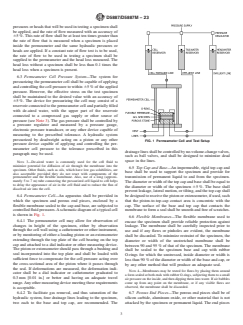
6.3 Permeameter Cell Pressure System—The system for
pressurizing the permeameter cell shall be capable of applying
and controlling the cell pressure to within 65 % of the applied
pressure. However, the effective stress on the test specimen
shall be maintained to the desired value with an accuracy of
65 %. The device for pressurizing the cell may consist of a
reservoir connected to the permeameter cell and partially filled
with de-aired water, with the upper part of the reservoir
connected to a compressed gas supply or other source of
pressure (see Note 3). The gas pressure shall be controlled by
a pressure regulator and measured by a pressure gauge,
electronic pressure transducer, or any other device capable of
measuring to the prescribed tolerance. A hydraulic system
pressurized by deadweight acting on a piston or any other
FIG. 1 Permeameter Cell and Test Setup
pressure device capable of applying and controlling the per-
meameter cell pressure to the tolerance prescribed in this
drainage lines shall be controlled by no-volume-change valves,
paragraph may be used.
such as ball valves, and shall be designed to minimize dead
space in the lines.
NOTE 3—De-aired water is commonly used for the cell fluid to
minimize potential for diffusion of air through the membrane into the
6.5 Top Cap and Base—An impermeable, rigid top cap and
specimen. Other fluids, such as oils, which have low gas solubilities, are
base shall be used to support the specimen and provide for
also acceptable provided they do not react with components of the
transmission of permanent liquid to and from the specimen.
permeameter and the flexible membrane. Also, use of a long (approxi-
mately 5 to 7 m) tube connecting the pressurized cell liquid to cell helps
The diameter or width of the top cap and base shall be equal to
to delay the appearance of air in the cell fluid and to reduce the flux of
the diameter or width of the specimen 65 %. The base shall
dissolved air into the cell.
prevent leakage, lateral motion, or tilting, and the top cap shall
6.4 Permeameter Cell—An apparatus shall be provided in be designed to receive the piston or extensometer, if used, such
which the specimen and porous end pieces, enclosed by a that the piston-to-top-cap contact area is concentric with the
flexible membrane sealed to the cap and base, are subjected to cap. The surface of the base and top cap that contacts the
controlled fluid pressures. A schematic diagram of a typical cell membrane to form a seal shall be smooth and free of scratches.
is shown in Fig. 1.
6.6 Flexible Membranes—The flexible membrane used to
6.4.1 The permeameter cell may allow for observation of
encase the specimen shall provide reliable protection against
changes in height of the specimen, either by observation
leakage. The membrane shall be carefully inspected prior to
through the cell wall using a cathetometer or other instrument,
use and if any flaws or pinholes are evident, the membrane
or by monitoring of either a loading piston or an extensometer
shall be discarded. To minimize restraint of the specimen, the
extending through the top plate of the cell bearing on the top
diameter or width of the unstretched membrane shall be
cap and attached to a dial indicator or other measuring device.
between 90 and 95 % of that of the specimen. The membrane
The piston or extensometer should pass through a bushing and
shall be sealed to the specimen base and cap with rubber
seal incorporated into the top plate and shall be loaded with
O-rings for which the unstressed, inside diameter or width is
sufficient force to compensate for the cell pressure acting over
less than 90 % of the diameter or width of the base and cap, or
the cross-sectional area of the piston where it passes through
by any other method that will produce an adequate seal.
the seal. If deformations are measured, the deformation indi-
NOTE 4—Membranes may be tested for flaws by placing them around
cator shall be a dial indicator or cathetometer graduated to
a form sealed at both ends with rubber O-rings, subjecting them to a small
0.3 mm [0.01 in.] or better and having an adequate travel
air pressure on the inside, and then dipping them into water. If air bubbles
range. Any other measuring device meeting these requirements
come up from any point on the membrane, or if any visible flaws are
observed, the membrane shall be discarded.
is acceptable.
6.4.2 To facilitate gas removal, and thus saturation of the 6.7 Porous End Pieces—The porous end pieces shall be of
hydraulic system, four drainage lines leading to the specimen, silicon carbide, aluminum oxide, or other material that is not
two each to the base and top cap, are recommended. The attacked by the specimen or permanent liquid. The end pieces
D5887/D5887M − 23
shall have plane and smooth surfaces and be free of cracks, specimen. The flux through a GCL specimen can be substan-
chips, and nonuniformities. They shall be checked regularly to tially influenced by the permeating fluid. Deionized water shall
ensure that they are not clogged. be used in this test method.
6.7.1 The porous end pieces shall have a diameter no greater 7.1.2 The permeant water shall be de-aired as well as
than 100 mm [3.95 in.] and no less than 98 mm [3.85 in.], and deionized. The water is usually de-aired by boiling, by spray-
the thickness shall be sufficient to prevent breaking. ing a fine mist of water into an evacuated vessel attached to
6.7.2 The hydraulic conductivity of the porous end pieces vacuum source, or by forceful agitation of water in a container
shall be substantially greater than that of the specimen to be attached to a vacuum source. De-aired water shall not be
tested such that there is no significant impedance of flow. exposed to air for prolonged periods.
Including the porous end pieces in the procedures set forth in
8. Test Specimen Preparation
6.2.3 will ensure that no significant impedance occurs.
8.1 Inspect the bulk GCL sample to be tested and record any
6.8 Filter Paper—To prevent intrusion of material into the
disturbance, irregularity, or damages. Choose a representative
pores of the porous end pieces, one or more sheets of filter
section of the GCL sample to obtain the specimen for testing.
paper shall be placed between the top and bottom porous end
pieces and the specimen (see Note 5). The hydraulic conduc- 8.2 Place a template with a known area (for example, 30.5
tivity of the filter paper shall be substantially greater than that by 30.5 cm [12 by 12 in.]) on the selected section.
of the specimen to be tested such that there is no significant
8.3 Utilizing a sharp utility knife or other suitable
impedance of flow. Including the filter paper in the procedures
instruments, cut the bulk GCL sample to the exact size of the
set forth in 6.2.3 will ensure that no significant impedance
template. Carefully remove, with little or no loss of bentonite,
occurs.
and weigh the cut GCL sample (see Note 6).
NOTE 5—The type of filter paper recommended is Whatman No. 1 (or
NOTE 6—The weight of the GCL sample and the area of the template
equivalent), that has particle retention capability greater than 11 μm.
could be used to provide an estimate of the mass per unit area of the GCL
sample.
6.9 Devices for Measuring the Dimensions of the
Specimen—Devices used to measure the dimensions of the
8.4 If necessary, utilizing a squirt bottle with a long nozzle
specimen shall be capable of measuring to the nearest 0.3 mm
and filled with deionized water, wet the edges of the GCL
[0.01 in.] or better and shall be constructed such that their use
sample to prevent bentonite loss during further handling and
will not disturb the specimen.
specimen preparation.
6.10 Balances—The balance shall be suitable for determin-
8.5 Carefully place the GCL sample on a flat, smooth
ing the mass of the specimen and shall be selected as discussed
surface.
in Guide D4753. The mass of specimens shall be determined to
8.6 Place a 100 6 1 mm [4 6 0.04 in.] diameter disc at the
the nearest 0.01 g.
center of the GCL sample. With a thin marker, trace around the
6.11 Equipment for Mounting the Specimen—Equipment for
disc directly on the GCL backing.
mounting the specimen in the permeameter cell shall include a
8.7 Remove the disc. Using a sharp utility knife or other
membrane stretcher or cylinder and ring for expanding and
suitable i
...
This document is not an ASTM standard and is intended only to provide the user of an ASTM standard an indication of what changes have been made to the previous version. Because
it may not be technically possible to adequately depict all changes accurately, ASTM recommends that users consult prior editions as appropriate. In all cases only the current version
of the standard as published by ASTM is to be considered the official document.
Designation: D5887/D5887M − 22a D5887/D5887M − 23
Standard Test Method for
Measurement of Index Flux Through Saturated Geosynthetic
Clay Liner Specimens Using a Flexible Wall Permeameter
This standard is issued under the fixed designation D5887/D5887M; the number immediately following the designation indicates the
year of original adoption or, in the case of revision, the year of last revision. A number in parentheses indicates the year of last
reapproval. A superscript epsilon (´) indicates an editorial change since the last revision or reapproval.
1. Scope
1.1 This test method covers an index test that covers laboratory measurement of flux through saturated geosynthetic clay liner
(GCL) specimens using a flexible wall permeameter.
1.2 This test method is applicable to GCL products having geotextile backing(s). It is not applicable to GCL products with
geomembrane backing(s), geofilm backing(s), or polymer coating backing(s).
1.3 This test method provides a measurement of flux under a prescribed set of conditions that can be used for manufacturing
quality control. The test method can also be used to check conformance. The flux value determined using this test method is not
considered to be representative of the in-service flux of GCLs.
1.4 The values stated in either SI units or inch-pound units are to be regarded separately as standard. The values stated in each
system are not necessarily exact equivalents; therefore, to ensure conformance with the standard, each system shall be used
independently of the other, and values from the two systems shall not be combined.
1.5 This standard does not purport to address all of the safety concerns, if any, associated with its use. It is the responsibility
of the user of this standard to establish appropriate safety, health, and environmental practices and determine the applicability of
regulatory limitations prior to use.
1.6 This international standard was developed in accordance with internationally recognized principles on standardization
established in the Decision on Principles for the Development of International Standards, Guides and Recommendations issued
by the World Trade Organization Technical Barriers to Trade (TBT) Committee.
2. Referenced Documents
2.1 ASTM Standards:
D374/D374M Test Methods for Thickness of Solid Electrical Insulation
D653 Terminology Relating to Soil, Rock, and Contained Fluids
D2216 Test Methods for Laboratory Determination of Water (Moisture) Content of Soil and Rock by Mass
D4439 Terminology for Geosynthetics
D4753 Guide for Evaluating, Selecting, and Specifying Balances and Standard Masses for Use in Soil, Rock, and Construction
Materials Testing
This test method is under the jurisdiction of ASTM Committee D35 on Geosynthetics and is the direct responsibility of Subcommittee D35.04 on Geosynthetic Clay
Liners.
Current edition approved Oct. 1, 2022Nov. 1, 2023. Published October 2022November 2023. Originally approved in 1995. Last previous edition approved in 2022 as
D5887/D5887M – 22.D5887/D5887M – 22a. DOI: 10.1520/D5887_D5887M-22A.10.1520/D5887_D5887M-23.
For referenced ASTM standards, visit the ASTM website, www.astm.org, or contact ASTM Customer Service at service@astm.org. For Annual Book of ASTM Standards
volume information, refer to the standard’s Document Summary page on the ASTM website.
Copyright © ASTM International, 100 Barr Harbor Drive, PO Box C700, West Conshohocken, PA 19428-2959. United States
D5887/D5887M − 23
E145 Specification for Gravity-Convection and Forced-Ventilation Ovens
E691 Practice for Conducting an Interlaboratory Study to Determine the Precision of a Test Method
3. Terminology
3.1 Definitions:
3.1.1 flux, n—the rate of discharge of water under laminar flow conditions through a unit cross-sectional area of a GCL specimen.
3.1.2 geosynthetic clay liner (GCL), n—a factory-manufactured geosynthetic hydraulic barrier consisting of clay supported by
geotextiles or geomembranes, or both, that are held together by needling, stitching, or chemical adhesives.
3.1.3 index test, n—a test procedure that may contain a bias, but that may be used to establish an order for a set of specimens with
respect to the property of interest.
3.1.4 For definitions of other terms used in this test method, see Terminologies D653 and D4439.
4. Summary of Test Method
4.1 This test method involves permeation of a 100-mm [4-in.]100 mm [4 in.] diameter GCL test specimen. The specimen is set
up in a flexible wall permeameter and subjected to a total stress of 550 kPa [80 psi] and a back pressure of 515 kPa [75 psi] for
a period of 48 h. Flow is initiated using deionized water by raising the pressure on the influent side of the test specimen to 530
kPa [77 psi]. The flux is determined when inflow and outflow are approximately equal (within 625 %).
5. Significance and Use
5.1 This test method yields the flux of water through a saturated GCL specimen that is consolidated, hydrated, and permeated
under a prescribed set of conditions.
5.2 This test method can be performed to determine if the flux of a GCL specimen exceeds the maximum value stated by the
manufacturer.
5.3 This test method can be used to determine the variation in flux within a sample of GCL by testing a number of different
specimens.
5.4 This test method does not provide a flux value to be used directly in design calculations.
NOTE 1—Flux for in-service conditions depends on a number of factors, including confining pressure, type of hydration fluid, degree of hydration, degree
of saturation, type of permeating fluid, and hydraulic gradient. Correlation between flux values obtained with this test method and flux through GCLs
subjected to in-service conditions has not been fully investigated.
5.5 This test method does not provide a value of hydraulic conductivity. Although hydraulic conductivity can be determined in
a manner similar to the method described in this test method, the thickness of the specimen is needed to calculate hydraulic
conductivity. This test method does not include procedures for measuring the thickness of the GCL nor of the clay component
within the GCL. Refer to Appendix X2 for calculation of hydraulic conductivity.
5.6 The apparatus used in this test method is commonly used to determine the hydraulic conductivity of soil specimens. However,
flux values measured in this test are typically much lower than those commonly measured for most natural soils. It is essential that
the leakage rate of the apparatus used in this test be less than 10 % of the flux.
6. Apparatus
6.1 Hydraulic System, constant head (Test Method A), falling head (Test Methods B and C), or constant rate of flow (Test Method
D) systems may be utilized provided they meet the criteria outlined as follows:
6.1.1 Constant Head—The system shall be capable of maintaining constant hydraulic pressures to within 65 % and shall include
means to measure the hydraulic pressures to within the prescribed tolerance. In addition, the head loss across the test specimen
D5887/D5887M − 23
must be held constant to within 65 % and shall be measured with the same accuracy or better. Pressures shall be measured by a
pressure gauge, electronic pressure transducer, or any other device of suitable accuracy.
6.1.2 Falling Head—The system shall allow for measurement of the applied head loss to within 65 % at any time. In addition,
the ratio of initial head loss divided by final head loss over an interval of time shall be measured such that this computed ratio is
accurate to within 65 %. The head loss shall be measured with a pressure gauge, electronic pressure transducer, engineer’s scale,
graduated pipette, or any other device of suitable accuracy. Falling head tests may be performed with either a constant tailwater
elevation (Test Method B) or a rising tailwater elevation (Test Method C).
6.1.3 Constant Rate of Flow—The system shall be capable of maintaining a constant rate of flow through the specimen to within
65 %. Flow measurement shall be by calibrated syringe, graduated pipette, or other device of suitable accuracy. The head loss
across the specimens shall be measured to an accuracy of 65 % using an electronic pressure transducer or other device of suitable
accuracy. More information on testing with a constant rate of flow is given in the literature.
6.1.4 System De-Airing—The hydraulic system shall be designed to facilitate rapid and complete removal of free air bubbles from
flow lines.
6.1.5 Back Pressure System—The hydraulic system shall have the capability to apply back pressure to the specimen to facilitate
saturation. The system shall be capable of maintaining the applied back pressure throughout the duration of hydraulic conductivity
measurements. The back pressure system shall be capable of applying, controlling, and measuring the back pressure within 65 %
of the applied pressure. The back pressure may be provided by a compressed gas supply, a deadweight acting on a piston, or any
other method capable of applying and controlling the back pressure to the tolerance prescribed in this paragraph.
NOTE 2—Application of gas pressure directly to a fluid will dissolve gas in the fluid. A variety of techniques are available to minimize dissolution of gas
in the back pressure fluid, including separation of gas and liquid phases with a bladder and frequent replacement of the liquid with de-aired water.
6.2 Flow Measurement System—Both inflow and outflow volumes shall be measured unless the lack of leakage, continuity of flow,
and cessation of consolidation or swelling can be verified by other means. Flow volumes shall be measured by a graduated
accumulator, graduated pipette, vertical standpipe in conjunction with an electronic pressure transducer, or other volume-
measuring volume measuring device of suitable accuracy.
6.2.1 Flow Accuracy—Required accuracy for the quantity of flow measured over an interval of time is 65 %.
6.2.2 De-Airing and Compliance of the System—The flow-measurement flow measurement system shall contain a minimum of
dead space and be capable of complete and rapid de-airing. Compliance of the system in response to changes in pressure shall be
minimized by using a stiff flow measurement system. Rigid tubing, such as metallic or rigid thermoplastic tubing, shall be used.
6.2.3 Head Losses—Head losses in the tubes, valves, porous end pieces, and filter paper may lead to error. To guard against such
errors, the permeameter shall be assembled with no specimen inside and then the hydraulic system filled. If a constant or falling
head test is to be used, the hydraulic pressures or heads that will be used in testing a specimen shall be applied, and the rate of
flow measured with an accuracy of 65 %. This rate of flow shall be at least ten times greater than the rate of flow that is measured
when a specimen is placed inside the permeameter and the same hydraulic pressures or heads are applied. If a constant rate of flow
test is to be used, the rate of flow to be used in testing a specimen shall be supplied to the permeameter and the head loss measured.
The head loss without a specimen shall be less than 0.1 times the head loss when a specimen is present.
6.3 Permeameter Cell Pressure System—The system for pressurizing the permeameter cell shall be capable of applying and
controlling the cell pressure to within 65 % of the applied pressure. However, the effective stress on the test specimen shall be
maintained to the desired value with an accuracy of 65 %. The device for pressurizing the cell may consist of a reservoir connected
to the permeameter cell and partially filled with de-aired water, with the upper part of the reservoir connected to a compressed gas
supply or other source of pressure (see Note 3). The gas pressure shall be controlled by a pressure regulator and measured by a
pressure gauge, electronic pressure transducer, or any other device capable of measuring to the prescribed tolerance. A hydraulic
system pressurized by deadweight acting on a piston or any other pressure device capable of applying and controlling the
permeameter cell pressure to the tolerance prescribed in this paragraph may be used.
NOTE 3—De-aired water is commonly used for the cell fluid to minimize potential for diffusion of air through the membrane into the specimen. Other
Olson, H. W., Morin, R. H., and Nichols, R. W., “Flow Pump Applications in Triaxial Testing,” Symposium on Advanced Triaxial Testing of Soil and Rock, ASTM STP
977, ASTM International, 1988, pp. 68–81.
D5887/D5887M − 23
fluids, such as oils, which have low gas solubilities, are also acceptable provided they do not react with components of the permeameter and the flexible
membrane. Also, use of a long (approximately 5 to 7 m) tube connecting the pressurized cell liquid to cell helps to delay the appearance of air in the
cell fluid and to reduce the flux of dissolved air into the cell.
6.4 Permeameter Cell—An apparatus shall be provided in which the specimen and porous end pieces, enclosed by a flexible
membrane sealed to the cap and base, are subjected to controlled fluid pressures. A schematic diagram of a typical cell is shown
in Fig. 1.
6.4.1 The permeameter cell may allow for observation of changes in height of the specimen, either by observation through the cell
wall using a cathetometer or other instrument, or by monitoring of either a loading piston or an extensometer extending through
the top plate of the cell bearing on the top cap and attached to a dial indicator or other measuring device. The piston or
extensometer should pass through a bushing and seal incorporated into the top plate and shall be loaded with sufficient force to
compensate for the cell pressure acting over the cross-sectional area of the piston where it passes through the seal. If deformations
are measured, the deformation indicator shall be a dial indicator or cathetometer graduated to 0.3 mm [0.01 in.] or better and having
an adequate travel range. Any other measuring device meeting these requirements is acceptable.
6.4.2 To facilitate gas removal, and thus saturation of the hydraulic system, four drainage lines leading to the specimen, two each
to the base and top cap, are recommended. The drainage lines shall be controlled by no-volume-change valves, such as ball valves,
and shall be designed to minimize dead space in the lines.
6.5 Top Cap and Base—An impermeable, rigid top cap and base shall be used to support the specimen and provide for
transmission of permanent liquid to and from the specimen. The diameter or width of the top cap and base shall be equal to the
diameter or width of the specimen 65 %. The base shall prevent leakage, lateral motion, or tilting, and the top cap shall be
designed to receive the piston or extensometer, if used, such that the piston-to-top-cap contact area is concentric with the cap. The
surface of the base and top cap that contacts the membrane to form a seal shall be smooth and free of scratches.
6.6 Flexible Membranes—The flexible membrane used to encase the specimen shall provide reliable protection against leakage.
The membrane shall be carefully inspected prior to use and if any flaws or pinholes are evident, the membrane shall be discarded.
To minimize restraint of the specimen, the diameter or width of the unstretched membrane shall be between 90 and 95 % of that
of the specimen. The membrane shall be sealed to the specimen base and cap with rubber O-rings for which the unstressed, inside
diameter or width is less than 90 % of the diameter or width of the base and cap, or by any other method that will produce an
adequate seal.
FIG. 1 Permeameter Cell and Test Setup
D5887/D5887M − 23
NOTE 4—Membranes may be tested for flaws by placing them around a form sealed at both ends with rubber O-rings, subjecting them to a small air
pressure on the inside, and then dipping them into water. If air bubbles come up from any point on the membrane, or if any visible flaws are observed,
the membrane shall be discarded.
6.7 Porous End Pieces—The porous end pieces shall be of silicon carbide, aluminum oxide, or other material that is not attacked
by the specimen or permanent liquid. The end pieces shall have plane and smooth surfaces and be free of cracks, chips, and
nonuniformities. They shall be checked regularly to ensure that they are not clogged.
6.7.1 The porous end pieces shall have a diameter no greater than 100 mm [3.95 in.] and no less than 98 mm [3.85 in.], and the
thickness shall be sufficient to prevent breaking.
6.7.2 The hydraulic conductivity of the porous end pieces shall be substantially greater than that of the specimen to be tested such
that there is no significant impedance of flow. Including the porous end pieces in the procedures set forth in 6.2.3 will ensure that
no significant impedance occurs.
6.8 Filter Paper—To prevent intrusion of material into the pores of the porous end pieces, one or more sheets of filter paper shall
be placed between the top and bottom porous end pieces and the specimen (see Note 5). The hydraulic conductivity of the filter
paper shall be substantially greater than that of the specimen to be tested such that there is no significant impedance of flow.
Including the filter paper in the procedures set forth in 6.2.3 will ensure that no significant impedance occurs.
NOTE 5—The type of filter paper recommended is Whatman No. 1 (or equivalent), that has particle retention capability greater than 11 μm.
6.9 Devices for Measuring the Dimensions of the Specimen—Devices used to measure the dimensions of the specimen shall be
capable of measuring to the nearest 0.3 mm [0.01 in.] or better and shall be constructed such that their use will not disturb the
specimen.
6.10 Balances—The balance shall be suitable for determining the mass of the specimen and shall be selected as discussed in Guide
D4753. The mass of specimens shall be determined to the nearest 0.01 g.
6.11 Equipment for Mounting the Specimen—Equipment for mounting the specimen in the permeameter cell shall include a
membrane stretcher or cylinder and ring for expanding and placing O-rings on the base and top cap to seal the membrane.
6.12 Vacuum Pump—To assist with de-airing of permeameter system and saturation of specimens.
6.13 Temperature Maintaining Device—The temperature of the permeameter, test specimen, and permeant reservoir shall be
maintained at 21 6 2 °C. Normally, this is accomplished by performing the test in a room with a relatively constant temperature.
If such a room is not available, the apparatus shall be placed in a water bath, insulated chamber, or other device that maintains
a temperature within the specified tolerance. The temperature shall be periodically measured and recorded at a minimum at the
beginning of the permeation phase and at the end of the permeation phase of the test.
6.14 Water Content Containers—The containers shall be in accordance with Test Methods D2216.
6.15 Drying Oven—The oven shall be in accordance with Specification E145.
7. Reagents
7.1 Permeant Water:
7.1.1 The permeant water is the liquid used to permeate the test specimen and is also the liquid used in back pressuring the
specimen. The flux through a GCL specimen can be substantially influenced by the permeating fluid. Deionized water shall be used
in this test method.
7.1.2 The permeant water shall be de-aired as well as deionized. The water is usually de-aired by boiling, by spraying a fine mist
D5887/D5887M − 23
of water into an evacuated vessel attached to vacuum source, or by forceful agitation of water in a container attached to a vacuum
source. De-aired water shall not be exposed to air for prolonged periods.
8. Test Specimen Preparation
8.1 Inspect the bulk GCL sample
...