

ASTM D6766-20a
(Test Method)Standard Test Method for Evaluation of Hydraulic Properties of Geosynthetic Clay Liners Permeated with Potentially Incompatible Aqueous Solutions
General Information
- Abstract
SIGNIFICANCE AND USE
4.1 This test method applies to one-dimensional, laminar flow of aqueous solutions, such as chemical solutions, landfill leachate, and contaminated water (from here on referred to as “test liquid”), through saturated/hydrated GCL specimen that is consolidated and permeated under a prescribed or requested set of conditions.
4.2 This test method assumes that Darcy’s law is valid and that the hydraulic conductivity is essentially unaffected by hydraulic gradient. The validity of Darcy’s law may be evaluated by measuring the hydraulic conductivity of the specimen at three different hydraulic gradients; if all measured values are similar (within about 25 %), then Darcy's law may be taken as valid. However, when the hydraulic gradient acting on a test specimen is changed, the state of stress will also change and, if the specimen is compressible, the volume of the specimen will change. Thus, some change in hydraulic conductivity may occur when the hydraulic gradient is altered, even in cases where Darcy's law is valid.
4.3 This test method provides tools for determining flux and hydraulic conductivity values for a given GCL under the following two different scenarios, which should be specified by the requester:
4.3.1 Scenario 1 – Hydrated/Saturated with Water Prior to Contact with Test Liquid—This scenario simulates the field conditions where the GCL is well hydrated with water prior to contact with actual test liquid. It should be noted that initial degree of saturation/hydration greatly affects the hydraulic properties of a GCL product. The test has two phases: (Phase 1) hydrate, saturate, consolidate, and permeate with water as Test Liquid 1, and (Phase 2) switch to permeation with test liquid as Test Liquid 2.
4.3.2 Scenario 2 – Hydrated/Saturated with Test Liquid (Worst Case)—This scenario simulates the field conditions where the GCL is in contact with test liquid prior to being fully hydrated with water. It should be noted that this scenario may result in...
SCOPE
1.1 This test method covers laboratory measurement of both flux and hydraulic conductivity (also referred to as coefficient of permeability) of geosynthetic clay liner (GCL) specimens permeated with chemical solutions and leachates utilizing a flexible wall permeameter. For test measurement of index hydraulic properties of geosynthetic clay liners, refer to Test Method D5887/D5887M. For hydraulic conductivity compatibility of soils with aqueous chemical solutions and leachates, refer to Test Method D7100.
1.2 This test method may be utilized with GCL specimens that have a hydraulic conductivity less than or equal to 1 × 10⁻⁵ m/s (1 × 10⁻³ cm/s).
1.3 This test method is applicable to GCL products having geotextile backing(s). It is not applicable to GCL products with geomembrane backing(s), geofilm backing(s), or polymer coating backing(s).
1.4 This test method allows the requester to evaluate the hydraulic properties of a GCL with site-specific or laboratory-prepared solution under different test conditions; thus, the test method also may be used to check performance or conformance, or both.
1.5 The values stated in SI units are to be regarded as the standard, unless other units are specifically given. By tradition in U.S. practice, hydraulic conductivity is reported in centimeters per second, although the common SI units for hydraulic conductivity are meters per second.
1.6 This standard does not purport to address all of the safety concerns, if any, associated with its use. It is the responsibility of the user of this standard to establish appropriate safety, health, and environmental practices and determine the applicability of regulatory limitations prior to use.
1.7 This international standard was developed in accordance with internationally recognized principles on standardization established in the Decision on Principles for the Development of International Standards, Guides and Recommendations i...
- Status
- Published
- Publication Date
- 30-Apr-2020
- Technical Committee
- D35 - Geosynthetics
- Drafting Committee
- D35.04 - Geosynthetic Clay Liners
Buy Documents
ASTM D6766-20a - Standard Test Method for Evaluation of Hydraulic Properties of Geosynthetic Clay Liners Permeated with Potentially Incompatible Aqueous Solutions
REDLINE ASTM D6766-20a - Standard Test Method for Evaluation of Hydraulic Properties of Geosynthetic Clay Liners Permeated with Potentially Incompatible Aqueous Solutions
Overview
ASTM D6766-20a is the Standard Test Method for Evaluation of Hydraulic Properties of Geosynthetic Clay Liners (GCLs) Permeated with Potentially Incompatible Aqueous Solutions. Developed by ASTM International, this laboratory standard specifies methods for assessing both the flux and hydraulic conductivity (permeability) of GCL specimens using a flexible wall permeameter when the GCL is exposed to chemical solutions, landfill leachates, or other contaminated aqueous solutions. Understanding GCL hydraulic behavior in chemically aggressive environments is essential for environmental containment and infrastructure projects.
Key Topics
- Applicability: The standard is intended for GCL products with geotextile backing(s) and a hydraulic conductivity less than or equal to 1 × 10⁻⁵ m/s.
- Test Liquids: The method covers the use of various aqueous solutions, such as leachates and industrial fluids, that might be incompatible with GCLs.
- Test Scenarios:
- Scenario 1: Hydration/saturation with water prior to contact with the test liquid, simulating typical field conditions.
- Scenario 2: Hydration/saturation directly with the test liquid, representing worst-case performance.
- Measurement Method: Laboratory testing is conducted under controlled conditions using a flexible wall permeameter, and results are interpreted under the assumption of laminar, one-dimensional flow governed by Darcy’s Law.
- Result Evaluation: The standard outlines detailed procedures for measuring, calculating, and validating hydraulic conductivity and flux values, ensuring consistency and repeatability.
- Limitations: Applicable only to GCLs with geotextile backings, and not for products with geomembrane, geofilm, or polymer-coated surfaces.
Applications
ASTM D6766-20a is particularly valuable in the following practical applications:
- Landfill Liner and Cover Systems: Evaluating the performance of GCLs as hydraulic barriers when subjected to landfill leachates or chemical spills, ensuring long-term containment in waste management facilities.
- Contaminated Site Remediation: Assessing GCL compatibility with site-specific contaminated water, supporting the design of effective remediation barriers for polluted sites.
- Mining and Industrial Applications: Testing GCL response to process fluids or tailings water, vital for environmental protection in mining and industrial waste containment.
- Compliance and Product Development: Manufacturers and project specifiers use the test to assess product suitability and conformance with performance requirements for specified site conditions.
By providing standardized methods to evaluate GCL hydraulic properties in challenging chemical environments, this standard helps designers, engineers, and regulators select appropriate materials and ensure compliance with environmental protection goals.
Related Standards
- ASTM D5887/D5887M: Measurement of index flux through saturated geosynthetic clay liner specimens using a flexible wall permeameter.
- ASTM D7100: Test method for hydraulic conductivity compatibility testing of soils with aqueous solutions and leachates.
- ASTM D653 & D4439: Key terminology related to soil, rock, contained fluids, and geosynthetics.
- ASTM D2216 & D854: Methods for water content and specific gravity measurements, which support specimen preparation.
- ASTM E145: Specification for drying ovens used in laboratory sample preparation.
Conclusion
ASTM D6766-20a offers a comprehensive protocol for laboratory evaluation of hydraulic properties of geosynthetic clay liners in the presence of potentially incompatible chemical solutions. By standardizing procedures and result criteria, this test method supports responsible environmental engineering, regulatory compliance, and informed material selection for critical containment projects involving GCLs.
Relations
- Effective Date
- 01-May-2020
- Effective Date
- 01-Feb-2024
- Effective Date
- 01-Feb-2024
- Effective Date
- 01-Nov-2023
- Effective Date
- 01-Nov-2023
- Effective Date
- 15-Feb-2020
- Effective Date
- 01-Mar-2019
- Effective Date
- 01-Mar-2019
- Effective Date
- 15-Apr-2018
- Effective Date
- 01-Aug-2017
- Effective Date
- 01-Sep-2016
- Effective Date
- 01-Sep-2015
- Effective Date
- 01-Jul-2015
- Effective Date
- 01-May-2015
- Effective Date
- 01-Aug-2014
Buy Documents
ASTM D6766-20a - Standard Test Method for Evaluation of Hydraulic Properties of Geosynthetic Clay Liners Permeated with Potentially Incompatible Aqueous Solutions
REDLINE ASTM D6766-20a - Standard Test Method for Evaluation of Hydraulic Properties of Geosynthetic Clay Liners Permeated with Potentially Incompatible Aqueous Solutions
Get Certified
Connect with accredited certification bodies for this standard

Control Union Certifications
Global certification for agriculture and sustainability.

Hohenstein Institut
Textile testing and certification.

Bureau Veritas Bangladesh
Bureau Veritas certification services in Bangladesh.
Sponsored listings
Frequently Asked Questions
ASTM D6766-20a is a standard published by ASTM International. Its full title is "Standard Test Method for Evaluation of Hydraulic Properties of Geosynthetic Clay Liners Permeated with Potentially Incompatible Aqueous Solutions". This standard covers: SIGNIFICANCE AND USE 4.1 This test method applies to one-dimensional, laminar flow of aqueous solutions, such as chemical solutions, landfill leachate, and contaminated water (from here on referred to as “test liquid”), through saturated/hydrated GCL specimen that is consolidated and permeated under a prescribed or requested set of conditions. 4.2 This test method assumes that Darcy’s law is valid and that the hydraulic conductivity is essentially unaffected by hydraulic gradient. The validity of Darcy’s law may be evaluated by measuring the hydraulic conductivity of the specimen at three different hydraulic gradients; if all measured values are similar (within about 25 %), then Darcy's law may be taken as valid. However, when the hydraulic gradient acting on a test specimen is changed, the state of stress will also change and, if the specimen is compressible, the volume of the specimen will change. Thus, some change in hydraulic conductivity may occur when the hydraulic gradient is altered, even in cases where Darcy's law is valid. 4.3 This test method provides tools for determining flux and hydraulic conductivity values for a given GCL under the following two different scenarios, which should be specified by the requester: 4.3.1 Scenario 1 – Hydrated/Saturated with Water Prior to Contact with Test Liquid—This scenario simulates the field conditions where the GCL is well hydrated with water prior to contact with actual test liquid. It should be noted that initial degree of saturation/hydration greatly affects the hydraulic properties of a GCL product. The test has two phases: (Phase 1) hydrate, saturate, consolidate, and permeate with water as Test Liquid 1, and (Phase 2) switch to permeation with test liquid as Test Liquid 2. 4.3.2 Scenario 2 – Hydrated/Saturated with Test Liquid (Worst Case)—This scenario simulates the field conditions where the GCL is in contact with test liquid prior to being fully hydrated with water. It should be noted that this scenario may result in... SCOPE 1.1 This test method covers laboratory measurement of both flux and hydraulic conductivity (also referred to as coefficient of permeability) of geosynthetic clay liner (GCL) specimens permeated with chemical solutions and leachates utilizing a flexible wall permeameter. For test measurement of index hydraulic properties of geosynthetic clay liners, refer to Test Method D5887/D5887M. For hydraulic conductivity compatibility of soils with aqueous chemical solutions and leachates, refer to Test Method D7100. 1.2 This test method may be utilized with GCL specimens that have a hydraulic conductivity less than or equal to 1 × 10⁻⁵ m/s (1 × 10⁻³ cm/s). 1.3 This test method is applicable to GCL products having geotextile backing(s). It is not applicable to GCL products with geomembrane backing(s), geofilm backing(s), or polymer coating backing(s). 1.4 This test method allows the requester to evaluate the hydraulic properties of a GCL with site-specific or laboratory-prepared solution under different test conditions; thus, the test method also may be used to check performance or conformance, or both. 1.5 The values stated in SI units are to be regarded as the standard, unless other units are specifically given. By tradition in U.S. practice, hydraulic conductivity is reported in centimeters per second, although the common SI units for hydraulic conductivity are meters per second. 1.6 This standard does not purport to address all of the safety concerns, if any, associated with its use. It is the responsibility of the user of this standard to establish appropriate safety, health, and environmental practices and determine the applicability of regulatory limitations prior to use. 1.7 This international standard was developed in accordance with internationally recognized principles on standardization established in the Decision on Principles for the Development of International Standards, Guides and Recommendations i...
SIGNIFICANCE AND USE 4.1 This test method applies to one-dimensional, laminar flow of aqueous solutions, such as chemical solutions, landfill leachate, and contaminated water (from here on referred to as “test liquid”), through saturated/hydrated GCL specimen that is consolidated and permeated under a prescribed or requested set of conditions. 4.2 This test method assumes that Darcy’s law is valid and that the hydraulic conductivity is essentially unaffected by hydraulic gradient. The validity of Darcy’s law may be evaluated by measuring the hydraulic conductivity of the specimen at three different hydraulic gradients; if all measured values are similar (within about 25 %), then Darcy's law may be taken as valid. However, when the hydraulic gradient acting on a test specimen is changed, the state of stress will also change and, if the specimen is compressible, the volume of the specimen will change. Thus, some change in hydraulic conductivity may occur when the hydraulic gradient is altered, even in cases where Darcy's law is valid. 4.3 This test method provides tools for determining flux and hydraulic conductivity values for a given GCL under the following two different scenarios, which should be specified by the requester: 4.3.1 Scenario 1 – Hydrated/Saturated with Water Prior to Contact with Test Liquid—This scenario simulates the field conditions where the GCL is well hydrated with water prior to contact with actual test liquid. It should be noted that initial degree of saturation/hydration greatly affects the hydraulic properties of a GCL product. The test has two phases: (Phase 1) hydrate, saturate, consolidate, and permeate with water as Test Liquid 1, and (Phase 2) switch to permeation with test liquid as Test Liquid 2. 4.3.2 Scenario 2 – Hydrated/Saturated with Test Liquid (Worst Case)—This scenario simulates the field conditions where the GCL is in contact with test liquid prior to being fully hydrated with water. It should be noted that this scenario may result in... SCOPE 1.1 This test method covers laboratory measurement of both flux and hydraulic conductivity (also referred to as coefficient of permeability) of geosynthetic clay liner (GCL) specimens permeated with chemical solutions and leachates utilizing a flexible wall permeameter. For test measurement of index hydraulic properties of geosynthetic clay liners, refer to Test Method D5887/D5887M. For hydraulic conductivity compatibility of soils with aqueous chemical solutions and leachates, refer to Test Method D7100. 1.2 This test method may be utilized with GCL specimens that have a hydraulic conductivity less than or equal to 1 × 10⁻⁵ m/s (1 × 10⁻³ cm/s). 1.3 This test method is applicable to GCL products having geotextile backing(s). It is not applicable to GCL products with geomembrane backing(s), geofilm backing(s), or polymer coating backing(s). 1.4 This test method allows the requester to evaluate the hydraulic properties of a GCL with site-specific or laboratory-prepared solution under different test conditions; thus, the test method also may be used to check performance or conformance, or both. 1.5 The values stated in SI units are to be regarded as the standard, unless other units are specifically given. By tradition in U.S. practice, hydraulic conductivity is reported in centimeters per second, although the common SI units for hydraulic conductivity are meters per second. 1.6 This standard does not purport to address all of the safety concerns, if any, associated with its use. It is the responsibility of the user of this standard to establish appropriate safety, health, and environmental practices and determine the applicability of regulatory limitations prior to use. 1.7 This international standard was developed in accordance with internationally recognized principles on standardization established in the Decision on Principles for the Development of International Standards, Guides and Recommendations i...
ASTM D6766-20a is classified under the following ICS (International Classification for Standards) categories: 59.080.70 - Geotextiles. The ICS classification helps identify the subject area and facilitates finding related standards.
ASTM D6766-20a has the following relationships with other standards: It is inter standard links to ASTM D6766-20, ASTM D4439-24, ASTM D4753-24, ASTM D854-23, ASTM D5887/D5887M-23, ASTM D7100-11(2020), ASTM E145-19, ASTM D2216-19, ASTM D4439-18, ASTM D4439-17, ASTM D5887/D5887M-16, ASTM D4439-15a, ASTM D4439-15, ASTM D4753-15, ASTM D653-14. Understanding these relationships helps ensure you are using the most current and applicable version of the standard.
ASTM D6766-20a is available in PDF format for immediate download after purchase. The document can be added to your cart and obtained through the secure checkout process. Digital delivery ensures instant access to the complete standard document.
Standards Content (Sample)
This international standard was developed in accordance with internationally recognized principles on standardization established in the Decision on Principles for the
Development of International Standards, Guides and Recommendations issued by the World Trade Organization Technical Barriers to Trade (TBT) Committee.
Designation: D6766 − 20a
Standard Test Method for
Evaluation of Hydraulic Properties of Geosynthetic Clay
Liners Permeated with Potentially Incompatible Aqueous
Solutions
This standard is issued under the fixed designation D6766; the number immediately following the designation indicates the year of
original adoption or, in the case of revision, the year of last revision.Anumber in parentheses indicates the year of last reapproval.A
superscript epsilon (´) indicates an editorial change since the last revision or reapproval.
1. Scope 1.7 This international standard was developed in accor-
dance with internationally recognized principles on standard-
1.1 Thistestmethodcoverslaboratorymeasurementofboth
ization established in the Decision on Principles for the
flux and hydraulic conductivity (also referred to as coeffıcient
Development of International Standards, Guides and Recom-
of permeability) of geosynthetic clay liner (GCL) specimens
mendations issued by the World Trade Organization Technical
permeated with chemical solutions and leachates utilizing a
Barriers to Trade (TBT) Committee.
flexible wall permeameter. For test measurement of index
hydraulic properties of geosynthetic clay liners, refer to Test
2. Referenced Documents
Method D5887/D5887M. For hydraulic conductivity compat-
ibility of soils with aqueous chemical solutions and leachates, 2.1 ASTM Standards:
D653Terminology Relating to Soil, Rock, and Contained
refer to Test Method D7100.
Fluids
1.2 This test method may be utilized with GCL specimens
D854Test Methods for Specific Gravity of Soil Solids by
that have a hydraulic conductivity less than or equal to
–5 –3 Water Pycnometer
1×10 m⁄s(1×10 cm/s).
D2216TestMethodsforLaboratoryDeterminationofWater
1.3 This test method is applicable to GCL products having
(Moisture) Content of Soil and Rock by Mass
geotextilebacking(s).ItisnotapplicabletoGCLproductswith
D4439Terminology for Geosynthetics
geomembranebacking(s),geofilmbacking(s),orpolymercoat-
D4753Guide for Evaluating, Selecting, and Specifying Bal-
ing backing(s).
ances and Standard Masses for Use in Soil, Rock, and
Construction Materials Testing
1.4 This test method allows the requester to evaluate the
D5887/D5887MTest Method for Measurement of Index
hydraulic properties of a GCLwith site-specific or laboratory-
Flux Through Saturated Geosynthetic Clay Liner Speci-
prepared solution under different test conditions; thus, the test
mens Using a Flexible Wall Permeameter
method also may be used to check performance or
D7100TestMethodforHydraulicConductivityCompatibil-
conformance, or both.
ity Testing of Soils with Aqueous Solutions
1.5 The values stated in SI units are to be regarded as the
E145Specification for Gravity-Convection and Forced-
standard, unless other units are specifically given. By tradition
Ventilation Ovens
in U.S. practice, hydraulic conductivity is reported in centime-
ters per second, although the common SI units for hydraulic
3. Terminology
conductivity are meters per second.
3.1 Definitions:
1.6 This standard does not purport to address all of the
3.1.1 flux, n—the rate of discharge of liquid under laminar
safety concerns, if any, associated with its use. It is the
flow conditions through a unit cross-sectional area of a GCL
responsibility of the user of this standard to establish appro-
specimen at a standard temperature condition (22 6 3°C).
priate safety, health, and environmental practices and deter-
3.1.2 geosynthetic clay liner (GCL), n—a factory-
mine the applicability of regulatory limitations prior to use.
manufactured geosynthetic hydraulic barrier consisting of clay
supported by geotextiles, geomembranes, or a combination
This test method is under the jurisdiction of ASTM Committee D35 on
Geosynthetics and is the direct responsibility of Subcommittee D35.04 on Geosyn-
thetic Clay Liners. For referenced ASTM standards, visit the ASTM website, www.astm.org, or
Current edition approved May 1, 2020. Published May 2020. Originally contact ASTM Customer Service at service@astm.org. For Annual Book of ASTM
approved in 2002. Last previous edition approved in 2020 as D6766–20. DOI: Standards volume information, refer to the standard’s Document Summary page on
10.1520/D6766-20A. the ASTM website.
Copyright © ASTM International, 100 Barr Harbor Drive, PO Box C700, West Conshohocken, PA 19428-2959. United States
D6766 − 20a
thereof, that are held together by needling, stitching, chemical 4.3.2 Scenario 2 – Hydrated/Saturated with Test Liquid
adhesives, or other methods. (Worst Case)—This scenario simulates the field conditions
wheretheGCLisincontactwithtestliquidpriortobeingfully
3.1.3 hydraulic conductivity, k, n—the rate of discharge of
hydrated with water. It should be noted that this scenario may
liquid under laminar flow conditions through a unit cross-
result in higher flux and hydraulic conductivity values com-
sectional area of a GCL specimen under a unit hydraulic
pared to Scenario 1, as chemicals present in test liquid may
gradient and standard temperature conditions (22 6 3°C).
alter the hydration and hydraulic properties of a GCLproduct.
3.1.3.1 Discussion—The term coeffıcient of permeability is
often used instead of hydraulic conductivity, but hydraulic
4.4 The apparatus used in this test method is commonly
conductivity is used exclusively in this test method. A more
usedtodeterminethehydraulicconductivityofsoilspecimens.
complete discussion of the terminology associated with Dar-
However, flux values measured in this test are typically much
cy’s law is given in the literature.
lower than those commonly measured for most natural soils. It
is essential that the leakage rate of the apparatus in this test be
3.1.4 index test, n—a test procedure that may contain bias,
butmaybeusedtoestablishcomparableresultswithrespectto less than 10% of the flux.
the property of interest.
5. Apparatus
3.1.5 pore volume of flow, n—the cumulative quantity of
flowintoatestspecimendividedbythevolumeofvoidsinthe
5.1 Compatibility—All parts in contact with the test liq-
specimen.
uid(s) shall be checked/verified for long-term compatibility.
This can be established either based on the available informa-
3.2 For definitions of other terms used in this test method,
tion or by in-house testing.
see Terminologies D653 and D4439.
5.2 Hydraulic System—Constant head (Method A), falling
4. Significance and Use
head (Methods B and C), or constant rate of flow (Method D)
4.1 This test method applies to one-dimensional, laminar systems may be utilized provided they meet the criteria
flow of aqueous solutions, such as chemical solutions, landfill
outlined as follows:
leachate, and contaminated water (from here on referred to as
5.2.1 Constant Head (Method A)—The system must be
“testliquid”),throughsaturated/hydratedGCLspecimenthatis
capable of maintaining constant hydraulic pressures to within
consolidatedandpermeatedunderaprescribedorrequestedset
65% and shall include means to measure the hydraulic
of conditions.
pressures to within the prescribed tolerance. In addition, the
head loss across the test specimen must be held constant to
4.2 This test method assumes that Darcy’s law is valid and
within 65% and shall be measured with the same accuracy or
that the hydraulic conductivity is essentially unaffected by
better. Pressures shall be measured by a pressure gage, elec-
hydraulic gradient. The validity of Darcy’s law may be
tronic pressure transducer, or any other device of suitable
evaluated by measuring the hydraulic conductivity of the
accuracy.
specimen at three different hydraulic gradients; if all measured
values are similar (within about 25%), then Darcy’s law may 5.2.2 Falling Head (Methods B and C)—The system shall
betakenasvalid.However,whenthehydraulicgradientacting allowformeasurementoftheappliedheadloss,thushydraulic
on a test specimen is changed, the state of stress will also gradient, to within 65%. In addition, the ratio of initial head
changeand,ifthespecimeniscompressible,thevolumeofthe loss divided by final head loss over an interval of time shall be
specimen will change. Thus, some change in hydraulic con- measured such that this computed ratio is accurate to within
ductivity may occur when the hydraulic gradient is altered, 65%. The head loss shall be measured with a pressure gage,
electronic pressure transducer, engineer’s scale, graduated
even in cases where Darcy’s law is valid.
pipette, or any other device of suitable accuracy. Falling head
4.3 Thistestmethodprovidestoolsfordeterminingfluxand
tests may be performed with either a falling headwater and
hydraulic conductivity values for a given GCL under the
constant tailwater elevation (Method B) or a falling headwater
followingtwodifferentscenarios,whichshouldbespecifiedby
and rising tailwater elevation (Method C).
the requester:
5.2.3 Constant Rate of Flow (Method D)—The system must
4.3.1 Scenario 1 – Hydrated/Saturated with Water Prior to
be capable of maintaining a constant rate of flow through the
Contact with Test Liquid—This scenario simulates the field
specimen to within +5%. Flow measurement shall be by
conditions where the GCLis well hydrated with water prior to
calibrated syringe, graduated pipette, or other device of suit-
contact with actual test liquid. It should be noted that initial
able accuracy. The head loss across the specimen shall be
degree of saturation/hydration greatly affects the hydraulic
measured to an accuracy of 5% or better using an electronic
properties of a GCL product. The test has two phases: (Phase
pressure transducer or other device of suitable accuracy. More
1) hydrate, saturate, consolidate, and permeate with water as
information on testing with a constant rate of flow is given in
Test Liquid 1, and (Phase 2) switch to permeation with test
the literature.
liquid as Test Liquid 2.
3 4
Olson,R.E.andDaniel,D.E.,“MeasurementoftheHydraulicConductivityof Olson, H. W., Morin, R. H., and Nichols, R. W., “Flow Pump Applications in
Fine-Grained Soils,” Symposium on Permeability and Groundwater Contaminant TriaxialTesting,” Symposium onAdvanced Triaxial Testing of Soil and Rock,ASTM
Transport, ASTM STP 746, ASTM International, 1981, pp. 18–64. STP 977, ASTM International, 1988, pp. 68–81.
D6766 − 20a
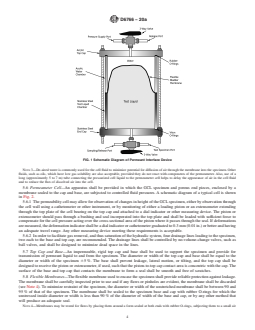
5.2.4 System De-Airing—The hydraulic system shall be 1. The device consists of mainly a water chamber and a test
designed to facilitate rapid and complete removal of free air liquid chamber, which are separated with a flexible bladder
bubbles from flow lines. membrane. The device should be checked for leaks at the
desired test pressures prior to the testing.
5.2.5 Back Pressure System—The hydraulic system shall
have the capability to apply back pressure to the specimen to
NOTE 2—The suppliers of the apparatus materials in contact with the
facilitate saturation. The system shall be capable of maintain- test liquid (for example, permeant interface device, flexible membrane,
and porous end pieces) may be consulted regarding chemical compatibil-
ing the applied back pressure throughout the duration of
ity with the test liquid prior to testing.
hydraulic conductivity measurements. The back pressure sys-
5.5 Permeameter Cell Pressure System—The system for
tem shall be capable of applying, controlling, and measuring
pressurizing the permeameter cell shall be capable of applying
the back pressure to 5% or better of the applied pressure. The
and controlling the cell pressure to within 65% of the applied
back pressure may be provided by a compressed gas supply
pressure. However, the effective stress on the test specimen
(see Note 1), a dead weight acting on a piston, or any other
(which is the difference between the cell pressure and the pore
method capable of applying and controlling the back pressure
waterpressure)shallbemaintainedtothedesiredvaluewithan
to the tolerance prescribed in this paragraph.
accuracyof 65%orbetter.Thedeviceforpressurizingthecell
NOTE1—Applicationofgaspressuredirectlytoafluidwilldissolvegas
inthefluid.Anysuitabletechnique,includingseparationofgasandliquid may consist of a reservoir connected to the permeameter cell
phases with a bladder, may be used to minimize dissolution of gas in the
and partially filled with de-aired water, with the upper part of
back pressure fluid.
the reservoir connected to a compressed gas supply or other
5.3 Flow Measurement System—Both inflow and outflow source of pressure (see Note 3). The gas pressure shall be
controlled by a pressure regulator and measured by a pressure
volumes shall be measured unless the lack of leakage, conti-
nuityofflow,andcessationofconsolidationorswellingcanbe gage, electronic pressure transducer, or any other device
verified by other means. Flow volumes shall be measured by a capable of measuring to the prescribed tolerance. A hydraulic
graduated accumulator, graduated pipette, vertical standpipe in system pressurized by dead weight acting on a piston or any
conjunction with an electronic pressure transducer, or other other pressure device capable of applying and controlling the
volume-measuring device of suitable accuracy. permeameter cell pressure to the tolerance prescribed in this
paragraph may be used.
5.3.1 FlowAccuracy—Requiredaccuracyforthequantityof
NOTE 3—De-aired water is commonly used for the cell fluid to
flow measured over an interval of time is 65%.
minimize potential for diffusion of air through the membrane into the
5.3.2 De-Airing and Compliance of the System—The flow
specimen.Otherfluids,suchasoils,whichhavelowgassolubilityarealso
measurement system shall contain a minimum of dead space
acceptable,providedtheydonotreactwithcomponentsofthepermeame-
ter. Also, use of a long (approximately 5 to 7 m) tube connecting the
andbecapableofcompleteandrapidde-airing.Complianceof
pressurized cell liquid to the permeameter cell helps to delay the
the system in response to changes in pressure shall be
appearance of air in the cell fluid and to reduce the flux of dissolved air
minimized by using a stiff flow measurement system. Rigid
into the cell.
tubing, such as metallic or rigid thermoplastic tubing, shall be
5.6 Permeameter Cell—An apparatus shall be provided in
used.
which the GCL specimen and porous end pieces, enclosed by
5.3.3 Head Losses—Headlossesinthetubes,valves,porous
a membrane sealed to the cap and base, are subjected to
end pieces, and filter paper may lead to error.To guard against
controlledfluidpressures.Aschematicdiagramofatypicalcell
such errors, the permeameter shall be assembled with no
is shown in Fig. 2.
specimen inside and then the hydraulic system filled. If a
5.6.1 The permeability cell may allow for observation of
constant or falling head test is to be used, the hydraulic
changes in height of the GCL specimen, either by observation
pressures or heads that will be used in testing a specimen shall
through the cell wall using a cathetometer or other instrument,
be applied, and the rate of flow measured with an accuracy of
or by monitoring of either a loading piston or an extensometer
5%orbetter.Thisrateofflowshallbeatleasttentimesgreater
extending through the top plate of the cell bearing on the top
thantherateofflowthatismeasuredwhenaGCLspecimenis
cap and attached to a dial indicator or other measuring device.
placed inside the permeameter and the same hydraulic pres-
The piston or extensometer should pass through a bushing and
sures or heads are applied. If a constant rate of flow test is to
seal incorporated into the top plate and shall be loaded with
be used, the rate of flow to be used in testing a specimen shall
sufficient force to compensate for the cell pressure acting over
be supplied to the permeameter and the head loss measured.
the cross-sectional area of the piston where it passes through
The head loss without a specimen shall be less than 0.1 times
the seal. If deformations are measured, the deformation indi-
the head loss when a GCL specimen is present.
cator shall be a dial indicator or cathetometer graduated to
5.4 Permeant Interface Device (Bladder Accumulator)—A 0.3mm (0.01 in.) or better and having an adequate travel
permeant interface device shall be used when a hazardous/ range.Anyothermeasuringdevicemeetingtheserequirements
corrosive or volatile test liquid, or both, is to be used as the is acceptable.
permeant. The permeant interface device shall contain the test 5.6.2 In order to facilitate gas removal, and thus saturation
liquid in a closed chamber and allow neither possible contami- of the hydraulic system, four drainage lines leading to the
nationofflowmeasurementandpressuresystemsnorpotential specimen,twoeachtothebaseandtopcap,arerecommended.
release of chemicals present in the test liquid to the breathing The drainage lines shall be controlled by no-volume-change
air, while maintaining the desired test pressures. A schematic valves, such as ball valves, and shall be designed to minimize
diagramofatypicalpermeantinterfacedeviceisshowninFig. dead space in the lines.
D6766 − 20a
FIG. 1 Schematic Diagram of Permeant Interface Device
FIG. 2 Schematic Diagram of Permeameter Cell
5.7 Top Cap and Base—An impermeable, rigid top cap and prevent leakage, lateral motion, or tilting, and the top cap shall
base shall be used to support the specimen and provide for bedesignedtoreceivethepistonorextensometer,ifused,such
transmissionofpermeantliquidtoandfromthespecimen.The that the piston-to-top cap contact area is concentric with the
diameter or width of the top cap and base shall be equal to the cap. The surface of the base and top cap that contacts the
diameter or width of the specimen 65%. The base shall membranetoformasealshallbesmoothandfreeofscratches.
D6766 − 20a
5.8 Flexible Membranes—The flexible membrane used to be determined to the nearest 0.01g. The mass of specimens
encase the specimen shall provide reliable protection against 100g or larger shall be determined to the nearest 0.1g. The
leakage. The membrane shall be carefully inspected prior to mass of specimens larger than 1000g shall be determined to
use and if any flaws or pinholes are evident, the membrane the nearest 1.0g.
shall be discarded (see Note 4). To minimize restraint of the
5.14 EquipmentforMountingtheSpecimen—Equipmentfor
specimen, the diameter or width of the unstretched membrane
mounting the specimen in the permeameter cell shall include a
shall be between 90 and 95% of that of the specimen. The
membrane expander or cylinder, and rings for expanding and
membrane shall be sealed to the specimen base and cap with
placing O-rings on the base and top cap to seal the membrane.
rubber O-rings for which the unstressed inside diameter or
5.15 Vacuum Pump—To assist with de-airing of water or, if
widthislessthan90%ofthediameterofwidthofthebaseand
applicable, the test liquid.
cap,orbyanyothermethodthatwillproduceanadequateseal.
NOTE 4—Membranes may be tested for flaws by placing them around
5.16 Temperature Maintaining Device—The temperature of
aformsealedatbothendswithrubberO-rings,subjectingthemtoasmall
the permeameter, test specimen, and reservoir(s) of test liquid
airpressureontheinside,andthendippingthemintowater.Ifairbubbles
shall not vary more than 63°C (65.7°F). Normally, this is
come up from any point on the membrane, or if any visible flaws are
observed,themembraneshallbediscarded.Insomecases,whenthereare accomplishedbyperformingthetestinaroomwithatempera-
no compatible membranes available, the specimen may be wrapped by a
tureof22 63°C.Ifsucharoomisnotavailable,theapparatus
very thin and flexible sheet/film/tape of chemically resistive and compat-
shall be placed in a water bath, insulated chamber, or other
ible material such as TFE-fluorocarbon prior to placement of the flexible
device that maintains a temperature within the specified
membrane.
tolerance. The temperature shall be periodically measured and
5.9 Porous End Pieces—The porous end pieces shall be of
recorded.
silicon carbide, aluminum oxide, or other material that is not
5.17 Water Content Containers—The containers shall be in
attacked by the specimen or permeant liquid. The end pieces
accordance with Test Methods D2216.
shall have plane and smooth surfaces and be free of cracks,
chips, and nonuniformities.They shall be checked regularly to
5.18 Drying Oven—The oven shall be in accordance with
ensure that they are not clogged.
Specification E145.
5.9.1 The porous end pieces shall be the same diameter or
width (65%) as the specimen, and the thickness shall be
6. Reagents
sufficient to prevent breaking.
6.1 Deionized Water:
5.9.2 The hydraulic conductivity of the porous end pieces
6.1.1 De-Aired Water—To aid in saturating the test speci-
shall be significantly greater than that of the specimen to be
men as much as possible, de-aired water should be used when
tested. The requirements outlined in 5.3.3 ensure this.
appropriate. Water can be de-aired by boiling, by spraying a
5.10 Filter Paper—To prevent intrusion of material into the
fine mist of water into an evacuated vessel attached to a
pores of the porous end pieces, one or more sheets of filter
vacuum source, or by forceful agitation of water in a container
paper shall be placed between the top and bottom porous end
attached to a vacuum source. If boiling is used, care shall be
pieces and the specimen (see Note 5). The filter paper shall
takennottoevaporateanexcessiveamountofliquidwhichcan
have a negligibly small hydraulic impedance. The require-
leadtoalargermineralconcentrationinthewaterthandesired.
ments outlined in 5.3.3 ensure that the impedance is small.
Topreventdissolutionofairbackintothewater,de-airedwater
NOTE 5—The type of filter paper recommended is Whatman No. 1 (or
shall not be exposed to air for prolonged periods.
equivalent), that has a particle retention capability greater than 11 µm.
NOTE 6—For solutions with high suspended solids levels, clogging can
6.2 Test Liquids:
be an important consideration. In these cases, nonwoven geotextiles can
6.2.1 The test liquid is the liquid used for permeation of the
be used on both sides of the GCL specimen, in lieu of porous stones and
test specimen and it may be used in hydrating/saturating the
filter paper that can be more susceptible to particulate clogging. Some
specimen.
laboratoriesfirstpasshighsuspendedsolidssolutionsthrougha100-mesh
stainless steel screen to filter out solids.
6.2.2 The test liquids should be specified and, if available,
supplied along with chemical composition by the requester for
5.11 Trimming Equipment—Specific equipment for trim-
both Test Scenarios 1 and 2.
mingthespecimentothedesireddiameterwillvarydepending
6.2.3 Test liquids which may contain volatile chemicals or
on quality and characteristics of the sample and the procedure
may cause any potential hazards during the de-airing process
used to prepare the specimen. The following items, however,
should not be de-aired, even when the test liquid is used to
arecommonlyused:razorknife,cuttingdyes,carpetknife,and
hydrate/saturate the specimen.
scissors.
NOTE 7—Samples containing separate phase liquids should be left in a
5.12 Devices for Measuring the Dimensions of the
quiescentstatefor24h,toallowthenon-aqueousphasestoseparatefrom
Specimen—Devices used to measure the dimensions of the
the aqueous phase. The aqueous phase can then be decanted and used as
specimen shall be capable of measuring to the nearest 0.3 mm the permeant liquid.
(0.01 in.) or better and shall be constructed such that their use
7. Test Specimen Preparation
will not disturb the specimen.
5.13 Balance—The balance shall be suitable for determin- 7.1 InspectthebulkGCLsampletobetestedandrecordany
ingthemassofthespecimenandshallbeselectedasdiscussed disturbance, irregularity, or damages. Choose a representative
in Guide D4753. The mass of specimen
...
This document is not an ASTM standard and is intended only to provide the user of an ASTM standard an indication of what changes have been made to the previous version. Because
it may not be technically possible to adequately depict all changes accurately, ASTM recommends that users consult prior editions as appropriate. In all cases only the current version
of the standard as published by ASTM is to be considered the official document.
Designation: D6766 − 20 D6766 − 20a
Standard Test Method for
Evaluation of Hydraulic Properties of Geosynthetic Clay
Liners Permeated with Potentially Incompatible Aqueous
Solutions
This standard is issued under the fixed designation D6766; the number immediately following the designation indicates the year of
original adoption or, in the case of revision, the year of last revision. A number in parentheses indicates the year of last reapproval. A
superscript epsilon (´) indicates an editorial change since the last revision or reapproval.
1. Scope
1.1 This test method covers laboratory measurement of both flux and hydraulic conductivity (also referred to as coeffıcient of
permeability) of geosynthetic clay liner (GCL) specimens permeated with chemical solutions and leachates utilizing a flexible wall
permeameter. For test measurement of index hydraulic properties of geosynthetic clay liners, refer to Test Method D5887/D5887M.
For hydraulic conductivity compatibility of soils with aqueous chemical solutions and leachates, refer to Test Method D7100.
–5
1.2 This test method may be utilized with GCL specimens that have a hydraulic conductivity less than or equal to 1 × 10 m ⁄s
–3
(1 × 10 cm/s).
1.3 This test method is applicable to GCL products having geotextile backing(s). It is not applicable to GCL products with
geomembrane backing(s), geofilm backing(s), or polymer coating backing(s).
1.4 This test method allows the requester to evaluate the hydraulic properties of a GCL with site-specific or laboratory-prepared
solution under different test conditions; thus, the test method also may be used to check performance or conformance, or both.
1.5 The values stated in SI units are to be regarded as the standard, unless other units are specifically given. By tradition in U.S.
practice, hydraulic conductivity is reported in centimeters per second, although the common SI units for hydraulic conductivity
are meters per second.
1.6 This standard does not purport to address all of the safety concerns, if any, associated with its use. It is the responsibility
of the user of this standard to establish appropriate safety, health, and environmental practices and determine the applicability of
regulatory limitations prior to use.
1.7 This international standard was developed in accordance with internationally recognized principles on standardization
established in the Decision on Principles for the Development of International Standards, Guides and Recommendations issued
by the World Trade Organization Technical Barriers to Trade (TBT) Committee.
2. Referenced Documents
2.1 ASTM Standards:
D653 Terminology Relating to Soil, Rock, and Contained Fluids
D854 Test Methods for Specific Gravity of Soil Solids by Water Pycnometer
D2216 Test Methods for Laboratory Determination of Water (Moisture) Content of Soil and Rock by Mass
D4439 Terminology for Geosynthetics
D4753 Guide for Evaluating, Selecting, and Specifying Balances and Standard Masses for Use in Soil, Rock, and Construction
Materials Testing
D5887/D5887M Test Method for Measurement of Index Flux Through Saturated Geosynthetic Clay Liner Specimens Using a
Flexible Wall Permeameter
D7100 Test Method for Hydraulic Conductivity Compatibility Testing of Soils with Aqueous Solutions
E145 Specification for Gravity-Convection and Forced-Ventilation Ovens
This test method is under the jurisdiction of ASTM Committee D35 on Geosynthetics and is the direct responsibility of Subcommittee D35.04 on Geosynthetic Clay
Liners.
Current edition approved Jan. 1, 2020May 1, 2020. Published January 2020May 2020. Originally approved in 2002. Last previous edition approved in 20182020 as
D6766 – 18.D6766 – 20. DOI: 10.1520/D6766-20.10.1520/D6766-20A.
For referenced ASTM standards, visit the ASTM website, www.astm.org, or contact ASTM Customer Service at service@astm.org. For Annual Book of ASTM Standards
volume information, refer to the standard’s Document Summary page on the ASTM website.
Copyright © ASTM International, 100 Barr Harbor Drive, PO Box C700, West Conshohocken, PA 19428-2959. United States
D6766 − 20a
3. Terminology
3.1 Definitions:
3.1.1 flux, n—the rate of discharge of liquid under laminar flow conditions through a unit cross-sectional area of a GCL
specimen at a standard temperature condition (22 6 3 °C).
3.1.2 geosynthetic clay liner (GCL), n—a factory-manufactured geosynthetic hydraulic barrier consisting of clay supported by
geotextiles, geomembranes, or a combination thereof, that are held together by needling, stitching, chemical adhesives, or other
methods.
3.1.3 hydraulic conductivity, k, n—the rate of discharge of liquid under laminar flow conditions through a unit cross-sectional
area of a GCL specimen under a unit hydraulic gradient and standard temperature conditions (22 6 3 °C).
3.1.3.1 Discussion—
The term coeffıcient of permeability is often used instead of hydraulic conductivity, but hydraulic conductivity is used exclusively
in this test method. A more complete discussion of the terminology associated with Darcy’s law is given in the literature.
3.1.4 index test, n—a test procedure that may contain bias, but may be used to establish comparable results with respect to the
property of interest.
3.1.5 pore volume of flow, n—the cumulative quantity of flow into a test specimen divided by the volume of voids in the
specimen.
3.2 For definitions of other terms used in this test method, see Terminologies D653 and D4439.
4. Significance and Use
4.1 This test method applies to one-dimensional, laminar flow of aqueous solutions, such as chemical solutions, landfill
leachate, and contaminated water (from here on referred to as “test liquid”), through saturated/hydrated GCL specimen that is
consolidated and permeated under a prescribed or requested set of conditions.
4.2 This test method assumes that Darcy’s law is valid and that the hydraulic conductivity is essentially unaffected by hydraulic
gradient. The validity of Darcy’s law may be evaluated by measuring the hydraulic conductivity of the specimen at three different
hydraulic gradients; if all measured values are similar (within about 25 %), then Darcy’s law may be taken as valid. However, when
the hydraulic gradient acting on a test specimen is changed, the state of stress will also change and, if the specimen is compressible,
the volume of the specimen will change. Thus, some change in hydraulic conductivity may occur when the hydraulic gradient is
altered, even in cases where Darcy’s law is valid.
4.3 This test method provides tools for determining flux and hydraulic conductivity values for a given GCL under the following
two different scenarios, which should be specified by the requester:
4.3.1 Scenario 1 – Hydrated/Saturated with Water Prior to Contact with Test Liquid—This scenario simulates the field
conditions where the GCL is well hydrated with water prior to contact with actual test liquid. It should be noted that initial degree
of saturation/hydration greatly affects the hydraulic properties of a GCL product. The test has two phases: (Phase 1) hydrate,
saturate, consolidate, and permeate with water as Test Liquid 1, and (Phase 2) switch to permeation with test liquid as Test Liquid
2.
4.3.2 Scenario 2 – Hydrated/Saturated with Test Liquid (Worst Case)—This scenario simulates the field conditions where the
GCL is in contact with test liquid prior to being fully hydrated with water. It should be noted that this scenario may result in higher
flux and hydraulic conductivity values compared to Scenario 1, as chemicals present in test liquid may alter the hydration and
hydraulic properties of a GCL product.
4.4 The apparatus used in this test method is commonly used to determine the hydraulic conductivity of soil specimens.
However, flux values measured in this test are typically much lower than those commonly measured for most natural soils. It is
essential that the leakage rate of the apparatus in this test be less than 10 % of the flux.
5. Apparatus
5.1 Compatibility—All parts in contact with the test liquid(s) shall be checked/verified for long-term compatibility. This can be
established either based on the available information or by in-house testing.
5.2 Hydraulic System—Constant head (Method A), falling head (Methods B and C), or constant rate of flow (Method D) systems
may be utilized provided they meet the criteria outlined as follows:
5.2.1 Constant Head (Method A)—The system must be capable of maintaining constant hydraulic pressures to within 65 % and
shall include means to measure the hydraulic pressures to within the prescribed tolerance. In addition, the head loss across the test
Olson, R. E. and Daniel, D. E., “Measurement of the Hydraulic Conductivity of Fine-Grained Soils,” Symposium on Permeability and Groundwater Contaminant
Transport, ASTM STP 746, ASTM International, 1981, pp. 18–64.
D6766 − 20a
specimen must be held constant to within 65 % and shall be measured with the same accuracy or better. Pressures shall be
measured by a pressure gage, electronic pressure transducer, or any other device of suitable accuracy.
5.2.2 Falling Head (Methods B and C)—The system shall allow for measurement of the applied head loss, thus hydraulic
gradient, to within 65 %. In addition, the ratio of initial head loss divided by final head loss over an interval of time shall be
measured such that this computed ratio is accurate to within 65 %. The head loss shall be measured with a pressure gage,
electronic pressure transducer, engineer’s scale, graduated pipette, or any other device of suitable accuracy. Falling head tests may
be performed with either a falling headwater and constant tailwater elevation (Method B) or a falling headwater and rising tailwater
elevation (Method C).
5.2.3 Constant Rate of Flow (Method D)—The system must be capable of maintaining a constant rate of flow through the
specimen to within +5 %. Flow measurement shall be by calibrated syringe, graduated pipette, or other device of suitable accuracy.
The head loss across the specimen shall be measured to an accuracy of 5 % or better using an electronic pressure transducer or
other device of suitable accuracy. More information on testing with a constant rate of flow is given in the literature.
5.2.4 System De-Airing—The hydraulic system shall be designed to facilitate rapid and complete removal of free air bubbles
from flow lines.
5.2.5 Back Pressure System—The hydraulic system shall have the capability to apply back pressure to the specimen to facilitate
saturation. The system shall be capable of maintaining the applied back pressure throughout the duration of hydraulic conductivity
measurements. The back pressure system shall be capable of applying, controlling, and measuring the back pressure to 5 % or
better of the applied pressure. The back pressure may be provided by a compressed gas supply (see Note 1), a dead weight acting
on a piston, or any other method capable of applying and controlling the back pressure to the tolerance prescribed in this paragraph.
NOTE 1—Application of gas pressure directly to a fluid will dissolve gas in the fluid. Any suitable technique, including separation of gas and liquid
phases with a bladder, may be used to minimize dissolution of gas in the back pressure fluid.
5.3 Flow Measurement System—Both inflow and outflow volumes shall be measured unless the lack of leakage, continuity of
flow, and cessation of consolidation or swelling can be verified by other means. Flow volumes shall be measured by a graduated
accumulator, graduated pipette, vertical standpipe in conjunction with an electronic pressure transducer, or other volume-
measuring device of suitable accuracy.
5.3.1 Flow Accuracy—Required accuracy for the quantity of flow measured over an interval of time is 65 %.
5.3.2 De-Airing and Compliance of the System—The flow measurement system shall contain a minimum of dead space and be
capable of complete and rapid de-airing. Compliance of the system in response to changes in pressure shall be minimized by using
a stiff flow measurement system. Rigid tubing, such as metallic or rigid thermoplastic tubing, shall be used.
5.3.3 Head Losses—Head losses in the tubes, valves, porous end pieces, and filter paper may lead to error. To guard against such
errors, the permeameter shall be assembled with no specimen inside and then the hydraulic system filled. If a constant or falling
head test is to be used, the hydraulic pressures or heads that will be used in testing a specimen shall be applied, and the rate of
flow measured with an accuracy of 5 % or better. This rate of flow shall be at least ten times greater than the rate of flow that is
measured when a GCL specimen is placed inside the permeameter and the same hydraulic pressures or heads are applied. If a
constant rate of flow test is to be used, the rate of flow to be used in testing a specimen shall be supplied to the permeameter and
the head loss measured. The head loss without a specimen shall be less than 0.1 times the head loss when a GCL specimen is
present.
5.4 Permeant Interface Device (Bladder Accumulator)—A permeant interface device shall be used when a hazardous/corrosive
or volatile test liquid, or both, is to be used as the permeant. The permeant interface device shall contain the test liquid in a closed
chamber and allow neither possible contamination of flow measurement and pressure systems nor potential release of chemicals
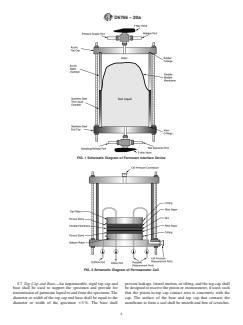
present in the test liquid to the breathing air, while maintaining the desired test pressures. A schematic diagram of a typical
permeant interface device is shown in Fig. 1. The device consists of mainly a water chamber and a test liquid chamber, which are
separated with a flexible bladder membrane. The device should be checked for leaks at the desired test pressures prior to the testing.
NOTE 2—The suppliers of the apparatus materials in contact with the test liquid (for example, permeant interface device, flexible membrane, and porous
end pieces) may be consulted regarding chemical compatibility with the test liquid prior to testing.
5.5 Permeameter Cell Pressure System—The system for pressurizing the permeameter cell shall be capable of applying and
controlling the cell pressure to within 65 % of the applied pressure. However, the effective stress on the test specimen (which is
the difference between the cell pressure and the pore water pressure) shall be maintained to the desired value with an accuracy of
65 % or better. The device for pressurizing the cell may consist of a reservoir connected to the permeameter cell and partially filled
with de-aired water, with the upper part of the reservoir connected to a compressed gas supply or other source of pressure (see Note
3). The gas pressure shall be controlled by a pressure regulator and measured by a pressure gage, electronic pressure transducer,
or any other device capable of measuring to the prescribed tolerance. A hydraulic system pressurized by dead weight acting on a
piston or any other pressure device capable of applying and controlling the permeameter cell pressure to the tolerance prescribed
in this paragraph may be used.
Olson, H. W., Morin, R. H., and Nichols, R. W., “Flow Pump Applications in Triaxial Testing,” Symposium on Advanced Triaxial Testing of Soil and Rock, ASTM STP
977, ASTM International, 1988, pp. 68–81.
D6766 − 20a
FIG. 1 Schematic Diagram of Permeant Interface Device
NOTE 3—De-aired water is commonly used for the cell fluid to minimize potential for diffusion of air through the membrane into the specimen. Other
fluids, such as oils, which have low gas solubility are also acceptable, provided they do not react with components of the permeameter. Also, use of a
long (approximately 5 to 7 m) tube connecting the pressurized cell liquid to the permeameter cell helps to delay the appearance of air in the cell fluid
and to reduce the flux of dissolved air into the cell.
5.6 Permeameter Cell—An apparatus shall be provided in which the GCL specimen and porous end pieces, enclosed by a
membrane sealed to the cap and base, are subjected to controlled fluid pressures. A schematic diagram of a typical cell is shown
in Fig. 2.
5.6.1 The permeability cell may allow for observation of changes in height of the GCL specimen, either by observation through
the cell wall using a cathetometer or other instrument, or by monitoring of either a loading piston or an extensometer extending
through the top plate of the cell bearing on the top cap and attached to a dial indicator or other measuring device. The piston or
extensometer should pass through a bushing and seal incorporated into the top plate and shall be loaded with sufficient force to
compensate for the cell pressure acting over the cross-sectional area of the piston where it passes through the seal. If deformations
are measured, the deformation indicator shall be a dial indicator or cathetometer graduated to 0.3 mm (0.01 in.) or better and having
an adequate travel range. Any other measuring device meeting these requirements is acceptable.
5.6.2 In order to facilitate gas removal, and thus saturation of the hydraulic system, four drainage lines leading to the specimen,
two each to the base and top cap, are recommended. The drainage lines shall be controlled by no-volume-change valves, such as
ball valves, and shall be designed to minimize dead space in the lines.
5.7 Top Cap and Base—An impermeable, rigid top cap and base shall be used to support the specimen and provide for
transmission of permeant liquid to and from the specimen. The diameter or width of the top cap and base shall be equal to the
diameter or width of the specimen 65 %. The base shall prevent leakage, lateral motion, or tilting, and the top cap shall be
designed to receive the piston or extensometer, if used, such that the piston-to-top cap contact area is concentric with the cap. The
surface of the base and top cap that contacts the membrane to form a seal shall be smooth and free of scratches.
5.8 Flexible Membranes—The flexible membrane used to encase the specimen shall provide reliable protection against leakage.
The membrane shall be carefully inspected prior to use and if any flaws or pinholes are evident, the membrane shall be discarded
(see Note 4). To minimize restraint of the specimen, the diameter or width of the unstretched membrane shall be between 90 and
95 % of that of the specimen. The membrane shall be sealed to the specimen base and cap with rubber O-rings for which the
unstressed inside diameter or width is less than 90 % of the diameter of width of the base and cap, or by any other method that
will produce an adequate seal.
NOTE 4—Membranes may be tested for flaws by placing them around a form sealed at both ends with rubber O-rings, subjecting them to a small air
D6766 − 20a
FIG. 2 Schematic Diagram of Permeameter Cell
pressure on the inside, and then dipping them into water. If air bubbles come up from any point on the membrane, or if any visible flaws are observed,
the membrane shall be discarded. In some cases, when there are no compatible membranes available, the specimen may be wrapped by a very thin and
flexible sheet/film/tape of chemically resistive and compatible material such as TFE-fluorocarbon prior to placement of the flexible membrane.
5.9 Porous End Pieces—The porous end pieces shall be of silicon carbide, aluminum oxide, or other material that is not attacked
by the specimen or permeant liquid. The end pieces shall have plane and smooth surfaces and be free of cracks, chips, and
nonuniformities. They shall be checked regularly to ensure that they are not clogged.
5.9.1 The porous end pieces shall be the same diameter or width (65 %) as the specimen, and the thickness shall be sufficient
to prevent breaking.
5.9.2 The hydraulic conductivity of the porous end pieces shall be significantly greater than that of the specimen to be tested.
The requirements outlined in 5.3.3 ensure this.
5.10 Filter Paper—To prevent intrusion of material into the pores of the porous end pieces, one or more sheets of filter paper
shall be placed between the top and bottom porous end pieces and the specimen (see Note 5). The filter paper shall have a
negligibly small hydraulic impedance. The requirements outlined in 5.3.3 ensure that the impedance is small.
NOTE 5—The type of filter paper recommended is Whatman No. 1 (or equivalent), that has a particle retention capability greater than 11 μm.
NOTE 6—For solutions with high suspended solids levels, clogging can be an important consideration. In these cases, nonwoven geotextiles can be used
on both sides of the GCL specimen, in lieu of porous stones and filter paper that can be more susceptible to particulate clogging. Some laboratories first
pass high suspended solids solutions through a 100-mesh stainless steel screen to filter out solids.
5.11 Trimming Equipment—Specific equipment for trimming the specimen to the desired diameter will vary depending on
quality and characteristics of the sample and the procedure used to prepare the specimen. The following items, however, are
commonly used: razor knife, cutting dyes, carpet knife, and scissors.
5.12 Devices for Measuring the Dimensions of the Specimen—Devices used to measure the dimensions of the specimen shall
be capable of measuring to the nearest 0.3 mm (0.01 in.) or better and shall be constructed such that their use will not disturb the
specimen.
5.13 Balance—The balance shall be suitable for determining the mass of the specimen and shall be selected as discussed in
Guide D4753. The mass of specimens less than 100 g shall be determined to the nearest 0.01 g. The mass of specimens 100 g or
larger shall be determined to the nearest 0.1 g. The mass of specimens larger than 1000 g shall be determined to the nearest 1.0 g.
5.14 Equipment for Mounting the Specimen—Equipment for mounting the specimen in the permeameter cell shall include a
membrane expander or cylinder, and rings for expanding and placing O-rings on the base and top cap to seal the membrane.
5.15 Vacuum Pump—To assist with de-airing of water or, if applicable, the test liquid.
5.16 Temperature Maintaining Device—The temperature of the permeameter, test specimen, and reservoir(s) of test liquid shall
not vary more than 63 °C (65.7 °F). Normally, this is accomplished by performing the test in a room with a temperature of 22
6 3 °C. If such a room is not available, the apparatus shall be placed in a water bath, insulated chamber, or other device that
maintains a temperature within the specified tolerance. The temperature shall be periodically measured and recorded.
D6766 − 20a
5.17 Water Content Containers—The containers shall be in accordance with Test Methods D2216.
5.18 Drying Oven—The oven shall be in accordance with Specification E145.
6. Reagents
6.1 Deionized Water:
6.1.1 De-Aired Water—To aid in saturating the test specimen as much as possible, de-aired water should be used when
appropriate. Water can be de-aired by boiling, by spraying a fine mist of water into an evacuated vessel attached to a vacuum
source, or by forceful agitation of water in a container attached to a vacuum source. If boiling is used, care shall be taken not to
evaporate an excessive amount of liquid which can lead to a larger mineral concentration in the water than desired. To prevent
dissolution of air back into the water, de-aired water shall not be exposed to air for prolonged periods.
6.2 Test Liquids:
6.2.1 The test liquid is the liquid used for permeation of the test specimen and it may be used in hydrating/saturating the
specimen.
6.2.2 The test liquids should be specified and, if available, supplied along with chemical composition by the requester for both
Test Scenarios 1 and 2.
6.2.3 Test liquids which may contain volatile chemicals or may cause any potential hazards during the de-airing process should
not be de-aired, even when the test liquid is used to hydrate/saturate the specimen.
NOTE 7—Samples containing separate phase liquids should be left in a quiescent state for 24 h, to allow the non-aqueous phases to separate from the
aqueous phase. The aqueous phase can then be decanted and used as the permeant liquid.
7. Test Specimen Preparation
7.1 Inspe
...