

ASTM D7100-11(2020)
(Test Method)Standard Test Method for Hydraulic Conductivity Compatibility Testing of Soils with Aqueous Solutions
General Information
- Abstract
SIGNIFICANCE AND USE
4.1 This test method is used to measure one-dimensional flow of aqueous solutions (for example, landfill leachates, liquid wastes and byproducts, single and mixed chemicals, etc., from hereon referred to as the permeant liquid) through initially saturated soils under an applied hydraulic gradient and effective stress. Interactions between some permeant liquids and some clayey soils have resulted in significant increases in the hydraulic conductivity of the soils relative to the hydraulic conductivity of the same soils permeated with water (1).4 This test method is used to evaluate the presence and effect of potential interactions between the soil specimen being permeated and the permeant liquid on the hydraulic conductivity of the soil specimen. Test programs may include comparisons between the hydraulic conductivity of soils permeated with water relative to the hydraulic conductivity of the same soils permeated with aqueous solutions to determine variations in the hydraulic conductivity of the soils due to the aqueous solutions.
4.2 Flexible-wall hydraulic conductivity testing is used to determine flow characteristics of aqueous solutions through soils. Hydraulic conductivity testing using flexible-wall cells is usually preferred over rigid-wall cells for testing with aqueous solutions due to the potential for sidewall leakage problems with rigid-wall cells. Excessive sidewall leakage may occur, for example, when a test soil shrinks during permeation with the permeant liquid due to interactions between the soil and the permeant liquid in a rigid-wall cell. In addition, the use of a rigid-wall cell does not allow for control of the effective stresses that exist in the test specimen.
4.3 Darcy’s law describes laminar flow through a test soil. Laminar flow conditions and, therefore, Darcy’s law may not be valid under certain test conditions. For example, interactions between a permeating liquid and a soil may cause severe channeling/cracking of the soil such tha...
SCOPE
1.1 This test method covers hydraulic conductivity compatibility testing of saturated soils in the laboratory with aqueous solutions that may alter hydraulic conductivity (for example, waste related liquids) using a flexible-wall permeameter. A hydraulic conductivity test is conducted until both hydraulic and chemical equilibrium are achieved such that potential interactions between the soil specimen being permeated and the aqueous solution are taken into consideration with respect to the measured hydraulic conductivity.
1.2 This test method is applicable to soils with hydraulic conductivities less than approximately 1 × 10⁻⁸ m/s.
1.3 In addition to hydraulic conductivity, intrinsic permeability can be determined for a soil if the density and viscosity of the aqueous solution are known or can be determined.
1.4 This test method can be used for all specimen types, including undisturbed, reconstituted, remolded, compacted, etc. specimens.
1.5 A specimen may be saturated and permeated using three methods. Method 1 is for saturation with water and permeation with aqueous solution. Method 2 is for saturation and permeation with aqueous solution. Method 3 is for saturation with water, initial permeation with water, and subsequent permeation with aqueous solution.
1.6 The amount of flow through a specimen in response to a hydraulic gradient generated across the specimen is measured with respect to time. The amount and properties of influent and effluent liquids are monitored during the test.
1.7 The hydraulic conductivity with an aqueous solution is determined using procedures similar to determination of hydraulic conductivity of saturated soils with water as described in Test Methods D5084. Several test procedures can be used, including the falling headwater-rising tailwater, the constant-head, the falling headwater-constant tailwater, or the constant rate-of-flow test procedures.
1.8 Units—The values stat...
- Status
- Published
- Publication Date
- 14-Feb-2020
- Technical Committee
- D18 - Soil and Rock
- Drafting Committee
- D18.04 - Hydrologic Properties and Hydraulic Barriers
Overview
ASTM D7100-11(2020) establishes a standard test method for evaluating the hydraulic conductivity compatibility of saturated soils with aqueous solutions in laboratory conditions. Developed by ASTM International, this method is essential for understanding how various liquid wastes, landfill leachates, and industrial byproducts affect the permeability of soils, especially under controlled hydraulic gradients and effective stresses. Utilizing a flexible-wall permeameter, this test determines if interactions between a particular soil and an aqueous solution may alter the hydraulic conductivity compared to water-saturated soil.
Key Topics
- Hydraulic Conductivity Testing: The standard outlines laboratory procedures for measuring the rate of one-dimensional flow of potentially reactive or hazardous liquids through soil samples.
- Soil-Solution Interaction: The method is crucial for detecting changes in hydraulic conductivity when soils are exposed to specific aqueous solutions that may cause swelling, shrinkage, clogging, or cracking.
- Flexible-Wall vs. Rigid-Wall Cells: Emphasizes the use of flexible-wall permeameters to avoid sidewall leakage and maintain control of effective stress, which is vital for producing accurate and reliable test results.
- Applicability: Suitable for various soil specimen types, including undisturbed, compacted, reconstituted, and remolded soils, with hydraulic conductivities less than approximately 1 × 10⁻⁸ m/s.
- Test Procedures: Supports several standard laboratory permeameter test methods such as falling head, constant head, and constant rate-of-flow procedures, aligning with ASTM D5084.
- Intrinsic Permeability: If the density and viscosity of the test liquid are known, the test can also be used to determine the intrinsic permeability of the soil.
Applications
ASTM D7100-11(2020) is widely applied in environmental, geotechnical, and civil engineering sectors for:
- Environmental Impact Assessments: Evaluating the suitability of soils for use as liner or barrier materials in waste containment facilities, such as landfills and hazardous waste sites, where chemical compatibility and permeability control are critical.
- Groundwater Protection: Assessing barrier performance to prevent contaminant migration from leachates or chemical spills into underlying groundwater resources.
- Site Remediation: Determining the effectiveness of soil barriers in containing or redirecting the flow of contaminated liquids during soil and groundwater cleanup projects.
- Material Selection: Guiding the choice of soil types or engineered barriers based on how their hydraulic conductivity may change when exposed to specific industrial or municipal wastewaters.
- Regulatory Compliance: Satisfying technical requirements for environmental regulations that demand proof of long-term soil-liquid compatibility.
Related Standards
For comprehensive laboratory and field practices related to soil permeability and hydraulic barrier assessment, consider the following ASTM standards:
- ASTM D5084: Test Methods for Measurement of Hydraulic Conductivity of Saturated Porous Materials Using a Flexible Wall Permeameter
- ASTM D653: Terminology Relating to Soil, Rock, and Contained Fluids
- ASTM D698 / D1557: Laboratory Compaction Characteristics of Soil
- ASTM D2216: Laboratory Determination of Water Content of Soil and Rock
- ASTM D4972: Test Methods for pH of Soils
- ASTM D4327: Test Method for Anions in Water by Suppressed Ion Chromatography
These referenced standards provide necessary guidance to ensure accurate testing, sample preparation, and interpretation of hydraulic conductivity results.
Keywords: ASTM D7100, hydraulic conductivity, soil compatibility, aqueous solution, flexible-wall permeameter, permeability testing, environmental containment, landfill liner, soil permeability test, geotechnical laboratory standards.
Relations
- Effective Date
- 15-Feb-2020
- Effective Date
- 01-Feb-2024
- Effective Date
- 01-Jan-2024
- Effective Date
- 01-Nov-2023
- Effective Date
- 01-Nov-2023
- Effective Date
- 01-Nov-2023
- Effective Date
- 01-Apr-2020
- Refers
ASTM D3977-97(2019) - Standard Test Methods for Determining Sediment Concentration in Water Samples - Effective Date
- 01-Nov-2019
- Effective Date
- 01-Oct-2019
- Effective Date
- 01-Oct-2019
- Effective Date
- 01-May-2019
- Effective Date
- 01-Mar-2019
- Effective Date
- 01-Feb-2019
- Effective Date
- 15-Dec-2018
- Effective Date
- 15-Dec-2018
Get Certified
Connect with accredited certification bodies for this standard

CIS Institut d.o.o.
Personal Protective Equipment (PPE) certification body. Notified Body NB-2890 for EU Regulation 2016/425 PPE.

Kiwa BDA Testing
Building and construction product certification.
Kmetijski inštitut Slovenije
Agricultural Institute of Slovenia. Soil testing, plant health, agricultural product analysis.
Sponsored listings
Frequently Asked Questions
ASTM D7100-11(2020) is a standard published by ASTM International. Its full title is "Standard Test Method for Hydraulic Conductivity Compatibility Testing of Soils with Aqueous Solutions". This standard covers: SIGNIFICANCE AND USE 4.1 This test method is used to measure one-dimensional flow of aqueous solutions (for example, landfill leachates, liquid wastes and byproducts, single and mixed chemicals, etc., from hereon referred to as the permeant liquid) through initially saturated soils under an applied hydraulic gradient and effective stress. Interactions between some permeant liquids and some clayey soils have resulted in significant increases in the hydraulic conductivity of the soils relative to the hydraulic conductivity of the same soils permeated with water (1).4 This test method is used to evaluate the presence and effect of potential interactions between the soil specimen being permeated and the permeant liquid on the hydraulic conductivity of the soil specimen. Test programs may include comparisons between the hydraulic conductivity of soils permeated with water relative to the hydraulic conductivity of the same soils permeated with aqueous solutions to determine variations in the hydraulic conductivity of the soils due to the aqueous solutions. 4.2 Flexible-wall hydraulic conductivity testing is used to determine flow characteristics of aqueous solutions through soils. Hydraulic conductivity testing using flexible-wall cells is usually preferred over rigid-wall cells for testing with aqueous solutions due to the potential for sidewall leakage problems with rigid-wall cells. Excessive sidewall leakage may occur, for example, when a test soil shrinks during permeation with the permeant liquid due to interactions between the soil and the permeant liquid in a rigid-wall cell. In addition, the use of a rigid-wall cell does not allow for control of the effective stresses that exist in the test specimen. 4.3 Darcy’s law describes laminar flow through a test soil. Laminar flow conditions and, therefore, Darcy’s law may not be valid under certain test conditions. For example, interactions between a permeating liquid and a soil may cause severe channeling/cracking of the soil such tha... SCOPE 1.1 This test method covers hydraulic conductivity compatibility testing of saturated soils in the laboratory with aqueous solutions that may alter hydraulic conductivity (for example, waste related liquids) using a flexible-wall permeameter. A hydraulic conductivity test is conducted until both hydraulic and chemical equilibrium are achieved such that potential interactions between the soil specimen being permeated and the aqueous solution are taken into consideration with respect to the measured hydraulic conductivity. 1.2 This test method is applicable to soils with hydraulic conductivities less than approximately 1 × 10⁻⁸ m/s. 1.3 In addition to hydraulic conductivity, intrinsic permeability can be determined for a soil if the density and viscosity of the aqueous solution are known or can be determined. 1.4 This test method can be used for all specimen types, including undisturbed, reconstituted, remolded, compacted, etc. specimens. 1.5 A specimen may be saturated and permeated using three methods. Method 1 is for saturation with water and permeation with aqueous solution. Method 2 is for saturation and permeation with aqueous solution. Method 3 is for saturation with water, initial permeation with water, and subsequent permeation with aqueous solution. 1.6 The amount of flow through a specimen in response to a hydraulic gradient generated across the specimen is measured with respect to time. The amount and properties of influent and effluent liquids are monitored during the test. 1.7 The hydraulic conductivity with an aqueous solution is determined using procedures similar to determination of hydraulic conductivity of saturated soils with water as described in Test Methods D5084. Several test procedures can be used, including the falling headwater-rising tailwater, the constant-head, the falling headwater-constant tailwater, or the constant rate-of-flow test procedures. 1.8 Units—The values stat...
SIGNIFICANCE AND USE 4.1 This test method is used to measure one-dimensional flow of aqueous solutions (for example, landfill leachates, liquid wastes and byproducts, single and mixed chemicals, etc., from hereon referred to as the permeant liquid) through initially saturated soils under an applied hydraulic gradient and effective stress. Interactions between some permeant liquids and some clayey soils have resulted in significant increases in the hydraulic conductivity of the soils relative to the hydraulic conductivity of the same soils permeated with water (1).4 This test method is used to evaluate the presence and effect of potential interactions between the soil specimen being permeated and the permeant liquid on the hydraulic conductivity of the soil specimen. Test programs may include comparisons between the hydraulic conductivity of soils permeated with water relative to the hydraulic conductivity of the same soils permeated with aqueous solutions to determine variations in the hydraulic conductivity of the soils due to the aqueous solutions. 4.2 Flexible-wall hydraulic conductivity testing is used to determine flow characteristics of aqueous solutions through soils. Hydraulic conductivity testing using flexible-wall cells is usually preferred over rigid-wall cells for testing with aqueous solutions due to the potential for sidewall leakage problems with rigid-wall cells. Excessive sidewall leakage may occur, for example, when a test soil shrinks during permeation with the permeant liquid due to interactions between the soil and the permeant liquid in a rigid-wall cell. In addition, the use of a rigid-wall cell does not allow for control of the effective stresses that exist in the test specimen. 4.3 Darcy’s law describes laminar flow through a test soil. Laminar flow conditions and, therefore, Darcy’s law may not be valid under certain test conditions. For example, interactions between a permeating liquid and a soil may cause severe channeling/cracking of the soil such tha... SCOPE 1.1 This test method covers hydraulic conductivity compatibility testing of saturated soils in the laboratory with aqueous solutions that may alter hydraulic conductivity (for example, waste related liquids) using a flexible-wall permeameter. A hydraulic conductivity test is conducted until both hydraulic and chemical equilibrium are achieved such that potential interactions between the soil specimen being permeated and the aqueous solution are taken into consideration with respect to the measured hydraulic conductivity. 1.2 This test method is applicable to soils with hydraulic conductivities less than approximately 1 × 10⁻⁸ m/s. 1.3 In addition to hydraulic conductivity, intrinsic permeability can be determined for a soil if the density and viscosity of the aqueous solution are known or can be determined. 1.4 This test method can be used for all specimen types, including undisturbed, reconstituted, remolded, compacted, etc. specimens. 1.5 A specimen may be saturated and permeated using three methods. Method 1 is for saturation with water and permeation with aqueous solution. Method 2 is for saturation and permeation with aqueous solution. Method 3 is for saturation with water, initial permeation with water, and subsequent permeation with aqueous solution. 1.6 The amount of flow through a specimen in response to a hydraulic gradient generated across the specimen is measured with respect to time. The amount and properties of influent and effluent liquids are monitored during the test. 1.7 The hydraulic conductivity with an aqueous solution is determined using procedures similar to determination of hydraulic conductivity of saturated soils with water as described in Test Methods D5084. Several test procedures can be used, including the falling headwater-rising tailwater, the constant-head, the falling headwater-constant tailwater, or the constant rate-of-flow test procedures. 1.8 Units—The values stat...
ASTM D7100-11(2020) is classified under the following ICS (International Classification for Standards) categories: 13.080.40 - Hydrological properties of soils. The ICS classification helps identify the subject area and facilitates finding related standards.
ASTM D7100-11(2020) has the following relationships with other standards: It is inter standard links to ASTM D7100-11, ASTM D4753-24, ASTM E70-24, ASTM D854-23, ASTM D6517-18(2023), ASTM D3740-23, ASTM D4767-11(2020), ASTM D3977-97(2019), ASTM D6286-19, ASTM D3740-19, ASTM D4972-19, ASTM D2216-19, ASTM D4448-01(2019), ASTM D4128-18, ASTM D5790-18. Understanding these relationships helps ensure you are using the most current and applicable version of the standard.
ASTM D7100-11(2020) is available in PDF format for immediate download after purchase. The document can be added to your cart and obtained through the secure checkout process. Digital delivery ensures instant access to the complete standard document.
Standards Content (Sample)
This international standard was developed in accordance with internationally recognized principles on standardization established in the Decision on Principles for the
Development of International Standards, Guides and Recommendations issued by the World Trade Organization Technical Barriers to Trade (TBT) Committee.
Designation: D7100 − 11 (Reapproved 2020)
Standard Test Method for
Hydraulic Conductivity Compatibility Testing of Soils with
Aqueous Solutions
This standard is issued under the fixed designation D7100; the number immediately following the designation indicates the year of
original adoption or, in the case of revision, the year of last revision.Anumber in parentheses indicates the year of last reapproval.A
superscript epsilon (´) indicates an editorial change since the last revision or reapproval.
1. Scope head, the falling headwater-constant tailwater, or the constant
rate-of-flow test procedures.
1.1 This test method covers hydraulic conductivity compat-
ibility testing of saturated soils in the laboratory with aqueous 1.8 Units—The values stated in SI units are to be regarded
as standard. The values given in parentheses are provided for
solutions that may alter hydraulic conductivity (for example,
waste related liquids) using a flexible-wall permeameter. A information only and are not considered standard.
1.8.1 Hydraulic conductivity has traditionally been ex-
hydraulic conductivity test is conducted until both hydraulic
and chemical equilibrium are achieved such that potential pressed in cm/s in the U.S., even though the official SI unit for
hydraulic conductivity is m/s.
interactions between the soil specimen being permeated and
the aqueous solution are taken into consideration with respect 1.8.2 The gravitational system of inch-pound units is used
when dealing with inch-pound units. In this system, the pound
to the measured hydraulic conductivity.
(lbf)representsaunitofforce(weight),whiletheunitformass
1.2 This test method is applicable to soils with hydraulic
is slugs.
–8
conductivities less than approximately1×10 m/s.
1.8.3 The slug unit of mass is almost never used in
1.3 In addition to hydraulic conductivity, intrinsic perme-
commercial practice; i.e., density, balances, etc. Therefore, the
ability can be determined for a soil if the density and viscosity
standard unit for mass in this standard is either kilogram (kg)
of the aqueous solution are known or can be determined.
or gram (g), or both. Also, the equivalent inch-pound unit
(slug) is not given/presented in parentheses. However, the use
1.4 This test method can be used for all specimen types,
of balances or scales recording pounds of mass (lbm) or
including undisturbed, reconstituted, remolded, compacted,
recording density in lbm/ft shall not be regarded as noncon-
etc. specimens.
formance with this standard.
1.5 Aspecimenmaybesaturatedandpermeatedusingthree
1.9 ThisstandardcontainsaHazardssectionrelatedtousing
methods.Method1isforsaturationwithwaterandpermeation
hazardous liquids (Section 7).
with aqueous solution. Method 2 is for saturation and perme-
ation with aqueous solution. Method 3 is for saturation with
1.10 This standard does not purport to address all of the
water, initial permeation with water, and subsequent perme-
safety concerns, if any, associated with its use. It is the
ation with aqueous solution.
responsibility of the user of this standard to establish appro-
priate safety, health, and environmental practices and deter-
1.6 The amount of flow through a specimen in response to
mine the applicability of regulatory limitations prior to use.
ahydraulicgradientgeneratedacrossthespecimenismeasured
1.11 This international standard was developed in accor-
withrespecttotime.Theamountandpropertiesofinfluentand
dance with internationally recognized principles on standard-
effluent liquids are monitored during the test.
ization established in the Decision on Principles for the
1.7 The hydraulic conductivity with an aqueous solution is
Development of International Standards, Guides and Recom-
determined using procedures similar to determination of hy-
mendations issued by the World Trade Organization Technical
draulic conductivity of saturated soils with water as described
Barriers to Trade (TBT) Committee.
in Test Methods D5084. Several test procedures can be used,
including the falling headwater-rising tailwater, the constant-
2. Referenced Documents
2.1 ASTM Standards:
ThistestmethodisunderthejurisdictionofASTMCommitteeD18onSoiland
Rock and is the direct responsibility of Subcommittee D18.04 on Hydrologic
Properties and Hydraulic Barriers. For referenced ASTM standards, visit the ASTM website, www.astm.org, or
Current edition approved Feb. 15, 2020. Published March 2020. Orginally contact ASTM Customer Service at service@astm.org. For Annual Book of ASTM
approved in 2004. Last previous edition approved in 2011 as D7100–11. DOI: Standards volume information, refer to the standard’s Document Summary page on
10.1520/D7100-11R20. the ASTM website.
Copyright © ASTM International, 100 Barr Harbor Drive, PO Box C700, West Conshohocken, PA 19428-2959. United States
D7100 − 11 (2020)
D653Terminology Relating to Soil, Rock, and Contained Coupled Plasma—Mass Spectrometry
Fluids D5790Test Method for Measurement of Purgeable Organic
D698Test Methods for Laboratory Compaction Character- Compounds in Water by Capillary Column Gas
istics of Soil Using Standard Effort (12,400 ft-lbf/ft (600 Chromatography/Mass Spectrometry
kN-m/m ))
D6001Guide for Direct-Push Groundwater Sampling for
D854Test Methods for Specific Gravity of Soil Solids by Environmental Site Characterization
Water Pycnometer
D6026Practice for Using Significant Digits in Geotechnical
D888Test Methods for Dissolved Oxygen in Water Data
D1125Test Methods for Electrical Conductivity and Resis-
D6151PracticeforUsingHollow-StemAugersforGeotech-
tivity of Water nical Exploration and Soil Sampling
D1293Test Methods for pH of Water
D6286Guide for Selection of Drilling and Direct Push
D1429TestMethodsforSpecificGravityofWaterandBrine
Methods for Geotechnical and Environmental Subsurface
D1498Test Method for Oxidation-Reduction Potential of
Site Characterization
Water
D6517Guide for Field Preservation of Ground Water
D1557Test Methods for Laboratory Compaction Character-
Samples
istics of Soil Using Modified Effort (56,000 ft-lbf/ft
D6519Practice for Sampling of Soil Using the Hydrauli-
(2,700 kN-m/m ))
cally Operated Stationary Piston Sampler
D1587Practice for Thin-Walled Tube Sampling of Fine-
D6919Test Method for Determination of Dissolved Alkali
Grained Soils for Geotechnical Purposes
andAlkaline Earth Cations andAmmonium in Water and
D1889Test Method for Turbidity of Water (Withdrawn
Wastewater by Ion Chromatography
2007)
E70Test Method for pH of Aqueous Solutions With the
D2216TestMethodsforLaboratoryDeterminationofWater
Glass Electrode
(Moisture) Content of Soil and Rock by Mass
E691Practice for Conducting an Interlaboratory Study to
D2435Test Methods for One-Dimensional Consolidation
Determine the Precision of a Test Method
Properties of Soils Using Incremental Loading
D3550Practice for Thick Wall, Ring-Lined, Split Barrel,
3. Terminology
Drive Sampling of Soils
3.1 Definitions:
D3740Practice for Minimum Requirements for Agencies
3.1.1 hydraulic conductivity, k—(also referred to as coeffi-
Engaged in Testing and/or Inspection of Soil and Rock as
cient of permeability or permeability) the rate of discharge of
Used in Engineering Design and Construction
apermeantliquidunderlaminarflowconditionsthroughaunit
D3977Test Methods for Determining Sediment Concentra-
cross-sectional area of porous medium under a unit hydraulic
tion in Water Samples
gradient and at standard temperature (20°C).
D4128Guide for Identification and Quantitation of Organic
Compounds in Water by Combined Gas Chromatography
3.1.2 permeameter—the apparatus (cell) containing the test
and Electron Impact Mass Spectrometry
specimen in a hydraulic conductivity test.
D4220 Practices for Preserving and Transporting Soil
3.1.2.1 Discussion—Theapparatusforthisteststandardisa
Samples
flexible-wall cell that includes top and bottom specimen caps,
D4327Test Method forAnions in Water by Suppressed Ion
including porous stones and filter paper, a flexible membrane,
Chromatography
an annulus chamber containing water, top and bottom plates,
D4448GuideforSamplingGround-WaterMonitoringWells
valves, and fittings.
D4691Practice for Measuring Elements in Water by Flame
3.1.3 head loss, h—the change in total head of liquid across
Atomic Absorption Spectrophotometry
D4696Guide for Pore-Liquid Sampling from the Vadose a given distance.
Zone
3.1.3.1 Discussion—The change in total head typically is
D4700Guide for Soil Sampling from the Vadose Zone
measured using heads acting at influent and effluent ends of a
D4753Guide for Evaluating, Selecting, and Specifying Bal-
specimen, and the given distance typically is the length of the
ances and Standard Masses for Use in Soil, Rock, and
test specimen.
Construction Materials Testing
3.1.4 pore volume of flow—the cumulative quantity of flow
D4767Test Method for Consolidated Undrained Triaxial
throughatestspecimendividedbythetotalvolumeofvoidsin
Compression Test for Cohesive Soils
the specimen.
D4972Test Methods for pH of Soils
3.1.4.1 Discussion—Thevolumeofvoidsinaspecimenthat
D5084Test Methods for Measurement of Hydraulic Con-
is effective in conducting flow may be lower than the total
ductivity of Saturated Porous Materials Using a Flexible
volume of voids. The voids that conduct flow are represented
Wall Permeameter
byan effective porosity.Theeffectiveporosityislowerthanthe
D5673Test Method for Elements in Water by Inductively
total porosity. This difference affects the accuracy for deter-
mining the actual pore volumes of flow associated with a test.
However, the presence and magnitude of effective porosity in
The last approved version of this historical standard is referenced on
www.astm.org. a soil specimen is usually not known a priori. Therefore, for
D7100 − 11 (2020)
the purposes of this standard, the determination of the pore 4.5 Specimens of initially water-saturated soils (for
volumes of flow will be based on the total porosity of the example,undisturbednaturalsoils)maybepermeatedwiththe
specimen. permeant liquid. Specimens of water unsaturated soils (for
example,compactedsoils)maybefullysaturatedwithwateror
3.1.5 back pressure—a pressure applied to the specimen
the permeant liquid and then permeated with the permeant
poreliquidtoforceanyairpresentinthespecimentocompress
liquid.Specimensofsoilsinitiallypartlyorfullysaturatedwith
and to therefore pass into the pore liquid resulting in an
a particular liquid (for example, specimens collected from a
increase of the degree of saturation of the specimen.
containment facility subsequent to a period of use) may be
3.2 Refer to Terminology D653 for definitions of other
fully saturated and then permeated with the same or another
terms in this standard.
liquid. The use of different saturating and permeating liquids
can have significant effects both on the results and the
4. Significance and Use
interpretation of the results of a test (1). Selection of type and
4.1 This test method is used to measure one-dimensional
sequence of liquids for saturation and permeation of test
flow of aqueous solutions (for example, landfill leachates,
specimens is based on the characteristics of the test specimens
liquidwastesandbyproducts,singleandmixedchemicals,etc.,
and the requirements of the specific application for which the
from hereon referred to as the permeant liquid) through
hydraulic conductivity testing is being conducted in a test
initiallysaturatedsoilsunderanappliedhydraulicgradientand
program. The user of this standard is responsible for selecting
effective stress. Interactions between some permeant liquids
and specifying the saturation and permeation conditions that
and some clayey soils have resulted in significant increases in
best represent the intended application.
the hydraulic conductivity of the soils relative to the hydraulic
4.6 Hydraulicconductivityofasoilwithwaterandaqueous
conductivity of the same soils permeated with water (1). This
solution can be determined using two approaches in a test
test method is used to evaluate the presence and effect of
program for comparisons between the hydraulic conductivity
potential interactions between the soil specimen being perme-
basedonpermeationwithwaterandthehydraulicconductivity
ated and the permeant liquid on the hydraulic conductivity of
based on permeation with aqueous solution. In the first
the soil specimen. Test programs may include comparisons
approach, specimens are initially saturated (if needed) and
between the hydraulic conductivity of soils permeated with
permeated with water and then the permeating liquid is
water relative to the hydraulic conductivity of the same soils
switched to the aqueous solution.This testing sequence allows
permeated with aqueous solutions to determine variations in
fordeterminationofbothwaterandaqueoussolutionhydraulic
the hydraulic conductivity of the soils due to the aqueous
conductivities on the same specimen. Obtaining water and
solutions.
aqueous solution values on the same specimen reduces the
4.2 Flexible-wall hydraulic conductivity testing is used to
uncertainties associated with specimen preparation, handling,
determine flow characteristics of aqueous solutions through
and variations in test conditions. However, such testing se-
soils.Hydraulicconductivitytestingusingflexible-wallcellsis
quences may not represent actual field conditions and may
usually preferred over rigid-wall cells for testing with aqueous
affect the results of a test. In the second approach, two
solutions due to the potential for sidewall leakage problems
specimens of the same soil are permeated, with one specimen
with rigid-wall cells. Excessive sidewall leakage may occur,
being permeated with water and the other specimen being
for example, when a test soil shrinks during permeation with
permeated with the aqueous solution. The specimens are
thepermeantliquidduetointeractionsbetweenthesoilandthe
prepared using the same sample preparation and handling
permeant liquid in a rigid-wall cell. In addition, the use of a
methods and tested under the same testing conditions. This
rigid-wall cell does not allow for control of the effective
approach may represent actual field conditions better than the
stresses that exist in the test specimen.
first approach, however, uncertainties may arise due to the use
4.3 Darcy’s law describes laminar flow through a test soil.
ofseparatespecimensfordetermininghydraulicconductivities
Laminar flow conditions and, therefore, Darcy’s law may not
based on permeation with water and the aqueous solution.
bevalidundercertaintestconditions.Forexample,interactions
Guidelines for preparing and testing multiple specimens for
between a permeating liquid and a soil may cause severe
comparativestudiesareprovidedinPracticeE691.Theuserof
channeling/cracking of the soil such that laminar flow is not
this standard shall be responsible for selecting and specifying
maintained through a test specimen containing large open
theapproachthatbestrepresentstheintendedapplicationwhen
pathways for flow.
comparisons of hydraulic conductivity are required.
4.4 Interactions that may clog the pore spaces of test soils
4.7 Terminationcriteriausedinthetestmethodarebasedon
(forexample,precipitation)mayoccurduringpermeationwith
bothachievingsteady-stateconditionswithrespecttoflowand
somepermeantliquids.Flowthroughtestsoilsmaybeseverely
equilibrium between the chemical composition of the effluent
restrictedinthesecases.Incaseswherethemeasuredhydraulic
(outflow) relative to the influent (inflow).
–12
conductivity is less than1×10 m/s, unsteady state analysis
4.8 Intrinsic permeability can be determined in addition to
may be used to determine the hydraulic conductivity of test
hydraulic conductivity using results of permeation tests de-
soils (2).
scribed in this standard.
4.9 The correlation between results obtained using this test
Theboldfacenumbersinparenthesesrefertothelistofreferencesattheendof
this standard. method and the hydraulic conductivities of in-place field
D7100 − 11 (2020)
materials has not been completely determined. Differences permeant liquid shall be determined prior to testing. This
may exist between the hydraulic conductivities measured on determination applies not only to the testing apparatus and
small test specimens in the laboratory and those obtained for
peripheral equipment used to measure the hydraulic
larger volumes in the field. Therefore, the results obtained
conductivity,butalsototheauxiliaryequipmentandapparatus
using this standard should be applied to field situations with
used for determining both the chemical properties of the
caution and by qualified personnel.
permeant liquid (density, pH, etc.) and the physical properties
of the test specimens (dimensions, moisture content, etc.).
4.10 While not required for determining the hydraulic
Determination of compatibility is particularly critical if aque-
conductivity of soils with aqueous solutions, soil chemical
ous solutions that contain more than 50% of miscible organic
properties such as pH, electrical conductivity, exchangeable
liquids are used in a test program.
metals (cations), and cation exchange capacity as well as the
mineralogical composition of the soil may be useful in the
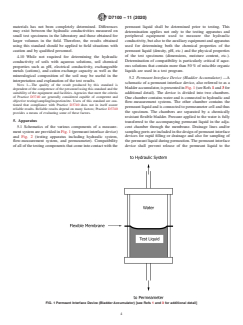
5.2 Permeant Interface Device (Bladder Accumulator) —A
interpretation and explanation of the test results.
schematic of a permeant interface device, also referred to as a
NOTE 1—The quality of the result produced by this standard is
bladderaccumulator,ispresentedinFig.1(seeRefs 1and 3for
dependent of the competence of the personnel using this standard and the
additional detail). The device is divided into two chambers.
suitability of the equipment and facilities.Agencies that meet the criteria
of Practice D3740 are generally considered capable of competent and
Onechambercontainswaterandisconnectedtohydraulicand
objective testing/sampling/inspection/etc. Users of this standard are cau-
flow-measurement systems. The other chamber contains the
tioned that compliance with Practice D3740 does not in itself assure
permeant liquid and is connected to permeameter cell and thus
reliable results. Reliable results depend on many factors; Practice D3740
the specimen. The chambers are separated by a chemically
provides a means of evaluating some of these factors.
resistant flexible bladder. Pressure applied to the water is fully
5. Apparatus
transferred to the accompanying permeant liquid in the adja-
cent chamber through the membrane. Drainage lines and/or
5.1 Schematics of the various components of a measure-
samplingportsareincludedinthedesignofpermeantinterface
mentsystemareprovidedinFig.1(permeantinterfacedevice)
and Fig. 2 (testing apparatus including hydraulic system, devices for rapid filling or drainage and also for sampling of
flow-measurement system, and permeameter). Compatibility thepermeantliquidduringpermeation.Thepermeantinterface
ofallofthetestingcomponentsthatcomeintocontactwiththe device shall prevent release of the permeant liquid to the
FIG. 1 Permeant Interface Device (Bladder Accumulator) [see Refs 1 and 3 for additional detail]
D7100 − 11 (2020)
FIG. 2 Example of Test Setup
surrounding environment and also shall prevent contact of the ofthechamberswithwaterandtheotherchamberwithcolored
permeant liquid with the hydraulic system and the flow- water. The device shall be connected to the permeameter cell
measurement system. Permeant interface devices shall be used
for this verification. Any mixing of the clear water with the
whenthetestliquidishazardousorvolatile.Permeantinterface colored water indicates leaks through the bladder. Also, the
devices may also be used for non-hazardous permeant liquids.
pressure lines and fittings as well as around the bladder
Use of bladder accumulators minimizes the need for involved
interface shall be inspected for any leaks.
clean-up procedures for the hydraulic and flow-measurement
5.3 Hydraulic System—The hydraulic system is used to
systems. When used, two bladder accumulators are required,
apply, maintain, and measure heads and resulting hydraulic
one connected to the influent line and the other connected to
gradients in a test. The hydraulic system consists of reservoirs
the effluent line.
that hold water and/or the test liquid, pressure application
5.2.1 The permeant interface device shall be constructed of
setups that are used to pressurize influent and effluent liquids,
stainless steel of sufficient grade or other material that is
andassociatedpiping,tubing,valves,andconnections(Fig.2).
resistanttothepermeantliquid.Allfittingsshallbeconstructed
The hydraulic conductivity can be measured using one of the
of materials resistant to the permeant liquid. All tubing shall
following test procedures: falling headwater-rising tailwater,
also be resistant to the permeant liquid. Teflon® may be used
constanthead,fallingheadwater-constanttailwater,orconstant
for tubing that comes in contact with the permeant liquid. The
rate of flow. The requirements for hydraulic systems for each
bladder shall be constructed of a flexible and chemically
procedure are provided below:
resistant material. Materials such as viton, nitrile, or ethylene
5.3.1 Falling Headwater–Rising Tailwater—The system
propylene are commonly used for the bladder, but other
materials that are resistant to the permeant liquid may also be shallallowformeasurementoftheappliedhead,thevariations
in head, and the gradient to within 65% or better accuracy
used. The long-term compatibility of all components with test
liquids shall be verified. duringatest.Theheadshallbemeasuredwithapressuregage,
electronic pressure transducer, engineer’s scale, graduated
5.2.2 The bladder shall be carefully inspected prior to use.
The bladder shall be discarded if any defects such as pinholes pipette, or any other device that has the resolution required for
are observed. The device shall be checked for leaks at the the determination of head and gradient to the accuracy pro-
maximum expected test pressure prior to testing by filling one vided above.
D7100 − 11 (2020)
5.3.2 Constant Head—The system shall allow for maintain- determination of flow to the accuracy provided above (Fig. 2).
ing constant hydraulic head to within 65% or better accuracy In most cases, these devices are common to the hydraulic
system.
during a test. The system shall allow for measurement of the
constant head to within 65% or better accuracy during a test.
5.4.1 De-airing and Dimensional Stability of the System—
The head shall be measured with a pressure gage, electronic The flow-measurement system shall contain a minimum of
pressure transducer, engineer’s scale, graduated pipette, or any dead space and shall be equipped to allow for complete and
other device that has the resolution required for the determi- rapid de-airing. Dimensional stability of the system with
nation of head to the accuracy provided above. respect to changes in pressure shall be ensured by using a stiff
flow-measurement system that includes glass pipe or rigid
5.3.3 Falling Headwater-Constant Tailwater—The require-
metallic or thermoplastic tubing.
ments are similar to 5.3.1 for the falling headwater elevation.
For the constant tailwater elevation, the system shall allow for
5.5 Permeameter—The permeameter shall allow for apply-
maintainingaconstanthydraulicheadtowithin 65%orbetter
ing a controlled cell pressure around a specimen and for
accuracy at the tailwater. The system shall also allow for the
transmitting a permeant liquid through a specimen under
measurement of the constant head to within 65% or better
applied inflow and outflow pressures. The permeameter shall
accuracy during a test. The requirements for measurement of
consist of a permeameter cell and attached equipment that
the constant head are similar to 5.3.2.
allow for connecting the permeameter to the hydraulic system
and the flow-measurement system as well as provisions to
5.3.4 Constant Rate of Flow—The system shall allow for
support a specimen and to permeate a specimen. The per-
maintaining a constant rate of flow through a specimen to
meametercellshallconsistofacoverplate,baseplate,annulus
within 65% or better accuracy. Flow shall be measured by
chamber, and attachments to hold the components together
calibrated syringe, graduated pipette, or other device that has
without leakage during a test (Fig. 2).
the precision required for the determination of flow to the
5.5.1 Cell Pressure System—Thesystemforpressurizingthe
accuracy provided above. The head loss across the specimen
permeameter cell shall allow for applying and controlling the
shall be measured to within 65% or better accuracy using an
cell pressure to within 65% or better accuracy. The effective
electronic pressure transducer or other device of suitable
stress on the test specimen (that is the difference between the
resolution.
cell pressure and the pore liquid pressure) shall be maintained
5.3.5 System De-airing—The hydraulic system shall be
to the desired value with an accuracy of 610% or better. The
designed to facilitate rapid and complete removal of free air
cellpressuresystemmayconsistofareservoirconnectedtothe
bubblesfromflowlines.Thiscanbeaccomplishedforexample
permeameter cell and partially filled with de-aired water, with
by using properly sized tubing and ball valves, and fittings
the upper part of the reservoir connected to a compressed gas
without pipe threads. Properly sized components are small
supply or other source of pressure (see Note 3). The gas
enough to prevent entrapment of air bubbles, but are large
pressure shall be controlled by a pressure regulator and
enough not to cause head losses as described in 5.5.4.
measuredbyapressuregage,electronicpressuretransducer,or
5.3.6 Back-Pressure System—The hydraulic system shall be
any other device that has the resolution required to apply and
equipped to apply back pressure to the specimen to facilitate
controlthepressuretotheaccuracyprovidedabove.Ahydrau-
saturation. The system shall be equipped to maintain the
lic system pressurized by deadweight acting on a piston or any
applied back pressure throughout the duration of hydraulic
other pressure device that allows for applying and controlling
conductivity measurements. The back-pressure system shall
the permeameter cell pressure within the tolerance prescribed
allow for applying, controlling, and measuring the back pres-
above may also be used.
suretowithin 65%orbetteraccuracy.Thebackpressuremay
NOTE 3—De-aired water is commonly used for the cell liquid to
be provided by a compressed gas supply, a deadweight acting
minimize potential for diffusion of air through the membrane into the
on a piston, or any other method that has the resolution
specimen.Otherliquidsthathavelowgassolubilitiessuchasoils,arealso
required for application of back pressure to the accuracy
acceptable, provided they do not react with the membrane and the
provided above. components of the permeameter.
5.5.2 The specimen shall be overlain and underlain by
NOTE 2—Application of gas pressure directly to a liquid will dissolve
porous end pieces and encased in a flexible membrane. Filter
gas in the liquid. A variety of techniques are available to minimize
dissolution of gas in the back-pressure liquid, including separation of gas
paper shall be placed between the porous end pieces and the
and liquid phases with a bladder and frequent replacement of the liquid
specimen.Atop cap and a bottom cap shall be used at the top
with de-aired liquid.
and bottom ends of a specimen, respectively. The components
5.4 Flow-Measurement System—Flow-measurement system shall be assembled such that the specimen and the influent and
is used to determine the amount of inflow and outflow from a the effluent lines that are connected to these components shall
be sealed against the surrounding cell liquid.
specimen during a test. The measurement device shall allow
for the measurement of the quantity of flow (both inflow and
5.5.2.1 Porous End Pieces—Porousendpiecesshallbeused
outflow) over an interval of time to within 65% or better to distribute permeant liquid uniformly over the surfaces of a
accuracy. Flow-measurement system consists of a graduated
test specimen (that is, areas perpendicular to the direction of
accumulator, graduated pipette, vertical standpipe in conjunc- flow).Porousendpiecesshallbeconstructedofsiliconcarbide,
tion with an electronic pressure transducer, or other volume-
aluminum oxide, or other material that does not react with the
measuring device that has the resolution required for the specimen or the permeant liquid. The end pieces shall have
D7100 − 11 (2020)
plane and smooth surfaces and be free of cracks, chips, and width of a specimen may be monitored by direct observation
discontinuities. The porous end pieces shall have the same through the cell wall using a cathetometer, camera setup, or
diameter or width (65% or better accuracy) as the specimen, other instrument that has the resolution required for the
and they shall have sufficient thickness to prevent breaking. determination of deformation as prescribed above. The height
The end pieces shall be free from clogging. The hydraulic
of a specimen may be monitored using a deformation gage
conductivity of the porous end pieces shall be significantly connected to the top cap above a specimen or a deformation
greaterthanthatofthespecimentobetested.Therequirements
gage attached to a loading piston connected to the top cap
outlined in 5.5.4 ensure that this criterion is met. above a specimen.The deformation can be determined using a
dial gage, LVDT, or other device that has the resolution
5.5.2.2 Filter Paper—One or more layers of filter paper
required for the determination of deformation as prescribed
shall be placed between the top and bottom porous end pieces
above. The deformation measurement device or the loading
and the specimen to prevent intrusion of material from the
specimen into the pores of the porous end pieces. The paper piston shall be sealed in a manner to prevent leaks at the
location where the device exits the permeameter under the
shall not impede the flow of liquid in and out of a specimen.
The requirements outlined in 5.5.4 ensure that this criterion is maximum cell pressure used in a test.
met.
5.6 Equipment for Compacting a Specimen—Forcompacted
5.5.2.3 Top Cap and Bottom Cap—Atop cap and a bottom
specimens, equipment (including compactor and mold) suit-
cap shall be used to support the specimen and to facilitate
able for the method of compaction specified by the requester
transmissionofpermeantliquidtoandfromthespecimen.The
shallbeused.Thesurfacesofcompactedliftsshallbescarified
top cap and the bottom cap shall be constructed of rigid
to ensure complete bonding of the lifts to prevent preferential
material with provisions for transmission of permeant liquid.
(interlift flow). Care shall be taken not to smooth or smear the
Thediameterorwidthofthecapsshallbeequaltothediameter
inflow and outflow faces of the specimen as smoothing or
or width of the specimen to within 65% or better accuracy.
smearing last lift may reduce the measured hydraulic conduc-
The bottom cap shall prevent leakage, lateral motion, and
tivity.
tilting. If deformation/height change measurements are
5.7 Sample Extruder—For field recovered samples, the
conducted, the top cap shall be designed to receive the probe
sample extruder shall be capable of extruding a soil core from
(or piston) used in height measurement such that the piston-
to-topcapcontactareaisconcentricwiththecap.Thesurfaces a sampling tube in the same direction of travel in which the
sample entered the tube and with minimum disturbance to the
of the caps that contact the membrane to form a seal shall be
smoothandclean,freeofanyexternalmaterialsandscratches. sample. If the soil core is not extruded vertically, care should
be taken to avoid bending stresses on the core due to gravity.
5.5.2.4 Flexible Membrane—A flexible membrane shall be
Conditions at the time of sample extrusion may dictate the
used to encase the specimen to provide reliable protection
direction of removal to guarantee minimum disturbance to the
against leakage. The membrane shall be carefully inspected
sample. For laboratory compacted samples, the extruder shall
prior to use. The membrane shall be discarded if any defects
be capable of extruding a soil specimen from a compaction
such as pinholes are observed. The diameter or width of the
moldinthesamedirectionasthesampleiscompactedandwith
un-stretched membrane shall be between 90 to 95% of the
minimum disturbance to the compacted soil.
width of the specimen to minimize lateral compression of the
specimen.The membrane shall be sealed to the specimen base
5.8 Trimming Equipment—Specific equipment for trimming
and cap with rubber O-rings or by any other method that will
the specimen to the desired dimensions vary as a function of
produce an adequate seal. The membrane shall be compatible
the quality and characteristics of the soil. The following
with the permeant liquid. Adverse interactions between com-
devices have been used successfully: lathe, wire saw with a
monly used latex membranes and organic test liquids have
wire approximately 0.3 mm (0.01 in.) in diameter, spatulas,
been reported in the literature (1). When compatible mem-
knives, steel rasp for very hard clay specimens, cradle or split
branes are not available, the specimen may be wrapped in a
mold for trimming specimen ends, and steel straight edge for
thinandflexiblesheet,film,ortapeofchemicallyresistantand
finaltrimmingofspecimenends.Asper5.6,careshallbetaken
compatible material such as Teflon® prior to encasement in a
not to smooth or smear the inflow and outflow faces of the
flexible membrane. Multiple layers of wrapping may be
specimen since smoothing or smearing last lift may reduce the
required in some cases.
measured hydraulic conductivity.
5.5.3 In order to facilitate gas removal, and thus saturation
5.9 Devices for Measuring the Dimensions of the
of the hydraulic system, four drainage lines leading to the
Specimen—The dimensions of a specimen shall be measured
specimen (two lines to the bottom cap and two lines to the top
with a resolution of 0.1 mm or 0.01 in. or better.The design of
cap)arerecommended.Thedrainagelinesshallbeoperatedby
the devices shall be such that their use will not disturb a
zero volume-change valves, such as ball valves, and shall be
specimen.
designed to minimize dead space in the lines.
5.5.4 Deformation Measurement—Thepermeametermaybe 5.10 Balances—The balance shall be suitable for determin-
equipped for determination of deformation of a specimen ingthemassofaspecimen.Thebalanceshallbeselectedbased
during a test.Axial and lateral deformation of a specimen may on the guidelines provided in Specification D4753. The mass
be monitored in a test.The deformation of a specimen shall be ofspecimenslessthan100gshallbedeterminedtothenearest
determined to the nearest 0.3 mm (0.01 in.). The height and 0.01 g. The mass of specimens between 100 g and 999 g shall
D7100 − 11 (2020)
be determined to the nearest 0.1 g. The mass of specimens MethodD4972;devicesfordeterminationofelectricalconduc-
greater than 999 g shall be determined to the nearest g. tivity of soils; devices for determination of cation exchange
capacityofsoils;devicesfordeterminingexchangeablecations
5.11 Equipment for Mounting the Specimen—Equipmentfor
(metals); devices for determination of mineralogical composi-
mounting the specimen in the permeameter cell includes a
tion of soils. The user shall be responsible for selecting the
membrane stretcher or cylinder, and ring for expanding and
appropriate devices for measurement of the properties of test
placing O-rings on the bottom and top cap to seal the
specimen.
membrane.
5.12 Vacuum Pump—Avacuumpumpmaybeusedtoassist
6. Reagents
with de-airing of water or permeant liquid and also saturation
6.1 Water—Water may be used to compact a specimen and
of specimens.
to saturate a specimen, and also may be used in permeation
5.13 Samplers for Permeant Liquid and Storage
prior to switching to the permeant liquid as described in 4.5
Containers—The samplers and containers shall be selected
and 4.6.
based on the source for the permeant liquid (for example,
6.1.1 The actual water to be used in the application is
landfill leachate, vadose zone sample, groundwater sample,
preferredforuseasthecompactionwater,thesaturationwater,
etc.) and the characteristics of the permeant liquid (non-
and/orthepermeantliquid.Whentheactualwaterisnotreadily
hazardous or hazardous).
available, a suitable water with a similar composition as that
5.14 Moisture Content Containers—The containers shall be
for the actual water maybe used as a substitute. In the case
in accordance with Test Method D2216.
where the composition of the actual water is unknown or
NOTE 4—Other containers shall be used if the specimens are not
cannot be readily determined, either potable tap water or a salt
compatible with the containers in Test Method D2216.
solution described in Test Methods D5084 may be used. The
5.15 Drying Oven—The oven shall be in accordance with
0.01 molar CaCl solution can be obtained for example, by
Test Method D2216.
dissolving 11.1 g of reagent-grade CaCl in 10 L of de-aired,
5.16 Time Measurement Devices—Devices to measure the
de-ionized, distilled water (commercial grade). In all cases
duration of each permeation trial, such as a clock with second
where the chemical composition of the water being used is
hand or stop watch (or equivalent), or both.
unknown, the chemical composition including chemical
species,pH,andelectricalconductivityorspecificconductance
5.17 Devices for Determining Properties of Water and
shall be determined, since the chemical composition of the
Permeant Liquid—Devices to determine specific gravity in
water can affect the hydraulic conductivity of the test soil.The
accordance withTest Methods D1429 for all liquids; pH meter
typeofwaterusedshallbeindicatedinthetestdatasheet/form.
in accordance with Test Methods D1293 for water and Test
NOTE5—Othertypesofwatersuchasde-ionizedwater,distilledwater,
MethodE70forpermeantliquid;EC(electricalconductivityor
de-ionized and distilled water, and various salt solutions with composi-
specific conductance) meter in accordance with Test Methods
tions and concentrations other than those for the 0.01 molar CaCl have
D1125 for all liquids; flame atomic absorption spectroscopy,
also been used. Interactions between these liquids and the soil can affect
flame emission spectroscopy or flame photometry, graphite
theresultsofthetestandtheseliquidsshouldnotbeusedindetermination
of hydraulic conductivity of soils with aqueous solutions.
furnace atomic absorption, inductively coupled plasma (ICP)
spectroscopy,ionchromatography(IC),anddistillationdevices
6.2 Permeant Liquid—This is the aqueous liquid that may
for inorganic chemical constituents in accordance with various
be used to saturate a specimen and that is used to permeate a
standards under Committee 19.05 (examples of applicable
specimen.
standards include Test Method D4327, Practice D4691, Test
6.2.1 Permeantliquidmaybeobtainedfromvarioussources
Method D5673, and Test Method D6919, various additional
and may possess various characteristics.Aqueous liquids from
standards are available for specific inorganic chemicals in
the subsurface shall be obtained in accordance with Guide
water); gas chromatography (GC), mass spectrometry (MS),
D4448, Guide D6001, or Guide D4696. All the available
TOC (total organic carbon) analyzer, and fluorescence spec-
information shall be obtained for a test liquid. The permeant
troscopy devices for organic constituents in accordance with
liquid shall be transported, handled, and stored in accordance
various standards under Committee 19.06 (examples of appli-
with the requirements based on its source and characteristics.
cablestandardsincludeTestMethodD5790andGuideD4128,
In addition, the permeant liquid shall be stored and handled
various additional standards are available for specific organic
such that the physical, chemical, and biological characteristics
chemicals in water); viscometers; equipment including turbid-
of the liquid shall not be altered throughout the entire duration
ity meters in accordance with Test Method D1889, dissolved
of a test program.
oxygen (DO) measurement devices in accordance with Test
6.2.2 Chemical composition and pH shall be determined as
MethodsD888,oxidation-reduction(redox)potentialmeasure-
a minimum for all permeant liquids. Electrical conductance
ment devices in accordance with Practice D1498, devices for
shall be determined for inorganics and dielectric constant shall
determining sediment concentration in accordance with Test
be determined for organics. When needed, the density and
Methods D3977; ovens, balances, glassware.The user shall be
viscosity of the permeant liquid shall also be determined.
responsible for selecting the appropriate devices for measure-
Additional characteristics that may be determined include, but
ment of the properties of aqueous test liquids.
are not necessarily limited to, total dissolved solids, chemical
5.18 Devices for Determining Properties of Test Specimen— oxygen demand, and biological oxygen demand. Applicable
Devices for measurement of soil pH in accordance with Test ASTM standards are provided in 5.17.
D7100 − 11 (2020)
mens (48 mm) are slightly lower than 50 mm.
6.2.3 Certain permeant liquids may be hazardous. Precau-
tions described in Section 7 shall be used with these liquids.
8.2 Undisturbed Specimens—Undisturbed test specimens
shall be prepared from a representative portion of undisturbed
7. Hazards
samples obtained in accordance with Practice D1587, Practice
7.1 Warning—Certain test liquids may be hazardous with D3550, Practice D6151, Practice D6519, or Guide D4700
serioushealtheffects.Theseliquidsmayposehealthrisksupon (block sampling may also be used). Additional guidance on
inhalation or contact with the skin. The effects may be
other drilling and sampling methods is provided in Guide
cumulative. D6286. Samples shall be preserved and transported in accor-
7.1.1 Tubing composed of glass or other brittle materials
dancewithrequirementsunderGroupCinPracticeD4220and
may explode/shatter when under pressure, particularly under as described in Guide D6286. Specimens obtained by tube
air pressure. Therefore, such tubing should be enclosed. sampling or coring may be tested without trimming except for
Allowable working pressures for tubing shall be established cutting and leveling the end surfaces perpendicular to the
and not exceeded during a test. Appropriate types of tubing longitudinal axis of the specimen. The ends of a test specimen
may include polyethylene, polypropylene, Teflon®, and stain- shall be cut.Awire saw shall be used for cutting specimens.A
less steel tubing. sharp blade may be used to cut some features, such as plant
remains,debris,etc.,thatmaybepresentinasample.Methods
7.2 Precaution—Inadditiontootherprecautionsforhazard-
that may smear the ends of specimens and seal off cracks,
ous liquids (which may be explosive, toxic, corrosive, and/or
slickensides,orothersecondaryfeaturesthatmayconductflow
reactive), the hazardous liquids shall be stored in sealed
(for example, troweling) shall be avoided. Specimens shall be
shatterproof containers to control evaporation in a well-
trimmedinanenvironmentwherechangesinmoisturecontent,
ventilated area or under a fume hood. Bladder accumulators
physical and chemical composition of the pore liquid, and
shall be assembled and filled with hazardous permeant liquids
volatilization of pore liquid constituents are minimized. A
in a well-ventilated area or under a fume hood. Rubber gloves
controlled humidity room may be useful for this purpose.
shall be used at all times when contacting hazardous liquids.
Specimenscontaininghazardousconstituentsshallbeprepared
7.2.1 Spills shall be cleaned up immediately using a proce-
inawell-ventilatedareaorunderafumehood.Thedimensions
dure recommended explicitly for the particular test liquid.
of the test specimen shall be determined to the required
7.2.2 Excess permeant liquids or any wastes contaminated
resolution provided in 8.1.The mass of the test spec
...