

ASTM D4959-24
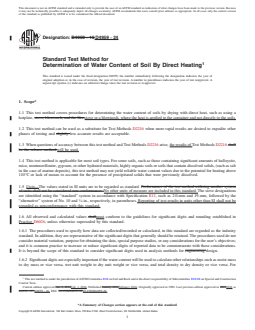
(Test Method)Standard Test Method for Determination of Water Content of Soil By Direct Heating
General Information
- Abstract
SIGNIFICANCE AND USE
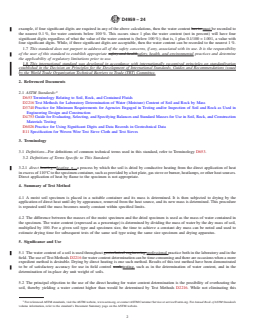
5.1 The water content of a soil is used throughout professional practice both in the laboratory and in the field. The use of Test Methods D2216 for water content determination can be time consuming and there are occasions when a more expedient method is desirable. Drying by direct heating is one such method. Results of this test method have been demonstrated to be of satisfactory accuracy for use in field control testing, such as in the determination of water content, and in the determination of in-place dry unit weight of soils.
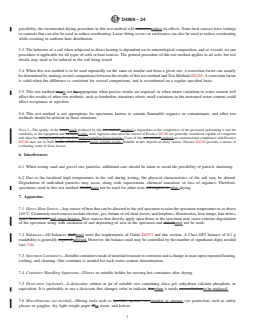
5.2 The principal objection to the use of the direct heating for water content determination is the possibility of overheating the soil, thereby yielding a water content higher than would be determined by Test Methods D2216. While not eliminating this possibility, the incremental drying procedure in this test method will reduce its effects. Some heat sources have settings or controls that can also be used to reduce overheating. Loose fitting covers or enclosures can also be used to reduce overheating while assisting in uniform heat distribution.
5.3 The behavior of a soil when subjected to direct heating is dependent on its mineralogical composition, and as a result, no one procedure is applicable for all types of soils or heat sources. The general procedure of this test method applies to all soils, but test details may need to be tailored to the soil being tested.
5.4 When this test method is to be used repeatedly on the same or similar soil from a given site, a correction factor can usually be determined by making several comparisons between the results of this test method and Test Methods D2216. A correction factor is valid when the difference is consistent for several comparisons, and is reconfirmed on a regular specified basis.
5.5 This test method is not appropriate when precise results are required, or when minor variations in water content will affect the results of other test methods, such as borderline situations where...
SCOPE
1.1 This test method covers procedures for determining the water content of soils by drying with direct heat, such as using a hotplate, stove or a blowtorch, where the heat is applied to the container and not directly to the soils.
1.2 This test method can be used as a substitute for Test Methods D2216 when more rapid results are desired to expedite other phases of testing and less accurate results are acceptable.
1.3 When questions of accuracy between this test method and Test Methods D2216 arise, the results of Test Methods D2216 will be used.
1.4 This test method is applicable for most soil types. For some soils, such as those containing significant amounts of halloysite, mica, montmorillonite, gypsum, or other hydrated materials, highly organic soils or soils that contain dissolved solids, (such as salt in the case of marine deposits), this test method may not yield reliable water content values due to the potential for heating above 110°C or lack of means to account for the presence of precipitated solids that were previously dissolved.
1.5 Units—The values stated in SI units are to be regarded as standard. No other units of measure are included in this standard. The sieve designations are identified using the “standard” system in accordance with Specification E11, such as 2.0-mm and 19-mm, followed by the “alternative” system of No. 10 and 3/4-in., respectively, in parentheses. Reporting of test results in units other than SI shall not be regarded as nonconformance with this standard.
1.6 All observed and calculated values must conform to the guidelines for significant digits and rounding established in Practice D6026, unless otherwise superseded by this standard.
1.6.1 The procedures used to specify how data are collected/recorded or calculated, in this standard are regarded as the industry standard. In addition, they are representative of the significant digits that generally should be retained....
- Status
- Published
- Publication Date
- 31-Jan-2024
- Technical Committee
- D18 - Soil and Rock
- Drafting Committee
- D18.08 - Special and Construction Control Tests
Buy Documents
ASTM D4959-24 - Standard Test Method for Determination of Water Content of Soil By Direct Heating
REDLINE ASTM D4959-24 - Standard Test Method for Determination of Water Content of Soil By Direct Heating
Overview
ASTM D4959-24 is the Standard Test Method for Determination of Water Content of Soil By Direct Heating, developed by ASTM International. This soil testing standard delivers a practical and efficient approach for determining the water content of soil samples using direct heat sources such as hotplates, stoves, or blowtorches-where heat is applied to the specimen container rather than directly to the soil. The method provides a valuable rapid-test alternative when standard oven-drying methods (such as ASTM D2216) would be too slow, enabling quicker field decisions and expedited laboratory workflows.
Key Topics
- Purpose and Use: Central to geotechnical engineering and soil science, water content determination is essential for assessing soil behavior and suitability for construction. This method supports both field and laboratory testing for soil moisture content.
- Test Method: The sample is weighed, dried with direct heat until mass remains constant, and reweighed-the water content is calculated from the mass difference. The process is repeated to ensure accuracy while preventing overheating.
- Applicability: Suitable for most soil types, but has limitations with highly organic soils, certain mineral-rich soils, or those containing dissolved solids.
- Precision and Limitations:
- Precision is acceptable for general field control and when minor losses of accuracy are permissible.
- Overheating can occur and must be managed; the incremental drying procedure helps minimize this risk.
- A correction factor may be established by comparing results with those of the standard oven-drying method (ASTM D2216) for soils from the same source.
- Not recommended where highly precise measurements or sensitive downstream tests are required.
- Safety Considerations: Direct heat, hot equipment, and potentially hazardous soil samples demand safe handling practices, personal protection, and appropriate ventilation.
Applications
The ASTM D4959-24 test method is widely used in:
- Field Soil Moisture Control: Rapid assessments in field settings for construction quality control, compaction control, and in-situ moisture verification.
- Geotechnical Investigations: Supporting soil characterization during site investigations, embankment construction, and foundation engineering.
- Laboratory Expediency: Useful when timely results are necessary to progress with other phases of geotechnical testing.
- Project Quality Assurance: Provides a means to monitor soil water content for compliance with project specifications within acceptable accuracy tolerances.
It is particularly beneficial when a quick turnaround is critical and when more precise, laboratory-based oven drying would unduly delay project timelines. However, it should not be used for soils where highly exact measurements or chemical sensitivity are critical, such as materials containing minerals that can lose chemically bound water or produce misleading results due to overheating.
Related Standards
When implementing ASTM D4959-24, the following related ASTM standards may also be referenced or required:
- ASTM D2216: Standard Test Methods for Laboratory Determination of Water (Moisture) Content of Soil and Rock by Mass (the reference oven-drying method)
- ASTM D6026: Practice for Using Significant Digits and Data Records in Geotechnical Data
- ASTM D653: Terminology Relating to Soil, Rock, and Contained Fluids
- ASTM E11: Specification for Woven Wire Test Sieve Cloth and Test Sieves
- ASTM D3740: Practice for Minimum Requirements for Agencies Engaged in Testing and/or Inspection of Soil and Rock as Used in Engineering Design and Construction
- ASTM D4753: Guide for Evaluating, Selecting, and Specifying Balances and Standard Masses for Use in Soil, Rock, and Construction Materials Testing
Practical Value
Choosing ASTM D4959-24 for soil water content measurement offers:
- Rapid, cost-effective soil moisture testing for field or laboratory applications
- Support for construction quality control and geotechnical decision-making
- Flexibility in soil types for broad applicability, with clear limitations noted for certain soils
- Alignment with international standards and best practices
When speed matters and absolute accuracy is not paramount, ASTM D4959-24 is a reliable tool for moisture determination in soils for construction, geotechnical, and quality assurance applications.
Relations
- Replaces
ASTM D4959-16 - Standard Test Method for Determination of Water Content of Soil By Direct Heating - Effective Date
- 01-Feb-2024
- Effective Date
- 01-Feb-2024
- Effective Date
- 01-May-2015
- Effective Date
- 01-Feb-2024
- Referred By
ASTM D5874-16 - Standard Test Methods for Determination of the Impact Value (IV) of a Soil - Effective Date
- 01-Feb-2024
- Effective Date
- 01-Feb-2024
- Effective Date
- 01-Feb-2024
- Effective Date
- 01-Feb-2024
- Effective Date
- 01-Feb-2024
- Referred By
ASTM E3373-24 - Standard Test Method for Scour of Hydrodynamic Separators and Settling Devices - Effective Date
- 01-Feb-2024
- Effective Date
- 01-Feb-2024
- Referred By
ASTM E2277-14(2019) - Standard Guide for Design and Construction of Coal Ash Structural Fills - Effective Date
- 01-Feb-2024
- Referred By
ASTM D2937-17e2 - Standard Test Method for Density of Soil in Place by the Drive-Cylinder Method - Effective Date
- 01-Feb-2024
- Effective Date
- 01-Feb-2024
- Effective Date
- 01-Feb-2024
Buy Documents
ASTM D4959-24 - Standard Test Method for Determination of Water Content of Soil By Direct Heating
REDLINE ASTM D4959-24 - Standard Test Method for Determination of Water Content of Soil By Direct Heating
Get Certified
Connect with accredited certification bodies for this standard

CIS Institut d.o.o.
Personal Protective Equipment (PPE) certification body. Notified Body NB-2890 for EU Regulation 2016/425 PPE.

Kiwa BDA Testing
Building and construction product certification.
Kmetijski inštitut Slovenije
Agricultural Institute of Slovenia. Soil testing, plant health, agricultural product analysis.
Sponsored listings
Frequently Asked Questions
ASTM D4959-24 is a standard published by ASTM International. Its full title is "Standard Test Method for Determination of Water Content of Soil By Direct Heating". This standard covers: SIGNIFICANCE AND USE 5.1 The water content of a soil is used throughout professional practice both in the laboratory and in the field. The use of Test Methods D2216 for water content determination can be time consuming and there are occasions when a more expedient method is desirable. Drying by direct heating is one such method. Results of this test method have been demonstrated to be of satisfactory accuracy for use in field control testing, such as in the determination of water content, and in the determination of in-place dry unit weight of soils. 5.2 The principal objection to the use of the direct heating for water content determination is the possibility of overheating the soil, thereby yielding a water content higher than would be determined by Test Methods D2216. While not eliminating this possibility, the incremental drying procedure in this test method will reduce its effects. Some heat sources have settings or controls that can also be used to reduce overheating. Loose fitting covers or enclosures can also be used to reduce overheating while assisting in uniform heat distribution. 5.3 The behavior of a soil when subjected to direct heating is dependent on its mineralogical composition, and as a result, no one procedure is applicable for all types of soils or heat sources. The general procedure of this test method applies to all soils, but test details may need to be tailored to the soil being tested. 5.4 When this test method is to be used repeatedly on the same or similar soil from a given site, a correction factor can usually be determined by making several comparisons between the results of this test method and Test Methods D2216. A correction factor is valid when the difference is consistent for several comparisons, and is reconfirmed on a regular specified basis. 5.5 This test method is not appropriate when precise results are required, or when minor variations in water content will affect the results of other test methods, such as borderline situations where... SCOPE 1.1 This test method covers procedures for determining the water content of soils by drying with direct heat, such as using a hotplate, stove or a blowtorch, where the heat is applied to the container and not directly to the soils. 1.2 This test method can be used as a substitute for Test Methods D2216 when more rapid results are desired to expedite other phases of testing and less accurate results are acceptable. 1.3 When questions of accuracy between this test method and Test Methods D2216 arise, the results of Test Methods D2216 will be used. 1.4 This test method is applicable for most soil types. For some soils, such as those containing significant amounts of halloysite, mica, montmorillonite, gypsum, or other hydrated materials, highly organic soils or soils that contain dissolved solids, (such as salt in the case of marine deposits), this test method may not yield reliable water content values due to the potential for heating above 110°C or lack of means to account for the presence of precipitated solids that were previously dissolved. 1.5 Units—The values stated in SI units are to be regarded as standard. No other units of measure are included in this standard. The sieve designations are identified using the “standard” system in accordance with Specification E11, such as 2.0-mm and 19-mm, followed by the “alternative” system of No. 10 and 3/4-in., respectively, in parentheses. Reporting of test results in units other than SI shall not be regarded as nonconformance with this standard. 1.6 All observed and calculated values must conform to the guidelines for significant digits and rounding established in Practice D6026, unless otherwise superseded by this standard. 1.6.1 The procedures used to specify how data are collected/recorded or calculated, in this standard are regarded as the industry standard. In addition, they are representative of the significant digits that generally should be retained....
SIGNIFICANCE AND USE 5.1 The water content of a soil is used throughout professional practice both in the laboratory and in the field. The use of Test Methods D2216 for water content determination can be time consuming and there are occasions when a more expedient method is desirable. Drying by direct heating is one such method. Results of this test method have been demonstrated to be of satisfactory accuracy for use in field control testing, such as in the determination of water content, and in the determination of in-place dry unit weight of soils. 5.2 The principal objection to the use of the direct heating for water content determination is the possibility of overheating the soil, thereby yielding a water content higher than would be determined by Test Methods D2216. While not eliminating this possibility, the incremental drying procedure in this test method will reduce its effects. Some heat sources have settings or controls that can also be used to reduce overheating. Loose fitting covers or enclosures can also be used to reduce overheating while assisting in uniform heat distribution. 5.3 The behavior of a soil when subjected to direct heating is dependent on its mineralogical composition, and as a result, no one procedure is applicable for all types of soils or heat sources. The general procedure of this test method applies to all soils, but test details may need to be tailored to the soil being tested. 5.4 When this test method is to be used repeatedly on the same or similar soil from a given site, a correction factor can usually be determined by making several comparisons between the results of this test method and Test Methods D2216. A correction factor is valid when the difference is consistent for several comparisons, and is reconfirmed on a regular specified basis. 5.5 This test method is not appropriate when precise results are required, or when minor variations in water content will affect the results of other test methods, such as borderline situations where... SCOPE 1.1 This test method covers procedures for determining the water content of soils by drying with direct heat, such as using a hotplate, stove or a blowtorch, where the heat is applied to the container and not directly to the soils. 1.2 This test method can be used as a substitute for Test Methods D2216 when more rapid results are desired to expedite other phases of testing and less accurate results are acceptable. 1.3 When questions of accuracy between this test method and Test Methods D2216 arise, the results of Test Methods D2216 will be used. 1.4 This test method is applicable for most soil types. For some soils, such as those containing significant amounts of halloysite, mica, montmorillonite, gypsum, or other hydrated materials, highly organic soils or soils that contain dissolved solids, (such as salt in the case of marine deposits), this test method may not yield reliable water content values due to the potential for heating above 110°C or lack of means to account for the presence of precipitated solids that were previously dissolved. 1.5 Units—The values stated in SI units are to be regarded as standard. No other units of measure are included in this standard. The sieve designations are identified using the “standard” system in accordance with Specification E11, such as 2.0-mm and 19-mm, followed by the “alternative” system of No. 10 and 3/4-in., respectively, in parentheses. Reporting of test results in units other than SI shall not be regarded as nonconformance with this standard. 1.6 All observed and calculated values must conform to the guidelines for significant digits and rounding established in Practice D6026, unless otherwise superseded by this standard. 1.6.1 The procedures used to specify how data are collected/recorded or calculated, in this standard are regarded as the industry standard. In addition, they are representative of the significant digits that generally should be retained....
ASTM D4959-24 is classified under the following ICS (International Classification for Standards) categories: 13.080.40 - Hydrological properties of soils. The ICS classification helps identify the subject area and facilitates finding related standards.
ASTM D4959-24 has the following relationships with other standards: It is inter standard links to ASTM D4959-16, ASTM D4753-24, ASTM D4753-15, ASTM D8167/D8167M-23e1, ASTM D5874-16, ASTM D7380/D7380M-21, ASTM C1746/C1746M-19, ASTM D6938-23, ASTM D2216-19, ASTM E3373-24, ASTM C1893-23, ASTM E2277-14(2019), ASTM D2937-17e2, ASTM D3839-14(2019), ASTM F1668-16(2022). Understanding these relationships helps ensure you are using the most current and applicable version of the standard.
ASTM D4959-24 is available in PDF format for immediate download after purchase. The document can be added to your cart and obtained through the secure checkout process. Digital delivery ensures instant access to the complete standard document.
Standards Content (Sample)
This international standard was developed in accordance with internationally recognized principles on standardization established in the Decision on Principles for the
Development of International Standards, Guides and Recommendations issued by the World Trade Organization Technical Barriers to Trade (TBT) Committee.
Designation: D4959 − 24
Standard Test Method for
Determination of Water Content of Soil By Direct Heating
This standard is issued under the fixed designation D4959; the number immediately following the designation indicates the year of
original adoption or, in the case of revision, the year of last revision. A number in parentheses indicates the year of last reapproval. A
superscript epsilon (´) indicates an editorial change since the last revision or reapproval.
1. Scope* significant digits that generally should be retained. The proce-
dures used do not consider material variation, purpose for
1.1 This test method covers procedures for determining the
obtaining the data, special purpose studies, or any consider-
water content of soils by drying with direct heat, such as using
ations for the user’s objectives; and it is common practice to
a hotplate, stove or a blowtorch, where the heat is applied to the
increase or reduce significant digits of reported data to be
container and not directly to the soils.
commensurate with these considerations. It is beyond the scope
1.2 This test method can be used as a substitute for Test
of this standard to consider significant digits used in analysis
Methods D2216 when more rapid results are desired to
methods for design.
expedite other phases of testing and less accurate results are
1.6.2 Significant digits are especially important if the water
acceptable.
content will be used to calculate other relationships such as
1.3 When questions of accuracy between this test method moist mass to dry mass or vice versa, wet unit weight to dry
unit weight or vice versa, and total density to dry density or
and Test Methods D2216 arise, the results of Test Methods
D2216 will be used. vice versa. For example, if four significant digits are required
in any of the above calculations, then the water content must be
1.4 This test method is applicable for most soil types. For
recorded to the nearest 0.1 %, for water contents below 100 %.
some soils, such as those containing significant amounts of
This occurs since 1 plus the water content (not in percent) will
halloysite, mica, montmorillonite, gypsum, or other hydrated
have four significant digits regardless of what the value of the
materials, highly organic soils or soils that contain dissolved
water content is (below 100 %); that is, 1 plus 0.1/100 = 1.001,
solids, (such as salt in the case of marine deposits), this test
a value with four significant digits. While, if three significant
method may not yield reliable water content values due to the
digits are acceptable, then the water content can be recorded to
potential for heating above 110°C or lack of means to account
the nearest 1 %.
for the presence of precipitated solids that were previously
1.7 This standard does not purport to address all of the
dissolved.
safety concerns, if any, associated with its use. It is the
1.5 Units—The values stated in SI units are to be regarded
responsibility of the user of this standard to establish appro-
as standard. No other units of measure are included in this
priate safety, health, and environmental practices and deter-
standard. The sieve designations are identified using the
mine the applicability of regulatory limitations prior to use.
“standard” system in accordance with Specification E11, such
1.8 This international standard was developed in accor-
as 2.0-mm and 19-mm, followed by the “alternative” system of
dance with internationally recognized principles on standard-
No. 10 and ⁄4-in., respectively, in parentheses. Reporting of
ization established in the Decision on Principles for the
test results in units other than SI shall not be regarded as
Development of International Standards, Guides and Recom-
nonconformance with this standard.
mendations issued by the World Trade Organization Technical
1.6 All observed and calculated values must conform to the
Barriers to Trade (TBT) Committee.
guidelines for significant digits and rounding established in
2. Referenced Documents
Practice D6026, unless otherwise superseded by this standard.
1.6.1 The procedures used to specify how data are collected/
2.1 ASTM Standards:
recorded or calculated, in this standard are regarded as the
D653 Terminology Relating to Soil, Rock, and Contained
industry standard. In addition, they are representative of the
Fluids
D2216 Test Methods for Laboratory Determination of Water
(Moisture) Content of Soil and Rock by Mass
This test method is under the jurisdiction of ASTM Committee D18 on Soil and
Rock and is the direct responsibility of Subcommittee D18.08 on Special and
Construction Control Tests. For referenced ASTM standards, visit the ASTM website, www.astm.org, or
Current edition approved Feb. 1, 2024. Published February 2024. Originally contact ASTM Customer Service at service@astm.org. For Annual Book of ASTM
approved in 1989. Last previous edition approved in 2016 as D4959 – 16. DOI: Standards volume information, refer to the standard’s Document Summary page on
10.1520/D4959-24. the ASTM website.
*A Summary of Changes section appears at the end of this standard
Copyright © ASTM International, 100 Barr Harbor Drive, PO Box C700, West Conshohocken, PA 19428-2959. United States
D4959 − 24
D3740 Practice for Minimum Requirements for Agencies 5.3 The behavior of a soil when subjected to direct heating
Engaged in Testing and/or Inspection of Soil and Rock as is dependent on its mineralogical composition, and as a result,
Used in Engineering Design and Construction no one procedure is applicable for all types of soils or heat
D4753 Guide for Evaluating, Selecting, and Specifying Bal- sources. The general procedure of this test method applies to all
ances and Standard Masses for Use in Soil, Rock, and soils, but test details may need to be tailored to the soil being
Construction Materials Testing tested.
D6026 Practice for Using Significant Digits and Data Re-
5.4 When this test method is to be used repeatedly on the
cords in Geotechnical Data
same or similar soil from a given site, a correction factor can
E11 Specification for Woven Wire Test Sieve Cloth and Test
usually be determined by making several comparisons between
Sieves
the results of this test method and Test Methods D2216. A
correction factor is valid when the difference is consistent for
3. Terminology
several comparisons, and is reconfirmed on a regular specified
3.1 Definitions—For definitions of common technical terms
basis.
used in this standard, refer to Terminology D653.
5.5 This test method is not appropriate when precise results
3.2 Definitions of Terms Specific to This Standard:
are required, or when minor variations in water content will
3.2.1 direct heating, n—a process by which the soil is dried
affect the results of other test methods, such as borderline
by conductive heating from the direct application of heat in
situations where small variations in the measured water content
excess of 110°C to the specimen container, such as provided by
could affect acceptance or rejection.
a hot plate, gas stove or burner, heatlamps, or other heat
5.6 This test method is not appropriate for specimens known
sources. Direct application of heat by flame to the specimen is
to contain flammable organics or contaminants, and other test
not appropriate.
methods should be utilized in these situations.
4. Summary of Test Method
NOTE 1—The quality of the result produced by this standard is
4.1 A moist soil specimen is placed in a suitable container
dependent on the competence of the personnel performing it and the
suitability of the equipment and facility used. Agencies that meet the
and its mass is determined. It is then subjected to drying by the
criteria of Practice D3740 are generally considered capable of competent
application of direct heat until dry by appearance, removed
and objective testing/sampling/inspection/etc. Users of this standard are
from the heat source, and its new mass is determined. This
cautioned that compliance with Practice D3740 does not in itself assure
procedure is repeated until the mass becomes nearly constant
reliable results. Reliable results depend on many factors; Practice D3740
within specified limits.
provides a means of evaluating some of those factors.
4.2 The difference between the masses of the moist speci-
6. Interferences
men and the dried specimen is used as the mass of water
6.1 When testing sand and gravel size particles, additional
contained in the specimen. The water content (expressed as a
care should be taken to avoid the possibility of particle
percentage) is determined by dividing the mass of water by the
shattering.
dry mass of soil, multiplied by 100. For a given soil type and
specimen size, the time to achieve a constant dry mass can be
6.2 Due to the localized high temperatures in the soil during
noted and used to estimate drying time for subsequent tests of
testing, the physical characteristics of the soil may be altered.
the same soil type using the same size specimen and drying
Degradation of individual particles may occur, along with
apparatus.
vaporization, chemical transition, or loss of organics.
Therefore, specimens used in this test method must not be used
5. Significance and Use
for other tests after drying.
5.1 The water content of a soil is used throughout profes-
sional practice both in the laboratory and in the field. The use
7. Apparatus
of Test Methods D2216 for water content determination can be
7.1 Direct Heat Source—Any source of heat that can be
time consuming and there are occasions when a more expedi-
directed to the soil specimen to raise the specimen temperature
ent method is desirable. Drying by direct heating is one such
to or above 110°C. Commonly used sources include electric,
method. Results of this test method have been demonstrated to
gas, butane or oil-fired stoves, and hotplates, blowtorches, heat
be of satisfactory accuracy for use in field control testing, such
lamps, hair driers, and space heaters. Heat sources that directly
as in the determination of water content, and in the determi-
apply open flame to the specimen may cause extreme degra-
nation of in-place dry unit weight of soils.
dation of the specimen along with oxidation of and depositing
5.2 The principal objection to the use of the direct heating
of soot in the specimen and must not be used.
for water content determination is the possibility of overheat-
7.2 Balances—All balances must meet the requirements of
ing the soil, thereby yielding a water content higher than would
Guide D4753 and this section. A Class GP2 balance of 0.1 g
be determined by Test Methods D2216. While not eliminating
readability is generally advised. However, the balance used
this possibility, the incremental drying procedure in this test
may be controlled by the number of significant digits needed
method will reduce its effects. Some heat sources have settings
(see 1.6).
or controls that can also be used to reduce overheating. Loose
fitting covers or enclosures can also be used to reduce 7.3 Specimen Containers—Suitable containers made of ma-
overheating while assisting in uniform heat distribution. terial resistant to corrosion and a change in mass upon repeated
D4959 − 24
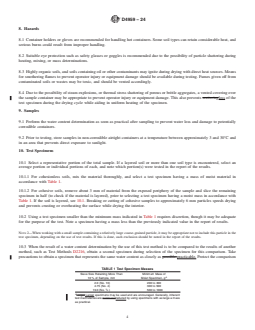
TABLE 1 Test Specimen Masses
heating, cooling, and cleaning. One container is needed for
each water content determination. Sieve Size Retaining More Than Minimum Mass of
A
10 % of Sample, mm Moist Specimen, g
7.4 Container Handling Apparatus—Gloves or suitable
2.0 (No. 10) 200 to 300
holder for moving hot containers after drying.
4.75 (No. 4) 300 to 500
19.0 (No. ⁄4 ) 500 to 1000
7.5 Desiccator (optional)—A desiccator cabinet or jar of
A
Larger specimens may be used and are encouraged. Generally, inherent test
suitable size containing silica gel, anhydrous calcium
inaccuracies are reduced by using specimens with as large a mass as practical.
phosphate, or equivalent. It is preferable to use a desiccant that
changes color to indicate when it needs to be replaced.
7.6 Miscellaneous (as needed)—Mixing tools such as spatu-
10.2 Using a test specimen smaller than the minimum mass
las or spoons; eye protection, such as safety glasses or goggles;
indicated in Table 1 requires discretion, though it may be
dry light-weight paper or tissue, and knives.
adequate for the purpose of the test. Note a specimen having a
8. Hazards mass less than the previously indicated value in the report of
results.
8.1 Container holders or gloves are
...
This document is not an ASTM standard and is intended only to provide the user of an ASTM standard an indication of what changes have been made to the previous version. Because
it may not be technically possible to adequately depict all changes accurately, ASTM recommends that users consult prior editions as appropriate. In all cases only the current version
of the standard as published by ASTM is to be considered the official document.
Designation: D4959 − 16 D4959 − 24
Standard Test Method for
Determination of Water Content of Soil By Direct Heating
This standard is issued under the fixed designation D4959; the number immediately following the designation indicates the year of
original adoption or, in the case of revision, the year of last revision. A number in parentheses indicates the year of last reapproval. A
superscript epsilon (´) indicates an editorial change since the last revision or reapproval.
1. Scope*
1.1 This test method covers procedures for determining the water content of soils by drying with direct heat, such as using a
hotplate, stove, blowtorch, and the like.stove or a blowtorch, where the heat is applied to the container and not directly to the soils.
1.2 This test method can be used as a substitute for Test Methods D2216 when more rapid results are desired to expedite other
phases of testing and slightly less accurate results are acceptable.
1.3 When questions of accuracy between this test method and Test Methods D2216 arise, the results of Test Methods D2216 shall
be the referee method.will be used.
1.4 This test method is applicable for most soil types. For some soils, such as those containing significant amounts of halloysite,
mica, montmorillonite, gypsum, or other hydrated materials, highly organic soils or soils that contain dissolved solids, (such as salt
in the case of marine deposits), this test method may not yield reliable water content values due to the potential for heating above
110°C or lack of means to account for the presence of precipitated solids that were previously dissolved.
1.5 Units—The values stated in SI units are to be regarded as standard. Performance of the test method utilizing another system
of units shall not be considered non-conformance. No other units of measure are included in this standard. The sieve designations
are identified using the “standard” system in accordance with Specification E11, such as 2.0-mm and 19-mm, followed by the
“alternative” system of No. 10 and ⁄4-in., respectively, in parentheses. Reporting of test results in units other than SI shall not be
regarded as nonconformance with this standard.
1.6 All observed and calculated values shallmust conform to the guidelines for significant digits and rounding established in
Practice D6026, unless otherwise superseded by this standard.
1.6.1 The procedures used to specify how data are collected/recorded or calculated, in this standard are regarded as the industry
standard. In addition, they are representative of the significant digits that generally should be retained. The procedures used do not
consider material variation, purpose for obtaining the data, special purpose studies, or any considerations for the user’s objectives;
and it is common practice to increase or reduce significant digits of reported data to be commensurate with these considerations.
It is beyond the scope of this standard to consider significant digits used in analysis methods for engineering design.
1.6.2 Significant digits are especially important if the water content will be used to calculate other relationships such as moist mass
to dry mass or vice versa, wet unit weight to dry unit weight or vice versa, and total density to dry density or vice versa. For
This test method is under the jurisdiction of ASTM Committee D18 on Soil and Rock and is the direct responsibility of Subcommittee D18.08 on Special and Construction
Control Tests.
Current edition approved Jan. 1, 2016Feb. 1, 2024. Published January 2016February 2024. Originally approved in 1989. Last previous edition approved in 20072016 as
D4959 – 07.D4959 – 16. DOI: 10.1520/D4959-16.10.1520/D4959-24.
*A Summary of Changes section appears at the end of this standard
Copyright © ASTM International, 100 Barr Harbor Drive, PO Box C700, West Conshohocken, PA 19428-2959. United States
D4959 − 24
example, if four significant digits are required in any of the above calculations, then the water content has to must be recorded to
the nearest 0.1 %, for water contents below 100 %. This occurs since 1 plus the water content (not in percent) will have four
significant digits regardless of what the value of the water content is (below 100 %); that is, 1 plus 0.1/100 = 1.001, a value with
four significant digits. While, if three significant digits are acceptable, then the water content can be recorded to the nearest 1 %.
1.7 This standard does not purport to address all of the safety concerns, if any, associated with its use. It is the responsibility
of the user of this standard to establish appropriate safety and healthsafety, health, and environmental practices and determine
the applicability of regulatory limitations prior to use.
1.8 This international standard was developed in accordance with internationally recognized principles on standardization
established in the Decision on Principles for the Development of International Standards, Guides and Recommendations issued
by the World Trade Organization Technical Barriers to Trade (TBT) Committee.
2. Referenced Documents
2.1 ASTM Standards:
D653 Terminology Relating to Soil, Rock, and Contained Fluids
D2216 Test Methods for Laboratory Determination of Water (Moisture) Content of Soil and Rock by Mass
D3740 Practice for Minimum Requirements for Agencies Engaged in Testing and/or Inspection of Soil and Rock as Used in
Engineering Design and Construction
D4753 Guide for Evaluating, Selecting, and Specifying Balances and Standard Masses for Use in Soil, Rock, and Construction
Materials Testing
D6026 Practice for Using Significant Digits and Data Records in Geotechnical Data
E11 Specification for Woven Wire Test Sieve Cloth and Test Sieves
3. Terminology
3.1 Definitions—For definitions of common technical terms used in this standard, refer to Terminology D653.
3.2 Definitions of Terms Specific to This Standard:
3.2.1 direct heating—heating, n—a process by which the soil is dried by conductive heating from the direct application of heat
in excess of 110°C to the specimen container, such as provided by a hot plate, gas stove or burner, heatlamps, or other heat sources.
Direct application of heat by flame to the specimen is not appropriate.
4. Summary of Test Method
4.1 A moist soil specimen is placed in a suitable container and its mass is determined. It is then subjected to drying by the
application of direct heat until dry by appearance, removed from the heat source, and its new mass is determined. This procedure
is repeated until the mass becomes nearly constant within specified limits.
4.2 The difference between the masses of the moist specimen and the dried specimen is used as the mass of water contained in
the specimen. The water content (expressed as a percentage) is determined by dividing the mass of water by the dry mass of soil,
multiplied by 100. For a given soil type and specimen size, the time to achieve a constant dry mass can be noted and used to
estimate drying time for subsequent tests of the same soil type using the same size specimen and drying apparatus.
5. Significance and Use
5.1 The water content of a soil is used throughout geotechnical engineering professional practice both in the laboratory and in the
field. The use of Test Methods D2216 for water content determination can be time consuming and there are occasions when a more
expedient method is desirable. Drying by direct heating is one such method. Results of this test method have been demonstrated
to be of satisfactory accuracy for use in field control work,testing, such as in the determination of water content, and in the
determination of in-place dry unit weight of soils.
5.2 The principal objection to the use of the direct heating for water content determination is the possibility of overheating the
soil, thereby yielding a water content higher than would be determined by Test Methods D2216. While not eliminating this
For referenced ASTM standards, visit the ASTM website, www.astm.org, or contact ASTM Customer Service at service@astm.org. For Annual Book of ASTM Standards
volume information, refer to the standard’s Document Summary page on the ASTM website.
D4959 − 24
possibility, the incremental drying procedure in this test method will minimizereduce its effects. Some heat sources have settings
or controls that can also be used to reduce overheating. Loose fitting covers or enclosures can also be used to reduce overheating
while assisting in uniform heat distribution.
5.3 The behavior of a soil when subjected to direct heating is dependent on its mineralogical composition, and as a result, no one
procedure is applicable for all types of soils or heat sources. The general procedure of this test method applies to all soils, but test
details may need to be tailored to the soil being tested.
5.4 When this test method is to be used repeatedly on the same or similar soil from a given site, a correction factor can usually
be determined by making several comparisons between the results of this test method and Test Methods D2216. A correction factor
is valid when the difference is consistent for several comparisons, and is reconfirmed on a regular specified basis.
5.5 This test method mayis not be appropriate when precise results are required, or when minor variations in water content will
affect the results of other test methods, such as borderline situations where small variations in the measured water content could
affect acceptance or rejection.
5.6 This test method is not appropriate for specimens known to contain flammable organics or contaminants, and other test
methods should be utilized in these situations.
NOTE 1—The quality of the resultsresult produced by this test method standard is dependent on the competence of the personnel performing it and the
suitability of the equipment and facilitiesfacility used. Agencies that meet the criteria of Practice D3740 are generally considered capable of competent
and objective testing/sampling/inspection.testing/sampling/inspection/etc. Users of this test method standard are cautioned that compliance with Practice
D3740 does not in itself ensure reliable results . assure reliable results. Reliable results depend on many factors; Practice D3740 provides a means of
evaluating some of those factors.
6. Interferences
6.1 When testing sand and gravel size particles, additional care should be taken to avoid the possibility of particle shattering.
6.2 Due to the localized high temperatures in the soil during testing, the physical characteristics of the soil may be altered.
Degradation of individual particles may occur, along with vaporization, chemical transition, or loss of organics. Therefore,
specimens used in this test method shouldmust not be used for other tests subsequent to after drying.
7. Apparatus
7.1 Direct Heat Source—Any source of heat that can be directed to the soil specimen to raise the specimen temperature to or above
110°C. Commonly used sources include electric, gas, butane or oil-fired stoves, and hotplates, blowtorches, heat lamps, hair driers,
space heaters, etc. and space heaters. Heat sources that directly apply open flame to the specimen may cause extreme degradation
of the specimen along with oxidation of and depositing of soot in the specimen and shouldmust not be used.
7.2 Balances—All balances shallmust meet the requirements of Guide D4753 and this section. A Class GP2 balance of 0.1 g
readability is generally required.advised. However, the balance used may be controlled by the number of significant digits needed
(see 1.6).
7.3 Specimen Containers—Suitable containers made of material resistant to corrosion and a change in mass upon repeated heating,
cooling, and cleaning. One container is needed for each water content determination.
7.4 Container Handling Apparatus—Gloves or suitable holder for moving hot containers after drying.
7.5 Desiccator (optional)—A desiccator cabinet or jar of suitable size containing silica gel, anhydrous calcium phosphate, or
equivalent. It is preferable to use a desiccant that changes color to indicate thatwhen it needs reconstitution.to be replaced.
7.6 Miscellaneous (as needed)—Mixing tools such as spatulas, spoons, etc.;spatulas or spoons; eye protection, such as safety
glasses or goggles; dry light-weight paper ofor tissue, and knives.
D4959 − 24
8. Hazards
8.1 Container holders or gloves are recommended for handling hot containers. Some soil types can retain considerable heat, and
serious burns could result from improper handling.
8.2 Suitable eye protection such as safety glasses or goggles is recommended due to the possibility of particle shattering during
heating, mixing, or mass determinations.
8.3 Highly organic soils, and soils containing oil or other contaminants may ignite during drying with direct heat sources. Means
for smothering flames to prevent operator injury or equipment damage should be available during testing. Fumes given off from
contaminated soils or wastes may be toxic, and should be vented accordingly.
8.4 Due to the possibility of steam explosions, or thermal stress shattering of porous or brittle aggregates, a vented covering over
the sample container may be appropriate to prevent operator injury or equipment damage. This also prevents scatteringloss of the
test specimen during the drying cycle while aiding in uniform heating of the specimen.
9. Samples
9.1 Perform the water content determination as soon as practical after sampling t
...