

ASTM E70-24
(Test Method)Standard Test Method for pH of Aqueous Solutions With the Glass Electrode
General Information
- Abstract
SIGNIFICANCE AND USE
4.1 pH is, within the limits described in 1.1, an accurate measurement of the hydrogen ion concentration and thus is widely used for the characterization of aqueous solutions.
4.2 pH measurement is one of the main process control variables in the chemical industry and has a prominent place in pollution control.
SCOPE
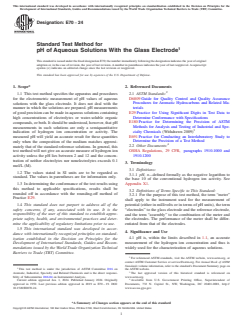
1.1 This test method specifies the apparatus and procedures for the electrometric measurement of pH values of aqueous solutions with the glass electrode. It does not deal with the manner in which the solutions are prepared. pH measurements of good precision can be made in aqueous solutions containing high concentrations of electrolytes or water-soluble organic compounds, or both. It should be understood, however, that pH measurements in such solutions are only a semiquantitative indication of hydrogen ion concentration or activity. The measured pH will yield an accurate result for these quantities only when the composition of the medium matches approximately that of the standard reference solutions. In general, this test method will not give an accurate measure of hydrogen ion activity unless the pH lies between 2 and 12 and the concentration of neither electrolytes nor nonelectrolytes exceeds 0.1 mol/L (M).
1.2 The values stated in SI units are to be regarded as standard. The values in parentheses are for information only.
1.3 In determining the conformance of the test results using this method to applicable specifications, results shall be rounded off in accordance with the rounding-off method of Practice E29.
1.4 This standard does not purport to address all of the safety concerns, if any, associated with its use. It is the responsibility of the user of this standard to establish appropriate safety, health, and environmental practices and determine the applicability of regulatory limitations prior to use.
1.5 This international standard was developed in accordance with internationally recognized principles on standardization established in the Decision on Principles for the Development of International Standards, Guides and Recommendations issued by the World Trade Organization Technical Barriers to Trade (TBT) Committee.
- Status
- Published
- Publication Date
- 31-Dec-2023
- Technical Committee
- D16 - Aromatic, Industrial, Specialty and Related Chemicals
- Drafting Committee
- D16.04 - Instrumental Analysis
Overview
ASTM E70-24: Standard Test Method for pH of Aqueous Solutions With the Glass Electrode defines reliable procedures for the electrometric determination of pH in aqueous solutions using a glass electrode and reference electrode assembly. Published by ASTM International, this standard is widely recognized across industries, including chemical manufacturing and environmental monitoring, as the authoritative guide for precision pH measurement within specified solution parameters.
pH measurement is a critical process control variable essential for quality assurance, environmental compliance, and process efficiency. This method provides guidelines for the selection of instruments, appropriate buffers, calibration, and reporting practices. ASTM E70-24 ensures consistency and comparability in pH readings by setting standardized apparatus configurations and procedural details.
Key Topics
- Scope and Applicability: Intended for aqueous solutions with a pH range between 2 and 12, and with concentrations of electrolytes/nonelectrolytes not exceeding 0.1 mol/L.
- Instrumentation: Specifies the use of pH meters equipped with glass electrodes and appropriate reference electrodes, such as silver-silver chloride types, for precise pH measurement.
- Calibration and Standardization: Detailed procedures are provided for instrument calibration using at least two reference buffer solutions that bracket the expected sample pH.
- Measurement Procedure: Outlines sample preparation (excluding solution preparation itself), electrode conditioning, measurement technique, and recommendations for continuous or intermittent measurement.
- Quality Assurance: Emphasizes laboratory quality control practices, including routine calibration checks and the use of quality control samples to validate performance.
- Safety Considerations: Advises users to follow current safety, health, and environmental regulations and best practices when handling chemicals and electrodes.
Applications
ASTM E70-24 is essential for industries and laboratories requiring accurate pH assessment, such as:
- Chemical Manufacturing: pH determination ensures proper reaction conditions, product quality, and safe operation.
- Water and Wastewater Analysis: pH measurement is fundamental in monitoring water quality and ensuring compliance with environmental regulations.
- Pharmaceuticals and Food Processing: Reliable pH monitoring is critical for maintaining process integrity, safety, and product uniformity.
- Academic and Research Laboratories: Used as a reference method for standardizing pH measurement across diverse analytical applications.
In all these environments, adherence to ASTM E70-24 assures data reliability and enables comparability between different laboratories and processes. Continuous or batch processes can integrate ASTM E70-24-compliant pH measurements for automated plant control and documentation.
Related Standards
Several standards complement ASTM E70-24 for specific applications or procedural enhancements:
- ASTM D1193: Specification for Reagent Water, which defines water quality for analytical procedures.
- ASTM D1293: Test Methods for pH of Water, tailored for specific water analysis scenarios.
- ASTM D5128, D5464, D6569: Standards for on-line and low-conductivity water pH measurements.
- ASTM E29: Practice for Using Significant Digits in Test Data.
- ASTM E691: Practice for Conducting Interlaboratory Studies to Determine Test Method Precision.
- ASTM D6809: Guide for Quality Control and Assurance Procedures.
Practical Value
Implementing ASTM E70-24 ensures the accurate, repeatable, and traceable measurement of pH in aqueous solutions, supporting regulatory compliance and optimal process control. The standard’s detailed calibration, procedural, and quality control requirements help minimize errors and enable meaningful data comparison across laboratories and timeframes. Its systematic approach to pH measurement underpins confident decision-making in manufacturing, environmental monitoring, and scientific research.
Keywords: ASTM E70-24, pH measurement, glass electrode, aqueous solutions, process control, laboratory standard, buffer solution, calibration, reference electrode, water analysis, chemical industry.
Relations
- Effective Date
- 01-Jan-2024
- Effective Date
- 01-Jan-2024
- Effective Date
- 01-Jan-2024
- Effective Date
- 01-Jan-2024
- Effective Date
- 01-Jan-2024
- Referred By
ASTM D1583-01(2018) - Standard Test Method for Hydrogen Ion Concentration of Dry Adhesive Films - Effective Date
- 01-Jan-2024
- Effective Date
- 01-Jan-2024
- Referred By
ASTM D3837-95(2019) - Standard Practice for Preparing a Solution of Alkali–Soluble Resins - Effective Date
- 01-Jan-2024
- Effective Date
- 01-Jan-2024
- Effective Date
- 01-Jan-2024
- Effective Date
- 01-Jan-2024
- Effective Date
- 01-Jan-2024
- Effective Date
- 01-Jan-2024
- Effective Date
- 01-Jan-2024
- Effective Date
- 01-Jan-2024
Get Certified
Connect with accredited certification bodies for this standard

ECOCERT
Organic and sustainability certification.

Eurofins Food Testing Global
Global leader in food, environment, and pharmaceutical product testing.

Intertek Bangladesh
Intertek certification and testing services in Bangladesh.
Sponsored listings
Frequently Asked Questions
ASTM E70-24 is a standard published by ASTM International. Its full title is "Standard Test Method for pH of Aqueous Solutions With the Glass Electrode". This standard covers: SIGNIFICANCE AND USE 4.1 pH is, within the limits described in 1.1, an accurate measurement of the hydrogen ion concentration and thus is widely used for the characterization of aqueous solutions. 4.2 pH measurement is one of the main process control variables in the chemical industry and has a prominent place in pollution control. SCOPE 1.1 This test method specifies the apparatus and procedures for the electrometric measurement of pH values of aqueous solutions with the glass electrode. It does not deal with the manner in which the solutions are prepared. pH measurements of good precision can be made in aqueous solutions containing high concentrations of electrolytes or water-soluble organic compounds, or both. It should be understood, however, that pH measurements in such solutions are only a semiquantitative indication of hydrogen ion concentration or activity. The measured pH will yield an accurate result for these quantities only when the composition of the medium matches approximately that of the standard reference solutions. In general, this test method will not give an accurate measure of hydrogen ion activity unless the pH lies between 2 and 12 and the concentration of neither electrolytes nor nonelectrolytes exceeds 0.1 mol/L (M). 1.2 The values stated in SI units are to be regarded as standard. The values in parentheses are for information only. 1.3 In determining the conformance of the test results using this method to applicable specifications, results shall be rounded off in accordance with the rounding-off method of Practice E29. 1.4 This standard does not purport to address all of the safety concerns, if any, associated with its use. It is the responsibility of the user of this standard to establish appropriate safety, health, and environmental practices and determine the applicability of regulatory limitations prior to use. 1.5 This international standard was developed in accordance with internationally recognized principles on standardization established in the Decision on Principles for the Development of International Standards, Guides and Recommendations issued by the World Trade Organization Technical Barriers to Trade (TBT) Committee.
SIGNIFICANCE AND USE 4.1 pH is, within the limits described in 1.1, an accurate measurement of the hydrogen ion concentration and thus is widely used for the characterization of aqueous solutions. 4.2 pH measurement is one of the main process control variables in the chemical industry and has a prominent place in pollution control. SCOPE 1.1 This test method specifies the apparatus and procedures for the electrometric measurement of pH values of aqueous solutions with the glass electrode. It does not deal with the manner in which the solutions are prepared. pH measurements of good precision can be made in aqueous solutions containing high concentrations of electrolytes or water-soluble organic compounds, or both. It should be understood, however, that pH measurements in such solutions are only a semiquantitative indication of hydrogen ion concentration or activity. The measured pH will yield an accurate result for these quantities only when the composition of the medium matches approximately that of the standard reference solutions. In general, this test method will not give an accurate measure of hydrogen ion activity unless the pH lies between 2 and 12 and the concentration of neither electrolytes nor nonelectrolytes exceeds 0.1 mol/L (M). 1.2 The values stated in SI units are to be regarded as standard. The values in parentheses are for information only. 1.3 In determining the conformance of the test results using this method to applicable specifications, results shall be rounded off in accordance with the rounding-off method of Practice E29. 1.4 This standard does not purport to address all of the safety concerns, if any, associated with its use. It is the responsibility of the user of this standard to establish appropriate safety, health, and environmental practices and determine the applicability of regulatory limitations prior to use. 1.5 This international standard was developed in accordance with internationally recognized principles on standardization established in the Decision on Principles for the Development of International Standards, Guides and Recommendations issued by the World Trade Organization Technical Barriers to Trade (TBT) Committee.
ASTM E70-24 is classified under the following ICS (International Classification for Standards) categories: 71.040.50 - Physicochemical methods of analysis. The ICS classification helps identify the subject area and facilitates finding related standards.
ASTM E70-24 has the following relationships with other standards: It is inter standard links to ASTM E70-19, ASTM E359-17, ASTM F862-11(2022), ASTM D1512-23, ASTM D2106-07(2022), ASTM D1583-01(2018), ASTM D4143-16(2022), ASTM D3837-95(2019), ASTM G85-19, ASTM D4608-89(2017), ASTM D465-15(2020), ASTM C400-19, ASTM D1208-96(2019), ASTM D1172-15(2024), ASTM D7705/D7705M-12(2019). Understanding these relationships helps ensure you are using the most current and applicable version of the standard.
ASTM E70-24 is available in PDF format for immediate download after purchase. The document can be added to your cart and obtained through the secure checkout process. Digital delivery ensures instant access to the complete standard document.
Standards Content (Sample)
This international standard was developed in accordance with internationally recognized principles on standardization established in the Decision on Principles for the
Development of International Standards, Guides and Recommendations issued by the World Trade Organization Technical Barriers to Trade (TBT) Committee.
Designation: E70 − 24
Standard Test Method for
pH of Aqueous Solutions With the Glass Electrode
This standard is issued under the fixed designation E70; the number immediately following the designation indicates the year of original
adoption or, in the case of revision, the year of last revision. A number in parentheses indicates the year of last reapproval. A superscript
epsilon (´) indicates an editorial change since the last revision or reapproval.
This standard has been approved for use by agencies of the U.S. Department of Defense.
1. Scope* 2. Referenced Documents
2.1 ASTM Standards:
1.1 This test method specifies the apparatus and procedures
D6809 Guide for Quality Control and Quality Assurance
for the electrometric measurement of pH values of aqueous
Procedures for Aromatic Hydrocarbons and Related Ma-
solutions with the glass electrode. It does not deal with the
terials
manner in which the solutions are prepared. pH measurements
E29 Practice for Using Significant Digits in Test Data to
of good precision can be made in aqueous solutions containing
Determine Conformance with Specifications
high concentrations of electrolytes or water-soluble organic
E180 Practice for Determining the Precision of ASTM
compounds, or both. It should be understood, however, that pH
Methods for Analysis and Testing of Industrial and Spe-
measurements in such solutions are only a semiquantitative
cialty Chemicals (Withdrawn 2009)
indication of hydrogen ion concentration or activity. The
E691 Practice for Conducting an Interlaboratory Study to
measured pH will yield an accurate result for these quantities
Determine the Precision of a Test Method
only when the composition of the medium matches approxi-
2.2 Other Documents:
mately that of the standard reference solutions. In general, this
OSHA Regulations, 29 CFR, paragraphs 1910.1000 and
test method will not give an accurate measure of hydrogen ion
1910.1200
activity unless the pH lies between 2 and 12 and the concen-
tration of neither electrolytes nor nonelectrolytes exceeds 0.1
3. Terminology
mol/L (M).
3.1 Definitions:
1.2 The values stated in SI units are to be regarded as
3.1.1 pH, n—defined formally as the negative logarithm to
standard. The values in parentheses are for information only.
the base 10 of the conventional hydrogen ion activity. See
1.3 In determining the conformance of the test results using Appendix X1.
this method to applicable specifications, results shall be
3.2 Definitions of Terms Specific to This Standard:
rounded off in accordance with the rounding-off method of
3.2.1 For the purpose of this test method, the term “meter”
Practice E29.
shall apply to the instrument used for the measurement of
1.4 This standard does not purport to address all of the potential (either in millivolts or in terms of pH units), the term
safety concerns, if any, associated with its use. It is the “electrodes” to the glass electrode and the reference electrode,
responsibility of the user of this standard to establish appro- and the term “assembly” to the combination of the meter and
priate safety, health, and environmental practices and deter- the electrodes. The performance of the meter shall be differ-
mine the applicability of regulatory limitations prior to use. entiated from that of the electrodes.
1.5 This international standard was developed in accor-
4. Significance and Use
dance with internationally recognized principles on standard-
4.1 pH is, within the limits described in 1.1, an accurate
ization established in the Decision on Principles for the
measurement of the hydrogen ion concentration and thus is
Development of International Standards, Guides and Recom-
widely used for the characterization of aqueous solutions.
mendations issued by the World Trade Organization Technical
Barriers to Trade (TBT) Committee.
For referenced ASTM standards, visit the ASTM website, www.astm.org, or
contact ASTM Customer Service at service@astm.org. For Annual Book of ASTM
Standards volume information, refer to the standard’s Document Summary page on
This test method is under the jurisdiction of ASTM Committee D16 on the ASTM website.
Aromatic, Industrial, Specialty and Related Chemicals and is the direct responsi- The last approved version of this historical standard is referenced on
bility of Subcommittee D16.04 on Instrumental Analysis. www.astm.org.
Current edition approved Jan. 1, 2024. Published January 2024. Originally Available from U.S. Government Printing Office, Superintendent of
approved in 1952. Last previous edition approved in 2019 as E70 – 19. DOI: Documents, 732 N. Capitol St., NW, Washington, DC 20401-0001, http://
10.1520/E0070-24. www.access.gpo.gov.
*A Summary of Changes section appears at the end of this standard
Copyright © ASTM International, 100 Barr Harbor Drive, PO Box C700, West Conshohocken, PA 19428-2959. United States
E70 − 24
4.2 pH measurement is one of the main process control conform with the requirements set forth in Appendix X2. The
variables in the chemical industry and has a prominent place in leads shall be shielded from the effects of body capacitance.
pollution control. 5.2.4 If the assembly is in intermittent use, the ends of the
electrodes shall be immersed between measurements in a
5. Apparatus
solution that follows the manufacturer’s recommendation for
electrode storage, (that is, 3 M KCL). If you do not have
5.1 pH meters—Many excellent pH meters are available
storage solution, you may use a pH 4 buffer solution as backup.
from commercial sources. To some extent, the choice of meter
For prolonged storage, follow the manufacturer’s recommen-
will depend on the desired precision of measurement. The
dations for electrode storage. Glass electrodes may be allowed
meter may operate on a null-detection principle or may utilize
to become dry (see Note 2), and reference electrodes shall be
digital readout or a direct deflection meter with a large scale.
capped to prevent undue evaporation.
Power may be supplied by batteries or a-c operation may be
provided. The maximum grid current drawn from the glass
NOTE 2—New glass electrodes and those that have been stored dry shall
−12
electrode during measurement shall not exceed 2 × 10 A. be conditioned as recommended by the manufacturer. Requirements for
the physical dimensions and shape of the electrodes and the composition
Automatic or manual adjustment shall allow for changes in
of the internal reference solution are not considered part of this test
F/(RT ln 10) when the temperature of the assembly is altered.
method.
For referee work, or in case of dispute, meters capable of
6. Reagents and Materials
discriminating changes of pH to 0.01 unit (0.6 mV) or less shall
be used.
6.1 Purity of Reagents—Reagent grade chemicals shall be
used in all tests. Unless otherwise indicated, it is intended that
5.2 Reference Electrodes and Glass Electrodes:
all reagents conform to the specifications of the Committee on
5.2.1 The silver-silver chloride electrode is suitable as
Analytical Reagents of the American Chemical Society where
reference electrodes in pH assemblies (Note 1 and 7.2). The
such specifications are available. Other grades may be used,
design of the electrode shall permit a fresh liquid junction
provided it is first ascertained that the reagent is of sufficiently
between the solution of potassium chloride and the buffer or
high purity to permit its use without lessening the accuracy of
test solution to be formed for each test and shall allow traces of
the determination. Commercially prepared solutions are ac-
solution to be readily removed by washing.
ceptable for use.
NOTE 1—Other reference electrodes of constant potential may be used,
provided no difficulty is experienced in standardizing the assembly as 6.2 Buffer Solutions—Commercially available, water-based
described in Section 8. Combination pH electrodes with or without
buffer solutions with pH values of 4, 7, 9, 10 or other values to
integrated temperature sensor are permitted for use with this test method.
bracket the measurement of samples are acceptable for the
5.2.2 The silver-silver chloride electrode also is used widely
standardization.
as a reference electrode and has replaced the mercury contain-
ing calomel electrode.
ACS Reagent Chemicals, Specifications and Procedures for Reagents and
Standard-Grade Reference Materials, American Chemical Society, Washington,
5.2.3 Commercial glass electrodes are designed for certain
DC. For suggestions on the testing of reagents not listed by the American Chemical
specific ranges of pH and temperature; consequently, the pH
Society, see Analar Standards for Laboratory Chemicals, BDH Ltd., Poole, Dorset,
and temperature of the test solutions shall be considered in
U.K., and the United States Pharmacopeia and National Formulary, U.S. Pharma-
selecting the glass electrode for use. The pH response shall copeial Convention, Inc. (USPC), Rockville, MD.
A,B
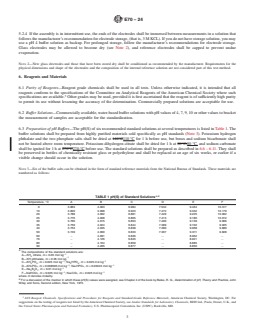
TABLE 1 pH(S) of Standard Solutions
Temperature, °C A B C D E F
0 3.863 4.003 6.984 7.534 9.464 10.317
10 3.820 3.998 6.923 7.472 9.332 10.179
20 3.788 4.002 6.881 7.429 9.225 10.062
25 3.776 4.008 6.865 7.413 9.180 10.012
30 3.766 4.015 6.853 7.400 9.139 9.966
35 3.759 4.024 6.844 7.389 9.102 9.925
40 3.753 4.035 6.838 7.380 9.068 9.889
50 3.749 4.060 6.833 7.367 9.011 9.828
60 . 4.091 6.836 . 8.962 .
70 . 4.126 6.845 . 8.921 .
80 . 4.164 6.859 . 8.885 .
90 . 4.205 6.877 . 8.850 .
A
The compositions of the standard solutions are:
−1
A—KH citrate, m = 0.05 mol kg
−1
B—KH phthalate, m = 0.05 mol kg
−1 −1
C—KH PO , m = 0.025 mol kg ; Na HPO , m = 0.025 mol kg
2 4 2 4
−1 −1
D—KH PO , m = 0.008695 mol kg ; Na HPO , m = 0.03043 mol kg
2 4 2 4
−1
E—Na B O , m = 0.01 mol kg
2 4 7
−1 −1
F—NaHCO , m = 0.025 mol kg ; Na CO , m = 0.025 mol kg
3 2 3
where m denotes molality.
B
For a discussion of the manner in which these pH(S) values were assigned, see Chapter 4 of the book by Bates, R. G., Determination of pH, Theory and Practice, John
Wiley and Sons, Second edition, New York, 1973.
E70 − 24
6.3 Preparation of pH Buffers—The pH(S) of six recom- 6.8 Phosphate, Standard Equimolal Solution C (molality of
mended standard solutions at several temperatures is listed in each phosphate salt = 0.025 mol ⁄kg; pH(S) = 6.865 at
Table 1. The buffer solutions shall be prepared from highly 25 °C)—Dissolve 3.388 g of potassium dihydrogen phosphate
purified materials sold specifically as pH standards (Note 3). and 3.533 g of disodium hydrogen phosphate in distilled water
Potassium hydrogen phthalate and the two phosphate salts shall and dilute to 1 L.
be dried at 110 °C for 1 h before use, but borax and sodium
6.9 Phosphate, Standard Solution D (1 + 3) (molality of
bicarbonate shall not be heated above room temperature.
KH PO = 0.008695 mol/kg, molality of Na HPO = 0.03043
2 4 2 4
Potassium dihydrogen citrate shall be dried for 1 h at 80 °C,
mol/kg); pH(S) = 7.413 at 25 °C)—Dissolve 1.179 g of potas-
and sodium carbonate shall be ignited for 1 h at 270 °C before
sium dihydrogen phosphate and 4.302 g of disodium hydrogen
use. The standard solutions shall be prepared as described in
phosphate in distilled water and dilute to 1 L.
6.6 – 6.11. They shall be preserved in bottles of chemically
6.10 Borax, Standard Solution E (molality = 0.01 mol/kg;
resistant glass or polyethylene and shall be replaced at an age
pH(S) = 9.180 at 25 °C)—Dissolve 3.80 g of sodium tetrabo-
of six weeks, or earlier if a visible change should occur in the
rate decahydrate (borax) in distilled water and dilute to 1 L.
solution.
6.11 Carbonate, Standard Solution F (molality of each
NOTE 3—Six of the buffer salts can be obtained in the form of standard
carbonate salt = 0.025 mol ⁄kg; pH(S) = 10.012 at 25 °C)—
reference materials from the National Bureau of Standards. These mate-
rials are numbered as follows: Dissolve 2.092 g of sodium bicarbonate and 2.640 g of sodium
Buffer Salt SRM No. carbonate in distilled water and dilute to 1 L.
Potassium hydrogen phthalate 185
Potassium dihydrogen phosphate 186I
7. Hazards
Disodium hydrogen phosphate 186II
Borax 187
7.1 Consult current OSHA regulations, suppliers’ Safety
Sodium bicarbonate 191
Data Sheets, and local regulations for all materials used in this
Sodium carbonate 192
test method.
The pH(S) values may vary slightly from one lot to another;
7.2 The use of the more toxic calomel (mercuric chloride)
consequently, the values given on the SRM certificate should be used in
preference to those given in Table 2, if slight differences exist.
electrodes has been almost completely eliminated in commer-
cial laboratories in the United States. They have been sup-
6.4 Commercial standard buffers are available. For the most
planted for the most part by safer silver-silver chloride refer-
exact measurements, the value of the commercial buffer should
ence electrodes, and to a smaller extent, by redox coupled
be verified using one of the recommended standard buffers in
systems such as an iodide salt system. Therefore, for safety
Table 1.
reasons, it is recommended to use the safer, newer reference
6.5 Purity of Water—Unless otherwise indicated, references
electrodes than the calomel reference electrode.
to water shall be understood to mean Type I or Type II. For the
preparation of the citrate, phthalate, and phosphate solutions,
8. Calibration and Standardization
the water need not be freed of dissolved carbon dioxide. The
8.1 Set up the instrument in accordance with the manufac-
water used for the borax standard and the carbonate standard
turer’s instructions. Rinse the glass and reference electrodes
shall be boiled for 15 min or purged with air free of carbon
with Type 1 or Type 2 water into a container. Allow the water
dioxide and shall be protected with a soda-lime tube or
to drain from the electrodes. Set the meter temperature setting
equivalent while cooling and in storage. The pH of the carbon
to the ambient temperature of the lab and buffers.
dioxide-free water shall be between 6.6 and 7.5 at 25 °C. The
temperature of the water used to prepare the standards shall be
8.2 Warm or cool test specimen to agree within 2 °C of
within 2 °C of 25 °C. The amounts of the buffer salts given in
buffer solutions used to calibrate the instrument. Follow the
6.3 through 6.8 are weights in air near sea level determined
manufacturer’s instructions for the calibration sequence taking
with brass weights.
care to rinse the electrodes after each measurement of buffer or
standard solution. Calibrate the instrument with at least two
6.6 Citrate, Standard Solution A (molality = 0.05 mol/kg;
standard solutions (Note 4) to bracket the anticipated pH, if
pH(S) = 3.776 at 25 °C)—Dissolve 11.41 g of potassium
possible. In order to reduce the
...
This document is not an ASTM standard and is intended only to provide the user of an ASTM standard an indication of what changes have been made to the previous version. Because
it may not be technically possible to adequately depict all changes accurately, ASTM recommends that users consult prior editions as appropriate. In all cases only the current version
of the standard as published by ASTM is to be considered the official document.
Designation: E70 − 19 E70 − 24
Standard Test Method for
pH of Aqueous Solutions With the Glass Electrode
This standard is issued under the fixed designation E70; the number immediately following the designation indicates the year of original
adoption or, in the case of revision, the year of last revision. A number in parentheses indicates the year of last reapproval. A superscript
epsilon (´) indicates an editorial change since the last revision or reapproval.
This standard has been approved for use by agencies of the U.S. Department of Defense.
1. Scope*
1.1 This test method specifies the apparatus and procedures for the electrometric measurement of pH values of aqueous solutions
with the glass electrode. It does not deal with the manner in which the solutions are prepared. pH measurements of good precision
can be made in aqueous solutions containing high concentrations of electrolytes or water-soluble organic compounds, or both. It
should be understood, however, that pH measurements in such solutions are only a semiquantitative indication of hydrogen ion
concentration or activity. The measured pH will yield an accurate result for these quantities only when the composition of the
medium matches approximately that of the standard reference solutions. In general, this test method will not give an accurate
measure of hydrogen ion activity unless the pH lies between 2 and 12 and the concentration of neither electrolytes nor
nonelectrolytes exceeds 0.1 mol/L (M).
1.2 The values stated in SI units are to be regarded as standard. The values in parentheses are for information only.
1.3 In determining the conformance of the test results using this method to applicable specifications, results shall be rounded off
in accordance with the rounding-off method of Practice E29.
1.4 This standard does not purport to address all of the safety concerns, if any, associated with its use. It is the responsibility
of the user of this standard to establish appropriate safety, health, and environmental practices and determine the applicability of
regulatory limitations prior to use.
1.5 This international standard was developed in accordance with internationally recognized principles on standardization
established in the Decision on Principles for the Development of International Standards, Guides and Recommendations issued
by the World Trade Organization Technical Barriers to Trade (TBT) Committee.
2. Referenced Documents
2.1 ASTM Standards:
D1193 Specification for Reagent Water
D1293 Test Methods for pH of Water
D5128 Test Method for On-Line pH Measurement of Water of Low Conductivity
D5464 Test Method for pH Measurement of Water of Low Conductivity
D6569 Test Method for On-Line Measurement of pH
D6809 Guide for Quality Control and Quality Assurance Procedures for Aromatic Hydrocarbons and Related Materials
This test method is under the jurisdiction of ASTM Committee D16 on Aromatic, Industrial, Specialty and Related Chemicals and is the direct responsibility of
Subcommittee D16.04 on Instrumental Analysis.
Current edition approved Nov. 1, 2019Jan. 1, 2024. Published December 2019January 2024. Originally approved in 1952. Last previous edition approved in 20152019
as E70 – 07 (2015).E70 – 19. DOI: 10.1520/E0070-19.10.1520/E0070-24.
For referenced ASTM standards, visit the ASTM website, www.astm.org, or contact ASTM Customer Service at service@astm.org. For Annual Book of ASTM Standards
volume information, refer to the standard’s Document Summary page on the ASTM website.
*A Summary of Changes section appears at the end of this standard
Copyright © ASTM International, 100 Barr Harbor Drive, PO Box C700, West Conshohocken, PA 19428-2959. United States
E70 − 24
E29 Practice for Using Significant Digits in Test Data to Determine Conformance with Specifications
E180 Practice for Determining the Precision of ASTM Methods for Analysis and Testing of Industrial and Specialty Chemicals
(Withdrawn 2009)
E691 Practice for Conducting an Interlaboratory Study to Determine the Precision of a Test Method
E1910/E1910M Test Method for Agricultural pH Control Agents, Measurement of pH Change and Buffering Capacity
2.2 Other Documents:
OSHA Regulations, 29 CFR, paragraphs 1910.1000 and 1910.1200
3. Terminology
3.1 Definitions:
3.1.1 pH—pH, n—defined formally as the negative logarithm to the base 10 of the conventional hydrogen ion activity. See
Appendix X1.
3.2 Definitions of Terms Specific to This Standard:
3.2.1 For the purpose of this test method, the term “meter” shall apply to the instrument used for the measurement of potential
(either in millivolts or in terms of pH units), the term “electrodes” to the glass electrode and the reference electrode, and the term
“assembly” to the combination of the meter and the electrodes. The performance of the meter shall be differentiated from that of
the electrodes.
4. Significance and Use
4.1 pH is, within the limits described in 1.1, an accurate measurement of the hydrogen ion concentration and thus is widely used
for the characterization of aqueous solutions.
4.2 pH measurement is one of the main process control variables in the chemical industry and has a prominent place in pollution
control.
5. Apparatus
5.1 pH meters—Many excellent pH meters are available from commercial sources. To some extent, the choice of meter will
depend on the desired precision of measurement. The meter may operate on a null-detection principle or may utilize digital readout
or a direct deflection meter with a large scale. Power may be supplied by batteries or a-c operation may be provided. The maximum
−12
grid current drawn from the glass electrode during measurement shall not exceed 2 × 10 A. Automatic or manual adjustment
shall allow for changes in F/(RT ln 10) when the temperature of the assembly is altered. For referee work, or in case of dispute,
meters capable of discriminating changes of pH to 0.01 unit (0.6 mV) or less shall be used.
5.2 Reference Electrodes and Glass Electrodes:
5.2.1 The silver-silver chloride electrode is suitable as reference electrodes in pH assemblies (Note 1 and 7.2). The design of the
electrode shall permit a fresh liquid junction between the solution of potassium chloride and the buffer or test solution to be formed
for each test and shall allow traces of solution to be readily removed by washing.
NOTE 1—Other reference electrodes of constant potential may be used, provided no difficulty is experienced in standardizing the assembly as described
in Section 8. Combination pH electrodes with or without integrated temperature sensor are permitted for use with this test method.
5.2.2 The silver-silver chloride electrode also is used widely as a reference electrode and has replaced the mercury containing
calomel electrode.
5.2.3 Commercial glass electrodes are designed for certain specific ranges of pH and temperature; consequently, the pH and
temperature of the test solutions shall be considered in selecting the glass electrode for use. The pH response shall conform with
the requirements set forth in Appendix X2. The leads shall be shielded from the effects of body capacitance.
The last approved version of this historical standard is referenced on www.astm.org.
Available from U.S. Government Printing Office, Superintendent of Documents, 732 N. Capitol St., NW, Washington, DC 20401-0001, http://www.access.gpo.gov.
E70 − 24
5.2.4 If the assembly is in intermittent use, the ends of the electrodes shall be immersed between measurements in a solution that
follows the manufacturer’s recommendation for electrode storage, (that is, 3 M KCL). If you do not have storage solution, you may
use a pH 4 buffer solution as backup. For prolonged storage, follow the manufacturer’s recommendations for electrode storage.
Glass electrodes may be allowed to become dry (see Note 2), and reference electrodes shall be capped to prevent undue
evaporation.
NOTE 2—New glass electrodes and those that have been stored dry shall be conditioned as recommended by the manufacturer. Requirements for the
physical dimensions and shape of the electrodes and the composition of the internal reference solution are not considered part of this test method.
6. Reagents and Materials
6.1 Purity of Reagents—Reagent grade chemicals shall be used in all tests. Unless otherwise indicated, it is intended that all
reagents conform to the specifications of the Committee on Analytical Reagents of the American Chemical Society where such
specifications are available. Other grades may be used, provided it is first ascertained that the reagent is of sufficiently high purity
to permit its use without lessening the accuracy of the determination. Commercially prepared solutions are acceptable for use.
6.2 Buffer Solutions—Commercially available, water-based buffer solutions with pH values of 4, 7, 9, 10 or other values to bracket
the measurement of samples are acceptable for the standardization.
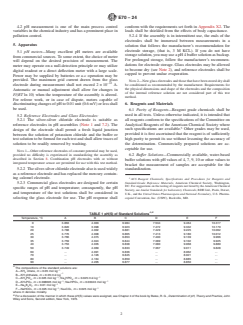
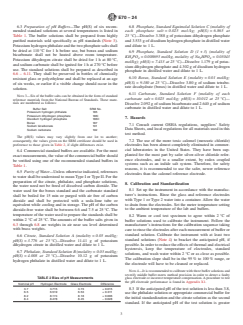
6.3 Preparation of pH Buffers—The pH(S) of six recommended standard solutions at several temperatures is listed in Table 1. The
buffer solutions shall be prepared from highly purified materials sold specifically as pH standards (Note 3). Potassium hydrogen
phthalate and the two phosphate salts shall be dried at 110°C110 °C for 1 h before use, but borax and sodium bicarbonate shall
not be heated above room temperature. Potassium dihydrogen citrate shall be dried for 1 h at 80°C,80 °C, and sodium carbonate
shall be ignited for 1 h at 270°C270 °C before use. The standard solutions shall be prepared as described in 6.6 – 6.11. They shall
be preserved in bottles of chemically resistant glass or polyethylene and shall be replaced at an age of six weeks, or earlier if a
visible change should occur in the solution.
NOTE 3—Six of the buffer salts can be obtained in the form of standard reference materials from the National Bureau of Standards. These materials are
numbered as follows:
A,B
TABLE 1 pH(S) of Standard Solutions
Temperature, °C A B C D E F
0 3.863 4.003 6.984 7.534 9.464 10.317
10 3.820 3.998 6.923 7.472 9.332 10.179
20 3.788 4.002 6.881 7.429 9.225 10.062
25 3.776 4.008 6.865 7.413 9.180 10.012
30 3.766 4.015 6.853 7.400 9.139 9.966
35 3.759 4.024 6.844 7.389 9.102 9.925
40 3.753 4.035 6.838 7.380 9.068 9.889
50 3.749 4.060 6.833 7.367 9.011 9.828
60 . 4.091 6.836 . 8.962 .
70 . 4.126 6.845 . 8.921 .
80 . 4.164 6.859 . 8.885 .
90 . 4.205 6.877 . 8.850 .
A
The compositions of the standard solutions are:
−1
A—KH citrate, m = 0.05 mol kg
−1
B—KH phthalate, m = 0.05 mol kg
−1 −1
C—KH PO , m = 0.025 mol kg ; Na HPO , m = 0.025 mol kg
2 4 2 4
−1 −1
D—KH PO , m = 0.008695 mol kg ; Na HPO , m = 0.03043 mol kg
2 4 2 4
−1
E—Na B O , m = 0.01 mol kg
2 4 7
−1 −1
F—NaHCO , m = 0.025 mol kg ; Na CO , m = 0.025 mol kg
3 2 3
where m denotes molality.
B
For a discussion of the manner in which these pH(S) values were assigned, see Chapter 4 of the book by Bates, R. G., Determination of pH, Theory and Practice, John
Wiley and Sons, Second edition, New York, 1973.
ACS Reagent Chemicals, Specifications and Procedures for Reagents and Standard-Grade Reference Materials, American Chemical Society, Washington, DC. For
suggestions on the testing of reagents not listed by the American Chemical Society, see Analar Standards for Laboratory Chemicals, BDH Ltd., Poole, Dorset, U.K., and
the United States Pharmacopeia and National Formulary, U.S. Pharmacopeial Convention, Inc. (USPC), Rockville, MD.
E70 − 24
Buffer Salt SRM No.
Potassium hydrogen phthalate 185
Potassium dihydrogen phosphate 186I
Disodium hydrogen phosphate 186II
Borax 187
Sodium bicarbonate 191
Sodium carbonate 192
The pH(S) values may vary slightly from one lot to another; consequently, the values given on the SRM certificate should be used in preference to
those given in Table 2, if slight differences exist.
6.4 Commercial standard buffers are available. For the most exact measurements, the value of the commercial buffer should be
verified using one of the recommended standard buffers in Table 1.
6.5 Distilled Purity of Water—The conductivity of the distilled water shall not exceed 2 × 10Unless otherwise indicated, references
−6 −1
to water shall be understood to s · cmmean Type I . For or Type II. For the preparation of the citrate, phthalate, and phosphate
solutions, the water need not be freed of dissolved carbon dioxide. The water used for the borax standard and the carbonate
standard shall be boiled for 15 min or purged with air free of carbon dioxide and shall be protected with a soda-lime tube or
equivalent (Note 4) while cooling and in storage. The pH of the carbon dioxide-free water shall be between 6.6 and 7.5 at
25°C.25 °C. The temperature of the water used to prepare the standards shall be within 2°C of 25°C.2 °C of 25 °C. The amounts
of the buffer salts given in 6.3 through 6.8 are weights in air near sea level determined with brass weights.
NOTE 4—The water used for preparing the standard buffer solutions shall be Types I or II reagent water in accordance with Specification D1193.
Precautions shall be taken to prevent contamination of the distilled water with traces of the material used for protection against carbon dioxide.
6.6 Citrate, Standard Solution A (molality = 0.05 mol/kg; pH(S) = 3.776 at 25°C)—25 °C)—Dissolve 11.41 g of potassium
dihydrogen citrate in distilled water and dilute to 1 L.
6.7 Phthalate, Standard Solution B (molality = 0.05 mol/kg; pH(S) = 4.008 at 25°C)—25 °C)—Dissolve 10.12 g of potassium
hydrogen phthalate in distilled water and dilute to 1 L.
6.8 Phosphate, Standard Equimolal Solution C (molality of each phosphate salt = 0.025 mol ⁄kg; pH(S) = 6.865 at 25°C)—
25 °C)—Dissolve 3.388 g of potassium dihydrogen phosphate and 3.533 g of disodium hydrogen phosphate in distilled water and
dilute to 1 L.
6.9 Phosphate, Standard Solution D (1 + 3) (molality of KH PO = 0.008695 mol/kg, molality of Na HPO = 0.03043 mol/kg);
2 4 2 4
pH(S) = 7.413 at 25°C)—25 °C)—Dissolve 1.179 g of potassium dihydrogen phosphate and 4.302 g of disodium hydrogen
phosphate in distilled water and dilute to 1 L.
6.10 Borax, Standard Solution E (molality = 0.01 mol/kg; pH(S) = 9.180 at 25°C)—25 °C)—Dissolve 3.80 g of sodium tetraborate
decahydrate (borax) in distilled water and dilute to 1 L.
6.11 Carbonate, Standard Solution F (molality of each carbonate salt = 0.025 mol ⁄kg; pH(S) = 10.012 at 25°C)—25 °C)—
Dissolve 2.092 g of sodium bicarbonate and 2.640 g of sodium carbonate in distilled water and dilute to 1 L.
7. Hazards
7.1 Consult current OSHA regulations, suppliers’ Safety Data Sheets, and local regulations for all materials used in this test
method.
TABLE 2 Bias of pH Measurements
Nominal pH Hydrogen Electrode Glass Electrode Difference
3.7 3.715 3.73 + 0.015
6.5 6.519 6.53 + 0.011
8.2 8.174 8.18 + 0.006
8.4 8.478 8.45 – 0.028
E70 − 24
7.2 The use of the more toxic calomel (mercuric chloride) electrodes has been almost completely eliminated in commercial
laboratories in the United States. They have been supplanted for the most part by safer silver-silver chloride reference electrodes,
and to a smaller extent, by redox coupled systems such as an iodide salt system. Therefore, for safety reasons, it is recommended
to use the safer, newer reference electrodes than the calomel reference electrode.
8. Calibration and Standardization
8.1 Set up the instrument in accordance with the manufacturer’s instructions. Rinse the glass and reference electrode
...