

ASTM E2409-20a
(Test Method)Standard Test Method for Glycol Impurities in Mono-, Di-, Tri- and Tetraethylene Glycol and in Mono- and Dipropylene Glycol(Gas Chromatographic Method)
General Information
- Abstract
SIGNIFICANCE AND USE
4.1 Knowledge of the impurities is required to establish whether the product meets the requirements of its specifications.
SCOPE
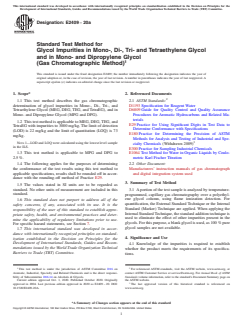
1.1 This test method describes the gas chromatographic determination of glycol impurities in Mono-, Di-, Tri-, and Tetraethylene Glycol (MEG, DEG, TEG, and TetraEG), and in Mono- and Dipropylene Glycol (MPG and DPG).
1.2 This test method is applicable to MEG, DEG, TEG, and TetraEG with impurities to 3000 mg/kg. The limit of detection (LOD) is 22 mg/kg and the limit of quantitation (LOQ) is 73 mg/kg.
Note 1: LOD and LOQ were calculated using the lowest level sample in the ILS.
1.3 This test method is applicable to MPG and DPG to 2.5 %.
1.4 The following applies for the purposes of determining the conformance of the test results using this test method to applicable specifications, results shall be rounded off in accordance with the rounding-off method of Practice E29.
1.5 The values stated in SI units are to be regarded as standard. No other units of measurement are included in this standard.
1.6 This standard does not purport to address all of the safety concerns, if any, associated with its use. It is the responsibility of the user of this standard to establish appropriate safety, health, and environmental practices and determine the applicability of regulatory limitations prior to use. For specific hazard statements, see Section 7.
1.7 This international standard was developed in accordance with internationally recognized principles on standardization established in the Decision on Principles for the Development of International Standards, Guides and Recommendations issued by the World Trade Organization Technical Barriers to Trade (TBT) Committee.
- Status
- Published
- Publication Date
- 30-Sep-2020
- Technical Committee
- D16 - Aromatic, Industrial, Specialty and Related Chemicals
- Drafting Committee
- D16.14 - Alcohols & Glycols
Buy Documents
ASTM E2409-20a - Standard Test Method for Glycol Impurities in Mono-, Di-, Tri- and Tetraethylene Glycol and in Mono- and Dipropylene Glycol<brk/>(Gas Chromatographic Method)
REDLINE ASTM E2409-20a - Standard Test Method for Glycol Impurities in Mono-, Di-, Tri- and Tetraethylene Glycol and in Mono- and Dipropylene Glycol<brk/>(Gas Chromatographic Method)
Overview
ASTM E2409-20a is a standard test method developed by ASTM International for the determination of glycol impurities in mono-, di-, tri-, and tetraethylene glycol (MEG, DEG, TEG, TetraEG), as well as mono- and dipropylene glycol (MPG, DPG) using gas chromatographic (GC) analysis. This method enables laboratories and manufacturers to quantitatively analyze glycol impurities to verify product quality and compliance with industry or regulatory specifications, thus supporting safety and supply chain integrity in chemical processing and related applications.
Key Topics
- Test Method Scope
- Applicable to ethylene glycols (MEG, DEG, TEG, TetraEG) for impurity levels up to 3000 mg/kg.
- Suitable for propylene glycols (MPG, DPG) with impurity levels up to 2.5% (mass/mass).
- Specifies limits for detection (LOD) and quantitation (LOQ) to ensure measurement reliability.
- Significance and Use
- Supports the evaluation of glycol product quality.
- Results are used to determine conformity to commercial and industrial specifications.
- Informs decisions in procurement, product acceptance, and release.
- Test Methodology
- Utilizes capillary gas chromatography (GC) with flame ionization detection.
- Employs either an internal or external standard calibration technique.
- Requires precise weighing, calibrated solutions, and chromatographic integration for accuracy.
- Precision and Reporting
- Outlines statistical quality control practices, repeatability, and reproducibility based on collaborative laboratory studies.
- Guides users on correct data reporting, rounding procedures, and determination of product purity.
- Safety and Quality
- Mandates compliance with laboratory safety and local regulations.
- Recommends quality control programs and participation in interlaboratory testing.
- Aligns with international standardization principles.
Applications
The ASTM E2409-20a standard test method is widely used in various industries, including:
- Chemical Manufacturing: Routine quality control of MEG, DEG, TEG, TetraEG, MPG, and DPG to ensure product specification conformity.
- Petrochemical Production: Verification of feedstock and intermediate chemical purity.
- Pharmaceutical and Cosmetic Formulation: Ensures raw glycols meet strict purity requirements, minimizing unwanted impurities that could affect product performance.
- Industrial Lubricants and Coolants: Analysis of glycols used in antifreeze, heat transfer fluids, and related formulations.
- Regulatory Compliance: Provides documented, reliable impurity measurements required for safety, environmental, and trade compliance.
- Research and Development: Supports the development of high-purity glycol grades and process optimization.
Related Standards
ASTM E2409-20a references and aligns with several other key standards commonly used in chemical analysis and quality control:
- ASTM D1193 - Specification for Reagent Water
- ASTM E29 - Practice for Using Significant Digits in Test Data to Determine Conformance with Specifications
- ASTM E300 - Practice for Sampling Industrial Chemicals
- ASTM E1064 - Test Method for Water in Organic Liquids by Coulometric Karl Fischer Titration
- ASTM D6809 - Guide for Quality Control and Quality Assurance Procedures for Aromatic Hydrocarbons and Related Materials
Adherence to these related standards ensures consistent, accurate, and internationally recognized methodologies for the detection and quantitation of glycol impurities in commercial and industrial environments.
Keywords: ASTM E2409-20a, glycol impurities, MEG, DEG, TEG, TetraEG, MPG, DPG, gas chromatographic method, chemical analysis, quality control, industrial chemicals, impurity detection, product specification, laboratory testing
Relations
- Effective Date
- 01-Jan-2024
- Effective Date
- 01-Nov-2016
- Effective Date
- 01-Oct-2008
- Effective Date
- 01-Jun-2007
- Effective Date
- 15-Nov-2006
- Effective Date
- 15-Sep-2006
- Effective Date
- 01-May-2006
- Effective Date
- 01-Mar-2006
- Effective Date
- 01-Dec-2004
- Effective Date
- 10-Jun-2002
- Effective Date
- 10-May-2002
- Effective Date
- 10-May-1999
- Effective Date
- 10-Feb-1999
- Effective Date
- 10-Feb-1999
Buy Documents
ASTM E2409-20a - Standard Test Method for Glycol Impurities in Mono-, Di-, Tri- and Tetraethylene Glycol and in Mono- and Dipropylene Glycol<brk/>(Gas Chromatographic Method)
REDLINE ASTM E2409-20a - Standard Test Method for Glycol Impurities in Mono-, Di-, Tri- and Tetraethylene Glycol and in Mono- and Dipropylene Glycol<brk/>(Gas Chromatographic Method)
Get Certified
Connect with accredited certification bodies for this standard

ECOCERT
Organic and sustainability certification.

Eurofins Food Testing Global
Global leader in food, environment, and pharmaceutical product testing.

Intertek Bangladesh
Intertek certification and testing services in Bangladesh.
Sponsored listings
Frequently Asked Questions
ASTM E2409-20a is a standard published by ASTM International. Its full title is "Standard Test Method for Glycol Impurities in Mono-, Di-, Tri- and Tetraethylene Glycol and in Mono- and Dipropylene Glycol<brk/>(Gas Chromatographic Method)". This standard covers: SIGNIFICANCE AND USE 4.1 Knowledge of the impurities is required to establish whether the product meets the requirements of its specifications. SCOPE 1.1 This test method describes the gas chromatographic determination of glycol impurities in Mono-, Di-, Tri-, and Tetraethylene Glycol (MEG, DEG, TEG, and TetraEG), and in Mono- and Dipropylene Glycol (MPG and DPG). 1.2 This test method is applicable to MEG, DEG, TEG, and TetraEG with impurities to 3000 mg/kg. The limit of detection (LOD) is 22 mg/kg and the limit of quantitation (LOQ) is 73 mg/kg. Note 1: LOD and LOQ were calculated using the lowest level sample in the ILS. 1.3 This test method is applicable to MPG and DPG to 2.5 %. 1.4 The following applies for the purposes of determining the conformance of the test results using this test method to applicable specifications, results shall be rounded off in accordance with the rounding-off method of Practice E29. 1.5 The values stated in SI units are to be regarded as standard. No other units of measurement are included in this standard. 1.6 This standard does not purport to address all of the safety concerns, if any, associated with its use. It is the responsibility of the user of this standard to establish appropriate safety, health, and environmental practices and determine the applicability of regulatory limitations prior to use. For specific hazard statements, see Section 7. 1.7 This international standard was developed in accordance with internationally recognized principles on standardization established in the Decision on Principles for the Development of International Standards, Guides and Recommendations issued by the World Trade Organization Technical Barriers to Trade (TBT) Committee.
SIGNIFICANCE AND USE 4.1 Knowledge of the impurities is required to establish whether the product meets the requirements of its specifications. SCOPE 1.1 This test method describes the gas chromatographic determination of glycol impurities in Mono-, Di-, Tri-, and Tetraethylene Glycol (MEG, DEG, TEG, and TetraEG), and in Mono- and Dipropylene Glycol (MPG and DPG). 1.2 This test method is applicable to MEG, DEG, TEG, and TetraEG with impurities to 3000 mg/kg. The limit of detection (LOD) is 22 mg/kg and the limit of quantitation (LOQ) is 73 mg/kg. Note 1: LOD and LOQ were calculated using the lowest level sample in the ILS. 1.3 This test method is applicable to MPG and DPG to 2.5 %. 1.4 The following applies for the purposes of determining the conformance of the test results using this test method to applicable specifications, results shall be rounded off in accordance with the rounding-off method of Practice E29. 1.5 The values stated in SI units are to be regarded as standard. No other units of measurement are included in this standard. 1.6 This standard does not purport to address all of the safety concerns, if any, associated with its use. It is the responsibility of the user of this standard to establish appropriate safety, health, and environmental practices and determine the applicability of regulatory limitations prior to use. For specific hazard statements, see Section 7. 1.7 This international standard was developed in accordance with internationally recognized principles on standardization established in the Decision on Principles for the Development of International Standards, Guides and Recommendations issued by the World Trade Organization Technical Barriers to Trade (TBT) Committee.
ASTM E2409-20a is classified under the following ICS (International Classification for Standards) categories: 71.040.50 - Physicochemical methods of analysis. The ICS classification helps identify the subject area and facilitates finding related standards.
ASTM E2409-20a has the following relationships with other standards: It is inter standard links to ASTM E1064-24, ASTM D6809-02(2016), ASTM E29-08, ASTM D6809-02(2007), ASTM E29-06b, ASTM E29-06a, ASTM E29-06, ASTM D1193-06, ASTM E29-04, ASTM D6809-02, ASTM E29-02e1, ASTM E29-93a(1999), ASTM D1193-99, ASTM D1193-99e1. Understanding these relationships helps ensure you are using the most current and applicable version of the standard.
ASTM E2409-20a is available in PDF format for immediate download after purchase. The document can be added to your cart and obtained through the secure checkout process. Digital delivery ensures instant access to the complete standard document.
Standards Content (Sample)
This international standard was developed in accordance with internationally recognized principles on standardization established in the Decision on Principles for the
Development of International Standards, Guides and Recommendations issued by the World Trade Organization Technical Barriers to Trade (TBT) Committee.
Designation: E2409 − 20a
Standard Test Method for
Glycol Impurities in Mono-, Di-, Tri- and Tetraethylene Glycol
and in Mono- and Dipropylene Glycol
(Gas Chromatographic Method)
This standard is issued under the fixed designation E2409; the number immediately following the designation indicates the year of
original adoption or, in the case of revision, the year of last revision. A number in parentheses indicates the year of last reapproval. A
superscript epsilon (´) indicates an editorial change since the last revision or reapproval.
1. Scope* 2. Referenced Documents
2.1 ASTM Standards:
1.1 This test method describes the gas chromatographic
determination of glycol impurities in Mono-, Di-, Tri-, and D1193 Specification for Reagent Water
Tetraethylene Glycol (MEG, DEG, TEG, and TetraEG), and in D6809 Guide for Quality Control and Quality Assurance
Mono- and Dipropylene Glycol (MPG and DPG). Procedures for Aromatic Hydrocarbons and Related Ma-
terials
1.2 This test method is applicable to MEG, DEG, TEG, and
E29 Practice for Using Significant Digits in Test Data to
TetraEG with impurities to 3000 mg/kg. The limit of detection
Determine Conformance with Specifications
(LOD) is 22 mg/kg and the limit of quantitation (LOQ) is 73
E180 Practice for Determining the Precision of ASTM
mg/kg.
Methods for Analysis and Testing of Industrial and Spe-
NOTE 1—LOD and LOQ were calculated using the lowest level sample
cialty Chemicals (Withdrawn 2009)
in the ILS.
E300 Practice for Sampling Industrial Chemicals
1.3 This test method is applicable to MPG and DPG to
E1064 Test Method for Water in Organic Liquids by Coulo-
2.5 %.
metric Karl Fischer Titration
1.4 The following applies for the purposes of determining 2.2 Other Document:
the conformance of the test results using this test method to
Manufacturers’ instruction manuals of gas chromatograph
applicable specifications, results shall be rounded off in accor- and digital integration system used
dance with the rounding-off method of Practice E29.
3. Summary of Test Method
1.5 The values stated in SI units are to be regarded as
standard. No other units of measurement are included in this 3.1 Aportion of the test sample is analyzed by temperature-
standard. programmed, capillary gas chromatography over a polyethyl-
ene glycol column, using flame ionization detection. For
1.6 This standard does not purport to address all of the
quantification, the External Standard Technique or the Internal
safety concerns, if any, associated with its use. It is the
Standard (Marker) Technique are applied. When applying the
responsibility of the user of this standard to establish appro-
Internal StandardTechnique, the standard addition technique is
priate safety, health, and environmental practices and deter-
used to eliminate the effect of other impurities present in the
mine the applicability of regulatory limitations prior to use.
glycols. For this purpose, a blank glycol is used, as 100 % pure
For specific hazard statements, see Section 7.
glycol samples are not available.
1.7 This international standard was developed in accor-
dance with internationally recognized principles on standard-
4. Significance and Use
ization established in the Decision on Principles for the
Development of International Standards, Guides and Recom-
4.1 Knowledge of the impurities is required to establish
mendations issued by the World Trade Organization Technical
whether the product meets the requirements of its specifica-
Barriers to Trade (TBT) Committee.
tions.
1 2
This test method is under the jurisdiction of ASTM Committee D16 on For referenced ASTM standards, visit the ASTM website, www.astm.org, or
Aromatic, Industrial, Specialty and Related Chemicals and is the direct responsi- contact ASTM Customer Service at service@astm.org. For Annual Book of ASTM
bility of Subcommittee D16.14 on Alcohols & Glycols. Standards volume information, refer to the standard’s Document Summary page on
Current edition approved Oct. 1, 2020. Published October 2020. Originally the ASTM website.
approved in 2004. Last previous edition approved in 2020 as E2409 – 20. DOI: The last approved version of this historical standard is referenced on
10.1520/E2409-20A. www.astm.org.
*A Summary of Changes section appears at the end of this standard
Copyright © ASTM International, 100 Barr Harbor Drive, PO Box C700, West Conshohocken, PA 19428-2959. United States
E2409 − 20a
5. Apparatus 5.5 Analytical Balance, readability 0.1 mg, calibrated. Re-
calibrate or verify at regular intervals.
5.1 Autoinjectors are required for all gas chromatograph
standards using an external standard to calculate results. 5.6 Crimp Top Vials, 1 mL and 5 mL.
5.2 Gas Chromatograph(s), provided with a sample splitter 5.7 Crimper/De-capper, for capping and de-capping the
or on-column injection, flame ionization detector and vials.
temperature-programming facilities. Optional are pressure pro-
5.8 Micro Syringes, 10 µL.
gramming and auto sampler facilities. The instrument must be
5.9 Bottles, 50 mL, with screw cap.
suitable for analysis according to the operating instructions
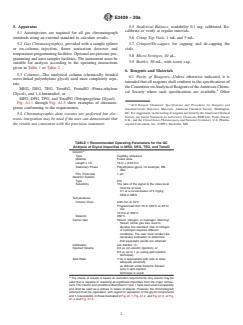
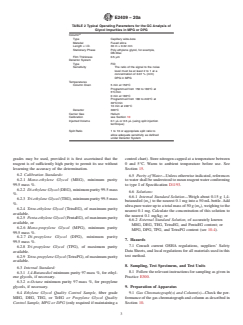
given in Table 1 or Table 2.
6. Reagents and Materials
5.3 Columns—The analytical column (chemically bonded
6.1 Purity of Reagents—Unless otherwise indicated, it is
cross-linked polyethylene glycol) used must completely sepa-
intended that all reagents shall conform to the specifications of
rate.
theCommitteeonAnalyticalReagentsoftheAmericanChemi-
MEG, DEG, TEG, TetraEG, PentaEG (Penta-ethylene
cal Society where such specifications are available. Other
Glycol), and 1,4-butanediol, or
MPG, DPG, TPG, and TetraPG (Tetrapropylene Glycol).
Fig. A1.1 through Fig. A1.5 show examples of chromato-
ACS Reagent Chemicals, Specifications and Procedures for Reagents and
grams conforming to the requirements.
Standard-Grade Reference Materials, American Chemical Society, Washington,
DC. For suggestions on the testing of reagents not listed by theAmerican Chemical
5.4 Chromatographic data systems are preferred but elec-
Society, see Analar Standards for Laboratory Chemicals, BDH Ltd., Poole, Dorset,
tronic integration may be used if the user can demonstrate that
U.K., and the United States Pharmacopeia and National Formulary, U.S. Pharma-
the results are consistent with the precision statement. copeial Convention, Inc. (USPC), Rockville, MD.
TABLE 1 Recommended Operating Parameters for the GC
Analysis of Glycol Impurities in MEG, DEG, TEG, and TetraG
A
Column
Type Capillary wide-bore
Material Fused silica
Length × I.D. 15m×0.53mm
Stationary Phase Polyethylene glycol, for example, DB-
Wax
Film Thickness 1 µm
Detector System
Type FID
Sensitivity The ratio of the signal to the noise level
must be at least
2:1 at a concentration of 5 mg/kg
DEG in MEG
Temperatures
Column Oven 0.05 min at 70°C
Programmed from 70 to 230°C at 25°C/
min
10 min at 230°C
Detector 250°C
Carrier Gas Helium, nitrogen, or hydrogen. Warning!
Helium carrier gas was used to
develop this standard. Use of nitrogen
or hydrogen requires different
conditions. The user must conduct the
necessary evaluation to determine
that equivalent results are obtained.
Calibration see Section 10
Injected Volume 0.2 µL (on-column injection), or
0.5 µL up to 1 µL (using split injection
technique)
Split Ratio 1:10 or appropriate split ratio to allow
adequate sensitivity
as defined under Detector System
(only if split injection
technique is used)
A
The choice of column is based on resolution requirements. Any column may be
used that is capable of resolving all significant impurities from the major compo-
nent. The column and conditions described in Table 1 have been used successfully
and shall be used as a referee in cases of dispute. However, the chromatogram
obtained must be equivalent, with regard to separation of the glycol components
and 1,4-butanediol, to those illustrated in Fig. A1.1, Fig. A1.2, and Fig. A1.3,or Fig.
A1.4 and Fig. A1.5.
E2409 − 20a
TABLE 2 Typical Operating Parameters for the GC Analysis of
Glycol Impurities in MPG or DPG
A
Column
Type Capillary wide-bore
Material Fused silica
Length × I.D. 30m×0.32mm
Stationary Phase Poly ethylene glycol, for example,
DB-Wax
Film Thickness 0.5 µm
Detector System
Type FID
Sensitivity The ratio of the signal to the noise
level must be at least 2 to 1 at a
concentration of 0.01 % (m/m)
DPG in MPG
Temperatures
Column Oven 5 min at 150°C
Programmed from 150 to 180°C at
5°C/min
0 min at 180°C
Programmed from 180 to 240°C at
30°C/min
10 min at 240°C
Detector 300°C
Carrier Gas Helium
Calibration see Section 10
Injected Volume 0.1 µL or 0.5 µL (using split injection
technique)
Split Ratio 1 to 10 or appropriate split ratio to
allow adequate sensitivity as defined
under Detector System
grades may be used, provided it is first ascertained that the control chart). Store nitrogen capped at a temperature between
reagent is of sufficiently high purity to permit its use without 0 and 5°C. Warm to ambient temperature before use. See
lessening the accuracy of the determination. Section 15.
6.2 Calibration Standards: 6.5 Purity of Water—Unless otherwise indicated, references
6.2.1 Mono-ethylene Glycol (MEG), minimum purity
towatershallbeunderstoodtomeanreagentwaterconforming
99.5 mass %. to type I of Specification D1193.
6.2.2 Di-ethylene Glycol(DEG),minimumpurity99.5 mass
6.6 Solutions:
%.
6.6.1 Internal Standard Solution—Weigh about 0.15 g 1,4-
6.2.3 Tri-ethylene Glycol(TEG),minimumpurity99.5 mass
butanediol (m ) to the nearest 0.1 mg into a 50 mLbottle.Add
%.
ultra-purewateruptoatotalmassof50g(m ),weighingtothe
6.2.4 Tetra-ethylene Glycol (TetraEG), of maximum purity
nearest 0.1 mg. Calculate the concentration of this solution to
available.
the nearest 0.1 mg/kg; or
6.2.5 Penta-ethylene Glycol (PentaEG), of maximum purity
6.6.2 External Standard Solution, of accurately known
available, or
MEG, DEG, TEG, TetraEG, and PentaEG content; or
6.2.6 Mono-propylene Glycol (MPG), minimum purity
MPG, DPG, TPG, and TetraPG content (see 10.4).
99.5 mass %.
6.2.7 Di-propylene Glycol (DPG), minimum purity
7. Hazards
99.5 mass %.
7.1 Consult current OSHA regulations, suppliers’ Safety
6.2.8 Tri-propylene Glycol (TPG), of maximum purity
Data Sheets, and local regulations for all materials used in this
available.
test method.
6.2.9 Tetra-propylene Glycol(TetraPG),ofmaximumpurity
available.
8. Sampling, Test Specimens, and Test Units
6.3 Internal Standard:
8.1 Followtherelevantinstructionsforsamplingasgivenin
6.3.1 1,4-Butanediol minimum purity 97 mass %, for ethyl-
Practice E300.
ene glycols, if necessary.
6.3.2 n-Octane minimum purity 97 mass %, for propylene
9. Preparation of Apparatus
glycols, if necessary.
6.4 Ethylene Glycol Quality Control Sample, fiber grade 9.1 Gas Chromatograph(s) and Column(s)—Check the per-
MEG, DEG, TEG, or TeEG or Propylene Glycol Quality formanceofthegaschromatographandcolumnasdescribedin
Control Sample, MPG or DPG (only required if maintaining a Section 10.
E2409 − 20a
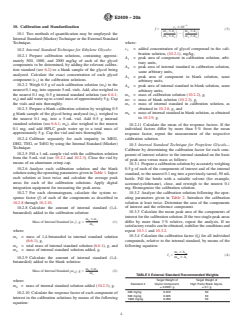
10. Calibration and Standardization c 310
f 5 (3)
m 3 A m 3 A
7 1 8 3
10.1 Two methods of quantification may be employed: the
S D S D
m 3 A m 3 A
3 2 5 4
Internal Standard (Marker)Technique or the External Standard
Technique. where:
c = added concentration of glycol compound in the cali-
10.2 Internal Standard Technique for Ethylene Glycols:
bration solution, (10.2.1), mg/kg,
10.2.1 Prepare calibration solutions, containing approxi-
A = peak area of component in calibration solution, arbi-
mately 500, 1000, and 2000 mg/kg of each of the glycol
trary units,
components to be determined, by adding the relevant calibra-
A = peak area of internal standard in calibration solution,
tion standard (see 6.2) to a blank sample of the glycol being
same arbitrary units,
analyzed. Calculate the exact concentration of each glycol
A = peak area of component in blank solution, same
component (c ) in the calibration solutions.
arbitrary units,
10.2.2 Weigh 0.5 g of each calibration solution (m)tothe
3 A = peak area of internal standard in blank solution, same
nearest 0.1 mg, into separate 5-mLvials.Add, also weighed to
arbitrary units,
the nearest 0.1 mg, 0.5 g internal standard solution (see 6.6.1;
m = mass of calibration solution (10.2.2), g,
m ) and add water up to a total mass of approximately 5 g. Cap m = mass of blank solution (10.2.3), g,
the vials and mix thoroughly. m = mass of internal standard in calibration solution, as
obtained in 10.2.8,g,and
10.2.3 Prepare a blank calibration solution by weighing 0.5
m = mass of internal standard in blank solution, as obtained
g blank sample of the glycol being analyzed (m ), weighed to 8
in 10.2.9,g.
the nearest 0.1 mg, into a 5-mL vial. Add 0.5 g internal
standard solution (see 6.6.1; m ), also weighed to the nearest
6 10.2.11 Calculate the mean of the response factors. If the
0.1 mg, and add HPLC grade water up to a total mass of
individual factors differ by more than 5 % from the mean
approximately 5 g. Cap the vial and mix thoroughly.
response factor, repeat the measurement of the respective
10.2.4 Calibrate separately for each impurity in MEG, calibration solution.
DEG, TEG, or TeEG by using the Internal Standard (Marker)
10.3 Internal Standard Technique for Propylene Glycols—
Technique.
Calibrate by determining the calibration factor for each com-
10.2.5 Fill a 1-mL sample vial with the calibration solution
ponent of interest relative to the internal standard on the basis
from the 5-mL vial (see 10.2.2 and 10.2.3). Close the vial by
of peak area versus mass as follows:
means of an aluminum crimp cap.
10.3.1 Prepareacalibrationsolutionbyaccuratelyweighing
10.2.6 Analyze each calibration solution and the blank
0.5 g of each of the components of interest and of the internal
solution using the operating parameters given in Table 1. Inject
standard, to the nearest 0.1 mg into a previously tarred, 50 mL
each solution at least twice and calculate the average peak
bottle. Fill the bottle with a suitable solvent (for example,
areas for each of the calibration solutions. Apply digital
acetone/cyclohexane), close, and reweigh to the nearest 0.1
integration equipment for measuring the peak areas.
mg. Homogenize the calibration solution.
10.2.7 For each chromatogram, calculate the system re- 10.3.2 Analyze the calibration solution following the oper-
sponse factor (f) of each of the components as described in ating parameters given in Table 2. Introduce the calibration
10.2.8 through 10.2.10. solution at least twice. Determine the area of the components
of interest and the reference component.
10.2.8 Calculate the amount of internal standard (1,4-
10.3.3 Calculate the mean peak area of the components of
butanediol) added to the calibration solution:
interestforthecalibrationsolution.Ifthetwosinglepeakareas
m 3 m
4 1
differ by more than 3 % relative, repeat the analysis. If no
Mass of Internal Standard ~m !,g 5 (1)
m
satisfactoryresultscanbeobtained,stabilizetheconditionsand
where: repeat 10.3.1 and 10.3.2.
10.3.4 Calculate the calibration factor (f ) for all individual
m = mass of 1,4-butanediol in internal standard solution
I
compounds, relative to the internal standard, by means of the
(6.6.1), g,
following equation:
m = total mass of internal standard solution (6.6.1), g, and
m = mass of internal standard solution added, g.
m 3A
i m
f 5 (4)
i
m 3A
10.2.9 Calculate the amount of internal standard (1,4- m i
butanediol) added to the blank solution:
m 3 m
6 1
Mass of Internal Standard m ,g 5 (2)
~ !
m
TABLE 3 External Standard Recommended Weights
where: Target Weight of Target Weight of
Standard # Glycol Component, High Purity Blank Glycol,
m = mass of internal standard solution added (10.2.3), g.
± 0.0001 g ± 0.1 g
200 mg/kg 0.010 50
10.2.10 Calculate the response factor of each component of
500 mg/kg 0.025 50
interest in the calibration solutions by means of the following
1000 mg/kg 0.050 50
equation:
E2409 − 20a
where:
C = the concentration (mg/kg) of the glycol com-
i
m = massofcomponentiincalibrationsolution(10.3.1),g. ponent added to the calibration standard of
i
m = mass of internal standard in calibration solution interest, and
m
(10.3.1), g. Y = absolute value of the concentration of blank
A = peak area of component i (10.3.3), arbitrary units. glycol determined from the linear regression
i
A = peak area of internal standard (10.3.3), same arbitrary
graph (intercept value) for each calibration
m
units.
standard.
NOTE 2—An alternative for the empirical calibration factors as de- 10.4.3 For each chromatogram, calculate the system re-
scribed in 10.2 and 10.3 is the use of theoretical factors, based on the
sponse factor (f) of each of the glycol components by means of
molecular structure of the compounds of interest. Theoretical factors
the following equation:
calculated are as follows: For MPG 3.045, for all DPG isomers 2.512, for
all TPG isomers 2.244, all relative to octane. See Footnote 6. Corrected C
i
f 5 (7)
A
10.4 External Standard Technique Ethylene Glycols, similar i
for Propylene Glycols:
where:
10.4.1 Prepare at least three calibration solutions, for
Corrected C = concentration of component in external stan-
i
example, containing 200, 500, and 1000 mg/kg of each of the
dard solution, mg/kg, and
glycol components to be determined, by adding the relevan
...
This document is not an ASTM standard and is intended only to provide the user of an ASTM standard an indication of what changes have been made to the previous version. Because
it may not be technically possible to adequately depict all changes accurately, ASTM recommends that users consult prior editions as appropriate. In all cases only the current version
of the standard as published by ASTM is to be considered the official document.
Designation: E2409 − 20 E2409 − 20a
Standard Test Method for
Glycol Impurities in Mono-, Di-, Tri- and Tetraethylene Glycol
and in Mono- and Dipropylene Glycol
(Gas Chromatographic Method)
This standard is issued under the fixed designation E2409; the number immediately following the designation indicates the year of
original adoption or, in the case of revision, the year of last revision. A number in parentheses indicates the year of last reapproval. A
superscript epsilon (´) indicates an editorial change since the last revision or reapproval.
1. Scope*
1.1 This test method describes the gas chromatographic determination of glycol impurities in Mono-, Di- Tri-Di-, Tri-, and
Tetraethylene Glycol (MEG, DEG, TEG and TeEG) in the range of 5 to 3000 mg/kg, TEG, and TetraEG), and in Mono- and
Dipropylene Glycol (MPG and DPG) in the range 0.01 to 2.5 % (m/m).DPG).
1.2 This test method is applicable to MEG, DEG, TEG, and TetraEG with impurities to 3000 mg/kg. The limit of detection (LOD)
is 22 mg/kg and the limit of quantitation (LOQ) is 73 mg/kg.
NOTE 1—LOD and LOQ were calculated using the lowest level sample in the ILS.
1.3 This test method is applicable to MPG and DPG to 2.5 %.
1.4 Review the current Safety Data Sheets (SDS) for detailed information concerning toxicity, first aid procedures, and safety
precautions.The following applies for the purposes of determining the conformance of the test results using this test method to
applicable specifications, results shall be rounded off in accordance with the rounding-off method of Practice E29.
1.5 The values stated in SI units are to be regarded as standard. No other units of measurement are included in this standard.
1.6 This standard does not purport to address all of the safety concerns, if any, associated with its use. It is the responsibility
of the user of this standard to establish appropriate safety, health, and environmental practices and determine the applicability of
regulatory limitations prior to use. For specific hazard statements, see Section 7.
1.7 This international standard was developed in accordance with internationally recognized principles on standardization
established in the Decision on Principles for the Development of International Standards, Guides and Recommendations issued
by the World Trade Organization Technical Barriers to Trade (TBT) Committee.
2. Referenced Documents
2.1 ASTM Standards:
D1193 Specification for Reagent Water
This test method is under the jurisdiction of ASTM Committee D16 on Aromatic, Industrial, Specialty and Related Chemicals and is the direct responsibility of
Subcommittee D16.14 on Alcohols & Glycols.
Current edition approved July 15, 2020Oct. 1, 2020. Published July 2020October 2020. Originally approved in 2004. Last previous edition approved in 20132020 as
E2409 – 13.E2409 – 20. DOI: 10.1520/E2409-20.10.1520/E2409-20A.
For referenced ASTM standards, visit the ASTM website, www.astm.org, or contact ASTM Customer Service at service@astm.org. For Annual Book of ASTM Standards
volume information, refer to the standard’s Document Summary page on the ASTM website.
*A Summary of Changes section appears at the end of this standard
Copyright © ASTM International, 100 Barr Harbor Drive, PO Box C700, West Conshohocken, PA 19428-2959. United States
E2409 − 20a
D6809 Guide for Quality Control and Quality Assurance Procedures for Aromatic Hydrocarbons and Related Materials
E29 Practice for Using Significant Digits in Test Data to Determine Conformance with Specifications
E180 Practice for Determining the Precision of ASTM Methods for Analysis and Testing of Industrial and Specialty Chemicals
(Withdrawn 2009)
E300 Practice for Sampling Industrial Chemicals
E1064 Test Method for Water in Organic Liquids by Coulometric Karl Fischer Titration
2.2 Other Document:
Manufacturers’ instruction manuals of gas chromatograph and digital integration system used
3. Summary of Test Method
3.1 A portion of the test sample is analyzed by temperature-programmed, capillary gas chromatography over a polyethylene glycol
column, using flame ionization detection. For quantification, the External Standard Technique or the Internal Standard (Marker)
Technique are applied. When applying the Internal Standard Technique, the standard addition technique is used to eliminate the
effect of other impurities present in the glycols. For this purpose, a blank glycol is used, as 100 % pure glycol samples are not
available.
4. Significance and Use
4.1 Knowledge of the impurities is required to establish whether the product meets the requirements of its specifications.
5. Apparatus
5.1 Autoinjectors are required for all gas chromatograph standards using an external standard to calculate results.
5.2 Gas Chromatograph(s), provided with a sample splitter or on-column injection, flame ionization detector and temperature-
programming facilities. Optional are pressure programming and auto sampler facilities. The instrument must be suitable for
analysis according to the operating instructions given in Table 1 or Table 2.
5.1.1 Columns—The analytical column (chemically bonded cross-linked polyethylene glycol) used must completely separate.
MEG, DEG, TEG, TeEG, PentaEG (Penta-ethylene Glycol) and 1,4-butanediol, or
MPG, DPG, TPG, and TePG
Figs. A1.1 through A1.5 show examples of chromatograms conforming to the requirements.
5.3 Columns—The analytical column (chemically bonded cross-linked polyethylene glycol) used must completely separate.
MEG, DEG, TEG, TetraEG, PentaEG (Penta-ethylene Glycol), and 1,4-butanediol, or
MPG, DPG, TPG, and TetraPG (Tetrapropylene Glycol).
Fig. A1.1 through Fig. A1.5 show examples of chromatograms conforming to the requirements.
5.4 Digital Integration Equipment. Chromatographic data systems are preferred but electronic integration may be used if the user
can demonstrate that the results are consistent with the precision statement.
5.5 Analytical Balance, readability 0.1 mg, calibrated. Re-calibrate or verify at regular intervals.
5.6 Crimp Top Vials, 1 mL and 5 mL.
5.7 Crimper/De-capper, for capping and de-capping the vials.
5.8 Micro Syringes, 10 μL.
5.9 Bottles, 50 mL, with screw cap.
The last approved version of this historical standard is referenced on www.astm.org.
E2409 − 20a
TABLE 1 TypicalRecommended Operating Parameters for the GC
Analysis of Glycol Impurities in MEG, DEG, TEG or TeEGTEG,
and TetraG
A
Column
Type Capillary wide-bore
Material Fused silica
Length × I.D. 15 m × 0.53 mm
Stationary Phase Polyethylene glycol, for example, DB-
Wax
Film Thickness 1 μm
Detector System
Type FID
Sensitivity The ratio of the signal to the noise level
must be at least
2:1 at a concentration of 5 mg/kg
DEG in MEG
Temperatures
Column Oven 0.05 min at 70°C
Programmed from 70 to 230°C at 25°C/
min
10 min at 230°C
Detector 250°C
Carrier Gas Helium or Nitrogen
Carrier Gas Helium, nitrogen, or hydrogen. Warning!
Helium carrier gas was used to
develop this standard. Use of nitrogen
or hydrogen requires different
conditions. The user must conduct the
necessary evaluation to determine
that equivalent results are obtained.
Calibration see Section 9
Calibration see Section 10
Injected Volume 0.2 μL (on-column injection), or
0.5 μL up to 1 μL (using split injection
technique)
Split Ratio 1:10 or appropriate split ratio to allow
adequate sensitivity
as defined under Detector System
(only if split injection
technique is used)
A
The mentioned DB-Wax column is available from Agilent Technologies, 5301
Stevens Creek Blvd, Santa Clara, CA 95051, USA. Other column suppliers market
equivalent stationary phaseschoice of column is based on resolution require-
ments. Any column may be used that is capable of resolving all significant
impurities from the major component. The column and conditions described in
Table 1 under trade names, therefore, it is permissible to use a different column
from an alternative supplier. have been used successfully and shall be used as a
referee in cases of dispute. However, the chromatogram obtained must be
equivalent, with regard to separation of the glycol components and 1,4-butanediol,
to those illustrated in Fig. A1.1Figs., Fig. A1.2A1.1, A1.2, , and Fig. A1.3A1.3,, or
A1.4Fig. A1.4 and Fig. A1.5A1.5.
6. Reagents and Materials
6.1 Purity of Reagents—Unless otherwise indicated, it is intended that all reagents shall conform to the specifications of the
Committee on Analytical Reagents of the American Chemical Society where such specifications are available. Other grades may
be used, provided it is first ascertained that the reagent is of sufficiently high purity to permit its use without lessening the accuracy
of the determination.
6.2 Calibration Standards:
6.2.1 Mono-ethylene Glycol (MEG), minimum purity 99.5 % mass (m/m).99.5 mass %.
6.2.2 Di-ethylene Glycol (DEG), minimum purity 99.5 % mass (m/m).99.5 mass %.
ACS Reagent Chemicals, Specifications and Procedures for Reagents and Standard-Grade Reference Materials, American Chemical Society, Washington, DC. For
suggestions on the testing of reagents not listed by the American Chemical Society, see Analar Standards for Laboratory Chemicals, BDH Ltd., Poole, Dorset, U.K., and
the United States Pharmacopeia and National Formulary, U.S. Pharmacopeial Convention, Inc. (USPC), Rockville, MD.
E2409 − 20a
TABLE 2 Typical Operating Parameters for the GC Analysis of
Glycol Impurities in MPG or DPG
A
Column
Type Capillary wide-bore
Material Fused silica
Length × I.D. 30 m × 0.32 mm
Stationary Phase Poly ethylene glycol, for example,
DB-Wax
Film Thickness 0.5 μm
Detector System
Type FID
Sensitivity The ratio of the signal to the noise
level must be at least 2 to 1 at a
concentration of 0.01 % (m/m)
DPG in MPG
Temperatures
Column Oven 5 min at 150°C
Programmed from 150 to 180°C at
5°C/min
0 min at 180°C
Programmed from 180 to 240°C at
30°C/min
10 min at 240°C
Detector 300°C
Carrier Gas Helium
Calibration see Section 9
Calibration see Section 10
Injected Volume 0.1 μL or 0.5 μL (using split injection
technique)
Split Ratio 1 to 10 or appropriate split ratio to
allow adequate sensitivity as defined
under Detector System
6.2.3 Tri-ethylene Glycol (TEG), minimum purity 99.5 % mass (m/m).99.5 mass %.
6.2.4 Tetra-ethylene Glycol (TeEG, also called TTEG), (TetraEG), of maximum purity available.
6.2.5 Penta-ethylene Glycol (PentaEG), of maximum purity available, or
6.2.6 Mono-propylene Glycol (MPG), minimum purity 99.5 % mass (m/m).99.5 mass %.
6.2.7 Di-propylene Glycol (DPG), minimum purity 99.5 % mass (m/m).99.5 mass %.
6.2.8 Tri-propylene Glycol (TPG), of maximum purity available.
6.2.9 Tetra-propylene Glycol (TePG),(TetraPG), of maximum purity available.
6.3 Internal Standard:
6.3.1 1,4-Butanediol minimum purity 97 % mass (m/m), 97 mass %, for ethylene glycols, if necessary.
6.3.2 n-Octane minimum purity 97 % mass (m/m), 97 mass %, for propylene glycols, if necessary.
6.4 Ethylene Glycol Quality Control Sample, fiber grade MEG, DEG, TEG, or TeEG or Propylene Glycol Quality Control Sample,
MPG or DPG (only required if maintaining a control chart). Store nitrogen capped at a temperature between 0 and 5°C. Warm to
ambient temperature before use. See Section 15.
6.5 Water, Purity of Water—HPLC grade.Unless otherwise indicated, references to water shall be understood to mean reagent
water conforming to type I of Specification D1193.
6.6 Solutions:
E2409 − 20a
6.6.1 Internal Standard Solution—Weigh about 0.15 g 1,4-butanediol (m ) to the nearest 0.1 mg into a 50 mL bottle. Add
ultra-pure water up to a total mass of 50 g (m ), weighing to the nearest 0.1 mg. Calculate the concentration of this solution to
the nearest 0.1 mg/kg; or
6.6.2 External Standard Solution, of accurately known
MEG, DEG, TEG, TetraEG, and TeEGPentaEG content; or
MPG, DPG, TPG, and TePGTetraPG content (see 9.410.4).
7. Hazards
7.1 Consult current OSHA regulations, suppliers’ Safety Data Sheets, and local regulations for all materials used in this test
method.
8. Sampling, Test Specimens, and Test Units
8.1 Follow the relevant instructions for sampling as given in Practice E300.
9. Preparation of Apparatus
9.1 Gas Chromatograph(s) and Column(s)—Check the performance of the gas chromatograph and column as described in Section
910.
10. Calibration and Standardization
10.1 Two methods of quantification may be employed: the Internal Standard (Marker) Technique or the External Standard
Technique.
10.2 Internal Standard Technique for Ethylene Glycols:
10.2.1 Prepare calibration solutions, containing approximately 500, 1000, and 2000 mg/kg of each of the glycol components to
be determined, by adding the relevant calibration standard (see 6.2) to a blank sample of the glycol being analyzed. Calculate the
exact concentration of each glycol component (c ) in the calibration solutions.
10.2.2 Weigh 0.5 g of each calibration solution (m ) to the nearest 0.1 mg, into separate 5-mL vials. Add, also weighed to the
nearest 0.1 mg, 0.5 g internal standard solution (see 6.6.1; m ) and add HPLC grade water up to a total mass of approximately 5
g. Cap the vials and mix thoroughly.
10.2.3 Prepare a blank calibration solution by weighing 0.5 g blank sample of the glycol being analyzed (m ), weighed to the
nearest 0.1 mg, into a 5-mL vial. Add 0.5 g internal standard solution (see 6.6.1; m ), also weighed to the nearest 0.1 mg, and add
HPLC grade water up to a total mass of approximately 5 g. Cap the vial and mix thoroughly.
10.2.4 Calibrate separately for each impurity in MEG, DEG, TEG, or TeEG by using the Internal Standard (Marker) Technique.
10.2.5 Fill a 1-mL sample vial with the calibration solution from the 5-mL vial (see 9.2.210.2.2 and 9.2.310.2.3). Close the vial
by means of an aluminum crimp cap.
10.2.6 Analyze each calibration solution and the blank solution using the operating parameters given in Table 1. Inject each
solution at least twice and calculate the average peak areas for each of the calibration solutions. Apply digital integration equipment
for measuring the peak areas.
10.2.7 For each chromatogram, calculate the system response factor (f) of each of the components as described in 9.2.810.2.8
through 9.2.1010.2.10.
10.2.8 Calculate the amount of internal standard (1,4-butanediol) added to the calibration solution:
m 3m
4 1
Mass of Internal Standard m , g5 (1)
~ !
m
E2409 − 20a
where:
m = mass of 1,4-butanediol in internal standard solution (6.6.1), g,
m = total mass of internal standard solution (6.6.1), g, and
m = mass of internal standard solution added, g.
10.2.9 Calculate the amount of internal standard (1,4-butanediol) added to the blank solution:
m 3m
6 1
Mass of Internal Standard ~m !, g5 (2)
m
where:
m = mass of internal standard solution added (9.2.3), g.
m = mass of internal standard solution added (10.2.3), g.
10.2.10 Calculate the response factor of each component of interest in the calibration solutions by means of the following
equation:
c 310
f 5 (3)
m 3A m 3A
7 1 8 3
S D S D
m 3A m 3A
3 2 5 4
where:
c = added concentration of glycol compound in the calibration solution, (9.2.1), mg/kg,
c = added concentration of glycol compound in the calibration solution, (10.2.1), mg/kg,
A = peak area of component in calibration solution, arbitrary units,
A = peak area of internal standard in calibration solution, same arbitrary units,
A = peak area of component in blank solution, same arbitrary units,
A = peak area of internal standard in blank solution, same arbitrary units,
m = mass of calibration solution (9.2.2), g,
m = mass of calibration solution (10.2.2), g,
m = mass of blank solution (9.2.3), g,
m = mass of blank solution (10.2.3), g,
m = mass of internal standard in calibration solution, as obtained in 9.2.8, g, and
m = mass of internal standard in calibration solution, as obtained in 10.2.8, g, and
m = mass of internal standard in blank solution, as obtained in 9.2.9, g.
m = mass of internal standard in blank solution, as obtained in 10.2.9, g.
10.2.11 Calculate the mean of the response factors. If the individual factors differ by more than 5 % from the mean response factor,
repeat the measurement of the respective calibration solution.
10.3 Internal Standard Technique for Propylene Glycols—Calibrate by determining the calibration factor for each component of
interest relative to the internal standard on the basis of peak area versus mass as follows:
10.3.1 Prepare a calibration solution by accurately weighing 0.5 g of each of the components of interest and of the internal
standard, to the nearest 0.1 mg into a previously tarred, 50 mL bottle. Fill the bottle with a suitable solvent (for example,
acetone/cyclohexane), close, and reweigh to the nearest 0.1 mg. Homogenize the calibration solution.
10.3.2 Analyze the calibration solution following the operating parameters given in Table 2. Introduce the calibration solution at
least twice. Determine the area of the components of interest and the reference component.
10.3.3 Calculate the mean peak area of the components of interest for the calibration solution. If the two single peak areas differ
by more than 3 % relative, repeat the analysis. If no satisfactory results can be obtained, stabilize the conditions and repeat
9.3.110.3.1 and 9.3.210.3.2.
10.3.4 Calculate the calibration factor (f ) for all individual compounds, relative to the internal standard, by means of the following
I
equation:
E2409 − 20a
TABLE 3 External Standard Recommended Weights
Target Weight of Target Weight of
Standard # Glycol Component, High Purity Blank Glycol,
± 0.0001 g ± 0.1 g
200 mg/kg 0.010 50
500 mg/kg 0.025 50
1000 mg/kg 0.050 50
m 3A
i m
f 5 (4)
i
m 3A
m i
where:
m = mass of component i in calibration solution (9.3.1), g.
i
m = mass of internal standard in calibration solution (9.3.1), g.
m
A = peak area of component i (9.3.3), arbitrary units.
i
A = peak area of internal standard (9.3.3), same arbitrary units.
m
m = mass of component i in calibration solution (10.3.1), g.
i
m = mass of internal standard in calibration solution (10.3.1), g.
m
A = peak area of component i (10.3.3), arbitrary units.
i
A = peak area of internal standard (10.3.3), same arbitrary units.
m
NOTE 2—An alternative for the empirical calibration factors as described in 9.210.2 and 9.310.3 is the use of theoretical factors, based on the molecular
structure of the compounds of interest. Theoretical factors calculated are as follows: For MPG 3.045, for all DPG isomers 2.512, for all TPG isomers
2.244, all relative to octane. See Footnote 5.6.
10.4 External Standard Technique Ethylene Glycols, similar for Propylene Glycols:
10.4.1 Prepare at least three calibration solutions, for example, containing 200, 500, and 1000 mg/kg of each of the glycol
components to be determined, by adding the relevant calibration standard (see 6.2) to a blank sample of the glycol being analyzed
and mix thoroughly. Weigh each glycol compone
...