

ASTM D6621-21
(Practice)Standard Practice for Performance Testing of Process Analyzers for Aromatic Hydrocarbon Materials
General Information
- Abstract
SIGNIFICANCE AND USE
5.1 Performance testing of on-line analyzers is critical to their proper performance within predictable levels of precision and accuracy. This practice can affect production efficiency and certification of aromatic hydrocarbon materials.
SCOPE
1.1 This practice serves as a practical guide for the performance testing of process stream analyzers specifically for measuring chemical or physical characteristics of liquid aromatic hydrocarbon materials for production or certification of these materials. The practice may be applicable to other hydrocarbon stream analyzers as well.
1.2 Only external methods (complete substitution of the process stream with a standard) of control sample introduction are included. Internal methods are beyond the scope of this practice.
1.3 Methods for resetting key operational parameters of analyzers to match predefined limits are provided by vendors and are not included in this practice.
1.4 Analyzer validation procedures are covered in Practices D3764 and D6122, not in this practice.
1.5 Procedures for statistically interpreting data from automatic sampling process stream analyzers are outlined.
1.6 The implementation of this practice requires that the analyzer be installed according to APIRP-550 (1),2 and be in agreement with the analyzer supplier’s recommendations. Also, it assumes that the analyzer is designed to monitor the specific material parameter of interest, and that at the time of initial or periodic validation, the analyzer was operating at the conditions specified by the manufacturer and consistently with the primary test method.
1.7 The units of measure used in this practice shall be the same as those applicable to the test primary method used for analyzer validation.
1.8 This standard does not purport to address all of the safety concerns, if any, associated with its use. It is the responsibility of the user of this standard to establish appropriate safety, health, and environmental practices, and determine the applicability of regulatory limitations prior to use.
1.9 This international standard was developed in accordance with internationally recognized principles on standardization established in the Decision on Principles for the Development of International Standards, Guides and Recommendations issued by the World Trade Organization Technical Barriers to Trade (TBT) Committee.
- Status
- Published
- Publication Date
- 31-Oct-2021
- Technical Committee
- D16 - Aromatic, Industrial, Specialty and Related Chemicals
- Drafting Committee
- D16.09 - On-Line Analysis
Buy Documents
ASTM D6621-21 - Standard Practice for Performance Testing of Process Analyzers for Aromatic Hydrocarbon Materials
REDLINE ASTM D6621-21 - Standard Practice for Performance Testing of Process Analyzers for Aromatic Hydrocarbon Materials
Overview
ASTM D6621-21: Standard Practice for Performance Testing of Process Analyzers for Aromatic Hydrocarbon Materials establishes practical procedures for evaluating the performance of on-line process stream analyzers. These analyzers are crucial for measuring key chemical or physical properties of liquid aromatic hydrocarbon materials used in industrial production and certification. Following this standard helps ensure analyzers reliably deliver accurate and precise data, supporting production quality and compliance with industry requirements. This standard is maintained by ASTM Committee D16 on Aromatic, Industrial, Specialty and Related Chemicals.
Key Topics
- Performance Testing Procedures: The standard focuses on external performance testing, which involves substituting the process stream with a control sample to benchmark analyzer accuracy and precision.
- Control Sample Use: Emphasizes that control samples-representative, stable materials-are key for frequent analyzer performance assessment.
- Statistical Process Control (SPC): Details the use of SPC charts for ongoing monitoring, using rule-based evaluation (such as Western Electric rules) to detect deviations and assess data quality.
- Installation and Validation Requirements: Specifies analyzers must be installed per APIRP-550 and manufacturer recommendations; validation using a primary reference method is a prerequisite for meaningful performance testing.
- Repeatability and Precision Checking: Procedures to systematically check analyzer repeatability are defined, along with guidelines for interpreting results and determining whether recalibration or maintenance is necessary.
- Scope Limitations: This standard covers only external testing methods; internal additions of known standards, analyzer parameter adjustment methods, and full validation protocols are referenced but not included.
Applications
ASTM D6621-21 has direct value for industries handling aromatic hydrocarbons-including petrochemical producers, quality laboratories, and facilities requiring continuous, reliable on-line analysis of process streams. Key applications include:
- Production Process Control: Ensuring analyzers continually meet preset performance standards supports tighter process control, optimizing product consistency and reducing waste.
- Material Certification: Performance-tested analyzers provide traceable, defensible data required for product certification and regulatory compliance.
- Optimization of Analyzer Maintenance: Statistical monitoring pinpoints when analyzers deviate from normal operation, allowing for targeted maintenance and reduced downtime.
- Support for Quality Management Systems: Integrating ASTM D6621-21 into plant procedures provides a recognized quality benchmark, reinforcing best practices in process analytics and data integrity.
Related Standards
Use of ASTM D6621-21 is complemented by several referenced and related ASTM standards, including:
- ASTM D3437: Practice for Sampling and Handling Liquid Cyclic Products
- ASTM D3438: Practice for Sampling and Handling Naphthalene, Maleic Anhydride, and Phthalic Anhydride
- ASTM D3764: Practice for Validation of the Performance of Process Stream Analyzer Systems
- ASTM D6122: Practice for Validation of the Performance of Multivariate Analyzer Systems
- ASTM E456: Terminology Relating to Quality and Statistics
- APIRP-550: Recommended practice for installation of refinery instruments and control systems (cited installation standard)
- Western Electric Statistical Process Control Methods: For charting and rule violations in data monitoring
Practical Value
Implementing ASTM D6621-21 supports robust quality assurance systems, reduces process variability, and ensures analyzers perform to internationally recognized standards. This standard is essential for industries aiming to maintain operational excellence, regulatory compliance, and product certification through reliable process stream analysis of aromatic hydrocarbons. Frequent performance testing guided by this practice strengthens data confidence and process optimization for continuous or batch production environments.
Relations
- Effective Date
- 01-Jul-2023
- Effective Date
- 01-Apr-2022
- Refers
ASTM D3852-20 - Standard Practice for Sampling and Handling Phenol, Cresols, and Cresylic Acid - Effective Date
- 01-Jun-2020
- Effective Date
- 01-Nov-2019
- Effective Date
- 01-Jun-2019
- Effective Date
- 01-May-2019
- Effective Date
- 01-Jan-2019
- Effective Date
- 01-Jul-2018
- Effective Date
- 01-Oct-2017
- Effective Date
- 01-Oct-2017
- Refers
ASTM D3852-16 - Standard Practice for Sampling and Handling Phenol, Cresols, and Cresylic Acid - Effective Date
- 01-Jun-2016
- Effective Date
- 01-Apr-2015
- Effective Date
- 01-Apr-2015
- Effective Date
- 15-Nov-2013
- Effective Date
- 15-Nov-2013
Buy Documents
ASTM D6621-21 - Standard Practice for Performance Testing of Process Analyzers for Aromatic Hydrocarbon Materials
REDLINE ASTM D6621-21 - Standard Practice for Performance Testing of Process Analyzers for Aromatic Hydrocarbon Materials
Get Certified
Connect with accredited certification bodies for this standard

ECOCERT
Organic and sustainability certification.

Eurofins Food Testing Global
Global leader in food, environment, and pharmaceutical product testing.

Intertek Bangladesh
Intertek certification and testing services in Bangladesh.
Sponsored listings
Frequently Asked Questions
ASTM D6621-21 is a standard published by ASTM International. Its full title is "Standard Practice for Performance Testing of Process Analyzers for Aromatic Hydrocarbon Materials". This standard covers: SIGNIFICANCE AND USE 5.1 Performance testing of on-line analyzers is critical to their proper performance within predictable levels of precision and accuracy. This practice can affect production efficiency and certification of aromatic hydrocarbon materials. SCOPE 1.1 This practice serves as a practical guide for the performance testing of process stream analyzers specifically for measuring chemical or physical characteristics of liquid aromatic hydrocarbon materials for production or certification of these materials. The practice may be applicable to other hydrocarbon stream analyzers as well. 1.2 Only external methods (complete substitution of the process stream with a standard) of control sample introduction are included. Internal methods are beyond the scope of this practice. 1.3 Methods for resetting key operational parameters of analyzers to match predefined limits are provided by vendors and are not included in this practice. 1.4 Analyzer validation procedures are covered in Practices D3764 and D6122, not in this practice. 1.5 Procedures for statistically interpreting data from automatic sampling process stream analyzers are outlined. 1.6 The implementation of this practice requires that the analyzer be installed according to APIRP-550 (1),2 and be in agreement with the analyzer supplier’s recommendations. Also, it assumes that the analyzer is designed to monitor the specific material parameter of interest, and that at the time of initial or periodic validation, the analyzer was operating at the conditions specified by the manufacturer and consistently with the primary test method. 1.7 The units of measure used in this practice shall be the same as those applicable to the test primary method used for analyzer validation. 1.8 This standard does not purport to address all of the safety concerns, if any, associated with its use. It is the responsibility of the user of this standard to establish appropriate safety, health, and environmental practices, and determine the applicability of regulatory limitations prior to use. 1.9 This international standard was developed in accordance with internationally recognized principles on standardization established in the Decision on Principles for the Development of International Standards, Guides and Recommendations issued by the World Trade Organization Technical Barriers to Trade (TBT) Committee.
SIGNIFICANCE AND USE 5.1 Performance testing of on-line analyzers is critical to their proper performance within predictable levels of precision and accuracy. This practice can affect production efficiency and certification of aromatic hydrocarbon materials. SCOPE 1.1 This practice serves as a practical guide for the performance testing of process stream analyzers specifically for measuring chemical or physical characteristics of liquid aromatic hydrocarbon materials for production or certification of these materials. The practice may be applicable to other hydrocarbon stream analyzers as well. 1.2 Only external methods (complete substitution of the process stream with a standard) of control sample introduction are included. Internal methods are beyond the scope of this practice. 1.3 Methods for resetting key operational parameters of analyzers to match predefined limits are provided by vendors and are not included in this practice. 1.4 Analyzer validation procedures are covered in Practices D3764 and D6122, not in this practice. 1.5 Procedures for statistically interpreting data from automatic sampling process stream analyzers are outlined. 1.6 The implementation of this practice requires that the analyzer be installed according to APIRP-550 (1),2 and be in agreement with the analyzer supplier’s recommendations. Also, it assumes that the analyzer is designed to monitor the specific material parameter of interest, and that at the time of initial or periodic validation, the analyzer was operating at the conditions specified by the manufacturer and consistently with the primary test method. 1.7 The units of measure used in this practice shall be the same as those applicable to the test primary method used for analyzer validation. 1.8 This standard does not purport to address all of the safety concerns, if any, associated with its use. It is the responsibility of the user of this standard to establish appropriate safety, health, and environmental practices, and determine the applicability of regulatory limitations prior to use. 1.9 This international standard was developed in accordance with internationally recognized principles on standardization established in the Decision on Principles for the Development of International Standards, Guides and Recommendations issued by the World Trade Organization Technical Barriers to Trade (TBT) Committee.
ASTM D6621-21 is classified under the following ICS (International Classification for Standards) categories: 71.040.50 - Physicochemical methods of analysis. The ICS classification helps identify the subject area and facilitates finding related standards.
ASTM D6621-21 has the following relationships with other standards: It is inter standard links to ASTM D6122-23, ASTM E456-13a(2022)e1, ASTM D3852-20, ASTM D3438-19, ASTM D6122-19b, ASTM D6122-19a, ASTM D6122-19, ASTM D6122-18, ASTM E456-13A(2017)e1, ASTM E456-13A(2017)e3, ASTM D3852-16, ASTM D3764-15, ASTM D3764-15e1, ASTM E456-13ae1, ASTM E456-13ae3. Understanding these relationships helps ensure you are using the most current and applicable version of the standard.
ASTM D6621-21 is available in PDF format for immediate download after purchase. The document can be added to your cart and obtained through the secure checkout process. Digital delivery ensures instant access to the complete standard document.
Standards Content (Sample)
This international standard was developed in accordance with internationally recognized principles on standardization established in the Decision on Principles for the
Development of International Standards, Guides and Recommendations issued by the World Trade Organization Technical Barriers to Trade (TBT) Committee.
Designation: D6621 − 21
Standard Practice for
Performance Testing of Process Analyzers for Aromatic
Hydrocarbon Materials
This standard is issued under the fixed designation D6621; the number immediately following the designation indicates the year of
original adoption or, in the case of revision, the year of last revision.Anumber in parentheses indicates the year of last reapproval.A
superscript epsilon (´) indicates an editorial change since the last revision or reapproval.
1. Scope* priate safety, health, and environmental practices, and deter-
mine the applicability of regulatory limitations prior to use.
1.1 This practice serves as a practical guide for the perfor-
1.9 This international standard was developed in accor-
mance testing of process stream analyzers specifically for
dance with internationally recognized principles on standard-
measuring chemical or physical characteristics of liquid aro-
ization established in the Decision on Principles for the
matic hydrocarbon materials for production or certification of
Development of International Standards, Guides and Recom-
these materials. The practice may be applicable to other
mendations issued by the World Trade Organization Technical
hydrocarbon stream analyzers as well.
Barriers to Trade (TBT) Committee.
1.2 Only external methods (complete substitution of the
process stream with a standard) of control sample introduction
2. Referenced Documents
are included. Internal methods are beyond the scope of this
2.1 ASTM Standards:
practice.
D3437Practice for Sampling and Handling Liquid Cyclic
1.3 Methods for resetting key operational parameters of
Products
analyzers to match predefined limits are provided by vendors
D3438Practice for Sampling and Handling Naphthalene,
and are not included in this practice.
Maleic Anhydride, and Phthalic Anhydride
1.4 Analyzer validation procedures are covered in Practices D3764PracticeforValidationofthePerformanceofProcess
D3764 and D6122, not in this practice.
Stream Analyzer Systems
D3852Practice for Sampling and Handling Phenol, Cresols,
1.5 Procedures for statistically interpreting data from auto-
and Cresylic Acid
matic sampling process stream analyzers are outlined.
D6122Practice for Validation of the Performance of Multi-
1.6 The implementation of this practice requires that the
variate Online, At-Line, Field and Laboratory Infrared
analyzer be installed according to APIRP-550 (1), and be in
Spectrophotometer, and Raman Spectrometer BasedAna-
agreement with the analyzer supplier’s recommendations.
lyzer Systems
Also, it assumes that the analyzer is designed to monitor the
E456Terminology Relating to Quality and Statistics
specific material parameter of interest, and that at the time of
E1655 Practices for Infrared Multivariate Quantitative
initial or periodic validation, the analyzer was operating at the
Analysis
conditions specified by the manufacturer and consistently with
the primary test method.
3. Terminology
1.7 The units of measure used in this practice shall be the
3.1 Definitions:
same as those applicable to the test primary method used for
3.1.1 accuracy, n—closeness of agreement between a test
analyzer validation.
result and an accepted reference value.
1.8 This standard does not purport to address all of the
3.1.2 analyzer output, n—signal that is proportional to the
safety concerns, if any, associated with its use. It is the
quality parameter being measured and suitable for input to
responsibility of the user of this standard to establish appro-
readout instrumentation.
3.1.2.1 Discussion—It may be pneumatic, electrical, digital,
etc., and expressed as psi, mv, sec., etc.
This practice is under the jurisdiction ofASTM Committee D16 on Aromatic,
Industrial, Specialty and Related Chemicals and is the direct responsibility of
Subcommittee D16.09 on On-Line Analysis.
Current edition approved Nov. 1, 2021. Published December 2021. Originally
approved in 2000. Last previous edition approved in 2017 as D6621–00 (2017). For referenced ASTM standards, visit the ASTM website, www.astm.org, or
DOI: 10.1520/D6621-21. contact ASTM Customer Service at service@astm.org. For Annual Book of ASTM
Theboldfacenumbersinparenthesesrefertothelistofreferencesattheendof Standards volume information, refer to the standard’s Document Summary page on
this practice. the ASTM website.
*A Summary of Changes section appears at the end of this standard
Copyright © ASTM International, 100 Barr Harbor Drive, PO Box C700, West Conshohocken, PA 19428-2959. United States
D6621 − 21
3.1.3 analyzer result, n—numerical estimate of a physical, 3.1.15 validation of an analyzer, n—process to identify how
chemical, or quality parameter produced by applying the comparableananalyzer’sresultsarestatisticallytoresultsfrom
calibration model to the analyzer output signal. the primary method, or to define how the analyzer’s results
compare to the primary method’s results in precision and
3.1.4 bias, n—the difference between the expectation of the
accuracy.
results and an accepted reference value.
3.1.15.1 Discussion—Must be done when the analyzer is
3.1.5 control sample, n—material similar to the process
firstconfiguredorreconfigured(initialvalidation),andthenon
stream that is stable over long periods of time so that its
a periodic basis (periodic validation), as described in Practice
parametersmaybemeasuredreproduciblyinperformancetests
D3764.
to characterize analyzer precision and accuracy.
3.2 For additional definitions, see Appendix X1.
3.1.5.1 Discussion—May be a pure compound, standard
mixture, or a sample from the process stream. Its parameters
4. Summary of Practice
are used to plot statistical process control charts to define
4.1 This practice standardizes aromatic hydrocarbon
analyzer precision in normal operation.
process-analyzer performance testing practices, or processes
3.1.6 external performance testing, n—procedure involving
formaintainingaccurateandpreciseanalyzermeasurements.It
complete substitution of the process/product stream measured
is used with methods for the measurement and certification of
by the analyzer with a control sample stream to measure the
aromatic hydrocarbon materials applied to continuous on-line
analyzer’s precision and possibly accuracy (if the control
analyzers. These methods are generally under the control of
sample’s true value is known).
CommitteeD16onAromatic,Industrial,SpecialtyandRelated
Chemicals. It is meant as a practical guide for persons setting
3.1.7 internal performance testing, n—procedure involving
the addition of a known quantity of a standard material up and maintaining these analyzers in a process (non-
laboratory) environment. They should apply it, with their
homogeneously into the process/product stream measured by
the analyzer to measure the analyzer’s precision and possibly knowledge of the analyzer’s operation and of how the process
analyzer results are to be used, to maintain and optimize
accuracy (if the sample material’s true value is known).
analyzer operation.
3.1.8 linearity, n—parameter ranges where the analyzer’s
results do and do not approximate a straight line.
5. Significance and Use
3.1.9 performance testing of an analyzer, n—mechanical
5.1 Performance testing of on-line analyzers is critical to
and statistical procedure for routinely checking the accuracy
their proper performance within predictable levels of precision
and precision of an analyzer’s results against historical accu-
andaccuracy.Thispracticecanaffectproductionefficiencyand
racy and precision for a control sample.
certification of aromatic hydrocarbon materials.
3.1.10 precision, n—closeness of agreement of independent
6. System Components
testresultsofthesamechemicalorphysicalpropertyofagiven
material obtained under stipulated conditions. 6.1 Process analyzers for measuring the chemical composi-
tion of aromatic hydrocarbons, their purity, or physical prop-
3.1.10.1 Discussion—Expressed in terms of dispersion of
erties often replace existing laboratory test methods, using the
test results around the arithmetic mean, usually as variance,
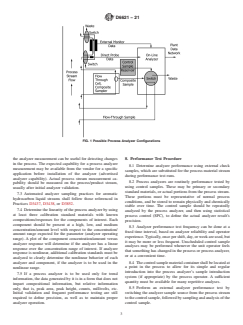
same or similar chemical measurement techniques. Fig. 1
standard deviation, repeatability or reproducibility, or both.
shows several possible analyzer configurations for on-line
3.1.11 repeatability of an analyzer, n—difference between
process testing of aromatic hydrocarbon materials. Aromatic
two successive analyzer results measured in a short time
hydrocarbon stream analyzers are often based on
interval that would be exceeded in the long run in only 1 case
chromatography, but they may also perform physical
in 20 (5% of the time) when the analyzer is operated on a
measurements, wet chemistry, or other methods described in
flowing sample of uniform quality.
new or existing Committee D16 methods. This practice is
3.1.12 reproducibility of an analyzer, n—differencebetween
intended to be generally applicable to any of them.
asingleresultfromeachoftwoidenticalanalyzersystemsthat
7. Performance Guidelines Before Calibration
would be exceededinthelongruninonly1casein20(5%of
the time) when the two systems are operated at different sites
7.1 At startup, validate any process analyzer against an
by different operators, but on identical samples.
existing analytical method, typically in this case, one overseen
by Committee D16.
3.1.13 rule violation, n—condition when a point value or
pattern of points in a statistical process control chart statisti-
7.2 The capability measurement (c ) for a given analyzer
m
cally exceeds the defined probability of its occurrence, as
(3) shall be less than 0.2, as defined in Eq 1:
defined by the Western Electric rules (2) being used.
2 2
c 5σ /σ ,0.2 (1)
m a p
3.1.14 spot sample, n—representative material resembling
where:
the stream being monitored, an identical portion of which is
σ = standard deviation of the analyzer measurement, and
analyzed both in a process analyzer and by a laboratory test on a
σ = standard deviation of the process.
a non-scheduled basis for periodic validation testing. p
3.1.14.1 Discussion—May be the same material as the The variance (standard deviation squared) of the analyzer
control sample. should be less than 20% of the variance of the process, so that
D6621 − 21
FIG. 1 Possible Process Analyzer Configurations
the analyzer measurement can be useful for detecting changes 8. Performance Test Procedure
in the process. The expected capability for a process analyzer
8.1 Determine analyzer performance using external check
measurement may be available from the vendor for a specific
samples, which are substituted for the process material stream
application before installation of the analyzer (advertised
during performance test runs.
analyzer capability). Actual process stream measurement ca-
8.2 Process analyzers are routinely performance tested by
pability should be measured on the process/product stream,
using control samples. These may be primary or secondary
usually after initial analyzer validation.
standard materials, or actual portions from the process stream.
7.3 Automated analyzer sampling practices for aromatic
These portions must be representative of normal process
hydrocarbon liquid streams shall follow those referenced in
conditions, and be stored to remain physically and chemically
Practices D3437, D3438,or D3852.
stable over time. The control sample should be repeatedly
7.4 Determine the linearity of the process analyzer by using
analyzed by the process analyzer, and then using statistical
at least three calibration standard materials with known
process control (SPC), to define the actual analyzer result’s
compositions/responses for the components of interest. Each
precision.
component should be present at a high, low, and medium
8.3 Analyzer performance test frequency can be done at a
concentration/amount level with respect to the concentration/
fixed time interval, based on analyzer reliability and operator
amount range expected for the parameter (analyzer operating
experience.Typically,oncepershift,day,orweekareused,but
range). A plot of the component concentration/amount versus
it may be more or less frequent. Unscheduled control sample
analyzer response will determine if the analyzer has a linear
analyses may be performed whenever the unit operator feels
response over the concentration range of interest. If analyzer
that something has changed in the process or process analyzer,
response is nonlinear, additional calibration standards must be
or at a convenient time.
analyzed to clearly determine the nonlinear behavior of each
analyzer and component, if the analyzer is to be used in the 8.4 Thecontrolsamplematerialcontainershallbelocatedat
a point in the process to allow for its simple and regular
nonlinear range.
introduction into the process analyzer’s sample introduction
7.5 If a process analyzer is to be used only for trend
system (if appropriate) by the process operator. A sufficient
information, the data generated by it is in a form that does not
quantity must be available for many repetitive analyses.
impart compositional information, but relative information
only, that is, peak area, peak height, counts, millivolts, etc. 8.5 Perform an external analyzer performance test by
Initial validation and frequent performance testing are still switching the analyzer sample source from the process stream
required to define precision, as well as to maintain proper tothecontrolsample,followedbysamplingandanalysisofthe
analyzer operation. control sample.
D6621 − 21
8.6 Monitor the analyzer’s output from the control sample reevaluate the SPC chart control limits after 20 additional
until it stabilizes, that is, the difference between successive points have been collected.
readings is at or below the repeatability of the analyzer (which 8.10.5 Repeatability should be measured any time the ana-
is measured as described in 8
...
This document is not an ASTM standard and is intended only to provide the user of an ASTM standard an indication of what changes have been made to the previous version. Because
it may not be technically possible to adequately depict all changes accurately, ASTM recommends that users consult prior editions as appropriate. In all cases only the current version
of the standard as published by ASTM is to be considered the official document.
Designation: D6621 − 00 (Reapproved 2017) D6621 − 21
Standard Practice for
Performance Testing of Process Analyzers for Aromatic
Hydrocarbon Materials
This standard is issued under the fixed designation D6621; the number immediately following the designation indicates the year of
original adoption or, in the case of revision, the year of last revision. A number in parentheses indicates the year of last reapproval. A
superscript epsilon (´) indicates an editorial change since the last revision or reapproval.
1. Scope Scope*
1.1 This practice serves as a practical guide for the performance testing of process stream analyzers specifically for measuring
chemical or physical characteristics of liquid aromatic hydrocarbon materials for production or certification of these materials. The
practice may be applicable to other hydrocarbon stream analyzers as well.
1.2 Only external methods (complete substitution of the process stream with a standard) of control sample introduction are
included. Internal methods are beyond the scope of this practice.
1.3 Methods for resetting key operational parameters of analyzers to match predefined limits are provided by vendors and are not
included in this practice.
1.4 Analyzer validation procedures are covered in Practices D3764 and D6122, not in this practice.
1.5 Procedures for statistically interpreting data from automatic sampling process stream analyzers are outlined.
1.6 The implementation of this practice requires that the analyzer be installed according to APIRP-550 (1), and be in agreement
with the analyzer supplier’s recommendations. Also, it assumes that the analyzer is designed to monitor the specific material
parameter of interest, and that at the time of initial or periodic validation, the analyzer was operating at the conditions specified
by the manufacturer and consistently with the primary test method.
1.7 The units of measure used in this practice shall be the same as those applicable to the test primary method used for analyzer
validation.
1.8 This standard does not purport to address all of the safety concerns, if any, associated with its use. It is the responsibility
of the user of this standard to establish appropriate safety safety, health, and healthenvironmental practices, and determine the
applicability of regulatory limitations prior to use.
1.9 This international standard was developed in accordance with internationally recognized principles on standardization
established in the Decision on Principles for the Development of International Standards, Guides and Recommendations issued
by the World Trade Organization Technical Barriers to Trade (TBT) Committee.
This practice is under the jurisdiction of ASTM Committee D16 on Aromatic, Industrial, Specialty and Related Chemicals and is the direct responsibility of Subcommittee
D16.09 on On-Line Analysis.
Current edition approved July 1, 2017Nov. 1, 2021. Published July 2017December 2021. Originally approved in 2000. Last previous edition approved in 20122017 as
D6621 – 00 (2012).(2017). DOI: 10.1520/D6621-00R17.10.1520/D6621-21.
The boldface numbers in parentheses refer to the list of references at the end of this practice.
*A Summary of Changes section appears at the end of this standard
Copyright © ASTM International, 100 Barr Harbor Drive, PO Box C700, West Conshohocken, PA 19428-2959. United States
D6621 − 21
2. Referenced Documents
2.1 ASTM Standards:
D3437 Practice for Sampling and Handling Liquid Cyclic Products
D3438 Practice for Sampling and Handling Naphthalene, Maleic Anhydride, and Phthalic Anhydride
D3764 Practice for Validation of the Performance of Process Stream Analyzer Systems
D4177D3852 Practice for Automatic Sampling of Petroleum and Petroleum Productsand Handling Phenol, Cresols, and Cresylic
Acid
D6122 Practice for Validation of the Performance of Multivariate Online, At-Line, Field and Laboratory Infrared
Spectrophotometer, and Raman Spectrometer Based Analyzer Systems
E456 Terminology Relating to Quality and Statistics
E1655 Practices for Infrared Multivariate Quantitative Analysis
3. Terminology
3.1 Definitions:
3.1.1 accuracy, n—closeness of agreement between a test result and an accepted reference value.
3.1.2 analyzer output, n—signal that is proportional to the quality parameter being measured and suitable for input to readout
instrumentation.
3.1.2.1 Discussion—
It may be pneumatic, electrical, digital, etc., and expressed as psi, mv, sec., etc.
3.1.3 analyzer result, n—numerical estimate of a physical, chemical, or quality parameter produced by applying the calibration
model to the analyzer output signal.
3.1.4 bias, n—the difference between the expectation of the results and an accepted reference value.
3.1.5 control sample, n—material similar to the process stream that is stable over long periods of time so that its parameters may
be measured reproducibly in performance tests to characterize analyzer precision and accuracy.
3.1.5.1 Discussion—
May be a pure compound, standard mixture, or a sample from the process stream. Its parameters are used to plot statistical process
control charts to define analyzer precision in normal operation.
3.1.6 external performance testing, n—procedure involving complete substitution of the process/product stream measured by the
analyzer with a control sample stream to measure the analyzer’s precision and possibly accuracy (if the control sample’s true value
is known).
3.1.7 internal performance testing, n—procedure involving the addition of a known quantity of a standard material homoge-
neously into the process/product stream measured by the analyzer to measure the analyzer’s precision and possibly accuracy (if
the sample material’s true value is known).
3.1.8 linearity, n—parameter ranges where the analyzer’s results do and do not approximate a straight line.
3.1.9 performance testing of an analyzer, n—mechanical and statistical procedure for routinely checking the accuracy and
precision of an analyzer’s results against historical accuracy and precision for a control sample.
3.1.10 precision, n—closeness of agreement of independent test results of the same chemical or physical property of a given
material obtained under stipulated conditions.
3.1.10.1 Discussion—
Expressed in terms of dispersion of test results around the arithmetic mean, usually as variance, standard deviation, repeatability
or reproducibility, or both.
For referenced ASTM standards, visit the ASTM website, www.astm.org, or contact ASTM Customer Service at service@astm.org. For Annual Book of ASTM Standards
volume information, refer to the standard’s Document Summary page on the ASTM website.
D6621 − 21
3.1.11 repeatability of an analyzer, n—difference between two successive analyzer results measured in a short time interval that
would be exceeded in the long run in only 1 case in 20 (5 % of the time) when the analyzer is operated on a flowing sample of
uniform quality.
3.1.12 reproducibility of an analyzer, n—difference between a single result from each of two identical analyzer systems that would
be exceeded in the long run in only 1 case in 20 (5 % of the time) when the two systems are operated at different sites by different
operators, but on identical samples.
3.1.13 rule violation, n—condition when a point value or pattern of points in a statistical process control chart statistically exceeds
the defined probability of its occurrence, as defined by the Western Electric rules (2) being used.
3.1.14 spot sample, n—representative material resembling the stream being monitored, an identical portion of which is analyzed
both in a process analyzer and by a laboratory test on a non-scheduled basis for periodic validation testing.
3.1.14.1 Discussion—
May be the same material as the control sample.
3.1.15 validation of an analyzer, n—process to identify how comparable an analyzer’s results are statistically to results from the
primary method, or to define how the analyzer’s results compare to the primary method’s results in precision and accuracy.
3.1.15.1 Discussion—
Must be done when the analyzer is first configured or reconfigured (initial validation), and then on a periodic basis (periodic
validation), as described in Practice D3764.
3.2 For additional definitions, see Appendix X1.
4. Summary of Practice
4.1 This practice standardizes aromatic hydrocarbon process-analyzer performance testing practices, or processes for maintaining
accurate and precise analyzer measurements. It is used with methods for the measurement and certification of aromatic
hydrocarbon materials applied to continuous on-line analyzers. These methods are generally under the control of Committee D16
on Aromatic, Industrial, Specialty and Related Chemicals. It is meant as a practical guide for persons setting up and maintaining
these analyzers in a process (non-laboratory) environment. They should apply it, with their knowledge of the analyzer’s operation
and of how the process analyzer results are to be used, to maintain and optimize analyzer operation.
5. Significance and Use
5.1 Performance testing of on-line analyzers is critical to their proper performance within predictable levels of precision and
accuracy. This practice can affect production efficiency and certification of aromatic hydrocarbon materials.
6. System Components
6.1 Process analyzers (Fig. 1) for measuring the chemical composition of aromatic hydrocarbons, their purity, or physical
properties often replace existing laboratory test methods, using the same or similar chemical measurement techniques. Fig. 1 shows
several possible analyzer configurations for on-line process testing of aromatic hydrocarbon materials. Aromatic hydrocarbon
stream analyzers are often based on chromatography, but they may also perform physical measurements, wet chemistry, or other
methods described in new or existing Committee D16 methods. This practice is intended to be generally applicable to any of them.
7. Performance Guidelines Before Calibration
7.1 At startup, validate any process analyzer against an existing analytical method, typically in this case, one overseen by
Committee D16.
7.2 The capability measurement (c ) for a given analyzer (3) shall be less than 0.2, as defined in Eq 1:
m
2 2
c 5 σ /σ ,0.2 (1)
m a p
D6621 − 21
FIG. 1 Possible Process Analyzer Configurations
where:
σ = standard deviation of the analyzer measurement, and
a
σ = standard deviation of the process.
p
The variance (standard deviation squared) of the analyzer should be less than 20 % of the variance of the process, so that the
analyzer measurement can be useful for detecting changes in the process. The expected capability for a process analyzer
measurement may be available from the vendor for a specific application before installation of the analyzer (advertised analyzer
capability). Actual process stream measurement capability should be measured on the process/product stream, usually after initial
analyzer validation.
7.3 Automated analyzer sampling practices for aromatic hydrocarbon liquid streams shall follow those referenced in Practice-
Practices D4177D3437, D3438, or D3852.
7.4 Determine the linearity of the process analyzer by using at least three calibration standard materials with known
compositions/responses for the components of interest. Each component should be present at a high, low, and medium
concentration/amount level with respect to the concentration/amount range expected for the parameter (analyzer operating range).
A plot of the component concentration/amount versus analyzer response will determine if the analyzer has a linear response over
the concentration range of interest. If analyzer response is nonlinear, additional calibration standards must be analyzed to clearly
determine the nonlinear behavior of each analyzer and component, if the analyzer is to be used in the nonlinear range.
7.5 If a process analyzer is to be used only for trend information, the data generated by it is in a form that does not impart
compositional information, but relative information only, that is, peak area, peak height, counts, millivolts, etc. Initial validation
and frequent performance testing are still required to define precision, as well as to maintain proper analyzer operation.
8. Performance Test Procedure
8.1 Determine analyzer performance using external check samples, which are substituted for the process material stream during
performance test runs.
8.2 Process analyzers are routinely performance tested by using control samples. These may be primary or secondary standard
materials, or actual portions from the process stream. These portions must be representative of normal process conditions, and be
D6621 − 21
stored to remain physically and chemically stable over time. The control sample should be repeatedly analyzed by the process
analyzer, and then using statistical process control (SPC), to define the actual analyzer result’s precision.
8.3 Analyzer performance test frequency can be done at a fixed time interval, based on analyzer reliability and operator
experience. Typically, once per shift, day, or week are used, but it may be more or less frequent. Unscheduled control sample
analyses may be performed whenever the unit operator feels that something has changed in the process or process analyzer, or at
a convenient time.
8.4 The control sample material container shall be located at a point in the process to allow for its simple and regular introduction
into the process analyzer’s sample introduction system (if appropriate) by the process operator. A sufficient quantity must be
available for many repetitive analyses.
8.5 Perform an external analyzer performance test by switching the analyzer sample source from the process stream to the control
sample, followed by sampling and analysis of the control sample.
8.6 Monitor the analyzer’s output from the control sample until it stabilizes, that is, the difference between successive readings
is at or below the repeatability of the analyzer,analyzer (which is measured as described in 8.10). If this does not occur, the
repeatabili
...