

ASTM D7106/D7106M-05(2023)
(Guide)Standard Guide for Selection of Test Methods for Ethylene Propylene Diene Terpolymer (EPDM) Geomembranes
General Information
- Abstract
SIGNIFICANCE AND USE
4.1 This standard provides guidance to obtain data that is the most representative of the material’s characteristics and performance. To properly evaluate EPDM, tests should be performed in accordance with specific test methods and procedures.
SCOPE
1.1 This guide covers and provides recommendations for the selection of appropriate test methods for Ethylene Propylene Diene Terpolymer (EPDM) geomembranes used in geotechnical and geoenvironmental applications.
1.2 This guide includes test methods for three different types of EPDM geomembranes including: scrim-reinforced membranes, composite membranes, and smooth, nonreinforced membranes.
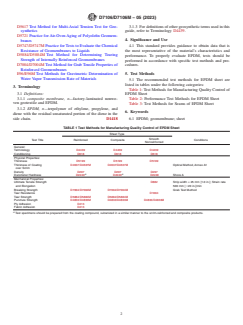
1.3 The test methods are divided into three categories including manufacturing quality control, optional performance tests, and seam testing.
1.4 The values stated in either SI units or inch-pound units are to be regarded separately as standard. The values stated in each system are not necessarily exact equivalents; therefore, to ensure conformance with the standard, each system shall be used independently of the other, and values from the two systems shall not be combined.
1.5 This standard does not purport to address all of the safety concerns, if any, associated with its use. It is the responsibility of the user of this standard to establish appropriate safety, health, and environmental practices and determine the applicability of regulatory limitations prior to use.
1.6 This international standard was developed in accordance with internationally recognized principles on standardization established in the Decision on Principles for the Development of International Standards, Guides and Recommendations issued by the World Trade Organization Technical Barriers to Trade (TBT) Committee.
- Status
- Published
- Publication Date
- 31-Aug-2023
- Technical Committee
- D35 - Geosynthetics
- Drafting Committee
- D35.10 - Geomembranes


Overview
ASTM D7106/D7106M-05(2023) is the standard guide for the selection of test methods for Ethylene Propylene Diene Terpolymer (EPDM) geomembranes. Published by ASTM International, this guide assists professionals in geotechnical and geoenvironmental industries to properly evaluate the characteristics and performance of EPDM geomembranes using recognized testing procedures. The standard applies to various types of EPDM geomembranes, including scrim-reinforced, composite, and smooth nonreinforced membranes, ensuring that the most appropriate and representative data about the material are obtained for quality assurance and application requirements.
Key Topics
- Test Method Selection: The standard offers comprehensive recommendations for choosing the most suitable test methods for different EPDM geomembrane products based on their design and end use.
- Product Types: Guidance is specific to scrim-reinforced, composite, and nonreinforced (smooth) membranes.
- Test Method Categories:
- Manufacturing Quality Control: Verifies the consistency and conformity of geomembrane products during production through tests such as thickness, density, and hardness.
- Optional Performance Tests: Assess the physical, mechanical, and endurance properties under various conditions, including water vapor transmission, puncture resistance, and chemical resistance.
- Seam Testing: Ensures the integrity of seams in finished installations, essential for overall system performance and leak prevention.
- Measurement Systems: Both SI and inch-pound units are used, but values in each system must be applied independently to maintain standard conformity.
Applications
EPDM geomembranes are widely used in geotechnical and geoenvironmental applications, serving as liners and barriers in projects such as:
- Landfills: Providing containment for waste to protect soil and groundwater.
- Ponds, Reservoirs, and Canals: Serving as liners for water retention and management.
- Environmental Protection: Acting as barriers in remediation and containment of hazardous materials.
- Construction and Civil Engineering: Offering waterproofing and soil stabilization functions in foundations, tunnels, and other infrastructure.
Applying ASTM D7106/D7106M-05(2023) helps:
- Ensure material suitability through robust quality control testing.
- Confirm performance criteria are met for project-specific conditions.
- Prevent failures related to improper seam construction or inadequate durability.
- Meet regulatory, environmental, and safety requirements by using industry-accepted test protocols.
Related Standards
This standard references and is used alongside numerous key ASTM standards, including:
- ASTM D882 - Tensile Properties of Thin Plastic Sheeting
- ASTM D1004 - Tear Resistance of Plastic Film and Sheeting
- ASTM D4833/D4833M - Index Puncture Resistance of Geomembranes
- ASTM D4437/D4437M - Seam Testing for Flexible Polymeric Sheet Geomembranes
- ASTM D2240 - Durometer Hardness of Rubber Property
- ASTM D2137 - Brittleness Point of Flexible Polymers and Coated Fabrics
- ASTM D5747/D5747M - Chemical Resistance of Geomembranes to Liquids
These referenced documents provide foundational test methods and terminology essential to the effective implementation of ASTM D7106/D7106M-05(2023) for EPDM geomembrane quality and performance assurance.
Keywords: ASTM D7106, EPDM geomembrane, geosynthetics, testing methods, quality control, seam testing, geotechnical, geoenvironmental, ASTM standard, environmental protection.
Relations
- Effective Date
- 01-Mar-2024
- Effective Date
- 01-Feb-2024
- Effective Date
- 15-Nov-2023
- Effective Date
- 01-Nov-2023
- Effective Date
- 01-Nov-2023
- Effective Date
- 01-Nov-2023
- Effective Date
- 01-Jun-2020
- Effective Date
- 01-Apr-2020
- Effective Date
- 01-Jul-2019
- Refers
ASTM D5199-12(2019) - Standard Test Method for Measuring the Nominal Thickness of Geosynthetics - Effective Date
- 15-Jun-2019
- Effective Date
- 15-Apr-2018
- Effective Date
- 01-Feb-2018
- Effective Date
- 01-Feb-2018
- Effective Date
- 01-Aug-2017
- Effective Date
- 01-Jun-2017
Get Certified
Connect with accredited certification bodies for this standard

Control Union Certifications
Global certification for agriculture and sustainability.

Hohenstein Institut
Textile testing and certification.

Bureau Veritas Bangladesh
Bureau Veritas certification services in Bangladesh.
Sponsored listings
Frequently Asked Questions
ASTM D7106/D7106M-05(2023) is a guide published by ASTM International. Its full title is "Standard Guide for Selection of Test Methods for Ethylene Propylene Diene Terpolymer (EPDM) Geomembranes". This standard covers: SIGNIFICANCE AND USE 4.1 This standard provides guidance to obtain data that is the most representative of the material’s characteristics and performance. To properly evaluate EPDM, tests should be performed in accordance with specific test methods and procedures. SCOPE 1.1 This guide covers and provides recommendations for the selection of appropriate test methods for Ethylene Propylene Diene Terpolymer (EPDM) geomembranes used in geotechnical and geoenvironmental applications. 1.2 This guide includes test methods for three different types of EPDM geomembranes including: scrim-reinforced membranes, composite membranes, and smooth, nonreinforced membranes. 1.3 The test methods are divided into three categories including manufacturing quality control, optional performance tests, and seam testing. 1.4 The values stated in either SI units or inch-pound units are to be regarded separately as standard. The values stated in each system are not necessarily exact equivalents; therefore, to ensure conformance with the standard, each system shall be used independently of the other, and values from the two systems shall not be combined. 1.5 This standard does not purport to address all of the safety concerns, if any, associated with its use. It is the responsibility of the user of this standard to establish appropriate safety, health, and environmental practices and determine the applicability of regulatory limitations prior to use. 1.6 This international standard was developed in accordance with internationally recognized principles on standardization established in the Decision on Principles for the Development of International Standards, Guides and Recommendations issued by the World Trade Organization Technical Barriers to Trade (TBT) Committee.
SIGNIFICANCE AND USE 4.1 This standard provides guidance to obtain data that is the most representative of the material’s characteristics and performance. To properly evaluate EPDM, tests should be performed in accordance with specific test methods and procedures. SCOPE 1.1 This guide covers and provides recommendations for the selection of appropriate test methods for Ethylene Propylene Diene Terpolymer (EPDM) geomembranes used in geotechnical and geoenvironmental applications. 1.2 This guide includes test methods for three different types of EPDM geomembranes including: scrim-reinforced membranes, composite membranes, and smooth, nonreinforced membranes. 1.3 The test methods are divided into three categories including manufacturing quality control, optional performance tests, and seam testing. 1.4 The values stated in either SI units or inch-pound units are to be regarded separately as standard. The values stated in each system are not necessarily exact equivalents; therefore, to ensure conformance with the standard, each system shall be used independently of the other, and values from the two systems shall not be combined. 1.5 This standard does not purport to address all of the safety concerns, if any, associated with its use. It is the responsibility of the user of this standard to establish appropriate safety, health, and environmental practices and determine the applicability of regulatory limitations prior to use. 1.6 This international standard was developed in accordance with internationally recognized principles on standardization established in the Decision on Principles for the Development of International Standards, Guides and Recommendations issued by the World Trade Organization Technical Barriers to Trade (TBT) Committee.
ASTM D7106/D7106M-05(2023) is classified under the following ICS (International Classification for Standards) categories: 59.080.70 - Geotextiles. The ICS classification helps identify the subject area and facilitates finding related standards.
ASTM D7106/D7106M-05(2023) has the following relationships with other standards: It is inter standard links to ASTM E96/E96M-24, ASTM D4439-24, ASTM E96/E96M-23, ASTM D5884/D5884M-23, ASTM D4437/D4437M-16(2023), ASTM D5617-23, ASTM D4833/D4833M-07(2020), ASTM D1204-14(2020), ASTM D5321/D5321M-19, ASTM D5199-12(2019), ASTM D4439-18, ASTM D5514/D5514M-18, ASTM D4437/D4437M-16(2018), ASTM D4439-17, ASTM D5321/D5321M-17. Understanding these relationships helps ensure you are using the most current and applicable version of the standard.
ASTM D7106/D7106M-05(2023) is available in PDF format for immediate download after purchase. The document can be added to your cart and obtained through the secure checkout process. Digital delivery ensures instant access to the complete standard document.
Standards Content (Sample)
This international standard was developed in accordance with internationally recognized principles on standardization established in the Decision on Principles for the
Development of International Standards, Guides and Recommendations issued by the World Trade Organization Technical Barriers to Trade (TBT) Committee.
Designation: D7106/D7106M − 05 (Reapproved 2023)
Standard Guide for
Selection of Test Methods for Ethylene Propylene Diene
Terpolymer (EPDM) Geomembranes
This standard is issued under the fixed designation D7106/D7106M; the number immediately following the designation indicates the
year of original adoption or, in the case of revision, the year of last revision. A number in parentheses indicates the year of last
reapproval. A superscript epsilon (´) indicates an editorial change since the last revision or reapproval.
1. Scope D297 Test Methods for Rubber Products—Chemical Analy-
sis
1.1 This guide covers and provides recommendations for
D413 Test Methods for Rubber Property—Adhesion to Flex-
the selection of appropriate test methods for Ethylene Propyl-
ible Substrate
ene Diene Terpolymer (EPDM) geomembranes used in geo-
D471 Test Method for Rubber Property—Effect of Liquids
technical and geoenvironmental applications.
D618 Practice for Conditioning Plastics for Testing
1.2 This guide includes test methods for three different
D882 Test Method for Tensile Properties of Thin Plastic
types of EPDM geomembranes including: scrim-reinforced
Sheeting
membranes, composite membranes, and smooth, nonreinforced
D1004 Test Method for Tear Resistance (Graves Tear) of
membranes.
Plastic Film and Sheeting
1.3 The test methods are divided into three categories
D1149 Test Methods for Rubber Deterioration—Cracking in
including manufacturing quality control, optional performance
an Ozone Controlled Environment
tests, and seam testing.
D1204 Test Method for Linear Dimensional Changes of
1.4 The values stated in either SI units or inch-pound units
Nonrigid Thermoplastic Sheeting or Film at Elevated
are to be regarded separately as standard. The values stated in
Temperature
each system are not necessarily exact equivalents; therefore, to
D1418 Practice for Rubber and Rubber Latices—
ensure conformance with the standard, each system shall be
Nomenclature
used independently of the other, and values from the two
D1434 Test Method for Determining Gas Permeability Char-
systems shall not be combined.
acteristics of Plastic Film and Sheeting
1.5 This standard does not purport to address all of the
D2137 Test Methods for Rubber Property—Brittleness Point
safety concerns, if any, associated with its use. It is the
of Flexible Polymers and Coated Fabrics
responsibility of the user of this standard to establish appro-
D2240 Test Method for Rubber Property—Durometer Hard-
priate safety, health, and environmental practices and deter-
ness
mine the applicability of regulatory limitations prior to use.
D4355/D4355M Test Method for Deterioration of Geotex-
1.6 This international standard was developed in accor-
tiles by Exposure to Light, Moisture, and Heat in a Xenon
dance with internationally recognized principles on standard-
Arc-Type Apparatus
ization established in the Decision on Principles for the
D4437/D4437M Practice for Nondestructive Testing (NDT)
Development of International Standards, Guides and Recom-
for Determining the Integrity of Seams Used in Joining
mendations issued by the World Trade Organization Technical
Flexible Polymeric Sheet Geomembranes
Barriers to Trade (TBT) Committee.
D4439 Terminology for Geosynthetics
D4637/D4637M Specification for EPDM Sheet Used in
2. Referenced Documents
2 Single-Ply Roof Membrane
2.1 ASTM Standards:
D4833/D4833M Test Method for Index Puncture Resistance
of Geomembranes and Related Products
This guide is under the jurisdiction of ASTM Committee D35 on Geosynthetics D5199 Test Method for Measuring the Nominal Thickness
and is the direct responsibility of Subcommittee D35.10 on Geomembranes.
of Geosynthetics
Current edition approved Sept. 1, 2023. Published September 2023. Originally
D5321/D5321M Test Method for Determining the Shear
approved in 2005. Last previous edition approved in 2015 as D7106/D7106M – 05
ɛ1
(2015) . DOI: 10.1520/D7106_D7106M-05R23. Strength of Soil-Geosynthetic and Geosynthetic-
For referenced ASTM standards, visit the ASTM website, www.astm.org, or
Geosynthetic Interfaces by Direct Shear
contact ASTM Customer Service at service@astm.org. For Annual Book of ASTM
D5514/D5514M Test Method for Large-Scale Hydrostatic
Standards volume information, refer to the standard’s Document Summary page on
the ASTM website. Puncture Testing of Geosynthetics
Copyright © ASTM International, 100 Barr Harbor Drive, PO Box C700, West Conshohocken, PA 19428-2959. United States
D7106/D7106M − 05 (2023)
D5617 Test Method for Multi-Axial Tension Test for Geo- 3.1.3 For definitions of other geosynthetic terms used in this
synthetics guide, refer to Terminology D4439.
D5721 Practice for Air-Oven Aging of Polyolefin Geomem-
4. Significance and Use
branes
D5747/D5747M Practice for Tests to Evaluate the Chemical
4.1 This standard provides guidance to obtain data th
...