

ASTM D5514/D5514M-18
(Test Method)Standard Test Method for Large-Scale Hydrostatic Puncture Testing of Geosynthetics
General Information
- Abstract
SIGNIFICANCE AND USE
4.1 Procedure A—This procedure is an index-type test which can be used as a guide for acceptance of commercial shipments of geosynthetics. The standard cone and pyramid test fixtures can establish critical height (ch) consistency with similar material from previous lots or different suppliers, as well as testing from other laboratories. However, due to the time required to perform tests, it is generally not recommended for routine acceptance testing.
4.2 Procedures B and C—These procedures are performance tests intended as a design aid used to simulate the in-situ behavior of geosynthetics under hydrostatic compression. These test methods may assist a design engineer in comparing the ability of several candidate geosynthetic materials to conform to a site-specific subgrade under specified use and conditions. In procedure B, the pressure is increased until a failure is observed. In procedure C, a given set of conditions (pressure, temperature and test duration) are maintained constant and the performance of the system is observed at the end of the test.
SCOPE
1.1 This test method evaluates the stress/time properties of geosynthetics by using hydrostatic pressure to compress the geosynthetic over synthetic or natural test bases consisting of manufactured test pyramids/cones, rocks, soil, or voids.
1.2 This test method allows the user to determine the relative failure mode or points of failure for geosynthetics, or both.
1.3 This test method offers two distinct procedures:
1.3.1 Procedure A incorporates manufactured test pyramids or cones as the base of the testing apparatus. Procedure A is intended to create comparable data between laboratories, and can be used as a guide for routine acceptance tests for various materials.
1.3.2 Procedures B and C incorporate site-specific soil or other material selected by the user as the test base of the testing apparatus. Procedures B and C are methods for geosynthetic design for a specific site.
1.4 The values stated in either SI units or inch-pound units are to be regarded separately as standard. The values stated in each system may not be exact equivalents; therefore, each system shall be used independently of the other. Combining values from the two systems may result in non-conformance with the standard.
1.5 This standard does not purport to address all of the safety concerns, if any, associated with its use. It is the responsibility of the user of this standard to establish appropriate safety, health, and environmental practices and determine the applicability of regulatory limitations prior to use. For a specific warning statement, see Section 6.
1.6 This international standard was developed in accordance with internationally recognized principles on standardization established in the Decision on Principles for the Development of International Standards, Guides and Recommendations issued by the World Trade Organization Technical Barriers to Trade (TBT) Committee.
- Status
- Published
- Publication Date
- 31-Jan-2018
- Technical Committee
- D35 - Geosynthetics
- Drafting Committee
- D35.10 - Geomembranes
Buy Documents
ASTM D5514/D5514M-18 - Standard Test Method for Large-Scale Hydrostatic Puncture Testing of Geosynthetics
REDLINE ASTM D5514/D5514M-18 - Standard Test Method for Large-Scale Hydrostatic Puncture Testing of Geosynthetics
Overview
ASTM D5514/D5514M-18: Standard Test Method for Large-Scale Hydrostatic Puncture Testing of Geosynthetics provides a detailed and standardized approach for evaluating the puncture resistance and stress/time properties of geosynthetic materials under hydrostatic pressure. Key applications include using both synthetic and natural subgrades to simulate real-world site conditions or provide comparable laboratory results.
This large-scale test method is essential for manufacturers, designers, and engineers to ensure that geosynthetic products meet specific performance requirements, especially in critical containment, lining, and infrastructure projects. The standard aids in both quality assurance and design verification, making it vital for the geosynthetics industry.
Key Topics
Procedures: ASTM D5514/D5514M-18 outlines three main procedures:
- Procedure A: Uses manufactured test pyramids or cones to provide index-type comparative data for laboratory consistency and acceptance of commercial shipments.
- Procedures B & C: Employ site-specific soils or materials as the base, focusing on simulating in-situ conditions to evaluate geosynthetic system performance for specific site applications.
Test Method Scope:
- Assesses stress/time response of geosynthetics using controlled hydrostatic pressure.
- Identifies failure modes, puncture resistance, and deformation characteristics.
- Applies to a wide range of subgrade materials including rocks, soil, manufactured cones, and voids.
Measurement Units: The standard supports both SI and inch-pound units, with a clear requirement to avoid mixing measurement systems.
Reporting:
- Detailed results on material identification, test methods, conditions, puncture pressures, and deformation are mandated.
- The test procedures ensure that critical information about geosynthetic behavior under pressure is systematically recorded.
Safety: Users are responsible for following all relevant safety, health, and environmental protocols during test execution.
Applications
ASTM D5514/D5514M-18 is widely used for:
- Product Acceptance Testing: Procedure A helps manufacturers and buyers evaluate consistency between product lots and suppliers, making it useful for procurement quality checks.
- Design Evaluation: Procedures B and C enable engineers to simulate actual field conditions, supporting the design and selection of geosynthetics for applications such as:
- Landfill liners
- Reservoirs
- Mining containment systems
- Roadway stabilization
- Erosion control projects
- Performance Comparison: Directly compare candidate geosynthetic materials under standardized or site-specific loading scenarios, informing better material selection.
- Research and Development: Assist in identifying puncture mechanisms, informing improvements in geosynthetic design, structure, and manufacturing.
The versatility of the test method allows adaptation to a broad spectrum of project requirements, making it invaluable for infrastructure and environmental applications involving geosynthetics.
Related Standards
Several ASTM standards complement D5514/D5514M-18, including:
- ASTM D4439: Terminology for Geosynthetics
- ASTM D5199: Measuring Nominal Thickness of Geosynthetics
- ASTM D5261: Measuring Mass per Unit Area of Geotextiles
- ASTM D792 / D1505: Determining Density of Plastics
- ASTM D2488: Practice for Soil Identification (Visual-Manual Procedures)
- ASTM D5994: Measuring Core Thickness of Textured Geomembranes
- ASTM E11: Specification for Woven Wire Test Sieve Cloth and Test Sieves
Keywords: ASTM D5514, hydrostatic puncture, geosynthetics, puncture resistance, geosynthetic test method, large-scale testing, subgrade simulation, stress/time properties, containment systems.
Relations
- Effective Date
- 01-Feb-2018
- Effective Date
- 01-Feb-2024
- Refers
ASTM D5199-12(2019) - Standard Test Method for Measuring the Nominal Thickness of Geosynthetics - Effective Date
- 15-Jun-2019
- Effective Date
- 01-Jul-2018
- Effective Date
- 15-Apr-2018
- Effective Date
- 01-Aug-2017
- Effective Date
- 15-Jul-2017
- Effective Date
- 01-Sep-2015
- Effective Date
- 01-Jul-2015
- Effective Date
- 01-Mar-2014
- Effective Date
- 01-Oct-2013
- Effective Date
- 01-Feb-2012
- Effective Date
- 01-Oct-2011
- Effective Date
- 01-Feb-2011
- Refers
ASTM D1505-10 - Standard Test Method for Density of Plastics by the Density-Gradient Technique - Effective Date
- 01-Jul-2010
Buy Documents
ASTM D5514/D5514M-18 - Standard Test Method for Large-Scale Hydrostatic Puncture Testing of Geosynthetics
REDLINE ASTM D5514/D5514M-18 - Standard Test Method for Large-Scale Hydrostatic Puncture Testing of Geosynthetics
Get Certified
Connect with accredited certification bodies for this standard

Control Union Certifications
Global certification for agriculture and sustainability.

Hohenstein Institut
Textile testing and certification.

Bureau Veritas Bangladesh
Bureau Veritas certification services in Bangladesh.
Sponsored listings
Frequently Asked Questions
ASTM D5514/D5514M-18 is a standard published by ASTM International. Its full title is "Standard Test Method for Large-Scale Hydrostatic Puncture Testing of Geosynthetics". This standard covers: SIGNIFICANCE AND USE 4.1 Procedure A—This procedure is an index-type test which can be used as a guide for acceptance of commercial shipments of geosynthetics. The standard cone and pyramid test fixtures can establish critical height (ch) consistency with similar material from previous lots or different suppliers, as well as testing from other laboratories. However, due to the time required to perform tests, it is generally not recommended for routine acceptance testing. 4.2 Procedures B and C—These procedures are performance tests intended as a design aid used to simulate the in-situ behavior of geosynthetics under hydrostatic compression. These test methods may assist a design engineer in comparing the ability of several candidate geosynthetic materials to conform to a site-specific subgrade under specified use and conditions. In procedure B, the pressure is increased until a failure is observed. In procedure C, a given set of conditions (pressure, temperature and test duration) are maintained constant and the performance of the system is observed at the end of the test. SCOPE 1.1 This test method evaluates the stress/time properties of geosynthetics by using hydrostatic pressure to compress the geosynthetic over synthetic or natural test bases consisting of manufactured test pyramids/cones, rocks, soil, or voids. 1.2 This test method allows the user to determine the relative failure mode or points of failure for geosynthetics, or both. 1.3 This test method offers two distinct procedures: 1.3.1 Procedure A incorporates manufactured test pyramids or cones as the base of the testing apparatus. Procedure A is intended to create comparable data between laboratories, and can be used as a guide for routine acceptance tests for various materials. 1.3.2 Procedures B and C incorporate site-specific soil or other material selected by the user as the test base of the testing apparatus. Procedures B and C are methods for geosynthetic design for a specific site. 1.4 The values stated in either SI units or inch-pound units are to be regarded separately as standard. The values stated in each system may not be exact equivalents; therefore, each system shall be used independently of the other. Combining values from the two systems may result in non-conformance with the standard. 1.5 This standard does not purport to address all of the safety concerns, if any, associated with its use. It is the responsibility of the user of this standard to establish appropriate safety, health, and environmental practices and determine the applicability of regulatory limitations prior to use. For a specific warning statement, see Section 6. 1.6 This international standard was developed in accordance with internationally recognized principles on standardization established in the Decision on Principles for the Development of International Standards, Guides and Recommendations issued by the World Trade Organization Technical Barriers to Trade (TBT) Committee.
SIGNIFICANCE AND USE 4.1 Procedure A—This procedure is an index-type test which can be used as a guide for acceptance of commercial shipments of geosynthetics. The standard cone and pyramid test fixtures can establish critical height (ch) consistency with similar material from previous lots or different suppliers, as well as testing from other laboratories. However, due to the time required to perform tests, it is generally not recommended for routine acceptance testing. 4.2 Procedures B and C—These procedures are performance tests intended as a design aid used to simulate the in-situ behavior of geosynthetics under hydrostatic compression. These test methods may assist a design engineer in comparing the ability of several candidate geosynthetic materials to conform to a site-specific subgrade under specified use and conditions. In procedure B, the pressure is increased until a failure is observed. In procedure C, a given set of conditions (pressure, temperature and test duration) are maintained constant and the performance of the system is observed at the end of the test. SCOPE 1.1 This test method evaluates the stress/time properties of geosynthetics by using hydrostatic pressure to compress the geosynthetic over synthetic or natural test bases consisting of manufactured test pyramids/cones, rocks, soil, or voids. 1.2 This test method allows the user to determine the relative failure mode or points of failure for geosynthetics, or both. 1.3 This test method offers two distinct procedures: 1.3.1 Procedure A incorporates manufactured test pyramids or cones as the base of the testing apparatus. Procedure A is intended to create comparable data between laboratories, and can be used as a guide for routine acceptance tests for various materials. 1.3.2 Procedures B and C incorporate site-specific soil or other material selected by the user as the test base of the testing apparatus. Procedures B and C are methods for geosynthetic design for a specific site. 1.4 The values stated in either SI units or inch-pound units are to be regarded separately as standard. The values stated in each system may not be exact equivalents; therefore, each system shall be used independently of the other. Combining values from the two systems may result in non-conformance with the standard. 1.5 This standard does not purport to address all of the safety concerns, if any, associated with its use. It is the responsibility of the user of this standard to establish appropriate safety, health, and environmental practices and determine the applicability of regulatory limitations prior to use. For a specific warning statement, see Section 6. 1.6 This international standard was developed in accordance with internationally recognized principles on standardization established in the Decision on Principles for the Development of International Standards, Guides and Recommendations issued by the World Trade Organization Technical Barriers to Trade (TBT) Committee.
ASTM D5514/D5514M-18 is classified under the following ICS (International Classification for Standards) categories: 59.080.70 - Geotextiles. The ICS classification helps identify the subject area and facilitates finding related standards.
ASTM D5514/D5514M-18 has the following relationships with other standards: It is inter standard links to ASTM D5514/D5514M-14, ASTM D4439-24, ASTM D5199-12(2019), ASTM D5261-10(2018), ASTM D4439-18, ASTM D4439-17, ASTM D2488-17, ASTM D4439-15a, ASTM D4439-15, ASTM D4439-14, ASTM E11-13, ASTM D5199-12, ASTM D4439-11, ASTM D5199-11, ASTM D1505-10. Understanding these relationships helps ensure you are using the most current and applicable version of the standard.
ASTM D5514/D5514M-18 is available in PDF format for immediate download after purchase. The document can be added to your cart and obtained through the secure checkout process. Digital delivery ensures instant access to the complete standard document.
Standards Content (Sample)
This international standard was developed in accordance with internationally recognized principles on standardization established in the Decision on Principles for the
Development of International Standards, Guides and Recommendations issued by the World Trade Organization Technical Barriers to Trade (TBT) Committee.
Designation: D5514/D5514M − 18
Standard Test Method for
Large-Scale Hydrostatic Puncture Testing of Geosynthetics
This standard is issued under the fixed designation D5514/D5514M; the number immediately following the designation indicates the
year of original adoption or, in the case of revision, the year of last revision. A number in parentheses indicates the year of last
reapproval. A superscript epsilon (´) indicates an editorial change since the last revision or reapproval.
1. Scope 2. Referenced Documents
1.1 This test method evaluates the stress/time properties of 2.1 ASTM Standards:
geosynthetics by using hydrostatic pressure to compress the D792Test Methods for Density and Specific Gravity (Rela-
geosynthetic over synthetic or natural test bases consisting of tive Density) of Plastics by Displacement
manufactured test pyramids/cones, rocks, soil, or voids. D1505Test Method for Density of Plastics by the Density-
Gradient Technique
1.2 This test method allows the user to determine the
D2488Practice for Description and Identification of Soils
relative failure mode or points of failure for geosynthetics, or
(Visual-Manual Procedures)
both.
D4439Terminology for Geosynthetics
1.3 This test method offers two distinct procedures:
D5199Test Method for Measuring the Nominal Thickness
1.3.1 ProcedureAincorporates manufactured test pyramids
of Geosynthetics
or cones as the base of the testing apparatus. Procedure A is
D5261Test Method for Measuring Mass per Unit Area of
intended to create comparable data between laboratories, and
Geotextiles
can be used as a guide for routine acceptance tests for various
D5994Test Method for Measuring Core Thickness of Tex-
materials.
tured Geomembranes
1.3.2 Procedures B and C incorporate site-specific soil or
E11Specification forWovenWireTest Sieve Cloth andTest
othermaterialselectedbytheuserasthetestbaseofthetesting
Sieves
apparatus. Procedures B and C are methods for geosynthetic
design for a specific site.
3. Terminology
1.4 The values stated in either SI units or inch-pound units
3.1 Definitions:
are to be regarded separately as standard. The values stated in
3.1.1 atmosphere for testing geomembranes, n—air main-
each system may not be exact equivalents; therefore, each
tained at a relative humidity of 50 to 70% and a temperature
system shall be used independently of the other. Combining
of 21 6 2°C [70 6 4°F].
values from the two systems may result in non-conformance
3.1.2 critical height (ch), n—the maximum exposed height
with the standard.
of a cone or pyramid that will not cause a puncture failure of
1.5 This standard does not purport to address all of the
a geosynthetic at a specified hydrostatic pressure for a given
safety concerns, if any, associated with its use. It is the
period of time.
responsibility of the user of this standard to establish appro-
3.1.3 failure, n—in testing geosynthetics, water or air pres-
priate safety, health, and environmental practices and deter-
sure in the test vessel at failure of the geosynthetic.
mine the applicability of regulatory limitations prior to use.
3.1.4 hydrostatic pressure, n—a state of stress in which all
For a specific warning statement, see Section 6.
theprincipalstressesareequal(andthereisnoshearstress),as
1.6 This international standard was developed in accor-
in a liquid at rest; induced artificially by means of a gaged
dance with internationally recognized principles on standard-
pressure system; the product of the unit weight of the liquid
ization established in the Decision on Principles for the
and the difference in elevation between the given point and the
Development of International Standards, Guides and Recom-
free water elevation.
mendations issued by the World Trade Organization Technical
Barriers to Trade (TBT) Committee.
3.2 For definitions of other terms used in this test method,
refer to Terminology D4439.
This test method is under the jurisdiction of ASTM Committee D35 on
GeosyntheticsandisthedirectresponsibilityofSubcommitteeD35.10onGeomem-
branes. For referenced ASTM standards, visit the ASTM website, www.astm.org, or
Current edition approved Feb. 1, 2018. Published February 2018. Originally contact ASTM Customer Service at service@astm.org. For Annual Book of ASTM
approved in 1994. Last previous edition approved in 2014 as D5514/D5514M–14. Standards volume information, refer to the standard’s Document Summary page on
DOI: 10.1520/D5514_D5514M-18. the ASTM website.
Copyright © ASTM International, 100 Barr Harbor Drive, PO Box C700, West Conshohocken, PA 19428-2959. United States
D5514/D5514M − 18
4. Significance and Use
4.1 Procedure A—This procedure is an index-type test
which can be used as a guide for acceptance of commercial
shipments of geosynthetics. The standard cone and pyramid
test fixtures can establish critical height (ch) consistency with
similar material from previous lots or different suppliers, as
well as testing from other laboratories. However, due to the
timerequiredtoperformtests,itisgenerallynotrecommended
for routine acceptance testing.
4.2 Procedures B and C—These procedures are perfor-
mancetestsintendedasadesignaidusedtosimulatethe in-situ
behavior of geosynthetics under hydrostatic compression.
These test methods may assist a design engineer in comparing
the ability of several candidate geosynthetic materials to
conform to a site-specific subgrade under specified use and
conditions. In procedure B, the pressure is increased until a
failure is observed. In procedure C, a given set of conditions
(pressure, temperature and test duration) are maintained con-
stant and the performance of the system is observed at the end
of the test.
Nominal Value Tolerance
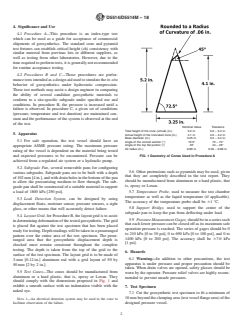
Total height of the cone (virtual) (in.) 5.2 in. 5.0 – 5.4 in.
5. Apparatus
Actual height of the truncated cone (in.) 4.1 in. 4.0 – 4.2 in.
Base diameter (in.) 3.25 in. 3.2 – 3.4 in.
5.1 For safe operation, the test vessel should have an
Angle of the conical section (°) 72.5° 72 – 73°
Angle of the top flat portion (°) 45° 44 – 46°
appropriate ASME pressure rating. The maximum pressure
All radius (in.) 0.06 in. 0.04 – 0.08 in.
rating of the vessel is dependent on the material being tested
and expected pressures to be encountered. Pressure can be
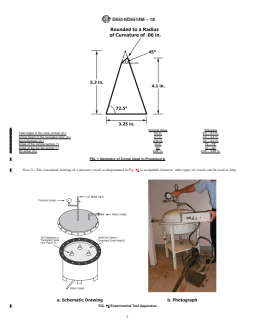
FIG. 1 Geometry of Cones Used in Procedure A
achieved from a regulated air system or a hydraulic pump.
5.2 Subgrade Pan, several removable pans for configuring
5.6 Other protrusions such as pyramids may be used, given
various subgrades. Subgrade pans are to be built with a depth
that they are completely described in the test report. They
of102mm[4in.],andwithdrainholesinthebottomofthepan
should be manufactured from aluminum or a hard plastic, that
to allow the pressurizing medium to flow through. The sub-
is, epoxy or Lexan.
grade pan shall be constructed of a suitable material to support
a load of 1800 kPa [250 psi].
5.7 Temperature Probe, used to measure the test chamber
temperature as well as the liquid temperature (if applicable).
5.3 Leak Detection System, can be designed by using
The accuracy of the temperature probe shall be 61°C.
displacement floats, moisture sensor, pressure sensors, a sight
5.8 Support Bridge, used to support the center of the
glass, or other means that will accurately detect failure.
subgrade pan to keep the pan from deflecting under load.
5.4 Layout Grid,forProcedureB,thelayoutgridistoassist
5.9 Pressure Measurement Gages,shouldbeinaseriessuch
indeterminingdeformationofthetestedgeosynthetic.Thegrid
that each lower pressure can be closed off as its maximum safe
is placed flat against the test specimen that has been placed
operation pressure is reached. The series of gages should be 0
readyfortesting.Depthreadingswillbetakeninaprearranged
to 210 kPa [0 to 30 psi], 0 to 690 kPa [0 to 100 psi], and 0 to
pattern over the entire area of the test specimen. The prear-
1400 kPa [0 to 200 psi]. The accuracy shall be 67.0 kPa
ranged area that the geosynthetic displacement depth is
[1psi].
checked must remain consistent throughout the complete
testing. The depth is taken from the top of the grid to the
6. Hazards
surface of the test specimen. The layout grid is to be made of
6.1 Warning—In addition to other precautions, the test
3-mm [0.12-in.] aluminum rod with a grid layout of 50 by
apparatus is under pressure and proper precaution should be
50mm [2 by 2 in.].
taken. When drain valves are opened, safety glasses should be
5.5 Test Cones—The cones should be manufactured from
worn by the operator. Pressure relief valves are highly recom-
aluminum or a hard plastic, that is, epoxy or Lexan. They
mended to prevent unsafe pressures.
should comply with the dimensions proposed in Fig. 1 and
exhibit a smooth surface with no indentation visible with the
7. Test Specimen
naked eye.
7.1 Cut the geosynthetic test specimen to fit a minimum of
10mmbeyondtheclampingarea(testvesselflangearea)ofthe
NOTE 1—An electrical detection system may be used in the cone to
facilitate observation of the failure. designed pressure vessel.
D5514/D5514M − 18
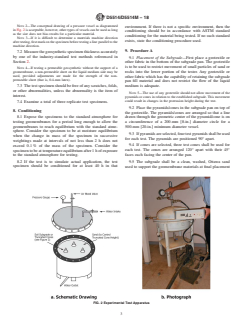
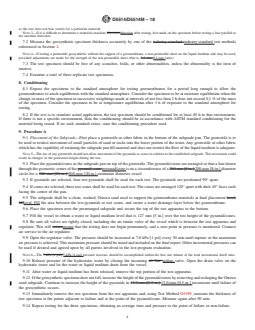
NOTE 2—The conceptual drawing of a pressure vessel as diagrammed
environment. If there is not a specific environment, then the
inFig.2isacceptable,however,othertypesofvesselscanbeusedaslong
conditioning should be in accordance with ASTM standard
as the size does not bias results for a particular material.
conditioning for the material being tested. If no such standard
NOTE 3—If it is difficult to determine a materials machine direction
exists, state the conditioning procedure used.
aftertesting,firstmarkonthespecimenbeforetestingalineparalleltothe
machine direction.
9. Procedure A
7.2 Measurethegeosyntheticspecimenthicknessaccurately
by one of the industry-standard test methods referenced in
9.1 Placement of the Subgrade—First place a geotextile or
Section 2.
other fabric in the bottom of the subgrade pan. The geotextile
is to be used to restrict movement of small particles of sand or
NOTE 4—If testing a permeable geosynthetic without the support of a
rocks into the lower portion of the tester. Any geotextile or
geomembrane, a non-permeable sheet on the liquid medium side may be
used, provided adjustments are made for the strength of the non- other fabric which has the capability of retaining the subgrade
permeable sheet (that is, 0.4-mm latex).
pan fill material and does not restrict the flow of the liquid
medium is adequate.
7.3 Thetestspecimenshouldbefreeofanyscratches,folds,
or other abnormalities, unless the abnormality is the item of
NOTE 5—The use of any geotextile should not allow movement of the
interest.
pyramids or cones in relation to the established subgrade.This movement
could result in changes in the protrusion height during the test.
7.4 Examine a total of three replicate test specimens.
9.2 Place the pyramids/cones in the subgrade pan on top of
8. Conditioning
the geotextile. The pyramids/cones are arranged so that a line
8.1 Expose the specimens to the standard atmosphere for drawn through the geometric center of the pyramid/cone is on
testing geomembranes for a period long enough to allow the
a circumference of a 200-mm [8-in.] diameter circle for a
geomembranes to reach equilibrium with the standard atmo- 500-mm [20-in.] minimum diameter vessel.
sphere. Consider the specimen to be at moisture equilibrium
9.3 Ifpyramidsareselected,fourtestpyramidsshallbeused
when the change in mass of the specimen in successive
for each test. The pyramids are positioned 90° apart.
weightings made at intervals of not less than 2 h does not
9.4 If cones are selected, three test cones shall be used for
exceed 0.1% of the mass of the specimen. Consider the
each test. The cones are arranged 120° apart with their 45°
specimentobeattemperatureequilibriumafter1hofexposure
to the standard atmosphere for testing. faces each facing the center of the pan.
8.2 If the test is to simulate actual application, the test 9.5 The subgrade shall be a clean, washed, Ottawa sand
specimen should be conditioned for at least 40 h in that used to support the geomembrane materials at final placement
FIG. 2 Experimental Test Apparatus
D5514/D5514M − 18
level. Fill the area between the test pyramids or test cones, and 10.5 Measure the defo
...
This document is not an ASTM standard and is intended only to provide the user of an ASTM standard an indication of what changes have been made to the previous version. Because
it may not be technically possible to adequately depict all changes accurately, ASTM recommends that users consult prior editions as appropriate. In all cases only the current version
of the standard as published by ASTM is to be considered the official document.
Designation: D5514/D5514M − 14 D5514/D5514M − 18
Standard Test Method for
Large Scale Large-Scale Hydrostatic Puncture Testing of
Geosynthetics
This standard is issued under the fixed designation D5514/D5514M; the number immediately following the designation indicates the
year of original adoption or, in the case of revision, the year of last revision. A number in parentheses indicates the year of last
reapproval. A superscript epsilon (´) indicates an editorial change since the last revision or reapproval.
1. Scope
1.1 This test method evaluates the stress/time properties of geosynthetics by using hydrostatic pressure to compress the
geosynthetic over synthetic or natural test bases consisting of manufactured test pyramids/cones, rocks, soil, or voids.
1.2 This test method allows the user to determine the relative failure mode, mode or points of failure for geosynthetics, or both.
1.3 This test method offers two distinct procedures.procedures:
1.3.1 Procedure A incorporates manufactured test pyramids or cones as the base of the testing apparatus. Procedure A is intended
to create comparable data between laboratories, and can be used as a guide for routine acceptance testtests for various materials.
1.3.2 Procedures B and C incorporate site specific site-specific soil or other material selected by the user as the test base of the
testing apparatus. Procedures B and C are methods for geosynthetic design for a specific site.
1.4 The values stated in either SI units or inch-pound units are to be regarded separately as standard. The values stated in each
system may not be exact equivalents; therefore, each system shall be used independently of the other. Combining values from the
two systems may result in non-conformance with the standard.
1.5 This standard does not purport to address all of the safety concerns, if any, associated with its use. It is the responsibility
of the user of this standard to establish appropriate safety safety, health, and healthenvironmental practices and determine the
applicability of regulatory limitations prior to use. For a specific warning statement, see Section 6.
1.6 This international standard was developed in accordance with internationally recognized principles on standardization
established in the Decision on Principles for the Development of International Standards, Guides and Recommendations issued
by the World Trade Organization Technical Barriers to Trade (TBT) Committee.
2. Referenced Documents
2.1 ASTM Standards:
D792 Test Methods for Density and Specific Gravity (Relative Density) of Plastics by Displacement
D1505 Test Method for Density of Plastics by the Density-Gradient Technique
D2488 Practice for Description and Identification of Soils (Visual-Manual Procedures)
D4439 Terminology for Geosynthetics
D5199 Test Method for Measuring the Nominal Thickness of Geosynthetics
D5261 Test Method for Measuring Mass per Unit Area of Geotextiles
D5994 Test Method for Measuring Core Thickness of Textured Geomembranes
E11 Specification for Woven Wire Test Sieve Cloth and Test Sieves
3. Terminology
3.1 Definitions:
3.1.1 atmosphere for testing geomembranes, n—air maintained at a relative humidity of 50 to 70 % and a temperature of 21 6
2°C2 °C [70 6 4°F].4 °F].
3.1.2 critical height (ch), n—the maximum exposed height of a cone or pyramid that will not cause a puncture failure of a
geosynthetic at a specified hydrostatic pressure for a given period of time.
This test method is under the jurisdiction of ASTM Committee D35 on Geosynthetics and is the direct responsibility of Subcommittee D35.10 on Geomembranes.
Current edition approved Jan. 1, 2014Feb. 1, 2018. Published January 2014February 2018. Originally approved in 1994. Last previous edition approved in 20112014 as
D5514 – 06D5514/D5514M – 14.(2011). DOI: 10.1520/D5514_D5514M-14.10.1520/D5514_D5514M-18.
For referenced ASTM standards, visit the ASTM website, www.astm.org, or contact ASTM Customer Service at service@astm.org. For Annual Book of ASTM Standards
volume information, refer to the standard’s Document Summary page on the ASTM website.
Copyright © ASTM International, 100 Barr Harbor Drive, PO Box C700, West Conshohocken, PA 19428-2959. United States
D5514/D5514M − 18
3.1.3 failure, n—in testing geosynthetics, water or air pressure in the test vessel at failure of the geosynthetic.
3.1.4 hydrostatic pressure, n—a state of stress in which all the principal stresses are equal (and there is no shear stress), as in
a liquid at rest; induced artificially by means of a gaged pressure system; the product of the unit weight of the liquid and the
difference in elevation between the given point and the free water elevation.
3.2 For definitions of other terms used in this test method, refer to Terminology D4439.
4. Significance and Use
4.1 Procedure A—This procedure is an index type index-type test which can be used as a guide for acceptance of commercial
shipments of geosynthetics. The standard cone and pyramid test fixtures can establish critical height (ch) consistency with similar
material from previous lots or different suppliers, as well as testing from other laboratories. However, due to the time required to
perform tests, it is generally not recommended for routine acceptance testing.
4.2 Procedures B and C—These procedures are performance tests intended as a design aid used to simulate the in-situ behavior
of geosynthetics under hydrostatic compression. These test methods may assist a design engineer in comparing the ability of
several candidate geosynthetic materials to conform to a site specific site-specific subgrade under specified use and conditions. In
procedure B, the pressure is increased until a failure is observed. In procedure C, a given set of conditions (pressure, temperature
and test duration) are maintained constant and the performance of the system is observed at the end of the test.
5. Apparatus
5.1 For safe operation, the test vessel should have an appropriate ASME pressure rating. The maximum pressure rating of the
vessel is dependent on the material being tested and expected pressures to be encountered. Pressure can be achieved from a
regulated air system or a hydraulic pump.
5.2 Subgrade Pan, several removable pans for configuring various subgrades. Subgrade pans are to be built,built with a depth
of 102 mm [4 in.], and with drain holes in the bottom of the pan to allow the pressurizing medium to flow through. The subgrade
pan shall be constructed of a suitable material to support a load of 1800 kPa [250 psi].
5.3 Leak Detection System, can be designed by using displacement floats, moisture sensor, pressure sensors, a sight glass, or
other means that will accurately detect failure.
5.4 Layout Grid, for procedureProcedure B, the layout grid is to assist in determining deformation of the tested geosynthetic.
The grid is placed flat against the test specimen that has been placed ready for testing. Depth readings will be taken in a prearranged
pattern over the entire area of the test specimen. The prearranged area that the geosynthetic displacement depth is checked must
remain consistent throughout the complete testing. The depth is taken from the top of the grid to the surface of the test specimen.
The layout grid is to be made of 3 mm [0.12 in.] 3-mm [0.12-in.] aluminum rod with a grid layout of 50 by 50 mm 50 mm [2 by
2 in.].
5.5 Test Pyramids, Cones—the pyramidThe cones should be manufactured from aluminum or a hard plastic, that is, epoxy or
Lexan. They should comply with the dimensions proposed in Fig. 1 and exhibit a smooth surface with no indentation visible with
the naked eye.
NOTE 1—An electrical detection system may be used in the cone to facilitate observation of the failure.
5.6 Test Cones, cones are more consistent when manufactured out of Other protrusions such as pyramids may be used, given
that they are completely described in the test report. They should be manufactured from aluminum or a hard plastic, that is,
epoxy.epoxy or Lexan.
5.7 Temperature Probe, used to measure the test chamber temperature as well as the liquid temperature (if applicable). The
accuracy of the temperature probe shall be 61°C.61 °C.
5.8 Support Bridge, used to support the center of the subgrade pan to keep the pan from deflecting under load.
5.9 Pressure Measurement Gages, should be in a series such that each lower pressure can be closed off as its maximum safe
operation pressure is reached. The series of gages should be 0 to 210 kPa [0 to 30 psi], 0 to 690 kPa [0 to 100 psi], and 0 to 1400
kPa [0 to 200 psi]. The accuracy shall be 67.0 kPa [1 psi].[1 psi].
6. Hazards
6.1 Warning—In addition to other precautions, the test apparatus is under pressure and proper precaution should be taken.
When drain valves are opened, safety glasses should be worn by the operator. Pressure relief valves are highly recommended to
prevent unsafe pressures.
7. Test Specimen
7.1 Cut the geosynthetic test specimen to fit a minimum of 10 mm beyond the clamping area (test vessel flange area) of the
designed pressure vessel.
D5514/D5514M − 18
Nominal Value Tolerance
Total height of the cone (virtual) (in.) 5.2 in. 5.0 – 5.4 in.
Actual height of the truncated cone (in.) 4.1 in. 4.0 – 4.2 in.
Base diameter (in.) 3.25 in. 3.2 – 3.4 in.
Angle of the conical section (°) 72.5° 72 – 73°
Angle of the top flat portion (°) 45° 44 – 46°
All radius (in.) 0.06 in. 0.04 – 0.08 in.
FIG. 1 Geometry of Cones Used in Procedure A
NOTE 2—The conceptual drawing of a pressure vessel as diagrammed in Fig. 12 is acceptable, however, other types of vessels can be used as long
FIG. 12 Experimental Test Apparatus
D5514/D5514M − 18
as the size does not bias results for a particular material.
NOTE 3—If it is difficult to determine a materials machine direction,direction after testing, first mark on the specimen before testing a line parallel to
the machine direction.
7.2 Measure the geosynthetic specimen thickness accurately by one of the industry standard industry-standard test methods
referenced in Section 2.
NOTE 4—If testing a permeable geosynthetic without the support of a geomembrane, a non-permeable sheet on the liquid medium side may be used,
provided adjustments are made for the strength of the non-permeable sheet (that is, 0.4 mm 0.4-mm latex).
7.3 The test specimen should be free of any scratches, folds, or other abnormalities, unless the abnormality is the item of
interest.
7.4 Examine a total of three replicate test specimens.
8. Conditioning
8.1 Expose the specimens to the standard atmosphere for testing geomembranes for a period long enough to allow the
geomembranes to reach equilibrium with the standard atmosphere. Consider the specimen to be at moisture equilibrium when the
change in mass of the specimen in successive weightings made at intervals of not less than 2 h does not exceed 0.1 % of the mass
of the specimen. Consider the specimen to be at temperature equilibrium after 1 h of exposure to the standard atmosphere for
testing.
8.2 If the test is to simulate actual application, the test specimen should be conditioned for at least 40 h in that environment.
If there is not a specific environment, then the conditioning should be in accordance with ASTM standard conditioning for the
material being tested. If no such standard exists, state the conditioning procedure used.
9. Procedure A
9.1 Placement of the Subgrade—First place a geotextile or other fabric in the bottom of the subgrade pan. The geotextile is to
be used to restrict movement of small particles of sand or rocks into the lower portion of the tester. Any geotextile or other fabric
which has the capability of retaining the subgrade pan fill material and does not restrict the flow of the liquid medium is adequate.
NOTE 5—The use of any geotextile should not allow movement of the pyramids or cones in relation to the established subgrade. This movement could
result in changes in the protrusion height during the test.
9.2 Place the pyramids/cones in the subgrade pan on top of the geotextile. The pyramids/cones are arranged so that a line drawn
through the geometric center of the pyramid, cone pyramid/cone is on a circumference of a 200 mm [8 in.] 200-mm [8-in.] diameter
circle for a 500 mm [20 in.] 500-mm [20-in.] minimum diameter vessel.
9.3 If pyramids are selected, four test pyramids shall be used for each test. The pyramids are positioned 90° apart.
9.4 If cones are selected, three test cones shall be used for each test. The cones are arranged 120° apart with their 45° faces each
facing the center of the pan.
9.5 The subgrade shall be a clean, washed, Ottawa sand used to support the geomembrane
...