

ASTM D4833/D4833M-07(2020)
(Test Method)Standard Test Method for Index Puncture Resistance of Geomembranes and Related Products
General Information
- Abstract
SIGNIFICANCE AND USE
5.1 This test method is an index test for determining the puncture resistance of geomembranes and related products. The use of this test method is to establish an index value by providing standard criteria and a basis for uniform reporting.
5.2 This test method is considered satisfactory for acceptance testing of commercial shipments of geomembranes and related materials since the test method has been used extensively in the trade for acceptance testing.
5.2.1 In case of a dispute arising from differences in reported test results when using this test method for acceptance testing of commercial shipments, the purchaser and the supplier should conduct comparative tests to determine if there is a statistical bias between their laboratories. Competent statistical assistance is recommended for the investigation of bias. As a minimum, the two parties should take a group of test specimens that are as homogeneous as possible and that are from a lot material of the type in question. The test specimens should then be randomly assigned in equal numbers to each laboratory for testing. The average results from the two laboratories should be compared using Student's t-test for unpaired data and an acceptable probability level chosen by the two parties before the testing is begun. If a bias is found, either its cause must be found and corrected or the purchaser and the supplier must agree to interpret future test results in the light of the known bias.
SCOPE
1.1 This test method is used to measure the index puncture resistance of geomembranes and related products.
1.2 The use of Test Method D4833/D4833M may be inappropriate for testing some woven geotextiles or related products which have large openings, such as geonets and geogrids.
1.3 It is recommended that geotextile and geotextile related products be tested using Test Method D6241.
1.4 The values stated in either SI units or inch-pound units are to be regarded separately as standard. The values stated in each system are not necessarily exact equivalents; therefore, to ensure conformance with the standard, each system shall be used independently of the other, and values from the two systems shall not be combined.
1.5 This standard does not purport to address all of the safety concerns, if any, associated with its use. It is the responsibility of the user of this standard to establish appropriate safety, health, and environmental practices and determine the applicability of regulatory limitations prior to use.
1.6 This international standard was developed in accordance with internationally recognized principles on standardization established in the Decision on Principles for the Development of International Standards, Guides and Recommendations issued by the World Trade Organization Technical Barriers to Trade (TBT) Committee.
- Status
- Published
- Publication Date
- 31-May-2020
- Technical Committee
- D35 - Geosynthetics
- Drafting Committee
- D35.01 - Mechanical Properties

Overview
ASTM D4833/D4833M-07(2020) is the internationally recognized standard test method for determining the index puncture resistance of geomembranes and related products. Developed by ASTM International, this standard provides a consistent and reliable procedure to assess how resistant geomembrane materials are to puncturing forces, ensuring quality control and product performance across a range of applications. The method is widely used in commercial acceptance testing, supporting manufacturers, suppliers, and buyers in the geosynthetics industry.
Key Topics
- Index Puncture Resistance: This standard outlines a precise laboratory method for measuring resistance to puncture in geomembranes by using a solid steel rod and a ring clamp in a controlled testing environment.
- Uniform Reporting: By following this method, users can establish a standardized index value, ensuring consistent results and reporting between different laboratories and projects.
- Sample Selection and Conditioning: The method describes how to properly select, condition, and prepare test specimens to minimize variables and maximize result reliability.
- Resolution of Disputes: In cases where differences exist between laboratory results, the standard gives guidance on comparative testing and statistical analysis, such as employing Student's t-test, to identify and resolve potential biases.
Applications
ASTM D4833/D4833M-07(2020) is crucial for industries and sectors that require the use of geomembranes, including:
- Environmental Protection: Ensuring liners used for waste containment, landfill barriers, or fluid migration barriers meet puncture resistance requirements.
- Civil Engineering: Verifying the durability and protective qualities of geomembranes in the construction of dams, canals, tunnels, and reservoirs.
- Water Management: Assessing the suitability of geomembranes for lining ponds, reservoirs, and irrigation channels where puncture resistance is critical.
- Product Quality Control: Assisting manufacturers and suppliers in verifying finished product quality, thereby facilitating commercial transactions and acceptance testing for shipments of geomembrane materials.
Related Standards
ASTM D4833/D4833M refers to several other ASTM standards and best-practice documents, including:
- ASTM D6241: Recommended for testing the puncture resistance of geotextiles and related products, especially those with larger openings like geonets and geogrids.
- ASTM D76/D76M: Specification for tensile testing machine requirements.
- ASTM D4354: Practice for sampling geosynthetics and rolled erosion control products for testing.
- ASTM D4439: Terminology for geosynthetics, providing foundational definitions.
- ASTM D2905: (Withdrawn) Practice for statements on number of specimens for textiles, referenced for historical context.
Practical Value
Implementing ASTM D4833/D4833M-07(2020) ensures reliable, repeatable, and defensible testing of geomembrane puncture resistance. This adds value in:
- Risk Mitigation: Preventing failures in containment systems by verifying material performance before installation.
- Product Development: Enabling designers and engineers to specify materials with adequate durability and mechanical properties.
- Trade and Compliance: Supporting fair and unbiased acceptance testing practices for buyers and sellers, ultimately improving trust and transparency in the global geosynthetics market.
By incorporating this standard into testing protocols, organizations demonstrate commitment to quality, safety, and environmental stewardship, aligning with internationally recognized principles and WTO Technical Barriers to Trade (TBT) requirements.
Relations
- Effective Date
- 01-Jun-2020
- Effective Date
- 01-Feb-2024
- Effective Date
- 01-May-2020
- Effective Date
- 01-Feb-2020
- Effective Date
- 15-Apr-2018
- Effective Date
- 01-Aug-2017
- Effective Date
- 01-Mar-2017
- Effective Date
- 01-Jan-2016
- Effective Date
- 15-Sep-2015
- Effective Date
- 01-Sep-2015
- Effective Date
- 01-Sep-2015
- Effective Date
- 01-Jul-2015
- Effective Date
- 01-Apr-2015
- Effective Date
- 01-Feb-2015
- Effective Date
- 01-Mar-2014
Get Certified
Connect with accredited certification bodies for this standard

Control Union Certifications
Global certification for agriculture and sustainability.

Hohenstein Institut
Textile testing and certification.

Bureau Veritas Bangladesh
Bureau Veritas certification services in Bangladesh.
Sponsored listings
Frequently Asked Questions
ASTM D4833/D4833M-07(2020) is a standard published by ASTM International. Its full title is "Standard Test Method for Index Puncture Resistance of Geomembranes and Related Products". This standard covers: SIGNIFICANCE AND USE 5.1 This test method is an index test for determining the puncture resistance of geomembranes and related products. The use of this test method is to establish an index value by providing standard criteria and a basis for uniform reporting. 5.2 This test method is considered satisfactory for acceptance testing of commercial shipments of geomembranes and related materials since the test method has been used extensively in the trade for acceptance testing. 5.2.1 In case of a dispute arising from differences in reported test results when using this test method for acceptance testing of commercial shipments, the purchaser and the supplier should conduct comparative tests to determine if there is a statistical bias between their laboratories. Competent statistical assistance is recommended for the investigation of bias. As a minimum, the two parties should take a group of test specimens that are as homogeneous as possible and that are from a lot material of the type in question. The test specimens should then be randomly assigned in equal numbers to each laboratory for testing. The average results from the two laboratories should be compared using Student's t-test for unpaired data and an acceptable probability level chosen by the two parties before the testing is begun. If a bias is found, either its cause must be found and corrected or the purchaser and the supplier must agree to interpret future test results in the light of the known bias. SCOPE 1.1 This test method is used to measure the index puncture resistance of geomembranes and related products. 1.2 The use of Test Method D4833/D4833M may be inappropriate for testing some woven geotextiles or related products which have large openings, such as geonets and geogrids. 1.3 It is recommended that geotextile and geotextile related products be tested using Test Method D6241. 1.4 The values stated in either SI units or inch-pound units are to be regarded separately as standard. The values stated in each system are not necessarily exact equivalents; therefore, to ensure conformance with the standard, each system shall be used independently of the other, and values from the two systems shall not be combined. 1.5 This standard does not purport to address all of the safety concerns, if any, associated with its use. It is the responsibility of the user of this standard to establish appropriate safety, health, and environmental practices and determine the applicability of regulatory limitations prior to use. 1.6 This international standard was developed in accordance with internationally recognized principles on standardization established in the Decision on Principles for the Development of International Standards, Guides and Recommendations issued by the World Trade Organization Technical Barriers to Trade (TBT) Committee.
SIGNIFICANCE AND USE 5.1 This test method is an index test for determining the puncture resistance of geomembranes and related products. The use of this test method is to establish an index value by providing standard criteria and a basis for uniform reporting. 5.2 This test method is considered satisfactory for acceptance testing of commercial shipments of geomembranes and related materials since the test method has been used extensively in the trade for acceptance testing. 5.2.1 In case of a dispute arising from differences in reported test results when using this test method for acceptance testing of commercial shipments, the purchaser and the supplier should conduct comparative tests to determine if there is a statistical bias between their laboratories. Competent statistical assistance is recommended for the investigation of bias. As a minimum, the two parties should take a group of test specimens that are as homogeneous as possible and that are from a lot material of the type in question. The test specimens should then be randomly assigned in equal numbers to each laboratory for testing. The average results from the two laboratories should be compared using Student's t-test for unpaired data and an acceptable probability level chosen by the two parties before the testing is begun. If a bias is found, either its cause must be found and corrected or the purchaser and the supplier must agree to interpret future test results in the light of the known bias. SCOPE 1.1 This test method is used to measure the index puncture resistance of geomembranes and related products. 1.2 The use of Test Method D4833/D4833M may be inappropriate for testing some woven geotextiles or related products which have large openings, such as geonets and geogrids. 1.3 It is recommended that geotextile and geotextile related products be tested using Test Method D6241. 1.4 The values stated in either SI units or inch-pound units are to be regarded separately as standard. The values stated in each system are not necessarily exact equivalents; therefore, to ensure conformance with the standard, each system shall be used independently of the other, and values from the two systems shall not be combined. 1.5 This standard does not purport to address all of the safety concerns, if any, associated with its use. It is the responsibility of the user of this standard to establish appropriate safety, health, and environmental practices and determine the applicability of regulatory limitations prior to use. 1.6 This international standard was developed in accordance with internationally recognized principles on standardization established in the Decision on Principles for the Development of International Standards, Guides and Recommendations issued by the World Trade Organization Technical Barriers to Trade (TBT) Committee.
ASTM D4833/D4833M-07(2020) is classified under the following ICS (International Classification for Standards) categories: 59.080.70 - Geotextiles. The ICS classification helps identify the subject area and facilitates finding related standards.
ASTM D4833/D4833M-07(2020) has the following relationships with other standards: It is inter standard links to ASTM D4833/D4833M-07(2013)e1, ASTM D4439-24, ASTM D4354-12(2020), ASTM D1776/D1776M-20, ASTM D4439-18, ASTM D4439-17, ASTM D123-17, ASTM D1776/D1776M-16, ASTM D123-15b, ASTM D4439-15a, ASTM D123-15a, ASTM D4439-15, ASTM D123-15, ASTM D1776/D1776M-15, ASTM D4439-14. Understanding these relationships helps ensure you are using the most current and applicable version of the standard.
ASTM D4833/D4833M-07(2020) is available in PDF format for immediate download after purchase. The document can be added to your cart and obtained through the secure checkout process. Digital delivery ensures instant access to the complete standard document.
Standards Content (Sample)
This international standard was developed in accordance with internationally recognized principles on standardization established in the Decision on Principles for the
Development of International Standards, Guides and Recommendations issued by the World Trade Organization Technical Barriers to Trade (TBT) Committee.
Designation: D4833/D4833M − 07 (Reapproved 2020)
Standard Test Method for
Index Puncture Resistance of Geomembranes and Related
Products
This standard is issued under the fixed designation D4833/D4833M; the number immediately following the designation indicates the
year of original adoption or, in the case of revision, the year of last revision. A number in parentheses indicates the year of last
reapproval. A superscript epsilon (´) indicates an editorial change since the last revision or reapproval.
This standard has been approved for use by agencies of the U.S. Department of Defense.
1. Scope D123 Terminology Relating to Textiles
D1776/D1776M Practice for Conditioning and Testing Tex-
1.1 This test method is used to measure the index puncture
tiles
resistance of geomembranes and related products.
D2905 Practice for Statements on Number of Specimens for
1.2 The use of Test Method D4833/D4833M may be inap- 3
Textiles (Withdrawn 2008)
propriate for testing some woven geotextiles or related prod-
D4354 Practice for Sampling of Geosynthetics and Rolled
ucts which have large openings, such as geonets and geogrids.
Erosion Control Products (RECPs) for Testing
D4439 Terminology for Geosynthetics
1.3 It is recommended that geotextile and geotextile related
products be tested using Test Method D6241. D6241 Test Method for Static Puncture Strength of Geotex-
tiles and Geotextile-Related Products Using a 50-mm
1.4 The values stated in either SI units or inch-pound units
Probe
are to be regarded separately as standard. The values stated in
each system are not necessarily exact equivalents; therefore, to
3. Terminology
ensure conformance with the standard, each system shall be
3.1 Definitions:
used independently of the other, and values from the two
3.1.1 atmosphere for testing geotextiles, n—air maintained
systems shall not be combined.
at a relative humidity of 65 6 5 % and a temperature of 21 6
1.5 This standard does not purport to address all of the
2 °C [70 6 4 °F].
safety concerns, if any, associated with its use. It is the
3.1.2 geomembrane, n—very low permeability synthetic
responsibility of the user of this standard to establish appro-
membrane liners or barriers used with any geotechnical engi-
priate safety, health, and environmental practices and deter-
neering related material so as to control fluid migration in a
mine the applicability of regulatory limitations prior to use.
man-made project, structure, or system.
1.6 This international standard was developed in accor-
dance with internationally recognized principles on standard-
3.1.3 index test, n—a test procedure which may contain a
ization established in the Decision on Principles for the
known bias but which may be used to establish an order for a
Development of International Standards, Guides and Recom-
set of specimens with respect to the property of interest.
mendations issued by the World Trade Organization Technical
3.1.4 puncture resistance (F), n—the inherent resisting
Barriers to Trade (TBT) Committee.
mechanism of the test specimen to the failure by a penetrating
or puncturing object.
2. Referenced Documents
3.2 For definitions of other terms relating to geosynthetics
2.1 ASTM Standards:
used in this standard, refer to Terminology D4439.
D76/D76M Specification for Tensile Testing Machines for
Textiles
4. Summary of Test Method
4.1 A test specimen is clamped without tension between
This test method is under the jurisdiction of ASTM Committee D35 on
circular plates of a ring clamp attachment secured in a tensile
Geosynthetics and is the direct responsibility of Subcommittee D35.01 on Mechani-
testing machine. A force is exerted against the center of the
cal Properties.
unsupported portion of the test specimen by a solid steel rod
Current edition approved June 1, 2020. Published June 2020. Originally
approved in 1988. Last previous edition approved in 2013 as D4833/D4833M – 07 attached to the load indicator until rupture of the specimen
ɛ1
(2013) . DOI: 10.1520/D4833_D4833M-07R20.
For referenced ASTM standards, visit the ASTM website, www.astm.org, or
contact ASTM Customer Service at service@astm.org. For Annual Book of ASTM
Standards volume information, refer to the standard’s Document Summary page on The last approved version of this historical standard is referenced on
the ASTM website. www.astm.org.
Copyright © ASTM International, 100 Barr Harbor Drive, PO Box C700, West Conshohocken, PA 19428-2959. United States
D4833/D4833M − 07 (2020)
occurs. The maximum force recorded is the value of puncture [3.937].Thediameterofthesixholesusedforsecuringthering
resistance of the specimen. clamp assembly is suggested to be 8 mm [0.135 in.] and
equally spaced at a radius of 37 mm [2.95 in.]. The surfaces of
5. Significance and Use
these plates can consist of grooves with O-rings or coarse
sandpaper bonded onto opposing surfaces.
5.1 This test method is an index test for determining the
puncture resistance of geomembranes and related products.
6.3 Solid Steel Rod, with a diameter of 8 6 0.1 mm [0.315
The use of this test method is to establish an index value by
6 0.004 in.] having a flat end with a 45° = 0.8 mm [0.315 in.]
providing standard criteria and a basis for uniform reporting.
chamfered edge contacting the test specimen’s surface. See
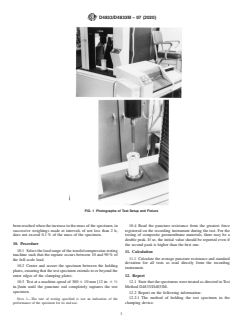
Fig. 1 and Fig. 3.
5.2 This test method is considered satisfactory for accep-
tance testing of commercial shipments of geomembranes and
7. Sampling
related materials since the test method has been used exten-
7.1 Lot Sample—Divide the product into lots and take the
sively in the trade for acceptance testing.
lot sample as directed in Practice D4354.
5.2.1 In case of a dispute arising from differences in
reported test results when using this test method for acceptance
7.2 Laboratory Sample—For the laboratory sample, take a
testing of commercial shipments, the purchaser and the sup-
swatch extending the full width and of sufficient length along
plier should conduct comparative tests to determine if there is
the selvage, from each sample roll so that the requirements of
a statistical bias between their laboratories. Competent statis-
7.3 and 8.1 can be met. Take a sample that will exclude
tical assistance is recommended for the investigation of bias.
material from the outer wrap and inner wrap around the core
As a minimum, the two parties should take a group of test
unless the sample is taken at the production site, then inner and
specimens that are as homogeneous as possible and that are
outer wrap material may be used.
from a lot material of the type in question. The test specimens
7.3 Test Specimens—Select from the laboratory sample the
should then be randomly assigned in equal numbers to each
number of specimens directed in Section 8. Minimum speci-
laboratory for testing. The average results
...