

ASTM D4354-12(2020)
(Practice)Standard Practice for Sampling of Geosynthetics and Rolled Erosion Control Products (RECPs) for Testing
General Information
- Abstract
SIGNIFICANCE AND USE
5.1 This practice provides a means by which samples of geosynthetics may be selected to provide a statistically valid sample for the selection of test specimens without previous knowledge of the variability that may exist between production units.
5.2 The principles stated in Practice D4271, and the illustrative text in that practice, can be used by test method authors in preparing sampling statements.
5.3 This practice gives three procedures for sampling: one for manufacturer's quality control (MQC), one for manufacturer's quality assurance (MQA) testing, and a third for purchaser's specification conformance testing. For this reason, test methods containing a section on sampling that requires the use of this practice should contain a statement in the section on reporting similar to the following: “Report which procedure from Practice D4354 was used for sampling: Procedure A for Manufacturer's Quality Control (MQC), Procedure B for Manufacturer's Quality Assurance (MQA) Testing, or Procedure C for Purchaser's Specification Conformance Testing.
5.4 Manufacturer's quality assurance is done internally to assure the manufacturer of the MQC program. When it is required to provide certification to a purchaser as to quality assurance, the MQA testing is to be done by an external MQA testing facility.
SCOPE
1.1 This practice covers three procedures for the sampling of geosynthetics and rolled erosion control products (RECPs) for testing. This practice requires that instructions on taking laboratory samples and test specimens be part of every test method for geosynthetics.
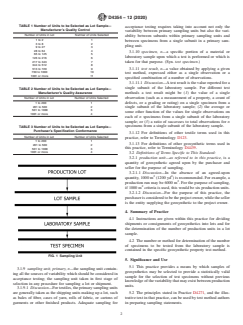
1.1.1 The first procedure describes the sampling of production units for the purpose of manufacturer's quality control (MQC) (Table 1).
1.1.2 The second procedure describes the sampling of production units for the purpose of manufacturer's quality assurance (MQA) testing during the manufacturing process. This requires that backup statistical process control records be maintained during the manufacturing process (Table 2).
1.1.3 The third procedure describes the division of shipments of geosynthetics and rolled erosion control products into lots and the determination of lot sample size for purchaser's specification conformance testing (Table 3).
1.2 This standard does not purport to address all of the safety concerns, if any, associated with its use. It is the responsibility of the user of this standard to establish appropriate safety, health, and environmental practices and determine the applicability of regulatory limitations prior to use.
1.3 This international standard was developed in accordance with internationally recognized principles on standardization established in the Decision on Principles for the Development of International Standards, Guides and Recommendations issued by the World Trade Organization Technical Barriers to Trade (TBT) Committee.
- Status
- Published
- Publication Date
- 30-Apr-2020
- Technical Committee
- D35 - Geosynthetics
- Drafting Committee
- D35.01 - Mechanical Properties

Overview
ASTM D4354-12(2020) is a standard practice developed by ASTM International for the sampling of geosynthetics and rolled erosion control products (RECPs) for testing. This standard outlines robust and statistically valid procedures for selecting laboratory samples and test specimens from production lots, ensuring that subsequent testing reflects the true characteristics of these materials. Geosynthetics and RECPs are crucial in civil engineering, environmental protection, and construction, often used in soil stabilization, erosion control, and drainage.
ASTM D4354 provides manufacturers, quality assurance agencies, and purchasers with clear guidelines needed to achieve consistency, reliability, and compliance in geosynthetic material testing, facilitating acceptance, certification, and market trust.
Key Topics
Statistically Valid Sampling: The standard establishes methods that ensure the samples taken for testing accurately represent the variability within production lots. This is essential for confidence in product quality and performance.
Procedures for Different Testing Needs:
- Manufacturer’s Quality Control (MQC): Internal checks to maintain continuous production quality.
- Manufacturer’s Quality Assurance (MQA): Internal processes, with the option of third-party verification, to assure buyers of compliance with quality standards.
- Purchaser’s Specification Conformance Testing: Independent checks by purchasers to confirm delivered goods align with contract or project requirements.
Lot Definition and Sample Size Determination: Provides guidance on defining lots (production or shipment groups) and selecting the number of units to sample, with recommended quantities based on lot size.
Sampling Terminology: Incorporates definitions for terms such as “geosynthetic,” “quality assurance,” “quality control,” “sample,” “specimen,” and “production unit” to promote clarity and standardization across the industry.
Integration with Other Standards: References related ASTM practices (including D4271 and D4439) to guide test method authors and users in sampling statement preparation and terminology.
Applications
ASTM D4354 is essential through various phases of geosynthetic use:
- Quality Control in Manufacturing: Ensures rolls or batches of geosynthetics and RECPs meet specified technical properties during production, supporting internal process improvement and certification.
- Quality Assurance Verification: Used by manufacturers or independent labs to confirm that materials meet agreed-upon standards before release or delivery.
- Purchasing and Project Compliance: Enables project owners, regulatory agencies, or independent organizations to verify that received geosynthetics conform to purchase specifications, which is critical for infrastructure, environmental, and construction projects.
This standard fosters objective, transparent, and repeatable sampling methods, reducing disputes and ensuring geosynthetic performance in the field.
Related Standards
- ASTM D4271: Practice for Writing Statements on Sampling in Test Methods for Textiles (withdrawn) - provides principles that inform the sampling statements required by ASTM D4354.
- ASTM D4439: Terminology for Geosynthetics - offers definitions for key terms used in geosynthetic sampling and testing.
- ASTM D123: Terminology Relating to Textiles - referenced for additional definitions related to sampling methods.
Keywords: ASTM D4354, geosynthetics sampling, rolled erosion control products, RECPs, geosynthetics quality control, quality assurance testing, specification conformance, material sampling, standard practices, geosynthetic testing methods.
By following ASTM D4354-12(2020), organizations involved in geosynthetics manufacturing, quality assurance, and procurement can ensure that their sampling and testing processes are consistent, reliable, and internationally recognized. This standard is vital for meeting project requirements and regulatory expectations in the geosynthetics industry.
Relations
- Effective Date
- 01-May-2020
- Effective Date
- 01-Feb-2024
- Effective Date
- 15-Apr-2018
- Effective Date
- 01-Aug-2017
- Effective Date
- 01-Mar-2017
- Effective Date
- 15-Sep-2015
- Effective Date
- 01-Sep-2015
- Effective Date
- 01-Sep-2015
- Effective Date
- 01-Jul-2015
- Effective Date
- 01-Apr-2015
- Effective Date
- 01-Mar-2014
- Effective Date
- 15-Jun-2013
- Effective Date
- 15-Jun-2013
- Effective Date
- 15-May-2013
- Effective Date
- 01-Feb-2012
Get Certified
Connect with accredited certification bodies for this standard

Control Union Certifications
Global certification for agriculture and sustainability.

Hohenstein Institut
Textile testing and certification.

Bureau Veritas Bangladesh
Bureau Veritas certification services in Bangladesh.
Sponsored listings
Frequently Asked Questions
ASTM D4354-12(2020) is a standard published by ASTM International. Its full title is "Standard Practice for Sampling of Geosynthetics and Rolled Erosion Control Products (RECPs) for Testing". This standard covers: SIGNIFICANCE AND USE 5.1 This practice provides a means by which samples of geosynthetics may be selected to provide a statistically valid sample for the selection of test specimens without previous knowledge of the variability that may exist between production units. 5.2 The principles stated in Practice D4271, and the illustrative text in that practice, can be used by test method authors in preparing sampling statements. 5.3 This practice gives three procedures for sampling: one for manufacturer's quality control (MQC), one for manufacturer's quality assurance (MQA) testing, and a third for purchaser's specification conformance testing. For this reason, test methods containing a section on sampling that requires the use of this practice should contain a statement in the section on reporting similar to the following: “Report which procedure from Practice D4354 was used for sampling: Procedure A for Manufacturer's Quality Control (MQC), Procedure B for Manufacturer's Quality Assurance (MQA) Testing, or Procedure C for Purchaser's Specification Conformance Testing. 5.4 Manufacturer's quality assurance is done internally to assure the manufacturer of the MQC program. When it is required to provide certification to a purchaser as to quality assurance, the MQA testing is to be done by an external MQA testing facility. SCOPE 1.1 This practice covers three procedures for the sampling of geosynthetics and rolled erosion control products (RECPs) for testing. This practice requires that instructions on taking laboratory samples and test specimens be part of every test method for geosynthetics. 1.1.1 The first procedure describes the sampling of production units for the purpose of manufacturer's quality control (MQC) (Table 1). 1.1.2 The second procedure describes the sampling of production units for the purpose of manufacturer's quality assurance (MQA) testing during the manufacturing process. This requires that backup statistical process control records be maintained during the manufacturing process (Table 2). 1.1.3 The third procedure describes the division of shipments of geosynthetics and rolled erosion control products into lots and the determination of lot sample size for purchaser's specification conformance testing (Table 3). 1.2 This standard does not purport to address all of the safety concerns, if any, associated with its use. It is the responsibility of the user of this standard to establish appropriate safety, health, and environmental practices and determine the applicability of regulatory limitations prior to use. 1.3 This international standard was developed in accordance with internationally recognized principles on standardization established in the Decision on Principles for the Development of International Standards, Guides and Recommendations issued by the World Trade Organization Technical Barriers to Trade (TBT) Committee.
SIGNIFICANCE AND USE 5.1 This practice provides a means by which samples of geosynthetics may be selected to provide a statistically valid sample for the selection of test specimens without previous knowledge of the variability that may exist between production units. 5.2 The principles stated in Practice D4271, and the illustrative text in that practice, can be used by test method authors in preparing sampling statements. 5.3 This practice gives three procedures for sampling: one for manufacturer's quality control (MQC), one for manufacturer's quality assurance (MQA) testing, and a third for purchaser's specification conformance testing. For this reason, test methods containing a section on sampling that requires the use of this practice should contain a statement in the section on reporting similar to the following: “Report which procedure from Practice D4354 was used for sampling: Procedure A for Manufacturer's Quality Control (MQC), Procedure B for Manufacturer's Quality Assurance (MQA) Testing, or Procedure C for Purchaser's Specification Conformance Testing. 5.4 Manufacturer's quality assurance is done internally to assure the manufacturer of the MQC program. When it is required to provide certification to a purchaser as to quality assurance, the MQA testing is to be done by an external MQA testing facility. SCOPE 1.1 This practice covers three procedures for the sampling of geosynthetics and rolled erosion control products (RECPs) for testing. This practice requires that instructions on taking laboratory samples and test specimens be part of every test method for geosynthetics. 1.1.1 The first procedure describes the sampling of production units for the purpose of manufacturer's quality control (MQC) (Table 1). 1.1.2 The second procedure describes the sampling of production units for the purpose of manufacturer's quality assurance (MQA) testing during the manufacturing process. This requires that backup statistical process control records be maintained during the manufacturing process (Table 2). 1.1.3 The third procedure describes the division of shipments of geosynthetics and rolled erosion control products into lots and the determination of lot sample size for purchaser's specification conformance testing (Table 3). 1.2 This standard does not purport to address all of the safety concerns, if any, associated with its use. It is the responsibility of the user of this standard to establish appropriate safety, health, and environmental practices and determine the applicability of regulatory limitations prior to use. 1.3 This international standard was developed in accordance with internationally recognized principles on standardization established in the Decision on Principles for the Development of International Standards, Guides and Recommendations issued by the World Trade Organization Technical Barriers to Trade (TBT) Committee.
ASTM D4354-12(2020) is classified under the following ICS (International Classification for Standards) categories: 59.080.70 - Geotextiles. The ICS classification helps identify the subject area and facilitates finding related standards.
ASTM D4354-12(2020) has the following relationships with other standards: It is inter standard links to ASTM D4354-12, ASTM D4439-24, ASTM D4439-18, ASTM D4439-17, ASTM D123-17, ASTM D123-15b, ASTM D123-15a, ASTM D4439-15a, ASTM D4439-15, ASTM D123-15, ASTM D4439-14, ASTM D123-13a, ASTM D123-13ae1, ASTM D123-13, ASTM D123-12e1. Understanding these relationships helps ensure you are using the most current and applicable version of the standard.
ASTM D4354-12(2020) is available in PDF format for immediate download after purchase. The document can be added to your cart and obtained through the secure checkout process. Digital delivery ensures instant access to the complete standard document.
Standards Content (Sample)
This international standard was developed in accordance with internationally recognized principles on standardization established in the Decision on Principles for the
Development of International Standards, Guides and Recommendations issued by the World Trade Organization Technical Barriers to Trade (TBT) Committee.
Designation: D4354 − 12 (Reapproved 2020)
Standard Practice for
Sampling of Geosynthetics and Rolled Erosion Control
Products (RECPs) for Testing
This standard is issued under the fixed designation D4354; the number immediately following the designation indicates the year of
original adoption or, in the case of revision, the year of last revision. A number in parentheses indicates the year of last reapproval. A
superscript epsilon (´) indicates an editorial change since the last revision or reapproval.
1. Scope D4271 Practice for Writing Statements on Sampling in Test
Methods for Textiles (Withdrawn 2009)
1.1 This practice covers three procedures for the sampling
D4439 Terminology for Geosynthetics
of geosynthetics and rolled erosion control products (RECPs)
for testing. This practice requires that instructions on taking
3. Terminology
laboratory samples and test specimens be part of every test
3.1 Definitions:
method for geosynthetics.
3.1.1 geosynthetic, n—a planar product manufactured from
1.1.1 The first procedure describes the sampling of produc-
polymeric material used with soil, rock, earth, or other geo-
tion units for the purpose of manufacturer’s quality control
technical engineering related material as an integral part of a
(MQC) (Table 1).
man-made project, structure, or system.
1.1.2 The second procedure describes the sampling of
3.1.2 lot, n—a unit of production, or a group of other units
production units for the purpose of manufacturer’s quality
assurance (MQA) testing during the manufacturing process. or packages, taken for sampling or statistical examination,
having one or more common properties and being readily
This requires that backup statistical process control records be
separable from other similar units.
maintained during the manufacturing process (Table 2).
1.1.3 The third procedure describes the division of ship-
3.1.3 quality assurance, n—all those planned or systematic
ments of geosynthetics and rolled erosion control products into
actions necessary to provide adequate confidence that a
lots and the determination of lot sample size for purchaser’s
material, product, system, or service will satisfy given needs.
specification conformance testing (Table 3).
3.1.4 quality control, n—the operational techniques and the
1.2 This standard does not purport to address all of the
activities which sustain a quality of material, product, system,
safety concerns, if any, associated with its use. It is the
or service that will satisfy given needs; also the use of such
responsibility of the user of this standard to establish appro-
techniques and activities.
priate safety, health, and environmental practices and deter-
3.1.5 sample, n—(1) a portion of material which is taken for
mine the applicability of regulatory limitations prior to use.
testing or for record purposes. (See also sample, lot; sample,
1.3 This international standard was developed in accor-
laboratory;and specimen.)(2)agroupofspecimensused,orof
dance with internationally recognized principles on standard-
observationsmade,whichprovideinformationthatcanbeused
ization established in the Decision on Principles for the
for making statistical inferences about the population(s) from
Development of International Standards, Guides and Recom-
which the specimens are drawn.
mendations issued by the World Trade Organization Technical
3.1.6 sample, laboratory, n—a portion of material taken to
Barriers to Trade (TBT) Committee.
represent the lot sample, or the original material, and used in
2. Referenced Documents
the laboratory as a source of test specimens.
2.1 ASTM Standards: 3.1.7 sample, lot, n—one or more shipping units taken at
D123 Terminology Relating to Textiles random to represent an acceptance sampling lot and used as a
source of laboratory samples.
This practice is under the jurisdiction of ASTM Committee D35 on Geosyn- 3.1.8 sampling unit, n—an identifiable, discrete unit or
thetics and is the direct responsibility of Subcommittee D35.01 on Mechanical
subunit of material that could be taken as part of a sample.
Properties.
3.1.8.1 Discussion—Fig. 1 is included to show the differ-
Current edition approved May 1, 2020. Published May 2020. Originally
ence between lot sample, laboratory sample, and test speci-
approved in 1984. Last previous edition approved in 2012 as D4354 – 12. DOI:
10.1520/D4354-12R20.
men.
For referenced ASTM standards, visit the ASTM website, www.astm.org, or
contact ASTM Customer Service at service@astm.org. For Annual Book of ASTM
Standards volume information, refer to the standard’s Document Summary page on The last approved version of this historical standard is referenced on
the ASTM website. www.astm.org.
Copyright © ASTM International, 100 Barr Harbor Drive, PO Box C700, West Conshohocken, PA 19428-2959. United States
D4354 − 12 (2020)
TABLE 1 Number of Units to be Selected as Lot Sample—
acceptance testing requires taking into account not only the
Manufacturer’s Quality Control
variability between primary sampling units but also the vari-
Number of Units in Lot Number of Units Selected
ability between subunits within primary sampling units and
1to2 1
between specimens from a single subunit in a primary sam-
3to8 2
pling unit.
9to27 3
28 to 64 4
3.1.10 specimen, n—a specific portion of a material or
65 to 125 5
laboratory sample upon which a test is performed or which is
126 to 216 6
217 to 343 7
taken for that purpose. (Syn. test specimen.)
344 to 512 8
513 to 729 9 3.1.11 test result, n—a value obtained by applying a given
730 to 1000 10
test method, expressed either as a single observation or a
1001 or more 11
specified combination of a number of observations.
3.1.11.1 Discussion—Atest result is the value reported for a
single subunit of the laboratory sample. For different test
TABLE 2 Number of Units to be Selected as Lot Sample—
Manufacturer’s Quality Assurance methods a test result might be (1) the value of a single
observation (such as a measurement of a property, a count of
Number of Units in Lot Number of Units Selected
defects, or a grading or rating) on a single specimen from a
1to200 1
201 to 500 2
single subunit of the laboratory sample; (2) the average or
501 to 1000 3
some other function of the values for single observations on
1001 or more 4
each of n specimens from a single subunit of the laboratory
sample; or (3) a ratio of successes to total observations for n
specimens from a single subunit of the laboratory sample.
TABLE 3 Number of Units to be Selected as Lot Sample—
Purchaser’s Specification Conformance
3.1.12 For definitions of other textile terms used in this
Number of Units in Lot Number of Units Selected
practice, refer to Terminology D123.
1to200 1
3.1.13 For definitions of other geosynthetic terms used in
201 to 500 2
501 to 1000 3 this practice, refer to Terminology D4439.
1001 or more 4
3.2 Definitions of Terms Specific to This Standard:
3.2.1 production unit—as referred to in this practice,isa
quantity of geosynthetic agreed upon by the purchaser and
seller for the purpose of sampling.
3.2.1.1 Discussion—In the absence of an agreed-upon
2 2
quantity, 1000 m (1200 yd ) is recommended. For example, a
production run may be 6000 m . For the purpose of sampling,
if 1000 m criteria is used, this would be six production units.
3.2.1.2 Discussion—For the purpose of this practice, the
purchaserisconsideredto
...