

ASTM D4496-21e1
(Test Method)Standard Test Method for D-C Resistance or Conductance of Moderately Conductive Materials
General Information
- Abstract
SIGNIFICANCE AND USE
5.1 This test method is useful for the comparison of materials, as a quality control test, and for specification purposes.
5.2 This test method is useful in the selection and use of materials in wires, cables, bushings, high-voltage rotating machinery, and other electrical apparatus in which shielding or the distribution of voltage stress is of value.
5.3 Commercially available “moderately conductive” materials frequently are comprised of both conductive and resistive components (that is, cellulose fibers with colloidal carbon black particles attached to portions of the surfaces of those fibers, or discrete conductive particles adhered to the surfaces of electrical insulating polymers). Such commercially available materials are often manufactured in a manner that results in anisotropy of electrical conduction. Hence, the significance of tests using this test method depends upon the orientation of the specimen tested to the direction of the electric field and the relationship between this orientation and the orientation of the material in the electrical apparatus, which uses these materials.
SCOPE
1.1 This test method covers the determination of electrical resistance and electrical resistivity of materials that are generally categorized as moderately conductive and are neither good electrical insulators nor good conductors.
1.2 This test method applies to the materials that exhibit volume resistivity in the range of 100 to 107 Ω-cm or surface resistivity in the range of 103 to 107 Ω (per square).
1.3 This test method is designed for measurements at standard conditions of 23 °C and 50 % relative humidity, but its principles of operation can be applied to specimens measured at lower or higher temperatures and relative humidities.
1.4 This standard does not purport to address all of the safety concerns, if any, associated with its use. It is the responsibility of the user of this standard to establish appropriate safety, health, and environmental practices and determine the applicability of regulatory limitations prior to use. Specific precautionary statements are given in 8.3.
1.5 This international standard was developed in accordance with internationally recognized principles on standardization established in the Decision on Principles for the Development of International Standards, Guides and Recommendations issued by the World Trade Organization Technical Barriers to Trade (TBT) Committee.
- Status
- Published
- Publication Date
- 31-Dec-2020
- Technical Committee
- D09 - Electrical and Electronic Insulating Materials
- Drafting Committee
- D09.12 - Electrical Tests
Overview
ASTM D4496-21e1 is the internationally recognized standard test method for determining the D-C (direct current) resistance or conductance of moderately conductive materials. Published by ASTM International, this standard supports the measurement of both electrical resistance and resistivity for materials that are neither highly conductive nor excellent insulators. The method is broadly applicable to materials with volume resistivity between 100 and 10⁷ Ω·cm and surface resistivity between 10³ and 10⁷ Ω per square.
This test method is widely adopted for comparing materials, performing quality control checks, and meeting specification criteria. Practical in manufacturing, research, and development environments, ASTM D4496 is also crucial for ensuring the reliability and safety of electrical apparatus such as wires, cables, bushings, and high-voltage rotating machinery where voltage stress distribution and shielding are essential.
Key Topics
- Moderately Conductive Materials: Focuses on substances with intermediate electrical properties, often containing both conductive and resistive components such as carbon-black dispersed fibers or conductive particle-filled polymers.
- Measurement Range: Applies to materials within the specified volume and surface resistivity ranges, critical for mid-range electrical applications.
- Test Conditions: Standard test conditions are 23°C and 50% relative humidity, though guidance is provided for varying environmental factors.
- Anisotropy Considerations: Many materials may conduct differently in various directions due to the manufacturing process, making orientation during testing significant.
- Sample Preparation: Emphasizes random selection, careful handling to prevent contamination (moisture, salts, etc.), and equilibrium conditioning before measurement.
- Resistivity Calculations: Provides formulas for calculating volume and surface resistivity based on the observed resistance, electrode configuration, and specimen dimensions.
- Safety and Best Practices: Stresses the user’s responsibility for establishing safe practices and understanding regulatory implications.
Applications
- Electrical Shielding: Ensures the efficient distribution of voltage stress and prevents uncontrolled electric fields in insulation systems.
- Component Selection: Assists engineers and designers in choosing suitable materials for semiconducting and partially conductive layers in wires, cables, transformers, and motors.
- Quality Control: Used by manufacturers for batch testing and to verify compliance with product specifications before release.
- Research and Development: Supports the development and improvement of new moderately conductive compositions, especially in the polymer and advanced materials sectors.
- Material Comparison: Facilitates benchmarking of new materials against established standards to evaluate performance characteristics crucial for electrical insulation and shielding.
Related Standards
- ASTM D257: Test Methods for DC Resistance or Conductance of Insulating Materials - Relevant for testing highly insulating substances.
- ASTM D991: Test Method for Rubber Property-Volume Resistivity of Electrically Conductive and Antistatic Products.
- ASTM D374/D374M: Test Methods for Thickness of Solid Electrical Insulation - Important for accurate resistivity calculations.
- ASTM D618: Practice for Conditioning Plastics for Testing - Provides guidance for pre-test conditioning of samples.
- ASTM D1711: Terminology Relating to Electrical Insulation - Defines terminology used in this and related standards.
Practical Value
ASTM D4496-21e1 is a cornerstone in the electrical industry for evaluating moderately conductive materials. Regular use of this method aids in:
- Achieving consistent electrical performance in products
- Controlling material quality
- Meeting international trade and compliance requirements
- Enhancing reliability and longevity of electrical equipment
Keywords: ASTM D4496, DC resistance, conductance, moderately conductive materials, electrical shielding, volume resistivity, surface resistivity, quality control, electrical apparatus testing, standard test method
Relations
- Effective Date
- 01-Mar-2024
- Effective Date
- 01-Oct-2023
- Effective Date
- 01-Nov-2015
- Effective Date
- 01-Nov-2014
- Effective Date
- 01-May-2014
- Effective Date
- 01-Nov-2013
- Effective Date
- 01-Aug-2011
- Effective Date
- 01-Nov-2008
- Effective Date
- 01-May-2008
- Effective Date
- 15-May-2007
- Effective Date
- 01-Nov-2005
- Refers
ASTM D257-99(2005) - Standard Test Methods for DC Resistance or Conductance of Insulating Materials - Effective Date
- 01-Sep-2005
- Effective Date
- 10-Mar-2002
- Effective Date
- 10-Nov-2000
- Effective Date
- 10-Oct-1999
Get Certified
Connect with accredited certification bodies for this standard

IMQ S.p.A. (Certification)
Italian electrical product certification.

SLG Prüf- und Zertifizierungs GmbH
German testing and certification body.

UL Solutions
Global safety science company with testing, inspection and certification.
Sponsored listings
Frequently Asked Questions
ASTM D4496-21e1 is a standard published by ASTM International. Its full title is "Standard Test Method for D-C Resistance or Conductance of Moderately Conductive Materials". This standard covers: SIGNIFICANCE AND USE 5.1 This test method is useful for the comparison of materials, as a quality control test, and for specification purposes. 5.2 This test method is useful in the selection and use of materials in wires, cables, bushings, high-voltage rotating machinery, and other electrical apparatus in which shielding or the distribution of voltage stress is of value. 5.3 Commercially available “moderately conductive” materials frequently are comprised of both conductive and resistive components (that is, cellulose fibers with colloidal carbon black particles attached to portions of the surfaces of those fibers, or discrete conductive particles adhered to the surfaces of electrical insulating polymers). Such commercially available materials are often manufactured in a manner that results in anisotropy of electrical conduction. Hence, the significance of tests using this test method depends upon the orientation of the specimen tested to the direction of the electric field and the relationship between this orientation and the orientation of the material in the electrical apparatus, which uses these materials. SCOPE 1.1 This test method covers the determination of electrical resistance and electrical resistivity of materials that are generally categorized as moderately conductive and are neither good electrical insulators nor good conductors. 1.2 This test method applies to the materials that exhibit volume resistivity in the range of 100 to 107 Ω-cm or surface resistivity in the range of 103 to 107 Ω (per square). 1.3 This test method is designed for measurements at standard conditions of 23 °C and 50 % relative humidity, but its principles of operation can be applied to specimens measured at lower or higher temperatures and relative humidities. 1.4 This standard does not purport to address all of the safety concerns, if any, associated with its use. It is the responsibility of the user of this standard to establish appropriate safety, health, and environmental practices and determine the applicability of regulatory limitations prior to use. Specific precautionary statements are given in 8.3. 1.5 This international standard was developed in accordance with internationally recognized principles on standardization established in the Decision on Principles for the Development of International Standards, Guides and Recommendations issued by the World Trade Organization Technical Barriers to Trade (TBT) Committee.
SIGNIFICANCE AND USE 5.1 This test method is useful for the comparison of materials, as a quality control test, and for specification purposes. 5.2 This test method is useful in the selection and use of materials in wires, cables, bushings, high-voltage rotating machinery, and other electrical apparatus in which shielding or the distribution of voltage stress is of value. 5.3 Commercially available “moderately conductive” materials frequently are comprised of both conductive and resistive components (that is, cellulose fibers with colloidal carbon black particles attached to portions of the surfaces of those fibers, or discrete conductive particles adhered to the surfaces of electrical insulating polymers). Such commercially available materials are often manufactured in a manner that results in anisotropy of electrical conduction. Hence, the significance of tests using this test method depends upon the orientation of the specimen tested to the direction of the electric field and the relationship between this orientation and the orientation of the material in the electrical apparatus, which uses these materials. SCOPE 1.1 This test method covers the determination of electrical resistance and electrical resistivity of materials that are generally categorized as moderately conductive and are neither good electrical insulators nor good conductors. 1.2 This test method applies to the materials that exhibit volume resistivity in the range of 100 to 107 Ω-cm or surface resistivity in the range of 103 to 107 Ω (per square). 1.3 This test method is designed for measurements at standard conditions of 23 °C and 50 % relative humidity, but its principles of operation can be applied to specimens measured at lower or higher temperatures and relative humidities. 1.4 This standard does not purport to address all of the safety concerns, if any, associated with its use. It is the responsibility of the user of this standard to establish appropriate safety, health, and environmental practices and determine the applicability of regulatory limitations prior to use. Specific precautionary statements are given in 8.3. 1.5 This international standard was developed in accordance with internationally recognized principles on standardization established in the Decision on Principles for the Development of International Standards, Guides and Recommendations issued by the World Trade Organization Technical Barriers to Trade (TBT) Committee.
ASTM D4496-21e1 is classified under the following ICS (International Classification for Standards) categories: 29.050 - Superconductivity and conducting materials. The ICS classification helps identify the subject area and facilitates finding related standards.
ASTM D4496-21e1 has the following relationships with other standards: It is inter standard links to ASTM D1711-24, ASTM D374/D374M-23, ASTM D1711-15, ASTM D1711-14a, ASTM D1711-14, ASTM D1711-13, ASTM D1711-11a, ASTM D618-08, ASTM D1711-08, ASTM D257-07, ASTM D618-05, ASTM D257-99(2005), ASTM D1711-02, ASTM D618-00, ASTM D257-99. Understanding these relationships helps ensure you are using the most current and applicable version of the standard.
ASTM D4496-21e1 is available in PDF format for immediate download after purchase. The document can be added to your cart and obtained through the secure checkout process. Digital delivery ensures instant access to the complete standard document.
Standards Content (Sample)
This international standard was developed in accordance with internationally recognized principles on standardization established in the Decision on Principles for the
Development of International Standards, Guides and Recommendations issued by the World Trade Organization Technical Barriers to Trade (TBT) Committee.
´1
Designation: D4496 − 21
Standard Test Method for
D-C Resistance or Conductance of Moderately Conductive
Materials
This standard is issued under the fixed designation D4496; the number immediately following the designation indicates the year of
original adoption or, in the case of revision, the year of last revision.Anumber in parentheses indicates the year of last reapproval.A
superscript epsilon (´) indicates an editorial change since the last revision or reapproval.
ε NOTE—Editorially updated adjunct stock code in December 2022.
1. Scope D374/D374MTest Methods for Thickness of Solid Electri-
cal Insulation
1.1 This test method covers the determination of electrical
D618Practice for Conditioning Plastics for Testing
resistance and electrical resistivity of materials that are gener-
D991Test Method for Rubber Property—Volume Resistiv-
allycategorizedasmoderatelyconductiveandareneithergood
ity Of Electrically Conductive and Antistatic Products
electrical insulators nor good conductors.
D1711Terminology Relating to Electrical Insulation
1.2 This test method applies to the materials that exhibit
2.2 ASTM Adjuncts:
0 7
volume resistivity in the range of 10 to 10 Ω-cm or surface
Carbon black test cell (two drawings)
3 7
resistivity in the range of 10 to 10 Ω (per square).
1.3 This test method is designed for measurements at
3. Terminology
standardconditionsof23°Cand50%relativehumidity,butits
3.1 Definitions:
principles of operation can be applied to specimens measured
3.1.1 moderately conductive—a solid material having vol-
at lower or higher temperatures and relative humidities.
0 7
ume resistivity between 10 and 10 Ω·cm.
1.4 This standard does not purport to address all of the
3.1.2 For definitions of the terms used, but not defined in
safety concerns, if any, associated with its use. It is the
this standard, refer to Terminology D1711.
responsibility of the user of this standard to establish appro-
3.2 Definitions of Terms Specific to This Standard:
priate safety, health, and environmental practices and deter-
3.2.1 steady state—for the purpose of this test method,
mine the applicability of regulatory limitations prior to use.
steady-state is attained if any rate of change in the observed
Specific precautionary statements are given in 8.3.
resistance (or conductance) averages less than 0.25%⁄s.
1.5 This international standard was developed in accor-
dance with internationally recognized principles on standard-
4. Summary of Test Method
ization established in the Decision on Principles for the
4.1 Specimens of the test material are conditioned at pre-
Development of International Standards, Guides and Recom-
scribed conditions and subjected to direct-voltage stress. Re-
mendations issued by the World Trade Organization Technical
sistance or conductance is measured and used with the dimen-
Barriers to Trade (TBT) Committee.
sional aspects of the specimen to compute the resistivity of the
material.Theapparatusandtechniquesusedinthistestmethod
2. Referenced Documents
are selected in accordance with the general principles set forth
2.1 ASTM Standards:
in Test Methods D257 and D991.
D257Test Methods for DC Resistance or Conductance of
Insulating Materials
5. Significance and Use
5.1 This test method is useful for the comparison of
materials, as a quality control test, and for specification
This test method is under the jurisdiction of ASTM Committee D09 on
purposes.
Electrical and Electronic Insulating Materials and is the direct responsibility of
Subcommittee D09.12 on Electrical Tests. 5.2 This test method is useful in the selection and use of
Current edition approved Jan. 1, 2021. Published February 2021. Originally
materials in wires, cables, bushings, high-voltage rotating
approved in 1985. Last previous edition approved in 2013 as D4496 – 13. DOI:
10.1520/D4496-21E01.
For referenced ASTM standards, visit the ASTM website, www.astm.org, or
contact ASTM Customer Service at service@astm.org. For Annual Book of ASTM Available from ASTM International Headquarters. Order Adjunct
Standards volume information, refer to the standard’s Document Summary page on No.ADJD4496-E-PDF. Original adjunct produced in 2015.Adjunct last revised in
the ASTM website. 2015.
Copyright © ASTM International, 100 Barr Harbor Drive, PO Box C700, West Conshohocken, PA 19428-2959. United States
´1
D4496 − 21
machinery, and other electrical apparatus in which shielding or 7.2 Prior to testing, condition all specimens to equilibrium
the distribution of voltage stress is of value. in the standard laboratory atmosphere prescribed in Practice
D618. For many materials the time of conditioning to equilib-
5.3 Commercially available “moderately conductive” mate-
rium will require only a few hours (that is, less than 24 h).
rials frequently are comprised of both conductive and resistive
Equilibrium with standard laboratory conditions is declared
components (that is, cellulose fibers with colloidal carbon
attainediftwoconsecutivevolumeresistancemeasurementson
black particles attached to portions of the surfaces of those
the same specimen agree within 61%. The two consecutive
fibers, or discrete conductive particles adhered to the surfaces
measurements are to be made at the intervals separated at least
ofelectricalinsulatingpolymers).Suchcommerciallyavailable
by4h.
materials are often manufactured in a manner that results in
anisotropy of electrical conduction. Hence, the significance of 7.3 Determine the dimensions of the test specimens to
testsusingthistestmethoddependsupontheorientationofthe within 62% on material in equilibrium with the standard
specimen tested to the direction of the electric field and the laboratory atmosphere. Make all thickness measurements in
relationship between this orientation and the orientation of the accordance with Method D of Test Methods D374/D374M
materialintheelectricalapparatus,whichusesthesematerials. using the appropriate procedure for the material being tested.
7.4 Forspecimensincorporatingconductivepaintelectrodes
6. Apparatus
see Annex A1.
6.1 Use apparatus conforming to the general requirements
7.5 For anisotropic materials, label and prepare specimens
set forth in Test Methods D257 and D991.
fortestingineachoftheprincipaldirectionsofanisotropy.This
6.2 Power Source—Capable of limiting the magnitude of
mayrequireusingmorethanonetypeoftestfixturedepending
the direct voltage applied to the specimen. (See Appendix X1
on sample shape and orientation.
for discussion of voltage stress and specimen heating.)
NOTE 2—Moderately conductive paper exhibits three axes of anisot-
6.3 Test cells, that have been found to be satisfactory are
ropy. The principal axes in paper are machine direction (MD); cross-
machine direction (CMD); and thickness direction (TD). Extruded poly-
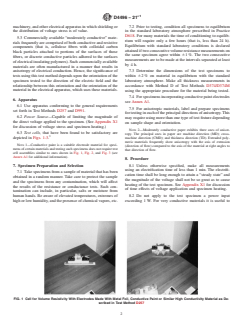
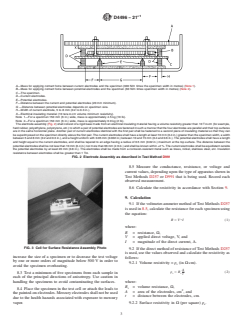
depicted in Figs. 1-3.
meric materials frequently show anisotropy with the axis of extrusion
NOTE 1—Conductive paint is a suitable electrode material for speci-
(direction of flow) compared to the axis of the material at right angles to
mens of certain materials and testing such specimens does not require test
that direction of flow.
cell assemblies similar to ones shown in Fig. 1, Fig. 2, and Fig. 3 (see
Annex A1 for additional information).
8. Procedure
8.1 Unless otherwise specified, make all measurements
7. Specimen Preparation and Selection
using an electrification time of less than 1 min. The electrifi-
7.1 Take specimens from a sample of material that has been
cation time shall be long enough to attain a “steady state” and
obtained in a random manner. Take care to protect the sample
the magnitude of the voltage shall not be so great as to cause
and the specimens from any contamination, which will affect
heating of the test specimen. See Appendix X1 for discussion
the results of the resistance or conductance tests. Such con-
of time effects of voltage application and specimen heating.
tamination can include, in particular, salts or moisture from
human hands. Be aware of elevated temperatures, extremes of 8.2 Do not apply to the test specimen a power input
highorlowhumidity,andthepresenceofchemicalvapors,etc. exceeding 1 W. For very conductive materials it is useful to
FIG. 1 Cell for Volume Resistivity With Electrodes Made With Metal Foil, Conductive Paint or Similar High Conductivity Material as De-
scribed in Test Method D257
´1
D4496 − 21
A—Mass for applying contact force between current electrodes and the specimen (300 N/m times the specimen width in metres) (Note 1).
B—Mass for applying contact force between potential electrodes and the specimen (60 N/m times specimen width in metres) (Note 2).
C—The specimen.
D—Current electrodes.
E—Potential electrodes.
F—Distance between the current and potential electrodes (20 mm minimum).
G —Distance between potential electrodes depends on specimen size.
H—Width of current electrode, 5 to 8 mm (0.2 to 0.3 in.).
X—Electrical insulating material (10 tera Ω·cm volume minimum resistivity).
Note 1—For a specimen 150 mm (6 in.) wide, mass is approximately 4.5 kg (10 lb).
Note 2—For a specimen 150 mm (6 in.) wide, mass is approximately 0.9 kg (2 lb).
The electrode assembly (Fig. 2) shall consist of a rigid base made from an electrical insulating material having a volume resistivity greater than 10 T Ω·cm (for example,
hard rubber, polyethylene, polystyrene, etc.) to which a pair of potential electrodes are fastened in such a manner that the four electrodes are parallel and their top surfaces
are in the same horizontal plane. Another pair of current electrodes identical with the first pair shall be fastened to a sec
...