

ASTM E977-05(2023)
(Practice)Standard Practice for Thermoelectric Sorting of Electrically Conductive Materials
General Information
- Abstract
ABSTRACT
This practice covers the procedure for sorting electrically conductive materials using the thermoelectric method, which is based on the seebeck effect. The procedure relates to the use of direct- and comparator-type thermoelectric instruments for distinguishing variations in materials which affect the thermoelectric properties of those materials. The two techniques that are primarily used in thermoelectric sorting are direct and comparative instrumentation. In the direct instruments, equipment is standardized by placing materials with known chemistry and metallurgical structure in the test system. In the comparative instruments, the thermoelectric response of the test piece is compared with that of a known standard(s) and the response indicates whether the piece is within the acceptance limits. The electronic apparatus shall be capable of maintaining a sufficient temperature differential across the electrodes to produce a suitable thermoelectric voltage. The different procedures for sorting electrically conductive materials are presented in details.
SCOPE
1.1 This practice covers the procedure for sorting materials using the thermoelectric method, which is based on the Seebeck effect. The procedure relates to the use of direct- and comparator-type thermoelectric instruments for distinguishing variations in materials which affect the thermoelectric properties of those materials.
1.2 While the practice is most commonly applied to the sorting of metals, it may be applied to other electrically conductive materials.
1.3 Thermoelectric sorting may also be applied to the sorting of materials on the basis of plating thickness, case depth, and hardness.
1.4 This standard does not purport to address all of the safety concerns, if any, associated with its use. It is the responsibility of the user of this standard to establish appropriate safety, health, and environmental practices and determine the applicability of regulatory limitations prior to use.
1.5 This international standard was developed in accordance with internationally recognized principles on standardization established in the Decision on Principles for the Development of International Standards, Guides and Recommendations issued by the World Trade Organization Technical Barriers to Trade (TBT) Committee.
- Status
- Published
- Publication Date
- 30-Nov-2023
- Technical Committee
- E07 - Nondestructive Testing
- Drafting Committee
- E07.10 - Specialized NDT Methods


Overview
ASTM E977-05(2023), Standard Practice for Thermoelectric Sorting of Electrically Conductive Materials, provides a comprehensive procedure for sorting materials based on their thermoelectric properties using the Seebeck effect. This practice details both direct and comparator-type thermoelectric instruments for distinguishing variations in conductive materials. Thermoelectric sorting offers a nondestructive and efficient method for differentiating between materials by their unique thermal and electrical characteristics. The practice is widely applicable to metals but can also be deployed for other electrically conductive materials.
Key Topics
Thermoelectric Sorting and the Seebeck Effect
Thermoelectric sorting relies on the Seebeck effect, where a voltage is generated when two different conductors are joined at points with differing temperatures. This thermoelectric voltage is influenced by the material’s composition, structure, surface state, and temperature at the electrode contact points.Direct vs. Comparator Instrumentation
- Direct Instrumentation: The equipment is standardized using reference materials of known chemistry and structure, and the measured voltage is compared to the standard.
- Comparator Instrumentation: The thermoelectric response of an unknown sample is compared directly with that of one or more known standards representing acceptance limits.
Instrument Calibration and Standardization
Proper calibration using reference samples is critical to reliable performance. Regular restandardization is recommended, particularly when operator, environmental, or system variables change.Sample Preparation and Interference
To ensure accurate results, surfaces must be free of insulating contaminants such as rust, oil, paint, or scale. Proper contact between the material and electrodes is vital. Temperature consistency among samples and standards is also necessary to prevent errors.
Applications
Industrial Metal Sorting
The thermoelectric method is highly effective for rapidly sorting large quantities of metallic materials in manufacturing, recycling, and quality control environments. It enables the separation of scrap metals, verification of alloy grades, and detection of manufacturing variances.Determination of Material Properties
Beyond basic composition, thermoelectric sorting can assess attributes such as plating thickness, case depth, and material hardness. This makes it valuable for process control in plating operations or heat treatment validation.Nondestructive Testing
The method offers a nondestructive solution that preserves the integrity of the materials being examined and is suitable for repetitive inspection tasks.Automation Compatibility
Thermoelectric sorting lends itself to automated feeding and classifying, supporting high-throughput industrial applications.
Related Standards
- ASTM E243 - Standard Practice for Electromagnetic (Eddy-Current) Sorting of Metallic Materials
- ASTM E18 - Standard Test Methods for Rockwell Hardness of Metallic Materials
- ASTM E566 - Standard Practice for Electromagnetic Sorting of Mixed Nonferrous Metals
- ISO 11952 - Metallic materials - Conductivity measurement
For further guidance, refer to standards on nondestructive testing and material identification that address specific application needs.
Keywords: thermoelectric sorting, Seebeck effect, ASTM E977, electrically conductive materials, comparator instrumentation, direct instrumentation, nondestructive testing, metal sorting, standardization, electrode contact.
Relations
- Effective Date
- 01-Dec-2023
- Effective Date
- 01-Dec-2023
- Referred By
ASTM E1476-04(2022) - Standard Guide for Metals Identification, Grade Verification, and Sorting - Effective Date
- 01-Dec-2023
Get Certified
Connect with accredited certification bodies for this standard

IMQ S.p.A. (Certification)
Italian electrical product certification.

SLG Prüf- und Zertifizierungs GmbH
German testing and certification body.

UL Solutions
Global safety science company with testing, inspection and certification.
Sponsored listings
Frequently Asked Questions
ASTM E977-05(2023) is a standard published by ASTM International. Its full title is "Standard Practice for Thermoelectric Sorting of Electrically Conductive Materials". This standard covers: ABSTRACT This practice covers the procedure for sorting electrically conductive materials using the thermoelectric method, which is based on the seebeck effect. The procedure relates to the use of direct- and comparator-type thermoelectric instruments for distinguishing variations in materials which affect the thermoelectric properties of those materials. The two techniques that are primarily used in thermoelectric sorting are direct and comparative instrumentation. In the direct instruments, equipment is standardized by placing materials with known chemistry and metallurgical structure in the test system. In the comparative instruments, the thermoelectric response of the test piece is compared with that of a known standard(s) and the response indicates whether the piece is within the acceptance limits. The electronic apparatus shall be capable of maintaining a sufficient temperature differential across the electrodes to produce a suitable thermoelectric voltage. The different procedures for sorting electrically conductive materials are presented in details. SCOPE 1.1 This practice covers the procedure for sorting materials using the thermoelectric method, which is based on the Seebeck effect. The procedure relates to the use of direct- and comparator-type thermoelectric instruments for distinguishing variations in materials which affect the thermoelectric properties of those materials. 1.2 While the practice is most commonly applied to the sorting of metals, it may be applied to other electrically conductive materials. 1.3 Thermoelectric sorting may also be applied to the sorting of materials on the basis of plating thickness, case depth, and hardness. 1.4 This standard does not purport to address all of the safety concerns, if any, associated with its use. It is the responsibility of the user of this standard to establish appropriate safety, health, and environmental practices and determine the applicability of regulatory limitations prior to use. 1.5 This international standard was developed in accordance with internationally recognized principles on standardization established in the Decision on Principles for the Development of International Standards, Guides and Recommendations issued by the World Trade Organization Technical Barriers to Trade (TBT) Committee.
ABSTRACT This practice covers the procedure for sorting electrically conductive materials using the thermoelectric method, which is based on the seebeck effect. The procedure relates to the use of direct- and comparator-type thermoelectric instruments for distinguishing variations in materials which affect the thermoelectric properties of those materials. The two techniques that are primarily used in thermoelectric sorting are direct and comparative instrumentation. In the direct instruments, equipment is standardized by placing materials with known chemistry and metallurgical structure in the test system. In the comparative instruments, the thermoelectric response of the test piece is compared with that of a known standard(s) and the response indicates whether the piece is within the acceptance limits. The electronic apparatus shall be capable of maintaining a sufficient temperature differential across the electrodes to produce a suitable thermoelectric voltage. The different procedures for sorting electrically conductive materials are presented in details. SCOPE 1.1 This practice covers the procedure for sorting materials using the thermoelectric method, which is based on the Seebeck effect. The procedure relates to the use of direct- and comparator-type thermoelectric instruments for distinguishing variations in materials which affect the thermoelectric properties of those materials. 1.2 While the practice is most commonly applied to the sorting of metals, it may be applied to other electrically conductive materials. 1.3 Thermoelectric sorting may also be applied to the sorting of materials on the basis of plating thickness, case depth, and hardness. 1.4 This standard does not purport to address all of the safety concerns, if any, associated with its use. It is the responsibility of the user of this standard to establish appropriate safety, health, and environmental practices and determine the applicability of regulatory limitations prior to use. 1.5 This international standard was developed in accordance with internationally recognized principles on standardization established in the Decision on Principles for the Development of International Standards, Guides and Recommendations issued by the World Trade Organization Technical Barriers to Trade (TBT) Committee.
ASTM E977-05(2023) is classified under the following ICS (International Classification for Standards) categories: 29.050 - Superconductivity and conducting materials. The ICS classification helps identify the subject area and facilitates finding related standards.
ASTM E977-05(2023) has the following relationships with other standards: It is inter standard links to ASTM E977-05(2019), ASTM E1916-11(2019), ASTM E1476-04(2022). Understanding these relationships helps ensure you are using the most current and applicable version of the standard.
ASTM E977-05(2023) is available in PDF format for immediate download after purchase. The document can be added to your cart and obtained through the secure checkout process. Digital delivery ensures instant access to the complete standard document.
Standards Content (Sample)
This international standard was developed in accordance with internationally recognized principles on standardization established in the Decision on Principles for the
Development of International Standards, Guides and Recommendations issued by the World Trade Organization Technical Barriers to Trade (TBT) Committee.
Designation: E977 − 05 (Reapproved 2023)
Standard Practice for
Thermoelectric Sorting of Electrically Conductive Materials
This standard is issued under the fixed designation E977; the number immediately following the designation indicates the year of
original adoption or, in the case of revision, the year of last revision. A number in parentheses indicates the year of last reapproval. A
superscript epsilon (´) indicates an editorial change since the last revision or reapproval.
1. Scope 2.1.3 direct instrumentation—a system that specifically
measures and displays the voltage (or an arbitrary unit)
1.1 This practice covers the procedure for sorting materials
generated between the electrodes when they are at different
using the thermoelectric method, which is based on the
temperatures and in contact with the material.
Seebeck effect. The procedure relates to the use of direct- and
comparator-type thermoelectric instruments for distinguishing
2.1.4 electrode—the conductors used in thermoelectric sort-
variations in materials which affect the thermoelectric proper- ing instruments used to generate the Seebeck effect with the
ties of those materials.
material under test.
1.2 While the practice is most commonly applied to the
2.1.5 Seebeck effect—the thermoelectric electromotive force
sorting of metals, it may be applied to other electrically
(emf) produced in a circuit connecting two dissimilar conduc-
conductive materials.
tors at two points of different temperatures; the magnitude of
this emf is a function of the chemistry of the materials, surface
1.3 Thermoelectric sorting may also be applied to the
metallurgical structure, and the temperature at the junctions.
sorting of materials on the basis of plating thickness, case
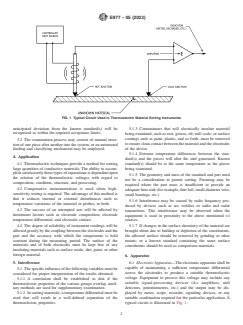
See Fig. 1.
depth, and hardness.
1.4 This standard does not purport to address all of the
3. Summary of Practice
safety concerns, if any, associated with its use. It is the
responsibility of the user of this standard to establish appro- 3.1 The two techniques that are primarily used in thermo-
priate safety, health, and environmental practices and deter- electric sorting are direct and comparative instrumentation. In
mine the applicability of regulatory limitations prior to use.
the direct instruments, equipment is standardized by placing
1.5 This international standard was developed in accor- materials with known chemistry and metallurgical structure in
dance with internationally recognized principles on standard- the test system. The value of the thermoelectric voltage (or
ization established in the Decision on Principles for the arbitrary unit) is read on the scale of an indicator. In the
Development of International Standards, Guides and Recom-
comparative instruments, the thermoelectric response of the
mendations issued by the World Trade Organization Technical test piece is compared with that of a known standard(s) and the
Barriers to Trade (TBT) Committee. response indicates whether the piece is within the acceptance
limits.
2. Terminology
3.1.1 Both kinds of instrumentation require comparing the
pieces to be examined with the known standard(s). Two or
2.1 Descriptions of Terms:
more samples representing the acceptance limits may be
2.1.1 acceptance limits—the thermoelectric response that
required.
establishes the group into which the material being examined
3.1.2 Direct Thermoelectric Instrumentation—A known
belongs.
standard(s) is inserted in the system and the controls of the
2.1.2 comparative instrumentation—a system that uses elec-
instrument are adjusted to obtain a voltage (or arbitrary unit)
trode assemblies (probes), associated electronics, and known
reading(s). The process is then continued by inserting the
standards to measure a thermoelectric response from an
pieces to be sorted into the system, and observing the instru-
electrically-conductive material; this response is compared
ment reading(s).
with that of the reference standard.
3.1.3 Comparative Instrumentation—Known standards rep-
resenting the acceptance limits are inserted into the system.
The instrument controls are adjusted for appropriate response.
This practice is under the jurisdiction of ASTM Committee E07 on Nonde-
The process is then continued by inserting the pieces to be
structive Testing and is the direct responsibility of Subcommittee E07.10 on
sorted in the system, and observing the instrument response.
Specialized NDT Methods.
Current edition approved Dec. 1, 2023. Published December 2023. Originally
3.2 In both instruments, the range of the instrument re-
approved in 1984. Last previous edition approved in 2019 as E977 – 05 (2019).
DOI: 10.1520/E0977-05R23. sponse must be adjusted during standardization so that any
Copyright © ASTM International, 100 Barr Harbor Drive, PO Box C700, West Conshohocken, PA 19428-2959. United States
E977 − 05 (2023)
FIG. 1 Typical Circuit Used in Thermoelectric Material Sorting Instruments
anticipated deviation from the known standard(s) will be 5.1.3 Contaminates that will electrically insulate material
recognized as within the required acceptance limits. being examined, such as rust, grease, oil, mill scale; or surface
coatings such as paint, plastic, and so forth, must be removed
3.3 The examination process may consist of manual inser-
to ensure clean contact between the material and the electrodes
tion of one piece after another into the system, or an automated
of the device.
feeding and classifying mechanism may be employed.
5.1.4 Extreme temperature differences between the stan-
4. Application
dard(s) and the pieces will alter the emf generated. Known
4.1 Thermoelectric techniques provide a method for sorting
standard(s) should be at the same temperature as the pieces
large quantities of conductive materials. The ability to accom-
being examined.
plish satisfactorily these types of separations is dependent upon
5.1.5 The geometry and mass of the standard and part need
the relation of the thermoelectric voltages with regard to
not be a consideration to permit sorting. Fixturing may be
composition, condition, structure, and processing.
required where the part mass is insufficient to provide an
4.2 Comparative instrumentation is used when high-
adequate heat sink (for example, thin foil, small-diameter wire,
sensitivity testing is required. The advantage of this method is
small bearings, etc.).
that it reduces internal or external disturbances such as
5.1.6 Interference may be caused by radio frequency pro-
temperature variations of the material or probes, or both.
duced by devices such as arc welders or radio and radar
4.3 The success of an attempted sort will be affected by
transmitters. This interference may be observed when the
instrument factors such as
...