

ASTM B542-13(2019)
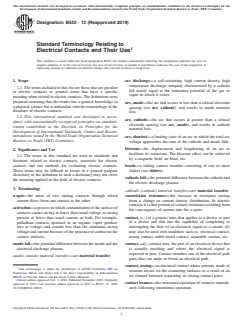
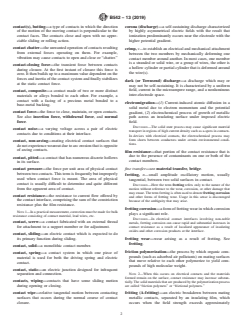
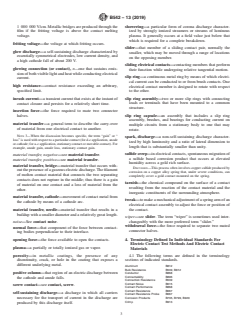
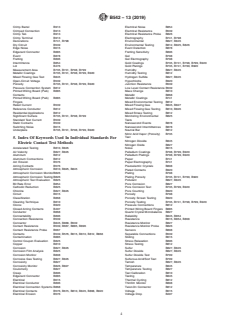
(Terminology)Standard Terminology Relating to Electrical Contacts and Their Use
General Information
- Abstract
SIGNIFICANCE AND USE
2.1 The terms in this standard are used in standards and literature related to electric contacts, materials for electric contacts and test methods for evaluating electric contacts. These terms may be difficult to locate in a general purpose dictionary or the definition in such a dictionary may not cover the meaning applied in the field of electric contacts.
SCOPE
1.1 The terms included in this list are those that are peculiar to electric contacts or general terms that have a specific meaning when related to electric contacts. The definitions were prepared assuming that the reader has a general knowledge in a physical science but is unfamiliar with the terminology of the literature of electric contacts.
1.2 This international standard was developed in accordance with internationally recognized principles on standardization established in the Decision on Principles for the Development of International Standards, Guides and Recommendations issued by the World Trade Organization Technical Barriers to Trade (TBT) Committee.
- Status
- Published
- Publication Date
- 31-Oct-2019
- Technical Committee
- B02 - Nonferrous Metals and Alloys
Overview
ASTM B542-13(2019), Standard Terminology Relating to Electrical Contacts and Their Use, is an international standard developed by ASTM International. This standard provides an authoritative glossary of terms specific to the field of electrical contacts, their materials, and the test methods used for evaluating contact performance. The terms defined within the document are widely used in industry standards, technical literature, manufacturing, and research focused on electrical contacts. Many of these terms are unique and may not be fully explained in general dictionaries, making ASTM B542 a valuable resource for professionals seeking clarity and precision in communication.
Key Topics
The terminology covered by ASTM B542-13(2019) spans a variety of critical aspects within the realm of electrical contacts, including:
- Types of Electrical Contacts: Definitions for arcing contacts, non-arcing contacts, spring contacts, static contacts, composite contacts, and more.
- Contact Phenomena: Concepts such as arc discharge, blowout, contact resistance, constriction resistance, film resistance, and contact noise.
- Wear and Degradation: Terms describing material transfer, pitting, fretting, fretting corrosion, and the mechanisms leading to contact degradation.
- Mechanical Definitions: Key notions like contact force, contact pressure, insertion force, withdrawal force, and contact-closing force.
- Electrical Events: Descriptions of discharges such as corona, glow discharge, spark discharge, and fritting.
- Connection Methods: Ways that contacts are physically and electrically joined, including crimping, screw contacts, and slip ring assemblies.
- Contact Materials and Surface Effects: Includes descriptions related to porosity, tarnish, oxidation, and surface contamination.
Applications
Understanding and consistently using the terminology defined in ASTM B542-13(2019) is essential for various practical contexts:
- Product Design and Manufacturing: Provides engineers with standardized language for specifying, testing, and producing electrical contacts in connectors, switches, relays, and circuit breakers.
- Quality Assurance and Testing: Supports accurate communication in laboratory test procedures for contact resistance, durability, and environmental performance.
- Technical Documentation: Enables clear instructions and descriptions in datasheets, manuals, and industry reports.
- Procurement and Compliance: Assists buyers, specifiers, and regulatory agencies in referencing product requirements and performance criteria for electrical contact systems.
- International Trade: Promotes harmonization across global supply chains, helping to ensure products meet the technical standards recognized by the World Trade Organization (WTO) Technical Barriers to Trade (TBT) Committee.
Related Standards
ASTM B542-13(2019) references and relates to a range of other ASTM standards and industry documents that define methods, materials, and requirements for electrical contacts and connectors. Notable referenced or associated standards include:
- ASTM B539, B667, B896 - Related to contact and connection resistance.
- ASTM B615, B854 - Cover topics such as contact noise and electrical noise.
- ASTM B576, B810, B845 - Standards for arc erosion and environmental testing of contacts.
- ASTM B868, B885 - Concerning electrical connectors and contacts.
- ASTM B735, B799, B920 - Covering porosity, corrosion, and gold platings.
- Other related standards might address contact materials like gold, palladium, silver, and alloys for specific performance criteria.
For a full understanding of electrical contacts, their performance, and applicable testing methods, ASTM B542 should be used alongside these and other relevant industry standards.
Keywords: ASTM B542, electrical contact terminology, contact resistance, arcing, fretting, electrical contacts, connector standards, test methods, contact materials, international standard.
Relations
- Effective Date
- 01-Nov-2019
- Effective Date
- 01-Nov-2019
- Referred By
ASTM B700-20 - Standard Specification for Electrodeposited Coatings of Silver for Engineering Use - Effective Date
- 01-Nov-2019
- Effective Date
- 01-Nov-2019
- Referred By
ASTM B488-18 - Standard Specification for Electrodeposited Coatings of Gold for Engineering Uses - Effective Date
- 01-Nov-2019
- Effective Date
- 01-Nov-2019
- Effective Date
- 01-Nov-2019
- Effective Date
- 01-Nov-2019
- Referred By
ASTM B845-97(2018) - Standard Guide for Mixed Flowing Gas (MFG) Tests for Electrical Contacts - Effective Date
- 01-Nov-2019
- Referred By
ASTM B684/B684M-22 - Standard Specification for Platinum-Iridium Electrical Contact Materials - Effective Date
- 01-Nov-2019
- Effective Date
- 01-Nov-2019
- Effective Date
- 01-Nov-2019
- Effective Date
- 01-Nov-2019
- Effective Date
- 01-Nov-2019
- Effective Date
- 01-Nov-2019
Get Certified
Connect with accredited certification bodies for this standard

IMQ S.p.A. (Certification)
Italian electrical product certification.

SLG Prüf- und Zertifizierungs GmbH
German testing and certification body.

UL Solutions
Global safety science company with testing, inspection and certification.
Sponsored listings
Frequently Asked Questions
ASTM B542-13(2019) is a standard published by ASTM International. Its full title is "Standard Terminology Relating to Electrical Contacts and Their Use". This standard covers: SIGNIFICANCE AND USE 2.1 The terms in this standard are used in standards and literature related to electric contacts, materials for electric contacts and test methods for evaluating electric contacts. These terms may be difficult to locate in a general purpose dictionary or the definition in such a dictionary may not cover the meaning applied in the field of electric contacts. SCOPE 1.1 The terms included in this list are those that are peculiar to electric contacts or general terms that have a specific meaning when related to electric contacts. The definitions were prepared assuming that the reader has a general knowledge in a physical science but is unfamiliar with the terminology of the literature of electric contacts. 1.2 This international standard was developed in accordance with internationally recognized principles on standardization established in the Decision on Principles for the Development of International Standards, Guides and Recommendations issued by the World Trade Organization Technical Barriers to Trade (TBT) Committee.
SIGNIFICANCE AND USE 2.1 The terms in this standard are used in standards and literature related to electric contacts, materials for electric contacts and test methods for evaluating electric contacts. These terms may be difficult to locate in a general purpose dictionary or the definition in such a dictionary may not cover the meaning applied in the field of electric contacts. SCOPE 1.1 The terms included in this list are those that are peculiar to electric contacts or general terms that have a specific meaning when related to electric contacts. The definitions were prepared assuming that the reader has a general knowledge in a physical science but is unfamiliar with the terminology of the literature of electric contacts. 1.2 This international standard was developed in accordance with internationally recognized principles on standardization established in the Decision on Principles for the Development of International Standards, Guides and Recommendations issued by the World Trade Organization Technical Barriers to Trade (TBT) Committee.
ASTM B542-13(2019) is classified under the following ICS (International Classification for Standards) categories: 01.040.29 - Electrical engineering (Vocabularies); 29.050 - Superconductivity and conducting materials. The ICS classification helps identify the subject area and facilitates finding related standards.
ASTM B542-13(2019) has the following relationships with other standards: It is inter standard links to ASTM B542-13, ASTM B867-95(2018), ASTM B700-20, ASTM B685-20, ASTM B488-18, ASTM B866-95(2018), ASTM B812-18, ASTM B878-97(2019), ASTM B845-97(2018), ASTM B684/B684M-22, ASTM B545-22, ASTM B799-95(2020), ASTM B896-10(2020), ASTM B667-97(2019), ASTM B683-20. Understanding these relationships helps ensure you are using the most current and applicable version of the standard.
ASTM B542-13(2019) is available in PDF format for immediate download after purchase. The document can be added to your cart and obtained through the secure checkout process. Digital delivery ensures instant access to the complete standard document.
Standards Content (Sample)
This international standard was developed in accordance with internationally recognized principles on standardization established in the Decision on Principles for the
Development of International Standards, Guides and Recommendations issued by the World Trade Organization Technical Barriers to Trade (TBT) Committee.
Designation: B542 − 13 (Reapproved 2019)
Standard Terminology Relating to
Electrical Contacts and Their Use
This standard is issued under the fixed designation B542; the number immediately following the designation indicates the year of
original adoption or, in the case of revision, the year of last revision. A number in parentheses indicates the year of last reapproval. A
superscript epsilon (´) indicates an editorial change since the last revision or reapproval.
1. Scope arc discharge—a self-sustaining, high current density, high
temperature discharge, uniquely characterized by a cathode
1.1 The terms included in this list are those that are peculiar
fall nearly equal to the ionization potential of the gas or
to electric contacts or general terms that have a specific
vapor in which it exists.
meaning when related to electric contacts.The definitions were
prepared assuming that the reader has a general knowledge in
arc, anode—the arc that occurs at less than a critical electrode
a physical science but is unfamiliar with the terminology of the
spacing (see arc, cathode), and results in anode material
literature of electric contacts.
loss.
1.2 This international standard was developed in accor-
arc, cathode—the arc that occurs at greater than a critical
dance with internationally recognized principles on standard-
electrode spacing (see arc, anode), and results in cathode
ization established in the Decision on Principles for the
material loss.
Development of International Standards, Guides and Recom-
mendations issued by the World Trade Organization Technical
arc, shortest—a limiting state of an arc in which the total arc
Barriers to Trade (TBT) Committee.
voltage approaches the sum of the cathode and anode falls.
blowout—the displacement and lengthening of an arc to
2. Significance and Use
facilitate its extinction. The blowout effect can be achieved
2.1 The terms in this standard are used in standards and
by a magnetic field, air blast, etc.
literature related to electric contacts, materials for electric
contacts and test methods for evaluating electric contacts.
brush—a sliding contact member consisting of one or more
These terms may be difficult to locate in a general purpose
sliders (see sliders).
dictionary or the definition in such a dictionary may not cover
cathode fall—the potential difference between the cathode and
the meaning applied in the field of electric contacts.
the electric discharge plasma.
3. Terminology
cathodic (cathode) material transfer—see material transfer.
constriction resistance—the increase in resistance arising
a-spot—the areas of two mating contacts through which
from a change in current density distribution. In electric
current flows from one contact to the other.
contacts it is that portion of contact resistance resulting from
activation—aprocessinwhichcontaminationofthesurfaceof
the convergence of current into the a-spots.
contacts causes arcing at lower than usual voltage or arcing
contact, n—(a) a generic term that applies to a device or part
persists at lower than usual current, or both. For example,
palladium contacts operated in an organic vapor produce of a device and that has the capability of completing or
interrupting the flow of an electrical signal in a circuit, (b)
arcs at voltage and current less than the minimum arcing
voltage and current because of the presence of carbon on the may also be used with modifiers such as: electrical contact,
arcing contact, noble metal contact, separable contact, etc.
contact surfaces.
anode fall—the potential difference between the anode and the contact, adj—contact area, the part of an electrical device that
electrical discharge plasma.
is actually touching and where the electrical signal is
expected to pass. Contact member, one of the electrical path
anodic (anode) material transfer—see material transfer.
parts that can make or break an electrical path.
contact, arcing—an electrical contact whose primary mode of
This terminology is under the jurisdiction of ASTM Committee B02 on
wearout occurs on the contacting surfaces as a result of an
Nonferrous Metals and Alloys and is the direct responsibility of Subcommittee
arc formed between separating or closing contact pairs.
B02.05 on Precious Metals and Electrical Contact Materials.
Current edition approved Nov. 1, 2019. Published November 2019. Originally
contact bounce—the unwanted operation of contacts immedi-
approved in 1932. Last previous edition approved in 2013 as B542 – 13. DOI:
10.1520/B0542-13R19. ately following intentional operation.
Copyright © ASTM International, 100 Barr Harbor Drive, PO Box C700, West Conshohocken, PA 19428-2959. United States
B542 − 13 (2019)
contact(s), butting—a type of contacts in which the direction corona (discharge)—a self-sustaining discharge characterized
of the motion of the moving contact is perpendicular to the by highly asymmetrical electric fields with the result that
contact faces. The contacts close and open with no appre- ionization predominantly occurs near the electrode with the
ciable sliding or rolling action. higher potential gradient.
contact chatter—the unwanted operation of contacts resulting
crimp, v—to establish an electrical and mechanical attachment
from external forces operating on them. For example,
between the two members by mechanically deforming one
vibration may cause contacts to open and close or “chatter.”
contact member around another. In most cases, one member
is a stranded or solid wire, or a group of wires, the other is
contact-closing force—the transient force between contacts
a hollow cylinder or partial cylinder that is deformed around
during closure. At the first instant of closure this force is
the wire(s).
zero. It then builds up to a maximum value dependent on the
forces and inertia of the contact system and finally stabilizes
dark (or Townsend) discharge—a discharge which may or
at the static contact force.
may not be self-sustaining. It is characterized by a uniform
field, current in the microampere range, and a nonluminous
contact, composite—a contact made of two or more distinct
inter-electrode space.
materials or alloys bonded to each other. For example, a
contact with a facing of a precious metal bonded to a
electromigration—(1) Current-induced atomic diffusion in a
base-metal backing.
solid metal due to electron momentum and the potential
contact force—the force to close, maintain, or open contacts.
gradient, (2) electrochemical process of growth of metallic
See also insertion force, withdrawal force, and normal path across an insulating surface under imposed electric
force.
field.
DISCUSSION—The solid state process may cause significant material
contact noise—a varying voltage across a pair of electric
transport in regions of high current density such as a-spots in contacts.
contacts due to conditions at their interface.
In devices with electrical contacts, the electrochemical process may
form shorts between conductors under certain environmental condi-
contact, non-arcing—mating electrical contact surfaces that
tions.
do not experience wearout due to arc erosion that is opposite
of arcing contacts.
film resistance—that portion of the contact resistance that is
due to the presence of contaminants on one or both of the
contact, pitted—a contact that has numerous discrete hollows
contact members.
in its surface.
contact pressure—the force per unit area of physical contact fine transfer—see material transfer, bridge.
betweentwocontacts.Thistermisfrequentlybutimproperly
fretting, n—small amplitude oscillatory motion, usually
used when contact force is meant. The area of physical
tangential, between two solid surfaces in contact.
contact is usually difficult to determine and quite different
DISCUSSION—Here the term fretting refers only to the nature of the
from the apparent area of contact.
motion without reference to the wear, corrosion, or other damage that
may ensue.The term fretting is often used to denote fretting corrosion
contact resistance—the resistance to current flow offered by
and other forms of fretting wear. Usage in this sense is discouraged
the contact interface, comprising the sum of the constriction
because of the ambiguity that may arise.
resistance plus the film resistance.
fretting corrosion—a form of fretting wear in which corrosion
NOTE 1—In a practical measurement, correction must be made for bulk
plays a significant role.
resistance consisting of contact material, lead wires, etc.
DISCUSSION—In electrical contact interfaces involving non-noble
contact, screw—a contact fabricated with an external thread
metals, fretting corrosion can cause rapid and substantial increases in
for attachment to a support member or for adjustment. contact resistance as a result of localized appearance of insulating
oxides and other corrosion products at the interface.
contact, sliding—an electric contact which is expected to do
its primary function during sliding. fretting wear—wear arising as a result of fretting. See
fretting.
contact, solid—a monolithic contact member.
friction polymerization—the process by which organic com-
contact, spring—a contact system in which one piece of
pounds (such as adsorbed air pollutants) on mating surfaces
material is used for both the driving spring and electric
that move relative to each other polymerize to yield com-
contact.
pounds of high molecular weight.
contact, static—an electric junction designed for infrequent
NOTE 2—When this occurs on electrical contacts and the materials
separation and connection.
formed remain on the surface, contact resistance may increase substan-
contacts, wiping—contacts that have some sliding motion tially. The solid materials that are produced by the polymerization process
are called “friction polymers” or “frictional polymers.”
during opening or closing.
contact wipe—relative tangential motion between contacting fritting (A-fritting)—an electric breakdown between mating
surfaces that occurs during the normal course of contact metallic contacts, separated by an insulating film, which
closure. occurs when the field strength exceeds approximately
B542 − 13 (2019)
1 000 000V/cm. Metallic bridges are produced through the showering—a particular form of corona discharge character-
film if the fritting voltage is above the contact melting ized by strongly ionized streamers or streams of luminous
voltage. plasma. It generally occurs at a field value just below that
which is required for a complete breakdown.
fritting voltage—the voltage at which fritting occurs.
slider—that member of a sliding contact pair, normally the
glow discharge—a self-sustaining discharge characterized by
smaller, which may be moved through a range of locations
essentially symmetrical electrodes, low current density, and
on the opposing member.
a high cathode fall of about 200 V.
sliding electrical contacts—contacting members that perform
glowing connecti
...