

ASTM B545-22
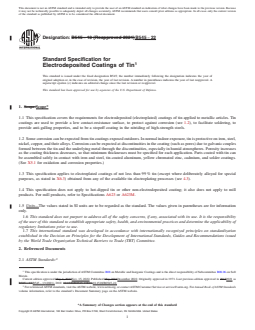
(Specification)Standard Specification for Electrodeposited Coatings of Tin
General Information
- Abstract
ABSTRACT
This specification covers the requirements for electrodeposited tin coatings applied to metallic articles to provide a low contact resistance surface, to protect against corrosion, to facilitate soldering, to provide anti-galling properties, and to be a stop-off coating in the nitriding of high-strength steels. This specification does not cover hot-dipped tin or other non-electrodeposited coatings, and mill products. Coatings shall be grouped into six service classes, which is based on the minimum thickness and severity of service required for the coating, and three surface appearance types, which is based on the type electroplating process employed. The surface appearance types are matte tin electrodeposits, bright tin electrodeposits, and flow-brightened electrodeposits. Coatings shall be sampled, tested and conform accordingly to specified requirements as to appearance, purity, local and mean thickness, integrity (including gross defects, mechanical damage, and porosity), adhesion, solderability, and hydrogen embrittlement relief.
SCOPE
1.1 This specification covers the requirements for electrodeposited (electroplated) coatings of tin applied to metallic articles. Tin coatings are used to provide a low contact-resistance surface, to protect against corrosion (see 1.2), to facilitate soldering, to provide anti-galling properties, and to be a stopoff coating in the nitriding of high-strength steels.
1.2 Some corrosion can be expected from tin coatings exposed outdoors. In normal indoor exposure, tin is protective on iron, steel, nickel, copper, and their alloys. Corrosion can be expected at discontinuities in the coating (such as pores) due to galvanic couples formed between the tin and the underlying metal through the discontinuities, especially in humid atmospheres. Porosity increases as the coating thickness decreases, so that minimum thicknesses must be specified for each application. Parts coated with tin can be assembled safely in contact with iron and steel, tin-coated aluminum, yellow chromated zinc, cadmium, and solder coatings. (See X5.1 for oxidation and corrosion properties.)
1.3 This specification applies to electroplated coatings of not less than 99 % tin (except where deliberately alloyed for special purposes, as stated in X6.3) obtained from any of the available tin electroplating processes (see 4.3).
1.4 This specification does not apply to hot-dipped tin or other non-electrodeposited coating; it also does not apply to mill products. For mill products, refer to Specifications A623 or A623M.
1.5 Units—The values stated in SI units are to be regarded as the standard. The values given in parentheses are for information only.
1.6 This standard does not purport to address all of the safety concerns, if any, associated with its use. It is the responsibility of the user of this standard to establish appropriate safety, health, and environmental practices and determine the applicability of regulatory limitations prior to use.
1.7 This international standard was developed in accordance with internationally recognized principles on standardization established in the Decision on Principles for the Development of International Standards, Guides and Recommendations issued by the World Trade Organization Technical Barriers to Trade (TBT) Committee.
- Status
- Published
- Publication Date
- 14-Nov-2022
- Technical Committee
- B08 - Metallic and Inorganic Coatings
- Drafting Committee
- B08.06 - Soft Metals
Overview
ASTM B545-22 is a widely recognized standard specification developed by ASTM International for electrodeposited (electroplated) tin coatings applied to metallic articles. This standard defines requirements and best practices to achieve tin coatings that deliver low contact resistance, corrosion protection, solderability, anti-galling properties, and specialized uses such as stop-off coatings for nitriding processes. It does not apply to hot-dipped tin, other non-electrodeposited coatings, or mill products, which are addressed by separate ASTM standards.
ASTM B545-22 is essential for engineers, manufacturers, and quality assurance professionals working with metallic components that require reliable, high-quality tin electroplating. The standard ensures consistent results and high-performance coatings across a wide range of industrial sectors.
Key Topics
- Service Classes: The standard groups tin coatings into six service classes based on their minimum thickness and the expected severity of service. This ensures that coatings are fit for their intended environmental exposure and functional requirements.
- Surface Appearance Types: Defines three main types of electrodeposited tin finishes:
- Matte tin
- Bright tin
- Flow-brightened tin
- Sampling and Testing: ASTM B545-22 specifies rigorous requirements for sampling, testing, and verifying coatings. Key characteristics inspected include:
- Appearance and uniformity
- Purity (not less than 99% tin)
- Local and mean thickness, determined by several standardized test methods
- Integrity, adhesion, solderability, and hydrogen embrittlement risk relief
- Coating Integrity: The standard addresses acceptance criteria for gross defects, porosity, and mechanical damage.
- Underplating Requirements: Guidance is provided for the use of nickel or copper undercoats, especially for certain substrates prone to diffusion or migration effects that could impair performance.
- Corrosion and Oxidation Properties: Highlights that while tin coatings afford good indoor protection, special provisions must be considered for outdoor or severe environments due to increased porosity and the risk of galvanic corrosion at discontinuities.
Applications
Electroplated tin coatings as specified by ASTM B545-22 are applied broadly across industries such as electronics, automotive, aerospace, and manufacturing. Key practical applications include:
- Electrical and Electronic Components: Tin plating provides low electrical contact resistance, critical for connectors, terminals, and relay components.
- Soldering Facilitation: Electroplated tin surfaces are ideal for parts that require reliable soldering performance (e.g., printed circuit boards, electrical assemblies).
- Corrosion Protection: Used for components made of iron, steel, copper, and their alloys to extend service life, particularly in moderate indoor environments.
- Anti-Galling and Wear Resistance: Applied to metal fittings and fasteners to prevent seizing and wear during assembly or operation.
- Stop-Off Coatings: Used as a masking layer during nitriding processes for high-strength steels, protecting designated areas from unwanted surface hardening.
Related Standards
When working with electrodeposited tin coatings, it is beneficial to be aware of other relevant ASTM standards for metallic coatings, testing, and product preparation:
- ASTM A623 / A623M - Tin Mill Products, General Requirements
- ASTM B32 - Solder Metal Specification
- ASTM B183 / B281 / B320 / B558 - Preparation of various metals for electroplating
- ASTM B487 / B499 / B504 / B567 / B568 - Various test methods for measuring coating thickness
- ASTM B322 - Cleaning Metals Prior to Electroplating
- ASTM B571 - Qualitative Adhesion Testing for Metallic Coatings
- ASTM B809 - Porosity Testing for Metallic Coatings
- ASTM B849 / B850 / B851 - Hydrogen Embrittlement Risk Reduction & Shot Peening
- ASTM B246 - Specification for Tinned Copper Wire
Conclusion
Adhering to ASTM B545-22 ensures that electrodeposited tin coatings meet stringent performance requirements for electrical, mechanical, and chemical properties. Utilizing this standard enhances quality assurance, reliability, and longevity of tin-plated metallic components across a diverse range of industries, supporting both functional and environmental demands. For optimal results, always use the most current edition of ASTM B545 and consider related standards in your plating and quality control processes.
Relations
- Effective Date
- 01-Nov-2023
- Effective Date
- 01-Nov-2023
- Effective Date
- 01-Nov-2023
- Effective Date
- 01-Nov-2023
- Effective Date
- 01-Oct-2023
- Effective Date
- 01-Nov-2019
- Effective Date
- 01-Apr-2019
- Effective Date
- 01-Apr-2019
- Effective Date
- 01-Apr-2019
- Effective Date
- 01-Apr-2019
- Effective Date
- 01-Aug-2018
- Effective Date
- 01-Aug-2018
- Effective Date
- 01-Aug-2018
- Effective Date
- 01-May-2018
- Effective Date
- 01-Nov-2017
Get Certified
Connect with accredited certification bodies for this standard

DVS-ZERT GmbH
German welding certification society.
CARES (UK Certification Authority for Reinforcing Steels)
UK certification for reinforcing steels and construction.
EWF/IIW (European/International Welding Federation)
International welding personnel certification.
Sponsored listings
Frequently Asked Questions
ASTM B545-22 is a technical specification published by ASTM International. Its full title is "Standard Specification for Electrodeposited Coatings of Tin". This standard covers: ABSTRACT This specification covers the requirements for electrodeposited tin coatings applied to metallic articles to provide a low contact resistance surface, to protect against corrosion, to facilitate soldering, to provide anti-galling properties, and to be a stop-off coating in the nitriding of high-strength steels. This specification does not cover hot-dipped tin or other non-electrodeposited coatings, and mill products. Coatings shall be grouped into six service classes, which is based on the minimum thickness and severity of service required for the coating, and three surface appearance types, which is based on the type electroplating process employed. The surface appearance types are matte tin electrodeposits, bright tin electrodeposits, and flow-brightened electrodeposits. Coatings shall be sampled, tested and conform accordingly to specified requirements as to appearance, purity, local and mean thickness, integrity (including gross defects, mechanical damage, and porosity), adhesion, solderability, and hydrogen embrittlement relief. SCOPE 1.1 This specification covers the requirements for electrodeposited (electroplated) coatings of tin applied to metallic articles. Tin coatings are used to provide a low contact-resistance surface, to protect against corrosion (see 1.2), to facilitate soldering, to provide anti-galling properties, and to be a stopoff coating in the nitriding of high-strength steels. 1.2 Some corrosion can be expected from tin coatings exposed outdoors. In normal indoor exposure, tin is protective on iron, steel, nickel, copper, and their alloys. Corrosion can be expected at discontinuities in the coating (such as pores) due to galvanic couples formed between the tin and the underlying metal through the discontinuities, especially in humid atmospheres. Porosity increases as the coating thickness decreases, so that minimum thicknesses must be specified for each application. Parts coated with tin can be assembled safely in contact with iron and steel, tin-coated aluminum, yellow chromated zinc, cadmium, and solder coatings. (See X5.1 for oxidation and corrosion properties.) 1.3 This specification applies to electroplated coatings of not less than 99 % tin (except where deliberately alloyed for special purposes, as stated in X6.3) obtained from any of the available tin electroplating processes (see 4.3). 1.4 This specification does not apply to hot-dipped tin or other non-electrodeposited coating; it also does not apply to mill products. For mill products, refer to Specifications A623 or A623M. 1.5 Units—The values stated in SI units are to be regarded as the standard. The values given in parentheses are for information only. 1.6 This standard does not purport to address all of the safety concerns, if any, associated with its use. It is the responsibility of the user of this standard to establish appropriate safety, health, and environmental practices and determine the applicability of regulatory limitations prior to use. 1.7 This international standard was developed in accordance with internationally recognized principles on standardization established in the Decision on Principles for the Development of International Standards, Guides and Recommendations issued by the World Trade Organization Technical Barriers to Trade (TBT) Committee.
ABSTRACT This specification covers the requirements for electrodeposited tin coatings applied to metallic articles to provide a low contact resistance surface, to protect against corrosion, to facilitate soldering, to provide anti-galling properties, and to be a stop-off coating in the nitriding of high-strength steels. This specification does not cover hot-dipped tin or other non-electrodeposited coatings, and mill products. Coatings shall be grouped into six service classes, which is based on the minimum thickness and severity of service required for the coating, and three surface appearance types, which is based on the type electroplating process employed. The surface appearance types are matte tin electrodeposits, bright tin electrodeposits, and flow-brightened electrodeposits. Coatings shall be sampled, tested and conform accordingly to specified requirements as to appearance, purity, local and mean thickness, integrity (including gross defects, mechanical damage, and porosity), adhesion, solderability, and hydrogen embrittlement relief. SCOPE 1.1 This specification covers the requirements for electrodeposited (electroplated) coatings of tin applied to metallic articles. Tin coatings are used to provide a low contact-resistance surface, to protect against corrosion (see 1.2), to facilitate soldering, to provide anti-galling properties, and to be a stopoff coating in the nitriding of high-strength steels. 1.2 Some corrosion can be expected from tin coatings exposed outdoors. In normal indoor exposure, tin is protective on iron, steel, nickel, copper, and their alloys. Corrosion can be expected at discontinuities in the coating (such as pores) due to galvanic couples formed between the tin and the underlying metal through the discontinuities, especially in humid atmospheres. Porosity increases as the coating thickness decreases, so that minimum thicknesses must be specified for each application. Parts coated with tin can be assembled safely in contact with iron and steel, tin-coated aluminum, yellow chromated zinc, cadmium, and solder coatings. (See X5.1 for oxidation and corrosion properties.) 1.3 This specification applies to electroplated coatings of not less than 99 % tin (except where deliberately alloyed for special purposes, as stated in X6.3) obtained from any of the available tin electroplating processes (see 4.3). 1.4 This specification does not apply to hot-dipped tin or other non-electrodeposited coating; it also does not apply to mill products. For mill products, refer to Specifications A623 or A623M. 1.5 Units—The values stated in SI units are to be regarded as the standard. The values given in parentheses are for information only. 1.6 This standard does not purport to address all of the safety concerns, if any, associated with its use. It is the responsibility of the user of this standard to establish appropriate safety, health, and environmental practices and determine the applicability of regulatory limitations prior to use. 1.7 This international standard was developed in accordance with internationally recognized principles on standardization established in the Decision on Principles for the Development of International Standards, Guides and Recommendations issued by the World Trade Organization Technical Barriers to Trade (TBT) Committee.
ASTM B545-22 is classified under the following ICS (International Classification for Standards) categories: 25.220.40 - Metallic coatings. The ICS classification helps identify the subject area and facilitates finding related standards.
ASTM B545-22 has the following relationships with other standards: It is inter standard links to ASTM B849-02(2023), ASTM B571-23, ASTM B765-03(2023), ASTM B678-23, ASTM D3951-18(2023), ASTM B542-13(2019), ASTM B849-02(2019), ASTM B558-79(2019), ASTM B320-60(2019), ASTM B281-88(2019)e1, ASTM B809-95(2018), ASTM B765-03(2018), ASTM B571-18, ASTM D3951-18, ASTM B678-86(2017). Understanding these relationships helps ensure you are using the most current and applicable version of the standard.
ASTM B545-22 is available in PDF format for immediate download after purchase. The document can be added to your cart and obtained through the secure checkout process. Digital delivery ensures instant access to the complete standard document.
Standards Content (Sample)
This international standard was developed in accordance with internationally recognized principles on standardization established in the Decision on Principles for the
Development of International Standards, Guides and Recommendations issued by the World Trade Organization Technical Barriers to Trade (TBT) Committee.
Designation: B545 −22
Standard Specification for
Electrodeposited Coatings of Tin
This standard is issued under the fixed designation B545; the number immediately following the designation indicates the year of
original adoption or, in the case of revision, the year of last revision.Anumber in parentheses indicates the year of last reapproval.A
superscript epsilon (´) indicates an editorial change since the last revision or reapproval.
This standard has been approved for use by agencies of the U.S. Department of Defense.
1. Scope* 1.7 This international standard was developed in accor-
dance with internationally recognized principles on standard-
1.1 Thisspecificationcoverstherequirementsforelectrode-
ization established in the Decision on Principles for the
posited (electroplated) coatings of tin applied to metallic
Development of International Standards, Guides and Recom-
articles. Tin coatings are used to provide a low contact-
mendations issued by the World Trade Organization Technical
resistance surface, to protect against corrosion (see 1.2), to
Barriers to Trade (TBT) Committee.
facilitatesoldering,toprovideanti-gallingproperties,andtobe
a stopoff coating in the nitriding of high-strength steels.
2. Referenced Documents
1.2 Some corrosion can be expected from tin coatings
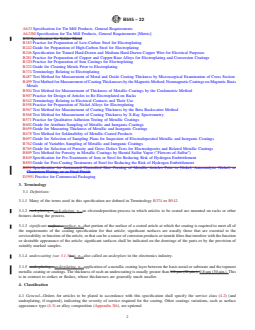
2.1 ASTM Standards:
exposed outdoors. In normal indoor exposure, tin is protective
A623Specification for Tin Mill Products, General Require-
oniron,steel,nickel,copper,andtheiralloys.Corrosioncanbe
ments
expectedatdiscontinuitiesinthecoating(suchaspores)dueto
A623MSpecification for Tin Mill Products, General Re-
galvanic couples formed between the tin and the underlying
quirements [Metric]
metal through the discontinuities, especially in humid atmo-
B183Practice for Preparation of Low-Carbon Steel for
spheres. Porosity increases as the coating thickness decreases,
Electroplating
so that minimum thicknesses must be specified for each
B242Guide for Preparation of High-Carbon Steel for Elec-
application. Parts coated with tin can be assembled safely in
troplating
contact with iron and steel, tin-coated aluminum, yellow
B246Specification for Tinned Hard-Drawn and Medium-
chromated zinc, cadmium, and solder coatings. (See X5.1 for
Hard-Drawn Copper Wire for Electrical Purposes
oxidation and corrosion properties.)
B281Practice for Preparation of Copper and Copper-Base
1.3 This specification applies to electroplated coatings of
Alloys for Electroplating and Conversion Coatings
not less than 99% tin (except where deliberately alloyed for
B320Practice for Preparation of Iron Castings for Electro-
special purposes, as stated in X6.3) obtained from any of the
plating
available tin electroplating processes (see 4.3).
B322Guide for Cleaning Metals Prior to Electroplating
1.4 This specification does not apply to hot-dipped tin or B374Terminology Relating to Electroplating
other non-electrodeposited coating; it also does not apply to B487Test Method for Measurement of Metal and Oxide
mill products. For mill products, refer to Specifications A623 Coating Thickness by Microscopical Examination of
or A623M. Cross Section
B499Test Method for Measurement of CoatingThicknesses
1.5 Units—The values stated in SI units are to be regarded
by the Magnetic Method: Nonmagnetic Coatings on
as the standard. The values given in parentheses are for
Magnetic Basis Metals
information only.
B504Test Method for Measurement of Thickness of Metal-
1.6 This standard does not purport to address all of the
lic Coatings by the Coulometric Method
safety concerns, if any, associated with its use. It is the
B507Practice for Design ofArticles to Be Electroplated on
responsibility of the user of this standard to establish appro-
Racks
priate safety, health, and environmental practices and deter-
B542Terminology Relating to Electrical Contacts andTheir
mine the applicability of regulatory limitations prior to use.
Use
This specification is under the jurisdiction of ASTM Committee B08 on
Metallic and Inorganic Coatings and is the direct responsibility of Subcommittee
B08.06 on Soft Metals. For referenced ASTM standards, visit the ASTM website, www.astm.org, or
Current edition approved Nov. 15, 2022. Published December 2022. Originally contact ASTM Customer Service at service@astm.org. For Annual Book of ASTM
approvedin1971.Lastpreviouseditionapprovedin2021asB545–13(2021).DOI: Standards volume information, refer to the standard’s Document Summary page on
10.1520/B0545-22. the ASTM website.
*A Summary of Changes section appears at the end of this standard
Copyright © ASTM International, 100 Barr Harbor Drive, PO Box C700, West Conshohocken, PA 19428-2959. United States
B545 − 22
B558Practice for Preparation of Nickel Alloys for Electro- required for the coating. Other coatings variations, such as
plating surface appearance type (4.3) or alloy composition (Appendix
B567Test Method for Measurement of Coating Thickness X6), are optional.
by the Beta Backscatter Method
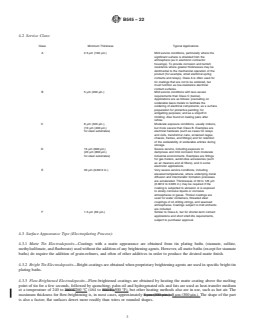
4.2 Service Class:
B568Test Method for Measurement of Coating Thickness
Class Minimum Thickness Typical Applications
by X-Ray Spectrometry
B571Practice for Qualitative Adhesion Testing of Metallic
A 2.5 µm (100 µin.) Mild service conditions, particularly where the
significant surface is shielded from the
Coatings
atmosphere (as in electronic connector
B602Guide for Attribute Sampling of Metallic and Inor-
housings). To provide corrosion and tarnish
ganic Coatings
resistance where greater thicknesses may be
detrimental to the mechanical operation of the
B659Guide for Measuring Thickness of Metallic and Inor-
product (for example, small electrical spring
ganic Coatings
contacts and relays). Class A is often used for
B678Test Method for Solderability of Metallic-Coated
tin coatings that are not to be soldered, but
must function as low-resistance electrical
Products
contact surfaces.
B697Guide for Selection of Sampling Plans for Inspection
B 5 µm (200 µin.) Mild service conditions with less severe
of Electrodeposited Metallic and Inorganic Coatings
requirements than Class C (below).
Applications are as follows: precoating on
B762GuideofVariablesSamplingofMetallicandInorganic
solderable basis metals to facilitate the
Coatings
soldering of electrical components; as a surface
B765GuideforSelectionofPorosityandGrossDefectTests preparation for protective painting; for
antigalling purposes; and as a stopoff in
for Electrodeposits and Related Metallic Coatings
nitriding. Also found on baking pans after
B809Test Method for Porosity in Metallic Coatings by
reflow.
Humid Sulfur Vapor (“Flowers-of-Sulfur”) C 8 µm (320 µin.), Moderate exposure conditions, usually indoors,
(10 µm (400 µin.) but more severe than Class B. Examples are
B849Specification for Pre-Treatments of Iron or Steel for
for steel substrates) electrical hardware (such as cases for relays
Reducing Risk of Hydrogen Embrittlement
and coils, transformer cans, screened cages,
chassis, frames, and fittings) and for retention
B850GuideforPost-CoatingTreatmentsofSteelforReduc-
of the solderability of solderable articles during
ing the Risk of Hydrogen Embrittlement
storage.
D3951Practice for Commercial Packaging
D 15 µm (600 µin.) Severe service, including exposure to
(20 µm (800 µin.) dampness and mild corrosion from moderate
for steel substrates) industrial environments. Examples are fittings
3. Terminology
for gas meters, automotive accessories (such
as air cleaners and oil filters), and in some
3.1 Definitions:
electronic applications.
3.1.1 Many of the terms used in this specification are
E 30 µm (0.0012 in.) Very severe service conditions, including
elevated temperatures, where underlying metal
defined in Terminology B374 or B542.
diffusion and intermetallic formation processes
3.1.2 rack-plating, n—anelectrodepositionprocessinwhich
are accelerated. Thicknesses of 30 to 125 µm
articles to be coated are mounted on racks or other fixtures
(0.0012 to 0.005 in.) may be required if the
coating is subjected to abrasion or is exposed
during the process.
to slowly corrosive liquids or corrosive
3.1.3 significant surface, n—that portion of the surface of a atmospheres or gases. Thicker coatings are
used for water containers, threaded steel
coatedarticleatwhichthecoatingisrequiredtomeetallofthe
couplings of oil drilling strings, and seacoast
requirements of the coating specification for that article;
atmospheres. Coatings subject to mild etchants
significant surfaces are usually those that are essential to the are included.
F 1.5 µm (60 µin.) Similar to Class A, but for shorter-term contact
serviceability or function of the article, or that can be a source
applications and short shelf-life requirements,
of corrosion products or tarnish films that interfere with the
subject to purchaser approval.
function or desirable appearance of the article; significant
4.3 Surface Appearance Type (Electroplating Process):
surfaces shall be indicated on the drawings of the parts or by
4.3.1 Matte Tin Electrodeposits—Coatings with a matte
the provision of suitably marked samples.
appearance are obtained from tin plating baths (stannate,
3.1.4 undercoating (see 3.1.5), n—also called an underplate
sulfate, methylsulfonate, and fluoborate) used without the
in the electronics industry.
addition of any brightening agents. However, all matte baths
3.1.5 underplating, n—application of a metallic coating
(except for stannate baths) do require the addition of grain-
layer between the basis metal or substrate and the topmost
refiners, and often of other additives in order to produce the
metallic coating or coatings. The thickness of such an under-
desired matte finish.
coating is usually greater than 0.8µm (30µin.). This is in
4.3.2 Bright Tin Electrodeposits—Bright coatings are ob-
contrast to strikes or flashes, whose thicknesses are generally
tained when proprietary brightening agents are used in specific
much smaller.
bright tin plating baths.
4.3.3 Flow-Brightened Electrodeposits—Flow-brightened
4. Classification
coatings are obtained by heating the matte coating above the
4.1 General—Orders for articles to be plated in accordance melting point of tin for a few seconds, followed by quenching;
with this specification shall specify the service class (4.2) (and palm oil and hydrogenated oils and fats are used as heat-
underplating, if required), indicating the severity of service transfer medium at a temperature of 240 to 260°C (464 to
B545 − 22
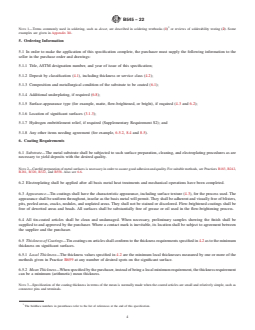
500°F), but other heating methods also are in use, such as hot 6.5 Thickness of Coatings—Tin coatings on articles shall
air. The maximum thickness for flow-brightening is, in most conformtothethicknessrequirementsspecifiedin4.2astothe
cases, approximately 8µm (300µin.). The shape of the part is minimum thickness on significant surfaces.
also a factor; flat surfaces dewet more readily than wires or 6.5.1 Local Thickness—The thickness values specified in
rounded shapes. 4.2 are the minimum local thicknesses measured by one or
more of the methods given in Practice B659 at any number of
NOTE 1—Terms commonly used in soldering, such as dewet, are
3 desired spots on the significant surface.
described in soldering textbooks (1) or reviews of solderability testing
6.5.2 Mean Thickness—When specified by the purchaser,
(2). Some examples are given in Appendix X6.
instead of being a local minimum requirement, the thickness
requirement can be a minimum (arithmetic) mean thickness.
5. Ordering Information
NOTE 3—Specification of the coating thickness in terms of the mean is
5.1 In order to make the application of this specification
normally made when the coated articles are small and relatively simple,
complete,thepurchasermustsupplythefollowinginformation
such as connector pins and terminals.
to the seller in the purchase order and drawings:
NOTE 4—Thickness of electrodeposited coatings varies from point to
5.1.1 Title,ASTM designation number, and year of issue of
point on the surfaces of a product (see Practice B507). The thickness is
this specification; lessininteriorcornersandholes.Suchsurfacesarenormallyexemptfrom
the thickness requirement. If the full thickness is required on these
5.1.2 Deposit by classification (4.1), including thickness or
surfaces,theelectroplaterwillhavetousespecialtechniquesthatprobably
service class (4.2);
will increase the cost of the process.
5.1.3 Composition and metallurgical condition of the sub-
NOTE 5—When articles are plated by mass plating techniques (such as
strate to be coated (6.1);
barrelplating),suchmeasurementmethodsas“stripandweigh”or“weigh
before and after plating” may be used to determine the mean thickness.
5.1.4 Additional underplating, if required (6.8);
5.1.5 Surface-appearance type (for example, matte, flow- 6.6 Adhesion—Adhesion of the coating shall be tested by
brightened, or bright), if required (4.3 and 6.2); oneofthemethodsgiveninPracticeB571.Thecoatingshould
5.1.6 Location of significant surfaces (3.1.3); adhere to the basis metal when subjected to the agreed test;
flakingorblisteringofthecoatingistobetakenasevidenceof
5.1.7 Hydrogen embrittlement relief, if required (Supple-
unsatisfactory adhesion.
mentary Requirement S2); and
5.1.8 Any other items needing agreement (for example,
6.7 Integrity of the Coating:
6.5.2, 8.4 and 8.5).
6.7.1 Gross Defects/Mechanical Damage—Coatings shall
be free of visible mechanical damage and similar gross defects
6. Coating Requirements
whenviewedatupto4×magnification.Forsomeapplications,
thisrequirementmayberelaxedtoallowforasmallnumberof
6.1 Substrate—The metal substrate shall be subjected to
such defects (per unit area), especially if they are outside of or
such surface preparation, cleaning, and electroplating proce-
on the periphery of significant surfaces (also see 6.7.2), as
dures as are necessary to yield deposits with the desired
allowed by the purchaser.
quality.
6.7.2 Porosity—Almostallas-platedelectrodepositscontain
NOTE 2—Careful preparation of metal surfaces is necessary in order to
some porosity. The amount of porosity in the coating that may
assure good adhesion and quality. For suitable methods, see Practices
betolerabledependsontheseverityoftheenvironmentthatthe
B183, B242, B281, B320, B322, and B558. Also see 6.6.
article is likely to encounter during service or storage. If the
6.2 Electroplating shall be applied after all basis metal heat
pores are few in number, or away from significant surfaces,
treatments and mechanical operations have been completed.
their presence can often be tolerated. Such acceptance (or
pass-fail) criteria, if required, should be part of the product
6.3 Appearance—Tin coatings shall have the characteristic
specification for the particular article or coating requiring the
appearance, including surface texture (4.3), for the process
porosity test. See 8.5 for porosity testing.
used. The appearance shall be uniform throughout, insofar as
thebasismetalwillpermit.Theyshallbeadherentandvisually
6.8 Underplating:
freeofblisters,pits,peeledareas,cracks,nodules,andunplated
6.8.1 For tin coatings in ClassAand Class F (4.2) that will
areas.Theyshallnotbestainedordiscolored.Flow-brightened
not be exposed to solder temperatures (especially those that
coatingsshallbefreeofdewettedareasandbeads.Allsurfaces
must function as electrically conductive surfaces), a nickel
shall be substantially free of grease or oil used in the
underplate or undercoating of at least 1.3µm (50µin.) shall be
flow-brightening process.
applied before tin plating.
6.8.2 To prevent zinc migration and impairment of solder-
6.4 All tin-coated articles shall be clean and undamaged.
ability during service or storage, substrates of brass or other
When necessary, preliminary samples showing the finish shall
copper alloys containing more than 5% zinc must have a
be supplied to and approved by the purchaser.Where a contact
copper undercoating of at least 2.5µm (100 µin.), or a nickel
mark is inevitable, its location shall be subject to agreement
undercoating of at least 1.3µm (50µin.), prior to tin plating.A
between the supplier and the purchaser.
thickercoatingofnickelmayberequiredinsomesituationsfor
additional retardation.
6.9 Hydrogen Embrittlement Relief—High-tensile strength
Theboldfacenumbersinparenthesesrefertothelistofreferencesattheendof
this specification. steels and severely cold-worked steels are susceptible to
B545 − 22
product(seeSection7).Ifspecialtestspecimensareused(7.3),caremust
embrittlement by hydrogen in both cleaning and electroplating
be taken to arrange the specimens so as to electroplate them under the
operations. See Supplementary Requirements S1 and S2 for
same conditions as typical production pieces.
details.
8.2 Thickness:
6.10 Deposit Purity—The tin coating shall be not less than
8.2.1 Standard Thickness—The coating thickness shall be
99% tin, when tested in accordance with 8.1. Deliberate
measured at locations on significant surfaces by one of the
alloying for special purposes shall only be allowed when
following test methods: Test Methods B487, B499 (magnetic
specifically agreed upon between the purchaser and seller (see
substratesonly),B504,B567,andB568.PracticeB659maybe
X6.3).
consulted to determine the most appropriate test method.
8.2.1.1 When Methods B504 and B568 are used with tin
7. Sampling
platings that have been alloyed with more than 0.5% of lead,
7.1 The sampling plan used for inspection of a quantity of
bismuth, or antimony to reduce whiskering (see X6.3.2.5), the
the coated articles shall be as agreed upon between the
standardshallhavethesamecompositionasthecoating.When
purchaser and the supplier.
Test Method B567 is used to measure these types of coatings,
NOTE 6—The procedure for sampling is accomplished by selecting a
the measuring instrument shall be calibrated with thickness
relatively small number of the finished articles at random. These articles
standards that have the same substrate and same composition
(the inspection lots) are inspected and classified as complying or not
of coating as the product.
complying with the requirements of the specification. The size of the
8.2.2 Mean Thickness—If the entire surface of the article is
sampleandthecriteriaofcompliancearedeterminedbytheapplicationof
statistics. The procedure is known as sampling inspection. Three a significant surface, the mean thickness can also be deter-
standards, Test Method B602, Guide B697, and Test Method B762,
minedbythemethoddescribedinAppendixX1.AlsoseeNote
contain sampling plans that are designed for the sampling inspection of
5.
coatings.
TestMethodB602containsfoursamplingplans,threeforusewithtests 8.3 Adhesion—Adhesion of the coating shall be tested by
that are non-destructive and one for use when they are destructive. The
one of the recommended methods of Practice B571 (see
buyer and seller may agree on the plan or plans to be used. If they do not,
Appendix X2).
Test Method B602 identifies the plan to be used.
Guide B697 provides a large number of plans and also provides
8.4 Solderability—For coatings that must be solderable, the
guidance in the selection of a plan. When Guide B697 is specified, the
method by which solderability is tested shall be specified.
buyer and seller must agree on the plan to be used.
Three test methods are described in Appendix X3, while a
Test Method B762 can be used only for coating requirements that have
simple dip test is given in Test Method B678. The purchaser
a numerical limit, such as coating thickness. The test must yield a
numerical value, and certain statistical requirements must be met. Test shall specify whether the tested articles are to receive an
Method B762 contains several plans and also provides instructions for
artificial aging treatment, such as that given in Test Method
calculatingplanstomeetspecialneeds.Thebuyerandsellermayagreeon
B678, so as to demonstrate whether the articles may be
the plan or plans to be used. If they do not, Test Method B762 identifies
expected to retain their solderability during long storage
the plan to be used.
periods.
7.2 An inspection lot shall be defined as a collection of
8.5 Porosity and Gross Defects Testing:
coated articles that meet the following requirements: they are
8.5.1 Coatings on articles of steel (or iron) having a local
of the same kind; have been produced to the same specifica-
thicknessof10µ(0.4mil)orgreatershouldbesubjectedtothe
tions; have been coated by a single supplier at one time, or at
test given in Appendix X5.
approximately the same time, under essentially identical con-
8.5.2 For coatings on articles made from copper or copper
ditions; and are submitted for acceptance or rejection as a
alloy as the basis metal, the following tests should be used:
group.
8.5.2.1 To determine mechanical damage or gross defects
7.3 Special Test Specimens—It may be preferable to use
only, subject samples to the sodium polysulfide immersion test
special test specimens to represent product in process control
outlined in Specification B246. Black spots or lines are
or in acceptance inspection when, for example, destructive
evidence of mechanical damage or gross defects.
testsareusedanditisdesirablenottodestroyproductorifthe
8.5.2.2 Todetermineallporositythatpenetratesdowntothe
test specimen is better adapted to the test. The use of special
coppersubstrate,especia
...
This document is not an ASTM standard and is intended only to provide the user of an ASTM standard an indication of what changes have been made to the previous version. Because
it may not be technically possible to adequately depict all changes accurately, ASTM recommends that users consult prior editions as appropriate. In all cases only the current version
of the standard as published by ASTM is to be considered the official document.
Designation: B545 − 13 (Reapproved 2021) B545 − 22
Standard Specification for
Electrodeposited Coatings of Tin
This standard is issued under the fixed designation B545; the number immediately following the designation indicates the year of
original adoption or, in the case of revision, the year of last revision. A number in parentheses indicates the year of last reapproval. A
superscript epsilon (´) indicates an editorial change since the last revision or reapproval.
This standard has been approved for use by agencies of the U.S. Department of Defense.
1. Scope Scope*
1.1 This specification covers the requirements for electrodeposited (electroplated) coatings of tin applied to metallic articles. Tin
coatings are used to provide a low contact-resistance surface, to protect against corrosion (see 1.2), to facilitate soldering, to
provide anti-galling properties, and to be a stopoff coating in the nitriding of high-strength steels.
1.2 Some corrosion can be expected from tin coatings exposed outdoors. In normal indoor exposure, tin is protective on iron, steel,
nickel, copper, and their alloys. Corrosion can be expected at discontinuities in the coating (such as pores) due to galvanic couples
formed between the tin and the underlying metal through the discontinuities, especially in humid atmospheres. Porosity increases
as the coating thickness decreases, so that minimum thicknesses must be specified for each application. Parts coated with tin can
be assembled safely in contact with iron and steel, tin-coated aluminum, yellow chromated zinc, cadmium, and solder coatings.
(See X5.1 for oxidation and corrosion properties.)
1.3 This specification applies to electroplated coatings of not less than 99 % tin (except where deliberately alloyed for special
purposes, as stated in X6.3) obtained from any of the available tin electroplating processes (see 4.3).
1.4 This specification does not apply to hot-dipped tin or other non-electrodeposited coating; it also does not apply to mill
products. For mill products, refer to Specifications A623 or A623M.
1.5 Units—The values stated in SI units are to be regarded as the standard. The values given in parentheses are for information
only.
1.6 This standard does not purport to address all of the safety concerns, if any, associated with its use. It is the responsibility
of the user of this standard to establish appropriate safety, health, and environmental practices and determine the applicability of
regulatory limitations prior to use.
1.7 This international standard was developed in accordance with internationally recognized principles on standardization
established in the Decision on Principles for the Development of International Standards, Guides and Recommendations issued
by the World Trade Organization Technical Barriers to Trade (TBT) Committee.
2. Referenced Documents
2.1 ASTM Standards:
This specification is under the jurisdiction of ASTM Committee B08 on Metallic and Inorganic Coatings and is the direct responsibility of Subcommittee B08.06 on Soft
Metals.
Current edition approved May 1, 2021Nov. 15, 2022. Published May 2021December 2022. Originally approved in 1971. Last previous edition approved in 20132021 as
B545 – 13.B545 – 13(2021). DOI: 10.1520/B0545-13R21.10.1520/B0545-22.
For referenced ASTM standards, visit the ASTM website, www.astm.org, or contact ASTM Customer Service at service@astm.org. For Annual Book of ASTM Standards
volume information, refer to the standard’s Document Summary page on the ASTM website.
*A Summary of Changes section appears at the end of this standard
Copyright © ASTM International, 100 Barr Harbor Drive, PO Box C700, West Conshohocken, PA 19428-2959. United States
B545 − 22
A623 Specification for Tin Mill Products, General Requirements
A623M Specification for Tin Mill Products, General Requirements [Metric]
B32 Specification for Solder Metal
B183 Practice for Preparation of Low-Carbon Steel for Electroplating
B242 Guide for Preparation of High-Carbon Steel for Electroplating
B246 Specification for Tinned Hard-Drawn and Medium-Hard-Drawn Copper Wire for Electrical Purposes
B281 Practice for Preparation of Copper and Copper-Base Alloys for Electroplating and Conversion Coatings
B320 Practice for Preparation of Iron Castings for Electroplating
B322 Guide for Cleaning Metals Prior to Electroplating
B374 Terminology Relating to Electroplating
B487 Test Method for Measurement of Metal and Oxide Coating Thickness by Microscopical Examination of Cross Section
B499 Test Method for Measurement of Coating Thicknesses by the Magnetic Method: Nonmagnetic Coatings on Magnetic Basis
Metals
B504 Test Method for Measurement of Thickness of Metallic Coatings by the Coulometric Method
B507 Practice for Design of Articles to Be Electroplated on Racks
B542 Terminology Relating to Electrical Contacts and Their Use
B558 Practice for Preparation of Nickel Alloys for Electroplating
B567 Test Method for Measurement of Coating Thickness by the Beta Backscatter Method
B568 Test Method for Measurement of Coating Thickness by X-Ray Spectrometry
B571 Practice for Qualitative Adhesion Testing of Metallic Coatings
B602 Guide for Attribute Sampling of Metallic and Inorganic Coatings
B659 Guide for Measuring Thickness of Metallic and Inorganic Coatings
B678 Test Method for Solderability of Metallic-Coated Products
B697 Guide for Selection of Sampling Plans for Inspection of Electrodeposited Metallic and Inorganic Coatings
B762 Guide of Variables Sampling of Metallic and Inorganic Coatings
B765 Guide for Selection of Porosity and Gross Defect Tests for Electrodeposits and Related Metallic Coatings
B809 Test Method for Porosity in Metallic Coatings by Humid Sulfur Vapor (“Flowers-of-Sulfur”)
B849 Specification for Pre-Treatments of Iron or Steel for Reducing Risk of Hydrogen Embrittlement
B850 Guide for Post-Coating Treatments of Steel for Reducing the Risk of Hydrogen Embrittlement
B851 Specification for Automated Controlled Shot Peening of Metallic Articles Prior to Nickel, Autocatalytic Nickel, or
Chromium Plating, or as Final Finish
D3951 Practice for Commercial Packaging
3. Terminology
3.1 Definitions:
3.1.1 Many of the terms used in this specification are defined in Terminology B374 or B542.
3.1.2 rack-plating—rack-plating, n—an electrodeposition process in which articles to be coated are mounted on racks or other
fixtures during the process.
3.1.3 significant surface—surface, n—that portion of the surface of a coated article at which the coating is required to meet all of
the requirements of the coating specification for that article; significant surfaces are usually those that are essential to the
serviceability or function of the article, or that can be a source of corrosion products or tarnish films that interfere with the function
or desirable appearance of the article; significant surfaces shall be indicated on the drawings of the parts or by the provision of
suitably marked samples.
3.1.4 undercoating (see 3.1.5)—), n—also called an underplate in the electronics industry.
3.1.5 underplating—underplating, n—application of a metallic coating layer between the basis metal or substrate and the topmost
metallic coating or coatings. The thickness of such an undercoating is usually greater than 0.8 μm (30 μin.). 0.8 μm (30 μin.). This
is in contrast to strikes or flashes, whose thicknesses are generally much smaller.
4. Classification
4.1 General—Orders for articles to be plated in accordance with this specification shall specify the service class (4.2) (and
underplating, if required), indicating the severity of service required for the coating. Other coatings variations, such as surface
appearance type (4.3) or alloy composition (Appendix X6), are optional.
B545 − 22
4.2 Service Class:
Class Minimum Thickness Typical Applications
A 2.5 μm (100 μin.) Mild service conditions, particularly where the
significant surface is shielded from the
atmosphere (as in electronic connector
housings). To provide corrosion and tarnish
resistance where greater thicknesses may be
detrimental to the mechanical operation of the
product (for example, small electrical spring
contacts and relays). Class A is often used for
tin coatings that are not to be soldered, but
must function as low-resistance electrical
contact surfaces.
B 5 μm (200 μin.) Mild service conditions with less severe
requirements than Class C (below).
Applications are as follows: precoating on
solderable basis metals to facilitate the
soldering of electrical components; as a surface
preparation for protective painting; for
antigalling purposes; and as a stopoff in
nitriding. Also found on baking pans after
reflow.
C 8 μm (320 μin.), Moderate exposure conditions, usually indoors,
(10 μm (400 μin.) but more severe than Class B. Examples are
for steel substrates) electrical hardware (such as cases for relays
and coils, transformer cans, screened cages,
chassis, frames, and fittings) and for retention
of the solderability of solderable articles during
storage.
D 15 μm (600 μin.) Severe service, including exposure to
(20 μm (800 μin.) dampness and mild corrosion from moderate
for steel substrates) industrial environments. Examples are fittings
for gas meters, automotive accessories (such
as air cleaners and oil filters), and in some
electronic applications.
E 30 μm (0.0012 in.) Very severe service conditions, including
elevated temperatures, where underlying metal
diffusion and intermetallic formation processes
are accelerated. Thicknesses of 30 to 125 μm
(0.0012 to 0.005 in.) may be required if the
coating is subjected to abrasion or is exposed
to slowly corrosive liquids or corrosive
atmospheres or gases. Thicker coatings are
used for water containers, threaded steel
couplings of oil drilling strings, and seacoast
atmospheres. Coatings subject to mild etchants
are included.
F 1.5 μm (60 μin.) Similar to Class A, but for shorter-term contact
applications and short shelf-life requirements,
subject to purchaser approval.
4.3 Surface Appearance Type (Electroplating Process):
4.3.1 Matte Tin Electrodeposits—Coatings with a matte appearance are obtained from tin plating baths (stannate, sulfate,
methylsulfonate, and fluoborate) used without the addition of any brightening agents. However, all matte baths (except for stannate
baths) do require the addition of grain-refiners, and often of other additives in order to produce the desired matte finish.
4.3.2 Bright Tin Electrodeposits—Bright coatings are obtained when proprietary brightening agents are used in specific bright tin
plating baths.
4.3.3 Flow-Brightened Electrodeposits—Flow-brightened coatings are obtained by heating the matte coating above the melting
point of tin for a few seconds, followed by quenching; palm oil and hydrogenated oils and fats are used as heat-transfer medium
at a temperature of 240 to 260°C260 °C (464 to 500°F),500 °F), but other heating methods also are in use, such as hot air. The
maximum thickness for flow-brightening is, in most cases, approximately 8 μm (300 μin.). 8 μm (300 μin.). The shape of the part
is also a factor; flat surfaces dewet more readily than wires or rounded shapes.
B545 − 22
NOTE 1—Terms commonly used in soldering, such as dewet, are described in soldering textbooks (1) or reviews of solderability testing (2). Some
examples are given in Appendix X6.
5. Ordering Information
5.1 In order to make the application of this specification complete, the purchaser must supply the following information to the
seller in the purchase order and drawings:
5.1.1 Title, ASTM designation number, and year of issue of this specification;
5.1.2 Deposit by classification (4.1), including thickness or service class (4.2);
5.1.3 Composition and metallurgical condition of the substrate to be coated (6.1);
5.1.4 Additional underplating, if required (6.8);
5.1.5 Surface-appearance type (for example, matte, flow-brightened, or bright), if required (4.3 and 6.2);
5.1.6 Location of significant surfaces (3.1.3);
5.1.7 Hydrogen embrittlement relief, if required (Supplementary Requirement S2); and
5.1.8 Any other items needing agreement (for example, 6.5.2, 8.4 and 8.5).
6. Coating Requirements
6.1 Substrate—The metal substrate shall be subjected to such surface preparation, cleaning, and electroplating procedures as are
necessary to yield deposits with the desired quality.
NOTE 2—Careful preparation of metal surfaces is necessary in order to assure good adhesion and quality. For suitable methods, see Practices B183, B242,
B281, B320, B322, and B558. Also see 6.6.
6.2 Electroplating shall be applied after all basis metal heat treatments and mechanical operations have been completed.
6.3 Appearance—Tin coatings shall have the characteristic appearance, including surface texture (4.3), for the process used. The
appearance shall be uniform throughout, insofar as the basis metal will permit. They shall be adherent and visually free of blisters,
pits, peeled areas, cracks, nodules, and unplated areas. They shall not be stained or discolored. Flow-brightened coatings shall be
free of dewetted areas and beads. All surfaces shall be substantially free of grease or oil used in the flow-brightening process.
6.4 All tin-coated articles shall be clean and undamaged. When necessary, preliminary samples showing the finish shall be
supplied to and approved by the purchaser. Where a contact mark is inevitable, its location shall be subject to agreement between
the supplier and the purchaser.
6.5 Thickness of Coatings—Tin coatings on articles shall conform to the thickness requirements specified in 4.2 as to the minimum
thickness on significant surfaces.
6.5.1 Local Thickness—The thickness values specified in 4.2 are the minimum local thicknesses measured by one or more of the
methods given in Practice B659 at any number of desired spots on the significant surface.
6.5.2 Mean Thickness—When specified by the purchaser, instead of being a local minimum requirement, the thickness requirement
can be a minimum (arithmetic) mean thickness.
NOTE 3—Specification of the coating thickness in terms of the mean is normally made when the coated articles are small and relatively simple, such as
connector pins and terminals.
The boldface numbers in parentheses refer to the list of references at the end of this specification.
B545 − 22
NOTE 4—Thickness of electrodeposited coatings varies from point to point on the surfaces of a product (see Practice B507). The thickness is less in interior
corners and holes. Such surfaces are normally exempt from the thickness requirement. If the full thickness is required on these surfaces, the electroplater
will have to use special techniques that probably will increase the cost of the process.
NOTE 5—When articles are plated by mass plating techniques (such as barrel plating), such measurement methods as “strip and weigh” or “weigh before
and after plating” may be used to determine the mean thickness.
6.6 Adhesion—Adhesion of the coating shall be tested by one of the methods given in Practice B571. The coating should adhere
to the basis metal when subjected to the agreed test; flaking or blistering of the coating is to be taken as evidence of unsatisfactory
adhesion.
6.7 Integrity of the Coating:
6.7.1 Gross Defects/Mechanical Damage—Coatings shall be free of visible mechanical damage and similar gross defects when
viewed at up to 4× magnification. For some applications, this requirement may be relaxed to allow for a small number of such
defects (per unit area), especially if they are outside of or on the periphery of significant surfaces (also see 6.7.2), as allowed by
the purchaser.
6.7.2 Porosity—Almost all as-plated electrodeposits contain some porosity. The amount of porosity in the coating that may be
tolerable depends on the severity of the environment that the article is likely to encounter during service or storage. If the pores
are few in number, or away from significant surfaces, their presence can often be tolerated. Such acceptance (or pass-fail) criteria,
if required, should be part of the product specification for the particular article or coating requiring the porosity test. See 8.5 for
porosity testing.
6.8 Underplating:
6.8.1 For tin coatings in Class A and Class F (4.2) that will not be exposed to solder temperatures (especially those that must
function as electrically conductive surfaces), a nickel underplate or undercoating of at least 1.3 μm (50 μin.) 1.3 μm (50 μin.) shall
be applied before tin plating.
6.8.2 To prevent zinc migration and impairment of solderability during service or storage, substrates of brass or other copper alloys
containing more than 5 % zinc must have a copper undercoating of at least 2.5 μm 2.5 μm (100 μin.), μin.), or a nickel undercoating
of at least 1.3 μm (50 μin.), 1.3 μm (50 μin.), prior to tin plating. A thicker coating of nickel may be required in some situations
for additional retardation.
6.9 Hydrogen Embrittlement Relief—High-tensile strength steels and severely cold-worked steels are susceptible to embrittlement
by hydrogen in both cleaning and electroplating operations. See Supplementary Requirements S1 and S2 for details.
6.10 Deposit Purity—The tin coating shall be not less than 99 % 99 % tin, when tested in accordance with 8.1. Deliberate alloying
for special purposes shall only be allowed when specifically agreed upon between the purchaser and seller (see X6.3).
7. Sampling
7.1 The sampling plan used for inspection of a quantity of the coated articles shall be as agreed upon between the purchaser and
the supplier.
NOTE 6—The procedure for sampling is accomplished by selecting a relatively small number of the finished articles at random. These articles (the
inspection lots) are inspected and classified as complying or not complying with the requirements of the specification. The size of the sample and the
criteria of compliance are determined by the application of statistics. The procedure is known as sampling inspection. Three standards, Test Method B602,
Guide B697, and Test Method B762, contain sampling plans that are designed for the sampling inspection of coatings.
Test Method B602 contains four sampling plans, three for use with tests that are non-destructive and one for use when they are destructive. The buyer
and seller may agree on the plan or plans to be used. If they do not, Test Method B602 identifies the plan to be used.
Guide B697 provides a large number of plans and also provides guidance in the selection of a plan. When Guide B697 is specified, the buyer and seller
must agree on the plan to be used.
Test Method B762 can be used only for coating requirements that have a numerical limit, such as coating thickness. The test must yield a numerical
value, and certain statistical requirements must be met. Test Method B762 contains several plans and also provides instructions for calculating plans to
meet special needs. The buyer and seller may agree on the plan or plans to be used. If they do not, Test Method B762 identifies the plan to be used.
7.2 An inspection lot shall be defined as a collection of coated articles that meet the following requirements: they are of the same
B545 − 22
kind; have been produced to the same specifications; have been coated by a single supplier at one time, or at approximately the
same time, under essentially identical conditions; and are submitted for acceptance or rejection as a group.
7.3 Special Test Specimens—It may be preferable to use special test specimens to represent product in process control or in
acceptance inspection when, for example, destructive tests are used and it is desirable not to destroy product or if the test specimen
is better adapted to the test. The use of special test specimens, their number, the material from which they are made, their size and
shape, and the conditions of their coating shall be as agreed upon by the purchaser and the seller.
8. Test Methods
8.1 Deposit Purity—Atomic absorption or energy dispersion spectrophotometry, or any other methods with a demonstrated
uncertainty of less than 10 % of the component measured, may be used to determine impurities. Initial scanning should be
conducted for all elements in order to detect any unknown or unexpected impurities. Determine deposit purity by subtracting the
total impurities from 100 %.
NOTE 7—Deposit purity is best determined on samples of the actual product (see Section 7). If special test specimens are used (7.3), care must be taken
to arrange the specimens so as to electroplate them under the same conditions as typical production pieces.
8.2 Thickness:
8.2.1 Standard Thickness—The coating thickness shall be measured at locations on significant surfaces by one of the following
test methods: Test Methods B487, B499 (magnetic substrates only), B504, B567, and B568. Practice B659 may be consulted to
determine the most appropriate test method.
8.2.1.1 When Methods B504 and B568 are used with tin platings that have been alloyed with more than 0.5 % of lead, bismuth,
or antimony to reduce whiskering (see X6.3.2.5), the standard shall have the same composition as the coating. When Test Method
B567 is used to measure these types of coatings, the measuring instrument shall be calibrated with thickness standards that have
the same substrate and same composition of coating as the product.
8.2.2 Mean Thickness—If the entire surface of the article is a significant surface, the mean thickness can also be determined by
the method described in Appendix X1. Also see Note 5.
8.3 Adhesion—Adhesion of the coating shall be tested by one of the recommended methods of Practice B571 (see Appendix X2).
8.4 Solderability—For coatings that must be solderable, the method by which solderability is tested shall be specified. Three test
methods are described in Appendix X3, while a simple dip test is given in Test Method B678. The purchaser shall specify whether
the tested articles are to receive an artificial aging treatment, such as that given in Test Method B678, so as to demonstrate whether
the articles may be expected to retain their solderability during long storage periods.
8.5 Porosity and Gross Defects Testing:
8.5.1 Coatings on articles of steel (or iron) having a local thickness of 10 μ (0.4 mil) 10 μ (0.4 mil) or greater should be subjected
to the test given in Appendix X5.
8.5.2 Fo
...