

ASTM B809-95(2018)
(Test Method)Standard Test Method for Porosity in Metallic Coatings by Humid Sulfur Vapor (“Flowers-of-Sulfur”)
General Information
- Abstract
SIGNIFICANCE AND USE
5.1 A major use of this test procedure is for determining coating quality. Porosity tests are indications of the completeness of protection or coverage offered by the coatings, since the coatings described in 1.2 are intended to be protective when properly applied. The porosity test results are therefore a measure of the deposition process control.
5.2 A particular purpose of the humid sulfur vapor test is for determining the quality of underplates of nickel or nickel alloy in those finish systems that have thin, 1.2 μm or less (50 μin. or less) top layers above the nickel, since porosity in the underplate usually continues into such top layers.
5.3 The humid sulfur vapor test is often used as an environmental test to simulate many indoor humid atmosphere tarnishing and tarnish creepage effects. However, the chemistry and properties of these tarnish films may not resemble those found in other service environments. For such product performance evaluations, the test should only be used in combination with other performance evaluation tests, as specified in the referencing document for that product.
5.4 Porosity tests differ from corrosion and aging tests, since the latter are intended to measure the chemical inertness of the coating. In contrast, in a good porosity test procedure the corrosive agent should not attack the coating. It must instead, clean, depolarize, or activate the substrate metal exposed by the pore, or both, and attack it sufficiently to cause reaction products to fill the pore to the surface of the coating.
5.5 The humid sulfur test is highly sensitive, and is capable of detecting virtually all porosity that penetrates down to copper or copper alloys. Since nickel is not attacked by moist sulfur vapor at 100°C or less, this test will not detect pores or cracks in the top coating if such pores or cracks do not penetrate through the nickel underplate overlaying the copper.
5.6 The level of porosity in the coating that may be tolerable d...
SCOPE
1.1 This standard covers equipment and test methods for determining the porosity of metallic coatings, where the pores penetrate down to a silver, copper, or copper-alloy substrate.
1.2 This test method is suitable for coatings consisting of single or combined layers of any coating that does not significantly tarnish in a reduced sulfur atmosphere, such as gold, nickel, tin, tin-lead, and palladium, or their alloys.
1.3 This test method is designed to determine whether the porosity level is less than or greater than some value which by experience is considered by the user to be acceptable for the intended application.
1.4 Recent reviews of porosity testing and testing methods can be found in the literature.2,3 Guide B765 is suitable to assist in the selection of porosity tests for electrodeposits and related metallic coatings. Other porosity test standards are Test Methods B735, B741, B798, and B799.
1.5 The values stated in SI units are to be regarded as the standard. The values given in parentheses are for information only.
1.6 This standard does not purport to address all of the safety concerns, if any, associated with its use. It is the responsibility of the user of this standard to establish appropriate safety, health, and environmental practices and determine the applicability of regulatory limitations prior to use. For specific hazards statements, see Section 8.
1.7 This international standard was developed in accordance with internationally recognized principles on standardization established in the Decision on Principles for the Development of International Standards, Guides and Recommendations issued by the World Trade Organization Technical Barriers to Trade (TBT) Committee.
- Status
- Published
- Publication Date
- 31-Jul-2018
- Technical Committee
- B08 - Metallic and Inorganic Coatings
- Drafting Committee
- B08.10 - Test Methods
Overview
ASTM B809-95(2018) defines a standardized test method for determining the porosity of metallic coatings on substrates such as silver, copper, or copper alloys using humid sulfur vapor, commonly referred to as the “flowers-of-sulfur” test. Developed by ASTM International, this test is a key indicator of coating quality, evaluating the effectiveness of protective layers applied to metals. The method is widely used in industries requiring reliable corrosion resistance, providing insight into the deposition process control and the completeness of coating coverage.
Key Topics
- Purpose of the Test: The primary aim is to assess the porosity of metallic coatings, ensuring they provide adequate protection to underlying metals.
- Test Method: Specimens are exposed to humid sulfur vapor in a controlled environment. The appearance of tarnish or corrosion on the exposed substrate indicates the presence of pores.
- Coating Types: Applicable to coatings that do not significantly tarnish in a reduced sulfur atmosphere, such as gold, nickel, tin, tin-lead, palladium, or their alloys, whether as single layers or composite systems.
- Assessment Criteria: The test determines whether porosity levels are above or below acceptable limits for a given application. The results inform decisions on process control and suitability for end-use environments.
- Distinction from Corrosion Tests: Unlike general corrosion or aging tests, porosity testing does not measure the inertness of the coating but focuses on pinpointing defects that expose the substrate metal.
Applications
- Quality Control in Plating Processes: Frequently used in the electronics, connector, and surface finishing industries to verify the integrity of deposited coatings.
- Assessment of Nickel Underplates: Particularly important in multilevel finish systems, where thin top layers (≤ 1.2 μm) make it crucial to assess the quality of the nickel or nickel alloy underplate, as porosity in the base layer can propagate upward.
- Environmental Simulation: The test simulates tarnishing effects observed in humid indoor environments, providing a practical evaluation for products exposed to such conditions, though it should often be combined with other tests for comprehensive corrosion performance assessment.
- Inspection of Finished Parts: The method accommodates complex geometries and selective area coatings, making it versatile for various manufactured parts.
- Determination of Acceptable Porosity Levels: Supports manufacturers and users in defining and verifying the maximum permissible porosity according to the intended application and service environment.
Related Standards
ASTM B809-95(2018) references and complements several other standards relevant to metallic coatings and porosity testing:
- ASTM B765 - Guide for Selection of Porosity and Gross Defect Tests for Electrodeposits and Related Metallic Coatings.
- ASTM B735 - Test Method for Porosity in Gold Coatings on Metal Substrates by Nitric Acid Vapor.
- ASTM B798 - Test Method for Porosity in Gold or Palladium Coatings on Metal Substrates by Gel-Bulk Electrography.
- ASTM B799 - Test Method for Porosity in Gold and Palladium Coatings by Sulfurous Acid/Sulfur-Dioxide Vapor.
- ASTM B374 & B542 - Terminology related to electroplating and electrical contacts.
Practical Value
ASTM B809 is an essential standard for ensuring the reliability and longevity of products relying on protective metallic coatings, particularly where electrical or mechanical performance can be compromised by corrosion. By identifying and quantifying porosity through a sensitive and reproducible method, manufacturers can optimize process controls, maintain product quality, and meet industry requirements for corrosion resistance. The standard is widely recognized and used internationally, supporting quality assurance in critical applications.
Keywords: ASTM B809, flowers-of-sulfur test, porosity in metallic coatings, humid sulfur vapor, coating quality, nickel underplate, corrosion testing, protective coatings, process control, industry standards.
Relations
- Effective Date
- 01-Aug-2018
- Effective Date
- 01-Nov-2023
- Effective Date
- 01-Nov-2019
- Effective Date
- 01-Aug-2018
- Effective Date
- 01-Oct-2014
- Effective Date
- 01-Oct-2014
- Effective Date
- 01-Dec-2013
- Effective Date
- 01-Feb-2013
- Effective Date
- 01-Oct-2011
- Effective Date
- 01-Apr-2011
- Effective Date
- 01-Oct-2009
- Effective Date
- 01-Oct-2009
- Effective Date
- 01-Aug-2008
- Effective Date
- 01-May-2007
- Effective Date
- 01-Dec-2006
Get Certified
Connect with accredited certification bodies for this standard

DVS-ZERT GmbH
German welding certification society.
CARES (UK Certification Authority for Reinforcing Steels)
UK certification for reinforcing steels and construction.
EWF/IIW (European/International Welding Federation)
International welding personnel certification.
Sponsored listings
Frequently Asked Questions
ASTM B809-95(2018) is a standard published by ASTM International. Its full title is "Standard Test Method for Porosity in Metallic Coatings by Humid Sulfur Vapor (“Flowers-of-Sulfur”)". This standard covers: SIGNIFICANCE AND USE 5.1 A major use of this test procedure is for determining coating quality. Porosity tests are indications of the completeness of protection or coverage offered by the coatings, since the coatings described in 1.2 are intended to be protective when properly applied. The porosity test results are therefore a measure of the deposition process control. 5.2 A particular purpose of the humid sulfur vapor test is for determining the quality of underplates of nickel or nickel alloy in those finish systems that have thin, 1.2 μm or less (50 μin. or less) top layers above the nickel, since porosity in the underplate usually continues into such top layers. 5.3 The humid sulfur vapor test is often used as an environmental test to simulate many indoor humid atmosphere tarnishing and tarnish creepage effects. However, the chemistry and properties of these tarnish films may not resemble those found in other service environments. For such product performance evaluations, the test should only be used in combination with other performance evaluation tests, as specified in the referencing document for that product. 5.4 Porosity tests differ from corrosion and aging tests, since the latter are intended to measure the chemical inertness of the coating. In contrast, in a good porosity test procedure the corrosive agent should not attack the coating. It must instead, clean, depolarize, or activate the substrate metal exposed by the pore, or both, and attack it sufficiently to cause reaction products to fill the pore to the surface of the coating. 5.5 The humid sulfur test is highly sensitive, and is capable of detecting virtually all porosity that penetrates down to copper or copper alloys. Since nickel is not attacked by moist sulfur vapor at 100°C or less, this test will not detect pores or cracks in the top coating if such pores or cracks do not penetrate through the nickel underplate overlaying the copper. 5.6 The level of porosity in the coating that may be tolerable d... SCOPE 1.1 This standard covers equipment and test methods for determining the porosity of metallic coatings, where the pores penetrate down to a silver, copper, or copper-alloy substrate. 1.2 This test method is suitable for coatings consisting of single or combined layers of any coating that does not significantly tarnish in a reduced sulfur atmosphere, such as gold, nickel, tin, tin-lead, and palladium, or their alloys. 1.3 This test method is designed to determine whether the porosity level is less than or greater than some value which by experience is considered by the user to be acceptable for the intended application. 1.4 Recent reviews of porosity testing and testing methods can be found in the literature.2,3 Guide B765 is suitable to assist in the selection of porosity tests for electrodeposits and related metallic coatings. Other porosity test standards are Test Methods B735, B741, B798, and B799. 1.5 The values stated in SI units are to be regarded as the standard. The values given in parentheses are for information only. 1.6 This standard does not purport to address all of the safety concerns, if any, associated with its use. It is the responsibility of the user of this standard to establish appropriate safety, health, and environmental practices and determine the applicability of regulatory limitations prior to use. For specific hazards statements, see Section 8. 1.7 This international standard was developed in accordance with internationally recognized principles on standardization established in the Decision on Principles for the Development of International Standards, Guides and Recommendations issued by the World Trade Organization Technical Barriers to Trade (TBT) Committee.
SIGNIFICANCE AND USE 5.1 A major use of this test procedure is for determining coating quality. Porosity tests are indications of the completeness of protection or coverage offered by the coatings, since the coatings described in 1.2 are intended to be protective when properly applied. The porosity test results are therefore a measure of the deposition process control. 5.2 A particular purpose of the humid sulfur vapor test is for determining the quality of underplates of nickel or nickel alloy in those finish systems that have thin, 1.2 μm or less (50 μin. or less) top layers above the nickel, since porosity in the underplate usually continues into such top layers. 5.3 The humid sulfur vapor test is often used as an environmental test to simulate many indoor humid atmosphere tarnishing and tarnish creepage effects. However, the chemistry and properties of these tarnish films may not resemble those found in other service environments. For such product performance evaluations, the test should only be used in combination with other performance evaluation tests, as specified in the referencing document for that product. 5.4 Porosity tests differ from corrosion and aging tests, since the latter are intended to measure the chemical inertness of the coating. In contrast, in a good porosity test procedure the corrosive agent should not attack the coating. It must instead, clean, depolarize, or activate the substrate metal exposed by the pore, or both, and attack it sufficiently to cause reaction products to fill the pore to the surface of the coating. 5.5 The humid sulfur test is highly sensitive, and is capable of detecting virtually all porosity that penetrates down to copper or copper alloys. Since nickel is not attacked by moist sulfur vapor at 100°C or less, this test will not detect pores or cracks in the top coating if such pores or cracks do not penetrate through the nickel underplate overlaying the copper. 5.6 The level of porosity in the coating that may be tolerable d... SCOPE 1.1 This standard covers equipment and test methods for determining the porosity of metallic coatings, where the pores penetrate down to a silver, copper, or copper-alloy substrate. 1.2 This test method is suitable for coatings consisting of single or combined layers of any coating that does not significantly tarnish in a reduced sulfur atmosphere, such as gold, nickel, tin, tin-lead, and palladium, or their alloys. 1.3 This test method is designed to determine whether the porosity level is less than or greater than some value which by experience is considered by the user to be acceptable for the intended application. 1.4 Recent reviews of porosity testing and testing methods can be found in the literature.2,3 Guide B765 is suitable to assist in the selection of porosity tests for electrodeposits and related metallic coatings. Other porosity test standards are Test Methods B735, B741, B798, and B799. 1.5 The values stated in SI units are to be regarded as the standard. The values given in parentheses are for information only. 1.6 This standard does not purport to address all of the safety concerns, if any, associated with its use. It is the responsibility of the user of this standard to establish appropriate safety, health, and environmental practices and determine the applicability of regulatory limitations prior to use. For specific hazards statements, see Section 8. 1.7 This international standard was developed in accordance with internationally recognized principles on standardization established in the Decision on Principles for the Development of International Standards, Guides and Recommendations issued by the World Trade Organization Technical Barriers to Trade (TBT) Committee.
ASTM B809-95(2018) is classified under the following ICS (International Classification for Standards) categories: 25.220.40 - Metallic coatings. The ICS classification helps identify the subject area and facilitates finding related standards.
ASTM B809-95(2018) has the following relationships with other standards: It is inter standard links to ASTM B809-95(2013), ASTM B765-03(2023), ASTM B542-13(2019), ASTM B765-03(2018), ASTM B799-95(2014), ASTM B798-95(2014), ASTM B765-03(2013), ASTM B542-13, ASTM B735-06(2011), ASTM B374-06(2011), ASTM B798-95(2009), ASTM B799-95(2009), ASTM B765-03(2008), ASTM B542-07, ASTM B735-06. Understanding these relationships helps ensure you are using the most current and applicable version of the standard.
ASTM B809-95(2018) is available in PDF format for immediate download after purchase. The document can be added to your cart and obtained through the secure checkout process. Digital delivery ensures instant access to the complete standard document.
Standards Content (Sample)
This international standard was developed in accordance with internationally recognized principles on standardization established in the Decision on Principles for the
Development of International Standards, Guides and Recommendations issued by the World Trade Organization Technical Barriers to Trade (TBT) Committee.
Designation: B809 − 95 (Reapproved 2018)
Standard Test Method for
Porosity in Metallic Coatings by Humid Sulfur Vapor
(“Flowers-of-Sulfur”)
This standard is issued under the fixed designation B809; the number immediately following the designation indicates the year of
original adoption or, in the case of revision, the year of last revision.Anumber in parentheses indicates the year of last reapproval.A
superscript epsilon (´) indicates an editorial change since the last revision or reapproval.
1. Scope mendations issued by the World Trade Organization Technical
Barriers to Trade (TBT) Committee.
1.1 This standard covers equipment and test methods for
determining the porosity of metallic coatings, where the pores
2. Referenced Documents
penetrate down to a silver, copper, or copper-alloy substrate.
2.1 ASTM Standards:
1.2 This test method is suitable for coatings consisting of
B374Terminology Relating to Electroplating
single or combined layers of any coating that does not
B542Terminology Relating to Electrical Contacts andTheir
significantly tarnish in a reduced sulfur atmosphere, such as
Use
gold, nickel, tin, tin-lead, and palladium, or their alloys.
B735Test Method for Porosity in Gold Coatings on Metal
1.3 This test method is designed to determine whether the
Substrates by Nitric Acid Vapor
porosity level is less than or greater than some value which by
B741Test Method for Porosity In Gold Coatings On Metal
experience is considered by the user to be acceptable for the
Substrates By Paper Electrography (Withdrawn 2005)
intended application.
B765GuideforSelectionofPorosityandGrossDefectTests
for Electrodeposits and Related Metallic Coatings
1.4 Recent reviews of porosity testing and testing methods
2,3
B798Test Method for Porosity in Gold or Palladium Coat-
can be found in the literature. Guide B765 is suitable to
ings on Metal Substrates by Gel-Bulk Electrography
assist in the selection of porosity tests for electrodeposits and
B799Test Method for Porosity in Gold and Palladium
related metallic coatings. Other porosity test standards areTest
Coatings by Sulfurous Acid/Sulfur-Dioxide Vapor
Methods B735, B741, B798, and B799.
1.5 The values stated in SI units are to be regarded as the
3. Terminology
standard. The values given in parentheses are for information
3.1 Definitions—Many terms used in this test method are
only.
defined in Terminologies B374 and B542.
1.6 This standard does not purport to address all of the
3.2 Definitions of Terms Specific to This Standard:
safety concerns, if any, associated with its use. It is the
3.2.1 corrosion products—reaction products of the basis
responsibility of the user of this standard to establish appro-
metal or underplate, that protrude from, or are otherwise
priate safety, health, and environmental practices and deter-
attached to, the coating surface after the test exposure.
mine the applicability of regulatory limitations prior to use.
For specific hazards statements, see Section 8. 3.2.2 measurement area—in this test method,thatportionor
1.7 This international standard was developed in accor- portions of the surface that is examined for the presence of
porosity. The measurement area shall be indicated on the
dance with internationally recognized principles on standard-
ization established in the Decision on Principles for the drawings of the parts, or by the provision of suitably marked
samples.
Development of International Standards, Guides and Recom-
3.2.3 metallic coatings—in this test method, include
platings, claddings, or other metallic coatings applied to the
ThistestmethodisunderthejurisdictionofASTMCommitteeB08onMetallic
substrate. The coating can comprise a single metallic layer or
and Inorganic Coatings and is the direct responsibility of Subcommittee B08.10 on
a combination of metallic layers.
Test Methods.
Current edition approved Aug. 1, 2018. Published August 2018. Originally
approvedin1990.Lastpreviouseditionapprovedin2013asB809–95(2013).DOI:
10.1520/B0809-95R18. For referenced ASTM standards, visit the ASTM website, www.astm.org, or
Clarke, M., “Porosity and Porosity Tests,” Properties of Electrodeposits, Sard, contact ASTM Customer Service at service@astm.org. For Annual Book of ASTM
Leidheiser, and Ogburn, eds., The Electrochemical Society, 1975, p. 122. Standards volume information, refer to the standard’s Document Summary page on
Krumbein, S. J., “Porosity Testing of Contact Platings,” Transactions of the the ASTM website.
Connectors and Interconnection Technology Symposium, Philadelphia, PA, October The last approved version of this historical standard is referenced on
1987, p. 47. www.astm.org.
Copyright © ASTM International, 100 Barr Harbor Drive, PO Box C700, West Conshohocken, PA 19428-2959. United States
B809 − 95 (2018)
3.2.4 porosity—the presence of any discontinuity, crack, or tarnishingandtarnishcreepageeffects.However,thechemistry
hole in the coating that exposes a different underlying metal and properties of these tarnish films may not resemble those
(see Guide B765). found in other service environments. For such product perfor-
manceevaluations,thetestshouldonlybeusedincombination
3.2.5 significant surface— of a coated part, is that portion
with other performance evaluation tests, as specified in the
(or portions) of the coating surface that is essential to the
referencing document for that product.
serviceability or function of the part, or which can be the
sourceofcorrosionproductsortarnishfilmsthatinterferewith
5.4 Porositytestsdifferfromcorrosionandagingtests,since
the function of the part. For many plated products, the critical
the latter are intended to measure the chemical inertness of the
surface is identical to the measurement area.
coating. In contrast, in a good porosity test procedure the
corrosive agent should not attack the coating. It must instead,
3.2.6 tarnish—reaction products of copper or silver with
clean,depolarize,oractivatethesubstratemetalexposedbythe
oxygen or reduced sulfur (that is, hydrogen sulfide (H S) and
pore, or both, and attack it sufficiently to cause reaction
elemental sulfur vapor, but not sulfur dioxide (SO ) or other
products to fill the pore to the surface of the coating.
sulfur oxides). They consist of thin films or spots that do not
protrude significantly from the surface of the metallic coating
5.5 The humid sulfur test is highly sensitive, and is capable
(in contrast to corrosion products).
of detecting virtually all porosity that penetrates down to
3.2.7 tarnish creepage—movement of tarnish films across
copper or copper alloys. Since nickel is not attacked by moist
the surface of the coating, the tarnish having originated either
sulfur vapor at 100°C or less, this test will not detect pores or
fromporesorcracksinthecoatingorfromareasofbaresilver,
cracks in the top coating if such pores or cracks do not
copper, or copper alloy near the measurement area (as in a cut
penetrate through the nickel underplate overlaying the copper.
edge).
5.6 Thelevelofporosityinthecoatingthatmaybetolerable
3.2.8 underplate(s)—ametalliccoatinglayer(s)betweenthe
depends on the severity of the environment that the product is
substrate and the topmost layer or layers. The thickness of an
likelytoencounterduringserviceorstorage.Also,thelocation
underplate is usually greater than 1 µm (40 µin.).
of the pores on the surface is important. If the pores are few in
number or away from the significant surfaces, their presence
4. Summary of Test Method
can often be tolerated.
4.1 The test specimens are suspended over “flowers-of-
5.7 The present test method can be used on samples of
sulfur” (powdered sulfur) in a vented container at controlled
variousgeometries,suchascurvedsurfaces.Itcanalsobeused
elevated relative humidity and temperature. Elemental sulfur
for selective area coatings, if allowance is made for tarnish
vapor, which always exists in equilibrium with sulfur power in
creepage from bare copper alloy areas.
a closed system, attacks any exposed silver, copper, or copper
alloy, such as at the bottom of pores. Brown or black tarnish
5.8 This test method is destructive in that it reveals the
spots indicate porosity.
presence of porosity by contaminating the surface with tarnish
films. Any parts exposed to this test method should not be
4.2 Exposure periods may vary, depending on the extent of
placed in service.
porosity to be revealed.
5.9 The relationship of porosity levels revealed by this test
4.3 This test involves tarnish or oxidation (corrosion) reac-
method to product performance and service life must be made
tions in which the products delineate defect sites in coatings.
by the user of the test through practical experience or by
Since the chemistry and properties of these products may not
judgment. Thus, absence of porosity in the coating may be a
resemble those found in natural or service environments, this
requirement for some applications, while a few pores on the
testisnotrecommendedforpredictionofproductperformance
significant surfaces may be acceptable for others.
unless correlation is first established with service experience
(but see 5.3).
6. Apparatus
5. Significance and Use
6.1 TestVessel—Maybeanyconvenient-sizevesselofglass,
5.1 A major use of this test procedure is for determining
acrylic-resin (or of any other material that is not affected by
coating quality. Porosity tests are indications of the complete-
high humidity or sulfur), such as a glass desiccator of 9 to 10
nessofprotectionorcoverageofferedbythecoatings,sincethe
L capacity. It should have a lid or cover capable of being
coatings described in 1.2 are intended to be protective when
plugged with a stopper. The stopper shall havea1to4mm
properly applied. The porosity test results are therefore a
diameter hole through it to serve as a vent.
measure of the deposition process control.
6.2 Sample Fixture or Holders—Supports or hangers shall
5.2 Aparticularpurposeofthehumidsulfurvaportestisfor
be made from material such as glass or acrylic plastic that will
determining the quality of underplates of nickel or nickel alloy
not be affected by sulfur or high humidity, and shall be
inthosefinishsystemsthathavethin,1.2µmorless(50µin.or
arranged so that the samples will be at least 75 mm away from
less) top layers above the nickel, since porosity in the under-
the humidity controlling solution or sulfur powder (see 6.3).
plate usually continues into such top layers.
The samples shall also be at least 25 mm from the vessel walls
5.3 The humid sulfur vapor test is often used as an envi- and at least 10 mm from other samples or other surfaces. Do
ronmental test to simulate many indoor humid atmosphere notuseadesiccatorplate.Thefixtureshallnotcovermorethan
B809 − 95 (2018)
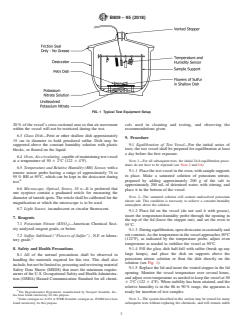
FIG. 1 Typical Test Equipment Setup
20% of the vessel’s cross-sectional area so that air movement cals used in cleaning and testing, and observing the
within the vessel will not be restricted during the test. recommendations given.
6.3 Glass Dish—Petri or other shallow dish approximately
9. Procedure
15 cm in diameter to hold powdered sulfur. Dish may be
9.1 Equilibration of Test Vessel—For the initial series of
supported above the constant humidity solution with plastic
tests, the test vessel shall be prepared for equilibration at least
block
...