

ASTM B49-20
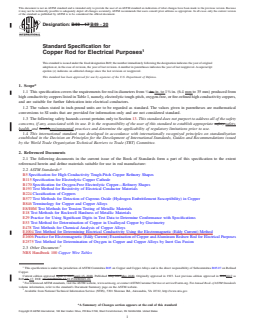
(Specification)Standard Specification for Copper Rod for Electrical Purposes
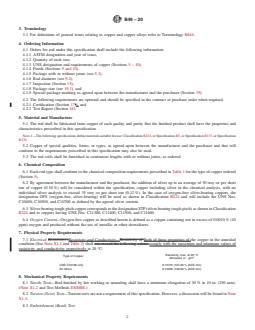
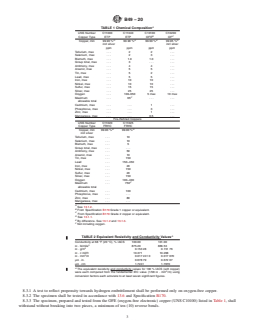
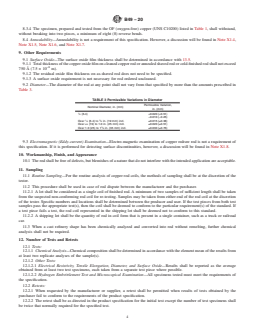
General Information
- Abstract
ABSTRACT
This specification covers the requirements for rod drawing stock produced from electrolytic tough-pitch or oxygen-free coppers and is suitable for further fabrication into electrical conductors. The rod shall be fabricated from copper of such quality and purity. Copper of special qualities, forms, or types, as agreed upon between the manufacturer and the purchaser and that will conform to the requirements prescribed in this specification may also be used. The specimen shall have the following chemical composition: tellurium, selenium, bismuth, antimony, arsenic, tin, lead, iron, nickel, sulfur, silver, oxygen, cadmium, phosphorus, zinc, and manganese. Embrittlement test shall be performed on the specimen to reflect propensity towards hydrogen embrittlement and shall be performed only on oxygen-free copper. The rod shall be free of defects, but blemishes of a nature that do not interfere with the intended application are acceptable.
SCOPE
1.1 This specification covers the requirements for rod in diameters from 1/4 in. to 13/8 in. (6.4 mm to 35 mm) produced from high conductivity coppers listed in Table 1, namely, electrolytic tough-pitch, oxygen-free, or fire-refined high conductivity coppers, and are suitable for further fabrication into electrical conductors.
1.2 The values stated in inch-pound units are to be regarded as standard. The values given in parentheses are mathematical conversions to SI units that are provided for information only and are not considered standard.
1.3 The following safety hazards caveat pertains only to Section 13. This standard does not purport to address all of the safety concerns, if any, associated with its use. It is the responsibility of the user of this standard to establish appropriate safety, health, and environmental practices and determine the applicability of regulatory limitations prior to use.
1.4 This international standard was developed in accordance with internationally recognized principles on standardization established in the Decision on Principles for the Development of International Standards, Guides and Recommendations issued by the World Trade Organization Technical Barriers to Trade (TBT) Committee.
- Status
- Published
- Publication Date
- 14-Apr-2020
- Technical Committee
- B05 - Copper and Copper Alloys
- Drafting Committee
- B05.07 - Refined Copper
Overview
ASTM B49-20: Standard Specification for Copper Rod for Electrical Purposes is an internationally recognized standard published by ASTM International. This specification defines the requirements for copper rod drawing stock produced from electrolytic tough-pitch (ETP), oxygen-free (OF, OFE), or fire-refined high conductivity (FRHC) coppers. These rods serve as the base material for further processing into electrical conductors, where superior electrical performance, consistency, and material quality are critical.
The standard outlines copper rod requirements covering chemical composition, mechanical properties, dimensional tolerances, and accepted test methods. Copper rods produced per ASTM B49-20 are widely used in industries that manufacture wire, cable, and other electrical conductors essential to modern infrastructure.
Key Topics
- Copper Types and Purity: The standard applies to high conductivity copper rods-ETP, OF, OFE, and FRHC-with stringent requirements for copper content and minimal allowable impurities to ensure excellent electrical conductivity.
- Chemical Composition: Specific maximum permissible limits for impurities such as tellurium, selenium, bismuth, arsenic, antimony, tin, lead, iron, nickel, sulfur, silver, oxygen, cadmium, phosphorus, zinc, and manganese. Special provision for oxygen-free and silver-bearing copper is included.
- Physical and Mechanical Requirements:
- Electrical Conductivity: Defines minimum conductivity levels for different copper types, ensuring suitability for electrical applications.
- Tensile and Bend Properties: Sets minimum elongation and bend test criteria to confirm mechanical durability.
- Surface Quality: Requires the rod to be free of detrimental defects; allows minor blemishes that don’t affect performance.
- Rod Dimensions: Specifies acceptable diameter tolerances for rod sizes ranging from 1/4 inch to 1 3/8 inch (6.4 mm to 35 mm).
- Testing and Compliance: Includes mandated sampling, chemical analysis, mechanical testing, and procedures for retesting and product rejection disputes.
- Packaging and Marking: Prescribes packaging, labeling, and identification requirements to ensure traceability and safe handling during shipment.
Applications
Copper rod manufactured under ASTM B49-20 is foundational to the electrical industry. Typical applications include:
- Wire and Cable Production: Drawing stock is further processed into electrical wires and power cables for infrastructure, residential, industrial, and automotive uses.
- Electrical Conductors: Utilized in busbars, transformer windings, motor windings, and other components demanding high electrical and mechanical performance.
- Electronics Manufacturing: Serves as raw material for connectors, circuit components, and other electronic devices where high purity, consistency, and conductivity are required.
- Renewable/Green Energy: Used in wind turbines, solar panel connections, and battery manufacturing due to the high conductivity of copper and associated efficiency improvements.
Manufacturers and end-users choose ASTM B49-20 compliant copper rod to ensure reliable downstream processing, superior conductor performance, and compliance with international trade and quality expectations.
Related Standards
For broader context and integration into quality management systems, the following related ASTM standards are commonly referenced alongside B49-20:
- ASTM B115 - Specification for Electrolytic Copper Cathode
- ASTM B170 - Specification for Oxygen-Free Electrolytic Copper-Refinery Shapes
- ASTM B193 - Test Method for Resistivity of Electrical Conductor Materials
- ASTM B224 - Classification of Coppers
- ASTM E478 - Test Methods for Chemical Analysis of Copper Alloys
- ASTM E8/E8M - Test Methods for Tension Testing of Metallic Materials
- ASTM E29 - Practice for Using Significant Digits in Test Data
- ASTM E1004 - Test Method for Determining Electrical Conductivity Using Electromagnetic (Eddy Current) Method
- ASTM E1606 - Practice for Electromagnetic (Eddy Current) Examination of Copper and Aluminum Redraw Rod for Electrical Purposes
Efficient use of ASTM B49-20 ensures consistency, safety, and performance in copper conductor manufacturing, supporting compliance throughout the global supply chain.
Relations
- Effective Date
- 15-Apr-2020
- Effective Date
- 01-Jan-2024
- Effective Date
- 01-Dec-2023
- Effective Date
- 01-Jun-2020
- Effective Date
- 01-Aug-2019
- Effective Date
- 15-Jun-2019
- Effective Date
- 01-Apr-2019
- Effective Date
- 01-Jan-2019
- Effective Date
- 01-Jul-2018
- Effective Date
- 01-Jul-2017
- Effective Date
- 01-Jun-2017
- Effective Date
- 15-Jul-2016
- Effective Date
- 01-Apr-2016
- Effective Date
- 01-Apr-2016
- Effective Date
- 01-Dec-2015
Get Certified
Connect with accredited certification bodies for this standard

IMQ S.p.A. (Certification)
Italian electrical product certification.

SLG Prüf- und Zertifizierungs GmbH
German testing and certification body.

UL Solutions
Global safety science company with testing, inspection and certification.
Sponsored listings
Frequently Asked Questions
ASTM B49-20 is a technical specification published by ASTM International. Its full title is "Standard Specification for Copper Rod for Electrical Purposes". This standard covers: ABSTRACT This specification covers the requirements for rod drawing stock produced from electrolytic tough-pitch or oxygen-free coppers and is suitable for further fabrication into electrical conductors. The rod shall be fabricated from copper of such quality and purity. Copper of special qualities, forms, or types, as agreed upon between the manufacturer and the purchaser and that will conform to the requirements prescribed in this specification may also be used. The specimen shall have the following chemical composition: tellurium, selenium, bismuth, antimony, arsenic, tin, lead, iron, nickel, sulfur, silver, oxygen, cadmium, phosphorus, zinc, and manganese. Embrittlement test shall be performed on the specimen to reflect propensity towards hydrogen embrittlement and shall be performed only on oxygen-free copper. The rod shall be free of defects, but blemishes of a nature that do not interfere with the intended application are acceptable. SCOPE 1.1 This specification covers the requirements for rod in diameters from 1/4 in. to 13/8 in. (6.4 mm to 35 mm) produced from high conductivity coppers listed in Table 1, namely, electrolytic tough-pitch, oxygen-free, or fire-refined high conductivity coppers, and are suitable for further fabrication into electrical conductors. 1.2 The values stated in inch-pound units are to be regarded as standard. The values given in parentheses are mathematical conversions to SI units that are provided for information only and are not considered standard. 1.3 The following safety hazards caveat pertains only to Section 13. This standard does not purport to address all of the safety concerns, if any, associated with its use. It is the responsibility of the user of this standard to establish appropriate safety, health, and environmental practices and determine the applicability of regulatory limitations prior to use. 1.4 This international standard was developed in accordance with internationally recognized principles on standardization established in the Decision on Principles for the Development of International Standards, Guides and Recommendations issued by the World Trade Organization Technical Barriers to Trade (TBT) Committee.
ABSTRACT This specification covers the requirements for rod drawing stock produced from electrolytic tough-pitch or oxygen-free coppers and is suitable for further fabrication into electrical conductors. The rod shall be fabricated from copper of such quality and purity. Copper of special qualities, forms, or types, as agreed upon between the manufacturer and the purchaser and that will conform to the requirements prescribed in this specification may also be used. The specimen shall have the following chemical composition: tellurium, selenium, bismuth, antimony, arsenic, tin, lead, iron, nickel, sulfur, silver, oxygen, cadmium, phosphorus, zinc, and manganese. Embrittlement test shall be performed on the specimen to reflect propensity towards hydrogen embrittlement and shall be performed only on oxygen-free copper. The rod shall be free of defects, but blemishes of a nature that do not interfere with the intended application are acceptable. SCOPE 1.1 This specification covers the requirements for rod in diameters from 1/4 in. to 13/8 in. (6.4 mm to 35 mm) produced from high conductivity coppers listed in Table 1, namely, electrolytic tough-pitch, oxygen-free, or fire-refined high conductivity coppers, and are suitable for further fabrication into electrical conductors. 1.2 The values stated in inch-pound units are to be regarded as standard. The values given in parentheses are mathematical conversions to SI units that are provided for information only and are not considered standard. 1.3 The following safety hazards caveat pertains only to Section 13. This standard does not purport to address all of the safety concerns, if any, associated with its use. It is the responsibility of the user of this standard to establish appropriate safety, health, and environmental practices and determine the applicability of regulatory limitations prior to use. 1.4 This international standard was developed in accordance with internationally recognized principles on standardization established in the Decision on Principles for the Development of International Standards, Guides and Recommendations issued by the World Trade Organization Technical Barriers to Trade (TBT) Committee.
ASTM B49-20 is classified under the following ICS (International Classification for Standards) categories: 29.050 - Superconductivity and conducting materials. The ICS classification helps identify the subject area and facilitates finding related standards.
ASTM B49-20 has the following relationships with other standards: It is inter standard links to ASTM B49-17, ASTM E8/E8M-24, ASTM E1004-23, ASTM E1606-20, ASTM B846-19a, ASTM E2575-19, ASTM B577-19, ASTM B846-19, ASTM E18-18, ASTM E18-17, ASTM E1004-17, ASTM E8/E8M-16, ASTM B193-16, ASTM B577-16, ASTM E1606-15. Understanding these relationships helps ensure you are using the most current and applicable version of the standard.
ASTM B49-20 is available in PDF format for immediate download after purchase. The document can be added to your cart and obtained through the secure checkout process. Digital delivery ensures instant access to the complete standard document.
Standards Content (Sample)
This international standard was developed in accordance with internationally recognized principles on standardization established in the Decision on Principles for the
Development of International Standards, Guides and Recommendations issued by the World Trade Organization Technical Barriers to Trade (TBT) Committee.
Designation:B49 −20
Standard Specification for
Copper Rod for Electrical Purposes
ThisstandardisissuedunderthefixeddesignationB49;thenumberimmediatelyfollowingthedesignationindicatestheyearoforiginal
adoptionor,inthecaseofrevision,theyearoflastrevision.Anumberinparenthesesindicatestheyearoflastreapproval.Asuperscript
epsilon (´) indicates an editorial change since the last revision or reapproval.
This standard has been approved for use by agencies of the U.S. Department of Defense.
1. Scope* B115Specification for Electrolytic Copper Cathode
B170Specification for Oxygen-Free Electrolytic Copper—
1.1 This specification covers the requirements for rod in
Refinery Shapes
1 3
diameters from ⁄4in. to 1 ⁄8in. (6.4 mm to 35 mm) produced
B193Test Method for Resistivity of Electrical Conductor
from high conductivity coppers listed in Table 1, namely,
Materials
electrolytic tough-pitch, oxygen-free, or fire-refined high con-
B224Classification of Coppers
ductivity coppers, and are suitable for further fabrication into
B577TestMethodsforDetectionofCuprousOxide(Hydro-
electrical conductors.
gen Embrittlement Susceptibility) in Copper
1.2 Thevaluesstatedininch-poundunitsaretoberegarded
B846Terminology for Copper and Copper Alloys
as standard. The values given in parentheses are mathematical
E8/E8MTest Methods for Tension Testing of Metallic Ma-
conversions to SI units that are provided for information only
terials
and are not considered standard.
E18Test Methods for Rockwell Hardness of Metallic Ma-
1.3 The following safety hazards caveat pertains only to
terials
Section13.Thisstandarddoesnotpurporttoaddressallofthe E29Practice for Using Significant Digits in Test Data to
safety concerns, if any, associated with its use. It is the
Determine Conformance with Specifications
responsibility of the user of this standard to establish appro- E53Test Method for Determination of Copper in Unalloyed
priate safety, health, and environmental practices and deter-
Copper by Gravimetry
mine the applicability of regulatory limitations prior to use. E478Test Methods for ChemicalAnalysis of CopperAlloys
1.4 This international standard was developed in accor-
E1004Test Method for Determining Electrical Conductivity
dance with internationally recognized principles on standard- Using the Electromagnetic (Eddy Current) Method
ization established in the Decision on Principles for the
E1606Practice for Electromagnetic (Eddy Current) Exami-
Development of International Standards, Guides and Recom-
nation of Copper andAluminum Redraw Rod for Electri-
mendations issued by the World Trade Organization Technical cal Purposes
Barriers to Trade (TBT) Committee.
E2575Test Method for Determination of Oxygen in Copper
and Copper Alloys by Inert Gas Fusion
2. Referenced Documents 3
2.3 Other Document:
2.1 The following documents in the current issue of the
NBS Handbook 100Copper Wire Tables
BookofStandardsformapartofthisspecificationtotheextent
3. Terminology
referenced herein and define materials suitable for use in rod
manufacture:
3.1 For definitions of general terms relating to copper and
copper alloys refer to Terminology B846.
2.2 ASTM Standards:
B5Specification for High ConductivityTough-Pitch Copper
4. Ordering Information
Refinery Shapes
4.1 Orders for rod under this specification shall include the
following information:
ThisspecificationisunderthejurisdictionofASTMCommitteeB05onCopper
4.1.1 ASTM designation and year of issue,
and Copper Alloys and is the direct responsibility of Subcommittee B05.07 on
Refined Copper. 4.1.2 Quantity of each size,
Current edition approved April 15, 2020. Published May 2020. Originally
4.1.3 UNS designation and requirements of copper (Sec-
approved in 1923. Last previous edition approved in 2017 as B49-17. DOI:
tions5–10),
10.1520/B0049-20.
For referenced ASTM standards, visit the ASTM website, www.astm.org, or
contact ASTM Customer Service at service@astm.org. For Annual Book of ASTM
Standards volume information, refer to the standard’s Document Summary page on Available from NationalTechnical Information Service (NTIS), 5301 Shawnee
the ASTM website. Rd., Alexandria, VA 22312, http://www.ntis.gov.
*A Summary of Changes section appears at the end of this standard
Copyright © ASTM International, 100 Barr Harbor Drive, PO Box C700, West Conshohocken, PA 19428-2959. United States
B49−20
A
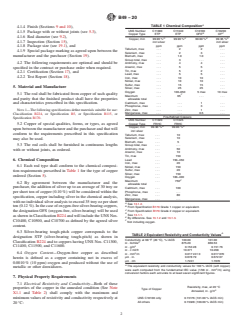
TABLE 1 Chemical Composition
4.1.4 Finish (Sections 9 and 10),
UNS Number C11000 C11040 C10100 C10200
4.1.5 Package with or without joints (see 5.3),
B C
Copper Type ETP ETP OFE OF
4.1.6 Rod diameter (see 9.2),
D E E D
Copper, min 99.90 % 99.90 % 99.99 % 99.95 %
4.1.7 Inspection (Section 15),
incl silver incl silver
ppm ppm ppm ppm
4.1.8 Package size (see 19.1), and
Tellurium, max . . . 2 2 . . .
4.1.9 Special package marking as agreed upon between the
Selenium, max . . . 2 3 . . .
manufacturer and the purchaser (Section 19).
Bismuth, max . . . 1.0 1.0 . . .
Group total, max . 3 . .
4.2 The following requirements are optional and should be
Antimony, max . . . 4 4 . . .
Arsenic, max . . . 5 5 . . .
specified in the contract or purchase order when required.
Tin, max . 5 2 .
4.2.1 Certification (Section 17), and
Lead, max . . . 5 5 . . .
4.2.2 Test Report (Section 18).
Iron, max . . . 10 10 . . .
Nickel, max . . . 10 10 . . .
Sulfur, max . . . 15 15 . . .
5. Material and Manufacture
Silver, max . . . 25 25 . . .
Oxygen . . . 100–650 5 max 10 max
5.1 The rod shall be fabricated from copper of such quality
F
Maximum . 65 . .
and purity that the finished product shall have the properties
allowable total
Cadmium, max . . . . . . 1 . . .
and characteristics prescribed in this specification.
Phosphorus, max . . . . . . 3 . . .
Zinc, max . . 1 .
NOTE 1—The following specifications define materials suitable for use:
Manganese, max . . . . . . 0.5 . . .
Classification B224, or Specification B5, or Specification B115,or
Fire-Refined Coppers
Specification B170.
UNS Number C11020 C11025
Copper Type FRHC FRHC
5.2 Copper of special qualities, forms, or types, as agreed
D D
Copper, min 99.90 % 99.90 %
uponbetweenthemanufacturerandthepurchaserandthatwill
incl silver
conform to the requirements prescribed in this specification
Tellurium, max . . . 10
Selenium, max . . . 10
may also be used.
Bismuth, max . . . 5
5.3 The rod coils shall be furnished in continuous lengths Group total, max . . . . . .
Antimony, max . . . 50
with or without joints, as ordered.
Arsenic, max . . . 10
Tin, max . . . 150
6. Chemical Composition Lead . . . 150–450
Iron, max . . . 20
6.1 Each rod type shall conform to the chemical composi-
Nickel, max . . . 150
Sulfur, max . . . 20
tion requirements prescribed in Table 1 for the type of copper
Silver, max . . . 150
ordered (Section 5).
Oxygen . . . 100–400
F
Maximum . 750
6.2 By agreement between the manufacturer and the
allowable total
purchaser, the addition of silver up to an average of 30 troy oz
Cadmium, max . . . 100
Phosphorus, max . . . . . .
per short ton of copper (0.10%) will be considered within the
Zinc, max . . . 80
specification, copper including silver in the chemical analysis,
Manganese, max . . . . . .
withnoindividualsilveranalysistoexceed35troyozpershort
A
See 13.1.2.
ton(0.12%).Inthecaseofoxygen-freesilver-bearingcoppers, B
From Specification B170 Grade 1 copper or equivalent.
C
From Specification B170 Grade 2 copper or equivalent.
the designation OFS (oxygen-free, silver-bearing) will be used
D
See 13.1.1.
asshowninClassificationB224andwillincludetheUNSNos.
E
By difference. See 13.1.2 and 13.1.3.
F
C10400, C10500, and C10700 as defined by the agreed silver
Not including oxygen.
content.
6.3 Silver-bearing tough-pitch copper corresponds to the
A
TABLE 2 Equivalent Resistivity and Conductivity Values
designation STP (silver-bearing tough-pitch) as shown in
Conductivity at 68 °F (20 °C), % IACS 100.00 101.00
Classification B224 and to coppers having UNS Nos. C11300,
Ω · lb/mile 875.20 866.53
C11400, C11500, and C11600. Ω ·g/m 0.153 28 0.151 76
Ω · c mil/ft 10.371 10.268
6.4 Oxygen Content—Oxygen-free copper as described
Ω ·mm /m 0.017 241 0 0.017 070
µΩ · in. 0.678 79 0.672 07
herein is defined as a copper containing not in excess of
µΩ · cm 1.7241 1.7070
0.0010% (10 ppm) oxygen and produced without the use of
A
The equivalent resistivity and conductivity values for 100 % IACS (soft copper)
metallic or other deoxidizers.
were each computed from the fundamental IEC value (1/58 Ω ·mm /m) using
conversion factors each accurate to at least seven significant figures.
7. Physical Property Requirements
7.1 Electrical Resistivity and Conductivity—Both of these
Resistivity, max, at 20 °C
properties of the copper in the annealed condition (See Note
Type of Copper
Annealed,Ω ·g/m
X1.1 and Table 2) shall comply with the maximum and
minimum values of resistivity and conductivity respectively at UNS C10100 only 0.15176 (101.00 % IACS min)
All others 0.15328 (100.00 % IACS min)
20°C:
B49−20
8. Mechanical Property Requirements 11. Sampling
8.1 TensileTests—Rodfinishedbyhotworkingorannealing 11.1 Routine Sampling—For the routine analysis of copper
shall have a minimum elongation of 30% in 10 in. (250 mm). rod coils, the methods of sampling shall be at the discretion of
(Note X1.2 and Test Methods E8/E8M.) the tester.
8.2 Torsion (Twist) Tests—Torsion tests are not a require- 11.2 This procedure shall be used in case of rod dispute
mentofthisspecification.However,adiscussionwillbefound between the manufacturer and the purchaser.
in Note X1.3. 11.2.1 A lot shall be considered as a single coil of finished
rod. A minimum of two samples of sufficient length shall be
8.3 Embrittlement (Bend) Test:
taken from the suspected non-conforming rod coil for re-
8.3.1 A test to reflect propensity towards hydrogen em-
testing. Samples may be taken from either end of the rod coil
brittlement shall be performed only on oxygen-free copper.
at the discretion of the tester. Specific numbers and locations
8.3.2 The specimen shall be tested in accordance with 13.6
shall be determined between the producer and user. If the test
and Specification B170.
pieces from both test samples pass the appropriate test(s), then
8.3.3 The specimen, prepared and tested from the OFE
the coil shall be deemed to conform to the particular require-
(oxygen-free electronic) copper (UNS C10100) listed in Table
ment(s) of the standard. If a test piece fails a test, the rod coil
1,shallwithstandwithoutbreakingintotwopieces,aminimum
represented in the shipping lot shall be deemed not to conform
of ten (10) reverse bends.
to this standard.
8.3.4 The specimen, prepared and tested from the OF
11.2.2 A shipping lot shall be the quantity of rod in coil
(oxygen-free) copper (UNS C10200) listed in Table 1, shall
form that is present in a single container, such as a truck or
withstand, without breaking into two pieces, a minimum of
railroad car.
eight (8) reverse bends.
11.3 When a cast refinery shape has been chemically
8.4 Annealability—Annealability is not a requirement of
analyzed and converted into rod without remelting, further
this specification. However, a discussion will be found in Note
chemical analysis shall not be required.
X1.4, Note X1.5, Note X1.6, and Note X1.7.
12. Number of Tests and Retests
9. Other Requirements
12.1 Tests:
9.1 Surface Oxide—The surface oxide film thickness shall
12.1.1 Chemical Analysis—Chemical composition shall be
be determined in accordance with 13.5.
determined in accordance with the element mean of the results
9.1.1 Total thickness of the copper oxide film on cleaned
from at least two replicate analyses of the sample(s).
copper rod or annealed shaved rod or cold-finished rod shall
−8
12.1.2 Other Tests:
not exceed 750 Å (7.5 × 10 m).
12.1.2.1 Electrical Resistivity, Tensile Elongation,
9.1.2 The residual oxide film thickness on as-shaved rod
Diameter, and Surface Oxide—Results shall be reported as the
does not need to be specified.
average obtained from at least two test specimens, each taken
9.1.3 A surface oxide requirement is not necessary for rod
from a separate test piece where possible.
ordered uncleaned.
12.1.2.2 Hydrogen Embrittlement Test and Microscopical
9.2 Diameter—Thediameteroftherodatanypointshallnot
Examination—All specimens tested must meet the require-
vary from that specified by more than the amounts prescribed
ments of the specification.
in Table 3.
12.2 Retests:
12.2.1 When requested by the manufacturer or supplier, a
TABLE 3 Permissible Variations in Diameter
retest shall be permitted when results of tests obtained by the
Permissible Variation,
Nominal Diameter, in. (mm)
purchaser fail to conform to the requirements of the product
in. (mm)
specification.
⁄4 (6.4) +0.020 (+0.51)
−0.010 (−0.25)
12.2.2 The retest shall be as directed in the product speci-
1 3
Over ⁄4 (6.4) to ⁄4 in. (19 mm) incl. ±0.015 (±0.38)
fication for the initial test except the number of test specimens
Over ⁄4 (19) to 1.0 in. (25 mm) incl. ±0.020 (±0.51)
3 shall be twice that normally required for the specified test.
Over 1.0 (25) to 1 ⁄8 in. (35 mm) incl. ±0.030 (±0.76)
12.2.3 All test specimens shall conform to the product
specification requirement(s) in retest. Failure to conform shall
be cause for rejection.
9.3 Electromagnetic (Eddy-current) Examination—Electro-
magnetic examination of copper redraw rod is not a require-
13. Test Methods
ment of this specification. If it is performed for detecting
surface discontinuities, however, a discussion will be found in 13.1 Chemical Analysis:
Note X1.8.
13.1.1 In case of dispute, copper content of the coppers
other than UNS C10100 and UNS C11040 in Table 1 shall be
10. Workmanship, Finish, and Appearance
determined in accordance with Test Method E53.
10.1 The rod shall be free of defects, but blemishes of a 13.1.2 Analyticalmethodfordeterminingimpuritylevelsof
nature that do not interfere with the intended application are coppers listed in Table 1 shall be in accordance with Specifi-
acceptable. cation B115.
B49−20
13.1.3 Copper content of UNS C10100 and UNS C11040
types shall be calculated by subtracting from 100% the total
impurityconcentrationdetermined.TheimpuritytotalforUNS
C10100 is defined as the sum of sulfur, silver, lead, tin,
bismuth, arsenic, antimony, iron, nickel, zinc, phosphorus,
selenium,tellurium,manganese,cadmium,andoxygenpresent
inthesample.TheimpuritytotalforUNSC11040isdefinedas
the sum of sulfur, silver, lead, tin, bismuth, arsenic, antimony,
iron, nickel, selenium, tellurium, and oxygen present in the
sample.
13.1.4 ThetestmethodsannexofSpecificationB170should
be referenced for the oxygen-free coppers.Test Methods E478
should be referenced for the determination of silver-bearing
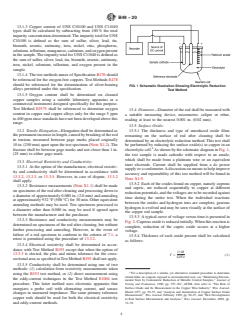
FIG. 1Schematic Illustration Showing Electrolytic Reduction
alloys permitted under this specification.
Test Method
13.1.5 Oxygen content shall be determined on cleaned
copper samples using a suitable laboratory apparatus or a
commercial instrument designed specifically for this purpose.
Test Method E2575 shall be referenced to determine oxygen
13.4 Diameter—Diameteroftherodshallbemeasuredwith
content in copper and copper alloys only for the range 5 ppm
a suitable measuring device, micrometer, caliper or other,
to400ppmsincestandardshavenotbeendevelopedabovethis
reading at least to the nearest 0.001 in. (0.02 mm).
range.
13.5 Surface Oxide:
13.2 Tensile Elongation—Elongation shall be determined as
13.5.1 The thickness and type of unreduced oxide films
thepermanentincreaseinlength,causedbybreakingoftherod
remaining on the surface of rod after cleaning shall be
in tension, measured between gage marks placed originally
determined by an electrolytic reduction method.This test shall
10in.(250mm)apartuponthetestspecimen(NoteX1.2).The
be performed by reducing the surface oxide(s) to copper in an
fracture shall be between gage marks and not closer than 1in.
electrolyticcell. AsshownbytheschematicdiagraminFig.1,
(25 mm) to either gage mark.
the test sample is made cathodic with respect to an anode,
which shall be made from a platinum wire or an equivalent
13.3 Electrical Resistivity and Conductivity:
inert electrode. Current shall be supplied from a dc power
13.3.1 At the option of the manufacturer, electrical resistiv-
supplyoracoulometer.Adiscussiononmeanstohelpimprove
ity and conductivity shall be determined in accordance with
accuracy and repeatability of this test method will be found in
13.3.2, 13.3.3,or 13.3.5. However, in case of dispute, 13.3.2
Note X1.9.
shall apply.
13.5.2 Each of the oxides found on copper, namely cuprous
13.3.2 Resistance measurements (Note X1.1) shall be made
and cupric, are reduced sequentially to copper at different
on specimens of the rod after cleaning and processing down to
reductionpotentials,andthevoltagesaretoberecordedagainst
a diameter of approximately 0.080 in. (2.0 mm) and annealing
time during the entire test. When the individual reactions
at approximately 932°F (500°C) for 30 min. Other equivalent
between the oxides and hydrogen ions are complete, gaseous
annealing methods may be used. Test specimens processed to
hydrogen is evolved and may be seen visually at the surface of
a diameter other than 0.080 in. may be used if agreed upon
the copper rod sample.
between the manufacturer and the purchaser.
13.5.3 Atypicalcurveofvoltageversustimeispresentedin
13.3.3 Resistance and conductivity measurements may be
Fig.2.Cuprousoxideisreducedinitially.Whenthisreactionis
determinedonspecimensoftherodaftercleaning,butwithout
complete, reduction of the cupric oxide occurs at a higher
further processing and annealing. However, in the event of
voltage.
failure of a rod specimen to conform to the criteria of 7.1,a
13.5.4 Thickness of each oxide present shall be calculated
retest is permitted using the procedure of 13.3.2.
as follows:
13.3.4 Electrical resistivity shall be determined in accor-
dance with Test Method B193 except that when the option of
ItM
13.3.3 is elected, the plus and minus tolerance for the cross-
T 5 (1)
SdFn
sectionalareaasspecifiedinTestMethodB193shallnotapply.
13.3.5 Conductivity shall be determined using one of two
methods: (1) calculation from resistivity measurements taken
For a description of a similar, yet alternative standard procedure to determine
using the B193 test method, or (2) direct measurement using
tarnish films on coupons exposed to environmental tests, see “Monitoring Environ-
the eddy-current techniques in the Test Method E1004 test
mental Tests by Coulometric Reduction of Metallic Control Samples,” Journal of
procedure. This latter method uses electronic apparatus that
Testing and Evaluation, 1989, pp. 357–367, ASTM. Also refer to “The Role of
Surface Oxide and Its Measurement in the Copper Wire Industry,” Wire Journal,
energizes a probe coil with alternating current, and senses
March 1977, pp. 50–57, and “Analysis and Automation of Copper Surface Oxide
changes in measured impedance. The same primary reference
Measurement,” Wire Journal, February 1999, pp. 90–97, and “New Developments
copper rods should be used for both the electrical resistivity
in Rod Surface Measurement and Analysis,” Wire Journal, December, 2009, pp.
and eddy-current methods. 72–78.
B49−20
15. Inspection
15.1 All inspections and tests shall be made at the place of
manufacture unless otherwise agreed upon between the manu-
facturer and the purchaser at the time of purchase. The
manufacturer shall afford the inspector representing the pur-
chaser all reasonable facilities to satisfy him that the material
being furnished is in accordance with this specification.
16. Rejection and Rehearing
16.1 Rejection:
16.1.1 Product that fails to conform to the requirements of
the product specification may be rejected.
16.1.2 Rejection shall be reported to the manufacturer, or
supplier, promptly and in writing.
16.1.3 In case of disagreement or dissatisfaction with the
results of the test upon which rejection was based, the
manufacturer or supplier may make claim for a rehearing.
16.2 Rehearing—Asaresultofproductrejection,themanu-
facturer or supplier may make claim for retest to be conducted
by the manufacturer or supplier and the purchaser. Samples of
the rejected product shall be taken in accordance with the
product specification and tested by both parties as directed in
FIG. 2Typical Voltage-Time Curve for the Reduction
the product specification, or alternatively upon agreement by
of Copper Oxide Films
bothparties,anindependentlaboratorymaybeselectedforthe
tests using the test methods prescribed in the product specifi-
where:
cation.
T = oxide thickness, cm;
I = current, A;
17. Certification
t = time of reaction, s;
17.1 When specified in the contract or purchase order, the
M = molecular weight of the oxide, g;
purchaser shall be furnished certification representative of the
S = surface area of immersed sample, cm ;
3 3
d = oxide density (6.0 g/cm for Cu O and 6.4 g/cm for shipping lot indicating that requirements have been met as
directed by this specification.
CuO);
F = Faraday constant, 96500 C; and
n = hydrogen equivalent (2).
18. Test Report
13.6 Hydrogen Embrittlement Susceptibility:
18.1 When specified in the contract or purchase order, a
13.6.1 The specimen of oxygen-free copper rod shall be
report of test results shall be furnished.
drawn into 0.080 in. (2.03 mm) diameter wire, annealed in an
atmosphere containing not less than 10% of hydrogen for
19. Packaging and Package Marking
30min at 1560°F 645°F (850°C 625°C) and cooled
19.1 Package size shall be agreed upon between the manu-
quickly in the same atmosphere, or without undue exposure to
facturer and the purchaser and shall be stated in the order.
air,quenchedintowater.Eachspecimenshallundergothebend
test in accordance with 13.6.2.
19.2 The rod shall be packaged and protected against
13.6.2 The specimen (13.6.1) shall be lightly clamped
damage from normal handling and shipping as is consistent
betweenjawswithedgeshavingaradiusof0.200in.(5.1mm),
with good
...
This document is not an ASTM standard and is intended only to provide the user of an ASTM standard an indication of what changes have been made to the previous version. Because
it may not be technically possible to adequately depict all changes accurately, ASTM recommends that users consult prior editions as appropriate. In all cases only the current version
of the standard as published by ASTM is to be considered the official document.
Designation: B49 − 17 B49 − 20
Standard Specification for
Copper Rod for Electrical Purposes
This standard is issued under the fixed designation B49; the number immediately following the designation indicates the year of original
adoption or, in the case of revision, the year of last revision. A number in parentheses indicates the year of last reapproval. A superscript
epsilon (´) indicates an editorial change since the last revision or reapproval.
This standard has been approved for use by agencies of the U.S. Department of Defense.
1. Scope*
1 3
1.1 This specification covers the requirements for rod in diameters from ⁄4 to in. to 1 ⁄8 in. (6.4 mm to 35 mm) produced from
high conductivity coppers listed in Table 1, namely, electrolytic tough-pitch, oxygen-free, or fire-refined high conductivity coppers,
and are suitable for further fabrication into electrical conductors.
1.2 The values stated in inch-pound units are to be regarded as standard. The values given in parentheses are mathematical
conversions to SI units that are provided for information only and are not considered standard.
1.3 The following safety hazards caveat pertains only to Section 13. This standard does not purport to address all of the safety
concerns, if any, associated with its use. It is the responsibility of the user of this standard to establish appropriate safety safety,
health, and healthenvironmental practices and determine the applicability of regulatory limitations prior to use.
1.4 This international standard was developed in accordance with internationally recognized principles on standardization
established in the Decision on Principles for the Development of International Standards, Guides and Recommendations issued
by the World Trade Organization Technical Barriers to Trade (TBT) Committee.
2. Referenced Documents
2.1 The following documents in the current issue of the Book of Standards form a part of this specification to the extent
referenced herein and define materials suitable for use in rod manufacture:
2.2 ASTM Standards:
B5 Specification for High Conductivity Tough-Pitch Copper Refinery Shapes
B115 Specification for Electrolytic Copper Cathode
B170 Specification for Oxygen-Free Electrolytic Copper—Refinery Shapes
B193 Test Method for Resistivity of Electrical Conductor Materials
B224 Classification of Coppers
B577 Test Methods for Detection of Cuprous Oxide (Hydrogen Embrittlement Susceptibility) in Copper
B846 Terminology for Copper and Copper Alloys
E8/E8M Test Methods for Tension Testing of Metallic Materials
E18 Test Methods for Rockwell Hardness of Metallic Materials
E29 Practice for Using Significant Digits in Test Data to Determine Conformance with Specifications
E53 Test Method for Determination of Copper in Unalloyed Copper by Gravimetry
E478 Test Methods for Chemical Analysis of Copper Alloys
E1004 Test Method for Determining Electrical Conductivity Using the Electromagnetic (Eddy Current) Method
E1606 Practice for Electromagnetic (Eddy Current) Examination of Copper and Aluminum Redraw Rod for Electrical Purposes
E2575 Test Method for Determination of Oxygen in Copper and Copper Alloys by Inert Gas Fusion
2.3 Other Document:
NBS Handbook 100 Copper Wire Tables
This specification is under the jurisdiction of ASTM Committee B05 on Copper and Copper Alloys and is the direct responsibility of Subcommittee B05.07 on Refined
Copper.
Current edition approved April 1, 2017April 15, 2020. Published May 2017May 2020. Originally approved in 1923. Last previous edition approved in 20162017 as
B49-16.-17. DOI: 10.1520/B0049-17.10.1520/B0049-20.
For referenced ASTM standards, visit the ASTM website, www.astm.org, or contact ASTM Customer Service at service@astm.org. For Annual Book of ASTM Standards
volume information, refer to the standard’s Document Summary page on the ASTM website.
Available from National Technical Information Service (NTIS), 5301 Shawnee Rd., Alexandria, VA 22312, http://www.ntis.gov.
*A Summary of Changes section appears at the end of this standard
Copyright © ASTM International, 100 Barr Harbor Drive, PO Box C700, West Conshohocken, PA 19428-2959. United States
B49 − 20
3. Terminology
3.1 For definitions of general terms relating to copper and copper alloys refer to Terminology B846.
4. Ordering Information
4.1 Orders for rod under this specification shall include the following information:
4.1.1 ASTM designation and year of issue,
4.1.2 Quantity of each size,
4.1.3 UNS designation and requirements of copper (Sections 5 – 10),
4.1.4 Finish (Sections 9 and 10),
4.1.5 Package with or without joints (see 5.3),
4.1.6 Rod diameter (see 9.2),
4.1.7 Inspection (Section 15),
4.1.8 Package size (see 19.1), and
4.1.9 Special package marking as agreed upon between the manufacturer and the purchaser (Section 19).
4.2 The following requirements are optional and should be specified in the contract or purchase order when required.
4.2.1 Certification (Section 17)), and
4.2.2 Test Report (Section 18).
5. Material and Manufacture
5.1 The rod shall be fabricated from copper of such quality and purity that the finished product shall have the properties and
characteristics prescribed in this specification.
NOTE 1—The following specifications define materials suitable for use: Classification B224, or Specification B5, or Specification B115, or Specification
B170.
5.2 Copper of special qualities, forms, or types, as agreed upon between the manufacturer and the purchaser and that will
conform to the requirements prescribed in this specification may also be used.
5.3 The rod coils shall be furnished in continuous lengths with or without joints, as ordered.
6. Chemical Composition
6.1 Each rod type shall conform to the chemical composition requirements prescribed in Table 1 for the type of copper ordered
(Section 5).
6.2 By agreement between the manufacturer and the purchaser, the addition of silver up to an average of 30 troy oz per short
ton of copper (0.10 %) will be considered within the specification, copper including silver in the chemical analysis, with no
individual silver analysis to exceed 35 troy oz per short ton (0.12 %). In the case of oxygen-free silver-bearing coppers, the
designation OFS (oxygen-free, silver-bearing) will be used as shown in Classification B224 and will include the UNS Nos.
C10400, C10500, and C10700 as defined by the agreed silver content.
6.3 Silver-bearing tough-pitch copper corresponds to the designation STP (silver-bearing tough-pitch) as shown in Classification
B224 and to coppers having UNS Nos. C11300, C11400, C11500, and C11600.
6.4 Oxygen Content—Oxygen-free copper as described herein is defined as a copper containing not in excess of 0.0010 % (10
ppm) oxygen and produced without the use of metallic or other deoxidizers.
7. Physical Property Requirements
7.1 Electrical Resistivity—Resistivity and Conductivity—Resistivity of Both of these properties of the copper in the annealed
condition (See Note X1.1 and Table 2) shall not exceed the following values comply with the maximum and minimum values of
resistivity and conductivity respectively at 20 °C:
Resistivity, max, at 20 °C
Type of Copper
Annealed, Ω · g/m
UNS C10100 only 0.15176 (101.00 % IACS min)
All others 0.15328 (100.00 % IACS min)
8. Mechanical Property Requirements
8.1 Tensile Tests—Rod finished by hot working or annealing shall have a minimum elongation of 30 % in 10 in. (250 mm).
(Note X1.2 and Test Methods E8/E8M.)
8.2 Torsion (Twist) Tests—Torsion tests are not a requirement of this specification. However, a discussion will be found in Note
X1.3.
8.3 Embrittlement (Bend) Test:
B49 − 20
A
TABLE 1 Chemical Composition
UNS Number C11000 C11040 C10100 C10200
B C
Copper Type ETP ETP OFE OF
D E E D
Copper, min 99.90 % 99.90 % 99.99 % 99.95 %
incl silver incl silver
ppm ppm ppm ppm
Tellurium, max . . . 2 2 . . .
Selenium, max . . . 2 3 . . .
Bismuth, max . . . 1.0 1.0 . . .
Group total, max . . . 3 . . . . . .
Antimony, max . . . 4 4 . . .
Arsenic, max . . . 5 5 . . .
Tin, max . . . 5 2 . . .
Lead, max . . . 5 5 . . .
Iron, max . . . 10 10 . . .
Nickel, max . . . 10 10 . . .
Sulfur, max . . . 15 15 . . .
Silver, max . . . 25 25 . . .
Oxygen . . . 100–650 5 max 10 max
F
Maximum . . . 65 . . . . . .
allowable total
Cadmium, max . . . . . . 1 . . .
Phosphorus, max . . . . . . 3 . . .
Zinc, max . . . . . . 1 . . .
Manganese, max . . . . . . 0.5 . . .
Fire-Refined Coppers
UNS Number C11020 C11025
Copper Type FRHC FRHC
D D
Copper, min 99.90 % 99.90 %
incl silver
Tellurium, max . . . 10
Selenium, max . . . 10
Bismuth, max . . . 5
Group total, max . . . . . .
Antimony, max . . . 50
Arsenic, max . . . 10
Tin, max . . . 150
Lead . . . 150–450
Iron, max . . . 20
Nickel, max . . . 150
Sulfur, max . . . 20
Silver, max . . . 150
Oxygen . . . 100–400
F
Maximum . . . 750
allowable total
Cadmium, max . . . 100
Phosphorus, max . . . . . .
Zinc, max . . . 80
Manganese, max . . . . . .
A
See 13.1.2.
B
From Specification B170 Grade 1 copper or equivalent.
C
From Specification B170 Grade 2 copper or equivalent.
D
See 13.1.1.
E
By difference. See 13.1.2 and 13.1.3.
F
Not including oxygen.
A
TABLE 2 Equivalent Resistivity and Conductivity Values
Conductivity at 68 °F (20 °C), % IACS 100.00 101.00
Ω · lb/mile 875.20 866.53
Ω · g/m 0.153 28 0.151 76
Ω · c mil/ft 10.371 10.268
Ω · mm /m 0.017 241 0 0.017 070
μΩ · in. 0.678 79 0.672 07
μΩ · cm 1.7241 1.7070
A
The equivalent resistivity and conductivity values for 100 % IACS (soft copper)
were each computed from the fundamental IEC value (1/58 Ω · mm /m) using
conversion factors each accurate to at least seven significant figures.
8.3.1 A test to reflect propensity towards hydrogen embrittlement shall be performed only on oxygen-free copper.
8.3.2 The specimen shall be tested in accordance with 13.6 and Specification B170.
8.3.3 The specimen, prepared and tested from the OFE (oxygen-free electronic) copper (UNS C10100) listed in Table 1, shall
withstand without breaking into two pieces, a minimum of ten (10) reverse bends.
B49 − 20
8.3.4 The specimen, prepared and tested from the OF (oxygen-free) copper (UNS C10200) listed in Table 1, shall withstand,
without breaking into two pieces, a minimum of eight (8) reverse bends.
8.4 Annealability—Annealability is not a requirement of this specification. However, a discussion will be found in Note X1.4,
Note X1.5, Note X1.6, and Note X1.7.
9. Other Requirements
9.1 Surface Oxide—The surface oxide film thickness shall be determined in accordance with 13.5.
9.1.1 Total thickness of the copper oxide film on cleaned copper rod or annealed shaved rod or cold-finished rod shall not exceed
−8
750 Å (7.5 × 10 m).
9.1.2 The residual oxide film thickness on as-shaved rod does not need to be specified.
9.1.3 A surface oxide requirement is not necessary for rod ordered uncleaned.
9.2 Diameter—The diameter of the rod at any point shall not vary from that specified by more than the amounts prescribed in
Table 3.
TABLE 3 Permissible Variations in Diameter
Permissible Variation,
Nominal Diameter, in. (mm)
in. (mm)
⁄4 (6.4) +0.020 (+0.51)
−0.010 (−0.25)
1 3
Over ⁄4 (6.4) to ⁄4 in. (19 mm) incl. ±0.015 (±0.38)
Over ⁄4 (19) to 1.0 in. (25 mm) incl. ±0.020 (±0.51)
Over 1.0 (25) to 1 ⁄8 in. (35 mm) incl. ±0.030 (±0.76)
9.3 Electromagnetic (Eddy-current) Examination—Electro-magnetic examination of copper redraw rod is not a requirement of
this specification. If it is performed for detecting surface discontinuities, however, a discussion will be found in Note X1.8.
10. Workmanship, Finish, and Appearance
10.1 The rod shall be free of defects, but blemishes of a nature that do not interfere with the intended application are acceptable.
11. Sampling
11.1 Routine Sampling—For the routine analysis of copper rod coils, the methods of sampling shall be at the discretion of the
tester.
11.2 This procedure shall be used in case of rod dispute between the manufacturer and the purchaser.
11.2.1 A lot shall be considered as a single coil of finished rod. A minimum of two samples of sufficient length shall be taken
from the suspected non-conforming rod coil for re-testing. Samples may be taken from either end of the rod coil at the discretion
of the tester. Specific numbers and locations shall be determined between the producer and user. If the test pieces from both test
samples pass the appropriate test(s), then the coil shall be deemed to conform to the particular requirement(s) of the standard. If
a test piece fails a test, the rod coil represented in the shipping lot shall be deemed not to conform to this standard.
11.2.2 A shipping lot shall be the quantity of rod in coil form that is present in a single container, such as a truck or railroad
car.
11.3 When a cast refinery shape has been chemically analyzed and converted into rod without remelting, further chemical
analysis shall not be required.
12. Number of Tests and Retests
12.1 Tests:
12.1.1 Chemical Analysis—Chemical composition shall be determined in accordance with the element mean of the results from
at least two replicate analyses of the sample(s).
12.1.2 Other Tests:
12.1.2.1 Electrical Resistivity, Tensile Elongation, Diameter, and Surface Oxide—Results shall be reported as the average
obtained from at least two test specimens, each taken from a separate test piece where possible.
12.1.2.2 Hydrogen Embrittlement Test and Microscopical Examination—All specimens tested must meet the requirements of
the specification.
12.2 Retests:
12.2.1 When requested by the manufacturer or supplier, a retest shall be permitted when results of tests obtained by the
purchaser fail to conform to the requirements of the product specification.
12.2.2 The retest shall be as directed in the product specification for the initial test except the number of test specimens shall
be twice that normally required for the specified test.
B49 − 20
12.2.3 All test specimens shall conform to the product specification requirement(s) in retest. Failure to conform shall be cause
for rejection.
13. Test Methods
13.1 Chemical Analysis:
13.1.1 In case of dispute, copper content of the coppers other than UNS C10100 and UNS C11040 in Table 1 shall be
determined in accordance with Test Method E53.
13.1.2 Analytical method for determining impurity levels of coppers listed in Table 1 shall be in accordance with Specification
B115.
13.1.3 Copper content of UNS C10100 and UNS C11040 types shall be calculated by subtracting from 100 % the total impurity
concentration determined. The impurity total for UNS C10100 is defined as the sum of sulfur, silver, lead, tin, bismuth, arsenic,
antimony, iron, nickel, zinc, phosphorus, selenium, tellurium, manganese, cadmium, and oxygen present in the sample. The
impurity total for UNS C11040 is defined as the sum of sulfur, silver, lead, tin, bismuth, arsenic, antimony, iron, nickel, selenium,
tellurium, and oxygen present in the sample.
13.1.4 The test methods annex of Specification B170 should be referenced for the oxygen-free coppers. Test Methods E478
should be referenced for the determination of silver-bearing alloys permitted under this specification.
13.1.5 Oxygen content shall be determined on cleaned copper samples using a suitable laboratory apparatus or a commercial
instrument designed specifically for this purpose. Test Method E2575 shall be referenced to determine oxygen content in copper
and copper alloys only for the range 5 ppm to 400 ppm since standards have not been developed above this range.
13.2 Tensile Elongation—Elongation shall be determined as the permanent increase in length, caused by breaking of the rod in
tension, measured between gage marks placed originally 10 in. (250 mm) apart upon the test specimen (Note X1.2). The fracture
shall be between gage marks and not closer than 1 in. (25 mm) to either gage mark.
13.3 Electrical Resistivity: Resistivity and Conductivity:
13.3.1 At the option of the manufacturer, electrical resistivity and conductivity shall be determined in accordance with 13.3.2,
13.3.3or , or 13.3.313.3.5. However, in case of dispute, 13.3.2 shall apply.
13.3.2 Resistance measurements (Note X1.1) shall be made on specimens of the rod after cleaning and processing down to a
diameter of approximately 0.080 in. (2.0 mm) and annealing at approximately 932 °F (500 °C) for 30 min. Other equivalent
annealing methods may be used. Test specimens processed to a diameter other than 0.080 in. may be used if agreed upon between
the manufacturer and the purchaser.
13.3.3 Resistance and conductivity measurements may be determined on specimens of the rod after cleaning, but without further
processing and annealing. However, in the event of failure of a rod specimen to conform to the criteria of 7.1, a retest is permitted
using the procedure of 13.3.2.
13.3.4 Electrical resistivity shall be determined in accordance with Test Method B193 except that when the option of 13.3.3 is
elected, the plus and minus tolerance for the cross-sectional area as specified in Test Method B193 shall not apply.
13.3.5 Conductivity shall be determined using one of two methods: (1) calculation from resistivity measurements taken using
the B193 test method, or (2) direct measurement using the eddy-current techniques in the Test Method E1004 test procedure. This
latter method uses electronic apparatus that energizes a probe coil with alternating current, and senses changes in measured
impedance. The same primary reference copper rods should be used for both the electrical resistivity and eddy-current methods.
13.4 Diameter—Diameter of the rod shall be measured with a suitable measuring device, micrometer, caliper or other, reading
at least to the nearest 0.001 in. (0.02 mm).
13.5 Surface Oxide:
B49 − 20
13.5.1 The thickness and type of unreduced oxide films remaining on the surface of rod after cleaning shall be determined by
FIG. 1 Schematic Illustration Showing Electrolytic Reduction
Test Method
an electrolytic reduction method. This test shall be performed by reducing the surface oxide(s) to copper in an electrolytic cell.
As shown by the schematic diagram in Fig. 1, the test sample is made cathodic with respect to an anode, which shall be made from
a platinum wire or an equivalent inert electrode. Current shall be supplied from a dc power supply or a coulometer. A discussion
on means to help improve accuracy and repeatability of this test method will be found in Note X1.9.
13.5.2 Each of the oxides found on copper, namely cuprous and cupric, are reduced sequentially to copper at different reduction
potentials, and the voltages are to be recorded against time during the entire test. When the individual reactions between the oxides
and hydrogen ions are complete, gaseous hydrogen is evolved and may be seen visually at the surface of the copper rod sample.
13.5.3 A typical curve of voltage versus time is presented in Fig. 2. Cuprous oxide is reduced initially. When this reaction is
complete, reduction of the cupric oxide occurs at a higher voltage.
FIG. 2 Typical Voltage-Time Curve for the Reduction
of Copper Oxide Films
For a description of a similar, yet alternative standard procedure to determine tarnish films on coupons exposed to environmental tests, see “Monitoring Environmental
Tests by Coulometric Reduction of Metallic Control Samples,” Journal of Testing and Evaluation, 1989, pp. 357-367,–367, ASTM. Also refer to “The Role of Surface Oxide
and Its Measurement in the Copper Wire Industry,” Wire Journal, March 1977, pp. 50-57,–57, and “Analysis and Automation of Copper Surface Oxide Measurement,” Wire
Journal, February 1999, pp. 90-97,–97, and “New Developments in Rod Surface Measurement and Analysis,” Wire Journal, December, 2009, pp. 72-78.–78.
B49 − 20
13.5.4 Thickness of each oxide present shall be calculated as follows:
I t M
T 5 (1)
Sd Fn
where:
T = oxide thickness, cm;
I = current, A;
t = time of reaction, s;
M = molecular weight of the oxide, g;
S = surface area of immersed sample, cm ;
3 3
d = oxide density (6.0 g/cm for Cu O and 6.4 g/cm for CuO);
F = Faraday constant, 96 500 C; and
n = hydrogen equivalent (2).
13.6 Hydrogen Embrittlement Susceptibility:
13.6.1 The specimen of oxygen-free copper rod shall be drawn into 0.080-in. (2.03-mm) 0.080 in. (2.03 mm) diameter wire,
annealed in an atmosphere containing not less than 10 % of hydrogen for 30 min at 1560 6 45 °F (850 6 25 °C)1560 °F 6 45 °F
(850 °C 6 25 °C) and cooled quickly in the same atmosphere, or without undue exposure to air, quenched into water. Each
specimen shall undergo the bend test in accordance with 13.6.2.
13.6.2 The specimen (13.6.1) shall be lightly clamped between jaws with edges having a radius of 0.200 in. (5.1 mm), bent by
hand over one edge of the jaws through an angle of 90°, and returned to its original position. This constitutes a second bend. Each
successive bend shall be made in the opposite direction from the previous bend (see Test Methods B577).
14. Significance of Numerical Limits
14.1 Calculated values shall be rounded to the nearest unit in the last right hand significant digit used in expressing the limiting
value in accordance with the rounding-off method in Practice E29.
15. Inspection
15.1 All inspections and tests shall be made at the place of manufacture unless otherwise agreed upon between the manufacturer
and the purchaser at the time of purchase. The manufacturer shall afford the inspector representing the purchaser all reasonable
facilities to satisfy him that the material being furnished is in accordance with this specification.
16. Rejection and Rehearing
16.1 Rejection:
16.1.1 Product that fails to conform to the requirements of the product specification may be rejected.
16.1.2 Rejection shall be reported to the manufacturer, or supplier, promptly and in writing.
16.1.3 In case of disagreement or dissatisfaction with the results of the test upon which rejection was based, the manufacturer
or supplier may make claim for a rehearing.
16.2 Rehearing—As a result of product rejection, the manufacturer or supplier may make claim for retest to be conducted by
the manufacturer or supplier and the purchaser. Samples of the rejected product shall be taken in accordance with the product
specification and tested by both parties as directed in the product specification, or alternatively upon agreement by both parties,
an independent laboratory may be selected for the tests using the test methods prescribed in the product specification.
17. Certification
17.1 When specified in the contract or purchase order, the purchaser shall be furnished certification representative of the
shipping lot indicating that requirements have been met as directed by this specification.
18. Test Report
18.1 When specified in the contract or purchase order, a report of test results shall be furnished.
19. Packaging and Package Marking
19.1 Package size shall be agreed upon between the manufacturer and the purchaser and shall be s
...