

ASTM D2633-21
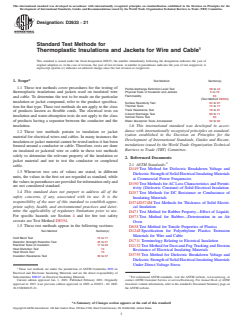
(Test Method)Standard Test Methods for Thermoplastic Insulations and Jackets for Wire and Cable
General Information
- Abstract
SIGNIFICANCE AND USE
6.1 Physical tests, properly interpreted, provide information with regard to the physical properties of the insulation or jacket. The physical test values give an approximation of how the insulation will physically perform in its service life. Physical tests provide useful data for research and development, engineering design, quality control, and acceptance or rejection under specifications.
SCOPE
1.1 These test methods cover procedures for the testing of thermoplastic insulations and jackets used on insulated wire and cable. To determine the test to be made on the particular insulation or jacket compound, refer to the product specification for that type. These test methods do not apply to the class of products known as flexible cords. The electrical tests on insulation and water-absorption tests do not apply to the class of products having a separator between the conductor and the insulation.
1.2 These test methods pertain to insulation or jacket material for electrical wires and cables. In many instances the insulation or jacket material cannot be tested unless it has been formed around a conductor or cable. Therefore, tests are done on insulated or jacketed wire or cable in these test methods solely to determine the relevant property of the insulation or jacket material and not to test the conductor or completed cable.
1.3 Whenever two sets of values are stated, in different units, the values in the first set are regarded as standard, while the values in parentheses are provided for information only and are not considered standard.
1.4 This standard does not purport to address all of the safety concerns, if any, associated with its use. It is the responsibility of the user of this standard to establish appropriate safety, health, and environmental practices and determine the applicability of regulatory limitations prior to use. For specific hazards see Section 4 and for fire test safety caveats see Test Method D8354.
1.5 These test methods appear in the following sections:
Test Method
Section(s)
Cold Bend Test
75 to 77
Dielectric Strength Retention Test
45 to 51
Electrical Tests of Insulation
17 to 29
Heat Distortion Test
74
Heat Shock Test
73
Insulation Resistance Test
30 to 37
Test Method
Section(s)
Partial-discharge Extinction Level Test
38 to 44
Physical Tests of Insulation and Jackets
5 to 16
Flammability
63
(Test Method D8354)
Surface Resistivity Test
64 to 67
Thermal Tests
72 to 77
Track Resistance Test
78 to 81
U-bend Discharge Test
68 to 71
Vertical Flame Test
63
Water Absorption Tests, Accelerated
52 to 62
1.6 This international standard was developed in accordance with internationally recognized principles on standardization established in the Decision on Principles for the Development of International Standards, Guides and Recommendations issued by the World Trade Organization Technical Barriers to Trade (TBT) Committee.
- Status
- Published
- Publication Date
- 31-Dec-2020
- Technical Committee
- D09 - Electrical and Electronic Insulating Materials
- Drafting Committee
- D09.07 - Electrical Insulating Materials
Buy Documents
ASTM D2633-21 - Standard Test Methods for Thermoplastic Insulations and Jackets for Wire and Cable
REDLINE ASTM D2633-21 - Standard Test Methods for Thermoplastic Insulations and Jackets for Wire and Cable
Overview
ASTM D2633-21: Standard Test Methods for Thermoplastic Insulations and Jackets for Wire and Cable is a comprehensive standard developed by ASTM International. It provides established procedures for testing the physical and electrical properties of thermoplastic insulation and jacket materials used in insulated wire and cable. These methods are vital in research, engineering design, product development, quality control, and compliance with specifications for wire and cable applications.
This standard ensures that thermoplastic materials used for insulation and jackets meet rigorous performance requirements, supporting product safety, reliability, and consistent quality across electrical wire and cable manufacturing.
Key Topics
ASTM D2633-21 details a range of tests and protocols, including:
- Physical Property Tests: These include assessing thickness, tensile strength, elongation, heat aging, oil immersion, water absorption, flammability, heat shock, heat distortion, and cold bend. The results simulate long-term service performance.
- Electrical Property Tests: dielectric breakdown strength, insulation resistance, and partial discharge extinction level are measured to evaluate electrical safety and reliability.
- Sample Preparation and Measurement: Outlines correct methods for obtaining and preparing test specimens, as well as procedures for accurate thickness measurements and avoidance of test biases.
- Test Reporting Requirements: Specifies what details must be included in test reports, such as manufacturer information, product specifications, sample identification, test methods used, data ranges, and calculation methods.
- Safety Considerations: Due to the high voltages and possible hazards in testing, the standard emphasizes the need for proper grounding, equipment design, and trained personnel.
- Scope Exclusions: These methods do not apply to flexible cords or products with a separator between conductor and insulation for electrical and water-absorption tests.
Applications
ASTM D2633-21 is essential for:
- Wire and Cable Manufacturers: Ensuring thermoplastic insulated and jacketed products consistently meet industry specifications for physical and electrical performance.
- Quality Control Laboratories: Providing repeatable procedures for batch approval, product verification, and troubleshooting.
- Research and Development Engineers: Supporting material selection, new product formulation, and design of cables for demanding environments.
- Compliance and Certification: Facilitating documentation and demonstration of conformity to contract requirements or regulatory standards.
- Procurement and Specification Writers: Defining mandatory test procedures and acceptance criteria for wire and cable supply contracts.
Typical applications include insulated wires and cables for residential and commercial power, control, and communication systems where safety, longevity, and reliability are critical.
Related Standards
ASTM D2633-21 references and complements several key standards, including:
- ASTM D149: Test Method for Dielectric Breakdown Voltage and Strength of Solid Electrical Insulating Materials
- ASTM D257: Test Methods for DC Resistance or Conductance of Insulating Materials
- ASTM D638: Test Method for Tensile Properties of Plastics
- ASTM D471: Test Method for Rubber Property-Effect of Liquids
- ASTM D8354: Test Method for Flammability of Electrical Insulating Materials Used for Sleeving or Tubing
- ASTM D150, D374/D374M, D573, D1248, D1711, D2132, D3755, D5025, D5207, D5423
- ICEA T-24-380: Guide for Partial-Discharge Procedure
- UL 2556: Wire and Cable Test Methods
These related standards reinforce the validity and reliability of testing procedures, supporting compliance, cross-referencing, and broader acceptance in the electrical wire and cable industry.
With its thorough procedures for testing thermoplastic insulations and jackets, ASTM D2633-21 stands as a foundation for quality assurance, product safety, and international wire and cable trade.
Relations
- Effective Date
- 01-Mar-2024
- Effective Date
- 01-Oct-2023
- Effective Date
- 01-Jan-2020
- Effective Date
- 01-Jan-2020
- Effective Date
- 01-Nov-2018
- Effective Date
- 15-Nov-2016
- Effective Date
- 01-Nov-2015
- Effective Date
- 01-Nov-2014
- Effective Date
- 15-May-2014
- Effective Date
- 01-May-2014
- Effective Date
- 01-Nov-2013
- Effective Date
- 01-Apr-2012
- Effective Date
- 01-Jan-2012
- Effective Date
- 01-Aug-2011
- Effective Date
- 15-Apr-2011
Buy Documents
ASTM D2633-21 - Standard Test Methods for Thermoplastic Insulations and Jackets for Wire and Cable
REDLINE ASTM D2633-21 - Standard Test Methods for Thermoplastic Insulations and Jackets for Wire and Cable
Get Certified
Connect with accredited certification bodies for this standard

IMQ S.p.A. (Certification)
Italian electrical product certification.

SLG Prüf- und Zertifizierungs GmbH
German testing and certification body.

UL Solutions
Global safety science company with testing, inspection and certification.
Sponsored listings
Frequently Asked Questions
ASTM D2633-21 is a standard published by ASTM International. Its full title is "Standard Test Methods for Thermoplastic Insulations and Jackets for Wire and Cable". This standard covers: SIGNIFICANCE AND USE 6.1 Physical tests, properly interpreted, provide information with regard to the physical properties of the insulation or jacket. The physical test values give an approximation of how the insulation will physically perform in its service life. Physical tests provide useful data for research and development, engineering design, quality control, and acceptance or rejection under specifications. SCOPE 1.1 These test methods cover procedures for the testing of thermoplastic insulations and jackets used on insulated wire and cable. To determine the test to be made on the particular insulation or jacket compound, refer to the product specification for that type. These test methods do not apply to the class of products known as flexible cords. The electrical tests on insulation and water-absorption tests do not apply to the class of products having a separator between the conductor and the insulation. 1.2 These test methods pertain to insulation or jacket material for electrical wires and cables. In many instances the insulation or jacket material cannot be tested unless it has been formed around a conductor or cable. Therefore, tests are done on insulated or jacketed wire or cable in these test methods solely to determine the relevant property of the insulation or jacket material and not to test the conductor or completed cable. 1.3 Whenever two sets of values are stated, in different units, the values in the first set are regarded as standard, while the values in parentheses are provided for information only and are not considered standard. 1.4 This standard does not purport to address all of the safety concerns, if any, associated with its use. It is the responsibility of the user of this standard to establish appropriate safety, health, and environmental practices and determine the applicability of regulatory limitations prior to use. For specific hazards see Section 4 and for fire test safety caveats see Test Method D8354. 1.5 These test methods appear in the following sections: Test Method Section(s) Cold Bend Test 75 to 77 Dielectric Strength Retention Test 45 to 51 Electrical Tests of Insulation 17 to 29 Heat Distortion Test 74 Heat Shock Test 73 Insulation Resistance Test 30 to 37 Test Method Section(s) Partial-discharge Extinction Level Test 38 to 44 Physical Tests of Insulation and Jackets 5 to 16 Flammability 63 (Test Method D8354) Surface Resistivity Test 64 to 67 Thermal Tests 72 to 77 Track Resistance Test 78 to 81 U-bend Discharge Test 68 to 71 Vertical Flame Test 63 Water Absorption Tests, Accelerated 52 to 62 1.6 This international standard was developed in accordance with internationally recognized principles on standardization established in the Decision on Principles for the Development of International Standards, Guides and Recommendations issued by the World Trade Organization Technical Barriers to Trade (TBT) Committee.
SIGNIFICANCE AND USE 6.1 Physical tests, properly interpreted, provide information with regard to the physical properties of the insulation or jacket. The physical test values give an approximation of how the insulation will physically perform in its service life. Physical tests provide useful data for research and development, engineering design, quality control, and acceptance or rejection under specifications. SCOPE 1.1 These test methods cover procedures for the testing of thermoplastic insulations and jackets used on insulated wire and cable. To determine the test to be made on the particular insulation or jacket compound, refer to the product specification for that type. These test methods do not apply to the class of products known as flexible cords. The electrical tests on insulation and water-absorption tests do not apply to the class of products having a separator between the conductor and the insulation. 1.2 These test methods pertain to insulation or jacket material for electrical wires and cables. In many instances the insulation or jacket material cannot be tested unless it has been formed around a conductor or cable. Therefore, tests are done on insulated or jacketed wire or cable in these test methods solely to determine the relevant property of the insulation or jacket material and not to test the conductor or completed cable. 1.3 Whenever two sets of values are stated, in different units, the values in the first set are regarded as standard, while the values in parentheses are provided for information only and are not considered standard. 1.4 This standard does not purport to address all of the safety concerns, if any, associated with its use. It is the responsibility of the user of this standard to establish appropriate safety, health, and environmental practices and determine the applicability of regulatory limitations prior to use. For specific hazards see Section 4 and for fire test safety caveats see Test Method D8354. 1.5 These test methods appear in the following sections: Test Method Section(s) Cold Bend Test 75 to 77 Dielectric Strength Retention Test 45 to 51 Electrical Tests of Insulation 17 to 29 Heat Distortion Test 74 Heat Shock Test 73 Insulation Resistance Test 30 to 37 Test Method Section(s) Partial-discharge Extinction Level Test 38 to 44 Physical Tests of Insulation and Jackets 5 to 16 Flammability 63 (Test Method D8354) Surface Resistivity Test 64 to 67 Thermal Tests 72 to 77 Track Resistance Test 78 to 81 U-bend Discharge Test 68 to 71 Vertical Flame Test 63 Water Absorption Tests, Accelerated 52 to 62 1.6 This international standard was developed in accordance with internationally recognized principles on standardization established in the Decision on Principles for the Development of International Standards, Guides and Recommendations issued by the World Trade Organization Technical Barriers to Trade (TBT) Committee.
ASTM D2633-21 is classified under the following ICS (International Classification for Standards) categories: 29.035.20 - Plastics and rubber insulating materials. The ICS classification helps identify the subject area and facilitates finding related standards.
ASTM D2633-21 has the following relationships with other standards: It is inter standard links to ASTM D1711-24, ASTM D374/D374M-23, ASTM D3755-20, ASTM D149-20, ASTM D2132-12(2018), ASTM D1248-16, ASTM D1711-15, ASTM D1711-14a, ASTM D3755-14, ASTM D1711-14, ASTM D1711-13, ASTM D1248-12, ASTM D2132-12, ASTM D1711-11a, ASTM D2132-11. Understanding these relationships helps ensure you are using the most current and applicable version of the standard.
ASTM D2633-21 is available in PDF format for immediate download after purchase. The document can be added to your cart and obtained through the secure checkout process. Digital delivery ensures instant access to the complete standard document.
Standards Content (Sample)
This international standard was developed in accordance with internationally recognized principles on standardization established in the Decision on Principles for the
Development of International Standards, Guides and Recommendations issued by the World Trade Organization Technical Barriers to Trade (TBT) Committee.
Designation: D2633 − 21
Standard Test Methods for
Thermoplastic Insulations and Jackets for Wire and Cable
This standard is issued under the fixed designation D2633; the number immediately following the designation indicates the year of
original adoption or, in the case of revision, the year of last revision.Anumber in parentheses indicates the year of last reapproval.A
superscript epsilon (´) indicates an editorial change since the last revision or reapproval.
1. Scope*
Test Method Section(s)
1.1 These test methods cover procedures for the testing of
Partial-discharge Extinction Level Test 38 to 44
thermoplastic insulations and jackets used on insulated wire Physical Tests of Insulation and Jackets 5 to 16
Flammability 63
and cable. To determine the test to be made on the particular
(Test Method D8354)
insulation or jacket compound, refer to the product specifica-
Surface Resistivity Test 64 to 67
tion for that type. These test methods do not apply to the class Thermal Tests 72 to 77
Track Resistance Test 78 to 81
of products known as flexible cords. The electrical tests on
U-bend Discharge Test 68 to 71
insulation and water-absorption tests do not apply to the class
Vertical Flame Test 63
Water Absorption Tests, Accelerated 52 to 62
of products having a separator between the conductor and the
insulation.
1.6 This international standard was developed in accor-
dance with internationally recognized principles on standard-
1.2 These test methods pertain to insulation or jacket
ization established in the Decision on Principles for the
material for electrical wires and cables. In many instances the
Development of International Standards, Guides and Recom-
insulationorjacketmaterialcannotbetestedunlessithasbeen
mendations issued by the World Trade Organization Technical
formed around a conductor or cable. Therefore, tests are done
Barriers to Trade (TBT) Committee.
on insulated or jacketed wire or cable in these test methods
solely to determine the relevant property of the insulation or
2. Referenced Documents
jacket material and not to test the conductor or completed
2.1 ASTM Standards:
cable.
D149Test Method for Dielectric Breakdown Voltage and
1.3 Whenever two sets of values are stated, in different
DielectricStrengthofSolidElectricalInsulatingMaterials
units, the values in the first set are regarded as standard, while
at Commercial Power Frequencies
thevaluesinparenthesesareprovidedforinformationonlyand
D150Test Methods forAC Loss Characteristics and Permit-
are not considered standard.
tivity (Dielectric Constant) of Solid Electrical Insulation
1.4 This standard does not purport to address all of the
D257Test Methods for DC Resistance or Conductance of
safety concerns, if any, associated with its use. It is the
Insulating Materials
responsibility of the user of this standard to establish appro-
D374/D374MTest Methods for Thickness of Solid Electri-
priate safety, health, and environmental practices and deter-
cal Insulation
mine the applicability of regulatory limitations prior to use.
D471Test Method for Rubber Property—Effect of Liquids
For specific hazards see Section 4 and for fire test safety
D573Test Method for Rubber—Deterioration in an Air
caveats see Test Method D8354.
Oven
1.5 These test methods appear in the following sections:
D638Test Method for Tensile Properties of Plastics
Test Method Section(s)
D1248Specification for Polyethylene Plastics Extrusion
Materials for Wire and Cable
Cold Bend Test 75 to 77
D1711Terminology Relating to Electrical Insulation
Dielectric Strength Retention Test 45 to 51
Electrical Tests of Insulation 17 to 29
D2132Test Method for Dust-and-Fog Tracking and Erosion
Heat Distortion Test 74
Resistance of Electrical Insulating Materials
Heat Shock Test 73
D3755Test Method for Dielectric Breakdown Voltage and
Insulation Resistance Test 30 to 37
DielectricStrengthofSolidElectricalInsulatingMaterials
Under Direct-Voltage Stress
These test methods are under the jurisdiction of ASTM Committee D09 on
Electrical and Electronic Insulating Materials and are the direct responsibility of
Subcommittee D09.07 on Electrical Insulating Materials. For referenced ASTM standards, visit the ASTM website, www.astm.org, or
Current edition approved Jan. 1, 2021. Published February 2021. Originally contact ASTM Customer Service at service@astm.org. For Annual Book of ASTM
approved in 1967. Last previous edition approved in 2020 as D2633–20. DOI: Standards volume information, refer to the standard’s Document Summary page on
10.1520/D2633-21. the ASTM website.
*A Summary of Changes section appears at the end of this standard
Copyright © ASTM International, 100 Barr Harbor Drive, PO Box C700, West Conshohocken, PA 19428-2959. United States
D2633 − 21
D5423Specification for Forced-Convection Laboratory Ov- 5.1.1 Thickness,
ens for Evaluation of Electrical Insulation 5.1.2 Tensile strength,
D8354Test Method for Flammability of Electrical Insulat- 5.1.3 Ultimate elongation,
ing Materials Used for Sleeving or Tubing 5.1.4 Accelerated aging,
E29Practice for Using Significant Digits in Test Data to 5.1.5 Effects of oil immersion,
Determine Conformance with Specifications 5.1.6 Accelerated water absorption,
2.2 Federal Standard: 5.1.7 Flame test evaluation,
PPP-T-45DFederal Specification for Tape; Paper, Gummed 5.1.8 Heat shock,
(Kraft) 5.1.9 Heat distortion, and
2.3 ICEA Standard: 5.1.10 Cold bend.
T-24-380Guide for Partial-Discharge Procedure
6. Significance and Use
3. Terminology
6.1 Physical tests, properly interpreted, provide information
3.1 Definitions:
with regard to the physical properties of the insulation or
3.1.1 For definitions of terms used in these test methods,
jacket. The physical test values give an approximation of how
refer to Terminology D1711.
the insulation will physically perform in its service life.
3.2 Definitions of Terms Specific to This Standard:
Physical tests provide useful data for research and
3.2.1 aging (act of), n—exposure of material to air or oil at
development, engineering design, quality control, and accep-
a temperature and a time as specified in the relevant material
tance or rejection under specifications.
specification for that material.
7. Sampling
3.3 Symbols:
3.3.1 kcmil=thousands of circular mils.
7.1 Number of Samples—Unless otherwise required by the
detailed product specification, sample the wire and cable to do
4. Hazards
the physical tests other than the tests for insulation and jacket
4.1 High Voltage:
thickness, as follows:
4.1.1 (Warning—Lethal voltages are a potential hazard 2
7.1.1 For Sizes of Less Than 250 kcmil (127 mm )—Select
during the performance of this test. It is essential that the test
one sample for each quantity ordered between 2000 ft (600 m)
apparatus, and all associated equipment electrically connected
and50000ft(15200m)ofwireorcable.Selectoneadditional
to it, be properly designed and installed for safe operation.)
sample for each additional 50000 ft thereafter. Do not select a
4.1.2 Solidly ground all electrically conductive parts which
sample from lots of less than 2000 ft.
it is possible for a person to contact during the test.
7.1.2 For Sizes of 250 kcmil (127 mm ) and Over—Select
4.1.3 Provide means for use at the completion of any test to
one sample for each quantity ordered between 1000 ft (300 m)
ground any parts which were at high voltage during the test or
and 25000 ft (7600 m) of wire or cable. Select one additional
have the potential for acquiring an induced charge during the
sample for each additional 25000 ft thereafter. Do not select a
test or retaining a charge even after disconnection of the
sample from lots of less than 1000 ft.
voltage source.
7.2 Size of Samples—Choose samples at least 6 ft (2 m) in
4.1.4 Thoroughly instruct all operators as to the correct
length when the wire size is less than 250 kcmil (127 mm ).
procedures for performing tests safely.
Select a sample at least 3 ft (1 m) in length when the wire size
4.1.5 When making high voltage tests, particularly in com-
is 250 kcmil or larger.
pressed gas or in oil, it is possible for the energy released at
breakdown to be sufficient to result in fire, explosion, or
8. Test Specimens
rupture of the test chamber. Design test equipment, test
8.1 Number of Specimens—From each of the samples se-
chambers, and test specimens so as to minimize the possibility
lected in accordance with Section 7, prepare test specimens as
ofsuchoccurrencesandtoeliminatethepossibilityofpersonal
follows:
injury. If the potential for fire exists, have fire suppression
Number of
equipment available. Design test equipment, test chambers,
Test
Test Specimens
and test specimens so as to minimize the possibility of such
For Determination of Original Tensile Strength and 3
occurrences and to eliminate the possibility of personal injury.
Ultimate Elongation
For Aging 3
See 20.1, 27.1, 33.1, 42.1, 48.1, 55.1, 65.1, 69.1, and 79.1.
For Oil Immersion 3
PHYSICAL TESTS OF INSULATIONS AND JACKETS
When only one or two samples are selected, test all three
5. Scope
specimens of each sample, and report the average result of
5.1 Physical tests include determination of the following each. Otherwise, test one specimen of each three and hold the
properties of insulations and jackets: other two specimens in reserve.
8.2 Size of Specimens—When testing wire smaller than
AvailablefromStandardizationDocumentsOrderDesk,Bldg.4SectionD,700 2
6AWG(13.3mm )whichhasaninsulationthicknesslessthan
Robbins Ave., Philadelphia, PA 19111-5094, Attn: NPODS.
0.095 in. (2.41 mm), test the entire specimen cut from the
Available from The Insulated Cable Engineers Association, Inc. (ICEA), P.O.
Box 2694, Alpharetta, GA 30023, http://www.icea.net. section of the insulation. When testing wire of 6 AWG and
D2633 − 21
larger, or wire smaller than 6 AWG having an insulation 10. Physical Test Procedures
thickness greater than 0.095 in., cut specimens approximately
10.1 Determine the physical properties in accordance with
square in section, with a cross section not greater than
Test Method D638, except as specified in 10.2, 10.3, and 10.4.
0.025 in. (1.6 mm ) from the insulation. If necessary, use a
10.2 Test the specimens at a temperature of 68 to 82 °F (20
segmented or sector-shaped specimen. Make the test speci-
to 28 °C).
mens approximately 6 in. (150 mm) long. Take the jacket
10.3 Markspecimensforallphysicaltestswithgaugemarks
compound test specimens from the complete wire assembly.
1in.(25mm)apart.Placeaspecimeninthejawsofthetesting
Cut the specimens parallel to the axis of the wire. Cut a test
machine. The maximum distance between the jaws is 2 in.
specimen (either a segment or sector) with a suitable sharp
(50 mm).
instrument. Alternatively, use a die to prepare a shaped
specimenwithacross-sectionalareanotgreaterthan0.025in.
10.4 Testinsulationorjacketingatajawseparationspeedas
specified in Specification D1248 or other applicable product
8.3 Preparation of Specimens—Prepare specimens having
specification.
smooth uncut surfaces. Remove irregularities and corrugations
by buffing, planing, or skiving so that the test specimen is
11. Calculation of Area of Specimens
smoothanduniforminthickness.Removereinforcingcordsor
11.1 Calculate the area of a test specimen as follows:
wires carefully. Do not heat, immerse in water, or subject
11.1.1 Whenthetotalcross-sectionoftheinsulationisused,
specimens to any mechanical or chemical treatment not spe-
calculate the area as the difference between the area of the
cificallyprescribedinthesetestmethods.Additionaltreatments
circle whose diameter is the average outside diameter of the
must be agreed upon by the producer and the purchaser.
insulation and the area of the conductor. Calculate the area of
8.4 Insulation removal is often facilitated by stretching the a stranded conductor from its maximum diameter.
11.1.2 Where the specimen is a slice cut from the insulation
conductor to the breaking point in a tensile-strength machine,
by a knife held tangent to the wire, and the resulting cross-
or by cutting the insulation through to the conductor,
section of that slice is not a segment of a circle, calculate the
longitudinally, and carefully removing it.
area from a direct measurement of the volume or from the
specific gravity and the weight of a known length of the
9. Measurement of Thickness of Specimens
specimen having a uniform cross-section.
9.1 Makethicknessmeasurementsoftheinsulationwithany
11.1.3 When a portion of a sector of a circle is taken from
type of micrometer reading to 0.001 in. (0.025 mm) and
a large conductor, calculate the area as the thickness times the
suitable for measurements of this characteristic. See Test
width. (This applies either to a die cut specimen or one from
Methods D374/D374M for appropriate measuring devices.
which all corrugations have been removed.)
Apparatus A is preferred, Apparatus C and Apparatus D are
11.1.4 Determine the dimensions of specimens to be aged
acceptable, butApparatus B is not recommended. The average
before the aging cycle is begun.
thickness of the insulation is calculated as one half the
12. Aging Test
difference between the mean of the maximum and minimum
diameters over the insulation at one point and the average
12.1 Age specimens in accordance withTest Method D573,
diameter of the conductor measured at the same point. The
except as specified in 12.2, 12.3, and 12.4.
minimum thickness of the insulation is calculated as the
12.2 Use an oven that meets the requirements given in
difference between a measurement made over the conductor
Specification D5423 for Type II ovens.
plus the thinnest insulation wall, and the diameter of the
12.3 The product specification defines the test period and
conductor. (Make the first measurement after slicing off the
temperature of heat aging.
thicker side of the insulation.) When the wire or cable has a
jacket, remove the jacket and determine its minimum and
12.4 Test the tensile strength and ultimate elongation of the
maximum thickness by micrometer measurement. Take the
specimensbetween16and96haftercompletionofheataging.
averageofthesedeterminationsastheaveragethicknessofthe
Use the procedure described in Section 11. Perform physical
jacket.
tests on both aged and unaged specimens at the same time.
9.2 If the procedures given in 9.1 cannot be followed
13. Oil Immersion Test
conveniently, use of an optical micrometer is permitted.
13.1 Oil Immersion Test for Poly(Vinyl Chloride) Insulation
9.3 Number of Thickness Measurements—When the lot of
and Jacket—Immerse the following test specimens in ASTM
wire to be inspected consists of two or fewer coils or reels,
Oil No. 2, IRM902, or equivalent, described in Table1 of Test
makeatleastonedeterminationofthethicknessoneachcoilor
Method D471,at158 6 1.8 °F (70 6 1 °C) for 4 h.
reel. When the lot is greater than two coils or reels and fewer
13.1.1 When using insulated conductors in sizes smaller
than 20 coils or reels, make at least one determination of the
than 6 AWG (13.3 mm ), do not immerse the ends of the
thickness on each of two coils or reels selected at random. For
specimens.
lots greater than 20 coils or reels, randomly select a minimum 13.1.2 Buffed die-cut specimens of the insulation in sizes
of 10% of the coils or reels. Make at least one determination
6 AWG (13.3 mm ) and larger.
of thickness on each coil or reel selected. 13.1.3 Buffed die-cut specimens of the jacket.
D2633 − 21
13.2 Aftera4h exposure period to ASTM Oil No. 2, insulation will perform under conditions similar to those
IRM902, or its equivalent, remove the specimens from the oil. observed in the tests. Electrical tests provide useful data for
Blot specimens to remove excess oil, and condition at room research and development, engineering design, quality control,
temperature for a period of 16 to 96 h. Determine the tensile and acceptance or rejection under specifications.
strength and elongation at the same time that the original
properties are determined. 18. Types of Voltage Tests
13.3 Calculations for Tensile Strength and Measurement of 18.1 Performvoltagewithstandtestsusingeitheralternating
Elongation—Base the calculations for tensile strength on the or direct current, or both, applied in accordance with Test
cross-sectional area of the specimen obtained before immer- Methods D149 and D3755, and as specified in the following
sion in the oil. Base the calculation for ultimate elongation on sections. Perform the partial discharge, ac voltage, insulation
the original distance between the gauge marks applied to the resistance, and dc voltage tests on entire lengths of completed
specimen before immersion in the oil. cable.
14. Retests 19. Order of Testing
14.1 Any specimens that fail to conform to the values
19.1 Perform the partial discharge, ac voltage withstand,
specified for any test, either before or after aging, are required insulation resistance, and dc voltage withstand tests in that
to have two additional specimens retested from the same
order when any of these tests are required. The sequence of
sample. Failure of the retests indicates nonconformity of the other testing is not specified.
sample to the requirement specified.
20. Hazards
15. Report
20.1 These tests involve the use of high voltages. See
15.1 Report the following information:
Section 4.
15.1.1 Identificationofthewireorcablesampledandtested
by manufacturer, lot number if applicable, gauge, sheath type,
21. Sampling, Test Specimens, and Test Units
reel number, length, etc.,
21.1 The specimen is defined in each test method.
15.1.2 Identification of the material sampled and tested by
how it was used (insulation, jacket, etc.) and by type (for
AC AND DC VOLTAGE WITHSTAND TESTS
example, polyethylene as specified in Specification D1248),
15.1.3 Date of testing,
22. Significance and Use
15.1.4 Name and location of testing laboratory and the
22.1 Voltage withstand tests are useful as an indication that
person responsible for the testing,
the cable is capable of electrically withstanding the intended
15.1.5 Remarks indicating the method or procedure used
rated voltage with adequate margin. These tests are normally
and the deviation, if any, from the standard procedure,
performedinthefactoryandareusedforproductacceptanceto
15.1.6 Indication of the variance in test measurements such
specification requirements.
as high, low, standard deviation, etc., and
15.1.7 Minimum, maximum, and average values as appli-
23. Apparatus
cable and any other information that is appropriate to the test
23.1 AC Apparatus—For ac tests, use a voltage source and
being performed.
a means of measuring the voltage that is in conformance with
15.2 The test results shall be reported as calculated or
the voltage source and voltage measurement sections of the
observed values rounded to the nearest unit in the last right
apparatus section of Test Method D149. Use a power supply
hand place of figures used in the wire or cable specification to
having a frequency of 49 to 61 Hz.
express the limiting value. (See the rounding method of
23.2 DC Apparatus—For dc tests, use any source of dc, but
Practice E29.)
if using rectified alternating current, limit the dc ripple to 4%.
Measure the voltage with an electrostatic voltmeter or, in the
16. Precision and Bias
case of the rectifying equipment, with suitable low-voltage
16.1 These test methods have been in use for many years.
indicators, provided the latter are so connected that their
No statement of precision has been made, and no activity is
indications are independent of the test load. See Test Method
planned to develop such a statement.
D3755.
16.2 A statement of bias is not possible due to a lack of a
23.3 Grounded Water Tank—For tests requiring immersion
standard reference material.
in water, a metal water tank connected to ground or a tank of
other material containing a grounded metal plate or bar is
ELECTRICAL TESTS OF INSULATION
required.
17. Significance and Use
24. Sampling, Test Specimens, and Test Units
17.1 Electrical tests, properly interpreted, provide informa-
tion with regard to the electrical properties of the insulation. 24.1 The specimen consists of entire lengths of completed
The electrical test values give an indication as to how the cable.
D2633 − 21
25. Rate of Voltage Application 27.4.3 Forcablesratedupto5000V,uponcompletionofthe
insulationresistancetest,testeachinsulatedconductorwithout
25.1 Increase the applied voltage (from zero unless other-
shielding over the insulation for 5 min at the dc withstand
wise specified), at a uniform rate, from the initial value to the
voltagegivenintheapplicableproductspecification,unlessthe
specified full test voltage within 60 s.
ac voltage withstand test described in 27.3 was performed.
26. Application of Voltage to Cable
28. Report
26.1 Cables Without Metallic Sheath, Metallic Shield, or
28.1 Report the following information:
Metallic Armor:
28.1.1 Manufacturer’s name,
26.1.1 When single-conductor cables of this type are
28.1.2 Manufacturer’s lot number, if applicable,
twisted together into an assembly of two or more conductors
28.1.3 Description of the cable construction,
without an overall jacket or covering, apply the specified
28.1.4 Voltage and time of application,
voltage between each conductor and the water. Test such
28.1.5 Whetherornotthecablewasimmersedinwater,and
assemblies after immersion for at least 1 h and while still
28.1.6 Whether or not the cable withstood the required
immersed.
voltage for the specified time.
26.1.2 Testallothersingleandmultipleconductorcablesof
this type, after immersion in water for at least 6 h and while
29. Precision and Bias
still immersed.
29.1 Nostatementismadeabouteithertheprecisionorbias
26.1.3 Test each conductor against all other conductors
of this test since the result merely states whether there is
connected to the grounded water tank.
conformance to the criteria for success specified in the proce-
26.2 Cables with Metallic Sheath, Metallic Shield, or Me-
dure.
tallic Armor:
INSULATION RESISTANCE TESTS ON COMPLETED
26.2.1 Test all cables of this type with the metallic sheaths,
CABLE
shields,orarmorsgrounded,withoutimmersioninwater,atthe
specified test voltage. For cables having a metallic sheath,
30. Significance and Use
shield, or armor over the individual conductor(s), apply the
30.1 The insulation resistance of a cable is primarily a
specified test voltage between the conductor and ground. For
measurement of the volume resistance of the insulating
multiple-conductorcableswithnonshieldedindividualconduc-
material, although surface resistance across the ends is often
tors having a metallic sheath, shield, or armor over the cable
significant for short specimens or when atmospheric humidity
assembly, apply the specified test voltage between each con-
is high. It is usually desirable for a cable to have a high value
ductor and all other conductors and ground.
ofinsulationresistance.Thistestisusedforproductacceptance
27. Procedure
to specification requirements, but is also useful for quality
control purposes in indicating consistency of manufacture. See
27.1 (Warning—These tests involve the use of high volt-
Test Methods D257 for a more complete discussion of the
ages. See Section 4.)
significance of insulation resistance tests.
27.2 Wheretheinsulationonasingle-conductorcableoron
individual conductors of a multiple-conductor cable is covered
31. Apparatus
withathermoplasticjacket,eitherintegralorseparatefromthe
31.1 Megohm Bridge—Use a megohm bridge capable of
insulation, or where the insulation is increased for mechanical
supplying a constant dc potential from 100 to 500 V. See Test
reasons,determinethetestvoltagebythesizeoftheconductor
Methods D257.
and the rated voltage of the cable and not by the apparent
thickness of the insulation.
32. Sampling, Test Specimens, and Test Units
27.3 AC Tests: 32.1 The specimen consists of entire lengths of completed
27.3.1 Test each insulated conductor for 5 min at the ac
cable.
withstandvoltagegivenintheapplicableproductspecification.
33. Procedure
This test is not necessary for non-shielded conductors rated up
to 5000 V, if the dc voltage withstand test described in 27.4 is 33.1 (Warning—This test method involves the use of high
to be performed. voltages. See Section 4.)
27.3.2 Do not apply a starting ac voltage (initial voltage)
33.2 Unlessotherwisespecifiedintheproductspecification:
greater than the rated ac voltage of the cable under test.
33.2.1 Performthistestonlyafterperformingthecompleted
27.4 DC Tests: cable ac voltage withstand tests as specified in 27.3.
27.4.1 Do not apply a starting dc voltage greater than 3.0 33.2.2 Perform this test only before performing the com-
times the rated ac voltage of the cable. The test voltage is pleted cable dc voltage withstand tests as specified in 27.4.
permitted to be of either polarity. 33.2.3 Perform this test in accordance with Test Methods
27.4.2 Uponcompletionoftheinsulationresistancetest,test D257, and as follows:
eachinsulatedconductorratedforserviceat5001Vandabove 33.2.3.1 Wherethevoltagewithstandtestsaremadeonwire
for 15 min at the dc voltage withstand given in the applicable andcableimmersedinwater,measuretheinsulationresistance
product specification. while the cable is still immersed.
D2633 − 21
33.3 Testing: ation.Usesufficientlengthtoyieldinsulationresistancevalues
33.3.1 For single conductor cables test between the conduc- under 25000 MΩ at the lowest water bath temperature.
tor and its metallic sheath or between the conductor and
35.2 Immerse the three specimens in a water bath equipped
surrounding water.
with heating, cooling, and circulating facilities, with the ends
33.3.2 Multiple-conductor Cables:
ofthespecimensextended2ft(0.6m)abovethesurfaceofthe
33.3.2.1 For cables with unshielded conductors, test be-
water and properly prepared for minimum leakage. Leave the
tween each conductor and all other conductors, and between
specimens in the water at room temperature for 16 h before
each conductor and the overall sheath or surrounding water.
adjustingthebathtemperatureto10°C,ortransferthesamples
33.3.2.2 For cables having shielded conductors, test be-
to a 10°C test temperature bath.
tween each conductor and its shield.
35.3 Measure the resistance of the conductor at suitable
33.3.3 Maintain the temperature of the water between 50
intervals of time until it remains unchanged for at least 5 min.
and 85 °F (10 and 30 °C).
The insulation will then be at the temperature of the bath as
33.3.4 Connect the conductor of the specimen under test to
read on the bath thermometer. Take insulation resistance
the negative terminal of the test equipment, and take readings
readings in accordance with Sections 33 and 34.
after an electrification of 1 min. On short sections of wire or
cable, use a guard circuit to prevent end leakage.
35.4 Expose the three specimens to successive water-bath
33.3.5 When the length of cable under test differs from
temperatures of 10, 16, 22, 28, and 35 °C, returning to 28, 22,
1000 ft (305 m), correct the measured value of insulation
16, and 10 °C. Take insulation resistance readings at each
resistance to MΩ-1000 ft by multiplying by the ratio L/1000
temperature after equilibrium is established. Average all the
(or L/305) where L is the length in feet (or metres).
readings taken at each temperature.
35.5 Usingsemi-logpaper(log Rversus T),plottheaverage
34. Calculation
readings obtained in 35.4.
34.1 Calculate the minimum insulation resistance in MΩ-
35.6 Calculations:
1000 ft (305 m) at a temperature of 60 °F (15.6 °C) for each
coil, reel, or length of wire or cable as follows: 35.6.1 Using the semi-log plot from 35.5, determine the
insulation resistance at 60 °F (15.6 °C) and at 61 °F (16.1 °C).
R 5 K log D/d (1)
~ !
Obtainthe1°Fcoefficientperdegreebydividingtheinsulation
where:
resistance at 60 °F by the insulation resistance at 61 °F.
R = minimum insulation resistance, MΩ-1000 ft (305 m),
35.6.2 If a more precise value is desired for the 1 °F
K = constant for the grade of insulation, (see 34.1.1),
coefficient per degree, subject the numerical values used in
D = diameter over the insulation, and
35.5toregressionanalysisinordertodeterminetheparameters
d = diameter under the insulation.
of the best fitting curve. The slope parameter is related to the
1 °F coefficient per degree.
34.1.1 Obtain the constant K, for the type of insulation in
the cable under test, by reference to the product specification.
36. Report
34.1.2 Where a nonconducting separator is applied between
the conductor and the insulation, or where an insulated
36.1 Report the following information:
conductor is covered with a nonmetallic jacket, the insulation
36.1.1 Manufacturer’s name,
resistanceshallbeatleast60%ofthatrequiredfortheprimary
36.1.2 Manufacturer’s lot number, if applicable,
insulation based on the thickness of that insulation.
36.1.3 Description of the cable construction,
34.2 The insulation resistance of wires and cables varies
36.1.4 Specimen length,
widely with temperature. If the temperature at the time
36.1.5 Whether or not a guard circuit was used,
measurementwasmadediffersfrom60°F(15.6°C),adjustthe
36.1.6 Whether or not the cable was immersed in water,
resistancetothatat60°Fbymultiplyingthemeasuredvalueby
36.1.7 Test temperature (air or water as applicable),
the proper correction factor from Table 1. Use the coefficient
36.1.8 Measured value for insulation resistance,
furnished by the manufacturer for the particular insulation and
36.1.9 Computed value for insulation resistance, and
temperature or determine it in accordance with Section 35.
36.1.10 1 °F coefficient, if used.
35. Determining Temperature Coefficients for Insulation
37. Precision and Bias
Resistance
35.1 Select three specimens, preferably of 14 AWG 37.1 Thistestmethodhasbeeninuseformanyyears,butno
(2.08 mm ) solid wire with a 0.045-in. (1.14 mm) wall of statementofprecisionhasbeenmadeandnoactivityisplanned
insulation, as representative of the insulation under consider- to develop such a statement.
D2633 − 21
TABLE 1 Temperature Correction Factors for Insulation Resistance at 60 °F
Temperature Coefficient for 1 °F
°F °C 1.03 1.04 1.05 1.06 1.07 1.08 1.09 1.10 1.11 1.12
50 10.0 0.75 0.68 0.62 0.56 0.51 0.46 0.42 0.38 0.35 0.32
51 10.6 0.77 0.70 0.65 0.59 0.54 0.50 0.46 0.42 0.39 0.36
52 11.1 0.79 0.73 0.68 0.63 0.58 0.54 0.50 0.47 0.43 0.40
53 11.7 0.82 0.76 0.71 0.67 0.62 0.58 0.55 0.51 0.48 0.45
54 12.2 0.84 0.79 0.75 0.70 0.67 0.63 0.60 0.56 0.54 0.51
55 12.8 0.87 0.82 0.78 0.75 0.71 0.68 0.65 0.62 0.60 0.57
56 13.3 0.89 0.86 0.82 0.76 0.76 0.74 0.71 0.69 0.66 0.64
57 13.6 0.92 0.89 0.87 0.84 0.82 0.80 0.78 0.76 0.73 0.71
58 14.4 0.94 0.93 0.91 0.90 0.88 0.86 0.85 0.83 0.82 0.80
59 15.0 0.97 0.96 0.96 0.95 0.94 0.93 0.92 0.91 0.90 0.89
60 15.6 1.00 1.00 1.00 1.00 1.00 1.00 1.00 1.00 1.00 1.00
61 16.1 1.03 1.04 1.05 1.06 1.07 1.08 1.09 1.10 1.11 1.12
62 16.7 1.06 1.08 1.10 1.13 1.15 1.17 1.19 1.21 1.24 1.27
63 17.2 1.09 1.13 1.16 1.19 1.23 1.26 1.30 1.34 1.38 1.42
64 17.8 1.13 1.17 1.22 1.26 1.31 1.36 1.41 1.47 1.53 1.58
65 18.3 1.16 1.22 1.28 1.34 1.40 1.47 1.54 1.62 1.70 1.78
66 18.9 1.20 1.27 1.35 1.42 1.50 1.59 1.69 1.78 1.88
...
This document is not an ASTM standard and is intended only to provide the user of an ASTM standard an indication of what changes have been made to the previous version. Because
it may not be technically possible to adequately depict all changes accurately, ASTM recommends that users consult prior editions as appropriate. In all cases only the current version
of the standard as published by ASTM is to be considered the official document.
Designation: D2633 − 20 D2633 − 21
Standard Test Methods for
Thermoplastic Insulations and Jackets for Wire and Cable
This standard is issued under the fixed designation D2633; the number immediately following the designation indicates the year of
original adoption or, in the case of revision, the year of last revision. A number in parentheses indicates the year of last reapproval. A
superscript epsilon (´) indicates an editorial change since the last revision or reapproval.
1. Scope*
1.1 These test methods cover procedures for the testing of thermoplastic insulations and jackets used on insulated wire and cable.
To determine the test to be made on the particular insulation or jacket compound, refer to the product specification for that type.
These test methods do not apply to the class of products known as flexible cords. The electrical tests on insulation and
water-absorption tests do not apply to the class of products having a separator between the conductor and the insulation.
1.2 These test methods pertain to insulation or jacket material for electrical wires and cables. In many instances the insulation or
jacket material cannot be tested unless it has been formed around a conductor or cable. Therefore, tests are done on insulated or
jacketed wire or cable in these test methods solely to determine the relevant property of the insulation or jacket material and not
to test the conductor or completed cable.
1.3 Whenever two sets of values are stated, in different units, the values in the first set are regarded as standard, while the values
in parentheses are provided for information only and are not considered standard.
1.4 This standard does not purport to address all of the safety concerns, if any, associated with its use. It is the responsibility
of the user of this standard to establish appropriate safety, health, and environmental practices and determine the applicability of
regulatory limitations prior to use. For specific hazards see SectionsSection 4 and 634 and for fire test safety caveats see Test
Method D8354.
1.5 TheThese test methods appear in the following sections:
Test Method Section(s)
Cold Bend Test 80 to 82
Cold Bend Test 75 to 77
Dielectric Strength Re-45 to 51
tention Test
Electrical Tests of In- 17 to 29
sulation
Heat Distortion Test 79
Heat Distortion Test 74
Heat Shock Test 78
Heat Shock Test 73
Insulation Resistance 30 to 37
Test
Test Method Section(s)
Partial-discharge Ex- 38 to 44
tinction Level Test
These test methods are under the jurisdiction of ASTM Committee D09 on Electrical and Electronic Insulating Materials and are the direct responsibility of Subcommittee
D09.07 on Electrical Insulating Materials.
Current edition approved Oct. 1, 2020Jan. 1, 2021. Published Nov. 1, 2020February 2021. Originally approved in 1967. Last previous edition approved in 20132020 as
D2633 – 13a.D2633 – 20. DOI: 10.1520/D2633-20.10.1520/D2633-21.
*A Summary of Changes section appears at the end of this standard
Copyright © ASTM International, 100 Barr Harbor Drive, PO Box C700, West Conshohocken, PA 19428-2959. United States
D2633 − 21
Test Method
Physical Tests of Insu-5 to 16
lation and Jackets
Flammability 63
(Test Method D8354)
Surface Resistivity 69 to 72
Test
Surface Resistivity 64 to 67
Test
Thermal Tests 77 to 82
Thermal Tests 72 to 77
Track Resistance Test 83 to 86
Track Resistance Test 78 to 81
U-bend Discharge Test73 to 76
U-bend Discharge Test68 to 71
Vertical Flame Test 63
Water Absorption 52 to 62
Tests, Accelerated
1.6 This international standard was developed in accordance with internationally recognized principles on standardization
established in the Decision on Principles for the Development of International Standards, Guides and Recommendations issued
by the World Trade Organization Technical Barriers to Trade (TBT) Committee.
2. Referenced Documents
2.1 ASTM Standards:
D149 Test Method for Dielectric Breakdown Voltage and Dielectric Strength of Solid Electrical Insulating Materials at
Commercial Power Frequencies
D150 Test Methods for AC Loss Characteristics and Permittivity (Dielectric Constant) of Solid Electrical Insulation
D257 Test Methods for DC Resistance or Conductance of Insulating Materials
D374/D374M Test Methods for Thickness of Solid Electrical Insulation
D471 Test Method for Rubber Property—Effect of Liquids
D573 Test Method for Rubber—Deterioration in an Air Oven
D638 Test Method for Tensile Properties of Plastics
D1248 Specification for Polyethylene Plastics Extrusion Materials for Wire and Cable
D1711 Terminology Relating to Electrical Insulation
D2132 Test Method for Dust-and-Fog Tracking and Erosion Resistance of Electrical Insulating Materials
D3755 Test Method for Dielectric Breakdown Voltage and Dielectric Strength of Solid Electrical Insulating Materials Under
Direct-Voltage Stress
D5025 Specification for Laboratory Burner Used for Small-Scale Burning Tests on Plastic Materials
D5207 Practice for Confirmation of 20-mm (50-W) and 125-mm (500-W) Test Flames for Small-Scale Burning Tests on Plastic
Materials
D5423 Specification for Forced-Convection Laboratory Ovens for Evaluation of Electrical Insulation
D8354 Test Method for Flammability of Electrical Insulating Materials Used for Sleeving or Tubing
E29 Practice for Using Significant Digits in Test Data to Determine Conformance with Specifications
2.2 Federal Standard:
PPP-T-45D Federal Specification for Tape; Paper, Gummed (Kraft)
2.3 ICEA Standard:
T-24-380 Guide for Partial-Discharge Procedure
2.4 UL Standard:
UL 2556 Wire and Cable Test Methods
3. Terminology
3.1 Definitions:
3.1.1 For definitions of terms used in these test methods, refer to Terminology D1711.
3.2 Definitions of Terms Specific to This Standard:
For referenced ASTM standards, visit the ASTM website, www.astm.org, or contact ASTM Customer Service at service@astm.org. For Annual Book of ASTM Standards
volume information, refer to the standard’s Document Summary page on the ASTM website.
Available from Standardization Documents Order Desk, Bldg. 4 Section D, 700 Robbins Ave., Philadelphia, PA 19111-5094, Attn: NPODS.
Available from The Insulated Cable Engineers Association, Inc. (ICEA), P.O. Box 2694, Alpharetta, GA 30023, http://www.icea.net.
D2633 − 21
3.2.1 aging (act of), n—exposure of material to air or oil at a temperature and a time as specified in the relevant material
specification for that material.
3.3 Symbols:
3.3.1 kcmil = thousands of circular mils.
4. Hazards
4.1 High Voltage:
4.1.1 (Warning—Lethal voltages are a potential hazard during the performance of this test. It is essential that the test apparatus,
and all associated equipment electrically connected to it, be properly designed and installed for safe operation.)
4.1.2 Solidly ground all electrically conductive parts which it is possible for a person to contact during the test.
4.1.3 Provide means for use at the completion of any test to ground any parts which were at high voltage during the test or have
the potential for acquiring an induced charge during the test or retaining a charge even after disconnection of the voltage source.
4.1.4 Thoroughly instruct all operators as to the correct procedures for performing tests safely.
4.1.5 When making high voltage tests, particularly in compressed gas or in oil, it is possible for the energy released at breakdown
to be sufficient to result in fire, explosion, or rupture of the test chamber. Design test equipment, test chambers, and test specimens
so as to minimize the possibility of such occurrences and to eliminate the possibility of personal injury. If the potential for fire
exists, have fire suppression equipment available. Design test equipment, test chambers, and test specimens so as to minimize the
possibility of such occurrences and to eliminate the possibility of personal injury. See 20.1, 27.1, 33.1, 42.1, 48.1, 55.1, 70.165.1,
74.169.1, and 84.179.1.
PHYSICAL TESTS OF INSULATIONS AND JACKETS
5. Scope
5.1 Physical tests include determination of the following properties of insulations and jackets:
5.1.1 Thickness,
5.1.2 Tensile strength,
5.1.3 Ultimate elongation,
5.1.4 Accelerated aging,
5.1.5 Effects of oil immersion,
5.1.6 Accelerated water absorption,
5.1.7 Flame test evaluation,
5.1.8 Heat shock,
5.1.9 Heat distortion, and
5.1.10 Cold bend.
6. Significance and Use
6.1 Physical tests, properly interpreted, provide information with regard to the physical properties of the insulation or jacket. The
D2633 − 21
physical test values give an approximation of how the insulation will physically perform in its service life. Physical tests provide
useful data for research and development, engineering design, quality control, and acceptance or rejection under specifications.
7. Sampling
7.1 Number of Samples—Unless otherwise required by the detailed product specification, sample the wire and cable to do the
physical tests other than the tests for insulation and jacket thickness, as follows:
7.1.1 For Sizes of Less Than 250 kcmil (127 mm )—Select one sample for each quantity ordered between 2000 ft (600 m) and
50 000 ft (15 200 m) of wire or cable. Select one additional sample for each additional 50 000 ft thereafter. Do not select a sample
from lots of less than 2000 ft.
7.1.2 For Sizes of 250 kcmil (127 mm ) and Over—Select one sample for each quantity ordered between 1000 ft (300 m) and
25 000 ft (7600 m) of wire or cable. Select one additional sample for each additional 25 000 ft thereafter. Do not select a sample
from lots of less than 1000 ft.
7.2 Size of Samples—Choose samples at least 6 ft (2 m) in length when the wire size is less than 250 kcmil (127 mm ). Select
a sample at least 3 ft (1 m) in length when the wire size is 250 kcmil or larger.
8. Test Specimens
8.1 Number of Specimens—From each of the samples selected in accordance with Section 7, prepare test specimens as follows:
Number of
Test
Test Specimens
For Determina- 3
tion of Original
Tensile Strength
and Ultimate
Elongation
For Determina- 3
tion of Original
Tensile Strength
and
Ultimate Elon-
gation
For Aging 3
For Oil Immer- 3
sion
D2633 − 21
When only one or two samples are selected, test all three specimens of each sample, and report the average result of each.
Otherwise, test one specimen of each three and hold the other two specimens in reserve.
8.2 Size of Specimens—When testing wire smaller than 6 AWG (13.3 mm ) which has an insulation thickness less than 0.095 in.
(2.41 mm), test the entire specimen cut from the section of the insulation. When testing wire of 6 AWG and larger, or wire smaller
than 6 AWG having an insulation thickness greater than 0.095 in., cut specimens approximately square in section, with a cross
2 2
section not greater than 0.025 in. (1.6 mm ) from the insulation. If necessary, use a segmented or sector-shaped specimen. Make
the test specimens approximately 6 in. (150 mm) long. Take the jacket compound test specimens from the complete wire assembly.
Cut the specimens parallel to the axis of the wire. Cut a test specimen (either a segment or sector) with a suitable sharp instrument.
Alternatively, use a die to prepare a shaped specimen with a cross-sectional area not greater than 0.025 in.
8.3 Preparation of Specimens—Prepare specimens having smooth uncut surfaces. Remove irregularities and corrugations by
buffing, planing, or skiving so that the test specimen is smooth and uniform in thickness. Remove reinforcing cords or wires
carefully. Do not heat, immerse in water, or subject specimens to any mechanical or chemical treatment not specifically prescribed
in these test methods. Additional treatments must be agreed upon by the producer and the purchaser.
8.4 Insulation removal is often facilitated by stretching the conductor to the breaking point in a tensile-strength machine, or by
cutting the insulation through to the conductor, longitudinally, and carefully removing it.
9. Measurement of Thickness of Specimens
9.1 Make thickness measurements of the insulation with any type of micrometer reading to 0.001 in. (0.025 mm) and suitable for
measurements of this characteristic. See Test Methods D374/D374M for appropriate measuring devices. Apparatus A is preferred,
Apparatus C and Apparatus D are acceptable, but Apparatus B is not recommended. The average thickness of the insulation is
calculated as one half the difference between the mean of the maximum and minimum diameters over the insulation at one point
and the average diameter of the conductor measured at the same point. The minimum thickness of the insulation is calculated as
the difference between a measurement made over the conductor plus the thinnest insulation wall, and the diameter of the conductor.
(Make the first measurement after slicing off the thicker side of the insulation.) When the wire or cable has a jacket, remove the
jacket and determine its minimum and maximum thickness by micrometer measurement. Take the average of these determinations
as the average thickness of the jacket.
9.2 If the procedures given in 9.1 cannot be followed conveniently, use of an optical micrometer is permitted.
9.3 Number of Thickness Measurements—When the lot of wire to be inspected consists of two or fewer coils or reels, make at least
one determination of the thickness on each coil or reel. When the lot is greater than two coils or reels and fewer than 20 coils or
reels, make at least one determination of the thickness on each of two coils or reels selected at random. For lots greater than 20
coils or reels, randomly select a minimum of 10 % of the coils or reels. Make at least one determination of thickness on each coil
or reel selected.
10. Physical Test Procedures
10.1 Determine the physical properties in accordance with Test Method D638, except as specified in 10.2, 10.3, and 10.4.
10.2 Test the specimens at a temperature of 68 to 82 °F (20 to 28 °C).
10.3 Mark specimens for all physical tests with gauge marks 1 in. (25 mm) apart. Place a specimen in the jaws of the testing
machine. The maximum distance between the jaws is 2 in. (50 mm).
10.4 Test insulation or jacketing at a jaw separation speed as specified in Specification D1248 or other applicable product
specification.
11. Calculation of Area of Specimens
11.1 Calculate the area of a test specimen as follows:
D2633 − 21
11.1.1 When the total cross-section of the insulation is used, calculate the area as the difference between the area of the circle
whose diameter is the average outside diameter of the insulation and the area of the conductor. Calculate the area of a stranded
conductor from its maximum diameter.
11.1.2 Where the specimen is a slice cut from the insulation by a knife held tangent to the wire, and the resulting cross-section
of that slice is not a segment of a circle, calculate the area from a direct measurement of the volume or from the specific gravity
and the weight of a known length of the specimen having a uniform cross-section.
11.1.3 When a portion of a sector of a circle is taken from a large conductor, calculate the area as the thickness times the width.
(This applies either to a die cut specimen or one from which all corrugations have been removed.)
11.1.4 Determine the dimensions of specimens to be aged before the aging cycle is begun.
12. Aging Test
12.1 Age specimens in accordance with Test Method D573, except as specified in 12.2, 12.3, and 12.4.
12.2 Use an oven that meets the requirements given in Specification D5423 for Type II ovens.
12.3 The product specification defines the test period and temperature of heat aging.
12.4 Test the tensile strength and ultimate elongation of the specimens between 16 and 96 h after completion of heat aging. Use
the procedure described in Section 11. Perform physical tests on both aged and unaged specimens at the same time.
13. Oil Immersion Test
13.1 Oil Immersion Test for Poly(Vinyl Chloride) Insulation and Jacket—Immerse the following test specimens in ASTM Oil No.
2, IRM902, or equivalent, described in Table 1 of Test Method D471, at 158 6 1.8 °F (70 6 1 °C) for 4 h.
13.1.1 When using insulated conductors in sizes smaller than 6 AWG (13.3 mm ), do not immerse the ends of the specimens.
13.1.2 Buffed die-cut specimens of the insulation in sizes 6 AWG (13.3 mm ) and larger.
13.1.3 Buffed die-cut specimens of the jacket.
13.2 After a 4 h exposure period to ASTM Oil No. 2, IRM902, or its equivalent, remove the specimens from the oil. Blot
specimens to remove excess oil, and condition at room temperature for a period of 16 to 96 h. Determine the tensile strength and
elongation at the same time that the original properties are determined.
13.3 Calculations for Tensile Strength and Measurement of Elongation—Base the calculations for tensile strength on the
cross-sectional area of the specimen obtained before immersion in the oil. Base the calculation for ultimate elongation on the
original distance between the gauge marks applied to the specimen before immersion in the oil.
14. Retests
14.1 Any specimens that fail to conform to the values specified for any test, either before or after aging, are required to have two
additional specimens retested from the same sample. Failure of the retests indicates nonconformity of the sample to the requirement
specified.
15. Report
15.1 Report the following information:
15.1.1 Identification of the wire or cable sampled and tested by manufacturer, lot number if applicable, gauge, sheath type, reel
number, length, etc.,
D2633 − 21
15.1.2 Identification of the material sampled and tested by how it was used (insulation, jacket, etc.) and by type (for example,
polyethylene as specified in Specification D1248),
15.1.3 Date of testing,
15.1.4 Name and location of testing laboratory and the person responsible for the testing,
15.1.5 Remarks indicating the method or procedure used and the deviation, if any, from the standard procedure,
15.1.6 Indication of the variance in test measurements such as high, low, standard deviation, etc., and
15.1.7 Minimum, maximum, and average values as applicable and any other information that is appropriate to the test being
performed.
15.2 The test results shall be reported as calculated or observed values rounded to the nearest unit in the last right hand place of
figures used in the wire or cable specification to express the limiting value. (See the rounding method of Practice E29.)
16. Precision and Bias
16.1 These test methods have been in use for many years. No statement of precision has been made, and no activity is planned
to develop such a statement.
16.2 A statement of bias is not possible due to a lack of a standard reference material.
ELECTRICAL TESTS OF INSULATION
17. Significance and Use
17.1 Electrical tests, properly interpreted, provide information with regard to the electrical properties of the insulation. The
electrical test values give an indication as to how the insulation will perform under conditions similar to those observed in the tests.
Electrical tests provide useful data for research and development, engineering design, quality control, and acceptance or rejection
under specifications.
18. Types of Voltage Tests
18.1 Perform voltage withstand tests using either alternating or direct current, or both, applied in accordance with Test Methods
D149 and D3755, and as specified in the following sections. Perform the partial discharge, ac voltage, insulation resistance, and
dc voltage tests on entire lengths of completed cable.
19. Order of Testing
19.1 Perform the partial discharge, ac voltage withstand, insulation resistance, and dc voltage withstand tests in that order when
any of these tests are required. The sequence of other testing is not specified.
20. Hazards
20.1 These tests involve the use of high voltages. See Section 4.
21. Sampling, Test Specimens, and Test Units
21.1 The specimen is defined in each test method.
D2633 − 21
AC AND DC VOLTAGE WITHSTAND TESTS
22. Significance and Use
22.1 Voltage withstand tests are useful as an indication that the cable is capable of electrically withstanding the intended rated
voltage with adequate margin. These tests are normally performed in the factory and are used for product acceptance to
specification requirements.
23. Apparatus
23.1 AC Apparatus—For ac tests, use a voltage source and a means of measuring the voltage that is in conformance with the
voltage source and voltage measurement sections of the apparatus section of Test Method D149. Use a power supply having a
frequency of 49 to 61 Hz.
23.2 DC Apparatus—For dc tests, use any source of dc, but if using rectified alternating current, limit the dc ripple to 4 %. Measure
the voltage with an electrostatic voltmeter or, in the case of the rectifying equipment, with suitable low-voltage indicators, provided
the latter are so connected that their indications are independent of the test load. See Test Method D3755.
23.3 Grounded Water Tank—For tests requiring immersion in water, a metal water tank connected to ground or a tank of other
material containing a grounded metal plate or bar is required.
24. Sampling, Test Specimens, and Test Units
24.1 The specimen consists of entire lengths of completed cable.
25. Rate of Voltage Application
25.1 Increase the applied voltage (from zero unless otherwise specified), at a uniform rate, from the initial value to the specified
full test voltage within 60 s.
26. Application of Voltage to Cable
26.1 Cables Without Metallic Sheath, Metallic Shield, or Metallic Armor:
26.1.1 When single-conductor cables of this type are twisted together into an assembly of two or more conductors without an
overall jacket or covering, apply the specified voltage between each conductor and the water. Test such assemblies after immersion
for at least 1 h and while still immersed.
26.1.2 Test all other single and multiple conductor cables of this type, after immersion in water for at least 6 h and while still
immersed.
26.1.3 Test each conductor against all other conductors connected to the grounded water tank.
26.2 Cables with Metallic Sheath, Metallic Shield, or Metallic Armor:
26.2.1 Test all cables of this type with the metallic sheaths, shields, or armors grounded, without immersion in water, at the
specified test voltage. For cables having a metallic sheath, shield, or armor over the individual conductor(s), apply the specified
test voltage between the conductor and ground. For multiple-conductor cables with nonshielded individual conductors having a
metallic sheath, shield, or armor over the cable assembly, apply the specified test voltage between each conductor and all other
conductors and ground.
27. Procedure
27.1 Warning(Warning—These tests involve the use of high voltages. See Section 4.—These tests involve the use of high
voltages. See Section )4.
D2633 − 21
27.2 Where the insulation on a single-conductor cable or on individual conductors of a multiple-conductor cable is covered with
a thermoplastic jacket, either integral or separate from the insulation, or where the insulation is increased for mechanical reasons,
determine the test voltage by the size of the conductor and the rated voltage of the cable and not by the apparent thickness of the
insulation.
27.3 AC Tests:
27.3.1 Test each insulated conductor for 5 min at the ac withstand voltage given in the applicable product specification. This test
is not necessary for non-shielded conductors rated up to 5000 V, if the dc voltage withstand test described in 27.4 is to be
performed.
27.3.2 Do not apply a starting ac voltage (initial voltage) greater than the rated ac voltage of the cable under test.
27.4 DC Tests:
27.4.1 Do not apply a starting dc voltage greater than 3.0 times the rated ac voltage of the cable. The test voltage is permitted to
be of either polarity.
27.4.2 Upon completion of the insulation resistance test, test each insulated conductor rated for service at 5001 V and above for
15 min at the dc voltage withstand given in the applicable product specification.
27.4.3 For cables rated up to 5000 V, upon completion of the insulation resistance test, test each insulated conductor without
shielding over the insulation for 5 min at the dc withstand voltage given in the applicable product specification, unless the ac
voltage withstand test described in 27.3 was performed.
28. Report
28.1 Report the following information:
28.1.1 Manufacturer’s name,
28.1.2 Manufacturer’s lot number, if applicable,
28.1.3 Description of the cable construction,
28.1.4 Voltage and time of application,
28.1.5 Whether or not the cable was immersed in water, and
28.1.6 Whether or not the cable withstood the required voltage for the specified time.
29. Precision and Bias
29.1 No statement is made about either the precision or bias of this test since the result merely states whether there is conformance
to the criteria for success specified in the procedure.
INSULATION RESISTANCE TESTS ON COMPLETED CABLE
30. Significance and Use
30.1 The insulation resistance of a cable is primarily a measurement of the volume resistance of the insulating material, although
surface resistance across the ends is often significant for short specimens or when atmospheric humidity is high. It is usually
desirable for a cable to have a high value of insulation resistance. This test is used for product acceptance to specification
requirements, but is also useful for quality control purposes in indicating consistency of manufacture. See Test Methods D257 for
a more complete discussion of the significance of insulation resistance tests.
D2633 − 21
31. Apparatus
31.1 Megohm Bridge—Use a megohm bridge capable of supplying a constant dc potential from 100 to 500 V. See Test Methods
D257.
32. Sampling, Test Specimens, and Test Units
32.1 The specimen consists of entire lengths of completed cable.
33. Procedure
33.1 Warning(Warning—This test method involves the use of high voltages. See Section 4.—This test involves the use of high
voltages. See Section )4.
33.2 Unless otherwise specified in the product specification:
33.2.1 Perform this test only after performing the completed cable ac voltage withstand tests as specified in 27.3.
33.2.2 Perform this test only before performing the completed cable dc voltage withstand tests as specified in 27.4.
33.2.3 Perform this test in accordance with Test Methods D257, and as follows:
33.2.3.1 Where the voltage withstand tests are made on wire and cable immersed in water, measure the insulation resistance while
the cable is still immersed.
33.3 Testing:
33.3.1 For single conductor cables test between the conductor and its metallic sheath or between the conductor and surrounding
water.
33.3.2 Multiple-conductor Cables:
33.3.2.1 For cables with unshielded conductors, test between each conductor and all other conductors, and between each conductor
and the overall sheath or surrounding water.
33.3.2.2 For cables having shielded conductors, test between each conductor and its shield.
33.3.3 Maintain the temperature of the water between 50 and 85 °F (10 and 30 °C).
33.3.4 Connect the conductor of the specimen under test to the negative terminal of the test equipment, and take readings after
an electrification of 1 min. On short sections of wire or cable, use a guard circuit to prevent end leakage.
33.3.5 When the length of cable under test differs from 1000 ft (305 m), correct the measured value of insulation resistance to
MΩ-1000 ft by multiplying by the ratio L/1000 (or L/305) where L is the length in feet (or metres).
34. Calculation
34.1 Calculate the minimum insulation resistance in MΩ-1000 ft (305 m) at a temperature of 60 °F (15.6 °C) for each coil, reel,
or length of wire or cable as follows:
R 5 K log D/d (1)
~ !
where:
R = minimum insulation resistance, MΩ-1000 ft (305 m),
K = constant for the grade of insulation, (see 34.1.1),
D = diameter over the insulation, and
d = diameter under the insulation.
D2633 − 21
34.1.1 Obtain the constant K, for the type of insulation in the cable under test, by reference to the product specification.
34.1.2 Where a nonconducting separator is applied between the conductor and the insulation, or where an insulated conductor is
covered with a nonmetallic jacket, the insulation resistance shall be at least 60 % of that required for the primary insulation based
on the thickness of that insulation.
34.2 The insulation resistance of wires and cables varies widely with temperature. If the temperature at the time measurement was
made differs from 60 °F (15.6 °C), adjust the resistance to that at 60 °F by multiplying the measured value by the proper correction
factor from Table 1. Use the coefficient furnished by the manufacturer for the particular insulation and temperature or determine
it in accordance with Section 35.
35. Determining Temperature Coefficients for Insulation Resistance
35.1 Select three specimens, preferably of 14 AWG (2.08 mm ) solid wire with a 0.045-in. (1.14 mm) wall of insulation, as
representative of the insulation under consideration. Use sufficient length to yield insulation resistance values under 25 000 MΩ
at the lowest water bath temperature.
35.2 Immerse the three specimens in a water bath equipped with heating, cooling, and circulating facilities, with the ends of the
specimens extended 2 ft (0.6 m) above the surface of the water and properly prepared for minimum leakage. Leave the specimens
in the water at room temperature for 16 h before adjusting the bath temperature to 10 °C, or transfer the samples to a 10 °C 10 °C
test temperature bath.
35.3 Measure the resistance of the conductor at suitable intervals of time until it remains unchanged for at least 5 min. The
TABLE 1 Temperature Correction Factors for Insulation Resistance at 60 °F
Temperature Coefficient for 1 °F
°F °C 1.03 1.04 1.05 1.06 1.07 1.08 1.09 1.10 1.11 1.12
50 10.0 0.75 0.68 0.62 0.56 0.51 0.46 0.42 0.38 0.35 0.32
51 10.6 0.77 0.70 0.65 0.59 0.54 0.50 0.46 0.42 0.39 0.36
52 11.1 0.79 0.73 0.68 0.63 0.58 0.54 0.50 0.47 0.43 0.40
53 11.7 0.82 0.76 0.71 0.67 0.62 0.58 0.55 0.51 0.48 0.45
54 12.2 0.84 0.79 0.75 0.70 0.67 0.63 0.60 0.56 0.54 0.51
55 12.8 0.87 0.82 0.78 0.75 0.71 0.68 0.65 0.62 0.60 0.57
56 13.3 0.89 0.86 0.82 0.76 0.76 0.74 0.71 0.69 0.66 0.64
57 13.6 0.92 0.89 0.87 0.84 0.82 0.80 0.78 0.76 0.73 0.71
58 14.4 0.94 0.93 0.91 0.90 0.88 0.86 0.85 0.83 0.82 0.80
59 15.0 0.97 0.96 0.96 0.95 0.94 0.93 0.92 0.91 0.90 0.89
60 15.6 1.00 1.00 1.00 1.00 1.00 1.00 1.00 1.00 1.00 1.00
61 16.1 1.03 1.04 1.05 1.06 1.07 1.08 1.09 1.10 1.11 1.12
62 16.7 1.06 1.08 1.10 1.13 1.15 1.17 1.19 1.21 1.24 1.27
63 17.2 1.09 1.13 1.16 1.19 1.23 1.26 1.30 1.34 1.38 1.42
64 17.8 1.13 1.17 1.22 1.26 1.31 1.36 1.41 1.47 1.53 1.58
65 18.3 1.16 1.22 1.28 1.34 1.40 1.47 1.54 1.62 1.70 1.78
66 18.9 1.20 1.27 1.35 1.42 1.50 1.59 1.69 1.78 1.88 1.98
67 19.4 1.23 1.32 1.41 1.51 1.62 1.72 1.84 1.96 2.09 2.21
68 20.0 1.27 1.37 1.48 1.60 1.72 1.86 1.99 2.15 2.31 2.48
69 20.6 1.31 1.43 1.55 1.69 1.84 2.00 2.18 2.36 2.57 2.77
70 21.1 1.35 1.48 1.63 1.79 1.97 2.17 2.38 2.60 2.85 3.10
71 21.7 1.39 1.54 1.72 1.90 2.11 2.34 2.59 2.87 3.17 3.48
72 22.2 1.43 1.60 1.80 2.02 2.26 2.53 2.82 3.15 3.52 3.90
73 22.8 1.47 1.67 1.89 2.14 2.42 2.72 3.08 3.46 3.90 4.37
74 23.3 1.52 1.74 1.98 2.27 2.58 2.94 3.35 3.81 4.31 4.88
75 23.9 1.56 1.80 2.08 2.40 2.76 3.18 3.65 4.19 4.78 5.47
76 24.4 1.61 1.87 2.19 2.54 2.96 3.43 3.98 4.61 5.30 6.12
77 25.0 1.66 1.95 2.30 2.70 3.17 3.70 4.34 5.08 5.88 6.85
78 25.6 1.71 2.02 2.41 2.86 3.39 4.00 4.78 5.59 6.51 7.68
79 26.1 1.76 2.11 2.53 3.03 3.62 4.33 5.16 6.14 7.27 8.59
80 26.7 1.81 2.19 2.66 3.21 3.87 4.67 5.61 6.72 8.07 9.65
81 27.2 1.87 2.28 2.80 3.40 4.15 5.04 6.12 7.43 8.98 10.8
82 27.8 1.92 2.37 2.94 3.60 4.43 5.45 6.69 8.18 9.92 12.1
83 28.3 1.98 2.47 3.08 3.82 4.73 5.89 7.28 9.00 11.0 13.6
84 28.9 2.04 2.57 3.23 4.05 5.04 6.35 7.92 9.90 12.2 15.2
85 29.4 2.10 2.67 3.40 4.30 5.42 6.84 8.67 10.8 13.5 17.0
D2633 − 21
insulation will then be at the temperature of the bath as read on the bath thermometer. Take insulation resistance readings in
accordance with Sections 3333 and 34 and 34.
35.4 Expose the three specimens to successive water-bath temperatures of 10, 16, 22, 28, and 35 °C, returning to 28, 22, 16, and
10 °C. Take insulation resistance readings at each temperature after equilibrium is established. Average all the readings taken at
each temperature.
35.5 Using semi-log paper (log R versus T), plot the average readings obtained in 35.4.
35.6 Calculations:
35.6.1 Using the semi-log plot from 35.5, determine the insulation resistance at 60 °F (15.6 °C) and at 61 °F (16.1 °C). Obtain
the 1 °F coefficient per degree by dividing the insulation resistance at 60 °F by the insulation resistance at 61 °F.
35.6.2 If a more precise value is desired for the 1 °F coefficient per degree, subject the numerical values used in 35.5 to regression
analysis in order to determine the parameters of the best fitting curve. The slope parameter is related to the 1 °F coefficient per
degree.
36. Report
36.1 Report the following information:
36.1.1 Manufacturer’s name,
36.1.2 Manufacturer’s lot number, if applicable,
36.1.3 Description of the cable construction,
36.1.4 Specimen length,
36.1.5 Whether or not a guard circuit was used,
36.1.6 Whether or not the cable was immersed in water,
36.1.7 Test temperature (air or water as applicable),
36.1.8 Measured value for insulation resistance,
36.1.9 Computed value for insulation resistance, and
36.1.10 1 °F coefficient, if used.
37. Precision and Bias
37.1 This test method has been in use for many years, but no statement of precision has been made and no activity is planned to
develop such a statement.
37.2 A statement of bias is not possible since the test result is determined solely by this test method.
PARTIAL-DISCHARGE EXTINCTION LEVEL TEST
38. Scope
38.1 This test applies to the detection and measurement of partial discharges occurring in the following types of electric cables:
D2633 − 21
38.1.1 Single-conductor shielded cables and assemblies thereof, and
38.1.2 Multiple-conductor cables with individually shielded conductors.
39. Significance and Use
39.1 Measurement of the partial-discharge extinction voltage provides useful information regarding the possibility of discharges
at a cable’s operating voltage. This measurement contributes to a knowledge of the expected life of the cable since the presence
of partial-discharges frequently results in significant reductions in life. Some materials are more susceptible to such discharge
damage than others. The partial-discharge extinction level is useful for quality control purposes, and this test is also used for
product acceptance to specification requirements.
40. Apparatus
40.1 See ICEA T-24-380 for a description of the required apparatus.
41. Sampling, Test Specimens, and Test Units
41.1 The specimen consists of entire lengths of completed cable.
42. Procedure
42.1 Warning(Warning—This test method involves the use of high voltages. See Section 4.—This test involves the use of high
voltages. See Section )4.
42.2 Prior to the ac voltage withstand test, perform the partial-discharge test in accordance with ICEA T-24-380 except as modified
in the following sections.
42.3 Apply an ac test voltage between the conductor and the metallic component of the insulation shield. Increase the applied
voltage sufficiently to indicate detector response to partial-discharge, but do not exceed the ac test voltage given in the applicable
product specification. Then lower the voltage at a rate not greater than 2000 V/s to determine the partial-discharge extinction level
(see 42.4).
42.4 The partial-discharge extinction level is that voltage at which the apparent charge transfer falls to 5 pC or less.
42.5 If the existence of discharges is not evident after the voltage has been raised to a value 20 % above the specified minimum
extinction value, the cable shall be considered to have met the requirements for this test.
42.6 Do not maintain the applied voltage for more than 3 min during any single test.
43. Report
43.1 Report the following information:
43.1.1 Manufacturer’s name,
43.1.2 Manufacturer’s lot number, if applicable,
43.1.3 Description of the cable construction,
43.1.4 Partial-discharge extinction voltage,
43.1.5 Whether or not discharges are evident at a voltage which is 20 % higher than the specified minimum extinction value, and
43.1.6 Method of end preparation.
D2633 − 21
44. Precision and Bias
44.1 This test method has been in use for many years, but no statement of precision has been made and no activity is planned to
develop such a statement.
44.2 A statement of bias is not possible since the test result is determined solely by this test method.
DIELECTRIC STRENGTH RETENTION TEST OF POLY(VINYL CHLORIDE) INSULATIONS
45. Significance and Use
45.1 Measurement of the dielectric strength retention of poly(vinyl chloride) insulations is a way of determining the suitability of
the insulation to perform in wet environments by observing the effect of water absorption on the dielectric strength of the
insulation.
46. Apparatus
46.1 See 23.1.
47. Sampling, Test Specimens, and Test Units
47.1 Select twenty specimens, preferably of AWG 14 (2.08 mm ), solid or stranded, with a 0.045 in. (1.14 mm) wall of insulation,
each at least 5 ft (1.5 m) long and, cut from a reel or coil chosen at random. When this test is specified, specimens of this length
shall be available for test for an inspection lot of cable, regardless of the conductor size of the lot.
48. Procedure
48.1 Warning(Warning—This test method involves the use of high voltages. See Section 4.—This test involves the use of high
voltages. See Section )4.
48.2 Immersion of Specimens:
48.2.1 Immerse ten identified specimens in tap water for 14 days. Maintain the temperature of the water at 50 6 1 °C, 75 6 1
°C, or 90 6 1 °C as specified in the applicable insulation specification.
48.2.2 At the end of 14 days, remove the ten identified specimens from the tap water. Immediately immerse all 20 specimens for
1 h in tap water stabilized at 20 to 30 °C. Immerse at least 3 ft (0.9 m) of each specimen, except for the ends.
48.3 After Immersion of Specimens:
48.3.1 When the 20 specimens have been immersed in accordance with 48.2.2, apply an ac test voltage between the conductor
and surrounding water, starting at zero and increasing at the rate of 500 V/s until breakdown occurs.
49. Calculation
49.1 Calculate the dielectric strength retention as follows:
dielectric strength retention, %5 ~B/A! 3100 (2)
where:
B = average breakdown voltage of the ten specimens immersed for 14 days at the specified temperature, and
A = average breakdown voltage of the ten specimens not immersed for 14 days at the specified temperature.
50. Report
50.1 Report the following information:
D2633 − 21
50.1.1 Manufacturer’s name,
50.1.2 Manufacturer’s lot number, if applicable,
50.1.3 Conductor size,
50.1.4 Conductor stranding,
50.1.5 Average breakdown voltage of specimens not immersed,
50.1.6 Average breakdown voltage of specimens immersed, and
50.1.7 Percent dielectric strength retention.
51. Precision and Bias
51.1 This test method has been in use for many years, but no statement of precision has been made and no activity is planned to
develop such a statement.
51.2 A statement of bias is not possible since the test result is determined solely by this test method.
ACCELERATED WATER ABSORPTION TEST
52. Significance and Use
52.1 Water absorption tests, properly interpreted, provide information about the water absorption properties of the insulation. They
indicate information about the surface condition of the insulation. The water absorption values suggest how the insulation will
perform in a wet environment. Water absorption tests provide useful data for research and development, engineering design, quality
control, and acceptance or rejection under specifications.
52.2 The gravimetric method is likely to give inaccurate results in tests of compounds containing volatile components. Some
volatile components evolve during drying.
ELECTRICAL METHOD
53. Apparatus
53.1 Water Tank—An electrically isolated water tank of sufficient length to contain a 10 ft length of cable. The tank contains a
heater of sufficient capacity to maintain the specified water temperature. The tank has a tightly fitting cover placed directly above
the water surface, with suitable water-tight bushings for the ends of the specimen.
53.2 Capacitance Bridge—See Test Methods D150 for apparatus for measuring capacitance.
54. Test Specimen
54.1 Dry a 15-ft (4.6 m) test specimen of the insulated wire for 24 h in air at 70 °C. Cool in air to approximately 50 °C before
immersion in water.
55. Procedure
55.1 Warning(Warning—This test method involves the use of high voltages. See Section 4.—This test involves the use of high
voltages. See Section )4.
55.2 Immersion of Specimen—Immerse the middle 10 ft (3.05 m) of the test specimen in tap water for 14 days. Keep 2.5 ft (0.76
D2633 − 21
m) of each end above water as leakage insulation. Maintain the water temperature at 50 6 1 °C, 75 6 1 °C, or 90 6 1 °C as
specified in the applicable insulation specification. Keep the water level constant.
55.3 Capacitance Measurements at 60 Hz—Using the apparatus as described in Test Methods D150, determine the capacitance
of the insulation at an average stress of 80 V/mil (3.2 kV/mm) at a frequency of approximately 60 Hz after 1, 7, and 14 days’
immersion. Express the increase in capacitance from 1 to 14 days and from 7 to 14 days as a percentage of the 1 and 7-day values,
respectively.
56. Report
56.1 Report the following information:
56.1.1 Manufacturer’s name,
56.1.2 Manufacturer’s lot number, if applicable,
56.1.3 The temperature of the water,
56.1.4 The size of the conductor,
56.1.5 The type and thickness of the insulation,
56.1.6 The capacitance values after 1, 7, and 14 days,
56.1.7 The increase in capacitance from 1 to 14 days as a percentage of the 1-day value, and
56.1.8 The increase in capacitance from 7 to 14 days as a percentage of the 7-day value.
57. Precision and Bias
57.1 This test method has been in use for many years. No statement of precision has been made, and no activity is planned to
develop such a statement.
57.2 A statement of bias is not possible due to a lack of a standard reference material.
GRAVIMETRIC METHOD
58. Test Specimen
58.1 Use an 11-in. (280 mm) test specimen of the insulated conductor, with all coverings removed, for the test, unless the test
specimen weighs more than 100 g. For heavier specimens, buff to remove all corrugations, then cut a 4 in. (100 mm) long and 1
in. (25 mm) wide segment from the insulation.
59. Procedure
59.1 Preparation of Specimen—Clean the surface of the test specimen by scrubbing with a lintless cloth moistened with water.
Dry the specimen for 48 h in a vacuum of 5 mmHg or less over calcium chloride at 70 6 2 °C. Cool in a dessicator to room
temperature. Weigh the specimen to the nearest 1 mg. Designate this weight as A. Calculate the surface area of the insulation on
2 2
the 10-in. length of wire or the surface area of the 4-in. segment of the insulation in in. (cm ) and designate this value as S. Bend
the insulated wire in the shape of U around the mandrel not less than three times the diameter of the specimen. Insert the ends in
tight-fitting holes in the cover of the immersion vessel so that 10 in. of the specimen is immersed when the vessel is completely
filled with water and the cover applied. The composition of the immersion vessel is stainless steel, or vitreous-enameled steel.
59.2 Immersion of Specimen—Immerse the test specimen in freshly boiled distilled water at a temperature of 70 6 1 °C or 82 6
1 °C, as specified in the applic
...