

ASTM D1248-16
(Specification)Standard Specification for Polyethylene Plastics Extrusion Materials for Wire and Cable
General Information
- Abstract
ABSTRACT
This specification provides for the identification of polyethylene plastics extrusion materials for wire and cable in such a manner that the seller and the purchaser can agree on the acceptability of different commercial lots or shipments. The polyethylene plastics are identified primarily on the basis of two characteristics, namely, density and flow rate (previously identified as melt index). The former is the criterion for assignment as to type which are as follows: Type 0,Type I, Type II, Type III, and Type IV, the latter for designation as to category which are: Category 1,Category 2, Category 3,Category 4, and Category 5. Other attributes important for certain applications are covered by three general classes and by specifying in greater detail, by grades, a minimum number of key characteristics covered too broadly or not at all by the type, class, and category designations. Each of five types and categories is subdivided into four classes according to composition and use as follows: Class A, Class B, Class C, and Class D. In addition, the materials can be classified into different grades namely Grade E1, Grade E2, Grade E3, Grade E4, Grade E5, Grade E6, Grade E7, Grade E8, Grade E9, and Grade E10. The extrusion material for wire and cable shall be polyethylene plastic in the form of powder, granules, or pellets. The extrusion materials for wire and cable shall be as uniform in composition and size and as free of contamination as can be achieved by good manufacturing practice. Different tests shall be conducted in order to determine the following physical properties of extrusion materials: tensile stress, elongation, brittleness temperature, environmental stress-crack resistance, thermal stress-crack resistance without cracking, dissipation factor before and after milling, dielectric constant, volume resistivity, water immersion stability, absorption coefficient, weatherability for colored materials, and carbon content.
SCOPE
1.1 This specification provides for the identification of polyethylene plastics extrusion materials for wire and cable in such a manner that the seller and the purchaser can agree on the acceptability of different commercial lots or shipments. The tests involved in this specification are intended to provide information for identifying materials according to the types, classes, categories, and grades covered. It is not the function of this specification to provide specific engineering data for design purposes.
1.2 This specification does not allow for the use of recycled plastics (see Note 3).
1.3 The values stated in SI units are to be regarded as the standard. The values given in parentheses are mathematical conversions to inch-pound units that are provided for information only and are not considered standard.
1.4 The following safety hazards caveat pertains only to the test method portion, Section 12, of this specification: This standard does not purport to address all of the safety concerns, if any, associated with its use. It is the responsibility of the user of this standard to establish appropriate safety and health practices and determine the applicability of regulatory limitations prior to use.
Note 1: There is no known ISO equivalent to this standard.
Note 2: This standard has undergone major revision from the reapproval of 1989 and now covers only polyethylene for wire and cable applications. For information regarding molding and extrusion materials, see Specification D4976. For information regarding plastic pipe materials, see Specification D3350.
Note 3: See Guide D7209and 3.1.2 of this standard for information and definitions related to recycled plastics.
- Status
- Published
- Publication Date
- 14-Nov-2016
- Technical Committee
- D20 - Plastics
- Drafting Committee
- D20.15 - Thermoplastic Materials
Buy Documents
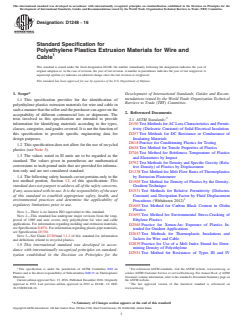
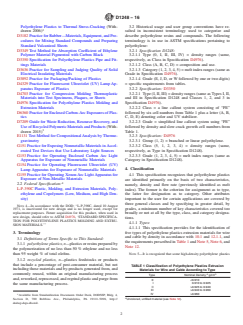
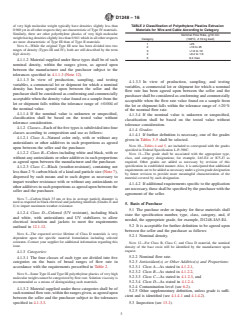
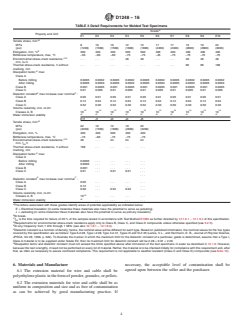
ASTM D1248-16 - Standard Specification for Polyethylene Plastics Extrusion Materials for Wire and Cable
REDLINE ASTM D1248-16 - Standard Specification for Polyethylene Plastics Extrusion Materials for Wire and Cable
Overview
ASTM D1248-16 is the standard specification developed by ASTM International for polyethylene plastics extrusion materials specifically designated for use in wire and cable applications. This standard provides a detailed classification system and identifies key physical and electrical properties required to ensure consistent quality between sellers and purchasers. Polyethylene extrusion materials addressed by ASTM D1248-16 are widely used for insulating and jacketing electrical wires and cables, where their performance attributes - such as density, melt flow rate (flow rate), and resistance to environmental stresses - are critical for reliability and safety.
Key Topics
- Material Classification: Polyethylene plastics are classified by density (Type 0, I, II, III, IV) and by flow rate (Category 1-5). Types reflect density range, while categories specify the material’s melt flow rate.
- Material Forms: The standard applies to polyethylene extrusion materials in powder, granule, or pellet form.
- Class & Grade Designations: Each type and category is further subdivided into four main classes (A: natural, B: colored, C: black/weather-resistant, D: colored/UV-resistant), and into specific grades (e.g., E1-E10) based on more detailed characteristics as needed.
- Performance Criteria: Materials must meet specific physical property requirements such as:
- Tensile stress and elongation
- Brittleness temperature
- Environmental and thermal stress-crack resistance
- Electrical properties: dissipation factor, dielectric constant, volume resistivity
- Stability under water immersion
- Weatherability (for colored compounds)
- Carbon black content (for black/weather-resistant grades)
- Quality and Uniformity: The material must be uniform in composition, free from contamination, and produced according to good manufacturing practice.
- Testing and Inspection: The standard outlines testing methodologies and sampling protocols for verifying compliance with classification criteria.
- No Recycled Content: Specifically prohibits use of recycled plastics in materials covered by this specification.
Applications
The requirements of ASTM D1248-16 are crucial in the wire and cable industry, where polyethylene extrusion materials are selected for:
- Insulation of Electrical Conductors: Polyethylene provides key electrical insulation properties, protecting wire cores from electrical shorts and environmental damage.
- Cable Jacketing: Offers additional mechanical and chemical protection to wire assemblies, shielding against abrasion, moisture, and UV exposure.
- Industrial Power and Communication Cables: Used across telecommunications, utilities, automotive, and electronics sectors, where material reliability directly affects product performance and service life.
- Specialized Applications: Weather-resistant and UV-stabilized classes serve outdoor or harsh-environment cables requiring extended durability.
This standard is referenced by manufacturers, specifiers, and quality control professionals to procure, certify, and use polyethylene extrusion material in high-performance, safety-critical wiring and cabling systems.
Related Standards
- ASTM D4976: Specification for Polyethylene Plastics Molding and Extrusion Materials (covers a broader range of applications beyond wire and cable).
- ASTM D3350: Specification for Polyethylene Plastics Pipe and Fittings Materials (pipe and plumbing industry).
- ASTM D150: Test Methods for AC Loss Characteristics and Permittivity of Solid Electrical Insulation.
- ASTM D638: Test Method for Tensile Properties of Plastics.
- ASTM D1693: Test Method for Environmental Stress-Cracking of Ethylene Plastics.
Note: There is no ISO equivalent for ASTM D1248-16. For wire and cable materials, always refer to the latest ASTM standard for official requirements.
Keywords: ASTM D1248-16, polyethylene, wire and cable extrusion, insulation, cable jacketing, plastics standards, electrical insulation, polymer classification, melt flow rate, density, quality control, cable manufacturing.
Relations
- Effective Date
- 15-Nov-2016
- Refers
ASTM D1238-23a - Standard Test Method for Melt Flow Rates of Thermoplastics by Extrusion Plastometer - Effective Date
- 15-Nov-2023
- Effective Date
- 01-Oct-2023
- Effective Date
- 15-Mar-2020
- Effective Date
- 01-Feb-2020
- Effective Date
- 01-Apr-2019
- Effective Date
- 01-Sep-2015
- Refers
ASTM D1238-13 - Standard Test Method for Melt Flow Rates of Thermoplastics by Extrusion Plastometer - Effective Date
- 01-Aug-2013
- Refers
ASTM D746-13 - Standard Test Method for Brittleness Temperature of Plastics and Elastomers by Impact - Effective Date
- 01-Jun-2013
- Effective Date
- 01-Apr-2013
- Effective Date
- 01-Mar-2013
- Effective Date
- 01-Mar-2013
- Effective Date
- 01-Jan-2013
- Effective Date
- 01-Dec-2012
- Effective Date
- 01-May-2012
Buy Documents
ASTM D1248-16 - Standard Specification for Polyethylene Plastics Extrusion Materials for Wire and Cable
REDLINE ASTM D1248-16 - Standard Specification for Polyethylene Plastics Extrusion Materials for Wire and Cable
Get Certified
Connect with accredited certification bodies for this standard

DIN CERTCO
DIN Group product certification.

Smithers Quality Assessments
US management systems and product certification.
Sponsored listings
Frequently Asked Questions
ASTM D1248-16 is a technical specification published by ASTM International. Its full title is "Standard Specification for Polyethylene Plastics Extrusion Materials for Wire and Cable". This standard covers: ABSTRACT This specification provides for the identification of polyethylene plastics extrusion materials for wire and cable in such a manner that the seller and the purchaser can agree on the acceptability of different commercial lots or shipments. The polyethylene plastics are identified primarily on the basis of two characteristics, namely, density and flow rate (previously identified as melt index). The former is the criterion for assignment as to type which are as follows: Type 0,Type I, Type II, Type III, and Type IV, the latter for designation as to category which are: Category 1,Category 2, Category 3,Category 4, and Category 5. Other attributes important for certain applications are covered by three general classes and by specifying in greater detail, by grades, a minimum number of key characteristics covered too broadly or not at all by the type, class, and category designations. Each of five types and categories is subdivided into four classes according to composition and use as follows: Class A, Class B, Class C, and Class D. In addition, the materials can be classified into different grades namely Grade E1, Grade E2, Grade E3, Grade E4, Grade E5, Grade E6, Grade E7, Grade E8, Grade E9, and Grade E10. The extrusion material for wire and cable shall be polyethylene plastic in the form of powder, granules, or pellets. The extrusion materials for wire and cable shall be as uniform in composition and size and as free of contamination as can be achieved by good manufacturing practice. Different tests shall be conducted in order to determine the following physical properties of extrusion materials: tensile stress, elongation, brittleness temperature, environmental stress-crack resistance, thermal stress-crack resistance without cracking, dissipation factor before and after milling, dielectric constant, volume resistivity, water immersion stability, absorption coefficient, weatherability for colored materials, and carbon content. SCOPE 1.1 This specification provides for the identification of polyethylene plastics extrusion materials for wire and cable in such a manner that the seller and the purchaser can agree on the acceptability of different commercial lots or shipments. The tests involved in this specification are intended to provide information for identifying materials according to the types, classes, categories, and grades covered. It is not the function of this specification to provide specific engineering data for design purposes. 1.2 This specification does not allow for the use of recycled plastics (see Note 3). 1.3 The values stated in SI units are to be regarded as the standard. The values given in parentheses are mathematical conversions to inch-pound units that are provided for information only and are not considered standard. 1.4 The following safety hazards caveat pertains only to the test method portion, Section 12, of this specification: This standard does not purport to address all of the safety concerns, if any, associated with its use. It is the responsibility of the user of this standard to establish appropriate safety and health practices and determine the applicability of regulatory limitations prior to use. Note 1: There is no known ISO equivalent to this standard. Note 2: This standard has undergone major revision from the reapproval of 1989 and now covers only polyethylene for wire and cable applications. For information regarding molding and extrusion materials, see Specification D4976. For information regarding plastic pipe materials, see Specification D3350. Note 3: See Guide D7209and 3.1.2 of this standard for information and definitions related to recycled plastics.
ABSTRACT This specification provides for the identification of polyethylene plastics extrusion materials for wire and cable in such a manner that the seller and the purchaser can agree on the acceptability of different commercial lots or shipments. The polyethylene plastics are identified primarily on the basis of two characteristics, namely, density and flow rate (previously identified as melt index). The former is the criterion for assignment as to type which are as follows: Type 0,Type I, Type II, Type III, and Type IV, the latter for designation as to category which are: Category 1,Category 2, Category 3,Category 4, and Category 5. Other attributes important for certain applications are covered by three general classes and by specifying in greater detail, by grades, a minimum number of key characteristics covered too broadly or not at all by the type, class, and category designations. Each of five types and categories is subdivided into four classes according to composition and use as follows: Class A, Class B, Class C, and Class D. In addition, the materials can be classified into different grades namely Grade E1, Grade E2, Grade E3, Grade E4, Grade E5, Grade E6, Grade E7, Grade E8, Grade E9, and Grade E10. The extrusion material for wire and cable shall be polyethylene plastic in the form of powder, granules, or pellets. The extrusion materials for wire and cable shall be as uniform in composition and size and as free of contamination as can be achieved by good manufacturing practice. Different tests shall be conducted in order to determine the following physical properties of extrusion materials: tensile stress, elongation, brittleness temperature, environmental stress-crack resistance, thermal stress-crack resistance without cracking, dissipation factor before and after milling, dielectric constant, volume resistivity, water immersion stability, absorption coefficient, weatherability for colored materials, and carbon content. SCOPE 1.1 This specification provides for the identification of polyethylene plastics extrusion materials for wire and cable in such a manner that the seller and the purchaser can agree on the acceptability of different commercial lots or shipments. The tests involved in this specification are intended to provide information for identifying materials according to the types, classes, categories, and grades covered. It is not the function of this specification to provide specific engineering data for design purposes. 1.2 This specification does not allow for the use of recycled plastics (see Note 3). 1.3 The values stated in SI units are to be regarded as the standard. The values given in parentheses are mathematical conversions to inch-pound units that are provided for information only and are not considered standard. 1.4 The following safety hazards caveat pertains only to the test method portion, Section 12, of this specification: This standard does not purport to address all of the safety concerns, if any, associated with its use. It is the responsibility of the user of this standard to establish appropriate safety and health practices and determine the applicability of regulatory limitations prior to use. Note 1: There is no known ISO equivalent to this standard. Note 2: This standard has undergone major revision from the reapproval of 1989 and now covers only polyethylene for wire and cable applications. For information regarding molding and extrusion materials, see Specification D4976. For information regarding plastic pipe materials, see Specification D3350. Note 3: See Guide D7209and 3.1.2 of this standard for information and definitions related to recycled plastics.
ASTM D1248-16 is classified under the following ICS (International Classification for Standards) categories: 83.140.99 - Other rubber and plastics products. The ICS classification helps identify the subject area and facilitates finding related standards.
ASTM D1248-16 has the following relationships with other standards: It is inter standard links to ASTM D1248-12, ASTM D1238-23a, ASTM D2565-23, ASTM E1131-20, ASTM D1603-20, ASTM D3636-19, ASTM D3892-15, ASTM D1238-13, ASTM D746-13, ASTM D1693-13, ASTM D3636-13ae1, ASTM D3636-13a, ASTM D3636-13, ASTM G154-12, ASTM D1603-12. Understanding these relationships helps ensure you are using the most current and applicable version of the standard.
ASTM D1248-16 is available in PDF format for immediate download after purchase. The document can be added to your cart and obtained through the secure checkout process. Digital delivery ensures instant access to the complete standard document.
Standards Content (Sample)
This international standard was developed in accordance with internationally recognized principles on standardization established in the Decision on Principles for the
Development of International Standards, Guides and Recommendations issued by the World Trade Organization Technical Barriers to Trade (TBT) Committee.
Designation:D1248 −16
Standard Specification for
Polyethylene Plastics Extrusion Materials for Wire and
Cable
This standard is issued under the fixed designation D1248; the number immediately following the designation indicates the year of
original adoption or, in the case of revision, the year of last revision. A number in parentheses indicates the year of last reapproval. A
superscript epsilon (´) indicates an editorial change since the last revision or reapproval.
This standard has been approved for use by agencies of the U.S. Department of Defense.
1. Scope* Development of International Standards, Guides and Recom-
mendations issued by the World Trade Organization Technical
1.1 This specification provides for the identification of
Barriers to Trade (TBT) Committee.
polyethylene plastics extrusion materials for wire and cable in
suchamannerthatthesellerandthepurchasercanagreeonthe
2. Referenced Documents
acceptability of different commercial lots or shipments. The
tests involved in this specification are intended to provide
2.1 ASTM Standards:
information for identifying materials according to the types, D150 Test Methods forAC Loss Characteristics and Permit-
classes, categories, and grades covered. It is not the function of
tivity (Dielectric Constant) of Solid Electrical Insulation
this specification to provide specific engineering data for D257 Test Methods for DC Resistance or Conductance of
design purposes.
Insulating Materials
D618 Practice for Conditioning Plastics for Testing
1.2 This specification does not allow for the use of recycled
D638 Test Method for Tensile Properties of Plastics
plastics (see Note 3).
D746 Test Method for Brittleness Temperature of Plastics
1.3 The values stated in SI units are to be regarded as the
and Elastomers by Impact
standard. The values given in parentheses are mathematical
D792 Test Methods for Density and Specific Gravity (Rela-
conversions to inch-pound units that are provided for informa-
tive Density) of Plastics by Displacement
tion only and are not considered standard.
D1238 Test Method for Melt Flow Rates of Thermoplastics
1.4 The following safety hazards caveat pertains only to the by Extrusion Plastometer
test method portion, Section 12, of this specification: This
D1505 Test Method for Density of Plastics by the Density-
standard does not purport to address all of the safety concerns,
Gradient Technique
if any, associated with its use. It is the responsibility of the user
D1531 Test Methods for Relative Permittivity (Dielectric
of this standard to establish appropriate safety, health, and
Constant) and Dissipation Factor by Fluid Displacement
environmental practices and determine the applicability of
Procedures (Withdrawn 2012)
regulatory limitations prior to use.
D1603 Test Method for Carbon Black Content in Olefin
Plastics
NOTE 1—There is no known ISO equivalent to this standard.
D1693 Test Method for Environmental Stress-Cracking of
NOTE 2—This standard has undergone major revision from the reap-
proval of 1989 and now covers only polyethylene for wire and cable Ethylene Plastics
applications. For information regarding molding and extrusion materials,
D2565 Practice for Xenon-Arc Exposure of Plastics In-
see Specification D4976. For information regarding plastic pipe materials,
tended for Outdoor Applications
see Specification D3350.
D2633 Test Methods for Thermoplastic Insulations and
NOTE 3—See Guide D7209and 3.1.2 of this standard for information
Jackets for Wire and Cable
and definitions related to recycled plastics.
D2839 Practice for Use of a Melt Index Strand for Deter-
1.5 This international standard was developed in accor-
mining Density of Polyethylene
dance with internationally recognized principles on standard-
D2951 Test Method for Resistance of Types III and IV
ization established in the Decision on Principles for the
1 2
This specification is under the jurisdiction of ASTM Committee D20 on For referenced ASTM standards, visit the ASTM website, www.astm.org, or
Plastics and is the direct responsibility of Subcommittee D20.15 on Thermoplastic contact ASTM Customer Service at service@astm.org. For Annual Book of ASTM
Materials. Standards volume information, refer to the standard’s Document Summary page on
Current edition approved Nov. 15, 2016. Published December 2016. Originally the ASTM website.
approved in 1952. Last previous edition approved in 2012 as D1248 - 12. DOI: The last approved version of this historical standard is referenced on
10.1520/D1248-16. www.astm.org.
*A Summary of Changes section appears at the end of this standard
Copyright © ASTM International, 100 Barr Harbor Drive, PO Box C700, West Conshohocken, PA 19428-2959. United States
D1248−16
Polyethylene Plastics to Thermal Stress-Cracking (With- 3.2 Historical usage and user group conventions have re-
drawn 2006) sulted in inconsistent terminology used to categorize and
D3182 PracticeforRubber—Materials,Equipment,andPro- describe polyethylene resins and compounds. The following
cedures for Mixing Standard Compounds and Preparing terminology is in use in ASTM specifications pertaining to
Standard Vulcanized Sheets polyethylene:
D3349 Test Method for Absorption Coefficient of Ethylene 3.2.1 Specification D1248:
Polymer Material Pigmented with Carbon Black 3.2.1.1 Type (0, I, II, III, IV) = density ranges (same,
D3350 Specification for Polyethylene Plastics Pipe and Fit- respectively, as Class in Specification D4976).
tings Materials 3.2.1.2 Class (A, B, C, D) = composition and use.
D3636 Practice for Sampling and Judging Quality of Solid 3.2.1.3 Category (1, 2, 3, 4, 5) = melt index ranges (same as
Electrical Insulating Materials Grade in Specification D4976).
D3892 Practice for Packaging/Packing of Plastics 3.2.1.4 Grade (E, J, D, or W followed by one or two digits)
D4329 Practice for Fluorescent Ultraviolet (UV) Lamp Ap- = specific requirements from tables.
paratus Exposure of Plastics 3.2.2 Specification: D3350
D4703 Practice for Compression Molding Thermoplastic 3.2.2.1 Type (I, II, III) = density ranges (same asTypes I, II,
Materials into Test Specimens, Plaques, or Sheets and III in Specification D1248 and Classes 1, 2, and 3 in
D4976 Specification for Polyethylene Plastics Molding and Specification D4976).
Extrusion Materials 3.2.2.2 Class = a line callout system consisting of “PE”
D6360 Practice for Enclosed Carbon-Arc Exposures of Plas- followed by six cell numbers from Table 1 plus a letter (A, B,
tics C, D, E) denoting color and UV stabilizer.
D7209 Guide for Waste Reduction, Resource Recovery, and 3.2.2.3 Grade = simplified line callout system using “PE”
Use of Recycled Polymeric Materials and Products (With- followed by density and slow crack growth cell numbers from
drawn 2015) Table 1.
E1131 Test Method for CompositionalAnalysis by Thermo- 3.2.3 Specification: D4976
gravimetry 3.2.3.1 Group (1, 2) = branched or linear polyethylene.
G151 Practice for Exposing Nonmetallic Materials inAccel- 3.2.3.2 Class (5, 1, 2, 3, 4) = density ranges (same,
erated Test Devices that Use Laboratory Light Sources respectively, as Type in Specification D1248).
G153 Practice for Operating Enclosed Carbon Arc Light 3.2.3.3 Grade (1, 2, 3, 4, 5) = melt index ranges (same as
Apparatus for Exposure of Nonmetallic Materials Category in Specification D1248).
G154 Practice for Operating Fluorescent Ultraviolet (UV)
4. Classification
Lamp Apparatus for Exposure of Nonmetallic Materials
G155 Practice for Operating XenonArc LightApparatus for
4.1 This specification recognizes that polyethylene plastics
Exposure of Non-Metallic Materials
are identified primarily on the basis of two characteristics,
2.2 Federal Specification:
namely, density and flow rate (previously identified as melt
L-P-390C Plastic, Molding, and Extrusion Materials, Poly-
index). The former is the criterion for assignment as to type,
ethylene and Copolymers (Low, Medium, and High Den-
the latter for designation as to category. Other attributes
sity)
important to the user for certain applications are covered by
three general classes and by specifying in greater detail, by
NOTE 4—In accordance with the DOD: “L-P-390C, dated 10 August
grades, a minimum number of key characteristics covered too
1971, is inactivated for new design and is no longer used, except for
replacement purposes. Future acquisition for this product, when used in broadly or not at all by the type, class, and category designa-
new design, should refer to ASTM D4976, ‘STANDARD SPECIFICA-
tions.
TION FOR POLYETHYLENE PLASTICS MOLDING AND EXTRU-
4.1.1 Types:
SION MATERIALS.’”
4.1.1.1 This specification provides for the identification of
five types of polyethylene plastics extrusion materials for wire
3. Terminology
and cable by density in accordance with 10.1 and 12.1.1, and
3.1 Definitions of Terms Specific to This Standard:
the requirements prescribed in Table 1 and Note 5, Note 6, and
3.1.1 polyethylene plastics, n—plasticsorresinspreparedby
Note 12.
the polymerization of no less than 50 % ethylene and no less
than 95 weight % of total olefins. NOTE 5—It is recognized that some high-density polyethylene plastics
3.1.2 recycled plastics, n—plastics feedstocks or products
that include a percentage of post-consumer material, but not
TABLE 1 Classification of Polyethylene Plastics Extrusion
including those materials and by-products generated from, and Materials for Wire and CableAccording to Type
A 3
commonly reused, within an original manufacturing process
Type Nominal Density, g/cm
and, reworked, reprocessed, and regrind plastic and purge from
0 <0.910
I 0.910 to 0.925
the same manufacturing process.
II >0.925 to 0.940
III >0.940 to 0.960
4 IV >0.960
Available from Standardization Documents Order Desk, DODSSP, Bldg. 4,
A
Section D, 700 Robbins Ave., Philadelphia, PA 19111-5098, http://
Uncolored, unfilled material (see Note 12).
dodssp.daps.dla.mil.
D1248−16
of very high molecular weight typically have densities slightly less than TABLE 2 Classification of Polyethylene Plastics Extrusion
Materials for Wire and CableAccording to Category
0.960 yet in all other respects they are characteristic of Type IV materials.
Similarly, there are other polyethylene plastics of very high molecular
Nominal Flow Rate, g/10 min
weight having densities slightly less than 0.941 which in all other respects
Category (190°C, 2.16 kg load)
are more characteristic of Type III than of Type II materials.
1 >25
NOTE 6—While the original Type III now has been divided into two
2 >10 to 25
ranges of density (Types III and IV), both are still described by the term
3 >1.0to10
high density.
4 >0.4to1.0
5 0.4 max
4.1.1.2 Material supplied under these types shall be of such
nominal density, within the ranges given, as agreed upon
between the manufacturer and the purchaser subject to the
tolerances specified in 4.1.1.3 (Note 12).
4.1.1.3 In view of production, sampling, and testing
4.1.3.3 In view of production, sampling, and testing
variables, a commercial lot or shipment for which a nominal
variables, a commercial lot or shipment for which a nominal
density has been agreed upon between the seller and the
flow rate has been agreed upon between the seller and the
purchaser shall be considered as conforming and commercially
purchaser shall be considered as conforming and commercially
acceptable when the density value found on a sample from the
acceptable when the flow rate value found on a sample from
lot or shipment falls within the tolerance range of 60.004 of
the lot or shipment falls within the tolerance range of 620 %
the nominal value.
of the nominal flow rate.
4.1.1.4 If the nominal value is unknown or unspecified,
4.1.3.4 If the nominal value is unknown or unspecified,
classification shall be based on the tested value without
classification shall be based on the tested value without
tolerance consideration.
tolerance consideration.
4.1.2 Classes—Eachofthefivetypesissubdividedintofour
4.1.4 Grades:
classes according to composition and use as follows:
4.1.4.1 If further definition is necessary, one of the grades
4.1.2.1 Class A—Natural color only, with or without any
given in Tables 3-5 shall be selected.
antioxidants or other additives in such proportions as agreed
NOTE 10—Tables 4 and 5, are included to correspond with the grades
upon between the seller and the purchaser.
specified in Federal Specification L-P-390C.
4.1.2.2 Class B—Colors including white and black, with or
NOTE 11—The grade shall be associated with the appropriate type,
without any antioxidants or other additives in such proportions
class, and category designations; for example, IA5-E4 or IC5-J3 as
as agreed upon between the manufacturer and the purchaser. required. Other grades are added as necessary by revision of this
specification in established manner. Also, it is anticipated that additional
4.1.2.3 Class C—Black (weather-resistant), containing not
requirementsaretobeaddedasnecessaryunderagivengradedesignation
less than 2 % carbon black of a kind and particle size (Note 7),
by future revision to provide more meaningful characterization of the
dispersed by such means and to such degree as necessary to
material covered by such designation.
impart weather resistance with or without any antioxidants or
4.1.4.2 If additional requirements specific to the application
other additives in such proportions as agreed upon between the
arenecessary,theseshallbespecifiedbythepurchaserwiththe
seller and the purchaser.
agreement of the seller.
NOTE 7—Carbon black 35 nm or less in average particle diameter is
used as required in black electrical and jacketing materials (Grades E and
5. Basis of Purchase
J) to impart maximum weather resistance.
5.1 The purchase order or inquiry for these materials shall
4.1.2.4 Class D—Colored (UV resistant), including black
state the specification number, type, class, category, and, if
and white, with antioxidants and UV stabilizers to allow
needed, the appropriate grade, for example, D1248–IA5-E4.
electrical insulation and jackets to meet the requirements
5.2 It is acceptable for further definition to be agreed upon
outlined in 12.1.12.
between the seller and the purchaser as follows:
NOTE 8—The expected service lifetime of Class D materials is very
5.2.1 Nominal density.
dependent upon the specific material formulation including selected
colorants. Contact your supplier for additional information regarding this
NOTE 12—For Class B, Class C, and Class D material, the nominal
issue.
density of the base resin will be identified by the manufacturer upon
request.
4.1.3 Categories:
5.2.2 Nominal flow rate.
4.1.3.1 The four classes of each type are divided into five
5.2.3 Antioxidant(s) or Other Additive(s) and Proportions:
categories on the basis of broad ranges of flow rate in
5.2.3.1 Class A—As stated in 4.1.2.1,
accordance with the requirements prescribed in Table 2.
5.2.3.2 Class B—As stated in 4.1.2.2,
NOTE 9—Some Type II and Type III polyethylene plastics of very high
5.2.3.3 Class C—As stated in 4.1.2.3, and
molecular weight cannot be categorized by flow rate. Solution viscosity is
5.2.3.4 Class D—As stated in 4.1.2.4.
recommended as a means of distinguishing such materials.
5.2.4 Contamination level (see 6.2).
4.1.3.2 Material supplied under these categories shall be of
5.2.5 Other supplementary definition, unless grade is suffi-
suchnominalflowrate,withintherangesgiven,asagreedupon
cient and is identified (see 4.1.4.1 and 4.1.4.2).
between the seller and the purchaser subject to the tolerances
specified in 4.1.3.3. 5.3 Inspection (see 13.1).
D1248−16
TABLE 3 Detail Requirements for Molded Test Specimens
A
Grade
Property and Unit
E1 E2 E3 E4 E5 E6 E7 E8 E9 E10
B
Tensile stress, min:
MPa 8 10101212 17 17 19 1922
(psi) (1200) (1500) (1500) (1800) (1800) (2400) (2400) (2800) (2800) (3200)
B
Elongation, min, % 300 400 400 500 500 400 400 400 400 400
Brittleness temperature, max, °C –50 –60 –60 –75 –75 –45 –75 –75 –75 –75
C,D
Environmental stress-crack resistance, . . . 48 48 . . 48 48 48
min, f h
Thermal stress-crack resistance, h without . . . . . . . 96 96 168
cracking, min
E
Dissipation factor, max:
Class A
Before milling 0.0005 0.0002 0.0005 0.0002 0.0005 0.0002 0.0005 0.0002 0.0005 0.0002
After milling 0.0005 0.0003 0.0005 0.0003 0.0005 0.0003 0.0005 0.0003 0.0005 0.0003
Class B 0.001 0.0005 0.001 0.0005 0.001 0.0005 0.001 0.0005 0.001 0.0005
Class C 0.01 0.005 0.01 0.005 0.01 0.005 0.01 0.005 0.01 0.005
E F
Dielectric constant max increase over nominal :
Class A 0.05 0.01 0.05 0.01 0.05 0.01 0.05 0.01 0.05 0.01
Class B 0.12 0.04 0.12 0.04 0.12 0.04 0.12 0.04 0.12 0.04
Class C 0.52 0.30 0.52 0.30 0.52 0.30 0.50 0.30 0.50 0.30
Volume resistivity, min,Ω·cm:
15 15 15 15 15 15 15 15 15 15
Classes A, B 10 10 10 10 10 10 10 10 10 10
GGGGG G G G G G
Water immersion stability
E11 J1J3J4J5
B
Tensile stress, min:
MPa 22 10 12 19 22
(psi) (3200) (1500) (1800) (2800) (3200)
Elongation, min, % 400 400 500 400 400
Brittleness temperature, max, °C –75 –60 –75 –75 –75
C,D
Environmental stress-crack resistance, 48 . . . 24 24 24
min, f h
Thermal stress-crack resistance, h without 168 . . . .
cracking, min
E
Dissipation factor, max:
Class A
Before milling 0.0005 . . . . . . . . . . . .
After milling 0.0005 . . . . . . . . . . . .
ClassB 0.001 . . . .
Class C 0.01 . . . 0.01 0.01 . . .
...
E F
Dielectric constant max increase over nominal :
ClassA 0.05 . . . .
ClassB 0.12 . . . .
Class C 0.50 . . . 0.52 0.52 . . .
Volume resistivity, min,Ω·cm:
Classes A, B 10 . . . .
G
Water immersion stability . . . .
A
The letters associated with these grades identify areas of potential applicability as indicated below:
E = Electrical Insulation (in some instances these materials also have the potential to serve as jacketing).
J = Jacketing (in some instances these materials also have the potential to serve as primary insulation).
B
At break.
C
f is the time required for failure of 20 % of the samples tested in accordance with Test Method D1693 as further directed by 12.1.6.1 – 12.1.6.4 of this specification.
D
Requirements for environmental stress-crack resistance apply only to Class B, Class C, and Class D compounds unless otherwise specified (see 5.2.5).
E
At any frequency from 1 kHz through 1 MHz (see also 12.1.8.1 – 12.1.8.3).
F
Dielectric constant is a function of density; hence, the nominal value will be different for each type. Based on published information, the nominal values for the five types
covered by this specification are as follows:Type 0-2.28,Type I-2.28,Type II-2.31,Types III and IV-2.35 (Lanza, V. L., and Herrmann, D. B., Journal of Polymer Science,
JPSCA, Vol 28, 1958, p. 622). To illustrate the manner in which the maximum limit for the dielectric constant of a particular, grade is determined, assume that a Type I,
Class A material is to be supplied under Grade E2, then its maximum limit for dielectric constant will be 2.28 + 0.01 = 2.29.
G
Dissipation factor and dielectric constant must not exceed the limits specified above after immersion of the test specimens in water as described in 12.1.9. However,
because this test is lengthy, it need not be performed on every lot of material. Rather, the material is to be checked initially for compliance with this requirement and, after
that, as often as necessary to assure continued compliance. This requirement is not applicable to weather resistant (Class C and Class D) compounds (see Note 12).
6. Materials and Manufacture necessary, the acceptable level of contamination shall be
agreed upon between the seller and the purchaser.
6.1 The extrusion material for wire and cable shall be
polyethyleneplasticintheformofpowder,granules,orpellets.
6.2 The extrusion materials for wire and cable shall be as
uniform in composition and size and as free of contamination
as can be achieved by good manufacturing practice. If
D1248−16
TABLE 4 Special Grades—Dielectric—Natural and Colors
Very Low Low Density, Specification D1248, Medium Density,
Density, Type I Specification
A
Specification D1248, Type II High Density, Specification D1248, Types III & IV
D1248,
Natural Colors Natural Colors Natural Colors
Type 0
Grade D0 D1 D2 D3 D4 D5 D6 D7 D8 D9 D10 D11
B
Tensile Stress, min:
MPa 6.9 9.7 9.7 9.7 9.7 12.4 12.4 19.3 19.3 24.1 24.1 27.6
(psi) 1000 (1400) (1400) (1400) (1400) (1800) (1800) (2800) (2800) (3500) (3500) (4000)
B
Elongation, min, % 500 400 400 400 400 400 400 400 400 400 400 400
Brittleness temperature, max, °C −60 −60 −55 −60 −55 −60 −55 −55 . −55 . .
Dielectric constant, max, 1 MHz 2.28 2.35 2.35 2.35 2.35 2.35 2.35 2.38 2.38 2.38 2.38 2.38
Dissipation factor, max, 1 MHz 0.0005 0.0005 0.0005 0.0005 0.0005 0.0005 0.0005 0.0005 0.0005 0.0005 0.0005 0.0005
Environmental stress crack
resistance, min:
f h (100 % Igepal) . . . . . . . . . 24 24 . . . . . . . . . . . . . . . . . . . . .
f h (10 % Igepal) >24 . . . . . . . . . . . . . . . . . . . . . . . . . . . . . . . . .
Thermal stress crack resistance, . . . . . . . 96 . 96 . .
min, f h
Milling stability . . . 0.0005 0.0005 0.0005 0.0005 0.0005 0.0005 0.0005 0.0005 0.0005 0.0005 0.0005
After milling, dissipation factor,
max
A
Grades D7 through D11 apply to both natural and colors, including black.
B
At break.
TABLE 5 Special Grades—Weather Resistant—Black
Very Low
Density, Med
...
This document is not an ASTM standard and is intended only to provide the user of an ASTM standard an indication of what changes have been made to the previous version. Because
it may not be technically possible to adequately depict all changes accurately, ASTM recommends that users consult prior editions as appropriate. In all cases only the current version
of the standard as published by ASTM is to be considered the official document.
Designation: D1248 − 12 D1248 − 16
Standard Specification for
Polyethylene Plastics Extrusion Materials for Wire and
Cable
This standard is issued under the fixed designation D1248; the number immediately following the designation indicates the year of
original adoption or, in the case of revision, the year of last revision. A number in parentheses indicates the year of last reapproval. A
superscript epsilon (´) indicates an editorial change since the last revision or reapproval.
This standard has been approved for use by agencies of the U.S. Department of Defense.
1. Scope*
1.1 This specification provides for the identification of polyethylene plastics extrusion materials for wire and cable in such a
manner that the seller and the purchaser can agree on the acceptability of different commercial lots or shipments. The tests involved
in this specification are intended to provide information for identifying materials according to the types, classes, categories, and
grades covered. It is not the function of this specification to provide specific engineering data for design purposes.
1.2 This specification does not allow for the use of recycled plastics (see Note 3).
1.3 The values stated in SI units are to be regarded as the standard. The values given in parentheses are mathematical
conversions to inch-pound units that are provided for information only and are not considered standard.
1.4 The following safety hazards caveat pertains only to the test method portion, Section 12, of this specification: This standard
does not purport to address all of the safety concerns, if any, associated with its use. It is the responsibility of the user of this
standard to establish appropriate safety and health practices and determine the applicability of regulatory limitations prior to use.
NOTE 1—There is no known ISO equivalent to this standard.
NOTE 2—This standard has undergone major revision from the reapproval of 1989 and now covers only polyethylene for wire and cable applications.
For information regarding molding and extrusion materials, see Specification D4976. For information regarding plastic pipe materials, see Specification
D3350.
NOTE 3—See Guide D7209and 3.1.2 of this standard for information and definitions related to recycled plastics.
2. Referenced Documents
2.1 ASTM Standards:
D150 Test Methods for AC Loss Characteristics and Permittivity (Dielectric Constant) of Solid Electrical Insulation
D257 Test Methods for DC Resistance or Conductance of Insulating Materials
D618 Practice for Conditioning Plastics for Testing
D638 Test Method for Tensile Properties of Plastics
D746 Test Method for Brittleness Temperature of Plastics and Elastomers by Impact
D792 Test Methods for Density and Specific Gravity (Relative Density) of Plastics by Displacement
D1238 Test Method for Melt Flow Rates of Thermoplastics by Extrusion Plastometer
D1505 Test Method for Density of Plastics by the Density-Gradient Technique
D1531 Test Methods for Relative Permittivity (Dielectric Constant) and Dissipation Factor by Fluid Displacement Procedures
(Withdrawn 2012)
D1603 Test Method for Carbon Black Content in Olefin Plastics
D1693 Test Method for Environmental Stress-Cracking of Ethylene Plastics
D2565 Practice for Xenon-Arc Exposure of Plastics Intended for Outdoor Applications
D2633 Test Methods for Thermoplastic Insulations and Jackets for Wire and Cable
D2839 Practice for Use of a Melt Index Strand for Determining Density of Polyethylene
D2951 Test Method for Resistance of Types III and IV Polyethylene Plastics to Thermal Stress-Cracking (Withdrawn 2006)
This specification is under the jurisdiction of ASTM Committee D20 on Plastics and is the direct responsibility of Subcommittee D20.15 on Thermoplastic Materials.
Current edition approved April 1, 2012Nov. 15, 2016. Published May 2012December 2016. Originally approved in 1952. Last previous edition approved in 20052012 as
D1248 - 05.D1248 - 12. DOI: 10.1520/D1248-12.10.1520/D1248-16.
For referenced ASTM standards, visit the ASTM website, www.astm.org, or contact ASTM Customer Service at service@astm.org. For Annual Book of ASTM Standards
volume information, refer to the standard’s Document Summary page on the ASTM website.
The last approved version of this historical standard is referenced on www.astm.org.
*A Summary of Changes section appears at the end of this standard
Copyright © ASTM International, 100 Barr Harbor Drive, PO Box C700, West Conshohocken, PA 19428-2959. United States
D1248 − 16
D3182 Practice for Rubber—Materials, Equipment, and Procedures for Mixing Standard Compounds and Preparing Standard
Vulcanized Sheets
D3349 Test Method for Absorption Coefficient of Ethylene Polymer Material Pigmented with Carbon Black
D3350 Specification for Polyethylene Plastics Pipe and Fittings Materials
D3636 Practice for Sampling and Judging Quality of Solid Electrical Insulating Materials
D3892 Practice for Packaging/Packing of Plastics
D4329 Practice for Fluorescent Ultraviolet (UV) Lamp Apparatus Exposure of Plastics
D4703 Practice for Compression Molding Thermoplastic Materials into Test Specimens, Plaques, or Sheets
D4976 Specification for Polyethylene Plastics Molding and Extrusion Materials
D6360 Practice for Enclosed Carbon-Arc Exposures of Plastics
D7209 Guide for Waste Reduction, Resource Recovery, and Use of Recycled Polymeric Materials and Products (Withdrawn
2015)
E1131 Test Method for Compositional Analysis by Thermogravimetry
G151 Practice for Exposing Nonmetallic Materials in Accelerated Test Devices that Use Laboratory Light Sources
G153 Practice for Operating Enclosed Carbon Arc Light Apparatus for Exposure of Nonmetallic Materials
G154 Practice for Operating Fluorescent Ultraviolet (UV) Lamp Apparatus for Exposure of Nonmetallic Materials
G155 Practice for Operating Xenon Arc Light Apparatus for Exposure of Non-Metallic Materials
2.2 Federal Specification:
L-P-390C Plastic, Molding, and Extrusion Materials, Polyethylene and Copolymers (Low, Medium, and High Density)
NOTE 4—In accordance with the DOD: “L-P-390C, dated 10 August 1971, is inactivated for new design and is no longer used, except for replacement
purposes. Future acquisition for this product, when used in new design, should refer to ASTM D4976, ‘STANDARD SPECIFICATION FOR
POLYETHYLENE PLASTICS MOLDING AND EXTRUSION MATERIALS.’”
3. Terminology
3.1 Definitions of Terms Specific to This Standard:
3.1.1 polyethylene plastics, n—plastics or resins prepared by the polymerization of no less than 50 % ethylene and no less than
95 weight % of total olefins.
3.1.2 recycled plastics, n—plastics feedstocks or products composed of recovered plastic material that may or may not that
include a percentage of post-consumer material, but not including those materials and by-products generated from, and commonly
reused, within an original manufacturing process and, reworked, reprocessed, and regrind plastic and purge from the same
manufacturing process.
3.2 Historical usage and user group conventions have resulted in inconsistent terminology used to categorize and describe
polyethylene resins and compounds. The following terminology is in use in ASTM specifications pertaining to polyethylene:
3.2.1 Specification D1248:
3.2.1.1 Type (0, I, II, III, IV) = density ranges (same, respectively, as Class in Specification D4976).
3.2.1.2 Class (A, B, C, D) = composition and use.
3.2.1.3 Category (1, 2, 3, 4, 5) = melt index ranges (same as Grade in Specification D4976).
3.2.1.4 Grade (E, J, D, or W followed by one or two digits) = specific requirements from tables.
3.2.2 Specification: D3350
3.2.2.1 Type (I, II, III) = density ranges (same as Types I, II, and III in Specification D1248 and Classes 1, 2, and 3 in
Specification D4976).
3.2.2.2 Class = a line callout system consisting of “PE” followed by six cell numbers from Table 1 plus a letter (A, B, C, D,
E) denoting color and UV stabilizer.
3.2.2.3 Grade = simplified line callout system using “PE” followed by density and slow crack growth cell numbers from Table
1.
3.2.3 Specification: D4976
3.2.3.1 Group (1, 2) = branched or linear polyethylene.
3.2.3.2 Class (5, 1, 2, 3, 4) = density ranges (same, respectively, as Type in Specification D1248).
3.2.3.3 Grade (1, 2, 3, 4, 5) = melt index ranges (same as Category in Specification D1248).
4. Classification
4.1 This specification recognizes that polyethylene plastics are identified primarily on the basis of two characteristics, namely,
density and flow rate (previously identified as melt index). The former is the criterion for assignment as to type, the latter for
designation as to category. Other attributes important to the user for certain applications are covered by three general classes and
by specifying in greater detail, by grades, a minimum number of key characteristics covered too broadly or not at all by the type,
class, and category designations.
Available from Standardization Documents Order Desk, DODSSP, Bldg. 4, Section D, 700 Robbins Ave., Philadelphia, PA 19111-5098, http://dodssp.daps.dla.mil.
D1248 − 16
4.1.1 Types:
4.1.1.1 This specification provides for the identification of five types of polyethylene plastics extrusion materials for wire and
cable by density in accordance with 10.1 and 12.1.1, and the requirements prescribed in Table 1 and Note 5, Note 6, and Note 12.
NOTE 5—It is recognized that some high-density polyethylene plastics of very high molecular weight maytypically have densities slightly less than
0.960 yet in all other respects they are characteristic of Type IV materials. Similarly, there are other polyethylene plastics of very high molecular weight
having densities slightly less than 0.941 which in all other respects are more characteristic of Type III than of Type II materials.
NOTE 6—While the original Type III now has been divided into two ranges of density (Types III and IV), both are still described by the term high
density.
4.1.1.2 Material supplied under these types shall be of such nominal density, within the ranges given, as agreed upon between
the manufacturer and the purchaser subject to the tolerances specified in 4.1.1.3 (Note 12).
4.1.1.3 In view of production, sampling, and testing variables, a commercial lot or shipment for which a nominal density has
been agreed upon between the seller and the purchaser shall be considered as conforming and commercially acceptable when the
density value found on a sample from the lot or shipment falls within the tolerance range of 60.004 of the nominal value.
4.1.1.4 If the nominal value is unknown or unspecified, classification shall be based on the tested value without tolerance
consideration.
4.1.2 Classes—Each of the five types is subdivided into four classes according to composition and use as follows:
4.1.2.1 Class A—Natural color only, with or without any antioxidants or other additives in such proportions as agreed upon
between the seller and the purchaser.
4.1.2.2 Class B—Colors including white and black, with or without any antioxidants or other additives in such proportions as
agreed upon between the manufacturer and the purchaser.
4.1.2.3 Class C—Black (weather-resistant), containing not less than 2 % carbon black of a kind and particle size (Note 7),
dispersed by such means and to such degree as necessary to impart weather resistance with or without any antioxidants or other
additives in such proportions as agreed upon between the seller and the purchaser.
NOTE 7—Carbon black 35 nm or less in average particle diameter is used as required in black electrical and jacketing materials (Grades E and J) to
impart maximum weather resistance.
4.1.2.4 Class D—Colored (UV resistant), including black and white, with antioxidants and UV stabilizers to allow electrical
insulation and jackets to meet the requirements outlined in 12.1.12.
NOTE 8—The expected service lifetime of Class D materials is very dependent upon the specific material formulation including selected colorants.
Contact your supplier for additional information regarding this issue.
4.1.3 Categories:
4.1.3.1 The four classes of each type are divided into five categories on the basis of broad ranges of flow rate in accordance
with the requirements prescribed in Table 2.
NOTE 9—Some Type II and Type III polyethylene plastics of very high molecular weight cannot be categorized by flow rate. Solution viscosity is
recommended as a means of distinguishing such materials.
4.1.3.2 Material supplied under these categories shall be of such nominal flow rate, within the ranges given, as agreed upon
between the seller and the purchaser subject to the tolerances specified in 4.1.3.3.
4.1.3.3 In view of production, sampling, and testing variables, a commercial lot or shipment for which a nominal flow rate has
been agreed upon between the seller and the purchaser shall be considered as conforming and commercially acceptable when the
flow rate value found on a sample from the lot or shipment falls within the tolerance range of 620 % of the nominal flow rate.
4.1.3.4 If the nominal value is unknown or unspecified, classification shall be based on the tested value without tolerance
consideration.
4.1.4 Grades:
4.1.4.1 If further definition is necessary, one of the grades given in Tables 3-5 shall be selected.
NOTE 10—Tables 4 and 5, are included to correspond with the grades specified in Federal Specification L-P-390C.
NOTE 11—The grade shall be associated with the appropriate type, class, and category designations; for example, IA5-E4 or IC5-J3 as required. Other
grades may be are added as necessary by revision of this specification in established manner. Also, it is anticipated that additional requirements may are
TABLE 1 Classification of Polyethylene Plastics Extrusion
Materials for Wire and Cable According to Type
A 3
Type Nominal Density, g/cm
0 <0.910
I 0.910 to 0.925
II >0.925 to 0.940
III >0.940 to 0.960
IV >0.960
A
Uncolored, unfilled material (see Note 12).
D1248 − 16
TABLE 2 Classification of Polyethylene Plastics Extrusion
Materials for Wire and Cable According to Category
Nominal Flow Rate, g/10 min
Category (190°C, 2.16 kg load)
1 >25
2 >10 to 25
3 >1.0 to 10
4 >0.4 to 1.0
5 0.4 max
to be added as necessary under a given grade designation by future revision to provide more meaningful characterization of the material covered by such
designation.
4.1.4.2 If additional requirements specific to the application are necessary, these shall be specified by the purchaser with the
agreement of the seller.
5. Basis of Purchase
5.1 The purchase order or inquiry for these materials shall state the specification number, type, class, category, and, if needed,
the appropriate grade, for example, D1248–IA5-E4.
5.2 It is acceptable for further definition to be agreed upon between the seller and the purchaser as follows:
5.2.1 Nominal density.
NOTE 12—For Class B, Class C, and Class D material, the nominal density of the base resin will be identified by the manufacturer upon request.
5.2.2 Nominal flow rate.
5.2.3 Antioxidant(s) or Other Additive(s) and Proportions:
5.2.3.1 Class A—As stated in 4.1.2.1,
5.2.3.2 Class B—As stated in 4.1.2.2,
5.2.3.3 Class C—As stated in 4.1.2.3, and
5.2.3.4 Class D—As stated in 4.1.2.4.
5.2.4 Contamination level (see 6.2).
5.2.5 Other supplementary definition, unless grade is sufficient and is identified (see 4.1.4.1 and 4.1.4.2).
5.3 Inspection (see 13.1).
6. Materials and Manufacture
6.1 The extrusion material for wire and cable shall be polyethylene plastic in the form of powder, granules, or pellets.
6.2 The extrusion materials for wire and cable shall be as uniform in composition and size and as free of contamination as can
be achieved by good manufacturing practice. If necessary, the acceptable level of contamination shall be agreed upon between the
seller and the purchaser.
6.3 Unless controlled by requirements specified elsewhere (see 4.1.4.1 and 4.1.4.2), the color and translucence of extruded
pieces formed under conditions recommended by the manufacturer of the material, shall be comparable within commercial match
tolerances to the color and translucence of standard molded or extruded samples of the same thickness supplied in advance by the
manufacturer of the material.
7. Physical Requirements
7.1 Test specimens of the material prepared as specified in 10.1, and tested in accordance with 12.1, shall conform to the
requirements prescribed by the material designation for type in Table 1, for class in 4.1.2, for category in Table 2, and for grade
in Tables 3-5.
8. Sampling
8.1 Sampling shall be statistically adequate to satisfy the requirements of 13.4.
8.2 A batch or lot shall be constituted as a unit of manufacture as prepared for shipment and can consist of a blend of two or
more production runs.
9. Testing
9.1 The requirements identified by the material designation and otherwise specified in the purchase order (see 5.1 and 5.2) shall
be verified by tests made in accordance with the directions given in 12.1.
D1248 − 16
TABLE 3 Detail Requirements for Molded Test Specimens
A
Grade
Property and Unit
E1 E2 E3 E4 E5 E6 E7 E8 E9 E10
B
Tensile stress, min:
MPa 8 10 10 12 12 17 17 19 19 22
(psi) (1200) (1500) (1500) (1800) (1800) (2400) (2400) (2800) (2800) (3200)
B
Elongation, min, % 300 400 400 500 500 400 400 400 400 400
Brittleness temperature, max, °C –50 –60 –60 –75 –75 –45 –75 –75 –75 –75
C,D
Environmental stress-crack resistance, . . . . . . . . . 48 48 . . . . . . 48 48 48
min, f h
Thermal stress-crack resistance, h without . . . . . . . . . . . . . . . . . . . . . 96 96 168
cracking, min
E
Dissipation factor, max:
Class A
Before milling 0.0005 0.0002 0.0005 0.0002 0.0005 0.0002 0.0005 0.0002 0.0005 0.0002
After milling 0.0005 0.0003 0.0005 0.0003 0.0005 0.0003 0.0005 0.0003 0.0005 0.0003
Class B 0.001 0.0005 0.001 0.0005 0.001 0.0005 0.001 0.0005 0.001 0.0005
Class C 0.01 0.005 0.01 0.005 0.01 0.005 0.01 0.005 0.01 0.005
E F
Dielectric constant max increase over nominal :
Class A 0.05 0.01 0.05 0.01 0.05 0.01 0.05 0.01 0.05 0.01
Class B 0.12 0.04 0.12 0.04 0.12 0.04 0.12 0.04 0.12 0.04
Class C 0.52 0.30 0.52 0.30 0.52 0.30 0.50 0.30 0.50 0.30
Volume resistivity, min, Ω·cm:
Volume resistivity, min, ·cm:
15 15 15 15 15 15 15 15 15 15
Classes A, B 10 10 10 10 10 10 10 10 10 10
G G G G G G G G G G
Water immersion stability
E11 J1 J3 J4 J5
B
Tensile stress, min:
MPa 22 10 12 19 22
(psi) (3200) (1500) (1800) (2800) (3200)
Elongation, min, % 400 400 500 400 400
Brittleness temperature, max, °C –75 –60 –75 –75 –75
C,D
Environmental stress-crack resistance, 48 . . . 24 24 24
min, f h
Thermal stress-crack resistance, h without 168 . . . . . . . . . . . .
cracking, min
E
Dissipation factor, max:
Class A
Before milling 0.0005 . . . . . . . . . . . .
After milling 0.0005 . . . . . . . . . . . .
Class B 0.001 . . . . . . . . . . . .
Class C 0.01 . . . 0.01 0.01 . . .
. . .
E F
Dielectric constant max increase over nominal :
Class A 0.05 . . . . . . . . . . . .
Class B 0.12 . . . . . . . . . . . .
Class C 0.50 . . . 0.52 0.52 . . .
Volume resistivity, min, Ω·cm:
Volume resistivity, min, ·cm:
Classes A, B 10 . . . . . . . . . . . .
G
Water immersion stability . . . . . . . . . . . .
A
The letters associated with these grades identify areas of potential applicability as indicated below:
EE = Electrical Insulation (in some instances these materials also have the potential to serve as jacketing).
JJ = Jacketing (in some instances these materials also have the potential to serve as primary insulation).
B
At break.
C
f is the time required for failure of 20 % of the samples tested in accordance with Test Method D1693 as further directed by 12.1.6.1 – 12.1.6.4 of this specification.
D
Requirements for environmental stress-crack resistance apply only to Class B, Class C, and Class D compounds unless otherwise specified (see 5.2.5).
E
At any frequency from 1 kHz through 1 MHz (see also 12.1.8.1 – 12.1.8.3).
F
Dielectric constant is a function of density; hence, the nominal value will be different for each type. Based on published information, the nominal values for the five types
covered by this specification are as follows: Type 0-2.28, Type I-2.28, Type II-2.31, Types III and IV-2.35 (Lanza, V. L., and Herrmann, D. B., Journal of Polymer Science,
JPSCA, Vol 28, 1958, p. 622). To illustrate the manner in which the maximum limit for the dielectric constant of a particular, grade is determined, assume that a Type I,
Class A material is to be supplied under Grade E2, then its maximum limit for dielectric constant will be 2.28 + 0.01 = 2.29.
G
Dissipation factor and dielectric constant must not exceed the limits specified above after immersion of the test specimens in water as described in 12.1.9. However,
because this test is lengthy, it need not be performed on every lot of material. Rather, the material is to be checked initially for compliance with this requirement and, after
that, as often as necessary to assure continued compliance. This requirement is not applicable to weather resistant (Class C and Class D) compounds (see Note 12).
10. Specimen Preparation
10.1 Unless otherwise specified in 12.1, the test specimens shall be molded in accordance with Procedure C as found in Annex
A1 of Practice D4703.
11. Conditioning
11.1 Conditioning—Once specimens are molded, they shall be moved to a standard laboratory atmosphere or a controlled
laboratory atmosphere. For unfilled polyethylene plastics the controlled laboratory atmosphere shall be 23 6 2°C. Test specimens
D1248 − 16
TABLE 4 Special Grades—Dielectric—Natural and Colors
Very Low Low Density, Specification D1248, Medium Density,
Density, Type I Specification
A
Specification D1248, Type II High Density, Specification D1248, Types III & IV
D1248,
Natural Colors Natural Colors Natural Colors
Type 0
Grade D0 D1 D2 D3 D4 D5 D6 D7 D8 D9 D10 D11
B
Tensile Stress, min:
MPa 6.9 9.7 9.7 9.7 9.7 12.4 12.4 19.3 19.3 24.1 24.1 27.6
(psi) 1000 (1400) (1400) (1400) (1400) (1800) (1800) (2800) (2800) (3500) (3500) (4000)
B
Elongation, min, % 500 400 400 400 400 400 400 400 400 400 400 400
Brittleness te
...