

ASTM D1047-21
(Specification)Standard Specification for Poly(Vinyl Chloride) Jacket for Wire and Cable
General Information
- Abstract
ABSTRACT
This specification covers a durable general-purpose thermoplastic jacket made from poly(vinyl chloride) or the copolymer of vinyl chloride and vinyl acetate for use in wires and cables at specified minimum installing temperature. The jackets shall meet specified values of the following physical and electrical properties: unexposed (unaged) tensile strength and elongation at rupture; tensile strength and elongation at rupture after air oven aging and oil immersion tests; heat distortion; heat shock; cold bend; surface resistivity; and U-bend discharge at required cable insulation AC test voltage.
SCOPE
1.1 This specification covers a durable general-purpose thermoplastic jacket made from poly(vinyl chloride) or the copolymer of vinyl chloride and vinyl acetate suitable for a minimum installing temperature of −10 °C.
1.2 The values stated in inch-pound units are to be regarded as standard. The values given in parentheses are mathematical conversions to SI units that are provided for information only and are not considered standard.
1.3 This international standard was developed in accordance with internationally recognized principles on standardization established in the Decision on Principles for the Development of International Standards, Guides and Recommendations issued by the World Trade Organization Technical Barriers to Trade (TBT) Committee.
- Status
- Published
- Publication Date
- 28-Feb-2021
- Technical Committee
- D09 - Electrical and Electronic Insulating Materials
- Drafting Committee
- D09.07 - Electrical Insulating Materials
Buy Documents
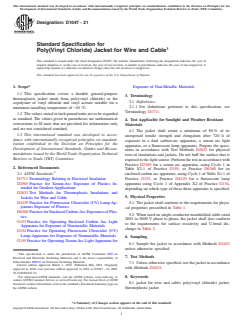


ASTM D1047-21 - Standard Specification for Poly(Vinyl Chloride) Jacket for Wire and Cable
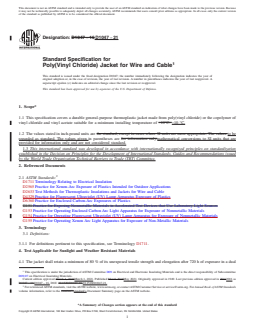
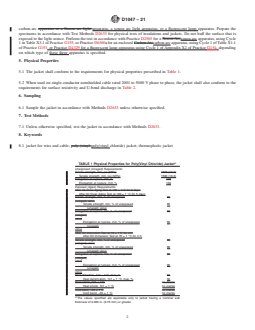


REDLINE ASTM D1047-21 - Standard Specification for Poly(Vinyl Chloride) Jacket for Wire and Cable
Overview
ASTM D1047-21 is a standard specification developed by ASTM for poly(vinyl chloride) (PVC) jackets used in wire and cable applications. This international standard outlines the requirements for physical and electrical properties of thermoplastic jackets made from PVC or copolymers of vinyl chloride and vinyl acetate, specifically for use at minimum installation temperatures down to −10°C. The standard ensures consistency and reliability in products, supporting manufacturers, installers, and end users in compliance and quality assurance.
Key Topics
- Material Scope: Specifies general-purpose thermoplastic jackets composed of poly(vinyl chloride) and suitable copolymers.
- Performance Properties:
- Tensile Strength: Minimum unaged tensile strength requirement.
- Elongation at Rupture: Minimum percentage at rupture for both unaged and aged materials.
- Aging Resistance: Retention of physical properties after air oven aging and oil immersion tests.
- Thermal Properties: Criteria for heat distortion and heat shock resistance.
- Cold Flexibility: Cold bend performance at sub-zero temperatures with no cracking.
- Surface Resistivity: Electrical resistance requirements for certain wire applications.
- U-Bend Discharge: Ensures cable jacket integrity at specified test voltages.
- Weather Resistance: Requirements for sunlight and weather-resistant jackets including minimum strength retention after exposure in xenon arc or carbon arc apparatus.
- Test Methods and Sampling: References ASTM D2633 for standardized preparation and testing procedures.
Applications
Poly(vinyl chloride) jackets meeting the criteria of ASTM D1047-21 are widely used in various electrical and electronic industries. Key applications include:
- Power and Control Cables: Provides robust insulation and mechanical protection for low- and medium-voltage cables, ensuring safety and durability.
- Installation in Adverse Environments: Suitable for installation at temperatures as low as −10°C, making them ideal for outdoor, cold-climate, and industrial environments.
- General-Purpose Wiring: Used in commercial and residential wiring where flexible, flame-retardant protective jackets are required.
- Weather-Resistant Uses: Ideal for cables exposed to UV radiation and varying weather conditions due to their required sunlight and weather resistance.
Manufacturers, electrical contractors, and specification engineers rely on this ASTM standard to ensure that PVC-jacketed cables meet industry benchmarks for safety, durability, and electrical performance.
Related Standards
For comprehensive testing and specification of wire and cable jackets, the following related ASTM standards are frequently referenced:
- ASTM D1711: Terminology relating to electrical insulation.
- ASTM D2565: Practice for xenon-arc exposure of plastics intended for outdoor applications.
- ASTM D2633: Test methods for thermoplastic insulations and jackets for wire and cable.
- ASTM D4329: Practice for fluorescent UV lamp apparatus exposure of plastics.
- ASTM D6360: Practice for enclosed carbon-arc exposures of plastics.
- ASTM G151, G153, G154, G155: Practices for exposure of nonmetallic materials in laboratory light sources including carbon arc and xenon arc testing.
These standards together support the full evaluation of poly(vinyl chloride) jacket compounds, ensuring cable products meet industry requirements for quality, reliability, and safety.
Keywords: ASTM D1047, poly(vinyl chloride) jacket, PVC cable jacket, thermoplastic wire jacket, electrical wire insulation standard, cable weather resistance, tensile strength wire insulation.
Relations
- Effective Date
- 01-Mar-2024
- Effective Date
- 01-Oct-2023
- Effective Date
- 01-Nov-2015
- Effective Date
- 01-Nov-2014
- Effective Date
- 01-May-2014
- Effective Date
- 01-Nov-2013
- Effective Date
- 01-Dec-2012
- Effective Date
- 01-Aug-2011
- Effective Date
- 01-Dec-2010
- Effective Date
- 01-May-2008
- Effective Date
- 01-Mar-2008
- Effective Date
- 01-Mar-2007
- Effective Date
- 05-Jun-2006
- Effective Date
- 01-Oct-2005
- Effective Date
- 15-Jul-2005
Buy Documents
ASTM D1047-21 - Standard Specification for Poly(Vinyl Chloride) Jacket for Wire and Cable
REDLINE ASTM D1047-21 - Standard Specification for Poly(Vinyl Chloride) Jacket for Wire and Cable
Get Certified
Connect with accredited certification bodies for this standard

IMQ S.p.A. (Certification)
Italian electrical product certification.

SLG Prüf- und Zertifizierungs GmbH
German testing and certification body.

UL Solutions
Global safety science company with testing, inspection and certification.
Sponsored listings
Frequently Asked Questions
ASTM D1047-21 is a technical specification published by ASTM International. Its full title is "Standard Specification for Poly(Vinyl Chloride) Jacket for Wire and Cable". This standard covers: ABSTRACT This specification covers a durable general-purpose thermoplastic jacket made from poly(vinyl chloride) or the copolymer of vinyl chloride and vinyl acetate for use in wires and cables at specified minimum installing temperature. The jackets shall meet specified values of the following physical and electrical properties: unexposed (unaged) tensile strength and elongation at rupture; tensile strength and elongation at rupture after air oven aging and oil immersion tests; heat distortion; heat shock; cold bend; surface resistivity; and U-bend discharge at required cable insulation AC test voltage. SCOPE 1.1 This specification covers a durable general-purpose thermoplastic jacket made from poly(vinyl chloride) or the copolymer of vinyl chloride and vinyl acetate suitable for a minimum installing temperature of −10 °C. 1.2 The values stated in inch-pound units are to be regarded as standard. The values given in parentheses are mathematical conversions to SI units that are provided for information only and are not considered standard. 1.3 This international standard was developed in accordance with internationally recognized principles on standardization established in the Decision on Principles for the Development of International Standards, Guides and Recommendations issued by the World Trade Organization Technical Barriers to Trade (TBT) Committee.
ABSTRACT This specification covers a durable general-purpose thermoplastic jacket made from poly(vinyl chloride) or the copolymer of vinyl chloride and vinyl acetate for use in wires and cables at specified minimum installing temperature. The jackets shall meet specified values of the following physical and electrical properties: unexposed (unaged) tensile strength and elongation at rupture; tensile strength and elongation at rupture after air oven aging and oil immersion tests; heat distortion; heat shock; cold bend; surface resistivity; and U-bend discharge at required cable insulation AC test voltage. SCOPE 1.1 This specification covers a durable general-purpose thermoplastic jacket made from poly(vinyl chloride) or the copolymer of vinyl chloride and vinyl acetate suitable for a minimum installing temperature of −10 °C. 1.2 The values stated in inch-pound units are to be regarded as standard. The values given in parentheses are mathematical conversions to SI units that are provided for information only and are not considered standard. 1.3 This international standard was developed in accordance with internationally recognized principles on standardization established in the Decision on Principles for the Development of International Standards, Guides and Recommendations issued by the World Trade Organization Technical Barriers to Trade (TBT) Committee.
ASTM D1047-21 is classified under the following ICS (International Classification for Standards) categories: 29.035.20 - Plastics and rubber insulating materials. The ICS classification helps identify the subject area and facilitates finding related standards.
ASTM D1047-21 has the following relationships with other standards: It is inter standard links to ASTM D1711-24, ASTM D2565-23, ASTM D1711-15, ASTM D1711-14a, ASTM D1711-14, ASTM D1711-13, ASTM G154-12, ASTM D1711-11a, ASTM G153-04(2010), ASTM D1711-08, ASTM D2565-99(2008), ASTM D6360-07, ASTM G154-06, ASTM G155-05a, ASTM D4329-05. Understanding these relationships helps ensure you are using the most current and applicable version of the standard.
ASTM D1047-21 is available in PDF format for immediate download after purchase. The document can be added to your cart and obtained through the secure checkout process. Digital delivery ensures instant access to the complete standard document.
Standards Content (Sample)
This international standard was developed in accordance with internationally recognized principles on standardization established in the Decision on Principles for the
Development of International Standards, Guides and Recommendations issued by the World Trade Organization Technical Barriers to Trade (TBT) Committee.
Designation:D1047 −21
Standard Specification for
Poly(Vinyl Chloride) Jacket for Wire and Cable
This standard is issued under the fixed designation D1047; the number immediately following the designation indicates the year of
original adoption or, in the case of revision, the year of last revision.Anumber in parentheses indicates the year of last reapproval.A
superscript epsilon (´) indicates an editorial change since the last revision or reapproval.
This standard has been approved for use by agencies of the U.S. Department of Defense.
1. Scope* Exposure of Non-Metallic Materials
1.1 This specification covers a durable general-purpose
3. Terminology
thermoplastic jacket made from poly(vinyl chloride) or the
3.1 Definitions:
copolymer of vinyl chloride and vinyl acetate suitable for a
3.1.1 For definitions pertinent to this specification, see
minimum installing temperature of −10 °C.
Terminology D1711.
1.2 The values stated in inch-pound units are to be regarded
as standard. The values given in parentheses are mathematical
4. Test Applicable for Sunlight and Weather Resistant
conversions to SI units that are provided for information only
Materials
and are not considered standard.
4.1 The jacket shall retain a minimum of 80% of its
1.3 This international standard was developed in accor-
unexposed tensile strength and elongation after 720 h of
dance with internationally recognized principles on standard-
exposure in a dual carbon-arc apparatus, a xenon arc light
ization established in the Decision on Principles for the
apparatus, or a fluorescent lamp apparatus. Prepare the speci-
Development of International Standards, Guides and Recom-
mens in accordance with Test Methods D2633 for physical
mendations issued by the World Trade Organization Technical
tests of insulations and jackets. Do not buff the surface that is
Barriers to Trade (TBT) Committee.
exposedtothelightsource.Performthetestinaccordancewith
Practice D2565 for a xenon arc apparatus, using Cycle 1 in
2. Referenced Documents
Table X3.1 of Practice G155, or Practice D6360 for an
2.1 ASTM Standards:
enclosed carbon arc apparatus, using Cycle 1 of Table X1.1 of
D1711Terminology Relating to Electrical Insulation
Practice G153, or Practice D4329 for a fluorescent lamp
D2565Practice for Xenon-Arc Exposure of Plastics In-
apparatus using Cycle 1 of Appendix X2 of Practice G154,
tended for Outdoor Applications depending on which type of these three apparatus is specified.
D2633Test Methods for Thermoplastic Insulations and
5. Physical Properties
Jackets for Wire and Cable
D4329Practice for Fluorescent Ultraviolet (UV) Lamp Ap-
5.1 The jacket shall conform to the requirements for physi-
paratus Exposure of Plastics
cal properties prescribed in Table 1.
D6360PracticeforEnclosedCarbon-ArcExposuresofPlas-
5.2 When used on single-conductor nonshielded cable rated
tics
2001 to 5000 V phase to phase, the jacket shall also conform
G153Practice for Operating Enclosed Carbon Arc Light
to the requirements for surface resistivity and U-bend dis-
Apparatus for Exposure of Nonmetallic Materials
charge in Table 2.
G154Practice for Operating Fluorescent Ultraviolet (UV)
Lamp Apparatus for Exposure of Nonmetallic Materials
6. Sampling
G155Practice for Operating XenonArc LightApparatus for
6.1 Sample the jacket in accordance with Methods D2633
unless otherwise specified.
This specification is under the jurisdiction of ASTM Committee D09 on
7. Tes
...
This document is not an ASTM standard and is intended only to provide the user of an ASTM standard an indication of what changes have been made to the previous version. Because
it may not be technically possible to adequately depict all changes accurately, ASTM recommends that users consult prior editions as appropriate. In all cases only the current version
of the standard as published by ASTM is to be considered the official document.
Designation: D1047 − 16 D1047 − 21
Standard Specification for
Poly(Vinyl Chloride) Jacket for Wire and Cable
This standard is issued under the fixed designation D1047; the number immediately following the designation indicates the year of
original adoption or, in the case of revision, the year of last revision. A number in parentheses indicates the year of last reapproval. A
superscript epsilon (´) indicates an editorial change since the last revision or reapproval.
This standard has been approved for use by agencies of the U.S. Department of Defense.
1. Scope*
1.1 This specification covers a durable general-purpose thermoplastic jacket made from poly(vinyl chloride) or the copolymer of
vinyl chloride and vinyl acetate suitable for a minimum installing temperature of −10°C. −10 °C.
1.2 The values stated in inch-pound units are the standard, except in cases where SI units are more appropriate. The values to be
regarded as standard. The values given in parentheses are for information only.mathematical conversions to SI units that are
provided for information only and are not considered standard.
1.3 This international standard was developed in accordance with internationally recognized principles on standardization
established in the Decision on Principles for the Development of International Standards, Guides and Recommendations issued
by the World Trade Organization Technical Barriers to Trade (TBT) Committee.
2. Referenced Documents
2.1 ASTM Standards:
D1711 Terminology Relating to Electrical Insulation
D2565 Practice for Xenon-Arc Exposure of Plastics Intended for Outdoor Applications
D2633 Test Methods for Thermoplastic Insulations and Jackets for Wire and Cable
D4329 Practice for Fluorescent Ultraviolet (UV) Lamp Apparatus Exposure of Plastics
D6360 Practice for Enclosed Carbon-Arc Exposures of Plastics
G151 Practice for Exposing Nonmetallic Materials in Accelerated Test Devices that Use Laboratory Light Sources
G153 Practice for Operating Enclosed Carbon Arc Light Apparatus for Exposure of Nonmetallic Materials
G154 Practice for Operating Fluorescent Ultraviolet (UV) Lamp Apparatus for Exposure of Nonmetallic Materials
G155 Practice for Operating Xenon Arc Light Apparatus for Exposure of Non-Metallic Materials
3. Terminology
3.1 Definitions:
3.1.1 For definitions pertinent to this specification, see Terminology D1711.
4. Test Applicable for Sunlight and Weather Resistant Materials
4.1 The jacket shall retain a minimum of 80 % of its unexposed tensile strength and elongation after 720 h of exposure in a dual
This specification is under the jurisdiction of ASTM Committee D09 on Electrical and Electronic Insulating Materials and is the direct responsibility of Subcommittee
D09.07 on Electrical Insulating Materials.
Current edition approved March 1, 2016March 1, 2021. Published March 2016May 2021. Originally approved in 1949. Last previous edition approved in 20112016 as
D1047 – 11.D1047 – 16. DOI: 10.1520/D1047-16.10.1520/D1047-21.
For referenced ASTM standards, visit the ASTM website, www.astm.org, or contact ASTM Customer Service at service@astm.org. For Annual Book of ASTM Standards
volume information, refer to the standard’sstandard’s Document Summary page on the ASTM website.
*A Summary of Changes section appears at the end of this standard
Copyright © ASTM International, 100 Barr Harbor Drive, PO Box C700, West Conshohocken, PA 19428-2959. United States
D1047 − 21
carbon-arc apparatus or a Xenon arc light apparatus, a xenon arc light apparatus, or a fluorescent lamp apparatus. Prepare the
specimens in accordance with Test Methods D2633 for physical tests of insulations and jackets. Do not buff the surface that is
exposed to the light source. Perform the test in accordance with Practice D2565 for a Xenon Arcxenon arc apparatus, using Cycle
1 in Table X3.1 of Practice G155, or Practice D6360
...