

ASTM D2148-22
(Test Method)Standard Test Methods for Bondable Silicone Rubber Tapes Used for Electrical Insulation
General Information
- Abstract
SIGNIFICANCE AND USE
5.1 Self-adhesion is a primary initial property since it affects layer-to-layer bonding. The integrity of the bond can significantly affect the electrical and physical performance of the insulation system. Therefore, the degree of self-adhesion is directly related to apparatus performance.
5.2 A high degree of self-adhesion is desirable for most electrical applications. In this test, a short unwinding length indicates a high degree of self-adhesion.
5.3 This test method has been found useful as a quality control test for lot acceptance.
SCOPE
1.1 These test methods cover tests for bondable silicone rubber tapes which form a sealed structure either with the application of heat (and pressure if needed) or by the process of auto-adhesion (self-fusing).
1.2 These test methods appear in the following sections:
Test Method
Section
Adhesion
3 – 10
Bond Strength
11 – 18
Dielectric Breakdown Voltage
19 – 26
Hardness
41
Length
33 and 34
Thickness
27 – 32
Width
36 – 40
1.3 Units—The values stated in SI units are the standard. The inch-pound units in parentheses are for information only. The values stated in each system are not necessarily exact equivalents; therefore, to ensure conformance with the standard, each system shall be used independently of the other, and values from the two systems shall not be combined.
1.4 This standard does not purport to address all of the safety concerns, if any, associated with its use. It is the responsibility of the user of this standard to establish appropriate safety, health, and environmental practices and determine the applicability of regulatory limitations prior to use. For a specific hazard statement see 23.1.1.
1.5 This international standard was developed in accordance with internationally recognized principles on standardization established in the Decision on Principles for the Development of International Standards, Guides and Recommendations issued by the World Trade Organization Technical Barriers to Trade (TBT) Committee.
- Status
- Published
- Publication Date
- 30-Sep-2022
- Technical Committee
- D09 - Electrical and Electronic Insulating Materials
- Drafting Committee
- D09.07 - Electrical Insulating Materials
Buy Documents
ASTM D2148-22 - Standard Test Methods for Bondable Silicone Rubber Tapes Used for Electrical Insulation
REDLINE ASTM D2148-22 - Standard Test Methods for Bondable Silicone Rubber Tapes Used for Electrical Insulation
Overview
ASTM D2148-22: Standard Test Methods for Bondable Silicone Rubber Tapes Used for Electrical Insulation specifies a comprehensive range of test methods to evaluate the properties and performance of bondable silicone rubber tapes. These tapes are essential in electrical insulation applications where self-adhesion and the resulting sealed structure are critical to maintaining electrical and physical integrity. The standard includes procedures for evaluating self-adhesion, bond strength, dielectric breakdown voltage, hardness, and dimensional properties, providing a robust framework for product qualification and quality control in electrical insulation materials.
Key Topics
ASTM D2148-22 addresses the following critical properties of bondable silicone rubber tapes:
- Self-Adhesion and Bond Strength
- Evaluates the tape’s ability to form strong, durable bonds between layers (auto-adhesion or self-fusing).
- The degree of self-adhesion impacts the overall effectiveness and lifespan of insulation systems.
- Dielectric Breakdown Voltage
- Measures the maximum voltage the tape can withstand before electrical failure, a key factor in safety and reliability.
- Dimensional Properties
- Precise measurement of length, thickness, and width, essential for consistent application and performance.
- Hardness
- Durometer hardness assessment ensures the material meets required flexibility and protection standards.
- Quality Control
- Methods serve as reliable quality control checks for batch acceptance, supporting manufacturing consistency.
All measurements are standardized in SI units to promote uniformity; inch-pound units are provided for reference only.
Applications
Bondable silicone rubber tapes tested by ASTM D2148-22 are widely used across various industries where high-performance electrical insulation is needed:
- Electrical Insulation Systems
- Used in wrapping wires, cables, splices, and terminations to protect against electrical faults and environmental hazards.
- Aerospace and Automotive
- Applied for high-temperature resistance and electrical shielding in demanding environments.
- Industrial Equipment
- Used in motor windings, transformers, and switchgear to improve insulation reliability and reduce maintenance needs.
- Repair and Maintenance
- Ideal for temporary or permanent electrical repairs where quick, reliable insulation is required, especially in the field.
The standard’s methods ensure that tapes meet rigorous criteria, enabling safe and effective use in both new installations and repairs.
Related Standards
To ensure comprehensive assessment and compatibility within insulation systems, ASTM D2148-22 references several related ASTM standards:
- ASTM D149 - Test Method for Dielectric Breakdown Voltage and Dielectric Strength of Solid Electrical Insulating Materials
- ASTM D374/D374M - Test Methods for Thickness of Solid Electrical Insulation
- ASTM D1000 - Test Methods for Pressure-Sensitive Adhesive-Coated Tapes Used for Electrical and Electronic Applications
- ASTM D2240 - Test Method for Rubber Property-Durometer Hardness
These standards complement ASTM D2148-22 by providing additional protocols for dielectric strength, dimensional measurement, and material hardness, key to a comprehensive insulation material evaluation.
Keywords: bondable silicone rubber tape, self-fusing tape, electrical insulation, ASTM D2148-22, dielectric breakdown voltage, bond strength, quality control, hardness, insulation tape standards.
Relations
- Effective Date
- 01-Oct-2023
- Effective Date
- 01-Jan-2020
- Effective Date
- 01-Jul-2017
- Effective Date
- 01-Nov-2013
- Effective Date
- 01-Jan-2010
- Effective Date
- 15-Oct-2009
- Effective Date
- 01-Nov-2008
- Effective Date
- 01-May-2007
- Effective Date
- 01-Nov-2005
- Effective Date
- 01-Sep-2004
- Effective Date
- 01-Sep-2004
- Effective Date
- 01-Mar-2004
- Effective Date
- 10-Sep-2001
- Effective Date
- 10-Sep-2001
- Effective Date
- 10-Nov-2000
Buy Documents
ASTM D2148-22 - Standard Test Methods for Bondable Silicone Rubber Tapes Used for Electrical Insulation
REDLINE ASTM D2148-22 - Standard Test Methods for Bondable Silicone Rubber Tapes Used for Electrical Insulation
Get Certified
Connect with accredited certification bodies for this standard

IMQ S.p.A. (Certification)
Italian electrical product certification.

SLG Prüf- und Zertifizierungs GmbH
German testing and certification body.

UL Solutions
Global safety science company with testing, inspection and certification.
Sponsored listings
Frequently Asked Questions
ASTM D2148-22 is a standard published by ASTM International. Its full title is "Standard Test Methods for Bondable Silicone Rubber Tapes Used for Electrical Insulation". This standard covers: SIGNIFICANCE AND USE 5.1 Self-adhesion is a primary initial property since it affects layer-to-layer bonding. The integrity of the bond can significantly affect the electrical and physical performance of the insulation system. Therefore, the degree of self-adhesion is directly related to apparatus performance. 5.2 A high degree of self-adhesion is desirable for most electrical applications. In this test, a short unwinding length indicates a high degree of self-adhesion. 5.3 This test method has been found useful as a quality control test for lot acceptance. SCOPE 1.1 These test methods cover tests for bondable silicone rubber tapes which form a sealed structure either with the application of heat (and pressure if needed) or by the process of auto-adhesion (self-fusing). 1.2 These test methods appear in the following sections: Test Method Section Adhesion 3 – 10 Bond Strength 11 – 18 Dielectric Breakdown Voltage 19 – 26 Hardness 41 Length 33 and 34 Thickness 27 – 32 Width 36 – 40 1.3 Units—The values stated in SI units are the standard. The inch-pound units in parentheses are for information only. The values stated in each system are not necessarily exact equivalents; therefore, to ensure conformance with the standard, each system shall be used independently of the other, and values from the two systems shall not be combined. 1.4 This standard does not purport to address all of the safety concerns, if any, associated with its use. It is the responsibility of the user of this standard to establish appropriate safety, health, and environmental practices and determine the applicability of regulatory limitations prior to use. For a specific hazard statement see 23.1.1. 1.5 This international standard was developed in accordance with internationally recognized principles on standardization established in the Decision on Principles for the Development of International Standards, Guides and Recommendations issued by the World Trade Organization Technical Barriers to Trade (TBT) Committee.
SIGNIFICANCE AND USE 5.1 Self-adhesion is a primary initial property since it affects layer-to-layer bonding. The integrity of the bond can significantly affect the electrical and physical performance of the insulation system. Therefore, the degree of self-adhesion is directly related to apparatus performance. 5.2 A high degree of self-adhesion is desirable for most electrical applications. In this test, a short unwinding length indicates a high degree of self-adhesion. 5.3 This test method has been found useful as a quality control test for lot acceptance. SCOPE 1.1 These test methods cover tests for bondable silicone rubber tapes which form a sealed structure either with the application of heat (and pressure if needed) or by the process of auto-adhesion (self-fusing). 1.2 These test methods appear in the following sections: Test Method Section Adhesion 3 – 10 Bond Strength 11 – 18 Dielectric Breakdown Voltage 19 – 26 Hardness 41 Length 33 and 34 Thickness 27 – 32 Width 36 – 40 1.3 Units—The values stated in SI units are the standard. The inch-pound units in parentheses are for information only. The values stated in each system are not necessarily exact equivalents; therefore, to ensure conformance with the standard, each system shall be used independently of the other, and values from the two systems shall not be combined. 1.4 This standard does not purport to address all of the safety concerns, if any, associated with its use. It is the responsibility of the user of this standard to establish appropriate safety, health, and environmental practices and determine the applicability of regulatory limitations prior to use. For a specific hazard statement see 23.1.1. 1.5 This international standard was developed in accordance with internationally recognized principles on standardization established in the Decision on Principles for the Development of International Standards, Guides and Recommendations issued by the World Trade Organization Technical Barriers to Trade (TBT) Committee.
ASTM D2148-22 is classified under the following ICS (International Classification for Standards) categories: 29.035.20 - Plastics and rubber insulating materials. The ICS classification helps identify the subject area and facilitates finding related standards.
ASTM D2148-22 has the following relationships with other standards: It is inter standard links to ASTM D374/D374M-23, ASTM D149-20, ASTM D1000-17, ASTM D1458-13, ASTM D1000-10, ASTM D1000-09, ASTM D618-08, ASTM D1458-01(2007), ASTM D618-05, ASTM D1000-04e1, ASTM D1000-04, ASTM D149-97a(2004), ASTM D1458-96, ASTM D1458-01, ASTM D618-00. Understanding these relationships helps ensure you are using the most current and applicable version of the standard.
ASTM D2148-22 is available in PDF format for immediate download after purchase. The document can be added to your cart and obtained through the secure checkout process. Digital delivery ensures instant access to the complete standard document.
Standards Content (Sample)
This international standard was developed in accordance with internationally recognized principles on standardization established in the Decision on Principles for the
Development of International Standards, Guides and Recommendations issued by the World Trade Organization Technical Barriers to Trade (TBT) Committee.
Designation: D2148 − 22
Standard Test Methods for
Bondable Silicone Rubber Tapes Used for Electrical
Insulation
This standard is issued under the fixed designation D2148; the number immediately following the designation indicates the year of
original adoption or, in the case of revision, the year of last revision. A number in parentheses indicates the year of last reapproval. A
superscript epsilon (´) indicates an editorial change since the last revision or reapproval.
1. Scope* 2. Referenced Documents
1.1 These test methods cover tests for bondable silicone 2.1 ASTM Standards:
rubber tapes which form a sealed structure either with the D149 Test Method for Dielectric Breakdown Voltage and
application of heat (and pressure if needed) or by the process DielectricStrengthofSolidElectricalInsulatingMaterials
of auto-adhesion (self-fusing). at Commercial Power Frequencies
D374/D374M Test Methods for Thickness of Solid Electri-
1.2 These test methods appear in the following sections:
cal Insulation
Test Method Section
D618 Practice for Conditioning Plastics for Testing
Adhesion 3–10
D1000 Test Methods for Pressure-Sensitive Adhesive-
Bond Strength 11–18
Coated Tapes Used for Electrical and Electronic Applica-
Dielectric Breakdown Voltage 19–26
tions
Hardness 41
Length 33 and 34
D1458 Test Methods for Fully Cured Silicone Rubber-
Thickness 27–32
Coated Glass Fabric and Tapes for Electrical Insulation
Width 36–40
(Withdrawn 2019)
1.3 Units—The values stated in SI units are the standard.
D2240 Test Method for Rubber Property—Durometer Hard-
The inch-pound units in parentheses are for information only.
ness
The values stated in each system are not necessarily exact
equivalents; therefore, to ensure conformance with the
ADHESION
standard, each system shall be used independently of the other,
3. Scope
and values from the two systems shall not be combined.
3.1 This test method covers the determination of the self-
1.4 This standard does not purport to address all of the
adhesion of unsupported, self-fusing silicone rubber rectangu-
safety concerns, if any, associated with its use. It is the
lar and taper-edge (Note 1) tape designed for use as electrical
responsibility of the user of this standard to establish appro-
insulation.
priate safety, health, and environmental practices and deter-
mine the applicability of regulatory limitations prior to use.
NOTE 1—Taper-edge tape includes such cross sections as triangular,
For a specific hazard statement see 23.1.1.
lens, etc.
1.5 This international standard was developed in accor-
4. Hazards
dance with internationally recognized principles on standard-
ization established in the Decision on Principles for the 4.1 High Voltage:
Development of International Standards, Guides and Recom-
4.1.1 Lethal voltages are a potential hazard during the
mendations issued by the World Trade Organization Technical performance of this test. It is essential that the test apparatus,
Barriers to Trade (TBT) Committee.
and all associated equipment electrically connected to it, be
properly designed and installed for safe operation.
1 2
These test methods are under the jurisdiction of ASTM Committee D09 on For referenced ASTM standards, visit the ASTM website, www.astm.org, or
Electrical and Electronic Insulating Materials and are the direct responsibility of contact ASTM Customer Service at service@astm.org. For Annual Book of ASTM
Subcommittee D09.07 on Electrical Insulating Materials. Standards volume information, refer to the standard’s Document Summary page on
Current edition approved Oct. 1, 2022. Published October 2022. Originally the ASTM website.
ɛ1
approved in 1963. Last previous edition approved in 2019 as D2148 – 19 . DOI: The last approved version of this historical standard is referenced on
10.1520/D2148-22. www.astm.org.
*A Summary of Changes section appears at the end of this standard
Copyright © ASTM International, 100 Barr Harbor Drive, PO Box C700, West Conshohocken, PA 19428-2959. United States
D2148 − 22
4.1.2 Solidly ground all electrically conductive parts which results.Whenproperlyassembled,themandrelshallturnfreely
it is possible for a person to contact during the test. when loaded with a 28 g (1-oz) weight suspended from a
4.1.3 Provide means for use at the completion of any test to cotton thread wound in a single layer at the center of the
ground any parts which were at high voltage during the test or mandrel.
have the potential for acquiring an induced charge during the
6.2 Weights, as specified in Section 8 and means for
test or retaining a charge even after disconnection of the
attachment.
voltage source.
6.3 Calibratedstopwatchcapableofmeasuringaccuratelyto
4.1.4 Thoroughly instruct all operators as to the correct
one second.
procedures for performing tests safely.
4.1.5 When making high voltage tests, particularly in com-
7. Test Specimen
pressed gas or in oil, it is possible for the energy released at
7.1 A test specimen shall consist of two pieces of tape
breakdown to be sufficient to result in fire, explosion, or
305 mm to 380 mm (12 to 15 in.) long. Divisions spaced 25
rupture of the test chamber. Design test equipment, test
mm (1 in.) apart shall be marked off on one piece of tape. If
chambers, and test specimens so as to minimize the possibility
tapes contain an interliner, the interliner shall be removed just
of such occurrences and to eliminate the possibility of personal
prior to wrapping the mandrel. Dirt and other forms of
injury. If the potential for fire exists, have fire suppression
contamination shall be avoided.
equipment available. See 23.1
8. Procedure
5. Significance and Use
8.1 Winding—Half lap the unmarked specimen perfectly on
5.1 Self-adhesionisaprimaryinitialpropertysinceitaffects
the mandrel of the test fixture, using the suggested weight as
layer-to-layer bonding. The integrity of the bond can signifi-
showninTable1.Theseweightsarenotcritical.However,they
cantly affect the electrical and physical performance of the
are necessary to get intimate contact and conformability of the
insulation system. Therefore, the degree of self-adhesion is
tape. To obtain perfect half lapping, tilt the tack tester at an
directly related to apparatus performance.
appropriate angle as shown in Fig. 1. Wrap the tape on the
5.2 A high degree of self-adhesion is desirable for most
mandrel at a speed of approximately 460 mm (18 in.)/min.
electrical applications. In this test, a short unwinding length
Using the winding procedure and weights just described, half
indicates a high degree of self-adhesion.
lap the marked tape sample on the mandrel over the first piece
5.3 This test method has been found useful as a quality
of tape. With the winding weight attached, return the test
control test for lot acceptance.
fixture to a horizontal position and allow the tape to bond for
1 min. Remove the winding weight from the tape and the
6. Apparatus
handle from the fixture and proceed with the unwinding test.
6.1 Inclined Mandrel Tack Test Fixture—Asuggestedfixture
8.2 Unwinding—After the tape has bonded for 1 min, attach
is shown in Fig. 1. Tack tester assembly and details are
a load of 600 g (21 oz)/25 mm (in.) of the original tape width
included as Appendix X1. The mandrel shall consist of a 16
(Note2).Attachtheweighttothefreeendofthetapebymeans
mm(0.625in.)diameteraluminumrodmountedinlow-friction
of a bulldog paper clamp or other suitable device. Release the
bearings. Good alignment of bearings is necessary for accurate
weight and record the length of tape unwound in 3 min.
Although the original 25 mm (1 in.) dimensions will elongate
due to the unwind weight, consider each division as one unit.
While the winding weights are not critical, the use of proper
unwinding weights is mandatory. Consistent and comparable
results depend upon accurate width measurements and the use
of the proper unwinding weight.
NOTE2—Commercialtapesareusuallymadetoa 61.6mm(60.06in.)
TABLE 1 Suggested Winding Weights for 1-in. Wide Tapes
Note—Winding weights are based on cross-sectional area and have been
selected to produce approximately the same unit stress on all cross-sections.
For tapes of dimensions not listed, use a winding weight of approximately
2 2
300 g (10.5 oz)/6 mm (0.01 in. ).
Tape Thickness, mm (in.)
Weight, g (oz)
Triangular Rectangular
0.50 (0.020) 0.25 (0.010) 300 (10.5)
0.75 (0.030) 0.4 (0.015) 450 (15.8)
1.02 (0.040) 0.5 (0.02) 600 (21.0)
1.27 (0.050) 0.64 (0.025) 750 (26.4)
1.52 (0.060) 0.76 (0.030) 900 (31.7)
1.78 (0.070) . 1050 (37.0)
2.03 (0.080) . 1200 (42.3)
FIG. 1 Inclined Mandrel Tack Test Fixture
D2148 − 22
tolerance. Therefore a 600-g weight shall be used for tapes varying in
in dimension than the specimens to be tested. This is used as a
width from 24 mm to 27 mm (0.94 to 1.06 in.); a 750-g weight shall be
pressure-equalizing device, compensating for irregularities in
used for tapes varying in width from 30 mm to 33 mm (1.19 to 1.31 in.)
either the specimen or the platens.
and a 900-g weight shall be used for tapes varying in width from 37 mm
to 40 mm (1.44 to 1.56 in.). Tapes with widths outside these ranges shall
13.4 Polytetrafluoroethylene or suitable release film, three
betestedinaccordancewiththeirwidth(determinedtothenearest1.6mm
sheets, approximately 0.05 mm to 0.10 mm (2 to 4 mils) thick.
(0.06 in.). For example, a 29 mm (1.125 in.) wide tape shall be tested with
One sheet is placed on each side of the specimens as a release
a 675-g weight. The unwinding weights shall be made to a tolerance of
sheet, the third sheet being used to separate the ends of the two
62%.
test specimens.
9. Report
13.5 Testing Machine—A power-driven testing machine of
9.1 Report the following information:
either the cross head or dead-weight pendulum type. The
9.1.1 Description of material, type of cross-section, tape
machine shall be equipped with a tension weighing device
width and thickness,
having a maximum capacity of 22.7 kg (50 lb) graduated to
9.1.2 Winding weight, in grams,
read 50 g (0.1 lb) or less per scale division.
9.1.3 Unwinding weight, in grams, and
9.1.4 Length of unwind, to the nearest ⁄4 unit.
14. Test Specimen
14.1 Thetestspecimenshallbeselectedtoberepresentative
10. Precision and Bias
of the material to be tested. The size of sample shall be
10.1 Thistestmethodhasbeeninuseformanyyears,butno
sufficienttogivesixstripsatleast32 mmto38mm(1.25to1.5
information has been presented to ASTM upon which to base
in.) wide and 150 mm (6 in.) long. Care shall be taken to
a statement of precision. No activity has been planned to
prevent contamination.
develop such information.
10.2 This test method has no bias because the value for
15. Conditioning
adhesion is determined solely in terms of this test method
15.1 The specimen shall not be exposed to temperatures
itself.
above 30 °C (85 °F) before bonding. The tests shall be con-
ducted in the Standard LaboratoryAtmosphere as described in
BOND STRENGTH
Practice D618.
11. Terminology
16. Procedure
11.1 Definitions of Terms Specific to This Standard:
11.1.1 bond strength, of unvulcanized and semivulcanized 16.1 Cut the strips of material to 32 mm to 38 mm (1.25 to
supported silicone rubber tapes—the strength of chemical
1.5 in.) wide and at least 150 mm (6 in.) long, the length being
linkages achieved between successive layers of tape under
measured in the warp or machine direction of the backing.
controlled vulcanizing conditions.
16.2 Remove any interliner material.
12. Significance and Use
16.3 Superimpose one strip on another, front side to back
side, to form a specimen.
12.1 The bond strength is an indication of the physical
integrity that can be expected under end use conditions in
16.4 Separate the two strips at one end for a distance of
which the insulating tapes are applied with an overlap.
about 25 mm (1 in.) and insert a strip of release film.
16.5 Preheat the press to 177 °C (350 °F).
13. Apparatus
16.6 Assemble the test specimens between two sheets of
13.1 Bonding Press—A platen press having the following
release film. Place the assembly on the unheated silicone
characteristics:
rubber pad and insert in the press.
13.1.1 A temperature range to 205 °C (400 °F).
13.1.2 A thermostat that will allow a set temperature to be
16.7 Close the press and apply 345 kPa (50 psi) pressure to
maintained 65°C(6 9 °F).
the specimens for 5 min.
13.1.3 A pressure regulator to allow setting and control of
16.8 Release the pressure, remove the specimens, and allow
the platen pressure.
them to cool for at least 5 min.
13.1.4 A pressure in
...
This document is not an ASTM standard and is intended only to provide the user of an ASTM standard an indication of what changes have been made to the previous version. Because
it may not be technically possible to adequately depict all changes accurately, ASTM recommends that users consult prior editions as appropriate. In all cases only the current version
of the standard as published by ASTM is to be considered the official document.
´1
Designation: D2148 − 19 D2148 − 22
Standard Test Methods for
Bondable Silicone Rubber Tapes Used for Electrical
Insulation
This standard is issued under the fixed designation D2148; the number immediately following the designation indicates the year of
original adoption or, in the case of revision, the year of last revision. A number in parentheses indicates the year of last reapproval. A
superscript epsilon (´) indicates an editorial change since the last revision or reapproval.
ε NOTE—Adjunct information was updated editorially in January 2021.
1. Scope*
1.1 These test methods cover tests for bondable silicone rubber tapes which form a sealed structure either with the application of
heat (and pressure if needed) or by the process of auto-adhesion (self-fusing).
1.2 These test methods appear in the following sections:
Test Method Section
Adhesion 3 – 10
Bond Strength 11 – 18
Dielectric Breakdown Voltage 19 – 26
Hardness 41
Length 33 and 34
Thickness 27 – 32
Width 36 – 40
1.3 Units—The values stated in SI units are the standard. The inch-pound units in parentheses are for information only. The values
stated in each system are not necessarily exact equivalents; therefore, to ensure conformance with the standard, each system shall
be used independently of the other, and values from the two systems shall not be combined.
1.4 This standard does not purport to address all of the safety concerns, if any, associated with its use. It is the responsibility
of the user of this standard to establish appropriate safety, health, and environmental practices and determine the applicability of
regulatory limitations prior to use. For a specific hazard statement see 23.1.1.
1.5 This international standard was developed in accordance with internationally recognized principles on standardization
established in the Decision on Principles for the Development of International Standards, Guides and Recommendations issued
by the World Trade Organization Technical Barriers to Trade (TBT) Committee.
2. Referenced Documents
2.1 ASTM Standards:
D149 Test Method for Dielectric Breakdown Voltage and Dielectric Strength of Solid Electrical Insulating Materials at
Commercial Power Frequencies
D374/D374M Test Methods for Thickness of Solid Electrical Insulation
These test methods are under the jurisdiction of ASTM Committee D09 on Electrical and Electronic Insulating Materials and are the direct responsibility of Subcommittee
D09.07 on Electrical Insulating Materials.
Current edition approved Aug. 1, 2019Oct. 1, 2022. Published August 2019October 2022. Originally approved in 1963. Last previous edition approved in 20182019 as
ɛ1
D2148 – 18.D2148 – 19 . DOI: 10.1520/D2148-19E01.10.1520/D2148-22.
For referenced ASTM standards, visit the ASTM website, www.astm.org, or contact ASTM Customer Service at service@astm.org. For Annual Book of ASTM Standards
volume information, refer to the standard’s Document Summary page on the ASTM website.
*A Summary of Changes section appears at the end of this standard
Copyright © ASTM International, 100 Barr Harbor Drive, PO Box C700, West Conshohocken, PA 19428-2959. United States
D2148 − 22
D618 Practice for Conditioning Plastics for Testing
D1000 Test Methods for Pressure-Sensitive Adhesive-Coated Tapes Used for Electrical and Electronic Applications
D1458 Test Methods for Fully Cured Silicone Rubber-Coated Glass Fabric and Tapes for Electrical Insulation (Withdrawn
2019)
D2240 Test Method for Rubber Property—Durometer Hardness
2.2 ASTM Adjuncts:
Tack Tester (one drawing)
ADHESION
3. Scope
3.1 This test method covers the determination of the self-adhesion of unsupported, self-fusing silicone rubber rectangular and
taper-edge (Note 1) tape designed for use as electrical insulation.
NOTE 1—Taper-edge tape includes such cross sections as triangular, lens, etc.
3.2 This international standard was developed in accordance with internationally recognized principles on standardization
established in the Decision on Principles for the Development of International Standards, Guides and Recommendations issued
by the World Trade Organization Technical Barriers to Trade (TBT) Committee.
3. Scope
3.1 This test method covers the determination of the self-adhesion of unsupported, self-fusing silicone rubber rectangular and
taper-edge (Note 1) tape designed for use as electrical insulation.
NOTE 1—Taper-edge tape includes such cross sections as triangular, lens, etc.
4. Hazards
4.1 High Voltage:
4.1.1 Lethal voltages are a potential hazard during the performance of this test. It is essential that the test apparatus, and all
associated equipment electrically connected to it, be properly designed and installed for safe operation.
4.1.2 Solidly ground all electrically conductive parts which it is possible for a person to contact during the test.
4.1.3 Provide means for use at the completion of any test to ground any parts which were at high voltage during the test or have
the potential for acquiring an induced charge during the test or retaining a charge even after disconnection of the voltage source.
4.1.4 Thoroughly instruct all operators as to the correct procedures for performing tests safely.
4.1.5 When making high voltage tests, particularly in compressed gas or in oil, it is possible for the energy released at breakdown
to be sufficient to result in fire, explosion, or rupture of the test chamber. Design test equipment, test chambers, and test specimens
so as to minimize the possibility of such occurrences and to eliminate the possibility of personal injury. If the potential for fire
exists, have fire suppression equipment available. See 23.1
5. Significance and Use
5.1 Self-adhesion is a primary initial property since it affects layer-to-layer bonding. The integrity of the bond can significantly
affect the electrical and physical performance of the insulation system. Therefore, the degree of self-adhesion is directly related
to apparatus performance.
5.2 A high degree of self-adhesion is desirable for most electrical applications. In this test, a short unwinding length indicates a
high degree of self-adhesion.
The last approved version of this historical standard is referenced on www.astm.org.
D2148 − 22
5.3 This test method has been found useful as a quality control test for lot acceptance.
6. Apparatus
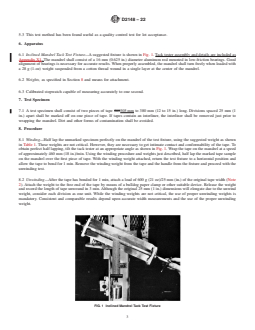
6.1 Inclined Mandrel Tack Test Fixture—A suggested fixture is shown in Fig. 1. Tack tester assembly and details are included as
Appendix X1. The mandrel shall consist of a 16 mm (0.625 in.) diameter aluminum rod mounted in low-friction bearings. Good
alignment of bearings is necessary for accurate results. When properly assembled, the mandrel shall turn freely when loaded with
a 28 g (1-oz) weight suspended from a cotton thread wound in a single layer at the center of the mandrel.
6.2 Weights, as specified in Section 8 and means for attachment.
6.3 Calibrated stopwatch capable of measuring accurately to one second.
7. Test Specimen
7.1 A test specimen shall consist of two pieces of tape 305305 mm to 380 mm (12 to 15 in.) long. Divisions spaced 25 mm (1
in.) apart shall be marked off on one piece of tape. If tapes contain an interliner, the interliner shall be removed just prior to
wrapping the mandrel. Dirt and other forms of contamination shall be avoided.
8. Procedure
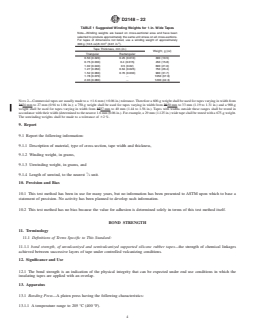
8.1 Winding—Half lap the unmarked specimen perfectly on the mandrel of the test fixture, using the suggested weight as shown
in Table 1. These weights are not critical. However, they are necessary to get intimate contact and conformability of the tape. To
obtain perfect half lapping, tilt the tack tester at an appropriate angle as shown in Fig. 1. Wrap the tape on the mandrel at a speed
of approximately 460 mm (18 in.)/min. Using the winding procedure and weights just described, half lap the marked tape sample
on the mandrel over the first piece of tape. With the winding weight attached, return the test fixture to a horizontal position and
allow the tape to bond for 1 min. Remove the winding weight from the tape and the handle from the fixture and proceed with the
unwinding test.
8.2 Unwinding—After the tape has bonded for 1 min, attach a load of 600 g (21 oz)/25 mm (in.) of the original tape width (Note
2). Attach the weight to the free end of the tape by means of a bulldog paper clamp or other suitable device. Release the weight
and record the length of tape unwound in 3 min. Although the original 25 mm (1 in.) dimensions will elongate due to the unwind
weight, consider each division as one unit. While the winding weights are not critical, the use of proper unwinding weights is
mandatory. Consistent and comparable results depend upon accurate width measurements and the use of the proper unwinding
weight.
FIG. 1 Inclined Mandrel Tack Test Fixture
D2148 − 22
TABLE 1 Suggested Winding Weights for 1-in. Wide Tapes
Note—Winding weights are based on cross-sectional area and have been
selected to produce approximately the same unit stress on all cross-sections.
For tapes of dimensions not listed, use a winding weight of approximately
2 2
300 g (10.5 oz)/6 mm (0.01 in. ).
Tape Thickness, mm (in.)
Weight, g (oz)
Triangular Rectangular
0.50 (0.020) 0.25 (0.010) 300 (10.5)
0.75 (0.030) 0.4 (0.015) 450 (15.8)
1.02 (0.040) 0.5 (0.02) 600 (21.0)
1.27 (0.050) 0.64 (0.025) 750 (26.4)
1.52 (0.060) 0.76 (0.030) 900 (31.7)
1.78 (0.070) . 1050 (37.0)
2.03 (0.080) . 1200 (42.3)
NOTE 2—Commercial tapes are usually made to a 61.6 mm (60.06 in.) tolerance. Therefore a 600-g weight shall be used for tapes varying in width from
2424 mm to 27 mm (0.94 to 1.06 in.); a 750-g weight shall be used for tapes varying in width from 3030 mm to 33 mm (1.19 to 1.31 in.) and a 900-g
weight shall be used for tapes varying in width from 3737 mm to 40 mm (1.44 to 1.56 in.). Tapes with widths outside these ranges shall be tested in
accordance with their width (determined to the nearest 1.6 mm (0.06 in.). For example, a 29 mm (1.125 in.) wide tape shall be tested with a 675-g weight.
The unwinding weights shall be made to a tolerance of 62 %.
9. Report
9.1 Report the following information:
9.1.1 Description of material, type of cross-section, tape width and thickness,
9.1.2 Winding weight, in grams,
9.1.3 Unwinding weight, in grams, and
9.1.4 Length of unwind, to the nearest ⁄4 unit.
10. Precision and Bias
10.1 This test method has been in use for many years, but no information has been presented to ASTM upon which to base a
statement of precision. No activity has been planned to develop such information.
10.2 This test method has no bias because the value for adhesion is determined solely in terms of this test method itself.
BOND STRENGTH
11. Terminology
11.1 Definitions of Terms Specific to This Standard:
11.1.1 bond strength, of unvulcanized and semivulcanized supported silicone rubber tapes—the strength of chemical linkages
achieved between successive layers of tape under controlled vulcanizing conditions.
12. Significance and Use
12.1 The bond strength is an indication of the physical integrity that can be expected under end use conditions in which the
insulating tapes are applied with an overlap.
13. Apparatus
13.1 Bonding Press—A platen press having the following characteristics:
13.1.1 A temperature range to 205 °C (400 °F).
D2148 − 22
13.1.2 A thermostat that will allow a set temperature to be maintained 6 5 °C (6 9 °F).
13.1.3 A pressure regulator to allow setting and control of the platen pressure.
13.1.4 A pressure indicator to show the pressure being exerted between the platen faces.
13.1.5 A timer to allow measurement of bonding time. It is preferred that a controller-type timer be used which will both indicate
bonding time and also cause the platen pressure to be released and the platens separated at the end of the bonding period.
13.2 Temperature-Measuring Device(s) to indicate face temperature of the platen(s).
13.3 Silicone Rubber Pad, approximately 3.2 mm (0.125 in.) thick, 60 to 70 Shore A durometer hardness, larger in dimension than
the specimens to be tested. This is used as a pressure-equalizing device, compensating for irregularities in either the specimen or
the platens.
13.4 Polytetrafluoroethylene or suitable release film, three sheets, approximately 0.050.05 mm to 0.10 mm (2 to 4 mils) thick. One
sheet is placed on each side of the specimens as a release sheet, the third sheet being used to separate the ends of the two test
specimens.
13.5 Testing Machine—A power-driven testing machine of either the cross head or dead-weight pendulum type. The machine shall
be equipped with a tension weighing device having a maximum capacity of 22.7 kg (50 lb) graduated to read 50 g (0.1 lb) or less
per scale division.
14. Test Specimen
14.1 The test specimen shall be selected to be representative of the material to be tested. The size of sample shall be sufficient
to give six strips at least 3232 mm to 38 mm (1.25 to 1.5 in.) wide and 150 mm (6 in.) long. Care shall be taken to prevent
contamination.
15. Conditioning
15.1 The specimen shall not be exposed to temperatures above 30 °C (85 °F) before bonding. The tests shall be conducted in the
Standard Laboratory Atmosphere as described in Practice D618.
16. Procedure
16.1 Cut the strips of material to 3232 mm to 38 mm (1.25 to 1.5 in.) wide and at least 150 mm (6 in.) long, the length being
measured in the warp or machine direction of the backing.
16.2 Remove any interliner material.
16.3 Superimpose one strip on another, front side to back side, to form a specimen.
16.4 Separate the two strips at one end for a distance of about 25 mm (1 in.) and insert a strip of release film.
16.5 Preheat the pres
...