

ASTM D350-21
(Test Method)Standard Test Methods for Flexible Treated Sleeving Used for Electrical Insulation
General Information
- Abstract
SIGNIFICANCE AND USE
12.1 The dielectric breakdown voltage of the sleeving is of importance as a measure of its ability to withstand electrical stress without failure. This value does not correspond to the dielectric breakdown voltage expected in service, but is of value in comparing different materials or different lots, in controlling manufacturing processes or, when coupled with experience, for a limited degree of design work. The comparison of dielectric breakdown voltage of the same sleeving before and after environmental conditioning (moisture, heat, and the like) gives a measure of its ability to resist these effects. For a more detailed discussion, refer to Test Method D149.
SCOPE
1.1 These test methods cover procedures for testing electrical insulating sleeving comprising a flexible tubular product made from a woven textile fibre base, such as cotton, rayon, nylon, or glass, thereafter impregnated, or coated, or impregnated and coated, with a suitable dielectric material.
1.2 The procedures appear in the following sections:
Procedures
Section(s)
Selection of Test Material
5
Conditioning
6
Dimensions
7 to 11
Dielectric Breakdown Voltage
12 to 17
Brittleness Temperature
18 to 21
Flammability (See Test Methods D8355)
22 to 23
Dielectric Breakdown Voltage After Short-Time Aging
24 to 28
Oil Resistance
29 to 32
Thermal Endurance
33 to 39
Compatibility of Sleeving with Magnet Wire Insulation
40 to 54
Solvent Resistance
55 to 60
Hydrolytic Stability
61 to 67
Effect of Push-Back After Heat Aging
68 to 73
1.3 The values stated in inch-pound units, except for °C, are to be regarded as the standard. The values in parentheses are mathematical conversions to SI units that are provided for information only and are not considered standard.
1.4 This is a fire-test-response standard. See Test Methods D8355, which contains procedures for flammability tests.
1.5 This standard does not purport to address all of the safety concerns, if any, associated with its use. It is the responsibility of the user of this standard to establish appropriate safety, health, and environmental practices and determine the applicability of regulatory limitations prior to use. For specific hazard statements, see 40.2 and 58.1.1.
Note 1: This standard resembles IEC 60684-2, Specification for Flexible Insulating Sleeving—Part 2 Methods of Test, in a number of ways, but is not consistently similar throughout. The data obtained using either standard are not necessarily technically equivalent.
1.6 This international standard was developed in accordance with internationally recognized principles on standardization established in the Decision on Principles for the Development of International Standards, Guides and Recommendations issued by the World Trade Organization Technical Barriers to Trade (TBT) Committee.
- Status
- Published
- Publication Date
- 31-Dec-2020
- Technical Committee
- D09 - Electrical and Electronic Insulating Materials
- Drafting Committee
- D09.07 - Electrical Insulating Materials
Buy Documents
ASTM D350-21 - Standard Test Methods for Flexible Treated Sleeving Used for Electrical Insulation
REDLINE ASTM D350-21 - Standard Test Methods for Flexible Treated Sleeving Used for Electrical Insulation
Overview
ASTM D350-21 provides standardized test methods for evaluating flexible treated sleeving used for electrical insulation. Developed by ASTM International, this standard guides manufacturers, laboratories, and quality control personnel in testing various properties of flexible tubular sleeving made from textile fiber bases - such as cotton, rayon, nylon, or glass - that have been impregnated and/or coated with dielectric materials. These test methods are crucial for assessing physical, electrical, thermal, and chemical properties, ensuring reliable performance in electrical insulation applications.
Key Topics
ASTM D350-21 covers a comprehensive range of test methods essential for the characterization and quality assurance of flexible electrical insulating sleeving. Key areas include:
- Selection and Conditioning of Test Material: Procedures for selecting representative samples and conditioning them under controlled humidity and temperature.
- Dimensional Tests: Methods for measuring inside diameter and wall thickness to ensure compliance with specified tolerances.
- Dielectric Breakdown Voltage: Evaluation of the electrical withstand capability, both in pristine condition and after environmental conditioning such as moisture or heat exposure.
- Brittleness Temperature: Determination of temperature at which the sleeving material becomes brittle.
- Flammability Tests: Reference to ASTM D8355 for assessing the fire resistance and flammability characteristics of sleeving.
- Short-Time Aging Effects: Tests to assess dielectric strength after exposure to elevated temperatures for short durations.
- Oil and Solvent Resistance: Investigation of material stability when exposed to oils and solvents, important for certain operational environments.
- Thermal Endurance: Determination of the long-term heat resistance and temperature index for durability and longevity.
- Compatibility with Magnet Wire Insulation: Examination of potential degrading effects the sleeving may have on magnet wire insulation in confined systems.
- Hydrolytic Stability and Push-Back After Heat Aging: Measuring resistance to humid environments and performance after mechanical manipulation post-aging.
Applications
Flexible treated sleeving evaluated according to ASTM D350-21 is widely utilized in:
- Electrical Equipment: Insulation for wiring in motors, transformers, generators, and switchgear, where flexibility and dielectric strength are vital.
- Electronics: Protection for wire harnesses in electronic assemblies, offering both electrical insulation and mechanical abrasion resistance.
- Automotive and Aerospace Industries: Insulating and bundling wire assemblies that are subjected to vibration, moisture, oil exposure, and temperature fluctuations.
- Industrial Control Panels: Organization and insulation of control wiring to ensure operational safety and reliability.
- Appliance Manufacturing: Insulation of internal wiring for home appliances, requiring consistency in flammability and dielectric performance.
Adhering to these standardized test methods enhances confidence in product quality, facilitates compliance with regulatory demands, and supports procurement and acceptance between manufacturers and end users.
Related Standards
ASTM D350-21 references several important related standards, supporting a unified approach to electrical insulation testing:
- ASTM D149: Dielectric breakdown voltage and dielectric strength of solid electrical insulating materials.
- ASTM D471: Evaluates the effect of liquids on rubber properties.
- ASTM D8355: Flammability test methods for electrical insulating materials.
- IEC 60684-2: International methods for testing flexible insulating sleeving.
- IEEE 101: Guide for statistical analysis of thermal life test data.
- ISO 13943: Vocabulary in fire safety.
ASTM D350-21 aligns with internationally recognized standardization principles, ensuring relevance across global markets and facilitating trade compliance under frameworks such as the WTO Technical Barriers to Trade (TBT) Agreement.
By following ASTM D350-21, organizations can ensure that flexible treated sleeving used for electrical insulation meets rigorous industry standards, supporting safety, performance, and long-term reliability in demanding applications.
Relations
- Effective Date
- 01-Mar-2024
- Effective Date
- 01-Jan-2024
- Effective Date
- 01-Jan-2020
- Effective Date
- 01-Apr-2019
- Effective Date
- 01-Mar-2019
- Effective Date
- 15-Dec-2018
- Effective Date
- 01-Mar-2018
- Refers
ASTM D3487-16 - Standard Specification for Mineral Insulating Oil Used in Electrical Apparatus - Effective Date
- 15-Jun-2016
- Refers
ASTM D3487-16e1 - Standard Specification for Mineral Insulating Oil Used in Electrical Apparatus - Effective Date
- 15-Jun-2016
- Effective Date
- 01-Nov-2015
- Effective Date
- 01-Aug-2015
- Effective Date
- 01-Aug-2015
- Effective Date
- 01-Feb-2015
- Effective Date
- 01-Nov-2014
- Effective Date
- 01-Oct-2014
Buy Documents
ASTM D350-21 - Standard Test Methods for Flexible Treated Sleeving Used for Electrical Insulation
REDLINE ASTM D350-21 - Standard Test Methods for Flexible Treated Sleeving Used for Electrical Insulation
Get Certified
Connect with accredited certification bodies for this standard

IMQ S.p.A. (Certification)
Italian electrical product certification.

SLG Prüf- und Zertifizierungs GmbH
German testing and certification body.

UL Solutions
Global safety science company with testing, inspection and certification.
Sponsored listings
Frequently Asked Questions
ASTM D350-21 is a standard published by ASTM International. Its full title is "Standard Test Methods for Flexible Treated Sleeving Used for Electrical Insulation". This standard covers: SIGNIFICANCE AND USE 12.1 The dielectric breakdown voltage of the sleeving is of importance as a measure of its ability to withstand electrical stress without failure. This value does not correspond to the dielectric breakdown voltage expected in service, but is of value in comparing different materials or different lots, in controlling manufacturing processes or, when coupled with experience, for a limited degree of design work. The comparison of dielectric breakdown voltage of the same sleeving before and after environmental conditioning (moisture, heat, and the like) gives a measure of its ability to resist these effects. For a more detailed discussion, refer to Test Method D149. SCOPE 1.1 These test methods cover procedures for testing electrical insulating sleeving comprising a flexible tubular product made from a woven textile fibre base, such as cotton, rayon, nylon, or glass, thereafter impregnated, or coated, or impregnated and coated, with a suitable dielectric material. 1.2 The procedures appear in the following sections: Procedures Section(s) Selection of Test Material 5 Conditioning 6 Dimensions 7 to 11 Dielectric Breakdown Voltage 12 to 17 Brittleness Temperature 18 to 21 Flammability (See Test Methods D8355) 22 to 23 Dielectric Breakdown Voltage After Short-Time Aging 24 to 28 Oil Resistance 29 to 32 Thermal Endurance 33 to 39 Compatibility of Sleeving with Magnet Wire Insulation 40 to 54 Solvent Resistance 55 to 60 Hydrolytic Stability 61 to 67 Effect of Push-Back After Heat Aging 68 to 73 1.3 The values stated in inch-pound units, except for °C, are to be regarded as the standard. The values in parentheses are mathematical conversions to SI units that are provided for information only and are not considered standard. 1.4 This is a fire-test-response standard. See Test Methods D8355, which contains procedures for flammability tests. 1.5 This standard does not purport to address all of the safety concerns, if any, associated with its use. It is the responsibility of the user of this standard to establish appropriate safety, health, and environmental practices and determine the applicability of regulatory limitations prior to use. For specific hazard statements, see 40.2 and 58.1.1. Note 1: This standard resembles IEC 60684-2, Specification for Flexible Insulating Sleeving—Part 2 Methods of Test, in a number of ways, but is not consistently similar throughout. The data obtained using either standard are not necessarily technically equivalent. 1.6 This international standard was developed in accordance with internationally recognized principles on standardization established in the Decision on Principles for the Development of International Standards, Guides and Recommendations issued by the World Trade Organization Technical Barriers to Trade (TBT) Committee.
SIGNIFICANCE AND USE 12.1 The dielectric breakdown voltage of the sleeving is of importance as a measure of its ability to withstand electrical stress without failure. This value does not correspond to the dielectric breakdown voltage expected in service, but is of value in comparing different materials or different lots, in controlling manufacturing processes or, when coupled with experience, for a limited degree of design work. The comparison of dielectric breakdown voltage of the same sleeving before and after environmental conditioning (moisture, heat, and the like) gives a measure of its ability to resist these effects. For a more detailed discussion, refer to Test Method D149. SCOPE 1.1 These test methods cover procedures for testing electrical insulating sleeving comprising a flexible tubular product made from a woven textile fibre base, such as cotton, rayon, nylon, or glass, thereafter impregnated, or coated, or impregnated and coated, with a suitable dielectric material. 1.2 The procedures appear in the following sections: Procedures Section(s) Selection of Test Material 5 Conditioning 6 Dimensions 7 to 11 Dielectric Breakdown Voltage 12 to 17 Brittleness Temperature 18 to 21 Flammability (See Test Methods D8355) 22 to 23 Dielectric Breakdown Voltage After Short-Time Aging 24 to 28 Oil Resistance 29 to 32 Thermal Endurance 33 to 39 Compatibility of Sleeving with Magnet Wire Insulation 40 to 54 Solvent Resistance 55 to 60 Hydrolytic Stability 61 to 67 Effect of Push-Back After Heat Aging 68 to 73 1.3 The values stated in inch-pound units, except for °C, are to be regarded as the standard. The values in parentheses are mathematical conversions to SI units that are provided for information only and are not considered standard. 1.4 This is a fire-test-response standard. See Test Methods D8355, which contains procedures for flammability tests. 1.5 This standard does not purport to address all of the safety concerns, if any, associated with its use. It is the responsibility of the user of this standard to establish appropriate safety, health, and environmental practices and determine the applicability of regulatory limitations prior to use. For specific hazard statements, see 40.2 and 58.1.1. Note 1: This standard resembles IEC 60684-2, Specification for Flexible Insulating Sleeving—Part 2 Methods of Test, in a number of ways, but is not consistently similar throughout. The data obtained using either standard are not necessarily technically equivalent. 1.6 This international standard was developed in accordance with internationally recognized principles on standardization established in the Decision on Principles for the Development of International Standards, Guides and Recommendations issued by the World Trade Organization Technical Barriers to Trade (TBT) Committee.
ASTM D350-21 is classified under the following ICS (International Classification for Standards) categories: 29.035.20 - Plastics and rubber insulating materials. The ICS classification helps identify the subject area and facilitates finding related standards.
ASTM D350-21 has the following relationships with other standards: It is inter standard links to ASTM D1711-24, ASTM E176-24, ASTM D149-20, ASTM D3636-19, ASTM E145-19, ASTM E176-18a, ASTM E176-18, ASTM D3487-16, ASTM D3487-16e1, ASTM D1711-15, ASTM E176-15a, ASTM E176-15ae1, ASTM E176-15, ASTM D1711-14a, ASTM E176-14c. Understanding these relationships helps ensure you are using the most current and applicable version of the standard.
ASTM D350-21 is available in PDF format for immediate download after purchase. The document can be added to your cart and obtained through the secure checkout process. Digital delivery ensures instant access to the complete standard document.
Standards Content (Sample)
This international standard was developed in accordance with internationally recognized principles on standardization established in the Decision on Principles for the
Development of International Standards, Guides and Recommendations issued by the World Trade Organization Technical Barriers to Trade (TBT) Committee.
Designation: D350 − 21
Standard Test Methods for
Flexible Treated Sleeving Used for Electrical Insulation
This standard is issued under the fixed designation D350; the number immediately following the designation indicates the year of
original adoption or, in the case of revision, the year of last revision. A number in parentheses indicates the year of last reapproval. A
superscript epsilon (´) indicates an editorial change since the last revision or reapproval.
This standard has been approved for use by agencies of the U.S. Department of Defense.
1. Scope 1.6 This international standard was developed in accor-
dance with internationally recognized principles on standard-
1.1 These test methods cover procedures for testing electri-
ization established in the Decision on Principles for the
cal insulating sleeving comprising a flexible tubular product
Development of International Standards, Guides and Recom-
made from a woven textile fibre base, such as cotton, rayon,
mendations issued by the World Trade Organization Technical
nylon, or glass, thereafter impregnated, or coated, or impreg-
Barriers to Trade (TBT) Committee.
nated and coated, with a suitable dielectric material.
1.2 The procedures appear in the following sections:
2. Referenced Documents
Procedures Section(s)
2.1 ASTM Standards:
Selection of Test Material 5
D149 Test Method for Dielectric Breakdown Voltage and
Conditioning 6
DielectricStrengthofSolidElectricalInsulatingMaterials
Dimensions 7 to 11
Dielectric Breakdown Voltage 12 to 17
at Commercial Power Frequencies
Brittleness Temperature 18 to 21
D374 Test Methods for Thickness of Solid Electrical Insu-
Flammability (See Test Methods D8355) 22 to 23
lation (Metric) D0374_D0374M
Dielectric Breakdown Voltage After Short-Time Aging 24 to 28
Oil Resistance 29 to 32
D471 Test Method for Rubber Property—Effect of Liquids
Thermal Endurance 33 to 39
D746 Test Method for Brittleness Temperature of Plastics
Compatibility of Sleeving with Magnet Wire Insulation 40 to 54
Solvent Resistance 55 to 60 and Elastomers by Impact
Hydrolytic Stability 61 to 67
D876 Test Methods for Nonrigid Vinyl Chloride Polymer
Effect of Push-Back After Heat Aging 68 to 73
Tubing Used for Electrical Insulation
1.3 The values stated in inch-pound units, except for °C, are
D1711 Terminology Relating to Electrical Insulation
to be regarded as the standard. The values in parentheses are
D2307 Test Method for Thermal Endurance of Film-
mathematical conversions to SI units that are provided for
Insulated Round Magnet Wire
information only and are not considered standard.
D3487 Specification for Mineral Insulating Oil Used in
Electrical Apparatus
1.4 This is a fire-test-response standard. See Test Methods
D8355, which contains procedures for flammability tests. D3636 Practice for Sampling and Judging Quality of Solid
Electrical Insulating Materials
1.5 This standard does not purport to address all of the
D5423 Specification for Forced-Convection Laboratory Ov-
safety concerns, if any, associated with its use. It is the
ens for Evaluation of Electrical Insulation
responsibility of the user of this standard to establish appro-
D6054 Practice for Conditioning Electrical Insulating Mate-
priate safety, health, and environmental practices and deter-
rials for Testing (Withdrawn 2012)
mine the applicability of regulatory limitations prior to use.
D8355 Test Methods for Flammability of Electrical Insulat-
For specific hazard statements, see 40.2 and 58.1.1.
ing Materials Used for Sleeving or Tubing
NOTE 1—This standard resembles IEC 60684-2, Specification for
E145 Specification for Gravity-Convection and Forced-
Flexible Insulating Sleeving—Part 2 Methods of Test, in a number of
Ventilation Ovens
ways, but is not consistently similar throughout. The data obtained using
E176 Terminology of Fire Standards
either standard are not necessarily technically equivalent.
1 2
These test methods are under the jurisdiction of ASTM Committee D09 on For referenced ASTM standards, visit the ASTM website, www.astm.org, or
Electrical and Electronic Insulating Materials and are the direct responsibility of contact ASTM Customer Service at service@astm.org. For Annual Book of ASTM
Subcommittee D09.07 on Electrical Insulating Materials. Standards volume information, refer to the standard’s Document Summary page on
Current edition approved Jan. 1, 2021. Published February 2021. Originally the ASTM website.
approved in 1932. Last previous edition approved in 2013 as D350 – 13. DOI: The last approved version of this historical standard is referenced on
10.1520/D0350-21. www.astm.org.
Copyright © ASTM International, 100 Barr Harbor Drive, PO Box C700, West Conshohocken, PA 19428-2959. United States
D350 − 21
TABLE 1 ASTM Standard Sizes for Flexible Sleeving
2.2 IEEE Standard:
IEEE 101 Guide for the StatisticalAnalysis ofThermal Life Inside Diameter, in. (mm)
Size
Test Data Max Min
1 in. 1.036 (26.3) 1.000 (25.4)
2.3 IEC Standard:
⁄8 in. 0.911 (23.1) 0.875 (22.2)
IEC 60684-2 Specification for Flexible Insulating
⁄4 in. 0.786 (20.0) 0.750 (19.1)
Sleeving—Part 2 Methods of Test 5
⁄8 in. 0.655 (16.6) 0.625 (15.9)
2.4 ISO Standard:
⁄2 in. 0.524 (13.3) 0.500 (12.7)
ISO 13943 Fire Safety—Vocabulary 7
⁄16 in. 0.462 (11.7) 0.438 (11.1)
⁄8 in. 0.399 (10.1) 0.375 (9.5)
No. 0 0.347 (8.8) 0.325 (8.3)
3. Terminology
3.1 Definitions: No. 1 0.311 (7.9) 0.289 (7.3)
No. 2 0.278 (7.1) 0.258 (6.6)
3.1.1 Use Terminology E176 and ISO 13943 for definitions
No. 3 0.249 (6.3) 0.229 (5.8)
of terms used in this test method and associated with fire
No. 4 0.224 (5.7) 0.204 (5.2)
issues. Where differences exist in definitions, those contained
No. 5 0.198 (5.0) 0.182 (4.6)
in Terminology E176 shall be used. Use Terminology D1711
No. 6 0.178 (4.5) 0.162 (4.1)
for definitions of terms used in this test method and associated
No. 7 0.158 (4.0) 0.144 (3.7)
with electrical insulation materials. No. 8 0.141 (3.6) 0.129 (3.3)
3.2 Definitions of Terms Specific to This Standard:
No. 9 0.124 (3.1) 0.114 (2.9)
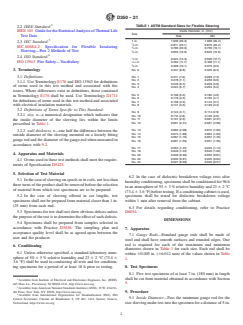
3.2.1 size, n—a numerical designation which indicates that
No. 10 0.112 (2.8) 0.102 (2.6)
No. 11 0.101 (2.6) 0.091 (2.31)
the inside diameter of the sleeving lies within the limits
No. 12 0.091 (2.31) 0.081 (2.06)
prescribed in Table 1.
No. 13 0.082 (2.08) 0.072 (1.83)
3.2.2 wall thickness, n—one half the difference between the
No. 14 0.074 (1.88) 0.064 (1.63)
outside diameter of the sleeving mounted on a loosely fitting
No. 15 0.067 (1.70) 0.057 (1.45)
gauge rod and the diameter of the gauge rod when measured in
No. 16 0.061 (1.55) 0.051 (1.30)
accordance with 9.2.
No. 17 0.054 (1.37) 0.045 (1.14)
No. 18 0.049 (1.24) 0.040 (1.02)
4. Apparatus and Materials
No. 20 0.039 (0.99) 0.032 (0.81)
No. 22 0.032 (0.81) 0.025 (0.64)
4.1 Ovens used in these test methods shall meet the require-
No. 24 0.027 (0.69) 0.020 (0.51)
ments of Specification D5423.
5. Selection of Test Material
6.2 In the case of dielectric breakdown voltage tests after
5.1 Inthecaseofsleevingonspoolsorincoils,notlessthan
humidityconditioning,specimensshallbeconditionedfor96h
three turns of the product shall be removed before the selection
in an atmosphere of 93 6 3 % relative humidity and 23 62°C
of material from which test specimens are to be prepared.
(73.4 63.6°F)beforetesting.Ifaconditioningcabinetisused,
5.2 In the case of sleeving offered in cut lengths, test
specimens shall be tested for dielectric breakdown voltage
specimens shall not be prepared from material closer than 1 in.
within 1 min after removal from the cabinet.
(25 mm) from each end.
6.3 For details regarding conditioning, refer to Practice
5.3 Specimensfortestshallnotshowobviousdefectsunless
D6054.
thepurposeofthetestistodeterminetheeffectofsuchdefects.
DIMENSIONS
5.4 Specimens shall be prepared from samples selected in
accordance with Practice D3636. The sampling plan and
7. Apparatus
acceptance quality level shall be as agreed upon between the
7.1 Gauge Rods—Standard gauge rods shall be made of
user and the producer.
steel and shall have smooth surfaces and rounded edges. One
rod is required for each of the maximum and minimum
6. Conditioning
diameters shown in Table 1 for each size. Each rod shall be
6.1 Unless otherwise specified, a standard laboratory atmo-
within 60.005 in. (66.012 mm) of the values shown in Table
sphere of 50 6 5 % relative humidity and 23 6 2 °C (73.4 6
1.
3.6 °F) shall be used in conducting all tests and for condition-
ing specimens for a period of at least 18 h prior to testing.
8. Test Specimens
8.1 Five test specimens of at least 7 in. (180 mm) in length
shall be cut from material obtained in accordance with Section
Available from Institute of Electrical and Electronics Engineers, Inc. (IEEE),
5.
445 Hoes Ln., Piscataway, NJ 08854-4141, http://www.ieee.org.
Available fromAmerican National Standards Institute (ANSI), 25 W. 43rd St.,
4th Floor, New York, NY 10036, http://www.ansi.org. 9. Procedure
Available from International Organization for Standardization (ISO), ISO
9.1 Inside Diameter—Pass the minimum gauge rod for the
Central Secretariat, Chemin de Blandonnet 8, CP 401, 1214 Vernier, Geneva,
Switzerland, https://www.iso.org. sizesleevingundertestintothespecimenforadistanceof5in.
D350 − 21
(127mm)withoutexpandingthewallofthesleeving.Iftherod stress without failure. This value does not correspond to the
has a snug fit, then consider the specimen as having an inside dielectric breakdown voltage expected in service, but is of
diameter equal to the diameter of the rod. If the minimum value in comparing different materials or different lots, in
gauge rod fits loosely, insert the maximum gauge rod into the controlling manufacturing processes or, when coupled with
specimen. If the maximum gauge rod passes freely into the experience, for a limited degree of design work. The compari-
specimen for a distance of 5 in. with a snug fit, or if it expands son of dielectric breakdown voltage of the same sleeving
the wall of the specimen, then consider the sleeving to be of before and after environmental conditioning (moisture, heat,
that size which falls within the limits of the maximum and andthelike)givesameasureofitsabilitytoresisttheseeffects.
minimum inside diameters as represented by the gauge rods. For a more detailed discussion, refer to Test Method D149.
9.2 Wall Thickness—Insert in the specimen the largest
13. Apparatus
standard gauge rod that will pass freely into the sleeving.
13.1 Inner Electrode—Astraightsuitablemetallicconductor
Apply a micrometer over the specimen and make thickness
which fits snugly into the sleeving, without stretching the wall,
measurements as specified in Method C of Test Methods D374
in such a manner that one end of the wire is exposed and can
except that the force on the pressor foot shall be 3 oz (85 g).
be used to support the specimen.
Obtain the average of five thickness readings taking the
13.1.1 Forspecimenshavinganinsidediametergreaterthan
micrometer readings at approximately 90° intervals about the
about size 8, the use of stranded conductors or of a bundle of
circumference of the specimen and spaced lineally approxi-
wires of smaller size, is recommended, instead of using a solid
mately 0.25 in. (6 mm). Methods A and B of Test Methods
conductor.
D374 can be used as alternative methods where agreed upon
between the manufacturer and purchaser. Compute wall thick-
13.2 Outer Electrode—Strips of soft metal foil 1-in. (25
ness as half the distance between the outside diameter of the
mm) wide and not more than 0.001 in. (0.03 mm) in thickness.
mounted sleeving and the diameter of the gauge rod.
14. Procedure A—Straight Specimens
10. Report
14.1 Test Specimens—Ten specimens 7 in. (180 mm) long
10.1 Report the following information:
shall be prepared for each conditioning test (see Section 6)
10.1.1 Identification of the sleeving,
from material selected in accordance with Section 5.
10.1.2 Method of measurement if other than Method C,
14.2 Procedure:
10.1.3 Size of sleeving, and
14.2.1 After conditioning in accordance with 6.1, determine
10.1.4 Wall thickness.
the dielectric breakdown voltage in accordance with Test
Method D149 except as specified in 14.2.2 and 14.2.3.
TABLE 2 Estimated Precision of Wall Thickness Measurement
14.2.2 Mount a sleeving specimen on the inner electrode.
Nominal Value, (Sr), (SR),
j j
Sleeving Type Wrap the outer electrode tightly on the outside of the sleeving
in. (mm) in. (mm) in. (mm)
atadistanceofnotlessthan1in.(25mm)fromtheendsofthe
Acrylic 0.0213 (0.54) 0.0007 (0.018) 0.0017 (0.043)
specimens. Snugly wrap the foil over the sleeving. Wind two
PVC 0.0237 (0.60) 0.0007 (0.018) 0.0021 (0.053)
Silicone Rubber 0.0331 (0.84) 0.0012 (0.030) 0.0019 (0.048)
moreturnsoffoiloverthefirstturn,leavingafreeendofabout
0.5 in. (13 mm) to which an electrical contact can be made.
14.2.3 Determine the breakdown voltage, in accordance
with Test Method D149 by the short time method, increasing
11. Precision and Bias
the voltage from zero at a rate of 0.5 kV/s. Calculate the
11.1 Precision—The overall estimates of the precision
average breakdown voltage for the ten tests.
within laboratories (Sr) and the precision between laboratories
j
(SR) for the determination of wall thickness are given in Table
j
15. Procedure B—90° Bent Specimens
2 for three selected materials. These estimates are based on a
15.1 Test Specimens—Ten specimens 4 in. (100 mm) long
round robin of the three materials with six laboratories partici-
shall be prepared for each conditioning test (see Section 6)
pating.
from material selected in accordance with Section 5.
11.2 Bias—This test method has no bias because the value
15.2 Procedure:
for wall thickness is determined solely in terms of this test
15.2.1 Mount a sleeving specimen on the inner electrode.
method itself.
15.2.2 Bend the specimen through an angle of 90 6 2° over
DIELECTRIC BREAKDOWN VOLTAGE
a smooth mandrel having a diameter of ten times the nominal
inside diameter of the specimen.Arrange the bend so that it is
12. Significance and Use
centrally located on the specimen.
12.1 The dielectric breakdown voltage of the sleeving is of
15.2.3 Condition the samples as specified in 6.1.
importance as a measure of its ability to withstand electrical 15.2.4 Determine the dielectric breakdown voltage of the
bent specimen using the following procedure:
15.2.4.1 Carefully wrap a strip of metal foil as in 14.2.2
Supporting data have been filed at ASTM International Headquarters and may
snugly over the specimens at the bend. In accordance withTest
beobtainedbyrequestingResearchReportRR:D09-1024.ContactASTMCustomer
Service at service@astm.org. Method D149 apply a voltage starting at zero and increasing at
D350 − 21
a constant rate of 0.5 kV/s until breakdown. Calculate the 19.1.2 Forsleevingsizes7through1in.insidediameter,cut
average breakdown voltage of the ten specimens. specimens 0.25 in. (6.4 mm) wide and 1.5 in. (38 mm) long
15.2.4.2 Apply the foil electrode after exposure to condi- with the longer dimension parallel to the axis of the sleeving.
tioning. Take care to avoid cutting the specimens from the edges of
sleeving that has been flattened during manufacture or storage.
16. Report
19.1.3 Useonlymotor-drivenorgravity-fallapparatus,such
as described in Test Methods D876. Mount specimens so that
16.1 Report the following information:
the striking edge of the apparatus contacts the film and not the
16.1.1 Identification of the sleeving,
braid.
16.1.2 Conditioning before test,
19.1.4 Failure of a specimen is indicated by cracking of the
16.1.3 Voltage breakdown for each puncture,
film completely through to the braid, as determined by visual
16.1.4 Average, minimum, and maximum voltage
examination.
breakdown,
16.1.5 Procedure used (Method A or B), and
20. Report
16.1.6 Temperatureandrelativehumidityoftest,ifdifferent
20.1 Report the following information:
from 6.1.
20.1.1 Identification of the sleeving,
17. Precision and Bias
20.1.2 Brittleness temperature to the nearest °C,
20.1.3 Method of calculation (see Test Method D746),
17.1 Precision—The overall estimates of the precision
20.1.4 Type of apparatus used, and
within laboratories (Sr) and the precision between laboratories
j
20.1.5 Number of specimens tested.
(SR) forthedeterminationofDielectricBreakdownVoltageby
j
Procedure A are given in Table 3 for three selected materials.
21. Precision and Bias
These estimates are based on a round robin of the three
21.1 Precision—This test method has been in use for many
materials with six laboratories participating.
years, but no information has been presented to ASTM upon
17.2 Bias—This test method has no bias because the value
which to base a statement of precision. No activity has been
for dielectric breakdown voltage is determined solely in terms
planned to develop such information.
of this test method.
21.2 Bias—This test method has no bias because the value
BRITTLENESS TEMPERATURE
for brittleness temperature is determined solely in terms of this
test method.
18. Significance and Use
FLAMMABILITY—METHOD A
18.1 This test method serves to measure the brittleness
temperature of the sleeving. It is useful for comparative and
22. Procedure—Determine the flammability in accordance
quality control purposes.
with test method A in Test Methods D8355.
18.2 Results of this test have not been found to correlate
FLAMMABILITY—METHOD B
with those obtained by bending or flexing around mandrels at
low temperatures. Brittleness temperatures determined for
23. Procedure—Determine the flammability in accordance
sleeving materials by this test are affected by differences in
with test method B in Test Methods D8355.
cross-sectional dimensions and in specimen configuration,
even if the materials have the same composition.
DIELECTRIC BREAKDOWN VOLTAGE AFTER
SHORT-TIME AGING
19. Procedure
24. Significance and Use
19.1 Determine the brittleness temperature in accordance
with Test Method D746, except as specified in 19.1.1 – 19.1.4.
24.1 This test method serves to indicate the resistance of
19.1.1 Forsleevingsizes20through8,cutspecimensinfull
sleeving to the effects of short-time exposure to elevated
section and 1.5 in. (38 mm) long.
temperatures. While this test method provides a means of
determining continuity of quality and is useful as a lot
acceptance test, it is not intended to provide information
TABLE 3 Estimated Precision of Dielectric Breakdown Voltage
regarding the thermal endurance of the sleeving (see Sections
Measurement
33 to 39).
Nominal Value, (Sr), (SR),
j j
Sleeving Type
volts volts volts
25. Test Specimens
Conditioned 18 h/23 °C/50 % RH
Acrylic 8480 802 1126
25.1 Prepare five 90° bent test specimens as described in
PVC 10980 983 1528
15.2.1 and 15.2.2.
Silicone Rubber 10770 904 1616
Conditioned 96 h/23 °C/93 % RH
26. Procedure
Acrylic 2048 197 828
PVC 8100 1003 2137
26.1 Condition the test specimens in an oven for a period of
Silicone Rubber 8540 1367 2550
96 h at a temperature 50 °C (90 °F) higher than the nominal
D350 − 21
temperature index of the sleeving. Remove the specimens and THERMAL ENDURANCE
allow to cool to room temperature. Apply the outer electrode
33. Summary of Test Method
and determine the dielectric breakdown voltage in accordance
with 14.2.
33.1 This test method describes preparation of specimens,
aging of specimens at elevated temperatures, and periodic
27. Report
testing of breakdown voltage. The data obtained are used to
plot a regression line on logarithmic-time versus reciprocal-
27.1 Report the following information:
absolute-temperature coordinates from which the thermal en-
27.1.1 Identification of the sleeving,
durance in terms of a temperature index is derived.
27.1.2 Temperature of conditioning, and
27.1.3 Average, minimum, and maximum voltage break-
34. Significance and Use
down values.
34.1 This test method is useful in determining the relative
thermal endurance of sleeving initially capable of being bent
28. Precision and Bias
90° without splitting.
28.1 Precision—This test method has been in use for many
34.2 The criterion of failure by this test method is reduction
years, but no information has been presented to ASTM upon
of breakdown voltage of the sleeving below a value of 3500 V.
which to base a statement of precision. No activity has been
It is believed that this embodies several modes of failure, such
planned to develop such information.
as cracking by embrittlement, volatilization, porosity, and
28.2 Bias—This test method has no bias because the value
crazing, which are not independently determinable.
for dielectric breakdown voltage after short-time aging is
34.3 Thermal endurance is based on the evaluation of 7.0
determined solely in terms of this test method.
kV grade, size 12 sleeving, even though it is recognized that
OIL RESISTANCE
laboratory results do not necessarily agree with those obtained
using other voltage grades and sizes. Future work will attempt
29. Test Specimens to determine the effects of grade and size differences, if any.
29.1 Cut three specimens, each 3 in. (76 mm) long, from
35. Apparatus and Materials
material selected in accordance with Section 5.
35.1 Soft Copper Wire, AWG Size No. 12, bare.
30. Procedure
36. Test Specimens
30.1 Immerse the specimens for 24 h inASTM Oil No. 2 as
36.1 Obtain specimens 4 in. (100 mm) in length from size
described in Test Method D471, the oil being maintained at a
12 sleeving having an average voltage breakdown value of
temperature of 105 6 2 °C (221 6 3.6 °F). At the end of this
between 7 and 9 kV. This size and voltage range is defined as
period, remove the specimens from the oil, wipe off excess oil
the qualifying style.
withacleancloth,andexaminethespecimensfordeterioration
as evidenced by blistering, splitting, flaking off of the film, and NOTE 3—Experience has indicated that the initial breakdown voltage,
which is a function of coating thickness, can be a factor affecting thermal
other visual defects.
life.Alimited range of initial breakdown voltage has been set to minimize
NOTE 2—Oil meeting Specification D3487 has been found suitable as a
this as a possible variable.
substitute for ASTM Oil No. 2.
36.2 Specimens shall be randomized with respect to posi-
30.2 Determine the degree of swelling by measurements of
tioninthesample,withcarebeingexercisedtopreventdamage
wall thickness as specified in 9.2.
to the sleeving during this process.
31. Report
37. Procedure
31.1 Report the following information: 37.1 Place the sleeving on a 5-in. (130 mm) straight length
of copper wire, which fits snugly into the sleeving without
31.1.1 Identification of the sleeving,
stretching the wall, in such a manner that one end of the wire
31.1.2 Evidence of deterioration of the sleeving,
isexposedandcanbeusedtosupportthespecimenintheoven.
31.1.3 Percentage of increase in wall thickness, and
31.1.4 Type of oil used (if other than ASTM No. 2).
37.2 Bend the specimen through an angle of 90 6 2° over
a smooth mandrel having a diameter of 0.85 6 0.04 in. (21.6
32. Precision
...
This document is not an ASTM standard and is intended only to provide the user of an ASTM standard an indication of what changes have been made to the previous version. Because
it may not be technically possible to adequately depict all changes accurately, ASTM recommends that users consult prior editions as appropriate. In all cases only the current version
of the standard as published by ASTM is to be considered the official document.
Designation: D350 − 13 D350 − 21
Standard Test Methods for
Flexible Treated Sleeving Used for Electrical Insulation
This standard is issued under the fixed designation D350; the number immediately following the designation indicates the year of
original adoption or, in the case of revision, the year of last revision. A number in parentheses indicates the year of last reapproval. A
superscript epsilon (´) indicates an editorial change since the last revision or reapproval.
This standard has been approved for use by agencies of the U.S. Department of Defense.
1. Scope*Scope
1.1 These test methods cover procedures for testing electrical insulating sleeving comprising a flexible tubular product made from
a woven textile fibre base, such as cotton, rayon, nylon, or glass, thereafter impregnated, or coated, or impregnated and coated,
with a suitable dielectric material.
1.2 The procedures appear in the following sections:
Procedures Section(s)
Selection of Test Material 5
Conditioning 6
Dimensions 7 to 11
Dielectric Breakdown Voltage 12 to 17
Brittleness Temperature 18 to 21
Flammability (See Test Methods D8355) 22 to 23
Dielectric Breakdown Voltage After Short-Time Aging 24 to 28
Oil Resistance 29 to 32
Thermal Endurance 33 to 39
Compatibility of Sleeving with Magnet Wire Insulation 40 to 54
Solvent Resistance 55 to 60
Hydrolytic Stability 61 to 67
Effect of Push-Back After Heat Aging 68 to 73
Procedures Sections
Brittleness Temperature 18 to 21
Compatibility of Sleeving with Magnet Wire Insulation 45 to 59
Conditioning 6
Dielectric Breakdown Voltage 12 to 17
Dielectric Breakdown Voltage After Short-Time Aging 29 to 33
Dimensions 7 to 11
Effect of Push-Back After Heat Aging 73 to 78
Flammability 22 to 28
Hydrolytic Stability 66 to 72
Oil Resistance 34 to 37
Selection of Test Material 5
Solvent Resistance 60 to 65
Thermal Endurance 38 to 44
1.3 The values stated in inch-pound units, except for °C, are to be regarded as the standard. The values in parentheses are
mathematical conversions to SI units that are provided for information only and are not considered standard.
These test methods are under the jurisdiction of ASTM Committee D09 on Electrical and Electronic Insulating Materials and are the direct responsibility of Subcommittee
D09.07 on Flexible and Rigid Electrical Insulating Materials.
Current edition approved Nov. 1, 2013Jan. 1, 2021. Published December 2013February 2021. Originally approved in 1932. Last previous edition approved in 20092013
as D350 – 09.D350 – 13. DOI: 10.1520/D0350-13.10.1520/D0350-21.
*A Summary of Changes section appears at the end of this standard
Copyright © ASTM International, 100 Barr Harbor Drive, PO Box C700, West Conshohocken, PA 19428-2959. United States
D350 − 21
1.4 This is a fire-test-response standard. See SectionsTest 22 throughMethods D835528, which are the contains procedures for
flammability tests.
1.5 This standard measures and describes the response of materials, products, or assemblies to heat and flame under controlled
conditions, but does not by itself incorporate all factors required for fire hazard or fire risk assessment of the materials, products
or assemblies under actual fire conditions.
1.5 This standard does not purport to address all of the safety concerns, if any, associated with its use. It is the responsibility
of the user of this standard to establish appropriate safety safety, health, and healthenvironmental practices and determine the
applicability of regulatory limitations prior to use. For specific hazard statements, see 45.240.2 and 63.1.158.1.1.
NOTE 1—This standard resembles IEC 60684-2, Specification for Flexible Insulating Sleeving—Part 2 Methods of Test, in a number of ways, but is not
consistently similar throughout. The data obtained using either standard are not necessarily technically equivalent.
1.7 Fire testing is inherently hazardous. Adequate safeguards for personnel and property shall be employed in conducting these
tests.
1.6 This international standard was developed in accordance with internationally recognized principles on standardization
established in the Decision on Principles for the Development of International Standards, Guides and Recommendations issued
by the World Trade Organization Technical Barriers to Trade (TBT) Committee.
2. Referenced Documents
2.1 ASTM Standards:
D149 Test Method for Dielectric Breakdown Voltage and Dielectric Strength of Solid Electrical Insulating Materials at
Commercial Power Frequencies
D374 Test Methods for Thickness of Solid Electrical Insulation (Metric) D0374_D0374M
D471 Test Method for Rubber Property—Effect of Liquids
D746 Test Method for Brittleness Temperature of Plastics and Elastomers by Impact
D876 Test Methods for Nonrigid Vinyl Chloride Polymer Tubing Used for Electrical Insulation
D1711 Terminology Relating to Electrical Insulation
D2307 Test Method for Thermal Endurance of Film-Insulated Round Magnet Wire
D3487 Specification for Mineral Insulating Oil Used in Electrical Apparatus
D3636 Practice for Sampling and Judging Quality of Solid Electrical Insulating Materials
D5423 Specification for Forced-Convection Laboratory Ovens for Evaluation of Electrical Insulation
D6054 Practice for Conditioning Electrical Insulating Materials for Testing (Withdrawn 2012)
D8355 Test Methods for Flammability of Electrical Insulating Materials Used for Sleeving or Tubing
E145 Specification for Gravity-Convection and Forced-Ventilation Ovens
E176 Terminology of Fire Standards
2.2 IEEE Standard:
IEEE 101 Guide for the Statistical Analysis of Thermal Life Test Data
2.3 IEC Standard:
IEC 60684-2 Specification for Flexible Insulating Sleeving—Part 2 Methods of Test
2.4 ISO Standard:
ISO 13943 Fire Safety—Vocabulary
3. Terminology
3.1 Definitions:
3.1.1 Use Terminology E176 and ISO 13943 for definitions of terms used in this test method and associated with fire issues. Where
For referenced ASTM standards, visit the ASTM website, www.astm.org, or contact ASTM Customer Service at service@astm.org. For Annual Book of ASTM Standards
volume information, refer to the standard’s Document Summary page on the ASTM website.
The last approved version of this historical standard is referenced on www.astm.org.
Available from Institute of Electrical and Electronics Engineers, Inc. (IEEE), 445 Hoes Ln., P.O. Box 1331, Piscataway, NJ 08854-1331,08854-4141, http://www.ieee.org.
Available from American National Standards Institute (ANSI), 25 W. 43rd St., 4th Floor, New York, NY 10036, http://www.ansi.org.
Available from International Organization for Standardization (ISO), ISO Central Secretariat, Chemin de Blandonnet 8, CP 401, 1214 Vernier, Geneva, Switzerland,
https://www.iso.org.
D350 − 21
differences exist in definitions, those contained in Terminology E176 shall be used. Use Terminology D1711 for definitions of
terms used in this test method and associated with electrical insulation materials.
3.2 Definitions of Terms Specific to This Standard:
3.2.1 size, n—a numerical designation which indicates that the inside diameter of the sleeving lies within the limits prescribed in
Table 1.
3.2.2 wall thickness, n—one half the difference between the outside diameter of the sleeving mounted on a loosely fitting
gagegauge rod and the diameter of the gagegauge rod when measured in accordance with 9.2.
4. Apparatus and Materials
4.1 Ovens used in these test methods shall meet the requirements of Specification D5423.
5. Selection of Test Material
5.1 In the case of sleeving on spools or in coils, not less than three turns of the product shall be removed before the selection of
material from which test specimens are to be prepared.
5.2 In the case of sleeving offered in cut lengths, test specimens shall not be prepared from material closer than 1 in. (25 mm)
from each end.
5.3 Specimens for test shall not show obvious defects unless the purpose of the test is to determine the effect of such defects.
5.4 Specimens shall be prepared from samples selected in accordance with Practice D3636. The sampling plan and acceptance
quality level shall be as agreed upon between the user and the producer.
TABLE 1 ASTM Standard Sizes for Flexible Sleeving
Inside Diameter, in. (mm)
Size
Max Min
1 in. 1.036 (26.3) 1.000 (25.4)
⁄8 in. 0.911 (23.1) 0.875 (22.2)
⁄4 in. 0.786 (20.0) 0.750 (19.1)
⁄8 in. 0.655 (16.6) 0.625 (15.9)
⁄2 in. 0.524 (13.3) 0.500 (12.7)
⁄16 in. 0.462 (11.7) 0.438 (11.1)
⁄8 in. 0.399 (10.1) 0.375 (9.5)
No. 0 0.347 (8.8) 0.325 (8.3)
No. 1 0.311 (7.9) 0.289 (7.3)
No. 2 0.278 (7.1) 0.258 (6.6)
No. 3 0.249 (6.3) 0.229 (5.8)
No. 4 0.224 (5.7) 0.204 (5.2)
No. 5 0.198 (5.0) 0.182 (4.6)
No. 6 0.178 (4.5) 0.162 (4.1)
No. 7 0.158 (4.0) 0.144 (3.7)
No. 8 0.141 (3.6) 0.129 (3.3)
No. 9 0.124 (3.1) 0.114 (2.9)
No. 10 0.112 (2.8) 0.102 (2.6)
No. 11 0.101 (2.6) 0.091 (2.31)
No. 12 0.091 (2.31) 0.081 (2.06)
No. 13 0.082 (2.08) 0.072 (1.83)
No. 14 0.074 (1.88) 0.064 (1.63)
No. 15 0.067 (1.70) 0.057 (1.45)
No. 16 0.061 (1.55) 0.051 (1.30)
No. 17 0.054 (1.37) 0.045 (1.14)
No. 18 0.049 (1.24) 0.040 (1.02)
No. 20 0.039 (0.99) 0.032 (0.81)
No. 22 0.032 (0.81) 0.025 (0.64)
No. 24 0.027 (0.69) 0.020 (0.51)
D350 − 21
6. Conditioning
6.1 Unless otherwise specified, a standard laboratory atmosphere of 50 6 5 % relative humidity and 23 6 2 °C (73.4 6 3.6 °F)
shall be used in conducting all tests and for conditioning specimens for a period of at least 18 h prior to testing.
6.2 In the case of dielectric breakdown voltage tests after humidity conditioning, specimens shall be conditioned for 96 h in an
atmosphere of 93 6 3 % relative humidity and 23 6 2 °C (73.4 6 3.6 °F) before testing. If a conditioning cabinet is used,
specimens shall be tested for dielectric breakdown voltage within 1 min after removal from the cabinet.
6.3 For details regarding conditioning, refer to Practice D6054.
DIMENSIONS
7. Apparatus
7.1 GageGauge Rods—Standard gagegauge rods shall be made of steel and shall have smooth surfaces and rounded edges. One
rod is required for each of the maximum and minimum diameters shown in Table 1 for each size. Each rod shall be within 60.005
in. (66.012 mm) of the values shown in Table 1.
8. Test Specimens
8.1 Five test specimens of at least 7 in. (180 mm) in length shall be cut from material obtained in accordance with Section 5.
9. Procedure
9.1 Inside Diameter—Pass the minimum gagegauge rod for the size sleeving under test into the specimen for a distance of 5 in.
(127 mm) without expanding the wall of the sleeving. If the rod has a snug fit, then consider the specimen as having an inside
diameter equal to the diameter of the rod. If the minimum gagegauge rod fits loosely, insert the maximum gagegauge rod into the
specimen. If the maximum gagegauge rod passes freely into the specimen for a distance of 5 in. with a snug fit, or if it expands
the wall of the specimen, then consider the sleeving to be of that size which falls within the limits of the maximum and minimum
inside diameters as represented by the gagegauge rods.
9.2 Wall Thickness—Insert in the specimen the largest standard gagegauge rod that will pass freely into the sleeving. Apply a
micrometer over the specimen and make thickness measurements as specified in Method C of Test Methods D374 except that the
force on the pressor foot shall be 3 oz (85 g). Obtain the average of five thickness readings taking the micrometer readings at
approximately 90° intervals about the circumference of the specimen and spaced lineally approximately 0.25 in. (6 mm). Methods
A and B of Test Methods D374 can be used as alternative methods where agreed upon between the manufacturer and purchaser.
Compute wall thickness as half the distance between the outside diameter of the mounted sleeving and the diameter of the
gagegauge rod.
10. Report
10.1 Report the following information:
10.1.1 Identification of the sleeving,
10.1.2 Method of measurement if other than Method C,
10.1.3 Size of sleeving, and
10.1.4 Wall thickness.
11. Precision and Bias
11.1 Precision—The overall estimates of the precision within laboratories (Sr) and the precision between laboratories (SR) for
j j
D350 − 21
TABLE 2 Estimated Precision of Wall Thickness Measurement
Nominal Value, (Sr) , (SR) ,
j j
Sleeving Type
in. (mm) in. (mm) in. (mm)
Acrylic 0.0213 (0.54) 0.0007 (0.018) 0.0017 (0.043)
PVC 0.0237 (0.60) 0.0007 (0.018) 0.0021 (0.053)
Silicone Rubber 0.0331 (0.84) 0.0012 (0.030) 0.0019 (0.048)
the determination of wall thickness are given in Table 2 for three selected materials. These estimates are based on a round robin
of the three materials with six laboratories participating.
11.2 Bias—This test method has no bias because the value for wall thickness is determined solely in terms of this test method
itself.
DIELECTRIC BREAKDOWN VOLTAGE
12. Significance and Use
12.1 The dielectric breakdown voltage of the sleeving is of importance as a measure of its ability to withstand electrical stress
without failure. This value does not correspond to the dielectric breakdown voltage expected in service, but is of value in
comparing different materials or different lots, in controlling manufacturing processes or, when coupled with experience, for a
limited degree of design work. The comparison of dielectric breakdown voltage of the same sleeving before and after
environmental conditioning (moisture, heat, and the like) gives a measure of its ability to resist these effects. For a more detailed
discussion, refer to Test Method D149.
13. Apparatus
13.1 Inner Electrode—A straight suitable metallic conductor which fits snugly into the sleeving, without stretching the wall, in
such a manner that one end of the wire is exposed and can be used to support the specimen.
13.1.1 For specimens having an inside diameter greater than about size 8, the use of stranded conductors or of a bundle of wires
of smaller size, is recommended, instead of using a solid conductor.
13.2 Outer Electrode—Strips of soft metal foil 1-in. (25-mm) (25 mm) wide and not more than 0.001 in. (0.03 mm) in thickness.
14. Procedure A—Straight Specimens
14.1 Test Specimens—Ten specimens 7 in. (180 mm) long shall be prepared for each conditioning test (see Section 6) from
material selected in accordance with Section 5.
14.2 Procedure:
14.2.1 After conditioning in accordance with 6.1, determine the dielectric breakdown voltage in accordance with Test Method
D149 except as specified in 14.2.2 and 14.2.3.
14.2.2 Mount a sleeving specimen on the inner electrode. Wrap the outer electrode tightly on the outside of the sleeving at a
distance of not less than 1 in. (25 mm) from the ends of the specimens. Snugly wrap the foil over the sleeving. Wind two more
turns of foil over the first turn, leaving a free end of about 0.5 in. (13 mm) to which an electrical contact can be made.
14.2.3 Determine the breakdown voltage, in accordance with Test Method D149 by the short time method, increasing the voltage
from zero at a rate of 0.5 kV/s. Calculate the average breakdown voltage for the ten tests.
Supporting data have been filed at ASTM International Headquarters and may be obtained by requesting Research Report RR: RR:D09-1024. Contact ASTM Customer
Service at service@astm.org.
D350 − 21
15. Procedure B—90° Bent Specimens
15.1 Test Specimens—Ten specimens 4 in. (100 mm) long shall be prepared for each conditioning test (see Section 6) from
material selected in accordance with Section 5.
15.2 Procedure:
15.2.1 Mount a sleeving specimen on the inner electrode.
15.2.2 Bend the specimen through an angle of 90 6 2° over a smooth mandrel having a diameter of ten times the nominal inside
diameter of the specimen. Arrange the bend so that it is centrally located on the specimen.
15.2.3 Condition the samples as specified in 6.1.
15.2.4 Determine the dielectric breakdown voltage of the bent specimen using the following procedure:
15.2.4.1 Carefully wrap a strip of metal foil as in 14.2.2 snugly over the specimens at the bend. In accordance with Test Method
D149 apply a voltage starting at zero and increasing at a constant rate of 0.5 kV/s until breakdown. Calculate the average
breakdown voltage of the ten specimens.
15.2.4.2 Apply the foil electrode after exposure to conditioning.
16. Report
16.1 Report the following information:
16.1.1 Identification of the sleeving,
16.1.2 Conditioning before test,
16.1.3 Voltage breakdown for each puncture,
16.1.4 Average, minimum, and maximum voltage breakdown,
16.1.5 Procedure used (Method A or B), and
16.1.6 Temperature and relative humidity of test, if different from 6.1.
17. Precision and Bias
17.1 Precision—The overall estimates of the precision within laboratories (Sr) and the precision between laboratories (SR) for
j j
the determination of Dielectric Breakdown Voltage by Procedure A are given in Table 3 for three selected materials. These
estimates are based on a round robin of the three materials with six laboratories participating.
17.2 Bias—This test method has no bias because the value for dielectric breakdown voltage is determined solely in terms of this
test method.
TABLE 3 Estimated Precision of Dielectric Breakdown Voltage
Measurement
Nominal Value, (Sr) , (SR) ,
j j
Sleeving Type
Volts volts Volts volts Volts volts
Conditioned 18 h/23 °C/50 % RH
Acrylic 8480 802 1126
PVC 10980 983 1528
Silicone Rubber 10770 904 1616
Conditioned 96 h/23 °C/93 % RH
Acrylic 2048 197 828
PVC 8100 1003 2137
Silicone Rubber 8540 1367 2550
D350 − 21
BRITTLENESS TEMPERATURE
18. Significance and Use
18.1 This test method serves to measure the brittleness temperature of the sleeving. It is useful for comparative and quality control
purposes.
18.2 Results of this test have not been found to correlate with those obtained by bending or flexing around mandrels at low
temperatures. Brittleness temperatures determined for sleeving materials by this test are affected by differences in cross-sectional
dimensions and in specimen configuration, even if the materials have the same composition.
19. Procedure
19.1 Determine the brittleness temperature in accordance with Test Method D746, except as specified in 19.1.1 – 19.1.4.
19.1.1 For sleeving sizes 20 through 8, cut specimens in full section and 1.5 in. (38 mm) long.
19.1.2 For sleeving sizes 7 through 1 in. inside diameter, cut specimens 0.25 in. (6.4 mm) wide and 1.5 in. (38 mm) long with
the longer dimension parallel to the axis of the sleeving. Take care to avoid cutting the specimens from the edges of sleeving that
has been flattened during manufacture or storage.
19.1.3 Use only motor-driven or gravity-fall apparatus, such as described in Test Methods D876. Mount specimens so that the
striking edge of the apparatus contacts the film and not the braid.
19.1.4 Failure of a specimen is indicated by cracking of the film completely through to the braid, as determined by visual
examination.
20. Report
20.1 Report the following information:
20.1.1 Identification of the sleeving,
20.1.2 Brittleness temperature to the nearest °C,
20.1.3 Method of calculation (see Test Method D746),
20.1.4 Type of apparatus used, and
20.1.5 Number of specimens tested.
21. Precision and Bias
21.1 Precision—This test method has been in use for many years, but no information has been presented to ASTM upon which
to base a statement of precision. No activity has been planned to develop such information.
21.2 Bias—This test method has no bias because the value for brittleness temperature is determined solely in terms of this test
method.
FLAMMABILITY—METHOD A
22. Procedure—Determine the flammability in accordance with test method A in Test Methods D8355.
22.1 Determine the flammability in accordance with Test Methods D876. The results of this test give an indication of the tendency
of the material to burn in case of fire.
D350 − 21
FLAMMABILITY—METHOD B
23. Significance and Use
23.1 This test gives an indication of the relative rate at which materials that will burn will propagate a flame.
24. Apparatus
24.1 Bunsen burner.
24.2 Stopwatch.
25. Test Specimens
25.1 Cut at least three specimens from the material selected in accordance with Section 5.
23. Procedure—Determine the flammability in accordance with test method B in Test Methods D8355.
26.1 Mark a gage length of 1 in. (25 mm) on each test specimen approximately 0.5 in. (13 mm) from one end of the specimen.
Using a method that will not distort the test area, close the other end to prevent passage of air through the specimen during the
test.
26.2 Insert the open end of the sleeving into the side of the burner flame with the lower side of the sleeving about 0.5 in. (13 mm)
above the top of the burner. Rotate the specimen in the flame to ignite it uniformly. Remove the sleeving from the flame and hold
vertically in the air with the burning end uppermost.
26.3 Start the timer when the leading edge of the flame reaches the upper gage mark and observe the time in seconds for the
leading edge of the flame to travel down the specimen to the lower gage mark.
27. Report
27.1 Report the following information:
27.1.1 Identification of the sleeving, and
27.1.2 For each specimen, the time in seconds required to burn 1 in. (25.4 mm).
28. Precision and Bias
28.1 No statement is made about either the precision or the bias of this test method since the result merely states whether there
is conformance to the criteria for success as specified in the procedure.
DIELECTRIC BREAKDOWN VOLTAGE AFTER SHORT-TIME AGING
24. Significance and Use
24.1 This test method serves to indicate the resistance of sleeving to the effects of short-time exposure to elevated temperatures.
While this test method provides a means of determining continuity of quality and is useful as a lot acceptance test, it is not intended
to provide information regarding the thermal endurance of the sleeving (see Sections 3833 to 4439).
25. Test Specimens
25.1 Prepare five 90° bent test specimens as described in 15.2.1 and 15.2.2.
D350 − 21
26. Procedure
26.1 Condition the test specimens in an oven for a period of 96 h at a temperature 50 °C (90 °F) higher than the nominal
temperature index of the sleeving. Remove the specimens and allow to cool to room temperature. Apply the outer electrode and
determine the dielectric breakdown voltage in accordance with 14.2.
27. Report
27.1 Report the following information:
27.1.1 Identification of the sleeving,
27.1.2 Temperature of conditioning, and
27.1.3 Average, minimum, and maximum voltage breakdown values.
28. Precision and Bias
28.1 Precision—This test method has been in use for many years, but no information has been presented to ASTM upon which
to base a statement of precision. No activity has been planned to develop such information.
28.2 Bias—This test method has no bias because the value for dielectric breakdown voltage after short-time aging is determined
solely in terms of this test method.
OIL RESISTANCE
29. Test Specimens
29.1 Cut three specimens, each 3 in. (76 mm) long, from material selected in accordance with Section 5.
30. Procedure
30.1 Immerse the specimens for 24 h in ASTM Oil No. 2 as described in Test Method D471, the oil being maintained at a
temperature of 105 6 2 °C (221 6 3.6 °F). At the end of this period, remove the specimens from the oil, wipe off excess oil with
a clean cloth, and examine the specimens for deterioration as evidenced by blistering, splitting, flaking off of the film, and other
visual defects.
NOTE 2—Oil meeting Specification D3487 has been found suitable as a substitute for ASTM Oil No. 2.
30.2 Determine the degree of swelling by measurements of wall thickness as specified in 9.2.
31. Report
31.1 Report the following information:
31.1.1 Identification of the sleeving,
31.1.2 Evidence of deterioration of the sleeving,
31.1.3 Percentage of increase in wall thickness, and
31.1.4 Type of oil used (if other than ASTM No. 2).
32. Precision and Bias
32.1 Precision—This test method has been in use for many years, but no information has been presented to ASTM upon which
to base a statement of precision. No activity has been planned to develop such information.
D350 − 21
32.2 Bias—This test method has no bias because the value for oil resistance is determined solely in terms of this test method.
THERMAL ENDURANCE
33. Summary of Test Method
33.1 This test method describes preparation of specimens, aging of specimens at elevated temperatures, and periodic testing of
breakdown voltage. The data obtained are used to plot a regression line on logarithmic-time versus reciprocal-absolute-temperature
coordinates from which the thermal endurance in terms of a temperature index is derived.
34. Significance and Use
34.1 This test method is useful in determining the relative thermal endurance of sleeving initially capable of being bent 90°
without splitting.
34.2 The criterion of failure by this test method is reduction of breakdown voltage of the sleeving below a value of 3500 V. It is
believed that this embodies several modes of failure, such as cracking by embrittlement, volatilization, porosity, and crazing, which
are not indepen
...