

ASTM D2303-20e1
(Test Method)Standard Test Methods for Liquid-Contaminant, Inclined-Plane Tracking and Erosion of Insulating Materials
General Information
- Abstract
SIGNIFICANCE AND USE
5.1 These test methods differentiate solid electrical insulating materials on the basis of their resistance to the action of voltage stresses along the surface of the solid when wet with an ionizable, electrically conductive liquid contaminant.
5.2 These test methods quantitatively evaluate, in a relative manner, the effects upon an insulating material resulting from the action of electrical discharges upon a material surface. The effects are similar to those that may occur in service under the influence of dirt combined with moisture condensed from the atmosphere.
5.2.1 In the field, the conditions resulting in electrical discharges occur sporadically. Degradation, often in the form of a conducting “track,” develops very slowly until it ultimately bridges the space between conductors thus causing complete electrical breakdown.
5.2.2 In these test methods, the conducting liquid contaminant is continuously supplied at an optimum rate to the surface of a test specimen in such a fashion that essentially continuous electrical discharge can be maintained.
5.2.3 By producing continuous surface discharge with controlled energy it is possible, within a few hours, to cause specimen failure which is similar to failure occurring under long-time exposure to the erratic conditions of service in the field.
5.2.4 The test conditions, which are standardized and accelerated, do not reproduce all of the conditions encountered in service. Use caution when making either direct or comparative service behavior inferences derived from the results of tracking tests.
5.3 The time-to-track a 1-in. (25 mm) distance at a specified voltage between electrodes separated 2 in. (50 mm) has also been found useful in categorizing insulating materials for indoor and protected outdoor applications, such as metal-clad switchgear.
5.4 The initial tracking voltage has been found useful for evaluating insulating materials to be used at high voltages or outdoors and unprotected, as well...
SCOPE
1.1 These test methods cover the evaluation of the relative tracking and erosion resistance of insulating solids using the liquid-contaminant, inclined-plane test.2 The following test methods also can be used to evaluate the tracking resistance of materials: Test Method D2132 (contaminants: dust and fog) and Test Method D3638 (contaminant: conductive liquid drops).
1.2 Two tracking and one erosion test procedure are described:
1.2.1 A “variable voltage method” to evaluate resistance to tracking.
1.2.2 A “time-to-track method” to evaluate resistance to tracking.
1.2.3 A method for quantitative determination of erosion (Annex A1).
1.3 While a particular contaminant solution is specified, other concentrations of the same contaminant, or different contaminants are used to simulate different environmental or service conditions.
1.4 The values stated in inch-pound units are to be regarded as standard. The values given in parentheses are mathematical conversions to SI units that are provided for information only and are not considered standard.
1.5 Although this standard and IEC 60587-2007, “Test Methods for Evaluating Resistance to Tracking and Erosion for Electrical Insulating Materials Used Under Severe Ambient Conditions,” differ in approach or detail, data obtained using either are technically equivalent.
1.6 This standard does not purport to address all of the safety concerns, if any, associated with its use. It is the responsibility of the user of this standard to establish appropriate safety, health, and environmental practices and determine the applicability of regulatory limitations prior to use. Specific precautionary statements are given in Section 9.
1.7 This international standard was developed in accordance with internationally recognized principles on standardization established in the Decision on Principles for the Development of International Standards, Guides and Recommendations is...
- Status
- Published
- Publication Date
- 31-Jul-2020
- Technical Committee
- D09 - Electrical and Electronic Insulating Materials
- Drafting Committee
- D09.12 - Electrical Tests
Overview
ASTM D2303-20e1, titled Standard Test Methods for Liquid-Contaminant, Inclined-Plane Tracking and Erosion of Insulating Materials, is a widely utilized standard developed by ASTM International. Its primary purpose is to evaluate and compare the resistance of solid electrical insulating materials to tracking and erosion when exposed to voltage stresses in the presence of a liquid contaminant. These test methods simulate service conditions in which atmospheric moisture and ionic contaminants can degrade insulating materials, leading to potential electrical failures.
The standard plays a crucial role in the electrical and electronics industries by providing reliable, accelerated laboratory test methods that support material selection and product development for various insulation applications.
Key Topics
- Tracking Resistance: The ability of insulating materials to resist the formation of conductive paths (tracks) due to surface electrical discharges under wet contamination.
- Erosion Resistance: Measurement of material degradation due to physical and chemical wear from electrical discharges on wet surfaces.
- Test Methods:
- Variable Voltage Method: Evaluates insulating materials' resistance to tracking by varying applied voltage.
- Time-to-Track Method: Measures the time taken for a conductive track to form over a set distance at a constant voltage.
- Erosion Testing: Provides a quantitative approach to assess material loss over time at constant voltage.
- Test Parameters:
- Use of standardized liquid contaminants, such as ammonium chloride solutions.
- Performance under controlled application rates of contaminants.
- Evaluation criteria based on time-to-track and initial tracking voltage.
- Safety Precautions: Emphasizes safe handling of high voltages and chemical contaminants during testing.
Applications
ASTM D2303-20e1 has extensive applications across industries that require robust, reliable electrical insulation. Key uses include:
- Material Selection for Electrical Equipment: Assists manufacturers in evaluating and comparing the performance of insulation in items like switchgear, transformers, and connectors.
- Product Development and Quality Control: Provides a framework for qualifying new insulating materials or formulations under controlled conditions, ensuring suitability for high-voltage or outdoor environments.
- Field Failure Correlation: Supports investigations into performance issues in the field, such as surface tracking and erosion on equipment exposed to contamination and moisture.
- Categorization and Specification: The time-to-track test is particularly useful for categorizing materials for indoor and protected outdoor applications where tracking can cause catastrophic failures.
- Testing Under Simulated Service Conditions: By using various contaminants, the method can simulate a range of environmental conditions, informing product design and maintenance schedules.
Related Standards
When evaluating insulating materials using ASTM D2303-20e1, the following related standards may also be relevant:
- ASTM D2132: Standard Test Method for Dust-and-Fog Tracking and Erosion Resistance of Electrical Insulating Materials.
- ASTM D3638: Standard Test Method for Comparative Tracking Index of Electrical Insulating Materials.
- IEC 60587: Test methods for evaluating resistance to tracking and erosion of electrical insulating materials used under severe ambient conditions.
- ASTM D374: Test Methods for Thickness of Solid Electrical Insulation.
- ASTM D1711: Terminology Relating to Electrical Insulation.
These standards provide complementary or alternative methods for assessing tracking and erosion resistance, broadening the evaluation of materials used in demanding electrical environments.
Keywords: electrical insulation, tracking resistance, erosion resistance, inclined-plane test, liquid contaminant, high voltage test, ASTM D2303, surface tracking, electrical discharge, quality control, electrical safety, standard test methods.
Relations
- Effective Date
- 01-Mar-2024
- Effective Date
- 01-Oct-2023
- Effective Date
- 01-Nov-2018
- Effective Date
- 01-Nov-2015
- Effective Date
- 01-Nov-2014
- Effective Date
- 01-May-2014
- Effective Date
- 01-Nov-2013
- Effective Date
- 01-Jan-2012
- Effective Date
- 01-Aug-2011
- Effective Date
- 15-Apr-2011
- Effective Date
- 01-May-2008
- Effective Date
- 01-Jun-2007
- Effective Date
- 01-Oct-2003
- Effective Date
- 10-Mar-2002
- Effective Date
- 10-Oct-1999
Get Certified
Connect with accredited certification bodies for this standard

IMQ S.p.A. (Certification)
Italian electrical product certification.

SLG Prüf- und Zertifizierungs GmbH
German testing and certification body.

UL Solutions
Global safety science company with testing, inspection and certification.
Sponsored listings
Frequently Asked Questions
ASTM D2303-20e1 is a standard published by ASTM International. Its full title is "Standard Test Methods for Liquid-Contaminant, Inclined-Plane Tracking and Erosion of Insulating Materials". This standard covers: SIGNIFICANCE AND USE 5.1 These test methods differentiate solid electrical insulating materials on the basis of their resistance to the action of voltage stresses along the surface of the solid when wet with an ionizable, electrically conductive liquid contaminant. 5.2 These test methods quantitatively evaluate, in a relative manner, the effects upon an insulating material resulting from the action of electrical discharges upon a material surface. The effects are similar to those that may occur in service under the influence of dirt combined with moisture condensed from the atmosphere. 5.2.1 In the field, the conditions resulting in electrical discharges occur sporadically. Degradation, often in the form of a conducting “track,” develops very slowly until it ultimately bridges the space between conductors thus causing complete electrical breakdown. 5.2.2 In these test methods, the conducting liquid contaminant is continuously supplied at an optimum rate to the surface of a test specimen in such a fashion that essentially continuous electrical discharge can be maintained. 5.2.3 By producing continuous surface discharge with controlled energy it is possible, within a few hours, to cause specimen failure which is similar to failure occurring under long-time exposure to the erratic conditions of service in the field. 5.2.4 The test conditions, which are standardized and accelerated, do not reproduce all of the conditions encountered in service. Use caution when making either direct or comparative service behavior inferences derived from the results of tracking tests. 5.3 The time-to-track a 1-in. (25 mm) distance at a specified voltage between electrodes separated 2 in. (50 mm) has also been found useful in categorizing insulating materials for indoor and protected outdoor applications, such as metal-clad switchgear. 5.4 The initial tracking voltage has been found useful for evaluating insulating materials to be used at high voltages or outdoors and unprotected, as well... SCOPE 1.1 These test methods cover the evaluation of the relative tracking and erosion resistance of insulating solids using the liquid-contaminant, inclined-plane test.2 The following test methods also can be used to evaluate the tracking resistance of materials: Test Method D2132 (contaminants: dust and fog) and Test Method D3638 (contaminant: conductive liquid drops). 1.2 Two tracking and one erosion test procedure are described: 1.2.1 A “variable voltage method” to evaluate resistance to tracking. 1.2.2 A “time-to-track method” to evaluate resistance to tracking. 1.2.3 A method for quantitative determination of erosion (Annex A1). 1.3 While a particular contaminant solution is specified, other concentrations of the same contaminant, or different contaminants are used to simulate different environmental or service conditions. 1.4 The values stated in inch-pound units are to be regarded as standard. The values given in parentheses are mathematical conversions to SI units that are provided for information only and are not considered standard. 1.5 Although this standard and IEC 60587-2007, “Test Methods for Evaluating Resistance to Tracking and Erosion for Electrical Insulating Materials Used Under Severe Ambient Conditions,” differ in approach or detail, data obtained using either are technically equivalent. 1.6 This standard does not purport to address all of the safety concerns, if any, associated with its use. It is the responsibility of the user of this standard to establish appropriate safety, health, and environmental practices and determine the applicability of regulatory limitations prior to use. Specific precautionary statements are given in Section 9. 1.7 This international standard was developed in accordance with internationally recognized principles on standardization established in the Decision on Principles for the Development of International Standards, Guides and Recommendations is...
SIGNIFICANCE AND USE 5.1 These test methods differentiate solid electrical insulating materials on the basis of their resistance to the action of voltage stresses along the surface of the solid when wet with an ionizable, electrically conductive liquid contaminant. 5.2 These test methods quantitatively evaluate, in a relative manner, the effects upon an insulating material resulting from the action of electrical discharges upon a material surface. The effects are similar to those that may occur in service under the influence of dirt combined with moisture condensed from the atmosphere. 5.2.1 In the field, the conditions resulting in electrical discharges occur sporadically. Degradation, often in the form of a conducting “track,” develops very slowly until it ultimately bridges the space between conductors thus causing complete electrical breakdown. 5.2.2 In these test methods, the conducting liquid contaminant is continuously supplied at an optimum rate to the surface of a test specimen in such a fashion that essentially continuous electrical discharge can be maintained. 5.2.3 By producing continuous surface discharge with controlled energy it is possible, within a few hours, to cause specimen failure which is similar to failure occurring under long-time exposure to the erratic conditions of service in the field. 5.2.4 The test conditions, which are standardized and accelerated, do not reproduce all of the conditions encountered in service. Use caution when making either direct or comparative service behavior inferences derived from the results of tracking tests. 5.3 The time-to-track a 1-in. (25 mm) distance at a specified voltage between electrodes separated 2 in. (50 mm) has also been found useful in categorizing insulating materials for indoor and protected outdoor applications, such as metal-clad switchgear. 5.4 The initial tracking voltage has been found useful for evaluating insulating materials to be used at high voltages or outdoors and unprotected, as well... SCOPE 1.1 These test methods cover the evaluation of the relative tracking and erosion resistance of insulating solids using the liquid-contaminant, inclined-plane test.2 The following test methods also can be used to evaluate the tracking resistance of materials: Test Method D2132 (contaminants: dust and fog) and Test Method D3638 (contaminant: conductive liquid drops). 1.2 Two tracking and one erosion test procedure are described: 1.2.1 A “variable voltage method” to evaluate resistance to tracking. 1.2.2 A “time-to-track method” to evaluate resistance to tracking. 1.2.3 A method for quantitative determination of erosion (Annex A1). 1.3 While a particular contaminant solution is specified, other concentrations of the same contaminant, or different contaminants are used to simulate different environmental or service conditions. 1.4 The values stated in inch-pound units are to be regarded as standard. The values given in parentheses are mathematical conversions to SI units that are provided for information only and are not considered standard. 1.5 Although this standard and IEC 60587-2007, “Test Methods for Evaluating Resistance to Tracking and Erosion for Electrical Insulating Materials Used Under Severe Ambient Conditions,” differ in approach or detail, data obtained using either are technically equivalent. 1.6 This standard does not purport to address all of the safety concerns, if any, associated with its use. It is the responsibility of the user of this standard to establish appropriate safety, health, and environmental practices and determine the applicability of regulatory limitations prior to use. Specific precautionary statements are given in Section 9. 1.7 This international standard was developed in accordance with internationally recognized principles on standardization established in the Decision on Principles for the Development of International Standards, Guides and Recommendations is...
ASTM D2303-20e1 is classified under the following ICS (International Classification for Standards) categories: 29.035.01 - Insulating materials in general. The ICS classification helps identify the subject area and facilitates finding related standards.
ASTM D2303-20e1 has the following relationships with other standards: It is inter standard links to ASTM D1711-24, ASTM D374/D374M-23, ASTM D2132-12(2018), ASTM D1711-15, ASTM D1711-14a, ASTM D1711-14, ASTM D1711-13, ASTM D2132-12, ASTM D1711-11a, ASTM D2132-11, ASTM D1711-08, ASTM D3638-07, ASTM D2132-03, ASTM D1711-02, ASTM D1711-99. Understanding these relationships helps ensure you are using the most current and applicable version of the standard.
ASTM D2303-20e1 is available in PDF format for immediate download after purchase. The document can be added to your cart and obtained through the secure checkout process. Digital delivery ensures instant access to the complete standard document.
Standards Content (Sample)
This international standard was developed in accordance with internationally recognized principles on standardization established in the Decision on Principles for the
Development of International Standards, Guides and Recommendations issued by the World Trade Organization Technical Barriers to Trade (TBT) Committee.
´1
Designation: D2303 − 20
Standard Test Methods for
Liquid-Contaminant, Inclined-Plane Tracking and Erosion of
Insulating Materials
This standard is issued under the fixed designation D2303; the number immediately following the designation indicates the year of
original adoption or, in the case of revision, the year of last revision.Anumber in parentheses indicates the year of last reapproval.A
superscript epsilon (´) indicates an editorial change since the last revision or reapproval.
This standard has been approved for use by agencies of the U.S. Department of Defense.
ε NOTE—Fig. 4 was updated editorially in May 2021.
1. Scope* 1.6 This standard does not purport to address all of the
safety concerns, if any, associated with its use. It is the
1.1 These test methods cover the evaluation of the relative
responsibility of the user of this standard to establish appro-
tracking and erosion resistance of insulating solids using the
2 priate safety, health, and environmental practices and deter-
liquid-contaminant, inclined-plane test. The following test
mine the applicability of regulatory limitations prior to use.
methods also can be used to evaluate the tracking resistance of
Specific precautionary statements are given in Section 9.
materials: Test Method D2132 (contaminants: dust and fog)
1.7 This international standard was developed in accor-
and Test Method D3638 (contaminant: conductive liquid
dance with internationally recognized principles on standard-
drops).
ization established in the Decision on Principles for the
1.2 Two tracking and one erosion test procedure are de-
Development of International Standards, Guides and Recom-
scribed:
mendations issued by the World Trade Organization Technical
1.2.1 A“variable voltage method” to evaluate resistance to
Barriers to Trade (TBT) Committee.
tracking.
1.2.2 A “time-to-track method” to evaluate resistance to
2. Referenced Documents
tracking.
2.1 ASTM Standards:
1.2.3 A method for quantitative determination of erosion
D374/D374MTest Methods for Thickness of Solid Electri-
(Annex A1).
cal Insulation
1.3 While a particular contaminant solution is specified,
D1711Terminology Relating to Electrical Insulation
other concentrations of the same contaminant, or different
D2132Test Method for Dust-and-Fog Tracking and Erosion
contaminants are used to simulate different environmental or
Resistance of Electrical Insulating Materials
service conditions.
D3638Test Method for Comparative Tracking Index of
Electrical Insulating Materials
1.4 Thevaluesstatedininch-poundunitsaretoberegarded
2.2 IEC Standard:
as standard. The values given in parentheses are mathematical
conversions to SI units that are provided for information only IEC 60587-2007Test Methods for Evaluating Resistance to
Tracking and Erosion for Electrical Insulating Materials
and are not considered standard.
Used Under Severe Ambient Conditions
1.5 Although this standard and IEC 60587-2007, “Test
MethodsforEvaluatingResistancetoTrackingandErosionfor
3. Terminology
Electrical Insulating Materials Used Under Severe Ambient
3.1 Definitions:
Conditions,” differ in approach or detail, data obtained using
3.1.1 erosion, electrical, n—the progressive wearing away
either are technically equivalent.
of electrical insulation by the action of electrical discharges.
3.1.2 erosion resistance, electrical, n—the quantitative ex-
These test methods are under the jurisdiction of ASTM Committee D09 on
pression of the amount of electrical erosion under specific
Electrical and Electronic Insulating Materials and are the direct responsibility of
conditions.
Subcommittee D09.12 on Electrical Tests.
Current edition approved Aug. 1, 2020. Published September 2020. Originally
approved in 1964. Last previous edition approved in 2013 as D2303–13. DOI:
10.1520/D2303-20E01. For referenced ASTM standards, visit the ASTM website, www.astm.org, or
K. N. Mathes, “Surface Failure Measurements,” Chapter 4 of Engineering contact ASTM Customer Service at service@astm.org. For Annual Book of ASTM
Dielectrics Volume IIB Electrical Properties of Solid Insulating Materials: Mea- Standards volume information, refer to the standard’s Document Summary page on
surement Techniques, ASTM STP 926, ASTM International, 1987. the ASTM website.
*A Summary of Changes section appears at the end of this standard
Copyright © ASTM International, 100 Barr Harbor Drive, PO Box C700, West Conshohocken, PA 19428-2959. United States
´1
D2303 − 20
3.1.3 track, n—a partially conducting path of localized of a conducting “track,” develops very slowly until it ulti-
deterioration on the surface of an insulating material. mately bridges the space between conductors thus causing
complete electrical breakdown.
3.1.4 tracking, n—the process that produces tracks as a
5.2.2 In these test methods, the conducting liquid contami-
result of the action of electric discharges on or close to the
nantiscontinuouslysuppliedatanoptimumratetothesurface
insulation surface.
of a test specimen in such a fashion that essentially continuous
3.1.5 tracking, contamination, n—tracking caused by scin-
electrical discharge can be maintained.
tillations that result from the increased surface conduction due
5.2.3 By producing continuous surface discharge with con-
to contamination.
trolled energy it is possible, within a few hours, to cause
3.1.6 tracking resistance, n—the quantitative expression of
specimen failure which is similar to failure occurring under
the voltage and the time required to develop a track under
long-time exposure to the erratic conditions of service in the
specified conditions.
field.
3.2 Definitions of Terms Specific to This Standard:
5.2.4 The test conditions, which are standardized and
3.2.1 initial tracking voltage, n—the applied voltage at
accelerated,donotreproducealloftheconditionsencountered
which continuous tracking can be initiated in a specified time.
in service. Use caution when making either direct or compara-
tive service behavior inferences derived from the results of
3.2.2 time-to-track, n—the time in which tracking proceeds
a specified distance between the test electrodes at a specified tracking tests.
voltage.
5.3 Thetime-to-tracka1-in.(25mm)distanceataspecified
3.3 Other definitions pertinent to these test methods are
voltage between electrodes separated 2 in. (50 mm) has also
given in Terminology D1711. been found useful in categorizing insulating materials for
indoor and protected outdoor applications, such as metal-clad
4. Hazards
switchgear.
4.1 High Voltage:
5.4 The initial tracking voltage has been found useful for
4.1.1 Lethal voltages are a potential hazard during the
evaluating insulating materials to be used at high voltages or
performance of this test. It is essential that the test apparatus,
outdoorsandunprotected,aswellasforestablishing(see11.1)
and all associated equipment electrically connected to it, be
the test voltage for the time-to-track test.
properly designed and installed for safe operation.
4.1.2 Solidly ground all electrically conductive parts which
5.5 In service many types of contamination cause tracking
it is possible for a person to contact during the test. anderosionofdifferentmaterialstodifferentdegrees.Thistest
4.1.3 Provide means for use at the completion of any test to
method recognizes the importance of such variability and
ground any parts which were at high voltage during the test or suggests the use of special test solutions to meet specific
have the potential for acquiring an induced charge during the
service needs. For example, an ionic contaminant containing,
test or retaining a charge even after disconnection of the in addition, a carbonaceous component such as sugar is
voltage source.
substituted to cause tracking on very resistant materials like
4.1.4 Thoroughly instruct all operators as to the correct polymethylmethacrylate. Such contamination is considered
procedures for performing tests safely.
representative of some severe industrial environments. In this
4.1.5 When making high voltage tests, particularly in com- case,thetime-to-tracktechniqueisused,sincetimeisrequired
pressed gas or in oil, it is possible for the energy released at
to decompose the contaminant solution and build up conduct-
breakdown to be sufficient to result in fire, explosion, or ing residues on the sample surface.
rupture of the test chamber. Design test equipment, test
5.6 Very track-resistant materials, such as
chambers, and test specimens so as to minimize the possibility
polymethylmethacrylate, typically erodes rather than track
ofsuchoccurrencesandtoeliminatethepossibilityofpersonal
undermoreusualcontaminantconditionsinservice.Theuseof
injury. If the potential for fire exists, have fire suppression
this method for measuring erosion is consequently important.
equipment available.
For erosion studies, only tests as a function of time at constant
voltage are useful.
5. Significance and Use
5.1 These test methods differentiate solid electrical insulat-
6. Apparatus
ing materials on the basis of their resistance to the action of
voltagestressesalongthesurfaceofthesolidwhenwetwithan
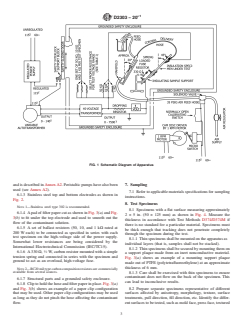
6.1 Asimpleschematicdiagramoftheapparatusisgivenin
ionizable, electrically conductive liquid contaminant.
Fig.1andconsistsofthefollowing.DetailsaregiveninAnnex
A2.
5.2 These test methods quantitatively evaluate, in a relative
6.1.1 A 60 Hz power supply with an output voltage stabi-
manner, the effects upon an insulating material resulting from
lized to 61% which can be varied from 1 to at least 7.5 kV
the action of electrical discharges upon a material surface.The
with a rated current of no less than 0.1Afor every test station
effects are similar to those that may occur in service under the
to be used (that is, 0.5 A for five stations).
influence of dirt combined with moisture condensed from the
atmosphere. 6.1.2 Ameansforapplyingaspecifiedcontaminantsolution
5.2.1 In the field, the conditions resulting in electrical at a controlled rate to the specimen surface. A pneumatically
discharges occur sporadically. Degradation, often in the form actuated repeating pipet has been found useful for this purpose
´1
D2303 − 20
FIG. 1 Schematic Diagram of Apparatus
andisdescribedinAnnexA2.Peristalticpumpshavealsobeen 7. Sampling
used (see Annex A2).
7.1 Refertoapplicablematerialsspecificationsforsampling
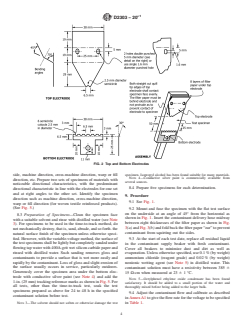
6.1.3 Stainless steel top and bottom electrodes as shown in
instructions.
Fig. 2.
8. Test Specimens
NOTE 1—Stainless steel type 302 is recommended.
8.1 Specimens with a flat surface measuring approximately
6.1.4 ApadoffilterpapercutasshowninFig.3(a)andFig.
2 × 5 in. (50 × 125 mm) as shown in Fig. 4. Measure the
3(b) to fit under the top electrode and used to smooth out the
thickness in accordance with Test Methods D374/D374M if
flow of the contaminant solution.
there is no standard for a particular material. Specimens must
6.1.5 A set of ballast resistors (50, 10, and 1 kΩ rated at
be thick enough that tracking does not penetrate completely
200 W each) to be connected as specified in series with each
through the specimen during the test.
test specimen on the high-voltage side of the power supply.
8.1.1 Thinspecimensshallbemountedontheapparatusas
Somewhat lower resistances are being considered by the
individual layers (that is, samples shall not be stacked).
International Electrotechnical Commission (IEC/TC15).
8.1.2 Thinspecimensshallbesecuredbymountingthemon
6.1.6 A330Ω, ⁄2W,carbonresistormountedwithasimple
a support plaque made from an inert nonconductive material.
tension spring and connected in series with the specimen and
Fig. 3(a) shows an example of a mounting support plaque
ground to act as an overload, high-voltage fuse.
made out of PTFE (polytetrafluoroethylene) at an approximate
thickness of 6 mm.
NOTE2—RC20miltypecarboncompositionresistorsarecommercially
available from several sources. 8.1.3 Care shall be exercised with thin specimens to ensure
contaminant does not flow on the back of the specimen. This
6.1.7 Structural parts and a grounded safety enclosure.
can lead to inconclusive results.
6.1.8 Cliptoholdthehoseandfilterpaperinplace.Fig.3(a)
and Fig. 3(b) shows an example of a paper clip configuration 8.2 Prepare separate specimens representative of different
that may be used. Other paper clip configurations may be used surfaces affected by anisotropy, morphology, texture, surface
aslongastheydonotpinchthehoseaffectingthecontaminant treatments, pull direction, fill direction, etc. Identify the differ-
flow. entsurfacestobetested,suchasmoldface,pressface,textured
´1
D2303 − 20
FIG. 2 Top and Bottom Electrodes
specimen. Isopropyl alcohol has been found suitable for many materials.
side, machine direction, cross-machine direction, warp or fill
NOTE 4—Conductive silver paint is commercially available from
direction, etc. Prepare two sets of specimens of materials with
several sources.
noticeable directional characteristics, with the predominant
8.4 Prepare five specimens for each determination.
directional characteristic in line with the electrodes for one set
and at right angles to the other set. Identify the specimen
9. Procedure
direction such as machine direction, cross-machine direction,
9.1 See Fig. 1.
warp or fill direction (for woven textile reinforced products).
(See Fig. 5.)
9.2 Mount and fuse the specimen with the flat test surface
on the underside at an angle of 45° from the horizontal as
8.3 Preparation of Specimens—Clean the specimen face
shown in Fig. 1. Insert the contaminant delivery hose midway
with a suitable solvent and rinse with distilled water (see Note
between eight thicknesses of the filter paper as shown in Fig.
3). For specimens to be used in the time-to-track method, do
3(a)andFig.3(b)andfoldbackthefilterpaper“ear”toprevent
notmechanicallydestroy,thatis,sand,abrade,andsoforth.the
contaminant from squirting out the sides.
natural surface finish of the specimen unless otherwise speci-
fied.However,withthevariable-voltagemethod,thesurfaceof
9.3 At the start of each test date, replace all residual liquid
thetestspecimensshallbelightlybutcompletelysandedunder
in the contaminant supply beaker with fresh contaminant.
flowingtapwaterwith400A-gritwetsiliconcarbidepaperand
Cover all beakers to minimize dust and dirt as well as
rinsed with distilled water. Such sanding removes gloss and
evaporation.Unlessotherwisespecified,use0.1%(byweight)
contaminants to provide a surface that is wet more easily and
ammonium chloride (reagent grade) and 0.02% (by weight)
rapidly by the contaminant. Loss of gloss and slight erosion of
nonionic wetting agent (see Note 5) in distilled water. This
the surface usually occurs in service, particularly outdoors.
contaminant solution must have a resistivity between 385 6
Generously cover the specimen area under the bottom elec-
15 Ω·cm when measured at 23 6 1 °C.
trode with conductive silver paint (see Note 4) and add the
NOTE 5—Octylphenol ethylene oxide condensate has been found
1-in.(25mm)trackingreferencemarksasshowninFig.5.For
satisfactory. It should be added to a small portion of the water and
all tests, other than the time-to-track test, soak the test
thoroughly mixed before being added to the larger bulk.
specimens prepared as above for 24 to 48 h in the specified
9.4 Adjust the contaminant flow and calibrate as described
contaminant solution before test.
inAnnexA1togivetheflowrateforthevoltagetobespecified
NOTE 3—The solvent should not soften or otherwise damage the test in Table 1.
´1
D2303 − 20
FIG. 3 (a) Filter Paper, Clip, and Method of Fastening
FIG. 3 (b) Nonconductive Mounting Support Plaque Made Out of PTFE, Approximately 6 mm Thick
9.5 After calibration, the start-up procedure differs depend- specimen face between electrodes.The contaminant must flow
ing on whether the test specimen is a carry-over from a from the quill hole in the bottom of the top electrode and shall
previous test, or an entirely new specimen. not squirt out of the sides or top of the filter paper during the
9.5.1 For a specimen that has never been subjected to pressure stroke of the pipet. Adjust the specimens so that the
voltages and contaminant (that is, new specimen), start the contaminant runs down as nearly as possible the center line of
contaminant injection into the filter paper, allowing the fresh the specimen. Avoid drafts on equipment that might cause
contaminant to wet the filter paper thoroughly and replace the undue cooling of the specimens or of the water vapor from
old liquid in the tubes and syringes and to flow as a steady evaporationofthecontaminant.Closethesafetygateandapply
stream (Note 6) (not intermittent bursts) across the test the appropriate test voltage tabulated in Table 1.
´1
D2303 − 20
9.7.2 Loss of any contaminant, such as by squirting out of
side of filter paper,
9.7.3 Whether the contaminant stream down the test speci-
men face is steady instead of in spurts,
9.7.4 Air bubble leaks into the syringes which would
change the contaminant feed rate, and
9.7.5 Stuck syringe pistons.
9.8 Notethetime,butdonotstopthetesttodisconnect,any
test specimen that has tracked to the 1 in. (25 mm) mark.
Stopping the test and removing the voltage, even momentarily,
willpermitthecontaminanttoexcessivelysaturatethepartially
tracked area of other unfailed specimens, with resultant vigor-
FIG. 4 Test Specimen
ous scintillation after restart. Excessive current in any speci-
men that continues to track will be taken care of by the fuse
resistor.
9.9 If the test is not completed within the working day, the
NOTE 6—This steady flow condition shall be observed for 5 min at the
test can be continued the following day if the following
normal test contaminant feed rate and not at a manually operated
precautions are taken:
accelerated calibration rate.
9.9.1 Remove voltage, and stop the contaminant feed.
9.5.2 For a specimen that is a continuation from a previous
9.9.2 Thoroughly wash down the filter paper with distilled
test (that is, off test overnight), wash down the test specimen
water. Do not replace the filter paper.
faceandfilterpaperwithdistilledwaterinordertoremoveany
9.9.3 Thoroughly wash down the specimen face with dis-
contaminant residue from the previous test. Do not change the
tilled water.
filter paper. Start the contaminant flow, allowing the fresh
9.9.4 Throw out the contaminant left in the supply beaker
contaminant to wet the filter paper thoroughly, and replace the
andreplacewithdistilledwatersothatthefeedhosesinkerwill
old liquid in the tubes and syringes until a steady contaminant
not become encrusted with dried contaminant residue. Do not
flow (Note 6) is established across the specimen face. Momen-
pump this distilled water into the hose, filter paper, or syringe.
tarily arrest the contaminant injection into the filter paper, and
inject2mLofdistilledwaterintothefilterpaperwithamanual 9.10 The method of voltage application and the evaluation
of tracking or erosion characteristics depend upon the different
syringe. Quickly rewash the specimen face only with distilled
water, close the safety gate, start up the contaminant flow, and test techniques used as described in Sections10–12 and
Annex A1.
applytherequiredvoltage.Timeisoftheessencehere,forany
prolonged delay will result in a too vigorous and faulty
10. Initial Tracking Voltage Test Method
start-up.
9.6 Effective scintillation, small yellow to white (perhaps 10.1 For the determination of the initial tracking voltage,
with some parts blue) arcs, is expected to appear predomi- apply the voltage between the electrodes in 250 V steps. Hold
nantlyjustabovetheteethofthelowerelectrodewithinatmost each voltage for 1 h (unless failure is indicated) before
increasing by 250 V to the next step. A starting test voltage
a very few minutes after application of the voltage. These
discharges are expected to occur in essentially a continuous must be determined so that tracking failure does not occur
sooner than the third step (between 2 and 3 h).Adjust the rate
fashion, although they sometimes “dance” from one tooth to
another before finally settling down to cause a small, bright of application of the contaminant so as to maintain effective
“hot spot” which will start “chewing” on the specimen surface scintillationatthedifferentvoltages(seeTable1).Timecanbe
and which will ultimately lead to tracking failure. The condi- saved in the determination of the appropriate starting test
tion of effective scintillation can also be observed with a voltageforaspecificmaterialifanintermediatetohighvoltage
cathode-ray oscilloscope. The signal is sometimes seen on the is first selected (that is, 3.25 kV). If the specimen fails quickly
ungrounded side of the fuse resistor. Proper scintillation is on the first voltage step, the starting voltage for the next test
observedasacontinualbutnon-uniformbreak-upofthe60Hz shall be decreased, usually at least 1 kV. On the other hand, if
current wave over the whole duration of each half cycle. four steps or more are needed to cause failure, then, increase
Effective scintillation is critical and if not obtained, then the the initial voltage accordingly. Experience helps in the deter-
electrical circuit, the contaminant flow characteristics, and the mination of the appropriate starting voltage.
contaminant conductivity must be carefully checked and ad-
10.2 The end point of the test is reached at the voltage step
justed to create the condition for effective scintillation.
where progressive tracking starts. Careful observation is
9.7 Regardless of whether the start-up is for new specimens needed to note when isolated markings on the surface first join
orspecimensthat
...