

ASTM E3061-17
(Test Method)Standard Test Method for Analysis of Aluminum and Aluminum Alloys by Inductively Coupled Plasma Atomic Emission Spectrometry (Performance Based Method)
General Information
- Abstract
SIGNIFICANCE AND USE
5.1 This test method for the analysis of aluminum and aluminum alloys is primarily intended to test material for compliance with The Aluminum Association Inc.5 registered composition limits or other specified composition limits for aluminum and aluminum alloys.
5.2 It is assumed that all who use this test method will be trained analysts capable of performing common laboratory procedures skillfully and safely, and that the work will be performed in a properly equipped laboratory.
5.3 This is a performance-based test method that relies more on the demonstrated quality of the test result than on strict adherence to specific procedural steps. It is expected that laboratories using this test method will prepare their own work instructions. These work instructions should include detailed operating instructions for the specific laboratory, the specific reference materials employed, and performance acceptance criteria.
SCOPE
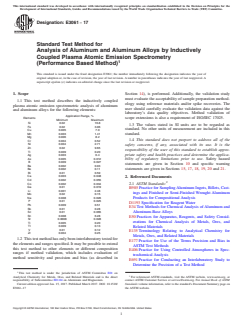
1.1 This test method describes the inductively coupled plasma atomic emission spectrometric analysis of aluminum and aluminum alloys for the following elements:
Elements
Application Range, %
Minimum
Maximum
Si
0.02
16.8
Fe
0.02
3.06
Cu
0.005
7.0
Mn
0.003
1.41
Mg
0.006
8.2
Cr
0.004
0.52
Ni
0.004
2.71
Zn
0.02
9.65
Ti
0.009
0.20
Ag
0.003
0.4
As
0.005
0.012
B
0.009
0.027
Ba
0.002
0.03
Be
0.002
0.11
Bi
0.01
0.59
Ca
0.003
0.048
Cd
0.002
0.055
Co
0.002
0.034
Ga
0.01
0.019
Li
0.001
2.48
Mo
0.02
0.15
Na
0.008
0.026
P
0.01
0.025
Pb
0.009
0.51
Sb
0.01
0.28
Sc
0.01
0.065
Sn
0.008
6.28
Sr
0.0008
0.028
Ti
0.005
0.20
Tl
0.009
0.13
V
0.01
0.12
Zr
0.004
0.25
1.2 This test method has only been interlaboratory tested for the elements and ranges specified. It may be possible to extend this test method to other elements or different composition ranges if method validation, which includes evaluation of method sensitivity and precision and bias (as described in Section 14), is performed. Additionally, the validation study must evaluate the acceptability of sample preparation methodology using reference materials and/or spike recoveries. The user should carefully evaluate the validation data against the laboratory’s data quality objectives. Method validation of scope extensions is also a requirement of ISO/IEC 17025.
1.3 The values stated in SI units are to be regarded as standard. No other units of measurement are included in this standard.
1.4 This standard does not purport to address all of the safety concerns, if any, associated with its use. It is the responsibility of the user of this standard to establish appropriate safety and health practices and determine the applicability of regulatory limitations prior to use. Safety hazard statements are given in Section 10 and specific warning statements are given in Sections 15, 17, 18, 19, 20 and 21.
- Status
- Published
- Publication Date
- 14-Jan-2017
- Technical Committee
- E01 - Analytical Chemistry for Metals, Ores, and Related Materials
- Drafting Committee
- E01.04 - Aluminum and Magnesium
Overview
ASTM E3061-17 is the standard test method developed by ASTM International for the analysis of aluminum and aluminum alloys using Inductively Coupled Plasma Atomic Emission Spectrometry (ICP-AES or ICP-OES). This performance-based method is intended to verify compliance with The Aluminum Association registered composition limits or other specified composition ranges in aluminum and its alloys. The flexibility of the method permits laboratories to tailor procedural steps, provided the demonstrated quality of test results meets the required performance criteria.
ICP-AES is widely recognized for its multi-element analytical capabilities, precision, and sensitivity, making ASTM E3061-17 a critical standard in industries that demand reliable compositional analysis of aluminum products.
Key Topics
- Scope of Elements: The method supports the quantitative analysis of a broad range of elements in aluminum alloys, including but not limited to Si, Fe, Cu, Mn, Mg, Cr, Ni, Zn, Ti, Ag, As, B, Ba, Be, Bi, Ca, Cd, Co, Ga, Li, Mo, Na, P, Pb, Sb, Sc, Sn, Sr, Tl, V, and Zr.
- Performance-Based Test: Laboratories are expected to develop and adhere to their own work instructions, focusing on their specific instruments, materials, and quality acceptance criteria.
- Interferences and Calibration: The standard provides guidance on identifying and correcting for spectral and physical interferences, including the use of internal standards and matrix matching calibration solutions.
- Method Validation: Extending the analysis to other elements or ranges requires method validation, including precision, bias, and sample preparation evaluation, as per ISO/IEC 17025 requirements.
- Sample Preparation: Detailed recommendations are given for dissolving test specimens, depending on the alloys and analytes of interest, to ensure representative and unbiased analysis.
Applications
The ASTM E3061-17 standard is essential for:
- Quality Control: Ensuring that aluminum and its alloys meet chemical composition specifications required by end-users, buyers, or regulatory agencies.
- Product Certification: Supporting certification processes by providing reliable and verifiable compositional analysis, crucial in industries such as aerospace, automotive, transportation, and construction.
- Research and Development: Facilitating analytical studies and alloy development by providing consistent, reproducible, and accurate results for multiple alloying elements.
- Regulatory Compliance: Meeting the analytical requirements for compliance with The Aluminum Association and other international standards.
Laboratories employing this method must use trained analysts and maintain proper laboratory safety and quality protocols. The method is adaptable, making it suitable for both routine production analysis and specialized research needs.
Related Standards
To ensure comprehensive material analysis and laboratory competence, ASTM E3061-17 references several related standards:
- ASTM E34: Chemical Analysis of Aluminum and Aluminum-Base Alloys
- ASTM B985: Sampling Aluminum Ingots, Billets, Castings, and Finished or Semi-Finished Aluminum Products for Compositional Analysis
- ASTM E50: Apparatus, Reagents, and Safety Considerations for Chemical Analysis of Metals
- ASTM E135: Terminology Relating to Analytical Chemistry for Metals, Ores, and Related Materials
- ASTM E716: Sampling and Sample Preparation of Aluminum and Alloys for Determination of Chemical Composition
- ASTM E691: Conducting Interlaboratory Studies to Determine the Precision of a Test Method
- ISO/IEC 17025: General Requirements for the Competence of Testing and Calibration Laboratories
Keywords: ASTM E3061-17, ICP-AES, aluminum alloy analysis, inductively coupled plasma, chemical composition, performance-based method, laboratory analysis, aluminum spectroscopy, quality control, method validation, spectral interferences, multi-element analysis, international standards.
By following ASTM E3061-17, laboratories can ensure reliable and compliant analysis of aluminum and its alloys, supporting quality assurance and material certification across global industries.
Relations
- Effective Date
- 01-Jan-2020
- Refers
ASTM E406-19 - Standard Practice for Using Controlled Atmospheres in Atomic Emission Spectrometry - Effective Date
- 01-Oct-2019
- Effective Date
- 15-May-2019
- Effective Date
- 01-Sep-2017
- Effective Date
- 01-Nov-2016
- Effective Date
- 01-Nov-2016
- Effective Date
- 01-Aug-2016
- Effective Date
- 15-May-2016
- Effective Date
- 01-Jul-2015
- Effective Date
- 15-May-2015
- Effective Date
- 15-Aug-2014
- Effective Date
- 01-May-2014
- Effective Date
- 01-Apr-2014
- Effective Date
- 15-Feb-2014
- Effective Date
- 01-Dec-2013
Get Certified
Connect with accredited certification bodies for this standard

Element Materials Technology
Materials testing and product certification.

Inštitut za kovinske materiale in tehnologije
Institute of Metals and Technology. Materials testing, metallurgical analysis, NDT.
Sponsored listings
Frequently Asked Questions
ASTM E3061-17 is a standard published by ASTM International. Its full title is "Standard Test Method for Analysis of Aluminum and Aluminum Alloys by Inductively Coupled Plasma Atomic Emission Spectrometry (Performance Based Method)". This standard covers: SIGNIFICANCE AND USE 5.1 This test method for the analysis of aluminum and aluminum alloys is primarily intended to test material for compliance with The Aluminum Association Inc.5 registered composition limits or other specified composition limits for aluminum and aluminum alloys. 5.2 It is assumed that all who use this test method will be trained analysts capable of performing common laboratory procedures skillfully and safely, and that the work will be performed in a properly equipped laboratory. 5.3 This is a performance-based test method that relies more on the demonstrated quality of the test result than on strict adherence to specific procedural steps. It is expected that laboratories using this test method will prepare their own work instructions. These work instructions should include detailed operating instructions for the specific laboratory, the specific reference materials employed, and performance acceptance criteria. SCOPE 1.1 This test method describes the inductively coupled plasma atomic emission spectrometric analysis of aluminum and aluminum alloys for the following elements: Elements Application Range, % Minimum Maximum Si 0.02 16.8 Fe 0.02 3.06 Cu 0.005 7.0 Mn 0.003 1.41 Mg 0.006 8.2 Cr 0.004 0.52 Ni 0.004 2.71 Zn 0.02 9.65 Ti 0.009 0.20 Ag 0.003 0.4 As 0.005 0.012 B 0.009 0.027 Ba 0.002 0.03 Be 0.002 0.11 Bi 0.01 0.59 Ca 0.003 0.048 Cd 0.002 0.055 Co 0.002 0.034 Ga 0.01 0.019 Li 0.001 2.48 Mo 0.02 0.15 Na 0.008 0.026 P 0.01 0.025 Pb 0.009 0.51 Sb 0.01 0.28 Sc 0.01 0.065 Sn 0.008 6.28 Sr 0.0008 0.028 Ti 0.005 0.20 Tl 0.009 0.13 V 0.01 0.12 Zr 0.004 0.25 1.2 This test method has only been interlaboratory tested for the elements and ranges specified. It may be possible to extend this test method to other elements or different composition ranges if method validation, which includes evaluation of method sensitivity and precision and bias (as described in Section 14), is performed. Additionally, the validation study must evaluate the acceptability of sample preparation methodology using reference materials and/or spike recoveries. The user should carefully evaluate the validation data against the laboratory’s data quality objectives. Method validation of scope extensions is also a requirement of ISO/IEC 17025. 1.3 The values stated in SI units are to be regarded as standard. No other units of measurement are included in this standard. 1.4 This standard does not purport to address all of the safety concerns, if any, associated with its use. It is the responsibility of the user of this standard to establish appropriate safety and health practices and determine the applicability of regulatory limitations prior to use. Safety hazard statements are given in Section 10 and specific warning statements are given in Sections 15, 17, 18, 19, 20 and 21.
SIGNIFICANCE AND USE 5.1 This test method for the analysis of aluminum and aluminum alloys is primarily intended to test material for compliance with The Aluminum Association Inc.5 registered composition limits or other specified composition limits for aluminum and aluminum alloys. 5.2 It is assumed that all who use this test method will be trained analysts capable of performing common laboratory procedures skillfully and safely, and that the work will be performed in a properly equipped laboratory. 5.3 This is a performance-based test method that relies more on the demonstrated quality of the test result than on strict adherence to specific procedural steps. It is expected that laboratories using this test method will prepare their own work instructions. These work instructions should include detailed operating instructions for the specific laboratory, the specific reference materials employed, and performance acceptance criteria. SCOPE 1.1 This test method describes the inductively coupled plasma atomic emission spectrometric analysis of aluminum and aluminum alloys for the following elements: Elements Application Range, % Minimum Maximum Si 0.02 16.8 Fe 0.02 3.06 Cu 0.005 7.0 Mn 0.003 1.41 Mg 0.006 8.2 Cr 0.004 0.52 Ni 0.004 2.71 Zn 0.02 9.65 Ti 0.009 0.20 Ag 0.003 0.4 As 0.005 0.012 B 0.009 0.027 Ba 0.002 0.03 Be 0.002 0.11 Bi 0.01 0.59 Ca 0.003 0.048 Cd 0.002 0.055 Co 0.002 0.034 Ga 0.01 0.019 Li 0.001 2.48 Mo 0.02 0.15 Na 0.008 0.026 P 0.01 0.025 Pb 0.009 0.51 Sb 0.01 0.28 Sc 0.01 0.065 Sn 0.008 6.28 Sr 0.0008 0.028 Ti 0.005 0.20 Tl 0.009 0.13 V 0.01 0.12 Zr 0.004 0.25 1.2 This test method has only been interlaboratory tested for the elements and ranges specified. It may be possible to extend this test method to other elements or different composition ranges if method validation, which includes evaluation of method sensitivity and precision and bias (as described in Section 14), is performed. Additionally, the validation study must evaluate the acceptability of sample preparation methodology using reference materials and/or spike recoveries. The user should carefully evaluate the validation data against the laboratory’s data quality objectives. Method validation of scope extensions is also a requirement of ISO/IEC 17025. 1.3 The values stated in SI units are to be regarded as standard. No other units of measurement are included in this standard. 1.4 This standard does not purport to address all of the safety concerns, if any, associated with its use. It is the responsibility of the user of this standard to establish appropriate safety and health practices and determine the applicability of regulatory limitations prior to use. Safety hazard statements are given in Section 10 and specific warning statements are given in Sections 15, 17, 18, 19, 20 and 21.
ASTM E3061-17 is classified under the following ICS (International Classification for Standards) categories: 77.040.30 - Chemical analysis of metals; 77.120.10 - Aluminium and aluminium alloys. The ICS classification helps identify the subject area and facilitates finding related standards.
ASTM E3061-17 has the following relationships with other standards: It is inter standard links to ASTM E135-20, ASTM E406-19, ASTM E135-19, ASTM E50-17, ASTM E1479-16, ASTM B985-12(2016), ASTM E50-11(2016), ASTM E135-16, ASTM E135-15a, ASTM E135-15, ASTM E135-14b, ASTM E177-14, ASTM E135-14a, ASTM E135-14, ASTM E135-13a. Understanding these relationships helps ensure you are using the most current and applicable version of the standard.
ASTM E3061-17 is available in PDF format for immediate download after purchase. The document can be added to your cart and obtained through the secure checkout process. Digital delivery ensures instant access to the complete standard document.
Standards Content (Sample)
This international standard was developed in accordance with internationally recognized principles on standardization established in the Decision on Principles for the
Development of International Standards, Guides and Recommendations issued by the World Trade Organization Technical Barriers to Trade (TBT) Committee.
Designation: E3061 − 17
Standard Test Method for
Analysis of Aluminum and Aluminum Alloys by Inductively
Coupled Plasma Atomic Emission Spectrometry
(Performance Based Method)
This standard is issued under the fixed designation E3061; the number immediately following the designation indicates the year of
original adoption or, in the case of revision, the year of last revision. A number in parentheses indicates the year of last reapproval. A
superscript epsilon (´) indicates an editorial change since the last revision or reapproval.
1. Scope Section 14), is performed. Additionally, the validation study
must evaluate the acceptability of sample preparation method-
1.1 This test method describes the inductively coupled
ology using reference materials and/or spike recoveries. The
plasma atomic emission spectrometric analysis of aluminum
user should carefully evaluate the validation data against the
and aluminum alloys for the following elements:
laboratory’s data quality objectives. Method validation of
Application Range, %
Elements
scope extensions is also a requirement of ISO/IEC 17025.
Minimum Maximum
Si 0.02 16.8
1.3 The values stated in SI units are to be regarded as
Fe 0.02 3.06
standard. No other units of measurement are included in this
Cu 0.005 7.0
Mn 0.003 1.41
standard.
Mg 0.006 8.2
1.4 This standard does not purport to address all of the
Cr 0.004 0.52
Ni 0.004 2.71
safety concerns, if any, associated with its use. It is the
Zn 0.02 9.65
responsibility of the user of this standard to establish appro-
Ti 0.009 0.20
priate safety and health practices and determine the applica-
Ag 0.003 0.4
As 0.005 0.012
bility of regulatory limitations prior to use. Safety hazard
B 0.009 0.027
statements are given in Section 10 and specific warning
Ba 0.002 0.03
statements are given in Sections 15, 17, 18, 19, 20 and 21.
Be 0.002 0.11
Bi 0.01 0.59
Ca 0.003 0.048
2. Referenced Documents
Cd 0.002 0.055
Co 0.002 0.034 2.1 ASTM Standards:
Ga 0.01 0.019
B985 Practice for Sampling Aluminum Ingots, Billets, Cast-
Li 0.001 2.48
ings and Finished or Semi-Finished Wrought Aluminum
Mo 0.02 0.15
Na 0.008 0.026 Products for Compositional Analysis
P 0.01 0.025
D1193 Specification for Reagent Water
Pb 0.009 0.51
E34 Test Methods for Chemical Analysis of Aluminum and
Sb 0.01 0.28
Sc 0.01 0.065 Aluminum-Base Alloys
Sn 0.008 6.28
E50 Practices for Apparatus, Reagents, and Safety Consid-
Sr 0.0008 0.028
erations for Chemical Analysis of Metals, Ores, and
Ti 0.005 0.20
Tl 0.009 0.13
Related Materials
V 0.01 0.12
E135 Terminology Relating to Analytical Chemistry for
Zr 0.004 0.25
Metals, Ores, and Related Materials
1.2 This test method has only been interlaboratory tested for
E177 Practice for Use of the Terms Precision and Bias in
the elements and ranges specified. It may be possible to extend
ASTM Test Methods
this test method to other elements or different composition
E406 Practice for Using Controlled Atmospheres in Spec-
ranges if method validation, which includes evaluation of
trochemical Analysis
method sensitivity and precision and bias (as described in
E691 Practice for Conducting an Interlaboratory Study to
Determine the Precision of a Test Method
This test method is under the jurisdiction of ASTM Committee E01 on
Analytical Chemistry for Metals, Ores, and Related Materials and is the direct For referenced ASTM standards, visit the ASTM website, www.astm.org, or
responsibility of Subcommittee E01.04 on Aluminum and Magnesium. contact ASTM Customer Service at service@astm.org. For Annual Book of ASTM
Current edition approved Jan. 15, 2017. Published March 2017. DOI: 10.1520/ Standards volume information, refer to the standard’s Document Summary page on
E3061–17 the ASTM website.
Copyright © ASTM International, 100 Barr Harbor Drive, PO Box C700, West Conshohocken, PA 19428-2959. United States
E3061 − 17
E716 Practices for Sampling and Sample Preparation of operating instructions for the specific laboratory, the specific
Aluminum and Aluminum Alloys for Determination of reference materials employed, and performance acceptance
Chemical Composition by Spark Atomic Emission Spec- criteria.
trometry
6. Interferences
E1329 Practice for Verification and Use of Control Charts in
Spectrochemical Analysis
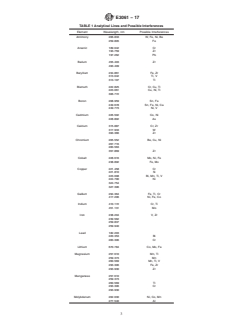
6.1 The effect of potential spectral overlap interferences and
E1452 Practice for Preparation of Calibration Solutions for
background will vary based on the wavelengths selected,
Spectrophotometric and for Spectroscopic Atomic Analy-
instrument design, and may vary from instrument to instrument
sis (Withdrawn 2005)
of the same design. Variation of excitation conditions or
E1479 Practice for Describing and Specifying Inductively
operating parameters may enhance or minimize these interfer-
Coupled Plasma Atomic Emission Spectrometers
ences. For these reasons, the effect of the potential interfer-
E2857 Guide for Validating Analytical Methods
ences must be thoroughly investigated for each element and
2.2 ISO Standards
matrix on the instrument chosen for analysis. Practice E1479
ISO/IEC 17025 General Requirements for the Competence
describes the typical physical and spectral interferences en-
of Calibration and Testing Laboratories
countered during the inductively coupled plasma spectrometric
ISO Guide 98-3 Uncertainty of Measurement Part 3:
analysis of metal alloys. Potential spectral interferences for
Guide to the Expression of Uncertainty in Measurement
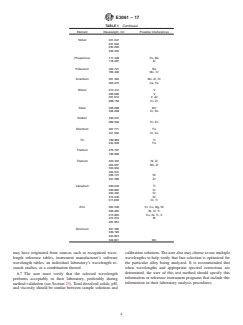
recommended wavelengths are given in Table 1. The user is
(GUM:1995) - First Edition
responsible for ensuring the absence of, or for compensating
for, interferences that may bias test results obtained using their
3. Terminology
particular spectrometer.
3.1 Definitions—For definitions of terms used in this test
6.2 The use of an internal standard may compensate for the
method, refer to Terminology E135.
physical interferences resulting from differences between
sample and calibration solutions transport efficiencies.
4. Summary of Test Method
6.3 Shifts in background intensity levels because of, for
4.1 The test specimen, in the form of drillings, chips,
example, recombination effects or molecular band
millings, turnings, small pieces or powder, is dissolved in a
contributions, or both, may be corrected by the use of an
caustic solution or a mixture of dilute mineral acids and
appropriate background correction technique. Direct spectral
hydrogen peroxide or sodium nitrite and the resulting solutions
overlaps are best addressed by selecting alternative wave-
are measured using inductively coupled plasma atomic emis-
lengths. If alternate wavelengths are not available, spectral
sion spectrometry. The spectrometer is calibrated using cali-
interference studies should be conducted on all new matrices to
bration solutions prepared to match the sample matrix, using a
determine the interference correction factor(s) that must be
pure aluminum stock solution prepared in 15.2 and stock
applied to compositions obtained from certain spectral line
solutions traceable to an SI unit through a national metrology
intensities to minimize biases. Some instrument manufacturers
laboratory or stock solutions prepared as directed in Practice
offer software options that mathematically correct for direct
E1452.
spectral overlaps, but the user should carefully evaluate this
approach to spectral correction.
5. Significance and Use
6.4 Modern ICP spectrometers typically have software that
5.1 This test method for the analysis of aluminum and
allows comparison of a sample spectrum to the spectrum
aluminum alloys is primarily intended to test material for
obtained from a blank solution. The user of this test method
compliance with The Aluminum Association Inc. registered
must examine this information to ascertain the need for
composition limits or other specified composition limits for
background correction and the correct placement of back-
aluminum and aluminum alloys.
ground points.
5.2 It is assumed that all who use this test method will be
6.5 Table 1 recommends wavelengths from the NIST
trained analysts capable of performing common laboratory
Atomic Spectra Database that may be used for the analysis of
procedures skillfully and safely, and that the work will be
aluminum and aluminum alloys. In this database, wavelengths
performed in a properly equipped laboratory.
of less than 200 nm were measured in vacuum and wavelengths
5.3 This is a performance-based test method that relies more
greater than or equal to 200 nm were measured in air. Software
on the demonstrated quality of the test result than on strict
tables for individual instruments may list wavelengths some-
adherence to specific procedural steps. It is expected that
what differently, as instrument optical path atmospheric con-
laboratories using this test method will prepare their own work
ditions may vary.
instructions. These work instructions should include detailed
6.6 Information on potential spectral interfering elements
typically found in aluminum alloys was provided by some of
The last approved version of this historical standard is referenced on
the laboratories participating in the interlaboratory study and
www.astm.org.
Available from American National Standards Institute (ANSI), 25 W. 43rd St.
4th Floor, New York, NY 10036, http//www.ansi.org
5 6
Available from The Aluminum Association Inc., 1400 Crystal Drive, Arlington, Available from The National Institute of Standards and Technology 100 Bureau
VA 22202, http://www.aluminum.org/ Dr., Gaithersburg, MD 20899 https://www.nist.gov/
E3061 − 17
TABLE 1 Analytical Lines and Possible Interferences
Element Wavelength, nm Possible Interferences
Antimony 206.833 W, Fe, Ni, Be
259.805 Fe
Arsenic 189.042 Cr
193.759 Zr
197.262 Pb
Barium 455.403 Zr
493.409
Beryllium 234.861 Fe, Zr
313.042 Ti, V
313.107 Ti
Bismuth 222.825 Cr, Cu, Ti
223.061 Cu, Ni, Ti
306.772
Boron 208.959 Sn, Fe
249.678 Sn, Fe, Ni, Ca
249.773 Ni, V
Cadmium 226.502 Co, Ni
228.802 As
Calcium 315.887 Cr, Zr
317.933 W
393.366 Zr
Chromium 205.552 Be, Cu, Ni
267.716
283.563
357.869 Zr
Cobalt 228.616 Mo, Ni, Fe
238.892 Fe, Mo
Copper 221.458 Cr
221.810 Si
223.008 Bi, Mn, Ti, V
224.700 Ni
324.754
327.396
Gallium 294.364 Fe, Ti, Cr
417.206 Ni, Fe, Co
Indium 410.172 Cr, Ti
451.131 Mo
Iron 238.204 V, Zr
239.562
259.837
259.940
Lead 182.203
220.353 Bi
283.306 Cr
Lithium 670.784 Co, Mo, Fe
Magnesium 257.610 Mn, Ti
259.373 Mn
260.569 Mn, Ti, V
293.306 Fe, Zr
293.930 Zr
Manganese 257.610
259.373
260.569 Ti
293.306 Cr
293.930
Molybdenum 202.030 Ni, Co, Mn
277.540 AI
E3061 − 17
TABLE 1 Continued
Element Wavelength, nm Possible Interferences
Nickel 221.647
231.604
232.003
239.452
Phosphorus 177.499 Cu, Be
178.287 AI
Potassium 404.721 Ba
766.490 Mo, Cr
Scandium 361.384 Mo, Zr, Cr
363.075 Ca, Fe
Silicon 212.412 V
250.690 V
251.612 V, Zn
288.158 Cr, Zr
Silver 328.068 Mn
338.289 Cr, Sb
Sodium 330.237
589.592 Cr, Zn
Strontium 407.771 Fe
421.552 Cr, Cu
Tin 189.989 Ti
242.949 Fe
Thallium 276.787
190.896
Titanium 323.452 Ni, Zr
323.657 Mn, Zr
334.904
334.941
336.121 Ni
337.280 Zr
Vanadium 290.646 Ti
290.882 Cr
292.402 Cr
310.230 Ni
311.838 Cr, Ti
Zinc 202.548 Cr, Cu, Mg, Ni
206.200 Bi, Cr, Ti
213.856 Cu, Ni, Ti, V
472.216 Bi
481.053
Zirconium 327.305
339.198
343.823
349.621 Mn
may have originated from sources such as recognized wave- calibration solutions. The user also may choose to use multiple
length reference tables, instrument manufacturer’s software wavelengths to help verify that line selection is optimized for
wavelength tables, an individual laboratory’s wavelength re-
the particular alloy being analyzed. It is recommended that
search studies, or a combination thereof.
when wavelengths and appropriate spectral corrections are
determined, the user of this test method should specify this
6.7 The user must verify that the selected wavelength
information or reference instrument programs that include this
performs acceptably in their laboratory, preferably during
information in their laboratory analysis procedures.
method validation (see Section 23). Total dissolved solids, pH,
and viscosity should be similar between sample solutions and
E3061 − 17
7. Apparatus 8.2 Internal Standard—The use of an internal standard is
not required but is recommended. The use of an internal
7.1 Inductively Coupled Plasma Atomic Emission
standard may compensate for the physical interferences result-
Spectrometers—Refer to Practice E1479 for attributes to con-
ing from differences in sample and calibration solutions
sider when selecting an appropriate instrument.
transport efficiency. Lanthanum, Co, Sc, Be, and Y were used
by participants in the Interlaboratory Study (ILS). Wavelengths
8. Reagents and Materials
used and potential interferences are given in Table 2.Itis
8.1 Reagents:
important that the element chosen for an internal standard is
8.1.1 Purity and Composition of Reagents —The purity and
not present in the samples at a level that will affect the analysis.
composition of chemical reagents shall conform to the require-
ments prescribed in Practices E50. Reagent grade chemicals or
9. Control Materials
better shall be used in all tests.
9.1 A laboratory may procure or produce a chip material
8.1.2 Alcohol, ethanol or methanol.
with a composition that is similar to the samples for use as a
8.1.3 Boric Acid (H BO ).
3 3
control material. These chips should have low heterogeneity
8.1.4 Hydrogen Peroxide (H O ), 30 %.
2 2
and be well blended. Users of this test method may also use
8.1.5 10.5 N Sodium Hydroxide (NaOH) Solution.
certified reference materials as control materials.
8.1.6 4 % Sodium Nitrite (NaNO ) Solution.
9.2 A laboratory may find it difficult to procure or produce
8.1.7 Metals of the highest purity available and having
the materials for all of the necessary analytes or alloys. Here,
known impurity content should be used if preparing stock
it is acceptable to prepare equivalent reference material solu-
solutions as directed in Practice E1452.
tions using the procedure described in Section 15 for use as
8.1.8 Purity of Water—References to water shall be under-
control solutions.
stood to mean reagent water, Type II grade, as defined by
Specification D1193. The water purification method used must
10. Hazards
be capable of removal of all elements that might bias the test
10.1 This test method involves the use of concentrated
results.
mineral acids. Read and follow label precautions carefully
8.1.9 Argon, of 99.998 % purity, has been found satisfac-
before using. Warning—This method involves the use of HF.
tory. For information on gas handling, refer to Practice E406.
HF is extremely dangerous. Read and follow label precautions,
8.1.10 Stock Solutions, if needed, shall be prepared as
SDS information, and Practices E50 for HF handling. For
directed in Practice E1452.
precautions to be observed in the use of certain other reagents
8.1.11 Certified Reference Materials (CRMs), in chip form
in this test method, refer to Practices E50.
are available from some national metrology organizations and
commercial sources.
11. Sampling
8.1.12 Single Element Certified Reference Material
11.1 Refer to Practices B985, E34, and E716 for procedures
Solutions—are available from some national metrology orga-
to sample aluminum and aluminum alloys that provide a
nizations and commercial sources.
representative sample.
8.1.13 Aluminum Metal (Al), for matrix matching calibra-
tion solutions. Aluminum that is at least 99.999 % is recom-
12. Sampling, Test Specimens, and Test Units
mended. Aluminum that is less pure may be used provided the
12.1 Test specimens should be obtained by milling or
impurities are not present at levels that affect the measured
drilling to obtain drillings, chips, millings, or turnings that are
amount for elements of interest or the internal standard if used.
clean and of sufficient quantity to generate test specimens of at
least 0.1 g for dissolution and analysis. Powdered aluminum
can typically be used as-is.
Reagent Chemicals, American Chemical Society Specifications, American
Chemical Society, Washington, DC. For suggestions on the testing of reagents not
NOTE 1—Antimony, arsenic, bismuth, and phosphorus may be volatil-
listed by the American Chemical Society, see the United States Pharmacopeia and
ized during the process of obtaining drillings, chips, millings, or turnings
National Formulary, U.S. Pharmacopeial Convention, Inc. (USPC), Rockville, MD.
TABLE 2 Wavelengths Used and Potential Interferences
Internal Standard Element Wavelength, nm Potential Interference
Beryllium 234.861 Fe, Zr
313.042 Ti, V
313.107 Ti
228.616 Mo, Ni, Fe
Cobalt 238.892 Fe, Mo
Lanthanum 379.477 Fe
Scandium 361.384 Mo, Zr, Cr
Yttrium 363.075 Ca, Fe
371.029 Ti
E3061 − 17
if the metal overheats. Lubricating the metal with methanol or ethanol
proximately 1 %, although some values approached 5 %. The
during machining is recommended. Pin samples or small pieces may also
user of this test method must decide if precision is adequate for
be used to prevent the loss of volatile elements.
meeting data quality objectives. Practice E1479 provides
13. Preparation of Apparatus limited guidance for the parameters that may have an effect on
instrument precision. Instrument troubleshooting manuals pro-
13.1 Analytical instrumentation and sample preparation
vided by the manufacturer of the equipment may also provide
equipment shall be installed and operated as directed by the
guidance for optimizing performance for the specific instru-
manufacturer.
ment being used.
13.2 Using the manufacturer’s ICP-AES instrument opera-
15. Calibration
tion software, conduct start-up procedures and adjustments to
the analytical instrument as directed in the manufacturer’s
15.1 Calibration Solutions and Preparation of Calibration
operation instructions. Prepare a method or program appropri-
Curve—In this test method, calibration is based on laboratory-
ate to calibrate and measure the elements of interest for the
prepared matrix-matched calibration solutions. Matrix-
selected wavelengths. Optimize the ICP-AES instrument pa-
matched calibration solutions are solutions that contain the
rameters. Profile the spectrometer as specified in the manufac-
approximate amount of aluminum and acid found in typical
turers’ instructions to ensure optical alignment.
sample solutions. They are intended to model the physical
behavior of sample solutions in the plasma. The matrix-
14. Sensitivity and Precision
matched solutions are prepared with Al stock solution prepared
14.1 Prior to calibration, establish that the instrument being
in 15.2 and various acids to match the sample matrix. These are
used is capable of demonstrating acceptable sensitivity and
spiked with aliquots of single element certified reference
precision for the elements being determined. Once it has been
material (CRM) solutions or stock solutions prepared as
demonstrated that the instrument has acceptable sensitivity and
directed in Practice E1452 and contain the analytes to be
precision for these elements, it is not necessary to routinely
quantified and the internal standard if used.
evaluate sensitivity and precision. Evaluate equipment sensi-
15.1.1 Calibration Solutions, traceable to an SI unit through
tivity and precision as described in 14.2 and 14.3 .
a national metrology organization, shall be prepared from
certified stock solutions, typically 1000 mg/L or 10 000 mg/L,
14.2 Sensitivity—Sensitivity shall be evaluated by establish-
or stock solutions prepared as directed in Practice E1452.
ing two-point calibrations for each element being determined
15.1.2 The composition for each element in the calibration
using the blank and a high calibration solution prepared as
solution should bracket the expected level of the element in
described in Section 15. After thorough rinsing, the blank
solution. Aluminum matrix solution (50 g/L), prepared in 15.2,
solution is measured 10 times. Calculate 3 times the standard
and acid should be added to the calibration solutions to match
deviation of these measurements to approximate the limit of
the amount of aluminum and acid that is in the final sample
detection. Calculate 10 times the standard deviation to approxi-
solution.
mate the limit of quantification. If the instrument/parameter
selection of the user does not produce an estimated limit of
NOTE 2—Paragraphs 15.1.1 and following describe the preparation of
detection equal to or better than the lower scope limit of the
alloy matrix-matched calibration solutions for analysis of sample solutions
that contain 0.5 g alloy/500 mL final dilution. It is acceptable to vary both
method for the element(s) being determined, then it is probable
the sample mass and final volume as long as the mass and volume chosen
the method user will be unable to meet the method’s lower
demonstrate the required sensitivity and precision as described in 14.2 and
scope limit. If the instrument/parameter selection of the user
14.3. It is recommended that sample mass should be at least 0.1 g to
does not produce a limit of quantification equal to or better than
ensure representative sampling.
the lower scope limit of the method for the element(s) being
15.1.3 Determine the number and concentrations of the
determined, then it is possible the method user will be unable
calibration solutions needed to cover the concentration range
to consistently meet the method’s lower scope limit.
for each element. The calibration solutions should have the
14.3 Precision—The short-term precision shall be deter-
highest concentration slightly above the highest expected
mined as follows. Using the two- point calibration generated in
sample solution concentration, the lowest concentration near
14.2, measure the high calibration solution 10 times using the
the lowest expected sample solution concentration, a concen-
instrument/parameters selected by the method user. Calculate
tration near the mid-range between the high and low calibration
the % Relative Standard Deviation (% RSD) as follows:
solutions, and a blank. A minimum of three calibration solu-
tions and a blank should be used for calibration of each
¯
% RSD 5 100 s⁄C (1)
element.
where:
15.2 Aluminum Stock Solution for Matrix Matching:
s = estimated standard deviation of the 10 measurements,
15.2.1 Prepare a 50 g/L Al matrix solution as follows:
and
Weigh 50 g of Al drillings, chips, millings, turnings, or powder
¯
= average of the 10 results for the measured composition.
C
to the nearest milligram, transfer toa1L beaker and add about
The calculated % RSD should be approximately 1 %. 150 mL of water and abo
...