

ASTM E1423-21
(Practice)Standard Practice for Determining Steady State Thermal Transmittance of Fenestration Systems
General Information
- Abstract
SIGNIFICANCE AND USE
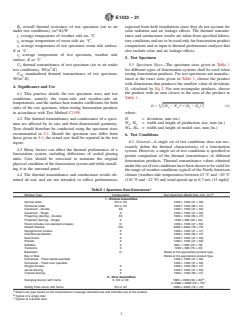
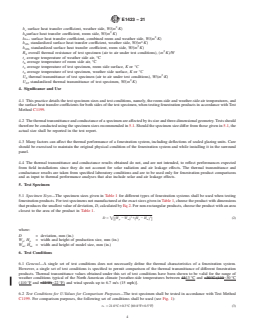
4.1 This practice details the test specimen sizes and test conditions, namely, the room-side and weather-side air temperatures, and the surface heat transfer coefficients for both sides of the test specimen, when testing fenestration products in accordance with Test Method C1199.
4.2 The thermal transmittance and conductance of a specimen are affected by its size and three-dimensional geometry. Tests should therefore be conducted using the specimen sizes recommended in 5.1. Should the specimen size differ from those given in 5.1, the actual size shall be reported in the test report.
4.3 Many factors can affect the thermal performance of a fenestration system, including deflections of sealed glazing units. Care should be exercised to maintain the original physical condition of the fenestration system and while installing it in the surround panel.
4.4 The thermal transmittance and conductance results obtained do not, and are not intended, to reflect performances expected from field installations since they do not account for solar radiation and air leakage effects. The thermal transmittance and conductance results are taken from specified laboratory conditions and are to be used only for fenestration product comparisons and as input to thermal performance analyses that also include solar and air leakage effects.
SCOPE
1.1 This practice covers standard test specimen sizes and test conditions as well as the calculation and presentation of the thermal transmittance and conductance data measured in accordance with Test Method C1199. The standard sizes and conditions are to be used for fenestration product comparison purposes. The specifier may choose other sizes and conditions for product development or research purposes.
1.2 This practice deals with the determination of the thermal properties of a fenestration system installed vertically without the influences of solar heat gain and air leakage effects.
Note 1: To determine air leakage effects of fenestration systems, Test Method E283/E283M or E1424 should be referenced.
Note 2: See Appendix X1 regarding garage doors and rolling doors.
1.3 This practice specifies the procedure for determining the standardized thermal transmittance of a fenestration test specimen using specified values of the room-side and weather-side surface heat transfer coefficients, hh and hc, respectively.
1.4 The values stated in SI units are to be regarded as standard. The values given in parentheses after SI units are provided for information only and are not considered standard.
1.5 This standard does not purport to address all of the safety concerns, if any, associated with its use. It is the responsibility of the user of this standard to establish appropriate safety, health, and environmental practices and determine the applicability of regulatory limitations prior to use.
1.6 This international standard was developed in accordance with internationally recognized principles on standardization established in the Decision on Principles for the Development of International Standards, Guides and Recommendations issued by the World Trade Organization Technical Barriers to Trade (TBT) Committee.
- Status
- Published
- Publication Date
- 31-Jul-2021
- Technical Committee
- E06 - Performance of Buildings
- Drafting Committee
- E06.51 - Performance of Windows, Doors, Skylights and Curtain Walls
Buy Documents
ASTM E1423-21 - Standard Practice for Determining Steady State Thermal Transmittance of Fenestration Systems
REDLINE ASTM E1423-21 - Standard Practice for Determining Steady State Thermal Transmittance of Fenestration Systems
Overview
ASTM E1423-21: Standard Practice for Determining Steady State Thermal Transmittance of Fenestration Systems establishes procedures for testing, calculating, and reporting the thermal transmittance (U-factor) and conductance of fenestration products such as windows, doors, skylights, and curtain walls. Developed by ASTM International, this practice supports standardized product evaluation under controlled laboratory conditions. It is primarily used for comparative analysis of fenestration systems, providing reliable data for designers, engineers, and manufacturers in the building and construction industry.
This standard aligns with internationally recognized principles for standardization and is intended to complement ASTM C1199, which details the hot box test method. ASTM E1423-21 defines the sizes of test specimens, the test conditions-including controlled temperatures and surface heat transfer coefficients-and prescribes accurate methods for mounting, instrumenting, and sealing specimens during testing.
Key Topics
- Standard Specimen Sizes: Specifies recommended dimensions for various fenestration products to ensure valid and comparable results. For windows, doors, and skylights, Table 1 in the standard details typical sizes to be used during testing.
- Test Conditions: Outlines controlled air temperatures for the room-side and weather-side, relative humidity limits, and standardized heat transfer coefficients for each side of the specimen.
- Installation and Sealing: Emphasizes proper installation within a surround panel, sealing of potential air leakage sites, and secure mounting consistent with actual building conditions.
- Instrument Placement: Provides guidelines for the location and attachment of temperature sensors on both frame and glazing components to ensure accurate temperature readings.
- Data Reporting: Requires reporting of standardized U-factor values along with specimen details and test conditions. If nonstandard sizes are used, they must be specified in the report.
- Limitations: Results reflect laboratory conditions only. Field performance may differ due to factors like solar gain and air leakage, which are not accounted for in this practice.
Applications
ASTM E1423-21 is a critical reference for:
- Product Comparison: Assists manufacturers, building designers, and rating organizations in comparing the thermal performance of different fenestration systems under consistent conditions.
- Design Optimization: Informs product development and material selection by providing standardized thermal transmittance data, influencing decisions to improve energy efficiency in buildings.
- Regulatory Compliance: Supports the certification and labeling of fenestration products to comply with building codes, energy standards, and green building programs.
- Thermal Performance Analysis: Supplies input data for computational models that include additional real-world effects such as solar radiation and air leakage.
Related Standards
For a comprehensive evaluation of fenestration thermal performance and air leakage, related standards include:
- ASTM C1199: Test Method for Measuring the Steady-State Thermal Transmittance of Fenestration Systems Using Hot Box Methods
- ASTM C1363: Test Method for Thermal Performance of Building Materials and Envelope Assemblies by Means of a Hot Box Apparatus
- ASTM E283/E283M & E1424: Methods for Determining Rate of Air Leakage Through Windows, Skylights, Curtain Walls, and Doors
- ASTM E783: Test Method for Field Measurement of Air Leakage Through Installed Exterior Windows and Doors
- NFRC 102: Procedure for Measuring Steady-State Thermal Transmittance of Fenestration Systems
- ANSI/DASMA 105: Test Method for Thermal Transmittance and Air Infiltration of Garage Doors and Rolling Doors
These standards complement ASTM E1423-21 in establishing robust, energy-efficient window and door products, contributing to improved building envelope performance and sustainability.
Key SEO terms: ASTM E1423-21, thermal transmittance, U-factor, fenestration systems, window thermal performance, door thermal testing, energy efficiency standards, building envelope, ASTM standards.
Relations
- Effective Date
- 15-Apr-2024
- Effective Date
- 01-Mar-2024
- Effective Date
- 01-Sep-2019
- Effective Date
- 01-Oct-2018
- Effective Date
- 15-Apr-2018
- Effective Date
- 01-Jun-2017
- Effective Date
- 15-Oct-2015
- Effective Date
- 01-Jun-2015
- Effective Date
- 01-Mar-2015
- Effective Date
- 01-Nov-2014
- Effective Date
- 01-Apr-2013
- Effective Date
- 01-Sep-2012
- Effective Date
- 15-May-2011
- Effective Date
- 01-Oct-2010
- Effective Date
- 01-Jan-2010
Buy Documents
ASTM E1423-21 - Standard Practice for Determining Steady State Thermal Transmittance of Fenestration Systems
REDLINE ASTM E1423-21 - Standard Practice for Determining Steady State Thermal Transmittance of Fenestration Systems
Get Certified
Connect with accredited certification bodies for this standard

DIBt (Deutsches Institut für Bautechnik)
German Institute for Building Technology.
DIN CERTCO
DIN Group product certification.

Aboma Certification B.V.
Specialized in construction, metal, and transport sectors.
Sponsored listings
Frequently Asked Questions
ASTM E1423-21 is a standard published by ASTM International. Its full title is "Standard Practice for Determining Steady State Thermal Transmittance of Fenestration Systems". This standard covers: SIGNIFICANCE AND USE 4.1 This practice details the test specimen sizes and test conditions, namely, the room-side and weather-side air temperatures, and the surface heat transfer coefficients for both sides of the test specimen, when testing fenestration products in accordance with Test Method C1199. 4.2 The thermal transmittance and conductance of a specimen are affected by its size and three-dimensional geometry. Tests should therefore be conducted using the specimen sizes recommended in 5.1. Should the specimen size differ from those given in 5.1, the actual size shall be reported in the test report. 4.3 Many factors can affect the thermal performance of a fenestration system, including deflections of sealed glazing units. Care should be exercised to maintain the original physical condition of the fenestration system and while installing it in the surround panel. 4.4 The thermal transmittance and conductance results obtained do not, and are not intended, to reflect performances expected from field installations since they do not account for solar radiation and air leakage effects. The thermal transmittance and conductance results are taken from specified laboratory conditions and are to be used only for fenestration product comparisons and as input to thermal performance analyses that also include solar and air leakage effects. SCOPE 1.1 This practice covers standard test specimen sizes and test conditions as well as the calculation and presentation of the thermal transmittance and conductance data measured in accordance with Test Method C1199. The standard sizes and conditions are to be used for fenestration product comparison purposes. The specifier may choose other sizes and conditions for product development or research purposes. 1.2 This practice deals with the determination of the thermal properties of a fenestration system installed vertically without the influences of solar heat gain and air leakage effects. Note 1: To determine air leakage effects of fenestration systems, Test Method E283/E283M or E1424 should be referenced. Note 2: See Appendix X1 regarding garage doors and rolling doors. 1.3 This practice specifies the procedure for determining the standardized thermal transmittance of a fenestration test specimen using specified values of the room-side and weather-side surface heat transfer coefficients, hh and hc, respectively. 1.4 The values stated in SI units are to be regarded as standard. The values given in parentheses after SI units are provided for information only and are not considered standard. 1.5 This standard does not purport to address all of the safety concerns, if any, associated with its use. It is the responsibility of the user of this standard to establish appropriate safety, health, and environmental practices and determine the applicability of regulatory limitations prior to use. 1.6 This international standard was developed in accordance with internationally recognized principles on standardization established in the Decision on Principles for the Development of International Standards, Guides and Recommendations issued by the World Trade Organization Technical Barriers to Trade (TBT) Committee.
SIGNIFICANCE AND USE 4.1 This practice details the test specimen sizes and test conditions, namely, the room-side and weather-side air temperatures, and the surface heat transfer coefficients for both sides of the test specimen, when testing fenestration products in accordance with Test Method C1199. 4.2 The thermal transmittance and conductance of a specimen are affected by its size and three-dimensional geometry. Tests should therefore be conducted using the specimen sizes recommended in 5.1. Should the specimen size differ from those given in 5.1, the actual size shall be reported in the test report. 4.3 Many factors can affect the thermal performance of a fenestration system, including deflections of sealed glazing units. Care should be exercised to maintain the original physical condition of the fenestration system and while installing it in the surround panel. 4.4 The thermal transmittance and conductance results obtained do not, and are not intended, to reflect performances expected from field installations since they do not account for solar radiation and air leakage effects. The thermal transmittance and conductance results are taken from specified laboratory conditions and are to be used only for fenestration product comparisons and as input to thermal performance analyses that also include solar and air leakage effects. SCOPE 1.1 This practice covers standard test specimen sizes and test conditions as well as the calculation and presentation of the thermal transmittance and conductance data measured in accordance with Test Method C1199. The standard sizes and conditions are to be used for fenestration product comparison purposes. The specifier may choose other sizes and conditions for product development or research purposes. 1.2 This practice deals with the determination of the thermal properties of a fenestration system installed vertically without the influences of solar heat gain and air leakage effects. Note 1: To determine air leakage effects of fenestration systems, Test Method E283/E283M or E1424 should be referenced. Note 2: See Appendix X1 regarding garage doors and rolling doors. 1.3 This practice specifies the procedure for determining the standardized thermal transmittance of a fenestration test specimen using specified values of the room-side and weather-side surface heat transfer coefficients, hh and hc, respectively. 1.4 The values stated in SI units are to be regarded as standard. The values given in parentheses after SI units are provided for information only and are not considered standard. 1.5 This standard does not purport to address all of the safety concerns, if any, associated with its use. It is the responsibility of the user of this standard to establish appropriate safety, health, and environmental practices and determine the applicability of regulatory limitations prior to use. 1.6 This international standard was developed in accordance with internationally recognized principles on standardization established in the Decision on Principles for the Development of International Standards, Guides and Recommendations issued by the World Trade Organization Technical Barriers to Trade (TBT) Committee.
ASTM E1423-21 is classified under the following ICS (International Classification for Standards) categories: 91.060.50 - Doors and windows; 91.120.10 - Thermal insulation of buildings. The ICS classification helps identify the subject area and facilitates finding related standards.
ASTM E1423-21 has the following relationships with other standards: It is inter standard links to ASTM C168-24, ASTM C1363-24, ASTM C1363-19, ASTM E783-02(2018), ASTM C168-18, ASTM C168-17, ASTM C168-15a, ASTM C168-15, ASTM E631-15, ASTM E631-14, ASTM C168-13, ASTM C1199-12, ASTM C1363-11, ASTM E783-02(2010), ASTM C168-10. Understanding these relationships helps ensure you are using the most current and applicable version of the standard.
ASTM E1423-21 is available in PDF format for immediate download after purchase. The document can be added to your cart and obtained through the secure checkout process. Digital delivery ensures instant access to the complete standard document.
Standards Content (Sample)
This international standard was developed in accordance with internationally recognized principles on standardization established in the Decision on Principles for the
Development of International Standards, Guides and Recommendations issued by the World Trade Organization Technical Barriers to Trade (TBT) Committee.
Designation: E1423 − 21
Standard Practice for
Determining Steady State Thermal Transmittance of
Fenestration Systems
This standard is issued under the fixed designation E1423; the number immediately following the designation indicates the year of
original adoption or, in the case of revision, the year of last revision.Anumber in parentheses indicates the year of last reapproval.A
superscript epsilon (´) indicates an editorial change since the last revision or reapproval.
1. Scope 2. Referenced Documents
2.1 ASTM Standards:
1.1 This practice covers standard test specimen sizes and
C168Terminology Relating to Thermal Insulation
testconditionsaswellasthecalculationandpresentationofthe
C1199TestMethodforMeasuringtheSteady-StateThermal
thermal transmittance and conductance data measured in ac-
Transmittance of Fenestration Systems Using Hot Box
cordance with Test Method C1199. The standard sizes and
Methods
conditions are to be used for fenestration product comparison
C1363Test Method for Thermal Performance of Building
purposes. The specifier may choose other sizes and conditions
Materials and Envelope Assemblies by Means of a Hot
for product development or research purposes.
Box Apparatus
1.2 Thispracticedealswiththedeterminationofthethermal
E283/E283MTest Method for Determining Rate of Air
properties of a fenestration system installed vertically without
Leakage Through Exterior Windows, Skylights, Curtain
the influences of solar heat gain and air leakage effects.
Walls, and Doors Under Specified Pressure Differences
Across the Specimen
NOTE 1—To determine air leakage effects of fenestration systems, Test
E631Terminology of Building Constructions
Method E283/E283M or E1424 should be referenced.
E783Test Method for Field Measurement of Air Leakage
NOTE 2—See Appendix X1 regarding garage doors and rolling doors.
Through Installed Exterior Windows and Doors
1.3 Thispracticespecifiestheprocedurefordeterminingthe
E1424TestMethodforDeterminingtheRateofAirLeakage
standardized thermal transmittance of a fenestration test speci-
Through Exterior Windows, Curtain Walls, and Doors
men using specified values of the room-side and weather-side
Under Specified Pressure and Temperature Differences
surface heat transfer coefficients, h and h , respectively.
Across the Specimen
h c
2.2 Other Documents:
1.4 The values stated in SI units are to be regarded as
ANSI/DASMA105Test Method forThermalTransmittance
standard. The values given in parentheses after SI units are
and Air Infiltration of Garage Doors and Rolling Doors
providedforinformationonlyandarenotconsideredstandard.
NFRC 102Procedure for Measuring the Steady-State Ther-
1.5 This standard does not purport to address all of the 4
mal Transmittance of Fenestration Systems
safety concerns, if any, associated with its use. It is the
responsibility of the user of this standard to establish appro-
3. Terminology
priate safety, health, and environmental practices and deter-
3.1 Definitions—Definitions and terms are in accordance
mine the applicability of regulatory limitations prior to use.
with Terminology E631 and C168, from which the following
1.6 This international standard was developed in accor-
have been selected and modified to apply specifically to
dance with internationally recognized principles on standard-
fenestration systems. See Fig. 1 and Fig. 2 for variable
ization established in the Decision on Principles for the
identification. (For further information on definitions and
Development of International Standards, Guides and Recom-
procedures, see Appendix X2 or Test Method C1199.)
mendations issued by the World Trade Organization Technical
Barriers to Trade (TBT) Committee.
For referenced ASTM standards, visit the ASTM website, www.astm.org, or
contact ASTM Customer Service at service@astm.org. For Annual Book of ASTM
This practice is under the jurisdiction of ASTM Committee E06 on Perfor- Standards volume information, refer to the standard’s Document Summary page on
mance of Buildings and is the direct responsibility of Subcommittee E06.51 on the ASTM website.
Performance of Windows, Doors, Skylights and Curtain Walls. Available fromAmerican National Standards Institute (ANSI), 25 W. 43rd St.,
Current edition approved Aug. 1, 2021. Published August 2021. Originally 4th Floor, New York, NY 10036, http://www.ansi.org.
approved in 1991. Last previous edition approved in 2014 as E1423–14. DOI: Available from National Fenestration Rating Council (NFRC), 6305 Ivy Ln.,
10.1520/E1423-21. Suite 140, Greenbelt, MD 20770, http://www.nfrc.org.
Copyright © ASTM International, 100 Barr Harbor Drive, PO Box C700, West Conshohocken, PA 19428-2959. United States
E1423 − 21
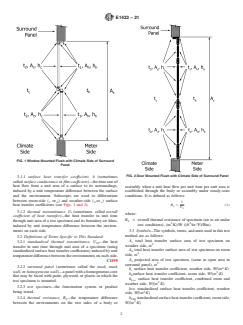
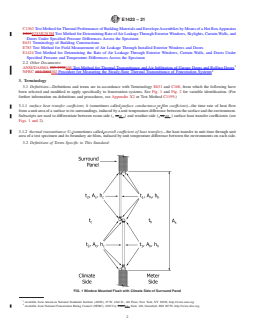
FIG. 1 Window Mounted Flush with Climate Side of Surround
Panel
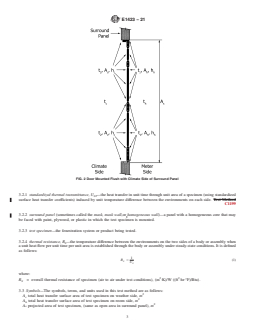
FIG. 2 Door Mounted Flush with Climate Side of Surround Panel
3.1.1 surface heat transfer coeffıcient, h (sometimes
called surfaceconductanceor filmcoeffıcient)—thetimerateof
heat flow from a unit area of a surface to its surroundings,
assembly when a unit heat flow per unit time per unit area is
induced by a unit temperature difference between the surface established through the body or assembly under steady-state
and the environment. Subscripts are used to differentiate
conditions. It is defined as follows:
between room-side ( or ) and weather-side ( or ) surface
1 h 2 c
R 5 (1)
heat transfer coefficients (see Figs. 1 and 2).
S
U
S
3.1.2 thermal transmittance U (sometimes called overall
s
where:
coeffıcient of heat transfer)—the heat transfer in unit time
R = overall thermal resistance of specimen (air to air under
S
through unit area of a test specimen and its boundary air films,
2 2
test conditions), (m ·K)/W ((ft ·hr·°F)/Btu).
induced by unit temperature difference between the environ-
ments on each side.
3.3 Symbols—Thesymbols,terms,andunitsusedinthistest
method are as follows:
3.2 Definitions of Terms Specific to This Standard:
A total heat transfer surface area of test specimen on
3.2.1 standardized thermal transmittance, U —the heat c
ST
weather side, m
transfer in unit time through unit area of a specimen (using
A total heat transfer surface area of test specimen on room
standardized surface heat transfer coefficients) induced by unit h
side, m
temperaturedifferencebetweentheenvironmentsoneachside.
A projected area of test specimen, (same as open area in
C1199 s
surround panel), m
3.2.2 surround panel (sometimes called the mask, mask
h surface heat transfer coefficient, weather side, W/(m ·K)
c
wall,or homogeneous wall)—apanelwithahomogeneouscore
h surface heat transfer coefficient, room side, W/(m ·K)
h
that may be faced with paint, plywood, or plastic in which the
h surface heat transfer coefficient, combined room and
h+c
test specimen is mounted.
weather side, W/(m ·K)
3.2.3 test specimen—the fenestration system or product
h standardized surface heat transfer coefficient, weather
STc
being tested.
side, W/(m ·K)
3.2.4 thermal resistance, R —the temperature difference h standardizedsurfaceheattransfercoefficient,roomside,
S STh
between the environments on the two sides of a body or W/(m ·K)
E1423 − 21
R overall thermal resistance of test specimen (air to air expected from field installations since they do not account for
S
under test conditions), (m ·K)/W solar radiation and air leakage effects. The thermal transmit-
t average temperature of weather side air, °C tance and conductance results are taken from specified labora-
c
t average temperature of room side air, °C toryconditionsandaretobeusedonlyforfenestrationproduct
h
t average temperature of test specimen, room side surface, comparisonsandasinputtothermalperformanceanalysesthat
K or °C also include solar and air leakage effects.
t average temperature of test specimen, weather side
5. Test Specimen
surface, K or °C
U thermal transmittance of test specimen (air to air under 5.1 Specimen Sizes—The specimen sizes given in Table 1
S
for different types of fenestration systems shall be used when
test conditions), W/(m ·K)
U standardized thermal transmittance of test specimen, testing fenestration products. For test specimens not manufac-
ST
tured at the exact sizes given in Table 1, choose the product
W/(m ·K)
with dimensions that produces the smallest value of deviation,
4. Significance and Use
D, calculated by Eq 2. For non-rectangular products, choose
the product with an area closest to the area of the product in
4.1 This practice details the test specimen sizes and test
Table 1.
conditions, namely, the room-side and weather-side air
temperatures,andthesurfaceheattransfercoefficientsforboth
2 2
D 5 =@~W 2 W ! 1~H 2 H ! # (2)
p m p m
sides of the test specimen, when testing fenestration products
in accordance with Test Method C1199. where:
D = deviation, mm (in.)
4.2 The thermal transmittance and conductance of a speci-
W,H = width and height of production size, mm (in.)
p p
men are affected by its size and three-dimensional geometry.
W ,H = width and height of model size, mm (in.)
m m
Tests should therefore be conducted using the specimen sizes
recommended in 5.1. Should the specimen size differ from
6. Test Conditions
those given in 5.1, the actual size shall be reported in the test
6.1 General—A single set of test conditions does not nec-
report.
essarily define the thermal characteristics of a fenestration
4.3 Many factors can affect the thermal performance of a
system. However, a single set of test conditions is specified to
fenestration system, including deflections of sealed glazing
permit comparison of the thermal transmittance of different
units. Care should be exercised to maintain the original
fenestration products. Thermal transmittance values obtained
physical condition of the fenestration system and while install-
underthissetoftestconditionshavebeenshowntobevalidfor
ing it in the surround panel.
the range of weather conditions typical of the NorthAmerican
4.4 The thermal transmittance and conductance results ob- climate [weather-side temperatures between 43°C and −30°C
tained do not, and are not intended, to reflect performances (110°F and −22°F) and wind speeds up to 6.7 m/s (15 mph)].
A
TABLE 1 Specimen Size Dimensions
B
Window Type Configuration Test Specimen Model Size, mm. (in.)
I - Window Assemblies
Vertical slider XO or XX 1200 × 1500 (47 × 59)
Horizontal slider XO or XX 1500 × 1200 (59 × 47)
Casement - Double XX 1200 × 1550 (47 × 59)
Casement - Single X 1200 × 1500 (47 × 59)
Projecting (Awning - Double) XX 1500 × 1200 (59 × 47)
Projected (Awning - Single) X 1500 × 600 (59 × 24)
Fixed (includes non-standard shapes) O 1200 × 1500 (47 × 59)
Sloped Glazing OO 2000 × 2000 (79 × 79)
Skylights/roof window X 1200 × 1200 (47 × 47)
Greenhouse/Garden X 1500 × 1200 (59 × 47)
Dual Action X 1200 × 1500 (47 × 59)
Pivoted X 1200 × 1500 (47 × 59)
Sidelites X 600 × 1200 (24 × 79)
Transoms X 1200 × 600 (79 × 24)
Basement O Rated at the appropriate product type
Bay or Bow Rated at the appropriate product type
Composite - Fixed beside operable 1200 × 1500 (47 × 59)
Composite - Fixed over operable 1200 × 1500 (47 × 59)
Hinged Escape X 1500 × 1200 (59 × 47)
Jal/Jal Awning X 1200 × 1500 (47 × 59)
Tropical Awning X 1500 × 1200 (59 × 47)
II - Door Assemblies
B
Swinging door(s) with frame X, OX or XX 1000 × 2000 (39 × 82)
C
or 2000 × 2000 (79 × 79)
Sliding Patio doors with frame XO or XX 2000 × 2000 (79 × 79)
A
Select size type based on the manufacturer’s average standard size and intended use of the product.
B
Typical of a single door.
C
Typical of a double door.
E1423 − 21
2 2
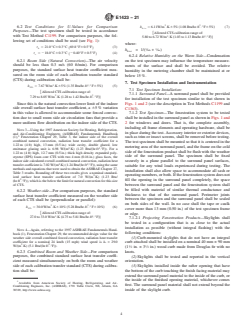
6.2 Test Conditions for U-Values for Comparison h 56.11W/m ·K65% ~1.08Btu/hr·ft ·°F65%! (7)
h1c
Purposes—The test specimen shall be tested in accordance
@AllowedCTScalibrationrangeof:
with Test Method C1199. For comparison purposes, the fol- 2 2
5.80to6.72W/m ·K ~1.03to1.13Btu/hr·ft ·°F!]
lowing set of conditions shall be used (see Fig. 1):
where:
t 521.0°C60.3°C 69.8°F60.5°F (3)
~ !
h
1 1
h = 1/( ⁄hh + ⁄hc)
h+c
t 5218.0°C60.3°C ~20.40°F60.5°F! (4)
c
6.2.4 Relative Humidity on the Warm Side—Condensation
6.2.1 Room Side (Natural Convection)—The air velocity
on the test specimen may influence the temperature measure-
should be less than 0.3 m/s (60 ft/min). For comparison
ments of the surface and shall be avoided. The relative
purposes, the standard surface heat transfer coefficient mea-
humidity in the metering chamber shall be maintained at or
sured on the room side of each calibration transfer standard
below 15%.
(CTS) during calibration shall be:
7. Test Specimen Installation and Instrumentation
2 2
h 57.67W/m ·K65% ~1.35Btu/hr·ft ·°F65%! (5)
STc
7.1 Test Specimen Installation:
@AllowedCTScalibrationrangeof:
7.1.1 Surround Panel—A surround panel shall be provided
2 2
7.29to8.05W/m ·K ~1.28to1.42Btu/hr·ft ·°F!]
for installation of the test specimen similar to that shown in
Since this is the natural convection lower limit of the indoor
Figs. 1 and 2 (see the description in Test Methods C1199 and
side overall surface heat transfer coefficient, a 65% variation C1363).
in this value is allowed to accommodate some forced convec-
7.1.2 Test Specimen—The fenestration system to be tested
tion due to small room side air circulation fans that provide a shall be installed in the surround panel as shown inFigs. 1 and
more uniform flow distribution on the indoor side of the CTS.
2 for windows and doors. That is, the complete assembly,
including all frame elements and operating hardware, shall be
NOTE 3—Using the 1997American Society for Heating, Refrigeration,
in place during the test.Accessory interior or exterior devices,
and Air-Conditioning Engineers (ASHRAE) Fundamentals Handbook
such as trim or insect screens, shall be removed before testing.
(1), Fenestration Chapter 29, Table 3, the indoor side of the overall
combined natural convection, radiation heat transfer coefficient for a
The test specimen shall be mounted so that it is centered in the
1.22m (4ft) high, 13mm (0.5in.) wide cavity, double glazed, low
metering area of the surround panel, and the frame on the cold
2 2
emittance glazing unit is 6.98 W/(m ·K) (1.23 Btu/(hr·ft ·°F)). For a
side of the fenestration product shall be flush with the weather
1.22m (4ft) high, 12.7mm (0.5in.) thick high density expanded poly-
side of the surround panel. The specimen shall be fixed
styrene (EPS) foam core CTS with two 4mm (0.16in.) glass faces, the
indoorsidecalculatedoverallcombinednaturalconvection,radiationheat securely in a plane parallel to the surround panel surfaces,
2 2
transfercoefficientis7.02W/(m ·K)(1.24Btu/(hr·ft ·°F)),usingthesame
suitable for any wind loads experienced during testing. The
methodsandequationsthatwereusedtoobtaintheASHRAEChapter27,
installation shall also allow space to accommodate all sash or
Table 3 results. Rounding off these two results gives a nominal standard-
2 operatingmembers,orboth.Ifthefenestrationsystemdoesnot
ized surface heat transfer coefficient of 7.0 W/(m ·K) (1.23 Btu/
fill the opening in the surround panel completely, the space
(hr·ft ·°F)),whichisthebelowthelimitfornaturalconvectionforthissize
of CTS.
between the surround panel and the fenestration system shall
be filled with material of similar thermal conductance and
6.2.2 Weather-side—For comparison purposes, the standard
thickness to that of the surround panel. Perimeter joints
surface heat transfer coefficient measured on the weather side
between the specimen and the surround panel shall be sealed
of each CTS shall be (perpendicular or parallel):
on both sides of the wall. In no case shall the tape or caulk
2 2
h 530.0W/m ·K610% ~5.28Btu/hr·ft ·°F610%! (6)
STc
cover more than 13 mm (0.50 in.) of the test specimen frame
@AllowedCTScalibrationrangeof:
or edge.
2 2
27.0to33.0W/m ·K ~4.75to5.81Btu/hr·ft ·°F!]
7.1.2.1 Projecting Fenestration Products—Skylights shall
be tested in a configuration that is as close to the actual
installation as possible (without integral flashing) with the
NOTE 4—Again, referring to the 1997 ASHRAE Fundamentals Hand-
following conditions:
book (1), Fenestration Chapter 29, the recommended design value for the
weather side overall combined forced convection, radiation heat transfer (1)Curb-mounted skylights that do not have an integral
coefficient for a nominal 24 km/h (15 mph) wind speed is h = 29.0
c curb attached shall be installed on a nominal 40 mm × 90 mm
2 2
W/(m ·K) (5.1 Btu/(hr·ft ·°F)).
1 1
(1 ⁄2in.×3 ⁄2 in.) wood curb made from Douglas fir with no
6.2.3 Combined Room and Weather Side—For comparison
knots.
purposes, the combined standard surface heat transfer coeffi-
(2)Skylights shall be tested and reported in the vertical
cient measured simultaneously on both the room and weather orientation.
sideofeachcalibrationtransferstandard(CTS)duringcalibra-
(3)Skylights installed inside the rafter opening that have
tion shall be: the bottom of the curb touching the finish facing material may
extend the surround panel material to the inside of the curb, or
the inside of the finished opening material, whichever comes
Available from American Society of Heating, Refrigerating, and Air-
first. The surround panel material shall not extend beyond the
Conditioning Engineers, Inc. (ASHRAE), 1791 Tullie Circle, NE, Atlanta, GA
30329, http://www.ashrae.org. inside of the skylight curb.
E1423 − 21
(4)The skylight size listed in Table 1 is based on a center
of the rafter to the center of the rafter dimension. Thereby, the
standard size references a median size between a skylight
mounted between the rafters and a skylight mounted on top of
the rafters.
(5)The U-factor for skylights is based on the projected
fenestration area. For skylights installed between the rafters,
the outside dimension of the curb is considered to be the
projected area. For skylights installed on top of the rafters, the
inside dimension of the curb is considered to be the projected
area.
7.1.3 Air Leakage—Allpotentialairleakagesitesonthetest
specimen, on the surround panel, and at the interface between
the surround panel and the test specimen must be sealed with
nonmetallictapeorcaulking,orboth,asclosetothewarmside
as possible to minimize or eliminate air leakage between the
room side and weather side chambers. The thermal perfor-
mance can be affected by the method and placement of the test
specimen air seal. Therefore, the test specimen is to be sealed
at the warm side of the test specimen with tape, caulking, or
other material of similar surface emissivity (60.1) to that of
the adhering surface. Minimize the use of tape or caulking, as
excessive application of these materials can affect the thermal
performance of the test specimen.
7.1.3.1 A test specimen with primary and secondary com-
ponents (such as a storm window) shall be sealed at the warm
side of each component.
7.1.3.2 Weep holes/slots located on the cold side shall be
sealed on the cold side.
FIG. 3 Casement Awning Temperature Sensor Placement
7.1.3.3 Perimeter joints between the test specimen and the
surround panel shall be sealed on both sides of the wall. In no
case shall the tape or caulk cover more than 13 mm (0.50 in.)
with fenestration product testing. If there is further interest in
of the test specimen frame or edge.
attempting to determine edge (spacer) heat transfer effects,
7.1.3.4 As an additional precaution to minimize the poten-
additionaltemperaturesensorsshouldbemountedintheregion
tial for leakage of air through and around the sealed test
of the glazing near the frame, especially in the glazing/frame
specim
...
This document is not an ASTM standard and is intended only to provide the user of an ASTM standard an indication of what changes have been made to the previous version. Because
it may not be technically possible to adequately depict all changes accurately, ASTM recommends that users consult prior editions as appropriate. In all cases only the current version
of the standard as published by ASTM is to be considered the official document.
Designation: E1423 − 14 E1423 − 21
Standard Practice for
Determining Steady State Thermal Transmittance of
Fenestration Systems
This standard is issued under the fixed designation E1423; the number immediately following the designation indicates the year of
original adoption or, in the case of revision, the year of last revision. A number in parentheses indicates the year of last reapproval. A
superscript epsilon (´) indicates an editorial change since the last revision or reapproval.
1. Scope
1.1 This practice covers standard test specimen sizes and test conditions as well as the calculation and presentation of the thermal
transmittance and conductance data measured in accordance with Test Method C1199. The standard sizes and conditions are to be
used for fenestration product comparison purposes. The specifier may choose other sizes and conditions for product development
or research purposes.
1.2 This practice deals with the determination of the thermal properties of a fenestration system installed vertically without the
influences of solar heat gain and air leakage effects.
NOTE 1—To determine air leakage effects of fenestration systems, Test Method E283E283/E283M or E1424 should be referenced.
NOTE 2—See Appendix Appendix X1 regarding garage doors and rolling doors.
1.3 This practice specifies the procedure for determining the standardized thermal transmittance of a fenestration test specimen
using specified values of the room-side and weather-side surface heat transfer coefficients, h and h , respectively.
h c
1.4 The values stated in SI units are to be regarded as the standard. The values given in parentheses are for information only.after
SI units are provided for information only and are not considered standard.
1.5 This standard does not purport to address all of the safety concerns, if any, associated with its use. It is the responsibility
of the user of this standard to establish appropriate safety safety, health, and healthenvironmental practices and determine the
applicability of regulatory limitations prior to use.
1.6 This international standard was developed in accordance with internationally recognized principles on standardization
established in the Decision on Principles for the Development of International Standards, Guides and Recommendations issued
by the World Trade Organization Technical Barriers to Trade (TBT) Committee.
2. Referenced Documents
2.1 ASTM Standards:
C168 Terminology Relating to Thermal Insulation
C1199 Test Method for Measuring the Steady-State Thermal Transmittance of Fenestration Systems Using Hot Box Methods
This guidepractice is under the jurisdiction of ASTM Committee E06 on Performance of Buildings and is the direct responsibility of Subcommittee E06.51 on
Performance of Windows, Doors, Skylights and Curtain Walls.
Current edition approved April 1, 2014Aug. 1, 2021. Published May 2014August 2021. Originally approved in 1991. Last previous edition approved in 20062014 as
E1423 – 06.E1423 – 14. DOI: 10.1520/E1423-14.10.1520/E1423-21.
For referenced ASTM standards, visit the ASTM website, www.astm.org, or contact ASTM Customer Service at service@astm.org. For Annual Book of ASTM Standards
volume information, refer to the standard’sstandard’s Document Summary page on the ASTM website.
Copyright © ASTM International, 100 Barr Harbor Drive, PO Box C700, West Conshohocken, PA 19428-2959. United States
E1423 − 21
C1363 Test Method for Thermal Performance of Building Materials and Envelope Assemblies by Means of a Hot Box Apparatus
E283E283/E283M Test Method for Determining Rate of Air Leakage Through Exterior Windows, Skylights, Curtain Walls, and
Doors Under Specified Pressure Differences Across the Specimen
E631 Terminology of Building Constructions
E783 Test Method for Field Measurement of Air Leakage Through Installed Exterior Windows and Doors
E1424 Test Method for Determining the Rate of Air Leakage Through Exterior Windows, Curtain Walls, and Doors Under
Specified Pressure and Temperature Differences Across the Specimen
2.2 Other Documents:
ANSI/DASMA 105-1998105 Test Method for Thermal Transmittance and Air Infiltration of Garage Doors and Rolling Doors
NFRC 102-2002102 Procedure for Measuring the Steady-State Thermal Transmittance of Fenestration Systems
3. Terminology
3.1 Definitions—Definitions and terms are in accordance with Terminology E631 and C168, from which the following have
been selected and modified to apply specifically to fenestration systems. See Fig. 1 and Fig. 2 for variable identification. (For
further information on definitions and procedures, see Appendix X2 or Test Method C1199.)
3.1.1 surface heat transfer coeffıcient, h (sometimes called surface conductance or film coeffıcient)—the time rate of heat flow
from a unit area of a surface to its surroundings, induced by a unit temperature difference between the surface and the environment.
Subscripts are used to differentiate between room-side ( oror ) and weather-side ( or or ) surface heat transfer coefficients (see
1 h 2 c
Figs. 1 and 2).
3.1.2 thermal transmittance U (sometimes called overall coeffıcient of heat transfer)—the heat transfer in unit time through unit
s
area of a test specimen and its boundary air films, induced by unit temperature difference between the environments on each side.
3.2 Definitions of Terms Specific to This Standard:
FIG. 1 Window Mounted Flush with Climate Side of Surround Panel
Available from American National Standards Institute (ANSI), 25 W. 43rd St., 4th Floor, New York, NY 10036, http://www.ansi.org.
Available from National Fenestration Rating Council (NFRC), 6305 Ivy Lane,Ln., Suite 140, Greenbelt, MD 20770, http://www.nfrc.org.
E1423 − 21
FIG. 2 Door Mounted Flush with Climate Side of Surround Panel
3.2.1 standardized thermal transmittance, U —the heat transfer in unit time through unit area of a specimen (using standardized
ST
surface heat transfer coefficients) induced by unit temperature difference between the environments on each side. Test Method
C1199
3.2.2 surround panel (sometimes called the mask, mask wall,or homogeneous wall)—a panel with a homogeneous core that may
be faced with paint, plywood, or plastic in which the test specimen is mounted.
3.2.3 test specimen—the fenestration system or product being tested.
3.2.4 thermal resistance, R —the temperature difference between the environments on the two sides of a body or assembly when
S
a unit heat flow per unit time per unit area is established through the body or assembly under steady-state conditions. It is defined
as follows:
R 5 (1)
S
U
S
where:
2 2
R = overall thermal resistance of specimen (air to air under test conditions), (m ·K)/W ((ft ·hr·°F)/Btu).
S
3.3 Symbols—The symbols, terms, and units used in this test method are as follows:
A total heat transfer surface area of test specimen on weather side, m
c
A total heat transfer surface area of test specimen on room side, m
h
A projected area of test specimen, (same as open area in surround panel), m
s
E1423 − 21
h surface heat transfer coefficient, weather side, W/(m ·K)
c
h surface heat transfer coefficient, room side, W/(m ·K)
h
h surface heat transfer coefficient, combined room and weather side, W/(m ·K)
h+c
h standardized surface heat transfer coefficient, weather side, W/(m ·K)
STc
h standardized surface heat transfer coefficient, room side, W/(m ·K)
STh
R overall thermal resistance of test specimen (air to air under test conditions), (m ·K)/W
S
t average temperature of weather side air, °C
c
t average temperature of room side air, °C
h
t average temperature of test specimen, room side surface, K or °C
t average temperature of test specimen, weather side surface, K or °C
U thermal transmittance of test specimen (air to air under test conditions), W/(m ·K)
S
U standardized thermal transmittance of test specimen, W/(m ·K)
ST
4. Significance and Use
4.1 This practice details the test specimen sizes and test conditions, namely, the room-side and weather-side air temperatures, and
the surface heat transfer coefficients for both sides of the test specimen, when testing fenestration products in accordance with Test
Method C1199.
4.2 The thermal transmittance and conductance of a specimen are affected by its size and three-dimensional geometry. Tests should
therefore be conducted using the specimen sizes recommended in 5.1. Should the specimen size differ from those given in 5.1, the
actual size shall be reported in the test report.
4.3 Many factors can affect the thermal performance of a fenestration system, including deflections of sealed glazing units. Care
should be exercised to maintain the original physical condition of the fenestration system and while installing it in the surround
panel.
4.4 The thermal transmittance and conductance results obtained do not, and are not intended, to reflect performances expected
from field installations since they do not account for solar radiation and air leakage effects. The thermal transmittance and
conductance results are taken from specified laboratory conditions and are to be used only for fenestration product comparisons
and as input to thermal performance analyses that also include solar and air leakage effects.
5. Test Specimen
5.1 Specimen Sizes—The specimen sizes given in Table 1 for different types of fenestration systems shall be used when testing
fenestration products. For test specimens not manufactured at the exact sizes given in Table 1, choose the product with dimensions
that produces the smallest value of deviation, D, calculated by Eq 2. For non-rectangular products, choose the product with an area
closest to the area of the product in Table 1.
2 2
D 5= W 2 W 1 H 2 H (2)
@~ ! ~ ! #
p m p m
where:
D = deviation, mm (in.)
W , H = width and height of production size, mm (in.)
p p
W , H = width and height of model size, mm (in.)
m m
6. Test Conditions
6.1 General—A single set of test conditions does not necessarily define the thermal characteristics of a fenestration system.
However, a single set of test conditions is specified to permit comparison of the thermal transmittance of different fenestration
products. Thermal transmittance values obtained under this set of test conditions have been shown to be valid for the range of
weather conditions typical of the North American climate [weather-side temperatures between 4343 °C and −30°C (110−30 °C
(110 °F and −22°F)−22 °F) and wind speeds up to 6.7 m/s (15 mph)].
6.2 Test Conditions for U-Values for Comparison Purposes—The test specimen shall be tested in accordance with Test Method
C1199. For comparison purposes, the following set of conditions shall be used (see Fig. 1):
t 5 21.0°C60.3°C 69.8°F60.5°F (3)
~ !
h
E1423 − 21
A
TABLE 1 Specimen Size Dimensions
B
Window Type Configuration Test Specimen Model Size, mm. (in.)
I - Window Assemblies
Vertical slider XO or XX 1200 × 1500 (47 × 59)
Horizontal slider XO or XX 1500 × 1200 (59 × 47)
Casement - Double XX 1200 × 1550 (47 × 59)
Casement - Single X 1200 × 1500 (47 × 59)
Projecting (Awning - Double) XX 1500 × 1200 (59 × 47)
Projected (Awning - Single) X 1500 × 600 (59 × 24)
Fixed (includes non-standard shapes) O 1200 × 1500 (47 × 59)
Sloped Glazing OO 2000 × 2000 (79 × 79)
Skylights/roof window X 1200 × 1200 (47 × 47)
Greenhouse/Garden X 1500 × 1200 (59 × 47)
Dual Action X 1200 × 1500 (47 × 59)
Pivoted X 1200 × 1500 (47 × 59)
Sidelites X 600 × 1200 (24 × 79)
Transoms X 1200 × 600 (79 × 24)
Basement O Rated at the appropriate product type
Bay or Bow Rated at the appropriate product type
Composite - Fixed beside operable 1200 × 1500 (47 × 59)
Composite - Fixed over operable 1200 × 1500 (47 × 59)
Hinged Escape X 1500 × 1200 (59 × 47)
Jal/Jal Awning X 1200 × 1500 (47 × 59)
Tropical Awning X 1500 × 1200 (59 × 47)
II - Door Assemblies
B
Swinging door(s) with frame X, OX or XX 1000 × 2000 (39 × 82)
C
or 2000 × 2000 (79 × 79)
Sliding Patio doors with frame XO or XX 2000 × 2000 (79 × 79)
A
Select size type based on the manufacturer’s average standard size and intended use of the product.
B
Typical of a single door.
C
Typical of a double door.
t 5218.0°C60.3°C 20.40°F60.5°F (4)
~ !
c
6.2.1 Room Side (Natural Convection)—The air velocity should be less than 0.3 m/s (60 ft/min). For comparison purposes, the
standard surface heat transfer coefficient measured on the room side of each calibration transfer standard (CTS) during calibration
shall be:
2 2
h 5 7.67 W/m ·K65% ~1.35 Btu/hr·ft ·°F65%! (5)
STc
@Allowed CTS calibration range of:
2 2
7.29 to 8.05 W/m ·K ~1.28 to 1.42 Btu/hr·ft ·°F!]
Since this is the natural convection lower limit of the indoor side overall surface heat transfer coefficient, a 65 % variation in
this value is allowed to accommodate some forced convection due to small room side air circulation fans that provide a more
uniform flow distribution on the indoor side of the CTS.
NOTE 3—Using the 1997 American Society for Heating, Refrigeration, and Air-Conditioning Engineers (ASHRAE) Fundamentals Handbook (1),
Fenestration Chapter 29, Table 3, the indoor side of the overall combined natural convection, radiation heat transfer coefficient for a 1.22-m (4-ft) high,
2 2
13-mm (0.5-in.)1.22 m (4 ft) high, 13 mm (0.5 in.) wide cavity, double glazed, low emittance glazing unit is 6.98 W/(m ·K) (1.23 Btu/(hr·ft ·°F)). For
a 1.22-m (4-ft) high, 12.7-mm (0.5-in.)1.22 m (4 ft) high, 12.7 mm (0.5 in.) thick high density expanded polystyrene (EPS) foam core CTS with two 4-mm
(0.16-in.)4 mm (0.16 in.) glass faces, the indoor side calculated overall combined natural convection, radiation heat transfer coefficient is 7.02 W/(m ·K)
(1.24 Btu/(hr·ft ·°F)), using the same methods and equations that were used to obtain the ASHRAE Chapter 27, Table 3 results. Rounding off these two
2 2
results gives a nominal standardized surface heat transfer coefficient of 7.0 W/(m ·K) (1.23 Btu/(hr·ft ·°F)), which is the below the limit for natural
convection for this size of CTS.
6.2.2 Weather-side—For comparison purposes, the standard surface heat transfer coefficient measured on the weather side of each
CTS shall be (perpendicular or parallel):
2 2
h 5 30.0 W/m ·K610% ~5.28 Btu/hr·ft ·°F610%! (6)
STc
Allowed CTS calibration range of:
@
2 2
27.0 to 33.0 W/m ·K ~4.75 to 5.81 Btu/hr·ft ·°F!]
Available from American Society of Heating, Refrigerating, and Air-Conditioning Engineers, Inc. (ASHRAE), 1791 Tullie Circle, NE, Atlanta, GA 30329,
http://www.ashrae.org.
E1423 − 21
NOTE 4—Again, referring to the 1997 ASHRAE Fundamentals Handbook (1), Fenestration Chapter 29, the recommended design value for the weather
side overall combined forced convection, radiation heat transfer coefficient for a nominal 24 km/h (15 mph) wind speed is h = 29.0 W/(m ·K) (5.1
c
Btu/(hr·ft ·°F)).
6.2.3 Combined Room and Weather Side—For comparison purposes, the combined standard surface heat transfer coefficient
measured simultaneously on both the room and weather side of each calibration transfer standard (CTS) during calibration shall
be:
2 2
h 5 6.11W/m ·K65% ~1.08 Btu/hr·ft ·°F65%! (7)
h1c
Allowed CTS calibration range of:
@
2 2
5.80 to 6.72 W/m ·K ~1.03 to 1.13 Btu/hr·ft ·°F!]
where:
1 1
h = 1/( ⁄hh + ⁄hc)
h+c
6.2.4 Relative Humidity on the Warm Side—Condensation on the test specimen may influence the temperature measurements of
the surface and shall be avoided. The relative humidity in the metering chamber shall be maintained at or below 15 %.
7. Test Specimen Installation and Instrumentation
7.1 Test Specimen Installation:
7.1.1 Surround Panel—A surround panel shall be provided for installation of the test specimen similar to that shown in Figs. 1
and 2 (see the description in Test Methods C1199 and C1363).
7.1.2 Test Specimen—The fenestration system to be tested shall be installed in the surround panel as shown in Figs. 1 and 2 for
windows and doors. That is, the complete assembly, including all frame elements and operating hardware, shall be in place during
the test. Accessory interior or exterior devices, such as trim or insect screens, shall be removed before testing. The test specimen
shall be mounted so that it is centered in the metering area of the surround panel, and the frame on the cold side of the fenestration
product shall be flush with the weather side of the surround panel. The specimen shall be fixed securely in a plane parallel to the
surround panel surfaces, suitable for any wind loads experienced during testing. The installation shall also allow space to
accommodate all sash or operating members, or both. If the fenestration system does not fill the opening in the surround panel
completely, the space between the surround panel and the fenestration system shall be filled with material of similar thermal
conductance and thickness to that of the surround panel. Perimeter joints between the specimen and the surround panel shall be
sealed on both sides of the wall. In no case shall the tape or caulk cover more than 13 mm (0.50 in.) of the test specimen frame
or edge.
7.1.2.1 Projecting Fenestration Products—Skylights shall be tested in a configuration that is as close to the actual installation as
possible (without integral flashing) with the following conditions:
(1) Curb-mounted skylights that do not have an integral curb attached shall be installed on a nominal 40 mm × 90 mm (1 ⁄2
in. × 3 ⁄2 in.) wood curb made from Douglas fir with no knots.
(2) Skylights shall be tested and reported in the vertical orientation.
(3) Skylights installed inside the rafter opening that have the bottom of the curb touching the finish facing material may extend
the surround panel material to the inside of the curb, or the inside of the finished opening material, whichever comes first. The
surround panel material shall not extend beyond the inside of the skylight curb.
(4) The skylight size listed in Table 1 is based on a center of the rafter to the center of the rafter dimension. Thereby, the
standard size references a median size between a skylight mounted between the rafters and a skylight mounted on top of the rafters.
(5) The U-factor for skylights is based on the projected fenestration area. For skylights installed between the rafters, the outside
dimension of the curb is considered to be the projected area. For skylights installed on top of the rafters, the inside dimension of
the curb is considered to be the projected area.
7.1.3 Air Leakage—All potential air leakage sites on the test specimen, on the surround panel, and at the interface between the
surround panel and the test specimen must be sealed with nonmetallic tape or caulking, or both, as close to the warm side as
possible to minimize or eliminate air leakage between the room side and weather side chambers. The thermal performance can be
affected by the method and placement of the test specimen air seal. Therefore, the test specimen is to be sealed at the warm side
of the test specimen with tape, caulking, or other material of similar surface emissivity (60.1) to that of the adhering surface.
Minimize the use of tape or caulking, as excessive application of these materials can affect the thermal performance of the test
specimen.
E1423 − 21
7.1.3.1 A test specimen with primary and secondary components (such as a storm window) shall be sealed at the warm side of
each component.
7.1.3.2 Weep holes/slots located on the cold side shall be sealed on the cold side.
7.1.3.3 Perimeter joints between the test specimen and the surround panel shall be sealed on both sides of the wall. In no case shall
the tape or caulk cover more than 13 mm (0.50 in.) of the test specimen frame or edge.
7.1.3.4 As an additional precaution to minimize the potential for leakage of air through and around the sealed test specimen, means
mayshall be provided to measure and equalizemonitor the pressure difference across the test specimen. For hot boxes that have
a perpendicular (to the test specimen weather side surface) wind direction, this is accomplished by balancing the the pressure
difference between the weather side total pressure withand the room side static pressure to 0 shall be no greater than 0 Pa 6 10
2 2
Pa (0(0 lbf ⁄ft 6 0.21 Lbf/ftlbf/ft ). For hot boxes that have a parallel (to the test specimen weather side surface) wind direction,
this is accomplished by balancing the the pressure difference between the weather side static pressure withand the room side static
2 2
pressure to 0 shall be no greater than 0 Pa 6 10 Pa (0(0
...