

ASTM C1199-22
(Test Method)Standard Test Method for Measuring the Steady-State Thermal Transmittance of Fenestration Systems Using Hot Box Methods
General Information
- Abstract
SIGNIFICANCE AND USE
4.1 This test method details the calibration and testing procedures and necessary additional temperature instrumentation required in applying Test Method C1363 to measure the thermal transmittance of fenestration systems mounted vertically in the thermal chamber.
4.2 The thermal transmittance of a test specimen is affected by its size and three-dimensional geometry. Care must be exercised when extrapolating to product sizes smaller or larger than the test specimen. Therefore, it is recommended that fenestration systems be tested at the recommended sizes specified in Practice E1423 or NFRC 100.
4.3 Since both temperature and surface heat transfer coefficient conditions affect results, use of recommended conditions will assist in reducing confusion caused by comparing results of tests performed under dissimilar conditions. Standardized test conditions for determining the thermal transmittance of fenestration systems are specified in Practice E1423 and Section 6.2. The performance of a test specimen measured at standardized test conditions is potentially different than the performance of the same fenestration product when installed in the wall of a building located outdoors. Standardized test conditions often represent extreme summer or winter design conditions, which are potentially different than the average conditions typically experienced by a fenestration product installed in an exterior wall. For the purpose of comparison, it is essential to calibrate with surface heat transfer coefficients on the Calibration Transfer Standard (CTS) which are as close as possible to the conventionally accepted values for building design; however, this procedure can be used at other conditions for research purposes or product development.
4.4 Similarly, it would be desirable to have a surround panel that closely duplicates the actual wall where the fenestration system would be installed. Since there are such a wide variety of fenestration system openings in North American...
SCOPE
1.1 This test method covers requirements and guidelines and specifies calibration procedures required for the measurement of the steady-state thermal transmittance of fenestration systems installed vertically in the test chamber. This test method specifies the necessary measurements to be made using measurement systems conforming to Test Method C1363 for determination of fenestration system thermal transmittance.
Note 1: This test method allows the testing of projecting fenestration products (that is, garden windows, skylights, and roof windows) installed vertically in a surround panel. Current research on skylights, roof windows, and projecting products hopefully will provide additional information that can be added to the next version of this test method so that skylight and roof windows can be tested horizontally or at some angle typical of a sloping roof.
1.2 This test method refers to the thermal transmittance, U of a fenestration system installed vertically in the absence of solar radiation and air leakage effects.
Note 2: The methods described in this document may also be adapted for use in determining the thermal transmittance of sections of building wall, and roof and floor assemblies containing thermal anomalies, which are smaller than the hot box metering area.
1.3 This test method describes how to determine the thermal transmittance, US of a fenestration product (also called test specimen) at well-defined environmental conditions. The thermal transmittance is also a reported test result from Test Method C1363. If only the thermal transmittance is reported using this test method, the test report must also include a detailed description of the environmental conditions in the thermal chamber during the test as outlined in 10.1.14.
1.4 For rating purposes, this test method also describes how to calculate a standardized thermal transmittance, UST, which can be used to compare test results from labor...
- Status
- Published
- Publication Date
- 28-Feb-2022
- Technical Committee
- C16 - Thermal Insulation
- Drafting Committee
- C16.30 - Thermal Measurement
Buy Documents
ASTM C1199-22 - Standard Test Method for Measuring the Steady-State Thermal Transmittance of Fenestration Systems Using Hot Box Methods
REDLINE ASTM C1199-22 - Standard Test Method for Measuring the Steady-State Thermal Transmittance of Fenestration Systems Using Hot Box Methods
Overview
ASTM C1199-22 is the Standard Test Method for Measuring the Steady-State Thermal Transmittance of Fenestration Systems Using Hot Box Methods. Developed by ASTM International, this standard provides comprehensive guidelines, procedures, and calibration requirements for accurately determining the steady-state thermal transmittance (U-value) of vertically installed fenestration systems such as windows, doors, skylights, and other glass openings. The primary method employed is the hot box technique, an industry-recognized approach for assessing the thermal performance of building envelope components.
This standard references and builds upon related methods and practices, particularly ASTM C1363, ensuring consistency and reliability in measured results. The procedure is applicable to various fenestration configurations, including projecting products like garden windows or roof windows, and is pivotal for energy efficiency evaluations, product comparison, and research in building thermal management.
Key Topics
- Test Method Application: Specifies calibration and testing procedures-along with required instrumentation-to measure the U-factor of fenestration systems when mounted vertically in a thermal chamber. Hot box setups and calibration transfer standards (CTS) are integral to this process.
- Environmental and Geometric Considerations: Recognizes that thermal transmittance is influenced by product size, shape, and boundary conditions. Standardized test environments, as defined in ASTM E1423 and NFRC 100, are recommended for meaningful comparison and repeatability.
- Calculation of Standardized Values: Describes both the Calibration Transfer Standard (CTS) and Area Weighting (AW) methods for calculating standardized thermal transmittance. These methodologies support comparative analysis across laboratories and with computer simulations.
- Use of Surround Panels: Recommends a homogeneous, high-resistance surround panel when testing, to focus measurement accuracy on the fenestration system itself and minimize wall interaction errors.
- Exclusion of Air Leakage and Solar Gain: Stipulates that tests are to be conducted in the absence of air leakage and solar radiation effects, for pure thermal transmittance assessment.
- Reporting Requirements: Mandates inclusion of detailed test chamber environmental conditions in reports, as these factors critically impact results.
Applications
ASTM C1199-22 has broad value across the architectural, construction, and manufacturing sectors focused on energy efficiency and building envelope design. Practical applications include:
- Product Development and Quality Control: Provides a repeatable, validated process for manufacturers of windows, doors, curtain walls, and related products to assess and benchmark the thermal performance of new or existing designs.
- Regulatory Compliance: Assists builders and product certifiers in meeting energy codes and standards that require documentation of U-values for fenestration components.
- Building Energy Modeling: Supplies reliable, standardized input data for computer simulations predicting building insulation performance and energy usage.
- Research and Comparative Analysis: Enables consistent evaluation of design alternatives, material choices, and installation methods for optimal energy conservation.
Related Standards
For a holistic approach to evaluating and specifying the thermal performance of building envelope components, the following standards are frequently referenced alongside ASTM C1199-22:
- ASTM C1363: Test Method for Thermal Performance of Building Materials and Envelope Assemblies by Means of a Hot Box Apparatus
- ASTM E1423: Practice for Determining Steady State Thermal Transmittance of Fenestration Systems
- NFRC 100: Procedure for Determining Fenestration Product U-factors
- ISO 12567-1/2: Thermal Performance Determination of Windows and Doors by Hot Box Method
- ASHRAE Handbook - Fundamentals: Authoritative reference for building energy calculations and guidance.
By adhering to ASTM C1199-22 and associated standards, organizations ensure accurate, repeatable measurement of fenestration thermal performance-critical for energy-efficient building design and sustainable product innovation.
Keywords: ASTM C1199-22, thermal transmittance, hot box method, fenestration systems, U-value, energy efficiency, window testing, building envelope standards, calibration procedures, CTS, AW method.
Relations
- Effective Date
- 15-Apr-2024
- Effective Date
- 01-Mar-2024
- Effective Date
- 01-Sep-2019
- Effective Date
- 01-Apr-2019
- Effective Date
- 01-Mar-2019
- Effective Date
- 01-Oct-2018
- Effective Date
- 15-Apr-2018
- Effective Date
- 01-Jun-2017
- Effective Date
- 15-Oct-2015
- Effective Date
- 01-Sep-2015
- Effective Date
- 01-Jun-2015
- Effective Date
- 01-Mar-2015
- Effective Date
- 01-Nov-2014
- Effective Date
- 01-Sep-2013
- Effective Date
- 01-Sep-2013
Buy Documents
ASTM C1199-22 - Standard Test Method for Measuring the Steady-State Thermal Transmittance of Fenestration Systems Using Hot Box Methods
REDLINE ASTM C1199-22 - Standard Test Method for Measuring the Steady-State Thermal Transmittance of Fenestration Systems Using Hot Box Methods
Get Certified
Connect with accredited certification bodies for this standard

DIBt (Deutsches Institut für Bautechnik)
German Institute for Building Technology.
DIN CERTCO
DIN Group product certification.

Aboma Certification B.V.
Specialized in construction, metal, and transport sectors.
Sponsored listings
Frequently Asked Questions
ASTM C1199-22 is a standard published by ASTM International. Its full title is "Standard Test Method for Measuring the Steady-State Thermal Transmittance of Fenestration Systems Using Hot Box Methods". This standard covers: SIGNIFICANCE AND USE 4.1 This test method details the calibration and testing procedures and necessary additional temperature instrumentation required in applying Test Method C1363 to measure the thermal transmittance of fenestration systems mounted vertically in the thermal chamber. 4.2 The thermal transmittance of a test specimen is affected by its size and three-dimensional geometry. Care must be exercised when extrapolating to product sizes smaller or larger than the test specimen. Therefore, it is recommended that fenestration systems be tested at the recommended sizes specified in Practice E1423 or NFRC 100. 4.3 Since both temperature and surface heat transfer coefficient conditions affect results, use of recommended conditions will assist in reducing confusion caused by comparing results of tests performed under dissimilar conditions. Standardized test conditions for determining the thermal transmittance of fenestration systems are specified in Practice E1423 and Section 6.2. The performance of a test specimen measured at standardized test conditions is potentially different than the performance of the same fenestration product when installed in the wall of a building located outdoors. Standardized test conditions often represent extreme summer or winter design conditions, which are potentially different than the average conditions typically experienced by a fenestration product installed in an exterior wall. For the purpose of comparison, it is essential to calibrate with surface heat transfer coefficients on the Calibration Transfer Standard (CTS) which are as close as possible to the conventionally accepted values for building design; however, this procedure can be used at other conditions for research purposes or product development. 4.4 Similarly, it would be desirable to have a surround panel that closely duplicates the actual wall where the fenestration system would be installed. Since there are such a wide variety of fenestration system openings in North American... SCOPE 1.1 This test method covers requirements and guidelines and specifies calibration procedures required for the measurement of the steady-state thermal transmittance of fenestration systems installed vertically in the test chamber. This test method specifies the necessary measurements to be made using measurement systems conforming to Test Method C1363 for determination of fenestration system thermal transmittance. Note 1: This test method allows the testing of projecting fenestration products (that is, garden windows, skylights, and roof windows) installed vertically in a surround panel. Current research on skylights, roof windows, and projecting products hopefully will provide additional information that can be added to the next version of this test method so that skylight and roof windows can be tested horizontally or at some angle typical of a sloping roof. 1.2 This test method refers to the thermal transmittance, U of a fenestration system installed vertically in the absence of solar radiation and air leakage effects. Note 2: The methods described in this document may also be adapted for use in determining the thermal transmittance of sections of building wall, and roof and floor assemblies containing thermal anomalies, which are smaller than the hot box metering area. 1.3 This test method describes how to determine the thermal transmittance, US of a fenestration product (also called test specimen) at well-defined environmental conditions. The thermal transmittance is also a reported test result from Test Method C1363. If only the thermal transmittance is reported using this test method, the test report must also include a detailed description of the environmental conditions in the thermal chamber during the test as outlined in 10.1.14. 1.4 For rating purposes, this test method also describes how to calculate a standardized thermal transmittance, UST, which can be used to compare test results from labor...
SIGNIFICANCE AND USE 4.1 This test method details the calibration and testing procedures and necessary additional temperature instrumentation required in applying Test Method C1363 to measure the thermal transmittance of fenestration systems mounted vertically in the thermal chamber. 4.2 The thermal transmittance of a test specimen is affected by its size and three-dimensional geometry. Care must be exercised when extrapolating to product sizes smaller or larger than the test specimen. Therefore, it is recommended that fenestration systems be tested at the recommended sizes specified in Practice E1423 or NFRC 100. 4.3 Since both temperature and surface heat transfer coefficient conditions affect results, use of recommended conditions will assist in reducing confusion caused by comparing results of tests performed under dissimilar conditions. Standardized test conditions for determining the thermal transmittance of fenestration systems are specified in Practice E1423 and Section 6.2. The performance of a test specimen measured at standardized test conditions is potentially different than the performance of the same fenestration product when installed in the wall of a building located outdoors. Standardized test conditions often represent extreme summer or winter design conditions, which are potentially different than the average conditions typically experienced by a fenestration product installed in an exterior wall. For the purpose of comparison, it is essential to calibrate with surface heat transfer coefficients on the Calibration Transfer Standard (CTS) which are as close as possible to the conventionally accepted values for building design; however, this procedure can be used at other conditions for research purposes or product development. 4.4 Similarly, it would be desirable to have a surround panel that closely duplicates the actual wall where the fenestration system would be installed. Since there are such a wide variety of fenestration system openings in North American... SCOPE 1.1 This test method covers requirements and guidelines and specifies calibration procedures required for the measurement of the steady-state thermal transmittance of fenestration systems installed vertically in the test chamber. This test method specifies the necessary measurements to be made using measurement systems conforming to Test Method C1363 for determination of fenestration system thermal transmittance. Note 1: This test method allows the testing of projecting fenestration products (that is, garden windows, skylights, and roof windows) installed vertically in a surround panel. Current research on skylights, roof windows, and projecting products hopefully will provide additional information that can be added to the next version of this test method so that skylight and roof windows can be tested horizontally or at some angle typical of a sloping roof. 1.2 This test method refers to the thermal transmittance, U of a fenestration system installed vertically in the absence of solar radiation and air leakage effects. Note 2: The methods described in this document may also be adapted for use in determining the thermal transmittance of sections of building wall, and roof and floor assemblies containing thermal anomalies, which are smaller than the hot box metering area. 1.3 This test method describes how to determine the thermal transmittance, US of a fenestration product (also called test specimen) at well-defined environmental conditions. The thermal transmittance is also a reported test result from Test Method C1363. If only the thermal transmittance is reported using this test method, the test report must also include a detailed description of the environmental conditions in the thermal chamber during the test as outlined in 10.1.14. 1.4 For rating purposes, this test method also describes how to calculate a standardized thermal transmittance, UST, which can be used to compare test results from labor...
ASTM C1199-22 is classified under the following ICS (International Classification for Standards) categories: 91.060.50 - Doors and windows; 91.120.10 - Thermal insulation of buildings. The ICS classification helps identify the subject area and facilitates finding related standards.
ASTM C1199-22 has the following relationships with other standards: It is inter standard links to ASTM C168-24, ASTM C1363-24, ASTM C1363-19, ASTM C1045-19, ASTM C1114-06(2019), ASTM E783-02(2018), ASTM C168-18, ASTM C168-17, ASTM C168-15a, ASTM C518-15, ASTM C168-15, ASTM E631-15, ASTM E631-14, ASTM C1114-06(2013), ASTM C1045-07(2013). Understanding these relationships helps ensure you are using the most current and applicable version of the standard.
ASTM C1199-22 is available in PDF format for immediate download after purchase. The document can be added to your cart and obtained through the secure checkout process. Digital delivery ensures instant access to the complete standard document.
Standards Content (Sample)
This international standard was developed in accordance with internationally recognized principles on standardization established in the Decision on Principles for the
Development of International Standards, Guides and Recommendations issued by the World Trade Organization Technical Barriers to Trade (TBT) Committee.
Designation: C1199 − 22
Standard Test Method for
Measuring the Steady-State Thermal Transmittance of
Fenestration Systems Using Hot Box Methods
This standard is issued under the fixed designation C1199; the number immediately following the designation indicates the year of
original adoption or, in the case of revision, the year of last revision.Anumber in parentheses indicates the year of last reapproval.A
superscript epsilon (´) indicates an editorial change since the last revision or reapproval.
1. Scope the comparison to results from computer programs that use
standard heat transfer coefficients to determine the thermal
1.1 This test method covers requirements and guidelines
transmittance of fenestration products. Although this test
and specifies calibration procedures required for the measure-
method specifies two methods of calculating the standardized
ment of the steady-state thermal transmittance of fenestration
thermal transmittance, only the standardized thermal transmit-
systems installed vertically in the test chamber. This test
tance result from one method is reported for each test. One
methodspecifiesthenecessarymeasurementstobemadeusing
standardizedthermaltransmittancecalculationprocedureisthe
measurement systems conforming to Test Method C1363 for
CalibrationTransferStandard(CTS)Methodandanotheristhe
determination of fenestration system thermal transmittance.
Area Weighting (AW) Method (see Section 9 for further
NOTE 1—This test method allows the testing of projecting fenestration
descriptions of these two methods). The Area Weighting
products (that is, garden windows, skylights, and roof windows) installed
method requires that the surface temperatures on both sides of
vertically in a surround panel. Current research on skylights, roof
the test specimen be directly measured as specified in Practice
windows, and projecting products hopefully will provide additional
E1423 in order to determine the surface heat transfer coeffi-
information that can be added to the next version of this test method so
thatskylightandroofwindowscanbetestedhorizontallyoratsomeangle
cients on the fenestration product during the test. The CTS
typical of a sloping roof.
Method does not use the measured surface temperatures on the
1.2 This test method refers to the thermal transmittance, U test specimen and instead utilizes the calculation of equivalent
of a fenestration system installed vertically in the absence of surfacetemperaturesfromcalibrationdatatodeterminethetest
solar radiation and air leakage effects. specimen surface heat transfer coefficients. The AW shall be
used whenever the thermal transmittance, U , is greater than
S
NOTE 2—The methods described in this document may also be adapted
2 2
3.4 W/(m ·K) [0.6 Btu/(hr·ft ·°F)], or when the ratio of test
for use in determining the thermal transmittance of sections of building
specimen projected surface area to wetted (that is, total heat
wall, and roof and floor assemblies containing thermal anomalies, which
are smaller than the hot box metering area.
transfer or developed) surface area on either side of the test
specimenislessthan0.80.OtherwisetheCTSMethodshallbe
1.3 Thistestmethoddescribeshowtodeterminethethermal
used to standardize the thermal transmittance results.
transmittance, U of a fenestration product (also called test
S
specimen) at well-defined environmental conditions. The ther-
1.5 Adiscussionoftheterminologyandunderlyingassump-
mal transmittance is also a reported test result from Test
tions for measuring the thermal transmittance are included.
Method C1363. If only the thermal transmittance is reported
1.6 The values stated in SI units are to be regarded as the
using this test method, the test report must also include a
standard. The values given in parentheses are provided for
detailed description of the environmental conditions in the
information purposes only.
thermal chamber during the test as outlined in 10.1.14.
1.7 This standard does not purport to address all of the
1.4 For rating purposes, this test method also describes how
safety concerns, if any, associated with its use. It is the
to calculate a standardized thermal transmittance, U , which
ST
responsibility of the user of this standard to establish appro-
can be used to compare test results from laboratories with
priate safety, health, and environmental practices and deter-
vastly different thermal chamber configurations, and facilitates
mine the applicability of regulatory limitations prior to use.
1.8 This international standard was developed in accor-
dance with internationally recognized principles on standard-
ThistestmethodisunderthejurisdictionofASTMCommitteeC16onThermal
Insulation and is the direct responsibility of Subcommittee C16.30 on Thermal
ization established in the Decision on Principles for the
Measurement.
Development of International Standards, Guides and Recom-
Current edition approved March 1, 2022. Published March 2022. Originally
mendations issued by the World Trade Organization Technical
approved in 1991. Last previous edition approved in 2014 as C1199–14. DOI:
10.1520/C1199-22. Barriers to Trade (TBT) Committee.
Copyright © ASTM International, 100 Barr Harbor Drive, PO Box C700, West Conshohocken, PA 19428-2959. United States
C1199 − 22
2. Referenced Documents Tests for Thermal Transmittance and Conductance, Sec-
2 tion 3.2 Calibrated Hot Box Method
2.1 ASTM Standards:
ASHRAE Handbook-Fundamentals 2009
C168Terminology Relating to Thermal Insulation
C177Test Method for Steady-State Heat Flux Measure-
3. Terminology
ments and Thermal Transmission Properties by Means of
the Guarded-Hot-Plate Apparatus
3.1 Definitions—Definitions and terms are in accordance
C518Test Method for Steady-State Thermal Transmission
with definitions in Terminologies E631 and C168, from which
Properties by Means of the Heat Flow Meter Apparatus
the following have been selected and modified to apply to
C1045Practice for Calculating Thermal Transmission Prop-
fenestration systems. See Fig. 1 for temperature locations.
erties Under Steady-State Conditions
3.2 Definitions of Terms Specific to This Standard:
C1114Test Method for Steady-State Thermal Transmission
3.2.1 apparent thermal conductance—A thermal conduc-
Properties by Means of the Thin-Heater Apparatus
tance assigned to a material that exhibits thermal transmission
C1363Test Method for Thermal Performance of Building
byseveralmodesofheattransferresultinginpropertyvariation
Materials and Envelope Assemblies by Means of a Hot
with specimen thickness, or surface emittance.
Box Apparatus
E283Test Method for Determining Rate of Air Leakage 3.2.2 calibration transfer standard, n—an insulation board
withaknownmeasuredthermalconductancethatisfacedwith
Through ExteriorWindows, Skylights, CurtainWalls, and
Doors Under Specified Pressure Differences Across the glazing, and instrumented with temperature sensors either
between the glazing and the insulation board core or on the
Specimen
E631Terminology of Building Constructions exterior surface of the glazing, which is used to calibrate the
surface resistances and the surround panel (see Annex A1 for
E783Test Method for Field Measurement of Air Leakage
Through Installed Exterior Windows and Doors design guidelines for Calibration Transfer Standards).
E1423 Practice for Determining Steady State Thermal
3.2.3 projecting products, n—a non-planar product where
Transmittance of Fenestration Systems
the glazing projects outward past the cold side surround panel
2.2 ISO Standards:
surface plane (that is, skylights, garden windows).
ISO8990ThermalInsulation-DeterminationofSteady-State
3.2.4 standardized thermal transmittance, n—U , the heat
ST
Thermal Transmission Properties—Calibrated and
3 transmission in unit time through unit area of a test specimen
Guarded Hot Box
and standardized boundary air films, induced by unit tempera-
ISO12567–1 ThermalInsulation—ThermalPerformanceof
ture difference between the environments on each side.
Windows and Doors—Determination of Thermal Trans-
mittance by Hot Box Method—Part 1 CompleteWindows 3.2.5 surface heat transfer coeffıcient, n—h, (sometimes
and Doors called surface conductance or film coeffıcient.) the time rate of
ISO12567–2 Thermal Insulation—Determination of Ther- heat flow from a unit area of a surface to its surroundings,
mal Transmittance by Hot Box Method—Part 2: Roof induced by a unit temperature difference between the surface
Windows and Other Projecting Windows and the environment.
2.3 Other Standards:
3.2.6 surround panel (sometimes called the mask, mask
NFRC 100–2004 Procedure for Determining Fenestration
wall, or homogeneous wall), n—a homogeneous panel with an
Product Thermal U-factors
opening where the Calibration Transfer Standard or the test
NFRC 102–2004 Procedure for Measuring the Steady-State
specimen is installed.When there is no test specimen aperture,
Thermal Transmittance of Fenestration Systems
or the opening is filled with the same thickness of surround
NFRC 200–2004 Procedure for Determining Fenestration
panel assembly, it is called a characterization panel. (see
ProductSolarHeatGainCoefficientandVisibleTransmit-
5.1.1.1,andAnnexA11ofTestMethodC1363foradescription
tance at Normal Incidence
of surround panels and characterization panels.)
BS874 Part 3, Section 3.1, 1987,British Standard Methods
3.2.7 test specimen, n—the fenestration system or product
for Determining Thermal Insulation Properties, (Part 3,
being tested.
Tests for Thermal Transmittance and Conductance, Sec-
tion 3.1) Guarded Hot Box Method 3.2.8 thermal transmittance, n—U (sometimes called the
S
BS874 Part 3, Section 3.2, 1990,British Standard Methods
overallcoefficientofheattransfer)theheattransferinunittime
for Determining Thermal Insulation Properties, Part 3, through unit area of a test specimen and its boundary air films,
induced by unit temperature difference between the environ-
ments on each side.
For referenced ASTM standards, visit the ASTM website, www.astm.org, or
contact ASTM Customer Service at service@astm.org. For Annual Book of ASTM
3.3 Symbols—Thesymbols,terms,andunitsusedinthistest
Standards volume information, refer to the standard’s Document Summary page on
method are as follows:
theASTM website.
Available fromAmerican National Standards Institute (ANSI), 25 W. 43rd St.,
4th Floor, New York, NY 10036, http://www.ansi.org.
Available from National Fenestration Rating Council, 6305 Ivy Lane, Suite
140, Greenbelt, MD 20770. Available from American Society of Heating, Refrigerating, and Air-
Available from British Standards Institute (BSI), 389 Chiswick High Rd., Conditioning Engineers, Inc. (ASHRAE), 1791 Tullie Circle, NE, Atlanta, GA
London W4 4AL, U.K., http://www.bsi-global.com. 30329, http://www.ashrae.org.
C1199 − 22
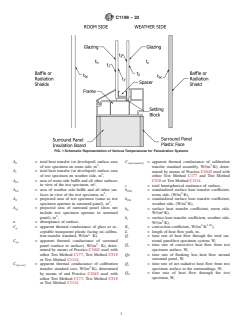
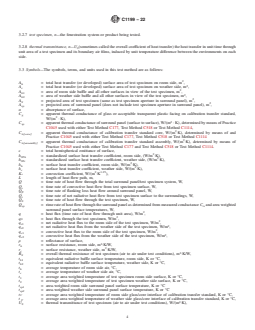
FIG. 1 Schematic Representation of Various Temperatures for Fenestration Systems
A = total heat transfer (or developed) surface area C = apparent thermal conductance of calibration
h ts[assembly]
2 2
of test specimen on room side, m , transfer standard assembly, W/(m ·K), deter-
A = total heat transfer (or developed) surface area
mined by means of Practice C1045 used with
c
of test specimen on weather side, m , either Test Method C177 and Test Method
A = area of room side baffle and all other surfaces
C518 or Test Method C1114.
b1
in view of the test specimen, m ,
ε = total hemispherical emittance of surface,
A = area of weather side baffle and all other sur- h = standardized surface heat transfer coefficient,
b2
STh
faces in view of the test specimen, m ,
room side, (W/m ·K),
A = projected area of test specimen (same as test
h = standardized surface heat transfer coefficient,
S
STc
specimen aperture in surround panel), m ,
weather side, (W/m ·K),
A = projected area of surround panel (does not
h = surface heat transfer coefficient, room side,
sp
h
include test specimen aperture in surround
W/(m ·K),
panel), m , h = surface heat transfer coefficient, weather side,
c
α = absorptance of surface, W/(m ·K),
2 1.25
C = apparent thermal conductance of glass or ac-
K = convection coefficient, W/(m ·K ),
g c
ceptable transparent plastic facing on calibra- L = length of heat flow path, m,
tion transfer standard, W/(m ·K), Q = time rate of heat flow through the total sur-
C = apparent thermal conductance of surround round panel/test specimen system, W,
sp
Q = time rate of convective heat flow from test
panel (surface to surface), W/(m ·K), deter-
c
specimen surface, W,
mined by means of Practice C1045 used with
Q = time rate of flanking loss heat flow around
either Test Method C177, Test Method C518
fl
surround panel, W,
or Test Method C1114,
Q = time rate of net radiative heat flow from test
C = apparent thermal conductance of calibration r
ts[core]
specimen surface to the surroundings, W,
transfer standard core, W/(m ·K), determined
Q = time rate of heat flow through the test
by means of and Practice C1045 used with S
specimen, W,
either Test Method C177, Test Method C518
or Test Method C1114
C1199 − 22
4.2 The thermal transmittance of a test specimen is affected
Q = rime rate of heat flow through the surround
sp
by its size and three-dimensional geometry. Care must be
panel as determined from measured conduc-
exercised when extrapolating to product sizes smaller or larger
tance C and area weighted surround panel
ts
than the test specimen. Therefore, it is recommended that
surface temperatures, W,
fenestration systems be tested at the recommended sizes
q = heat flux (time rate of heat flow through unit
specified in Practice E1423 or NFRC 100.
area), W/m ,
q = heat flux through the test specimen, W/m ,
S 4.3 Since both temperature and surface heat transfer coef-
q = net radiative heat flux to the room side of the
r1
ficient conditions affect results, use of recommended condi-
test specimen, W/m ,
tions will assist in reducing confusion caused by comparing
q = netradiativeheatfluxfromtheweathersideof
r2
results of tests performed under dissimilar conditions. Stan-
the test specimen, W/m ,
dardized test conditions for determining the thermal transmit-
q = convective heat flux to the room side of the
c1
tance of fenestration systems are specified in Practice E1423
test specimen, W/m ,
and Section 6.2.The performance of a test specimen measured
q = convective heat flux from the weather side of
c2
at standardized test conditions is potentially different than the
the test specimen, W/m ,
performanceofthesamefenestrationproductwheninstalledin
ρ = reflectance of surface,
2 the wall of a building located outdoors. Standardized test
r = surface resistance, room side, m ·K/W,
h
conditions often represent extreme summer or winter design
r = surface resistance, weather side, m ·K/W,
c
conditions, which are potentially different than the average
R = overall thermal resistance of test specimen (air
S
conditions typically experienced by a fenestration product
to air under test conditions), m ·K/W,
installed in an exterior wall. For the purpose of comparison, it
t = equivalentradiativebafflesurfacetemperature,
b1
is essential to calibrate with surface heat transfer coefficients
room side, K or °C,
on the Calibration Transfer Standard (CTS) which are as close
t = equivalentradiativebafflesurfacetemperature,
b2
as possible to the conventionally accepted values for building
weather side, K or °C,
t = average temperature of room side air, °C, design;however,thisprocedurecanbeusedatotherconditions
h
t = average temperature of weather side air, °C, for research purposes or product development.
c
t = average area weighted temperature of test
4.4 Similarly,itwouldbedesirabletohaveasurroundpanel
specimen room side surface, K or °C,
that closely duplicates the actual wall where the fenestration
t = average area weighted temperature of test
system would be installed. Since there are such a wide variety
specimen weather side surface, K or °C,
of fenestration system openings in NorthAmerican residential,
t = area-weighted room side surround panel sur-
sp1
commercial and industrial buildings, it is not feasible to select
face temperature, K or °C
a typical surround panel construction for installing the fenes-
t = area-weighted weather side surround panel
sp2
tration system test specimen. Furthermore, for high resistance
surface temperature, K or °C
fenestration systems installed in fenestration opening designs
t = average area weighted temperature of room
1'
and constructions that have thermal bridges, the large relative
side glass/core interface of calibration transfer
amount of heat transfer through the thermal bridge will cause
standard, K or °C,
the relatively small amount of heat transfer through the
t = average area weighted temperature of weather
2'
fenestration system to have a larger than desirable error. For
side glass/core interface of calibration transfer
this reason, the Calibration Transfer Standard and test speci-
standard, K or °C,
menareinstalledinahomogeneoussurroundpanelconstructed
U = thermal transmittance of test specimen (air to
S
from materials having a relatively high thermal resistance.
air under test conditions), W/(m ·K),
Installing the test specimen in a relatively high thermal
U = standardized thermal transmittance of test
ST
resistance surround panel places the focus of the test on the
specimen, W/(m ·K),
fenestration system thermal performance alone.Therefore, it is
U = standardized thermal transmittance of test
ST [AW]
important to recognize that the thermal transmittance results
specimen determined using measured Area
obtained from this test method are for ideal laboratory
Weighted [AW] surface temperatures (air to
conditions, and should only be used for fenestration product
air), W/(m ·K), and
U = standardized thermal transmittance of test comparisons unless the thermal bridge effects that have the
ST[CTS]
potentialtooccurduetothespecificdesignandconstructionof
specimen determined using Calibration Trans-
fer Standard [CTS] surface heat transfer coef- the fenestration system opening are included in the analysis.
ficients (air-to-air), W/(m ·K).
4.5 This test method does not include procedures to deter-
mine the heat flow due to either air movement through the
4. Significance and Use
specimen or solar radiation effects. As a consequence, the
4.1 This test method details the calibration and testing thermal transmittance results obtained do not reflect perfor-
procedures and necessary additional temperature instrumenta- mances that are expected from field installations. It is possible
tion required in applying Test Method C1363 to measure the to use the results from this test method as input to annual
thermal transmittance of fenestration systems mounted verti- energy performance analyses which include solar, and air
cally in the thermal chamber. leakageeffectstogetabetterestimateofhowthetestspecimen
C1199 − 22
would perform when installed in an actual building. To surface temperature differentials for the standardized calibra-
determine the Solar Heat Gain Coefficient of fenestration tion conditions are different from the surface temperature
products, refer to NFRC 200. To determine air leakage for differential that exists on the test specimen during the test.
windows and doors, refer to Test Methods E283 and E783. Currently, specifications for the Calibration Transfer Standard
give it a thermal transmittance of 1.7 W/(m ·K) [0.3 Btu/
4.6 It is important to recognize that the thermal
(hr·ft ·°F)]. Accordingly, the calculation of the standardized
transmittance, U , value determined in Section 8 is the only
S
thermal transmittance produces the least error when performed
true experimental measurement result of this test method. The
on test specimens with a similar thermal transmittance.
“standardized” thermal transmittance value, U , obtained by
ST
4.6.3 It is important to note that the standardized surface
eithertheCalibrationTransferStandard(CTS)orAreaWeight-
heat transfer coefficients, h and h , as calibrated prior to
h c
ing (AW) methods described in Section 8 include adjustments
testing a fenestration product using an appropriately sized
to the thermal transmittance value bases on results from
CalibrationTransferStandard(CTS)havethepotentialtodiffer
calibration runs described in Section 6. The standardized
from the surface heat transfer coefficients that exist during a
thermal transmittance is useful for two reasons; it facilitates
hot box test on a specific test specimen. Fenestration systems
comparison of test results between different laboratories with
usually have frame and sash surfaces that introduce two- and
different thermal chamber geometries and configurations, and
three-dimensional convective heat transfer effects which result
it improves the comparison between test results and computer
in variable surface heat transfer coefficients, which differ from
simulationresults.Duetothedifferencesinsize,geometry,and
the uniform standardized values. As a result of this, the test
climate chamber air flow permitted by this test method, Test
specimen surface heat transfer coefficients will differ from
Method C1363, and Practice E1423, there can be significant
thoseobtainedwiththenon-framed,essentiallyflatCalibration
variations in the local surface heat transfer coefficients on the
Transfer Standard tested under the same conditions. In this
same test specimen installed in different laboratories even
standardizing procedure, it is assumed that the differences are
though these laboratories measured identical surface heat
small enough so that the calibration surface heat transfer
transfer coefficients on their Calibration Transfer Standards.
coefficients can be used to calculate equivalent test specimen
Inter-Laboratory Comparisons conducted by the NFRC have
averagesurfacestemperatures,t andt ,inordertoestimatethe
1 2
shown that the effect of this variation is reduced if the
actual test specimen surface heat transfer coefficients. It is
standardized thermal transmittance is used for comparison
importanttorecognizethatthisassumptionwillnotbeaccurate
instead of the thermal transmittance. The standardized thermal
for all fenestration products, especially for high thermal
transmittance is also a useful tool for the evaluation and
transmittance products where the surface heat transfer coeffi-
comparison of experimental results of fenestration systems
cients are a major portion of the overall thermal resistance and
with computer calculations of the thermal transmittance. that
also for fenestration products with significant surface projec-
are made because the current Historically, computer calcula-
tions (for example, skylights, roof windows, garden windows)
tion methods (NFRC 100) for determining the thermal trans-
where the surface heat transfer coefficients are quite different
mittance were not capable of applying the actual surface heat
from the standardized values.
transfer coefficients that exist on the test specimen while
4.6.4 In these situations, it is important to attempt to
testing at standardized conditions. These current computer
measure the test specimen surface temperature distributions
calculationmethodsassumedthatuniformstandardizedsurface
and then calculate directly the test specimen average area
heat transfer coefficients exist on the indoor and outdoor
weighted surfaces temperatures, t and t . This area weighting
1 2
fenestration product surfaces. Although the next generation of
(AW) method also has problems in that the placement of
computer simulation programs includes improved radiation
temperature sensors to get an accurate area weighting is not
heat transfer algorithms, which generate non-uniform surface
known,especiallyonhighconductivityhorizontalsurfacesthat
heat transfer coefficients, the standardized thermal transmit-
actasheattransferextendedsurfaces(thatis,fins).Inaddition,
tance remains to be a useful tool when comparing test results
the placement of many temperature sensors on the test speci-
to computer modeling results.
men surfaces will affect the velocity fields in the vicinity of
4.6.1 It is important to recognize that due to radiation
these surfaces which will affect the surface temperatures and
effects, the room side or weather side temperature (t and t ,
h c
surface heat transfer coefficients.
respectively), has the potential to differ from the respective
room side or weather side baffle temperatures (t and t ,
b1 b2
5. Apparatus
respectively). If there is a difference of more than 61°C(62
°F), either on the room side or weather side, the radiation 5.1 General Thermal Chamber—This section specifies the
effects shall be accounted for as described in Sections 6 and 9
additional equipment and instrumentation necessary to
to maintain accuracy in the calculated surface heat transfer calibrate, and measure the thermal transmittance of fenestra-
coefficients. Calculating the radiation exchange for highly
tion systems using a thermal chamber as described in Test
conductive test specimens or projecting fenestration products Method C1363. Keep in mind that Test Method C1363
as described in Annex A2 is not a trivial task.
describes the overall construction, calibration and operation of
the thermal chamber and surround panel as well as additional
4.6.2 The calculation of the standardized thermal transmit-
air flow measurements and power measurements that are not
tance assumes that only the surface heat transfer coefficients
described in detailed in this test method.
change from the calibrated standardized values for the condi-
tions of the test. This assumption is possibly not valid if the 5.1.1 Equipment:
C1199 − 22
5.1.1.1 Surround Panel—As explained in 4.4 there is the
potential for a strong interaction between the heat flow in an
actual surrounding wall and the frame of the fenestration
system. If the surrounding wall construction contains highly
conductive materials, the heat flow through the fenestration
system frame could be significantly changed. Since it is not
feasible to select a typical wall to use as a surround panel, it is
desirable to have a relatively high-resistance surround panel to
minimize this “shorting” interaction so that the heat flow
through the fenestration system itself can be measured as
accurately as possible. This is especially true for the highly
resistive “ superwindows” currently being developed.
(1)A surround panel, consisting of a stable homogeneous
thermal insulation material with a apparent thermal conduc-
tance at 24 °C not in excess of 0.03 W/(m · K) [0.21
(Btu·in)⁄(hr·ft •ºF)] and having a very low gas permeance
(an air permeance less than 1.0E-10 m has been found to be
satisfactory), shall be provided for mounting the test specimen
(see Fig. 2). Surround panels shall be constructed,
characterized,andinstrumentedusingtheproceduresdescribed
in Annex A11 of Test Method C1363.
5.1.1.2 Calibration Transfer Standard—The test facility
surfaceheattransfercoefficientsshallbecalibratedusingaheat
flux transducer Calibration Transfer Standard constructed as
described in Annex A1 and illustrated in Fig. 2(a) and Fig.
2(b). The Calibration Transfer Standard has a core material of
known characteristics traceable to primary standards such as
FIG. 2 (a) Example Calibration Transfer Standard Design Information
the guarded hot plate of a national standard laboratory. The
projected dimensions and areas of the Calibration Transfer
Standards need to cover the same range as the test specimen
model sizes and tolerances as specified in Practice E1423 or
NFRC 100.Aminimum of two Calibration Transfer Standards
shall be used; one approximately the largest specimen size to
be tested and one approximately the smallest specimen size to
be tested. The Calibration Transfer Standard calibration coef-
ficients (that is, h , h , and K) used to standardize the thermal
h c
transmittance shall be those from the Calibration Transfer
Standardclosesttothesizeofthetestspecimen.See6.2forthe
values of the standardized surface heat transfer coefficients
required for using this test method for rating purposes.
NOTE 3—It is recommended that a minimum of three Calibration
Transfer Standards be used that cover the range of test specimen model
sizesthatalaboratoryplanstotest.Oneapproximatelythesmallestmodel
size to be tested, one approximately the average model size to be tested,
and one approximately the largest model size to be tested.
5.1.2 Instrumentation:
FIG. 2 (b) Minimum Temperature Sensors Array for Typical CTS
5.1.2.1 Power measurements—The total power to heaters,
fans or blowers, and any significant power to instrument
transducers within the metering box shall be measured or
shields, etc) exchanging radiation heat transfer with the test
determined over the duration of the test. See 6.12 of Test
specimen using the same area weighing criteria as specified in
Method C1363 for a full description of power measurement
Test Method C1363.
requirements.
(2) Air temperatures—The room side and weather side air
5.1.2.2 Temperature measurements—In addition to the air stream temperatures in a plane parallel to the surround panel
andsurfaceareaweightedtemperaturemeasurementsspecified surfaces shall be measured as specified in 6.10.3.1 of Test
in Test Method C1363, the following temperature measure- Method C1363. The air temperature sensors shall be located
ments are required: 75mm(3in.)fromthesurfaceofthesurroundpanel.Therows
(1) Radiating surface temperatures—The temperature of and columns closest to the metering box walls shall be located
all surfaces (baffles, surround panel opening, box surfaces, at a minimum distance of 150 mm (6 in.) from each meter box
C1199 − 22
wall. It is desirable to measure each of the air temperature Seal the characterization panel as per 7.5 andAnnex 11 ofTest
thermocouples individually, but if the thermocouples are to be Method C1363. The heat flow through the characterization
electrically averaged, ensure that the thermocouple leads panel as determined by its area, the surface temperature
within an averaged group are the same length and that each difference on both sides of the characterization panel, and the
averaged group is confined to individual horizontal rows. apparent thermal conductance of the characterization panel’s
materials (as determined by Test Methods C177, C518,or
NOTE 4—The temperature sensor requirements given in 5.1.2.2,
C1114) is compared to the metered heat flow that is input into
5.1.2.2(1), and 5.1.2.2(2) are minimum requirements. Section 7.5.2 on
the metering chamber (after it is corrected for the heat flow
temperature measurements requires additional temperature sensors which
are dependent on the test specimen type. It is acceptable to use more
through the metering chamber walls determined as per Annex
temperature sensors if they provide more accurate average temperature
A1 andAnnexA6 ofTest Method C1363)Typically this test is
(air and surface) values.
performed at least three times for each characterization panel;
5.1.2.3 Air Leakage—Practice E1423 describes the
one test with the guard chamber air temperature above the
equipment, instrumentation and methodology used to verify
metering chamber air temperature, one with the guard and
that all the Calibration Transfer Standards and test specimens
metering air temperature almost equal, and one test with the
are sealed in the surround panel before testing.
guard air temperature below the metering box air temperature.
5.1.2.4 Wind Velocity Measurements—As stipulated in
The results from these three tests are used to determine the
7.5.4, both the weather and meter side wind velocity shall be
metering box wall transducer and surround panel flanking loss
measured and recorded at locations that represents free stream
coefficients, [E +Q ], for each characterization panel. The
o fl
conditions for the duration of the test. A sensor with an
thinnest and thickest surround panels shall be tested first, and
accuracy of 65 % of the reading is required.
ifthedifferencesbetweenthemeteringboxwalltransducerand
5.1.2.5 Relative Humidity Measurements—Instrumentation
flanking loss coefficients are negligible, intermediate thick-
shall be used to measure and record the Relative Humidity
nesses of surround panel are not required to be tested. If the
within the metering box for the duration of the test. It is also
differencesbetweenthethickestandthinnestsurroundpanelsis
recommended that the Relative Humidity within the guard and
significant then separate metering box wall transducer and
climate chambers as well as the ambient laboratory environ-
surround panel flanking loss coefficients shall be determined
ment be monitored.
for each combination of materials and thicknesses of surround
5.1.2.6 Glazing Deflection—Equipment or instrumentation,
panels and environmental conditions used for testing; as per
or both, used to measure the glazing deflection of multiple-
Annex A6 of Test Method C1363.
pane glazing systems is required. Measurements shall be
NOTE 5—It is convenient to measure the time constant of the thermal
reported for each test specimen as specified in Section 8 of
chamber and the surround panel at this time. The time constant is used to
Practice E1423.
determine when a particular test has achieved steady-state conditions, and
is determined using the process described in SectionA10 of Test Method
6. Calibration
C1363. A continuous surround panel (that is, with the test specimen
aperturefilledwithsurroundpanelmaterial)canbeusedasaconservative
6.1 Calibration requirements—A minimum of two calibra-
estimate of the time constant of most window test specimens, which have
tion test procedures shall be performed to determine the
a thermal capacity and diffusivity less than an equivalent sized surround
metering box wall transducer and surround panel flanking loss
panel material. Therefore it is useful to determine the time constant of a
thermalchamberandsurroundpanelatthesametimethattheflankingloss
coefficients, [E + Q ], and to characterize the surface heat
o fl
is determined.
transfer coefficients on a Calibration Transfer Standard before
testing actual fenestration products. The first calibration test 6.1.2 Calibration Transfer Standard Test Procedure:
requires that a continuous surround panel (with the test 6.1.2.1 Install the Calibration Transfer Standard with the
specimen aperture filled with the same material as the rest of weather side surface 25 mm (1 in.) in from the surround panel
the surround panel) be tested at standard test conditions in weather side surface (see Fig. 3). Seal the cracks around the
order to determine the metering box wall and surround panel perimeter of the Calibration Transfer Standard with nonmetal-
heat transfer characteristics. In the second set of calibration lic tape or caulking, or both, to prevent air leakage. It is
tests,aCalibrationTransferStandardwithitsweathersideface desirable to measure each of the surface temperature thermo-
located 25 mm in from the weather side edge of the surround couplesintheCalibrationTransferStandardindividually,butif
panel opening shall be mounted in the surround panel and the thermocouples are to be electrically averaged, ensure the
testedatstandardizedconditions.Adjustthefansinthethermal thermocouple leads within an averaged group are the same
chamber so that the surface heat transfer coefficients measured length and that each averaged group is confined to individual
on both sides of the Calibration Transfer Standard are within a horizontal rows.The design construction and instrumentation
set tolerance of the standardized surface heat transfer coeffi- of Calibration Transfer Standards are presented in Annex A1.
cients (see 6.2). The design, construction and instrumentation 6.1.2.2 Establish, as per Test Method C1363 steady-state
of Calibration Transfer Standards are presented in Annex A1. thermal conditions for which the surround panel and Calibra-
6.1.1 Metering Box Wall Transducer and Flanking Loss Test tion Transfer Standard is to be calibrated and record the
Procedure—Install a continuous surround panel or character- metering box and climate chamber fan speeds, measurements
ization panel(onewithoutatestspecimenaperture,orwiththe of power, temperature, and velocity. The methodology and
aperture filled with surround panel material of equal thickness) criteria used to determine steady state for fenestration testing
in the thermal chamber and attach temperature sensors to both described in Note 23 in Section 10.11.3 ofTest Method C1363
sidesatthedensitydescribedinTestMethodC1363,Annex11. is considered to be the minimum mandatory requirements.
C1199 − 22
C = conductance of Calibration Transfer Standard
ts[assembly]
core assembly, including the core and facing
materials,W/(m · K), as determined by either
Test Methods C177, C518,or C1114 and
Practice C1045,
A = area of Calibration Transfer Standard, m ,
S
t = equal area weighted average room side Cali-
brationTransfer Standard surface temperature,
°C,
t = equal area weighted average weather side
calibration transfer standard surface
temperature, °C,
6.1.3.3 Surround panel heat flow, Q , is then:
sp
Q 5 C ·A · t 2 t (3)
~ !
sp sp sp sp1 sp2
where:
A = surround panel area, m ,
sp
t = area weighted room side surround panel surface
sp 1
temperature, °C, and
t = area weighted weather side surround panel surface
sp2
temperature, °C.
NOTE6—Theapparentthermalconductanceofalloftherigidinsulation
foams used as the core of Calibration Transfer Standards and surround
panels are a function of the mean temperature of that material. The mean
FIG. 3 Surround Panel With CTS
temperature corrections for the Calibration Transfer Standard and the
surround panel are previously established by measuring the apparent
thermal conductance at three different mean temperature conditions as
required in Annex A1, and Annex A11 of Test Method C1363.
6.1.3 Calibration Transfer Standard Data Analysis:
6.1.3.4 If t = t 61°C (62°F) and t = t 61°C (62°F)
b1 h b2 c
6.1.3.1 Total Heat Flow—Thetimerateofheatflowthrough
see6.1.3.6todeterminethesurfaceheattransfercoefficients.If
the test assembly (surround panel and Calibration Transfer
calculated values of the surface temperatures are to be used in
Standard), Q, is determined by the procedures specified inTest
the calculation procedure specified in Section 9, Calculation of
Method C1363.
Standardized Thermal Transmittance, then also carry out the
6.1.3.2 Calibration Transfer Standard Heat Flow—Q,is
calculation procedures specified in 6.1.3.7 to determine the
s
calculated differently depending if the temperature sensors are
convection coefficient, K .
c
located on the inside or the outside of the facing material:
6.1.3.5 If t > t +1°C (2°F) or t < t –1°C (2°F) and t
b1 h b1 h b2
(1) CTS with interior thermocouples—If the temperature
> t +1°C (2°F) or t < t –1°C (2°F), see 6.1.3.7 to determine
c b2 c
sensors are located between the glazing and the core, the
the surface heat transfer coefficients.
Calibration Transfer Standard Heat Flow, Q , is calculated as
S 6.1.3.6 Surfaceheattransfercoefficients,h andh ,whent
h c b1
follows:
= t 61°C (62°F) and t = t 61°C (62°F), are calculated as
h b2 c
follows:
Q 5 C ·A · t 2 t (1)
~ !
S ts@core# S 1' 2'
h 5 Q / A · t 2 t (4)
~ !
~ !
h S S h 1
where:
C = conductance of Calibration Transfer Standard
where:
ts[core]
core, W/(m · K), as determined by either Test
t = average room side air temperature, °C, and
h
Methods C177, C518,or C1114 and Practice
t = equal area weighted average room side Calibration
C1045,
Transfer Standard surface temperature, °C. If the tem-
A = area of Calibration Transfer Standard, m ,
S
peraturesensorsarelocatedbetweentheglazingandthe
t = average equal area weighted temperature of room
1'
core, the room side surface temperature is calculated as
side glass/core interface of calibration standard,
follows:
°C (see Fig. 1), and
t 5 t 1C • t 2 t /C (5)
~ !
1 1' ts 1' 2' g
t = average equal area weighted temperature of
2'
weather side glass/core interface of calibration
where:
standard, °C (see Fig. 1).
C = conductance of facing on calibration transfer standard,
g
(2) CTS with exterior thermocouples—If the temperature
W/(m ·K).
sensors are located on the exterior surface of the glazing, the
NOTE 7—The apparent thermal conductance of the glazing layer is the
Calibration Transfer Standard Heat Flow, Q , is calculated as
S
thermal conductivity of the glazing material divided by the glazing layer
follows: thickness.Avalueof1W/(m·K)forthethermalconductivityoffloatglass
isrecommendediftheactualvalueisnotprovidedbythemanufacturer.In
Q 5 C ·A ·~t 2 t ! (2)
S ts@assembly# S 1 2 othercases,suchaslaminatedorplasticglazing,theglazingmanufacturer
C1199 − 22
should provide the measured thermal conductivity of the glazing material.
q 5 Q /A (10)
c1 c1 s
Also, using Eq 10, the convection constant K in Eq 11 for
c
h 5 Q / A ·~t 2 t ! (6)
~ !
c S S 2 c
the convective heat transfer to the test specimen can be de-
termined.
where:
1.25
t = average weather side air temperature, °C, and
K 5 q /~t 2 t ! (11)
c
c c1 h 1
t = equal area weighted average weather side calibration
NOTE 9—The convective heat transfer calculation assumes natural
convection on the room side of the Calibration Transfer Standard. To
transfer standard surface temperature, °C, If the tem-
ensurethatasingleconvectioncoefficient, K ,canbeusedforfenestration
c
peraturesensorsarelocatedbetweentheglazingandthe
system tests, its behavior should be investigated, using the Calibration
core, the weather side surface temperature is calculated
Transfer Standard, over the range of heat flows expected. The hot box
as follows:
operatormayuseaconvectivecorrelationdifferentfromEq11ifitismore
appropriate for the convective heat transfer situation that exists for that
t 5 t 2 C · t 2 t /C (7)
~ !
2 2' ts 1' 2' g
operator’s hot box. However, the test report should include the alternative
formofEq11usedandthealternativevalueoftheconvectionconstant K
6.1.3.7 Surface heat transfer coefficients, h and h when t
c
h c b1
obtained.
> t +1°C (2°F) or t < t –1°C (2°F) and t > t +1°C (2°F)
h b1 h b2 c
(3) Room Side Surface Heat Transfer Coeffıcient, h —
h
or t < t –1°C (2°F), are calculated as follows:
b2 c
From Eq 8 and 10:
(1) Room Side Radiative Heat Transfer, Q —When the
r1
room side baffle or box wall is close to the test specimen,
h 5 q 1q / t 2 t (12)
~ ! ~ !
h r1 c1 h 1
where t is directly measured or calculated in accordance
parallel plate radiative heat transfer can be assumed. Then:
with Eq 5.
q 5 Q /A 51/ 1/ε 11/ε 2 1 ·σ· t 1 273.15 2 t
~ ! @~ ! ~
r1 r1 S 1 b1 b1 1
(4) Weather Side Radiative Heat Transfer, Q —The fol-
r2
1 273.15! # (8)
lowing procedure is used when testing under the conditions
specifiedin6.1.3.5.Assuminglargeparallelplateradiativeheat
where:
exchange; then:
ε = emittance of room-side facing surface (glass or
q 5 Q /A 51/ 1/ε 11⁄ε 2 1 ·σ·@ t 1273.15 2 t
plastic), ~ ! ~ ! ~
r2 r2 S 2 b2 2 b2
ε = radiant average emittance of the baffle/shield/surround 4
b1 1273.15! # (13)
panel opening/box wall and all other surfaces in view
where:
of the test specimen,
ε = emittance of weather-side facing surface (glass or
t = area weighted radiant average baffle/shield/box wall/
b1
plastic),
surround panel opening surface temperature in view of
ε = radiant average emittance of the baffle/shield/surround
the test specimen, °C, and
b2
–8 2 4
panel opening/box wall and all other surfaces in view
σ = Stefan-Boltzmannconstant=5.67×10 ,W/(m ·K ).
of the test specimen,
NOTE 8—If the test specimen surface views anything other than the
baffle/shield/box wall/surround panel opening surfaces, or if the baffle/
t = area weighted radiant average baffle/shield/box wall/
b2
shield/box wall/surround panel opening is not isothermal to within 61°C
surround panel opening surface temperature in view of
(62°F) then the radiative heat transfer calculation procedure in AnnexA2
the test specimen, °C, and
is required. Isothermal to within 61°C (62°F) is determined by compar-
–8 2 4
σ = Stefan-Boltzmann constant = 5.67 × 10 ,W/(m ·K ).
ing each of the individual baffle/shield/box wall/surround panel tempera-
ture measurements to the mean of all the baffle/shield/box wall/su
...
This document is not an ASTM standard and is intended only to provide the user of an ASTM standard an indication of what changes have been made to the previous version. Because
it may not be technically possible to adequately depict all changes accurately, ASTM recommends that users consult prior editions as appropriate. In all cases only the current version
of the standard as published by ASTM is to be considered the official document.
Designation: C1199 − 14 C1199 − 22
Standard Test Method for
Measuring the Steady-State Thermal Transmittance of
Fenestration Systems Using Hot Box Methods
This standard is issued under the fixed designation C1199; the number immediately following the designation indicates the year of
original adoption or, in the case of revision, the year of last revision. A number in parentheses indicates the year of last reapproval. A
superscript epsilon (´) indicates an editorial change since the last revision or reapproval.
1. Scope
1.1 This test method covers requirements and guidelines and specifies calibration procedures required for the measurement of the
steady-state thermal transmittance of fenestration systems installed vertically in the test chamber. This test method specifies the
necessary measurements to be made using measurement systems conforming to Test Method C1363 for determination of
fenestration system thermal transmittance.
NOTE 1—This test method allows the testing of projecting fenestration products (that is, garden windows, skylights, and roof windows) installed vertically
in a surround panel. Current research on skylights, roof windows, and projecting products hopefully will provide additional information that can be added
to the next version of this test method so that skylight and roof windows can be tested horizontally or at some angle typical of a sloping roof.
1.2 This test method refers to the thermal transmittance, U of a fenestration system installed vertically in the absence of solar
radiation and air leakage effects.
NOTE 2—The methods described in this document may also be adapted for use in determining the thermal transmittance of sections of building wall, and
roof and floor assemblies containing thermal anomalies, which are smaller than the hot box metering area.
1.3 This test method describes how to determine the thermal transmittance, U of a fenestration product (also called test specimen)
S
at well-defined environmental conditions. The thermal transmittance is also a reported test result from Test Method C1363. If only
the thermal transmittance is reported using this test method, the test report must also include a detailed description of the
environmental conditions in the thermal chamber during the test as outlined in 10.1.14.
1.4 For rating purposes, this test method also describes how to calculate a standardized thermal transmittance, U , which can be
ST
used to compare test results from laboratories with vastly different thermal chamber configurations, and facilitates the comparison
to results from computer programs that use standard heat transfer coefficients to determine the thermal transmittance of fenestration
products. Although this test method specifies two methods of calculating the standardized thermal transmittance, only the
standardized thermal transmittance result from one method is reported for each test. One standardized thermal transmittance
calculation procedure is the Calibration Transfer Standard (CTS) Method and another is the Area Weighting (AW) Method (see
Section 9 for further descriptions of these two methods). The Area Weighting method requires that the surface temperatures on both
sides of the test specimen be directly measured as specified in Practice E1423 in order to determine the surface heat transfer
coefficients on the fenestration product during the test. The CTS Method does not use the measured surface temperatures on the
test specimen and instead utilizes the calculation of equivalent surface temperatures from calibration data to determine the test
specimen surface heat transfer coefficients. The AW shall be used whenever the thermal transmittance, U , is greater than 3.4
S
This test method is under the jurisdiction of ASTM Committee C16 on Thermal Insulation and is the direct responsibility of Subcommittee C16.30 on Thermal
Measurement.
Current edition approved Feb. 1, 2014March 1, 2022. Published February 2014March 2022. Originally approved in 1991. Last previous edition approved in 20122014
as C1199 – 12.C1199 – 14. DOI: 10.1520/C1199-14.10.1520/C1199-22.
Copyright © ASTM International, 100 Barr Harbor Drive, PO Box C700, West Conshohocken, PA 19428-2959. United States
C1199 − 22
2 2
W/(m ·K) [0.6 Btu/(hr·ft ·°F)], or when the ratio of test specimen projected surface area to wetted (that is, total heat transfer or
developed) surface area on either side of the test specimen is less than 0.80. Otherwise the CTS Method shall be used to standardize
the thermal transmittance results.
1.5 A discussion of the terminology and underlying assumptions for measuring the thermal transmittance are included.
1.6 The values stated in SI units are to be regarded as the standard. The values given in parentheses are provided for information
purposes only.
1.7 This standard does not purport to address all of the safety concerns, if any, associated with its use. It is the responsibility
of the user of this standard to establish appropriate safety safety, health, and healthenvironmental practices and determine the
applicability of regulatory limitations prior to use.
1.8 This international standard was developed in accordance with internationally recognized principles on standardization
established in the Decision on Principles for the Development of International Standards, Guides and Recommendations issued
by the World Trade Organization Technical Barriers to Trade (TBT) Committee.
2. Referenced Documents
2.1 ASTM Standards:
C168 Terminology Relating to Thermal Insulation
C177 Test Method for Steady-State Heat Flux Measurements and Thermal Transmission Properties by Means of the
Guarded-Hot-Plate Apparatus
C518 Test Method for Steady-State Thermal Transmission Properties by Means of the Heat Flow Meter Apparatus
C1045 Practice for Calculating Thermal Transmission Properties Under Steady-State Conditions
C1114 Test Method for Steady-State Thermal Transmission Properties by Means of the Thin-Heater Apparatus
C1363 Test Method for Thermal Performance of Building Materials and Envelope Assemblies by Means of a Hot Box Apparatus
E283 Test Method for Determining Rate of Air Leakage Through Exterior Windows, Skylights, Curtain Walls, and Doors Under
Specified Pressure Differences Across the Specimen
E631 Terminology of Building Constructions
E783 Test Method for Field Measurement of Air Leakage Through Installed Exterior Windows and Doors
E1423 Practice for Determining Steady State Thermal Transmittance of Fenestration Systems
2.2 ISO Standards:
ISO 8990 Thermal Insulation-Determination of Steady-State Thermal Transmission Properties—Calibrated and Guarded Hot
Box
ISO12567–1 Thermal Insulation—Thermal Performance of Windows and Doors—Determination of Thermal Transmittance by
Hot Box Method—Part 1 Complete Windows and Doors
ISO12567–2 Thermal Insulation—Determination of Thermal Transmittance by Hot Box Method—Part 2: Roof Windows and
Other Projecting Windows
2.3 Other Standards:
NFRC 100 –2004 Procedure for Determining Fenestration Product Thermal U-factors
NFRC 102 –2004 Procedure for Measuring the Steady-State Thermal Transmittance of Fenestration Systems
NFRC 200 –2004 Procedure for Determining Fenestration Product Solar Heat Gain Coefficient and Visible Transmittance at
Normal Incidence
BS874 Part 3, Section 3.1, 1987, British Standard Methods for Determining Thermal Insulation Properties, (Part 3, Tests for
Thermal Transmittance and Conductance, Section 3.1) Guarded Hot Box Method
BS874 Part 3, Section 3.2, 1990, British Standard Methods for Determining Thermal Insulation Properties, Part 3, Tests for
Thermal Transmittance and Conductance, Section 3.2 Calibrated Hot Box Method
ASHRAE Handbook-Fundamentals 2009
For referenced ASTM standards, visit the ASTM website, www.astm.org, or contact ASTM Customer Service at service@astm.org. For Annual Book of ASTM Standards
volume information, refer to the standard’s Document Summary page on the ASTM website.
Available from American National Standards Institute (ANSI), 25 W. 43rd St., 4th Floor, New York, NY 10036, http://www.ansi.org.
Available from National Fenestration Rating Council, 6305 Ivy Lane, Suite 140, Greenbelt, MD 20770.
Available from British Standards Institute (BSI), 389 Chiswick High Rd., London W4 4AL, U.K., http://www.bsi-global.com.
Available from American Society of Heating, Refrigerating, and Air-Conditioning Engineers, Inc. (ASHRAE), 1791 Tullie Circle, NE, Atlanta, GA 30329,
http://www.ashrae.org.
C1199 − 22
3. Terminology
3.1 Definitions—Definitions and terms are in accordance with definitions in Terminologies E631 and C168, from which the
following have been selected and modified to apply to fenestration systems. See Fig. 1 for temperature locations.
3.2 Definitions of Terms Specific to This Standard:
3.2.1 apparent thermal conductance—A thermal conductance assigned to a material that exhibits thermal transmission by several
modes of heat transfer resulting in property variation with specimen thickness, or surface emittance.
3.2.2 calibration transfer standard, n—an insulation board with a known measured thermal conductance that is faced with glazing,
and instrumented with temperature sensors either between the glazing and the insulation board core or on the exterior surface of
the glazing, which is used to calibrate the surface resistances and the surround panel (see Annex A1 for design guidelines for
Calibration Transfer Standards).
3.2.3 projecting products, n—a non-planar product where the glazing projects outward past the cold side surround panel surface
plane (that is, skylights, garden windows).
3.2.4 standardized thermal transmittance, n—U , the heat transmission in unit time through unit area of a test specimen and
ST
standardized boundary air films, induced by unit temperature difference between the environments on each side.
3.2.5 surface heat transfer coeffıcient, n—h, (sometimes called surface conductance or film coeffıcient.) the time rate of heat flow
from a unit area of a surface to its surroundings, induced by a unit temperature difference between the surface and the environment.
3.2.6 surround panel (sometimes called themask, mask wall,or homogeneous wall),n—a homogeneous panel with an opening
where the Calibration Transfer Standard or the test specimen is installed. When there is no test specimen aperture, or the opening
is filled with the same thickness of surround panel assembly, it is called a characterization panel. (see 5.1.1.1, and Annex A11 of
Test Method C1363 for a description of surround panels and characterization panels.)
FIG. 1 Schematic Representation of Various Temperatures for Fenestration Systems
C1199 − 22
3.2.7 test specimen, n—the fenestration system or product being tested.
3.2.8 thermal transmittance, n—U (sometimes called the overall coefficient of heat transfer) the heat transfer in unit time through
S
unit area of a test specimen and its boundary air films, induced by unit temperature difference between the environments on each
side.
3.3 Symbols—The symbols, terms, and units used in this test method are as follows:
A = total heat transfer (or developed) surface area of test specimen on room side, m ,
h
A = total heat transfer (or developed) surface area of test specimen on weather side, m ,
c
A = area of room side baffle and all other surfaces in view of the test specimen, m ,
b1
A = area of weather side baffle and all other surfaces in view of the test specimen, m ,
b2
A = projected area of test specimen (same as test specimen aperture in surround panel), m ,
S
A = projected area of surround panel (does not include test specimen aperture in surround panel), m ,
sp
α = absorptance of surface,
C = apparent thermal conductance of glass or acceptable transparent plastic facing on calibration transfer standard,
g
W/(m · K),
C = apparent thermal conductance of surround panel (surface to surface), W/(m · K), determined by means of Practice
sp
C1045 used with either Test Method C177, Test Method C518 or Test Method C1114,
C = apparent thermal conductance of calibration transfer standard core, W/(m ·K), determined by means of and
ts[core]
Practice C1045 used with either Test Method C177, Test Method C518 or Test Method C1114
C = apparent thermal conductance of calibration transfer standard assembly, W/(m ·K), determined by means of
ts[assembly]
Practice C1045 used with either Test Method C177 and Test Method C518 or Test Method C1114.
ε = total hemispherical emittance of surface,
h = standardized surface heat transfer coefficient, room side, (W/m ·K),
STh
h = standardized surface heat transfer coefficient, weather side, (W/m ·K),
STc
h = surface heat transfer coefficient, room side, W/(m ·K),
h
h = surface heat transfer coefficient, weather side, W/(m ·K),
c
2 1.25
K = convection coefficient, W/(m ·K ),
c
L = length of heat flow path, m,
Q = time rate of heat flow through the total surround panel/test specimen system, W,
Q = time rate of convective heat flow from test specimen surface, W,
c
Q = time rate of flanking loss heat flow around surround panel, W,
fl
Q = time rate of net radiative heat flow from test specimen surface to the surroundings, W,
r
Q = time rate of heat flow through the test specimen, W,
S
Q = rime rate of heat flow through the surround panel as determined from measured conductance C and area weighted
sp ts
surround panel surface temperatures, W,
q = heat flux (time rate of heat flow through unit area), W/m ,
q = heat flux through the test specimen, W/m ,
S
q = net radiative heat flux to the room side of the test specimen, W/m ,
r1
q = net radiative heat flux from the weather side of the test specimen, W/m ,
r2
q = convective heat flux to the room side of the test specimen, W/m ,
c1
q = convective heat flux from the weather side of the test specimen, W/m ,
c2
ρ = reflectance of surface,
r = surface resistance, room side, m ·K/W,
h
r = surface resistance, weather side, m ·K/W,
c
R = overall thermal resistance of test specimen (air to air under test conditions), m ·K/W,
S
t = equivalent radiative baffle surface temperature, room side, K or °C,
b1
t = equivalent radiative baffle surface temperature, weather side, K or °C,
b2
t = average temperature of room side air, °C,
h
t = average temperature of weather side air, °C,
c
t = average area weighted temperature of test specimen room side surface, K or °C,
t = average area weighted temperature of test specimen weather side surface, K or °C,
t = area-weighted room side surround panel surface temperature, K or °C
sp1
t = area-weighted weather side surround panel surface temperature, K or °C
sp2
t = average area weighted temperature of room side glass/core interface of calibration transfer standard, K or °C,
1'
t = average area weighted temperature of weather side glass/core interface of calibration transfer standard, K or °C,
2'
U = thermal transmittance of test specimen (air to air under test conditions), W/(m ·K),
S
C1199 − 22
U = standardized thermal transmittance of test specimen, W/(m ·K),
ST
U = standardized thermal transmittance of test specimen determined using measured Area Weighted [AW] surface
ST [AW]
temperatures (air to air), W/(m ·K), and
U = standardized thermal transmittance of test specimen determined using Calibration Transfer Standard [CTS] surface
ST[CTS]
heat transfer coefficients (air-to-air), W/(m ·K).
4. Significance and Use
4.1 This test method details the calibration and testing procedures and necessary additional temperature instrumentation required
in applying Test Method C1363 to measure the thermal transmittance of fenestration systems mounted vertically in the thermal
chamber.
4.2 The thermal transmittance of a test specimen is affected by its size and three-dimensional geometry. Care must be exercised
when extrapolating to product sizes smaller or larger than the test specimen. Therefore, it is recommended that fenestration systems
be tested at the recommended sizes specified in Practice E1423 or NFRC 100.
4.3 Since both temperature and surface heat transfer coefficient conditions affect results, use of recommended conditions will assist
in reducing confusion caused by comparing results of tests performed under dissimilar conditions. Standardized test conditions for
determining the thermal transmittance of fenestration systems are specified in Practice E1423 and Section 6.2. The performance
of a test specimen measured at standardized test conditions is potentially different than the performance of the same fenestration
product when installed in the wall of a building located outdoors. Standardized test conditions often represent extreme summer or
winter design conditions, which are potentially different than the average conditions typically experienced by a fenestration product
installed in an exterior wall. For the purpose of comparison, it is essential to calibrate with surface heat transfer coefficients on the
Calibration Transfer Standard (CTS) which are as close as possible to the conventionally accepted values for building design;
however, this procedure can be used at other conditions for research purposes or product development.
4.4 Similarly, it would be desirable to have a surround panel that closely duplicates the actual wall where the fenestration system
would be installed. Since there are such a wide variety of fenestration system openings in North American residential, commercial
and industrial buildings, it is not feasible to select a typical surround panel construction for installing the fenestration system test
specimen. Furthermore, for high resistance fenestration systems installed in fenestration opening designs and constructions that
have thermal bridges, the large relative amount of heat transfer through the thermal bridge will cause the relatively small amount
of heat transfer through the fenestration system to have a larger than desirable error. For this reason, the Calibration Transfer
Standard and test specimen are installed in a homogeneous surround panel constructed from materials having a relatively high
thermal resistance. Installing the test specimen in a relatively high thermal resistance surround panel places the focus of the test
on the fenestration system thermal performance alone. Therefore, it is important to recognize that the thermal transmittance results
obtained from this test method are for ideal laboratory conditions, and should only be used for fenestration product comparisons
unless the thermal bridge effects that have the potential to occur due to the specific design and construction of the fenestration
system opening are included in the analysis.
4.5 This test method does not include procedures to determine the heat flow due to either air movement through the specimen or
solar radiation effects. As a consequence, the thermal transmittance results obtained do not reflect performances that are expected
from field installations. It is possible to use the results from this test method as input to annual energy performance analyses which
include solar, and air leakage effects to get a better estimate of how the test specimen would perform when installed in an actual
building. To determine the Solar Heat Gain Coefficient of fenestration products, refer to NFRC 200. To determine air leakage for
windows and doors, refer to Test Methods E283 and E783.
4.6 It is important to recognize that the thermal transmittance, U , value determined in Section 8 is the only true experimental
S
measurement result of this test method. The “standardized” thermal transmittance value, U , obtained by either the Calibration
ST
Transfer Standard (CTS) or Area Weighting (AW) methods described in Section 8 include adjustments to the thermal transmittance
value bases on results from calibration runs described in Section 6. The standardized thermal transmittance is useful for two
reasons; it facilitates comparison of test results between different laboratories with different thermal chamber geometries and
configurations, and it improves the comparison between test results and computer simulation results. Due to the differences in size,
geometry, and climate chamber air flow permitted by this test method, Test Method C1363, and Practice E1423, there can be
significant variations in the local surface heat transfer coefficients on the same test specimen installed in different laboratories even
though these laboratories measured identical surface heat transfer coefficients on their Calibration Transfer Standards.
Inter-Laboratory Comparisons conducted by the NFRC have shown that the effect of this variation is reduced if the standardized
thermal transmittance is used for comparison instead of the thermal transmittance. The standardized thermal transmittance is also
C1199 − 22
a useful tool for the evaluation and comparison of experimental results of fenestration systems with computer calculations of the
thermal transmittance. that are made because the current Historically, computer calculation methods (NFRC 100) for determining
the thermal transmittance were not capable of applying the actual surface heat transfer coefficients that exist on the test specimen
while testing at standardized conditions. These current computer calculation methods assumed that uniform standardized surface
heat transfer coefficients exist on the indoor and outdoor fenestration product surfaces. Although the next generation of computer
simulation programs includes improved radiation heat transfer algorithms, which generate non-uniform surface heat transfer
coefficients, the standardized thermal transmittance remains to be a useful tool when comparing test results to computer modeling
results.
4.6.1 It is important to recognize that due to radiation effects, the room side or weather side temperature (t and t , respectively),
h c
has the potential to differ from the respective room side or weather side baffle temperatures (t and t , respectively). If there is
b1 b2
a difference of more than 61 °C (62 °F), either on the room side or weather side, the radiation effects shall be accounted for as
described in Sections 6 and 9 to maintain accuracy in the calculated surface heat transfer coefficients. Calculating the radiation
exchange for highly conductive test specimens or projecting fenestration products as described in Annex A2 is not a trivial task.
4.6.2 The calculation of the standardized thermal transmittance assumes that only the surface heat transfer coefficients change
from the calibrated standardized values for the conditions of the test. This assumption is possibly not valid if the surface
temperature differentials for the standardized calibration conditions are different from the surface temperature differential that
exists on the test specimen during the test. Currently, specifications for the Calibration Transfer Standard give it a thermal
2 2
transmittance of 1.7 W/(m ·K) [0.3 Btu/(hr·ft ·°F)]. Accordingly, the calculation of the standardized thermal transmittance
produces the least error when performed on test specimens with a similar thermal transmittance.
4.6.3 It is important to note that the standardized surface heat transfer coefficients, h and h , as calibrated prior to testing a
h c
fenestration product using an appropriately sized Calibration Transfer Standard (CTS) have the potential to differ from the surface
heat transfer coefficients that exist during a hot box test on a specific test specimen. Fenestration systems usually have frame and
sash surfaces that introduce two- and three-dimensional convective heat transfer effects which result in variable surface heat
transfer coefficients, which differ from the uniform standardized values. As a result of this, the test specimen surface heat transfer
coefficients will differ from those obtained with the non-framed, essentially flat Calibration Transfer Standard tested under the same
conditions. In this standardizing procedure, it is assumed that the differences are small enough so that the calibration surface heat
transfer coefficients can be used to calculate equivalent test specimen average surfaces temperatures, t and t , in order to estimate
1 2
the actual test specimen surface heat transfer coefficients. It is important to recognize that this assumption will not be accurate for
all fenestration products, especially for high thermal transmittance products where the surface heat transfer coefficients are a major
portion of the overall thermal resistance and also for fenestration products with significant surface projections (for example,
skylights, roof windows, garden windows) where the surface heat transfer coefficients are quite different from the standardized
values.
4.6.4 In these situations, it is important to attempt to measure the test specimen surface temperature distributions and then calculate
directly the test specimen average area weighted surfaces temperatures, t and t . This area weighting (AW) method also has
1 2
problems in that the placement of temperature sensors to get an accurate area weighting is not known, especially on high
conductivity horizontal surfaces that act as heat transfer extended surfaces (that is, fins). In addition, the placement of many
temperature sensors on the test specimen surfaces will affect the velocity fields in the vicinity of these surfaces which will affect
the surface temperatures and surface heat transfer coefficients.
5. Apparatus
5.1 General Thermal Chamber—This section specifies the additional equipment and instrumentation necessary to calibrate, and
measure the thermal transmittance of fenestration systems using a thermal chamber as described in Test Method C1363. Keep in
mind that Test Method C1363 describes the overall construction, calibration and operation of the thermal chamber and surround
panel as well as additional air flow measurements and power measurements that are not described in detailed in this test method.
5.1.1 Equipment:
5.1.1.1 Surround Panel—As explained in 4.4 there is the potential for a strong interaction between the heat flow in an actual
surrounding wall and the frame of the fenestration system. If the surrounding wall construction contains highly conductive
materials, the heat flow through the fenestration system frame could be significantly changed. Since it is not feasible to select a
typical wall to use as a surround panel, it is desirable to have a relatively high-resistance surround panel to minimize this “shorting”
interaction so that the heat flow through the fenestration system itself can be measured as accurately as possible. This is especially
true for the highly resistive “ superwindows” currently being developed.
C1199 − 22
(1) A surround panel, consisting of a stable homogeneous thermal insulation material with a apparent thermal conductance at
24 °C not in excess of 0.03 W/(m · K) [0.21 (Btu · in) ⁄(hr · ft •ºF)] and having a very low gas permeance (an air permeance less
than 1.0E-10 m has been found to be satisfactory), shall be provided for mounting the test specimen (see Fig. 2). Surround panels
shall be constructed, characterized, and instrumented using the procedures described in Annex A11 of Test Method C1363.
5.1.1.2 Calibration Transfer Standard—The test facility surface heat transfer coefficients shall be calibrated using a heat flux
transducer Calibration Transfer Standard constructed as described in Annex A1 and illustrated in Fig. 2(a) and Fig. 2(b). The
Calibration Transfer Standard has a core material of known characteristics traceable to primary standards such as the guarded hot
plate of a national standard laboratory. The projected dimensions and areas of the Calibration Transfer Standards need to cover the
same range as the test specimen model sizes and tolerances as specified in Practice E1423 or NFRC 100. A minimum of two
FIG. 2 (a) Example Calibration Transfer Standard Design Information
FIG. 2 (b) Minimum Temperature Sensors Array for Typical CTS
C1199 − 22
Calibration Transfer Standards shall be used; one approximately the largest specimen size to be tested and one approximately the
smallest specimen size to be tested. The Calibration Transfer Standard calibration coefficients (that is, h , h , and K) used to
h c
standardize the thermal transmittance shall be those from the Calibration Transfer Standard closest to the size of the test specimen.
See 6.2 for the values of the standardized surface heat transfer coefficients required for using this test method for rating purposes.
NOTE 3—It is recommended that a minimum of three Calibration Transfer Standards be used that cover the range of test specimen model sizes that a
laboratory plans to test. One approximately the smallest model size to be tested, one approximately the average model size to be tested, and one
approximately the largest model size to be tested.
5.1.2 Instrumentation:
5.1.2.1 Power measurements—The total power to heaters, fans or blowers, and any significant power to instrument transducers
within the metering box shall be measured or determined over the duration of the test. See 6.12 of Test Method C1363 for a full
description of power measurement requirements.
5.1.2.2 Temperature measurements—In addition to the air and surface area weighted temperature measurements specified in Test
Method C1363, the following temperature measurements are required:
(1) Radiating surface temperatures—The temperature of all surfaces (baffles, surround panel opening, box surfaces, shields,
etc) exchanging radiation heat transfer with the test specimen using the same area weighing criteria as specified in Test Method
C1363.
(2) Air temperatures—The room side and weather side air stream temperatures in a plane parallel to the surround panel surfaces
shall be measured as specified in 6.10.3.1 of Test Method C1363. The air temperature sensors shall be located 75 mm (3 in.) from
the surface of the surround panel. The rows and columns closest to the metering box walls shall be located at a minimum distance
of 150 mm (6 in.) from each meter box wall. It is desirable to measure each of the air temperature thermocouples individually,
but if the thermocouples are to be electrically averaged, ensure that the thermocouple leads within an averaged group are the same
length and that each averaged group is confined to individual horizontal rows.
NOTE 4—The temperature sensor requirements given in 5.1.2.2, 5.1.2.2(1), and 5.1.2.2(2) are minimum requirements. Section 7.5.2 on temperature
measurements requires additional temperature sensors which are dependent on the test specimen type. It is acceptable to use more temperature sensors
if they provide more accurate average temperature (air and surface) values.
5.1.2.3 Air leakage—Leakage—Practice E1423 describes the equipment, instrumentation and methodology used to verify that all
the Calibration Transfer Standards and test specimens are sealed in the surround panel before testing.
5.1.2.4 Wind velocity measurements—Velocity Measurements—As stipulated in 7.5.4, both the weather and meter side wind
velocity shall be measured and recorded at locations that represents free stream conditions for the duration of the test. A sensor
with an accuracy of 65 % of the reading is required.
5.1.2.5 Relative Humidity measurements—Measurements—Instrumentation shall be used to measure and record the Relative
Humidity within the metering box for the duration of the test. It is also recommended that the Relative Humidity within the guard
and climate chambers as well as the ambient laboratory environment be monitored.
5.1.2.6 Glazing deflection—Deflection—Equipment or instrumentation, or both, used to measure the glazing deflection of
multiple-pane glazing systems is required. Measurements shall be reported for each test specimen as specified in Section 8 of
Practice E1423.
6. Calibration
6.1 Calibration requirements—A minimum of two calibration test procedures shall be performed to determine the metering box
wall transducer and surround panel flanking loss coefficients, [E + Q ], and to characterize the surface heat transfer coefficients
o fl
on a Calibration Transfer Standard before testing actual fenestration products. The first calibration test requires that a continuous
surround panel (with the test specimen aperture filled with the same material as the rest of the surround panel) be tested at standard
test conditions in order to determine the metering box wall and surround panel heat transfer characteristics. In the second set of
calibration tests, a Calibration Transfer Standard with its weather side face located 25 mm in from the weather side edge of the
surround panel opening shall be mounted in the surround panel and tested at standardized conditions. Adjust the fans in the thermal
chamber so that the surface heat transfer coefficients measured on both sides of the Calibration Transfer Standard are within a set
tolerance of the standardized surface heat transfer coefficients (see 6.2). The design, construction and instrumentation of
Calibration Transfer Standards are presented in Annex A1.
C1199 − 22
6.1.1 Metering Box Wall Transducer and Flanking Loss Test Procedure: Procedure—
6.1.1.1 Install a continuous surround panel or characterization panel (one without a test specimen aperture, or with the aperture
filled with surround panel material of equal thickness) in the thermal chamber and attach temperature sensors to both sides at the
density described in Test Method C1363, Annex 11. Seal the characterization panel as per 7.5 and Annex 11 of Test Method C1363.
The heat flow through the characterization panel as determined by its area, the surface temperature difference on both sides of the
characterization panel, and the apparent thermal conductance of the characterization panel’s materials (as determined by Test
Methods C177, C518, or C1114) is compared to the metered heat flow that is input into the metering chamber (after it is corrected
for the heat flow through the metering chamber walls determined as per Annex A1 and Annex A6 of Test Method C1363) Typically
this test is performed at least three times for each characterization panel; one test with the guard chamber air temperature above
the metering chamber air temperature, one with the guard and metering air temperature almost equal, and one test with the guard
air temperature below the metering box air temperature. The results from these three tests are used to determine the metering box
wall transducer and surround panel flanking loss coefficients, [E +Q ], for each characterization panel. The thinnest and thickest
o fl
surround panels shall be tested first, and if the differences between the metering box wall transducer and flanking loss coefficients
are negligible, intermediate thicknesses of surround panel are not required to be tested. If the differences between the thickest and
thinnest surround panels is significant then separate metering box wall transducer and surround panel flanking loss coefficients
shall be determined for each combination of materials and thicknesses of surround panels and environmental conditions used for
testing; as per Annex A6 of Test Method C1363.
NOTE 5—It is convenient to measure the time constant of the thermal chamber and the surround panel at this time. The time constant is used to determine
when a particular test has achieved steady-state conditions, and is determined using the process described in Section A10 of Test Method C1363. A
continuous surround panel (that is, with the test specimen aperture filled with surround panel material) can be used as a conservative estimate of the time
constant of most window test specimens, which have a thermal capacity and diffusivity less than an equivalent sized surround panel material. Therefore
it is useful to determine the time constant of a thermal chamber and surround panel at the same time that the flanking loss is determined.Install a
continuous surround panel or characterization panel (one without a test specimen aperture, or with the aperture filled with surround
panel material of equal thickness) in the thermal chamber and attach temperature sensors to both sides at the density described in
Test Method C1363, Annex 11. Seal the characterization panel as per 7.5 and Annex 11 of Test Method C1363. The heat flow
through the characterization panel as determined by its area, the surface temperature difference on both sides of the characterization
panel, and the apparent thermal conductance of the characterization panel’s materials (as determined by Test Methods C177, C518,
or C1114) is compared to the metered heat flow that is input into the metering chamber (after it is corrected for the heat flow
through the metering chamber walls determined as per Annex A1 and Annex A6 of Test Method C1363) Typically this test is
performed at least three times for each characterization panel; one test with the guard chamber air temperature above the metering
chamber air temperature, one with the guard and metering air temperature almost equal, and one test with the guard air temperature
below the metering box air temperature. The results from these three tests are used to determine the metering box wall transducer
and surround panel flanking loss coefficients, [E +Q ], for each characterization panel. The thinnest and thickest surround panels
o fl
shall be tested first, and if the differences between the metering box wall transducer and flanking loss coefficients are negligible,
intermediate thicknesses of surround panel are not required to be tested. If the differences between the thickest and thinnest
surround panels is significant then separate metering box wall transducer and surround panel flanking loss coefficients shall be
determined for each combination of materials and thicknesses of surround panels and environmental conditions used for testing;
as per Annex A6 of Test Method C1363.
NOTE 5—It is convenient to measure the time constant of the thermal chamber and the surround panel at this time. The time constant is used to determine
when a particular test has achieved steady-state conditions, and is determined using the process described in Section A10 of Test Method C1363. A
continuous surround panel (that is, with the test specimen aperture filled with surround panel material) can be used as a conservative estimate of the time
constant of most window test specimens, which have a thermal capacity and diffusivity less than an equivalent sized surround panel material. Therefore
it is useful to determine the time constant of a thermal chamber and surround panel at the same time that the flanking loss is determined.
6.1.2 Calibration Transfer Standard Test Procedure:
6.1.2.1 Install the Calibration Transfer Standard with the weather side surface 25 mm (1 in.) in from the surround panel weather
side surface (see Fig. 3). Seal the cracks around the perimeter of the Calibration Transfer Standard with nonmetallic tape or
caulking, or both, to prevent air leakage. It is desirable to measure each of the surface temperature thermocouples in the Calibration
Transfer Standard individually, but if the thermocouples are to be electrically averaged, ensure the thermocouple leads within an
averaged group are the same length and that each averaged group is confined to individual horizontal rows.The design construction
and instrumentation of Calibration Transfer Standards are presented in Annex A1.
6.1.2.2 Establish, as per Test Method C1363 steady-state thermal conditions for which the surround panel and Calibration Transfer
Standard is to be calibrated and record the metering box and climate chamber fan speeds, measurements of power, temperature,
C1199 − 22
FIG. 3 Surround Panel With CTS
and velocity. The methodology and criteria used to determine steady state for fenestration testing described in Note 23 in Section
10.11.3 of Test Method C1363 is considered to be the minimum mandatory requirements.
6.1.3 Calibration Transfer Standard Data Analysis:
6.1.3.1 Total heat flow—Heat Flow—The time rate of heat flow through the test assembly (surround panel and Calibration Transfer
Standard), Q, is determined by the procedures specified in Test Method C1363.
6.1.3.2 Calibration Transfer Standard Heat Flow—Q , is calculated differently depending if the temperature sensors are located
s
on the inside or the outside of the facing material:
(1) CTS with interior thermocouples—If the temperature sensors are located between the glazing and the core, the Calibration
Transfer Standard Heat Flow, Q , is calculated as follows:
S
Q 5 C ·A · t 2 t (1)
~ !
S ts@core# S 1' 2'
where:
C = conductance of Calibration Transfer Standard core, W/(m · K), as determined by either Test Methods C177, C518,
ts[core]
or C1114 and Practice C1045,
A = area of Calibration Transfer Standard, m ,
S
t = average equal area weighted temperature of room side glass/core interface of calibration standard, °C (see Fig. 1),
1'
and
t = average equal area weighted temperature of weather side glass/core interface of calibration standard, °C (see Fig. 1).
2'
(2) CTS with exterior thermocouples—If the temperature sensors are located on the exterior surface of the glazing, the
Calibration Transfer Standard Heat Flow, Q , is calculated as follows:
S
Q 5 C ·A · t 2 t (2)
~ !
S ts assembly S 1 2
@ #
C = conductance of Calibration Transfer Standard core assembly, including the core and facing materials, W/(m · K),
ts[assembly]
as determined by either Test Methods C177, C518, or C1114 and Practice C1045,
A = area of Calibration Transfer Standard, m ,
S
t = equal area weighted average room side Calibration Transfer Standard surface temperature, °C,
t = equal area weighted average weather side calibration transfer standard surface temperature, °C,
C1199 − 22
6.1.3.3 Surround panel heat flow, Q , is then:
sp
Q 5 C ·A · t 2 t (3)
~ !
sp sp sp sp1 sp2
where:
A = surround panel area, m ,
sp
t = area weighted room side surround panel surface temperature, °C, and
sp 1
t = area weighted weather side surround panel surface temperature, °C.
sp2
NOTE 6—The apparent thermal conductance of all of the rigid insulation foams used as the core of Calibration Transfer Standards and surround panels
are a function of the mean temperature of that material. The mean temperature corrections for the Calibration Transfer Standard and the surround panel
are previously established by measuring the apparent thermal conductance at three different mean temperature conditions as required in Annex A1, and
Annex A11 of Test Method C1363.
6.1.3.4 If t = t 61°C (62°F) and t = t 61°C (62°F) see 6.1.3.6 to determine the surface heat transfer coefficients. If
b1 h b2 c
calculated values of the surface temperatures are to be used in the calculation procedure specified in Section 9, Calculation of
Standardized Thermal Transmittance, then also carry out the calculation procedures specified in 6.1.3.7 to determine the convection
coefficient, K .
c
6.1.3.5 If t > t +1°C (2°F) or t < t –1°C (2°F) and t > t +1°C (2°F) or t < t –1°C (2°F), see 6.1.3.7 to determine the surface
b1 h b1 h b2 c b2 c
heat transfer coefficients.
6.1.3.6 Surface heat transfer coefficients, h and h , when t = t 61°C (62°F) and t = t 61°C (62°F), are calculated as follows:
h c b1 h b2 c
h 5 Q / A · t 2 t (4)
~ ~ !!
h S S h 1
where:
t = average room side air temperature, °C, and
h
t = equal area weighted average room side Calibration Transfer Standard surface temperature, °C. If the temperature sensors
are located between the glazing and the core, the room side surface temperature is calculated as follows:
t 5 t 1C •~t 2 t !/C (5)
1 1' ts 1' 2' g
where:
C = conductance of facing on calibration transfer standard, W/(m ·K).
g
NOTE 7—The apparent thermal conductance of the glazing layer is the thermal conductivity of the glazing material divided by the glazing layer thickness.
A value of 1 W/(m·K) for the thermal conductivity of float glass is recommended if the actual value is not provided by the manufacturer. In other cases,
suc
...