

ASTM E2363-23
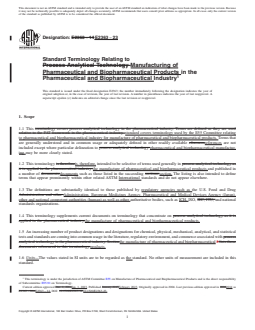
(Terminology)Standard Terminology Relating to Manufacturing of Pharmaceutical and Biopharmaceutical Products in the Pharmaceutical and Biopharmaceutical Industry
General Information
- Abstract
SCOPE
1.1 This standard covers terminology used by the E55 Committee relating to pharmaceutical and biopharmaceutical industry for manufacture of pharmaceutical and biopharmaceutical products. Terms that are generally understood and in common usage or adequately defined in other readily available references are not included except where particular delineation to pharmaceutical and biopharmaceutical manufacturing may be more clearly stated.
1.2 This terminology is, therefore, intended to be selective of terms used generally in the manufacture of pharmaceutical and biopharmaceutical products and published in a number of documents such as those listed in the succeeding section. The listing is also intended to define terms that appear prominently within other related ASTM International standards and do not appear elsewhere.
1.3 The definitions are substantially identical to those published by regulatory agencies such as the U.S. Food and Drug Administration, European Medicines Agency, Pharmaceutical and Medical Devices Agency (Japan), other and national competent authorities (human) as well as other authoritative bodies, such as ICH, ISO, and national standards organizations.
1.4 This terminology supplements current documents on terminology that concentrate on the manufacture of pharmaceutical and biopharmaceutical products.
1.5 An increasing number of product designations and designations for chemical, physical, mechanical, analytical, and statistical tests and standards are coming into common usage in the literature, regulatory environment, and commerce associated with the manufacture of pharmaceutical and biopharmaceutical products.
1.6 Units—The values stated in SI units are to be regarded as the standard. No other units of measurement are included in this standard.
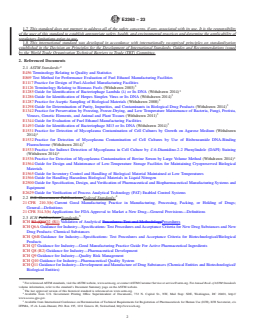
1.7 This standard does not purport to address all of the safety concerns, if any, associated with its use. It is the responsibility of the user of this standard to establish appropriate safety, health, and environmental practices and determine the applicability of regulatory limitations prior to use.
1.8 This international standard was developed in accordance with internationally recognized principles on standardization established in the Decision on Principles for the Development of International Standards, Guides and Recommendations issued by the World Trade Organization Technical Barriers to Trade (TBT) Committee.
- Status
- Published
- Publication Date
- 31-Dec-2022
- Technical Committee
- E55 - Manufacture of Pharmaceutical and Biopharmaceutical Products
- Drafting Committee
- E55.91 - Terminology
Buy Documents
ASTM E2363-23 - Standard Terminology Relating to Manufacturing of Pharmaceutical and Biopharmaceutical Products in the Pharmaceutical and Biopharmaceutical Industry
REDLINE ASTM E2363-23 - Standard Terminology Relating to Manufacturing of Pharmaceutical and Biopharmaceutical Products in the Pharmaceutical and Biopharmaceutical Industry
Overview
ASTM E2363-23: Standard Terminology Relating to Manufacturing of Pharmaceutical and Biopharmaceutical Products in the Pharmaceutical and Biopharmaceutical Industry is a crucial reference developed by ASTM International for professionals working within the pharmaceutical and biopharmaceutical sector. This standard, managed by ASTM Committee E55, establishes a comprehensive and harmonized set of terminology specific to the manufacture of pharmaceutical and biopharmaceutical products, addressing a significant need for consistent language across organizations, regulatory bodies, and documentation.
ASTM E2363-23 is particularly valuable as it brings together commonly used and regulatory agency-approved definitions, supporting alignment with agencies including the FDA, EMA, PMDA, ICH, ISO, and various national standards organizations. The document selectively includes terms not already adequately defined elsewhere, ensuring clarity and relevance to current manufacturing practices.
Key Topics
The scope of ASTM E2363-23 addresses:
- Terminology Standardization: Providing precise definitions of terms as applied in pharmaceutical and biopharmaceutical manufacturing, including analytical procedures, process parameters, risk management, and quality systems.
- Process Analytical Technology (PAT): Defining terms relevant to the PAT framework, which is central to modern, real-time process monitoring and control in manufacturing.
- Manufacturing Concepts: Clarifying key terms such as batch, lot, control strategy, process validation, in-process control, and manufacturing systems, supporting process efficiency and compliance.
- Regulatory Consistency: Harmonizing terminology with major regulatory documents (FDA, ICH, ISO, etc.), facilitating international compatibility and compliance.
- Test and Measurement: Addressing terms for chemical, physical, mechanical, analytical, and statistical tests crucial to product quality and validation.
- Safety and Risk Management: Including widely recognized definitions for elements such as CGMP (current Good Manufacturing Practices), risk management, quality systems, and process controls.
Applications
The practical applications of ASTM E2363-23 include:
- Manufacturing Documentation: Ensuring that internal and external documents-such as SOPs, training manuals, and batch records-use standardized, universally understood terms.
- Regulatory Submissions: Facilitating the preparation of submissions to regulatory authorities by referencing harmonized terminology, thereby reducing the risk of misinterpretation.
- Quality Management Systems: Supporting the consistent implementation of quality control, risk management, and process validation practices in line with international norms.
- Process Development and Technology Transfer: Streamlining communication during process scale-up, technology transfer, and cross-functional collaboration by utilizing consistent terminology.
- Workforce Training: Assisting with the training and onboarding of employees by providing clear, unambiguous definitions for key concepts and procedures.
- Audit and Compliance: Enhancing the robustness of audits and inspections by ensuring all parties share a common understanding of essential manufacturing and quality terms.
Related Standards
ASTM E2363-23 references and is complemented by several notable standards and regulatory guides, including:
- ASTM E2500: Specification, Design, and Verification of Pharmaceutical and Biopharmaceutical Manufacturing Systems and Equipment
- ASTM E2629: Guide for Verification of Process Analytical Technology (PAT)-Enabled Control Systems
- ISO 9000: Quality Management Systems-Fundamentals and Vocabulary
- ICH Q7, Q8, Q9, Q10, Q11: Comprehensive international guidelines for pharmaceutical development, quality risk management, and GMP for APIs
- 21 CFR 210 and 314: U.S. FDA regulations defining Good Manufacturing Practice and drug approval terminologies
- EU GMP Glossary: Terms used in European Good Manufacturing Practice
By aligning with ASTM E2363-23, organizations in the pharmaceutical and biopharmaceutical industry can ensure clarity, consistency, and regulatory compliance across global operations.
Keywords: ASTM E2363-23, pharmaceutical manufacturing terminology, biopharmaceutical terminology, process analytical technology, GMP, quality systems, regulatory standards, PAT, pharmaceutical industry, biopharmaceutical products, manufacturing process, compliance.
Relations
- Effective Date
- 01-Apr-2022
- Effective Date
- 15-Jun-2019
- Effective Date
- 01-Oct-2017
- Effective Date
- 01-Oct-2017
- Effective Date
- 01-Dec-2014
- Effective Date
- 01-Dec-2014
- Refers
ASTM E1566-00(2014) - Standard Guide for Handling Hazardous Biological Materials in Liquid Nitrogen - Effective Date
- 01-Dec-2014
- Effective Date
- 15-Nov-2013
- Effective Date
- 15-Nov-2013
- Effective Date
- 15-Nov-2013
- Effective Date
- 15-Nov-2013
- Effective Date
- 15-Aug-2013
- Effective Date
- 15-Oct-2012
- Effective Date
- 01-May-2012
- Effective Date
- 01-May-2012
Buy Documents
ASTM E2363-23 - Standard Terminology Relating to Manufacturing of Pharmaceutical and Biopharmaceutical Products in the Pharmaceutical and Biopharmaceutical Industry
REDLINE ASTM E2363-23 - Standard Terminology Relating to Manufacturing of Pharmaceutical and Biopharmaceutical Products in the Pharmaceutical and Biopharmaceutical Industry
Get Certified
Connect with accredited certification bodies for this standard

BSI Group
BSI (British Standards Institution) is the business standards company that helps organizations make excellence a habit.

TÜV Rheinland
TÜV Rheinland is a leading international provider of technical services.

TÜV SÜD
TÜV SÜD is a trusted partner of choice for safety, security and sustainability solutions.
Sponsored listings
Frequently Asked Questions
ASTM E2363-23 is a standard published by ASTM International. Its full title is "Standard Terminology Relating to Manufacturing of Pharmaceutical and Biopharmaceutical Products in the Pharmaceutical and Biopharmaceutical Industry". This standard covers: SCOPE 1.1 This standard covers terminology used by the E55 Committee relating to pharmaceutical and biopharmaceutical industry for manufacture of pharmaceutical and biopharmaceutical products. Terms that are generally understood and in common usage or adequately defined in other readily available references are not included except where particular delineation to pharmaceutical and biopharmaceutical manufacturing may be more clearly stated. 1.2 This terminology is, therefore, intended to be selective of terms used generally in the manufacture of pharmaceutical and biopharmaceutical products and published in a number of documents such as those listed in the succeeding section. The listing is also intended to define terms that appear prominently within other related ASTM International standards and do not appear elsewhere. 1.3 The definitions are substantially identical to those published by regulatory agencies such as the U.S. Food and Drug Administration, European Medicines Agency, Pharmaceutical and Medical Devices Agency (Japan), other and national competent authorities (human) as well as other authoritative bodies, such as ICH, ISO, and national standards organizations. 1.4 This terminology supplements current documents on terminology that concentrate on the manufacture of pharmaceutical and biopharmaceutical products. 1.5 An increasing number of product designations and designations for chemical, physical, mechanical, analytical, and statistical tests and standards are coming into common usage in the literature, regulatory environment, and commerce associated with the manufacture of pharmaceutical and biopharmaceutical products. 1.6 Units—The values stated in SI units are to be regarded as the standard. No other units of measurement are included in this standard. 1.7 This standard does not purport to address all of the safety concerns, if any, associated with its use. It is the responsibility of the user of this standard to establish appropriate safety, health, and environmental practices and determine the applicability of regulatory limitations prior to use. 1.8 This international standard was developed in accordance with internationally recognized principles on standardization established in the Decision on Principles for the Development of International Standards, Guides and Recommendations issued by the World Trade Organization Technical Barriers to Trade (TBT) Committee.
SCOPE 1.1 This standard covers terminology used by the E55 Committee relating to pharmaceutical and biopharmaceutical industry for manufacture of pharmaceutical and biopharmaceutical products. Terms that are generally understood and in common usage or adequately defined in other readily available references are not included except where particular delineation to pharmaceutical and biopharmaceutical manufacturing may be more clearly stated. 1.2 This terminology is, therefore, intended to be selective of terms used generally in the manufacture of pharmaceutical and biopharmaceutical products and published in a number of documents such as those listed in the succeeding section. The listing is also intended to define terms that appear prominently within other related ASTM International standards and do not appear elsewhere. 1.3 The definitions are substantially identical to those published by regulatory agencies such as the U.S. Food and Drug Administration, European Medicines Agency, Pharmaceutical and Medical Devices Agency (Japan), other and national competent authorities (human) as well as other authoritative bodies, such as ICH, ISO, and national standards organizations. 1.4 This terminology supplements current documents on terminology that concentrate on the manufacture of pharmaceutical and biopharmaceutical products. 1.5 An increasing number of product designations and designations for chemical, physical, mechanical, analytical, and statistical tests and standards are coming into common usage in the literature, regulatory environment, and commerce associated with the manufacture of pharmaceutical and biopharmaceutical products. 1.6 Units—The values stated in SI units are to be regarded as the standard. No other units of measurement are included in this standard. 1.7 This standard does not purport to address all of the safety concerns, if any, associated with its use. It is the responsibility of the user of this standard to establish appropriate safety, health, and environmental practices and determine the applicability of regulatory limitations prior to use. 1.8 This international standard was developed in accordance with internationally recognized principles on standardization established in the Decision on Principles for the Development of International Standards, Guides and Recommendations issued by the World Trade Organization Technical Barriers to Trade (TBT) Committee.
ASTM E2363-23 is classified under the following ICS (International Classification for Standards) categories: 01.040.11 - Health care technology (Vocabularies); 11.120.01 - Pharmaceutics in general. The ICS classification helps identify the subject area and facilitates finding related standards.
ASTM E2363-23 has the following relationships with other standards: It is inter standard links to ASTM E456-13a(2022)e1, ASTM E2629-19, ASTM E456-13A(2017)e3, ASTM E456-13A(2017)e1, ASTM E1564-00(2014), ASTM E1565-00(2014), ASTM E1566-00(2014), ASTM E456-13a, ASTM E456-13ae1, ASTM E456-13ae3, ASTM E456-13ae2, ASTM E456-13, ASTM E2500-07(2012), ASTM E456-12e1, ASTM E456-12. Understanding these relationships helps ensure you are using the most current and applicable version of the standard.
ASTM E2363-23 is available in PDF format for immediate download after purchase. The document can be added to your cart and obtained through the secure checkout process. Digital delivery ensures instant access to the complete standard document.
Standards Content (Sample)
This international standard was developed in accordance with internationally recognized principles on standardization established in the Decision on Principles for the
Development of International Standards, Guides and Recommendations issued by the World Trade Organization Technical Barriers to Trade (TBT) Committee.
Designation: E2363 − 23
Standard Terminology Relating to
Manufacturing of Pharmaceutical and Biopharmaceutical
Products in the Pharmaceutical and Biopharmaceutical
Industry
This standard is issued under the fixed designation E2363; the number immediately following the designation indicates the year of
original adoption or, in the case of revision, the year of last revision. A number in parentheses indicates the year of last reapproval. A
superscript epsilon (´) indicates an editorial change since the last revision or reapproval.
1. Scope 1.7 This standard does not purport to address all of the
safety concerns, if any, associated with its use. It is the
1.1 This standard covers terminology used by the E55
responsibility of the user of this standard to establish appro-
Committee relating to pharmaceutical and biopharmaceutical
priate safety, health, and environmental practices and deter-
industry for manufacture of pharmaceutical and biopharmaceu-
mine the applicability of regulatory limitations prior to use.
tical products. Terms that are generally understood and in
1.8 This international standard was developed in accor-
common usage or adequately defined in other readily available
dance with internationally recognized principles on standard-
references are not included except where particular delineation
ization established in the Decision on Principles for the
to pharmaceutical and biopharmaceutical manufacturing may
Development of International Standards, Guides and Recom-
be more clearly stated.
mendations issued by the World Trade Organization Technical
1.2 This terminology is, therefore, intended to be selective
Barriers to Trade (TBT) Committee.
of terms used generally in the manufacture of pharmaceutical
and biopharmaceutical products and published in a number of
2. Referenced Documents
documents such as those listed in the succeeding section. The
listing is also intended to define terms that appear prominently 2.1 ASTM Standards:
within other related ASTM International standards and do not E456 Terminology Relating to Quality and Statistics
appear elsewhere. E869 Test Method for Performance Evaluation of Fuel
Ethanol Manufacturing Facilities
1.3 The definitions are substantially identical to those pub-
E1117 Practice for Design of Fuel-Alcohol Manufacturing
lished by regulatory agencies such as the U.S. Food and Drug
Facilities
Administration, European Medicines Agency, Pharmaceutical
E1126 Terminology Relating to Biomass Fuels (Withdrawn
and Medical Devices Agency (Japan), other and national
2003)
competent authorities (human) as well as other authoritative
E1285 Guide for Identification of Bacteriophage Lambda (λ)
bodies, such as ICH, ISO, and national standards organizations.
or Its DNA (Withdrawn 2014)
1.4 This terminology supplements current documents on
E1286 Guide for Identification of Herpes Simplex Virus or
terminology that concentrate on the manufacture of pharma-
Its DNA (Withdrawn 2014)
ceutical and biopharmaceutical products.
E1287 Practice for Aseptic Sampling of Biological Materials
1.5 An increasing number of product designations and
(Withdrawn 2008)
designations for chemical, physical, mechanical, analytical,
E1298 Guide for Determination of Purity, Impurities, and
and statistical tests and standards are coming into common
Contaminants in Biological Drug Products (Withdrawn
usage in the literature, regulatory environment, and commerce
2014)
associated with the manufacture of pharmaceutical and bio-
E1342 Practice for Preservation by Freezing, Freeze-Drying,
pharmaceutical products.
and Low Temperature Maintenance of Bacteria, Fungi,
Protista, Viruses, Genetic Elements, and Animal and Plant
1.6 Units—The values stated in SI units are to be regarded
Tissues (Withdrawn 2011)
as the standard. No other units of measurement are included in
this standard.
1 2
This terminology is under the jurisdiction of ASTM Committee E55 on For referenced ASTM standards, visit the ASTM website, www.astm.org, or
Manufacture of Pharmaceutical and Biopharmaceutical Products and is the direct contact ASTM Customer Service at service@astm.org. For Annual Book of ASTM
responsibility of Subcommittee E55.91 on Terminology. Standards volume information, refer to the standard’s Document Summary page on
Current edition approved Jan. 1, 2023. Published February 2023. Originally the ASTM website.
approved in 2004. Last previous edition approved in 2014 as E2363 – 14. DOI: The last approved version of this historical standard is referenced on www.ast-
10.1520/E2363-23. m.org.
Copyright © ASTM International, 100 Barr Harbor Drive, PO Box C700, West Conshohocken, PA 19428-2959. United States
E2363 − 23
E1344 Guide for Evaluation of Fuel Ethanol Manufacturing Biotechnological/Biological Entities)
Facilities ICH Q12 Technical and Regulatory Considerations for Phar-
E1493 Guide for Identification of Bacteriophage M13 or Its maceutical Product Lifecycle Management
DNA (Withdrawn 2014)
2.4 ISO Standards:
E1531 Practice for Detection of Mycoplasma Contamination
ISO 9000:2005 Quality Management Systems—
of Cell Cultures by Growth on Agarose Medium (With-
Fundamentals and Vocabulary
drawn 2014)
ISO EN 14971:2012 Medical Devices—Application of Risk
E1532 Practice for Detection of Mycoplasma Contamination
Management for Medical Devices
of Cell Cultures by Use of Bisbenzamide DNA-Binding
ISO/IEC Guide 51:2014 Safety Aspects—Guidelines for
Fluorochrome (Withdrawn 2014)
Their Inclusion in Standards
E1533 Practice for Indirect Detection of Mycoplasma in Cell
ISO Guide 73:2009 Risk Management—Vocabulary
Culture by 4'-6-Diamidino-2-2 Phenylindole (DAPI)
Staining (Withdrawn 2014)
3. Terminology
E1536 Practice for Detection of Mycoplasma Contamination
3.1 Definitions:
of Bovine Serum by Large Volume Method (Withdrawn
acceptance criteria, n—numerical limits, ranges, or other
2014)
suitable measures for acceptance of test results. ICH Q7
E1564 Guide for Design and Maintenance of Low-
accuracy, n—the accuracy of an analytical procedure ex-
Temperature Storage Facilities for Maintaining Cryopre-
presses the closeness of agreement between the value that is
served Biological Materials
accepted either as a conventional true value or an accepted
E1565 Guide for Inventory Control and Handling of Bio-
reference value and the value found. ICH Q2 (R1)
logical Material Maintained at Low Temperatures
E1566 Guide for Handling Hazardous Biological Materials
active pharmaceutical ingredient, API (or drug substance),
in Liquid Nitrogen
n—this term identifies the product manufactured in small
E2500 Guide for Specification, Design, and Verification of
molecules / synthetics processes. For biologics and large
Pharmaceutical and Biopharmaceutical Manufacturing
molecules, the term drug substance is mostly used. See also
Systems and Equipment
drug substance.
E2629 Guide for Verification of Process Analytical Technol-
DISCUSSION—Such substances are intended to furnish pharmacologi-
ogy (PAT) Enabled Control Systems
cal activity or other direct effect in the diagnosis, cure, mitigation,
2.2 Federal Standards: treatment, or prevention of disease or to affect the structure and
function of the body. ICH Q7
21 CFR 210.3(b) Current Good Manufacturing Practice in
Manufacturing, Processing, Packing, or Holding of Drugs;
aerobe, adj—organism that can survive and grow in an
General—Definitions
oxygenated environment.
21 CFR 314.3(b) Applications for FDA Approval to Market
aerobic fermentation, n—fermentation processes that require
a New Drug—General Provisions—Definitions
the presence of oxygen.
2.3 ICH Standards:
ICH Q2 (R1) Validation of Analytical Procedures
anaerobe obligate, n—microorganism killed by normal atmo-
ICH Q6A Guidance for Industry—Specifications: Test Pro-
spheric concentrations of oxygen.
cedures and Acceptance Criteria for New Drug Substances
anaerobic facultative, n—microorganism that makes ATP by
and New Drug Products: Chemical Substances
aerobic respiration if oxygen is present but is capable of
ICH Q6B Guidance for Industry—Specifications: Test Pro-
switching to fermentation if oxygen is absent.
cedures and Acceptance Criteria for Biotechnological/
Biological Products
analytical procedure, n—analytical procedure refers to the
ICH Q7 Guidance for Industry—Good Manufacturing Prac-
way of performing the analysis.
tice Guide For Active Pharmaceutical Ingredients
DISCUSSION—It should describe in detail the steps necessary to
ICH Q8 (R2) Guidance for Industry—Pharmaceutical De-
perform each analytical test. This may include, but is not limited to, the
velopment sample, the reference standard and the reagents preparations, use of the
apparatus, generation of the calibration curve, use of the formulae for
ICH Q9 Guidance for Industry—Quality Risk Management
the calculation, and so forth. ICH Q2 (R1)
ICH Q10 Guidance for Industry—Pharmaceutical Quality
System
analyzer, n—instrument designed to measure and report a
ICH Q11 Guidance for Industry—Development and Manu-
property of the process, material, or environmental condi-
facture of Drug Substances (Chemical Entities and
tion.
anhydrous, adj—material that does not contain water either
Available from U.S. Government Printing Office Superintendent of Documents, absorbed on its surface or as water of crystallization; a
732 N. Capitol St., NW, Mail Stop: SDE, Washington, DC 20401, http://
water-free product.
www.access.gpo.gov.
Available from International Conference on Harmonisation of Technical
Requirements for Registration of Pharmaceuticals for Human Use (ICH), ICH
Secretariat, c/o IFPMA, 15 ch. Louis-Dunant, P.O. Box 195, 1211 Geneva 20, Available from American National Standards Institute (ANSI), 25 W. 43rd St.,
Switzerland, http://www.ich.org. 4th Floor, New York, NY 10036, http://www.ansi.org.
E2363 − 23
API, n—acronym for Active Pharmaceutical Ingredient. produce anhydrous ethanol from the ethanol water
azeotrope. E1344
API starting material, n—a raw material, intermediate, or an
backset, n—liquid portion of the thin stillage that is recycled as
API that is used in the production of an API and that is
part of the process liquid in mash preparation. E1344
incorporated as a significant structural fragment into the
structure of the API. An API Starting Material can be an
bacteriophage, n—virus that infects bacteria. E1285
article of commerce, a material purchased from one or more
basic hydrolysis, n—chemical addition of water to a
suppliers under contract or commercial agreement, or pro-
duced in-house. API Starting Materials are normally of compound. E1344
defined chemical properties and structure. ICH Q7
batch (or lot), n—a specific quantity of material produced in a
process or series of processes so that it is expected to be
aseptic sampling, n—sampling process in which no extrane-
homogeneous within specified limits. In the case of continu-
ous microorganisms or substances are introduced into the
ous production, a batch may correspond to a defined fraction
sample or its original bulk material as a result of the
of the production. The batch size can be defined either by a
sampling system and activity. E1287
fixed quantity or by the amount produced in a fixed time
at-line measurements, n—measurement in which the sample
interval ICH Q7
is removed, isolated from, and analyzed in close proximity to
batch fermentation—batch of nutrient mixture and microor-
the process stream.
ganisms mixed in a vessel and allowed to ferment. E1344
attribute, n—characteristic or inherent property or feature.
batch number (or Lot number), n—a unique combination of
numbers, letters, or symbols, or a combination thereof, that
audit, n—systematic, independent, and documented process
for obtaining audit evidence and evaluating it objectively to identifies a batch (or lot) and from which the production and
distribution history can be determined. ICH Q7
determine the extent to which audit criteria are fulfilled.
ISO 9000:2005
batch process, n—noncontinuous operation in which discrete
audit client, n—organization or person requesting an audit. quantities of material are transformed using individual or
ISO 9000:2005 sequential steps.
bioburden, n—the level and type (for example, objectionable
audit conclusion, n—outcome of an audit provided by the
or not) of micro-organisms that can be present in raw
audit team after consideration of the audit objectives and all
materials, API starting materials, intermediates or APIs.
audit findings. ISO 9000:2005
Bioburden should not be considered contamination unless
audit criteria, n—set of policies, procedures or requirements.
the levels have been exceeded or defined objectionable
ISO 9000:2005
organisms have been detected. ICH Q7
audit evidence, n—records, statements of fact, or other infor-
bioconversion, n—general term describing the use of biologi-
mation that are relevant to the audit criteria and verifiable.
cal systems to transform one compound into another.
ISO 9000:2005
DISCUSSION—Examples are digestion of organic wastes or sewage by
microorganisms to produce methane.
audit findings, n—results of the evaluation of the collected
biomass, n—total weight of living matter in a given volume.
audit evidence against audit criteria. ISO 9000:2005
calibration, n—the demonstration that a particular instrument
audit plan, n—description of the activities and arrangements
or device produces results within specified limits by com-
for an audit. ISO 9000:2005
parison with those produced by a reference or traceable
audit program, n—set of one or more audits planned for a
standard over an appropriate range of measurements.
specific time frame and directed towards a specific purpose.
ICH Q7
ISO 9000:2005
capability, n—ability of an organization, system, or process to
audit scope, n—extent and boundaries of an audit. ISO
realize a product that will fulfil the requirements for that
9000:2005
product. ISO 9000:2005
auditee, n—organization being audited. ISO 9000:2005
capability of a process, n—ability of a process to realize a
product that will fulfil the requirements of that product.
auditor, n—person with the demonstrated personal attributes
DISCUSSION—The concept of process capability can also be defined in
and competence to conduct an audit. ISO 9000:2005
statistical terms.
ISO 9000:2005, ICH Q10
azeotrope, n—constant boiling mixture; for ethanol water, the
azeotrope of 95.6 % ethanol and 4.4 % water (both percent-
change management, n—systematic approach to proposing,
ages by volume) boils at one atmosphere pressure. E1344
evaluating, approving, implementing, and reviewing
changes. ICH Q10
azeotropic distillation, n—use of an organic solvent to create
a new constant boiling point mixture; a method used to characteristic, n—distinguishing feature. ISO 9000:2005
E2363 − 23
chemical transformation step, n—for chemical entities, a step at a pressure negative to the immediate external environment
involved in the synthesis of the chemical structure of the and allow for the efficient removal of small quantities of
drug substance from precursor molecular fragments. airborne contaminants. ISO 14644
DISCUSSION—Typically, it involves C-X or C-C bond formation or
control model, n—procedure or mathematical expression (al-
breaking. ICH Q11
gorithm) that uses the outputs of the process model com-
competence, n—demonstrated personal attributes and demon-
bined with any other data inputs required to calculate values
strated ability to apply knowledge and skills. for the critical control parameters for the process; it uses
ISO 9000:2005
input data from the process to generate an actionable
command or commands that are issued to the control system.
computer system, n—group of hardware components and
E2629
associated software designed and assembled to perform a
specific function or group of functions. control number, n—see lot number.
ICH Q7
control strategy, n—planned set of controls, derived from
computerized system, n—a process or operation integrated current product and process understanding, that assures
with a computer system. ICH Q7 process performance and product quality.
DISCUSSION—The controls can include parameters and attributes
conformity, n—fulfillment of a requirement. ISO 9000:2005
related to drug substance and drug product materials and components,
facility and equipment operating conditions, in-process controls, fin-
consequence, n—outcome of an event affecting objectives.
ished product specifications, and the associated methods and frequency
ISO 73:2009
of monitoring and control. ICH Q10
containment, n—the action of confining a biological agent or
control system, n—system that responds to inputs signals from
other entity within a defined space.
the process, its associated equipment, other programmable
systems, or an operator, or combinations thereof, and gen-
contaminants, n—any adventitiously introduced materials (for
erates output signals causing the process and its associated
example, chemical, biochemical, or microbial species) not
equipment to operate in the desired manner. E2629
intended to be part of the manufacturing process of the drug
substance or drug product. ICH Q6B
correction, n—action to eliminate a detected nonconformity.
ISO 9000:2005
contamination, n—undesired introduction of impurities of a
chemical or microbiological nature, or of foreign matter, into
corrective action, n—action to eliminate the cause of a
or onto a raw material, intermediate, API, or dosage form
detected nonconformity or other undesirable situation.
during production, sampling, packaging, or repackaging,
ISO 9000:2005
storage, or transport. ICH Q7
critical, adj—describes a process step, process condition, test
continual improvement, n—recurring activity to increase the
requirement, or other relevant parameter or item that shall be
ability to fulfill requirements. ICH Q10, ISO 9000:2005
controlled within predetermined criteria to ensure that the
API or drug product meets its specification. ICH Q7
continuous fermentation, n—nonstop flow of nutrients into a
fermenting vessel with the simultaneous outflow of products,
critical material attribute, n—a physical, chemical, biologi-
organisms, and by-products. E1344
cal or microbiological property or characteristic of a raw
material that should be within an appropriate limit, range, or
continuous process—process in which material is added,
distribution to ensure the desired product quality.
processed, and removed in an uninterrupted manner.
critical quality attribute, n—a critical quality attribute (CQA)
continuous process verification, n—alternative approach to
is a physical, chemical, biological, or microbiological prop-
process validation in which manufacturing process perfor-
erty or characteristic that should be within an appropriate
mance is continuously monitored and evaluated.
limit, range, or distribution to ensure the desired product
ICH Q8 (R2)
quality. ICH Q8 (R2)
contract, n—binding agreement. ISO 9000:2005
critical process parameter, n—a Critical Process Parameter
contract manufacturer, n—manufacturer who performs some
(CPP) is a term used in pharmaceutical production for
aspect of manufacturing on behalf of another entity. process variables which have an impact on a critical quality
attribute (CQA) and, therefore, should be monitored or
control, n—measure that is modifying risk. ISO 73:2009
controlled to ensure the API or drug product obtains the
controlled area, n—an area constructed and operated in such desired quality. ICH Q8 (R2)
a manner that some attempt is made to control the introduc-
cross-contamination, n—contamination of a material or prod-
tion of potential contamination (an air supply approximating
uct with another material or product.
to grade D may be appropriate), and the consequences of
ICH Q7
accidental release of living organisms. The level of control
exercised should reflect the nature of the organism employed cryogenic temperatures, n—temperatures below or equal to
in the process. At a minimum, the area should be maintained -100 °C. E1564, E1565, E1566
E2363 − 23
cryoprotectant, n—chemical substance used to protect cells deviation, n—departure from an approved instruction or estab-
during freezing and rewarming. E1342 lished standard. ICH Q7
CGMP, n—acronym for current Good Manufacturing Prac- deviation permit, n—permission to depart from the originally
tices. specified requirements of a product before realization. ISO
9000:2005
CGMP regulations, n—current regulations published by the
direct detection of mycoplasma, n—detection of mycoplasma
U.S. Food and Drug Administration (FDA) regarding
by cultivation in culture media.
manufacturing, processing, packaging, and storing of drug
and biological products. E1287
document, n—information and its supporting medium. ISO
customer, n—organization or person that receives a product. 9000:2005
ISO 9000:2005
drug product, n—the dosage form in the final immediate
packaging intended for marketing. (Reference Q1A). ICH
customer satisfaction, n—customer’s perception of the degree
Q7
to which the customer’s requirements have been fulfilled.
ISO 9000:2005
drug substance, n—term used to specify the API in biologics
and large molecules manufacturing. The term API is mostly
decision maker(s), n—person(s) with the competence and
used in small molecules / synthetics manufacturing. See also
authority to make appropriate and timely quality risk man-
API. ICH Q7
agement decisions.
dry basis moisture control, n—of biomass, cells, or product
defect, n—non-fulfillment of a requirement related to an
fuels, the ratio of the weight of the water in a sample to the
intended or specified use. ISO 9000:2005
weight of the dry material.
deleterious impurities, n—impurities that are a health or
DISCUSSION—It is expressed as a percent.
safety concern, particularly with respect to toxicity,
durability, n—quality of a component to perform as designed
carcinogenicity, or immunogenicity.
for its design life.
DISCUSSION—Deleterious impurities shall be controlled, and their
levels determined using suitable analytical methods. E1298
effectiveness, n—relationship between the result achieved and
the resources used. ISO 9000:2005
dependability, n—collective term used to describe the avail-
ability performance and its influencing factors: reliability
enabler, n—tool or process that provides the means to achieve
performance, maintainability performance, and maintenance
an objective. ICH Q10
support performance. ISO 9000:2005
envelope, n—layer of cell membrane-derived lipoprotein that
design and development, n—set of processes that transforms
surrounds the protein coat (capsid) of some viruses. E1286
requirements into specified characteristics or the specifica-
enzyme, n—biological catalyst that is protein in nature. E1344
tion of a product, process or system. ISO 9000:2005
establishing the context, v—defining the external and internal
design of experiments, DoE, n—a structured, organized
parameters to be taken into account when managing risk and
method for determining the relationship between factors
setting the scope and risk criteria for the risk management
affecting a process and the output of the process. ICH Q8
policy. ISO 73:2009
(R2)
eutectic temperature, n—temperature below which all liquid
design reviews, n—planned and systematic reviews of
portions of an aqueous suspension have entered the solid
specifications, design, and design development and continu-
phase. E1342
ous improvement changes performed as appropriate
throughout the life cycle of the manufacturing system.
event, n—occurrence or change of a particular set of
DISCUSSION—Design reviews evaluate deliverables against standards
circumstances. ISO 73:2009
and requirements, identify problems, and propose required corrective
actions. E2500
expiry date (or expiration date), n—the date placed on the
container/labels of an API designating the time during which
design space, n—the multidimensional combination and inter-
the API is expected to remain within established shelf life
action of input variables (for example, material attributes)
specifications if stored under defined conditions, and after
and process parameters that have been demonstrated to
which it should not be used. ICH Q7
provide assurance of quality. ICH Q8 (R2)
exposure, n—extent to which an organization or stakeholders
detectability, n—ability to discover or determine the existence,
or both are subject to an event. ISO 73:2009
presence, or fact of a hazard. ICH Q9
external context,, n—external environment in which the
detection limit, n—detection limit of an individual analytical
organization seeks to achieve its objectives. ISO 73:2009
procedure is the lowest amount of analyte in a sample that
can be detected but not necessarily quantitated as an exact F pilus, n—protrusion on E. coli that is necessary for mating.
value. ICH Q2 (R1) DISCUSSION—The F pilus also contains the receptor for phage M13.
E2363 − 23
Feedback, n—the modification or control of a process or impurity, n—any component present in a raw material,
system by its results or effects. ICH Q10 intermediate, API, or dosage form that is not the desired
entity. ICH Q7
Feedforward, n—the modification or control of a process
impurity profile, n—description of the identified and uniden-
using its anticipated results or effects. ICH Q10
tified impurities present in a raw material, intermediate, API,
fermentation, n—biochemical reaction process in which mi-
or dosage form.
croorganisms in a nutrient medium convert a feedstock to a
in-line measurements, n—measurement in which the sample
product. E1344
is not removed from the process stream and can be invasive
flashpoint, n—temperature at which a combustible liquid
or non-invasive.
ignites. E1344
in-process control (or process control), n—checks performed
freeze drying, v—also known as lyophilization; sublimation of during production in order to monitor and, if appropriate, to
water from a frozen aqueous suspension. E1342 adjust the process or to ensure that the intermediate or API
conforms to its specifications, or both. ICH Q7
freezing, v—lowering the temperature of an aqueous suspen-
in-process material, n—any material(s) fabricated,
sion to a point at or below the temperature of ice crystal
compounded, blended, or synthesized using a chemical,
formation. E1342
physical, or biological process that is produced for and being
frequency, n—number of events or outcomes per defined unit
used in the preparation of an intermediate, drug substance, or
of time. ISO 73:2009
drug product.
genome (of a virus), n—genetic material consisting of nucleic
in-process tests, n—measurements performed during manu-
acid (RNA or DNA). E1286
facturing and pertaining to the process or in-process material
within the process.
glucose, n—most prominent simple sugar (six-membered
C H O ) produced from starches and cellulose material by indirect detection of mycoplasma, n—detection of myco-
6 12 6
hydrolysis. E1344 plasma by DNA staining or any method other than cultiva-
tion.
good engineering practices, n—include design practices and
induction, n—relief of repression of transcription of lysogenic
criteria accepted in professional societies (ASTM, AIChE,
phage genes encoding the functions for lytic growth so that
ASME, ACS, and so forth), proved by experience, verified
the phage will grow lytically. E1285
by actual data, and so forth, that will meet the process,
safety, and environmental requirements of the system.
information, n—meaningful data. ISO 9000:2005
grade, n—category or rank given to different quality require-
infrastructure, n—system of facilities, equipment, and ser-
ments for products, processes, or systems having the same
vices needed for the operation of an organization. ISO
functional use. ISO 9000:2005
9000:2005
harm, n—damage to health, including the damage that can
inherently safe design, n—measures taken to eliminate haz-
occur from loss of product quality or availability or injury or
ards or reduce risks or both by changing the design or
damage to the health of people or damage to property or the
operating characteristics of the product or system.
environment. ICH Q9, ISO 51:2014
ISO 51:2014
hazard, n—potential source of harm. ICH Q9, ISO
innocuous impurities, n—impurities that are not a health or
14971:2019, ISO 73:2009, ISO 51:2014
safety concern in the product.
DISCUSSION—The route of administration of the drug may be a
hazardous biological materials, n—biological materials, and
significant criterion in the determination of whether an impurity is
products derived therefrom, that pose a potential threat to
innocuous. E1298
human health.
innovation, n—introduction of new technologies or
hazardous event, n—event that can cause harm. ISO 51:2014
methodologies. ICH Q10
hazardous situation, n—circumstance in which people,
inspection, n—conformity evaluation by observation and
property, or the environment is/are exposed to one or more
judgement accompanied as appropriate by measurement,
hazards. ISO 14971:2019, ISO 51:2014
testing, or gauging. ISO 9000:2005
Hfr, n—strain of E. coli in which the F+ factor is inserted into
intended use, n—use in accordance with information provided
the chromosome. E1493
with a product or system, or, in the absence of such
information, by generally understood patterns of usage.
hydrolysis, n—act of cleaving or splitting of complex mol-
ISO 51:2014
ecules by the chemical addition of a water molecule.
DISCUSSION—Acid hydrolysis is defined as the chemical addition of interested party, n—person or group having an interest in the
water to a compound. E1344 performance or success of an organization. ISO 9000:2005
E2363 − 23
intermediate, n—a material produced during steps of the quality control, release, storage, and distribution of APIs and
processing of an API that undergoes further molecular related controls. ICH Q7
change or purification before it becomes an API. Intermedi-
manufacturer, n—natural or legal person with responsibility
ates may or may not be isolated. ICH Q7
for the design or manufacture, or both, of a pharmaceutical
intermediate precision, n—intermediate precision expresses
product with the intention of making the pharmaceutical
within-laboratories variations: different days, different
product available for use under his name whether or not such
analysts, different equipment, and so forth. ICH Q2 (R1)
a pharmaceutical product is designed or manufactured, or
both, by that person himself or on his behalf by another
knowledge management, n—systematic approach to
person(s). ISO 14971:2019
acquiring, analyzing, storing, and disseminating information
related to products, manufacturing processes, and
manufacturing process, n—set of activities or operations
components. ICH Q10
performed to deliver a desired output.
level of risk, n—magnitude of a risk or combination of risks
Manufacturing systems—elements of pharmaceutical and
expressed in terms of the combination of consequences and
biopharmaceutical manufacturing capability, including facil-
their likelihood. ISO 73:2009
ity equipment, process equipment, supporting utilities, asso-
ciated process monitoring and control systems, and automa-
life cycle, n—series of all phases in the life of a pharmaceutical
tion systems that have the potential to affect product quality
product from the initial conception to final decommissioning
and patient safety. E2500
and disposal ISO 14971:2019
likelihood, n—chance of something happening. ISO 73:2009 Material, n—general term used to denote raw materials
(starting materials, reagents, and solvents), process aids,
linearity, n—linearity of an analytical procedure is its ability
intermediates, APIs, drug products and packaging and label-
(within a given range) to obtain test results that are directly
ing materials. ICH Q7
proportional to the concentration (amount) of analyte in the
sample. ICH Q2 (R1)
material specification, n—set of criteria to which a material
shall conform to be considered acceptable for its intended
liquid nitrogen freezers, n—freezers that operate by a refrig-
use.
eration system in which cooling is provided by a refrigerant
such as liquid nitrogen. E1565
measurement management system, n—set of interrelated and
interacting elements necessary to achieve metrological con-
liquid nitrogen storage, n—storage directly in liquid nitrogen
firmation and continual control of measurement processes.
or in the vapor phase above liquid nitrogen. E1566
ISO 9000:2005
lot, n—batch, or a specific identified portion of a batch, having
uniform character and quality within specified limits or, in measurement process—set of operations to determine the
the case of a drug product produced by continuous process, value of a quantity. ISO 9000:2005
it is a specific identified amount produced in a unit of time
measurement system, n—system of sensors, instruments,
or quantity in a manner that assures its having uniform
analyzers, or combinations thereof that collects signals
character and quality within specified limits. 21 CFR
generated by passive or active interaction with process
210.3(b)
material or process equipment and converts those signals
lot number, control number, or batch number, n—any
into data. E2629
distinctive combination of letters, numbers, or symbols, or
measuring equipment, n—measuring instrument, software,
any combination of them, from which the complete history
measurement standard, reference material, auxiliary
of the manufacture, processing, packing, holding, and dis-
apparatus, or combination thereof necessary to realize a
tribution of a batch or lot of drug product or other material
measurement process. ISO 9000:2005
can be determined. 21 CFR 210.3(b)
low-temperature preservation, n—stabilizing viable or bio- metrological characteristic, n—distinguishing feature that
can influence the results of measurement. ISO 9000:2005
logically active material by freezing or freeze-drying. E1342
lysogen, n—bacterial strain that has a phage stably maintained.
metrological confirmation, n—set of operations required to
DISCUSSION—In the case of lambda, the phage is integrated into the
ensure that measuring equipment conforms to the require-
host genome. The integrated phage is called a prophage. E1285
ments for its intended use. ISO 9000:2005
management, n—coordinated activities to direct and control
metrological function, n—function with administrative and
an organization. ISO 9000:2005
technical responsibility for defining and implementing the
measurement management system. ISO 9000:2005
management system, n—system to establish policy and ob-
jectives and to achieve those objectives. ISO 9000:2005
moisture content, n—amount of water contained in product
manufacture, n—all operations of receipt of materials, expressed as either a percentage of the mass of the oven-dry
production, packaging, repackaging, labelling, relabelling, biomass or of the wet biomass, moisture content, dry basis.
E2363 − 23
monitoring, v—continual checking, supervising, critically changing primary methods) or as part of an ongoing verifi-
observing, or determining the status to identify change from cation of the control decision.
the performance level required or expected. ISO 73:2009
parameter, n—measurable or quantifiable characteristic of a
system or process.
mother liquor, n—residual liquid that remains after the crys-
tallization or isolation processes.
passive refrigeration, n—refrigeration system in which cool-
DISCUSSION—A mother liquor may contain unreacted materials,
ing is provided by a refrigerant such as liquid nitrogen.
intermediates, levels of the API, or impurities, or combinations thereof.
It may be used for further processing. ICH Q7
pathogenic, adj—disease causing. E1287
multiple cloning site, n—DNA that contains several contigu- performance indicators, n—measurable values used to quan-
ous restriction enzyme recognition sites; also called a tify quality objectives to reflect the performance of an
polylinker. E1493 organization, process, or system; also known as “perfor-
mance metrics” in some regions. ICH Q10
multiplicity of infection, n—ratio of infecting phage to host
pharmaceutical quality system, PQS, n—management sys-
bacteria. E1285
tem to direct and control a pharmaceutical company in
mycoplasma, n—smallest prokaryotes capable of living freely,
regard to quality. ICH Q10
lacking a cell wall, having a circular double-stranded DNA
plaque—round, clear area in a layer of host cells caused by
relatively rich in adenine and thymine, and containing 16s
virus growth and resultant killing or lysis of the cells. E1286
and 23s ribosomal RNAs.
DISCUSSION—They can be found as contaminants in cell cultures.
platform manufacturing, n—approach of developing a pro-
duction strategy for a new drug starting from manufacturing
nonconformity, n—nonfulfillment of a requirement. ISO
processes similar to those used by the same applicant to
9000:2005
manufacture other drugs of the same type (for example, as in
normal operating conditions, n—usual range of physical
the production of monoclonal antibodies using predefined
operating conditions (flow, pressure, temperature, and so
host cell, cell culture, and purification processes, for which
forth) for component or system.
there already exists considerable experience). ICH Q11
nucleocapsid, n—outer protein coat or shell (capsid) of a virus
precision, n—precision of an analytical procedure expresses
plus its inner core of nucleic acid and proteins E1286
the closeness of agreement (degree of scatter) between a
series of measurements obtained from multiple sampling of
objective evidence, n—data supporting the existence or verity
the same homogeneous sample under the prescribed condi-
of something. ISO 9000:2005, ISO 14971:2019
tions.
DISCUSSION—Precision may be considered at three levels:
off-line measurements, n—measurement in which the sample
repeatability, intermediate precision, and reproducibility. ICH Q2
is removed, isolated from, and analyzed in an area remote
(R1)
from the manufacturing process.
press, n—mechanical device that removes liquids from solids
on-line measurements, n—measurement in which the sample
by mechanically pressing the solids against a porous surface.
is diverted from the manufacturing process and may be
E1344
returned to the process stream.
preventive action, n—action to eliminate the cause of a
organization, n—group of people and facilities with an ar-
potential nonconformity or other undesirable potential
rangement of responsibilities, authorities, and relationships.
situation. ISO 9000:2005
ISO 9000:2005
probability, n—measure of the chance of occurrence ex-
organizational structure, n—arrangement of responsibilities,
pressed either quantitatively using mathematical
authorities, and relationships between people. ISO
probabilities, for example, expressed as a number between 0
9000:2005
and 1 in which 0 is impossibility and 1 is absolute certainty
or qualitatively using other types of measures. ICH Q9, ISO
outsourced activities, n—activities conducted by a contract
73:2009, ISO EN 14971:2012
acceptor under a written agreement with a contract giver.
ICH Q10
procedure, n—documented description of the operations to be
performed, the precautions to be taken, and the measures to
packaging material, n—any material intended to protect an
be applied directly or indirectly related to the manufacture of
intermediate or API during storage and transport. ICH Q7
an intermediate, API, or drug product or specified way to
parallel method, n—low-risk impact method carried out to
carry out an activity or a process. ICH Q7
verify the control decision made by the primary method.
process, n—set of interrelated or interacting activities that
parallel testing, n—time when the parallel method is run transforms inputs into outputs or set of interrelated or
alongside the primary method and can either be used to interacting activities that use inputs to deliver an intended
establish equivalence of primary and parallel methods (when result. ISO 9000:2005, ISO 14971:2019
E2363 − 23
process aids, n—materials, excluding solvents, used as an aid purity of a biological product, n—measure of the biologically
in the manufacture of an intermediate or API that do not active drug in relation to the total substances (not including
themselves participate in a chemical or biological reaction additives) present in the drug product, usually expressed on
(for example, filter aid, activated carbon). a percentage basis. E1298
ICH Q7
qualification, n—action of proving and documenting that
equipment or ancillary systems are properly installed, work
process analytical technology, PAT, n—system for designing,
correctly, and actually lead to the expected results.
analyzing, and controlling manufacturing through timely
DISCUSSION—Qualification is part of validation, but the individual
measurements (that is, during processing) of critical quality
qualification steps alone do not constitute process validation. ICH Q7
and performance attributes of raw and in-process materials
and processes with the goal of ensuring final product quality.
qualification process, n—process to demonstrate the ability to
ICH Q8 (R2)
fulfill specified requirements. ISO 9000:2005
process control, n—checks performed during manufacturing
quality—degree to which a set of inherent properties of a
to measure critical attributes and, if appropriate, adjust the
product, system, or process fulfills requirements.
process to deliver the desired output(s). ICH Q7
ICH Q9, ISO 9000:2005
process model, n—mathematical expression (algorithm) that
quality assurance, QA—(1) part of quality management
uses data from the measurement system(s) (inputs to the
focused on providing confidence that quality requirements
process model) to calculate the value of one or more of the
will be fulfilled (ISO 9000:2005) and (2) the sum total of the
process or material attributes (outputs from the process
organised arrangements made with the object of ensuring
model) at the time the measurement was taken or the future
that all APIs are of the quality required for their intended use
value of the process or material attribute. E2629
and that quality systems are maintained. ICH Q7
process parameter, n—attribute of the manufacturing system.
quality attribute, n—attribute that affects product quality.
process robustness, n—ability of a process to tolerate vari- quality characteristic, n—inherent characteristic of a product,
process, or system related to a requirement. ISO 9000:2005
ability of materials and changes of the process and equip-
ment without negative impact on quality. ICH Q8 (R2)
quality control, QC—(1) part of quality management focused
on fulfilling quality requirements (ISO 9000:2005) and (2)
product, n—result of a set of interrelated or interacting
checking or testing that specifications are met. ICH Q7
activities which transforms inputs into outputs or result of a
process. ISO 9000:2005
quality improvement, n—part of quality management focused
on increasing the ability to fulfill quality requirements.
product life cycle, n—all phases in the life of the product from
ISO 9000:2005
the initial development through marketing until the product’s
discontinuation. ICH Q9
quality management, n—coordinated activities to direct and
control an organization in regard to quality. ISO 9000:2005
product realization, n—achievement of a product with the
quality attributes appropriate to meet the needs of patients,
quality management system, n—management system to di-
health care professionals, and regulatory authorities and
rect and control an organization in regard to quality.
internal customer requirements. ICH Q10
ISO 9000:2005
production, n—all operations involved in the preparation of an
quality manual, n—document specifying the quality manage-
API from receipt of materials through processing and
ment system of an organization. ISO 9000:2005
packaging of the API. ICH Q7
quality objectives, n—means to translate the quality policy
and strategies into measurable activities. ICH Q10
production cycle, n—series of operations required to process
through the facility a quantity of raw materials necessary for
quality plan, n—document specifying which procedures and
manufacturing of drug substance or drug product and return
associated resources shall be applied by
...
This document is not an ASTM standard and is intended only to provide the user of an ASTM standard an indication of what changes have been made to the previous version. Because
it may not be technically possible to adequately depict all changes accurately, ASTM recommends that users consult prior editions as appropriate. In all cases only the current version
of the standard as published by ASTM is to be considered the official document.
Designation: E2363 − 14 E2363 − 23
Standard Terminology Relating to
Process Analytical Technology Manufacturing of
Pharmaceutical and Biopharmaceutical Products in the
Pharmaceutical and Biopharmaceutical Industry
This standard is issued under the fixed designation E2363; the number immediately following the designation indicates the year of
original adoption or, in the case of revision, the year of last revision. A number in parentheses indicates the year of last reapproval. A
superscript epsilon (´) indicates an editorial change since the last revision or reapproval.
1. Scope
1.1 This terminology covers process analytical technology in the pharmaceutical industry. Terms are defined as they are used
relative to the PAT framework in the pharmaceutical industry. standard covers terminology used by the E55 Committee relating
to pharmaceutical and biopharmaceutical industry for manufacture of pharmaceutical and biopharmaceutical products. Terms that
are generally understood and in common usage or adequately defined in other readily available eferencesreferences are not
included except where particular delineation to process analytical technology pharmaceutical and biopharmaceutical manufactur-
ing may be more clearly stated.
1.2 This terminology is thereforeis, therefore, intended to be selective of terms used generally in process analytical technology as
it is applied in the pharmaceutical industry the manufacture of pharmaceutical and biopharmaceutical products and published in
a number of documents,documents such as those listed in the succeeding sections.section. The listing is also intended to define
terms that appear prominently within other related ASTM International standards and do not appear elsewhere.
1.3 The definitions are substantially identical to those published by regulatory agencies such as the U.S. Food and Drug
Administration and other Administration, European Medicines Agency, Pharmaceutical and Medical Devices Agency (Japan),
other and national competent authorities (human) as well as other authoritative bodies, such as ICH, ISO, IEC, ITU, and national
standards organizations.
1.4 This terminology supplements current documents on terminology that concentrate on process analytical technology as it is
applied in the pharmaceutical industry.the manufacture of pharmaceutical and biopharmaceutical products.
1.5 An increasing number of product designations and designations for chemical, physical, mechanical, analytical, and statistical
tests and standards are coming into common usage in the literature, regulatory environment, and commerce associated with process
analytical technology in the pharmaceutical industry. Sectionthe manufacture of pharmaceutical and biopharmaceutical 2 lists those
documents referenced in this terminology.products.
1.6 Units—The values stated in SI units are to be regarded as the standard. No other units of measurement are included in this
standard.
This terminology is under the jurisdiction of ASTM Committee E55 on Manufacture of Pharmaceutical and Biopharmaceutical Products and is the direct responsibility
of Subcommittee E55.91 on Terminology.
Current edition approved Dec. 1, 2014Jan. 1, 2023. Published January 2015February 2023. Originally approved in 2004. Last previous edition approved in 20062014 as
E2363 – 06a.E2363 – 14. DOI: 10.1520/E2363-14.10.1520/E2363-23.
Copyright © ASTM International, 100 Barr Harbor Drive, PO Box C700, West Conshohocken, PA 19428-2959. United States
E2363 − 23
1.7 This standard does not purport to address all of the safety concerns, if any, associated with its use. It is the responsibility
of the user of this standard to establish appropriate safety, health, and environmental practices and determine the applicability of
regulatory limitations prior to use.
1.8 This international standard was developed in accordance with internationally recognized principles on standardization
established in the Decision on Principles for the Development of International Standards, Guides and Recommendations issued
by the World Trade Organization Technical Barriers to Trade (TBT) Committee.
2. Referenced Documents
2.1 ASTM Standards:
E456 Terminology Relating to Quality and Statistics
E869 Test Method for Performance Evaluation of Fuel Ethanol Manufacturing Facilities
E1117 Practice for Design of Fuel-Alcohol Manufacturing Facilities
E1126 Terminology Relating to Biomass Fuels (Withdrawn 2003)
E1285 Guide for Identification of Bacteriophage Lambda (λ) or Its DNA (Withdrawn 2014)
E1286 Guide for Identification of Herpes Simplex Virus or Its DNA (Withdrawn 2014)
E1287 Practice for Aseptic Sampling of Biological Materials (Withdrawn 2008)
E1298 Guide for Determination of Purity, Impurities, and Contaminants in Biological Drug Products (Withdrawn 2014)
E1342 Practice for Preservation by Freezing, Freeze-Drying, and Low Temperature Maintenance of Bacteria, Fungi, Protista,
Viruses, Genetic Elements, and Animal and Plant Tissues (Withdrawn 2011)
E1344 Guide for Evaluation of Fuel Ethanol Manufacturing Facilities
E1493 Guide for Identification of Bacteriophage M13 or Its DNA (Withdrawn 2014)
E1531 Practice for Detection of Mycoplasma Contamination of Cell Cultures by Growth on Agarose Medium (Withdrawn
2014)
E1532 Practice for Detection of Mycoplasma Contamination of Cell Cultures by Use of Bisbenzamide DNA-Binding
Fluorochrome (Withdrawn 2014)
E1533 Practice for Indirect Detection of Mycoplasma in Cell Culture by 4'-6-Diamidino-2-2 Phenylindole (DAPI) Staining
(Withdrawn 2014)
E1536 Practice for Detection of Mycoplasma Contamination of Bovine Serum by Large Volume Method (Withdrawn 2014)
E1564 Guide for Design and Maintenance of Low-Temperature Storage Facilities for Maintaining Cryopreserved Biological
Materials
E1565 Guide for Inventory Control and Handling of Biological Material Maintained at Low Temperatures
E1566 Guide for Handling Hazardous Biological Materials in Liquid Nitrogen
E2500 Guide for Specification, Design, and Verification of Pharmaceutical and Biopharmaceutical Manufacturing Systems and
Equipment
E2629 Guide for Verification of Process Analytical Technology (PAT) Enabled Control Systems
2.2 U.S. Government Publications:Federal Standards:
21 CFR 210.3(b) Current Good Manufacturing Practice in Manufacturing, Processing, Packing, or Holding of Drugs;
General—Definitions
21 CFR 314.3(b) Applications for FDA Approval to Market a New Drug—General Provisions—Definitions
2.3 ICH Publications:Standards:
ICH R2 (Q1)Q2 (R1) Validation of Analytical Procedures: Text and MethodologyProcedures
ICH Q6A Guidance for Industry—Specifications: Test Procedures and Acceptance Criteria for New Drug Substances and New
Drug Products: Chemical Substances
ICH Q6B Guidance for Industry—Specifications: Test Procedures and Acceptance Criteria for Biotechnological/Biological
Products
ICH Q7 Guidance for Industry—Good Manufacturing Practice Guide For Active Pharmaceutical Ingredients
ICH Q8 (R2) Guidance for Industry—Pharmaceutical Development
ICH Q9 Guidance for Industry—Quality Risk Management
ICH Q10 Guidance for Industry—Pharmaceutical Quality System
ICH Q11 Guidance for Industry—Development and Manufacture of Drug Substances (Chemical Entities and Biotechnological/
Biological Entities)
For referenced ASTM standards, visit the ASTM website, www.astm.org, or contact ASTM Customer Service at service@astm.org. For Annual Book of ASTM Standards
volume information, refer to the standard’s Document Summary page on the ASTM website.
The last approved version of this historical standard is referenced on www.astm.org.
Available from U.S. Government Printing Office Superintendent of Documents, 732 N. Capitol St., NW, Mail Stop: SDE, Washington, DC 20401, http://
www.access.gpo.gov.
Available from International Conference on Harmonisation of Technical Requirements for Registration of Pharmaceuticals for Human Use (ICH), ICH Secretariat, c/o
IFPMA, 15 ch. Louis-Dunant, P.O. Box 195, 1211 Geneva 20, Switzerland, http://www.ich.org.
E2363 − 23
ICH Q12 Technical and Regulatory Considerations for Pharmaceutical Product Lifecycle Management
2.4 ISO Publications:Standards:
ISO 9000:2005 Quality Management Systems—Fundamentals and Vocabulary
ISO EN 14971:2012 Medical Devices—Application of Risk Management for Medical Devices
ISO/IEC Guide 51:2014 Safety Aspects—Guidelines for Their Inclusion in Standards
ISO Guide 73:2009 Risk Management—Vocabulary
2.5 Other Publication:
EU GMP Glossary
3. Terminology
3.1 Definitions:
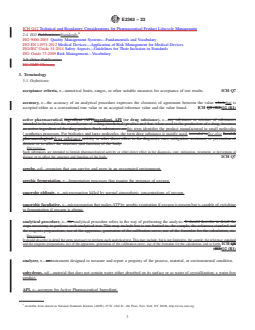
acceptance criteria, n—numerical limits, ranges, or other suitable measures for acceptance of test results. ICH Q7
accuracy, n—the accuracy of an analytical procedure expresses the closeness of agreement between the value whichthat is
accepted either as a conventional true value or an accepted reference value and the value found. ICH Q8 (R2)Q2 (R1)
active pharmaceutical ingredient (API)ingredient, API (or drug substance), n—any substance or mixture of substances
intended to be used in the manufacture of a drug (medicinal) product and that, when used in the production of a drug, becomes
an active ingredient of the drug product. Such substances arethis term identifies the product manufactured in small molecules
/ synthetics processes. For biologics and large molecules, the term drug substance is mostly used. intended toSee also furnish
pharmacological drug substance.activity or other direct effect in the diagnosis, cure, mitigation, treatment, or prevention of
disease or to affect the structure and function of the body.
DISCUSSION—
Such substances are intended to furnish pharmacological activity or other direct effect in the diagnosis, cure, mitigation, treatment, or prevention of
disease or to affect the structure and function of the body. ICH Q7
aerobe, adj—organism that can survive and grow in an oxygenated environment.
aerobic fermentation, n—fermentation processes that require the presence of oxygen.
anaerobe obligate, n—microorganism killed by normal atmospheric concentrations of oxygen.
anaerobic facultative, n—microorganism that makes ATP by aerobic respiration if oxygen is present but is capable of switching
to fermentation if oxygen is absent.
analytical procedure, n—the analytical procedure refers to the way of performing the analysis. It should describe in detail the
steps necessary to perform each analytical test. This may include but is not limited to: the sample, the reference standard and
the reagents preparations, use of the apparatus, generation of the calibration curve, use of the formulae for the calculation, etc.
DISCUSSION—
It should describe in detail the steps necessary to perform each analytical test. This may include, but is not limited to, the sample, the reference standard
and the reagents preparations, use of the apparatus, generation of the calibration curve, use of the formulae for the calculation, and so forth. ICH Q8
(R2)Q2 (R1)
analyzer, n—an instrument designed to measure and report a property of the process, material, or environmental condition.
anhydrous, adj—material that does not contain water either absorbed on its surface or as water of crystallization; a water-free
product.
API, n—acronym for Active Pharmaceutical Ingredient.
Available from American National Standards Institute (ANSI), 25 W. 43rd St., 4th Floor, New York, NY 10036, http://www.ansi.org.
E2363 − 23
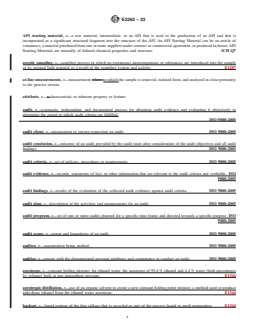
API starting material, n—a raw material, intermediate, or an API that is used in the production of an API and that is
incorporated as a significant structural fragment into the structure of the API. An API Starting Material can be an article of
commerce, a material purchased from one or more suppliers under contract or commercial agreement, or produced in-house. API
Starting Materials are normally of defined chemical properties and structure. ICH Q7
aseptic sampling, n—sampling process in which no extraneous microorganisms or substances are introduced into the sample
or its original bulk material as a result of the sampling system and activity. E1287
at-line measurements, n—measurement where in which the sample is removed, isolated from, and analyzed in close proximity
to the process stream.
attribute, n—a characteristic or inherent property or feature.
audit, n—systematic, independent, and documented process for obtaining audit evidence and evaluating it objectively to
determine the extent to which audit criteria are fulfilled.
ISO 9000:2005
audit client, n—organization or person requesting an audit. ISO 9000:2005
audit conclusion, n—outcome of an audit provided by the audit team after consideration of the audit objectives and all audit
findings. ISO 9000:2005
audit criteria, n—set of policies, procedures or requirements. ISO 9000:2005
audit evidence, n—records, statements of fact, or other information that are relevant to the audit criteria and verifiable. ISO
9000:2005
audit findings, n—results of the evaluation of the collected audit evidence against audit criteria. ISO 9000:2005
audit plan, n—description of the activities and arrangements for an audit. ISO 9000:2005
audit program, n—set of one or more audits planned for a specific time frame and directed towards a specific purpose. ISO
9000:2005
audit scope, n—extent and boundaries of an audit. ISO 9000:2005
auditee, n—organization being audited. ISO 9000:2005
auditor, n—person with the demonstrated personal attributes and competence to conduct an audit. ISO 9000:2005
azeotrope, n—constant boiling mixture; for ethanol water, the azeotrope of 95.6 % ethanol and 4.4 % water (both percentages
by volume) boils at one atmosphere pressure. E1344
azeotropic distillation, n—use of an organic solvent to create a new constant boiling point mixture; a method used to produce
anhydrous ethanol from the ethanol water azeotrope. E1344
backset, n—liquid portion of the thin stillage that is recycled as part of the process liquid in mash preparation. E1344
E2363 − 23
bacteriophage, n—virus that infects bacteria. E1285
basic hydrolysis, n—chemical addition of water to a compound. E1344
batch, batch (or lot), n—a specific quantity of a drug or other material that is intended to have uniform character and quality,
within specified limits, and is produced according to a single manufacturing order during the same cycle of manufacture.material
produced in a process or series of processes so that it is expected to be homogeneous within specified limits. In the case of
continuous production, a batch may correspond to a defined fraction of the production. The batch size can be defined either by
a fixed quantity or by the amount produced in a fixed time interval 21 CFR 210.3(b)ICH Q7
batch fermentation—batch of nutrient mixture and microorganisms mixed in a vessel and allowed to ferment. E1344
batch number, number (or Lot number), n—Seea lot number.unique combination of numbers, letters, or symbols, or a
combination thereof, that identifies a batch (or lot) and from which the production and distribution history can be determined.
ICH Q7
batch process, n—a noncontinuous operation in which discrete quantities of material are transformed using individual or
sequential steps. 21 CFR 210.3(b)
bioburden, n—the level and type (for example, objectionable or not) of micro-organisms that can be present in raw materials,
API starting materials, intermediates or APIs. Bioburden should not be considered contamination unless the levels have been
exceeded or defined objectionable organisms have been detected. ICH Q7
bioconversion, n—general term describing the use of biological systems to transform one compound into another.
DISCUSSION—
Examples are digestion of organic wastes or sewage by microorganisms to produce methane.
biomass, n—total weight of living matter in a given volume.
calibration, n—the demonstration that a particular instrument or device produces results within specified limits by comparison
with those produced by a reference or traceable standard over an appropriate range of measurements.
ICH Q7
capability, n—ability of an organization, system, or process to realize a product that will fulfil the requirements for that product.
ISO 9000:2005
capability of a process, n—ability of a process to realize a product that will fulfil the requirements of that product. The concept
of process capability can also be defined in statistical terms.
DISCUSSION—
The concept of process capability can also be defined in statistical terms.
ISO 9000:2005, ICH Q10
change management, n—a systematic approach to proposing, evaluating, approving, implementing, and reviewing changes.
ICH Q10
characteristic, n—distinguishing feature. ISO 9000:2005
chemical transformation step, n—for chemical entities, a step involved in the synthesis of the chemical structure of the drug
substance from precursor molecular fragments. Typically it involves C-X or C-C bond formation or breaking.
E2363 − 23
DISCUSSION—
Typically, it involves C-X or C-C bond formation or breaking. ICH Q11
competence, n—demonstrated personal attributes and demonstrated ability to apply knowledge and skills. ISO 9000:2005
computer system, n—a group of hardware components and associated software designed and assembled to perform a specific
function or group of functions.
ICH Q7
computerized system, n—a process or operation integrated with a computer system. ICH Q7
conformity, n—fulfillment of a requirement. ISO 9000:2005
consequence, n—outcome of an event affecting objectives. ISO 73:2009
containment, n—the action of confining a biological agent or other entity within a defined space.
contaminants, n—any adventitiously introduced materials (for example, chemical, biochemical, or microbial species) not
intended to be part of the manufacturing process of the drug substance or drug product. ICH Q6B
contamination, n—the undesired introduction of impurities of a chemical or microbiological nature, or of foreign matter, into
or onto a raw material, intermediate, API (active pharmaceutical ingredient), API, or dosage form during production, sampling,
packaging, or repackaging, storage, or transport. ICH Q7
continual improvement, n—recurring activity to increase the ability to fulfilfulfill requirements. ICH Q10, ISO 9000:2005
continuous fermentation, n—nonstop flow of nutrients into a fermenting vessel with the simultaneous outflow of products,
organisms, and by-products. E1344
continuous process—a process in which material is added, processed, and removed in an uninterrupted manner.
continuous process verification, n—an alternative approach to process validation in which manufacturing process performance
is continuously monitored and evaluated.
ICH Q8 (R2)
contract, n—binding agreement. ISO 9000:2005
contract manufacturer, n—a manufacturer who performs some aspect of manufacturing on behalf of another entity.
control number, control, n—Seemeasure lot number.that is modifying risk. ISO 73:2009
controlled area, n—an area constructed and operated in such a manner that some attempt is made to control the introduction
of potential contamination (an air supply approximating to grade D may be appropriate), and the consequences of accidental
release of living organisms. The level of control exercised should reflect the nature of the organism employed in the process.
At a minimum, the area should be maintained at a pressure negative to the immediate external environment and allow for the
efficient removal of small quantities of airborne contaminants. ISO 14644
control model, n—procedure or mathematical expression (algorithm) that uses the outputs of the process model combined with
any other data inputs required to calculate values for the critical control parameters for the process; it uses input data from the
process to generate an actionable command or commands that are issued to the control system. E2629 E2629
E2363 − 23
control number, n—see lot number.
control strategy, n—a planned set of controls, derived from current product and process understanding, that assures process
performance and product quality. The controls can include parameters and attributes related to drug substance and drug product
materials and components, facility and equipment operating conditions, in-process controls, finished product specifications, and
the associated methods and frequency of monitoring and control.
DISCUSSION—
The controls can include parameters and attributes related to drug substance and drug product materials and components, facility and equipment
operating conditions, in-process controls, finished product specifications, and the associated methods and frequency of monitoring and control. ICH
Q10
control system, n—system that responds to inputs signals from the process, its associated equipment, other programmable
systems, or an operator, or combinations thereof, and generates output signals causing the process and its associated equipment
to operate in the desired manner. E2629
correction, n—action to eliminate a detected nonconformity. ISO 9000:2005
corrective action, n—action to eliminate the cause of a detected non-conformitynonconformity or other undesirable situation.
ISO 9000:2005
DISCUSSION—
Corrective action is taken to prevent recurrence whereas preventive action is taken to prevent occurrence.
critical, n—adj—describes a process step, process condition, test requirement, or other relevant parameter or item that mustshall
be controlled within predetermined criteria to ensure that the API or drug product meets its specification. ICH Q7
critical material attribute, n—a physical, chemical, biological or microbiological property or characteristic of a raw material
that should be within an appropriate limit, range, or distribution to ensure the desired product quality.
critical quality attribute, n—a critical quality attribute (CQA) is a physical, chemical, biological, or microbiological property
or characteristic that should be within an appropriate limit, range, or distribution to ensure the desired product quality. ICH Q8
(R2)
critical process parameter, n—a Critical Process Parameter (CPP) is a term used in pharmaceutical production for process
variables which have an impact on a critical quality attribute (CQA) and, therefore, should be monitored or controlled to ensure
the API or drug product obtains the desired quality. ICH Q8 (R2)
cross-contamination, n—contamination of a material or product with another material or product.
ICH Q7
cryogenic temperatures, n—temperatures below or equal to -100 °C. E1564, E1565, E1566
cryoprotectant, n—chemical substance used to protect cells during freezing and rewarming. E1342
CGMP, n—acronym for current Good Manufacturing Practices.
current good manufacturing practices (CGMP), CGMP regulations, n—current regulations published by the United States
U.S. Food and Drug Administration (FDA) regarding manufacturing, processing, packaging, and storing of drug and biological
products. E1287 E1287
customer, n—organization or person that receives a product. ISO 9000:2005
E2363 − 23
customer satisfaction, n—customer’s perception of the degree to which the customer’s requirements have been fulfilled. ISO
9000:2005
decision maker(s), n—person(s) with the competence and authority to make appropriate and timely quality risk management
decisions. ICH Q9
detectability,defect, n—the ability to discover or determine the existence, presence, or fact of a hazard.non-fulfillment of a
requirement related to an intended or specified use. ISO 9000:2005 ICH Q9
deleterious impurities, n—impurities that are a health or safety concern, particularly with respect to toxicity, carcinogenicity,
or immunogenicity.
DISCUSSION—
Deleterious impurities shall be controlled, and their levels determined using suitable analytical methods. E1298
detection limit, dependability, n—the detection limit of an individual analytical procedure is the lowest amount of analyte in
a sample which can be detected but not necessarily quantitated as an exact value.collective term used to describe the availability
performance and its influencing factors: reliability performance, maintainability performance, and maintenance support
performance. ISO 9000:2005 ICH R2 (Q1)
Design of Experiments (DoE), design and development, n—the arrangement in which an experimental program is to be
conducted, and the selection of the levels (versions) of one or more factors or factor combinations to be included in the
experiment. set of processes that transforms requirements into specified characteristics or the specification of a product, process
or system. E456ISO 9000:2005
design of experiments, DoE, n—a structured, organized method for determining the relationship between factors affecting a
process and the output of the process. ICH Q8 (R2)
design reviews, n—planned and systematic reviews of specifications, design, and design development and continuous
improvement changes performed as appropriate throughout the life-cycle life cycle of the manufacturing system. Design reviews
evaluate deliverables against standards and requirements, identify problems, and propose required corrective actions.
DISCUSSION—
Design reviews evaluate deliverables against standards and requirements, identify problems, and propose required corrective actions. E2500 E2500
design space, n—the multidimensional combination and interaction of input variables (for example, material attributes) and
process parameters that have been demonstrated to provide assurance of quality. ICH Q8 (R2)
detectability, n—the ability to discover or determine the existence, presence, or fact of a hazard. ICH Q9
detection limit, n—detection limit of an individual analytical procedure is the lowest amount of analyte in a sample that can
be detected but not necessarily quantitated as an exact value. ICH Q2 (R1)
deviation, n—departure from an approved instruction or established standard. ICH Q7
deviation permit, n—permission to depart from the originally specified requirements of a product before realization. ISO
9000:2005
direct detection of mycoplasma, n—detection of mycoplasma by cultivation in culture media.
document, n—information and its supporting medium. ISO 9000:2005
E2363 − 23
drug product, n—a finished dosage form, for example, tablet, capsule, solution, etc., that contains an active drug ingredient
generally, but not necessarily, in association with inactive ingredients. The term also includes a finished dosage form that does
not contain an active ingredient but is intended to be used as a placebo.the dosage form in the final immediate packaging
intended for marketing. (Reference Q1A). 21 CFR 210.3(b)ICH Q7
drug substance, n—term used to specify the API in biologics and large molecules manufacturing. The term API is mostly used
in small molecules / synthetics manufacturing. See also API. ICH Q7
dry basis moisture control, n—of biomass, cells, or product fuels, the ratio of the weight of the water in a sample to the weight
of the dry material.
DISCUSSION—
It is expressed as a percent.
durability, n—quality of a component to perform as designed for its design life.
effectiveness, n—relationship between the result achieved and the resources used. ISO 9000:2005
enabler, n—a tool or process whichthat provides the means to achieve an objective. ICH Q10
envelope, n—layer of cell membrane-derived lipoprotein that surrounds the protein coat (capsid) of some viruses. E1286
enzyme, n—biological catalyst that is protein in nature. E1344
establishing the context, v—defining the external and internal parameters to be taken into account when managing risk and
setting the scope and risk criteria for the risk management policy. ISO 73:2009
eutectic temperature, n—temperature below which all liquid portions of an aqueous suspension have entered the solid phase.
E1342
event, n—occurrence or change of a particular set of circumstances. ISO 73:2009
expiry date (or expiration date), n—the date placed on the container/labels of an API designating the time during which the
API is expected to remain within established shelf life specifications if stored under defined conditions, and after which it should
not be used. ICH Q7
exposure, n—extent to which an organization or stakeholders or both are subject to an event. ISO 73:2009
external context,, n—external environment in which the organization seeks to achieve its objectives. ISO 73:2009
F pilus, n—protrusion on E. coli that is necessary for mating.
DISCUSSION—
The F pilus also contains the receptor for phage M13.
feedback / feedforward, Feedback, n—can be applied technically in process control strategies and conceptually in quality
management.the modification or control of a process or system by its results or effects. ICH Q10 ICH Q10
DISCUSSION—
Feedback: The modification or control of a process or system by its results or effects. Feedforward: The modification or control of a process using
its anticipated results or effects.
E2363 − 23
Feedforward, n—the modification or control of a process using its anticipated results or effects. ICH Q10
formal experimental design, fermentation, n—a structured, organized method for determining the relationship between factors
affecting a process and the output of that process. Also known as “design of experiments”.biochemical reaction process in which
microorganisms in a nutrient medium convert a feedstock to a product. E1344 ICH Q8 (R2)
flashpoint, n—temperature at which a combustible liquid ignites. E1344
freeze drying, v—also known as lyophilization; sublimation of water from a frozen aqueous suspension. E1342
freezing, v—lowering the temperature of an aqueous suspension to a point at or below the temperature of ice crystal formation.
E1342
frequency, n—number of events or outcomes per defined unit of time. ISO 73:2009
genome (of a virus), n—genetic material consisting of nucleic acid (RNA or DNA). E1286
glucose, n—most prominent simple sugar (six-membered C H O ) produced from starches and cellulose material by
6 12 6
hydrolysis. E1344
good engineering practices, n—include design practices and criteria accepted in professional societies (ASTM, AIChE, ASME,
ACS, and so forth), proved by experience, verified by actual data, and so forth, that will meet the process, safety, and
environmental requirements of the system.
grade, n—category or rank given to different quality requirements for products, processes, or systems having the same functional
use. ISO 9000:2005
harm, n—damage to health, including the damage that can occur from loss of product quality or availability.availability or injury
or damage to the health of people or damage to property or the environment. ICH Q9Q9, ISO 51:2014
hazard, n—the potential source of harm (ISO/IEC Guide 51:2014).harm. ICH Q9Q9, ISO 14971:2019, ISO 73:2009, ISO
51:2014
hazardous biological materials, n—biological materials, and products derived therefrom, that pose a potential threat to human
health.
hazardous event, n—event that can cause harm. ISO 51:2014
hazardous situation, n—circumstance in which people, property, or the environment is/are exposed to one or more hazards. ISO
14971:2019, ISO 51:2014
Hfr, n—strain of E. coli in which the F+ factor is inserted into the chromosome. E1493
hydrolysis, n—act of cleaving or splitting of complex molecules by the chemical addition of a water molecule.
DISCUSSION—
Acid hydrolysis is defined as the chemical addition of water to a compound. E1344
impurity, n—any component present in a raw material, intermediate, API, or dosage form that is not the desired entity. ICH Q7
E2363 − 23
impurity profile, n—a description of the identified and unidentified impurities present in a raw material, intermediate, API, or
dosage form.
in-line measurements, n—measurement where in which the sample is not removed from the process stream,stream and can be
invasive or non-invasive.
in-process control (or process control), n—checks performed during production in order to monitor and, if appropriate, to
adjust the process or to ensure that the intermediate or API, or both, API conforms to its specifications.specifications, or both.
ICH Q7
in-process material, n—any material(s) fabricated, compounded, blended, or synthesized using a chemical, physical, or
biological process that is produced for and being used in the preparation of an intermediate, drug substance, or drug product.
in-process tests, n—measurements performed during manufacturing and pertaining to the process or products in-process
material within the process.
indirect detection of mycoplasma, n—detection of mycoplasma by DNA staining or any method other than cultivation.
induction, n—relief of repression of transcription of lysogenic phage genes encoding the functions for lytic growth so that the
phage will grow lytically. E1285
information, n—meaningful data. ISO 9000:2005
infrastructure, n—system of facilities, equipment, and services needed for the operation of an organization. ISO 9000:2005
inherently safe design, n—measures taken to eliminate hazards or reduce risks or both by changing the design or operating
characteristics of the product or system.
ISO 51:2014
innocuous impurities, n—impurities that are not a health or safety concern in the product.
DISCUSSION—
The route of administration of the drug may be a significant criterion in the determination of whether an impurity is innocuous. E1298
innovation, n—introduction of new technologies or methodologies. ICH Q10
inspection, n—conformity evaluation by observation and judgement accompanied as appropriate by measurement, testing, or
gauging. ISO 9000:2005
intended use, n—use in accordance with information provided with a product or system, or, in the absence of such information,
by generally understood patterns of usage.
ISO 51:2014
interested party, n—person or group having an interest in the performance or success of an organization. ISO 9000:2005
intermediate, n—a material produced during manufacture steps of the processing of an API that undergoes further change or
purification. molecular change or purification before it becomes an API. Intermediates may or may not be isolated. ICH Q7
intermediate precision, n—intermediate precision expresses within-laboratories variations: different days, different analysts,
different equipment, etc.and so forth. ICH R2 (Q1)Q2 (R1)
E2363 − 23
innovation, n—the introduction of new technologies or methodologies. ICH Q10
knowledge management, n—systematic approach to acquiring, analysing,analyzing, storing, and disseminating information
related to products, manufacturing processes, and components. ICH Q10
level of risk, n—magnitude of a risk or combination of risks expressed in terms of the combination of consequences and their
likelihood. ISO 73:2009
life cycle, n—series of all phases in the life of a pharmaceutical product from the initial conception to final decommissioning
and disposal ISO 14971:2019
likelihood, n—chance of something happening. ISO 73:2009
linearity, n—the linearity of an analytical procedure is its ability (within a given range) to obtain test results whichthat are
directly proportional to the concentration (amount) of analyte in the sample. ICH R2 (Q1)Q2 (R1)
liquid nitrogen freezers, n—freezers that operate by a refrigeration system in which cooling is provided by a refrigerant such
as liquid nitrogen. E1565
liquid nitrogen storage, n—storage directly in liquid nitrogen or in the vapor phase above liquid nitrogen. E1566
lot, n—a batch, or a specific identified portion of a batch, having uniform character and quality within specified limits;limits or,
in the case of a drug product produced by continuous process, it is a specific identified amount produced in a unit of time or
quantity in a manner that assures its having uniform character and quality within specified limits. 21 CFR 210.3(b)
lot number, control number, or batch number, n—any distinctive combination of letters, numbers, or symbols, or any
combination of them, from which the complete history of the manufacture, processing, packing, holding, and distribution of a
batch or lot of drug product or other material can be determined. 21 CFR 210.3(b)
low-temperature preservation, n—stabilizing viable or biologically active material by freezing or freeze-drying. E1342
lysogen, n—bacterial strain that has a phage stably maintained.
DISCUSSION—
In the case of lambda, the phage is integrated into the host genome. The integrated phage is called a prophage. E1285
management, n—coordinated activities to direct and control an organization. ISO 9000:2005
management system, n—system to establish policy and objectives and to achieve those objectives. ISO 9000:2005
manufacture, n—all operations of receipt of materials, production, packaging, repackaging, labeling, relabeling,labelling,
relabelling, quality control, release, storage, and distribution of APIs or drug products and related controls. ICH Q7
manufacturer, n—natural or legal person with responsibility for the design or manufacture, or both, of a pharmaceutical product
with the intention of making the pharmaceutical product available for use under his name whether or not such a pharmaceutical
product is designed or manufactured, or both, by that person himself or on his behalf by another person(s). ISO 14971:2019
manufacturing process, n—a set of activities or operations performed to deliver a desired output.
E2363 − 23
Manufacturing systems—elements of pharmaceutical and biopharmaceutical manufacturing capability, including facility
equipment, process equipment, supporting utilities, associated process monitoring and control systems, and automation systems
that have the potential to affect product quality and patient safety. E2500
material,Material, n—a general term used to denote raw materials (starting materials, reagents, and solvents), process aids,
intermediates, APIs, drug products and packaging and labeling materials. ICH Q7
material specification, n—a set of criteria to which a material mustshall conform to be considered acceptable for its intended
use.
manufacturing systems, measurement management system, n—elements of pharmaceutical and biopharmaceutical manu-
facturing capability, including manufacturing systems, facility equipment, process equipment, supporting utilities, associated
process monitoring and control systems, and automation systems, that have the potential to affect product quality and patient
safety.set of interrelated and interacting elements necessary to achieve metrological confirmation and continual control of
measurement processes. ISO 9000:2005 E2500
measurement process—set of operations to determine the value of a quantity. ISO 9000:2005
measurement system, n—system of sensors, instruments, or analyzers, or combinations thereof,thereof that collects signals
generated by passive or active interaction with process material or process equipment and converts those signals into data. E2629
measuring equipment, n—measuring instrument, software, measurement standard, reference material, auxiliary apparatus, or
combination thereof necessary to realize a measurement process. ISO 9000:2005
metrological characteristic, n—distinguishing feature that can influence the results of measurement. ISO 9000:2005
metrological confirmation, n—set of operations required to ensure that measuring equipment conforms to the requirements for
its intended use. ISO 9000:2005
metrological function, n—function with administrative and technical responsibility for defining and implementing the
measurement management system. ISO 9000:2005
moisture content, n—amount of water contained in product expressed as either a percentage of the mass of the oven-dry
biomass or of the wet biomass, moisture content, dry basis.
monitoring, v—continual checking, supervising, critically observing, or determining the status to identify change from the
performance level required or expected. ISO 73:2009
mother liquor, n—the residual liquid whichthat remains after the crystallization or isolation processes. A mother liquor may
contain unreacted materials, intermediates, levels of the API, or impurities, or combinations thereof. It may be used for further
processing.
DISCUSSION—
A mother liquor may contain unreacted materials, intermediates, levels of the API, or impurities, or combinations thereof. It may be used for further
processing. ICH Q7
multiple cloning site, n—DNA that contains several contiguous restriction enzyme recognition sites; also called a polylinker.
E1493
multiplicity of infection, n—ratio of infecting phage to host bacteria. E1285
E2363 − 23
mycoplasma, n—smallest prokaryotes capable of living freely, lacking a cell wall, having a circular double-stranded DNA
relatively rich in adenine and thymine, and containing 16s and 23s ribosomal RNAs.
DISCUSSION—
They can be found as contaminants in cell cultures.
nonconformity, n—nonfulfillment of a requirement. ISO 9000:2005
normal operating conditions, n—usual range of physical operating conditions (flow, pressure, temperature, and so forth) for
component or system.
nucleocapsid, n—outer protein coat or shell (capsid) of a virus plus its inner core of nucleic acid and proteins E1286
objective evidence, n—data supporting the existence or verity of something. ISO 9000:2005, ISO 14971:2019
off-line measurements, n—measurement where in which the sample is removed, isolated from, and analyzed in an area remote
from the manufacturing process.
on-line measurements, n—measurement where in which the sample is diverted from the manufacturing process,process and
may be returned to the process stream.
organization, n—group of people and facilities with an arrangement of responsibilities, authorities, and relationships. ISO
9000:2005
organizational structure, n—arrangement of responsibilities, authorities, and relationships between people. ISO 9000:2005
outsourced activities, n—activities conducted by a contract acceptor under a written agreement with a contract giver. ICH Q10
packaging material, n—any material intended to protect an intermediate or API during storage and transport. ICH Q7
parallel method, n—low-risk impact method carried out to verify the control decision made by the primary method.
parallel testing, n—time when the parallel method is run alongside the primary method and can either be used to establish
equivalence of primary and parallel methods (when changing primary methods) or as part of an ongoing verification of the
control decision.
parameter, n—a measurable or quantifiable characteristic of a system or process.
parametric release,passive refrigeration, n—a system of release that gives assurance that the product is of the intended quality
based on the information collected during the manufacturing process.refrigeration system in which cooling is provided by a
refrigerant such as liquid nitrogen.
pathogenic, adj—disease causing. E1287
performance indicators, n—measurable values used to quantify quality objectives to reflect the performance of an organization,
process or system,process, or system; also known as “performance metrics” in some regions. ICH Q10
pharmaceutical quality system (PQS),system, PQS, n—management system to direct and control a pharmaceutical company
within regard to quality. ICH Q10
E2363 − 23
plaque—round, clear area in a layer of host cells caused by virus growth and resultant killing or lysis of the cells. E1286
platform manufacturing, n—the approach of developing a production strategy for a new drug starting from manufacturing
processes similar to those used by the same applicant to manufacture other drugs of the same type (for example, as in the
production of monoclonal antibodies using predefined host cell, cell culture, and purification processes, for which there already
exists considerable experience). ICH Q11
precision, n—the precision of an analytical procedure expresses the closeness of agreement (degree of scatter) betwee
...