

ASTM F2004-17
(Test Method)Standard Test Method for Transformation Temperature of Nickel-Titanium Alloys by Thermal Analysis
General Information
- Abstract
SIGNIFICANCE AND USE
5.1 Differential scanning calorimetry provides a rapid method for determining the transformation temperature(s) of nickel-titanium shape memory alloys.
5.2 This test method uses small, stress-free, annealed samples to determine whether a sample of nickel-titanium alloy containing nominally 54.5 to 57.0 % nickel by weight is austenitic or martensitic at a particular temperature. Since chemical analysis of these alloys does not have sufficient precision to determine the transformation temperature by measuring the nickel-to-titanium ratio of the alloy, direct measurement of the transformation temperature of an annealed sample of known thermal history is recommended.
5.3 This test method is useful for quality control, specification acceptance, and research.
5.4 Transformation temperatures derived from differential scanning calorimetry (DSC) may not agree with those obtained by other test methods due to the effects of strain and load on the transformation. For example, transformation temperatures measured in accordance with Test Method F2082 will differ from those measured by the current standard.
5.5 The use of this test method for finished or semi-finished components without annealing (as in 8.2) shall be agreed upon between the purchaser and the supplier.
SCOPE
1.1 This test method defines procedures for determining the transformation temperatures of nickel-titanium shape memory alloys, produced in accordance with Specification F2063, by differential scanning calorimetry.
1.2 The values stated in SI units are to be regarded as standard. No other units of measurement are included in this standard.
1.3 This standard does not purport to address all of the safety concerns, if any, associated with its use. It is the responsibility of the user of this standard to establish appropriate safety, health, and environmental practices and to determine the applicability of regulatory limitations prior to use.
1.4 This international standard was developed in accordance with internationally recognized principles on standardization established in the Decision on Principles for the Development of International Standards, Guides and Recommendations issued by the World Trade Organization Technical Barriers to Trade (TBT) Committee.
- Status
- Published
- Publication Date
- 30-Sep-2017
- Technical Committee
- F04 - Medical and Surgical Materials and Devices
- Drafting Committee
- F04.15 - Material Test Methods
Buy Documents
ASTM F2004-17 - Standard Test Method for Transformation Temperature of Nickel-Titanium Alloys by Thermal Analysis
REDLINE ASTM F2004-17 - Standard Test Method for Transformation Temperature of Nickel-Titanium Alloys by Thermal Analysis
Overview
ASTM F2004-17 defines a standard test method for determining the transformation temperature of nickel-titanium (NiTi) shape memory alloys using differential scanning calorimetry (DSC). The standard enables accurate identification of critical phase transformation temperatures, such as the austenitic and martensitic transitions, vital to the performance of shape memory alloys in diverse applications. Developed by ASTM International, this method is essential for quality control, specification validation, and research and development activities associated with NiTi alloys.
This test method applies to small, stress-free, annealed samples of NiTi alloys, produced according to ASTM F2063, and is especially relevant where precise assessment of transformation temperatures is necessary, such as in the medical device and advanced materials industries.
Key Topics
- Transformation Temperature Measurement: The method details procedures for accurately measuring transformation temperatures, bypassing the limitations of chemical composition analysis in predicting phase changes.
- Differential Scanning Calorimetry (DSC): DSC is employed due to its sensitivity and efficiency in detecting phase transformations in NiTi shape memory alloys through thermal analysis.
- Sample Preparation: Strict requirements for sample size, homogeneity, annealing processes, and avoidance of strain effects ensure reliable results.
- Precision and Bias: The standard includes guidelines for calibration, data acquisition, and reporting, as well as considerations for repeatability and reproducibility across different laboratories.
Applications
The ASTM F2004-17 test method is integral to managing and controlling the performance characteristics of NiTi shape memory alloys, particularly in sectors that rely on their unique thermomechanical properties.
- Medical Devices: Used extensively in the development and quality assurance of medical implants, stents, and surgical tools relying on the shape memory and superelastic effect of NiTi alloys.
- Quality Control: Manufacturers utilize this standard to certify material lots meet required transformation temperatures, ensuring product reliability and consistency.
- Research and Development: Scientists and engineers use the method to investigate the effects of alloy composition, processing, and annealing on transformation behavior.
- Specification Acceptance: Provides a recognized framework for material suppliers and purchasers to verify conforming batches and resolve disputes concerning transformation temperatures.
It is important to note that data derived from DSC per ASTM F2004-17 may differ from results produced with alternative test methods due to influences like sample stress and mechanical load. For finished or semi-finished, non-annealed components, the use of this test method should be mutually agreed upon by supplier and customer.
Related Standards
For comprehensive materials characterization and consistency across the industry, ASTM F2004-17 references and complements several related standards:
- ASTM F2063: Specification for Wrought Nickel-Titanium Shape Memory Alloys for Medical Devices and Surgical Implants.
- ASTM F2082: Test Method for Determination of Transformation Temperature of NiTi Alloys by Bend and Free Recovery.
- ASTM E967: Test Method for Temperature Calibration of Differential Scanning Calorimeters and Differential Thermal Analyzers.
- ASTM E473 & E1142: Terminologies relating to thermal analysis and thermophysical properties.
- ASTM E177 & E691: Standards for determining precision, bias, and interlaboratory studies.
These related standards ensure consistent terminology, calibration, and cross-method validation for nickel-titanium alloy testing and analysis.
Keywords: ASTM F2004-17, nickel-titanium alloys, NiTi, Nitinol, differential scanning calorimetry, DSC, transformation temperature, shape memory alloy, thermal analysis, medical device materials, phase transformation
Relations
- Effective Date
- 01-Oct-2017
- Effective Date
- 01-Oct-2023
- Effective Date
- 01-Oct-2023
- Effective Date
- 01-May-2015
- Effective Date
- 01-May-2015
- Effective Date
- 15-Aug-2014
- Effective Date
- 15-Aug-2014
- Effective Date
- 01-May-2014
- Effective Date
- 01-Apr-2014
- Effective Date
- 15-Feb-2014
- Effective Date
- 01-May-2013
- Effective Date
- 01-May-2013
- Effective Date
- 01-Dec-2012
- Effective Date
- 01-Sep-2012
- Effective Date
- 01-Nov-2011
Buy Documents
ASTM F2004-17 - Standard Test Method for Transformation Temperature of Nickel-Titanium Alloys by Thermal Analysis
REDLINE ASTM F2004-17 - Standard Test Method for Transformation Temperature of Nickel-Titanium Alloys by Thermal Analysis
Get Certified
Connect with accredited certification bodies for this standard

Element Materials Technology
Materials testing and product certification.

Inštitut za kovinske materiale in tehnologije
Institute of Metals and Technology. Materials testing, metallurgical analysis, NDT.
Sponsored listings
Frequently Asked Questions
ASTM F2004-17 is a standard published by ASTM International. Its full title is "Standard Test Method for Transformation Temperature of Nickel-Titanium Alloys by Thermal Analysis". This standard covers: SIGNIFICANCE AND USE 5.1 Differential scanning calorimetry provides a rapid method for determining the transformation temperature(s) of nickel-titanium shape memory alloys. 5.2 This test method uses small, stress-free, annealed samples to determine whether a sample of nickel-titanium alloy containing nominally 54.5 to 57.0 % nickel by weight is austenitic or martensitic at a particular temperature. Since chemical analysis of these alloys does not have sufficient precision to determine the transformation temperature by measuring the nickel-to-titanium ratio of the alloy, direct measurement of the transformation temperature of an annealed sample of known thermal history is recommended. 5.3 This test method is useful for quality control, specification acceptance, and research. 5.4 Transformation temperatures derived from differential scanning calorimetry (DSC) may not agree with those obtained by other test methods due to the effects of strain and load on the transformation. For example, transformation temperatures measured in accordance with Test Method F2082 will differ from those measured by the current standard. 5.5 The use of this test method for finished or semi-finished components without annealing (as in 8.2) shall be agreed upon between the purchaser and the supplier. SCOPE 1.1 This test method defines procedures for determining the transformation temperatures of nickel-titanium shape memory alloys, produced in accordance with Specification F2063, by differential scanning calorimetry. 1.2 The values stated in SI units are to be regarded as standard. No other units of measurement are included in this standard. 1.3 This standard does not purport to address all of the safety concerns, if any, associated with its use. It is the responsibility of the user of this standard to establish appropriate safety, health, and environmental practices and to determine the applicability of regulatory limitations prior to use. 1.4 This international standard was developed in accordance with internationally recognized principles on standardization established in the Decision on Principles for the Development of International Standards, Guides and Recommendations issued by the World Trade Organization Technical Barriers to Trade (TBT) Committee.
SIGNIFICANCE AND USE 5.1 Differential scanning calorimetry provides a rapid method for determining the transformation temperature(s) of nickel-titanium shape memory alloys. 5.2 This test method uses small, stress-free, annealed samples to determine whether a sample of nickel-titanium alloy containing nominally 54.5 to 57.0 % nickel by weight is austenitic or martensitic at a particular temperature. Since chemical analysis of these alloys does not have sufficient precision to determine the transformation temperature by measuring the nickel-to-titanium ratio of the alloy, direct measurement of the transformation temperature of an annealed sample of known thermal history is recommended. 5.3 This test method is useful for quality control, specification acceptance, and research. 5.4 Transformation temperatures derived from differential scanning calorimetry (DSC) may not agree with those obtained by other test methods due to the effects of strain and load on the transformation. For example, transformation temperatures measured in accordance with Test Method F2082 will differ from those measured by the current standard. 5.5 The use of this test method for finished or semi-finished components without annealing (as in 8.2) shall be agreed upon between the purchaser and the supplier. SCOPE 1.1 This test method defines procedures for determining the transformation temperatures of nickel-titanium shape memory alloys, produced in accordance with Specification F2063, by differential scanning calorimetry. 1.2 The values stated in SI units are to be regarded as standard. No other units of measurement are included in this standard. 1.3 This standard does not purport to address all of the safety concerns, if any, associated with its use. It is the responsibility of the user of this standard to establish appropriate safety, health, and environmental practices and to determine the applicability of regulatory limitations prior to use. 1.4 This international standard was developed in accordance with internationally recognized principles on standardization established in the Decision on Principles for the Development of International Standards, Guides and Recommendations issued by the World Trade Organization Technical Barriers to Trade (TBT) Committee.
ASTM F2004-17 is classified under the following ICS (International Classification for Standards) categories: 77.120.40 - Nickel, chromium and their alloys; 77.120.50 - Titanium and titanium alloys. The ICS classification helps identify the subject area and facilitates finding related standards.
ASTM F2004-17 has the following relationships with other standards: It is inter standard links to ASTM F2004-16, ASTM E473-23b, ASTM E1142-23b, ASTM E1142-15, ASTM F2082-15, ASTM E1142-14b, ASTM E473-14, ASTM E177-14, ASTM E1142-14a, ASTM E1142-14, ASTM E177-13, ASTM E691-13, ASTM F2063-12, ASTM E1142-12, ASTM E691-11. Understanding these relationships helps ensure you are using the most current and applicable version of the standard.
ASTM F2004-17 is available in PDF format for immediate download after purchase. The document can be added to your cart and obtained through the secure checkout process. Digital delivery ensures instant access to the complete standard document.
Standards Content (Sample)
This international standard was developed in accordance with internationally recognized principles on standardization established in the Decision on Principles for the
Development of International Standards, Guides and Recommendations issued by the World Trade Organization Technical Barriers to Trade (TBT) Committee.
Designation: F2004 − 17
Standard Test Method for
Transformation Temperature of Nickel-Titanium Alloys by
Thermal Analysis
This standard is issued under the fixed designation F2004; the number immediately following the designation indicates the year of
original adoption or, in the case of revision, the year of last revision. A number in parentheses indicates the year of last reapproval. A
superscript epsilon (´) indicates an editorial change since the last revision or reapproval.
1. Scope E1142 Terminology Relating to Thermophysical Properties
F2005 Terminology for Nickel-Titanium Shape Memory
1.1 This test method defines procedures for determining the
Alloys
transformation temperatures of nickel-titanium shape memory
F2063 Specification for Wrought Nickel-Titanium Shape
alloys, produced in accordance with Specification F2063,by
Memory Alloys for Medical Devices and Surgical Im-
differential scanning calorimetry.
plants
1.2 The values stated in SI units are to be regarded as
F2082 Test Method for Determination of Transformation
standard. No other units of measurement are included in this
Temperature of Nickel-Titanium Shape Memory Alloys
standard.
by Bend and Free Recovery
1.3 This standard does not purport to address all of the
3. Terminology
safety concerns, if any, associated with its use. It is the
responsibility of the user of this standard to establish appro- 3.1 Specific technical terms used in this test method are
priate safety, health, and environmental practices and to found in Terminologies E473, E1142, and F2005.
determine the applicability of regulatory limitations prior to
4. Summary of Test Method
use.
4.1 This test method involves heating and cooling a test
1.4 This international standard was developed in accor-
dance with internationally recognized principles on standard- specimen at a controlled rate in a controlled environment
through the temperature interval of the phase transformation.
ization established in the Decision on Principles for the
Development of International Standards, Guides and Recom- The difference in heat flow between the test material and a
reference material due to energy changes is continuously
mendations issued by the World Trade Organization Technical
Barriers to Trade (TBT) Committee. monitored and recorded. Absorption of energy due to a phase
transformation in the specimen results in an endothermic peak
2. Referenced Documents
on heating. Release of energy due to a phase transformation in
the specimen results in an exothermic peak on cooling.
2.1 ASTM Standards:
E177 Practice for Use of the Terms Precision and Bias in
5. Significance and Use
ASTM Test Methods
5.1 Differential scanning calorimetry provides a rapid
E473 Terminology Relating to Thermal Analysis and Rhe-
method for determining the transformation temperature(s) of
ology
nickel-titanium shape memory alloys.
E691 Practice for Conducting an Interlaboratory Study to
Determine the Precision of a Test Method
5.2 This test method uses small, stress-free, annealed
E967 Test Method for Temperature Calibration of Differen-
samplestodeterminewhetherasampleofnickel-titaniumalloy
tial Scanning Calorimeters and Differential Thermal Ana-
containing nominally 54.5 to 57.0 % nickel by weight is
lyzers
austenitic or martensitic at a particular temperature. Since
chemical analysis of these alloys does not have sufficient
precision to determine the transformation temperature by
This test method is under the jurisdiction ofASTM Committee F04 on Medical
measuring the nickel-to-titanium ratio of the alloy, direct
and Surgical Materials and Devices and is the direct responsibility of Subcommittee
measurement of the transformation temperature of an annealed
F04.15 on Material Test Methods.
Current edition approved Oct. 1, 2017. Published October 2017. Originally sample of known thermal history is recommended.
approved in 2000. Last previous edition approved in 2016 as F2004 – 16. DOI:
5.3 This test method is useful for quality control, specifica-
10.1520/F2004-17.
For referenced ASTM standards, visit the ASTM website, www.astm.org, or tion acceptance, and research.
contact ASTM Customer Service at service@astm.org. For Annual Book of ASTM
5.4 Transformation temperatures derived from differential
Standards volume information, refer to the standard’s Document Summary page on
the ASTM website. scanning calorimetry (DSC) may not agree with those obtained
Copyright © ASTM International, 100 Barr Harbor Drive, PO Box C700, West Conshohocken, PA 19428-2959. United States
F2004 − 17
byothertestmethodsduetotheeffectsofstrainandloadonthe of the alloy. For example, bare 25-45 mg samples can be air
transformation. For example, transformation temperatures cooled after solution annealing.
measured in accordance with Test Method F2082 will differ
8.3 Clean the sample of all foreign materials such as cutting
from those measured by the current standard.
fluid. If the sample is oxidized during heat treatment, grind,
5.5 The use of this test method for finished or semi-finished polish, or etch the sample to remove the oxide. Take care to
components without annealing (as in 8.2) shall be agreed upon avoid cold working the sample as this will change its thermal
between the purchaser and the supplier. response. Slight oxidation is permissible but remove all heavy
oxide scale.
6. Interferences
9. Calibration
6.1 Make sure the material to be tested is homogeneous
9.1 Calibrate the temperature axis of the instrument using
since milligram sample quantities are used.
thesameheatingrate,purgegas,andflowrateasthoseusedfor
6.2 Take care in preparing the sample (1). Cutting and
analyzing the specimen in accordance with Test Method E967.
grinding can cause localized heating and/or deformation, that
affect the transformation temperature. Oxidation during heat
10. Procedure
treatment can change the thermal conductance of the sample.
10.1 Place the sample on the sample pan and place the pan
6.3 Set the gas flow to provide adequate thermal conductiv-
on the test pedestal.
ity in the test cell.
10.2 Place an empty pan on the reference pedestal.
7. Apparatus 10.3 Turn on the purge gas at a flow rate of 10 to 50
mL/min.
7.1 Use a differential scanning calorimeter capable of heat-
10.3.1 Use helium as the purge gas for the sample chamber.
ing and cooling at rates up to 10°C/min and of automatically
10.3.2 Use a dry air, helium, or nitrogen cover gas. The dry
recording the differential energy input between the specimen
gas shall have a dew point below the lowest temperature of the
and the reference to the required sensitivity and precision.
cooling cycle.
7.2 Use sample capsules or pans composed of aluminum or
10.4 Run the cooling and heating program.
other inert material of high thermal conductivity.
10.4.1 Use the heating and cooling rates of 10 6 0.5°C/min.
7.3 Use helium gas purge supply. See 10.3.1.
10.4.2 Heat the sample from room temperature to a tem-
7.4 Use an analytical balance with a capacity of 100 mg perature of at least A + 30°C; hold at that temperature for a
f
capable of weighing to the nearest 0.1 mg. time sufficient to equilibrate the sample with the furnace.
10.4.3 Cool the sample to a temperature of below M –
f
8. Sampling
30°C; hold for a time sufficient to equilibrate the sample with
the furnace. Then, heat the sample to a temperature of at least
8.1 Use a sample size of 25 to 45 mg. Cut the sample to
A + 30°C.
f
maximize surface contact with the (DSC) sample pan.
10.5 DataAcquisition—Record the resulting curve from the
8.2 Anneal the sample at 800 to 850°C for 15 to 60 min in
heating and cooling program from A + 30°C to M – 30°C.
f f
vacuum or inert atmosphere, or in air with adequate protection
from oxidation. Rapidly cool the sample to prevent precipita-
11. Graphical Data Reduction
tion of phases that may change the transformation temperature
11.1 Draw the baselines for the cooling and heating portions
of the curve as shown in Fig. 1.
11.2 Draw the tangents to the cooling and heating spikes
through the inflection points as shown in Fig. 1. If a computer
program is used to construct the tangents, care must be taken in
locating the tangent points.
11.3 Obtain M,M,A , andA as the graphical intersection
s f s f
of the baseline with the
...
This document is not an ASTM standard and is intended only to provide the user of an ASTM standard an indication of what changes have been made to the previous version. Because
it may not be technically possible to adequately depict all changes accurately, ASTM recommends that users consult prior editions as appropriate. In all cases only the current version
of the standard as published by ASTM is to be considered the official document.
Designation: F2004 − 16 F2004 − 17
Standard Test Method for
Transformation Temperature of Nickel-Titanium Alloys by
Thermal Analysis
This standard is issued under the fixed designation F2004; the number immediately following the designation indicates the year of
original adoption or, in the case of revision, the year of last revision. A number in parentheses indicates the year of last reapproval. A
superscript epsilon (´) indicates an editorial change since the last revision or reapproval.
1. Scope
1.1 This test method defines procedures for determining the transformation temperatures of nickel-titanium shape memory
alloys, produced in accordance with Specification F2063, by differential scanning calorimetry.
1.2 The values stated in SI units are to be regarded as standard. No other units of measurement are included in this standard.
1.3 This standard does not purport to address all of the safety concerns, if any, associated with its use. It is the responsibility
of the user of this standard to establish appropriate safety safety, health, and healthenvironmental practices and to determine the
applicability of regulatory limitations prior to use.
1.4 This international standard was developed in accordance with internationally recognized principles on standardization
established in the Decision on Principles for the Development of International Standards, Guides and Recommendations issued
by the World Trade Organization Technical Barriers to Trade (TBT) Committee.
2. Referenced Documents
2.1 ASTM Standards:
E177 Practice for Use of the Terms Precision and Bias in ASTM Test Methods
E473 Terminology Relating to Thermal Analysis and Rheology
E691 Practice for Conducting an Interlaboratory Study to Determine the Precision of a Test Method
E967 Test Method for Temperature Calibration of Differential Scanning Calorimeters and Differential Thermal Analyzers
E1142 Terminology Relating to Thermophysical Properties
F2005 Terminology for Nickel-Titanium Shape Memory Alloys
F2063 Specification for Wrought Nickel-Titanium Shape Memory Alloys for Medical Devices and Surgical Implants
F2082 Test Method for Determination of Transformation Temperature of Nickel-Titanium Shape Memory Alloys by Bend and
Free Recovery
3. Terminology
3.1 Specific technical terms used in this test method are found in Terminologies E473, E1142, and F2005.
4. Summary of Test Method
4.1 This test method involves heating and cooling a test specimen at a controlled rate in a controlled environment through the
temperature interval of the phase transformation. The difference in heat flow between the test material and a reference material due
to energy changes is continuously monitored and recorded. Absorption of energy due to a phase transformation in the specimen
results in an endothermic peak on heating. Release of energy due to a phase transformation in the specimen results in an exothermic
peak on cooling.
5. Significance and Use
5.1 Differential scanning calorimetry provides a rapid method for determining the transformation temperature(s) of nickel-
titanium shape memory alloys.
This test method is under the jurisdiction of ASTM Committee F04 on Medical and Surgical Materials and Devices and is the direct responsibility of Subcommittee
F04.15 on Material Test Methods.
Current edition approved Dec. 1, 2016Oct. 1, 2017. Published January 2017October 2017. Originally approved in 2000. Last previous edition approved in 20102016 as
F2004 – 05 (2010).F2004 – 16. DOI: 10.1520/F2004-16.10.1520/F2004-17.
For referenced ASTM standards, visit the ASTM website, www.astm.org, or contact ASTM Customer Service at service@astm.org. For Annual Book of ASTM Standards
volume information, refer to the standard’s Document Summary page on the ASTM website.
Copyright © ASTM International, 100 Barr Harbor Drive, PO Box C700, West Conshohocken, PA 19428-2959. United States
F2004 − 17
5.2 This test method uses small, stress-free, annealed samples to determine whether a sample of nickel-titanium alloy containing
nominally 54.5 to 56.5 %57.0 % nickel by weight is austenitic or martensitic at a particular temperature. Since chemical analysis
of these alloys does not have sufficient precision to determine the transformation temperature by measuring the nickel-to-titanium
ratio of the alloy, direct measurement of the transformation temperature of an annealed sample of known thermal history is
recommended.
5.3 This test method is useful for quality control, specification acceptance, and research.
5.4 Transformation temperatures derived from differential scanning calorimetry (DSC) may not agree with those obtained by
other test methods due to the effects of strain and load on the transformation. For example, transformation temperatures measured
in accordance with Test Method F2082 will differ from those measured by the current standard.
5.5 The use of this test method for finished or semi-finished components without annealing (as in 8.2) shall be agreed upon
between the purchaser and the supplier.
6. Interferences
6.1 Make sure the material to be tested is homogeneous since milligram sample quantities are used.
6.2 Take care in preparing the sample (1). Cutting and grinding can cause localized heating and/or deformation, that affect the
transformation temperature. Oxidation during heat treatment can change the thermal conductance of the sample.
6.3 Set the gas flow to provide adequate thermal conductivity in the test cell.
7. Apparatus
7.1 Use a differential scanning calorimeter capable of heating and cooling at rates up to 10°C/min and of automatically
recording the differential energy input between the specimen and the reference to the required sensitivity and precision.
7.2 Use sample capsules or pans composed of aluminum or other inert material of high thermal conductivity.
7.3 Use helium gas purge supply. See 10.3.1.
7.4 Use an analytical balance with a capacity of 100 mg capable of weighing to the nearest 0.1 mg.
8. Sampling
8.1 Use a sample size of 25 to 45 mg. Cut the sample to maximize surface contact with the (DSC) sample pan.
8.2 Anneal the sample at 800 to 850°C for 15 to 60 min in vacuum or inert atmosphere, or in air with adequate protection from
oxidation. Rapidly cool the sample to prevent precipitation of phases that may change the transformation temperature of the alloy.
For example, bare 25-45 mg samples can be air cooled after solution annealing.
8.3 Clean the sample of all foreign materials such as cutting fluid. If the sample is oxidized during heat treatment, grind, polish,
or etch the sample to remove the oxide. Take care to avoid cold working the sample as this will change its thermal response. Slight
oxidation is permissible but remove all heavy oxide scale.
9. Calibration
9.1 Calibrate the temperature axis of the instrument using the same heating rate, purge gas, and flow rate as those used for
analyzing the specimen in accordance with Test Method E967.
FIG. 1 DSC Curve for Nickel-Titanium (NiTi)
F2004 − 17
10. Procedure
10.1 Place the sample on the sample pan and place the pan on the test pedestal.
10.2 Place an empty pan on the reference pedestal.
10.3 Turn on the purge gas at a flow rate of 10 to 50 mL/min.
10.3.1 Use helium as the purge gas for the sample chamber.
10.3.2 Use a dry air, helium, or nitrogen cover gas. The dry gas shall have a dew point below the lowest temperature of the
cooling cycle.
10.4 Run the cooling and heating program.
10.4.1 Use the heating and cooling rates of 10 6 0.5°C/min.
10.4.2 Heat the sample from room temperature to a temperature of at least A + 30°C; hold at that temperature for a time
f
sufficient to equilibrate the sample with the furnace.
10.4.3 Cool the sample to a temperature of below M – 30°C; hold for a time sufficient to equilibrate the sample with the
f
furnace. Then, heat the sample to a temperature of at least A + 30°C.
f
10.5 Data Acquisition—Record the resulting curve from the heating and cooling program from A + 30°C to M – 30°C.
f f
11. Graphical Data Reduction
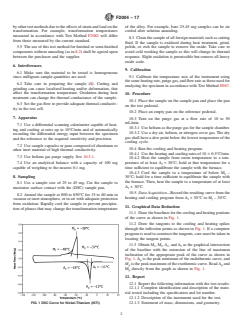
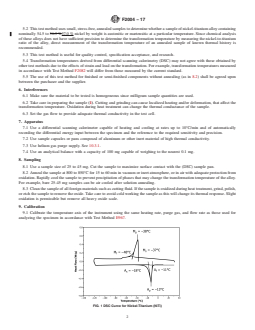
11.1 Draw the baselines for the cooling and heating portions of the curve as shown in Fig. 1.
11.2 Draw the tangents to the cooling and heating spikes through the inflection points as shown in Fig. 1. If a computer program
is used
...