

ASTM E2964-21
(Test Method)Standard Test Method for Measurement of the Normalized Insertion Loss of Doors
General Information
- Abstract
SIGNIFICANCE AND USE
5.1 This standard provides a method for testing the apparent sound insulating properties of doors in the field originally proposed by Morin (1).6 This allows doors to be evaluated with a result that has been found to be similar to the transmission loss.
5.2 The results of this measurement are the normalized door insertion loss, NDIL, at individual frequencies, and the single-number rating door transmission class, DTC. The insertion loss is normalized by the small change in sound level which occurs on the source side when the door is opened and closed. The results are in theory the same when measured in each direction through the door, but differences have been observed in practice.
5.3 Comparative measurements using this method and the method of Test Method E90 on the same door installations in a laboratory indicate good agreement between the transmission loss and normalized door insertion loss when the door is in a wall between two rooms and flanking is not significant. No similar verification has been done for corridors. See Appendix X1 and Ref (2).
5.4 The fixed-microphone and scanning methods have been compared in the field. See Appendix X2.
SCOPE
1.1 The sound insulation properties of a door are measured in a laboratory as the sound transmission loss in accordance with Test Method E90. Using those data, the single-number rating sound transmission class (STC) is assigned. In the field, the rooms on one or both sides of a partition containing a door are often either too small or too large and absorptive to allow the apparent transmission loss (ATL) of the partition-door assembly to be measured. Even if that is not the case, the result measured is the composite ATL of the partition including the door, and not that of the door itself. Test Method E336 states that it is impossible to measure the ATL of a portion of a partition such as a door according to the procedures of that standard. This test method provides a method of evaluating doors in the field using a normalized insertion loss with a resulting single-number rating door transmission class, DTC. This method is intended primarily for hinged personnel doors with latching mechanisms and is limited to door openings of area less than 6 m2. The flanking effects of surrounding structure are reduced compared to Test Method E336 but not completely eliminated. In a laboratory environment, the DTC is close to or equal to the STC of the door, but in the field results less than the laboratory STC are to be expected due to flanking.
1.2 The values stated in SI units are to be regarded as standard. No other units of measurement are included in this standard.
1.3 This standard does not purport to address all of the safety concerns, if any, associated with its use. It is the responsibility of the user of this standard to establish appropriate safety, health, and environmental practices and determine the applicability of regulatory limitations prior to use.
1.4 This international standard was developed in accordance with internationally recognized principles on standardization established in the Decision on Principles for the Development of International Standards, Guides and Recommendations issued by the World Trade Organization Technical Barriers to Trade (TBT) Committee.
- Status
- Published
- Publication Date
- 31-Jul-2021
- Technical Committee
- E33 - Building and Environmental Acoustics
- Drafting Committee
- E33.03 - Sound Transmission
Buy Documents
ASTM E2964-21 - Standard Test Method for Measurement of the Normalized Insertion Loss of Doors
REDLINE ASTM E2964-21 - Standard Test Method for Measurement of the Normalized Insertion Loss of Doors
Overview
ASTM E2964-21: Standard Test Method for Measurement of the Normalized Insertion Loss of Doors establishes a practical and standardized approach for evaluating the sound insulation performance of doors under field conditions. Developed by ASTM International, this standard addresses the challenge of isolating the acoustic performance of doors, particularly when it is not feasible to measure full partition assemblies or when room characteristics deviate from laboratory environments. The method yields the Normalized Door Insertion Loss (NDIL) for individual frequencies and a single-number Door Transmission Class (DTC) rating.
Key Topics
- Sound Insulation in Field Settings: Unlike laboratory test methods, ASTM E2964-21 allows practitioners to assess the sound insulating properties of doors in actual buildings, where room size and absorption may vary significantly from controlled environments.
- Normalized Door Insertion Loss (NDIL): The standard defines procedures to calculate NDIL, providing frequency-specific insight into how much sound energy is reduced by a closed door compared to when it's open.
- Door Transmission Class (DTC): DTC is a single-number summary, derived from NDIL data, making it easier to compare doors or assess compliance.
- Measurement Methods: The standard describes both fixed-microphone and scanning measurement techniques for flexible application and reliability in different field scenarios.
- Consideration of Flanking Transmission: While the method reduces the influence of sound transmission through paths other than the door and partition, it acknowledges that residual flanking paths can influence results.
Applications
The ASTM E2964-21 standard is especially useful in the following contexts:
- Building Acoustics Assessments: Architects, acoustical consultants, and facility managers use E2964-21 to evaluate and document door performance during commissioning or renovation of commercial, educational, medical, and residential buildings.
- Quality Control and Compliance: Ensures door installations meet specified acoustic criteria, particularly for spaces requiring privacy or minimal noise intrusion (e.g., conference rooms, hotel suites, patient rooms).
- Product Comparison: Allows accurate, field-based comparison of door assemblies, aiding in specification, purchasing, and validation processes.
- Post-Installation Verification: Helps confirm that doors deliver expected sound insulation after installation, accounting for effects such as seal adjustment, partition characteristics, and real-world mounting.
- Research and Development: Manufacturers can use field data derived from this standard to guide improvements in door design or installation practices.
Related Standards
ASTM E2964-21 is part of a suite of standards focused on building and environmental acoustics:
- ASTM E90: Laboratory Measurement of Airborne Sound Transmission Loss of Building Partitions and Elements.
- ASTM E336: Measurement of Airborne Sound Attenuation between Rooms in Buildings; notes the inability to isolate door-only performance.
- ASTM E413: Classification for Rating Sound Insulation, which provides the procedure for assigning DTC values.
- ASTM E492, E1007, E966, E1414: These standards address impact sound and the measurement of sound transmission through various building elements and assemblies.
- ANSI S1.4, S1.10, S1.11, S1.40: U.S. standards specifying requirements and calibration for sound measurement instruments.
- IEC 60804, IEC 60942: International standards for sound level meters and calibrators.
- ISO 16283-1: International standard for field measurement of sound insulation in buildings and building elements.
Practical Value
By isolating door sound insulation performance in real-world environments, ASTM E2964-21:
- Empowers professionals to identify weaknesses in acoustic performance due to installation or environmental conditions.
- Supports documentation and reporting for regulatory compliance, certifications, or client assurances.
- Facilitates informed decision-making for architectural design, retrofits, and new construction where acoustic privacy and comfort are priorities.
Keywords: ASTM E2964-21, door sound insulation, normalized door insertion loss, Door Transmission Class, building acoustics, field sound measurement, acoustic standards, partition insulation, NDIL, DTC.
Relations
- Effective Date
- 01-Dec-2023
- Effective Date
- 01-Oct-2019
- Effective Date
- 01-Jan-2019
- Effective Date
- 01-Nov-2018
- Effective Date
- 15-Jan-2018
- Effective Date
- 15-Nov-2017
- Effective Date
- 01-Jul-2017
- Effective Date
- 01-Jul-2017
- Effective Date
- 01-Dec-2016
- Effective Date
- 01-Oct-2016
- Effective Date
- 01-Oct-2016
- Effective Date
- 01-Jan-2016
- Effective Date
- 01-Sep-2015
- Effective Date
- 01-Sep-2014
- Effective Date
- 15-Apr-2014
Buy Documents
ASTM E2964-21 - Standard Test Method for Measurement of the Normalized Insertion Loss of Doors
REDLINE ASTM E2964-21 - Standard Test Method for Measurement of the Normalized Insertion Loss of Doors
Get Certified
Connect with accredited certification bodies for this standard

DIBt (Deutsches Institut für Bautechnik)
German Institute for Building Technology.
DIN CERTCO
DIN Group product certification.

Aboma Certification B.V.
Specialized in construction, metal, and transport sectors.
Sponsored listings
Frequently Asked Questions
ASTM E2964-21 is a standard published by ASTM International. Its full title is "Standard Test Method for Measurement of the Normalized Insertion Loss of Doors". This standard covers: SIGNIFICANCE AND USE 5.1 This standard provides a method for testing the apparent sound insulating properties of doors in the field originally proposed by Morin (1).6 This allows doors to be evaluated with a result that has been found to be similar to the transmission loss. 5.2 The results of this measurement are the normalized door insertion loss, NDIL, at individual frequencies, and the single-number rating door transmission class, DTC. The insertion loss is normalized by the small change in sound level which occurs on the source side when the door is opened and closed. The results are in theory the same when measured in each direction through the door, but differences have been observed in practice. 5.3 Comparative measurements using this method and the method of Test Method E90 on the same door installations in a laboratory indicate good agreement between the transmission loss and normalized door insertion loss when the door is in a wall between two rooms and flanking is not significant. No similar verification has been done for corridors. See Appendix X1 and Ref (2). 5.4 The fixed-microphone and scanning methods have been compared in the field. See Appendix X2. SCOPE 1.1 The sound insulation properties of a door are measured in a laboratory as the sound transmission loss in accordance with Test Method E90. Using those data, the single-number rating sound transmission class (STC) is assigned. In the field, the rooms on one or both sides of a partition containing a door are often either too small or too large and absorptive to allow the apparent transmission loss (ATL) of the partition-door assembly to be measured. Even if that is not the case, the result measured is the composite ATL of the partition including the door, and not that of the door itself. Test Method E336 states that it is impossible to measure the ATL of a portion of a partition such as a door according to the procedures of that standard. This test method provides a method of evaluating doors in the field using a normalized insertion loss with a resulting single-number rating door transmission class, DTC. This method is intended primarily for hinged personnel doors with latching mechanisms and is limited to door openings of area less than 6 m2. The flanking effects of surrounding structure are reduced compared to Test Method E336 but not completely eliminated. In a laboratory environment, the DTC is close to or equal to the STC of the door, but in the field results less than the laboratory STC are to be expected due to flanking. 1.2 The values stated in SI units are to be regarded as standard. No other units of measurement are included in this standard. 1.3 This standard does not purport to address all of the safety concerns, if any, associated with its use. It is the responsibility of the user of this standard to establish appropriate safety, health, and environmental practices and determine the applicability of regulatory limitations prior to use. 1.4 This international standard was developed in accordance with internationally recognized principles on standardization established in the Decision on Principles for the Development of International Standards, Guides and Recommendations issued by the World Trade Organization Technical Barriers to Trade (TBT) Committee.
SIGNIFICANCE AND USE 5.1 This standard provides a method for testing the apparent sound insulating properties of doors in the field originally proposed by Morin (1).6 This allows doors to be evaluated with a result that has been found to be similar to the transmission loss. 5.2 The results of this measurement are the normalized door insertion loss, NDIL, at individual frequencies, and the single-number rating door transmission class, DTC. The insertion loss is normalized by the small change in sound level which occurs on the source side when the door is opened and closed. The results are in theory the same when measured in each direction through the door, but differences have been observed in practice. 5.3 Comparative measurements using this method and the method of Test Method E90 on the same door installations in a laboratory indicate good agreement between the transmission loss and normalized door insertion loss when the door is in a wall between two rooms and flanking is not significant. No similar verification has been done for corridors. See Appendix X1 and Ref (2). 5.4 The fixed-microphone and scanning methods have been compared in the field. See Appendix X2. SCOPE 1.1 The sound insulation properties of a door are measured in a laboratory as the sound transmission loss in accordance with Test Method E90. Using those data, the single-number rating sound transmission class (STC) is assigned. In the field, the rooms on one or both sides of a partition containing a door are often either too small or too large and absorptive to allow the apparent transmission loss (ATL) of the partition-door assembly to be measured. Even if that is not the case, the result measured is the composite ATL of the partition including the door, and not that of the door itself. Test Method E336 states that it is impossible to measure the ATL of a portion of a partition such as a door according to the procedures of that standard. This test method provides a method of evaluating doors in the field using a normalized insertion loss with a resulting single-number rating door transmission class, DTC. This method is intended primarily for hinged personnel doors with latching mechanisms and is limited to door openings of area less than 6 m2. The flanking effects of surrounding structure are reduced compared to Test Method E336 but not completely eliminated. In a laboratory environment, the DTC is close to or equal to the STC of the door, but in the field results less than the laboratory STC are to be expected due to flanking. 1.2 The values stated in SI units are to be regarded as standard. No other units of measurement are included in this standard. 1.3 This standard does not purport to address all of the safety concerns, if any, associated with its use. It is the responsibility of the user of this standard to establish appropriate safety, health, and environmental practices and determine the applicability of regulatory limitations prior to use. 1.4 This international standard was developed in accordance with internationally recognized principles on standardization established in the Decision on Principles for the Development of International Standards, Guides and Recommendations issued by the World Trade Organization Technical Barriers to Trade (TBT) Committee.
ASTM E2964-21 is classified under the following ICS (International Classification for Standards) categories: 91.060.50 - Doors and windows; 91.120.20 - Acoustics in building. Sound insulation. The ICS classification helps identify the subject area and facilitates finding related standards.
ASTM E2964-21 has the following relationships with other standards: It is inter standard links to ASTM E90-23, ASTM E336-19a, ASTM E336-19, ASTM E966-18a, ASTM E966-18, ASTM E336-17a, ASTM E336-17, ASTM E3091-17, ASTM E90-09(2016), ASTM E336-16a, ASTM E1007-16, ASTM E336-16, ASTM E336-15, ASTM E1007-14, ASTM E336-14. Understanding these relationships helps ensure you are using the most current and applicable version of the standard.
ASTM E2964-21 is available in PDF format for immediate download after purchase. The document can be added to your cart and obtained through the secure checkout process. Digital delivery ensures instant access to the complete standard document.
Standards Content (Sample)
This international standard was developed in accordance with internationally recognized principles on standardization established in the Decision on Principles for the
Development of International Standards, Guides and Recommendations issued by the World Trade Organization Technical Barriers to Trade (TBT) Committee.
Designation: E2964 − 21
Standard Test Method for
Measurement of the Normalized Insertion Loss of Doors
This standard is issued under the fixed designation E2964; the number immediately following the designation indicates the year of
original adoption or, in the case of revision, the year of last revision. A number in parentheses indicates the year of last reapproval. A
superscript epsilon (´) indicates an editorial change since the last revision or reapproval.
INTRODUCTION
This test method is part of a set of standards for evaluating the sound-insulating properties of
building elements and the sound isolation between spaces. It is designed to measure the field sound
isolation performance of doors. Others in the set cover the airborne sound transmission loss of an
isolated partition element in a controlled laboratory environment (Test Method E90), field measure-
ments of the sound isolation between rooms in buildings (Test Method E336), the laboratory
measurement of impact sound transmission through floors (Test Method E492), the measurement of
impact sound transmission in buildings (Test Method E1007), the measurement of sound transmission
through building facades and facade elements (Guide E966), and the measurement of sound
transmission through a common plenum between two rooms (Test Method E1414).
1. Scope 1.2 The values stated in SI units are to be regarded as
standard. No other units of measurement are included in this
1.1 The sound insulation properties of a door are measured
standard.
in a laboratory as the sound transmission loss in accordance
1.3 This standard does not purport to address all of the
with Test Method E90. Using those data, the single-number
safety concerns, if any, associated with its use. It is the
rating sound transmission class (STC) is assigned. In the field,
responsibility of the user of this standard to establish appro-
the rooms on one or both sides of a partition containing a door
priate safety, health, and environmental practices and deter-
are often either too small or too large and absorptive to allow
mine the applicability of regulatory limitations prior to use.
the apparent transmission loss (ATL) of the partition-door
1.4 This international standard was developed in accor-
assembly to be measured. Even if that is not the case, the result
dance with internationally recognized principles on standard-
measured is the composite ATL of the partition including the
ization established in the Decision on Principles for the
door, and not that of the door itself. Test Method E336 states
Development of International Standards, Guides and Recom-
that it is impossible to measure the ATL of a portion of a
mendations issued by the World Trade Organization Technical
partition such as a door according to the procedures of that
Barriers to Trade (TBT) Committee.
standard. This test method provides a method of evaluating
doors in the field using a normalized insertion loss with a
2. Referenced Documents
resulting single-number rating door transmission class, DTC.
2.1 ASTM Standards:
This method is intended primarily for hinged personnel doors
C634 Terminology Relating to Building and Environmental
with latching mechanisms and is limited to door openings of
Acoustics
area less than 6 m . The flanking effects of surrounding
E90 Test Method for Laboratory Measurement of Airborne
structure are reduced compared to Test Method E336 but not
Sound Transmission Loss of Building Partitions and
completely eliminated. In a laboratory environment, the DTC
Elements
is close to or equal to the STC of the door, but in the field
E336 Test Method for Measurement of Airborne Sound
results less than the laboratory STC are to be expected due to
Attenuation between Rooms in Buildings
flanking.
E413 Classification for Rating Sound Insulation
E492 Test Method for Laboratory Measurement of Impact
Sound Transmission Through Floor-Ceiling Assemblies
ThistestmethodisunderthejurisdictionofASTMCommitteeE33onBuilding
and Environmental Acoustics and is the direct responsibility of Subcommittee
E33.03 on Sound Transmission. For referenced ASTM standards, visit the ASTM website, www.astm.org, or
Current edition approved Aug. 1, 2021. Published September 2021. Originally contact ASTM Customer Service at service@astm.org. For Annual Book of ASTM
approved in 2014. Last previous edition approved in 2019 as E2964 – 19. DOI: Standards volume information, refer to the standard’s Document Summary page on
10.1520/E2964-21. the ASTM website.
Copyright © ASTM International, 100 Barr Harbor Drive, PO Box C700, West Conshohocken, PA 19428-2959. United States
E2964 − 21
Using the Tapping Machine transmission is significant, theATLwill be less than the TLfor
E966 Guide for Field Measurements of Airborne Sound the partition.Apparent transmission loss (ATL) is equivalent in
Attenuation of Building Facades and Facade Elements meaning to apparent sound reduction index (ASRI) used by
E1007 Test Method for Field Measurement of Tapping ISO 16283-1:2014.
Machine Impact Sound Transmission Through Floor-
3.2.2 direct transmission, n—sound that travels between a
Ceiling Assemblies and Associated Support Structures
source and a receiving room only through the common
E1414 Test Method for Airborne Sound Attenuation Be-
(separating) building element.
tween Rooms Sharing a Common Ceiling Plenum
3.2.3 door transmission class, DTC, n—a single-number
E3091 Specification for Systems to Measure Sound Levels
rating obtained by applying the classification procedure of
2.2 ANSI Standards:
Classification E413 to normalized door insertion loss data.
S1.40-2006 Specifications and Verification Procedures for
3.2.4 normalized door insertion loss, NDIL, n—of a door
Sound Calibrators
installed in a building in a specified frequency band is
2.3 IEC Standards:
operationally defined as
IEC 60942:2013 Electroacoustics–Sound calibrators
2.4 ISO Standard: ¯ ¯ ¯ ¯
NDIL 5 L 2 L 1 L 2 L
~ ! ~ !
rec open rec closed source closed source open
~ ! ~ ! ~ ! ~ !
ISO 16283-1:2014 Acoustics -- Field measurement of sound
(2)
insulation in buildings and of building elements -- Part 1:
when a sound source is operated on the source side of the door,
Airborne sound insulation
where:
3. Terminology
¯
L = the average sound pressure level on the
(rec open)
3.1 The following terms used in this test method have receiving side of the door with the door
specific meanings that are defined in Terminology C634: open,
¯
L = the average sound pressure level due to the
3.1.1 airborne sound; background noise; decibel; diffuse
(rec closed)
source on the receiving side of the door with
sound field; flanking transmission; pink noise; receiving room;
the door closed (the background-adjusted
sound absorption; sound attenuation; sound insulation; sound
average level in the receiving room with the
isolation; sound pressure level; sound transmission loss, TL;
door closed),
source room
¯
L = the average sound pressure level on the
(source closed)
NOTE 1—The unqualified term average sound pressure level in this
source side of the door with the door closed,
document means that sound pressure levels were averaged for specified
and
periods of time.
¯
L = the average sound pressure level on the
(source open)
3.2 Definitions of Terms Specific to This Standard:
source side of the door with the door open.
3.2.1 apparent transmission loss, ATL, n—of a partition
installed in a building, in a specified frequency band is
4. Summary of Test Method
operationally defined as:
4.1 The door and corresponding source and receiving rooms
S
¯ ¯
ATL 5 L 2 L 110 log (1) are selected.
S D
1 2
A
4.2 The number and location of sound sources are chosen,
where:
sound is produced in the source room, and sound pressure
S = the area of the partition common to both source and
levels are measured on each side of the door with both open
receiving rooms,
and closed door conditions using either a fixed microphone or
A = the sound absorption in the receiving room,
scanning method.
¯
L = the average sound pressure level in the source room,
and 4.3 The background sound is measured in the receiving
¯
L = the average sound pressure level in the receiving room
room with the source(s) off and the door closed.
resulting from the combined effect of direct and flank-
4.4 Results and single-number ratings are calculated and
ing transmission.
reported.
3.2.1.1 Discussion—Throughout this test method, log is
taken to mean log , unless otherwise indicated. 5. Significance and Use
3.2.1.2 Discussion—This definition attributes all the power
5.1 This standard provides a method for testing the apparent
transmittedintothereceivingroombydirectandflankingpaths
sound insulating properties of doors in the field originally
to the area of the partition common to both rooms. If flanking
proposedbyMorin (1). Thisallowsdoorstobeevaluatedwith
a result that has been found to be similar to the transmission
3 loss.
Available from American National Standards Institute (ANSI), 25 W. 43rd St.,
4th Floor, New York, NY 10036, http://www.ansi.org.
Available from International Electrotechnical Commission (IEC), 3, rue de
Varembé, P.O. Box 131, CH-1211 Geneva 20, Switzerland, http://www.iec.ch.
5 6
Available from International Organization for Standardization (ISO), 1, ch. de The boldface numbers in parentheses refer to the list of references at the end of
la Voie-Creuse, CP 56, CH-1211 Geneva 20, Switzerland, http://www.iso.org. this standard.
E2964 − 21
5.2 The results of this measurement are the normalized door assure that the equipment is operating within instrument
insertion loss, NDIL, at individual frequencies, and the single- standards and manufacturer’s specifications. The appropriate
number rating door transmission class, DTC.The insertion loss calibration interval depends on several factors including the
is normalized by the small change in sound level which occurs complexity of the instrument, frequency of use, frequency of
on the source side when the door is opened and closed. The field use and transportation, manufacturer recommendations,
results are in theory the same when measured in each direction and history of reliability or problems as observed in prior
through the door, but differences have been observed in calibrations.
NOTE 4—Specification E3091 provides more information on calibra-
practice.
tion.
5.3 Comparative measurements using this method and the
7.2 Perform sensitivity checks of the entire measuring setup
method of Test Method E90 on the same door installations in
(including the microphone, all cables, and instruments) with
a laboratory indicate good agreement between the transmission
the same calibration equipment before and after the measure-
loss and normalized door insertion loss when the door is in a
ments. If the calibration values differ by more than 0.5 dB, the
wall between two rooms and flanking is not significant. No
results are invalid and measurements shall be repeated.
similar verification has been done for corridors. See Appendix
X1 and Ref (2).
8. Test Site and Door Conditions
5.4 The fixed-microphone and scanning methods have been
8.1 The test specimen shall be a door including seals and
compared in the field. See Appendix X2.
frame that must for this test be installed in a partition that
separates the source and receiving rooms.
6. Test Equipment
8.2 Particular attention shall be given to identifying poten-
6.1 Sound Sources and Signals—Sound sources shall be
tial flanking paths not only through the surrounding partition
loudspeaker systems driven by power amplifiers. The input
but also through ducts or through plenums over acoustical
signal to the amplifiers shall be random noise containing an
ceilings before conducting testing. Report any temporary
approximatelycontinuousdistributionoffrequenciesovereach
improvements made to reduce flanking influence.
test band. White or pink electronic noise sources satisfy this
NOTE 5—While this method is designed to reduce the influence of
condition.
flanking, significant flanking in the partition around the door or by other
paths could influence results.Asurrounding partition with a high apparent
NOTE 2—Ideally, loudspeaker systems should be omnidirectional. In
transmission class will reduce influence of the partition on results.Away
practice, using multiple driver elements to cover different frequency
to investigate the effect of flanking is to construct a cover over the source
ranges and placing and aiming sources into trihedral corners of the room
sideofthedoorandrepeatthemeasurementsofthereceivesidelevelwith
will normally be adequate.
the door closed. A suitable cover is a layer of gypsum spaced approxi-
6.1.1 The sound power of the source(s) must be sufficient to
mately 100 mm from the door with sound absorptive material in that
cavity and the edges sealed. If the measured sound level on the receive
raisethesignallevelinthereceivingroomwiththedoorclosed
side with the source operating after doing this is not significantly reduced,
far enough above background noise to meet the requirements
then that sound level is being controlled by either the background sound
of 11.8.
or flanking.
6.2 Measuring Equipment—Microphones, amplifiers,
8.3 Results will be influenced by the performance of the
filters, and electronic circuitry to process microphone signals
door seals. Care shall be taken to assure the door is properly
and perform measurements shall satisfy the requirements of
closed with any latch present properly engaged when measure-
Section 5 and either Section 6 or Sections 7.1 to 7.4 of
ments are made on the receiving side with the door closed.
Specification E3091.
8.4 When the door is opened, it shall be opened as far as
6.2.1 Measurement quality microphones 13 mm or smaller
possible for each open-door measurement to reduce the influ-
in diameter and that are close to omnidirectional below 5000
ence of reflections from its surface.
Hz shall be used.
NOTE3—Ifmeasurementsaretobemadeabove5000Hz,adiffuse-field 9. Selection of Door Location and Direction of
(random-incidence) microphone or corrector is preferred.
Measurement
6.2.1.1 If multiple microphones are used, they shall all be of
9.1 If the door location or locations for testing within a
the same make and model.
building have not been specified by the party requesting the
test, select a representative door location or a number of door
6.3 Calibrators—The field calibrator used for sensitivity
locations to be examined.
checks shall be an acoustic or electroacoustic calibrator meet-
NOTE 6—If the door has acoustical seals, the DTC rating can vary
ing class 1 requirements of ANSI S1.40-2006 or IEC
widely depending upon the individual adjustment of these seals. Thus, if
60942:2013.
multiple doors of a given design exist on a site, consider testing multiple
doors or all doors. See 13.3.5.
6.4 Devices used to establish the microphone positions
shown in Fig. 1 and Fig. 2 shall be capable of being read to the
9.2 Select the corridor or the smaller of the rooms as the
nearest millimeter.
source space unless there is a compelling reason to do
otherwise (such as high background sound in what would be
7. Calibration and Sensitivity Checks
the receiving room). An outdoor space is acceptable as the
7.1 A thorough calibration of acoustical instrumentation by receiving side, but an outdoor space shall not be used as the
a calibration laboratory at regular intervals is necessary to help source space.
E2964 − 21
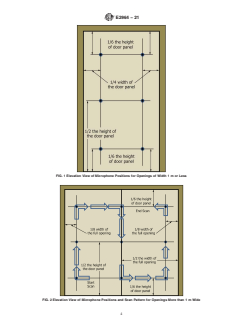
FIG. 1 Elevation View of Microphone Positions for Openings of Width1mor Less
FIG. 2 Elevation View of Microphone Positions and Scan Pattern for Openings More than1mWide
E2964 − 21
9.3 Select door openings of area less than 6 m . scanning method as described below shall be used. The same
positions or scan path shall also be used for background noise
9.4 When possible, select doors that will open at least 90°.
measurements.
9.5 When possible, locations shall be selected where the
11.3.1 Fixed Positions—Measurement with fixed positions
surfaces opposite the door surface are at least 3 m from the
is the preferred method.
door surface. All partition surfaces opposite the closed door
11.3.1.1 If the opening is1mor less wide, six measurement
shall be at least 1.5 m from the door surface. This means for
positionsshallbeusedoneachsideofthedoorasshownonthe
instance that corridors used as the source space must be at least
elevation view of a door in Fig. 1.
1.5 m wide. When surfaces opposite the door are curved or
11.3.1.2 If the opening is more than 1 m wide, nine
irregular, all points on such surface directly opposite the door
measurement positions shall be used on each side of the door
must be at least 1.5 m from the door surface.
as shown in Fig. 2, with three additional measurement points at
the midpoint of the total door opening width.
10. Sound Source Placement
11.3.1.3 Microphone position tolerance shall be 612 mm in
10.1 Location—Where possible, place the loudspeakers at
the direction perpendicular to the door surface. The lateral and
least 3 m and preferably 5 m from the door, but do not choose
vertical tolerances on the positions shown in Fig. 1 and Fig. 2
the larger room as the source room just to get the loudspeakers
are 650 mm.
more than 3 m from the door. If the loudspeakers are
NOTE 9—If using a single microphone to make measurements, consider
directional, aim them into corners most distant from the door,
making all measurements at a given height before proceeding to measure-
or for a corridor source room into the wall on the opposite side
ments at another height. Alternatively, a fixture with an easy method to
of the corridor from the door, unless the room is so large that
move the microphone to the required heights is useful. If a door panel is
more than 1 m wide, it will be necessary to move the microphones to open
it is necessary to place the loudspeakers closer to the door or
and close the door.
aimed at the door for adequate sound. Directional loudspeakers
aimed at the door shall be at least 5 m from the door. Where
11.3.1.4 Averaging Time at Each Fixed Position—The av-
possible in a corridor, place loudspeakers beyond the ends of
eraging time for a given frequency shall be the same at each
the partition containing the door.
fixed position. When measuring sound pressure levels in all
NOTE 7—Sound sources should be far enough away from the door that
frequency bands simultaneously at fixed positions, the mini-
the direct field reaching the latter is significantly less than the reverberant
mum averaging time shall be 10 s for measurements down to
field.
125 Hz. If frequency bands are measured sequentially, the
10.2 Multiple sources or repeated and averaged tests with
minimum averaging time shall be5sat250Hzand above.The
sources at multiple locations are preferred but not required. If
minimum averaging time, T , at frequency f that is less than
a
more than one source position is used, the distance between
250 Hz must be computed from:
positions shall be at least 2 m. If more than one source is used
simultaneously, they shall be driven by separate noise genera-
T 5 s (3)
a
f
tors and amplifier channels so the outputs are uncorrelated.
NOTE 10—This provides 95 % confidence limits of 6 0.5 dB for the
sound level at a position based on the assumption of a Gaussian
11. Measurement of Average Sound Pressure Levels
distribution of sound level with time. For more information, see Ref (3).
11.1 Thetestmethodrequiresfourmeasurementsofaverage
11.3.1.5 Determination of Space-Average Levels—Use the
sound pressure levels over the series of contiguous one-third-
following equation to obtain the average sound pressure level
octave bands with mid-band frequencies from 125 to 4000 Hz
for a number of fixed positions which is a space and time
with the source(s) operating in the source room. Two are in the
average level:
source room and two in the receiving room, one of each with
n
¯ L ⁄10
the door open and closed. An additional measurement is made i
L 5 10 log 10 (4)
F G
(
n
i51
in the receiving room with the door closed and the source off.
where:
NOTE 8—It is desirable that the frequency range be extended to include
L = the level measured at the ith microphone position and
at least the 100 and 5000-Hz bands as this is required to calculate
i
octave-band results.
there are n positions.
11.2 The operator shall avoid standing between the sound
11.3.2 Scanning Method—A manual scanning method is an
source(s) and measurement positions on the source side or
option. The microphone shall be held well away from the
between the door and measurement positions on the receive
operator’s body (a boom serves to increase the distance). The
side. Also, the operator shall avoid standing in a location that
microphone speed shall remain as constant as practical. Espe-
would place the microphone directly between the operator’s
cially when measuring sound in the receiving room, take care
body and the sound source on the source side, or directly
when walking or moving the microphone or its cable to avoid
between the operator’s body and the door on the receive side.
contamination by footstep sounds or extraneous signals due to
11.3 Microphone Positions—The measurement positions inadvertent contact between the microphone or cable and the
operator’s body.
shall be 1 m from the plane of the door on each side. The
microphone diaphragm shall on each side of the door opening 11.3.2.1 If the opening is 1 m or less wide, the scan shall
be parallel with the plane of the closed door panel and pointed follow a rectangular pattern passing through the six micro-
toward that plane. Either fixed microphone positions or a phone positions shown in Fig. 1.
E2964 − 21
11.3.2.2 If the opening is more than 1 m wide, the scan shall difference between the average background noise level and the
follow the pattern shown on Fig. 2 passing through the nine average combined (signal plus background noise) level in the
identified microphone positions. receiving room with the door closed. This calculation shall be
11.3.2.3 The scan time shall be at least 30 s for all scanned performed without any rounding beyond that inherent in the
measurements, including background sound. initial recording of data.
11.8.1 For each one-third-octave band, if the difference is 6
NOTE 11—Before proceeding with a full set of measurements, consider
dB or more, the background-adjusted average receiving-room
making measurements of the background sound and source level with the
door closed at one position on the receiving side to evaluate the adequacy
level with the door closed shall be calculated as follows:
of the source level.
¯ ¯
L ⁄10 L ⁄10
¯
sb b
L 5 10 log~10 2 10 ! (5)
~rec closed!
11.4 Recording of Measured Sound Levels—Record and use
sound levels as reported by the measurement instrument with
where:
maximum available digits without further rounding.
¯
L = the average background noise level, dB,
b
¯
L = the average level of the combined signal and
11.5 Level in Source Room—With the sound source(s) sb
background noise (the measured average level
operating at a constant level, measure the average sound
in the receiving room with the door closed),
pressure level at each frequency in the source room, with the
dB, and
door closed and then with the door open.
¯
L = the background-adjusted average level in the
(rec closed)
11.6 Level in Receiving Room—With the sound source(s)
receiving
...
This document is not an ASTM standard and is intended only to provide the user of an ASTM standard an indication of what changes have been made to the previous version. Because
it may not be technically possible to adequately depict all changes accurately, ASTM recommends that users consult prior editions as appropriate. In all cases only the current version
of the standard as published by ASTM is to be considered the official document.
Designation: E2964 − 19 E2964 − 21
Standard Test Method for
Measurement of the Normalized Insertion Loss of Doors
This standard is issued under the fixed designation E2964; the number immediately following the designation indicates the year of
original adoption or, in the case of revision, the year of last revision. A number in parentheses indicates the year of last reapproval. A
superscript epsilon (´) indicates an editorial change since the last revision or reapproval.
INTRODUCTION
This test method is part of a set of standards for evaluating the sound-insulating properties of
building elements and the sound isolation between spaces. It is designed to measure the field sound
isolation performance of doors. Others in the set cover the airborne sound transmission loss of an
isolated partition element in a controlled laboratory environment (Test Method E90), field measure-
ments of the sound isolation between rooms in buildings (Test Method E336), the laboratory
measurement of impact sound transmission through floors (Test Method E492), the measurement of
impact sound transmission in buildings (Test Method E1007), the measurement of sound transmission
through building facades and facade elements (Guide E966), and the measurement of sound
transmission through a common plenum between two rooms (Test Method E1414).
1. Scope
1.1 The sound insulation properties of a door are measured in a laboratory as the sound transmission loss in accordance with Test
Method E90. Using those data single numberdata, the single-number rating sound transmission class (STC) is assigned. In the field,
the rooms on one or both sides of a partition containing a door are often either too small or too large and absorptive to allow the
apparent transmission loss (ATL) of the partition-door assembly to be measured. Even if that is not the case, the result measured
is the composite ATL of the partition including the door, and not that of the door itself. Test Method E336 actually states that it
is impossible to measure the ATL of a portion of a partition such as a door according to the procedures of that standard. This test
method provides a method of evaluating doors in such casesthe field using a normalized insertion loss with a resulting single
number single-number rating door transmission class, DTC. This method is intended primarily for hinged personnel doors with
latching mechanisms and is limited to door openings of area less than 6 m . The flanking effects of surrounding structure are
reduced compared to Test Method E336 but not completely eliminated. In a laboratory environment, the DTC is close to or equal
to the STC of the door, but in the field results less than the laboratory STC should be expected.are to be expected due to flanking.
1.2 The values stated in SI units are to be regarded as standard. No other units of measurement are included in this standard.
1.3 This standard does not purport to address all of the safety concerns, if any, associated with its use. It is the responsibility
of the user of this standard to establish appropriate safety, health, and environmental practices and determine the applicability of
regulatory limitations prior to use.
1.4 This international standard was developed in accordance with internationally recognized principles on standardization
established in the Decision on Principles for the Development of International Standards, Guides and Recommendations issued
by the World Trade Organization Technical Barriers to Trade (TBT) Committee.
This test method is under the jurisdiction of ASTM Committee E33 on Building and Environmental Acoustics and is the direct responsibility of Subcommittee E33.03
on Sound Transmission.
Current edition approved April 1, 2019Aug. 1, 2021. Published April 2019September 2021. Originally approved in 2014. Last previous edition approved in 20142019 as
ε1
E2964 – 14E2964 – 19. . DOI: 10.1520/E2964-19.10.1520/E2964-21.
Copyright © ASTM International, 100 Barr Harbor Drive, PO Box C700, West Conshohocken, PA 19428-2959. United States
E2964 − 21
2. Referenced Documents
2.1 ASTM Standards:
C634 Terminology Relating to Building and Environmental Acoustics
E90 Test Method for Laboratory Measurement of Airborne Sound Transmission Loss of Building Partitions and Elements
E336 Test Method for Measurement of Airborne Sound Attenuation between Rooms in Buildings
E413 Classification for Rating Sound Insulation
E492 Test Method for Laboratory Measurement of Impact Sound Transmission Through Floor-Ceiling Assemblies Using the
Tapping Machine
E966 Guide for Field Measurements of Airborne Sound Attenuation of Building Facades and Facade Elements
E1007 Test Method for Field Measurement of Tapping Machine Impact Sound Transmission Through Floor-Ceiling Assemblies
and Associated Support Structures
E1414 Test Method for Airborne Sound Attenuation Between Rooms Sharing a Common Ceiling Plenum
E3091 Specification for Systems to Measure Sound Levels
2.2 ANSI Standards:
S1.4 Specification for Sound Level Meters
S1.10 Pressure Calibration of Laboratory Standard Pressure Microphones
S1.11 Specification for Octave-Band and Fractional-Octave-Band Analog and Digital Filters
S1.40S1.40-2006 SpecificationSpecifications and Verification Procedures for Sound Calibrators
2.3 IEC Standards:
IEC 60804 Specification for Integrating-Averaging Sound Level Meters
IEC 6094260942:2013 Electroacoustics–Sound Calibratorscalibrators
2.4 ISO Standard:
ISO 16283-1:2014 Acoustics -- Field measurement of sound insulation in buildings and of building elements -- Part 1: Airborne
sound insulation
3. Terminology
3.1 The following terms used in this test method have specific meanings that are defined in Terminology C634:
3.1.1 airborne sound; background noise; decay rate; decibel; diffuse sound field; field sound transmission class, FSTC; field
transmission loss, FTL; flanking transmission; pink noise; receiving room; self-noise; sound absorption; sound attenuation; sound
insulation; sound isolation; sound pressure level; sound transmission loss, TL; source room
NOTE 1—The unqualified term average sound pressure level in this document means that sound pressure levels were averaged for specified periods of
time.
3.2 Definitions of Terms Specific to This Standard:
3.2.1 apparent transmission loss, ATL, n—of a partition installed in a building, in a specified frequency band is operationally
defined as:
S
¯ ¯
ATL 5 L 2 L 110 log (1)
S D
1 2
A
where:
S = the area of the partition common to both source and receiving rooms,
A = the sound absorption in the receiving room,
L¯ = the source room average sound pressure level, and
L¯ = the average sound pressure level in the source room, and
L¯ = the receiving room average sound pressure level resulting from the combined effect of direct and flanking transmission.
L¯ = the average sound pressure level in the receiving room resulting from the combined effect of direct and flanking
transmission.
For referenced ASTM standards, visit the ASTM website, www.astm.org, or contact ASTM Customer Service at service@astm.org. For Annual Book of ASTM Standards
volume information, refer to the standard’s Document Summary page on the ASTM website.
Available from American National Standards Institute (ANSI), 25 W. 43rd St., 4th Floor, New York, NY 10036, http://www.ansi.org.
Available from International Electrotechnical Commission (IEC), 3, rue de Varembé, P.O. Box 131, CH-1211 Geneva 20, Switzerland, http://www.iec.ch.
Available from International Organization for Standardization (ISO), 1, ch. de la Voie-Creuse, CP 56, CH-1211 Geneva 20, Switzerland, http://www.iso.org.
E2964 − 21
3.2.1.1 Discussion—
Throughout this test method, log is taken to mean log10,log , unless otherwise indicated.
3.2.1.2 Discussion—
This definition attributes all the power transmitted into the receiving room,room by direct and flanking paths,paths to the area of
the partition common to both rooms. If flanking transmission is significant, the ATL will be less than the TL for the partition.
Apparent transmission loss (ATL) is equivalent in meaning to apparent sound reduction index (ASRI) used by ISO 16283-1:2014.
3.2.2 direct transmission, n—sound that travels between a source and a receiving room only through the common (separating)
building element.
3.2.3 door transmission class, DTC, n—a single number single-number rating obtained by applying the classification procedure
of Classification E413 to normalized door insertion loss data.
3.2.4 normalized door insertion loss, NDIL, n—of a door installed in a building in a specified frequency band is operationally
defined as
¯ ¯ ¯ ¯
NDIL 5 L 2 L 1 L 2 L (2)
~ ! ~ !
rec open rec closed source closed source open
~ ! ~ ! ~ ! ~ !
NDIL 5 L 2 L 1 L 2 L (2)
~ ! ~ !
rec open rec closed source closed source open
~ ! ~ ! ~ ! ~ !
when a sound source is operated on the source side of the door.
when a sound source is operated on the source side of the door, where:
L = the average sound pressure level on the receiving side of the door with the door open,
(rec open)
L = the average sound pressure level due to the source on the receiving side of the door with the door closed,
(rec closed)
L = the average sound pressure level on the source side of the door with the door closed, and
(source closed)
L = the average sound pressure level on the source side of the door with the door open.
(source open)
L¯ = the average sound pressure level on the receiving side of the door with the door open,
(rec open)
L¯ = the average sound pressure level due to the source on the receiving side of the door with the door closed (the
(rec closed)
background-adjusted average level in the receiving room with the door closed),
L¯ = the average sound pressure level on the source side of the door with the door closed, and
(source closed)
L¯ = the average sound pressure level on the source side of the door with the door open.
(source open)
4. Summary of Test Method
4.1 The door and corresponding source and receiving rooms are selected.
4.2 The number and location of sound sources are chosen, sound is produced in the source room, and sound pressure levels are
measured on each side of the door with the door both open and closed door conditions using either a fixed microphone or scanning
method.
4.3 The background sound is measured in the receiving room with the source(s) off and the door closed.
4.4 Results and single number single-number ratings are calculated and reported.
5. Significance and Use
5.1 This standard provides a method for testing the apparent sound insulating properties of doors in the field originally proposed
by Morin (1). This allows doors to be evaluated with a result that has been found to be similar to the transmission loss.
5.2 The results of this measurement are the normalized door insertion loss, NDIL, at individual frequencies, and the single number
single-number rating door transmission class, DTC. The insertion loss is normalized by the small change in sound level which
occurs on the source side when the door is opened and closed. The results are in theory the same when measured in each direction
through the door, but differences have been observed in practice.
The boldface numbers in parentheses refer to the list of references at the end of this standard.
E2964 − 21
5.3 Comparative measurements using this method and the method of Test Method E90 on the same door installations in a
laboratory indicate good agreement between the transmission loss and normalized door insertion loss. loss when the door is in a
wall between two rooms and flanking is not significant. No similar verification has been done for corridors. See Appendix X1 and
Ref (2).
5.4 The fixed-microphone and scanning methods have been compared in the field. See Appendix X2.
6. Test Equipment
6.1 Sound Sources and Signals—Sound sources shall be loudspeaker systems driven by power amplifiers. The input signal to the
amplifiers shall be random noise containing an approximately continuous distribution of frequencies over each test band. White
or pink electronic noise sources satisfy this condition.
NOTE 2—Ideally, loudspeaker systems should be omnidirectional. In practice, using multiple driver elements to cover different frequency ranges and
placing and aiming sources into trihedral corners of the room will normally be adequate.
6.1.1 The sound power of the source(s) must be sufficient to raise the signal level in the receiving room with the door closed far
enough above background noise to meet the requirements of 11.8.
6.2 Measuring Equipment—Microphones, amplifiers, filters, and electronic circuitry to process microphone signals and perform
measurements shall satisfy the requirements of ANSI S1.4 for Type 1 sound level meters, except that B and C weighting networks
are not required.Section 5 and either Section 6 or Sections 7.1 to 7.4 of Specification E3091.
6.2.1 Measurement quality microphones 13 mm or smaller in diameter and that are close to omnidirectional below 5000 Hz shall
be used.
NOTE 3—If measurements are to be made above 5000 Hz, a diffuse-field (random-incidence) microphone or corrector is preferred.
6.2.1.1 If multiple microphones are used, they shall all be of the same make and model.
6.3 Bandwidth and Filtering—The measurement system filters or each test band, shall meet or exceed the specifications of ANSI
S1.11 for one-third-octave band filter set, class 1 or better.
6.3.1 The minimum range of measurements shall be a series of contiguous one-third-octave bands with mid-band frequencies from
125 to 4000 Hz.
NOTE 4—It is desirable that the frequency range be extended to include at least the 100 and 5000-Hz bands as this is required to calculate octave-band
results. With modern-parallel measurement instruments, no extra work is required.
6.3 Calibrators—The field calibrator used for sensitivity checks shall be an acoustic or electroacoustic calibrator meeting class 1
requirements of ANSI S1.40S1.40-2006 or IEC 60942.60942:2013.
6.4 Devices used to establish the microphone positions shown in Fig. 1 and Fig. 2 shall be capable of being read to the nearest
millimeter.
7. Calibration and Sensitivity Checks
7.1 A thorough calibration of acoustical instrumentation by a calibration laboratory at regular intervals is necessary to help assure
that the equipment is operating within instrument standards and manufacturer’s specifications. The appropriate calibration interval
depends on several factors including the complexity of the instrument, frequency of use, frequency of field use and transportation,
manufacturer recommendations, and history of reliability or problems as observed in prior calibrations.
NOTE 4—ANSI S1.10Specification E3091 provides more information on calibration.
E2964 − 21
FIG. 1 Microphone Locations for Opening Elevation View of Microphone Positions for Openings of Width 1 m or Less Wide
7.2 Perform sensitivity checks of the entire measuring setup (including the microphone, all cables, and instruments) with the same
calibration equipment before and after the measurements. If the calibration values differ by more than 0.5 dB, the results are invalid
and measurements shall be repeated.
8. Test Site and Door Conditions
8.1 The test specimen willshall be a door including seals and frame that must for this test be installed in a partition that separates
the source and receiving rooms.
8.2 Flanking transmission in the structure adjacent to the door will be present.
8.2 While this method is designed to minimize the influence of flanking, major flanking due to weakness of the partition in which
the door is installed (or other paths) may influence results. If such is suspected, temporary improvements to the partition or other
paths may be made. Such improvements shall be reported. Particular attention shall be given to identifying potential flanking paths
that may be present through not only through the surrounding partition but also through ducts or through plenums over acoustical
ceilings.ceilings before conducting testing. Report any temporary improvements made to reduce flanking influence.
NOTE 5—If it is desired to While this method is designed to reduce the influence of flanking, significant flanking in the partition around the door or by
other paths could influence results. A surrounding partition with a high apparent transmission class will reduce influence of the partition on results. A way
to investigate the effect of flanking, this might be done by constructing flanking is to construct a cover over the source side of the door and repeatingrepeat
the measurements of the receive side level with the door closed. A suitable cover could be is a layer of gypsum spaced approximately 100 mm from the
door with sound absorptive material in that cavity and the edges sealed. If the measured sound level on the receive side with the source operating after
doing this is not significantly reduced, then that sound level is being controlled by either the background sound or flanking.
E2964 − 21
FIG. 2 Microphone Locations for Opening More than One Meter Wide with Scan PatternElevation View of Microphone Positions and
Scan Pattern for Openings More than 1 m Wide
8.3 Results will be influenced by the performance of the door seals. Care shall be taken to assure the door is properly closed with
any latch present properly latchedengaged when measurements are made on the receiving side with the door closed.
8.4 When the door is opened, it shall be opened as far as possible for each open door open-door measurement to minimizereduce
the influence of reflections from its surface.
9. Selection of Door and Room SelectionLocation and Direction of Measurement
9.1 When measurements are being made to evaluate the apparent sound insulation performance of a particular door, the door may
be If the door location or locations for testing within a building have not been specified by the party requesting the test. In other
cases it may be necessary to select a door or number of doors to be examined from among many. This method does not impose
particular requirements on the test spaces except that it is desirable that the ATL of the partition into which the door is installed
be significantly greater than that of the door. Thus, where partitions differ, it is desirable to select doors in partitions believed to
have the highest transmission loss and least flanking transmission.test, select a representative door location or a number of door
locations to be examined.
NOTE 6—Results from a single field test of a door should not be used to represent performance of similar or nominally identical doors. If the door has
acoustical seals, the DTC rating can vary widely depending upon the individual adjustment of these seals. Thus, if multiple doors of a given design exist
on a site consideration should be given to testing all doors.site, consider testing multiple doors or all doors. See 13.3.5.
9.2 In general for this method it is desirable to have the sound on the source side as diffuse as possible, and to have the space on
the receiving side as large and absorptive as possible. Thus, the corridor or smaller room shall be used Select the corridor or the
smaller of the rooms as the source space. space unless there is a compelling reason to do otherwise (such as high background sound
in what would be the receiving room). An outdoor space may be used is acceptable as the receiving side if background sound is
not a problem, side, but an outdoor space mayshall not be used as the source space.
9.3 Select door openings of area less than 6 m .
9.4 When possible, select doors that will open at least 90 degrees.90°.
E2964 − 21
9.5 When possible, locations shall be selected where the surfaces opposite the door surface are at least 3 m from the door surface.
All partition surfaces opposite the closed door shall be at least 1.5 m from the door surface. This means for instance that corridors
used as the source space must be at least 1.5 m wide. When surfaces opposite the door are curved or irregular, all points on such
surface directly opposite the door must be at least 1.5 m from the door surface.
10. Sound Source Placement
10.1 Location—Where possible, place the loudspeakers at least 3 m and preferably 5 m from the door, but do not choose the larger
room as the source room for this reason. just to get the loudspeakers more than 3 m from the door. If the loudspeakers are
directional, aim them into corners most distant from the door or door, or for a corridor source room into the wall of a corridor
oppositeon the opposite side of the corridor from the door, unless the room is so large that it is necessary to place the loudspeakers
closer to the door or aimed at the door for adequate sound. Directional loudspeakers aimed at the door shall be at least 5 m from
the door. Where possible in a corridor, place speakersloudspeakers beyond the ends of the partition containing the door.
NOTE 7—Sound sources should be far enough away from the door that the direct field reaching the latter is as small as possible compared to significantly
less than the reverberant field.
10.2 Multiple sources or repeated and averaged tests with sources at multiple locations are preferred but not required. If more than
one source position is used, the distance between positions shall be at least 2 m. If more than one source is used simultaneously,
they shall be driven by separate noise generators and amplifier channels so the outputs are uncorrelated.
11. Measurement of Average Sound Pressure Levels
11.1 The test method requires four measurements of average sound pressure levels over the frequency range specified with series
of contiguous one-third-octave bands with mid-band frequencies from 125 to 4000 Hz with the source(s) operating in the source
room. Two are in the source room and two in the receiving room, one of each with the door open and closed. An additional
measurement is made in the receiving room with the door closed and the source off.
NOTE 8—It is desirable that the frequency range be extended to include at least the 100 and 5000-Hz bands as this is required to calculate octave-band
results.
11.2 The body of the operator may interfere with the sound field. To the extent possible, the operator should operator shall avoid
standing between the sound source(s) and measurement positions on the source side or between the door and measurement
positions on the receive side. Also where possible Also, the operator should avoid placing shall avoid standing in a location that
would place the microphone directly between the operator’s body and the sound source on the source side. Similarly, the operator
should avoid placing the microphone side, or directly between the operator’s body and the door on the receive side.
11.3 Microphone Positions—The measurement positions shall be 1 m from the plane of the door on each side. The microphone
diaphragm shall on each side of the door opening be parallel with the plane of the closed door panel when in the closed position,
and pointed toward that plane. Either fixed microphone positions or a scanning method as described below canshall be used. These
positions The same positions or scan path shall also be used for background levelnoise measurements.
11.3.1 Fixed Positions—Measurement with fixed positions is the preferred method.
11.3.1.1 If the opening is 1 m or less wide, six measurement positions shall be used on each side of the door as shown on the
elevation view of a door in Fig. 1.
11.3.1.2 If the opening is more than 1 m wide, nine measurement positions shall be used on each side of the door as shown in
Fig. 2, with three additional measurement points at the midpoint of the total door opening width.
11.3.1.3 Microphone position tolerance shall be 612 mm from the in the direction perpendicular to the door surface. The lateral
and vertical tolerances on the locationspositions shown in Figs. 1 and 2Fig. 1 and Fig. 2 are 650 mm.
NOTE 9—If using a single microphone to make measurements the fastest way to do the measurements may be to make measurements, consider making
all measurements at a given height before proceeding to measurements at another height. Alternatively, a fixture with an easy method to move the
microphone to the required heights could be is useful. If a door panel is more than 1 m wide, it will be necessary to move the microphones to open and
close the door.
E2964 − 21
11.3.1.4 Averaging Time—Time at Each Fixed Position—The averaging time for a given frequency shall be the same at each fixed
position. When measuring sound pressure levels in all frequency bands simultaneously at fixed locations,positions, the minimum
averaging time shall be 10 s for measurements down to 125 Hz. If frequency bands are measured sequentially, the minimum
averaging time mayshall be 5 s at 250 Hz and above. The minimum averaging time, T , at frequency f that is less than 250 Hz
a
must be computed from:
T 5 s (3)
a
f
NOTE 10—This provides 95 % confidence limits of 6 0.5 dB. dB for the sound level at a position based on the assumption of a Gaussian distribution
of sound level with time. For more information, see Ref (3).
11.3.1.5 Determination of Space-Average Levels—Use the following equation to obtain the average sound pressure level for a
number of fixed positions which is a space and time average level:
n
¯ L⁄10
L 5 10 log 10 (4)
F G
( i
n
i51
n
¯ L ⁄10
i
L 5 10 log 10 (4)
F G
(
n
i51
where:
L = the level measured at the ith microphone position and there are n locations.
i
L = the level measured at the ith microphone position and there are n positions.
i
11.3.2 Scanning Method—A manual scanning method can be used.is an option. The microphone shall be held well away from the
operator’soperator’s body (a boom serves to increase the distance). The microphone speed shall remain as constant as practical.
Take care when moving the microphone or its cable, especially when Especially when measuring sound in the receiving room. The
data can be contaminated room, take care when walking or moving the microphone or its cable to avoid contamination by footstep
sounds or extraneous signals due to inadvertent contact between the microphone or cable and the operator’s body.
11.3.2.1 If the opening is 1 m or less wide, the scan shall follow a rectangular pattern passing through the six microphone positions
shown in Fig. 1.
11.3.2.2 If the opening is more than 1 m wide, the scan shall follow the pattern shown on Fig. 2 passing through the nine identified
microphone positions.
11.3.2.3 Scan The scan time shall be at least 30 s.s for all scanned measurements, including background sound.
NOTE 11—Before proceeding with a full set of measurements, consider making measurements at one location on the receiving side of the background
sound and source level with the door closed, and of the source level with the door open closed at one position on the receiving side to evaluate the
adequacy of the source level and determine whether there are major problems with door seals that should be fixed before proceeding with the full
measurement.level.
11.4 Recording of Measured Sound Levels—Record all measured levels in dB accurate to one decimal place.and use sound levels
as reported by the measurement instrument with maximum available digits without further rounding.
11.5 Source Room Level—Level in Source Room—With the sound source(s) operating at a constant level, me
...