

ASTM E966-18a
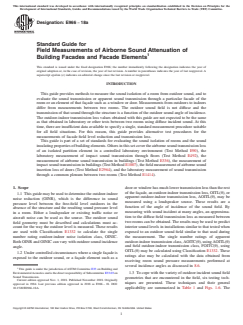
(Guide)Standard Guide for Field Measurements of Airborne Sound Attenuation of Building Facades and Facade Elements
General Information
- Abstract
SIGNIFICANCE AND USE
5.1 The best uses of this guide are to measure the OINR and the AOITL(θ) or OITL(θ) at specific angles of incidence. By measuring the AOITL(θ) or OITL(θ) at several loudspeaker sound incidence angles, by energy-averaging the receiving room sound levels before computing results, an approximation of the diffuse field results measured with Test Methods E90 and E336 may be obtained.
5.2 The traffic noise method is to be used only for OINR measurements and is most suitable for situations where the OINR of a specimen at a specific location is exposed to an existing traffic noise source.
5.3 The OINR, AOITL(θ), and OITL(θ) produced by the methods described will not correspond to the transmission loss and noise reduction measured by Test Methods E90 and E336 because of the different incident sound fields that exist in the outdoors (1)4. All of these results are a function of the angle of incidence of the sound for two reasons.
5.3.1 The transmission loss is strongly influenced by the coincidence effect where the frequency and projected wavelength of sound incident at angle, θ, coincides with the wavelength of a bending wave of the same frequency in the panel (2, 3, 4, 5). This frequency and the angle of least transmission loss (greatest transparency) both depend on specimen panel stiffness, damping and area mass. In diffuse-field testing as in the laboratory, the effect is a weakness at the diffuse field average coincidence frequency that is dependent on material and thickness, often seen around the frequency of 2500 Hz for drywall and glass specimens. Thick wood panels, such as doors, and masonry wall exhibit lower coincident frequencies while thinner sheet steel exhibits higher coincidence frequencies. For free field sound coming from one direction only, the coincidence frequency varies with incidence angle and will differ from the diffuse-field value (5). Near or at grazing (θ close to 90°) it will be much lower in frequency than the diffuse field (E90 and E33...
SCOPE
1.1 This guide may be used to determine the outdoor-indoor noise reduction (OINR), which is the difference in sound pressure level between the free-field level outdoors in the absence of the structure and the resulting sound pressure level in a room. Either a loudspeaker or existing traffic noise or aircraft noise can be used as the source. The outdoor sound field geometry must be described and calculations must account for the way the outdoor level is measured. These results are used with Classification E1332 to calculate the single number rating outdoor-indoor noise isolation class, OINIC. Both OINR and OINIC can vary with outdoor sound incidence angle.
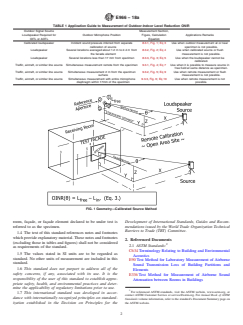
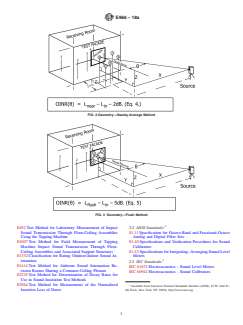
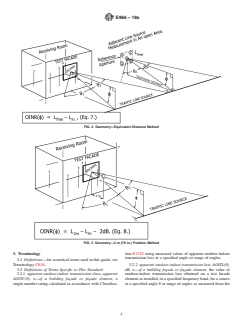
1.2 Under controlled circumstances where a single façade is exposed to the outdoor sound, or a façade element such as a door or window has much lower transmission loss than the rest of the façade, an outdoor-indoor transmission loss, OITL(θ), or apparent outdoor-indoor transmission loss, AOITL(θ), may be measured using a loudspeaker source. These results are a function of the angle of incidence of the sound field. By measuring with sound incident at many angles, an approximation to the diffuse field transmission loss as measured between two rooms can be obtained. The results may be used to predict interior sound levels in installations similar to that tested when exposed to an outdoor sound field similar to that used during the measurement. The single number ratings of apparent outdoor-indoor transmission class, AOITC(θ), using AOITL(θ) and field outdoor-indoor transmission class, FOITC(θ), using OITL(θ) may be calculated using Classification E1332. These ratings also may be calculated with the data obtained from receiving room sound pressure measurements performed at several incidence angles as discussed in 8.6.
1.3 To cope with the variety of outdoor incident sound field geometries that are encountered in the field, six testing techniques are presented. These te...
- Status
- Published
- Publication Date
- 31-Oct-2018
- Technical Committee
- E33 - Building and Environmental Acoustics
- Drafting Committee
- E33.03 - Sound Transmission
Buy Documents
ASTM E966-18a - Standard Guide for Field Measurements of Airborne Sound Attenuation of Building Facades and Facade Elements
REDLINE ASTM E966-18a - Standard Guide for Field Measurements of Airborne Sound Attenuation of Building Facades and Facade Elements
Overview
ASTM E966-18a is the Standard Guide for Field Measurements of Airborne Sound Attenuation of Building Facades and Facade Elements. Developed by ASTM International, this guide outlines standardized field methods for assessing how well building exteriors, including windows and doors, reduce the transmission of airborne sound from outside to inside a room. By providing procedures to measure outdoor-indoor noise reduction (OINR) and outdoor-indoor transmission loss (OITL), the standard helps architects, engineers, acousticians, and building professionals evaluate façade sound insulation in real-world conditions distinct from laboratory settings.
Understanding façade sound attenuation is critical for improving occupant comfort in buildings exposed to environmental noise sources such as traffic and aircraft.
Key Topics
- Outdoor-Indoor Noise Reduction (OINR): Measures the difference in sound pressure level between outside (in the absence of the structure) and inside a room. OINR can be influenced by the angle at which sound impacts the facade.
- Outdoor-Indoor Transmission Loss (OITL) and Apparent OITL (AOITL): Quantifies how much sound energy is lost when passing through a façade or a façade element. AOITL is reported when flanking sound transmission cannot be ruled out.
- Source Types: Allows for use of calibrated loudspeaker (controllable sound source) or existing environmental noise (such as road or aircraft noise) for measurement.
- Angles of Incidence: Field measurements consider the angle at which noise strikes the façade, impacting transmission loss results.
- Field vs. Laboratory Results: Highlights that field results differ from laboratory tests (e.g., ASTM E90 or E336) due to differences in sound field conditions and sources.
Applications
ASTM E966-18a’s field measurement procedures for façade sound attenuation are valuable in scenarios such as:
- Building Code Compliance and Certification: Evaluating whether a building meets acoustic requirements for noise isolation from traffic, airports, or other sources.
- Design Optimization: Comparing the performance of different façade assemblies or elements (e.g., comparing window types) under realistic conditions to inform design improvements.
- Site-Specific Assessment: Measuring real-world sound isolation performance of existing buildings to respond to occupant complaints or for environmental noise mitigation.
- Predicting Interior Sound Levels: Estimating potential indoor noise exposure for buildings in various outdoor noise environments.
By utilizing the methods in ASTM E966-18a, practitioners can better understand the performance of building facades and identify opportunities to enhance sound attenuation, improving occupant health and well-being.
Related Standards
- ASTM E90 - Laboratory Measurement of Airborne Sound Transmission Loss of Building Partitions and Elements
- ASTM E336 - Field Measurement of Airborne Sound Attenuation between Rooms in Buildings
- ASTM E492 - Laboratory Measurement of Impact Sound Transmission Through Floor-Ceiling Assemblies
- ASTM E1332 - Classification for Rating Outdoor-Indoor Sound Attenuation (used for deriving single-number ratings like OINIC)
- ASTM E2235 - Test Method for Determination of Decay Rates for Sound Insulation Test Methods
- ANSI S1.43 / IEC 61672 - Specifications for Sound Level Meters used in measurement procedures
Conclusion
ASTM E966-18a provides robust, field-oriented guidance for assessing the airborne sound insulation performance of building facades and elements. Adherence to this standard enables consistent, reliable measurement and comparison, supporting both regulatory compliance and optimized building design where noise isolation is a priority. For professionals focused on building acoustics and environmental noise control, integrating ASTM E966-18a procedures ensures accurate appraisal of façade sound attenuation under actual conditions.
Relations
- Effective Date
- 01-Nov-2018
- Effective Date
- 01-Dec-2023
- Effective Date
- 01-Oct-2019
- Effective Date
- 01-Jan-2019
- Effective Date
- 15-Nov-2017
- Effective Date
- 01-Jul-2017
- Effective Date
- 01-Dec-2016
- Effective Date
- 01-Oct-2016
- Effective Date
- 01-Oct-2016
- Effective Date
- 01-Jan-2016
- Effective Date
- 01-Sep-2015
- Effective Date
- 01-Sep-2014
- Refers
ASTM E2964-14 - Standard Test Method for Measurement of the Normalized Insertion Loss of Doors - Effective Date
- 01-Jun-2014
- Refers
ASTM E2964-14e1 - Standard Test Method for Measurement of the Normalized Insertion Loss of Doors - Effective Date
- 01-Jun-2014
- Effective Date
- 15-Apr-2014
Buy Documents
ASTM E966-18a - Standard Guide for Field Measurements of Airborne Sound Attenuation of Building Facades and Facade Elements
REDLINE ASTM E966-18a - Standard Guide for Field Measurements of Airborne Sound Attenuation of Building Facades and Facade Elements
Get Certified
Connect with accredited certification bodies for this standard

DIBt (Deutsches Institut für Bautechnik)
German Institute for Building Technology.
DIN CERTCO
DIN Group product certification.

Aboma Certification B.V.
Specialized in construction, metal, and transport sectors.
Sponsored listings
Frequently Asked Questions
ASTM E966-18a is a guide published by ASTM International. Its full title is "Standard Guide for Field Measurements of Airborne Sound Attenuation of Building Facades and Facade Elements". This standard covers: SIGNIFICANCE AND USE 5.1 The best uses of this guide are to measure the OINR and the AOITL(θ) or OITL(θ) at specific angles of incidence. By measuring the AOITL(θ) or OITL(θ) at several loudspeaker sound incidence angles, by energy-averaging the receiving room sound levels before computing results, an approximation of the diffuse field results measured with Test Methods E90 and E336 may be obtained. 5.2 The traffic noise method is to be used only for OINR measurements and is most suitable for situations where the OINR of a specimen at a specific location is exposed to an existing traffic noise source. 5.3 The OINR, AOITL(θ), and OITL(θ) produced by the methods described will not correspond to the transmission loss and noise reduction measured by Test Methods E90 and E336 because of the different incident sound fields that exist in the outdoors (1)4. All of these results are a function of the angle of incidence of the sound for two reasons. 5.3.1 The transmission loss is strongly influenced by the coincidence effect where the frequency and projected wavelength of sound incident at angle, θ, coincides with the wavelength of a bending wave of the same frequency in the panel (2, 3, 4, 5). This frequency and the angle of least transmission loss (greatest transparency) both depend on specimen panel stiffness, damping and area mass. In diffuse-field testing as in the laboratory, the effect is a weakness at the diffuse field average coincidence frequency that is dependent on material and thickness, often seen around the frequency of 2500 Hz for drywall and glass specimens. Thick wood panels, such as doors, and masonry wall exhibit lower coincident frequencies while thinner sheet steel exhibits higher coincidence frequencies. For free field sound coming from one direction only, the coincidence frequency varies with incidence angle and will differ from the diffuse-field value (5). Near or at grazing (θ close to 90°) it will be much lower in frequency than the diffuse field (E90 and E33... SCOPE 1.1 This guide may be used to determine the outdoor-indoor noise reduction (OINR), which is the difference in sound pressure level between the free-field level outdoors in the absence of the structure and the resulting sound pressure level in a room. Either a loudspeaker or existing traffic noise or aircraft noise can be used as the source. The outdoor sound field geometry must be described and calculations must account for the way the outdoor level is measured. These results are used with Classification E1332 to calculate the single number rating outdoor-indoor noise isolation class, OINIC. Both OINR and OINIC can vary with outdoor sound incidence angle. 1.2 Under controlled circumstances where a single façade is exposed to the outdoor sound, or a façade element such as a door or window has much lower transmission loss than the rest of the façade, an outdoor-indoor transmission loss, OITL(θ), or apparent outdoor-indoor transmission loss, AOITL(θ), may be measured using a loudspeaker source. These results are a function of the angle of incidence of the sound field. By measuring with sound incident at many angles, an approximation to the diffuse field transmission loss as measured between two rooms can be obtained. The results may be used to predict interior sound levels in installations similar to that tested when exposed to an outdoor sound field similar to that used during the measurement. The single number ratings of apparent outdoor-indoor transmission class, AOITC(θ), using AOITL(θ) and field outdoor-indoor transmission class, FOITC(θ), using OITL(θ) may be calculated using Classification E1332. These ratings also may be calculated with the data obtained from receiving room sound pressure measurements performed at several incidence angles as discussed in 8.6. 1.3 To cope with the variety of outdoor incident sound field geometries that are encountered in the field, six testing techniques are presented. These te...
SIGNIFICANCE AND USE 5.1 The best uses of this guide are to measure the OINR and the AOITL(θ) or OITL(θ) at specific angles of incidence. By measuring the AOITL(θ) or OITL(θ) at several loudspeaker sound incidence angles, by energy-averaging the receiving room sound levels before computing results, an approximation of the diffuse field results measured with Test Methods E90 and E336 may be obtained. 5.2 The traffic noise method is to be used only for OINR measurements and is most suitable for situations where the OINR of a specimen at a specific location is exposed to an existing traffic noise source. 5.3 The OINR, AOITL(θ), and OITL(θ) produced by the methods described will not correspond to the transmission loss and noise reduction measured by Test Methods E90 and E336 because of the different incident sound fields that exist in the outdoors (1)4. All of these results are a function of the angle of incidence of the sound for two reasons. 5.3.1 The transmission loss is strongly influenced by the coincidence effect where the frequency and projected wavelength of sound incident at angle, θ, coincides with the wavelength of a bending wave of the same frequency in the panel (2, 3, 4, 5). This frequency and the angle of least transmission loss (greatest transparency) both depend on specimen panel stiffness, damping and area mass. In diffuse-field testing as in the laboratory, the effect is a weakness at the diffuse field average coincidence frequency that is dependent on material and thickness, often seen around the frequency of 2500 Hz for drywall and glass specimens. Thick wood panels, such as doors, and masonry wall exhibit lower coincident frequencies while thinner sheet steel exhibits higher coincidence frequencies. For free field sound coming from one direction only, the coincidence frequency varies with incidence angle and will differ from the diffuse-field value (5). Near or at grazing (θ close to 90°) it will be much lower in frequency than the diffuse field (E90 and E33... SCOPE 1.1 This guide may be used to determine the outdoor-indoor noise reduction (OINR), which is the difference in sound pressure level between the free-field level outdoors in the absence of the structure and the resulting sound pressure level in a room. Either a loudspeaker or existing traffic noise or aircraft noise can be used as the source. The outdoor sound field geometry must be described and calculations must account for the way the outdoor level is measured. These results are used with Classification E1332 to calculate the single number rating outdoor-indoor noise isolation class, OINIC. Both OINR and OINIC can vary with outdoor sound incidence angle. 1.2 Under controlled circumstances where a single façade is exposed to the outdoor sound, or a façade element such as a door or window has much lower transmission loss than the rest of the façade, an outdoor-indoor transmission loss, OITL(θ), or apparent outdoor-indoor transmission loss, AOITL(θ), may be measured using a loudspeaker source. These results are a function of the angle of incidence of the sound field. By measuring with sound incident at many angles, an approximation to the diffuse field transmission loss as measured between two rooms can be obtained. The results may be used to predict interior sound levels in installations similar to that tested when exposed to an outdoor sound field similar to that used during the measurement. The single number ratings of apparent outdoor-indoor transmission class, AOITC(θ), using AOITL(θ) and field outdoor-indoor transmission class, FOITC(θ), using OITL(θ) may be calculated using Classification E1332. These ratings also may be calculated with the data obtained from receiving room sound pressure measurements performed at several incidence angles as discussed in 8.6. 1.3 To cope with the variety of outdoor incident sound field geometries that are encountered in the field, six testing techniques are presented. These te...
ASTM E966-18a is classified under the following ICS (International Classification for Standards) categories: 91.120.20 - Acoustics in building. Sound insulation. The ICS classification helps identify the subject area and facilitates finding related standards.
ASTM E966-18a has the following relationships with other standards: It is inter standard links to ASTM E966-18, ASTM E90-23, ASTM E336-19a, ASTM E336-19, ASTM E336-17a, ASTM E336-17, ASTM E90-09(2016), ASTM E336-16a, ASTM E1007-16, ASTM E336-16, ASTM E336-15, ASTM E1007-14, ASTM E2964-14, ASTM E2964-14e1, ASTM E336-14. Understanding these relationships helps ensure you are using the most current and applicable version of the standard.
ASTM E966-18a is available in PDF format for immediate download after purchase. The document can be added to your cart and obtained through the secure checkout process. Digital delivery ensures instant access to the complete standard document.
Standards Content (Sample)
This international standard was developed in accordance with internationally recognized principles on standardization established in the Decision on Principles for the
Development of International Standards, Guides and Recommendations issued by the World Trade Organization Technical Barriers to Trade (TBT) Committee.
Designation: E966 − 18a
Standard Guide for
Field Measurements of Airborne Sound Attenuation of
Building Facades and Facade Elements
This standard is issued under the fixed designation E966; the number immediately following the designation indicates the year of
original adoption or, in the case of revision, the year of last revision. A number in parentheses indicates the year of last reapproval. A
superscript epsilon (´) indicates an editorial change since the last revision or reapproval.
INTRODUCTION
This guide provides methods to measure the sound isolation of a room from outdoor sound, and to
evaluate the sound transmission or apparent sound transmission through a particular facade of the
room or an element of that façade such as a window or door. Measurements from outdoors to indoors
differ from measurements between two rooms. The outdoor sound field is not diffuse and the
transmission of that sound through the structure is a function of the outdoor sound angle of incidence.
The outdoor-indoor transmission loss values obtained with this guide are not expected to be the same
as that obtained in laboratory or other tests between two rooms using diffuse incident sound. At this
time, there are insufficient data available to specify a single, standard measurement procedure suitable
for all field situations. For this reason, this guide provides alternative test procedures for the
measurements of facade field level reduction and transmission loss.
This guide is part of a set of standards for evaluating the sound isolation of rooms and the sound
insulatingpropertiesofbuildingelements.Othersinthissetcovertheairbornesoundtransmissionloss
of an isolated partition element in a controlled laboratory environment (Test Method E90), the
laboratory measurement of impact sound transmission through floors (Test Method E492), the
measurement of airborne sound transmission in buildings (Test Method E336), the measurement of
impactsoundtransmissioninbuildings(TestMethodE1007),thefieldmeasurementofairbornesound
insertion loss of doors (Test Method E2964), and the laboratory measurement of sound transmission
through a common plenum between two rooms (Test Method E1414).
1. Scope door or window has much lower transmission loss than the rest
of the façade, an outdoor-indoor transmission loss, OITL(θ), or
1.1 This guide may be used to determine the outdoor-indoor
apparent outdoor-indoor transmission loss, AOITL(θ), may be
noise reduction (OINR), which is the difference in sound
measured using a loudspeaker source. These results are a
pressure level between the free-field level outdoors in the
function of the angle of incidence of the sound field. By
absence of the structure and the resulting sound pressure level
measuring with sound incident at many angles, an approxima-
in a room. Either a loudspeaker or existing traffic noise or
tion to the diffuse field transmission loss as measured between
aircraft noise can be used as the source. The outdoor sound
two rooms can be obtained. The results may be used to predict
field geometry must be described and calculations must ac-
interior sound levels in installations similar to that tested when
count for the way the outdoor level is measured. These results
exposed to an outdoor sound field similar to that used during
are used with Classification E1332 to calculate the single
the measurement. The single number ratings of apparent
number rating outdoor-indoor noise isolation class, OINIC.
Both OINR and OINIC can vary with outdoor sound incidence outdoor-indoor transmission class,AOITC(θ), usingAOITL(θ)
and field outdoor-indoor transmission class, FOITC(θ), using
angle.
OITL(θ) may be calculated using Classification E1332. These
1.2 Under controlled circumstances where a single façade is
ratings also may be calculated with the data obtained from
exposed to the outdoor sound, or a façade element such as a
receiving room sound pressure measurements performed at
several incidence angles as discussed in 8.6.
This guide is under the jurisdiction ofASTM Committee E33 on Building and
EnvironmentalAcousticsandisthedirectresponsibilityofSubcommitteeE33.03on
1.3 To cope with the variety of outdoor incident sound field
Sound Transmission.
geometries that are encountered in the field, six testing tech-
Current edition approved Nov. 1, 2018. Published November 2018. Originally
niques are presented. These techniques and their general
approved in 1984. Last previous edition approved in 2018 as E966 – 18. DOI:
10.1520/E0966-18A. applicability are summarized in Table 1 and Figs. 1-6. The
Copyright © ASTM International, 100 Barr Harbor Drive, PO Box C700, West Conshohocken, PA 19428-2959. United States
E966 − 18a
TABLE 1 Application Guide to Measurement of Outdoor-Indoor Level Reduction ONIR
Outdoor Signal Source Measurement Section,
Loudspeaker Required for Outdoor Microphone Position Figure, Calculation Applications Remarks
OITL or AOTL Equation
Calibrated loudspeaker Incident sound pressure inferred from separate 8.3.1, Fig. 1; Eq 3 Use when outdoor measurement at or near
calibration of source specimen is not possible.
Loudspeaker Several locations averaged about 1.2 m to 2.4 m from 8.3.2, Fig. 2; Eq 4 Use when calibrated source or flush
the facade element measurement is not possible.
Loudspeaker Several locations less than 17 mm from specimen 8.3.3, Fig. 3; Eq 5 Use when the loudspeaker cannot be
calibrated.
Traffic, aircraft, or similar line source Simultaneous measurement remote from the specimen 9.3.1, Fig. 4; Eq 7 Use when it is possible to measure source in
free field at same distance as specimen.
Traffic, aircraft, or similar line source Simultaneous measurement 2 m from the specimen 9.3.2, Fig. 5; Eq 9 Use when remote measurement or flush
surface measurement is not possible.
Traffic, aircraft, or similar line source Simultaneous measurement with entire microphone 9.3.3, Fig. 6; Eq 10 Use when remote measurement is not
diaphragm within 17mm of the specimen possible.
FIG. 1 Geometry—Calibrated Source Method
room, façade, or façade element declared to be under test is Development of International Standards, Guides and Recom-
referred to as the specimen. mendations issued by the World Trade Organization Technical
Barriers to Trade (TBT) Committee.
1.4 The text of this standard references notes and footnotes
which provide explanatory material. These notes and footnotes
2. Referenced Documents
(excluding those in tables and figures) shall not be considered
2.1 ASTM Standards:
as requirements of the standard.
C634 Terminology Relating to Building and Environmental
1.5 The values stated in SI units are to be regarded as
Acoustics
standard. No other units of measurement are included in this
E90 Test Method for Laboratory Measurement of Airborne
standard.
Sound Transmission Loss of Building Partitions and
1.6 This standard does not purport to address all of the
Elements
safety concerns, if any, associated with its use. It is the
E336 Test Method for Measurement of Airborne Sound
responsibility of the user of this standard to establish appro-
Attenuation between Rooms in Buildings
priate safety, health, and environmental practices and deter-
mine the applicability of regulatory limitations prior to use.
For referenced ASTM standards, visit the ASTM website, www.astm.org, or
1.7 This international standard was developed in accor-
contact ASTM Customer Service at service@astm.org. For Annual Book of ASTM
dance with internationally recognized principles on standard-
Standards volume information, refer to the standard’s Document Summary page on
ization established in the Decision on Principles for the the ASTM website.
E966 − 18a
FIG. 2 Geometry—Nearby Average Method
FIG. 3 Geometry—Flush Method
E492 Test Method for Laboratory Measurement of Impact 2.2 ANSI Standards:
Sound Transmission Through Floor-Ceiling Assemblies S1.11 Specification for Octave-Band and Fractional-Octave
Using the Tapping Machine Analog and Digital Filter Sets
E1007 Test Method for Field Measurement of Tapping S1.40 Specifications and Verification Procedures for Sound
Machine Impact Sound Transmission Through Floor- Calibrators
Ceiling Assemblies and Associated Support Structures S1.43 Specifications for Integrating -Averaging Sound Level
E1332 Classification for Rating Outdoor-Indoor Sound At- Meters
tenuation
2.3 IEC Standards:
E1414 Test Method for Airborne Sound Attenuation Be-
IEC 61672 Electroacoustics - Sound Level Meters
tween Rooms Sharing a Common Ceiling Plenum
IEC 60942 Electroacoustics - Sound Calibrators
E2235 Test Method for Determination of Decay Rates for
Use in Sound Insulation Test Methods
E2964 Test Method for Measurement of the Normalized 3
Available fromAmerican National Standards Institute (ANSI), 25 W. 43rd St.,
Insertion Loss of Doors 4th Floor, New York, NY 10036, http://www.ansi.org.
E966 − 18a
FIG. 4 Geometry—Equivalent Distance Method
FIG. 5 Geometry—2 m (79 in.) Position Method
3. Terminology tion E1332 using measured values of apparent outdoor-indoor
transmission loss at a specified angle or range of angles.
3.1 Definitions—for acoustical terms used in this guide, see
Terminology C634. 3.2.2 apparent outdoor-indoor transmission loss,AOITL(θ),
3.2 Definitions of Terms Specific to This Standard: dB, n—of a building façade or façade element, the value of
3.2.1 apparent outdoor-indoor transmission class, apparent outdoor-indoor transmission loss obtained on a test facade
AOITC(θ), n—of a building façade or façade element,a elementasinstalled,inaspecifiedfrequencyband,forasource
single-number rating calculated in accordance with Classifica- at a specified angle θ or range of angles as measured from the
E966 − 18a
FIG. 6 Geometry and Formulas—Line Source Flush Method
normal to the center of the specimen surface, without flanking frequency band, for a source at a specified angle θ or range of
tests to identify or eliminate extraneous transmission paths. angles as measured from the normal to the center of the
3.2.2.1 Discussion—All the sound power transmitted into specimen surface, ten times the common logarithm of the ratio
the receiving room through both direct and flanking paths is of airborne sound power incident on the specimen to the sound
attributed solely to the physical area of the test specimen. If power transmitted through it and radiated to the room interior.
flanking transmission is significant, the AOITL will be less 3.2.6.1 Discussion—The unqualified term OITL(θ) signifies
than the actual OITL for the specimen. thatflankingtestshavebeenperformedaccordingtoAnnexA1
to verify that there was no significant flanking or leakage
3.2.3 field outdoor-indoor transmission class, FOITC(θ),
transmission.Intheabsenceofsuchtests,thetestresultmaybe
n—of a building façade or façade element, the single number
termed the AOITL(θ) (see 3.2.2).
rating obtained by Classification E1332 with OITL values at a
specified angle θ or range of angles. 3.2.7 sound exposure level—*SELindecibelswherethe“*”
denotes the frequency weighting such as CSEL for
3.2.4 outdoor-indoor noise isolation class, OINIC or
C-weighting (understood to be A if absent).
OINIC(θ), n—of an enclosed space, a single-number rating
calculated in accordance with Classification E1332 using 3.2.8 one-third octave-band sound exposure—level one-
values of outdoor-indoor noise reduction. third octave-band SEL(f), (dB), n—ten times the logarithm to
3.2.4.1 Discussion—OINIC is an A-weighted level differ- the base ten of the ratio of a given time integral of squared
ence based on a specific spectrum defined in Classification instantaneous sound pressure in a specific one-third octave-
E1332. band of center frequency f, over a stated time interval or event,
to the product of the squared reference sound pressure of 20
3.2.5 outdoor-indoor noise reduction, OINR or OINR(θ),
micropascals and reference duration of one second.
dB, n—for a specified source angle of incidence or source
sound distribution, the difference in a specified frequency band 3.2.9 traffıc noise—noise emitted by moving transportation
between the time average free-field sound pressure level at the vehicles, such as cars, trucks, locomotives, or aircraft moving
exterior of a façade and the space-time average sound pressure along an extended line path.
level in a room of a building exposed to the outdoor sound
4. Summary of Guide
through that façade.
3.2.5.1 Discussion—Theoutdoor-indoornoisereductionhas
4.1 Thisguideprovidesprocedurestomeasurethereduction
been known previously in this guide as the outdoor-indoor
in sound level from the outdoors to an enclosed room, the
level reduction, OILR. For measured data, the OINR (θ) may
outdoor-indoor level reduction, OINR, with a variety of
be used to indicate results at a specific angle (θ) as discussed in
sources and methods. With further measurements under re-
8.5. ONIR may be used to indicate the weighted average of
strictedconditionsusingaloudspeakersource,abasicproperty
measurements over a range of angles as discussed in 8.6 or a
of a facade or facade element, the outdoor-indoor transmission
measurement result due to exposure to a line source as
loss, OITL(θ), may be determined. This requires that the
discussed in Section 9.
conditions of AnnexA1 be met to demonstrate that flanking of
3.2.6 outdoor-indoor transmission loss, OITL(θ), (dB), sound around the test specimen is not significant. If it is not
n—of a building façade or façade element, in a specified possible to meet the conditions of AnnexA1, theAOITL(θ)is
E966 − 18a
FIG. 7 Source Location (*) and θ Definition
reported. These results measured with a loudspeaker will vary 4.4 Sound measurements made to assess the sound attenu-
with the angle of the source θ as measured from the normal to ation of an exterior partition should be conducted in a series of
the surface as shown in Fig. 7. The OINR(θ), the AOITL(θ), one-third octave-band frequencies from at least 80 to 4000 Hz,
and the OITL(θ) may be reported for a variety of angles. The preferably to 5000 Hz. Such data can be used to compute the
result using traffic noise, OINR(line,Φ), can depend on the expected performance of the specimen exposed to a specific
incidence angle Φ, from the normal to the point at closest spectrum of sound, such as is done using Classification E1332.
approach. See Fig. 8),
5. Significance and Use
4.2 Sources of Test Signal:
5.1 The best uses of this guide are to measure the OINR and
4.2.1 Loudspeaker Source—The outdoor sound pressure
the AOITL(θ) or OITL(θ) at specific angles of incidence. By
level produced by a loudspeaker source is either inferred from
measuring the AOITL(θ) or OITL(θ) at several loudspeaker
a previous calibration of the level emitted by that loudspeaker
sound incidence angles, by energy-averaging the receiving
at a specific distance (Fig. 1 and 8.3.1), or it is measured near
room sound levels before computing results, an approximation
the façade (Fig. 2 and 8.3.2), or it is measured flush to the
ofthediffusefieldresultsmeasuredwithTestMethodsE90and
facade (Fig. 3 and 8.3.3). When the outdoor sound level is
E336 may be obtained.
measured near the facade, measurements shall be averaged
over several locations near the test specimen to minimize 5.2 The traffic noise method is to be used only for OINR
effects of incident and reflected sound wave interference. The measurements and is most suitable for situations where the
test sound incidence angle, θ , is determined and reported. OINR of a specimen at a specific location is exposed to an
4.2.2 Traffıc Source—In the traffic noise method used for existing traffic noise source.
OINR only, movement of noise sources along a line such as a
5.3 The OINR, AOITL(θ), and OITL(θ) produced by the
highway or flight path combined with time averaging will
methods described will not correspond to the transmission loss
minimize sound wave interference effects. See Figs. 4-6.To
and noise reduction measured by Test Methods E90 and E336
account for source fluctuations using the traffic noise method,
because of the different incident sound fields that exist in the
the incident sound level is measured synchronously with the 4
outdoors (1) .All of these results are a function of the angle of
indoor sound level.
incidence of the sound for two reasons.
4.3 To avoid extraneous noise and propagation anomalies,
the measurements shall be made without precipitation and
The boldface numbers in parentheses refer to a list of references at the end of
when the wind speed is less than 5 m/s. this standard.
E966 − 18a
FIG. 8 Location of Traffic Line Source and Orientation of Incidence Angles with Respect to Traffic Flow and Facade Normal
5.3.1 The transmission loss is strongly influenced by the when the sound is not incident normal to the surface.
coincidence effect where the frequency and projected wave- Additionally, when the sound of level L arrives as a free-field
length of sound incident at angle, θ, coincides with the
from one direction only, and that is normal to the surface, the
wavelength of a bending wave of the same frequency in the
resulting sound intensity in this direction is 4 times that due to
panel (2, 3, 4, 5). This frequency and the angle of least
diffuse-field sound of the same level, L. These factors are
transmissionloss(greatesttransparency)bothdependonspeci-
reflected by the cos(θ) and 6 dB terms in Eq 6.
men panel stiffness, damping and area mass. In diffuse-field
5.3.3 The methods in this guide should not be used as a
testing as in the laboratory, the effect is a weakness at the
substitute for laboratory testing in accordance with Test
diffuse field average coincidence frequency that is dependent
Method E90.
on material and thickness, often seen around the frequency of
2500 Hz for drywall and glass specimens. Thick wood panels,
5.4 Of the three methods cited for measuring the outdoor
such as doors, and masonry wall exhibit lower coincident
sound field from a loudspeaker, the calibrated loudspeaker and
frequencies while thinner sheet steel exhibits higher coinci-
flush methods are most repeatable. The near method is used
dence frequencies. For free field sound coming from one
only when neither the calibrated speaker nor the flush method
direction only, the coincidence frequency varies with incidence
are feasible.
angle and will differ from the diffuse-field value (5). Near or at
5.5 Flanking transmission or unusual field conditions could
grazing(θcloseto90°)itwillbemuchlowerinfrequencythan
render the determination of OITL(θ) difficult or meaningless.
the diffuse field (E90 and E336) value, and will increase with
Where the auxiliary tests described in Annex A1 cannot be
reducing θ to be considerably above the diffuse-field frequency
when θ is 30° or less. satisfied, only the OINR and the AOITL(θ) are valid.
5.3.2 The OINR is influenced by the angle of incidence of
5.6 When a room has multiple surfaces exposed to outdoor
free field sound coming from a specific angle as compared to
sound, testing with just one surface exposed to test sound will
a diffuse field. This is because the intensity of free field sound
result in a greater OINR than when all surfaces are exposed to
incident across the specimen surface S is reduced by cos(θ)
E966 − 18a
test sound. The difference is negligible when the OITC of the 7.4.1 It is preferred that the receiving room should have
unexposed surface is at least 10 greater than the OITC of the hard wall, ceiling, and floor surfaces. The receiving room
exposed surface. sound absorption shall not exceed:
2/3 3
A 5 V for AOITL θ when the room volume is 150 m or more,(1)
~ !
6. Conditions Required to Measure AOITL(θ)or
2/3
A 5 V for OITL θ in any size room (2)
OITL(θ) of a Façade or Facade Element Specimen ~ !
6.1 The specimen under test will often be a complete façade where:
3 3
wall enclosing one room (the receiving room). The room
V = room volume, m (ft ), and
selected for test must be surrounded with equal or better
A = absorption, m .
construction, with no obvious leakage paths such as open
7.4.2 Measurement of the Receiving Room Sound
windows in adjacent spaces. Rooms at the top floor of a
Absorption, A :
building or at a corner might be unsuitable for wall, window,
7.4.2.1 When room sound absorption or decay rate must be
and door testing because of flanking transmission through the
measured in the receiving room to determine theAOITL(θ)or
roof.Aroom at the corner of a building may be undesirable for
OITL(θ), they shall be determined in accordance with Test
evaluating a small specimen since sound penetrating the
Method E2235.
adjoining exterior wall may be difficult to assess.
6.2 If a relatively massive facade contains a low-mass
8. OINR (θ), AOITL (θ), and OITL (θ) Measurement
element such as a window or door, the latter could be
with a Fixed (Loudspeaker) Source
considered the specimen under test on the assumption that it
8.1 Measurements:
transmits a greater amount of incident sound. The specimen
8.1.1 Specific measurement procedures are provided for
area, S in Eq 6, shall include its perimeter joints and framing.
each measurement method in 8.3 and 8.4.
6.3 If the OITL is to be measured, flanking measurement
8.1.2 Site Background Noise—Where possible turn off any
according to Annex A1 must be made by blocking the
extraneous interfering noise sources either indoors or outdoors.
specimen under test as defined in 6.2. This test determines the
Measure the background sound both indoors and outdoors in
degree to which sound transmits through the remainder of the
thesamewaythetestnoiselevelsaremeasuredwiththesource
facade. The OITL(θ) may be computed with the result of Eq
operating. Make adjustments for this background noise as
A1.1, and so stated in the report according to 12.1.2.
required by Section 10. It may be necessary to conduct
measurements during periods of low indoor and outdoor
7. Properties of the Receiving Room Required to
ambient noise to meet these requirements.
Determine OITL(θ) or OITL(θ)
8.1.3 One-third octave-band filtering should be used in the
7.1 The sound transmitted through the specimen is mea-
measuringsystemtoreducetheeffectsofbackgroundsoundon
sured in an adjacent receiving room. This room must form an
measurements.
enclosed space. See Figs. 1-6. The ratio of the incident power
8.1.4 Bands of random noise may exhibit minor fluctuations
to the power transmitted and radiated into the room is
in level with time. Measurements should be averaged over at
calculated using the space- and time-averaged room sound
least 15 s below 250 Hz, and5sat250Hzand higher.
pressure level and room sound absorption.
8.2 Generation of Outdoor Sound Field:
7.2 Receiving Room Shape and Volume—The receiving
8.2.1 Loudspeaker Sound Emission Characteristics—A
room must form an enclosed space. For determining the
single loudspeaker enclosure is preferred. Its directional char-
OITL(θ) or AOITL(θ), the room length, width, and height
acteristic should be such that at 2 000 Hz the free-field radiated
should be all different with the largest dimension no greater
sound pressure up to an angle of 45° off-axis shall not be more
than twice the shortest. The smallest room dimension must be
than 6 dB different from the on-axis sound pressure. It must
at least 2.3 m. Except for windows and doors, the specimen
supply sufficient output in all measurement bands to achieve
dimensions should be at least 2.3 by 2.4 m.
sound levels at least 5 dB and preferably 10 dB over the
7.2.1 The volume of the receiving room determines to a
background level in the receiving room over the range from 80
large extent the lowest frequency at which the sound fields are
to 4 000 Hz. It may be necessary to add a high frequency
adequatelyuniform.Thelargertheroom,thelowerthelimiting
loudspeaker in or on the enclosure to achieve sound that is
frequency. In all cases, the room volume must be reported. For
reasonably distributed over the specimen area and to have the
measurementofAOITL(θ)atfrequenciesof125Hzandhigher
transmitted sound be above the background noise in the
and the reporting of AOITC(θ), the receiving room volume
3 receiving room.
must be at least 25 m . For measurement of OITL(θ)at
8.2.2 Test Signal—The electrical signal to the loudspeaker
frequencies of 125 Hz and higher and the reporting of
shall consist of random noise over the test frequency range. It
FOITC(θ), the room volume must be at least 40 m .
may be necessary to filter the spectrum of the noise source to
7.3 Diffusion—For determining an accurate spatial sound
concentrate the available speaker sound power capability in a
pressure level, it is preferred that the receiving room contains
few bands to increase the receiver room sound pressure level.
diffusing objects such as hard furniture.
In such cases, the bandwidth of the filter applied to the source
7.4 Receiving Room Sound Absorption Measurement for signal shall extend at least one-third octave-band above and
Determining OITL(θ) and AOITL(θ): below the frequency band(s) measured in the receiving room.
E966 − 18a
8.2.3 Geometry of theAngle of Incidence—AsshowninFig. 8.2.5.5 If multiple room surfaces are exposed simultane-
7, the loudspeaker shall be located to create sound arriving at ouslyinactualuse,thesoundreachingtheroominteriorwillbe
the specimen at a specified angle of incidence, θ, which is the sum of the total sound through each of the surfaces, and the
angle between a perpendicular line OY at the midpoint of the sound level inside will be higher than predicted based on the
OINR of a single side.
specimen and the line from that midpoint to the source. In this
guide, this angle can lie in any plane. See also Figs. 1-3.
8.2.5.6 If the expected overall interior sound level due to
simultaneousexposureofseveralsurfacesisdesired,determine
8.2.3.1 When the test objective is to evaluate the perfor-
the OINR for each surface. Determine the exposure SPL for
mance of a specimen for a particular source location, the test
each surface. An estimate of the sum of the sound through all
should duplicate the condition of concern as closely as pos-
the affected surfaces is the sum of the resulting sound levels.
sible.
8.2.5.7 This guide does not provide a way to use the tests of
8.2.3.2 Whenthetestobjectiveistominimizethenumberof
individual surfaces to provide an OINR of the room due to
source locations, an incident angle, θ, of 45 is preferred. If
exposure on multiple surfaces.
these results are to be compared to those obtained in a diffuse
sound field, measurements should be made at angles of 15, 30,
8.3 Determination of Outdoor Sound Pressure Level:
45, 60 and 75 and averaged according to 8.6.1. The source
8.3.1 Calibrated Loudspeaker Source Method (Fig. 1)—The
positions should preferably be in the vertical plane through the
sound pressure incident on the specimen is inferred from a
center of the specimen and perpendicular to the specimen.
prior calibration of the source of constant test sound such as a
8.2.3.3 If the facade has major irregularities such as loudspeaker. In addition to the requirements of 8.2.1 and 8.2.2,
this source shall be calibrated in a free-field (echo-free)
balconies,additionalmeasurementdirectionsmaybeneededto
provide adequate representation of the facade performance. environment, and at the same distance that the source is to be
from the specimen. Measurements are made of L at all test
The preferred set of additional source positions are in the
frequencies at a distance from the source and at an angle from
horizontal plane through the center of the specimen. If mea-
the source (loudspeaker) axis corresponding to the loudspeaker
surements are made at several angles of incidence, the indi-
location relative to the specimen (Fig. 1 inset). Each level
vidual values of OITL(θ) should be reported. The OITL(θ)is
measurement must be averaged over a sufficient time period
computed with Eq 6.
(see 8.1.3). The level L at each frequency is assumed to be the
8.2.4 Distance of Source from Test Specimen—The source
sound pressure level incident on the specimen without the
shall be far enough from the specimen so that the ratio of the
specimen and without reflections from surrounding building
distancesfromthesourceinthefarthestandnearestpartsofthe
components. Average the sound pressure level found at five
test surface is no more than two. The loudspeaker axis shall be
random positions within the reference aperture that corre-
directed toward the center of the specimen, favoring the more
sponds to the expected location of the test specimen. See Fig.
remote edge only as needed to make the sound pressure
1.Inaddition,measureandrecordanear-fieldcalibrationvalue
variation across the specimen as small as possible, preferably
at a fixed short distance on-axis, that is, at 0.5m, to provide a
within 3 dB.
value that shall be verified at the time of specimen test.
8.2.5 Rooms with multiple surfaces—If a room has multiple
8.3.1.1 The calibration site ground must be similar to that at
exterior surfaces such as two perpendicular walls or walls and
the test site. The objective is that the sound pressure level
roof, and a loudspeaker source is used, each surface must be
imposedonthespecimen,werethespecimennotthere,shallbe
tested and reported separately.
the same as found during calibration. The effect of nearby
8.2.5.1 If it is desired to establish the OINR of the room for
object reflections at higher frequencies is determined by
a source at a specific fixed location, the loudspeaker can be
blocking or deflecting all evident reflection paths with a screen
placed in that location or in that direction.
orbyapplyingasoundabsorbertothosesurfaces.Forpurposes
8.2.5.2 If it is desired to establish the OINR of each surface
of this guide, the calibration site meets the free-field require-
including flanking, such as to establish the AOITL of each
ment when the L calibration level does not change by more
surface, test the surface following normal requirements.
than 1 dB when the screen(s) and absorber(s) are removed.
8.2.5.3 If a room surface other than the one primarily
NOTE 1—When outdoor measurements made proximate to another
exposed in the test is much weaker, sound flanking around
building facade are influenced by reflections from that other building, it
through that weaker surface may be the primary path of sound
should be so stated in the test report. This fact is especially important
into the room. This is still a valid test of the OINR of the room when the test noise source is a calibrated loudspeaker or a traffic source at
an equivalent distance.
for this defined exposure.
8.2.5.4 If the room has multiple surfaces exposed to 8.3.2 Outdoor Measurement Near the Specimen (Fig. 2)—
movingordistributedsources,anditisdesiredtousedatafrom Measure the outdoor sound pressure level near the specimen.
loudspeaker tests to predict interior levels or to determine the To minimize wave interference effects, average five or more
OITL, then the OINR of each individual surface must be measurements at random distances from the specimen, at
established separately. This requires minimizing the influence random positions across the specimen, and at varying heights
of sound passing through surfaces not under test (see A1.2.2) across the specimen. The random distances should be in the
by covering weak areas such as doors, windows or range of more than 1.2 m and less than 2.5 m from the
penetrations, or by using outdoor soun
...
This document is not an ASTM standard and is intended only to provide the user of an ASTM standard an indication of what changes have been made to the previous version. Because
it may not be technically possible to adequately depict all changes accurately, ASTM recommends that users consult prior editions as appropriate. In all cases only the current version
of the standard as published by ASTM is to be considered the official document.
Designation: E966 − 18 E966 − 18a
Standard Guide for
Field Measurements of Airborne Sound Attenuation of
Building Facades and Facade Elements
This standard is issued under the fixed designation E966; the number immediately following the designation indicates the year of
original adoption or, in the case of revision, the year of last revision. A number in parentheses indicates the year of last reapproval. A
superscript epsilon (´) indicates an editorial change since the last revision or reapproval.
INTRODUCTION
This guide provides methods to measure the sound isolation of a room from outdoor sound, and to
evaluate the sound transmission or apparent sound transmission through a particular facade of the
room or an element of that façade such as a window or door. Measurements from outdoors to indoors
differ from measurements between two rooms. The outdoor sound field is not diffuse and the
transmission of that sound through the structure is a function of the outdoor sound angle of incidence.
The outdoor-indoor transmission loss values obtained with this guide are not expected to be the same
as that obtained in laboratory or other tests between two rooms using diffuse incident sound. At this
time, there are insufficient data available to specify a single, standard measurement procedure suitable
for all field situations. For this reason, this guide provides alternative test procedures for the
measurements of facade field level reduction and transmission loss.
This guide is part of a set of standards for evaluating the sound isolation of rooms and the sound
insulating properties of building elements. Others in this set cover the airborne sound transmission loss
of an isolated partition element in a controlled laboratory environment (Test Method E90), the
laboratory measurement of impact sound transmission through floors (Test Method E492), the
measurement of airborne sound transmission in buildings (Test Method E336), the measurement of
impact sound transmission in buildings (Test Method E1007), the field measurement of airborne sound
insertion loss of doors (Test Method E2964), and the laboratory measurement of sound transmission
through a common plenum between two rooms (Test Method E1414).
1. Scope
1.1 This guide may be used to determine the outdoor-indoor noise reduction (OINR), which is the difference in sound pressure
level between the free-field level outdoors in the absence of the structure and the resulting sound pressure level in a room. Either
a loudspeaker or existing traffic noise or aircraft noise can be used as the source. The outdoor sound field geometry must be
described and calculations must account for the way the outdoor level is measured. These results are used with Classification
E1332 to calculate the single number rating outdoor-indoor noise isolation class, OINIC. Both OINR and OINIC can vary with
outdoor sound incidence angle.
1.2 Under controlled circumstances where a single façade is exposed to the outdoor sound, or a façade element such as a door
or window has much lower transmission loss than the rest of the façade, an outdoor-indoor transmission loss, OITL(θ), or apparent
outdoor-indoor transmission loss, AOITL(θ), may be measured using a loudspeaker source. These results are a function of the angle
of incidence of the sound field. By measuring with sound incident at many angles, an approximation to the diffuse field
transmission loss as measured between two rooms can be obtained. The results may be used to predict interior sound levels in
installations similar to that tested when exposed to an outdoor sound field similar to that used during the measurement. The single
number ratings of apparent outdoor-indoor transmission class, AOITC(θ), using AOITL(θ) and field outdoor-indoor transmission
class, FOITC(θ), using OITL(θ) may be calculated using Classification E1332. These ratings also may be calculated with the data
obtained from receiving room sound pressure measurements performed at several incidence angles as discussed in 8.6.
This guide is under the jurisdiction of ASTM Committee E33 on Building and Environmental Acoustics and is the direct responsibility of Subcommittee E33.03 on Sound
Transmission.
Current edition approved Jan. 15, 2018Nov. 1, 2018. Published January 2018November 2018. Originally approved in 1984. Last previous edition approved in 20102018
ε1
as E966 – 10E966 – 18. . DOI: 10.1520/E0966-18.10.1520/E0966-18A.
Copyright © ASTM International, 100 Barr Harbor Drive, PO Box C700, West Conshohocken, PA 19428-2959. United States
E966 − 18a
1.3 To cope with the variety of outdoor incident sound field geometries that are encountered in the field, six testing techniques
are presented. These techniques and their general applicability are summarized in Table 1 and Figs. 1-6. The room, façade, or
façade element declared to be under test is referred to as the specimen.
1.4 The text of this standard references notes and footnotes which provide explanatory material. These notes and footnotes
(excluding those in tables and figures) shall not be considered as requirements of the standard.
1.5 The values stated in SI units are to be regarded as standard. No other units of measurement are included in this standard.
1.6 This standard does not purport to address all of the safety concerns, if any, associated with its use. It is the responsibility
of the user of this standard to establish appropriate safety, health, and environmental practices and determine the applicability of
regulatory limitations prior to use.
1.7 This international standard was developed in accordance with internationally recognized principles on standardization
established in the Decision on Principles for the Development of International Standards, Guides and Recommendations issued
by the World Trade Organization Technical Barriers to Trade (TBT) Committee.
2. Referenced Documents
2.1 ASTM Standards:
C634 Terminology Relating to Building and Environmental Acoustics
E90 Test Method for Laboratory Measurement of Airborne Sound Transmission Loss of Building Partitions and Elements
E336 Test Method for Measurement of Airborne Sound Attenuation between Rooms in Buildings
E492 Test Method for Laboratory Measurement of Impact Sound Transmission Through Floor-Ceiling Assemblies Using the
Tapping Machine
E1007 Test Method for Field Measurement of Tapping Machine Impact Sound Transmission Through Floor-Ceiling Assemblies
and Associated Support Structures
E1332 Classification for Rating Outdoor-Indoor Sound Attenuation
E1414 Test Method for Airborne Sound Attenuation Between Rooms Sharing a Common Ceiling Plenum
E2235 Test Method for Determination of Decay Rates for Use in Sound Insulation Test Methods
E2964 Test Method for Measurement of the Normalized Insertion Loss of Doors
2.2 ANSI Standards:
S1.11 Specification for Octave-Band and Fractional-Octave Analog and Digital Filter Sets
S1.40 Specifications and Verification Procedures for Sound Calibrators
S1.43 Specifications for Integrating -Averaging Sound Level Meters
2.3 IEC Standards:
IEC 61672 Electroacoustics - Sound Level Meters
IEC 60942 Electroacoustics - Sound Calibrators
3. Terminology
3.1 Definitions—for acoustical terms used in this guide, see Terminology C634.
3.2 Definitions of Terms Specific to This Standard:
TABLE 1 Application Guide to Measurement of Outdoor-Indoor Level Reduction ONIR
Outdoor Signal Source Measurement Section,
Loudspeaker Required for Outdoor Microphone Position Figure, Calculation Applications Remarks
OITL or AOTL Equation
Calibrated loudspeaker Incident sound pressure inferred from separate 8.3.1, Fig. 1; Eq 3 Use when outdoor measurement at or near
calibration of source specimen is not possible.
Loudspeaker Several locations averaged about 1.2 m to 2.4 m from 8.3.2, Fig. 2; Eq 4 Use when calibrated source or flush
the facade element measurement is not possible.
Loudspeaker Several locations less than 17 mm from specimen 8.3.3, Fig. 3; Eq 5 Use when the loudspeaker cannot be
calibrated.
Traffic, aircraft, or similar line source Simultaneous measurement remote from the specimen 9.3.1, Fig. 4; Eq 7 Use when it is possible to measure source in
free field at same distance as specimen.
Traffic, aircraft, or similar line source Simultaneous measurement 2 m from the specimen 9.3.2, Fig. 5; Eq 9 Use when remote measurement or flush
surface measurement is not possible.
Traffic, aircraft, or similar line source Simultaneous measurement with entire microphone 9.3.3, Fig. 6; Eq 10 Use when remote measurement is not
diaphragm within 17mm of the specimen possible.
For referenced ASTM standards, visit the ASTM website, www.astm.org, or contact ASTM Customer Service at service@astm.org. For Annual Book of ASTM Standards
volume information, refer to the standard’s Document Summary page on the ASTM website.
Available from American National Standards Institute (ANSI), 25 W. 43rd St., 4th Floor, New York, NY 10036, http://www.ansi.org.
E966 − 18a
FIG. 1 Geometry—Calibrated Source Method
FIG. 2 Geometry—Nearby Average Method
3.2.1 apparent outdoor-indoor transmission class, apparent AOITC(θ), n—of a building façade or façade element, a
single-number rating calculated in accordance with Classification E1332 using measured values of apparent outdoor-indoor
transmission loss at a specified angle or range of angles.
3.2.2 apparent outdoor-indoor transmission loss, AOITL(θ), dB, n—of a building façade or façade element, the value of
outdoor-indoor transmission loss obtained on a test facade element as installed, in a specified frequency band, for a source at a
specified angle θ or range of angles as measured from the normal to the center of the specimen surface, without flanking tests to
identify or eliminate extraneous transmission paths.
3.2.2.1 Discussion—
E966 − 18a
FIG. 3 Geometry—Flush Method
FIG. 4 Geometry—Equivalent Distance Method
All the sound power transmitted into the receiving room through both direct and flanking paths is attributed solely to the physical
area of the test specimen. If flanking transmission is significant, the AOITL will be less than the actual OITL for the specimen.
3.2.3 field outdoor-indoor transmission class, FOITC(θ), n—of a building façade or façade element, the single number rating
obtained by Classification E1332 with OITL values at a specified angle θ or range of angles.
3.2.4 outdoor-indoor noise isolation class, OINIC or OINIC(θ), n—of an enclosed space, a single-number rating calculated in
accordance with Classification E1332 using values of outdoor-indoor noise reduction.
3.2.4.1 Discussion—
OINIC is an A-weighted level difference based on a specific spectrum defined in Classification E1332.
E966 − 18a
FIG. 5 Geometry—2 m (79 in.) Position Method
FIG. 6 Geometry and Formulas—Line Source Flush Method
3.2.5 outdoor-indoor noise reduction, OINR or OINR(θ), dB, n—for a specified source angle of incidence or source sound
distribution, the difference in a specified frequency band between the time average free-field sound pressure level at the exterior
of a façade and the space-time average sound pressure level in a room of a building exposed to the outdoor sound through that
façade.
3.2.5.1 Discussion—
The outdoor-indoor noise reduction has been known previously in this guide as the outdoor-indoor level reduction, OILR. For
measured data, the OINR (θ) may be used to indicate results at a specific angle (θ) as discussed in 8.5. ONIR may be used to
indicate the weighted average of measurements over a range of angles as discussed in 8.6 or a measurement result due to exposure
to a line source as discussed in Section 9.
E966 − 18a
3.2.6 outdoor-indoor transmission loss, OITL(θ), (dB), n—of a building façade or façade element, in a specified frequency band,
for a source at a specified angle θ or range of angles as measured from the normal to the center of the specimen surface, ten times
the common logarithm of the ratio of airborne sound power incident on the specimen to the sound power transmitted through it
and radiated to the room interior.
3.2.6.1 Discussion—
The unqualified term OITL(θ) signifies that flanking tests have been performed according to Annex A1 to verify that there was
no significant flanking or leakage transmission. In the absence of such tests, the test result may be termed the AOITL(θ) (see 3.2.2).
3.2.7 sound exposure level—*SEL in decibels where the “*” denotes the frequency weighting such as CSEL for C-weighting
(understood to be A if absent).
3.2.8 one-third octave-band sound exposure—level one-third octave-band SEL(f), (dB), n—ten times the logarithm to the base
ten of the ratio of a given time integral of squared instantaneous sound pressure in a specific one-third octave-band of center
frequency f, over a stated time interval or event, to the product of the squared reference sound pressure of 20 micropascals and
reference duration of one second.
3.2.9 traffıc noise—noise emitted by moving transportation vehicles, such as cars, trucks, locomotives, or aircraft moving along
an extended line path.
4. Summary of Guide
4.1 This guide provides procedures to measure the reduction in sound level from the outdoors to an enclosed room, the
outdoor-indoor level reduction, OINR, with a variety of sources and methods. With further measurements under restricted
conditions using a loudspeaker source, a basic property of a facade or facade element, the outdoor-indoor transmission loss,
OITL(θ), may be determined. This requires that the conditions of Annex A1 be met to demonstrate that flanking of sound around
the test specimen is not significant. If it is not possible to meet the conditions of Annex A1, the AOITL(θ) is reported. These results
measured with a loudspeaker will vary with the angle of the source θ as measured from the normal to the surface as shown in Fig.
7. The OINR(θ), the AOITL(θ), and the OITL(θ) may be reported for a variety of angles. The result using traffic noise,
OINR(line,Φ), can depend on the incidence angle Φ, from the normal to the point at closest approach. See Fig. 8),
FIG. 7 Source Location (*) and θ Definition
E966 − 18a
FIG. 8 Location of Traffic Line Source and Orientation of Incidence Angles with Respect to Traffic Flow and Facade Normal
4.2 Sources of Test Signal:
4.2.1 Loudspeaker Source—The outdoor sound pressure level produced by a loudspeaker source is either inferred from a
previous calibration of the level emitted by that loudspeaker at a specific distance (Fig. 1 and 8.3.1), or it is measured near the
façade (Fig. 2 and 8.3.2), or it is measured flush to the facade (Fig. 3 and 8.3.3). When the outdoor sound level is measured near
the facade, measurements shall be averaged over several locations near the test specimen to minimize effects of incident and
reflected sound wave interference. The test sound incidence angle, θ , is determined and reported.
4.2.2 Traffıc Source—In the traffic noise method used for OINR only, movement of noise sources along a line such as a highway
or flight path combined with time averaging will minimize sound wave interference effects. See Figs. 4-6. To account for source
fluctuations using the traffic noise method, the incident sound level is measured synchronously with the indoor sound level.
4.3 To avoid extraneous noise and propagation anomalies, the measurements shall be made without precipitation and when the
wind speed is less than 5 m/s.
4.4 Sound measurements made to assess the sound attenuation of an exterior partition should be conducted in a series of
one-third octave-band frequencies from at least 80 to 4000 Hz, preferably to 5000 Hz. Such data can be used to compute the
expected performance of the specimen exposed to a specific spectrum of sound, such as is done using Classification E1332.
5. Significance and Use
5.1 The best uses of this guide are to measure the OINR and the AOITL(θ) or OITL(θ) at specific angles of incidence. By
measuring the AOITL(θ) or OITL(θ) at several loudspeaker sound incidence angles, by energy-averaging the receiving room sound
levels before computing results, an approximation of the diffuse field results measured with Test Methods E90 and E336 may be
obtained.
5.2 The traffic noise method is to be used only for OINR measurements and is most suitable for situations where the OINR of
a specimen at a specific location is exposed to an existing traffic noise source.
E966 − 18a
5.3 The OINR, AOITL(θ), and OITL(θ) produced by the methods described will not correspond to the transmission loss and
noise reduction measured by Test Methods E90 and E336 because of the different incident sound fields that exist in the outdoors
(1) . All of these results are a function of the angle of incidence of the sound for two reasons.
5.3.1 The transmission loss is strongly influenced by the coincidence effect where the frequency and projected wavelength of
sound incident at angle, θ, coincides with the wavelength of a bending wave of the same frequency in the panel (2, 3, 4, 5). This
frequency and the angle of least transmission loss (greatest transparency) both depend on specimen panel stiffness, damping and
area mass. In diffuse-field testing as in the laboratory, the effect is a weakness at the diffuse field average coincidence frequency
that is dependent on material and thickness, often seen around the frequency of 2500 Hz for drywall and glass specimens. Thick
wood panels, such as doors, and masonry wall exhibit lower coincident frequencies while thinner sheet steel exhibits higher
coincidence frequencies. For free field sound coming from one direction only, the coincidence frequency varies with incidence
angle and will differ from the diffuse-field value (5). Near or at grazing (θ close to 90°) it will be much lower in frequency than
the diffuse field (E90 and E336) value, and will increase with reducing θ to be considerably above the diffuse-field frequency when
θ is 30° or less.
5.3.2 The OINR is influenced by the angle of incidence of free field sound coming from a specific angle as compared to a diffuse
field. This is because the intensity of free field sound incident across the specimen surface S is reduced by cos(θ) when the sound
is not incident normal to the surface. Additionally, when the sound of level L arrives as a free-field from one direction only, and
that is normal to the surface, the resulting sound intensity in this direction is 4 times that due to diffuse-field sound of the same
level, L. These factors are reflected by the cos(θ) and 6 dB terms in Eq 6.
5.3.3 The methods in this guide should not be used as a substitute for laboratory testing in accordance with Test Method E90.
5.4 Of the three methods cited for measuring the outdoor sound field from a loudspeaker, the calibrated loudspeaker and flush
methods are most repeatable. The near method is used only when neither the calibrated speaker nor the flush method are feasible.
5.5 Flanking transmission or unusual field conditions could render the determination of OITL(θ) difficult or meaningless. Where
the auxiliary tests described in Annex A1 cannot be satisfied, only the OINR and the AOITL(θ) are valid.
5.6 When a room has multiple surfaces exposed to outdoor sound, testing with just one surface exposed to test sound will result
in a greater OINR than when all surfaces are exposed to test sound. The difference is negligible when the OITC of the unexposed
surface is at least 10 greater than the OITC of the exposed surface.
6. Conditions Required to Measure AOITL(θ) or OITL(θ) of a Façade or Facade Element Specimen
6.1 The specimen under test will often be a complete façade wall enclosing one room (the receiving room). The room selected
for test must be surrounded with equal or better construction, with no obvious leakage paths such as open windows in adjacent
spaces. Rooms at the top floor of a building or at a corner might be unsuitable for wall, window, and door testing because of
flanking transmission through the roof. A room at the corner of a building may be undesirable for evaluating a small specimen since
sound penetrating the adjoining exterior wall may be difficult to assess.
6.2 If a relatively massive facade contains a low-mass element such as a window or door, the latter could be considered the
specimen under test on the assumption that it transmits a greater amount of incident sound. The specimen area, S in Eq 6, shall
include its perimeter joints and framing.
6.3 If the OITL is to be measured, flanking measurement according to Annex A1 must be made by blocking the specimen under
test as defined in 6.2. This test determines the degree to which sound transmits through the remainder of the facade. The OITL(θ)
may be computed with the result of Eq A1.1, and so stated in the report according to 12.1.2.
7. Properties of the Receiving Room Required to Determine OITL(θ) or OITL(θ)
7.1 The sound transmitted through the specimen is measured in an adjacent receiving room. This room must form an enclosed
space. See Figs. 1-6. The ratio of the incident power to the power transmitted and radiated into the room is calculated using the
space- and time-averaged room sound pressure level and room sound absorption.
7.2 Receiving Room Shape and Volume—The receiving room must form an enclosed space. For determining the OITL(θ) or
AOITL(θ), the room length, width, and height should be all different with the largest dimension no greater than twice the shortest.
The smallest room dimension must be at least 2.3 m. Except for windows and doors, the specimen dimensions should be at least
2.3 by 2.4 m.
7.2.1 The volume of the receiving room determines to a large extent the lowest frequency at which the sound fields are
adequately uniform. The larger the room, the lower the limiting frequency. In all cases, the room volume must be reported. For
measurement of AOITL(θ) at frequencies of 125 Hz and higher and the reporting of AOITC(θ), the receiving room volume must
be at least 25 m . For measurement of OITL(θ) at frequencies of 125 Hz and higher and the reporting of FOITC(θ), the room
volume must be at least 40 m .
The boldface numbers in parentheses refer to a list of references at the end of this standard.
E966 − 18a
7.3 Diffusion—For determining an accurate spatial sound pressure level, it is preferred that the receiving room contains diffusing
objects such as hard furniture.
7.4 Receiving Room Sound Absorption Measurement for Determining OITL(θ) and AOITL(θ):
7.4.1 It is preferred that the receiving room should have hard wall, ceiling, and floor surfaces. The receiving room sound
absorption shall not exceed:
2/3 3
A 5 V for AOITL~θ! when the room volume is 150 m or more, (1)
2/3
A 5 V for OITL~θ! in any size room (2)
where:
3 3
V = room volume, m (ft ), and
A = absorption, m .
7.4.2 Measurement of the Receiving Room Sound Absorption, A :
7.4.2.1 When room sound absorption or decay rate must be measured in the receiving room to determine the AOITL(θ) or
OITL(θ), they shall be determined in accordance with Test Method E2235.
8. OINR (θ), AOITL (θ), and OITL (θ) Measurement with a Fixed (Loudspeaker) Source
8.1 Measurements:
8.1.1 Specific measurement procedures are provided for each measurement method in 8.3 and 8.4.
8.1.2 Site Background Noise—Where possible turn off any extraneous interfering noise sources either indoors or outdoors.
Measure the background sound both indoors and outdoors in the same way the test noise levels are measured with the source
operating. Make adjustments for this background noise as required by Section 10. It may be necessary to conduct measurements
during periods of low indoor and outdoor ambient noise to meet these requirements.
8.1.3 One-third octave-band filtering should be used in the measuring system to reduce the effects of background sound on
measurements.
8.1.4 Bands of random noise may exhibit minor fluctuations in level with time. Measurements should be averaged over at least
15 s below 250 Hz, and 5 s at 250 Hz and higher.
8.2 Generation of Outdoor Sound Field:
8.2.1 Loudspeaker Sound Emission Characteristics—A single loudspeaker enclosure is preferred. Its directional characteristic
should be such that at 2 000 Hz the free-field radiated sound pressure up to an angle of 45° off-axis shall not be more than 6 dB
different from the on-axis sound pressure. It must supply sufficient output in all measurement bands to achieve sound levels at least
5 dB and preferably 10 dB over the background level in the receiving room over the range from 80 to 4 000 Hz. It may be necessary
to add a high frequency loudspeaker in or on the enclosure to achieve sound that is reasonably distributed over the specimen area
and to have the transmitted sound be above the background noise in the receiving room.
8.2.2 Test Signal—The electrical signal to the loudspeaker shall consist of random noise over the test frequency range. It may
be necessary to filter the spectrum of the noise source to concentrate the available speaker sound power capability in a few bands
to increase the receiver room sound pressure level. In such cases, the bandwidth of the filter applied to the source signal shall
extend at least one-third octave-band above and below the frequency band(s) measured in the receiving room.
8.2.3 Geometry of the Angle of Incidence—As shown in Fig. 7, the loudspeaker shall be located to create sound arriving at the
specimen at a specified angle of incidence, θ, which is the angle between a perpendicular line OY at the midpoint of the specimen
and the line from that midpoint to the source. In this guide, this angle can lie in any plane. See also Figs. 1-3.
8.2.3.1 When the test objective is to evaluate the performance of a specimen for a particular source location, the test should
duplicate the condition of concern as closely as possible.
8.2.3.2 When the test objective is to minimize the number of source locations, an incident angle, θ, of 45 is preferred. If these
results are to be compared to those obtained in a diffuse sound field, measurements should be made at angles of 15, 30, 45, 60 and
75 and averaged according to 8.6.1. The source positions should preferably be in the vertical plane through the center of the
specimen and perpendicular to the specimen.
8.2.3.3 If the facade has major irregularities such as balconies, additional measurement directions may be needed to provide
adequate representation of the facade performance. The preferred set of additional source positions are in the horizontal plane
through the center of the specimen. If measurements are made at several angles of incidence, the individual values of OITL(θ)
should be reported. The OITL(θ) is computed with Eq 6.
8.2.4 Distance of Source from Test Specimen—The source shall be far enough from the specimen so that the ratio of the
distances from the source in the farthest and nearest parts of the test surface is no more than two. The loudspeaker axis shall be
directed toward the center of the specimen, favoring the more remote edge only as needed to make the sound pressure variation
across the specimen as small as possible, preferably within 3 dB.
8.2.5 Rooms with multiple surfaces—If a room has multiple exterior surfaces such as two perpendicular walls or walls and roof,
and a loudspeaker source is used, each surface must be tested and reported separately.
E966 − 18a
8.2.5.1 If it is desired to establish the OINR of the room for a source at a specific fixed location, the loudspeaker can be placed
in that location or in that direction.
8.2.5.2 If it is desired to establish the OINR of each surface including flanking, such as to establish the AOITL of each surface,
test the surface following normal requirements.
8.2.5.3 If a room surface other than the one primarily exposed in the test is much weaker, sound flanking around through that
weaker surface may be the primary path of sound into the room. This is still a valid test of the OINR of the room for this defined
exposure.
8.2.5.4 If the room has multiple surfaces exposed to moving or distributed sources, and it is desired to use data from
loudspeaker tests to predict interior levels or to determine the OITL, then the OINR of each individual surface must be established
separately. This requires minimizing the influence of sound passing through surfaces not under test (see A1.2.2) by covering weak
areas such as doors, windows or penetrations, or by using outdoor sound barriers parallel to and extended from the surface under
test.
8.2.5.5 If multiple room surfaces are exposed simultaneously in actual use, the sound reaching the room interior will be sum
of the total sound through each of the surfaces, and the sound level inside will be higher than predicted based on the OINR of a
single side.
8.2.5.6 If the expected overall interior sound level due to simultaneous exposure of several surfaces is desired, determine the
OINR for each surface. Determine the exposure SPL for each surface. An estimate of the sum of the sound through all the affected
surfaces is the sum of the resulting sound levels.
8.2.5.7 This guide does not provide a way to use the tests of individual surfaces to provide an OINR of the room due to exposure
on multiple surfaces.
8.3 Determination of Outdoor Sound Pressure Level:
8.3.1 Calibrated Loudspeaker Source Method (Fig. 1)—The sound pressure incident on the specimen is inferred from a prior
calibration of the source of constant test sound such as a loudspeaker. In addition to the requirements of 8.2.1 and 8.2.2, this source
shall be calibrated in a free-field (echo-free) environment, and at the same distance that the source is to be from the specimen.
Measurements are made of L at all test frequencies at a distance from the source and at an angle from the source (loudspeaker)
axis corresponding to the loudspeaker location relative to the specimen (Fig. 1 inset). Each level measurement must be averaged
over a sufficient time period (see 8.1.3). The level L at each frequency is assumed to be the sound pressure level incident on the
specimen without the specimen and without reflections from surrounding building components. Average the sound pressure level
found at five random positions within the reference aperture that corresponds to the expected location of the test specimen. See
Fig. 1. In addition, measure and record a near-field calibration value at a fixed short distance on-axis, that is, at 0.5m, to provide
a value that shall be verified at the time of specimen test.
8.3.1.1 The calibration site ground must be similar to that at the test site. The objective is that the sound pressure level imposed
on the specimen, were the specimen not there, shall be the same as found during calibration. The effect of nearby object reflections
at higher frequencies is determined by blocking or deflecting all evident reflection paths with a screen or by applying a sound
absorber to those surfaces. For purposes of this guide, the calibration site meets the free-field requirement when the L calibration
level does not change by more than 1 dB when the screen(s) and absorber(s) are removed.
NOTE 1—When outdoor measurements made proximate to another building facade are influenced by reflections from that other building, it should be
so stated in the test report. This fact is especially important when the test noise source is a calibrated loudspeaker or a traffic source at an equivalent
distance.
8.3.2 Outdoor Measurement Near the Specimen (Fig. 2)—Measure the outdoor sound pressure level near the specimen. To
minimize wave interference effects, average five or more measurements at random distances from the specimen,
...