

ASTM E336-23
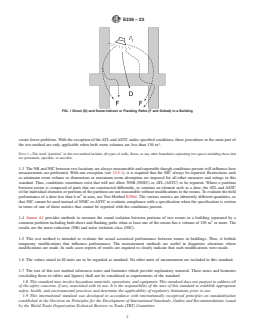
(Test Method)Standard Test Method for Measurement of Airborne Sound Attenuation between Rooms in Buildings
General Information
- Abstract
SIGNIFICANCE AND USE
5.1 The main part of this standard uses procedures originally developed for laboratory measurements of the sound transmission loss of partitions. These procedures assume that the rooms in which the measurements are performed have a sound field that reasonably approximates a diffuse field. Sound pressure levels in such rooms are reasonably uniform throughout the room and average levels vary inversely with the logarithm of the room sound absorption. Not all rooms will satisfy these conditions. Experience and controlled studies (1)6 have shown that the test method is applicable to smaller spaces normally used for work or living, such as rooms in multi-family dwellings, hotel guest rooms, meeting rooms, and offices with volumes less than 150 m3. The measures appropriate for such spaces are NR, NNR, and ATL. The corresponding single number ratings are NIC, NNIC and ASTC. The ATL and ASTC are measurable between larger spaces that meet a limitation on absorption in the spaces to provide uniform sound distribution.
5.2 Annex A1 was developed for use in spaces that are very large (volume of 150 m3 or greater). Sound pressure levels during testing vary markedly across large rooms so that the degree of isolation varies strongly with distance from the common (separating) partition. This procedure evaluates the isolation observed near the partition. The appropriate measure is NR, and the appropriate single number rating is NIC.
5.3 Several metrics are available for specific uses. Some evaluate the overall sound isolation between spaces including the effect of absorption in the receiving space and some evaluate the performance or apparent performance of the partition being evaluated. The results obtained are applicable only to the specific location tested.
5.3.1 Noise Reduction (NR) and Noise Isolation Class (NIC)—Describe the sound isolation found between two spaces. Noise reduction data are based on the space- and time averaged sound pressure levels meeting the require...
SCOPE
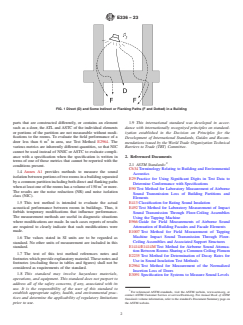
1.1 The sound isolation between two spaces in a building is influenced most strongly by a combination of the direct transmission through the nominally separating building element (as normally measured in a laboratory) and any transmission along a number of indirect paths, referred to as flanking paths. Fig. 1 illustrates the direct paths (D) and some possible structural flanking paths (F). Additional non-structural flanking paths include transmission through common air ducts between rooms, or doors to the corridor from adjacent rooms. Sound isolation is also influenced by the size of the separating partition between spaces and absorption in the receiving space, and in the case of small spaces by modal behavior of the space and close proximity to surfaces.
FIG. 1 Direct (D) and Some Indirect or Flanking Paths (F and Dotted) in a Building
1.2 The main part of this test method defines procedures and metrics to assess the sound isolation between two rooms or portions thereof in a building separated by a common partition or the apparent sound insulation of the separating partition, including both direct and flanking transmission paths in all cases. Appropriate measures and their single number ratings are the noise reduction (NR) and noise isolation class (NIC) which indicate the isolation with the receiving room furnished as it is during the test, the normalized noise reduction (NNR) and normalized noise isolation class (NNIC) which indicate the isolation expected if the receiving room was a normally furnished living or office space that is at least 25 m3 (especially useful when the test must be done with the receiving room unfurnished), and the apparent transmission loss (ATL) and apparent sound transmission class (ASTC) which indicate the apparent sound insulating properties of a separating partition including both the direct transmission and flanking transmission through the support structure. The measurement of ATL ...
- Status
- Published
- Publication Date
- 31-Dec-2022
- Technical Committee
- E33 - Building and Environmental Acoustics
- Drafting Committee
- E33.03 - Sound Transmission
Buy Documents
ASTM E336-23 - Standard Test Method for Measurement of Airborne Sound Attenuation between Rooms in Buildings
REDLINE ASTM E336-23 - Standard Test Method for Measurement of Airborne Sound Attenuation between Rooms in Buildings
Overview
ASTM E336-23 is the Standard Test Method for Measurement of Airborne Sound Attenuation between Rooms in Buildings, published by ASTM International. This standard establishes procedures and defines performance metrics for measuring the sound isolation between rooms in existing buildings, focusing on both direct and flanking transmission paths through partitions such as walls or floor-ceiling assemblies. The test method is applicable to a wide range of building types including multi-family dwellings, hotels, offices, and meeting rooms, especially where assessment of acoustical privacy and noise control is essential.
Key Topics
- Direct and Flanking Sound Transmission: The standard accounts for both the direct passage of sound through the separating partition and indirect transmission, called flanking paths. Non-structural paths such as air ducts or doors are included, as are structural paths through connected building elements.
- Applicable Room Sizes: Most procedures are suitable for rooms under 150 m³, typical of residential and office spaces, while Annex A1 provides guidance for larger spaces.
- Sound Field Conditions: The methodology assumes a reasonably diffuse sound field - that is, uniform sound pressure throughout the room.
- Measurement Metrics:
- Noise Reduction (NR): Difference in space-averaged sound pressure levels between source and receiving rooms.
- Noise Isolation Class (NIC): A single-number rating of isolation derived from NR.
- Normalized Noise Reduction (NNR) and Normalized Noise Isolation Class (NNIC): Standardized to typical furnished conditions for more consistent comparison, especially when testing unfurnished rooms.
- Apparent Transmission Loss (ATL) and Apparent Sound Transmission Class (ASTC): Measures the sound insulation, attributing all sound in the receiving room (including flanking) to the separating partition.
Applications
ASTM E336-23 is widely used for:
- Building Acoustics Testing: Helps architects, builders, and acoustical consultants measure and rate airborne sound attenuation between adjacent rooms, guiding sound insulation upgrades and compliance with building codes for acoustical performance.
- Legal and Regulatory Compliance: Provides objective test methods often required for demonstrating compliance with building codes or project specifications regarding sound control in multi-unit residential or commercial buildings.
- Product and Partition Evaluation: Facilitates in-situ assessment of partition systems, including walls, demountable partitions, and floors, to determine their acoustical performance in real-world conditions.
- Diagnostic and Investigative Use: Procedures are useful for diagnosing problematic sound transmission and for verifying the effectiveness of remedial measures or construction changes.
- Large and Small Spaces: Includes specialized procedures for both standard (e.g., apartments, offices) and larger (e.g., ballrooms, open-plan offices) spaces.
Related Standards
ASTM E336-23 is part of a family of standards that collectively address a range of acoustical measurement needs in buildings:
- ASTM E90 - Laboratory Measurement of Airborne Sound Transmission Loss of Building Partitions and Elements
- ASTM E413 - Classification for Rating Sound Insulation
- ASTM E492 - Laboratory Measurement of Impact Sound Transmission Through Floor-Ceiling Assemblies
- ASTM E1007 - Field Measurement of Tapping Machine Impact Sound Transmission Through Floor-Ceiling Assemblies
- ASTM E966 - Field Measurements of Airborne Sound Attenuation of Building Facades and Facade Elements
- ASTM E1414 - Airborne Sound Attenuation Between Rooms Sharing a Common Ceiling Plenum
- ASTM E2964 - Measurement of the Normalized Insertion Loss of Doors
- ISO 16283-1 - Field measurement of sound insulation in buildings and of building elements – Airborne sound insulation
Practical Value
Applying ASTM E336-23 ensures reliable, standardized airborne sound attenuation measurements between rooms, supporting better acoustical environments, occupant comfort, privacy, and regulatory compliance. Whether for new construction or retrofitting, the standard is a foundational tool for professionals committed to optimizing building acoustics. Incorporating E336-23 methods leads to informed decisions in material selection, partition design, and acoustical remediation.
Relations
- Effective Date
- 01-Dec-2023
- Effective Date
- 01-Apr-2020
- Effective Date
- 01-Nov-2018
- Effective Date
- 15-Jan-2018
- Effective Date
- 01-Jul-2017
- Effective Date
- 01-Dec-2016
- Effective Date
- 01-Oct-2016
- Effective Date
- 01-Sep-2014
- Refers
ASTM E2964-14e1 - Standard Test Method for Measurement of the Normalized Insertion Loss of Doors - Effective Date
- 01-Jun-2014
- Refers
ASTM E2964-14 - Standard Test Method for Measurement of the Normalized Insertion Loss of Doors - Effective Date
- 01-Jun-2014
- Effective Date
- 15-Oct-2013
- Effective Date
- 01-Oct-2013
- Effective Date
- 01-Sep-2013
- Effective Date
- 01-Apr-2013
- Effective Date
- 01-Apr-2012
Buy Documents
ASTM E336-23 - Standard Test Method for Measurement of Airborne Sound Attenuation between Rooms in Buildings
REDLINE ASTM E336-23 - Standard Test Method for Measurement of Airborne Sound Attenuation between Rooms in Buildings
Get Certified
Connect with accredited certification bodies for this standard

DIBt (Deutsches Institut für Bautechnik)
German Institute for Building Technology.
DIN CERTCO
DIN Group product certification.

Aboma Certification B.V.
Specialized in construction, metal, and transport sectors.
Sponsored listings
Frequently Asked Questions
ASTM E336-23 is a standard published by ASTM International. Its full title is "Standard Test Method for Measurement of Airborne Sound Attenuation between Rooms in Buildings". This standard covers: SIGNIFICANCE AND USE 5.1 The main part of this standard uses procedures originally developed for laboratory measurements of the sound transmission loss of partitions. These procedures assume that the rooms in which the measurements are performed have a sound field that reasonably approximates a diffuse field. Sound pressure levels in such rooms are reasonably uniform throughout the room and average levels vary inversely with the logarithm of the room sound absorption. Not all rooms will satisfy these conditions. Experience and controlled studies (1)6 have shown that the test method is applicable to smaller spaces normally used for work or living, such as rooms in multi-family dwellings, hotel guest rooms, meeting rooms, and offices with volumes less than 150 m3. The measures appropriate for such spaces are NR, NNR, and ATL. The corresponding single number ratings are NIC, NNIC and ASTC. The ATL and ASTC are measurable between larger spaces that meet a limitation on absorption in the spaces to provide uniform sound distribution. 5.2 Annex A1 was developed for use in spaces that are very large (volume of 150 m3 or greater). Sound pressure levels during testing vary markedly across large rooms so that the degree of isolation varies strongly with distance from the common (separating) partition. This procedure evaluates the isolation observed near the partition. The appropriate measure is NR, and the appropriate single number rating is NIC. 5.3 Several metrics are available for specific uses. Some evaluate the overall sound isolation between spaces including the effect of absorption in the receiving space and some evaluate the performance or apparent performance of the partition being evaluated. The results obtained are applicable only to the specific location tested. 5.3.1 Noise Reduction (NR) and Noise Isolation Class (NIC)—Describe the sound isolation found between two spaces. Noise reduction data are based on the space- and time averaged sound pressure levels meeting the require... SCOPE 1.1 The sound isolation between two spaces in a building is influenced most strongly by a combination of the direct transmission through the nominally separating building element (as normally measured in a laboratory) and any transmission along a number of indirect paths, referred to as flanking paths. Fig. 1 illustrates the direct paths (D) and some possible structural flanking paths (F). Additional non-structural flanking paths include transmission through common air ducts between rooms, or doors to the corridor from adjacent rooms. Sound isolation is also influenced by the size of the separating partition between spaces and absorption in the receiving space, and in the case of small spaces by modal behavior of the space and close proximity to surfaces. FIG. 1 Direct (D) and Some Indirect or Flanking Paths (F and Dotted) in a Building 1.2 The main part of this test method defines procedures and metrics to assess the sound isolation between two rooms or portions thereof in a building separated by a common partition or the apparent sound insulation of the separating partition, including both direct and flanking transmission paths in all cases. Appropriate measures and their single number ratings are the noise reduction (NR) and noise isolation class (NIC) which indicate the isolation with the receiving room furnished as it is during the test, the normalized noise reduction (NNR) and normalized noise isolation class (NNIC) which indicate the isolation expected if the receiving room was a normally furnished living or office space that is at least 25 m3 (especially useful when the test must be done with the receiving room unfurnished), and the apparent transmission loss (ATL) and apparent sound transmission class (ASTC) which indicate the apparent sound insulating properties of a separating partition including both the direct transmission and flanking transmission through the support structure. The measurement of ATL ...
SIGNIFICANCE AND USE 5.1 The main part of this standard uses procedures originally developed for laboratory measurements of the sound transmission loss of partitions. These procedures assume that the rooms in which the measurements are performed have a sound field that reasonably approximates a diffuse field. Sound pressure levels in such rooms are reasonably uniform throughout the room and average levels vary inversely with the logarithm of the room sound absorption. Not all rooms will satisfy these conditions. Experience and controlled studies (1)6 have shown that the test method is applicable to smaller spaces normally used for work or living, such as rooms in multi-family dwellings, hotel guest rooms, meeting rooms, and offices with volumes less than 150 m3. The measures appropriate for such spaces are NR, NNR, and ATL. The corresponding single number ratings are NIC, NNIC and ASTC. The ATL and ASTC are measurable between larger spaces that meet a limitation on absorption in the spaces to provide uniform sound distribution. 5.2 Annex A1 was developed for use in spaces that are very large (volume of 150 m3 or greater). Sound pressure levels during testing vary markedly across large rooms so that the degree of isolation varies strongly with distance from the common (separating) partition. This procedure evaluates the isolation observed near the partition. The appropriate measure is NR, and the appropriate single number rating is NIC. 5.3 Several metrics are available for specific uses. Some evaluate the overall sound isolation between spaces including the effect of absorption in the receiving space and some evaluate the performance or apparent performance of the partition being evaluated. The results obtained are applicable only to the specific location tested. 5.3.1 Noise Reduction (NR) and Noise Isolation Class (NIC)—Describe the sound isolation found between two spaces. Noise reduction data are based on the space- and time averaged sound pressure levels meeting the require... SCOPE 1.1 The sound isolation between two spaces in a building is influenced most strongly by a combination of the direct transmission through the nominally separating building element (as normally measured in a laboratory) and any transmission along a number of indirect paths, referred to as flanking paths. Fig. 1 illustrates the direct paths (D) and some possible structural flanking paths (F). Additional non-structural flanking paths include transmission through common air ducts between rooms, or doors to the corridor from adjacent rooms. Sound isolation is also influenced by the size of the separating partition between spaces and absorption in the receiving space, and in the case of small spaces by modal behavior of the space and close proximity to surfaces. FIG. 1 Direct (D) and Some Indirect or Flanking Paths (F and Dotted) in a Building 1.2 The main part of this test method defines procedures and metrics to assess the sound isolation between two rooms or portions thereof in a building separated by a common partition or the apparent sound insulation of the separating partition, including both direct and flanking transmission paths in all cases. Appropriate measures and their single number ratings are the noise reduction (NR) and noise isolation class (NIC) which indicate the isolation with the receiving room furnished as it is during the test, the normalized noise reduction (NNR) and normalized noise isolation class (NNIC) which indicate the isolation expected if the receiving room was a normally furnished living or office space that is at least 25 m3 (especially useful when the test must be done with the receiving room unfurnished), and the apparent transmission loss (ATL) and apparent sound transmission class (ASTC) which indicate the apparent sound insulating properties of a separating partition including both the direct transmission and flanking transmission through the support structure. The measurement of ATL ...
ASTM E336-23 is classified under the following ICS (International Classification for Standards) categories: 91.120.20 - Acoustics in building. Sound insulation. The ICS classification helps identify the subject area and facilitates finding related standards.
ASTM E336-23 has the following relationships with other standards: It is inter standard links to ASTM E90-23, ASTM E2235-04(2020), ASTM E966-18a, ASTM E966-18, ASTM E3091-17, ASTM E90-09(2016), ASTM E1007-16, ASTM E1007-14, ASTM E2964-14e1, ASTM E2964-14, ASTM E1007-13b, ASTM E1007-13a, ASTM C634-13, ASTM E1007-13, ASTM E2235-04(2012). Understanding these relationships helps ensure you are using the most current and applicable version of the standard.
ASTM E336-23 is available in PDF format for immediate download after purchase. The document can be added to your cart and obtained through the secure checkout process. Digital delivery ensures instant access to the complete standard document.
Standards Content (Sample)
This international standard was developed in accordance with internationally recognized principles on standardization established in the Decision on Principles for the
Development of International Standards, Guides and Recommendations issued by the World Trade Organization Technical Barriers to Trade (TBT) Committee.
Designation: E336 − 23
Standard Test Method for
Measurement of Airborne Sound Attenuation between
Rooms in Buildings
This standard is issued under the fixed designation E336; the number immediately following the designation indicates the year of
original adoption or, in the case of revision, the year of last revision. A number in parentheses indicates the year of last reapproval. A
superscript epsilon (´) indicates an editorial change since the last revision or reapproval.
This standard has been approved for use by agencies of the U.S. Department of Defense.
INTRODUCTION
This test method is part of a set of standards for evaluating the sound-insulating properties of
building elements. It is designed to measure the sound isolation between two rooms or to estimate
lower limits for sound transmission through a partition element installed as an interior part of a
building. Others in the set cover the airborne sound transmission loss of an isolated partition element
in a controlled laboratory environment (Test Method E90), the laboratory measurement of impact
sound transmission through floors (Test Method E492), the measurement of impact sound transmis-
sion in buildings (Test Method E1007), the measurement of sound transmission through building
facades and facade elements (Guide E966), the measurement of sound transmission through a
common plenum between two rooms (Test Method E1414/E1414M), and measurement of the
normalized insertion loss of doors (Test Method E2964).
1. Scope which indicate the isolation with the receiving room furnished
as it is during the test, the normalized noise reduction (NNR)
1.1 The sound isolation between two spaces in a building is
and normalized noise isolation class (NNIC) which indicate the
influenced most strongly by a combination of the direct
isolation expected if the receiving room was a normally
transmission through the nominally separating building ele-
furnished living or office space that is at least 25 m (especially
ment (as normally measured in a laboratory) and any transmis-
useful when the test must be done with the receiving room
sion along a number of indirect paths, referred to as flanking
unfurnished), and the apparent transmission loss (ATL) and
paths. Fig. 1 illustrates the direct paths (D) and some possible
apparent sound transmission class (ASTC) which indicate the
structural flanking paths (F). Additional non-structural flanking
apparent sound insulating properties of a separating partition
paths include transmission through common air ducts between
including both the direct transmission and flanking transmis-
rooms, or doors to the corridor from adjacent rooms. Sound
sion through the support structure. The measurement of ATL is
isolation is also influenced by the size of the separating
limited to spaces of at least 25 m where modal effects create
partition between spaces and absorption in the receiving space,
fewer problems. With the exception of the ATL and ASTC
and in the case of small spaces by modal behavior of the space
under specified conditions, these procedures in the main part of
and close proximity to surfaces.
the test method are only applicable when both room volumes
1.2 The main part of this test method defines procedures and
are less than 150 m .
metrics to assess the sound isolation between two rooms or
NOTE 1—The word “partition” in this test method includes all types of
portions thereof in a building separated by a common partition
walls, floors, or any other boundaries separating two spaces including
or the apparent sound insulation of the separating partition,
those that are permanent, operable, or movable.
including both direct and flanking transmission paths in all
1.3 The NR and NIC between two locations are always
cases. Appropriate measures and their single number ratings
measureable and reportable though conditions present will
are the noise reduction (NR) and noise isolation class (NIC)
influence how measurements are performed. With one excep-
tion (see 13.5.1), it is required that the NIC always be reported.
1 Restrictions such as minimum room volume or dimensions or
This test method is under the jurisdiction of ASTM Committee E33 on Building
and Environmental Acoustics and is the direct responsibility of Subcommittee
maximum room absorption are imposed for all other measures
E33.03 on Sound Transmission.
and ratings in this standard. Thus, conditions sometimes exist
Current edition approved Jan. 1, 2023. Published February 2023. Originally
that will not allow NNR (NNIC) or ATL (ASTC) to be
approved in 1971. Last previous edition approved in 2020 as E336 – 20. DOI:
10.1520/E0336-23. reported. Where a partition between rooms is composed of
Copyright © ASTM International, 100 Barr Harbor Drive, PO Box C700, West Conshohocken, PA 19428-2959. United States
E336 − 23
FIG. 1 Direct (D) and Some Indirect or Flanking Paths (F and Dotted) in a Building
parts that are constructed differently, or contains an element 1.9 This international standard was developed in accor-
such as a door, the ATL and ASTC of the individual elements dance with internationally recognized principles on standard-
or portions of the partition are not measurable without modi- ization established in the Decision on Principles for the
fications to the rooms. To evaluate the field performance of a
Development of International Standards, Guides and Recom-
door less than 6 m in area, use Test Method E2964. The
mendations issued by the World Trade Organization Technical
various metrics are inherently different quantities, so that NIC
Barriers to Trade (TBT) Committee.
cannot be used instead of NNIC or ASTC to evaluate compli-
ance with a specification when the specification is written in
2. Referenced Documents
terms of one of those metrics that cannot be reported with the
2.1 ASTM Standards:
conditions present.
C634 Terminology Relating to Building and Environmental
1.4 Annex A1 provides methods to measure the sound
Acoustics
isolation between portions of two rooms in a building separated
E29 Practice for Using Significant Digits in Test Data to
by a common partition including both direct and flanking paths
Determine Conformance with Specifications
when at least one of the rooms has a volume of 150 m or more.
E90 Test Method for Laboratory Measurement of Airborne
The results are the noise reduction (NR) and noise isolation
Sound Transmission Loss of Building Partitions and
class (NIC).
Elements
1.5 This test method is intended to evaluate the actual
E413 Classification for Rating Sound Insulation
acoustical performance between rooms in buildings. Thus, it
E492 Test Method for Laboratory Measurement of Impact
forbids temporary modifications that influence performance.
Sound Transmission Through Floor-Ceiling Assemblies
The measurement methods are useful in diagnostic situations
Using the Tapping Machine
where modifications are made. In such cases reports of results
E966 Guide for Field Measurements of Airborne Sound
are required to clearly indicate that such modifications were
Attenuation of Building Facades and Facade Elements
made.
E1007 Test Method for Field Measurement of Tapping
Machine Impact Sound Transmission Through Floor-
1.6 The values stated in SI units are to be regarded as
Ceiling Assemblies and Associated Support Structures
standard. No other units of measurement are included in this
E1414/E1414M Test Method for Airborne Sound Attenua-
standard.
tion Between Rooms Sharing a Common Ceiling Plenum
1.7 The text of this test method references notes and
E2235 Test Method for Determination of Decay Rates for
footnotes which provide explanatory material. These notes and
Use in Sound Insulation Test Methods
footnotes (excluding those in tables and figures) shall not be
E2964 Test Method for Measurement of the Normalized
considered as requirements of the standard.
Insertion Loss of Doors
1.8 This standard may involve hazardous materials,
E3091 Specification for Systems to Measure Sound Levels
operations, and equipment. This standard does not purport to
address all of the safety concerns, if any, associated with its
use. It is the responsibility of the user of this standard to
For referenced ASTM standards, visit the ASTM website, www.astm.org, or
establish appropriate safety, health, and environmental prac-
contact ASTM Customer Service at service@astm.org. For Annual Book of ASTM
tices and determine the applicability of regulatory limitations
Standards volume information, refer to the standard’s Document Summary page on
prior to use. the ASTM website.
E336 − 23
2.2 ANSI Standard:
A = the sound absorption in the receiving room, m
¯
S1.40-2006 Specifications and Verification Procedures for
L = the source room average sound pressure level, dB and
¯
Sound Calibrators
L = the receiving room average sound pressure level result-
2.3 IEC Standards: ing from the combined effect of direct and flanking
IEC 60942:2003 Electroacoustics – Sound calibrators
transmission, dB.
IEC 60942:2017 Electroacoustics – Sound calibrators
3.2.2.1 Discussion—Throughout this test method, log is
IEC 61094-4:1995 Measurement microphones – Part 4:
taken to mean log , unless otherwise indicated.
Specifications for working standard microphones
3.2.2.2 Discussion—This definition attributes all the power
IEC 61672-1:2013 Electroacoustics – Sound level meters –
transmitted into the receiving room, by direct and flanking
Part 1: Specifications
paths, to the area of the partition common to both rooms. If
IEC 61672-3:2013 Electroacoustics – Sound level meters –
flanking transmission is significant, the ATL will be less than
Part 3: Periodic tests
the TL for the partition. Apparent transmission loss (ATL) is
NOTE 2—The IEC standards are often adopted by national standards
equivalent in meaning to apparent sound reduction index
organizations as national standards sometimes with additional unique
(ASRI) used by ISO 16283-1:2014.
national standards numbers assigned.
5 3.2.3 apparent sound transmission class, ASTC, n—a single
2.4 ISO Standard:
number rating obtained by applying the classification proce-
ISO 16283-1:2014 Acoustics – Field measurement of sound
dure of Classification E413 to apparent transmission loss data.
insulation in buildings and of building elements – Part 1:
¯
Airborne sound insulation 3.2.4 average sound pressure level, L , (dB), n—(1) in a
p
specified frequency band within a defined measurement region,
3. Terminology
a continuous time-averaged sound pressure level measured
3.1 Terms used in this standard are defined either in Termi- with a moving microphone; (2) for several related time-
nology C634 or within this standard. The definition of terms averaged sound pressure levels measured at different positions
explicitly given within this standard take precedence over for the same length of time either simultaneously or
definitions given in Terminology C634. The definitions within sequentially, ten times the base 10 logarithm of the arithmetic
the Terminology section of Terminology C634 and this stan- mean of the squared ratios of acoustic pressure to reference
dard take precedence over any other definitions found in any
pressure (20 μPa) from which the individual sound pressure
other documents, including documents that are referenced in levels were derived.”
this standard.
3.2.4.1 Discussion—For an individual time-average sound
3.1.1 The following terms used in this test method have pressure level, L , the corresponding squared pressure ratio is
i
~L ⁄10!
i
specific meanings that are defined in Terminology C634:
equal to 10 . The calculation of average sound pressure
airborne sound; background noise; decay rate; decibel; diffuse level from individual L values is expressed in Eq 6.
i
sound field; flanking transmission; pink noise; receiving room;
3.2.5 coupled space, n—a secondary space that is adjacent
reverberation; reverberation time; sound absorption; sound
to and partially open to the primary space on the same side of
attenuation; sound insulation; sound isolation; sound pressure
the separating partition and which meets spatial and sound
level; sound transmission class, STC; sound transmission loss,
level distribution requirements sufficient to allow the second-
TL; source room
ary space to be included as part of the measurement space with
3.2 Definitions of Terms Specific to This Standard: the primary space.
3.2.1 The following terms are either not defined in the 3.2.5.1 Discussion—Fig. 2 and Fig. 3 illustrate conditions
Terminology section of Terminology C634 or have definitions that are candidates for coupled spaces.
in this document different from those stated in the Terminology
3.2.5.2 Discussion—To qualify as a coupled space in this
section of Terminology C634. standard the space must meet requirements specified in 9.4.1.
3.2.2 apparent transmission loss, ATL (dB), n—of a parti-
3.2.6 direct transmission, n—sound that travels between a
tion installed in a building, in a specified frequency band is
source and a receiving room only through the common
operationally defined as:
(separating) building element.
S
H H 3.2.7 noise reduction, NR, (dB), n—in a specified frequency
ATL 5 L 2 L 110log (1)
S D
1 2
A
band, the difference between the sound pressure levels at two
well-defined locations.
where:
S = the area of the partition common to both source and 3.2.8 noise isolation class, NIC, n—a single-number rating
calculated in accordance with Classification E413 using mea-
receiving rooms, m
sured values of noise reduction.
3.2.9 normalized noise reduction, NNR, (dB), n—between
Available from American National Standards Institute (ANSI), 25 W. 43rd St.,
two rooms of less than 150 m where the receiving room is at
4th Floor, New York, NY 10036, http://www.ansi.org.
Available from International Electrotechnical Commission (IEC), 3 rue de
least 25 m , in a specified frequency band, the value that the
Varembé, Case postale 131, CH-1211, Geneva 20, Switzerland, http://www.iec.ch.
noise reduction, NR, in a given field test would have if the
reverberation time in the receiving room were 0.5 s. NNR is
Available from International Organization for Standardization (ISO), 1, ch. de
la Voie-Creuse, CP 56, CH-1211 Geneva 20, Switzerland, http://www.iso.org. calculated as follows:
E336 − 23
FIG. 2 Coupled Spaces Adjacent to a Primary Space
FIG. 3 Receiving Spaces Adjacent to a Coupled Source Space
T nonzero digit for numbers represented with a decimal point are
NNR 5 NR110log (2)
S D
0.5 significant digits. The significance of trailing zeros for numbers
represented without use of a decimal point can only be
where:
identified from knowledge of the source of the value. A
NR = noise reduction, dB, and
decimal point must not be inserted after a non-significant zero.
T = reverberation time in receiving room, s.
The significance or non-significance of a zero can often be
clarified by expressing the number in scientific notation or by
3.2.9.1 Discussion—The normalized noise reduction is in-
changing the SI prefix for the units.
tended to approximate the noise reduction that would exist in
3.2.11.3 Discussion—Further discussion and examples are
an ordinarily furnished receiving room.
provided in the discussions of this term in Practice E29.
3.2.10 normalized noise isolation class, NNIC (dB), n—a
single-number rating for noise isolation between two rooms
4. Summary of Test Method
both less than 150 m calculated in accordance with Classifi-
4.1 The source and receiving rooms are selected, the mea-
cation E413 using measured values of normalized noise
surement spaces and volumes in each room are defined and the
reduction. (See normalized noise reduction.)
metrics to be measured are identified based on information
3.2.11 significant digit, n—any of the figures 0 through 9
given in Section 5 within the restrictions given in 11.3 and
that is used with its place value to denote a numerical quantity
Annex A1.
to some desired approximation, excepting all leading zeros and
4.2 The number and location of sound sources are chosen,
some trailing zeros in numbers not represented with a decimal
sound is produced in the source room and sound pressure levels
point. E29
are sampled spatially in the measurement spaces in both the
3.2.11.1 Discussion—A measurement value is not always
source and receiving rooms.
precise to the number of significant digits used to represent it.
3.2.11.2 Discussion—Zeros leading the first nonzero digit of 4.3 Sound decay rates are measured as necessary depending
a number are not significant digits. Zeros trailing the last on the result to be reported.
E336 − 23
4.4 If a value for noise reduction is to be measured between furnished spaces, and noise reduction values between the
rooms immediately adjacent to a common partition where spaces depend on the test direction used and the sound
either is 150 m in volume or greater, the requirements and absorption in the spaces. However, these effects are lessened
procedures of Annex A1 must be satisfied. when the method of Annex A1 is used.
5.3.2 Normalized Noise Reduction (NNR) and Normalized
4.5 If values of NNR are to be reported, the requirements of
Noise Isolation Class (NNIC)—Describe the sound isolation
9.3 must be satisfied. If values of ATL are to be reported, the
between two residential or office spaces meeting the require-
requirements of 9.4.1 must be satisfied and if ATL is to be
ments of 9.3.1 adjusted to standardized room conditions typical
reported for a partition between spaces where either is 150 m
of such spaces when normally furnished.
in volume or greater, the requirement of 9.4.1.2 must be
5.3.3 Apparent Transmission Loss (ATL) and Apparent
satisfied.
Sound Transmission Class (ASTC)—Describe the apparent
4.6 Results and single number ratings are calculated and
sound insulation of a partition separating two spaces as
reported.
influenced by flanking in the supporting structure. All sound
transmission, including any flanking transmission, is ascribed
5. Significance and Use
to the partition. The apparent transmission loss of the partition
5.1 The main part of this standard uses procedures origi-
will be less than the actual sound transmission loss (Path D in
nally developed for laboratory measurements of the sound
Fig. 1) if flanking (Path F in Fig. 1) is significant (2,3). These
transmission loss of partitions. These procedures assume that
results are in theory the same in each direction but differences
the rooms in which the measurements are performed have a
with direction have been observed in practice. If it is necessary
sound field that reasonably approximates a diffuse field. Sound
for diagnostic purposes to suppress flanking when doing
pressure levels in such rooms are reasonably uniform through-
measurements, the results must be clearly labeled as “flanking
out the room and average levels vary inversely with the
suppressed.”
logarithm of the room sound absorption. Not all rooms will
5.4 The primary use of this test method is to evaluate the
satisfy these conditions. Experience and controlled studies (1)
sound isolation and apparent sound insulation performance in
have shown that the test method is applicable to smaller spaces
buildings based on tests of unmodified structures. If the
normally used for work or living, such as rooms in multi-
measurement methods are used for diagnostic or investigative
family dwellings, hotel guest rooms, meeting rooms, and
purposes to measure the performance of modified structures in
offices with volumes less than 150 m . The measures appro-
buildings, results must be clearly labeled to indicate such.
priate for such spaces are NR, NNR, and ATL. The correspond-
ing single number ratings are NIC, NNIC and ASTC. The ATL NOTE 3—Versions of this standard prior to 2017 included TL and STC
metrics with prefixes designated as “Field (F).” The “Field” version of the
and ASTC are measurable between larger spaces that meet a
metrics was intended to exclude the presence of flanking sound transmis-
limitation on absorption in the spaces to provide uniform sound
sion altogether; whereas, the “Apparent” version presumes an (unknown)
distribution.
degree of flanking. In addition, the “Field” version of the metrics required
more stringent limits on room volume and room absorption. These earlier
5.2 Annex A1 was developed for use in spaces that are very
versions also included guidance on suppression of flanking, useful for
large (volume of 150 m or greater). Sound pressure levels
diagnostic purposes.
during testing vary markedly across large rooms so that the
degree of isolation varies strongly with distance from the
6. Test Equipment, Data Recording, and Rounding in
common (separating) partition. This procedure evaluates the
Calculations
isolation observed near the partition. The appropriate measure
6.1 Sound Sources and Signals—Sound sources shall be
is NR, and the appropriate single number rating is NIC.
loudspeaker systems driven by power amplifiers.
5.3 Several metrics are available for specific uses. Some
6.1.1 The input signal to the amplifiers shall be random
evaluate the overall sound isolation between spaces including noise containing a continuous distribution of frequencies over
the effect of absorption in the receiving space and some
each test band. Measure and check the loudspeaker output on
evaluate the performance or apparent performance of the site to ensure it is operating as expected without damage to the
partition being evaluated. The results obtained are applicable
system. If the input signal is filtered to a narrow band to
only to the specific location tested.
increase output level (see 11.7.2), the filter shall be capable of
5.3.1 Noise Reduction (NR) and Noise Isolation Class
providing signal at least one-third octave above and below the
(NIC)—Describe the sound isolation found between two
measurement test band.
spaces. Noise reduction data are based on the space- and time
NOTE 4—A pink noise source is recommended, especially when all
averaged sound pressure levels meeting the requirements of
frequencies within the test range are being excited simultaneously, but
11.3 or A1.3 as required depending on the sound absorption,
adjustment for exactly equal output level in each band is not required.
volume, and shape requirements of 9.2. Noise reduction values Directional loudspeakers with multiple driver elements to cover different
frequency ranges placed and aimed into trihedral corners of the room or
are influenced by the absorption in the receiving space as well
omnidirectional loudspeakers are acceptable.
as the apparent performance of the partition. The noise
6.1.2 Select high-power amplifiers and efficient loudspeak-
reduction values in unfurnished spaces are typically less than in
ers considering the requirements of 11.7.1 and any information
available concerning expected test site conditions.
The boldface numbers in parentheses refer to the list of references at the end of
this standard. NOTE 5—Preliminary measurements on site can evaluate background
E336 − 23
sound and identify the need to turn off background sources where possible.
transportation, manufacturer recommendations, and history of
reliability or problems as observed in prior calibrations.
6.1.3 If more than one source is used simultaneously, the
NOTE 8—IEC 61672-3:2013 provides more information on calibration.
sources shall be driven by separate noise generators and
amplifier channels, so the outputs are uncorrelated. 7.2 If equipment is sensitive to line voltage variations, use a
line-voltage regulator.
6.2 Sound Measuring Equipment—Amplifiers, filters, and
electronic circuitry to process microphone signals and perform 7.3 Perform sensitivity checks of the entire measuring setup
measurements shall satisfy the requirements of Section 5 and (including the microphone, all cables, and instruments) with
either Section 6 or Sections 7.1–7.4 of Specification E3091. the same calibration equipment before and after the measure-
The system shall also include the ability to measure time- ments. If the calibration values differ by more than 0.5 dB, the
average levels (as required of integrating-averaging sound results are invalid and measurements shall be repeated.
level meters) and A-weighting filters, both as specified in IEC
61672-1:2013. 8. Test Site Conditions
6.2.1 “Working standard” microphones 13 mm or smaller in
8.1 Except as discussed in 8.2 and 8.4, the test site shall be
diameter as described in IEC 61094-4:1995 shall be used.
a pair of rooms in a building separated by a completed wall or
NOTE 6—If measurements are to be performed above 5000 Hz, a floor-ceiling that is not modified from the condition expected
diffuse-field (random-incidence) microphone or corrector is preferred.
for future use. Doors shall be installed with the closure
hardware and seals (if any) that are to be in place in final
6.2.1.1 If multiple microphones are used, they shall all be of
construction. Results are intended to indicate conditions to be
the same make and model.
expected by building occupants.
6.3 Calibrators—The field calibrator used for sensitivity
8.1.1 No building elements that separate and define the
checks shall be an acoustic or electroacoustic calibrator meet-
source and receiving rooms shall be modified by any temporary
ing class 1 requirements of ANSI S1.40-2006, IEC
means to improve performance. Any permanent modifications
60942:2003, or IEC 60942:2017.
made after the beginning of testing shall be reported.
6.4 Devices for measuring linear dimensions shall be ca-
8.1.2 Flanking transmission in the structure will be present.
pable of determining such to at least three significant digits for
No efforts to suppress such structural flanking transmission
dimensions of 0.1 m or greater, including one estimated digit
shall be made.
beyond the last certain digit if necessary. Count final zeros as
8.1.3 Flanking due to doors or other openings into common
significant if they are a verified part of the measurement.
areas adjacent to the source and receiving rooms shall not be
suppressed by any temporary modification.
NOTE 7—For non-logarithmic numbers, the significant digits are the
first and last non-zero digit, plus all digits between those, plus zero digits
8.2 Elimination of Coupled Space—When determining the
at the end if those zeros are verified by measurement and not just added.
apparent transmission loss ATL, a coupled space on the
The significant digits in numbers multiplied or divided control the
receiving side is permitted but not required to be blocked off by
significant digits in the result of the calculation. A tape marked in decimal
divisions of units, or a laser device providing results in decimal divisions,
solid heavy material such as gypsum board or plywood to
makes it easier to record field dimensions directly for use in calculations
create a smaller and more defined measurement volume. The
with proper significant digits and minimizes the need for additional
coupled space shall not be so blocked if it is needed to satisfy
calculation steps. In decibels, the number of significant digits is equivalent
the minimum volume requirement for the receiving side.
to the number of digits after the decimal point plus one.
8.3 Verification of Coupled Spaces—Any coupled space
6.5 Devices for measuring reverberation time or decay rates
included in measurements must be verified by dimensional
shall be capable of determining and reporting the reverberation
factors and measurement of sound levels. For a space to be a
time to at least hundredths of a second or decay rates to at least
coupled space for purposes of this standard, the following
three significant digits, considering both to be non-logarithmic
conditions must be met:
numbers.
8.3.1 The opening between the primary and secondary
6.6 Record observed values to the greatest resolution pro-
spaces must be at least 33 % of the total area of the partition
vided by the instrument for sound levels, reverberation times,
separating the primary and secondary spaces.
and decay rates. Record linear dimensions to at least 3
8.3.2 Unless one or more of the dimensions of a secondary
significant digits.
space is less than 1 m (such as spaces A1, A2, and B in Fig. 4),
6.7 Do not round any intermediate results during calcula-
it must be demonstrated by measurement with the sound source
tions. Only round reported results as directed herein or round
operating that the difference between the space-averaged
as specified in computing single number ratings.
A-weighted overall sound level in the primary and secondary
spaces (such as D and F in Fig. 4) is not more than 6 dB.
7. Calibration and Sensitivity Checks
8.3.3 If either dimension of the secondary space in the
plane of the opening between spaces is less than 1 m (such as
7.1 A thorough calibration of acoustical instrumentation by
space B in Fig. 4), that space shall not be considered coupled
a calibration laboratory at regular intervals is necessary to help
if the dimension perpendicular to that plane is more than 1 m.
assure that the equipment is operating within instrument
standards and manufacturer’s specifications. The appropriate
NOTE 9—Coupled spaces sometimes occur where adjacent spaces are
calibration interval depends on the complexity of the
partially divided without doors or are created by fully opening doors
instrument, frequency of use, frequency of field use and between adjacent spaces. Such coupled spaces are possible adjacent to a
E336 − 23
A. Always include spaces such as A1 and A2 in volume unless
closed off
B. Never include in volume and measurements
C. Do not include in volume and measurements unless needed to
meet minimum volume
D. If conditions 8.3.1 and 8.3.2 are met, include in volume and mea-
surements unless closed off
E. Closed off or ensure condition 9.4.9 is met
F. If E is not closed off, include in measurement and volume. If E is
closed off, include F in volume and measurements if conditions 8.3.1
and 8.3.2 unless F is closed off also.
FIG. 4 Examples of Potential Coupled Spaces
given primary space as shown in Fig. 4. Examples are a bay window,
since by definition ATL does not have flanking suppressed. See
niche, or open shallow closet-like space of less than one meter depth (such
13.1.2.2, 13.1.2.3, and 13.1.4.3.
as A1 and A2 in Fig. 4). These small coupled spaces are part of the overall
room volume. However, sound measurements are not performed within
8.5 Drying and Curing Period—The drying and curing
them.
period for construction materials shall be considered in the
NOTE 10—A corridor less than 1 m wide and extending away from the
scheduling of testing and reporting of results. The date of
primary space for more than 1 m (such as space B in Fig. 4) is not coupled
construction completion for elements under test shall be
and its volume is not included as it is impossible to measure within it.
reported if within 30 days before testing.
8.4 Investigative Measurements—The measurement meth-
ods in this test method are useful and appropriate in situations
NOTE 11—Results have been found to be influenced by drying or curing
where structures are modified to isolate specific transmission
time. Some typical drying and curing times for common materials are as
paths. Examples are (1) the investigation of structural flanking follows: masonry 28 days; gypsum concrete 14 days if less than 35 mm
thick, 21 days otherwise; plaster 3 days if 3 mm or less thick, 28 days
with the structural flanking suppressed, (2) investigation of
otherwise; wallboard partitions 12 h with typical joint and finishing
structural transmission and structural flanking where it is
components, 3 days with non-water-based laminating adhesive, 14 days
necessary to eliminate major non-structural flanking through
with water-based laminating adhesive.
paths such as through doors to a common corridor beside the
test rooms, and (3) subdividing a room into two spaces by use
9. Measurement and Source and Receiving Space
of heavy solid panels to measure the ATL of parts of a
Requirements for Specific Measurements
separating partition that are of different construction for the
9.1 The areas to be used for measurements and restrictions
two spaces. Because investigative measurements do not repre-
sent the actual expected performance, the reports and results on the size and absorption present in spaces depend on the type
of measurement being performed. These matters are addressed
must indicate such. Any ATL results where flanking has been
suppressed are required to be marked “flanking suppressed” in this section specifically for each type of measurement. These
E336 − 23
(which is often determined by the type and amount of furnishings).
restrictions prohibit some measurements from being per-
formed. The user shall choose to make one or more of the
9.2.2 If the gross volume of the source room (including
permitted measurements dependent upon the purpose of the
coupled spaces, if any) and the gross volume of the receiving
measurements and the restrictions imposed in the remainder of
room (including coupled spaces, if any) are each less than 150
Section 9.
m , the procedures of Section 11 shall be used. Noise reduction
9.1.1 With the exception of the volume to be used to
is also measurable for defined limited areas within such spaces
calculate the sound absorption in some cases in 11.9, the
such as a living area or dining area or kitchen area. When doing
volumes to be used in this standard are the gross volumes of
so, the specific areas included in the measurements must be
rooms including coupled spaces without subtracting out the
clearly identified on a drawing in the report.
volumes of built-in cabinets, appliances, furniture or other
9.2.3 If the gross volume of the source room (including
objects in the room.
coupled spaces, if any) or the gross volume of the receiving
9.1.2 With one exception (see 9.2.3), all measurements are
room (including coupled spaces, if any) are either 150 m or
performed using procedures specified in Section 11. The NIC
more, the procedures of Annex A1 shall be used. In this case
must always be reported with one exception: when only the
the space shall not be divided into smaller functional spaces
ATL is being measured and the gross volume of the source or
such as a living or dining area for measurement using the
receiving room is 150 m or more (see 9.4.1.2). If the purpose
procedures of Section 11.
of the test requires the reporting of both the ATL and the NR
9.2.4 When the receiving space for an NR measurement is a
when the gross volume of either the source or receiving room
corridor, the measurement space in the corridor shall be defined
is 150 m or greater, then separate measurements must be
as follows and as illustrated in Fig. 5.
performed in accordance with Section 11 for ATL and in
9.2.4.1 When the corridor is perpendicular to the separating
accordance with Annex A1 for NR.
partition, take measurements in the region 1 to 2 m from the
9.2 Noise Reduction—Procedures for the measurement of
separating partition.
NR differ depending on circumstances.
9.2.4.2 When the corridor is parallel to the separating
9.2.1 When measurements are being performed to deter-
partition, take measurements in the region between the ends of
mine sound isolation between a particular pair of rooms in only
the separating partition.
one direction, and the choice of source and receiving room is
9.3 Normalized Noise Reduction—NNR shall only be mea-
not specified by the party requesting the test, and the rooms are
sured between spaces meeting further restrictions beyond those
significantly different in size and furnishings, the measure-
specified above for the noise reduction.
ments shall be in the direction expected to produce the lowest
9.3.1 NNR shall be measured only between two spaces
numerical result unless there is a compelling reason not to do
meeting the following conditions:
so.
9.3.1.1 The gross volumes of the spaces on each side of the
NOTE 12—Since NR and NIC are not normalized to the sound
partition must each be less than 150 m .
absorption in the receiving room, it is possible that there will be a
9.3.1.2 The gross volume of the receiving room (including
significant difference in NR and NIC values measured when the source
coupled spaces, if any) and any functional areas such as living,
and receiving rooms are interchanged. This is especially true when the
rooms are of substantially different size and degree of sound absorption dining, or kitchen area where NNR is to be measured, must be
FIG. 5 Receiving Measurement Space in Corridors
E336 − 23
at least 25 m and the smallest dimension of the receiving This is the one case where it is not required to report the
space must be at least 2.3 m. NIC. If it is desired to also report the NIC, measurements for
the NR must be performed in accordance with Annex A1.
NOTE 13—The uncertainty of the space average sound pressure level
9.4.2 The specimen area for calculation of the ATL shall be
increases with decreasing frequency and with decreasing room volume.
the area of the separating partition or floor-ceiling common to
9.3.2 When measuring NNR, all doors present enclosing the
both the source and receiving rooms, as illustrated in the
source and receiving rooms shall be closed unless doing so
example shown in Fig. 6. Determine this common area.
leaves the primary space too small to meet volume require-
ments. In that case, if leaving the doors to an adjacent space
NOTE 14—A combination of drawings, experience on the site, visual
open creates a coupled space meeting the requirements of 8.3
observations, and dimensional measurements is useful in making this
determination.
such that the room including coupled spaces meets the mini-
mum volume requirement, then all the doors to that coupled
9.4.3 If a corridor must be used as one of the spaces for
space shall be left fully open. However, if doing so increases
measurement of ATL, it shall be used as the source space
flanking between the source room and receiving room, this
unless there is a compelling reason not to do so.
shall be reported.
9.4.4 When the partition separating spaces is not the same in
9.4 Apparent Transmission Loss—ATL measurements are
all areas (for instance a portion of a wall is covered with
permitted only when certain requirements are met as specified
permanently installed cabinets or there are soffits, or the ceiling
in the remainder of this section. All measurements of ATL are
is lowered in some areas of a floor-ceiling being evaluated)
performed using the procedures of Section 11.
then the ATL of the complete partition including the covered or
9.4.1 ATL of a partition shall be measured only if the
thicker sections shall be reported. The overall area of the
following requirements based on gross volume, absorption, and
partition in the plane of the partition including the area of the
minimum dimensions are met:
partition that is covered by cabinets or soffits or thicker areas
9.4.1.1 The gross volume of the source room (including
shall be used in the calculation. The area of extensions
coupled spaces, if any) and the gross volume of the receiving
perpendicular to the plane of the partition shall not be included
room (including coupled spaces, if any), excluding spaces not
in the area.
coupled, must each be at least 25 m , and the smallest
9.4.5 All doors enclosing the source and receiving spaces
dimension of the primary spaces of each room (the spaces
shall be closed unless doing so leaves the primary space too
immediately adjacent to the partition under test) must be at
small to meet volume requirements. In that case, if leaving the
least 2.3 m.
doors to an adjacent space open creates a coupled space such
9.4.1.2 If the gross volume of the source room (including
that the total volume meets the minimum volume requirement,
coupled spaces, if any) or the gross volume of the receiving
then all the doors to that coupled space shall be left fully open.
room (including coupled spaces, if any) is 150 m or more, the
A door shall not be opened if doing so increases flanking
sound absorption, A, for each room must be measured in
between the source room and the receiving room.
accordance with 11.9 in each one-third-octave band from 125
9.4.6 Coupled Spaces—When either the source or the re-
to 4000 Hz inclusive and shown to be less than:
ceiving space immediately adjacent to the separating partition
2/3
A # 2 V (3)
~ ! is connected by an unblocked opening to a secondary space
(see Fig. 2), then the existence of a coupled space must be
where:
evaluated in accordance with 8.3, and if such exists, the
V = the gross room volume described in 9.1.1. If V is in m ,
requirements of 9.4.7 – 9.4.9 shall be met for the measurement
then A is in m .
of ATL. If a space is not found to be coupled, then that space
FIG. 6 Illustration of common area used as test specimen for ATL calculation when rooms are not aligned with fully common area on
each side
E336 − 23
vertical wall, sources are usually placed in corners away from the isolating
shall not be included in the measurements and its volume shall
partition. When the isolating partition is a floor ceiling structure, the
not be used in calculations even if it is left open to the primary
source usually should be placed in the lower room.) Pointing loudspeakers
space.
into corners reduces the direct field from the loudspeakers in the source
room and is generally recommended even in large rooms. However, it has
NOTE 15—Unless needed to meet minimum volume requirements, it is
been observed that the combination of placing speakers within 1 m of the
recommended that coupled spaces with all dimensions greater than 1 m
apex of the corner and aiming them horizontally into the corner often
and that are open to receiving spaces without doors (such as areas D and
introduces a weakness in part of the sound spectrum in the range of
F in Fig. 4) be eliminated from the measurement space by blocking
measurement (4), becoming severe as room size increases. Either spacing
openings with sheets of solid material such as gypsum board or plywood
the speaker at least 1 m from the corner apex or aiming the speaker at least
if such materials are available. Note that it is not necessary to evaluate
20° above horizontal will greatly reduce this effect in the frequency range
coupling for secondary spaces blocked by doors unless doors are left open
of concern. When this weakness in the spectrum is significant, the NR is
to meet minimum volume requirements.
reduced in the frequency region of the weakness, but the single number
9.4.7 All coupled spaces on the receiving side not elimi-
ratings are typically not reduced more than one point even in severe cases.
nated by the closure of openings shall be included in the
10.1.3 If measuring the isolation of a floor-ceiling with the
measurements and calculations and all coupled spaces on the
source room above, support the sound source(s) so the radiat-
source side shall be excluded from the measurements, except in
ing surfaces are at least 1.5 m above the floor. Aim directional
the following two cases:
sources toward the nearby reflective surface but not downward.
9.4.7.1 The volume of the coupled spaces on the source side
Take steps to provide structural isolation of the source from the
is needed to meet minimum volume requirements, or
floor.
9.4.7.2 The coupled space on the source side is immediately
adjacent to a partition separating it from either the primary or
NOTE 17—Though not required, support of sources 2 m above the floor
is encouraged in rooms greater than 100 m in volume.
a coupled space on the receiving side (see Fig. 3 and space E
in Fig. 4).
10.2 If more than one source position is used, the distance
9.4.8 When a coupled space exists on only one side of a
between positions shall be at least 2 m.
partition, that side with the coupled space shall be used as the
NOTE 18—The use of multiple simultaneous sources can be useful to
source side whenever all the following three conditions exist: reduce variability in results, especially at low frequencies and for larger
rooms. An alternative to multiple simultaneous sources for this issue is to
9.4.8.1 The coupled space is not partially boun
...
This document is not an ASTM standard and is intended only to provide the user of an ASTM standard an indication of what changes have been made to the previous version. Because
it may not be technically possible to adequately depict all changes accurately, ASTM recommends that users consult prior editions as appropriate. In all cases only the current version
of the standard as published by ASTM is to be considered the official document.
Designation: E336 − 20 E336 − 23
Standard Test Method for
Measurement of Airborne Sound Attenuation between
Rooms in Buildings
This standard is issued under the fixed designation E336; the number immediately following the designation indicates the year of
original adoption or, in the case of revision, the year of last revision. A number in parentheses indicates the year of last reapproval. A
superscript epsilon (´) indicates an editorial change since the last revision or reapproval.
This standard has been approved for use by agencies of the U.S. Department of Defense.
INTRODUCTION
This test method is part of a set of standards for evaluating the sound-insulating properties of
building elements. It is designed to measure the sound isolation between two rooms or to estimate
lower limits for sound transmission through a partition element installed as an interior part of a
building. Others in the set cover the airborne sound transmission loss of an isolated partition element
in a controlled laboratory environment (Test Method E90), the laboratory measurement of impact
sound transmission through floors (Test Method E492), the measurement of impact sound transmis-
sion in buildings (Test Method E1007), the measurement of sound transmission through building
facades and facade elements (Guide E966), the measurement of sound transmission through a
common plenum between two rooms (Test Method E1414/E1414M), and measurement of the
normalized insertion loss of doors (Test Method E2964).
1. Scope
1.1 The sound isolation between two spaces in a building is influenced most strongly by a combination of the direct transmission
through the nominally separating building element (as normally measured in a laboratory) and any transmission along a number
of indirect paths, referred to as flanking paths. Fig. 1 illustrates the direct paths (D) and some possible structural flanking paths
(F). Additional non-structural flanking paths include transmission through common air ducts between rooms, or doors to the
corridor from adjacent rooms. Sound isolation is also influenced by the size of the separating partition between spaces and
absorption in the receiving space, and in the case of small spaces by modal behavior of the space and close proximity to surfaces.
1.2 The main part of this test method defines procedures and metrics to assess the sound isolation between two rooms or portions
thereof in a building separated by a common partition or the apparent sound insulation of the separating partition, including both
direct and flanking transmission paths in all cases. Appropriate measures and their single number ratings are the noise reduction
(NR) and noise isolation class (NIC) which indicate the isolation with the receiving room furnished as it is during the test, the
normalized noise reduction (NNR) and normalized noise isolation class (NNIC) which indicate the isolation expected if the
receiving room was a normally furnished living or office space that is at least 25 m (especially useful when the test must be done
with the receiving room unfurnished), and the apparent transmission loss (ATL) and apparent sound transmission class (ASTC)
which indicate the apparent sound insulating properties of a separating partition including both the direct transmission and flanking
transmission through the support structure. The measurement of ATL is limited to spaces of at least 25 m where modal effects
This test method is under the jurisdiction of ASTM Committee E33 on Building and Environmental Acoustics and is the direct responsibility of Subcommittee E33.03
on Sound Transmission.
Current edition approved April 1, 2020Jan. 1, 2023. Published April 2020February 2023. Originally approved in 1971. Last previous edition approved in 20192020 as
E336 – 19a.E336 – 20. DOI: 10.1520/E0336-20.10.1520/E0336-23.
Copyright © ASTM International, 100 Barr Harbor Drive, PO Box C700, West Conshohocken, PA 19428-2959. United States
E336 − 23
FIG. 1 Direct (D) and Some Indirect or Flanking Paths (F and Dotted) in a Building
create fewer problems. With the exception of the ATL and ASTC under specified conditions, these procedures in the main part of
the test method are only applicable when both room volumes are less than 150 m .
NOTE 1—The word “partition” in this test method includes all types of walls, floors, or any other boundaries separating two spaces including those that
are permanent, operable, or movable.
1.3 The NR and NIC between two locations are always measureable and reportable though conditions present will influence how
measurements are performed. With one exception (see 13.5.1), it is required that the NIC always be reported. Restrictions such
as minimum room volume or dimensions or maximum room absorption are imposed for all other measures and ratings in this
standard. Thus, conditions sometimes exist that will not allow NNR (NNIC) or ATL (ASTC) to be reported. Where a partition
between rooms is composed of parts that are constructed differently, or contains an element such as a door, the ATL and ASTC
of the individual elements or portions of the partition are not measurable without modifications to the rooms. To evaluate the field
performance of a door less than 6 m in area, use Test Method E2964. The various metrics are inherently different quantities, so
that NIC cannot be used instead of NNIC or ASTC to evaluate compliance with a specification when the specification is written
in terms of one of those metrics that cannot be reported with the conditions present.
1.4 Annex A1 provides methods to measure the sound isolation between portions of two rooms in a building separated by a
common partition including both direct and flanking paths when at least one of the rooms has a volume of 150 m or more. The
results are the noise reduction (NR) and noise isolation class (NIC).
1.5 This test method is intended to evaluate the actual acoustical performance between rooms in buildings. Thus, it forbids
temporary modifications that influence performance. The measurement methods are useful in diagnostic situations where
modifications are made. In such cases reports of results are required to clearly indicate that such modifications were made.
1.6 The values stated in SI units are to be regarded as standard. No other units of measurement are included in this standard.
1.7 The text of this test method references notes and footnotes which provide explanatory material. These notes and footnotes
(excluding those in tables and figures) shall not be considered as requirements of the standard.
1.8 This standard may involve hazardous materials, operations, and equipment. This standard does not purport to address all
of the safety concerns, if any, associated with its use. It is the responsibility of the user of this standard to establish appropriate
safety, health, and environmental practices and determine the applicability of regulatory limitations prior to use.
1.9 This international standard was developed in accordance with internationally recognized principles on standardization
established in the Decision on Principles for the Development of International Standards, Guides and Recommendations issued
by the World Trade Organization Technical Barriers to Trade (TBT) Committee.
E336 − 23
2. Referenced Documents
2.1 ASTM Standards:
C634 Terminology Relating to Building and Environmental Acoustics
E29 Practice for Using Significant Digits in Test Data to Determine Conformance with Specifications
E90 Test Method for Laboratory Measurement of Airborne Sound Transmission Loss of Building Partitions and Elements
E413 Classification for Rating Sound Insulation
E492 Test Method for Laboratory Measurement of Impact Sound Transmission Through Floor-Ceiling Assemblies Using the
Tapping Machine
E966 Guide for Field Measurements of Airborne Sound Attenuation of Building Facades and Facade Elements
E1007 Test Method for Field Measurement of Tapping Machine Impact Sound Transmission Through Floor-Ceiling Assemblies
and Associated Support Structures
E1414/E1414M Test Method for Airborne Sound Attenuation Between Rooms Sharing a Common Ceiling Plenum
E2235 Test Method for Determination of Decay Rates for Use in Sound Insulation Test Methods
E2964 Test Method for Measurement of the Normalized Insertion Loss of Doors
E3091 Specification for Systems to Measure Sound Levels
2.2 ANSI Standard:
S1.40S1.40-2006 SpecificationSpecifications and Verification Procedures for Sound Calibrators
2.3 IEC Standards:
IEC 6094260942:2003 Electroacoustics – Sound calibrators
IEC 61260-160942:2017 Electroacoustics – Octave-band and fractional-octave-band filters – Part 1: SpecificationsSound
calibrators
IEC 61094-4:1995 Measurement microphones – Part 4: Specifications for working standard microphones
IEC 61672-161672-1:2013 Electroacoustics – Sound level meters – Part 1: Specifications
IEC 61672-361672-3:2013 Electroacoustics – Sound level meters – Part 3: Periodic tests
NOTE 2—The IEC standards are often adopted by national standards organizations as national standards sometimes with additional unique national
standards numbers assigned.
2.4 ISO Standard:
ISO 16283-1:2014 Acoustics – Field measurement of sound insulation in buildings and of building elements – Part 1: Airborne
sound insulation
FIG. 2 Coupled Spaces Adjacent to a Primary Space
For referenced ASTM standards, visit the ASTM website, www.astm.org, or contact ASTM Customer Service at service@astm.org. For Annual Book of ASTM Standards
volume information, refer to the standard’s Document Summary page on the ASTM website.
Available from American National Standards Institute (ANSI), 25 W. 43rd St., 4th Floor, New York, NY 10036, http://www.ansi.org.
Available from International Electrotechnical Commission (IEC), 3 rue de Varembé, Case postale 131, CH-1211, Geneva 20, Switzerland, http://www.iec.ch.
Available from International Organization for Standardization (ISO), 1, ch. de la Voie-Creuse, CP 56, CH-1211 Geneva 20, Switzerland, http://www.iso.org.
E336 − 23
3. Terminology
3.1 The following terms Terms used in this test method have specific meanings that are defined standard are defined either in
Terminology C634: or within this standard. The definition of terms explicitly given within this standard take precedence over
definitions given in Terminology C634. The definitions within the Terminology section of Terminology C634 and this standard take
precedence over any other definitions found in any other documents, including documents that are referenced in this standard.
3.1.1 The following terms used in this test method have specific meanings that are defined in Terminology C634: airborne sound;
background noise; decay rate; decibel; diffuse sound field; flanking transmission; pink noise; receiving room; reverberation;
reverberation time; sound absorption; sound attenuation; sound insulation; sound isolation; sound pressure level; sound
transmission class, STC; sound transmission loss, TL; source room
NOTE 3—The unqualified term average sound pressure level in this document means that sound pressure levels were averaged over the measurement
region for specified periods of time.
3.2 Definitions of Terms Specific to This Standard:
3.2.1 The following terms are either not defined in the Terminology section of Terminology C634 or have definitions in this
document different from those stated in the Terminology section of Terminology C634.
3.2.2 apparent transmission loss, ATL (dB), n—of a partition installed in a building, in a specified frequency band is operationally
defined as:
S
H H
ATL 5 L 2 L 110log (1)
S D
1 2
A
where:
S = the area of the partition common to both source and receiving rooms, m
A = the sound absorption in the receiving room, m
L¯ = the source room average sound pressure level, dB and
L¯ = the receiving room average sound pressure level resulting from the combined effect of direct and flanking transmission,
dB.
3.2.2.1 Discussion—
Throughout this test method, log is taken to mean log , unless otherwise indicated.
3.2.2.2 Discussion—
This definition attributes all the power transmitted into the receiving room, by direct and flanking paths, to the area of the partition
common to both rooms. If flanking transmission is significant, the ATL will be less than the TL for the partition. Apparent
transmission loss (ATL) is equivalent in meaning to apparent sound reduction index (ASRI) used by ISO 16283-1:2014.
3.2.3 apparent sound transmission class, ASTC, n—a single number rating obtained by applying the classification procedure of
Classification E413 to apparent transmission loss data.
3.2.4 average sound pressure level, L¯ , (dB), n—(1) in a specified frequency band within a defined measurement region, a
p
continuous time-averaged sound pressure level measured with a moving microphone; (2) for several related time-averaged sound
pressure levels measured at different positions for the same length of time either simultaneously or sequentially, ten times the base
10 logarithm of the arithmetic mean of the squared ratios of acoustic pressure to reference pressure (20 μPa) from which the
individual sound pressure levels were derived.”
3.2.4.1 Discussion—
~L ⁄10!
i
For an individual time-average sound pressure level, L , the corresponding squared pressure ratio is equal to 10 . The calculation
i
of average sound pressure level from individual L values is expressed in Eq 6.
i
3.2.5 coupled space, n—a secondary space that is adjacent to and partially open to the primary space on the same side of the
separating partition and which meets spatial and sound level distribution requirements sufficient to allow the secondary space to
be included as part of the measurement space with the primary space.
3.2.5.1 Discussion—
Fig. 2 and Fig. 3 illustrate conditions that are candidates for coupled spaces.
E336 − 23
FIG. 3 Receiving Spaces Adjacent to a Coupled Source Space
3.2.5.2 Discussion—
To qualify as a coupled space in this standard the space must meet requirements specified in 9.4.1.
3.2.6 direct transmission, n—sound that travels between a source and a receiving room only through the common (separating)
building element.
3.2.7 noise reduction, NR, (dB), n—in a specified frequency band, the difference between the sound pressure levels at two
well-defined locations.
3.2.8 noise isolation class, NIC, n—a single-number rating calculated in accordance with Classification E413 using measured
values of noise reduction.
3.2.9 normalized noise reduction, NNR, (dB), n—between two rooms of less than 150 m where the receiving room is at least 25
m , in a specified frequency band, the value that the noise reduction, NR, in a given field test would have if the reverberation time
in the receiving room were 0.5 s. NNR is calculated as follows:
T
NNR 5 NR110log (2)
S D
0.5
where:
NR = noise reduction, dB, and
T = reverberation time in receiving room, s.
3.2.9.1 Discussion—
The normalized noise reduction is intended to approximate the noise reduction that would exist in an ordinarily furnished receiving
room.
3.2.10 normalized noise isolation class, NNIC (dB), n—a single-number rating for noise isolation between two rooms both less
than 150 cubicm meters calculated in accordance with Classification E413 using measured values of normalized noise reduction.
(See normalized noise reduction.)
3.2.11 significant digit, n—any of the figures 0 through 9 that is used with its place value to denote a numerical quantity to some
desired approximation, excepting all leading zeros and some trailing zeros in numbers not represented with a decimal point. E29
3.2.11.1 Discussion—
A measurement value is not always precise to the number of significant digits used to represent it.
3.2.11.2 Discussion—
Zeros leading the first nonzero digit of a number are not significant digits. Zeros trailing the last nonzero digit for numbers
represented with a decimal point are significant digits. The significance of trailing zeros for numbers represented without use of
a decimal point can only be identified from knowledge of the source of the value. A decimal point must not be inserted after a
E336 − 23
non-significant zero. The significance or non-significance of a zero can often be clarified by expressing the number in scientific
notation or by changing the SI prefix for the units.
3.2.11.3 Discussion—
Further discussion and examples are provided in the discussions of this term in Practice E29.
4. Summary of Test Method
4.1 The source and receiving rooms are selected, the measurement spaces and volumes in each room are defined and the metrics
to be measured are identified based on information given in Section 5 within the restrictions given in 11.3 and Annex A1.
4.2 The number and location of sound sources are chosen, sound is produced in the source room and sound pressure levels are
sampled spatially in the measurement spaces in both the source and receiving rooms.
4.3 Sound decay rates are measured as necessary depending on the result to be reported.
4.4 If a value for noise reduction is to be measured between rooms immediately adjacent to a common partition where either is
150 m in volume or greater, the requirements and procedures of Annex A1 must be satisfied.
4.5 If values of NNR are to be reported, the requirements of 9.3 must be satisfied. If values of ATL are to be reported, the
requirements of 9.4.1 must be satisfied and if ATL is to be reported for a partition between spaces where either is 150 cubicm
meters in volume or greater, the requirement of 9.4.1.2 must be satisfied.
4.6 Results and single number ratings are calculated and reported.
5. Significance and Use
5.1 The main part of this standard uses procedures originally developed for laboratory measurements of the sound transmission
loss of partitions. These procedures assume that the rooms in which the measurements are performed have a sound field that
reasonably approximates a diffuse field. Sound pressure levels in such rooms are reasonably uniform throughout the room and
average levels vary inversely with the logarithm of the room sound absorption. Not all rooms will satisfy these conditions.
Experience and controlled studies (1) have shown that the test method is applicable to smaller spaces normally used for work or
living, such as rooms in multi-family dwellings, hotel guest rooms, meeting rooms, and offices with volumes less than 150 cubicm
meters. . The measures appropriate for such spaces are NR, NNR, and ATL. The corresponding single number ratings are NIC,
NNIC and ASTC. The ATL and ASTC are measurable between larger spaces that meet a limitation on absorption in the spaces to
provide uniform sound distribution.
5.2 Annex A1 was developed for use in spaces that are very large (volume of 150 m or greater). Sound pressure levels during
testing vary markedly across large rooms so that the degree of isolation varies strongly with distance from the common (separating)
partition. This procedure evaluates the isolation observed near the partition. The appropriate measure is NR, and the appropriate
single number rating is NIC.
5.3 Several metrics are available for specific uses. Some evaluate the overall sound isolation between spaces including the effect
of absorption in the receiving space and some evaluate the performance or apparent performance of the partition being evaluated.
The results obtained are applicable only to the specific location tested.
5.3.1 Noise Reduction (NR) and Noise Isolation Class (NIC)—Describe the sound isolation found between two spaces. Noise
reduction data are based on the space- and time averaged sound pressure levels meeting the requirements of 11.3 or A1.3 as
required depending on the sound absorption, volume, and shape requirements of 9.2. Noise reduction values are influenced by the
absorption in the receiving space as well as the apparent performance of the partition. The noise reduction values in unfurnished
spaces are typically less than in furnished spaces, and noise reduction values between the spaces depend on the test direction used
and the sound absorption in the spaces. However, these effects are lessened when the method of Annex A1 is used.
The boldface numbers in parentheses refer to the list of references at the end of this standard.
E336 − 23
5.3.2 Normalized Noise Reduction (NNR) and Normalized Noise Isolation Class (NNIC)—Describe the sound isolation between
two residential or office spaces meeting the requirements of 9.3.1 adjusted to standardized room conditions typical of such spaces
when normally furnished.
5.3.3 Apparent Transmission Loss (ATL) and Apparent Sound Transmission Class (ASTC)—Describe the apparent sound
insulation of a partition separating two spaces as influenced by flanking in the supporting structure. All sound transmission,
including any flanking transmission, is ascribed to the partition. The apparent transmission loss of the partition will be less than
the actual sound transmission loss (Path D in Fig. 1) if flanking (Path F in Fig. 1) is significant (2,3). These results are in theory
the same in each direction but differences with direction have been observed in practice. If it is necessary for diagnostic purposes
to suppress flanking when doing measurements, the results must be clearly labeled as “flanking suppressed.”
5.4 The primary use of this test method is to evaluate the sound isolation and apparent sound insulation performance in buildings
based on tests of unmodified structures. If the measurement methods are used for diagnostic or investigative purposes to measure
the performance of modified structures in buildings, results must be clearly labeled to indicate such.
NOTE 3—Versions of this standard prior to 2017 included TL and STC metrics with prefixes designated as “Field (F).” The “Field” version of the metrics
was intended to exclude the presence of flanking sound transmission altogether; whereas, the “Apparent” version presumes an (unknown) degree of
flanking. In addition, the “Field” version of the metrics required more stringent limits on room volume and room absorption. These earlier versions also
included guidance on suppression of flanking, useful for diagnostic purposes.
6. Test Equipment, Data Recording, and Rounding in Calculations
6.1 Sound Sources and Signals—Sound sources shall be loudspeaker systems driven by power amplifiers. The input signal to the
amplifiers shall be random noise containing a continuous distribution of frequencies over each test band. White or pink electronic
noise sources satisfy this condition.
6.1.1 The input signal to the amplifiers shall be random noise containing a continuous distribution of frequencies over each test
band. Measure and check the loudspeaker output on site to ensure it is operating as expected without damage to the system. If the
input signal is filtered to a narrow band to increase output level (see 11.7.2), the filter shall be capable of providing signal at least
one-third octave above and below the measurement test band.
NOTE 4—A pink noise source is recommended, especially when all frequencies within the test range are being excited simultaneously, but adjustment for
exactly equal output level in each band is not required. Directional loudspeakers with multiple driver elements to cover different frequency ranges placed
and aimed into trihedral corners of the room or omnidirectional loudspeakers are acceptable.
6.1.2 Select high-power amplifiers and efficient loudspeakers considering the requirements of 11.7.1 and any information available
concerning expected test site conditions.
NOTE 5—Ideally, loudspeaker systems should be omnidirectional. In practice, using multiple driver elements to cover different frequency ranges and
placing and aiming sources into trihedral corners of the room will normally be adequate.Preliminary measurements on site can evaluate background sound
and identify the need to turn off background sources where possible.
6.1.3 The sound power of the source(s) must be sufficient to raise the signal level in the receiving room far enough above
background noise to meet the requirements ofIf more than one source is used simultaneously, the sources shall be driven by
separate noise generators and amplifier channels, so the outputs are 11.8.uncorrelated.
6.2 Sound Measuring Equipment—Microphones, amplifiers,Amplifiers, filters, and electronic circuitry to process microphone
signals and perform measurements shall satisfy the requirements of IEC 61672-1 for Type 1 Section 5 and either Section 6 or
Sections 7.1–7.4 of Specification E3091. The system shall also include the ability to measure time-average levels (as required of
integrating-averaging sound level meters, except that B and C weighting networks are not required.meters) and A-weighting filters,
both as specified in IEC 61672-1:2013.
6.2.1 Measurement quality“Working standard” microphones 13 mm or smaller in diameter and that are close to omnidirectional
below 5000 Hz as described in IEC 61094-4:1995 shall be used.
NOTE 6—If measurements are to be performed above 5000 Hz, a diffuse-field (random-incidence) microphone or corrector is preferred.
E336 − 23
6.2.1.1 If multiple microphones are used, they shall all be of the same make and model.
6.3 Bandwidth and Filtering—The measurement system filters or each test band, shall meet or exceed the specifications of IEC
61260-1 for one-third-octave band filter set, class 1 or better.
6.3.1 The minimum range of measurements shall be a series of contiguous one-third-octave bands with mid-band frequencies from
125 to 4000 Hz.
NOTE 7—It is desirable that the frequency range be extended to include at least the 100 and 5000-Hz bands.
6.3 Calibrators—The field calibrator used for sensitivity checks shall be an acoustic or electroacoustic calibrator meeting class 1
requirements of ANSI S1.40 S1.40-2006, IEC 60942:2003, or IEC 60942.60942:2017.
6.4 Devices for measuring linear dimensions shall be capable of determining such to at least two significant figuresthree significant
digits for dimensions of 0.1 m or greater and three significant figures for dimensions of 1 m or greater. Include one estimated digit
beyond the last certain digit if necessary.greater, including one estimated digit beyond the last certain digit if necessary. Count final
zeros as significant if they are a verified part of the measurement.
NOTE 7—For non-logarithmic numbers, the significant digits are the first and last non-zero digit, plus all digits between those, plus zero digits at the end
if those zeros are verified by measurement and not just added. The significant digits in numbers multiplied or divided control the significant digits in the
result of the calculation. A tape marked in decimal divisions of units, or a laser device providing results in decimal divisions, makes it easier to record
field dimensions directly for use in calculations with proper significant digits and minimizes the need for additional calculation steps. In decibels, the
number of significant digits is equivalent to the number of digits after the decimal point plus one.
6.5 Devices for measuring reverberation time or decay rates shall be capable of determining and reporting the reverberation time
to at least hundredths of a second or decay rates to at least three significant figures.digits, considering both to be non-logarithmic
numbers.
6.6 Where capability exists in the instruments used, record and use sound levels to at least hundredths of a decibel, and linear
dimensions, Record observed values to the greatest resolution provided by the instrument for sound levels, reverberation times,
and decay rates rates. Record linear dimensions to at least one significant figure greater than specified in 3 significant digits.6.5
and 6.6.
6.7 Do not round any intermediate results during calculations. Only round reported results as directed herein.herein or round as
specified in computing single number ratings.
7. Calibration and Sensitivity Checks
7.1 A thorough calibration of acoustical instrumentation by a calibration laboratory at regular intervals is necessary to help assure
that the equipment is operating within instrument standards and manufacturer’s specifications. The appropriate calibration interval
depends on the complexity of the instrument, frequency of use, frequency of field use and transportation, manufacturer
recommendations, and history of reliability or problems as observed in prior calibrations.
NOTE 8—IEC 61672-361672-3:2013 provides more information on calibration.
7.2 If equipment is sensitive to line voltage variations, use a line-voltage regulator.
7.3 Perform sensitivity checks of the entire measuring setup (including the microphone, all cables, and instruments) with the same
calibration equipment before and after the measurements. If the calibration values differ by more than 0.5 dB, the results are invalid
and measurements shall be repeated.
8. Test Site Conditions
8.1 Except as discussed in 8.2 and 8.4, the test site shall be a pair of rooms in a building separated by a completed wall or
E336 − 23
floor-ceiling that is not modified from the condition expected for future use. Doors shall be installed with the closure hardware and
seals (if any) that are to be in place in final construction. Results are intended to indicate conditions to be expected by building
occupants.
8.1.1 No building elements that separate and define the source and receiving rooms shall be modified by any temporary means
to improve performance. Any permanent modifications made after the beginning of testing shall be reported.
8.1.2 Flanking transmission in the structure will be present. No efforts to suppress such structural flanking transmission shall be
made.
8.1.3 Flanking due to doors or other openings into common areas adjacent to the source and receiving rooms shall not be
suppressed by any temporary modification.
8.2 Elimination of Coupled Space—When determining the apparent transmission losssloss ATL, a coupled space on the receiving
side is permitted but not required to be blocked off by solid heavy material such as gypsum board or plywood to create a smaller
and more defined measurement volume. The coupled space shall not be so blocked if it is needed to satisfy the minimum volume
requirement for the receiving side.
8.3 Verification of Coupled Spaces—Any coupled space included in measurements must be verified by dimensional factors and
measurement of sound levels. For a space to be a coupled space for purposes of this standard, the following conditions must be
met:
8.3.1 The opening between the primary and secondary spaces must be at least 33 % of the total area of the partition separating
the primary and secondary spaces.
8.3.2 Unless one or more of the dimensions of a secondary space is less than 1 m (such as spaces A1, A2, and B in Fig. 4), it
must be demonstrated by measurement with the sound source operating that the difference between the space-averaged A-weighted
overall sound level in the primary and secondary spaces (such as D and F in Fig. 4) is not more than 6 dB.
8.3.3 If either dimension of the secondary space in the plane of the opening between spaces is less than 1 m (such as space B
in Fig. 4), that space shall not be considered coupled if the dimension perpendicular to that plane is more than 1 m.
NOTE 9—Coupled spaces sometimes occur where adjacent spaces are partially divided without doors or are created by fully opening doors between
adjacent spaces. Such coupled spaces are possible adjacent to a given primary space as shown in Fig. 4. Examples are a bay window, niche, or open
shallow closet-like space of less than one meter depth (such as A1 and A2 in Fig. 4). These small coupled spaces are part of the overall room volume.
However, sound measurements are not performed within them.
NOTE 10—A corridor less than 1 m wide and extending away from the primary space for more than 1 m (such as space B in Fig. 4) is not coupled and
its volume is not included as it is impossible to measure within it.
8.4 Investigative Measurements—The measurement methods in this test method are useful and appropriate in situations where
structures are modified to isolate specific transmission paths. Examples are (1) the investigation of structural flanking with the
structural flanking suppressed, (2) investigation of structural transmission and structural flanking where it is necessary to eliminate
major non-structural flanking through paths such as through doors to a common corridor beside the test rooms, and (3) subdividing
a room into two spaces by use of heavy solid panels to measure the ATL of parts of a separating partition that are of different
construction for the two spaces. Because investigative measurements do not represent the actual expected performance, the reports
and results must indicate such. Any ATL results where flanking has been suppressed are required to be marked “flanking
suppressed” since by definition ATL does not have flanking suppressed. See 13.1.2.2, 13.1.2.3, and 13.1.4.3.
8.5 Drying and Curing Period—The drying and curing period for construction materials shall be considered in the scheduling of
testing and reporting of results. The date of construction completion for elements under test shall be reported if within 30 days
before testing.
NOTE 11—Results have been found to be influenced by drying or curing time. Some typical drying and curing times for common materials are as follows:
masonry 28 days; gypsum concrete 14 days if less than 35 mm thick, 21 days otherwise; plaster 3 days if 3 mm or less thick, 28 days otherwise; wallboard
partitions 12 h with typical joint and finishing components, 3 days with non-water-based laminating adhesive, 14 days with water-based laminating
adhesive.
E336 − 23
A. Always include spaces such as A1 and A2 in volume unless
closed off
B. Never include in volume and measurements
C. Do not include in volume and measurements unless needed to
meet minimum volume
D. If conditions 8.3.1 and 8.3.2 are met, include in volume and mea-
surements unless closed off
E. Closed off or ensure condition 9.4.9 is met
F. If E is not closed off, include in measurement and volume. If E is
closed off, include F in volume and measurements if conditions 8.3.1
and 8.3.2 unless F is closed off also.
FIG. 4 Examples of Potential Coupled Spaces
9. Measurement and Source and Receiving Space Requirements for Specific Measurements
9.1 The areas to be used for measurements and restrictions on the size and absorption present in spaces depend on the type of
measurement being performed. These matters are addressed in this section specifically for each type of measurement. These
restrictions prohibit some measurements from being performed. The user shall choose to make one or more of the permitted
measurements dependent upon the purpose of the measurements and the restrictions imposed in the remainder of Section 9.
9.1.1 With the exception of the volume to be used to calculate the sound absorption in some cases in 11.9, the volumes to be used
in this standard are the gross volumes of rooms including coupled spaces without subtracting out the volumes of built-in cabinets,
appliances, furniture or other objects in the room.
9.1.2 With one exception (see 9.2.3), all measurements are performed using procedures specified in Section 11. The NIC must
always be reported with one exception: when only the ATL is being measured and the gross volume of the source or receiving room
is 150 m or more (see 9.4.1.2). If the purpose of the test requires the reporting of both the ATL and the NR when the gross volume
of either the source or receiving room is 150 m or greater, then separate measurements must be performed in accordance with
Section 11 for ATL and in accordance with Annex A1 for NR.
9.2 Noise Reduction—Procedures for the measurement of NR differ depending on circumstances.
9.2.1 When measurements are being performed to determine sound isolation between a particular pair of rooms in only one
direction, and the choice of source and receiving room is not specified by the party requesting the test, and the rooms are
E336 − 23
significantly different in size and furnishings, the measurements shall be in the direction expected to produce the lowest numerical
result unless there is a compelling reason not to do so.
NOTE 12—Since NR and NIC are not normalized to the sound absorption in the receiving room, it is possible that there will be a significant difference
in NR and NIC values measured when the source and receiving rooms are interchanged. This is especially true when the rooms are of substantially
different size and degree of sound absorption (which is often determined by the type and amount of furnishings).
9.2.2 If the gross volume of the source room (including coupled spaces, if any) and the gross volume of the receiving room
(including coupled spaces, if any) are each less than 150 m , the procedures of Section 11 shall be used. Noise reduction is also
measurable for defined limited areas within such spaces such as a living area or dining area or kitchen area. When doing so, the
specific areas included in the measurements must be clearly identified on a drawing in the report.
9.2.3 If the gross volume of the source room (including coupled spaces, if any) or the gross volume of the receiving room
(including coupled spaces, if any) are either 150 m or more, the procedures of Annex A1 shall be used. In this case the space shall
not be divided into smaller functional spaces such as a living or dining area for measurement using the procedures of Section 11.
9.2.4 When the receiving space for an NR measurement is a corridor, the measurement space in the corridor shall be defined as
follows and as illustrated in Fig. 5:.
9.2.4.1 When the corridor is perpendicular to the separating partition, take measurements in the region 1 to 2 m from the separating
partition.
9.2.4.2 When the corridor is parallel to the separating partition, take measurements in the region between the ends of the separating
partition.
9.3 Normalized Noise Reduction—NNR shall only be measured between spaces meeting further restrictions beyond those specified
above for the noise reduction.
9.3.1 NNR shall be measured only between two spaces meeting the following conditions:
9.3.1.1 The gross volumes of the spaces on each side of the partition must each be less than 150 m .
9.3.1.2 The gross volume of the receiving room (including coupled spaces, if any) and any functional areas such as living, dining,
or kitchen area where NNR is to be measured, must be at least 25 m and the smallest dimension of the receiving space must be
at least 2.3 m.
FIG. 5 Receiving Measurement Space in Corridors
E336 − 23
NOTE 13—The uncertainty of the space average sound pressure level increases with decreasing frequency and with decreasing room volume.
9.3.2 When measuring NNR, all doors present enclosing the source and receiving rooms shall be closed unless doing so leaves
the primary space too small to meet volume requirements. In that case, if leaving the doors to an adjacent space open creates a
coupled space meeting the requirements of 8.3 such that the room including coupled spaces meets the minimum volume
requirement, then all the doors to that coupled space shall be left fully open. However, if doing so increases flanking between the
source room and receiving room, this shall be reported.
9.4 Apparent Transmission Loss—ATL measurements are permitted only when certain requirements on the room volume,
dimensions, and absorption are met. are met as specified in the remainder of this section. All measurements of ATL are performed
using the procedures of Section 11.
9.4.1 ATL of a partition shall be measured only if the following requirements based on gross volume, absorption, and minimum
dimensions are met:
9.4.1.1 The gross volume of the source room (including coupled spaces, if any) and the gross volume of the receiving room
(including coupled spaces, if any), excluding spaces not coupled, must each be at least 25 m , and the smallest dimension of the
primary spaces of each room (the spaces immediately adjacent to the partition under test) must be at least 2.3 m.
9.4.1.2 If the gross volume of the source room (including coupled spaces, if any) or the gross volume of the receiving room
(including coupled spaces, if any) is 150 m or more, the sound absorption, A, for each room must be measured in accordance with
11.9 in each one-third-octave band from 125 to 4000 Hz inclusive and shown to be less than:
2/3
A # 2 ~V ! (3)
where:
3 2
V = the gross room volume described in 9.1.1. If V is in m , then A is in m .
This is the one case where it is not required to report the NIC. If it is desired to also report the NIC, measurements for the NR
must be performed in accordance with Annex A1.
9.4.2 All the requirements of the remainder ofThe specimen area for calculation of the ATL shall be the area of the separating
partition 9.4 must be met in measuring ATL.or floor-ceiling common to both the source and receiving rooms, as illustrated in the
example shown in Fig. 6. Determine this common area.
NOTE 14—A combination of drawings, experience on the site, visual observations, and dimensional measurements is useful in making this determination.
9.4.3 If a corridor must be used as one of the spaces for measurement of ATL, it shall be used as the source space unless there
is a compelling reason not to do so.
FIG. 6 Illustration of common area used as test specimen for ATL calculation when rooms are not aligned with fully common area on
each side
E336 − 23
9.4.4 When the partition separating spaces is not the same in all areas (for instance a portion of a wall is covered with permanently
installed cabinets or there are soffits, or the ceiling is lowered in some areas of a floor-ceiling being evaluated) then the ATL of
the complete partition including the covered or thicker sections shall be reported. The overall area of the partition in the plane of
the partition including the area of the partition that is covered by cabinets or soffits or thicker areas shall be used in the calculation.
The area of extensions perpendicular to the plane of the partition shall not be included in the area.
9.4.5 All doors enclosing the source and receiving spaces shall be closed unless doing so leaves the primary space too small to
meet volume requirements. In that case, if leaving the doors to an adjacent space open creates a coupled space such that the total
volume meets the minimum volume requirement, then all the doors to that coupled space shall be left fully open. A door shall not
be opened if doing so increases flanking between the source room and the receiving room.
9.4.6 Coupled Spaces—When either the source or the receiving space immediately adjacent to the separating partition is connected
by an unblocked opening to a secondary space (see Fig. 2), then the existence of a coupled space must be evaluated in accordance
with 8.3, and if such exists, the requirements of 9.4.7 – 9.4.9 shall be met for the measurement of ATL. If a space is not found
to be coupled, then that space shall not be included in the measurements and its volume shall not be used in calculations even if
it is left open to the primary space.
NOTE 15—Unless needed to meet minimum volume requirements, it is recommended that coupled spaces with all dimensions greater than 1 m and that
are open to receiving spaces without doors (such as areas D and F in Fig. 4) be eliminated from the measurement space by blocking openings with sheets
of solid material such as gypsum board or plywood if such materials are available. Note that it is not necessary to evaluate coupling for secondary spaces
blocked by doors unless doors are left open to meet minimum volume requirements.
9.4.7 All coupled spaces on the receiving side not eliminated by the closure of openings shall be included in the measurements
and calcul
...