

ASTM D7145-22
(Guide)Standard Guide for Measurement of Atmospheric Wind and Turbulence Profiles by Acoustic Means
General Information
- Abstract
SIGNIFICANCE AND USE
5.1 Sodars have found wide applications for the remote measurement of wind and turbulence profiles in the atmosphere, particularly in the gap between meteorological towers and the lower range gates of wind profiling radars. The sodar’s far field acoustic power is also used for refractive index calculations and to estimate atmospheric stability, heat flux, and mixed layer depth (1-5).3 Sodars are useful for these purposes because of strong interaction between sound waves and the atmosphere’s thermal and velocity micro-structure that produce acoustic returns with substantial signal-to-noise ratios (SNR). The returned echoes are Doppler-shifted in frequency. This frequency shift, proportional to the radial velocity of the scattering surface, provides the basis for wind measurement. Advantages offered by sodar wind sounding technology include reasonably low procurement, operating, and maintenance costs, no emissions of eye-damaging light beams or electromagnetic radiation requiring frequency clearances, and adjustable frequencies and pulse lengths that can be used to optimize data quality at desired ranges and range resolutions. When properly sited and used with adequate sampling methods, sodars can provide continuous wind and turbulence profile information at height ranges from a few tens of meters to over a kilometer for typical averaging periods of 1 to 60 minutes.
SCOPE
1.1 This guide describes the application of acoustic remote sensing for measuring atmospheric wind and turbulence profiles. It includes a summary of the fundamentals of atmospheric sound detection and ranging (sodar), a description of the methodology and equipment used for sodar applications, factors to consider during site selection and equipment installation, and recommended procedures for acquiring valid and relevant data.
1.2 This guide applies principally to pulsed monostatic sodar techniques as applied to wind and turbulence measurement in the open atmosphere, although many of the definitions and principles are also applicable to bistatic configurations. This guide is not directly applicable to radio-acoustic sounding systems (RASS), or tomographic methods.
1.3 The values stated in SI units are to be regarded as standard. No other units of measurement are included in this guide.
1.4 This standard does not purport to address all of the safety concerns, if any, associated with its use. It is the responsibility of the user of this standard to establish appropriate safety, health, and environmental practices and determine the applicability of regulatory limitations prior to use.
1.5 This international standard was developed in accordance with internationally recognized principles on standardization established in the Decision on Principles for the Development of International Standards, Guides and Recommendations issued by the World Trade Organization Technical Barriers to Trade (TBT) Committee.
- Status
- Published
- Publication Date
- 28-Feb-2022
- Technical Committee
- D22 - Air Quality
- Drafting Committee
- D22.11 - Meteorology
Buy Documents
ASTM D7145-22 - Standard Guide for Measurement of Atmospheric Wind and Turbulence Profiles by Acoustic Means
REDLINE ASTM D7145-22 - Standard Guide for Measurement of Atmospheric Wind and Turbulence Profiles by Acoustic Means
Overview
ASTM D7145-22 is the internationally recognized standard guide developed by ASTM for the measurement of atmospheric wind and turbulence profiles by acoustic means. This guide outlines the application of acoustic remote sensing, primarily through sodar (Sound Detection and Ranging), to obtain wind and turbulence data in the open atmosphere. Sodar technology plays a critical role in bridging the observational gap between traditional meteorological towers and wind profiling radars. It provides real-time, continuous wind and turbulence measurements across a wide range of altitudes, serving diverse atmospheric research and monitoring needs.
Key Topics
The ASTM D7145-22 standard focuses on several essential areas related to acoustic wind profiling:
- Fundamentals of Sodar: The guide describes the principles of atmospheric profiling using sodar, which emits acoustic pulses and analyzes Doppler-shifted echoes to calculate wind speed, direction, and turbulence.
- System Components: Descriptions of sodar equipment, such as antenna arrays, transmitters/receivers, signal processors, and data acquisition systems, are included.
- Site Selection and Installation: The standard provides best practices for site selection to minimize noise interference and maximize data quality, as well as guidelines for equipment installation and alignment.
- Operational Parameters: Guidance is provided on configuring operational factors, such as pulse length, inter-pulse period (IPP), acoustic frequency, averaging periods, and optimization settings for various atmospheric conditions.
- Data Acquisition and Quality Control: Recommendations for data collection, including automatic acquisition, periodic review, noise identification, and quality control (QC) and assurance (QA) are outlined for sustained accuracy and reliability.
Applications
Sodar-based wind and turbulence profiling, as outlined in ASTM D7145-22, has broad and practical applications:
- Meteorological and Climatological Research: Continuous wind profile measurement aids in boundary layer studies, atmospheric stability assessment, and refractive index analysis.
- Wind Energy Assessment: Sodar fills the data gap between surface-level tower measurements and higher-altitude radar observations, supporting site selection and performance monitoring for wind farms.
- Air Quality Monitoring and Regulatory Compliance: Acoustic profiling provides vital data for dispersion modeling, pollution forecasting, and meeting environmental compliance standards.
- Aviation and Weather Forecasting: Accurate turbulence and wind profiling enhance safety and operational planning for airports and critical infrastructure.
- Industrial and Urban Planning: Data on atmospheric mixing and wind patterns inform decisions for placement of structures, emission sources, and mitigation strategies.
The advantages of sodar technology include:
- Lower procurement and maintenance costs compared to traditional wind towers and radars
- No hazardous emissions or electromagnetic interference
- Adjustable frequencies and pulse settings for customized measurement requirements
Related Standards
To ensure comprehensive understanding and compatibility, consider these related standards:
- ASTM D1356: Terminology relating to sampling and analysis of atmospheres, supporting consistent communication and reporting in atmospheric measurement activities.
- Other atmospheric remote sensing guides and quality assurance protocols published by ASTM or regulatory agencies, such as the US EPA.
ASTM D7145-22 defines best practices and procedures for reliable, safe, and accurate measurement of atmospheric wind and turbulence using acoustic remote sensing. Its adoption supports improved research capabilities, regulatory compliance, and enhanced operational decision-making in meteorology, environmental monitoring, and wind energy sectors.
Relations
- Effective Date
- 01-Sep-2020
- Effective Date
- 15-Mar-2020
- Effective Date
- 15-Oct-2015
- Effective Date
- 01-Jul-2015
- Effective Date
- 01-Dec-2014
- Effective Date
- 01-May-2014
- Effective Date
- 15-Jan-2014
- Effective Date
- 01-Apr-2010
- Effective Date
- 01-May-2005
- Effective Date
- 10-Nov-2000
Buy Documents
ASTM D7145-22 - Standard Guide for Measurement of Atmospheric Wind and Turbulence Profiles by Acoustic Means
REDLINE ASTM D7145-22 - Standard Guide for Measurement of Atmospheric Wind and Turbulence Profiles by Acoustic Means
Get Certified
Connect with accredited certification bodies for this standard

BSMI (Bureau of Standards, Metrology and Inspection)
Taiwan's standards and inspection authority.
Sponsored listings
Frequently Asked Questions
ASTM D7145-22 is a guide published by ASTM International. Its full title is "Standard Guide for Measurement of Atmospheric Wind and Turbulence Profiles by Acoustic Means". This standard covers: SIGNIFICANCE AND USE 5.1 Sodars have found wide applications for the remote measurement of wind and turbulence profiles in the atmosphere, particularly in the gap between meteorological towers and the lower range gates of wind profiling radars. The sodar’s far field acoustic power is also used for refractive index calculations and to estimate atmospheric stability, heat flux, and mixed layer depth (1-5).3 Sodars are useful for these purposes because of strong interaction between sound waves and the atmosphere’s thermal and velocity micro-structure that produce acoustic returns with substantial signal-to-noise ratios (SNR). The returned echoes are Doppler-shifted in frequency. This frequency shift, proportional to the radial velocity of the scattering surface, provides the basis for wind measurement. Advantages offered by sodar wind sounding technology include reasonably low procurement, operating, and maintenance costs, no emissions of eye-damaging light beams or electromagnetic radiation requiring frequency clearances, and adjustable frequencies and pulse lengths that can be used to optimize data quality at desired ranges and range resolutions. When properly sited and used with adequate sampling methods, sodars can provide continuous wind and turbulence profile information at height ranges from a few tens of meters to over a kilometer for typical averaging periods of 1 to 60 minutes. SCOPE 1.1 This guide describes the application of acoustic remote sensing for measuring atmospheric wind and turbulence profiles. It includes a summary of the fundamentals of atmospheric sound detection and ranging (sodar), a description of the methodology and equipment used for sodar applications, factors to consider during site selection and equipment installation, and recommended procedures for acquiring valid and relevant data. 1.2 This guide applies principally to pulsed monostatic sodar techniques as applied to wind and turbulence measurement in the open atmosphere, although many of the definitions and principles are also applicable to bistatic configurations. This guide is not directly applicable to radio-acoustic sounding systems (RASS), or tomographic methods. 1.3 The values stated in SI units are to be regarded as standard. No other units of measurement are included in this guide. 1.4 This standard does not purport to address all of the safety concerns, if any, associated with its use. It is the responsibility of the user of this standard to establish appropriate safety, health, and environmental practices and determine the applicability of regulatory limitations prior to use. 1.5 This international standard was developed in accordance with internationally recognized principles on standardization established in the Decision on Principles for the Development of International Standards, Guides and Recommendations issued by the World Trade Organization Technical Barriers to Trade (TBT) Committee.
SIGNIFICANCE AND USE 5.1 Sodars have found wide applications for the remote measurement of wind and turbulence profiles in the atmosphere, particularly in the gap between meteorological towers and the lower range gates of wind profiling radars. The sodar’s far field acoustic power is also used for refractive index calculations and to estimate atmospheric stability, heat flux, and mixed layer depth (1-5).3 Sodars are useful for these purposes because of strong interaction between sound waves and the atmosphere’s thermal and velocity micro-structure that produce acoustic returns with substantial signal-to-noise ratios (SNR). The returned echoes are Doppler-shifted in frequency. This frequency shift, proportional to the radial velocity of the scattering surface, provides the basis for wind measurement. Advantages offered by sodar wind sounding technology include reasonably low procurement, operating, and maintenance costs, no emissions of eye-damaging light beams or electromagnetic radiation requiring frequency clearances, and adjustable frequencies and pulse lengths that can be used to optimize data quality at desired ranges and range resolutions. When properly sited and used with adequate sampling methods, sodars can provide continuous wind and turbulence profile information at height ranges from a few tens of meters to over a kilometer for typical averaging periods of 1 to 60 minutes. SCOPE 1.1 This guide describes the application of acoustic remote sensing for measuring atmospheric wind and turbulence profiles. It includes a summary of the fundamentals of atmospheric sound detection and ranging (sodar), a description of the methodology and equipment used for sodar applications, factors to consider during site selection and equipment installation, and recommended procedures for acquiring valid and relevant data. 1.2 This guide applies principally to pulsed monostatic sodar techniques as applied to wind and turbulence measurement in the open atmosphere, although many of the definitions and principles are also applicable to bistatic configurations. This guide is not directly applicable to radio-acoustic sounding systems (RASS), or tomographic methods. 1.3 The values stated in SI units are to be regarded as standard. No other units of measurement are included in this guide. 1.4 This standard does not purport to address all of the safety concerns, if any, associated with its use. It is the responsibility of the user of this standard to establish appropriate safety, health, and environmental practices and determine the applicability of regulatory limitations prior to use. 1.5 This international standard was developed in accordance with internationally recognized principles on standardization established in the Decision on Principles for the Development of International Standards, Guides and Recommendations issued by the World Trade Organization Technical Barriers to Trade (TBT) Committee.
ASTM D7145-22 is classified under the following ICS (International Classification for Standards) categories: 17.140.99 - Other standards related to acoustics. The ICS classification helps identify the subject area and facilitates finding related standards.
ASTM D7145-22 has the following relationships with other standards: It is inter standard links to ASTM D1356-20a, ASTM D1356-20, ASTM D1356-15a, ASTM D1356-15, ASTM D1356-14b, ASTM D1356-14a, ASTM D1356-14, ASTM D1356-05(2010), ASTM D1356-05, ASTM D1356-00a. Understanding these relationships helps ensure you are using the most current and applicable version of the standard.
ASTM D7145-22 is available in PDF format for immediate download after purchase. The document can be added to your cart and obtained through the secure checkout process. Digital delivery ensures instant access to the complete standard document.
Standards Content (Sample)
This international standard was developed in accordance with internationally recognized principles on standardization established in the Decision on Principles for the
Development of International Standards, Guides and Recommendations issued by the World Trade Organization Technical Barriers to Trade (TBT) Committee.
Designation:D7145 −22
Standard Guide for
Measurement of Atmospheric Wind and Turbulence Profiles
by Acoustic Means
This standard is issued under the fixed designation D7145; the number immediately following the designation indicates the year of
original adoption or, in the case of revision, the year of last revision. A number in parentheses indicates the year of last reapproval. A
superscript epsilon (´) indicates an editorial change since the last revision or reapproval.
1. Scope D1356 Terminology Relating to Sampling and Analysis of
Atmospheres
1.1 This guide describes the application of acoustic remote
sensing for measuring atmospheric wind and turbulence pro-
3. Terminology
files.Itincludesasummaryofthefundamentalsofatmospheric
sound detection and ranging (sodar), a description of the
3.1 Definitions—Refer to Terminology D1356 for general
methodology and equipment used for sodar applications, fac-
terms and their definitions.
tors to consider during site selection and equipment
3.2 Definitions of Terms Specific to This Standard:
installation, and recommended procedures for acquiring valid
Note: The definitions below are presented in simplified,
and relevant data.
common, qualitative terms. Refer to noted references for more
1.2 This guide applies principally to pulsed monostatic
detailed information.
sodar techniques as applied to wind and turbulence measure-
3.2.1 acoustic beam, n—focused or directed acoustic pulse
ment in the open atmosphere, although many of the definitions
(compression wave) propagating in a radial direction from its
and principles are also applicable to bistatic configurations.
point of origin.
This guide is not directly applicable to radio-acoustic sounding
3.2.2 acoustic power, n—relative amplitude or intensity
systems (RASS), or tomographic methods.
(dB) of an atmospheric compression wave.
1.3 The values stated in SI units are to be regarded as
3.2.3 acoustic refractive index, n—ratio of reference (at a
standard. No other units of measurement are included in this
standard temperature of 293.15 K and 1013.25 hPa pressure)
guide.
speed of sound value to its actual value.
1.4 This standard does not purport to address all of the
safety concerns, if any, associated with its use. It is the 3.2.4 acoustic scatter, n—the dispersal by reflection,
responsibility of the user of this standard to establish appro-
refraction, or diffraction of acoustic energy in the atmosphere.
priate safety, health, and environmental practices and deter-
3.2.5 acoustic scattering Cross-section Per Unit Volume (σ,
mine the applicability of regulatory limitations prior to use.
–1
m ), n—fraction of incident power at the transmit frequency
1.5 This international standard was developed in accor-
that is backscattered per unit distance into a unit solid angle.
dance with internationally recognized principles on standard-
3.2.6 acoustic attenuation (φ, dB/100m ), n—loss of acous-
ization established in the Decision on Principles for the
tic power (acoustic wave amplitude) by beam spreading,
Development of International Standards, Guides and Recom-
scattering, and absorption as the transmitted wavefront propa-
mendations issued by the World Trade Organization Technical
gates through the atmosphere.
Barriers to Trade (TBT) Committee.
3.2.7 backscatter, n—power returned towards a receiving
2. Referenced Documents
antenna.
2.1 ASTM Standards:
3.2.8 beamwidth (degrees), n—one way angular width (half
angle at –3dB) of an acoustic beam from its centerline
maximum to the point at the beam periphery where the power
This guide is under the jurisdiction of ASTM Committee D22 on Air Quality
level is half (3 decibels below) centerline beam power.
and is the direct responsibility of Subcommittee D22.11 on Meteorology.
Current edition approved March 1, 2022. Published May 2022. Originally
3.2.9 bistatic, adj—sodar configuration that uses spatially
approved in 2005. Last previous edition approved in 2015 as D7145 – 05 (2015).
separated antennas for signal transmission and reception.
DOI: 10.1520/D7145-22.
For referenced ASTM standards, visit the ASTM website, www.astm.org, or
3.2.10 clutter, n—undesirable returns, particularly from
contact ASTM Customer Service at service@astm.org. For Annual Book of ASTM
sidelobes, that increase background noise and obscure desired
Standards volume information, refer to the standard’s Document Summary page on
the ASTM website. signals.
Copyright © ASTM International, 100 Barr Harbor Drive, PO Box C700, West Conshohocken, PA 19428-2959. United States
D7145−22
3.2.11 decibel (dB), n—logarithmic (base 10) ratio of power 3.2.29 signal-to-noise-ratio, n—ratio of the calculated re-
to a reference power, usually one-tenth bell; for power P1 and ceived signal power to the calculated noise power, frequently
reference power P2, the ratio is given by 10log (P1/P2). abbreviated as SNR.
3.2.12 directivity, n—concentration of transmitted power
3.2.30 sound detection and ranging (sodar), adj—remote
(dB) within a narrow beam by an antenna, measured as a ratio sensing technique that generates acoustic pulses that propagate
of power in the main beam to power radiated in all directions. through the atmosphere, and subsequently samples the scat-
tered atmospheric returns.
3.2.13 Doppler frequency (f , Hz), n—shifted frequency
D
n—instrument that performs these functions.
measured at the receiver from the scattered acoustic signal.
3.2.31 temperature structure parameter (C , K),
T
3.2.14 effective antenna aperture (A,m ), n—product of
e
n—structure constant for measurement of fast-response tem-
antenna area with antenna efficiency.
perature differences over small spatial separations that ac-
3.2.15 gain (G), n—increase in power (dB) per unit area
counts for the effects of molecular diffusion and turbulent
arising from the product of antenna directivity with efficiency.
energy dissipation into heat.
n—non-dimensional effective aperture amplification factor
3.2.32 transmit frequency (f, Hz), n—selected frequency or
arising from an antenna’s directivity.
frequencies at which an acoustic transmitter’s output is
3.2.16 inter pulse period (t , s), n—time between the start
max
achieved.
of successive transmitted pulses or pulse sequences.
3.2.33 transmitted power (P, W), n—electrical power in
t
3.2.16.1 Discussion—The inter pulse period (IPP) is the
watts measured at the antenna input; acoustic power radiated
inverse of the pulse repetition frequency (PRF) in Hertz (Hz).
by an antenna is the product of transmitted electrical power
3.2.17 monostatic, adj—sodar configuration that uses the
with the conversion efficiency from electrical to acoustic
same antenna for transmission and reception.
power.
3.2.18 Neper, n—natural logarithm of the ratio of reflected
3.3 Symbols:
to incident sound energy flux density at a given range.
â = viscous and molecular sound absorption coefficient,
3.2.19 pulse, n—finite burst of transmitted energy.
–1
Nepers per wavelength, m ,
3.2.20 pulse length (τ, s), n—duration of a single pulse.
A = effective antenna aperture, m ,
e
–1
c = speed of sound, ms ,
3.2.21 pulse sequence, n—train of pulses, often at different
2 –2/3
C = temperature structure parameter, K m ,
frequencies.
T
ε = receiver electromechanical efficiency,
R
3.2.22 range (r, m), n—distance from the antenna surface to
ε = transmitter electromechanical efficiency,
T
the scattering surface.
f = central acoustic frequency transmitted by the sodar,
3.2.23 range aliasing, n—sampling ambiguity that arises Hz,
f = Doppler frequency, Hz,
when returns are received from a transmission that was made
D
G = antenna gain,
prior to the latest transmitted pulse sequence, usually from a
P = received electrical power, W,
scattering surface located beyond the maximum unambiguous r
P = transmitted electrical power, W,
t
range.
r = range from transmitter to a range gate, m,
3.2.24 range gate, n—conical section of the atmosphere
r = maximum unambiguous range, m,
max
containing the scattering volume from which acoustic returns
t = time between transmission of an acoustic pulse and
can be resolved.
reception of returning echoes, s,
T = temperature in Kelvins, K,
3.2.25 range resolution (D , m), n—length of a segment of K
r
t = IPP, the maximum listening time between transmitted
max
the scattering volume along the axis of beam propagation.
pulses or pulse sequences, s,
3.2.25.1 Discussion—Rangeresolutionequalshalftheprod-
–1
V = target velocity, ms ,
t
uct of speed of sound and pulse length (∆r=cτ⁄2).
∆r = range resolution, m,
3.2.26 received power (P , W), n—electrical power received
r φ = combined viscous and molecular attenuation factor,
m
at an antenna during listening mode; the product of received
φ = excess attenuation factor,
x
acousticpowerwithreceiverconversionefficiencyfromacous- λ = acoustic wavelength, m,
–1
σ = acoustic scattering crossection per unit volume, m ,
tic to electrical power.
3 and
3.2.27 scattering volume (m ), n—volume of a conical
τ = pulse length, s.
section in the atmosphere centered on the radial along which
the acoustic beam propagates.
4. Summary of Guide
3.2.27.1 Discussion—This is commonly calculated from the
4.1 The principles of atmospheric wind and turbulence
3 dB beamwidth.
profiling using the sound direction and ranging technique are
3.2.28 sidelobes, n—acoustic energy transmitted in a direc-
described.
tion other than the main beam (or lobe).
3.2.28.1 Discussion—Sidelobes vary inversely with antenna 4.2 Considerations for sodar equipment, site selection, and
size and transmitted frequency. equipment installation procedures are presented.
D7145−22
4.3 Data acquisition and quality assurance procedures are drawingofacousticwavefrontgenerationandbackscatterfrom
described. a reflecting surface is presented in Fig. 1.After its transmission
of an acoustic pulse train, the sodar switches to listening mode
5. Significance and Use
for backscattered acoustic signals. Returning signals are char-
5.1 Sodars have found wide applications for the remote acterized by their intensity (amplitude), spectral width,
Doppler-shifted frequency, and elapsed time (t) from initial
measurement of wind and turbulence profiles in the
atmosphere, particularly in the gap between meteorological pulse transmission. Returns from lower heights are received
sooner than returns from greater heights. The relationship
towers and the lower range gates of wind profiling radars. The
sodar’sfarfieldacousticpowerisalsousedforrefractiveindex between elapsed time (t), speed of sound (c), and radial range
calculations and to estimate atmospheric stability, heat flux, (r) to the scattering surface is given by:
and mixed layer depth (1-5). Sodars are useful for these
r 5 ct/2 (1)
purposes because of strong interaction between sound waves
and the atmosphere’s thermal and velocity micro-structure that where the factor of 2 accounts for travel along outward
propagating and return paths. Wind profiling sodars that
produce acoustic returns with substantial signal-to-noise ratios
(SNR). The returned echoes are Doppler-shifted in frequency. transmit a minimum of three radial beams resolve horizontal
This frequency shift, proportional to the radial velocity of the and vertical wind components. Assuming homogeneity in the
scattering surface, provides the basis for wind measurement. wind field above the sodar, trigonometry is used to resolve
Advantages offered by sodar wind sounding technology in- distance along each radial, which is then converted to height
cludereasonablylowprocurement,operating,andmaintenance above the sodar antenna. The user is then presented with a
costs, no emissions of eye-damaging light beams or electro-
vertical profile of wind, turbulence, and signal strength infor-
magnetic radiation requiring frequency clearances, and adjust- mation.Heightranging,rangeresolution,andsignalqualityare
able frequencies and pulse lengths that can be used to optimize
functions of sodar performance and its operating environment,
data quality at desired ranges and range resolutions. When
as described below.
properly sited and used with adequate sampling methods,
6.3 The Sodar Equation. The power received (P)bya
r
sodars can provide continuous wind and turbulence profile
sodar’s acoustic antenna is a product of sodar performance and
information at height ranges from a few tens of meters to over
atmospheric attenuation factors. Sodar performance factors
a kilometer for typical averaging periods of 1 to 60 minutes.
include effective transmitted power (P) at its transmitted
t
frequency(ies), effective antenna aperture (A ), transmitter and
6. Monostatic Sound Direction and Ranging
e
receiver efficiency factors (ε and ε ), and pulse length (τ).
T R
6.1 Sodar Design Types. Most commercially available so-
Atmospheric scattering factors include the acoustic scattering
dars operate using a monostatic phased array antenna design
crossection (σ) and attenuation factors φ and φ . Attenuation
m x
composed of a planar array of acoustic transmitters that form
factor φ represents “classical” viscous losses plus the com-
m
the emitted beam and steer it towards the desired direction.
bination of molecular rotational and vibrational absorption.
Other designs, including those based on non-phased antennas
The second factor (φ ) represents excess attenuation due to
x
for each beam and those based on bi-static configurations, are
complex interactions of the acoustic beam with larger scale
also available. An advantage offered by bi-static sodars is that
atmospheric features. The sodar performance and atmospheric
theyusesignalsscatteredfromsmallscalevelocityfluctuations
factors are combined in a simplified monostatic sodar equation
that are not available in monostatic configurations. Except for
for received power:
beam forming, steering, and the simplified monostatic sodar
equation, the information provided below is generally appli- P 5 $sodar performance% $atmospheric factors%
r
cable to those designs as well.
5 P A ε ε cτ/2 σφ φ (2)
$~ !~ !~ !% $ %
t e T R m x
6.2 Description of Operation. A phased array monostatic
6.4 Sodar Performance. Sodar performance characteristics
sodar emits acoustic pulses (adiabatic compression waves) at a
includethesodartransmittedacousticpower,andtheefficiency
transmit frequency or frequencies. Pulses from each antenna
with which power is transmitted and received. P A is the
t e
are formed into a conical beam or wavefront with its vertex at 2
power-aperture product. A =AG⁄r is the solid angle sub-
e
the antenna. Individual transducer pulse timing or phase
tended by an antenna of aperture (A, m ) multiplied by the
shiftingmethods,indicatedbyΦinFig.1,areusedtoshapethe
effective aperture factor (G, the antenna’s gain), as viewed at
beam and steer it in the desired direction. As it travels along a
range (r) from the scattering volume. Range resolution (∆r=
radial direction through the atmosphere at speed of sound (c),
cτ/2) is the length (m), along the radial axis of signal
this acoustic wave experiences attenuation by spreading,
propagation, of the instantaneous scattering volume and de-
absorption, and scattering as described below. Temperature
finesthevolumefromwhichabackscatteredsignalisresolved.
inhomogeneitiesandsharpgradientsencounteredbythepropa-
Note that range resolution determines range gate thickness.
gating beam deform and scatter the beam. Wind velocity
Scattering surfaces that produce useful acoustic returns often
components along the axis of propagation also Doppler- shift
occupy only a fraction of the scattering volume in the real
the acoustic frequency of backscattered signals. A schematic
atmosphere (see Fig. 1 and 6.6).The magnitude of the returned
signals is directly proportional to the percentage of the scat-
tering volume occupied by scattering surfaces and the intensity
The boldface numbers in parentheses refer to the list of references at the end of
this standard. of the turbulence (C ) producing the return.
T
D7145−22
FIG. 1Acoustic Wavefront Generation and Backscatter
D7145−22
6.5 Pulse Length and Inter Pulse Period (IPP). Pulse length temperature gradients. The magnitude of this turbulence is
and IPP (t ) define height and velocity limits for valid sodar represented by the temperature structure parameter C . Re-
max T
signals.Pulselengthandsystemsettlingtime(timeofrecovery
fractive index inhomogeneities most effectively scatter acous-
from the state of excitation during pulse transmission) deter- tic energy of twice their wavelength. Energy propagating along
mine the minimum height (first range gate) from which
one direction is scattered over many directions when it
backscattered signals can be received. IPP determines the
encounters a scattering surface, but the magnitude of the
maximum range from which unambiguous backscattered re-
off-axis power loss during a scattering event is usually much
turns are received. If all measurable returns are not received
smaller than the incident power. Therefore, most of the
priortotheinitiationofthenextpulse,itispossiblethatreturns
acoustic power continues to propagate along its original path.
from the earlier pulse will be received in the same time period
This Born “single scatter” approximation (6) also applies to
asreturnsfromthenewpulse.Thiscausesanambiguoussignal
backscatteredsignals.Mostback-scatteredsignalsareexpected
knownasrangealiasing.Becauset representsthemaximum
max to reach the receiver without being completely dispersed by
time between pulses, the maximum unambiguous range is
multiple scattering. Acoustic scattering cross-section per unit
defined by:
volume (σ) defines the fraction of incident power at frequency
(f) backscattered per unit distance. For a monostatic sodar,σ is
r 5 ct /2 (3)
max max
represented by (9):
Any returns from targets beyond r will appear as spurious
max
0.333 2 2
σ 5 0.0039 2πf/c C /T (4)
~ !
T K
signalsinarangegateintendedforreturnsfromthesubsequent
pulse.Liker ,Dopplershiftedvelocitymeasurementscanbe
max
where T is the absolute temperature in Kelvins. Monostatic
K
unambiguously determined only within certain limits. The
sodars rely on returns from the atmosphere’s thermal gradients,
frequency limits over which the Doppler shift can be unam-
while returns to bistatic sodars are enhanced by additional
biguouslydetermineddependsont ,whichshouldbeashigh
max
scatter from velocity fluctuations. Thermal gradients and tur-
as needed to unambiguously sample the maximum anticipated
bulence is often weak during the transition periods through
velocity. Thus, a sodar’s maximum and minimum range, range
sunrise and sunset, which degrades the performance of mono-
resolution, and maximum velocity range are defined by τ and
static sodars during these times.
t settings and the transmitted central frequency. Some
max
sodarsaredesignedtooperateusingpulsecodingwithmultiple 6.9 Acoustic Wavelength and Frequency. Acoustic beams of
central frequencies. This feature helps distinguish backscat- wavelength λ and frequency (f) propagating through the
tered signal from clutter and enhances the probability of useful atmosphere can be characterized in terms of amplitude and
returns. phase. Amplitude is in proportion to the energy content or
strength (intensity) of an acoustic pulse, and phase refers to the
6.6 Attenuation by Absorption. Absorption reduces the ra-
position of a point along the wave relative to a chosen
diated power of a propagating acoustic wave through viscous
reference. Phase is expressed in circular units, with a complete
losses, and by the excitation of rotational and vibrational
wave corresponding to 360° or 2π radians. Wavelength is the
modes in atmospheric gases (6). The excitation of atmospheric
distance between two consecutive points of the same phase
gases is strongly dampened by the presence of atmospheric
along the wave. Frequency is the number of wavelengths that
water vapor. Thus, sodar performance is enhanced in moist
pass a measurement point per unit time, which is usually
rather than dry environments. Combined absorption effects are
measured in cycles per second or Hertz (Hz). The relationship
represented by the viscous and molecular attenuation factor
–2âr
between frequency, wavelength, and speed of sound (c, nomi-
φ =e . This factor contains the product of â, the molecular
m
–1
nally 340 ms ) is:
and viscous absorption coefficient, with range. Note that
distances from the transmitter to the range gate and from the
fλ 5 c (5)
range gate to the receiver are assumed to be the same. This is
6.10 The Doppler Effect. The Doppler effect is created by
true for a monostatic sodar, but range distances can vary for
theactionofreflectingsurface(target)motiononapropagating
bistatic configurations.
acoustic beam. Target velocity (V) is considered positive if it
t
6.7 Excess Attenuation. An additional factor known as
is moving away from the acoustic source and negative if
excess attenuation φ , usually manifested as excessive beam
x moving towards the acoustic source. Velocity of the target
spreadingandlossofreturnedacousticpower,isalsopresentin
alongthedirectionofacousticpropagationeitherlowers(target
the atmosphere. Excess attenuation is highly variable in mag-
moving away from the source of the acoustic beam) or raises
nitude and duration due to the complex interactions between
(target moving towards the source of acoustic beam) the
transient shear and turbulence effects with a propagating
frequency of the backscattered wavefront in direct proportion
acoustic wavefront and its path geometry (7,8). Excess attenu-
to target velocity, as given by:
ation increases with the wind speed, turbulence level, and
f 522 V /λ (6)
D t
acoustic frequency, but decreases with increasing beamwidth.
6.8 Scatter. Scatter disperses propagating acoustic sign
...
This document is not an ASTM standard and is intended only to provide the user of an ASTM standard an indication of what changes have been made to the previous version. Because
it may not be technically possible to adequately depict all changes accurately, ASTM recommends that users consult prior editions as appropriate. In all cases only the current version
of the standard as published by ASTM is to be considered the official document.
Designation: D7145 − 05 (Reapproved 2015) D7145 − 22
Standard Guide for
Measurement of Atmospheric Wind and Turbulence Profiles
by Acoustic Means
This standard is issued under the fixed designation D7145; the number immediately following the designation indicates the year of
original adoption or, in the case of revision, the year of last revision. A number in parentheses indicates the year of last reapproval. A
superscript epsilon (´) indicates an editorial change since the last revision or reapproval.
1. Scope
1.1 This guide describes the application of acoustic remote sensing for measuring atmospheric wind and turbulence profiles. It
includes a summary of the fundamentals of atmospheric sound detection and ranging (sodar), a description of the methodology and
equipment used for sodar applications, factors to consider during site selection and equipment installation, and recommended
procedures for acquiring valid and relevant data.
1.2 This guide applies principally to pulsed monostatic sodar techniques as applied to wind and turbulence measurement in the
open atmosphere, although many of the definitions and principles are also applicable to bistatic configurations. This guide is not
directly applicable to radio-acoustic sounding systems (RASS), or tomographic methods.
1.3 The values stated in SI units are to be regarded as standard. No other units of measurement are included in this guide.
1.4 This standard does not purport to address all of the safety concerns, if any, associated with its use. It is the responsibility
of the user of this standard to establish appropriate safety, health, and environmental practices and determine the applicability of
regulatory limitations prior to use.
1.5 This international standard was developed in accordance with internationally recognized principles on standardization
established in the Decision on Principles for the Development of International Standards, Guides and Recommendations issued
by the World Trade Organization Technical Barriers to Trade (TBT) Committee.
2. Referenced Documents
2.1 ASTM Standards:
D1356 Terminology Relating to Sampling and Analysis of Atmospheres
3. Terminology
3.1 Definitions—Refer to Terminology D1356 for general terms and their definitions.
3.2 Definitions of Terms Specific to This Standard:
Note: The definitions below are presented in simplified, common, qualitative terms. Refer to noted references for more detailed
information.
This guide is under the jurisdiction of ASTM Committee D22 on Air Quality and is the direct responsibility of Subcommittee D22.11 on Meteorology.
Current edition approved April 1, 2015March 1, 2022. Published April 2015May 2022. Originally approved in 2005. Last previous edition approved in 20102015 as
ε1
D7145 – 05 (2010)(2015). . DOI: 10.1520/D7145-05R15.10.1520/D7145-22.
For referenced ASTM standards, visit the ASTM website, www.astm.org, or contact ASTM Customer Service at service@astm.org. For Annual Book of ASTM Standards
volume information, refer to the standard’s Document Summary page on the ASTM website.
Copyright © ASTM International, 100 Barr Harbor Drive, PO Box C700, West Conshohocken, PA 19428-2959. United States
D7145 − 22
3.2.1 acoustic beam, n—focused or directed acoustic pulse (compression wave) propagating in a radial direction from its point of
origin.
3.2.2 acoustic power, n—relative amplitude or intensity (dB) of an atmospheric compression wave.
3.2.3 acoustic refractive index, n—ratio of reference (at a standard temperature of 293.15 K and 1013.25 hPa pressure) speed of
sound value to its actual value.
3.2.4 acoustic scatter, n—the dispersal by reflection, refraction, or diffraction of acoustic energy in the atmosphere.
–1
3.2.5 acoustic scattering Cross-section Per Unit Volume (σ, m ), n—fraction of incident power at the transmit frequency that is
backscattered per unit distance into a unit solid angle.
3.2.6 acoustic attenuation (φ, dB/100m ), n—loss of acoustic power (acoustic wave amplitude) by beam spreading, scattering, and
absorption as the transmitted wavefront propagates through the atmosphere.
3.2.7 backscatter, n—power returned towards a receiving antenna.
3.2.8 beamwidth (degrees), n—one way angular width (half angle at –3dB) of an acoustic beam from its centerline maximum to
the point at the beam periphery where the power level is half (3 decibels below) centerline beam power.
3.2.9 bistatic, adj—sodar configuration that uses spatially separated antennas for signal transmission and reception.
3.2.10 clutter, n—undesirable returns, particularly from sidelobes, that increase background noise and obscure desired signals.
3.2.11 decibel (dB), n—logarithmic (base 10) ratio of power to a reference power, usually one-tenth bell; for power P1 and
reference power P2, the ratio is given by 10log (P1/P2).
3.2.12 directivity, n—concentration of transmitted power (dB) within a narrow beam by an antenna, measured as a ratio of power
in the main beam to power radiated in all directions.
3.2.13 Doppler frequency (f , Hz), n—shifted frequency measured at the receiver from the scattered acoustic signal.
D
3.2.14 effective antenna aperture (A , m ), n—product of antenna area with antenna efficiency.
e
3.2.15 gain (G), n—increase in power (dB) per unit area arising from the product of antenna directivity with efficiency.
n—non-dimensional effective aperture amplification factor arising from an antenna’s directivity.
3.2.16 inter pulse period (t , s), n—time between the start of successive transmitted pulses or pulse sequences.
max
3.2.16.1 Discussion—
The inter pulse period (IPP) is the inverse of the pulse repetition frequency (PRF) in Hertz (Hz).
3.2.17 monostatic, adj—sodar configuration that uses the same antenna for transmission and reception.
3.2.18 Neper, n—natural logarithm of the ratio of reflected to incident sound energy flux density at a given range.
3.2.19 pulse, n—finite burst of transmitted energy.
3.2.20 pulse length (τ, s), n—duration of a single pulse.
3.2.21 pulse sequence, n—train of pulses, often at different frequencies.
D7145 − 22
3.2.22 range (r, m), n—distance from the antenna surface to the scattering surface.
3.2.23 range aliasing, n—sampling ambiguity that arises when returns are received from a transmission that was made prior to
the latest transmitted pulse sequence, usually from a scattering surface located beyond the maximum unambiguous range.
3.2.24 range gate, n—conical section of the atmosphere containing the scattering volume from which acoustic returns can be
resolved.
3.2.25 range resolution (D , m), n—length of a segment of the scattering volume along the axis of beam propagation.
r
3.2.25.1 Discussion—
Range resolution equals half the product of speed of sound and pulse length (Δr = cτ ⁄2).
3.2.26 received power (P , W), n—electrical power received at an antenna during listening mode; the product of received acoustic
r
power with receiver conversion efficiency from acoustic to electrical power.
3.2.27 scattering volume (m ), n—volume of a conical section in the atmosphere centered on the radial along which the acoustic
beam propagates.
3.2.27.1 Discussion—
This is commonly calculated from the 3 dB beamwidth.
3.2.28 sidelobes, n—acoustic energy transmitted in a direction other than the main beam (or lobe).
3.2.28.1 Discussion—
Sidelobes vary inversely with antenna size and transmitted frequency.
3.2.29 signal-to-noise-ratio, n—ratio of the calculated received signal power to the calculated noise power, frequently abbreviated
as SNR.
3.2.30 sound detection and ranging (sodar), adj—remote sensing technique that generates acoustic pulses that propagate through
the atmosphere, and subsequently samples the scattered atmospheric returns.
n—instrument that performs these functions.
3.2.31 temperature structure parameter (C , K), n—structure constant for measurement of fast-response temperature differences
T
over small spatial separations that accounts for the effects of molecular diffusion and turbulent energy dissipation into heat.
3.2.32 transmit frequency (f, Hz), n—selected frequency or frequencies at which an acoustic transmitter’s output is achieved.
3.2.33 transmitted power (P , W), n—electrical power in watts measured at the antenna input; acoustic power radiated by an
t
antenna is the product of transmitted electrical power with the conversion efficiency from electrical to acoustic power.
3.3 Symbols:
–1
â = viscous and molecular sound absorption coefficient, Nepers per wavelength, m ,
A = effective antenna aperture, m ,
e
–1
c = speed of sound, ms ,
2 –2/3
C = temperature structure parameter, K m ,
T
ε = receiver electromechanical efficiency,
R
ε = transmitter electromechanical efficiency,
T
f = central acoustic frequency transmitted by the sodar, Hz,
f = Doppler frequency, Hz,
D
G = antenna gain,
P = received electrical power, W,
r
P = transmitted electrical power, W,
t
r = range from transmitter to a range gate, m,
r = maximum unambiguous range, m,
max
t = time between transmission of an acoustic pulse and reception of returning echoes, s,
D7145 − 22
T = temperature in Kelvins, K,
K
t = IPP, the maximum listening time between transmitted pulses or pulse sequences, s,
max
–1
V = target velocity, ms ,
t
Δr = range resolution, m,
φ = combined viscous and molecular attenuation factor,
m
φ = excess attenuation factor,
x
λ = acoustic wavelength, m,
–1
σ = acoustic scattering crossection per unit volume, m , and
τ = pulse length, s.
4. Summary of Guide
4.1 The principles of atmospheric wind and turbulence profiling using the sound direction and ranging technique are described.
4.2 Considerations for sodar equipment, site selection, and equipment installation procedures are presented.
4.3 Data acquisition and quality assurance procedures are described.
5. Significance and Use
5.1 Sodars have found wide applications for the remote measurement of wind and turbulence profiles in the atmosphere,
particularly in the gap between meteorological towers and the lower range gates of wind profiling radars. The sodar’s far field
acoustic power is also used for refractive index calculations and to estimate atmospheric stability, heat flux, and mixed layer depth
(1-5). Sodars are useful for these purposes because of strong interaction between sound waves and the atmosphere’s thermal and
velocity micro-structure that produce acoustic returns with substantial signal-to-noise ratios (SNR). The returned echoes are
Doppler-shifted in frequency. This frequency shift, proportional to the radial velocity of the scattering surface, provides the basis
for wind measurement. Advantages offered by sodar wind sounding technology include reasonably low procurement, operating,
and maintenance costs, no emissions of eye-damaging light beams or electromagnetic radiation requiring frequency clearances, and
adjustable frequencies and pulse lengths that can be used to optimize data quality at desired ranges and range resolutions. When
properly sited and used with adequate sampling methods, sodars can provide continuous wind and turbulence profile information
at height ranges from a few tens of meters to over a kilometrekilometer for typical averaging periods of 1 to 60 minutes.
6. Monostatic Sound Direction and Ranging
6.1 Sodar Design Types. Most commercially available sodars operate using a monostatic phased array antenna design composed
of a planar array of acoustic transmitters that form the emitted beam and steer it towards the desired direction. Other designs, to
include including those based on non-phased antennas for each beam and those based on bi-static configurations, are also available.
An advantage offered by bi-static sodars is that they also utilize use signals scattered from small scale velocity fluctuations that
are not available in monostatic configurations. Except for beam forming, steering, and the simplified monostatic sodar equation,
the information provided below is generally applicable to those designs as well.
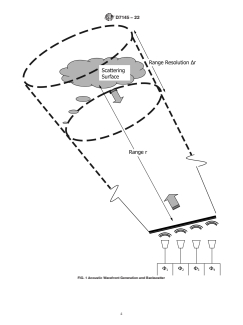
6.2 Description of Operation. A phased array monostatic sodar emits acoustic pulses (adiabatic compression waves) at a transmit
frequency or frequencies. Pulses from each antenna are formed into a conical beam or wavefront with its vertex at the antenna.
Individual transducer pulse timing or phase shifting methods, indicated by Φ in Fig. 1, are used to shape the beam and steer it in
the desired direction. As it travels along a radial direction through the atmosphere at speed of sound (c), this acoustic wave
experiences attenuation by spreading, absorption, and scattering as described below. Temperature inhomogeneities and sharp
gradients encountered by the propagating beam deform and scatter the beam. Wind velocity components along the axis of
propagation also Doppler- shift the acoustic frequency of backscattered signals. A schematic drawing of acoustic wavefront
generation and backscatter from a reflecting surface is presented in Fig. 1. After its transmission of an acoustic pulse train, the sodar
switches to listening mode for backscattered acoustic signals. Returning signals are characterized by their intensity (amplitude),
spectral width, Doppler-shifted frequency, and lapsedelapsed time (t) from initial pulse transmission. Returns from lower heights
are received sooner than returns from greater heights. The relationship between lapsedelapsed time (t), speed of sound (c), and
radial range (r) to the scattering surface is given by:
r 5 ct/2 (1)
The boldface numbers in parentheses refer to the list of references at the end of this standard.
D7145 − 22
FIG. 1 Acoustic Wavefront Generation and Backscatter
D7145 − 22
where the factor of 2 accounts for travel along outward propagating and return paths. Wind profiling sodars that transmit a
minimum of three radial beams resolve horizontal and vertical wind components. Assuming homogeneity in the wind field above
the sodar, trigonometry is used to resolve distance along each radial, which is then converted to height above the sodar antenna.
The user is then presented with a vertical profile of wind, turbulence, and signal strength information. Height ranging, range
resolution, and signal quality are functions of sodar performance and its operating environment, as described below.
6.3 The Sodar Equation. The power received (P ) by a sodar’s acoustic antenna is a product of sodar performance and atmospheric
r
attenuation factors. Sodar performance factors include effective transmitted power (P ) at its transmitted frequency(ies), effective
t
antenna aperture (A ), transmitter and receiver efficiency factors (ε and ε ), and pulse length (τ). Atmospheric scattering factors
e T R
include the acoustic scattering crossection (σ) and attenuation factors φ and φ . Attenuation factor φ represents “classical”
m x m
viscous losses plus the combination of molecular rotational and vibrational absorption. The second factor (φ ) represents excess
x
attenuation due to complex interactions of the acoustic beam with larger scale atmospheric features. The sodar performance and
atmospheric factors are combined in a simplified monostatic sodar equation for received power:
P 5 sodar performance atmospheric factors 5 P A ε ε cτ/2 σφ φ (2)
$ % $ % $~ ! ~ ! ~ !% $ %
r t e T R m x
6.4 Sodar Performance. Sodar performance characteristics include the sodar transmitted acoustic power, and the efficiency with
which power is transmitted and received. P A is the power-aperture product. A = AG ⁄r is the solid angle subtended by an
t e e
antenna of aperture (A, m ) multiplied by the effective aperture factor (G, the antenna’s gain), as viewed at range (r) from the
scattering volume. Range resolution (Δr = cτ/2) is the length (m), along the radial axis of signal propagation, of the instantaneous
scattering volume and defines the volume from which a backscattered signal is resolved. Note that range resolution determines
range gate thickness. Scattering surfaces that produce useful acoustic returns often occupy only a fraction of the scattering volume
in the real atmosphere (see Fig. 1 and 6.6). The magnitude of the returned signals is directly proportional to the percentage of the
scattering volume occupied by scattering surfaces and the intensity of the turbulence (C ) producing the return.
T
6.5 Pulse Length and Inter Pulse Period (IPP). Pulse length and IPP (t ) define height and velocity limits for valid sodar signals.
max
Pulse length and system settling time (time of recovery from the state of excitation during pulse transmission) determine the
minimum height (first range gate) from which backscattered signals can be received. IPP determines the maximum range from
which unambiguous backscattered returns are received. If all measurable returns are not received prior to the initiation of the next
pulse, it is possible that returns from the earlier pulse will be received in the same time period as returns from the new pulse. This
causes an ambiguous signal known as range aliasing. Because t represents the maximum time between pulses, the maximum
max
unambiguous range is defined by:
r 5 ct /2 (3)
max max
Any returns from targets beyond r will appear as spurious signals in a range gate intended for returns from the subsequent
max
pulse. Like r , Doppler shifted velocity measurements can be unambiguously determined only within certain limits. The
max
frequency limits over which the Doppler shift can be unambiguously determined depends on t , which should be as high as
max
needed to unambiguously sample the maximum anticipated velocity. Thus, a sodar’s maximum and minimum range, range
resolution, and maximum velocity range are defined by τ and t settings and the transmitted central frequency. Some sodars are
max
designed to operate using pulse coding with multiple central frequencies. This feature helps distinguish backscattered signal from
clutter and enhances the probability of useful returns.
6.6 Attenuation by Absorption. Absorption reduces the radiated power of a propagating acoustic wave through viscous losses, and
by the excitation of rotational and vibrational modes in atmospheric gases (6). The excitation of atmospheric gases is strongly
dampened by the presence of atmospheric water vapor. Thus, sodar performance is enhanced in moist rather than dry environments.
–2âr
Combined absorption effects are represented by the viscous and molecular attenuation factor φ = e . This factor contains the
m
product of â, the molecular and viscous absorption coefficient, with range. Note that distances from the transmitter to the range
gate and from the range gate to the receiver are assumed to be the same. This is true for a monostatic sodar, but range distances
can vary for bistatic configurations.
6.7 Excess Attenuation. An additional factor known as excess attenuation φ , usually manifested as excessive beam spreading and
x
loss of returned acoustic power, is also present in the atmosphere. Excess attenuation is highly variable in magnitude and duration
due to the complex interactions between transient shear and turbulence effects with a propagating acoustic wavefront and its path
geometry (7,8). Excess attenuation increases with the wind speed, turbulence level, and acoustic frequency, but decreases with
increasing beamwidth.
6.8 Scatter. Scatter disperses propagating acoustic signal power, but also produces the sodar’s returned (backscattered) signal.
D7145 − 22
Scattering happens as acoustic wavefronts propagating through the atmosphere encounter perturbations in the acoustic refractive
index caused by turbulent patches of air containing temperature gradients. The magnitude of this turbulence is represented by the
temperature structure parameter C . Refractive index inhomogeneities most effectively scatter acoustic energy of twice their
T
wavelength. Energy propagating along one direction is scattered over many directions when it encounters a scattering surface, but
the magnitude of the off-axis power loss during a scattering event is usually much smaller than the incident power. Therefore, most
of the acoustic power continues to propagate along its original path. This Born “single scatter” approximation (6) also applies to
backscattered signals. Most back-scattered signals are expected to reach the receiver without being completely dispersed by
multiple scattering. Acoustic scattering cross-section per unit volume (σ) defines the fraction of incident power at frequency (f)
backscattered per unit distance. For a monostatic sodar, σ is represented by (9):
0.333 2 2
σ5 0.0039 2πf/c C /T (4)
~ !
T K
where T is the absolute temperature in Kelvins. Monostatic sodars rely on returns from the atmosphere’s thermal gradients,
K
while returns to bistatic sodars are enhanced by additional scatter from velocity fluctuations. Thermal gradients and turbulence is
often weak during the transition periods through sunrise and sunset, which degrades the performance of monostatic sodars during
these times.
6.9 Acoustic Wavelength and Frequency. Acoustic beams of wavelength λ and frequency (f) propagating through the atmosphere
can be characterized in terms of amplitude and phase. Amplitude is in proportion to the energy content or strength (intensity) of
an acoustic pulse, and phase refers to the position of a point along the wave relative to a chosen reference. Phase is expressed in
circular units, with a complete wave corresponding to 360° or 2π radians. Wavelength is the distance between two consecutive
points of the same phase along the wave. Frequency is the number of wavelengths that pass a measurement point per unit time,
which is usually measured in cycles per second or Hertz (Hz). The relationship between frequency, wavelength, and speed of sound
–1
(c, nominally 340 ms ) is:
fλ5 c (5)
6.10 The Doppler Effect. The Doppler effect is created by the action of reflecting surface (target) motion on a propagating acoustic
beam. Target velocity (V ) is considered positive if it is moving away fro
...