

ASTM D8445-22a
(Practice)Standard Practice for Measuring Chemical Emissions from Spray Polyurethane Foam (SPF) Insulation Samples in a Large-scale Ventilated Enclosure
General Information
- Abstract
SIGNIFICANCE AND USE
5.1 The demand for SPF insulation in homes and commercial buildings has increased as emphasis on energy efficiency increases. In an effort to protect the health and safety of both trade workers and building occupants due to the application of SPF, it is essential that reentry/reoccupancy-times into the structure where SPF has been applied, be established.
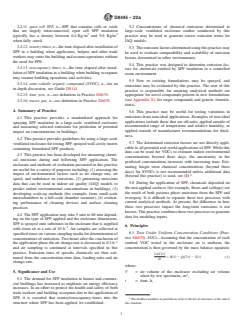
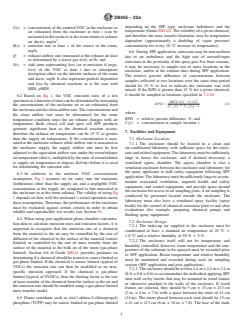
5.2 Concentrations of chemical emissions determined in large-scale ventilated enclosure studies conducted by this practice may be used to generate source emission terms for IAQ models.
5.3 The emission factors determined using this practice may be used to evaluate comparability and scalability of emission factors determined in other environments.
5.4 This practice was designed to determine emission factors for chemicals emitted by SPF insulation in a controlled room environment.
5.5 New or existing formulations may be sprayed, and emissions may be evaluated by this practice. The user of this practice is responsible for ensuring analytical methods are appropriate for novel compounds present in new formulations (see Appendix X1 for target compounds and generic formulations).
5.6 This practice may be useful for testing variations in emissions from non-ideal applications. Examples of non-ideal applications include those that are off-ratio, applied outside of recommended range of temperature and relative humidity, or applied outside of manufacturer recommendations for thickness.
5.7 The determined emission factors are not directly applicable to all potential real-world applications of SPF. While this data can be used for VOCs to estimate indoor environmental concentrations beyond three days, the uncertainty in the predicted concentrations increases with increasing time. Estimating longer term chemical concentrations (beyond three days) for SVOCs is not recommended unless additional data (beyond this practice) is used, see (1).4
5.8 During the application of SPF, chemicals deposited on the non-applie...
SCOPE
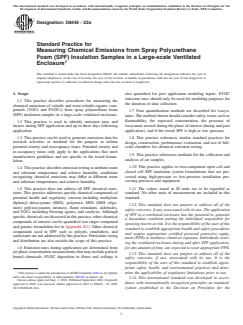
1.1 This practice describes procedures for measuring the chemical emissions of volatile and semi-volatile organic compounds (VOCs and SVOCs) from spray polyurethane foam (SPF) insulation samples in a large-scale ventilated enclosure.
1.2 This practice is used to identify emission rates and factors during SPF application and up to three days following application.
1.3 This practice can be used to generate emissions data for research activities or modeled for the purpose to inform potential reentry and reoccupancy times. Potential reentry and re-occupancy times only apply to the applications that meet manufacturer guidelines and are specific to the tested formulation.
1.4 This practice describes emission testing at ambient room and substrate temperature and relative humidity conditions recognizing chemical emissions may differ at different room and substrate temperatures and relative humidity.
1.5 This practice does not address all SPF chemical emissions. This practice addresses specific chemical compounds of potential health and regulatory concern including methylene diphenyl diisocyanate (MDI), polymeric MDI (MDI oligomeric polyisocyanates mixture), flame retardants, aldehydes, and VOCs including blowing agents, and catalysts. Although specific chemicals are discussed in this practice, other chemical compounds of interest can be quantified (see target compound and generic formulation list in Appendix X1). Other chemical compounds used in SPF such as polyols, emulsifiers, and surfactants are not addressed by this practice. Particulate sizing and distribution are also outside the scope of this practice.
1.6 Emission rates during application are determined from air phase concentration measurements that may include particle bound chemicals. SVOC deposition to floors and ceilings is also quantified for post application modeling inputs. SVOC emission rates should only be used for modeling purposes for the durati...
- Status
- Published
- Publication Date
- 31-Aug-2022
- Technical Committee
- D22 - Air Quality
- Drafting Committee
- D22.05 - Indoor Air
Buy Documents
ASTM D8445-22a - Standard Practice for Measuring Chemical Emissions from Spray Polyurethane Foam (SPF) Insulation Samples in a Large-scale Ventilated Enclosure
REDLINE ASTM D8445-22a - Standard Practice for Measuring Chemical Emissions from Spray Polyurethane Foam (SPF) Insulation Samples in a Large-scale Ventilated Enclosure
Overview
ASTM D8445-22a is the Standard Practice for Measuring Chemical Emissions from Spray Polyurethane Foam (SPF) Insulation Samples in a Large-Scale Ventilated Enclosure. Developed by ASTM International, this standard provides a systematic method for evaluating the volatile and semi-volatile organic compound (VOC and SVOC) emissions produced during and after the application of SPF insulation. As the use of SPF insulation in both residential and commercial buildings rises to meet energy efficiency goals, understanding and controlling chemical emissions has become critical for occupant and worker safety.
By establishing procedures for controlled testing within a large-scale ventilated enclosure, ASTM D8445-22a supports evidence-based decisions about proper reentry and reoccupancy times after SPF installation-helping mitigate risks associated with exposure to potentially hazardous chemicals such as methylene diphenyl diisocyanate (MDI), flame retardants, aldehydes, and other VOCs.
Key Topics
- Emission Measurement Protocols: Guides the setup and use of large-scale ventilated enclosures for consistent chemical emissions testing.
- Target Chemicals: Focuses on health- and regulation-relevant compounds including MDI, polymeric MDI, flame retardants, aldehydes, and various VOCs (e.g., blowing agents, catalysts).
- Sampling Methods: Outlines validated procedures for collecting and analyzing air samples during and after SPF application, using a range of industry-standard analytical techniques.
- Environmental Parameters: Requires monitoring of room and substrate temperature, relative humidity, and ventilation rates, as chemical emissions can be significantly impacted by these factors.
- Data Use for Models: Emission factors generated are suitable for indoor air quality (IAQ) modeling, enabling better prediction of indoor pollutant concentrations and their impacts.
- Applicability to Various SPF Types: Supports evaluation of both open-cell and closed-cell SPF insulation systems, processed with high- or low-pressure equipment.
- Non-Ideal Applications: Provides for testing under off-ratio mixing, non-optimal temperatures or humidity, and other conditions outside manufacturer recommendations.
Applications
Practical uses of ASTM D8445-22a include:
- Indoor Air Quality Assessment: Generating data to predict VOC and SVOC concentrations post-SPF installation, supporting healthier indoor environments.
- Reentry and Reoccupancy Guidance: Informing safe timeframes for workers and building occupants to return following SPF application, minimizing unnecessary exposure.
- Regulatory Compliance: Demonstrating adherence to national and local guidelines for IAQ and chemical exposure, aiding permitting and certification processes.
- Product Development and Evaluation: Testing new SPF formulations or comparing emission performance across products under controlled, repeatable conditions.
- Research and Modeling: Supplying data for academic and industry research on emission rates, scalability across different test environments, and model development for real-world scenarios.
Related Standards
Several other ASTM and international standards complement or provide reference methods for use with ASTM D8445-22a:
- ASTM D5116: Guide for Small-Scale Environmental Chamber Determinations of Organic Emissions from Indoor Materials/Products
- ASTM D6670: Practice for Full-Scale Chamber Determination of Volatile Organic Emissions from Indoor Materials/Products
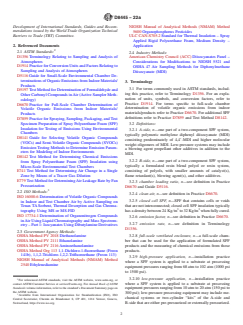
- ASTM D7859: Practice for Spraying, Sampling, Packaging, and Test Specimen Preparation of SPF Insulation for Emissions Testing
- ASTM D8141/D8142: Selection of VOC and SVOC Emission Testing Methods; Test Method for Determining Chemical Emissions from SPF Using Micro-Scale Chambers
- ISO 16000-6 & ISO 17734-1: Methods for Determination of VOCs in indoor and chamber air, and isocyanates in air, respectively
- OSHA and NIOSH Methods: Includes specific sampling and analysis techniques referenced for certain target compounds
By adhering to ASTM D8445-22a, industry professionals ensure a consistent, scientifically sound approach to chemical emission measurement from SPF insulation, significantly contributing to healthier buildings and safer work environments.
Relations
- Effective Date
- 01-Sep-2023
- Effective Date
- 01-Sep-2020
- Effective Date
- 15-Mar-2020
- Effective Date
- 01-Jan-2019
- Effective Date
- 01-Jan-2019
- Effective Date
- 01-Sep-2018
- Refers
ASTM E779-10(2018) - Standard Test Method for Determining Air Leakage Rate by Fan Pressurization - Effective Date
- 15-Jul-2018
- Effective Date
- 01-Nov-2017
- Effective Date
- 01-Oct-2017
- Effective Date
- 01-Oct-2017
- Effective Date
- 15-Oct-2015
- Effective Date
- 01-Jul-2015
- Effective Date
- 01-Dec-2014
- Effective Date
- 01-May-2014
- Effective Date
- 15-Jan-2014
Buy Documents
ASTM D8445-22a - Standard Practice for Measuring Chemical Emissions from Spray Polyurethane Foam (SPF) Insulation Samples in a Large-scale Ventilated Enclosure
REDLINE ASTM D8445-22a - Standard Practice for Measuring Chemical Emissions from Spray Polyurethane Foam (SPF) Insulation Samples in a Large-scale Ventilated Enclosure
Get Certified
Connect with accredited certification bodies for this standard

DIBt (Deutsches Institut für Bautechnik)
German Institute for Building Technology.
DIN CERTCO
DIN Group product certification.

Kiwa BDA Testing
Building and construction product certification.
Sponsored listings
Frequently Asked Questions
ASTM D8445-22a is a standard published by ASTM International. Its full title is "Standard Practice for Measuring Chemical Emissions from Spray Polyurethane Foam (SPF) Insulation Samples in a Large-scale Ventilated Enclosure". This standard covers: SIGNIFICANCE AND USE 5.1 The demand for SPF insulation in homes and commercial buildings has increased as emphasis on energy efficiency increases. In an effort to protect the health and safety of both trade workers and building occupants due to the application of SPF, it is essential that reentry/reoccupancy-times into the structure where SPF has been applied, be established. 5.2 Concentrations of chemical emissions determined in large-scale ventilated enclosure studies conducted by this practice may be used to generate source emission terms for IAQ models. 5.3 The emission factors determined using this practice may be used to evaluate comparability and scalability of emission factors determined in other environments. 5.4 This practice was designed to determine emission factors for chemicals emitted by SPF insulation in a controlled room environment. 5.5 New or existing formulations may be sprayed, and emissions may be evaluated by this practice. The user of this practice is responsible for ensuring analytical methods are appropriate for novel compounds present in new formulations (see Appendix X1 for target compounds and generic formulations). 5.6 This practice may be useful for testing variations in emissions from non-ideal applications. Examples of non-ideal applications include those that are off-ratio, applied outside of recommended range of temperature and relative humidity, or applied outside of manufacturer recommendations for thickness. 5.7 The determined emission factors are not directly applicable to all potential real-world applications of SPF. While this data can be used for VOCs to estimate indoor environmental concentrations beyond three days, the uncertainty in the predicted concentrations increases with increasing time. Estimating longer term chemical concentrations (beyond three days) for SVOCs is not recommended unless additional data (beyond this practice) is used, see (1).4 5.8 During the application of SPF, chemicals deposited on the non-applie... SCOPE 1.1 This practice describes procedures for measuring the chemical emissions of volatile and semi-volatile organic compounds (VOCs and SVOCs) from spray polyurethane foam (SPF) insulation samples in a large-scale ventilated enclosure. 1.2 This practice is used to identify emission rates and factors during SPF application and up to three days following application. 1.3 This practice can be used to generate emissions data for research activities or modeled for the purpose to inform potential reentry and reoccupancy times. Potential reentry and re-occupancy times only apply to the applications that meet manufacturer guidelines and are specific to the tested formulation. 1.4 This practice describes emission testing at ambient room and substrate temperature and relative humidity conditions recognizing chemical emissions may differ at different room and substrate temperatures and relative humidity. 1.5 This practice does not address all SPF chemical emissions. This practice addresses specific chemical compounds of potential health and regulatory concern including methylene diphenyl diisocyanate (MDI), polymeric MDI (MDI oligomeric polyisocyanates mixture), flame retardants, aldehydes, and VOCs including blowing agents, and catalysts. Although specific chemicals are discussed in this practice, other chemical compounds of interest can be quantified (see target compound and generic formulation list in Appendix X1). Other chemical compounds used in SPF such as polyols, emulsifiers, and surfactants are not addressed by this practice. Particulate sizing and distribution are also outside the scope of this practice. 1.6 Emission rates during application are determined from air phase concentration measurements that may include particle bound chemicals. SVOC deposition to floors and ceilings is also quantified for post application modeling inputs. SVOC emission rates should only be used for modeling purposes for the durati...
SIGNIFICANCE AND USE 5.1 The demand for SPF insulation in homes and commercial buildings has increased as emphasis on energy efficiency increases. In an effort to protect the health and safety of both trade workers and building occupants due to the application of SPF, it is essential that reentry/reoccupancy-times into the structure where SPF has been applied, be established. 5.2 Concentrations of chemical emissions determined in large-scale ventilated enclosure studies conducted by this practice may be used to generate source emission terms for IAQ models. 5.3 The emission factors determined using this practice may be used to evaluate comparability and scalability of emission factors determined in other environments. 5.4 This practice was designed to determine emission factors for chemicals emitted by SPF insulation in a controlled room environment. 5.5 New or existing formulations may be sprayed, and emissions may be evaluated by this practice. The user of this practice is responsible for ensuring analytical methods are appropriate for novel compounds present in new formulations (see Appendix X1 for target compounds and generic formulations). 5.6 This practice may be useful for testing variations in emissions from non-ideal applications. Examples of non-ideal applications include those that are off-ratio, applied outside of recommended range of temperature and relative humidity, or applied outside of manufacturer recommendations for thickness. 5.7 The determined emission factors are not directly applicable to all potential real-world applications of SPF. While this data can be used for VOCs to estimate indoor environmental concentrations beyond three days, the uncertainty in the predicted concentrations increases with increasing time. Estimating longer term chemical concentrations (beyond three days) for SVOCs is not recommended unless additional data (beyond this practice) is used, see (1).4 5.8 During the application of SPF, chemicals deposited on the non-applie... SCOPE 1.1 This practice describes procedures for measuring the chemical emissions of volatile and semi-volatile organic compounds (VOCs and SVOCs) from spray polyurethane foam (SPF) insulation samples in a large-scale ventilated enclosure. 1.2 This practice is used to identify emission rates and factors during SPF application and up to three days following application. 1.3 This practice can be used to generate emissions data for research activities or modeled for the purpose to inform potential reentry and reoccupancy times. Potential reentry and re-occupancy times only apply to the applications that meet manufacturer guidelines and are specific to the tested formulation. 1.4 This practice describes emission testing at ambient room and substrate temperature and relative humidity conditions recognizing chemical emissions may differ at different room and substrate temperatures and relative humidity. 1.5 This practice does not address all SPF chemical emissions. This practice addresses specific chemical compounds of potential health and regulatory concern including methylene diphenyl diisocyanate (MDI), polymeric MDI (MDI oligomeric polyisocyanates mixture), flame retardants, aldehydes, and VOCs including blowing agents, and catalysts. Although specific chemicals are discussed in this practice, other chemical compounds of interest can be quantified (see target compound and generic formulation list in Appendix X1). Other chemical compounds used in SPF such as polyols, emulsifiers, and surfactants are not addressed by this practice. Particulate sizing and distribution are also outside the scope of this practice. 1.6 Emission rates during application are determined from air phase concentration measurements that may include particle bound chemicals. SVOC deposition to floors and ceilings is also quantified for post application modeling inputs. SVOC emission rates should only be used for modeling purposes for the durati...
ASTM D8445-22a is classified under the following ICS (International Classification for Standards) categories: 13.040.01 - Air quality in general; 91.100.60 - Thermal and sound insulating materials. The ICS classification helps identify the subject area and facilitates finding related standards.
ASTM D8445-22a has the following relationships with other standards: It is inter standard links to ASTM D8142-23, ASTM D1356-20a, ASTM D1356-20, ASTM D7859-19, ASTM E779-19, ASTM D6670-18, ASTM E779-10(2018), ASTM D5116-17, ASTM D8142-17e1, ASTM D8142-17, ASTM D1356-15a, ASTM D1356-15, ASTM D1356-14b, ASTM D1356-14a, ASTM D1356-14. Understanding these relationships helps ensure you are using the most current and applicable version of the standard.
ASTM D8445-22a is available in PDF format for immediate download after purchase. The document can be added to your cart and obtained through the secure checkout process. Digital delivery ensures instant access to the complete standard document.
Standards Content (Sample)
This international standard was developed in accordance with internationally recognized principles on standardization established in the Decision on Principles for the
Development of International Standards, Guides and Recommendations issued by the World Trade Organization Technical Barriers to Trade (TBT) Committee.
Designation: D8445 − 22a
Standard Practice for
Measuring Chemical Emissions from Spray Polyurethane
Foam (SPF) Insulation Samples in a Large-scale Ventilated
Enclosure
This standard is issued under the fixed designation D8445; the number immediately following the designation indicates the year of
original adoption or, in the case of revision, the year of last revision.Anumber in parentheses indicates the year of last reapproval.A
superscript epsilon (´) indicates an editorial change since the last revision or reapproval.
1. Scope also quantified for post application modeling inputs. SVOC
emission rates should only be used for modeling purposes for
1.1 This practice describes procedures for measuring the
the duration of data collection.
chemical emissions of volatile and semi-volatile organic com-
pounds (VOCs and SVOCs) from spray polyurethane foam
1.7 Four quantification methods are described for isocya-
(SPF) insulation samples in a large-scale ventilated enclosure.
nates.Themethodchosenshouldconsidersafetyissuessuchas
flammability, the expected concentration, the presence of
1.2 This practice is used to identify emission rates and
isocyanateaerosolduringthephaseofinterest(duringandpost
factors during SPF application and up to three days following
application), and if the tested SPF is high or low pressure.
application.
1.3 This practice can be used to generate emissions data for
1.8 This practice references similar standard practices for
research activities or modeled for the purpose to inform
design, construction, performance evaluation, and use of full-
potential reentry and reoccupancy times. Potential reentry and
scale chambers for chemical emission testing.
re-occupancy times only apply to the applications that meet
1.9 This practice references methods for the collection and
manufacturer guidelines and are specific to the tested formu-
analysis of air samples.
lation.
1.10 This practice applies to two-component open cell and
1.4 Thispracticedescribesemissiontestingatambientroom
closed cell SPF insulation system formulations that are pro-
and substrate temperature and relative humidity conditions
cessed using high-pressure or low-pressure installation pro-
recognizing chemical emissions may differ at different room
cessing practices and equipment.
and substrate temperatures and relative humidity.
1.5 This practice does not address all SPF chemical emis-
1.11 The values stated in SI units are to be regarded as
sions. This practice addresses specific chemical compounds of standard. No other units of measurement are included in this
potential health and regulatory concern including methylene
standard.
diphenyl diisocyanate (MDI), polymeric MDI (MDI oligo-
1.12 This standard does not purport to address all of the
meric polyisocyanates mixture), flame retardants, aldehydes,
safety concerns, if any, associated with its use. The application
and VOCs including blowing agents, and catalysts. Although
of SPF in a ventilated enclosure has the potential to generate
specificchemicalsarediscussedinthispractice,otherchemical
a hazardous condition putting the individual responsible for
compounds of interest can be quantified (see target compound
sprayinginsertsatrisk.Itistheresponsibilityoftheuserofthis
and generic formulation list in Appendix X1). Other chemical
standard to establish appropriate health and safety procedures
compounds used in SPF such as polyols, emulsifiers, and
and require appropriate certified personal protective equip-
surfactantsarenotaddressedbythispractice.Particulatesizing
ment (PPE) to minimize chemical exposure. Individuals enter-
and distribution are also outside the scope of this practice.
ing the ventilated enclosure during and after SPF application,
1.6 Emission rates during application are determined from
for any amount of time, are expected to wear appropriate PPE.
airphaseconcentrationmeasurementsthatmayincludeparticle
1.13 This standard does not purport to address all of the
bound chemicals. SVOC deposition to floors and ceilings is
safety concerns, if any, associated with its use. It is the
responsibility of the user of this standard to establish appro-
priate safety, health, and environmental practices and deter-
ThispracticeisunderthejurisdictionofASTMCommitteeD22onAirQuality mine the applicability of regulatory limitations prior to use.
and is the direct responsibility of Subcommittee D22.05 on Indoor Air.
1.14 This international standard was developed in accor-
Current edition approved Sept. 1, 2022. Published September 2022. Originally
dance with internationally recognized principles on standard-
approved in 2022. Last previous edition approved in 2022 as D8445– 22. DOI:
10.1520/D8445-22A. ization established in the Decision on Principles for the
Copyright © ASTM International, 100 Barr Harbor Drive, PO Box C700, West Conshohocken, PA 19428-2959. United States
D8445 − 22a
Development of International Standards, Guides and Recom- NIOSH Manual of Analytical Methods (NMAM) Method
mendations issued by the World Trade Organization Technical 5600Organophosphorus Pesticides
Barriers to Trade (TBT) Committee.
ULC CAN-S705.2Standard for Thermal Insulation – Spray
Applied Rigid Polyurethane Foam, Medium Density –
2. Referenced Documents
Application
2.1 ASTM Standards:
2.4 Industry Methods:
D1356Terminology Relating to Sampling and Analysis of
American Chemistry Council (ACC)Diisocyanates Panel –
Atmospheres
Considerations for Modifications to NIOSH 5521 and
D1914PracticeforConversionUnitsandFactorsRelatingto
OSHA 47 Air Sampling Methods for Diphenylmethane
Sampling and Analysis of Atmospheres
Diisocyanate (MDI)
D5116Guide for Small-Scale Environmental Chamber De-
terminationsofOrganicEmissionsfromIndoorMaterials/
3. Terminology
Products
3.1 For terms commonly used in ASTM standards, includ-
D5197TestMethodforDeterminationofFormaldehydeand
ing this practice, refer to Terminology D1356. For an expla-
OtherCarbonylCompoundsinAir(ActiveSamplerMeth-
nation of units, symbols, and conversion factors, refer to
odology)
Practice D1914. For terms specific to full-scale chamber
D6670Practice for Full-Scale Chamber Determination of
determination of volatile organic emissions from indoor
Volatile Organic Emissions from Indoor Materials/
materials/products refer to Practice D6670. For additional SPF
Products
definitions refer to Practice D7859 and Test Method D8142.
D7859PracticeforSpraying,Sampling,Packaging,andTest
Specimen Preparation of Spray Polyurethane Foam (SPF)
3.2 Definitions:
Insulation for Testing of Emissions Using Environmental
3.2.1 A-side, n—one part of a two-component SPF system,
Chambers
typically polymeric methylene diphenyl diisocyanate (MDI)
D8141Guide for Selecting Volatile Organic Compounds
consisting predominately of 4,4’-MDI and higher molecular
(VOCs) and Semi-Volatile Organic Compounds (SVOCs)
weight oligomers of MDI. Low-pressure systems may include
EmissionTesting Methods to Determine Emission Param-
a blowing agent propellant other additives in addition to the
eters for Modeling of Indoor Environments
MDI.
D8142Test Method for Determining Chemical Emissions
3.2.2 B-side, n—one part of a two-component SPF system,
from Spray Polyurethane Foam (SPF) Insulation using
typically a formulated resin blend polyol or resin system,
Micro-Scale Environmental Test Chambers
consisting of polyols, with smaller amounts of catalyst(s),
E741Test Method for Determining Air Change in a Single
flame retardant(s), blowing agent(s), and other additives.
Zone by Means of a Tracer Gas Dilution
E779TestMethodforDeterminingAirLeakageRatebyFan
3.2.3 chamber loading ratio, n—see definition in Practice
Pressurization
D6670 and Guide D5116.
2.2 ISO Methods:
3.2.4 clean air, n—see definition in Practice D6670.
ISO 16000-6Determination ofVolatile Organic Compounds
3.2.5 closed cell SPF, n—SPF that contains cells or voids
in Indoor and Test Chamber Air by Active Sampling on
thatarenotinterconnected;closedcellSPFinsulationtypically
Tenax TASorbent, Thermal Desorption and Gas Chroma-
3 3
hasadensitybetween24Kg⁄m to32Kg/m whenfullycured.
tography Using MS or MS-FID
ISO 17734-1Determination of Organonitrogen Compounds
3.2.6 emission factor, n—see definition in Practice D6670.
inAirUsingLiquidChromatographyandMassSpectrom-
3.2.7 emission rate, n—see definition in Terminology
etry–Part1:IsocyanatesUsingDibutylamineDerivatives
D1356.
2.3 Government Agency Methods:
OSHA Method PV 2018Diethanolamine 3.2.8 full-scale ventilated enclosure, n—a full-scale cham-
ber that can be used for the application of formulated SPF
OSHA Method PV 2111Ethanolamine
OSHA Method PV 2116Aminoethanolamine products and the measuring of chemical emissions from those
products.
OSHA Method Org 1131,1-Dichloro-1-fluoroethane (Freon
141b), 1,1,2-Trichloro-1,2,2-Trifluoroethane (Freon 113)
3.2.9 high-pressure application, n—installation practice
NIOSH Manual of Analytical Methods (NMAM) Method
where a SPF system is applied to a substrate at processing
2540Ethylenediamine
equipmentpressuresrangingfrom68atmto102atm(1000psi
to 1500 psi).
3.2.10 low-pressure application, n—installation practice
For referenced ASTM standards, visit the ASTM website, www.astm.org, or
where a SPF system is applied to a substrate at processing
contact ASTM Customer Service at service@astm.org. For Annual Book of ASTM
Standards volume information, refer to the standard’s Document Summary page on
equipmentpressuresrangingfrom10atmto20atm(150psito
the ASTM website.
300psi); low-pressure processing equipment may include me-
Available from International Organization for Standardization (ISO), ISO
chanical systems or two-cylinder “kits” of the A-side and
Central Secretariat, Chemin de Blandonnet 8, CP 401, 1214 Vernier, Geneva,
Switzerland, https://www.iso.org. B-side that are either pre-pressurized or externally pressurized.
D8445 − 22a
3.2.11 open cell SPF, n—SPF that contains cells or voids 5.2 Concentrations of chemical emissions determined in
that are largely interconnected; open cell SPF insulation large-scale ventilated enclosure studies conducted by this
3 3
typically has a density between 6.4Kg⁄m and 9.6 Kg/m practice may be used to generate source emission terms for
when fully cured. IAQ models.
3.2.12 reentrytimes,n—thetimeelapsedafterinstallationof
5.3 Theemissionfactorsdeterminedusingthispracticemay
SPF in a building when applicators, helpers and other trade
be used to evaluate comparability and scalability of emission
workers may enter the building and resume operations without
factors determined in other environments.
the need for PPE.
5.4 This practice was designed to determine emission fac-
3.2.13 reoccupancy times, n—the time elapsed after instal-
tors for chemicals emitted by SPF insulation in a controlled
lation of SPF insulation in a building when building occupants
room environment.
may resume building operations and activities.
5.5 New or existing formulations may be sprayed, and
3.2.14 semi-volatile organic compound (SVOC), n—for an
emissions may be evaluated by this practice. The user of this
in-depth discussion, see Guide D8141.
practice is responsible for ensuring analytical methods are
3.2.15 time zero, n—see definition in Practice D6670.
appropriate for novel compounds present in new formulations
(see Appendix X1 for target compounds and generic formula-
3.2.16 tracer gas, n—see definition in Practice D6670.
tions).
4. Summary of Practice
5.6 This practice may be useful for testing variations in
emissions from non-ideal applications. Examples of non-ideal
4.1 This practice provides a standardized approach for
applications include those that are off-ratio, applied outside of
spraying SPF insulation in a large-scale ventilated enclosure
recommended range of temperature and relative humidity, or
and measuring selected emissions for prediction of potential
applied outside of manufacturer recommendations for thick-
impact on concentrations in buildings.
ness.
4.2 This practice provides guidelines for using a large-scale
5.7 The determined emission factors are not directly appli-
ventilatedenclosurefortestingSPF-sprayedwallcavityinserts
cabletoallpotentialreal-worldapplicationsofSPF.Whilethis
containing formulated SPF products.
data can be used for VOCs to estimate indoor environmental
4.3 This practice has been developed for measuring chemi-
concentrations beyond three days, the uncertainty in the
cal emissions during and following SPF application. The
predicted concentrations increases with increasing time. Esti-
enclosure and methods of evaluation presented in this practice
mating longer term chemical concentrations (beyond three
are useful for a variety of purposes including: (1) assessing the
days) for SVOCs is not recommended unless additional data
impact of environmental factors such as air change rate, air
(beyond this practice) is used, see (1).
speed, and turbulence on emissions, (2) generating emissions
5.8 During the application of SPF, chemicals deposited on
data that can be used in indoor air quality (IAQ) models to
the non-applied surfaces (for example, floors and ceilings) are
predict indoor environmental concentrations in buildings, (3)
the result of both gaseous phase emissions from the SPF and
developing scale-up methods (for example, from small-scale
overspray. It is difficult to separate these two processes with
microchambers to a full-scale chamber scenario), (4) evaluat-
current analytical methods. At present, the difference in how
ing performance of cleaning devices and surface cleaning
these two processes impact the long-term emissions is not
practices.
known.Thispracticecombinesthesetwoprocessestogenerate
4.4 The SPF application may take 5min to 60min depend-
data for modeling inputs.
ing on the type of SPF applied and the enclosure dimensions.
SPF is sprayed onto substrates in the enclosure that is supplied
6. Principles
–1
with clean air at a rate of 10 h . Air samples are collected at
6.1 Tests Under Uniform Concentration Conditions (Prac-
specifiedtimesonvarioussamplingmediafordeterminationof
tice D6670)–VOCs—Assuming that the concentration of each
concentrations of emissions.Two hours after the conclusion of
–1
emitted VOC tested in the enclosure air is uniform, the
theapplicationphasetheairchangerateisdecreasedto0.3h
and air sampling is continued at intervals specified in this concentration is then governed by the mass balance equation:
practice. Emission rates of specific chemicals are then esti-
VdC t
~ !
5 R~t! 2QC~t! 2 S~t! (1)
mated from the concentration-time data, loading ratio and air
dt
change rate.
where:
V = air volume of the enclosure excluding air volume
5. Significance and Use
taken by test specimens, m ,
5.1 The demand for SPF insulation in homes and commer-
t = time, h,
cial buildings has increased as emphasis on energy efficiency
increases. In an effort to protect the health and safety of both
trade workers and building occupants due to the application of
SPF, it is essential that reentry/reoccupancy-times into the
Theboldfacenumbersinparenthesesrefertothelistofreferencesattheendof
structure where SPF has been applied, be established. this standard.
D8445 − 22a
depending on the SPF type, enclosure turbulence and the
C(t) = concentration of the emitted VOC in the enclosure or
temperature(GuideD8141).Thevolatilityofagivenchemical,
air exhausted from the enclosure at time t (can be
and therefore the mass transfer limitation, may be temperature
measuredintheroomorattheroomreturnorexhaust
dependent (approximately a doubling of vapor pressure/
air ducts), mg/m ,
concentration for every 10 °C increase in temperature).
R(t) = emission rate at time t, of the source in the room,
mg/h,
6.6 During SPF application, emissions may be non-uniform
Q = exhaust airflow rate (measured at the exhaust air duct
due to air turbulence and the high rate of aerosol/vapor
or determined by a tracer gas test), m /h, and
emissions in the proximity of the spray gun. For these reasons,
S(t) = sink term representing loss (or re-emission if nega-
it may be necessary to sample two or more locations in the
tive) of the VOC at time t due to adsorption/
enclosure, and/or at the exhaust duct during SPF application.
desorption effect on the interior surfaces of the room
The relative percent difference of concentrations between
and ducts, mg/h. It also represents particle deposition
samples collected at two locations over the same time period
and loss by chemical reactions as is the case with
should be 15 % or less to indicate the enclosure was well
MDI, pMDI.
mixed. If the RPD is greater than 15 % for a given chemical,
it should be sampled in locations specified in 7.2.10.
6.2 Based on Eq 1, the VOC emission rates of a test
specimenasafunctionoftimecanbedeterminedbymeasuring
100 C t 2 C t
~ ! ~ !
? 1 1 ?
RPD 5 (2)
the concentrations of the enclosure air or air exhausted from
~C ~t! 1 C ~t!!⁄2
1 2
theenclosureandthecleanairflowrate.Theconcentrationsand
where:
the clean airflow rate must be determined for the same
RPD = relative percent difference, %, and
temperature condition since the air volume changes with air
C(t) = concentration at sample location i.
temperature. Both closed cell and open cell SPF products i
generate significant heat as the chemical reaction occurs,
7. Facilities and Equipment
therefore the exhaust air temperature can be 15°C or greater
than the supply air temperature. If the concentration is mea- 7.1 Enclosure Location:
suredattheenclosureexhaustwhileairflowrateismeasuredat 7.1.1 The enclosure should be located in a clean and
the enclosure supply, the supply airflow rate must be first
air-conditioned laboratory with sufficient space for the enclo-
adjusted to the equivalent airflow rate under the room/exhaust sureandrelatedequipment.Thelaboratorymustbesufficiently
airtemperature(thatis,multipliedbytheratioofroom/exhaust
large to house the enclosure, and if deemed necessary, a
to supply air temperature in degrees Kelvin) before it is used ventilated egress chamber. The egress chamber is also a
for determining the emission rate.
ventilated enclosure between the enclosure and laboratory for
the spray applicator to doff safety equipment following SPF
6.3 In addition to the uniform VOC concentration
application.Thelaboratorymustbesufficientlylargetoaccom-
assumption, Eq 1 assumes no air entry into the enclosure
modate associated ventilation, required health and safety
(infiltration) other than the supply air, and a negligible VOC
equipment, and control equipment, and provide space around
concentration at the supply air, compared to that measured in
theenclosureforaccesstoairsamplingports,ifairsamplingis
the enclosure or at the room exhaust. The validity of using Eq
conducted by personnel located outside the enclosure. The
1 depends on how well the enclosure’s actual operation meets
laboratory must also have a ventilated spray facility (spray
theseassumptions.Therefore,theperformanceoftheenclosure
booth) for the control of chemical emissions prior to and after
must be evaluated against certain criteria in order to obtain
evaluations (for example, preparing chemical pumps and
reliable and reproducible test results (see Section 9).
flushing spray equipment).
6.4 When using post-application phase chamber concentra-
7.2 Enclosure Design:
tion data to calculate emission rates and emission factors, it is
7.2.1 The make-up air supplied to the enclosure must be
important to recognize that the emission rate of a chemical
conditioned to have a standard air temperature of 25°C 6
from the material to the air may be controlled by the rate of
1.0°C and a relative humidity of 50% 65%.
diffusion of the chemical to the surface of the material (source
7.2.2 The enclosure itself will not be temperature and
limited) or controlled by the rate of mass transfer from the
humidity controlled, however, room temperature and the tem-
surface of the material to the bulk air of the room (gas-phase
perature of the substrate to be sprayed must be recorded prior
limited). Section 6.6 of Guide D8141 provides guidance on
to SPF application. Room temperature and relative humidity
determiningifachemicalshouldbetreatedassourcelimitedor
must be monitored and recorded during each air sampling
gas-phase limited. If the chemical is source limited (typical of
session (SPF application and post application).
VOCs) the emission rate can then be modelled as an area-
7.2.3 Theenclosureshouldbeatleast2.4m×2.4m×2.4m
specific emission approach. If the chemical is gas-phase
(8ft×8ft×8ft)toaccommodatetheindividualapplyingSPF
limited (typical of SVOCs), then the limiting factor is the rate
onto wall cavity inserts that may be mounted in wood frames
of mass transfer of the chemical from the surface to the air and
or otherwise attached to the walls of the enclosure. If wood
the emission rate should be modeled using a gas-phase limited
frames are selected, they should be 5cm × 15cm × 213cm
mass transfer model.
(2in. × 4in. × 7ft) with a space between the studs of 41cm
6.5 Flame retardants such as tris(1-chloro-2-chloropropyl) (16in). The insert placed between each stud should be 15cm
phosphate (TCPP) may be source limited or gas-phase limited × 41cm × 213cm (6in. × 16in. × 7ft). The face of the studs
D8445 − 22a
canbecoveredwitheitherfoldedcardboardfromtheinsertsor 7.2.15 Low-pressure internally pressurized or externally
an extra cardboard strip may be placed on exposed stud pressurized cylinders must be placed outside the enclosure, if
surfaces. The total number of inserts sprayed should be possible. The spray gun and hose are passed through an
2 3
sufficienttoachievetheenclosureloadingratioof0.7m /m to opening in the wall of the enclosure in a manner similar to
2 3
0.8 m /m . high-pressure systems. When in place, the opening is sealed.
7.2.16 The enclosure must have on-line monitoring of test
7.2.4 Larger enclosures of varying dimensions are accept-
conditions such as airflow rates (make-up and exhaust fan
able provided the SPF surface area is adjusted to attain a
2 3 2 3
loading ratio of 0.7m /m to 0.8 m /m . speed), air temperature, relative humidity, and differential
pressure inside the enclosure (indicator of air infiltration).
7.2.5 The enclosure and air distribution components must
be constructed of materials such as stainless steel or aluminum
8. Air Sampling Methods
that have been selected to minimize absorption of SPF chemi-
8.1 Air sampling and analytical methods described in this
cals and can be cleaned between uses.
section represent validated methods that may be used to
7.2.6 The enclosure door may be connected to an egress
evaluate atmospheric conditions during SPF application and
chamber. The door and gaskets around the door must be
post application. Alternative air sampling and/or analytical
constructed of non-absorbing or non-emitting materials. If an
methods equivalent to those listed in this section may be
egress chamber is used, the ventilation must remain off when
substituted, as appropriate.
the spray applicator enters or exits the enclosure.
8.2 Air sampling should be conducted throughout the appli-
7.2.7 All openings to the enclosure must be sealed to
cation phase.Air sample volumes should be set in accordance
minimize leakage. Openings should be sufficient to allow air
with individual air sampling method requirement and adjusted
sampling devices to pass in and out of chamber.
to avoid saturation of sorbent materials. Air sampling
7.2.8 The enclosure’s supply air and exhaust ventilation
–1
procedures,includingtheestablishmentofairsampleflowrates
must be controlled over air change rates ranging from 0.3 h
–1
andairsampletimesshouldbedeterminedbytheindividual(s)
to 10 h .
collectingtheairsamplesandthelaboratoryperformingtheair
7.2.9 A mixing fan(s), separate from the enclosure air
sample analyses prior to initiating the SPF chemical emissions
supply and exhaust ventilation, must be installed and operated
testing.
in a manner to ensure mixing throughout the enclosure. The
fan(s) should be constructed from stainless steel or other
8.3 SPF VOC and SVOC emissions generated during SPF
non-porous material so that it can be cleaned between experi-
application are generally significantly greater than those gen-
ments.
erated during post application, therefore consideration must be
7.2.10 For reactive (isocyanates) or non-well mixed com- given to the selection of the appropriate air sampling method
pounds (SVOCs) sampling media should be placed at a height (Table 1). For certain formulations VOC/SVOC sorbent mate-
of 1.0 m to 1.50 m and a distance inside the room to be a rials described inTest Method D8142 may be suitable for both
minimum of 0.75m from the spray foam surface or enclosure SPF application and post application segments provided air
walls.Air sampling pumps and flow controllers can be located samplevolumesareadjustedtoavoidsorbentsaturation.Inthe
event appropriate sample volumes cannot be achieved, the air
outside of the chamber.
sampling methods described in 8.4 should be followed during
7.2.11 Forallotherchemicals,thesamplelocationcanbeat
the application phase and methods described in 8.5 should be
the same location as 7.2.10, at the exhaust duct, or other
followed for post application emission testing.
location that provides a representative sample. If sample is
collectedintheexhaustduct,anytemperaturechangesmustbe
8.4 Air sampling methods that may be used during SPF
accounted for when determining the chamber concentration as
application:
described in 6.2.
8.4.1 Carbonyls—For formaldehyde and other carbonyl
7.2.12 Sampling ports may be used to connect the sampling
compounds,usecartridgesortubescontainingsilicageltreated
media to the sampling pumps using tubing. Sampling media
with 2,4-dinitrophenylhydrazine (DNPH) as described in Test
and connecting tubing should be inserted and withdrawn into
Method D5197.
the chamber through the sample ports. Sample ports must be
8.4.2 Amine Catalysts—VOCs emitted during application,
designedtobesealedaroundsampletubingduringexperiments
such as amine catalysts, may be collected on XAD-2 treated
and sealed when not in use.
with 10 % 1-naphthylisothiocyanate (NITC) and analyzed by
7.2.13 High-pressure formulations should be sprayed using
high-pressure liquid chromatography (HPLC) with ultraviolet
commerciallyavailablesprayequipment.Low-pressureformu-
(UV)detectoraccordingtoOSHAMethodsPV2116,PV2018,
lations should be sprayed using equipment provided by the
PV 2111, and NMAM Method 2540.
manufacturer or commercially available spray equipment rec-
8.4.3 Blowing Agents—Chlorofluorocarbon and
ommended by the manufacturer.
hydrofluoro-olefin blowing agents may be collected using by
7.2.14 High-pressure spray equipment as well as the SPF drawingairthroughtubescontainingAnasorbsorbent(150mg
chemicals must be stationed outside the enclosure. After and 75 mg). Samples are desorbed with carbon disulfide
equipment preparation work, such as flushing the equipment analyzed by GC-FID using OSHA Org 113.
with the SPF to be tested, the spray gun and hose are passed 8.4.4 Flame Retardants—Flame retardants such as TCPP
throughanopeninginthewalloftheenclosure.Wheninplace, emitted during application may be collected on OSHA Versa-
the opening is sealed around the hose. tile Sampler (OVS) with 13mm quartz filter and XAD-2
D8445 − 22a
TABLE 1 Summary of Air Sampling Methods
During Post
Target Chemical Method Method
Application Application
Carbonyls Silica gel treated with 2,4- ASTM D5197 Silica gel treated with 2,4- ASTM D5197
dinitrophenylhydrazine dinitrophenylhydrazine
(DNPH) (DNPH)
Amine Catalysts Multi Sorbent Tube ASTM D8142 Multi Sorbent Tube ASTM D8142
and/or and/or
XAD-2 treated with 10 % OSHA Methods PV 2116,
1-naphthylisothiocyanate PV2018, PV2111, NMAM
(NITC) 2540 (Amine catalysts)
Flame retardants Multi Sorbent Tube ASTM D8142 Multi Sorbent Tube ASTM D8142
and/or and/or
OSHA Versatile Sampler NMAM 5600
(OVS) with 13 mm quartz
filter and XAD-2 sorbent
(270/140)
Blowing agents Multi Sorbent Tube ASTM D8142 Multi Sorbent Tube ASTM D8142
and/or and/or
Anasorb sorbent (150 mg OSHA Org 113
and 75 mg)
MDI – High-Pressure Impinger solution contain- ASTM D5932 (2,4 -TDI), Impinger solution contain- ASTM D5932 (2,4 -TDI),
Systems ing toluene and either dibu- D6561 (HDI), D6562 (HDI) ing toluene and either dibu- D6561 (HDI), D6562 (HDI)
tylamine or 1,2 PP with and/or tylamine or 1,2 PP with and/or
back-up 13 mm glass fiber ISO 17734 – 1 back-up 13 mm glass fiber ISO 17734 – 1
filter with 1,2-PP and/or filter with 1,2-PP and/or
and/or IRSST and/or ACC Diisocyanates Panel
CIP10 device with a sam- and/or ASSET (trademarked)
pling head that makes use ACC Diisocyanates Panel EZ4-NCO Dry Sampler
of a centrifuged liquid me- and/or
dium composed of DMPS ISO-CHEK. Dual filter cas-
+ MOPIP sette; 5-µm PTFE mem-
brane traps aerosol phase,
glass fiber filter impreg-
nated with MAMA collects
vapor phase
MDI – Low-Pressure Impinger solution contain- ASTM D5932 (2,4 -TDI), Impinger solution contain- ASTM D5932 (2,4 -TDI),
Systems ing toluene and either dibu- D6561 (HDI), D6562 (HDI) ing toluene and either dibu- D6561 (HDI), D6562 (HDI)
tylamine or 1,2 PP with and/or tylamine or 1,2 PP with and/or
back-up 13 mm glass fiber ISO 17734 – 1 back-up 13 mm glass fiber ISO 17734 – 1
filter with 1,2-PP and/or filter with 1,2-PP and/or
and/or ACC Diisocyanates Panel and/or ACC Diisocyanates Panel
ASSET EZ4-NCODry Sam- ASSET EZ4-NCO Dry
pler Sampler
and/or and/or
ISO-CHEK. Dual filter cas- ISO-CHEK. Dual filter cas-
sette; 5-µm PTFE mem- sette; 5-µm PTFE mem-
brane traps aerosol phase, brane traps aerosol phase,
glass fiber filter impreg- glass fiber filter impreg-
nated with MAMA collects nated with MAMA collects
vapor phase vapor phase
sorbent (270/140). Samples are analyzed by GC, flame photo- 8.4.5.1 Particle size plays an important role on the efficacy
metric detection (FPD) according to NMAM 5600. of the collection method. Data gathered on particle-size distri-
8.4.5 Isocyanates—Several methods are available to collect butionislimited,andavailabledatasuggeststhathigh-pressure
2,4-MDI,4,4-MDI,andpMDIduringandpostSPFapplication systems generate relatively larger particles compared to low-
(Table 2). Isocyanates are highly reactive and contact with a pressure systems (4-6). For high-pressure systems, solid phase
derivatizing reagent is needed to quantify isocyanates. Air samplers(suchastheASSETsampler)appeartoresultinlower
samplers can use filters that are impregnated with a derivatiz- MDI air concentrations than impingers (7). It is unknown
ing agent, an impinger that contains a derivatizing agent whether a similar bias between impinger and solid-phase
dissolved in a solvent, and/or a derivatizing agent packed into samplers exists for low-pressure systems. Liquid devices
a denuder tube (2, 3). Each sampling method has advantages (CIP10 and impinger) may not capture smaller particles.
and disadvantages related to collection efficiency and ease of However, for impingers, a filter treated with a derivatizing
sample collection. The selected method should be based upon agent can be placed at the impinger outlet to capture smaller
the degree of aerosol generation and sampling location. particles (American Chemistry Council (ACC) Diisocyanates
D8445 − 22a
TABLE 2 2,4-MDI, 4,4-MDI, and pMDI Air Sampling Methods
Method Advantages Disadvantages Reference
Impinger Collection efficiency for monomer Cannot be operated through a (9, 10)
and oligomers approaches 100 % sampling port
Flammable absorbing solution
Post device derivatizing filters
needed to capture smaller
particles
CIP 10 Collects MDI monomers in same The air sampling pump and (4)
range as impinger method. sampling head come as a single
Oligomer captured more efficiently unit, therefore the device cannot
than impingers be operated through a sampling
port outside the enclosure
Only samples larger particles
sizes
No post device filters can be
attached to capture smaller
particles
ISO-CHEK Dual filter separates monomer Heavy filter loading with aerosol (6)
and oligomers may prevent contact with
Dry sampler derivatizing agent
Small size allows sampling Requires field filter desorption
through a sampling port
ASSET EZ4-NCO Dry sampler Monomer and oligomer (7)
Small size allows sampling concentrations underestimated
through a sampling port during SPF application for high-
Does not require field filter pressure systems when compared
desorption. to the impinger method
Panel, ISO 17734-1). Solid devices, such as (ISO-CHEK, through a sampling port outside the enclosure. For high-
ASSET EZ4-NCO) derivatizing agent utilization issues may pressures systems, the CIP10 collects monomer concentrations
lead to lower readings compared to liquid methods (8). equal to the impinger method and oligomer concentrations
8.4.5.2 Dry filter samplers or nonflammable liquid samplers better than the impinger method as demonstrated by the
minimize the exposure to sampling personnel and keep flam- positive bi
...
This document is not an ASTM standard and is intended only to provide the user of an ASTM standard an indication of what changes have been made to the previous version. Because
it may not be technically possible to adequately depict all changes accurately, ASTM recommends that users consult prior editions as appropriate. In all cases only the current version
of the standard as published by ASTM is to be considered the official document.
Designation: D8445 − 22 D8445 − 22a
Standard Practice for
Measuring Chemical Emissions from Spray Polyurethane
Foam (SPF) Insulation Samples in a Large-scale Ventilated
Enclosure
This standard is issued under the fixed designation D8445; the number immediately following the designation indicates the year of
original adoption or, in the case of revision, the year of last revision. A number in parentheses indicates the year of last reapproval. A
superscript epsilon (´) indicates an editorial change since the last revision or reapproval.
1. Scope
1.1 This practice describes procedures for measuring the chemical emissions of volatile and semi-volatile organic compounds
(VOCs and SVOCs) from spray polyurethane foam (SPF) insulation samples in a large-scale ventilated enclosure.
1.2 This practice is used to identify emission rates and factors during SPF application and up to three days following application.
1.3 This practice can be used to generate emissions data for research activities or modeled for the purpose to inform potential
reentry and reoccupancy times. Potential reentry and re-occupancy times only apply to the applications that meet manufacturer
guidelines and are specific to the tested formulation.
1.4 This practice describes emission testing at ambient room and substrate temperature and relative humidity conditions
recognizing chemical emissions may differ at different room and substrate temperatures and relative humidity.
1.5 This practice does not address all SPF chemical emissions. This practice addresses specific chemical compounds of potential
health and regulatory concern including methylene diphenyl diisocyanate (MDI), polymeric MDI (MDI oligomeric polyisocya-
nates mixture), flame retardants, aldehydes, and VOCs including blowing agents, and catalysts. Although specific chemicals are
discussed in this practice, other chemical compounds of interest can be quantified (see target compound and generic formulation
list in Appendix X1). Other chemical compounds used in SPF such as polyols, emulsifiers, and surfactants are not addressed by
this practice. Particulate sizing and distribution are also outside the scope of this practice.
1.6 Emission rates during application are determined from air phase concentration measurements that may include particle bound
chemicals. SVOC deposition to floors and ceilings is also quantified for post application modeling inputs. SVOC emission rates
should only be used for modeling purposes for the duration of data collection.
1.7 Four quantification methods are described for isocyanates. The method chosen should consider safety issues such as
flammability, the expected concentration, the presence of isocyanate aerosol during the phase of interest (during and post
application), and if the tested SPF is high or low pressure.
1.8 This practice references similar standard practices for design, construction, performance evaluation, and use of full-scale
chambers for chemical emission testing.
This practice is under the jurisdiction of ASTM Committee D22 on Air Quality and is the direct responsibility of Subcommittee D22.05 on Indoor Air.
Current edition approved May 1, 2022Sept. 1, 2022. Published September 2022. Originally approved in 2022. Last previous edition approved in 2022 as D8445 – 22. DOI:
10.1520/D8445-22.10.1520/D8445-22A.
Copyright © ASTM International, 100 Barr Harbor Drive, PO Box C700, West Conshohocken, PA 19428-2959. United States
D8445 − 22a
1.9 This practice references methods for the collection and analysis of air samples.
1.10 This practice applies to two-component open cell and closed cell SPF insulation system formulations that are processed using
high-pressure or low-pressure installation processing practices and equipment.
1.11 The values stated in SI units are to be regarded as standard. No other units of measurement are included in this standard.
1.12 This standard does not purport to address all of the safety concerns, if any, associated with its use. The application of SPF
in a ventilated enclosure has the potential to generate a hazardous condition putting the individual responsible for spraying inserts
at risk. It is the responsibility of the user of this standard to establish appropriate health and safety procedures and require
appropriate certified personal protective equipment (PPE) to minimize chemical exposure. Individuals entering the ventilated
enclosure during and after SPF application, for any amount of time, are expected to wear appropriate PPE.
1.13 This standard does not purport to address all of the safety concerns, if any, associated with its use. It is the responsibility
of the user of this standard to establish appropriate safety, health, and environmental practices and determine the applicability of
regulatory limitations prior to use.
1.14 This international standard was developed in accordance with internationally recognized principles on standardization
established in the Decision on Principles for the Development of International Standards, Guides and Recommendations issued
by the World Trade Organization Technical Barriers to Trade (TBT) Committee.
2. Referenced Documents
2.1 ASTM Standards:
D1356 Terminology Relating to Sampling and Analysis of Atmospheres
D1914 Practice for Conversion Units and Factors Relating to Sampling and Analysis of Atmospheres
D5116 Guide for Small-Scale Environmental Chamber Determinations of Organic Emissions from Indoor Materials/Products
D5197 Test Method for Determination of Formaldehyde and Other Carbonyl Compounds in Air (Active Sampler Methodology)
D6670 Practice for Full-Scale Chamber Determination of Volatile Organic Emissions from Indoor Materials/Products
D7859 Practice for Spraying, Sampling, Packaging, and Test Specimen Preparation of Spray Polyurethane Foam (SPF)
Insulation for Testing of Emissions Using Environmental Chambers
D8141 Guide for Selecting Volatile Organic Compounds (VOCs) and Semi-Volatile Organic Compounds (SVOCs) Emission
Testing Methods to Determine Emission Parameters for Modeling of Indoor Environments
D8142 Test Method for Determining Chemical Emissions from Spray Polyurethane Foam (SPF) Insulation using Micro-Scale
Environmental Test Chambers
E741 Test Method for Determining Air Change in a Single Zone by Means of a Tracer Gas Dilution
E779 Test Method for Determining Air Leakage Rate by Fan Pressurization
2.2 ISO Methods:
ISO 16000-6 Determination of Volatile Organic Compounds in Indoor and Test Chamber Air by Active Sampling on Tenax TA
Sorbent, Thermal Desorption and Gas Chromatography Using MS or MS-FID
ISO 17734-1 Determination of Organonitrogen Compounds in Air Using Liquid Chromatography and Mass Spectrometry – Part
1: Isocyanates Using Dibutylamine Derivatives
2.3 Government Agency Methods:
OSHA Method PV 2018 Diethanolamine
OSHA Method PV 2111 Ethanolamine
OSHA Method PV 2116 Aminoethanolamine
OSHA Method Org 113 1,1-Dichloro-1-fluoroethane (Freon 141b), 1,1,2-Trichloro-1,2,2-Trifluoroethane (Freon 113)
NIOSH Manual of Analytical Methods (NMAM) Method 2540 Ethylenediamine
NIOSH Manual of Analytical Methods (NMAM) Method 5600 Organophosphorus Pesticides
ULC CAN-S705.2 Standard for Thermal Insulation – Spray Applied Rigid Polyurethane Foam, Medium Density – Application
2.4 Industry Methods:
American Chemistry Council (ACC) Diisocyanates Panel – Considerations for Modifications to NIOSH 5521 and OSHA 47 Air
Sampling Methods for Diphenylmethane Diisocyanate (MDI)
For referenced ASTM standards, visit the ASTM website, www.astm.org, or contact ASTM Customer Service at service@astm.org. For Annual Book of ASTM Standards
volume information, refer to the standard’s Document Summary page on the ASTM website.
Available from International Organization for Standardization (ISO), ISO Central Secretariat, Chemin de Blandonnet 8, CP 401, 1214 Vernier, Geneva, Switzerland,
https://www.iso.org.
D8445 − 22a
3. Terminology
3.1 For terms commonly used in ASTM standards, including this practice, refer to Terminology D1356. For an explanation of
units, symbols, and conversion factors, refer to Practice D1914. For terms specific to full-scale chamber determination of volatile
organic emissions from indoor materials/products refer to Practice D6670. For additional SPF definitions refer to Practice D7859
and Test Method D8142.
3.2 Definitions:
3.2.1 A-side, n—one part of a two-component SPF system, typically polymeric methylene diphenyl diisocyanate (MDI) consisting
predominately of 4,4’-MDI and higher molecular weight oligomers of MDI. Low-pressure systems may include a blowing agent
propellant other additives in addition to the MDI.
3.2.2 B-side, n—one part of a two-component SPF system, typically a formulated resin blend polyol or resin system, consisting
of polyols, with smaller amounts of catalyst(s), flame retardant(s), blowing agent(s), and other additives.
3.2.3 chamber loading ratio, n—see definition in Practice D6670 and Guide D5116.
3.2.4 clean air, n—see definition in Practice D6670.
3.2.5 closed cell SPF, n—SPF that contains cells or voids that are not interconnected; closed cell SPF insulation typically has a
3 3
density between 24 Kg ⁄m to 32 Kg/m when fully cured.
3.2.6 emission factor, n—see definition in Practice D6670.
3.2.7 emission rate, n—see definition in Terminology D1356.
3.2.8 full-scale ventilated enclosure, n—a full-scale chamber that can be used for the application of formulated SPF products and
the measuring of chemical emissions from those products.
3.2.9 high-pressure application, n—installation practice where a SPF system is applied to a substrate at processing equipment
pressures ranging from 68 atm to 102 atm (1000 psi to 1500 psi).
3.2.10 low-pressure application, n—installation practice where a SPF system is applied to a substrate at processing equipment
pressures ranging from 10 atm to 20 atm (150 psi to 300 psi); low-pressure processing equipment may include mechanical systems
or two-cylinder “kits” of the A-side and B-side that are either pre-pressurized or externally pressurized.
3.2.11 open cell SPF, n—SPF that contains cells or voids that are largely interconnected; open cell SPF insulation typically has
3 3
a density between 6.4 Kg ⁄m and 9.6 Kg/m when fully cured.
3.2.12 reentry times, n—the time elapsed after installation of SPF in a building when applicators, helpers and other trade workers
may enter the building and resume operations without the need for PPE.
3.2.13 reoccupancy times, n—the time elapsed after installation of SPF insulation in a building when building occupants may
resume building operations and activities.
3.2.14 semi-volatile organic compound (SVOC), n—for an in-depth discussion, see Guide D8141.
3.2.15 time zero, n—see definition in Practice D6670.
3.2.16 tracer gas, n—see definition in Practice D6670.
D8445 − 22a
4. Summary of Practice
4.1 This practice provides a standardized approach for spraying SPF insulation in a large-scale ventilated enclosure and measuring
selected emissions for prediction of potential impact on concentrations in buildings.
4.2 This practice provides guidelines for using a large-scale ventilated enclosure for testing SPF-sprayed wall cavity inserts
containing formulated SPF products.
4.3 This practice has been developed for measuring chemical emissions during and following SPF application. The enclosure and
methods of evaluation presented in this practice are useful for a variety of purposes including: (1) assessing the impact of
environmental factors such as air change rate, air speed, and turbulence on emissions, (2) generating emissions data that can be
used in indoor air quality (IAQ) models to predict indoor environmental concentrations in buildings, (3) developing scale-up
methods (for example, from small-scale microchambers to a full-scale chamber scenario), (4) evaluating performance of cleaning
devices and surface cleaning practices.
4.4 The SPF application may take 5 min to 60 min depending on the type of SPF applied and the enclosure dimensions. SPF is
–1
sprayed onto substrates in the enclosure that is supplied with clean air at a rate of 10 h . Air samples are collected at specified
times on various sampling media for determination of concentrations of emissions. Two hours after the conclusion of the
–1
application phase the air change rate is decreased to 0.3 h and air sampling is continued at intervals specified in this practice.
Emission rates of specific chemicals are then estimated from the concentration-time data, loading ratio and air change rate.
5. Significance and Use
5.1 The demand for SPF insulation in homes and commercial buildings has increased as emphasis on energy efficiency increases.
In an effort to protect the health and safety of both trade workers and building occupants due to the application of SPF, it is essential
that reentry/reoccupancy-times into the structure where SPF has been applied, be established.
5.2 Concentrations of chemical emissions determined in large-scale ventilated enclosure studies conducted by this practice may
be used to generate source emission terms for IAQ models.
5.3 The emission factors determined using this practice may be used to evaluate comparability and scalability of emission factors
determined in other environments.
5.4 This practice was designed to determine emission factors for chemicals emitted by SPF insulation in a controlled room
environment.
5.5 New or existing formulations may be sprayed, and emissions may be evaluated by this practice. The user of this practice is
responsible for ensuring analytical methods are appropriate for novel compounds present in new formulations (see Appendix X1
for target compounds and generic formulations).
5.6 This practice may be useful for testing variations in emissions from non-ideal applications. Examples of non-ideal applications
include those that are off-ratio, applied outside of recommended range of temperature and relative humidity, or applied outside of
manufacturer recommendations for thickness.
5.7 The determined emission factors are not directly applicable to all potential real-world applications of SPF. While this data can
be used for VOCs to estimate indoor environmental concentrations beyond three days, the uncertainty in the predicted
concentrations increases with increasing time. Estimating longer term chemical concentrations (beyond three days) for SVOCs is
not recommended unless additional data (beyond this practice) is used, see (1).
5.8 During the application of SPF, chemicals deposited on the non-applied surfaces (for example, floors and ceilings) are the result
of both gaseous phase emissions from the SPF and overspray. It is difficult to separate these two processes with current analytical
methods. At present, the difference in how these two processes impact the long-term emissions is not known. This practice
combines these two processes to generate data for modeling inputs.
The boldface numbers in parentheses refer to the list of references at the end of this standard.
D8445 − 22a
6. Principles
6.1 Tests Under Uniform Concentration Conditions (Practice D6670)–VOCs—Assuming that the concentration of each emitted
VOC tested in the enclosure air is uniform, the concentration is then governed by the mass balance equation:
VdC t
~ !
5 R t 2QC t 2S t (1)
~ ! ~ ! ~ !
dt
where:
V = air volume of the enclosure excluding air volume taken by test specimens, m ,
t = time, h,
C(t) = concentration of the emitted VOC in the enclosure or air exhausted from the enclosure at time t (can be measured in the
room or at the room return or exhaust air ducts), mg/m ,
R(t) = emission rate at time t, of the source in the room, mg/h,
Q = exhaust airflow rate (measured at the exhaust air duct or determined by a tracer gas test), m /h, and
S(t) = sink term representing loss (or re-emission if negative) of the VOC at time t due to adsorption/desorption effect on the
interior surfaces of the room and ducts, mg/h. It also represents particle deposition and loss by chemical reactions as is
the case with MDI, pMDI.
6.2 Based on Eq 1, the VOC emission rates of a test specimen as a function of time can be determined by measuring the
concentrations of the enclosure air or air exhausted from the enclosure and the clean airflow rate. The concentrations and the clean
airflow rate must be determined for the same temperature condition since the air volume changes with air temperature. Both closed
cell and open cell SPF products generate significant heat as the chemical reaction occurs, therefore the exhaust air temperature can
be 15 °C or greater than the supply air temperature. If the concentration is measured at the enclosure exhaust while airflow rate
is measured at the enclosure supply, the supply airflow rate must be first adjusted to the equivalent airflow rate under the
room/exhaust air temperature (that is, multiplied by the ratio of room/exhaust to supply air temperature in degrees Kelvin) before
it is used for determining the emission rate.
6.3 In addition to the uniform VOC concentration assumption, Eq 1 assumes no air entry into the enclosure (infiltration) other than
the supply air, and a negligible VOC concentration at the supply air, compared to that measured in the enclosure or at the room
exhaust. The validity of using Eq 1 depends on how well the enclosure’s actual operation meets these assumptions. Therefore, the
performance of the enclosure must be evaluated against certain criteria in order to obtain reliable and reproducible test results (see
Section 9).
6.4 When using post-application phase chamber concentration data to calculate emission rates and emission factors, it is important
to recognize that the emission rate of a chemical from the material to the air may be controlled by the rate of diffusion of the
chemical to the surface of the material (source limited) or controlled by the rate of mass transfer from the surface of the material
to the bulk air of the room (gas-phase limited). Section 6.6 of Guide D8141 provides guidance on determining if a chemical should
be treated as source limited or gas-phase limited. If the chemical is source limited (typical of VOCs) the emission rate can then
be modelled as an area-specific emission approach. If the chemical is gas-phase limited (typical of SVOCs), then the limiting factor
is the rate of mass transfer of the chemical from the surface to the air and the emission rate should be modeled using a gas-phase
limited mass transfer model.
6.5 Flame retardants such as tris(1-chloro-2-chloropropyl) phosphate (TCPP) may be source limited or gas-phase limited
depending on the SPF type, enclosure turbulence and the temperature (Guide D8141). The volatility of a given chemical, and
therefore the mass transfer limitation, may be temperature dependent (approximately a doubling of vapor pressure/concentration
for every 10 °C increase in temperature).
6.6 During SPF application, emissions may be non-uniform due to air turbulence and the high rate of aerosol/vapor emissions in
the proximity of the spray gun. For these reasons, it may be necessary to sample two or more locations in the enclosure, and/or
at the exhaust duct during SPF application. The relative percent difference of concentrations between samples collected at two
locations over the same time period should be 15 % or less to indicate the enclosure was well mixed. If the RPD is greater than
15 % for a given chemical, it should be sampled in locations specified in 7.2.10.
100 C ~t! 2 C ~t!
? 1 1 ?
RPD 5 (2)
C t 1 C t ⁄ 2
~ ~ ! ~ !!
1 2
D8445 − 22a
where:
RPD = relative percent difference, %, and
C (t) = concentration at sample location i.
i
7. Facilities and Equipment
7.1 Enclosure Location:
7.1.1 The enclosure should be located in a clean and air-conditioned laboratory with sufficient space for the enclosure and related
equipment. The laboratory must be sufficiently large to house the enclosure, and if deemed necessary, a ventilated egress chamber.
The egress chamber is also a ventilated enclosure between the enclosure and laboratory for the spray applicator to doff safety
equipment following SPF application. The laboratory must be sufficiently large to accommodate associated ventilation, required
health and safety equipment, and control equipment, and provide space around the enclosure for access to air sampling ports, if
air sampling is conducted by personnel located outside the enclosure. The laboratory must also have a ventilated spray facility
(spray booth) for the control of chemical emissions prior to and after evaluations (for example, preparing chemical pumps and
flushing spray equipment).
7.2 Enclosure Design:
7.2.1 The make-up air supplied to the enclosure must be conditioned to have a standard air temperature of 25 °C 6 1.0 °C and
a relative humidity of 50 % 6 5 %.
7.2.2 The enclosure itself will not be temperature and humidity controlled, however, room temperature and the temperature of the
substrate to be sprayed must be recorded prior to SPF application. Room temperature and relative humidity must be monitored and
recorded during each air sampling session (SPF application and post application).
7.2.3 The enclosure should be at least 2.4 m × 2.4 m × 2.4 m (8 ft × 8 ft × 8 ft) to accommodate the individual applying SPF onto
wall cavity inserts that may be mounted in wood frames or otherwise attached to the walls of the enclosure. If wood frames are
selected, they should be 5 cm × 15 cm × 213 cm (2 in. × 4 in. × 7 ft) with a space between the studs of 41 cm (16 in). The insert
placed between each stud should be 15 cm × 41 cm × 213 cm (6 in. × 16 in. × 7 ft). The face of the studs can be covered with either
folded cardboard from the inserts or an extra cardboard strip may be placed on exposed stud surfaces. The total number of inserts
2 3 2 3
sprayed should be sufficient to achieve the enclosure loading ratio of 0.7 m /m to 0.8 m /m .
7.2.4 Larger enclosures of varying dimensions are acceptable provided the SPF surface area is adjusted to attain a loading ratio
2 3 2 3
of 0.7 m /m to 0.8 m /m .
7.2.5 The enclosure and air distribution components must be constructed of materials such as stainless steel or aluminum that have
been selected to minimize absorption of SPF chemicals and can be cleaned between uses.
7.2.6 The enclosure door may be connected to an egress chamber. The door and gaskets around the door must be constructed of
non-absorbing or non-emitting materials. If an egress chamber is used, the ventilation must remain off when the spray applicator
enters or exits the enclosure.
7.2.7 All openings to the enclosure must be sealed to minimize leakage. Openings should be sufficient to allow air sampling
devices to pass in and out of chamber.
–1 –1
7.2.8 The enclosure’s supply air and exhaust ventilation must be controlled over air change rates ranging from 0.3 h to 10 h .
7.2.9 A mixing fan(s), separate from the enclosure air supply and exhaust ventilation, must be installed and operated in a manner
to ensure mixing throughout the enclosure. The fan(s) should be constructed from stainless steel or other non-porous material so
that it can be cleaned between experiments.
7.2.10 For reactive (isocyanates) or non-well mixed compounds (SVOCs) sampling media should be placed at a height of 1.0 m
to 1.50 m and a distance inside the room to be a minimum of 0.75 m from the spray foam surface or enclosure walls. Air sampling
pumps and flow controllers can be located outside of the chamber.
7.2.11 For all other chemicals, the sample location can be at the same location as 7.2.10, at the exhaust duct, or other location that
D8445 − 22a
provides a representative sample. If sample is collected in the exhaust duct, any temperature changes must be accounted for when
determining the chamber concentration as described in 6.2.
7.2.12 Sampling ports may be used to connect the sampling media to the sampling pumps using tubing. Sampling media and
connecting tubing should be inserted and withdrawn into the chamber through the sample ports. Sample ports must be designed
to be sealed around sample tubing during experiments and sealed when not in use.
7.2.13 High-pressure formulations should be sprayed using commercially available spray equipment. Low-pressure formulations
should be sprayed using equipment provided by the manufacturer or commercially available spray equipment recommended by
the manufacturer.
7.2.14 High-pressure spray equipment as well as the SPF chemicals must be stationed outside the enclosure. After equipment
preparation work, such as flushing the equipment with the SPF to be tested, the spray gun and hose are passed through an opening
in the wall of the enclosure. When in place, the opening is sealed around the hose.
7.2.15 Low-pressure internally pressurized or externally pressurized cylinders must be placed outside the enclosure, if possible.
The spray gun and hose are passed through an opening in the wall of the enclosure in a manner similar to high-pressure systems.
When in place, the opening is sealed.
7.2.16 The enclosure must have on-line monitoring of test conditions such as airflow rates (make-up and exhaust fan speed), air
temperature, relative humidity, and differential pressure inside the enclosure (indicator of air infiltration).
8. Air Sampling Methods
8.1 Air sampling and analytical methods described in this section represent validated methods that may be used to evaluate
atmospheric conditions during SPF application and post application. Alternative air sampling and/or analytical methods equivalent
to those listed in this section may be substituted, as appropriate.
8.2 Air sampling should be conducted throughout the application phase. Air sample volumes should be set in accordance with
individual air sampling method requirement and adjusted to avoid saturation of sorbent materials. Air sampling procedures,
including the establishment of air sample flowrates and air sample times should be determined by the individual(s) collecting the
air samples and the laboratory performing the air sample analyses prior to initiating the SPF chemical emissions testing.
8.3 SPF VOC and SVOC emissions generated during SPF application are generally significantly greater than those generated
during post application, therefore consideration must be given to the selection of the appropriate air sampling method (Table 1).
For certain formulations VOC/SVOC sorbent materials described in Test Method D8142 may be suitable for both SPF application
and post application segments provided air sample volumes are adjusted to avoid sorbent saturation. In the event appropriate
sample volumes cannot be achieved, the air sampling methods described in 8.38.4 should be followed during the application phase
and methods described in 8.48.5 should be followed for post application emission testing.
8.4 Air sampling methods that may be used during SPF application:
8.4.1 Carbonyls—For formaldehyde and other carbonyl compounds, use cartridges or tubes containing silica gel treated with
2,4-dinitrophenylhydrazine (DNPH) as described in Test Method D5197.
8.4.2 Amine Catalysts—VOCs emitted during application, such as amine catalysts, may be collected on XAD-2 treated with 10
% 1-naphthylisothiocyanate (NITC) and analyzed by high-pressure liquid chromatography (HPLC) with ultraviolet (UV) detector
according to OSHA Methods PV 2116, PV 2018, PV 2111, and NMAM Method 2540.
8.4.3 Blowing Agents—Chlorofluorocarbon and hydrofluoro-olefin blowing agents may be collected using by drawing air through
tubes containing Anasorb sorbent (150 mg and 75 mg). Samples are desorbed with carbon disulfide analyzed by GC-FID using
OSHA Org 113.
8.4.4 Flame Retardants—Flame retardants such as TCPP emitted during application may be collected on OSHA Versatile Sampler
(OVS) with 13mm quartz filter and XAD-2 sorbent (270/140). Samples are analyzed by GC, flame photometric detection (FPD)
according to NMAM 5600.
D8445 − 22a
TABLE 1 Summary of Air Sampling Methods
During Post
Target Chemical Method Method
Application Application
Carbonyls Silica gel treated with 2,4- ASTM D5197 Silica gel treated with 2,4- ASTM D5197
dinitrophenylhydrazine dinitrophenylhydrazine
(DNPH) (DNPH)
Amine Catalysts Multi Sorbent Tube ASTM D8142 Multi Sorbent Tube ASTM D8142
and/or and/or
XAD-2 treated with 10 % OSHA Methods PV 2116,
1-naphthylisothiocyanate PV2018, PV2111, NMAM
(NITC) 2540 (Amine catalysts)
Flame retardants Multi Sorbent Tube ASTM D8142 Multi Sorbent Tube ASTM D8142
and/or and/or
OSHA Versatile Sampler NMAM 5600
(OVS) with 13 mm quartz
filter and XAD-2 sorbent
(270/140)
Blowing agents Multi Sorbent Tube ASTM D8142 Multi Sorbent Tube ASTM D8142
and/or and/or
Anasorb sorbent (150 mg OSHA Org 113
and 75 mg)
MDI – High-Pressure Impinger solution contain- ASTM D5932 (2,4 -TDI), Impinger solution contain- ASTM D5932 (2,4 -TDI),
Systems ing toluene and either dibu- D6561 (HDI), D6562 (HDI) ing toluene and either dibu- D6561 (HDI), D6562 (HDI)
tylamine or 1,2 PP with and/or tylamine or 1,2 PP with and/or
back-up 13 mm glass fiber ISO 17734 – 1 back-up 13 mm glass fiber ISO 17734 – 1
filter with 1,2-PP and/or filter with 1,2-PP and/or
and/or IRSST and/or ACC Diisocyanates Panel
CIP10 device with a sam- and/or ASSET (trademarked)
pling head that makes use ACC Diisocyanates Panel EZ4-NCO Dry Sampler
of a centrifuged liquid me- and/or
dium composed of DMPS ISO-CHEK. Dual filter cas-
+ MOPIP sette; 5-μm PTFE mem-
brane traps aerosol phase,
glass fiber filter impreg-
nated with MAMA collects
vapor phase
MDI – Low-Pressure Impinger solution contain- ASTM D5932 (2,4 -TDI), Impinger solution contain- ASTM D5932 (2,4 -TDI),
Systems ing toluene and either dibu- D6561 (HDI), D6562 (HDI) ing toluene and either dibu- D6561 (HDI), D6562 (HDI)
tylamine or 1,2 PP with and/or tylamine or 1,2 PP with and/or
back-up 13 mm glass fiber ISO 17734 – 1 back-up 13 mm glass fiber ISO 17734 – 1
filter with 1,2-PP and/or filter with 1,2-PP and/or
and/or ACC Diisocyanates Panel and/or ACC Diisocyanates Panel
ASSET EZ4-NCODry Sam- ASSET EZ4-NCO Dry
pler Sampler
and/or and/or
ISO-CHEK. Dual filter cas- ISO-CHEK. Dual filter cas-
sette; 5-μm PTFE mem- sette; 5-μm PTFE mem-
brane traps aerosol phase, brane traps aerosol phase,
glass fiber filter impreg- glass fiber filter impreg-
nated with MAMA collects nated with MAMA collects
vapor phase vapor phase
8.4.5 Isocyanates—Several methods are available to collect 2,4-MDI, 4,4-MDI, and pMDI during and post SPF application (Table
2). Isocyanates are highly reactive and contact with a derivatizing reagent is needed to quantify isocyanates. Air samplers can use
filters that are impregnated with a derivatizing agent, an impinger that contains a derivatizing agent dissolved in a solvent, and/or
a derivatizing agent packed into a denuder tube (2, 3). Each sampling method has advantages and disadvantages related to
collection efficiency and ease of sample collection. The selected method should be based upon the degree of aerosol generation
and sampling location.
8.4.5.1 Particle size plays an important role on the efficacy of the collection method. Data gathered on particle-size distribution
is limited, and available data suggests that high-pressure systems generate relatively larger particles compared to low-pressure
systems (4-6). For high-pressure systems, solid phase samplers (such as the ASSET sampler) appear to result in lower MDI air
concentrations than impingers (7). It is unknown whether a similar bias between impinger and solid-phase samplers exists for
low-pressure systems. Liquid devices (CIP10 and impinger) may not capture smaller particles. However, for impingers, a filter
treated with a derivatizing agent can be placed at the impinger outlet to capture smaller particles (American Chemistry Council
D8445 − 22a
TABLE 2 2,4-MDI, 4,4-MDI, and pMDI Air Sampling Methods
Method Advantages Disadvantages Reference
Impinger Collection efficiency for monomer Cannot be operated through a (9, 10)
and oligomers approaches 100 % sampling port
Flammable absorbing solution
Post device derivatizing filters
needed to capture smaller
particles
CIP 10 Collects MDI monomers in same The air sampling pump and (4)
range as impinger method. sampling head come as a single
Oligomer captured more efficiently unit, therefore the device cannot
than impingers be operated through a sampling
port outside the enclosure
Only samples larger particles
sizes
No post device filters can be
attached to capture smaller
particles
ISO-CHEK Dual filter separates monomer Heavy filter loading with aerosol (6)
and oligomers may prevent contact with
Dry sampler derivatizing agent
Small size allows sampling Requires field filter desorption
through a sampling port
ASSET EZ4-NCO Dry sampler Monomer and oligomer (7)
Small size allows sampling concentrations underestimated
through a sampling port during SPF application for high-
Does not require field filter pressure systems when compared
desorption. to the impinger method
(ACC) Diisocyanates Panel, ISO 17734-1). Solid devices, such as (ISO-CHEK, ASSET EZ4-NCO) derivatizing agent utilization
issues may lead to lower readings compared to liquid methods (8).
8.4.5.2 Dry filter samplers or nonflammable liquid samplers minimize the exposure to sampling personnel and keep flammable
chemicals out of the chamber. Dry isocyanate samplers can be inserted into the chamber from external sampling ports rather than
having personnel entering the chamber to change impingers.
8.4.5.3 Impingers are commonly used, but like the CIP 10, cannot easily be inserted into the chamber. Use of these methods may
require two people to be in the chamber during application phase: one to spray and one to operate air sampling equipment.
8.4.5.4 The impinger method requires the use of 1 (2-pyridyl piperazine (1,2-PP) or dibutylamine as derivatizing agents suspended
in toluene. A 13 mm filter cassette equipped with a 13 mm glass fiber filter is attached to the impinger outlet for the purpose of
capturing particles less than 2 micrometers in size. Although the impinger method has close to 100 % collection efficiency, there
are flammability issues related to the toluene absorbing solution and that glass impingers are susceptible to breakage during air
sampling. Like the CIP 10 method, air sampling from outside the enclosure can be difficult.
8.4.5.5 The CIP10 device is equipped with a sampling head that makes use of a centrifuged liquid medium composed of
–1
derivatizing agents dimethylpolysiloxane (DMPS) + 1-(2-methoxyphenyl) piperazine MOPIP (0.5 mg mL ). The MDI–MOPIP
monomer and oligomer derivatives are analyzed by reverse phase liquid chromatography with UV detection (HPLC/UV). The air
sampling pump and sampling head come as a single unit, therefore the device cannot be operated through a sampling port outside
the enclosure. For high-pressures systems, the CIP10 collects monomer concentrations equal to the impinger method and oligomer
concentrations better than the impinger method as demonstrated by the positive bias between 76 % and 113 % (4).
8.4.5.6 The ISO-CHECK (trademarked) filter method that simultaneously traps and separates both monomers and oligomers at the
point of collection for highly sensitive physical and chemical characterizations of diisocyanates. The ISO-CHEK uses a two-stage
filter arrangement, the first stage being a 5 micrometer PTFE filter for aerosols followed by a second stage glass fiber filter
impregnated with 9-(N-methyl-aminoethyl) anthracene (MAMA) for the vapor phase. The primary disadvantage to the
ISO-CHECK method as well as most filter methods is, MDI concentrations may be underestimated due to heavy filter loading
where the aerosol may not contact the MAMA derivatizing agent. A second disadvantage is the PTFE filter must be placed in a
MOPIP in toluene derivatizing solution prior to shipping to the laboratory for analysis (6).
8.4.5.7 The ASSET EZ4-NCO Dry Sampler (trademarked) is composed of two sections: a filter located at the base of the sampler
and a denuder section that that runs the length of the sampler. Both components are treated with a dibutylamine (DBA) derivatizing
D8445 − 22a
agent. Samples are analyzed in accordance with ISO method 17734-1. The samplers have the advantage that they are sufficiently
small to fit though a sampling port along with other sorbent tube air sampling media. In addition, the method does not require a
derivatization step prior to shipment. The major disadvantage to using the dry sampler during SPF application is, concentrations
of monomers and oligomers may be underestimated when compared to the impinger method (7).
8.4.5.8 For high-pressure systems, the application phase will have significant MDI aerosol components. Impinger or CIP10 are
best suited for sampling in this high-pressure application phase environment. For low-pressure application, the gaseous MDI
component may be important. Impingers with backup derivatizing filter, ASSET EZ4-NCO Dry Sampler, or ISO-CHEK may be
best suited for sampling in this low-pressure application phase environment.
8.4.5.9 The impinger method is the most widely accepted method to accurately quantify MDI concentrations. However, safety
issues are a concern when this method is used in the confines of a large-scale enclosure during the active application phase.
8.4.5.10 A sampling strategy that includes multiple methods should aim to minimize entering and exiting the enclosure after the
completion of SPF application.
8.4.5.11 Different methods may result in varying data. For comparability with previous research or tests, it is recommended that
consistent isocyanate methods be used.
8.5 Air sampling methods to be used post SPF application:
8.5.1 VOC and certain SVOCs are collected on multi-sorbent samplers and analyzed by thermal desorption – gas chromatography
(GC) with mass spectroscopy (MS) to identify and quantify compounds as described in ISO 16000-6, US EPA Method T0-17 and
Test Method D8142.
8.5.2 Formaldehyde and other carbonyl compounds are sampled (<75 % RH) and analyzed according to Test Method D5197.
8.5.3 The gaseous MDI component may be important for both low and high pressure post application. It is therefore important
to consider the methods described in 8.3.58.4.5. Impingers with backup derivatizing filter, ASSET EZ4-NCO Dry Sampler, or
ISO-CHEK may be appropriate for sampling in this post application phase environment.
9. Enclosure Performance Evaluation
9.1 Background Concentrations in the Enclosure:
9.1.1 Background concentrations of VOC/SVOCs in the enclosure must be measured no more than 24 h prior to SPF application.
9.1.2 The background concentrations of the enclosure should be evaluated with the room operating under the required test
conditions (temperature, relative humidity, and air change rate). Background concentrations must be taken at both 10 /h and 0.30
/h air change rates. Wood frames and inserts should be in place for a minimum of 10 hours at 0.30 /h prior to background
measurements at the 0.30 /h air change rate. At the conclusion of 0.30 /h background measurements, the air change rate should
be increased to 10 /h for a minimum of 0.5 h prior to taking 10 /h background measurements. Air samples should be obtained at
a sample location in the enclosure and at the air supply duct to represent the background concentrations of SPF chemicals to be
evaluated. Compare concentrations at high and low air change rates. If concentrations are the same at each air change rate, then
the source of chemical is most likely the supply air. If concentrations are higher at the low air change rate, then the source of
chemical may be surfaces of the chamber or substrate materials.
9.1.3 Background quantities should be subtracted from quantities measured during tests (see 11.1).
9.2 Airtightness:
9.2.1 Airtightness of the enclosure should be evaluated at least on an annual basis. Airtightness evaluations may be more frequent,
such as quarterly or on a biannual basis depending on the use of the enclosure. It can be assessed by measuring the air-leakage
rate through the enclosure envelope under a specified room pressure (for example, 10 Pa per Test Method E779). This air-leakage
rate can be measured under a static condition (that is, when the enclosure’s ventilation system is off) or a dynamic condition (in
which the enclosure is operating in the full exhaust mode. As a guideline for general quality assurance, the air-leakage rate should
be less than 0.03 and 0.05 h at 10 Pa pressure difference between inside and outside the enclosure under the static and dynamic
operating conditions, respectively.
D8445 − 22a
9.2.2 Several methods can be used to determine the air-leakage rate of the enclosure (suitably sealed at the supply and exhaust
ducts) as follows:
9.2.2.1 Pressurization Method—The enclosure may be pressurized by supplying air into the enclosure to maintain a constant
pressure differential (for example, 10 Pa) between inside and outside the enclosure. The supply airflow rate required to maintain
the constant pressure difference is the air-leakage rate of the enclosure at the pressure differential between the inside and outside
the enclosure (that is, 10 Pa). Detailed procedures for the pressurization test can found in Test Method E779. As the laboratory
pressure (pressure outside the enclosure) is much more stable than that outside the building, a 10 Pa pressure differential between
inside and outside the enclosure is usually sufficient to obtain accurate measurements.
9.2.2.2 Tracer Gas Method—A small amount of tracer gas [for example, sulfur hexafluoride (SF )] is introduced into the
enclosure. The concentration of the tracer gas is measured continuously. The absolute value of the slope of the concentration decay
curve on a semi-log scale plot is the air change rate due to the air leakage in the enclosure. This method requires that the tracer
gas in the enclosure to be well mixed, which can be achieved by running a mixing fan in the enclosure. Detailed procedures for
the tracer gas method can be found in Test Method E741.
9.3 Control Accuracy and Precision:
9.3.1 The capability to control clean make up air temperature and relative humidity, and the room airflow rates and pressure,
should be assessed to evaluate design criteria. For a given experiment, the control accuracy and precision of the room system can
be evaluated by continuously monitoring, at least every 15 minutes per control parameter (airflow rates, temperature, relative
humidity, and pressure) for the length of the experiment. The control accuracy (expressed as the bias) and precision can be
calculated by the following:
Δ5 X 2 Xs (3)
n
Γ5Œ @x ~t ! 2 X# (4)
( i
n 2 1
i51
where:
Δ = control accuracy, defined as the difference between the mean value of the control parameter and its set point,
n
X =
mean value of the control parameter, X5 x t
( ~ i!
n
i51
X = set point of a control parameter (flow rate, temperature, relative humidity or pressure),
s
Γ = control precision defined as the standard deviation of the control parameter from its mean value,
N = number of data measured for the control parameter,
I = index, representing a data point,
x(t ) = value of the control parameter measured at time t , and
i i
t = measurement time of data point i.
i
9.3.2 Recommended accuracy and precision values are listed on Table 3.
9.4 Air-mixing in a Large-scale Enclosure:
9.4.1 Air-mixing in an enclosure is essential especially if concentrations measured at the return or exhaust duct are used to
represent average concentrations in the enclosure. Wall cavities and sprayed inserts should be in place and testing should be
A A
TABLE 3 Recommended Control Accuracy and Precision
Control Accuracy, Δ
Parameter Control Precision, Γ
(expressed as bias)
Make-up air temperature, °C ± 1.0 ± 0.5
Make-up air relative humidity, % ± 2 ± 5
B
Enclosure pressure, Pa ± 10 % of the set point, or ± 20 % of the set point, or
± 5 Pa, whichever is greater ± 10 Pa, whichever is greater
...