

ASTM D7740-20
(Practice)Standard Practice for Optimization, Calibration, and Validation of Atomic Absorption Spectrometry for Metal Analysis of Petroleum Products and Lubricants
General Information
- Abstract
SIGNIFICANCE AND USE
5.1 Accurate elemental analysis of petroleum products and lubricants is necessary for the determination of chemical properties, which are used to establish compliance with commercial and regulatory specifications.
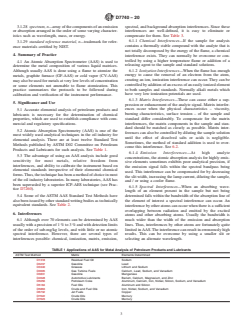
5.2 Atomic Absorption Spectrometry (AAS) is one of the most widely used analytical techniques in the oil industry for elemental analysis. There are at least twelve Standard Test Methods published by ASTM D02 Committee on Petroleum Products and Lubricants for such analysis. See Table 1.
5.3 The advantage of using an AAS analysis include good sensitivity for most metals, relative freedom from interferences, and ability to calibrate the instrument based on elemental standards irrespective of their elemental chemical forms. Thus, the technique has been a method of choice in most of the oil industry laboratories. In many laboratories, AAS has been superseded by a superior ICP-AES technique (see Practice D7260).
5.4 Some of the ASTM AAS Standard Test Methods have also been issued by other standard writing bodies as technically equivalent standards. See Table 2. (A) Excerpted from ASTM MNL44, Guide to ASTM Test Methods for the Analysis of Petroleum Products and Lubricants, 2nd edition, Ed., Nadkarni, R. A. Kishore, ASTM International, West Conshohocken, PA, 2007.
SCOPE
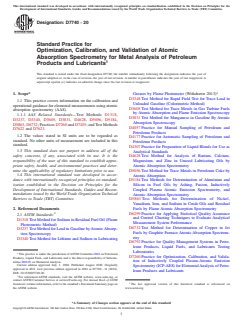
1.1 This practice covers information on the calibration and operational guidance for elemental measurements using atomic absorption spectrometry (AAS).
1.1.1 AAS Related Standards—Test Methods D1318, D3237, D3340, D3605, D3831, D4628, D5056, D5184, D5863, D6732; Practices D7260 and D7455; and Test Methods D7622 and D7623.
1.2 The values stated in SI units are to be regarded as standard. No other units of measurement are included in this standard.
1.3 This standard does not purport to address all of the safety concerns, if any, associated with its use. It is the responsibility of the user of this standard to establish appropriate safety, health, and environmental practices and determine the applicability of regulatory limitations prior to use.
1.4 This international standard was developed in accordance with internationally recognized principles on standardization established in the Decision on Principles for the Development of International Standards, Guides and Recommendations issued by the World Trade Organization Technical Barriers to Trade (TBT) Committee.
- Status
- Published
- Publication Date
- 30-Jun-2020
- Technical Committee
- D02 - Petroleum Products, Liquid Fuels, and Lubricants
- Drafting Committee
- D02.03 - Elemental Analysis
Buy Documents
ASTM D7740-20 - Standard Practice for Optimization, Calibration, and Validation of Atomic Absorption Spectrometry for Metal Analysis of Petroleum Products and Lubricants

REDLINE ASTM D7740-20 - Standard Practice for Optimization, Calibration, and Validation of Atomic Absorption Spectrometry for Metal Analysis of Petroleum Products and Lubricants
Overview
ASTM D7740-20 is an internationally recognized standard practice published by ASTM International, focused on the optimization, calibration, and validation of Atomic Absorption Spectrometry (AAS) for the metal analysis of petroleum products and lubricants. Accurate elemental analysis is essential in the oil and lubricant industries to ensure compliance with chemical property specifications, both for commercial quality and regulatory requirements.
This practice provides detailed guidance on the operation, calibration, and validation of AAS instruments used for measuring metal concentrations in a variety of petroleum matrices. It also outlines approaches to ensure data quality, address potential interferences, and maintain accuracy and precision in laboratory settings.
Key Topics
- Calibration and Validation: Procedures for calibrating AAS instruments using certified reference materials, preparing calibration curves with standards, and implementing check standards for ongoing quality control.
- Sample Preparation: Recommendations for handling and homogenizing samples, as well as appropriate dissolution techniques to ensure a representative test specimen.
- Interference Management: Identification and mitigation of common interferences in AAS, including chemical, ionization, matrix, spectral, and background absorption interferences. Methods such as the standard addition technique and use of chemical suppressants are discussed.
- Operational Guidance: Requirements for burners, flames, nebulizers, photomultiplier tube detectors, and monochromators to achieve dependable and accurate elemental measurements.
- Quality Control: Implementation of quality assurance programs, including routine analysis of quality control (QC) samples and the use of control charts to monitor measurement system performance.
- Reporting: Guidelines for accurately reporting results, managing below-detection-limit findings, and ensuring traceability to specific test methods.
Applications
The standard is widely applicable throughout the petroleum and lubricant sectors, including:
- Refineries and Quality Control Labs: To verify metal content in base oils, lubricants, fuels, and additives, safeguarding product integrity and regulatory compliance.
- Research and Development: Supporting the investigation of product formulations and the effects of trace metals on performance or degradation.
- Environmental and Regulatory Testing: Ensuring that products meet environmental safety standards for permissible levels of metals such as lead, mercury, and vanadium.
- Performance Monitoring: Routine laboratory analysis of used oils and lubricants for wear metals, which is critical in predictive maintenance and equipment reliability assessments.
Related Standards
ASTM D7740-20 references and is directly associated with numerous other standards that complement metal analysis of petroleum products:
- ASTM D1318: Sodium in Residual Fuel Oil
- ASTM D3237: Lead in Gasoline by Atomic Absorption Spectroscopy
- ASTM D3605: Trace Metals in Gas Turbine Fuels
- ASTM D3831: Manganese in Gasoline by Atomic Absorption
- ASTM D4628: Analysis of Barium, Calcium, Magnesium, and Zinc in Lubricating Oils
- ASTM D5056: Trace Metals in Petroleum Coke
- ASTM D5184: Determination of Aluminum & Silicon in Fuel Oils
- ASTM D5863: Nickel, Vanadium, Iron, and Sodium in Crude Oils and Residual Fuels
- ASTM D6732: Copper in Jet Fuels
- ASTM D7260: Optimization, Calibration, and Validation of ICP-AES for Elemental Analysis
- ASTM D7455: Sample Preparation for Elemental Analysis
- ASTM D7622 & D7623: Total Mercury in Crude Oil
Additionally, ASTM D7740-20 aligns with related international standards from organizations such as ISO and DIN, facilitating global acceptance and interoperability.
Practical Value
By standardizing the process for instrument calibration, sample preparation, and data validation, ASTM D7740-20 enables laboratories to achieve consistent, reliable, and comparable results in trace metal analysis. Adherence to this practice supports regulatory compliance, quality assurance, and product performance, making it indispensable for laboratories operating in the petroleum and lubricant industries. Frequent references to complementary standards further reinforce the robustness and relevance of this practice across a wide spectrum of analytical applications.
Relations
- Effective Date
- 01-Jul-2020
- Effective Date
- 01-Dec-2023
- Effective Date
- 01-Nov-2023
- Effective Date
- 01-Oct-2023
- Effective Date
- 01-May-2020
- Effective Date
- 01-May-2019
- Effective Date
- 01-May-2019
- Effective Date
- 15-Dec-2017
- Effective Date
- 15-Nov-2017
- Effective Date
- 01-Jan-2017
- Effective Date
- 01-Oct-2015
- Effective Date
- 01-Jun-2015
- Effective Date
- 01-Dec-2014
- Effective Date
- 01-May-2014
- Effective Date
- 01-Oct-2013
Buy Documents
ASTM D7740-20 - Standard Practice for Optimization, Calibration, and Validation of Atomic Absorption Spectrometry for Metal Analysis of Petroleum Products and Lubricants
REDLINE ASTM D7740-20 - Standard Practice for Optimization, Calibration, and Validation of Atomic Absorption Spectrometry for Metal Analysis of Petroleum Products and Lubricants
Get Certified
Connect with accredited certification bodies for this standard

ECOCERT
Organic and sustainability certification.

Element Materials Technology
Materials testing and product certification.

ABS Group Brazil
ABS Group certification services in Brazil.
Sponsored listings
Frequently Asked Questions
ASTM D7740-20 is a standard published by ASTM International. Its full title is "Standard Practice for Optimization, Calibration, and Validation of Atomic Absorption Spectrometry for Metal Analysis of Petroleum Products and Lubricants". This standard covers: SIGNIFICANCE AND USE 5.1 Accurate elemental analysis of petroleum products and lubricants is necessary for the determination of chemical properties, which are used to establish compliance with commercial and regulatory specifications. 5.2 Atomic Absorption Spectrometry (AAS) is one of the most widely used analytical techniques in the oil industry for elemental analysis. There are at least twelve Standard Test Methods published by ASTM D02 Committee on Petroleum Products and Lubricants for such analysis. See Table 1. 5.3 The advantage of using an AAS analysis include good sensitivity for most metals, relative freedom from interferences, and ability to calibrate the instrument based on elemental standards irrespective of their elemental chemical forms. Thus, the technique has been a method of choice in most of the oil industry laboratories. In many laboratories, AAS has been superseded by a superior ICP-AES technique (see Practice D7260). 5.4 Some of the ASTM AAS Standard Test Methods have also been issued by other standard writing bodies as technically equivalent standards. See Table 2. (A) Excerpted from ASTM MNL44, Guide to ASTM Test Methods for the Analysis of Petroleum Products and Lubricants, 2nd edition, Ed., Nadkarni, R. A. Kishore, ASTM International, West Conshohocken, PA, 2007. SCOPE 1.1 This practice covers information on the calibration and operational guidance for elemental measurements using atomic absorption spectrometry (AAS). 1.1.1 AAS Related Standards—Test Methods D1318, D3237, D3340, D3605, D3831, D4628, D5056, D5184, D5863, D6732; Practices D7260 and D7455; and Test Methods D7622 and D7623. 1.2 The values stated in SI units are to be regarded as standard. No other units of measurement are included in this standard. 1.3 This standard does not purport to address all of the safety concerns, if any, associated with its use. It is the responsibility of the user of this standard to establish appropriate safety, health, and environmental practices and determine the applicability of regulatory limitations prior to use. 1.4 This international standard was developed in accordance with internationally recognized principles on standardization established in the Decision on Principles for the Development of International Standards, Guides and Recommendations issued by the World Trade Organization Technical Barriers to Trade (TBT) Committee.
SIGNIFICANCE AND USE 5.1 Accurate elemental analysis of petroleum products and lubricants is necessary for the determination of chemical properties, which are used to establish compliance with commercial and regulatory specifications. 5.2 Atomic Absorption Spectrometry (AAS) is one of the most widely used analytical techniques in the oil industry for elemental analysis. There are at least twelve Standard Test Methods published by ASTM D02 Committee on Petroleum Products and Lubricants for such analysis. See Table 1. 5.3 The advantage of using an AAS analysis include good sensitivity for most metals, relative freedom from interferences, and ability to calibrate the instrument based on elemental standards irrespective of their elemental chemical forms. Thus, the technique has been a method of choice in most of the oil industry laboratories. In many laboratories, AAS has been superseded by a superior ICP-AES technique (see Practice D7260). 5.4 Some of the ASTM AAS Standard Test Methods have also been issued by other standard writing bodies as technically equivalent standards. See Table 2. (A) Excerpted from ASTM MNL44, Guide to ASTM Test Methods for the Analysis of Petroleum Products and Lubricants, 2nd edition, Ed., Nadkarni, R. A. Kishore, ASTM International, West Conshohocken, PA, 2007. SCOPE 1.1 This practice covers information on the calibration and operational guidance for elemental measurements using atomic absorption spectrometry (AAS). 1.1.1 AAS Related Standards—Test Methods D1318, D3237, D3340, D3605, D3831, D4628, D5056, D5184, D5863, D6732; Practices D7260 and D7455; and Test Methods D7622 and D7623. 1.2 The values stated in SI units are to be regarded as standard. No other units of measurement are included in this standard. 1.3 This standard does not purport to address all of the safety concerns, if any, associated with its use. It is the responsibility of the user of this standard to establish appropriate safety, health, and environmental practices and determine the applicability of regulatory limitations prior to use. 1.4 This international standard was developed in accordance with internationally recognized principles on standardization established in the Decision on Principles for the Development of International Standards, Guides and Recommendations issued by the World Trade Organization Technical Barriers to Trade (TBT) Committee.
ASTM D7740-20 is classified under the following ICS (International Classification for Standards) categories: 71.040.50 - Physicochemical methods of analysis; 75.040 - Crude petroleum; 75.100 - Lubricants, industrial oils and related products; 75.160.20 - Liquid fuels. The ICS classification helps identify the subject area and facilitates finding related standards.
ASTM D7740-20 has the following relationships with other standards: It is inter standard links to ASTM D7740-11(2016), ASTM D6299-23a, ASTM D6792-23c, ASTM D6792-23b, ASTM D6732-04(2020), ASTM D7260-19, ASTM D7455-19, ASTM D6299-17b, ASTM D6299-17a, ASTM D6299-17, ASTM D4307-99(2015), ASTM D5056-15, ASTM D4628-14, ASTM D7455-14, ASTM D6299-13e1. Understanding these relationships helps ensure you are using the most current and applicable version of the standard.
ASTM D7740-20 is available in PDF format for immediate download after purchase. The document can be added to your cart and obtained through the secure checkout process. Digital delivery ensures instant access to the complete standard document.
Standards Content (Sample)
This international standard was developed in accordance with internationally recognized principles on standardization established in the Decision on Principles for the
Development of International Standards, Guides and Recommendations issued by the World Trade Organization Technical Barriers to Trade (TBT) Committee.
Designation: D7740 − 20
Standard Practice for
Optimization, Calibration, and Validation of Atomic
Absorption Spectrometry for Metal Analysis of Petroleum
Products and Lubricants
This standard is issued under the fixed designation D7740; the number immediately following the designation indicates the year of
original adoption or, in the case of revision, the year of last revision. A number in parentheses indicates the year of last reapproval. A
superscript epsilon (´) indicates an editorial change since the last revision or reapproval.
1. Scope* Greases by Flame Photometer (Withdrawn 2013)
D3348 Test Method for Rapid Field Test for Trace Lead in
1.1 This practice covers information on the calibration and
Unleaded Gasoline (Colorimetric Method)
operationalguidanceforelementalmeasurementsusingatomic
D3605 Test Method for Trace Metals in Gas Turbine Fuels
absorption spectrometry (AAS).
by Atomic Absorption and Flame Emission Spectroscopy
1.1.1 AAS Related Standards—Test Methods D1318,
D3831 Test Method for Manganese in Gasoline By Atomic
D3237, D3340, D3605, D3831, D4628, D5056, D5184,
Absorption Spectroscopy
D5863,D6732;PracticesD7260andD7455;andTestMethods
D4057 Practice for Manual Sampling of Petroleum and
D7622 and D7623.
Petroleum Products
1.2 The values stated in SI units are to be regarded as
D4177 Practice for Automatic Sampling of Petroleum and
standard. No other units of measurement are included in this
Petroleum Products
standard.
D4307 Practice for Preparation of Liquid Blends for Use as
1.3 This standard does not purport to address all of the
Analytical Standards
safety concerns, if any, associated with its use. It is the D4628 Test Method for Analysis of Barium, Calcium,
responsibility of the user of this standard to establish appro-
Magnesium, and Zinc in Unused Lubricating Oils by
priate safety, health, and environmental practices and deter- Atomic Absorption Spectrometry
mine the applicability of regulatory limitations prior to use.
D5056 Test Method for Trace Metals in Petroleum Coke by
1.4 This international standard was developed in accor- Atomic Absorption
dance with internationally recognized principles on standard-
D5184 Test Methods for Determination of Aluminum and
ization established in the Decision on Principles for the
Silicon in Fuel Oils by Ashing, Fusion, Inductively
Development of International Standards, Guides and Recom- Coupled Plasma Atomic Emission Spectrometry, and
mendations issued by the World Trade Organization Technical
Atomic Absorption Spectrometry
Barriers to Trade (TBT) Committee. D5863 Test Methods for Determination of Nickel,
Vanadium, Iron, and Sodium in Crude Oils and Residual
2. Referenced Documents Fuels by Flame Atomic Absorption Spectrometry
D6299 Practice for Applying Statistical Quality Assurance
2.1 ASTM Standards:
and Control Charting Techniques to Evaluate Analytical
D1318 Test Method for Sodium in Residual Fuel Oil (Flame
Measurement System Performance
Photometric Method)
D6732 Test Method for Determination of Copper in Jet
D3237 TestMethodforLeadinGasolinebyAtomicAbsorp-
Fuels by Graphite Furnace Atomic Absorption Spectrom-
tion Spectroscopy
etry
D3340 Test Method for Lithium and Sodium in Lubricating
D6792 Practice for Quality Management Systems in Petro-
leum Products, Liquid Fuels, and Lubricants Testing
Laboratories
This practice is under the jurisdiction ofASTM Committee D02 on Petroleum
D7260 Practice for Optimization, Calibration, and Valida-
Products, Liquid Fuels, and Lubricants and is the direct responsibility of Subcom-
mittee D02.03 on Elemental Analysis. tion of Inductively Coupled Plasma-Atomic Emission
Current edition approved July 1, 2020. Published August 2020. Originally
Spectrometry (ICP-AES) for ElementalAnalysis of Petro-
approved in 2011. Last previous edition approved in 2016 as D7740 – 11 (2016).
leum Products and Lubricants
DOI: 10.1520/D7740-20.
For referenced ASTM standards, visit the ASTM website, www.astm.org, or
contact ASTM Customer Service at service@astm.org. For Annual Book of ASTM
Standards volume information, refer to the standard’s Document Summary page on The last approved version of this historical standard is referenced on
the ASTM website. www.astm.org.
*A Summary of Changes section appears at the end of this standard
Copyright © ASTM International, 100 Barr Harbor Drive, PO Box C700, West Conshohocken, PA 19428-2959. United States
D7740 − 20
D7455 Practice for Sample Preparation of Petroleum and 3.1.13 graphite furnace, n—electrothermal device for atom-
Lubricant Products for Elemental Analysis izing the metal constituents.
D7622 Test Method for Total Mercury in Crude Oil Using
3.1.14 hollow cathode lamp, n—device consisting of a
Combustion and Direct Cold Vapor Atomic Absorption
quartz envelope containing a cathode of the metal to be
Method with Zeeman Background Correction
determined and a suitable anode.
D7623 Test Method for Total Mercury in Crude Oil Using
3.1.15 hydride generation, n—device to atomize some met-
Combustion-Gold Amalgamation and Cold Vapor Atomic
als which form gaseous hydrides.
Absorption Method
3.1.16 monochromator, n—device that isolates a single
3. Terminology atomic resonance line from the line spectrum emitted by the
hollow cathode lamp, excluding all other wavelengths.
3.1 Definitions:
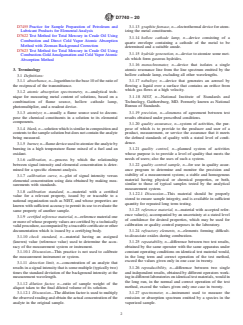
3.1.1 absorbance, n—logarithmtothebase10oftheratioof 3.1.17 nebulizer, n—device that generates an aerosol by
flowing a liquid over a surface that contains an orifice from
the reciprocal of the transmittance.
which gas flows at a high velocity.
3.1.2 atomic absorption spectrometry, n—analytical tech-
nique for measuring metal content of solutions, based on a 3.1.18 NIST, n—National Institute of Standards and
Technology, Gaithersburg, MD. Formerly known as National
combination of flame source, hollow cathode lamp,
photomultiplier, and a readout device. Bureau of Standards.
3.1.3 atomizer, n—usually a flame source used to decom- 3.1.19 precision, n—closeness of agreement between test
pose the chemical constituents in a solution to its elemental results obtained under prescribed conditions.
components.
3.1.20 quality assurance, n—system of activities, the pur-
3.1.4 blank, n—solutionwhichissimilarincompositionand
pose of which is to provide to the producer and user of a
contentstothesamplesolutionbutdoesnotcontaintheanalyte product, measurement, or service the assurance that it meets
being measured.
the defined standards of quality with a stated level of confi-
dence.
3.1.5 burner, n—flamedeviceusedtoatomizetheanalyteby
burning in a high temperature flame mixed of a fuel and an
3.1.21 quality control, n—planned system of activities
oxidant.
whose purpose is to provide a level of quality that meets the
needs of users; also the uses of such a system.
3.1.6 calibration, n—process by which the relationship
between signal intensity and elemental concentration is deter-
3.1.22 quality control sample, n—for use in quality assur-
mined for a specific element analysis.
ance program to determine and monitor the precision and
stability of a measurement system; a stable and homogenous
3.1.7 calibration curve, n—plot of signal intensity versus
material having physical or chemical properties, or both,
elemental concentration using data obtained by making mea-
similar to those of typical samples tested by the analytical
surements with standards.
measurement system.
3.1.8 calibration standard, n—material with a certified
3.1.22.1 Discussion—This material should be properly
value for a relevant property, issued by or traceable to a
stored to ensure sample integrity, and is available in sufficient
national organization such as NIST, and whose properties are
quantity for repeated long term testing.
known with sufficient accuracy to permit its use to evaluate the
3.1.23 reference material, n—material with accepted refer-
same property of another sample.
ence value(s), accompanied by an uncertainty at a stated level
3.1.9 certified reference material, n—reference material one
of confidence for desired properties, which may be used for
or more of whose property values are certified by a technically
calibration or quality control purposes in the laboratory.
validprocedure,accompaniedbyatraceablecertificateorother
3.1.24 refractory elements, n—elements forming difficult-
documentation which is issued by a certifying body.
to-dissociate oxides during combustion.
3.1.10 check standard, n—material having an assigned
(known) value (reference value) used to determine the accu- 3.1.25 repeatability, n—difference between two test results,
racy of the measurement system or instrument. obtained by the same operator with the same apparatus under
constant operating conditions on identical test material would,
3.1.10.1 Discussion—This practice is not used to calibrate
the measurement instrument or system. in the long term and correct operation of the test method,
exceed the values given only in one case in twenty.
3.1.11 detection limit, n—concentration of an analyte that
resultsinasignalintensitythatissomemultiple(typicallytwo) 3.1.26 reproducibility, n—difference between two single
times the standard deviation of the background intensity at the and independent results, obtained by different operators work-
measurement wavelength. ingindifferentlaboratoriesonidenticaltestmaterials,wouldin
the long run, in the normal and correct operation of the test
3.1.12 dilution factor, n—ratio of sample weight of the
method, exceed the values given only one case in twenty.
aliquot taken to the final diluted volume of its solution.
3.1.12.1 Discussion—The dilution factor is used to multiply 3.1.27 spectrometer, n—instrument used to measure the
the observed reading and obtain the actual concentration of the emission or absorption spectrum emitted by a species in the
analyte in the original sample. vaporized sample.
D7740 − 20
3.1.28 spectrum, n—arrayofthecomponentsofanemission spectral, and background absorption interferences. Since these
or absorption arranged in the order of some varying character- interferences are well-defined, it is easy to eliminate or
istics such as wavelength, mass, or energy. compensate for them. See Table 3.
6.1.1 Chemical Interferences—If the sample for analysis
3.1.29 standard reference material, n—trademark for refer-
contains a thermally stable compound with the analyte that is
ence materials certified by NIST.
not totally decomposed by the energy of the flame, a chemical
4. Summary of Practice
interference exists. They can normally be overcome or con-
trolled by using a higher temperature flame or addition of a
4.1 An Atomic Absorption Spectrometer (AAS) is used to
releasing agent to the sample and standard solutions.
determine the metal composition of various liquid matrices.
6.1.2 Ionization Interferences—When the flame has enough
Although usually AAS is done using a flame to atomize the
energy to cause the removal of an electron from the atom,
metals, graphite furnace (GF-AAS) or cold vapor (CV-AAS)
creating an ion, ionization interference can occur. They can be
may also be used for metals at very low levels of concentration
controlledbyadditionofanexcessofaneasilyionizedelement
or some elements not amenable to flame atomization. This
to both samples and standards. Normally alkali metals which
practice summarizes the protocols to be followed during
have very low ionization potentials are used.
calibration and verification of the instrument performance.
6.1.3 Matrix Interferences—These can cause either a sup-
5. Significance and Use
pression or enhancement of the analyte signal. Matrix interfer-
ences occur when the physical characteristics – viscosity,
5.1 Accurate elemental analysis of petroleum products and
burning characteristics, surface tension – of the sample and
lubricants is necessary for the determination of chemical
standard differ considerably. To compensate for the matrix
properties, which are used to establish compliance with com-
interferences, the matrix components in the sample and stan-
mercial and regulatory specifications.
dard should be matched as closely as possible. Matrix inter-
5.2 Atomic Absorption Spectrometry (AAS) is one of the
ferences can also be controlled by diluting the sample solution
most widely used analytical techniques in the oil industry for
until the effect of dissolved salts or acids is negligible.
elemental analysis. There are at least twelve Standard Test
Sometimes, the method of standard addition is used to over-
Methods published by ASTM D02 Committee on Petroleum
come this interference. See 6.2.
Products and Lubricants for such analysis. See Table 1.
6.1.4 Emission Interferences—At high analyte
5.3 The advantage of using an AAS analysis include good
concentrations, the atomic absorption analysis for highly emis-
sensitivity for most metals, relative freedom from
sive elements sometimes exhibits poor analytical precision, if
interferences, and ability to calibrate the instrument based on
the emission signal falls within the spectral bandpass being
elemental standards irrespective of their elemental chemical
used. This interference can be compensated for by decreasing
forms.Thus,thetechniquehasbeenamethodofchoiceinmost
the slit width, increasing the lamp current, diluting the sample,
of the oil industry laboratories. In many laboratories,AAS has
and / or using a cooler flame.
been superseded by a superior ICP-AES technique (see Prac-
6.1.5 Spectral Interferences—When an absorbing wave-
tice D7260).
length of an element present in the sample but not being
5.4 Some of the ASTM AAS Standard Test Methods have
determined falls within the bandwidth of the absorption line of
alsobeenissuedbyotherstandardwritingbodiesastechnically the element of interest a spectral interference can occur. An
equivalent standards. See Table 2.
interference by other atoms can occur when there is a sufficient
overlapping between radiation and emitted by the excited
6. Interferences
atoms and other absorbing atoms. Usually the bandwidth is
6.1 Although over 70 elements can be determined by AAS much wider than the width of the emission and absorption
usuallywithaprecisionof1 %to3 %andwithdetectionlimits lines. Thus, interferences by other atoms are fortunately quite
of the order of sub-mg/kg levels, and with little or no atomic limited inAAS.The interference can result in erroneously high
spectral interference. However, there are several types of results. This can be overcome by using a smaller slit or
interferences possible: chemical, ionization, matrix, emission, selecting an alternate wavelength.
TABLE 1 Applications of AAS for Metal Analysis of Petroleum Products and Lubricants
ASTM Test Method Matrix Elements Determined
D1318 Residual Fuel Oil Sodium
D3237 Gasoline Lead
D3340 Greases Lithium and Sodium
D3605 Gas Turbine Fuels Calcium, Lead, Sodium, and Vanadium
D3831 Gasoline Manganese
D4628 Automotive Lubricants Barium, Calcium, Magnesium, and Zinc
D5056 Petroleum Coke Aluminum, Calcium, Iron, Nickel, Silicon, Sodium, and Vanadium
D5184 Fuel Oils Aluminum and Silicon
D5863 Crude and Fuel Oils Iron, Nickel, Sodium, and Vanadium
D6732 Jet Fuels Copper
D7622 Crude Oils Mercury
D7623 Crude Oils Mercury
D7740 − 20
A
TABLE 2 Equivalent AAS Test Methods
Analysis ASTM Standard EI Standard ISO Standard DIN Standard
Lead in Gasoline D3237 IP 428 8691
Analysis of Gas Turbine Fuels D3605 IP 413 51-790T3
Additive Elements in Lube Oils D4628 IP 308 51-391T1
Al and Si in Fuel Oils D5184 IP 377 10478 51-416
A
Excerpted from ASTM MNL44, Guide to ASTM Test Methods for the Analysis of Petroleum Products and Lubricants, 2nd edition, Ed., Nadkarni, R. A. Kishore, ASTM
International, West Conshohocken, PA, 2007.
TABLE 3 Elemental Analysis of Petroleum Products by AAS
Element Wavelength, Flame Typical Detection Matrix ASTM Test Method
nm Limits, mg/L
Aluminum 309.3 N O+C H 0.03 Petroleum Coke; Fuel Oils D5056; D5184B
2 2 2
Barium N O+C H 0.008 Lubricants D4628
2 2 2
Calcium 422.7 N O+C H 0.001 Gas Turbine Fuels; Lubricants; D3605; D4628; D5056
2 2 2
Petroleum Coke
Copper 324.8 GF-AAS 0.001 Jet Fuel D6732
Iron 248.3 Air + C H 0.003 Crude Oils; Fuel Oils D5184
2 2
Lead 283.3 Air + C H 0.01 Gasoline; Gas Turbine Fuels D3237; D3340
2 2
Magnesium 285.2 N O+C H 0.00001 Lubricants D4628
2 2 2
Manganese 279.5 Air + C H 0.001 Gasoline D3831
2 2
Mercury 253.65 CV-AAS 0.000008 Crude Oil D7622; D7623
Nickel 232.0 Air + C H 0.004 Crude Oils; Fuel Oils D5863
2 2
Silicon 251.6 N O+C H 0.06 Fuel Oils D5184B
2 2 2
Sodium 589.6 Air + C H 0.0002 Residual Fuel Oil; Gas Turbine Fuels; D1318; D3605; D5056; D5863
2 2
Petroleum Coke; Crude Oils; Fuel
Oils
Vanadium 318.34 N O+C H 0.04 Gas Turbine Fuels; Petroleum Coke; D3605; D5056; D5863
2 2 2
Crude Oils; Fuel Oils
Zinc 213.9 N O+C H 0.0008 Lubricants D4628
2 2 2
6.1.6 Background Absorption Interferences—There are two may be less accurate than direct comparison; but when matrix
causes of background absorption: light scattering by particles interferences are encountered, it is necessary to use standard
intheflameandmolecularabsorptionoflightfromthelampby addition.
molecules in the flame. This interference cannot be corrected
6.3 Chemical Suppressants—In some cases, ionization sup-
with standard addition method. The most common way to
pressorsorotherchemicalreagentsareaddedtothesampleand
compensate for background absorption is to use a background
standard solutions to suppress such interferences. Examples
corrector which utilizes a continuum source.
include: Test Method D3237 (lead in gasoline) uses iodine
6.2 Standard Addition Method—One way of dealing with
solution in toluene, Test Method D3831 (manganese in gaso-
some of the interferences in the AAS methods is to use a
line) uses bromine solution, and Test Method D4628 (additive
technique called standard addition. IUPAC rule defines this
elements in lubricating oils) uses potassium salt as ionization
technique as “Analyte Addition Method,” however, the phrase
suppressant.
“standard addition method” is well known and is widely used
by the practitioners of AAS; hence, there is no need to adopt
7. Apparatus
the IUPAC rule. This technique takes longer time than the
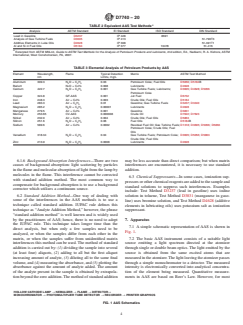
7.1 A simple schematic representation of AAS is shown in
direct analysis, but when only a few samples need to be
Fig. 1.
analyzed, or when the samples differ from each other in the
matrix, or when the samples suffer from unidentified matrix 7.2 The basic AAS instrument consists of a suitable light
interferences this method can be used. The method of standard source emitting a light spectrum directed at the atomizer
addition is carried out by: (1) dividing the sample into several through single or double beam optics. The light emitted by the
(at least four) aliquots, (2) adding to all but the first aliquot source is obtained from the same excited atoms that are
increasing amount of analyte, (3) diluting all to the same final measuredintheatomizer.Thelightleavingtheatomizerpasses
volume, and (4) measuring the absorbance, and (5) plotting the through a simple monochromator to a detector. The measured
absorbance against the amount of analyte added. The amount intensity is electronically converted into analytical concentra-
of the analyte present in the sample is obtained by extrapola- tion of the element being measured. Quantitative measure-
tion beyond the zero addition.The method of standard addition ments in AAS are based on Beer’s Law. However, for most
HOLLOW CATHODE LAMP→ NEBULIZER→ FLAME→ DETECTOR→
MONOCHROMATOR→ PHOTOMULTIPLIER TUBE DETECTOR→ RECORDER→ PRINTER GRAPHICS
FIG. 1 AAS Schematics
D7740 − 20
elements, particularly at high concentrations, the relationship the impact bead. However, for nitrous oxide–acetylene flame,
between concentration and absorbance deviates from Beer’s noticeably poorer precision is obtained when using impact
Law and is not linear. Usually two or more calibration bead.
standards spanning the sample concentration and a blank are
7.7 Flame Sources:
used for preparing the calibration curve. After initial
7.7.1 Usually, AAS instruments use flame as the atomiza-
calibration, a check standard at mid range of calibration should
tion source. An air-acetylene flame is used for most elements;
be analyzed.
the nitrous oxide-acetylene flame reaches higher temperature
7.3 The ground state atom absorbs the light energy of a
(2300 °C for air-C H versus 2955 °C for N O-C H ), and is
2 2 2 2 2
specificwavelengthasitenterstheexcitedstate.Asthenumber
used for atomizing the more refractory oxide forming metals.
of atoms in the light path increase, the amount of the light
Flame conditions used in AAS are summarized in Table 4.
absorbed also increases. By measuring the light absorbed, a
7.7.2 Out of several possible combinations (Table 4), air-
quantitative determination of the amount of the analyte present
acetylene and nitrous oxide–acetylene are the most commonly
can be calculated.
used flames as atomization sources in AAS. Over 30 elements
7.4 Two types ofAAS instruments use either single beam or can be determined with the air–acetylene flame. The nitrous
doublebeam.Inthefirsttype,thelightsourceemitsaspectrum oxide–acetylene flame is the hottest of the flames used and
specific to the element of which it is made, which is focused produces a maximum temperature of 3000 °C. It can atomize
through the sample cell into the monochromator. The light refractory elements such as aluminum, silicon, vanadium, and
source is electronically modulated to differentiate between the titanium, and others, all forming highly refractory oxide
light from the source and the emission from the sample cell. In molecules in the flame. Although nitrous oxide–acetylene
adoublebeamAAspectrometer,thelightfromthesourcelamp flame can be used for the determination of over 65 elements, in
is divided into a sample beam which is focused through the practiceitisusedonlywhereair–acetyleneflameisineffective.
sample cell, and a reference beam which is directed around the
7.8 Hollow Cathode Lamps:
sample cell. In a double beam system, the readout represents
7.8.1 A typical hollow cathode lamp consists of a quartz
the ratio of the sample and the reference beams. Therefore,
envelope containing a cathode, made of the element to be
fluctuations in the source intensity do not become fluctuations
determined and a suitable anode. The sealed envelope is filled
intheinstrumentreadout,andthebaselineismuchmorestable.
withaninertgassuchasargonorneonatalowpressure.When
Both types use the light sources that emit element specific
a high voltage (up to 600 volts), is applied across the
spectra.
electrodes, positively charged gas ions bombard the cathode
7.5 In AAS, the sample solution whether aqueous or non-
and dislodge atoms of the element used in the cathode. These
aqueous, is vaporized into a flame, and the elements are
atoms are subsequently excited and the spectrum of the
atomized at high temperatures. The elemental concentration is
chemical element is emitted. Hollow cathode lamps are pre-
determined by absorption of the analyte atoms of a character-
ferred as the light sources because they generate a very narrow
isticwavelengthemittedfromalightsource,typicallyahollow
line, about one tenth of the elemental absorption line width.
cathode lamp which consi
...
This document is not an ASTM standard and is intended only to provide the user of an ASTM standard an indication of what changes have been made to the previous version. Because
it may not be technically possible to adequately depict all changes accurately, ASTM recommends that users consult prior editions as appropriate. In all cases only the current version
of the standard as published by ASTM is to be considered the official document.
Designation: D7740 − 11 (Reapproved 2016) D7740 − 20
Standard Practice for
Optimization, Calibration, and Validation of Atomic
Absorption Spectrometry for Metal Analysis of Petroleum
Products and Lubricants
This standard is issued under the fixed designation D7740; the number immediately following the designation indicates the year of
original adoption or, in the case of revision, the year of last revision. A number in parentheses indicates the year of last reapproval. A
superscript epsilon (´) indicates an editorial change since the last revision or reapproval.
1. Scope Scope*
1.1 This practice covers information on the calibration and operational guidance for elemental measurements using atomic
absorption spectrometry (AAS).
1.1.1 AAS Related Standards—Test Methods D1318, D3237, D3340, D3605, D3831, D4628, D5056, D5184, D5863, D6732;
Practices D7260 and D7455; and Test Methods D7622 and D7623.
1.2 The values stated in SI units are to be regarded as standard. No other units of measurement are included in this standard.
1.3 This standard does not purport to address all of the safety concerns, if any, associated with its use. It is the responsibility
of the user of this standard to establish appropriate safety safety, health, and healthenvironmental practices and determine the
applicability of regulatory limitations prior to use.
1.4 This international standard was developed in accordance with internationally recognized principles on standardization
established in the Decision on Principles for the Development of International Standards, Guides and Recommendations issued
by the World Trade Organization Technical Barriers to Trade (TBT) Committee.
2. Referenced Documents
2.1 ASTM Standards:
D1318 Test Method for Sodium in Residual Fuel Oil (Flame Photometric Method)
D3237 Test Method for Lead in Gasoline by Atomic Absorption Spectroscopy
D3340 Test Method for Lithium and Sodium in Lubricating Greases by Flame Photometer (Withdrawn 2013)
D3348 Test Method for Rapid Field Test for Trace Lead in Unleaded Gasoline (Colorimetric Method)
D3605 Test Method for Trace Metals in Gas Turbine Fuels by Atomic Absorption and Flame Emission Spectroscopy
D3831 Test Method for Manganese in Gasoline By Atomic Absorption Spectroscopy
D4057 Practice for Manual Sampling of Petroleum and Petroleum Products
D4177 Practice for Automatic Sampling of Petroleum and Petroleum Products
D4307 Practice for Preparation of Liquid Blends for Use as Analytical Standards
D4628 Test Method for Analysis of Barium, Calcium, Magnesium, and Zinc in Unused Lubricating Oils by Atomic Absorption
Spectrometry
D5056 Test Method for Trace Metals in Petroleum Coke by Atomic Absorption
D5184 Test Methods for Determination of Aluminum and Silicon in Fuel Oils by Ashing, Fusion, Inductively Coupled Plasma
Atomic Emission Spectrometry, and Atomic Absorption Spectrometry
D5863 Test Methods for Determination of Nickel, Vanadium, Iron, and Sodium in Crude Oils and Residual Fuels by Flame
Atomic Absorption Spectrometry
D6299 Practice for Applying Statistical Quality Assurance and Control Charting Techniques to Evaluate Analytical Measure-
ment System Performance
D6732 Test Method for Determination of Copper in Jet Fuels by Graphite Furnace Atomic Absorption Spectrometry
This practice is under the jurisdiction of ASTM Committee D02 on Petroleum Products, Liquid Fuels, and Lubricants and is the direct responsibility of Subcommittee
D02.03 on Elemental Analysis.
Current edition approved April 1, 2016July 1, 2020. Published May 2016August 2020. Originally approved in 2011. Last previous edition approved in 20112016 as
D7740 – 11.D7740 – 11 (2016). DOI: 10.1520/D7740-11R16.10.1520/D7740-20.
For referenced ASTM standards, visit the ASTM website, www.astm.org, or contact ASTM Customer Service at service@astm.org. For Annual Book of ASTM Standards
volume information, refer to the standard’s Document Summary page on the ASTM website.
The last approved version of this historical standard is referenced on www.astm.org.
*A Summary of Changes section appears at the end of this standard
Copyright © ASTM International, 100 Barr Harbor Drive, PO Box C700, West Conshohocken, PA 19428-2959. United States
D7740 − 20
D6792 Practice for Quality Management Systems in Petroleum Products, Liquid Fuels, and Lubricants Testing Laboratories
D7260 Practice for Optimization, Calibration, and Validation of Inductively Coupled Plasma-Atomic Emission Spectrometry
(ICP-AES) for Elemental Analysis of Petroleum Products and Lubricants
D7455 Practice for Sample Preparation of Petroleum and Lubricant Products for Elemental Analysis
D7622 Test Method for Total Mercury in Crude Oil Using Combustion and Direct Cold Vapor Atomic Absorption Method with
Zeeman Background Correction
D7623 Test Method for Total Mercury in Crude Oil Using Combustion-Gold Amalgamation and Cold Vapor Atomic Absorption
Method
D7740 − 20
3. Terminology
3.1 Definitions:
3.1.1 absorbance, n—logarithm to the base 10 of the ratio of the reciprocal of the transmittance.
3.1.2 atomic absorption spectrometry, n—analytical technique for measuring metal content of solutions, based on a combination
of flame source, hollow cathode lamp, photomultiplier, and a readout device.
3.1.3 atomizer, n—usually a flame source used to decompose the chemical constituents in a solution to its elemental
components.
3.1.4 blank, n—solution which is similar in composition and contents to the sample solution but does not contain the analyte
being measured.
3.1.5 burner, n—flame device used to atomize the analyte by burning in a high temperature flame mixed of a fuel and an oxidant.
3.1.6 calibration, n—process by which the relationship between signal intensity and elemental concentration is determined for
a specific element analysis.
3.1.7 calibration curve, n—plot of signal intensity versus elemental concentration using data obtained by making measurements
with standards.
3.1.8 calibration standard, n—material with a certified value for a relevant property, issued by or traceable to a national
organization such as NIST, and whose properties are known with sufficient accuracy to permit its use to evaluate the same property
of another sample.
3.1.9 certified reference material, n—reference material one or more of whose property values are certified by a technically valid
procedure, accompanied by a traceable certificate or other documentation which is issued by a certifying body.
3.1.10 check standard, n—material having an assigned (known) value (reference value) used to determine the accuracy of the
measurement system or instrument.
3.1.10.1 Discussion—
This practice is not used to calibrate the measurement instrument or system.
3.1.11 detection limit, n—concentration of an analyte that results in a signal intensity that is some multiple (typically two) times
the standard deviation of the background intensity at the measurement wavelength.
3.1.12 dilution factor, n—ratio of sample weight of the aliquot taken to the final diluted volume of its solution.
3.1.12.1 Discussion—
The dilution factor is used to multiply the observed reading and obtain the actual concentration of the analyte in the original
sample.
3.1.13 graphite furnace, n—electrothermal device for atomizing the metal constituents.
3.1.14 hollow cathode lamp, n—device consisting of a quartz envelope containing a cathode of the metal to be determined and
a suitable anode.
3.1.15 hydride generation, n—device to atomize some metals which form gaseous hydrides.
3.1.16 monochromator, n—device that isolates a single atomic resonance line from the line spectrum emitted by the hollow
cathode lamp, excluding all other wavelengths.
3.1.17 nebulizer, n—device that generates an aerosol by flowing a liquid over a surface that contains an orifice from which gas
flows at a high velocity.
3.1.18 NIST, n—National Institute of Standards and Technology, Gaithersburg, MD. Formerly known as National Bureau of
Standards.
3.1.19 precision, n—closeness of agreement between test results obtained under prescribed conditions.
3.1.20 quality assurance, n—system of activities, the purpose of which is to provide to the producer and user of a product,
measurement, or service the assurance that it meets the defined standards of quality with a stated level of confidence.
3.1.21 quality control, n—planned system of activities whose purpose is to provide a level of quality that meets the needs of
users; also the uses of such a system.
3.1.22 quality control sample, n—for use in quality assurance program to determine and monitor the precision and stability of
a measurement system; a stable and homogenous material having physical or chemical properties, or both, similar to those of
typical samples tested by the analytical measurement system.
D7740 − 20
3.1.22.1 Discussion—
This material should be properly stored to ensure sample integrity, and is available in sufficient quantity for repeated long term
testing.
3.1.23 reference material, n—material with accepted reference value(s), accompanied by an uncertainty at a stated level of
confidence for desired properties, which may be used for calibration or quality control purposes in the laboratory.
3.1.24 refractory elements, n—elements forming difficult-to-dissociate oxides during combustion.
3.1.25 repeatability, n—difference between two test results, obtained by the same operator with the same apparatus under
constant operating conditions on identical test material would, in the long term and correct operation of the test method, exceed
the values given only in one case in twenty.
3.1.26 reproducibility, n—difference between two single and independent results, obtained by different operators working in
different laboratories on identical test materials, would in the long run, in the normal and correct operation of the test method,
exceed the values given only one case in twenty.
3.1.27 spectrometer, n—instrument used to measure the emission or absorption spectrum emitted by a species in the vaporized
sample.
3.1.28 spectrum, n—array of the components of an emission or absorption arranged in the order of some varying characteristics
such as wavelength, mass, or energy.
3.1.29 standard reference material, n—trademark for reference materials certified by NIST.
4. Summary of Practice
4.1 An Atomic Absorption Spectrometer (AAS) is used to determine the metal composition of various liquid matrices. Although
usually AAS is done using a flame to atomize the metals, graphite furnace (GF-AAS) or cold vapor (CV-AAS) may also be used
for metals at very low levels of concentration or some elements not amenable to flame atomization. This practice summarizes the
protocols to be followed during calibration and verification of the instrument performance.
5. Significance and Use
5.1 Accurate elemental analysis of petroleum products and lubricants is necessary for the determination of chemical properties,
which are used to establish compliance with commercial and regulatory specifications.
5.2 Atomic Absorption Spectrometry (AAS) is one of the most widely used analytical techniques in the oil industry for
elemental analysis. There are at least twelve Standard Test Methods published by ASTM D02 Committee on Petroleum Products
and Lubricants for such analysis. See Table 1.
5.3 The advantage of using an AAS analysis include good sensitivity for most metals, relative freedom from interferences, and
ability to calibrate the instrument based on elemental standards irrespective of their elemental chemical forms. Thus, the technique
has been a method of choice in most of the oil industry laboratories. In many laboratories, AAS has been superseded by a superior
ICP-AES technique (see Practice D7260).
5.4 Some of the ASTM AAS Standard Test Methods have also been issued by other standard writing bodies as technically
equivalent standards. See Table 2.
6. Interferences
6.1 Although over 70 elements can be determined by AAS usually with a precision of 1-3 % 1 % to 3 % and with detection
limits of the order of sub-mg/kg levels, and with little or no atomic spectral interference. However, there are several types of
TABLE 1 Applications of AAS for Metal Analysis of Petroleum Products and Lubricants
ASTM Test Method Matrix Elements Determined
D1318 Residual Fuel Oil Sodium
D3237 Gasoline Lead
D3340 Greases Lithium and Sodium
D3605 Gas Turbine Fuels Calcium, Lead, Sodium, and Vanadium
D3831 Gasoline Manganese
D4628 Automotive Lubricants Barium, Calcium, Magnesium, and Zinc
D5056 Petroleum Coke Aluminum, Calcium, Iron, Nickel, Silicon, Sodium, and Vanadium
D5184 Fuel Oils Aluminum and Silicon
D5863 Crude and Fuel Oils Iron, Nickel, Sodium, and Vanadium
D6732 Jet Fuels Copper
D7622 Crude Oils Mercury
D7623 Crude Oils Mercury
D7740 − 20
A
TABLE 2 Equivalent AAS Test Methods
Analysis ASTM Standard EI Standard ISO Standard DIN Standard
Lead in Gasoline D3237 IP 428 8691
Analysis of Gas Turbine Fuels D3605 IP 413 51-790T3
Additive Elements in Lube Oils D4628 IP 308 51-391T1
Al and Si in Fuel Oils D5184 IP 377 10478 51-416
A
Excerpted from ASTM MNL44, Guide to ASTM Test Methods for the Analysis of Petroleum Products and Lubricants, 2nd edition, Ed., Nadkarni, R. A. Kishore, ASTM
International, West Conshohocken, PA, 2007.
interferences possible: chemical, ionization, matrix, emission, spectral, and background absorption interferences. Since these
interferences are well-defined, it is easy to eliminate or compensate for them. See Table 3.
6.1.1 Chemical Interferences—If the sample for analysis contains a thermally stable compound with the analyte that is not
totally decomposed by the energy of the flame, a chemical interference exists. They can normally be overcome or controlled by
using a higher temperature flame or addition of a releasing agent to the sample and standard solutions.
6.1.2 Ionization Interferences—When the flame has enough energy to cause the removal of an electron from the atom, creating
an ion, ionization interference can occur. They can be controlled by addition of an excess of an easily ionized element to both
samples and standards. Normally alkali metals which have very low ionization potentials are used.
6.1.3 Matrix Interferences—These can cause either a suppression or enhancement of the analyte signal. Matrix interferences
occur when the physical characteristics – viscosity, burning characteristics, surface tension – of the sample and standard differ
considerably. To compensate for the matrix interferences, the matrix components in the sample and standard should be matched
as closely as possible. Matrix interferences can also be controlled by diluting the sample solution until the effect of dissolved salts
or acids is negligible. Sometimes, the method of standard addition is used to overcome this interference. See 6.2.
6.1.4 Emission Interferences—At high analyte concentrations, the atomic absorption analysis for highly emissive elements
sometimes exhibits poor analytical precision, if the emission signal falls within the spectral bandpass being used. This interference
can be compensated for by decreasing the slit width, increasing the lamp current, diluting the sample, and / or using a cooler flame.
6.1.5 Spectral Interferences—When an absorbing wavelength of an element present in the sample but not being determined falls
within the bandwidth of the absorption line of the element of interest a spectral interference can occur. An interference by other
atoms can occur when there is a sufficient overlapping between radiation and emitted by the excited atoms and other absorbing
atoms. Usually the bandwidth is much wider than the width of the emission and absorption lines. Thus, interferences by other
atoms are fortunately quite limited in AAS. The interference can result in erroneously high results. This can be overcome by using
a smaller slit or selecting an alternate wavelength.
6.1.6 Background Absorption Interferences—There are two causes of background absorption: light scattering by particles in the
flame and molecular absorption of light from the lamp by molecules in the flame. This interference cannot be corrected with
standard addition method. The most common way to compensate for background absorption is to use a background corrector which
utilizes a continuum source.
6.2 Standard Addition Method—One way of dealing with some of the interferences in the AAS methods is to use a technique
called standard addition. IUPAC rule defines this technique as “Analyte Addition Method,” however, the phrase “standard addition
method” is well known and is widely used by the practitioners of AAS; hence, there is no need to adopt the IUPAC rule. This
technique takes longer time than the direct analysis, but when only a few samples need to be analyzed, or when the samples differ
from each other in the matrix, or when the samples suffer from unidentified matrix interferences this method can be used. The
TABLE 3 Elemental Analysis of Petroleum Products by AAS
Element Wavelength, Flame Typical Detection Matrix ASTM Test Method
nm Limits, mg/L
Aluminum 309.3 N O + C H 0.03 Petroleum Coke; Fuel Oils D5056; D5184B
2 2 2
Barium N O + C H 0.008 Lubricants D4628
2 2 2
Calcium 422.7 N O + C H 0.001 Gas Turbine Fuels; Lubricants; D3605; D4628; D5056
2 2 2
Petroleum Coke
Copper 324.8 GF-AAS 0.001 Jet Fuel D6732
Iron 248.3 Air + C H 0.003 Crude Oils; Fuel Oils D5184
2 2
Lead 283.3 Air + C H 0.01 Gasoline; Gas Turbine Fuels D3237; D3340
2 2
Magnesium 285.2 N O + C H 0.00001 Lubricants D4628
2 2 2
Manganese 279.5 Air + C H 0.001 Gasoline D3831
2 2
Mercury 253.65 CV-AAS 0.000008 Crude Oil D7622; D7623
Nickel 232.0 Air + C H 0.004 Crude Oils; Fuel Oils D5863
2 2
Silicon 251.6 N O + C H 0.06 Fuel Oils D5184B
2 2 2
Sodium 589.6 Air + C H 0.0002 Residual Fuel Oil; Gas Turbine Fuels; D1318; D3605; D5056; D5863
2 2
Petroleum Coke; Crude Oils; Fuel
Oils
Vanadium 318.34 N O + C H 0.04 Gas Turbine Fuels; Petroleum Coke; D3605; D5056; D5863
2 2 2
Crude Oils; Fuel Oils
Zinc 213.9 N O + C H 0.0008 Lubricants D4628
2 2 2
D7740 − 20
method of standard addition is carried out by: (1) dividing the sample into several (at least four) aliquots, (2) adding to all but the
first aliquot increasing amount of analyte, (3) diluting all to the same final volume, and (4) measuring the absorbance, and (5)
plotting the absorbance against the amount of analyte added. The amount of the analyte present in the sample is obtained by
extrapolation beyond the zero addition. The method of standard addition may be less accurate than direct comparison; but when
matrix interferences are encountered, it is necessary to use standard addition.
6.3 Chemical Suppressants—In some cases, ionization suppressors or other chemical reagents are added to the sample and
standard solutions to suppress such interferences. Examples include: Test Method D3237 (lead in gasoline) uses iodine solution
in toluene, Test Method D3831 (manganese in gasoline) uses bromine solution, and Test Method D4628 (additive elements in
lubricating oils) uses potassium salt as ionization suppressant.
7. Apparatus
7.1 A simple schematic representation of AAS is shown in Fig. 1.
7.2 The basic AAS instrument consists of a suitable light source emitting a light spectrum directed at the atomizer through single
or double beam optics. The light emitted by the source is obtained from the same excited atoms that are measured in the atomizer.
The light leaving the atomizer passes through a simple monochromator to a detector. The measured intensity is electronically
converted into analytical concentration of the element being measured. Quantitative measurements in AAS are based on Beer’s
Law. However, for most elements, particularly at high concentrations, the relationship between concentration and absorbance
deviates from Beer’s Law and is not linear. Usually two or more calibration standards spanning the sample concentration and a
blank are used for preparing the calibration curve. After initial calibration, a check standard at mid range of calibration should be
analyzed.
7.3 The ground state atom absorbs the light energy of a specific wavelength as it enters the excited state. As the number of atoms
in the light path increase, the amount of the light absorbed also increases. By measuring the light absorbed, a quantitative
determination of the amount of the analyte present can be calculated.
7.4 Two types of AAS instruments use either single beam or double beam. In the first type, the light source emits a spectrum
specific to the element of which it is made, which is focused through the sample cell into the monochromator. The light source
is electronically modulated to differentiate between the light from the source and the emission from the sample cell. In a double
beam AA spectrometer, the light from the source lamp is divided into a sample beam which is focused through the sample cell,
and a reference beam which is directed around the sample cell. In a double beam system, the readout represents the ratio of the
sample and the reference beams. Therefore, fluctuations in the source intensity do not become fluctuations in the instrument
readout, and the baseline is much more stable. Both types use the light sources that emit element specific spectra.
7.5 In AAS, the sample solution whether aqueous or non-aqueous, is vaporized into a flame, and the elements are atomized at
high temperatures. The elemental concentration is determined by absorption of the analyte atoms of a characteristic wavelength
emitted from a light source, typically a hollow cathode lamp which consists of a tungsten anode and a cylindrical cathode made
of the analyte metal, encased in a gas-tight chamber. Usually a separate lamp is needed for each element; however, multi-element
lamps are in quite common use. The detector is usually a photomultiplier tube. A monochromator separates the elemental lines and
the light source is modulated to discriminate against the continuum light emitted by the atomization source.
7.6 Burner System—A dual option burner system consists of both a flow spoiler and an impact bead for optimal operation under
different analytical conditions. Equivalent precision is obtained with the air–acetylene flame using the flow spoiler or the impact
bead. However, for nitrous oxide–acetylene flame, noticeably poorer precision is obtained when using impact bead.
7.7 Flame Sources:
7.7.1 Usually, AAS instruments use flame as the atomization source. An air-acetylene flame is used for most elements; the
nitrous oxide-acetylene flame reaches higher temperature (2300°C(2300 °C for air-C H versus 2955°C2955 °C for N O-C H ),
2 2 2 2 2
and is used for atomizing the more refractory oxide forming metals. Flame conditions used in AAS are summarized in Table 4.
7.7.2 Out of several possible combinations (Table 4), air-acetylene and nitrous oxide–acetylene are the most commonly used
flames as atomization sources in AAS. Over 30 elements can be determined with the air–acetylene flame. The nitrous
oxide–acetylene flame is the hottest of the flames used and produces a maximum temperature of 3000 °C. It can atomize refractory
elements such as aluminum, silicon, vanadium, and titanium, and others, all forming highly refractory oxide molecules in the
flame. Although nitrous oxide–acetylene flame can be used for the determination of over 65 elements, in practice it is used only
where air–acetylene flame is ineffective.
7.8 Hollow Cathode Lamps:
HOLLOW CATHODE LAMP → NEBULIZER → FLAME →
...